Fadden: Canada needs a national inquiry into its handling of COVID-19

Fully agree this is needed. And hopefully, the results and recommendations will lead to action, in the short and medium term, unlike the forgetfulness following the SARS enquiries:

As COVID-19 case counts continue to decline and Canada looks optimistically ahead to our future after pandemic restrictions are lifted, it may be time to also start looking back – specifically, at how this country handled the pandemic and how we should organize ourselves to deal with the next major disruptive event. The only way this can be done comprehensively and objectively is through the establishment of a public inquiry with national scope and freedom from political interference.

Two points can be made in favour of such an inquiry. The first is that it is indisputable that the pandemic could have been better handled. We were not properly prepared and many of the decisions taken from the very beginning were the wrong ones, or were at least not explained nearly as clearly as they might have been. The expiry of much of our national stockpile of personal protective equipment and the confusing initial advice on the wearing of masks are just two examples. A careful examination of the reasons for these types of mistakes could help us avoid repeating them in the future.

The second point underlying the need for an inquiry is the worldwide consensus that serious disruptive events will continue to occur and are likely to grow in intensity and variety. Other pandemics, flooding, fires or migration are the most obvious and likely. To fail to better prepare for such events will border on criminal, and proper planning requires a clear understanding of how the management of past events can be improved upon.

There are a number of ways to review our management of the current pandemic, but nothing short of a nationally oriented public inquiry established by – but not beholden to – the federal government will do. Internal reviews by the public service would be too narrow and they would be undertaken by the very institutions whose activities and advice need to be reviewed. Review by Parliament would fall prey to the excessive partisanship that seems to govern relations within our various legislatures. Auditors general will have a contribution to make to our understanding of what happened, but they are limited to their respective jurisdictions and have little if any ability to consider activity in the private sector and in civil society.

The COVID-19 crisis is unquestionably a national and international challenge that paid little attention to borders, and as such the inquiry must be structured to allow for a review of all aspects of how Canada fared. Three issues should be of particular focus.

The first is the need to consider to what extent Canada should ensure that certain essential goods be available, no matter what. This is not a matter for governments alone; it requires the participation of the business sector and the provinces.

The second issue is one of personal freedoms. We live in a country of rights and responsibilities, and that balance always needs to be carefully calibrated. The question of whether an individual’s right to refuse public health advice supersedes government efforts to ensure the greater good needs at least some measure of resolution.

The third issue involves the roles and responsibilities of the numerous levels of government within Canada, as well as the roles of other countries and of international institutions. The management of interprovincial and international borders is perhaps the most obvious example of something in this area that needs to be probed. The broad distribution of responsibility and action to deal with COVID-19 may or may not have been essentially correct. Either way, it needs an objective review to determine if any adjustments are necessary for the future.

A process like this could also help us recognize and fortify our strong points. The objective of an inquiry is not to assume bad faith or assign blame, but rather to look into what was done and how, with a view to proposing corrective action. Any inquiry must recognize what went well. In this respect, the relatively positive response of the public to instructions and the general level of co-operation between the federal and provincial governments (as evidenced by many First Minister virtual meetings) need mention.

Given the number of deaths Canada has seen throughout this pandemic, the enormous social and economic adjustments Canadians have made, and the unprecedented cost to taxpayers, this country needs a credible, practical and comprehensive look at how we can be better prepared for the next pandemic. A public inquiry established by the federal government, but independent of it, is the only practical vehicle to accomplish this. It needs to be set up before the next election to prevent its work from becoming a matter of partisan debate. Now is not too soon to get started.

Richard Fadden is a former national security adviser to the prime minister. He was director of the Canadian Security Intelligence Service from 2009 to 2013 and served as deputy minister of national defence from 2013 to 2015.

Source: https://www.theglobeandmail.com/opinion/article-canada-needs-a-national-inquiry-into-its-handling-of-covid-19/

Selley: Justin Trudeau’s symbolic agenda collides with itself at the Supreme Court

Can’t satisfy all groups on a nine-member court (more latitude with respect to all judicial appointments where government, as per the contrast between the 2016 baseline and subsequent appointments highlights. And while symbolism is important, the harder work lies with reducing inequalities and long-standing issues:

A few headlines from the past week: “Justice Mahmud Jamal is first person of colour nominated to the Supreme Court of Canada” (CBCthe Toronto Star, and The Guardian). “ ‘Taunted and harassed’ as a youth, judge Mahmud Jamal receives historic Supreme Court nomination” (CTV and the National Post, quoting Jamal’s application statement). “Judge Mahmud Jamal, who finished high school in Edmonton, nominated to Supreme Court of Canada” (the Edmonton Journal, scoring the all-important local angle).

The first sentence in The Globe and Mail’s story mentions that Jamal is a “frequently cited author on the Charter of Rights and Freedoms.” We learn later on about his copious qualifications and impressive record as a jurist. But the second sentence explains a conflict: Prime Minister Justin Trudeau was “under pressure from minority and Indigenous organizations to make the Supreme Court more diverse.” And so “the Indigenous Bar Association is disappointed.”

The Supreme Court has some pretty spicy meatballs on its plate, not least the future of certain religious practices in certain parts of Quebec’s public service, and will have more spicy meatballs in the future. The retiring Rosalie Abella is no ordinary Supreme Court justice, but rather the standard-bearer for a very activist and flexible brand of judge. We might hear more about Jamal’s approach when he meets with parliamentary committees. But surely it’s odd how much more we seem to care about who he is than about how he thinks or how he might rule.

Justin Trudeau isn’t the first prime minister to be concerned with the symbolism of his appointments, and nor have the Canadian media only recently acquired an interest. Globe and Mail headline writers greeted Bertha Wilson’s appointment in 1982 with “First woman is appointed to Canada’s top court” (March 5). (This was followed by “Woman judge still avoiding press” (March 9) and finally “Woman justice to take oath” (March 26).) Abella’s and Louise Charron’s appointments in 2004 were hailed for approaching near-gender-parity on the top bench.

This is all for the good, to a large extent. In a jury trial, we are ostensibly judged by our peers. We shouldn’t want judges to be members of an exalted class. Ideally, the jurisprudence they create would reflect the full scope of Canadian experiences — of class, race, ethnicity, faith and so on.

But it’s not a stretch to say that Trudeau — Mr. “Because it’s 2015″ — is more obsessed with symbolism than is typical. And sometimes it makes his life far more difficult than it needs to be. On the Supreme Court, his wish to appoint an Indigenous justice runs smack into his pledge never to appoint a justice who can’t manage a hearing in both official languages — which is to say, his wish to placate Quebec nationalists at every possible turn.

“A fully bilingual Indigenous candidate who also meets regional requirements and conventions” is a very tough order to fill, as many articles in the press have explained. Fewer articles have noted how far offside this requirement is with Trudeau’s reconciliation agenda. Trudeau’s new rule for judges doesn’t just discount Indigenous languages entirely; it also demands Indigenous lawyers learn not just one settler tongue fluently, but both! In a recent interview with APTN, Harry LaForme, Canada’s first Indigenous appellate court judge, likened the policy to the assimilation of children at residential schools. It would be very awkward, if only more people noticed.

You see a somewhat different problem when it comes to the unfilled vacancy at Rideau Hall, which is seeing similar demands for a minority or Indigenous appointment. Either would be fine, obviously, just so long as they’re not on a mission to do anything other than be the Queen’s representative on Canadian soil. You can just imagine Trudeau and his advisers struggling with the concept, even after Julie Payette’s flameout and Paul Martin’s near-miss with obvious-separatist Michaëlle Jean. This is a chance to make a splash, to send a message!

But the returns diminish. Real people who need real improvements in their lives cannot be impressed by symbolism. And weakness for symbolism makes us overlook things. It’s a distraction. Many of Trudeau’s detractors, especially to his left, would suggest it has distracted him from actually making significant progress on issues central to his brand, and to which these symbolic appointments are meant to nod.

A pledge to eliminate boil-water advisories on reserves is worthless without eliminating boil-water advisories. Adopting or not adopting the UN declaration on Indigenous rights is worthless without implementing what’s in it. At some point after accepting the findings of the Truth and Reconciliation Commission, which had a whole section on unmarked and forgotten children’s gravesites, someone was going to have to pony up the money to look for those gravesites. It took until now.

I often argue there are maddeningly few fundamental differences between Liberal governance and Conservative governance in Canada — certainly not nearly enough to justify the intensity of the battles between them. Privileging action and disdaining empty symbolism is one principle Canadian conservatives should guard jealously, even if they don’t always apply it consistently themselves. It’s the only way to help real people with real problems.

Source: https://ottawacitizen.com/opinion/chris-selley-justin-trudeaus-symbolic-agenda-collides-with-itself-at-the-supreme-court/wcm/cad4b3f1-d2c4-48a2-93f0-976678296276

Canada’s data gaps hampered pandemic response, hurting vaccination tracking: report

An area that governments need to address:

The pandemic has exposed significant problems with how Canada gathers and processes data on everything from case numbers to vaccinations, which has hurt the country’s response to COVID-19, a new report conducted for the federal government says.

Canada could not track the spread of the virus as effectively as it needed to last year, according to a report prepared by the Pan-Canadian Health Data Strategy Expert Advisory Group that will be made public Thursday. The country is now struggling to keep tabs on vaccine effectiveness because of flaws in the system, including how different jurisdictions record and share information.

These data gaps, created by a patchwork of health systems that don’t always work together and often code data in different ways, need to be addressed with a national approach, the report warns.

“There is no doubt that our response to the pandemic has been severely limited as a result,” says an advance copy of the report, which was reviewed by The Globe and Mail.

The report was ordered by Ottawa last year to examine data problems exposed by COVID-19. The group will put together a list of recommendations to the Public Health Agency of Canada and other departments on how to fix these weaknesses, said Vivek Goel, who chaired the review.

When the COVID-19 outbreak hit, problems in reporting new cases, symptoms and other crucial data became apparent in Canada’s patchwork system. Since provincial and territorial jurisdictions don’t necessarily use the same standards for collecting or codifying information, pooling crucial data on a national level became difficult.

“Early on it was challenging to get a full national picture, even of basic case counts,” Dr. Goel said, noting that crucial information such as the sites of the outbreaks, or the occupations of those who became ill, weren’t always collected, codified, or shared between health jurisdictions. This prevented policy makers from knowing where and how hot spots were developing, and where the next crisis might be lurking.

“That [information] is something that is collected on the front lines of public health as people do their interviews, or it is collected at the time someone goes for testing. But if it’s not collected in a consistent way in every place and then coded and loaded into the system, we don’t wind up with a good picture,” Dr. Goel said.

“I would say if we had some of that information in a more timely manner, we might have had some decisions [by the government] being made sooner,” Dr. Goel said.

The country got better at processing information as the pandemic progressed, but “Canada had had some pretty significant challenges early on in even getting some of that basic data shared and uploaded,” he said.

These data gaps have become magnified as the country tries to mount a rapid immunization campaign across those same varied jurisdictions. Lacking the ability to quickly and effectively pool data from around the country, Canada is struggling to track, in real time, how effectively the vaccines are working in the broader population.

“Probably the most important question around vaccination in Canada is around the effectiveness of the vaccines in the real world with the dosing schedules and approaches that we’ve taken in Canada, because we’re the country that’s taken the longest dose interval,” Dr. Goel said.

“We’ve got reports that have started to come out, but they’re coming out at the provincial level,” he said. “We don’t have a national report, and every province’s systems are slightly different. So we wind up with slightly different estimates. They’re not going to be comparable.”

More detailed data on vaccine uptake is also difficult to compile, he said. “We need to have data coming together around how many people have been immunized by age group, occupation codes, all sorts of information. For example, people want to know how many teachers have had [the vaccine]. But we don’t have systems that really allow us to easily bring that kind of data together,” Dr. Goel said.

Questions specific to Canada, such as the effectiveness of mixing vaccines, are also hard to answer without properly collecting and analyzing data from across the country, he said. “We’ve got more of this mixing and matching coming up, so we need to be generating real-world evidence on how well it’s working,” Dr. Goel said.

The findings echo a report by the Auditor-General of Canada in March that said the government lacked proper data procedures to accurately track the spread of the virus. Dr. Goel said the issues are due to a number of causes, from lack of investment and concerns over privacy breaches to provinces simply wanting to oversee their own systems.

He also noted that various reports and governments have tried to address these issues in the past, but the problems were never fixed. After the 2003 SARS outbreak, Ottawa oversaw the creation of a database system known as Panorama, intended to improve infectious-disease surveillance and immunization tracking on a national level. However, the project struggled to gain support, ran into numerous roadblocks and was never effective.

“Despite all these good intentions, we don’t seem to make the progress we’d like to see,” said Dr. Goel, a professor at the University of Toronto’s Dalla Lana School of Public Health who is leaving to become president of the University of Waterloo next month.

The report calls for Ottawa to work with provinces and territories, as well as First Nations, Inuit and Métis organizations, to build a system where health data, including information on outbreaks and immunization, can be pooled effectively, and governments can act faster. Overcoming privacy concerns is a key challenge, and any such initiative must ensure that personalized information is protected, the report says.

“We need to tackle the root causes of the problems that have plagued our ability to make progress toward a common aim for all Canadians,” the report says. “Put simply, our systems, processes and policies are geared towards an analog world, while we live in a digital age.”

Dr. Goel said there are several examples of countries that collect, share and process data better than Canada, while still protecting privacy and respecting regional autonomy. Several Scandinavian countries have systems Canada should seek to emulate, he said, while the British, despite having data challenges of their own, have a more effective surveillance system implemented across England, Scotland, Wales and Northern Ireland.

“There are models for how we could approach that in Canada, but until we get to the point where we work together on these things, we wind up with these siloed sorts of approaches across the country,” Dr. Goel said.

“These issues have been underscored through Canada’s response to COVID-19,” the report says. The challenges include “timely collection and use of testing, case and vaccination data; assessing impacts of the pandemic in specific populations; sharing genomic data for management of variants; and the persistent challenges of long-term care.”

Source: https://www.theglobeandmail.com/canada/article-canadas-data-gaps-hampered-pandemic-response-hurting-vaccination/

Government’s failure to keep stock of PPE reserves hurt us when we needed it most

Good commentary on the long history of government data management and use issues, brought to prominence during COVID-19, along with systemic accountability issues.

And yes, the default option for government data would be public (and to be fair, the open government initiative has resulted in more availability of data):

Seventeen years ago, there was a cabinet minister named Reg Alcock, the President of the Treasury Board, who invited people to his office for lectures about data.

The late Mr. Alcock was a hefty, 6-foot-8 mountain of a man with two main interests: Liberal Party organizing in Manitoba and dragging the government into the digital age. Part of the lecture he gave in 2004 was a question: Why is it that corporate executives have computers that can tell them, for example, how many trucks their company owns, but a prime minister would need a year to get the same answer from government?

On Wednesday, Auditor-General Karen Hogan issued a report on the government’s handling of stockpiles of PPE that let it be known that Mr. Alcock’s question is still hanging in the air, nearly two decades later.

Ms. Hogan’s team reported that the Public Health Agency of Canada (PHAC) had a stockpile of personal protective equipment and medical devices, but it didn’t have a policy about what should be in it, or what was in it, or whether the equipment had expired.

When the biggest public-health crisis of modern times hit and provinces needed N95 masks and ventilators from the National Emergency Strategic Stockpile, well, there wasn’t enough useful stuff there. The data were so unreliable the auditors couldn’t tell how badly it fell short.

The haphazard management of the stockpile wasn’t a new thing. Internal audits in 2010 and 2013 raised those issues.

Citizens might think a decade of disregarded warnings is a scandal that will shake the halls of power in Ottawa. But for a politician, it is cause for relief. The best kind of failure is one that was going on long before you took office. Prime Minister Justin Trudeau’s advisers will be happy enough that the Auditor-General credited the government for responding after the crisis hit.

But note that PHAC did draft a proposal to develop a better inventory management system in January, 2020 – just as COVID-19 was spreading – but agency officials told auditors “it was put on hold because of budget constraints.”

Mr. Alcock, back in the day, didn’t just want government to get computer systems – they have a lot – but to manage data, to make more information available and usable, so that government knows better what is happening within government.

But politicians in charge aren’t good at driving change in long-term, systemic issues that voters don’t even see. Mr. Alcock, for example, was preaching for IT in a Paul Martin government busy with Liberal scandals and non-confidence votes in Parliament.

Two PMs later, and governments still have a hard time seeing what government is doing. The National Emergency Strategic Stockpile wasn’t much use in a crisis because it didn’t do the kind of information management that that happens at a grocery store: figuring out what you will need, buying it, tracking what goes in and out and what is going bad.

By now we know that bad data management, not knowing what you don’t know, raises risk in a crisis. And there’s something else: Most of that data can and should be made public.

Why not let the public see the running tally of N95 masks in inventory, or ventilators on the web? Most people won’t look at it, but perhaps a few experts in universities and elsewhere will analyze the policies, crunch the data and, we can hope, point out when they’re messed up. Or just missing. That applies to other kinds of data, too.

In Britain, this week’s remarkable testimony of Dominic Cummings, a former aide to Prime Minister Boris Johnson, about the chaotic initial response to the pandemic made it pretty clear that it’s no longer necessary, or wise, to leave the data inside government.

Mr. Cummings testified to a parliamentary committee that false assumptions, bad analysis, and groupthink inside government led Mr. Johnson’s government to a disastrous notion that it should try to reach herd immunity rather than slowing the spread of COVID-19. Scientists outside government, notably a mathematician, helped convince him that was “catastrophically wrong,” he said. He and the government’s top science adviser later agreed data should have been released earlier, to get input.

That’s not the same thing as PHAC’s failure to keep track of a stockpile. But then, if we want to encourage the government to keep tabs on the data, one good way is to demand to see it.

Source: https://www.theglobeandmail.com/politics/article-governments-failure-to-keep-stock-of-ppe-reserves-hurt-us-when-we/

Is it time to move Ottawa out of Ottawa?

Valid question given experience over more than a year with remote work. Some colleagues who are still working have indicated much easier to engage the regions given everyone on the same platform, rather than the Ottawa folks meeting in person and regional staff being on a telephone conference call.

And of course, the broader question of what percent of public servants, or what percentage of their time, requires physical presence compared to working remotely, along with the associated (but often overstated) management challenges:

The COVID-19 pandemic resulted in much of the federal public service shifting to remote work. Ottawa invested in telecommunications and found new ways for employees to work effectively from far-flung locations.

The transition was sufficiently successful that the federal government is considering continuing some remote work, possibly reducing its office rental spaces.

This raises the question — if work doesn’t need to be done in Ottawa-area offices, does it need to be done in Ottawa at all?

The centralization of federal jobs

Canada has more than 300,000 federal employees, with over 230,000 in core public administration (CPA) and just under 70,000 employed in separate agencies like the Canada Revenue Agency. 

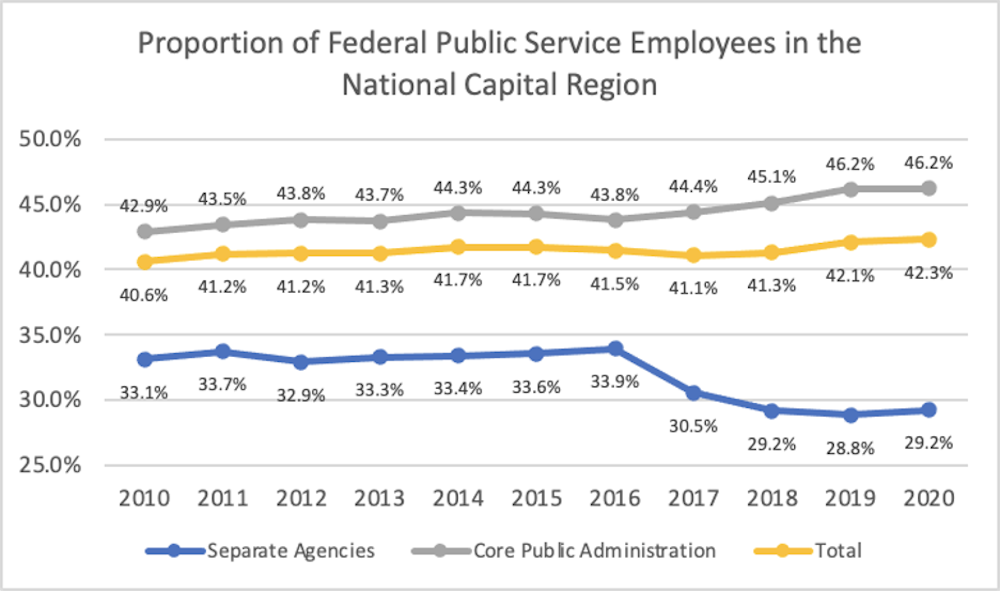
The proportion of agency jobs concentrated in the National Capital Region, which includes Ottawa-Gatineau and surrounding areas, has declined since 2016. The opposite is seen with CPA jobs. The concentration of CPA employees was only 33 per cent in 1995, but was up to 46 per cent in 2020. 

graph shows the number of federal public service jobs in the capital region
The number of federal public service jobs in the Ottawa region, according to the Government of Canada Open Data Portal. Treasury Board of Canada Secretariat, 2020

Most CPA workers are skilled knowledge workers. These are good jobs. It is time for more federal jobs, including CPA jobs, to decentralize.

The case for decentralization

Research suggests decentralizing public service jobs reduces costsstrengthens national security by spreading government functions across the country and reduces cynicism toward government

Decentralization also distributes the economic benefits of the public sector across the country. According to one 2019 British study, “the arrival of 10 civil service jobs in an area spurs the creation of about 11 jobs in the private sector,” including professional service jobs like law and consulting.

Most importantly, it gives federal governments more ability to directly engage with communities. Regional voices within government increase as career opportunities are more accessible to qualified people nationally. Advocacy and community groups across the country enjoy a more level playing field to engage in the policy process. 

This increased geographic diversity of voices working within and connecting with government can result in improved strategic policy advice. 

Creating a national strategy

Now is the perfect time to make a serious effort to decentralize Canada’s federal jobs.

The COVID-19 remote work experience demonstrates the remarkable potential of technology to overcome distance. We have learned how efficiently we can use technology to reduce unnecessary travel and connect easily across the country. We must use the disruption of the pandemic to rethink what jobs and services need to be in Ottawa at all.

We can expect growing calls for this in Canada’s economic recovery, particularly from Alberta. Just before the COVID-19 shutdown, four MPs identified the centralization of federal headquarters as an example of systemic unfairness towards Alberta. A few months later, Alberta’s Fair Deal Panel recommended western premiers request “a distribution map of federal civil servants across Canada and a list of federal government agencies and decision-making bodies that can be recommended for relocation to Western Canada.” 

Recent surveys find decentralizing jobs may be publicly popular. The 2021 Viewpoint Alberta survey, which included over 800 respondents in Alberta and Saskatchewan, found strong support for increasing federal jobs in each province.

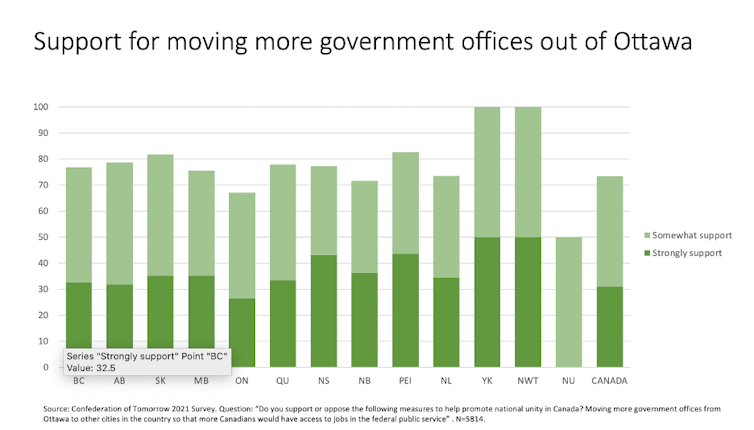
Similarly, the 2021 Confederation of Tomorrow survey of more than 5,800 Canadians found almost three-quarters (73.5 per cent) support “moving more government offices from Ottawa to other cities in the country so that more Canadians would have access to jobs in the federal public service.” 

A graph shows support for moving federal public service jobs out of the Ottawa area.
Support for moving federal public service jobs out of the Ottawa area. Confederation of Tomorrow 2021 Survey, Author provided

The time for action is now. In fact, Canada faces an immediate decision regarding the location of the new Canada Water Agency. While the decision process has yet to be announced, Regina and Sault Ste. Marie, Ont., are already vying for the agency headquarters. Other cities may also be planning to do so.

Canada already has experience in decentralizing federal jobs, including moving the National Energy Board headquarters from Ottawa to Calgary and creating regional Canada Revenue Agency tax centres. These serve as precedents for a bold new strategy.

Moving forward on a national strategy

To be sure, decentralization faces political challenges. As the benefits of job decentralization are long-term and the challenges are immediate, politicians more focused on the next election might be disinclined to take up the task.

Vested interests are loud. Strategies are needed to address relocation costs, including staff turnover and the associated loss of experience, though remote work options can reduce these.

A national strategy is required. The United Kingdom’s Places for Growth program will move thousands of London jobs, including policy advisory roles, to 13 regional hubs over the next decade and could provide ideas or a blueprint. 

Canada might also consider efforts to shift civil service work out of national capitals in Mexico, Norway, South Korea, Denmark and Malaysia

The COVID-19 remote work experience suggests that distance is not insurmountable for federal government work. No one is suggesting that public servants work from home forever, but the public’s business does not always have to be done in Ottawa. Let’s use this as an opportunity to rethink how we distribute federal work across Canada.

Source: https://theconversationcanada.cmail20.com/t/r-l-tlidhrg-kyldjlthkt-o/

Delacourt: Justin Trudeau isn’t fighting his father’s battles in Quebec. But maybe we should

Of note:

Justin Trudeau issued no statements on Thursday to mark the 41st anniversary of Quebec’s first referendum on sovereignty.

So the prime minister’s comments from earlier this week — on Quebec’s bid to unilaterally declare itself a nation in the Constitution — will have to stand as his remarks on how far Canada has travelled from that fateful moment on May 20, 1980.

“Our initial analysis …. (is) that it is perfectly legitimate for a province to modify the section of the Constitution that applies specifically to them and that that is something that they can do,” Trudeau told reporters on Tuesday.

There is no way to view those remarks in isolation from the signature battle of his father’s career, much as the current prime minister tends to resist the historical comparisons.

Forty-one years ago this week, Pierre Trudeau was soberly, cautiously celebrating the victory of federalism against the forces that wanted to make Quebec a separate nation, with words such as these:

“To those who may wish to recreate in this land those old nationalistic barriers between peoples — barriers of which the world has been trying to rid itself — I say, we Canadians do not have to repeat the mistakes of the past,” Pierre Trudeau said in a statement after 59.5 per cent of Quebec voted “no” to a bid to embark on separation from Canada.

“All of us have the opportunity to show the whole world that we are not the last colonials on earth, but rather among the first people to free themselves from the old world of nation-states.”

That old world has re-emerged in 2021 with a twist in the form of Quebec’s new language law, which has been presented — and disturbingly accepted by Trudeau and other political leaders — as a none-of-your-business bit of provincial housekeeping. Just keeping the French language alive, drive on, nothing to see here.

Source: Justin Trudeau isn’t fighting his father’s battles in Quebec. But maybe we should

Public servants say they work better from home, despite stress: survey

Interesting (on my to do list, look at the survey’s disaggregated data):

During the pandemic, employees of local, provincial, and federal governments from coast to coast to coast have provided essential services while working from home.

And it would appear that federal employees are happier now about their workplace than they were before the pandemic, according to the 2020 Public Service Employee Survey released by the Treasury Board Secretariat last week.

While we don’t know the full story of the “big pivot” over a single weekend in March 2020 — when public servants started working from home — we do know many have been working over weekends and statutory holidays and forgoing annual leave.

This isn’t sustainable over the long term. If not attended to, such behaviour could result in a crash or organizational failure.

Stress has increased since 2019. A third of employees said they felt emotionally drained after their workday, up from 29 per cent in 2019. Just over a quarter said their workload was heavier, up slightly from 24 per cent in 2019.

However, new questions in the 2020 survey about work-life balance during the pandemic revealed some silver linings:

  • 39 per cent of employees had requested flexible work hours since the start of the pandemic; and
  • 83 per cent said their immediate supervisor allowed them.

Employees said the quality of their work improved, too. For example:

  • only 23 per cent of employees said their work quality suffered because their department or agency lacked stability, which was down from 30 per cent in 2019; and
  • just 24 per cent of employees said their work suffered because of high staff turnover, down from 32 per cent in 2019.

Employees’ perceptions of change management also improved in 2020, with 59 per cent saying change was managed well in their department or agency, compared to 50 per cent in 2019.

They also reported better feedback from their supervisors in 2020, compared to 2019:

  • 69 per cent said they received meaningful recognition for work well done, up from 65 per cent in 2019; and
  • 77 per cent said they got useful feedback from their immediate supervisor about their job performance, up from 74 per cent in 2019.

Overall job satisfaction improved in 2020, too:

  • 83 per cent of employees said they liked their job, up from 81 per cent in 2019;
  • 78 per cent reported getting a sense of satisfaction from their work, up from 76 per cent in 2019;
  • 75 per cent said they were satisfied with their department or agency, up from 71 per cent in 2019;
  • 75 per cent said they would recommend their department or agency as a great place to work, up from 70 per cent in 2019; and
  • 71 per cent of employees said they felt valued at work, up from 68 per cent in 2019.

Respondents also felt their workplace was “psychologically” healthier. For example:

  • 68 per cent said their workplace was psychologically healthy, up from 61 per cent in 2019; and
  • 81 per cent said their department or agency was doing a good job of raising awareness of mental health in the workplace, up from 73 per cent in 2019.

In response to a new question in 2020, 69 per cent of employees said they’d feel comfortable sharing concerns about their mental health with their immediate supervisor.

The survey included new questions about working during the pandemic:

  • 70 per cent said senior managers were taking adequate steps to support their mental health during the pandemic;
  • 84 per cent felt their department or agency was effectively communicating the mental-health services and resources available to them; and
  • 81 per cent said they were satisfied with the measures their department or agency was taking to protect their physical health and safety during the pandemic.

Employees were also asked about the information they received from their department or agency about the pandemic:

  • 78 per cent said it was clear and easy to understand;
  • 81 per cent said it was consistent with the information they got from their immediate supervisor; and
  • 92 per cent said the information was available in both official languages.

And finally, instances of harassment also fell. In 2020, 11 per cent of employees said they’d been harassed on the job in the previous 12 months, down from 14 per cent in 2019. In addition, 71 per cent said their department or agency worked hard to create a workplace that prevents harassment, up from 69 per cent in 2019.

So while the pandemic isn’t over, public servants remain engaged. It would appear that working from home and away from the office has improved their view of the workplace and of their senior managers.

Stephen Van Dine is the senior vice-president of public governance at the Institute on Governance.

Source: Public servants say they work better from home, despite stress: survey

Sunshine lists have helped narrow the gender pay gap, but Ottawa won’t commit to one

While I understand the attractiveness of sunshine lists, I find this places too much emphasis on the individuals rather than systemic trends and gaps.

There is a wealth of government employment equity data for the four groups – women, visible minorities, Indigenous peoples and PwD – that can be disaggregated by occupational level. For example, an earlier analysis I did with TBS data:

While situations are different in universities, crown corporations and the like, where individual salary differences can be greater, in the federal public service it is the group and level that determine salaries, not individual negotiations. It would however, be useful for someone to request anonymized EX performance pay data to see if any significant gender and other differences:

The federal government does not release an annual “sunshine list” – a document outlining the name, compensation and often job title of its high-earning employees – unlike almost every province. And the Trudeau government has no plans to change this practice.

The Globe and Mail asked Treasury Board President Jean-Yves Duclos if the Liberals, who ran on a platform of government transparency and gender equity in 2015, would consider passing legislation on public-sector salary disclosure. Spokesman Martin Potvin replied that the board is “not currently working on any changes to how it reports” employee compensation.

This is despite years of feedback from equity advocates and researchers, who say sunshine laws have helped narrow the gender wage gap, as well as pressure from stakeholder groups concerned about a lack of transparency.

Beyond the issue of taxpayer accountability, sunshine laws around the country have revealed inequities in hiring practices, promotion and compensation.

For example, Anita Kozyrskyj, a professor in the department of pediatrics at the University of Alberta, was part of a group of female professors who used the university’s disclosure list to expose pay inequities within the faculty of medicine and dentistry. The academics found a $5,000 gender wage gap after accounting for factors such as rank and years of experience.

“[It] would not have been possible had we not had the sunshine list,” said Prof. Kozyrskyj, who learned she personally was making about $20,000 less than her equivalent male peers. (A similar report by academics at the University of Alberta used the sunshine list to reveal pay and representation gaps between men and women professors, as well as white and racialized faculty.)

Other research, such as a study from economists at the University of Toronto that examined the impact of sunshine laws on gender pay imbalances in academia, suggests disclosure leads to reduced inequities.

“The gender pay gap, in general, has been shrinking over time, and these laws have accounted for about 30 to 40 per cent of the closure since these laws were passed,” said one of the authors, Yosh Halberstam.

Universities that were unionized showed the clearest improvement, he added, suggesting progress requires both a mechanism to expose inequities, as well as a framework for staff to advocate for themselves.

Since January, The Globe has been publishing a series called the Power Gap, which looks at gender imbalances in the modern work force. By collecting sunshine lists from hundreds of employers across the country, the project produced an unprecedented look at where women stand within vital public institutions.

The data revealed how women’s careers are stalling out in mid-level management and how, on average, women made less than comparable male colleagues. But The Globe could not analyze federal employees, includingthose who work for the RCMP, public health, the Canada Revenue Agency or for federal Crown corporations – such as the Bank of Canada or Via Rail Canada – because the information is not available.

The Canadian Taxpayers Federation has been calling for Ottawa to introduce sunshine legislation for many years. “I think it’s a very simple transparency argument. There’s no reason that – if [almost] all the provinces are doing it, the federal government shouldn’t follow suit,” said Aaron Wudrick, the federal director of the organization.

The federation’s interest in the issue is centred around taxpayer accountability, which was then-premier Mike Harris’s motivation when his Progressive Conservative government passed Ontario’s sunshine law in 1996.

Other provinces followed suit over the past quarter century. Sunshine laws require government-owned or funded entities – such as schools and universities, Crown corporations, hospitals, the core public service and usually municipalities – to release data for all employees who earn more than a certain threshold, usually six figures. Today, every Canadian jurisdiction except Prince Edward Island, New Brunswick, the territories and the federal government requires some form of disclosure for top earners. (In Quebec, only senior managers are subject to compensation disclosure.)

These lists are not without controversy. Politically, they have been used to shame well-compensated civil servants. But in daily practice, they are a vital tool of information for women and other equity-seeking groups.

Lorna Turnbull, a feminist legal scholar and law professor at the University of Manitoba, has spent decades studying and writing about the legislative attempts from government to narrow the economic inequality between men and women. A common thread in her research has been that laws alone are not enough to protect against discrimination. For example, it’s been illegal for decades to pay equally qualified men and women different salaries for the same job because of their gender, but it still happens.

In 2011, she encountered her own real-life example. Prof. Turnbull competed for – and won – the position of dean in the faculty of law. She was to be the first woman to hold that position in the school’s nearly 100-year history. But when discussions turned to salary, Prof. Turnbull realized she was being offered less than her male predecessors.

“I was able to discover this because Manitoba has a sunshine list,” she said. Prof. Turnbull used intel from the disclosure list to negotiate a higher salary. She served as the university’s dean of law until 2016.

Prof. Turnbull said modern-day discrimination is very rarely the kind of overt, easy-to-spot bias that was typical decades ago when governments began passing anti-discrimination laws. Without access to the hard numbers, women and other marginalized groups might never know they’re not being properly paid.

Sarah Kaplan, director of the Institute for Gender and the Economy at the University of Toronto’s Rotman School of Management, said sunshine lists are not without drawbacks, but on the whole they are useful.

“The downside is that if you are on the sunshine list and you can see that others of your peers are paid more than you, it can be very demotivating. Often, there is little possibility to negotiate pay adjustments once you are in the job,” she said. “But over all, the transparency can increase pressure for long-term change, such as promoting more women to the higher-paying roles and paying women more fairly when they are hired.”

The most recent province to pass sunshine legislation is Newfoundland and Labrador, after efforts from former St. John’s Telegram reporter James McLeod.

In 2015, the Progressive Conservative government promised to introduce salary-disclosure legislation, but after it lost power, the Liberals were indecisive about doing the same, Mr. McLeod says.

“I thought, if the government won’t do a sunshine list, I’ll do it myself.”

Mr. McLeod filed freedom of information requests with large public agencies and the issue ultimately ended up in court. With public pressure building, the government passed sunshine legislation on its own in 2016. (Also, Mr. McLeod’s case won on appeal.)

Gordon Scott Campbell, an information and privacy lawyer at Aubry Campbell MacLean, said one advantage that Mr. McLeod’s case had is Newfoundland’s freedom of information legislation actually states the public is entitled to know a civil servant’s salary. The federal act, on the other hand, states the public is only entitled to a salary range. As a result, it would almost certainly require a legislative change to release specific salary amounts.

Mr. Campbell said there is always tension between access and privacy.

“Privacy legislation seeks to strongly protect Canadian privacy … access-to-information legislation seeks to broadly free government information,” he said. “I think most Canadians would support [both]. So it’s a balance.”

Source: https://www.theglobeandmail.com/canada/article-sunshine-lists-have-helped-narrow-the-gender-pay-gap-but-ottawa-wont/?utm_medium=email&utm_source=Morning%20Update&utm_content=2021-5-17_5&utm_term=Morning%20Update:%20Israel%20vows%20to%20continue%20attacks%20as%20ceasefire%20negotiations%20falter&utm_campaign=newsletter&cu_id=%2BTx9qGuxCF9REU6kNldjGJtpVUGIVB3Y

National security threats are changing, but Canada is mired in conventional thinking

Valid arguments:

An invisible virus borne on the air and reaching across continents and oceans, moving freely among people, disrespecting borders and ideas of state sovereignty, will mark the most profound shake-up of thinking about national security since the beginning of the atomic age in 1945.

We have entered an era in which national security is not just about protecting the state against adversaries, but also against dangers that have a direct impact on the daily lives of people.

The vectors of these threats are new and different — they don’t present the menacing face of armies and war, the shadowy artifice of the traditional spy, or the low-tech threat of terrorism. The new threats come at us straight out of our digital environment and are unleashed out of the natural world.

Digitally enabled threats take aim at precious resources — our data, our economy, our research — and the fundamentals of our democracy. They rob us and bend the truth, and as more of our economy is digitally enabled it is capable of being digitally disabled.

Natural hazards from climate change and the globalized spread of serious infectious diseases threaten livelihoods and lives across the country.

Thinking about national security in Canada has long been the preserve of small cadres of federal government officials and even smaller elements of civil society, each profoundly disconnected from the other. It’s not a subject taught much at our colleges and universities, from which future generations of leaders emerge as innocents. National security has rarely penetrated public debate, hardly ever featured in election campaigns, and only spasmodically seized the headlines — usually in moments of scandal.

In the new environment in which we live, that must change.

Government, political parties, and civil society must all pivot to a new understanding of what national security means and how threats are expected to be met.

We have, in Canada, a long way to go to embrace this new and disquieting understanding of national security, yet our collective future depends on it.

The distance we have to go was on display recently in two reports tabled in Parliament.

One was presented by the National Security and Intelligence Committee of Parliamentarians (NSICOP), a cornerstone of the Liberal government’s efforts to create a much stronger system of review for our security agencies. NSICOP devoted the entirety of its 2020 annual report to an analysis of the national security threats facing Canada.

This was a laudable endeavour, but one mired in conventional thinking. It failed to be sufficiently forward looking, and the committee limited itself to a discussion of five threats:

  1. Terrorism
  2. Espionage and foreign interference
  3. Malicious cyber activities
  4. Major organized crime
  5. Weapons of mass destruction

All of these are undoubtedly threats, but look hard at this list and you see the conceptual problems.

To give priority of place to terrorism threats is legacy thinking. Espionage and foreign interference are distinct problems, not to be mashed together. Organized crime comes into the national security picture only in very specific manifestations.

More problematic by far is what is missing: pandemic and biosecurity threats, climate change security impacts, and economic security. Precisely the issues that matter most to Canadians, the ones that have the greatest impact on their daily lives, were absent from the frame.

The Canadian Security Intelligence Service (CSIS), in its annual public report for 2020, did better. It is clear from the report that CSIS is seized by threats to Canada’s economic security, including those that emerged to the bio-pharma sector during the early months of COVID-19.

Likewise, troubling state-sponsored disinformation campaigns are now on the CSIS radar. Counterintelligence, long a pillar of CSIS operations, is now focused beyond espionage on foreign interference operations.

The CSIS mandate places it squarely in the fight against violent extremism, but unlike the National Security and Intelligence Committee of Parliamentarians, CSIS does not make this the top item in its picture of the threat environment.

And CSIS is working alongside the Communications Security Establishment in trying to understand and counter cyber threats.

However, the CSIS picture of the threat environment is necessarily geared to its lawful mandate. It doesn’t have a pandemic security mission writ large, or a climate change security mandate.

To embrace those missions properly will require new thinking and new ways of organizing our national security apparatus.

When it comes to national security, the past is not prologue. The present is moving fast and the future is hard to get a grip on. But here is a prediction: the comfortable and time-honoured habit of treating national security as far-removed from the general public discourse, of erasing it from politics, is over.

The 2015 federal election in which the Conservatives stumbled over opposition to their anti-terrorism legislation was but a small foreshadowing of a much larger debate over how to live safely, prosperously and democratically in a new age.

The next federal election campaign will be one in which all parties will have to prepare coherent and plausible visions of national security, and argue them in public in the interests of all Canadians.

Source: National security threats are changing, but Canada is mired in conventional thinking

How one federal agency broke free of outdated IT infrastructure

While written a bit too much as a puff piece, an interesting and relevant example of modernization (some of these remind me of my time in the early days of Service Canada and IT infrastructure renewal, where of course the issues were on a much larger scale and higher risk for CPP and EI):

The COVID-19 pandemic has laid bare the need for modern, agile IT systems as both the public and private sectors grapple with a suddenly remote workforce. Cloud platforms are the backbone of modern IT infrastructure, providing scalability, speed, and remote access, and are secure without the expense of physical infrastructure. Yet less than 10 per cent of federal departments have transferred some of their operations to a cloud platform. Part of this is because the pandemic diverted focus, but it is also due to fear of the unknown and uncertainty over security benefits and procurement rules.

Had the pandemic struck five years earlier, Canada Mortgage and Housing Corporation (CMHC) would have been crippled by its lagging IT infrastructure. Instead, CMHC’s operations continued without missing a step – even supporting the government’s pandemic response by rolling out critical economic support with record speed, such as the Canada Emergency Commercial Rent Assistance for small businesses and the Insured Mortgage Purchase Program to support the financial system.

CMHC’s partnership approach to transforming its IT infrastructure can serve as a model for other federal departments. CMHC and Accenture, a global professional services company, came together five years ago to move CMHC’s outdated and siloed systems to a robust digital service platform.

Back in 2016, CMHC relied on close to 1,000 separate software applications, many of which were customized and hard to maintain. From operations and insurance underwriting to applications for program funding and accounting, every structure had its own siloed system.

Technology was a source of frustration. Twenty-three per cent of CMHC employees rated it their number one barrier, and one in six employees spent their time trying to find data.

Today, those systems have been replaced with enterprise platforms that have automated manual tasks, sped up processing times and offer real-time data to support better decision-making. This endeavour was no small feat. Finding the right partner and doing a thorough analysis of the scope of the challenge took over a year.

Together as CMHC’s deputy chief information officer and Accenture’s federal government practice lead, we helped execute a project that took place over several years and involved hundreds of employees from both organizations. Ultimately, we found that how we implemented the technology was just as important as the technologies we invested in. Sometimes it was even more important.

Here are five key lessons learned that we believe can help other departments successfully approach digital innovation:

1. Leadership buy-in is crucial

The journey for the project – called CMHC in Motion – began under CMHC’s president and leadership team with the goal of becoming a more agile, focused and efficient company with a culture of accountability.

CMHC modernized its organizational structure and focused on communication and training to manage risk, change and execution and to encourage innovation. Fixing technology was the next step.

The leadership team ensured the building blocks were in place for technology and business transformation. Program funding and resources were made available to drive this three-year transformation and its evolution for years to come.

The CIO role was elevated. Now the CIO sits on CMHC’s executive committee and is positioned to influence decisions that affect all parts of the company. Digital and technological thinking need to be able to influence business strategy rather than being made to fit into strategy that is already set. The two need to evolve hand-in-hand.

2. Innovative solutions require innovative approaches

It was clear from the start that the traditional procurement route of a complicated and time-consuming request-for-proposal process would be an obstacle for the project. Inviting potential partners to analyze the scale of the problem was critical to finding not only the right partner but also the right solutions. For three months, two potential partners were given access to CMHC’s infrastructure and systems to fully assess the scale of the situation they would face. More importantly, it allowed CMHC to leverage the experience of external experts in defining the solution. Incorporating this into the proposal process allowed for a broader, more robust and feasible path forward.

When CMHC and Accenture came together there was already an understanding of the challenges and potential solutions, and the project team was able to move straight to planning implementation.

3. A true partnership and governance structure is vital

From day one, CMHC wanted a partner. The vision was an arrangement where both parties shared in the benefits and risks and would collaborate on challenges. Given the complexity and timelines of the project, it was impossible to predict where the work would lead, what outcomes and technologies would be needed or even be available. A risk-sharing fund positioned both parties to carefully consider potential project variances and cost overruns, and both parties came together to solve emerging needs and to consider any potential changes to the scope of work.

Agreeing up front to share in the financial risk is not the norm for public sector transformation projects, but it eliminated years of delay as we avoided time-consuming project scoping, trying to describe the perfect solution. It meant that CMHC was not dictating a solution, but rather defining the problem and getting fresh outside perspectives on how to address it through a cohesive joint team.

Managing outsourcing relationships isn’t easy, so CMHC created a partner relationship management team. Three levels of governance are used at CMHC. It starts at the highest level, with the executive team, then flows to the management and operational governance structures. On a bi-weekly basis CMHC and Accenture Canada’s CEOs met to discuss program performance, relationship status and planning. Five years after the contract was signed, these meetings still take place.

4. Commit to an uncharted path

A multi-year transformation will not follow a straight path. Innovative, agile organizations need to be open to imperfection and experimentation. Innovation requires an acceptance that not all ideas work, and that getting out of planning mode and into testing mode happens so we can learn, adapt and move forward. Progress over perfection and timeliness was important, and we made risk-based decisions to move quickly.

For CMHC, technology was also used to help drive a change in culture around risk-taking, speed and being ok with failure. For CMHC and Accenture, there was an understanding that immediate answers would not always be available, especially with rapid advances in technology. This enabled the delivery team to take risks and push forward at a quicker pace, knowing that it was ok to fail fast to avoid the lengthy detours of searching for the “perfect” solution.

Along the journey, unforeseen events – like the introduction of the National Housing Strategy in 2017 and the COVID-19 pandemic – required significant changes to plans and priorities. CMHC was able to adapt, demonstrating that with the right culture and committed senior leadership, organizations can become resilient and better equipped to respond to unexpected changes in their business environment.

5. Create a feedback loop to guide the pace of change

Engaged and enabled employees can make or break transformative IT projects. Change management is often the first thing to cut when an organization is trying to save its resources, yet it is one of the areas we found to be critical. Continuous dialogue and check-ins through surveys and consultations ensured employees believed in the transformation and had the skills and confidence to adopt transformed business approaches. It is essential to communicate early and often to employees in a transparent and simple way.

To get early buy-in from employees and to show our commitment to making this transformation work, the first project we tackled was the one with the biggest positive impact for our employees – moving off Lotus Notes email to Outlook and Skype. The success of this implementation was instrumental in gaining buy-in from employees and made the transformation real for them.

We were cognizant of the massive cultural shift we were asking employees to make. Their entire technological world was being altered, from a new email platform and filing systems, to a client relationship management system, invoicing and how they manage client requests. We developed a “heat map” to identify which areas of CMHC were undergoing the most change. With the map and employee feedback, we were able to adjust our approach and ease up where the pace of change was too intense. We worked alongside senior management and human resources to continuously evaluate progress and identify areas that needed more training or support.

Moving forward

We find ourselves at an exciting time, where rapid innovation in technology has the potential to drastically change the way we develop and deliver public programs and policy. Over the past few years, technology companies have improved the ease of use, security, scale and interoperability of their offerings. The flexibility and cost-effectiveness of cloud services are undeniable.

The pandemic has highlighted the need for agility in our IT infrastructure. As Canadians look to all levels of government to lead them through these unprecedented times, they have seen the tangible results of government in action to keep them safe, provide them with financial support and navigate the road to economic recovery. Now is the time to build a better, more resilient IT environment for our public sector, one that will allow us to weather storms and continue to provide Canadians with world-class government services.

Source: How one federal agency broke free of outdated IT infrastructure