USA: White Supremacy Beyond a White Majority

Quite a contrast with Canadian judicial appointments, currently over 50 percent women under the current government, about one-third under the previous Conservative government and the 80 percent males judges appointed under Trump.

Can only foreshadow further divergence between Canadian and US jurisprudence and representation:

The white male racist patriarchy will not be denied. It is having a moment. It has its own president.

According to a Pew Research Center analysis of race/ethnicity and sex among validated voters in the 2016 presidential election, white men were the only group in which a majority voted for Donald Trump — 62 percent — although a plurality of white women did also — 47 percent.

We are living through a flagrant display of a white male exertion of power, authority and privilege, a demonstration meant to underscore that they will forcefully fight any momentum toward demographic displacement, no matter how inevitable the math.

The fear of white male displacement is a powerful psychological motivator and keeps Trump’s base animated and active.

It keeps farmers holding out hope and making excuses for him, even as his trade war devastates their operations. It keeps coal country loyal, even as the promises of a revitalized coal industry ring hollow. It keeps white voters in the rust belt on the edge of their seats, waiting for the day that he will magically bring back manufacturing. It keeps white voters in the South heated over the issue of immigration and an “invasion” or “infestation” of Latin Americans.

Trump’s central promise as a politician has been the elevation, protection and promotion of whiteness, particularly white men who fear demographic changes and loss of status and privilege.

As Vox reported in 2017, white people of all ideologies, including liberals, become more conservative when confronted with the reality that a rising minority population means a loss of white dominance.

As the psychologist Jonathan Haidt recently told Vox:

“As multiculturalism is emphasized more and more, there emerges a reaction against it on the right, which is attractive to the authoritarian mind and also appeals to other conservatives. And this, I think, is what has happened, this is what Trump is about — not entirely, of course, but certainly this is a big factor.”

It is about stacking the courts, controlling the bodies of women (look no further than the raft of state abortion restrictions recently passed, including the outrageous new abortion law in Alabama), fighting the redefinition of gender as personified by the advances in liberty among people who are transgender, restricting the voting of nonwhite, less conservative groups, and controlling the flow of migrants into the country who do not bolster the white population.

While much of the country tries to contend with the unending stream of outrages in the White House, the Senate majority leader is pushing through a steady stream of Trump’s far-right federal judges, often breaking precedent and allowing for their confirmations over their home state’s senators’ objection.

The recent confirmation of Joseph Bianco to the U.S. Court of Appeals for the Second Circuit, based in New York, was Trump’s 38th confirmed circuit court judge, HuffPost reported last week, adding:

“That’s more circuit judges than any president has gotten by this point in a first term, and means that one in every six seats on the nation’s circuit courts is now filled by a Trump nominee.”

These are lifetime appointments. Even if demographics change over one’s lifetime, these judges will not.

As a recent Congressional Research Service report pointed out, 90 percent of Trump’s circuit court nominees have been white and 92 percent of those confirmed have been white. Among recent presidents, only Ronald Reagan — who opposed making Martin Luther King Jr. Day a federal holiday, but eventually reversed himself, and who vetoedthe Comprehensive Apartheid Act, which, with a congressional override, leveled sanctions against South Africa for its oppressive racist social architecture — appointed and confirmed a higher percentage of white judges.

Eighty percent of Trump’s judicial nominees have been men, and men have been 74 percent of those confirmed.

None of this can fully prevent change, but it can slow it.

The strategy is to find a way to maintain white supremacy, white dominance, without the necessity of a white majority in the U.S. population.

The point is that once white people become a minority in America, the country itself will move from a majority rule ideal to a minority rule one.

ICYMI: Canada hoping U.S. gets on board as it moves to update gender info on NEXUS cards

Interesting to watch in current US administration context:

Canada’s border agency is about to shake up the way it tracks sex and gender information — which could lead to some awkward conversations with Washington.

For the past two years, the federal government has been looking into how to introduce a third gender identifier across federal departments — something beyond checking off “male” or “female” on a form.

The new plan includes displaying gender information (how someone identifies) instead of sex information (biological characteristics) unless absolutely necessary, says an interim report prepared for the clerk of the Privy Council, a copy of which was obtained under access to information.

The draft plan encourages departments to offer M, F and X as identifiers.

It also says the policy overhaul would affect the NEXUS card, a program shared by the U.S. and Canada to help speed up border crossing for frequent, low-risk travellers.

However, changing the card will require negotiations with the Trump administration, which recently banned most transgender people from serving in its military.

Apart from the NEXUS card, the Canada Border Services Agency also issues ID cards for the Fast and Secure Trade Program (FAST) and corporate pilots.

CBSA spokesperson Rebecca Purdy said the department can’t force another country to follow its rules.

“As each of our domestic and international relationships are different (bilaterally and multilaterally), and we cannot impose our policies upon our partners, the CBSA will work to inform them of this government of Canada policy shift and hopefully reach a satisfactory solution wherever possible that respects Canadian laws and values,” she said in an email to CBC.

Frontline training needed

Helen Kennedy is the executive director of Egale Canada, a national LGBT advocacy group. She’s urging the government to put up a good fight with the Americans.

“I don’t think that we can be compromising our human rights, values and principles to accommodate anybody, quite frankly, regardless of who’s in the White House. I do know that there are a lot of governments around the world that are hostile, not just the U.S.,” she said.

“I would anticipate and hope that Canada would stand its ground and push for a more inclusive way of travelling for anybody who identifies as non-binary or trans, or whose gender expression doesn’t match the marker on their passport.”

Kennedy said the policy shift needs to come with training for those on the frontlines.

“It is incredibly stressful for trans and non-binary folk, and for people whose gender expression may not reflect the markers on their passports, to travel anywhere. I think that it’s a good initiative, but we also need to be aware of some of the complications that it brings with it,” she said.

“If we don’t provide the education and training to the folks who are reviewing these documents … if they don’t understand, if they don’t have the language, if they’re not comfortable or familiar with what an X marker can actually mean, then it can be very stressful for the traveller.”

The PCO report says a policy update also would bring the federal government in line with provinces that have made changes already. For example, people in Ontario and Alberta can choose an “X” identifier on their drivers’ licences.

Kennedy said she’d prefer if there were no gender markers at all, but supports the shift.

Immigration, Refugees and Citizenship Canada (IRCC) already has started down this path.

Gender ‘unspecified’

In 2017 it announced plans to offer a third option for Canadians to identify themselves on a passport. In the interim, people can ask that a free observation sticker be added to their passport or travel document that reads: “The sex of the bearer should read as ‘X,’ indicating that it is unspecified.”

IRCC said it doesn’t know how many Canadian travellers have been refused entry to foreign countries because of their gender identity.

“Before booking, travellers are advised to check with all the countries they are planning to visit or transit through so they can be aware of entry requirements that may affect them,” said a spokesperson in an email.

The PCO report said implementation of the new gender identifier policy could take years and would have significant financial and operational impacts.

It’s not clear when federal forms will be changed officially, but former clerk of the Privy Council Michael Wernick, whose last day on the job was Wednesday, has said he’s in favour of the current policy direction.

“Given domestic and international movement on this issue, it is clear that the government of Canada must be engaged and must coordinate action to respond at the federal level,” he wrote in a letter to the Treasury Board, also obtained by CBC.

The federal policy change also would affect military IDs, permanent resident and Indian Status cards, work permits, firearm licences and police record check letters.

Source: Canada hoping U.S. gets on board as it moves to update gender info on NEXUS cards

Why Jason Kenney’s workaholic style may not work when he’s premier [diversity numbers]

The numbers:

I pointed out on Twitter that Kenney’s UCP caucus contains a record-setting five Jasons. Yet, this change of government does bring in more ethnic diversity to Alberta’s legislature, as the NDP previously struggled to recruit non-white candidates. The new MLAs include 16 visible minority candidates (five NDP, 11 UCP) up from 10 elected overall in 2015. Say what you will about the racists who were exposed in the UCP ranks throughout this long campaign—and please do, it’s an important discussion—but Kenney has clearly brought with him from Ottawa an aptitude for bringing multicultural leaders and activists into the Conservative fold.

This legislature will have one openly LGBTQ member—rookie New Democrat Janis Irwin in Edmonton—down from three in the previous term. There was nobody from the community running as a UCP candidate. Should Edmonton–West Henday flip to Williams, who self-identifies at Métis, she will be the lone Indigenous MLA.

While Canada now has no female premiers for the first time in more than a decade, the legislature’s gender makeup didn’t suffer tremendously. There stands to be 26 or 27 female MLAs, just behind the record of 28 set last election—still far from parity in the 87-seat assembly.

Source: Why Jason Kenney’s workaholic style may not work when he’s premier

Taking stock of Ottawa’s diversity promises

My latest in Policy Options:


Each of the mandate letters given to cabinet ministers by Prime Minister Justin Trudeau over the past three years has included the following commitment: “You are expected to do your part to fulfill our government’s commitment to transparent, merit-based appointments, to help ensure gender parity and that Indigenous Canadians and minority groups are better reflected in positions of leadership.”

With three years of appointments under the Trudeau government’s belt, it’s possible to conduct an analysis of its record with respect to judicial, Governor-in-Council, deputy minister, head of mission and Senate appointments, using available data and public records.

The government has largely delivered on its commitment, but with mixed results on its promise to be more transparent on appointments…
Full article: Taking stock of Ottawa’s diversity promises

Nepal is among 25 countries that deny women right to pass on citizenship to children independently

Good reference list:

In Nepal while there is a debate ongoing over whether to grant the women the right to confer citizenship to their children without any exception and limitation. South Asia Check has examined the citizenship laws and gender equality in the global context.

According to a survey report on Gender Equality, Nationality Laws and Stateless 2018 prepared by the Office of the United Nations High Commissioner for Refugees (UNHCR), equality between men and women relating to conferral of nationality upon children has not yet been attained in 25 countries. The majority of these states are in the Middle East and North Africa (twelve countries) and Sub Saharan Africa (six countries). In Asia and the Pacific there are five countries and in the Americas two countries that do not grant mothers equal rights as fathers to confer their nationality on their children. It is important to note that an additional group of states grants equality to men and women with regard to the nationality of children but not with regard to acquisition, change or retention of nationality upon change in civil status.

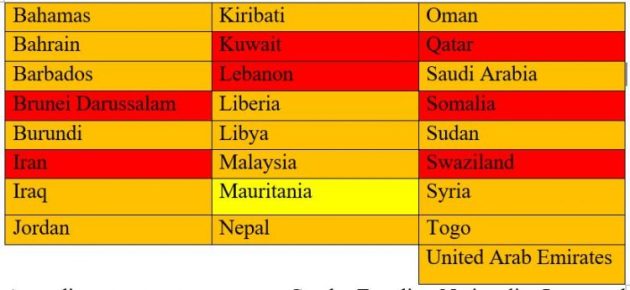
The classification of countries that limits women to confer nationality to their children

The table below uses a color scheme to divide the laws of the 25 countries into three categories. The laws of the first group of countries (red) have nationality laws which do not allow mothers to confer their nationality on their children with no, or very limited exceptions. These laws create the greatest risk of statelessness. The laws of the second group of countries (orange) have made some exceptions for mothers to confer nationality if the father is unknown or stateless. The laws of the third group of countries (yellow) also limit the conferral of nationality by women but additional guarantees ensure that statelessness will only arise in very few circumstances.

Table: Courtesy of UNHCR report

The law in Qatar doesn’t allow mothers to confer nationality on their children, without exception. According to the law of Kuwait, if a Kuwaiti mother has a child with a father who is unknown or whose paternity has not been established, the individual concerned may apply for Kuwaiti citizenship at majority. In such cases, nationality is granted by decree based on the discretionary recommendation of the Minister of Interior. However, this is an extraordinary measure that occurs rarely in practice.

The nationality law of Lebanon also allows only Lebanese fathers to confer their nationality on their children in all circumstances. Women can only confer their citizenship if the child is born out of marriage and recognized while a minor by the Lebanese mother.

The nationality laws of Jordan, Libya, Saudi Arabia and the United Arab Emirates do not allow women nationals married to foreign nationals to pass their nationality to their children. However, they do permit women nationals to confer their nationality on their children in certain circumstances such as where fathers are unknown, stateless, of unknown nationality or do not establish filiation.

In Iraq, although the Iraqi Constitution of 2005 establishes gender equality by providing that nationality is acquired by descent from either men or women, Iraq’s 2006 nationality law limits the ability of Iraqi women to confer nationality on children born outside the country. For such births, the child of an Iraqi mother may apply for Iraqi nationality within one year of reaching majority, providing that the child’s father is unknown or stateless and the child is residing in Iraq at the time of the application.

According to the nationality law of Syria, mothers can only confer nationality if the child was born in Syria and the father does not establish filiation in relation to the child. The law of Bahrain allows mothers to confer their nationality on their children born either in their home countries or abroad if the fathers are unknown or stateless. Under the law of Oman, mothers confer nationality on their children born either in their home countries or abroad if the fathers are unknown or are former Omani nationals.

In Mauritania, mothers can confer nationality on children when the father is unknown or stateless. Children born in Mauritania to Mauritanian mothers and foreign fathers, or to mothers who were born in Mauritania themselves, also acquire Mauritanian nationality. Children born abroad to Mauritanian mothers and foreign fathers can opt for Mauritanian nationality in the year before majority.

The laws of Somalia and Swaziland do not allow mothers to confer their citizenship on their children under the same conditions as fathers. Under the 1962 Somali Citizenship Law, only children of Somali fathers acquire Somali citizenship. Swaziland’s Constitution of 2005 stipulates that any child born inside or outside Swaziland prior to 2005 to at least one Swazi parent acquires Swazi citizenship by descent. However, children born after 2005 only acquire Swazi citizenship from their fathers, unless the child was born out of wedlock and has not been claimed by the father in accordance with customary law.

In Burundi, the 2000 Nationality Code does not allow mothers to transfer nationality to children except when maternal filiation is established when they are born out of wedlock to unknown fathers or if disowned by their fathers.

In Liberia, the Aliens and Nationality Law of 1973 allows children born in Liberia to acquire Liberian citizenship at birth. Children born abroad to Liberian mothers, however, are excluded from acquiring Liberian citizenship. In case of Togo, the 1978 nationality grants citizenship to children born in its territory who cannot claim the nationality of another state, it only allow mothers to confer their nationality on their children if the father is stateless or of unknown nationality.

In Sudan the amended law in 2005 allows a child born to a Sudanese mother to acquire Sudanese nationality by birth by following an application process.

In Brunei Darussalam and Iran, only fathers can confer their respective nationalities on their children in all circumstances.

In Kiribati, children born in the country to an i-Kiribati father or mother can acquire nationality of Kiribati; however, only children born abroad to i-Kiribati fathers, not mothers, acquire the nationality of Kiribati. In Malaysia, children born in the country to either Malaysian mothers or Malaysian fathers automatically acquire Malaysian nationality. But children born to Malaysian mothers outside of Malaysia may only acquire Malaysian citizenship at the discretion of the Federal Government through registration at an overseas Malaysian consulate or at the National Registration Department in Malaysia.

In Nepal, children born to Nepali fathers acquire Nepali citizenship in all circumstances. Children born in Nepal to Nepali mothers and foreign fathers can apply to acquire citizenship through naturalization, provided they have permanent domicile in Nepal and have not acquired the foreign citizenship of their fathers.

In The Bahamas, children born in the country to either a Bahamian father or mother acquire Bahamian nationality; however, only children born abroad to Bahamian fathers, not mothers, can acquire Bahamian nationality. The same applies in Barbados, where children born in Barbados to either Barbadian mothers or fathers acquire Barbadian nationality, but Barbadian mothers cannot confer nationality on their children born abroad, whereas Barbadian fathers can.

Source: Nepal is among 25 countries that deny women right to pass on citizenship to children independently

Saudi Kingdom Tries To Prevent More Women From Fleeing

Not surprising:

After an 18-year-old Saudi woman, who said she feared death if deported to Saudi Arabia, arrived in Canada, she directed some of her first public commentsback home. Rahaf Mohammed Alqunun encouraged other women to flee family abuse and the oppressive controls imposed on them by the conservative kingdom.

She has just showed them how to do it.

Alqunun was offered asylum in Canada in January after she barricaded herself in a Bangkok hotel room, from where she mounted a sophisticated social media campaign that sparked international headlines and sympathy.

But in Saudi Arabia, Alqunun’s successful escape from a prominent family spurred harsh media attacks and a social media narrative accusing Western nations of using Saudi women to undermine the kingdom. Still, the domestic campaign is unlikely to deter other young women from fleeing the kingdom, say activists who are in touch with women planning to run.

The high-profile story is “going to set off copycat scenarios,” says Bessma Momani, a Middle East specialist at Canada’s University of Waterloo. “I think women will feel more emboldened.”

She explains that Alqunun’s story has provided a virtual road map for others and revealed a network of groups willing to work out logistics and offer escape strategies. “Rahaf’s story showed there is a quasi-organized group that is willing to help,” Momani says.

Alqunun’s asylum in Canada comes as Saudi Arabia’s Crown Prince Mohammed bin Salman, often referred to as MBS, portrays himself as the leader who is steering the country toward a more secular modernity.

Movie theaters have reopened. Saudi women can now drive cars and attend sports events. The kingdom says it has made it easier for women to enter the workplace.

“Any way you slice it, MBS has done more change than anyone in the last 50 years,” says Ali Shihabi, who heads the Arabia Foundation, a pro-Saudi think tank in Washington, D.C. Reform is “an art rather than a science,” he says, “and being an art, there are going to be mistakes. He can’t let the snowball get too big.”

The crown prince is also behind a harsh crackdown on political dissent. That includes jailing more than a dozen women’s rights activists who were vocally pushing for an end to Saudi Arabia’s guardianship system, which allows male relatives to control most aspects of a woman’s life.

“When MBS came, he made it clear: ‘You either listen to me, or you go to jail,’ ” says Yasmine Farouk, a visiting scholar in the Middle East Program at the Carnegie Endowment for International Peace in Washington.

“He is that much of a dictator that he is able to impose measures that other kings were too scared to impose on society. We are talking about a regime that wants to do everything under its control.”

But the growing number of Saudis seeking refuge abroad undermines Prince Mohammed’s international image as a leader bringing new personal freedoms to the kingdom, says 30-year-old Samah Damanhoori. She was granted asylum in the United States last year after she accused her family of abuse and declared she was no longer a Muslim.

“OK, we are going to let you drive — happy now? Stop running away,” she says, to explain her views on reforms introduced by Prince Mohammed. “But more women are running away. We have to do that to get them full rights.”

In Saudi Arabia, men wield vast powers over women. The guardianship system gives male relatives control over women’s travel, education, medical treatment and marriage. An app called Absher allows Saudi men to specify when and where a woman can travel. The service includes a message alert when a woman uses her passport at an airport or a border crossing.

Fleeing even an abusive home is a crime. If caught, a woman can be jailed or housed in a government-run shelter until her guardian permits her release.

Alqunun’s success was a “huge shake,” Damanhoori says, because she comes from a prominent family, the daughter of a powerful governor.

“The more powerful the family, the harder for a woman to escape, because of family connections. But she made it.”

Alqunun’s family status may explain why the Saudi government has ramped up a campaign to stem the flow. In recent weeks, the General Department for Counter Extremism released an online video as a warning. The animated message compares women who flee the country to young men who join terrorist groups — and blames a vast international conspiracy that it says is aiming to damage the kingdom’s image through its youth.

“Everyone who tried to escape, they compare her with ISIS — it’s horrible,” complains Damanhoori.

“This is not going to end,” says Hala Aldosari, a Saudi activist and writer based in New York. “It will get worse.”

Aldosari says the government blames “agents of the West” and “women activists” as the culprits of the alleged global plot to destabilize Saudi Arabia, “rather than the grievance of the women.” She says the common denominator among those trying to flee is that they are “women who come from controlling or abusive families” and who believe that running is the only way to survive.

The rise of social media has opened a window for people to compare Saudi women’s rights with women’s rights in other Gulf nations. “Saudi women are now more aware of the restriction they live with, and they take higher risks to escape,” Aldosari says.

Reliable statistics in Saudi Arabia on these escapes are hard to find. Some families don’t report a missing daughter for fear of social stigma in a society where a family’s honor is tied to the behavior of women.

Figures on Saudi asylum-seekers abroad, however, are known to have increased. Saudis made 815 asylum claims worldwide in 2017, compared with 195 in 2012, according to the latest tallies published in the United Nations Refugee Agency’s database. Their destinations include the U.S., Canada, Germany, Sweden, the U.K. and Australia.

In 2011, Manal al-Sharif was jailed for nine days in Saudi Arabia for protesting driving restrictions. Her activism cost her the custody of her son, she says. Now she is living in self-imposed exile in Sydney.

“These proclaimed reforms are just refurbishing a huge cage,” al-Sharif says of the changes in Saudi Arabia. “We can’t run a country when half of it is depending on the other half.”

But inside the kingdom, the crown prince is largely viewed as trying to change that equation, says Farouk at Carnegie. “It really is a paradox. It’s the strong man who is able to impose reforms without being afraid of the consequences.”

But Saudi officials know the consequences of the continued flight of women. That undermines the international message that Saudi Arabia is modernizing and that Prince Mohammed has opened a new era of freedoms.

Alqunun’s father, who is a governor, released a statement in January saying that the family had disowned the runaway and calling her “the mentally unstable daughter who has displayed insulting and disgraceful behavior.” That prompted the 18-year-old to drop her family name, she told reporters.

Her father reportedly denied physically abusing her or trying to force her into marriage, according to The Associated Press.

So far, Farouk says, the domestic response, even among women, is to condemn Alqunun’s escape as reckless.

“They don’t care,” Farouk says. “Things have changed in their daily life: They can drive to work, they can go to concerts, play sports. As long as their daily life has been made easier, why care about politics?”

But there is still a limit to personal freedoms. “They will care when they try to contest a policy at work,” she says. “They will be jailed or interrogated, or their fathers will have to get them out of the police station. They will care, but it will take time.”

Source: Saudi Kingdom Tries To Prevent More Women From Fleeing

Tolley: Racialized and women politicians still get different news treatment

I am a great fan of Erin Tolley’s work. Some good words of advice to journalists covering politics and other spheres:

In the days after Jody Wilson-Raybould’s resignation from federal cabinet, reportssuggested she was difficult, not a team player, and even “mean.” Supportersdenounced this framing and pointed to its gendered and racialized undertones, a criticism with which the prime minister eventually agreed. Even so, media coverage came complete with editorial cartoons depicting Wilson-Raybould bound, gagged and beaten. Although the cartoons were largely condemned, some commentators derided the critics as overly sensitive, while of one of the cartoonists blamed faux-outrage and virtue-signalling.

As the days wore on, a caucus colleague suggested that Wilson-Raybould couldn’t handle the pressure of her cabinet position. Others argued that the evident cabinet discord is a predictable outcome of the government’s focus on “identity politics,” with one columnistsaying the prime minister had “been hoisted by his own petard.”

The media and political institutions have both edged toward more inclusivity, but women and racialized minorities remain, as former journalist Vivian Smith has put it, “outsiders still.” This outsider status partly reflects basic demographics: Parliament, newsroomsand the parliamentary press gallery are still mostly made up of white men. But it is also indicative of the ways that race and gender structure politics.

I have researched news coverage and found systemic differences in the ways white and racialized politicians are covered by journalists. Similar patterns exist in media coverage of women in politics. As I point out in my 2016 book, Framed: Media and the Coverage of Race in Canadian Politics, these patterns are longstanding, so as the 2019 federal election campaign kicks into high gear, we are likely to see more of the same.

Racialized candidates’ coverage is as plentiful but more negative than that of white candidates. Their coverage focuses less on politically salient issues and is more likely to mention aspects of the candidate’s background like their race, immigration status or religion than is the case for white candidates. Racialized candidates are less likely to be quoted and more likely to be featured in stories that are buried on the inside pages of print editions. These patterns give racialized candidates less visibility and credibility.

Race influences how journalists decide to frame and portray their subjects. This type of coverage cues voters to apply racial considerations to their evaluations of politicians. It is grounded in assumptions about the meaning, importance and consequences of race. One aspect of this process is to assume that race is only relevant to subjects with minority racial backgrounds. Because of this, stories will often advance racial explanations in the coverage of racialized subjects but not in those about white subjects.

So, for example, when the news media do shine a light on racialized politicians, that coverage often frames them as a product of their demography. After the US midterm elections in 2018, which saw a record number of women candidates and several “historic firsts,” much of the coverage focused on the candidates who “broke race and gender barriers” and would be heading to Congress. There’s nothing wrong with covering these trailblazers, but the focus on their socio-demographic backgrounds conceals the other qualifications that they bring with them, including their professional credentials, community organizing and political acumen. The focus on socio-demographics has the effect of suggesting electoral success was a function of these candidates’ race or gender and that the backgrounds of white or male politicians did not factor into their victories.

Racialized women break the political mould in two ways: once on account of their gender and again on account of their race. Their media coverage bears the marker of their intersecting identities.

In my work, I have documented the portrayal of racialized women serving as members of Parliament in Canadian print news coverage since 1993. In addition to highlighting the novelty of racialized women politicians, there is a tendency to exoticize them.

In a 2008 Toronto Star news story, then-Bloc Québécois MP Vivian Barbot was described as having a “captivating smoky voice.” In a 2009 column in the Globe and Mail, Ruby Dhalla was referred to as “a young drop-dead gorgeous, Indo-Canadian woman,” while a list of “10 things you should know about Ruby Dhalla” that appeared in the same paper said the Liberal MP is “like something out of a Bollywood movie.”

Some argue that media framing is simply a reflection of a candidate’s self-presentation. For example, in speeches and interviews, Olivia Chow, a longtime Toronto city councilor, MP and one-time mayoral candidate often referenced her background as an immigrant and woman of colour. Her background helps to explain her political activism, but Chow herself suggests it is also a response to the racism and sexism she endured on the campaign trail. Her treatment included an editorial cartoon that depicted her with exaggerated slanted eyes, dressed as a Maoist communist, and riding on her late husband’s coattails. The race and gender of white male politicians is rarely mentioned: they are portrayed as the neutral standard. Chow tried to counteract this tendency by framing her own narrative rather than leaving it up to the media.

The ways in which the media cover political candidates partly comes down to what news outlets think will interest their viewers and readers. Journalists consider timeliness, relevance and novelty when deciding what stories to cover, what angle to adopt and who to quote.

The Canadian Press Stylebook, a reference for print journalists, provides some guidelines. In its section on race and ethnicity, journalists are counseled to “identify a person by race, colour, national origin or immigration status only when it is truly pertinent.” However, it goes on to say that “race is pertinent in reporting an accomplishment unusual in a particular race: for example, if a Canadian of Chinese origin is named to the Canadian Football Hall of Fame.”

The standard of a racially unusual accomplishment is not echoed in the section on sexism, which instead instructs journalists to “Treat the sexes equally and without stereotyping. . . . The test always is: Would this information be used if the subject were a man?” By contrast, there is no mention of this kind of reverse test in the section on race and ethnicity. There, journalists are not counseled to ask, “Would this information be used if the subject were white?” In other words, when determining what is relevant, the standard that journalists are advised to apply is different for race than it is for gender.

Although those in the media and those in politics might each be loath to admit it, these institutions share a common lineage, resting on foundations that are both racialized and gendered. In the political realm, for example, racist restrictions barred some Canadians from voting, sometimes until well into the 20th century. In other words, politicians and the news media are navigating institutions marked by racialized assumptions, not to mention prejudice, patriarchy and classism.

In this context, racialized women candidates stand out, and their atypicality provides journalists with what seems like a novel hook for a story.

The way for journalists to improve the fairness of their coverage is not to ignore race and gender altogether, but instead to use the same standard when deciding on the hook for stories, the way they will be framed, and which details they will focus on when they are covering white men and racialized women. Race and gender are as much factors in the political trajectories of successful white men as they are in the stories of racialized women who have triumphed. News coverage should reflect this.

Source: Racialized and women politicians still get different news treatment

Google Finds It’s Underpaying Many Men as It Addresses Wage Equity

Interesting but more nuanced than headline would suggest given hiring at different pay grades. Not sure if the Canadian public service has carried out this kind of detailed analysis (reader input welcome):

When Google conducted a study recently to determine whether the company was underpaying women and members of minority groups, it found, to the surprise of just about everyone, that men were paid less money than women for doing similar work.

The study, which disproportionately led to pay raises for thousands of men, is done every year, but the latest findings arrived as Google and other companies in Silicon Valley face increasing pressure to deal with gender issues in the workplace, from sexual harassment to wage discrimination.

Gender inequality is a radioactive topic at Google. The Labor Department is investigating whether the company systematically underpays women. It has been sued by former employees who claim they were paid less than men with the same qualifications. And last fall, thousands of Google employees protested the way the company handles sexual harassment claims against top executives.

Critics said the results of the pay study could give a false impression. Company officials acknowledged that it did not address whether women were hired at a lower pay grade than men with similar qualifications.

Google seems to be advancing a “flawed and incomplete sense of equality” by making sure men and women receive similar salaries for similar work, said Joelle Emerson, chief executive of Paradigm, a consulting company that advises companies on strategies for increasing diversity. That is not the same as addressing “equity,” she said, which would involve examining the structural hurdles that women face as engineers.

Google has denied paying women less, and the company agreed that compensation among similar job titles was not by itself a complete measure of equity. A more difficult issue to solve — one that critics say Google often mismanages for women — is a human resources concept called leveling. Are employees assigned to the appropriate pay grade for their qualifications?

The company said it was now trying to address the issue.

“Because leveling, performance ratings and promotion impact pay, this year we are undertaking a comprehensive review of these processes to make sure the outcomes are fair and equitable for all employees,” Lauren Barbato, Google’s lead analyst for pay equity, people analytics, wrote in a blog post made public on Monday.

To set an employee’s salary, Google starts with an algorithm using factors like performance, location and job. Next, managers can consider subjective factors: Do they believe the employee has a strong future with the company? Is he or she being paid on a par with peers who make similar contributions? Managers must provide a rationale for the decision.

While the pay bump is helpful, Google’s critics say it doesn’t come close to matching what a woman would make if she had been assigned to the appropriate pay grade in the first place.

Kelly Ellis, a former Google engineer and one of the plaintiffs in the gender-pay suit against the company, said in a legal filing that Google had hired her in 2010 as a Level 3 employee — the category for new software engineers who are recent college graduates — despite her four years of experience. Within a few weeks, a male engineer who had also graduated from college four years earlier was hired for Ms. Ellis’s team — as a Level 4 employee. That meant he received a higher salary and had more opportunities for bonuses, raises and stock compensation, according to the suit. Other men on the team whose qualifications were equal to or less than hers were also brought in at Level 4, the suit says.

The claim could become a class-action suit representing more than 8,300 current and former female employees.

The pay study covered 91 percent of Google’s employees and compared their compensation — salaries, bonuses and company stock — within specific job types, job levels, performance and location.

It was not possible to compare how racial minorities fared in terms of wage adjustments, Google said, because the United States is the only place where the global company tracks workers’ racial backgrounds.

In response to the study, Google gave $9.7 million in additional compensation to 10,677 employees for this year. Men account for about 69 percent of the company’s work force, but they received a higher percentage of the money. The exact number of men who got raises is unclear.

The company has done the study every year since 2012. At the end of 2017, it adjusted 228 employees’ salaries by a combined total of about $270,000. This year, new hires were included in the analysis for the first time, which Google said probably explained the big change in numbers.

Google’s work force, especially in leadership and high-paying technical roles, is overwhelmingly male and mostly white and Asian. Its efforts to increase diversity have touched off an internal culture war. In 2017, James Damore, a software engineer, wrote a widely circulated memo criticizing the company’s diversity programs. He argued that biological differences and not a lack of opportunity explained the shortage of women in upper-tier positions.

When Google fired Mr. Damore, conservatives argued that the company was dominated by people with liberal political and social views. Mr. Damore sued Google, claiming it is biased against white men with conservative views. The matter has been moved to private arbitration. Its status is unclear.

Google’s parent company, Alphabet, said it had 98,771 employees at the end of 2018. The company declined to provide the number of Google employees, but Google is by far the largest part of the company.

Google informed employees about the findings of its latest pay study in January at a meeting called to discuss a memo about cost-cutting proposals that had been leaked publicly. The proposals, reported earlier by Bloomberg, caused an uproar because they included ideas like slowing the pace at which Google promotes workers and eliminating some of its famous perks.

At the meeting, Sundar Pichai, Google’s chief executive, played down the proposals as the product of brainstorming by members of the human resources staff and not things that senior managers were seriously considering, according to a video viewed by The New York Times.

But in an effort to demonstrate that Google was not skimping on wages, executives said at the meeting that the company had adjusted the pay of more employees than ever before. Ms. Barbato, who presented the findings, said that more men were underpaid was a “surprising trend that we didn’t expect.”

Source: Google Finds It’s Underpaying Many Men as It Addresses Wage Equity

Tracking the gender gap in Canadian media

I find this kind of analysis more helpful than more anecdotal and would love to see this expanded further. Unfortunately, harder to do for all visible minority groups although some could be captured by names:

“I believe that all voices are equal and deserving of equal respect.” That’s what Siri responds when asked if she is a feminist.

We share Siri’s sentiment. That’s why, using computational linguistics — the technology behind voice-activated assistants — we’ve created the Gender Gap Tracker to help us analyze how Canadian media represent women’s voices.

Using the Gender Gap Tracker, in partnership with Informed Opinionsand supported by Simon Fraser University, we’ve downloaded and analyzed thousands of news articles posted on mainstream media outlets in Canada, including CBC, CTV, Global, Huffington Post, the National Post, the Globe and Mail and the Toronto Star. Our research, relying on the power of computational linguistics, allows us to identify who is mentioned and quoted, providing a very accurate gender breakdown.

Text mining for social good

Computational linguistics, and the overlapping field of text mining, have already demonstrated their ability to help bring about meaningful social change.

Applications have been used to analyze video footage from police cameras during traffic stops, showing racial disparity. Police officers use less respectful language with Black versus white community members, regardless of the race of the officer or the severity of the infraction.

As a result of these findings, the Oakland Police Department changed its training modules, and other police departments in the United States are considering comparable initiatives. Similarly, the SAFE Lab at Columbia University analyzes social media posts to detect who is likely to engage in gang-related violence. With this information, SAFE Lab has assisted social workers in making decisions about intervention.

Machine translation, another computational linguistics application, has been deployed in crises. The English-Haitian Creole translator developed by Microsoft within days of Haiti’s 2010 earthquake was invaluable to first responders.

Computational linguistics has also been used to help detect and overcome dyslexia, detect epidemic outbreaks in Canada and to monitor potential fire events in Australia.

Scraping and organizing data

The Gender Gap Tracker scrapes and organizes data from all the news stories published on mainstream Canadian media outlets. Then, for each article, we use Named Entity Recognition techniques to find out who is mentioned and who is quoted in the text. To avoid over-counting those who are mentioned or quoted more than once, we then perform a second level of analysis to link all the mentions to the same person. Finally, we assign genders to each person mentioned and quoted.

A graph depicting the most recent results from the Gender Gap Tracker. Author provided

The gender identification process assigns people to one of three categories: female, male and unknown. The unknown category includes cases where we’re not sure (is Alex a man or a woman?); where the gender is unknowable because the source is an organization (for example: “The police said they arrested somebody”); and cases where the person is identifiable as an individual, but uses a gender-neutral pronoun (they).

Our existing system performs this analysis for English-language media in Canada. We’re now collaborating with French computational linguists to develop a version analyzing francophone media to be released later this year. We’re also working to go beyond the source categories of politician, expert, witness or victim to distinguish different types of sources and experts being quoted.

For instance, it would be interesting to see the proportion of individuals from each gender group that appear as expert opinion holders versus in other roles.

Gender parity in media by 2025

The goal for the research team using the Gender Tracker Tool is to help decision-makers in mainstream media see how well they’re representing women’s voices. Informed Opinions’ goal is to motivate journalists to achieve gender parity in Canadian public discourse by 2025. In this way, we are using computational linguistics techniques as a means to motivate social change.

Over the last few months, the Gender Gap Tracker has consistently shown an average of 74 per cent male sources versus 25 per cent female, with roughly one per cent unknown. We can do better than that. Some reporters who track the gender breakdown of their sources are already taking measures to reach parity.

At the same time, the Gender Gap Tracker will provide valuable data to other researchers interested in studying the news. These potential offshoots of research should allow us to assess a range of issues, including whether mainstream media restricts women’s voices to certain topics, and whether they portray those voices in a way that conveys a systematically more positive or more negative sentiment compared to male voices.

Source: Tracking the gender gap in Canadian media

Lebanese lawmaker fights ‘degrading’ citizenship law against women

Uphill struggle:

Nine months after being voted into the 128-seat Lebanese parliament as one of six female lawmakers, Paula Yacoubian is urging fellow legislators to help change discriminatory laws that are an “injustice” against women.

Yacoubian, 42, won her seat as a civil society candidate in May’s election, and prides herself on being the first woman in Lebanon’s parliament not aligned with any political party in the country’s sectarian political system.

The former journalist turned lawmaker’s biggest battle is gaining nationality rights for thousands of stateless children born to Lebanese women.

In Lebanon, women married to foreigners cannot pass their Lebanese nationality on to their husbands or children.

“There is so much injustice. You have thousands of kids in this country that have no rights – they are Lebanese, they grew up here, they speak only Arabic,” Yacoubian told the Thomson Reuters Foundation from her Beirut office.

“It is not only about women – it is about suffering families … They don’t have a piece of paper that says that you have a nationality – it is degrading.”

Stateless children cannot access public healthcare, have difficulty getting access to education, and when they are old enough, they cannot work without a permit, according to the law.

Additionally, women in some communities can’t inherit or own property regardless of who they marry.Lebanon is far behind other countries in the region, like Tunisia, Morocco and Egypt, that have provided equal citizenship rights to men and women, activists who have worked on the issue said.

MORE PROTECTION FOR WOMEN

Beyond reform, Yacoubian said it is critical for additional laws to be passed in order to protect young women’s health and against forced marriage.

There is no minimum age for marriage in Lebanon. Religious communities can allow girls younger than 15 to marry, according to Human Rights Watch.

Yacoubian supports KAFA, a local campaign group calling on Lebanon to pass a law to make 18 the minimum age for marriage – with no exceptions.

“If there [are] any exceptions to be made it will not have the same impact. The message should be very clear – no marriage under 18,” she said.

Globally, 12 million girls marry before age 18 every year, according to Girls Not Brides, a coalition working to end child marriage.

KAFA said other Arab countries are a step ahead of Lebanon in setting 18 as the minimum marriage age, including Algeria, Egypt, Iraq, Jordan, Libya, Morocco, Oman, Tunisia and the United Arab Emirates.

Protecting women against violence also needs “a lot of work” in a country that passed a long-awaited law in 2014 against domestic violence, Yacoubian said.

But rights groups were outraged that authorities watered it down so much it fell short of criminalising marital rape.

A 2017 national study by ABAAD, a Lebanese women’s rights group, found that one in four women have been raped in Lebanon. Less than a quarter of those sexually assaulted reported it, the survey said.

TIME FOR DISRUPTION

With women in Lebanon gaining only two seats in parliament in May’s election for a total of six, Yacoubian said there needs to be a 33 percent quota to give women fair representation.

“It is their rights first to be represented – to have equal chances. And because this is the real representation of Lebanon … more than half of the country is women. They should be represented in a way that reflects how the society works.”

“I think in the long run it can be disruptive for this patriarchal system that humiliates women.”

Having women in lawmaking postitions will help boost women’s rights in a country where men don’t view women as their equals – something she has experienced herself in the workplace, Yacoubian said.

“I have MPs who treat me as if I am either a flower or something fragile … We don’t have a culture that understands that women are equal to men,” she said.

Many months after May’s election, Lebanese leaders are still at odds over how to parcel out cabinet positions among rival groups as mandated by a political system that shares government positions among Christian and Muslim sects.

Yacoubian called it a “mafia system” that is running the country based off of religion, money and power – dominated by men.

She said she will “keep fighting” for women’s rights and is hopeful legal changes will be made to protect women.

“I hope it will be soon because you will have less suffering, less problems. I am sure that one day this country will see a new horizon, a new light.”