Polgreen:Restoring the Past Won’t Liberate Palestine

Noteworthy:

…The agonizing months since Oct. 7 have made it seem all but impossible for any of us to imagine what kind of hopeful future might be invented out of the present nightmare. We have reached a terrifying new stage of the war with the looming assault on Rafah, where hundreds of thousands of civilians have fled Israeli bullets and bombs only to find themselves once again in the cross hairs with nowhere left to run. But generations of Palestinian activists and intellectuals, people who have perhaps the greatest reason to find sustenance in fantasies of a mythic past free of Israel and its people, do not dream of rolling back time.

“Successful liberation movements were successful precisely because they employed creative ideas, original ideas, imaginative ideas, whereas less successful movements (like ours, alas) had a pronounced tendency to formulas and an uninspired repetition of past slogans and past patterns of behavior,” wrote the Palestinian American scholar Edward Said. “The future, like the past, is built by human beings. They, and not some distant mediator or savior, provide the agency for change.”

Said was perhaps the most influential intellectual heir to Fanon, and in a tragic twist, he too died of leukemia, the same cancer that killed Fanon at the age of 36. Both of them died without seeing their lifelong struggles won. But both went to their graves as modern, cosmopolitan men, engaged with the world not as they wished it was but as they found it, chronicled it and shaped it toward their unshakable vision of self-determination and freedom for the colonized peoples of the world. Liberation requires invention, not restoration. If history tells us anything it is this: Time moves in one direction, forward.

Source: Restoring the Past Won’t Liberate Palestine

Israel and the International Community

A reminder to those who casually label Israel’s actions in Gaza genocide of what the court actually ruled:

A critical takeaway from all of this should be that the international community, no matter how much Israelis find it vexing, can serve as an important shield and corroborator for Israel. Leftist protestors were not slowed down one bit by Israel dismissing their overreaching claims of genocide, but those claims are now harder to sustain—even if they will continue apace anyway—in the wake of international law’s highest body declining to order Israel’s operations in Gaza to stop. It was easy to dismiss Israeli gripes about UNRWA as hasbara in the service of a battle against Palestinian refugeehood, but that no longer carries the same weight after UNRWA fired its own employees and many of its largest donors halted its funding. While it is absolutely true that hostility to Israel permeates the U.N. and many international institutions and NGOs always have Israel in their crosshairs, that same international community can vindicate Israel in ways that nobody else can.

On the other side, those who have been screaming about genocide and referencing international law and Israel’s allegedly manifest violations of it at every opportunity should have the decency to revisit their prebaked assertions. I don’t expect that most of the protestors who deploy the genocide charge as if they are noting a fact as straightforward as the sun rising in the east will be swayed by the ICJ or any other evidence that contradicts their convictions, but they should acknowledge that the rug has been pulled out from under them. Israel’s war conduct is not perfect, and there are likely plenty of violations of international law and much objectionable conduct that people can find. But that does not make it genocide, and based on the ICJ’s provisional orders, Israel’s war is both ungenocidal and a legitimate defensive response to Hamas’ illegitimate and indefensible actions. If you want to rely on international law to tar Israel, you need to respect that same international law when it tells you that you are wrong.

Source: Israel and the International Community

Ibbitson: Liberals trying to play both sides in Gaza conflict

Definition of middle of the road: road kill!

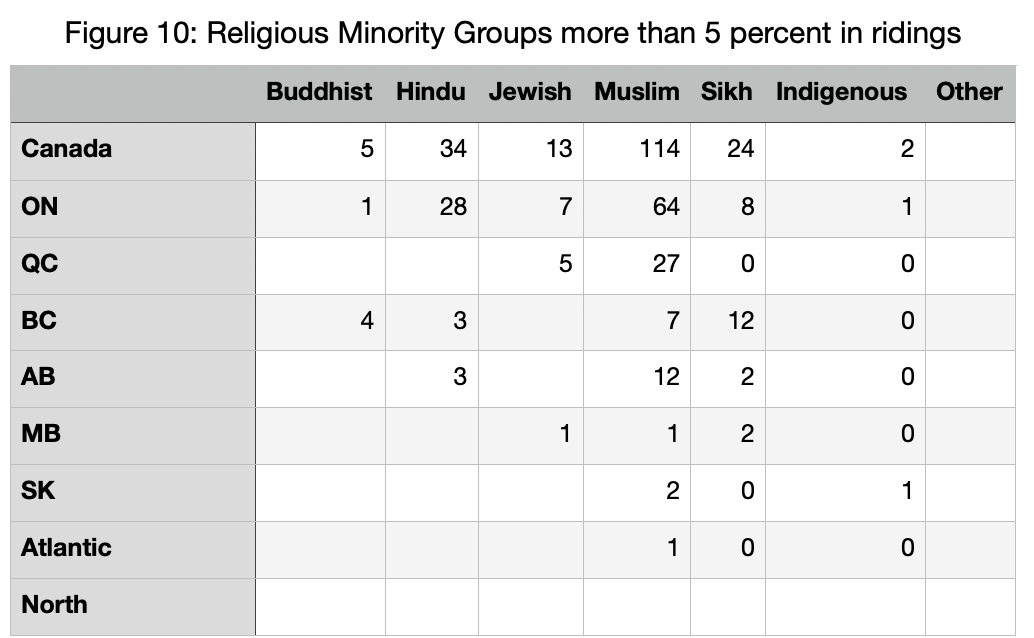
The table below highlights the number of ridings with more than 5 percent religious minorities, highlighting just how many more ridings have significant Muslim populations compared to Jewish populations.

The Liberals find themselves caught between an Israel/Conservative rock and a NDP/Palestinian hard place. And they don’t seem to have a solution, other than to placate both sides, which is no solution at all.

Source: Liberals trying to play both sides in Gaza conflict

Conford: Israelis and Palestinians are both trapped by the dangerous fantasies of history

One of the best commentaries I have seen, thoughtful and balanced:

… For years, the right-wing in Israel – and Hamas in their way – have promulgated the notion that the peace process was an illusion, a mirage. But what events have shown is that the delusion, the Fata Morgana, was that there could ever be normality without finding a peaceful, negotiated settlement to the issue. Polls back in 1993 – before a cruel wave of Hamas suicide bombings and the assassination of Israeli prime minister Yitzhak Rabin undermined belief in the possibility – had support for a peace treaty among both Palestinians and Israelis running above 65 per cent.

Since then, the far right in Israel and Hamas have shared the same goal: to put a halt to any possibility of the peaceful division of the land into mutually recognized stable states of Israel and Palestine. Even in the past few weeks, Mr. Netanyahu has boasted how he has stopped a Palestinian state from coming into existence in the past and how he will also in the future, arguing that the Hamas attack shows why he is right to do so.

It is exactly this thinking which has brought us to where we are now.

The sole way to escape the cycle of violence is to clearheadedly renounce all the maximalist and eliminationist fantasies and the dehumanizing caricatures that have led, and will continue to lead, to the horrifying shedding of the blood of thousands of men, women and children….

M.G. Conford is the writer and director of the documentaries Through The Eyes Of EnemiesNot On Any Map, and Fragments of Jerusalem. He is an associate professor of film at Toronto Metropolitan University

Source: Israelis and Palestinians are both trapped by the dangerous fantasies of history

John Ivison: Ottawa’s new ‘pragmatic diplomacy’ policy misfires at the UN

Embarrassing that the government couldn’t vote in favour of UN resolution condemning the Israeli settlements in the West Bank as obstacles to peace as they clearly are with their ongoing expansion. Good critique by Ivison:

If “pragmatic diplomacy” is a real, breathing strategy, then the vote to censure illegal settlements in the West Bank would have been a pragmatic and diplomatic start.

Source: John Ivison: Ottawa’s new ‘pragmatic diplomacy’ policy misfires at the UN

Yakabuski: Fin de la récréation pour Trudeau

Hard hitting but merited:

Depuis l’attaque des militants du Hamas contre Israël du 7 octobre dernier, le premier ministre Justin Trudeau se garde soigneusement de dévier de la position américaine sur le conflit, qui menace de se propager à d’autres pays du Proche-Orient.

Son refus d’appeler à un cessez-le-feu crée des remous au sein du caucus libéral. Pas moins de 23 députés libéraux ont signé une lettre lui demandant que le Canada « se joigne au nombre croissant de pays qui demandent un cessez-le-feu immédiat ». M. Trudeau leur a répondu cette semaine en se disant favorable « à l’idée de pauses humanitaires », qui permettraient l’acheminement d’aide aux civils piégés à Gaza tout en n’empêchant pas Israël de reprendre son assaut sur le territoire palestinien dans le but d’éliminer le Hamas.

Sa déclaration, mardi, est arrivée presque simultanément à celle du secrétaire d’État américain, Antony Blinken. Devant l’Organisation des Nations unies, à New York, il a, lui aussi, appelé à des pauses humanitaires.

Depuis son arrivée au pouvoir, en 2015, le gouvernement de M. Trudeau semble élaborer sa politique étrangère en fonction des désirs des clientèles ethniques de certaines circonscriptions clés, notamment de la banlieue de Toronto et de Vancouver. Dans beaucoup de cas, ses positions n’attirent pas l’attention du public en dehors de ces enclaves ethniques, où l’appui — ou pas — de la population sikhe, tamoule, chinoise ou autre peut tout changer entre une victoire ou une défaite des libéraux lors d’élections fédérales.

Puisque leurs mots et leurs actions ne pèsent pas beaucoup sur la scène internationale, les gouvernements canadiens, sauf de rares exceptions, ont tous traditionnellement eu le luxe de concevoir leur politique étrangère comme un bidule à faire gagner des votes. Toutefois, cette approche s’est retournée deux fois contre le gouvernement Trudeau dans la dernière année.

Il a longtemps cherché à minimiser les allégations d’ingérence chinoise dans les élections fédérales de 2019 afin de ne pas se mettre à dos les électeurs chinois des circonscriptions baromètres de Toronto et de Vancouver. Mais ce scandale a fini par lui éclater au visage, avec les révélations dans les médias des avertissements répétés sur l’ingérence chinoise que lui aurait lancés le Service canadien du renseignement de sécurité.

On est en droit de se demander si M. Trudeau aurait fait une sortie aussi dramatique pour annoncer que l’Inde serait impliquée dans l’assassinat d’un militant séparatiste sikh commis en banlieue de Vancouver en juin dernier s’il ne se préoccupait pas autant du sort des libéraux dans les circonscriptions où la population sikhe est majoritaire ou presque. La réaction du gouvernement indien à ses propos menace maintenant les relations du Canada avec le pays que tous nos alliés cherchent à courtiser pour contrer l’influence chinoise dans le monde.

Dans le dossier du conflit entre Israël et le Hamas, M. Trudeau, contrairement à certains de ses députés, ne peut pas contredire nos alliés sans qu’ils s’en aperçoivent. Tout comme pour la guerre en Ukraine, les enjeux de ce conflit sont trop importants pour que le premier ministre ose aller à contre-courant.

Certes, des divisions existent aussi au sein même de l’alliance occidentale, comme en témoigne la difficulté qu’ont les pays de l’Union européenne à s’entendre sur une position commune. Seul le premier ministre espagnol, le socialiste Pedro Sánchez, qui lutte pour sa survie politique après avoir perdu les élections en juillet, a jusqu’ici exigé publiquement un cessez-le-feu. Mais, dans son cas, toute autre position ferait éclater la coalition de partis de gauche qu’il essaie de préserver afin de garder le pouvoir et d’éviter la tenue d’élections, qui pourraient mener à sa défaite définitive.

Le président américain, Joe Biden, n’est pas prêt à appeler à un cessez-le-feu, même s’il dit déplorer les conséquences des actions militaires d’Israël contre le Hamas pour la population de Gaza et qu’il milite pour une accélération dans la livraison d’aide humanitaire. D’abord, parce qu’il sait que le Hamas, un groupe terroriste qui se consacre à la destruction d’Israël, ne respecterait jamais ses conditions. Ensuite, parce que toute clémence envers cette organisation serait perçue comme une invitation, pour les ennemis des États-Unis, à commencer par l’Iran, à semer la terreur à travers la région et le monde.

Tout au plus M. Biden demande-t-il à Israël d’exercer une certaine prudence en menant sa campagne contre le Hamas. Il sait pertinemment que cette situation est un bourbier géopolitique qui risque de plomber sa présidence et de mener à de multiples conflagrations militaires ailleurs au Proche-Orient et dans le monde. La dernière chose dont il a besoin, c’est de voir un gouvernement canadien soucieux de plaire à l’opinion publique lui compliquer davantage la tâche, déjà si délicate. M. Trudeau semble l’avoir compris.

Source: Fin de la récréation pour Trudeau

Tasha Kheiriddin: Re-election is more important to Trudeau than supporting Canadian Jews

A bit over the top but yes, diaspora communities influence all parties and governments. But I fully expect the PM will visit Café Landwer and his initial messaging was strong. But of course the changing demographics have an impact. That 23 Liberal MPs called for an immediate ceasefire, along with recent mixed messaging, reflects, in part, that there are 114 ridings where Muslims form more than 5 percent of the population, compared to 13 ridings where Jews form more than 5 percent:

The Israel-Hamas War has shocked the world on many levels: the brutality of the Oct. 7 attacks against Israeli civilians, the propagation of disinformation by supposedly reputable news outlets, and the overt antisemitism on display in academia, politics and public demonstrations. The concept of decolonization, so fashionable in left-wing circles, has been turned against a people who for over a millennium have been persecuted, stateless, and the victim of racial hatred. Yet today, Jews are being cast as villains, in a manner that would make even Shakespeare blush.

In Canada, the conflict has also done something else. It has definitively exposed the true motivations for Liberal government’s seemingly incoherent and milquetoast foreign policy. Instead of standing for principle and the interests of our nation and its allies, the Trudeau Doctrine is dictated by diaspora politics and his party’s re-election prospects. This is true not only of its positioning on the current conflict, but on every major foreign policy issue in the past year.

It began with the Liberals trying at all costs to avoid a public inquiry into Chinese electoral interference. In February 2023, the Globe and Mail broke the story of how China implemented a sophisticated strategy to engineer the return of a Liberal minority government and defeat opposition Conservative politicians in the 2021 election. Allegations about this had been swirling for months, including reports on Chinese interference in the previous 2019 election.

But instead of seeking answers, Trudeau sought cover. He appointed “special rapporteur” David Johnston to examine the issue, effectively kicking the can down the road. Months later, Johnston quit in disgrace when the House of Commons demanded he resign after he had conveniently concluded that interference claims were based on “limited and partial intelligence” and thus did not warrant an inquiry.

Yet months later, when Trudeau was given information by CSIS that the agency was “actively pursuing credible allegations of a potential link”  between India and the killing of a Canadian Sikh separatist gunned down in the parking lot of a temple in Surrey, the government leapt into action.

Trudeau first raised the issue privately with Indian Prime Minister Narendra Modi at a G20 meeting in New Delhi. When that didn’t achieve the desired result, Trudeau publicly accused India of involvement in the crime in September, setting off a diplomatic firestorm that continues to burn. Canada’s trade mission to India was cancelled, 41 of our diplomats in India have been recalled, and our Indo-Pacific Strategy lies in ashes less than a year after it was unveiled.

Why did Trudeau act in such an incoherent way on these issues? Well, it’s math. A glance at the Canadian electoral map shows the importance of the Sikh and Chinese diaspora vote in both British Columbia and Ontario. There’s also the matter of Trudeau’s supply and confidence agreement with the NDP, led by Jagmeet Singh, who was strongly supportive of Trudeau’s stance.

And now, as war rages once again in the Middle East, there’s the Muslim vote to worry about, in electoral districts in Scarborough and the 905 belt around Toronto, as well as in Montreal. With the Conservatives soaring in the polls, ridings like Mississauga-Lakeshore, which the Liberals kept in the past byelection, could be in jeopardy if Muslim voters switch allegiances or stay home.

So once again, Trudeau is letting domestic policy dictate foreign policy. And this time, he’s not only throwing the Jewish community under the bus, but the values Canadians cherish, including the protection of minorities from hatred. And this weekend provided yet another example of that.

On Oct. 21, Trudeau visited a mosque and tweeted, “As members of the Palestinian, Arab, and Black Muslim communities gathered for prayer yesterday, I wanted them to know this: We know you’re worried and hurting. We’re here for you. We will not stop advocating for civilians to be protected and for international law to be upheld.”

Yet on the same day, a Jewish-owned business in Toronto was targeted by protesters waving Palestinian flags and screaming to boycott the “Zionist café.” Social media was flooded with images of hundreds of people mobbing the windows of Cafe Landwer while frightened patrons sat helplessly inside.

Trudeau’s response? We’re still waiting.

Source: Tasha Kheiriddin: Re-election is more important to Trudeau than supporting Canadian Jews

Nicolas: La vérité, le temps, le pouvoir et la paix

Balanced and relevant reflections:

Quatre choses fondamentales semblent nous filer entre les doigts et échapper à notre vue, alors que le monde tente de prendre acte de la violence en Israël et à Gaza.

La vérité. Nul besoin de s’étendre face au malheureux mélange du journalisme en crise, de l’explosion de l’intelligence artificielle et de l’effondrement de Twitter (renommé X). Les petits crochets « vérifié » ne garantissent plus la crédibilité de personne, les services de modération du contenu et de vérification des faits des plateformes ne sont d’aucune efficacité et les fausses informations abondent. Résultat : il n’a jamais été aussi difficile de s’informer en ligne d’un conflit où les actions — et les morts — évoluent d’heure en heure.

Le temps. Bien des observateurs ont comparé l’attaque du Hamas contre des civils israéliens, y compris beaucoup d’enfants, samedi, à Pearl Harbour ou au 11 septembre 2001. Ce qu’on essaie de transmettre par cette image, c’est le sentiment d’une brèche. Il n’y a jamais eu autant de morts du côté israélien, tout comme les Américains n’ont pas l’habitude d’être attaqués sur leur propre sol. Les États-Unis ont disposé de temps pour entrer en deuil national, puis réagir : la guerre du Pacifique qui s’est soldée par deux bombes atomiques d’un côté, la guerre en Irak et la déstabilisation du Proche-Orient de l’autre.

On ne dispose pas, ici, de temps. La contre-offensive de l’armée israélienne à Gaza est déjà en cours. Le nombre de civils décédés monte d’heure en heure, dont là aussi, beaucoup d’enfants. Vu le déséquilibre des forces en présence, on craint ce qui suivra.

La quasi-totalité de la classe politique canadienne a condamné les manifestations propalestiniennes du week-end, comme si chaque personne dans la rue était là pour « célébrer » l’attaque du Hamas, et donc des morts juives. Bien qu’il y eût, certes, parmi les organisateurs, des personnages aux objectifs hautement condamnables, bien des participants en étaient mal informés et se montraient plutôt profondément inquiets, ainsi que solidaires du peuple palestinien, plus largement.

Comment peut-on vouloir envoyer ce message de soutien aux Palestiniens alors que les corps des victimes du Hamas sont encore chauds ? Parce qu’il n’y a pas de temps, justement. Toutes les préoccupations, les peurs, les colères et les deuils s’empilent les uns sur les autres, se blessent et s’enterrent les uns les autres. Dans un conflit où les émotions sont aussi à fleur de peau, le manque de temps envenime tout.

Le pouvoir. C’est une chose de souhaiter une couverture médiatique équilibrée et qui met de l’avant une représentation juste des points de vue de chaque partie impliquée, de chercher à traiter avec respect chaque victime de la guerre. C’est indispensable, même. C’en est une autre de gommer, de perdre de vue, ou de feindre de ne pas remarquer comment le pouvoir et ses iniquités affectent différemment chacun des camps.

Un exemple criant, parmi tant d’autres. D’un côté, Gaza fait l’objet d’un blocus depuis des années, et l’Égypte ne permet la sortie que de quelques personnes au compte-goutte au poste frontalier de Rafah, qui est d’ailleurs bombardé par Israël depuis le début de la semaine. De l’autre, on planifie avec l’appui de la communauté internationale des évacuations de l’aéroport de Tel-Aviv, où une proportion importante des Israéliens a une double citoyenneté, et d’où on peut circuler dans le monde sans visa.

Tout le monde cherche à fuir devant la peur, la peur atroce, la terreur, les morts. La peur peut être aussi grande de chaque côté. La peur est propre à chacun. La peur ne se mesure pas. Les moyens de fuir, eux, se mesurent.

La paix. J’ai le sentiment que chaque reportage, chaque entrevue doit se terminer sur un « avez-vous l’espoir de voir la paix un jour » ? Non seulement c’est cliché, mais il est aussi irritant de voir la paix présentée comme un processus qui appartient à une poignée d’hommes qui accepteraient un jour de parlementer autour d’une même table.

La paix n’est pas qu’un état politique, c’est une action que l’on peut choisir de mener, ou non, chaque jour. La paix est un moteur derrière nos gestes et nos paroles aussi.

On se souvient tous du « soit vous êtes avec nous, soit vous êtes avec les terroristes » de George W. Bush au lendemain du 11 septembre. C’était là une logique guerrière, qui a mené tout droit à la guerre réelle. Cette logique est manichéenne. Elle prend toute entreprise de contextualisation comme une injure, et est persuadée que de chercher à comprendre les actions du camp adverse, c’est les justifier, les excuser ou même s’en solidariser.

Cette logique guerrière pullule. Elle accélère la droitisation de la société civile israélienne et prend sa gauche, qui souhaite une Palestine libre, en étau — alors que cette gauche est essentielle aux efforts de paix. Elle mène à des tensions douloureuses au sein des communautés juives d’ici, et rend d’autant plus ardue et coûteuse le partage de perspectives qui dissonent d’avec celles des grandes associations. Elle soutient tout autant le processus de radicalisation qui a permis l’émergence du Hamas et marginalisé le leadershipde l’Autorité palestinienne. La logique guerrière refuse de faire la distinction entre le soutien à une Palestine libre et un cri de ralliement terroriste. Elle ramène du même souffle toute la population d’Israël, et même tout le peuple juif, à l’administration de Nétanyahou.

La paix, comme choix à la portée de tous, c’est le choix de faire de la place dans son esprit et dans son coeur à plusieurs émotions et vérités en même temps. La paix cherche à comprendre à la fois le rôle du trauma de l’Holocauste et des siècles d’antisémitisme dans la charge symbolique que porte Israël, les 75 ans de délocalisation, d’oppression et de marginalisation du peuple palestinien, le rôle du colonialisme dans le contrôle britannique du territoire palestinien au moment où il a été donné à Israël et le pouvoir continu de l’Occident sur la région depuis. La paix cherche à écouter tout, entendre tout, faire assez de place pour tout.

Anthropologue, Emilie Nicolas est chroniqueuse au Devoir et à Libération. Elle anime le balado Détours pour Canadaland.

Source: La vérité, le temps, le pouvoir et la paix

McKinnon: The India debacle should prompt Canada to rethink the naive way we engage with the world

From a former colleague of mine.

Always been a challenge with large diaspora communities and will likely remain so, to a greater or lessor cost depending on the issue and situation:

The implosion of the Canada-India relationship, only months after our Indo-Pacific Strategy described India as a “critical partner,” is stunning. Canada’s relationship with a democratic and pluralistic India was intended, at least in part, to be a counterweight to our troubled relationship with authoritarian China. But after Prime Minister Justin Trudeau announced last month that there were “credible allegations” that the Indian government was involved in the killing of Hardeep Singh Nijjar in Surrey, B.C., the two countries engaged in a tit-for-tat expulsion of senior diplomats; now, Delhi is reportedly further demanding the removal of 41 of Canada’s 62 remaining envoys.

The immediate cause of the breakdown may rest with Delhi, but the dysfunction has deep roots. A serious rethink is needed to get the relationship back on track. This includes consciously balancing national interests – Canada’s security and prosperity – against special interests, including the diasporas, in our relationship with India.

If the allegations are true, there will be implications for India’s international standing. It would no longer be seen as a largely benign democratic counterweight to China and Russia. Instead, it would prove that it is what it has always been: a complex giant focused on taking its place in the world and advancing its interests, albeit now under a leader in Prime Minister Narendra Modi who has overtly sidelined Jawaharlal Nehru’s original vision of a secular and tolerant democratic India. Canada and its allies must grapple with the contradictions of developing closer relations with an important country with an increasingly illiberal leadership – a more difficult task if there is serious evidence India is behind extrajudicial killings abroad.

A real challenge for Canada is that our allies have enough at stake in their own relations with India that they are unlikely to countenance their own serious ruptures with Delhi, even if they accept our version of events and want to be supportive. Despite tough talk in Canada, holding Indian officials accountable will be hard, to say the least, particularly if no one is put on trial. Nonetheless, a message needs to be sent that this cannot happen again.

But while I am shocked by this turn of events, I am not surprised that the long-standing misalignment in the relationship led to a deep cleavage.

As Canada’s trade and investment relationship with a booming India grew in the 2000s, a visit to the country became a priority for politicians from all levels of government. In my experience from that time, it was clear that for the most part, their interests were at least as much in the prospect of photos from an India trip playing well with voters in Canada than in seriously engaging the country. Politicians from across the spectrum wanted to see the country and the relationship in terms they could understand easily and convey to audiences at home, especially from Indian-originating diasporas. And so official visitors routinely described the Canada-India relationship as based on shared values of democracy and human rights, as well as strong people-to-people links.

Indeed, those links were seen by most Canadians to be an undiluted positive. From the Indian perspective, though, it was much more complex – the Indian diaspora, like the country itself, is diverse. The Indian diaspora in Canada is very large, with perhaps half of it Sikh, even as Sikhs represent only 2 per cent of India’s population. I recall reminding politicians who were heading to photo-ops in the city of Amritsar that it was important to remember that Sikhs, an impressive and distinguished community, made up about the same percentage of India’s population as that of their home provinces, so they needed to appreciate how much of India they were not seeing.

Even then, though, little attention was given to the complex history of the relationship, or our more substantive and enduring interests (economic, geopolitical, etc.) in a growing country that is home to 20 per cent of humanity. Or that it is in Canada’s interest to develop a substantive relationship with India, whether or not our values are precisely aligned. Instead, we mistakenly assumed that, because the relationship was based on shared values and our large India-originating diaspora, our relationship was assured.

But whatever pleasantries the Indian hosts might have offered visiting Canadians, you can be sure that they were much more focused on the hard edge of their interests and advancing them. Our view of the relationship would inevitably conflict with those of a country located in a difficult region where national interests were seen as paramount, and where the focus of the otherwise limited relationship with Canada touched on India’s national security.

Indeed, while the Canada-India relationship has difficult elements to its history – including the discovery that a Canadian nuclear reactor provided to India for peaceful purposes in 1954 had been used to launch India’s nuclear weapons program in 1974 – the most significant continuing irritant is the support in Canada for the cause of Khalistan, the concept of a separate Sikh homeland. In the 1970s, Canada developed a reputation as a base for the Khalistani movement. While simply voicing support would clearly be protected speech under Canadian law, violence in Canada quickly became a problem, including the 1986 attempted murder of Punjab minister Malkiat Singh Sidhu, who was visiting Vancouver Island, and the 1985 bombing of an Air India flight travelling from Montreal to London in which 329 people were killed, overwhelmingly Canadian citizens. The failures of the Canadian security services to disrupt the plot and the ultimate inability of the Canadian justice system to hold the perpetrators to account are well-known in India; at the same time, memory of the bombing in Canada is shamefully weak.

Those failures are exacerbated by Canadian politicians frequently being photographed at events where violent Khalistani extremists are lauded as martyrs. By and large, this is excused as carelessness while in pursuit of votes in diaspora communities. In India, it is viewed altogether differently, and not just by the hardline Hindu nationalist supporters of Mr. Modi.

Diasporas are an important part of Canada’s diversity and dynamism, and they reinforce our links overseas. But they also complicate them. Members of diasporas from other countries often have their perspectives frozen at the time they left, without full appreciation of current realities. This is not to say the views of diasporas should not be heard; of course they should be. But politicians and policymakers need to have a broader and up-to-date understanding of a country into which they can contextualize the views of individuals or groups from whom they are hearing. That’s especially true if those groups are advocating for the breakup of their country of origin. We need to tread very carefully around separatism, particularly given our own experience.

While the Sikh population in Canada is the largest in the world outside of India, other countries that have significant Sikh populations and active groups of Khalistan supporters – notably the U.K., Australia and U.S., – still manage to have constructive strategic bilateral relationships with India. That is essentially because those countries have developed substantial political, economic and security links to New Delhi that underscore their importance to a broader set of India’s interests. They have not simply rested on the naive assumption that (supposedly) shared values and having a diaspora are a sufficient base for an enduring relationship.

Canada’s lack of broader links with India means that Delhi believes it can act in a heavy-handed way on this file. Little else is at stake for the Indian government; in fact, the domestic political benefits to taking action against Canada are potentially significant for Mr. Modi. Our long-term interests in the purely bilateral relationship are relatively greater than India’s, given its size and status as a rising global power, and so we need to find a way out. That said, the stakes for India rise considerably as this becomes a global reputational issue that has the potential to damage its broader interests, and so at the end of the day, it must realize it cannot act with impunity in Canada or other countries.

So how do Canada and India get out of this situation?

Diplomacy, supported by high-level political engagement, is crucial to limit the broader fallout as much as possible. Effective diplomacy requires a clear understanding and acknowledgment of the issue at hand, along with a thoughtful strategy to make progress. Integral to this will be a willingness to listen more, and not just to friends, but also those with whom we do not regularly see eye-to-eye.

Our team in India needs to be able to do its job. The same is true for Indian representatives here, who can help Delhi understand better the situation in Canada. Hopefully, Delhi will soon realize how counterproductive a forced, rapid and significant drawdown of our diplomatic staff in India would be.

Ottawa needs to work with friends to whom Delhi will pay attention. We also need to understand, at the highest level, what Canadian interests are at stake, and to lift these above transactional or very short-term considerations. Presumably, our allies and other potentially influential countries (beyond our Five Eyes intelligence-sharing partners) have been made aware of the evidence we have about alleged Indian complicity in the murder, and if not, they should be, because we will need support from more than just the usual “like-minded” countries. Ideally, there should be at least some cross-party understanding of the way forward too, as this will be a long game. It also goes without saying that the police investigation into the Nijjar murder and any subsequent legal process must continue unhindered here.

The credibility and reputations for both India and Canada are now at stake, but perhaps especially for us. We make a lot of assertions about our importance, but our lack of substantive commitments compared to our rhetorical flourishes on the global stage over the years has been noticed.

Our governments – both politicians and officials – need to engage with Canadians about our national interests and international priorities, not just deliver pre-scripted sound bites or limit engagement to special interest groups or particular diaspora communities. Such engagement can encourage Canadians to think about the challenges that our country faces and to be supportive of serious debate about Canada’s place in the world, including what we need to secure our future as a country. The Indo-Pacific Strategy provides a good basis for such a discussion about the region with Canadians, but there must be an openness to differing views.

Values are important, but they should guide how we pursue our interests, rather than define them. Too much focus on values rather than other common interests inevitably marginalizes Canada’s influence in the very relationships where we might want to encourage improvement in human rights or governance. We are taken less seriously because we are seen as primarily interested in broadcasting our judgments rather than engaging with other countries to find common ground.

The world has dramatically changed, and it will continue to do so. Without a serious rethink of how we engage internationally, it will be difficult to ensure Canada’s security and prosperity in an ever more uncertain world.

David McKinnon is a former Canadian diplomat who has been posted to New Delhi, Canberra, Bangkok and, most recently, Colombo, where he served as Canada’s high commissioner to Sri Lanka.
Source: The India debacle should prompt Canada to rethink the naive way we engage with the world

Aziz: The real reasons Canada’s relationship with India is broken

Classes example of diaspora politics taken to excess:

When Prime Minister Justin Trudeau stood up in the House of Commons on Monday and made the unprecedented allegationthat “agents of the government of India” assassinated a Canadian citizen on Canadian soil, I cannot say I was surprised. It was a brazen and violent encroachment upon Canadian sovereignty, done in public, meant to be discovered, and over one of the issues that the Indian government of Narendra Modi takes most seriously.

I should know. In 2017, I was the Policy Advisor in the Foreign Minister’s office, working closely with the Prime Minister’s Office on India. From the first briefing, it was clear that India-Canada relations were headed in the wrong direction. There had been rumours of Indian intelligence services operating in the Canadian suburbs for years (along with others). The Indians counter-alleged that Canada was giving shelter, if not encouragement, to Khalistani extremists – supporters of an independent Sikh homeland, partitioned out of India. Sikhs in Canada, meanwhile, have likened the Indian government’s violence against them to genocide. The two sides had been talking past each other for years.

The sore point in this, which young Canadians have no memory of, is the tragic Air India bombing of 1985. Until 9/11, this was the worst act of terrorism in the sky, whereby Sikh extremists planted a bomb on an Air India flight, resulting in the deaths of 329 passengers and crew.

By the time I served in government in 2017, two things had recently – and radically – changed. First was the election of Mr. Modi in 2014, and his Hindutva politics. Mr. Modi’s ideology sees India as a primarily Hindu nation, and it stokes ethnic chauvinism and grievance against anyone who dares criticize it. Mr. Modi was a strongman, and would no longer take lecturing from Canada.

The second factor was the election of Donald Trump, which moved everyone’s attention and focus to Washington dramas. India, meanwhile, had gone fully nationalist by this point. Since coming into office, Mr. Modi has silenced critics, targeted Muslimslocked up political opponents, and rewritten the Indian curriculum to blot out India’s syncretic history. Mr. Modi has rolled back India’s democracy, and remains an ally of India’s far-right.When I met with India’s greatest economist, Amartya Sen, last fall, he warned me that the regime was getting worse. There can be no doubt that Mr. Modi has used state violence against minorities in frightening and authoritarian ways.

Over the years, the politics of this issue in Canada had also grown more difficult. There are some 770,000 Sikhs in Canada, one of the most politically organized communities in the country. Canadian Sikhs have kept the issue of Sikh justice on the agenda by continually advocating and pressuring politicians. Because foreign policy in a democracy is ultimately informed by domestic public opinion, the Sikh issue has an enlarged influence on our bilateral relations with India. It came up in every meeting, in every talking point, in every pull-aside. Unfortunately, Canadian politicians then didn’t care enough about either Sikhs or India to give this the policy attention it deserved.

By 2017, when I worked in government, India did not take Mr. Trudeau or Canada seriously. They viewed Canada as a bit player in world affairs, America’s loud-mouthed neighbour. In Ottawa, at least in my experience, officials did not respect India, either – to our peril. Canada’s political establishment is old and white, and infused with an ignorant Eurocentrism that still affects foreign policy priorities. Western Europe and the United States were our focus, and some ministers could hardly see beyond London or Berlin. There’s a reason why, along with India, relations with China, with Latin American countries, with much of Africa have deteriorated. It was a great abdication of our long-term priorities, given where we have ended up.

When Mr. Trudeau went to India in 2018, the trip became a debacle for Canada. Mr. Modi did not greet him on the tarmac, Mr. Trudeau got a chilly reception in general, and the PMO was put on its heels after it was reported that Jaspal Atwal, a Khalistan supporter once convicted of trying to kill an Indian cabinet minister, had been invited to two receptions during Mr. Trudeau’s visit.

Canada should have at least begun to take steps to ensure our land was not used for terrorist financing – a reasonable demand, given that the overwhelming number of Canadian Sikhs are peaceful and uninterested in using violence to create a separate Sikh homeland. (Coincidentally, Khalistan is almost entirely a diaspora issue; there is little organized support, even among Sikhs in India, for a separate homeland.) By taking goodwill measures, it would have at least been possible to keep talking and find workable policy solutions. The only problem was, Mr. Trudeau did not want to lose the Sikh vote to Jagmeet Singh. So we dug in our heels.

What I saw in government was how Canada’s ethnic domestic battles were distorting our long-term foreign policy priorities, and politicians, who never understood South Asia or India anyway, were pandering in lowest-common-denominator ways in B.C. and Ontario suburbs, and playing up ethnic grievances to win votes. This was especially true within internal Liberal Party politics, meaning that we could hardly focus on foreign policy and strategy without factoring in which ridings might be lost because a certain group might be upset. Canada, as a country, has suffered greatreputational damage by such thinking – and none of our allies are going to come to our help on this issue.

Not that Mr. Modi would have necessarily been a great friend to Canada. In my research on right-wing nationalist regimes, it is apparent that governments pursuing state violence internally – against minorities, against critics – will ultimately pursue such aggression externally. It is why the rise of the new authoritarians is so destabilizing for the world order. But Canada ultimately got the worst of all possible deals – nearly ruptured relations with India, and now a potential split in the Western alliance.

The global chessboard is shifting. The United States is strengthening its Asia alliances, something we could and should have been doing six years ago. The new influential club is the Quad – the U.S., Japan, Australia, and India. Canada is not part of it. At the G20, Canada is demeaned. The world powers will eventually face the contradiction between Mr. Modi’s Hindu nationalist regime and his foreign policy influence. What’s worrying is that Canada isn’t even at the table where those decisions are being made.

We have entered a critical period in world affairs. Major realignments are taking place – and now the murder of a Canadian citizen, allegedly carried out with the knowledge if not support of another country, could go many different ways. It is imperative the investigation continues, that its findings are made public, and that Canada seeks de-escalation with India. Canada may never be a major power in international affairs. But it can still be a serious one.

Omer Aziz is a former foreign policy adviser in the government of Justin Trudeau and the author of Brown Boy: A Memoir.

Source: The real reasons Canada’s relationship with India is broken