The Campaign for Equal Citizenship led by the Foreign Spouses Support Group welcomes the recent announcement by Tan Sri Muhyiddin Yassin and the Ministry of Home Affairs to draw up a new standard operating procedure (SOP) for citizenship applications. This would presumably ensure that citizenship applications are considered more fairly and promptly.
However, this is inadequate for the thousands of Malaysian mothers who wish to confer citizenship to their children born overseas. The government must fix the law, so that Malaysian women enjoy equal citizenship rights compared to Malaysian men.
Of course, a Malaysian mother married to a foreign man who gives birth in Malaysia can confer citizenship to their children but the discrimination is stark when these mothers for various valid reasons give birth overseas.
Reasons for giving birth overseas range from holding overseas jobs, unable to afford flights, premature births or risking medical complications. There are also many reasons such as aging parents, why women choose to return to Malaysia with their families and have their children grow up here as citizens.
Whilst a Malaysian father can simply notify and register at the nearest embassy of the country where his foreign wife has given birth, whereupon Malaysian citizenship papers will be issued within a time period from 3 days two months, however the Malaysian mother has to apply for citizenship for her children
Based on experiences of these Malaysian mothers, they are often misinformed by authorities abroad and at home, given inconsistent information and experience inconsistent practices. While there have been success stories, we are looking at an average waiting time of one to seven years or more to get an approval, often after multiple rejections and re-applications. Allegedly rejections are part of the SOPS to test to see if these Malaysian mothers are truly sincere and loyal to Malaysia a test not accorded to Malaysian fathers.
So, while developing a new SOP may be a temporary solution, there is a dire need for a permanent solution.
To do so, we must address first the root of the discrimination. In principle, Malaysia does not recognise mothers as equal parents by law, as the Federal Constitution expressly provides that children born overseas to married Malaysian fathers are entitled to citizenship by operation of law (Article 14(1)(b) but is silent on children born overseas to Malaysian mothers. Consequently, the process for registering children born overseas as Malaysian citizens is far more arduous for Malaysian women making them feel like second-class citizens.
This law is deeply rooted in patriarchy which allows for sexist attitudes that influence the applications processes. These women are expected to follow the husband’s citizenship, live overseas and not enjoy the option for their children to choose their nationality. Not to be labour a point, the children born overseas to Malaysian fathers enjoy this choice.
Malaysia is currently one of only twenty-five countries globally, and one of four countries in the Asia Pacific region, which has discriminatory citizenship laws.
Amend Schedule II of Federal Constitution to explicitly allow both men and women to confer citizenship on their children born outside of Malaysia through the same process. and make it equal and right for Malaysian women, we make up half of Malaysia and we count.
The usual tired commentary by Chapman, with minimal information on the cases he sites, which presumably relate to the first generation limit on transmission of citizenship, introduced by the Conservatives and maintained by the Liberals.
So I suspect the Canadian parents in the cases cited were themselves born outside Canada and thus their children, also born outside Canada, were caught by the provision as foreseen.
The purpose was, after all, to avoid citizenship transmission independent of any residency in Canada, provoked in part by the 2006 Lebanese Canadian evacuation, where minimal to no connection to Canada nevertheless meant costly evacuation (and when the situation became calm, many returned to Lebanon).
The changes did include provisions to address statelessness, where the process is likely time consuming and where there may well be some administrative issues that should be addressed.
“Thousands and thousands.” Where is the evidence?
Justin Trudeau is a hypocrite.
Case in point: On June 17, he met with Michelle Bachelet Jeria, the United Nations Commissioner for Human Rights. In a Prime Minister press release: “During the visit, Prime Minister Trudeau and High Commissioner Bachelet will discuss efforts to protect human rights and promote gender equality around the world. They will underline the importance of the international rule of law, and emphasize how countries must continue to work together to protect the world’s most vulnerable and make sure everyone’s rights are equally respected.”
Woah, wait a minute, Trudeau’s government is currently violating three UN Human Rights Conventions: the Rights of the Child; the Reduction of Statelessness; and the Elimination of all forms of Discrimination Against Women. I’m the head of the Lost Canadians, the driving force behind several bills on citizenship, including several court challenges. How shameful for Canada to be an abusing nation, and how disgusting that taxpayers have no choice but to fund it.
And I’d bet a dollar to a doughnut that most Canadians are completely unaware.
Cutting to the chase, Trudeau’s statement that, “a Canadian is a Canadian is a Canadian” is pure hogwash. In citizenship law, some Canadians have more rights than others. Tiered citizenship exists. Naturalized Canadians have more rights many Canadian-born citizens. Some children born to a Canadian citizen parent have been denied basic rights, like attending school or getting health care—something that doesn’t happen to children of naturalized Canadians.
Babies like Chloe Goldring and Rachel Chandler were born stateless, despite having a Canadian-citizen parent. Rachel is now 10 years old. Her father fought for over nine years trying to get the government to accept his daughter. She recently got approved—not as a citizen mind you, but as a Permanent Resident (PR).
Ten-year old Akari Maruyama wasn’t so lucky. Her Canadian mother could only get her daughter ‘temporary’ resident status. The result was that Akari and her sister were denied healthcare in Alberta.
As signatories to several UN Human Rights conventions, it’s a human-rights violation to refuse children health care; or not letting them live with their parents; or to deny them a national identity. Children are never to be made stateless, and they must be able to attend school.
The Trudeau government has violated all the above.
Cleary, the U.S. is not alone in abusing children. The difference: Canada targets youngsters with citizen parents, the U.S. does not.
Seriously, had Rachel or Akari been adopted by any Canadian, had they been abandoned, or if their parent had been naturalized, they’d immediately qualify for citizenship. Their only guilt was being born to a Canadian parent.
And they’re not alone. Thousands and thousands of other children are in the same boat, they simply haven’t been discovered by IRCC. Most of their parents have no idea that amended citizenship legislation put their little ones at risk.
For Justin Trudeau and Andrew Scheer, one must question their motives. Why are they silent when it comes to children of Canadians and ongoing human rights violations? They can’t claim ignorance, as 11 years ago, the Conservatives passed the offending legislation, which prompted Trudeau nine years ago to issue a press release saying: “The rules regarding Canadian citizenship must remain consistent with the values of the Charter of Rights and Freedoms.”
So what did Trudeau do about this once he held a majority government? Legislatively, nothing. But he did welcome tens of thousands of refugee children with absolutely no connection to Canada. Kudos, but what about first welcoming children of Canadian citizens?
Trudeau then restored citizenship to terrorists who had their Canadian status stripped away for being, well, terrorists. For should-be Canadian kids like Rachel and Akari, the Liberals did nothing, except to enforce the offending laws keeping them out.
In another situation, it took less than a week for the prime minister to grant asylum and PR status to Saudi teenager Rahaf Mohammed Alqunun. Barricaded in a Thai hotel, she drew global attention after launching a social campaign about the lack of rights for Saudi women. Taking notice, Trudeau quickly rolled out the welcome mat. By doing this, he risked further upsetting Saudi-Canada relations. Just months earlier Saudi expelled Canada’s ambassador, then withdrew its own ambassador after Canada’s foreign ministry tweeted support for several Saudi women’s right activists. Saudi followed through by selling Canadian investments, then ordered their citizens studying in Canada to leave. It was quite a gamble.
For Alqunun and the Syrian kids, the world was watching. Trudeau looked like a saviour.
Also watching, but in Canada, were Rachel and Akari’s parents, whose daughters got little to no media attention. Could that be why Trudeau and Scheer didn’t come forward? I pleaded with both sides for compassion, but no dice. They did, however, put me on their Christmas card list, which included a picture of each leader with their respective “Canadian” children. I wondered what they’d do if one of their kids had been turned away?
The other UN Convention being violated is the elimination of all forms of discrimination against women. Just over a year ago, Bill S-3 received royal assent, giving Indigenous women the right to pass Indian status to their grandchildren. Ojibwa Canadian Joan Valliere could now confer Indian status to her two granddaughters, but she couldn’t confer citizenship. Why? Because the gender inequality that existed in the Indian Act and deemed unconstitutional by the courts was corrected legislatively, but only in the Indian Act. The Citizenship Act still allows gender discrimination, making it impossible for Joan to pass citizenship onto her now ‘Indian status’ grandchildren.
That led to another Charter challenge. At risk are Sec. 15 and 28. To win, Trudeau will have to undo his father’s signature accomplishment—the Charter of Rights and Freedoms.
Regarding the meeting between Trudeau and Bachelet, I don’t know how it went. My guess is that Bachelet left Canada not knowing that the leader she met with is a human rights abuser, albeit with a reputation as a human rights leader.
For Trudeau, it made him look good.
For the Canadian public, they remain mostly unaware.
For Rachel Chandler and Akari Maruyama and countless other should-be Canadian children, they remain as outcasts and victims.
Providing provincial voting rights to expatriates makes little sense. Provincial services are largely residency-based, unlike federal voting rights which are citizenship-based (even there I have serious reservations as noted in earlier posts):
And not convinced in any case that this will make much difference in overall voting trends and turn-out:
What does it mean to be a voter in a Canadian federation increasingly defined by wealth inequality and economic migration?
As public policy scholars, we argue that politicians, policy-makers and citizens alike need to start rethinking how to ensure everyone’s voice is heard in a regionally diverse federation. More specifically, we think that provinces have good grounds for extending voting rights to expatriate citizens. In the case of Newfoundland and Labrador, extending the vote is particularly warranted.
As two expatriate Newfoundland and Labradorians — one of us in Australia — we watched from the sidelines during this spring’s provincial election. It was so defined by negativity and an absence of social vision that it inspired a playful CBC podcast with the question: “Does anyone actually want to win the election?”
That things played out this way came as little surprise. The province is trapped between a need to get its financial affairs in order and politicians who look to spending increases instead of long-term solutions as a means of winning elections. The ruling Liberals, for example, opened their campaign with an extra $152 million for the budget, including a cut to the deficit reduction levy which had only come into effect in 2016.
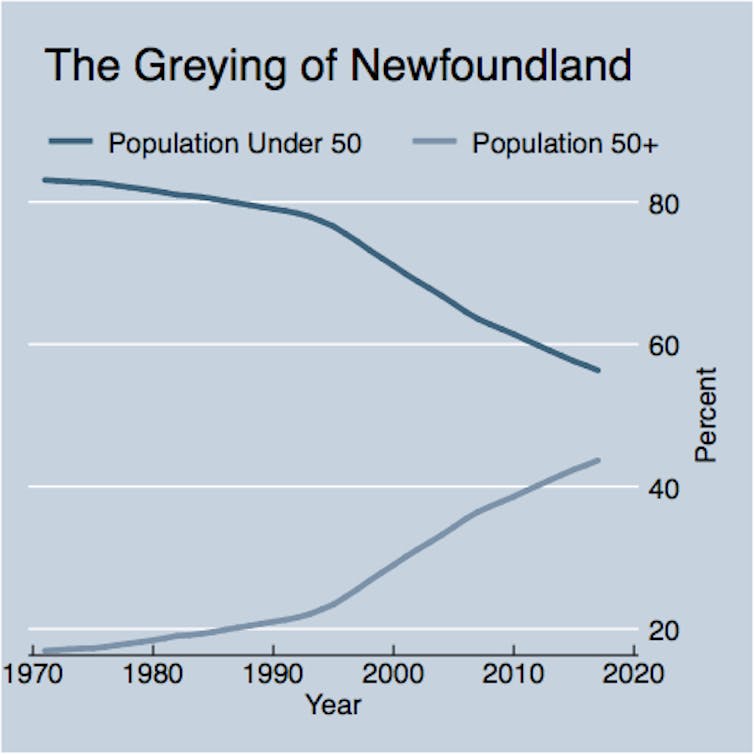
The graph below shows that Newfoundland and Labradorians face a tricky demographic challenge.
The graph vividly portrays how rapidly Newfoundland is growing older.Author provided
The share of the population under 50 years of age has been shrinking for the past 45 years. Since 2000, the population in age quintiles (five-year intervals) has declined in every age group below 50, while increasing in every age quintile above 50. While the population, post-2000, has remained relatively stable, the composition of the province’s population is vastly different.
As the population ages, so too does the median voter.
Citizens who are older are understandably less likely to support long-term reforms that will cut into their more immediate interests. This means that proposing tough solutions to current fiscal problems can make it hard to win elections, especially if there is a rural/urban divide separating younger and older voters.
Unlike Newfoundland’s fiscally tough solutions of the past, we propose a solution that more greatly strengthens attachment to home: Allowing Newfoundlanders and Labradorians living outside the province to vote.
Youth injection
To cast ballots in Newfoundland and Labrador elections, voters must be provincial residents the day before polling day. We propose to extend the vote in a simple, transparent and inclusive manner to anyone 18 or older who has ever attended school in the province.
Why former students? First, many children of Newfoundland and Labrador have been lured or forced abroad to scratch out a living or seek their fortune. All have been victims of the lack of opportunity at home. Many of these people wish to return, and many do return, in their more senior years. Why should their voices not be heard at the provincial ballot box?
A recent study published in the Journal of Labor Economics suggests that the mobility of these workers has boosted pay in their province of origin. Wages rise because employers at home must hike pay to prevent more workers from leaving. This is a real economic gain, on top of any money that workers who leave their home province send back home.
Second, there is precedent — national voter eligibility is not determined by location, but rather by citizenship. The electoral district you vote in federally is determined by your current residential address, but your eligibility to vote is preserved by the government of Canada even when you are living abroad.
Third, consider the civic education that has been instilled in these individuals through the province’s school system. They have a respect for the people and the land, the traditions and the ambitions of their home province.
Generally speaking, we extend the vote to people because they are either directly affected by the collective decisions of government or because they are subject to the laws of that government. Expatriates easily satisfy the first of these two conditions. Provincial policies affect both their ability to return home and their loved ones who remain behind.
To be sure, extending the franchise is not a magic bullet that will immediately solve the province’s problems. And there are no doubt further questions about the voting mechanisms needed to make this proposal a reality.
But we think extending the vote to expatriates strongly aligns with the province’s values. It could also help nudge its politics closer to long-term solutions that respect the roots and rights of all Newfoundland and Labradorians past, present and future.
Yet another example of citizenship-by-investment and related abuses:
Are you in the market for a second passport? One that can get you into scores of countries — including Europe, the UK, Hong Kong, Singapore and Russia — without needing a visa?
Key Points:
Applicants can become a Vanuatu citizen without needing to set foot in the country
It costs about $220,000 for a single application and more for couples and families
More than 4,000 passports have been sold under the scheme, with most to Chinese citizens
Or perhaps you’d like to park your money in a tax haven where there are no personal or corporate income taxes.
Maybe you’d just like to get away from the rat race and live on a picturesque tropical island in the South Pacific.
Vanuatu, then, could be the place for you.
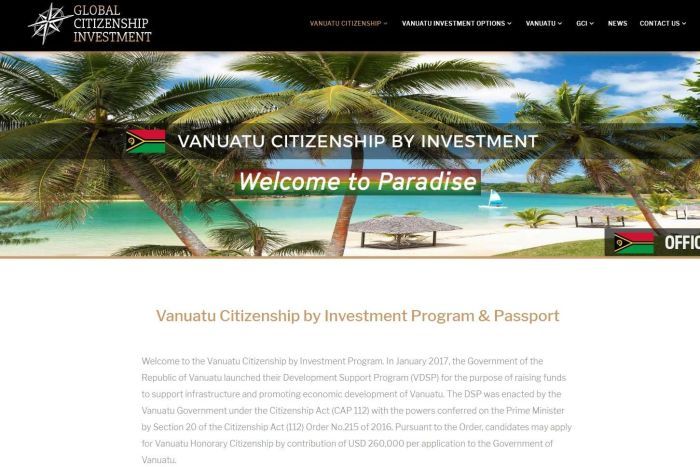
These are some of the selling points of Vanuatu’s citizenship by investment scheme, or cash-for-passports as it’s also known locally.
Sales have been booming in recent years, providing the Government with an unexpected but lucrative source of revenue.
But not everyone is happy about the scheme, with several prominent locals — including former presidents and high-ranking chiefs — saying it undermines the value of Vanuatu citizenship and the country’s fight to gain independence from its former colonial masters, the French and British.
Many countries have citizenship by investment schemes but often applicants are required to become permanent residents first and then only after a number of years do they become eligible to become a citizen.
Under Vanuatu’s scheme, successful applicants can become citizens within a matter of months, and there’s no requirement to reside in the country or even set foot on Vanuatu soil at all.
It costs around $US150,000 ($220,900) for a single application and more for couples and families.
Interested parties submit their applications through agents who’ve been approved by the Citizenship’s Office and Commission, which oversees the entire process.
The job of screening an applicant’s criminal and financial backgrounds is performed by the Government’s Financial Intelligence Unit.
If their client’s application is successful, the agent pockets around a third of the application fee.
Once approved, freshly minted citizens can then apply for the real prize, a Vanuatu passport.
Why does the Vanuatu Government sell passports?
Pure and simple: to raise revenue. There have been several iterations of Vanuatu’s citizenship by investment scheme since it was first introduced in 2014.
Despite the rising tide of domestic criticism, the Government has largely remained tight-lipped about how many passports have been sold and how much money has been raised.
But in June, a parliamentary committee told local media that more than 4,000 passports had been sold under the scheme.
The Vanuatu Daily Post newspaper examined government financial statements and found that sales sky-rocketed last year, with 1,800 passports sold in 2018 alone.
Most have been sold to people from mainland China even though it’s technically illegal to hold dual citizenship under Chinese law.
What does the deportation of six Chinese nationals have to do with the scheme?
Six Chinese nationals were arrested in the capital Port Vila in late June and later deported back to China at the request of Beijing law enforcement officials.
The group was allegedly running an online financial scam targeting people back in China.
Before their deportation it emerged that four of them had successfully applied for Vanuatu citizenship and obtained passports.
Critics of the citizenship by investment scheme said the incident validated their concerns that undesirable people were buying passports for nefarious purposes.
Vanuatu’s founding president Ati George Sokomanu said the sale of Vanuatu citizenship was demeaning to those who had struggled to achieve the country’s independence.
“The Government needs to state clearly how many passports have been sold, who they’ve been sold to, and how much revenue the sales have generated,” Mr Sokomanu said.
The Financial Intelligence Unit later said none of the deported Chinese nationals had a criminal record and Chinese officials informed local authorities of their investigation after they had been granted citizenship.
Of note. Combination of increased demand and reduced resources:
Over the course of just a few years, average waiting times for Swedish citizenship applications have increased dramatically, and currently stand at over two and a half years, new data reveals.
There were 86,853 citizenship applications in processing at the end of June this year, according to the Migration Agency’s figures.
On Monday, the agency’s website showed that applications for citizenship could expect a 30-month (or 913-day) waiting time, adding that this did not necessarily mean all applicants would get a decision within that time. This is two months longer than the estimated waiting time as shown back in January this year, and much longer than was the case a few years ago.
Although the website states that this number “shows how long it has taken for people with similar applications to receive a decision”, a press officer for the Migration Agency told The Local that it represented “the longest expected time if you apply for citizenship today”.
Press officer Mardin Baban told The Local in an email that people receiving their decision on citizenship in July 2019 would have waited an average 284 days, well below the expected 913-day waiting time for those submitting their application in July 2019.
The average processing time for citizenship applications which have already been concluded in 2019 is 292 days, according to Migration Agency figures. This is up from 230 days in 2018, 185 in 2017, 176 in 2016, and 177 in 2015.
“Since the refugee situation in 2014-2016, many of those who were granted asylum in Sweden have now reached the criteria to be granted Swedish citizenship. Between 2014 and 2016, 131,109 people were granted asylum in Sweden, which is the most ever in such a short time,” said Baban.
“So the easy answer to the question is that there are very many at the moment who want to apply for citizenship in Sweden, which is why the processing time has almost doubled.”
The number of people becoming Swedish citizens has soared over the past decade. In 2010, a total of 28,100 people were granted citizenship, a figure which reached a peak of 65,562 in 2017 and was 61,312 last year.
The Migration Agency’s general director Mikael Ribbenvik has said that cuts to resources have also been an issue, telling the TT news agency: “If you have limited resources, you have to invest in certain areas. You can’t invest in all areas if there aren’t sufficient resources.”
However, he added that citizenship cases were now being prioritized, saying that the agency had allocated more staff to work on these cases as well as digitalizing parts of the process. The Local has contacted the Migration Agency for comment.
Earlier this year, the agency began prioritizing applications from British citizens in order to avoid additional paperwork and delays in the event of Brexit.
People of over 170 different nationalities became Swedish in 2018, with Syria the most common country of origin. Syrians, Somalians, stateless people, Iraqis, and Afghans accounted for almost a third of the total number of new citizens, and the next most common nationalities were Eritrean, Polish, Iranian, Thai, and British.
Rohingya refugees in Bangladesh refuse to return to Myanmar unless they are recognised as an ethnic group in their home country, leaders told visiting Myanmar officials on Sunday as fresh repatriation talks started.
A campaign by Myanmar’s military in response to insurgent attacks in 2017 drove 730,000 Rohingya Muslims to flee to Bangladesh’s southeastern border district of Cox’s Bazar, where they live in squalid camps, fearing further persecution if they return.
U.N. investigators have said Myanmar’s operation included mass killings, gang rapes and arson and was executed with “genocidal intent.” Myanmar denies the charge.
This is the second time Myanmar officials have visited the camps in Cox’s Bazar in an effort to persuade Rohingya refugees to kick-start the repatriation process. In October, Rohingya rejected an offer to go back to their homeland when a Myanmar delegation held talks with leaders of the group.
The Myanmar delegation, led by permanent foreign secretary Myint Thu, held talks with 35 Rohingya leaders in Cox’s Bazar on Saturday and Sunday amid tightened security in the camps.
Rohingya leaders said they wanted Myanmar to recognize them as an ethnic group with the right to Myanmar citizenship before they return.
“We told them we won’t return unless we are recognized as Rohingya in Myanmar,” Dil Mohammed, one of the Rohingya leaders who joined the talks, told Reuters by telephone.
He also said they will not return to Myanmar unless demands for justice, international protection and the ability to go back to their original villages and lands are met.
“We want citizenship, we want all our rights. We don’t trust them. We will return only if international protection is in place,” he said.
“We will return to our own land … (we) don’t want to end up living in camps.”
In November, a formal move to start the repatriation process stalled as no Rohingya agreed to return to Myanmar.
The U.N. refugee agency and aid groups are also doubtful about the plan as they fear for the safety of Rohingya in Myanmar.
“We are ready to begin the repatriation anytime. It is up to Myanmar to create a conducive environment to allow the Rohingya to return to their homeland,” said Abul Kalam, Bangladesh’s refugee relief and repatriation commissioner.
With the repatriation plan largely stalled, Bangladesh has been considering relocating Rohingya refugees to an island in the Bay of Bengal, but some have expressed concern this could lead to a new crisis given the island is vulnerable to cyclones.
Myanmar has made “minimal” preparations for the return of Rohingya sheltering in Bangladesh, an Australian think-tank said.
Despite the fast-moving news cycle nowadays, shifting immigration policies and policy guidelines make headlines every week. At the end of one dizzying week that included a serious discussion on the decriminalization of border crossings and a Supreme Court ruling againstadding a citizenship question on the 2020 U.S. Census, the Supreme Court announced it would hear the Trump administration’s appeal to end Deferred Action for Childhood Arrivals (DACA) next fall, just in time to issue their ruling the summer before the election. And that was just one week in June.
Dreamers have faced uncertainty about their immigration status since September 2017 when the Trump administration moved to terminate the program and the federal courts took up several lawsuits challenging these actions. Now, new research shows that immigration policy concerns are taking mental tolls on first-generation Latinx (Latino/Latina) adolescents.
Using data from a long-term study of primarily Mexican families living in California’s Salinas Valley region, researchers surveyed 397 sixteen-year-olds with at least one immigrant parent. In the year following the 2016 presidential election, nearly half of the teens reported that they worried about how immigration policies could affect themselves and their families. Compared to before the 2016 election, the teens who worried more about immigration policy also reported an increase in symptoms of anxiety. Particularly among teenage boys, higher anxiety was correlated with poor sleep quality.
As we debate changes to U.S. immigration policy, many immigrant families are having difficult conversations about planning for the worst-case scenario. This research shows that the uncertainty regarding immigration status has effects on mental health in children as well as adults. More studies need to be done to address the long-term health consequences of these policies on immigrant families, both directly and indirectly through their access to healthcare services.
Appears to be an ongoing issue, likely to continue under the current Indian government:
Three years ago, police in India’s northeastern state of Assam were looking for a woman named Madhumala Das, who had been declared an illegal immigrant by a local tribunal.
When they reached the village of Bishnupur, they picked up 59-year-old Madhubala Mandal, who was lighting a fire outside her bamboo hut one morning in November 2016.
Mandal, a frail, Bengali-speaking woman who is just over four feet tall, spent over two-and-a-half years in a detention center until she was freed last month following a probe conducted by a new police chief in the area.
In a recent interview in her hut, Mandal said she told the police she was not the person they were looking for, that she was Indian and had documents to prove it. But they did not listen.
Local activists and lawyers say such cases are not uncommon in Assam, where a long-simmering movement against illegal immigrants, particularly Bengali-speaking Muslims, has been fanned by Prime Minister Narendra Modi’s Hindu nationalist government. His ruling Bharatiya Janata Party (BJP) also governs Assam.
BJP’s campaign against people deemed to be foreigners from Muslim-majority and Bengali-speaking Bangladesh, even if they have lived in India for decades, or were born in India but can’t prove it, is about to reach boiling point.
At the end of next month, Assam plans to publish the final version of a register of citizens it has been preparing since 2015. Hundreds of thousands – perhaps millions – are likely to be left off the list – meaning they will have to prove their citizenship, or risk detention like Mandal.
This is unlikely to lead to immediate mass arrests because detention centers are full, and Bangladesh has not agreed to accept the people identified as “foreigners”.
But being a non-citizen carries many penalties, including loss of access to government payments, voting rights, healthcare and state education. People could be quickly marginalized.
And this isn’t only an Assam issue.
Last week, Modi’s top lieutenant, Home (Interior) Minister Amit Shah, who has described Assam’s illegal immigrants as “termites”, said the government intends to go nationwide in identifying and deporting those who don’t have the right to stay.
At the same time, the government has been welcoming Hindu, Sikh and Buddhist migrants, making Muslims feel targeted. Shah said this month that the government wanted to “stop infiltration and push every single infiltrator out of the country”, but would welcome Hindu refugees.
WORSE THAN CONVICTS
When she was arrested, Mandal, a Hindu, was taken to a detention center in the town of Kokrajhar, in western Assam.
A group from India’s National Human Rights Commission that visited that center last year said illegal immigrant detainees there were in some ways “deprived even of the rights of convicted prisoners”.
U.N. experts warned in a statement this month that the citizenship drive in Assam risked rendering millions stateless or in prolonged detention, and that the process “could fuel religious discrimination”, adding that the legal system was discriminative and arbitrary.
The office of the chief minister, the highest elected official in Assam, did not respond to questions sent by Reuters on this story.
Ajoy Rai, a local activist who worked with police to secure Mandal’s release, said there may be many more wrongly detained people in the state.
“Most people are not literate and don’t understand what the documents they have even mean,” he said. “When there are floods or a fire, people lose the documents too.”
Assam, one of India’s poorest states, is ravaged by floods annually, displacing millions, with this year no exception.
Rights activists and lawyers say Assam’s system of ‘foreigners tribunals’, detention centers and its ‘border police’ – a unit in charge of checking illegal immigration – is biased against the poor and against Bengali speakers, who are deemed to be from Bangladesh.
Bengali is the second-most widely spoken language in India, after Hindi. The official language in Assam is Assamese.
A review of orders issued in recent years by Assam’s tribunals – quasi-judicial bodies set up for illegal immigration cases – shows many people of Bengali descent have been declared foreigners because of discrepancies in their names and other details on identity documents.
The tribunal judges’ performance itself, which is evaluated by the government, appears to be at least partly based on the percentage of the people they declare as foreigners, according to their appraisal sheets. Reuters reviewed copies of the appraisal sheets of judges in 79 of Assam’s roughly 100 tribunals.
The documents, which evaluate the judges’ performance over two years until April 30, 2017, show that a majority of judges who declared less than 10 percent of all the people they examined as foreigners got a rating of “may be terminated.”
Despite criticism of the process, Assam is working on setting up some 200 more foreigner tribunals by Sept. 1, growing to around 1,000 eventually, as it scrambles to prepare for the aftermath of the publication of the final register on Aug. 31. Around 245,000 cases are pending at the tribunals, and scores more are likely to be added after the final list is published.
The government has also lowered the eligibility criteria for the post of judges, allowing retired bureaucrats and lawyers with seven years of experience to apply – as opposed to 10 years required earlier.
“It is obvious that these appointments lack judicial independence or adequate separation from the executive, and the judges are being appointed for tribunals with indications that they should lean in favor of declaring people foreigners,” said Sanjay Hegde, a senior Supreme Court lawyer in New Delhi.
There is room for appeal against a tribunal decision through the high court in Guwahati, Assam’s main city, But that court is swamped with some two dozen new cases of illegal immigration each week, said Hafiz Rashid Ahmed Chaudhry, a senior lawyer in Guwahati.
Santanu Bharali, legal adviser to Assam’s chief minister, dismissed criticism that the tribunals were biased or had targets to declare people as foreigners. He said the judges relied on documents submitted as proof of citizenship and the tribunals’ decisions could be appealed.
“CREATE ONE WHOLE TOWN”
Assam is far from ready to deal with the situation if hundreds of thousands of residents are declared illegal.
The six detention centers there are already overcrowded, said Bharali. They held 1,133 illegal immigrants as of May 25, 2019, the government said earlier this month.
Kula Saikia, the chief of police in Assam, told Reuters there was no clarity on what would be done with those who don’t make it onto the citizenship register. He and other officials say they are awaiting orders from India’s Supreme Court, which is supervising the process.
“It’s impossible” to detain hundreds of thousands of more people, said Bharali. “We will have to create one whole town for these people.”
Local activists say the fear of being declared an illegal immigrant has driven at least 25 people to suicide since a draft citizenship list was drawn up in July 2018. Reuters could not independently verify the claims, and the police have refrained from linking the suicide cases to the citizenship verification process.
In the case of Madhumala Das, she was first declared a foreigner by a tribunal in 1988, and a fresh order was passed in June 2016 that led to Mandal’s arrest.
Police said the mistake occurred as there were three women with similar names in Mandal’s village.
“They had to follow the tribunal’s orders and find the person,” said a senior officer at the police station near Mandal’s home.
Madhumala Das had died more than a decade earlier. The border police did not know.
After months of headlines, presidential tweets and a Supreme Court decision, the 2020 Census will not ask people about their citizenship status.
President Donald Trump and his advisers tried to add the question, claiming it was necessary to help enforce the Voting Rights Act, while Census Bureau officials, civil rights advocates and a coalition of dozens of states and cities argued the real intent was to scare immigrants and prevent a growing portion of the U.S. population from being counted. The Supreme Court ultimately blocked the citizenship question and ruled the Administration’s justification was “contrived” — but the controversy is far from over, and is sure to come up when the Director of the U.S. Census Bureau, Steven Dillingham, testifies before Congress on Wednesday.
But this is not the first time such debates have surfaced. The census has always been political, since the framers of the Constitution created it as a tool for determining political representation, and today’s controversy over the 2020 Census specifically echoes a crisis that occurred almost exactly 100 years ago.
Then, as now, the controversy centered on the presence of immigrants and the rising importance of cities. These changes were key because the Census not only counts how many people live in the U.S., but it also determines how much voting power and funding different areas of the country receive; as populations change, so do they. Those measurements are supposed to be updated as each Census is conducted every 10 years, and it has long been understood that a correct update requires counting all residents, not just all citizens.
But when the 1920 Census results came out, Congress was so unhappy with its results that they ignored the numbers for nearly a decade, refusing to adjust even as the composition of the American population was clearly changing.
The years leading up to that Census had already seen a rise of anti-immigrant fervor, concern over labor unions and other “radicals,” and race riots igniting across the Midwest. It was in this context that the 1920 Census determined that the U.S. not only already included a large number of immigrants, but also that the majority of Americans officially lived in cities for the first time in the nation’s history. This represented a major shift from just a few decades earlier, when most Americans lived in the countryside and many worked on farms. Now, the country had become industrialized and the government had evidence that people were flocking to urban areas from their rural surroundings and from abroad. Applying the results of the Census would mean moving power and funding to cities, which leaned toward the Democratic Party.
This all proved too much for the Republican-dominated Congress, many of whom were elected from rural districts. So the members of Congress claimed the census numbers simply had to be wrong.
“The numbers weren’t wrong,” says Margo Anderson, a historian at the University of Wisconsin-Milwaukee and author of The American Census: A Social History. But the idea of an urbanizing population, especially one increasing due to immigration, “seemed horrific” to nativist members of Congress — many of whom were in the party in control.
So Congress managed to delay reapportionment each session until 1929. In fact, they were so concerned about the presence of immigrants that they tried to amend the Constitution to bar non-citizens from being included in the counts used for apportionment.
While that did not succeed, the concern over immigration during those years led Congress to enact strict immigration quotas. The Immigration Act of 1924 tightly limited immigrants from southern and eastern Europe, expanded a ban on Asian immigrants and restricted immigration overall.
“The thinking was, if in fact the country going to hell in a hand basket because of those people, then you stop those people from coming,” explains Anderson.
When Congress finally did pass a re-apportionment law in 1929, it also created a system that meant future Census results would automatically trigger re-apportionment unless Congress acted affirmatively to stop that. But in order to secure this measure, they struck a compromise that allowed rural interests to maintain control over how they apportioned power within their states — in other words, the number of seats in Congress for each state would shift automatically, but that didn’t necessarily mean representation for cities would increase proportionally. “The result was wink wink nod nod, you reapportion Congressional seats among the states, but you allow states to massively malapportion withinthe states,” Anderson said.
States were thus allowed to gerrymander districts or not reapportion their districts at all, if they wanted to keep power in certain hands for decades at a time. That system remained in place until the “one person, one vote” court decisions in the 1960s. Today there are stricter laws about apportionment, and Congress — or the President — could not stop Census results from being used the way they did in the 1920s. But the tensions from that decade still inform the context of the contemporary Census battle.
Trump’s rhetoric about immigrants and minorities is also likely to stick with people as they fill out the Census next year, making some wary to give the government their information even without an official citizenship question. States, civil rights groups and local community leaders are now going to have to do extra work to convince people it’s worth being counted, says Anderson. “The Census is a pretty voluntary enterprise. You have to have massive public support so that people will get this form and fill it out,” she says. “I think things are still very, very fraught.”
There is still time for the political environment to change before Americans start receiving their Census forms, and officials and advocacy groups are experienced at encouraging participation. But there’s a long way to go before we have a certain Census count, and Trump is unlikely to let the discussion go just because the courts have ruled against him. He has also shown a willingness to raise doubts about the results of other parts of the democratic process — and Anderson says 1920 is a warning for the trouble that can follow if government officials start to question who is filling out the Census or the validity of its final results.
“That would be a big problem,” Anderson said. “That’s where we’re going.”
It is now clear that there will be no question about citizenship on the 2020 U.S. Census.
After the Supreme Court ruled against the Trump administration, President Trump vowed to find a way to include the question. But with no legal path forward and time running out, the administration ultimately backed down.
Opponents of the citizenship question remain concerned about the census, though hopeful that more immigrant households will respond to the census now that the question has been removed.
However, a citizenship question wouldn’t actually help the government distinguish between who is an undocumented immigrant and who is not. The question distinguishes only between citizens and noncitizens, and noncitizens are not the same as undocumented immigrants. For example, three out of five noncitizens are in the country legally.
Even more importantly, demographers have figured out a simple and effective way to estimate the number of unauthorized immigrants – even without information on citizenship. In the last five years, my colleagues Frank D. Bean, James D. Bachmeier and I have conducted a seriesofstudies that evaluate this method and its assumptions.
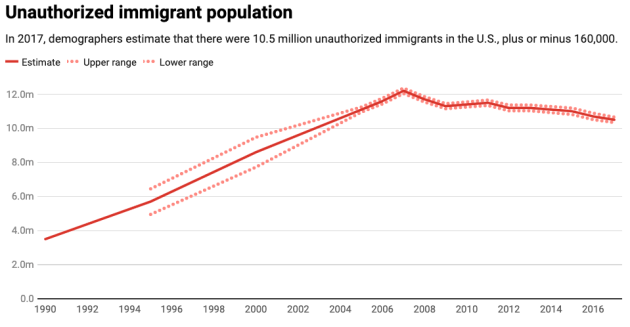
Our research on the methods used to estimate the size of the group indicates that existing estimates – putting the undocumented population at about 11 million – are reasonably accurate.
Here’s how it works.
What’s the formula?
Beginning in the late 1970s, a group of demographers consisting primarily of Jeffrey Passel, Robert Warren, Jacob Siegel, Gregory Robinson and Karen Woodrow introduced the “residual method” for estimating the number of unauthorized immigrants living in the country.
At the time, Passel and his collaborators were affiliated with the U.S. Bureau of the Census and Warren with the Office of Immigration Statistics of the Immigration and Naturalization Service. Much of this work was published in the form of internal reports, but some of it appearedinmajorjournals.
The residual method uses an estimate of the total foreign-born population in the country, based on U.S. Census data. Researchers then subtract from it the number of legal immigrants residing here, estimated from government records of legal immigrants who receive “green cards” minus the number that died or left the country. The result is an estimate of the unauthorized population.
Various adjustments are typically made to this formula. Most adjustments are minor, but a particularly important one adjusts for what researchers call “coverage error” among the unauthorized foreign-born. Coverage error occurs when the census data underestimate the size of a group. This can occur when people live in nonresidential or unconventional locations – such as on the streets or in a neighbor’s basement – or when they fail to respond to the census.
Coverage error could be particularly high among unauthorized immigrants because they may be trying to avoid detection. The Census Bureau’s own research suggests that asking about citizenship would likely aggravate this issue.
The residual method has been widely used and accepted since the late 1970s. Within a reasonable margin of error, it predicted the number of unauthorized immigrants to legalize under the Immigration Reform and Control Act of 1986, which, among other things, granted permanent residency status to unauthorized immigrants who had been living in the country since 1982. The residual method predicted that about 2.2 millionmet the residency requirement; the actual number to come forward was about 1.7 million.
Both Department of Homeland Security and Pew have used the residual method to estimate the unauthorized population since 2005. Despite using slightly different data and assumptions, Pew’s, Department of Homeland Security’s, and the Center for Migration Studies’s estimates have never differed by more than 1 million people, less than 10% of the total unauthorized population.
Nevertheless, skeptics question a key assumption of the residual method, which is that unauthorized immigrants participate in census surveys. All three organizations listed above inflate their estimates to account for the possibility that some unauthorized immigrants are missing from census data. For example, Pew inflates by about 13%. But is this enough?
My colleagues and I estimated coverage error among Mexican immigrants, a group that composes 60% of all unauthorized immigrants.
Even if they are not counted in a census, populations leave “footprints” of their presence in the form of deaths and births. Because people give birth and die with known regularity, regardless of their legal status, we were able to use birth and death records of all Mexican-born persons to determine the number of Mexican-born persons living in the U.S. We also looked at changes in Mexican census data between 1990 and 2010 to gauge the size of Mexico’s “missing” population, most of whom moved to the U.S.
We then compared these estimates with the estimated number of Mexican immigrants in census data. We found that the census missed as many as 26% of unauthorized immigrants in the early 2000s.
We speculated that this could have been due to the large numbers of temporary Mexican labor migrants who were living in the U.S. at the time. Because many worked in construction during the housing boom and lived in temporary housing arrangements, it may have been particularly difficult to accurately account for them in census surveys.
However, when the Great Recession and housing crisis hit, many of these temporary workers went home or stopped coming to the U.S. in the first place, and coverage error declined. By 2010, the coverage error may have been as low as 6% and does not appear to have changed much since then.
If current levels of coverage error for all unauthorized immigrants were as high as 26%, then the number living in the country could be as high as 13 million. But if coverage error were as low as 6%, then the figure could be as low as 10.3 million. The true number likely falls within that narrow range.
What this boils down to is that demographers already have a pretty good idea of the number of unauthorized immigrants living in the U.S., even without relying on citizenship data. If coverage error has declined as much as we think it has, then the truth is at the lower end of this range.
Will administrative records improve the estimates?
Looking ahead, methods could change as new data become available.
They want to link information on citizenship and immigration status in administrative records to everyone’s census responses. For example, the executive order requests the Department of Homeland Security’s records on refugee and asylum visas, as well as Master Beneficiary Records from the Social Security Administration. They want to use this information to estimate the undocumented population at very detailed levels of geography for purposes of redistricting, reapportionment and the allocation of public funds.
(It is worth noting that the Census Bureau is a fortress when it comes to protecting your data. Under federal law, the Census Bureau cannot share your personal information with anyone, including other government agencies such as ICE.)
Regardless of how anyone feels about these policy proposals, administrative data may not be up to the task. In my view, administrative records are complicated to use. They can provide inconsistent information about the same person depending on which agency’s records are used.
Additionally, the records will be of limited value for describing those who fall outside of the administrative records system, which can happen for all kinds of reasons. Even if the Trump administration uses administrative records to estimate the undocumented population, researchers will still need to make assumptions about coverage error, just like they do for the residual method.
Overall, I suspect that administrative records could help answer some narrowly defined questions about immigrants and improve national estimates. The jury is still out about their ability to provide definitive answers about the precise numbers of undocumented immigrants, particularly at detailed levels of geography.

 Multicultural Meanderings