Yes, you can hold an Australian passport but not be a citizen. Here’s how – Analysis & Opinion

For citizenship policy nerds and people falling between the cracks:

Being born in Australia does not make you an Australian citizen.

The Tamil family with two Australian-born daughters on Christmas Island awaiting a decision on their future knows this only too well.

In some countries, such as the United States, children born there automatically become citizens of that country.

But in Australia, this isn’t the case.

In Australia, the automatic birthright to citizenship ended on August 19, 1986, under section 12 of the Australian Citizenship Act 2007.

Children born in Australia from August 20, 1986 are only Australian citizens by birth if, at the time of their birth, at least one of their parents was an Australian citizen or permanent resident.

If they meet this criterion, they can obtain a passport.

The Department of Foreign Affairs and Trade (DFAT), which issues Australian passports, says: “Only Australian citizens can be issued with Australian passports”, but the Department of Home Affairs sometimes has other ideas.

This has had a negative impact on children who might fall into the gap between the passport and citizenship requirements of these two government departments.

Most of the time, acquiring an Australian passport at birth, based on providing standard evidence of identity, like birth certificates, means citizenship for life.

In some instances, though, Home Affairs has the power to request, arbitrarily and with no explanation, that further evidence be provided to justify a child’s citizenship, even DNA testing.

DNA testing to prove citizenship

In one recent case our firm dealt with, the foreign mother of an Australian child who had an Australian passport was told she needed to produce evidence of citizenship for her son, even though he was born in Australia and his father had always held Australian citizenship.

The family birth certificates and passports she had provided when successfully obtaining her child’s passport were “not deemed sufficient evidence” of citizenship.

She was required to obtain a “certificate of citizenship” from Home Affairs. And to get this, DNA testing was requested to prove the Australian citizen was indeed the biological father of the child in question.

But the mother’s relationship with the child’s father had broken down irreparably at the time of the child’s birth, and the father refused the DNA test.

DNA testing was not compulsory, Home Affairs advised. Other methods could be used to prove the relationship between the father and son was biological.

But the alternative social evidence recommended by Home Affairs, and supplied by the mother, included exhaustive personal, hospital, social work and government records.

They detailed the mother and child’s contact with the father and grandparents before and after the birth. This was still deemed “not sufficient”.
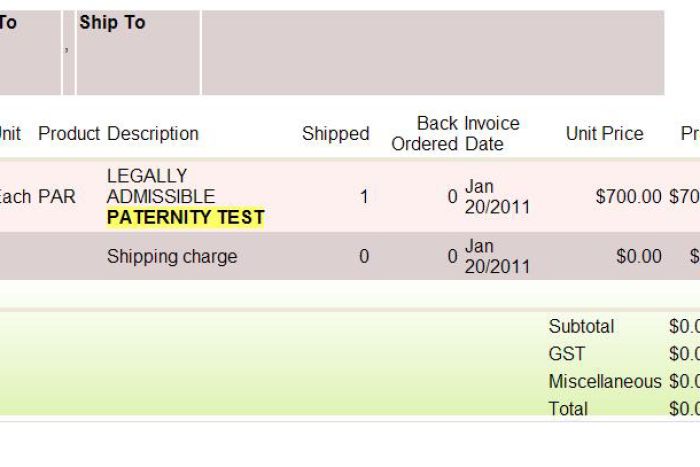
In effect, this shows DNA has become the only acceptable evidence, despite Home Affairs’ claims.

The outcome, Home Affairs advised, is that the child’s passport will be cancelled and the child will lose his status as an Australian citizen.

In another example, the father of a child in care, an Australian passport holder, was asked to do a DNA test as part of the process of obtaining a certificate of citizenship for the child.

He was estranged from the child and the mother, and so he refused. Home Affairs made its assessment of paternity based on that refusal, and the child’s passport and citizenship were cancelled.

Losing citizenship from ‘insufficient’ evidence

Citizenship can be revoked and a passport consequently cancelled in limited circumstances — mostly relating to criminal or security issues.

There is no provision in the Australian Citizenship Act 2007 for the cancellation of citizenship held by a child under 16 who became a citizen at birth.

Yet it is happening.

Our firm has recently seen an increase in cases where the citizenship status of a child passport holder has been challenged if the child’s mother is a temporary resident.

While investigating a mother’s circumstances, Home Affairs delegates have required children — Australian passport holders with citizenship acquired through their father — to verify their citizenship by obtaining “certificates of citizenship”.

In these recent cases, the evidence usually required to obtain such a certificate — relevant birth certificates linking the child to the father, and evidence of citizenship or permanent residence of the father at the time of birth — has been rejected as insufficient.

The common thread is the absence of the father, where family relationships have broken down.

The child is consequently caught in a bureaucratic tangle: their birth certificate identifying their father remains valid, but Home Affairs refuses to accept this.

Evidence of paternity can’t always be provided when families break down

For Home Affairs, sometimes the standard evidence of identity isn’t enough to justify a child’s citizenship.

And where a relationship has broken down, or if a father has moved on physically or emotionally from the child, there may be no way of providing biological proof of that paternity.

The onus of proof in this case is on the child or its mother, with Home Affairs providing no explanation why such evidence may be necessary or relevant.

A child’s birth certificate signed at the time of birth by an Australian citizen father, or social evidence of a paternal relationship, can count for nothing here.

What’s disconcerting is the apparently unfettered right of Home Affairs to request additional evidence of citizenship from children who already hold Australian passports, granted following the normal protocols, without any need for Home Affairs to explain on what basis such information is sought.

This is at odds with the practice under the Migration Act 1958, which acknowledges principles of “natural justice”.

Cancelling children’s passports and withholding citizenship — effectively a consequence of their absent father and their parents’ inability to maintain a harmonious relationship — seems clearly unjust.

Refusing to accept certificates issued by state Registrars of Births, Deaths and Marriages, and overturning the capacity of the Department of Foreign Affairs and Trade to issue passports based on its own sets of rules, is yet another indicator of the enormous and — despite its denials — unchecked power of Home Affairs.

If birth certificates no longer suffice as evidence of paternity, perhaps we’ll all be looking at DNA testing in the future.

Source: Yes, you can hold an Australian passport but not be a citizen. Here’s how – Analysis & Opinion

Surge in Gulf applicants for US scheme offering citizenship amid price increase

Still remarkable cheap sale of citizenship, even with the increase. Absolute numbers are small:

There has been a huge surge in Gulf residents applying to take part in an American scheme offering the chance to earn citizenship, ahead of new reforms due to come into effect on November 21, which will increase the cost of applying by 80 percent, according to industry experts in Dubai.

The EB-5 visa for Immigrant Investors was created by the US Immigration Act of 1990 as a way of encouraging foreign investment in projects across the United States.

At present, for a minimum investment of $500,000, investors can apply to be part of the scheme, which can lead to a green card and the chance of full American citizenship after five years.

Last month, the EB-5 Modernisation regulations were introduced, meaning that, from November 21, the minimum investment amount for projects classed as targeted employment areas will increase from $500,000 to $900,000. At the same time, the minimum investment for non-targeted employment area projects will increase from $1 million to $1.8 million.

This has led to a surge in applications as potential investors look to get their paperwork filed before the November 21 deadline.

“I have seen almost more than 100 percent surge in applications as it has been out there now for nearly a month,” Preeya Malik, managing director of Step America, a Dubai-based firm which offers the EB-5 visa scheme, told Arabian Business in an interview on Wednesday.

“People are getting to know about it and it is the first time since 2015 they have written a price increase into legislation. If we were getting five applications every week, now we are getting five people almost every other day. People who have been sitting on the fence, this has been the deciding factor to move forward,” she added.

Higher cost bracket

The majority of applicants coming from the GCC are in the higher cost bracket, which are projects in metropolitan districts – or those classed a ‘non-targeted employment areas’ – which are keen to use the scheme to encourage overseas investments.

Targeted employment areas are classed as areas in the US which are economically challenged and have an unemployment rate more than 150 percent of the federal average.

There has been talk over the last few years of an increase in the cost of participation in the EB-5 scheme, which led to a dramatic increase in the number of approvals from the GCC, which collectively rose 564 percent to 93 approvals – a majority of them expats – in 2018.

A total of 54 UAE residents were approved for the programme in 2018, a 350 percent jump from the year before. Neighbouring Saudi Arabia, which saw just a single approval in 2017, recorded 15, a 1,400 percent increase.

Malik said the nationalities looking to take part varied a lot, but the motivation was usually the same, to support their families and children and help them to obtain a green card or passport in the US.

“We have a lot of Arab clients, Pakistani, Indian, but definitely the same in that they are wanting to do it for their children, that is the same no matter the nationality,” she said.

Source: Surge in Gulf applicants for US scheme offering citizenship amid price increase

Germany eases citizenship rules, but Jewish roadblocks remain – Monash Lens

One of the more lengthy and comprehensive analyses:

Germany’s constitution contains a provision that permits citizenship to be granted to descendants of persons stripped of their German citizenship by the former Nazi regime for political, racial or religious reasons.

In practice, this provision, Article 116(2), is mostly – although not exclusively – directed at descendants of Jewish refugees from Germany. Approximately 7000 German Jews fled to Australia before World War II, due to the policies of the Nazi regime, and there are many descendants in Australia who now wish to become German citizens.

However, the German parliament has not properly implemented Article 116(2) in its citizenship law. German legislation precludes the granting of citizenship to various groups of descendants of Jewish refugees.

Many applicants have been denied citizenship on the basis that the affected family member was female, because citizenship passed only through the father at the time the German constitution was enacted.

Other applications are denied because German authorities contend that the applicant’s female ancestor willingly gave up German citizenship by marrying a non-German man after escaping Germany.

In other cases, the authorities have denied applications to the descendants of those who the authorities argue left Germany “voluntarily” during the Nazi reign and willingly relinquished their German citizenship — a position that flies in the face of historical realities. And some applicants have been denied citizenship on the basis that their parents were unmarried, or that the applicant was adopted.

We can see no rational reason why these groups of descendants are excluded for eligibility for German citizenship. As Article 116(2) of the constitution seeks to provide a form of restitution for past injustices, it’s imperative that this provision is interpreted in a generous fashion, without drawing arbitrary distinctions between descendants.

An inconsistent law

A very strong argument can be made that the law is inconsistent with the right to equality under the German constitution, not to mention Germany’s obligations of non-discrimination and the right to private and family life under the European Convention on Human Rights, to which Germany is a party.

On 30 August, the German government issued a decree that attempts to rectify some of the discriminatory aspects of the law. The decree addresses some aspects of the gender discrimination in the current law, and extends citizenship rights to those born before 1949, who were until now precluded from eligibility by a 2012 decree.

However, the decree does not completely remedy the discrimination in the law.

For example, children born out of wedlock to a German mother would be excluded, whereas children born out of wedlock to a German father would be eligible. Moreover, citizenship won’t be granted unconditionally to those who become eligible. Rather, applicants will need to demonstrate German language competence and knowledge of Germany’s legal and social order.

The determination of whether these criteria are satisfied in an individual case is to a large degree discretionary, based on a subjective assessment made by German consular officials. In light of Germany’s track record in relation to granting citizenship under Article 116(2) of the constitution, there’s a need for greater transparency and more objective decision-making criteria to ensure the decree is given effect to in the manner it was intended.

Another issue is that by requiring certain groups to pass the above tests but not others, the law perpetuates gender discrimination. For example, descendants of female ancestors need to demonstrate German language skills, but descendants of male ancestors do not.

Moreover, the generation born after 31 December, 1999, would be the last generation to be eligible under this decree to obtain German citizenship. Although an argument can be made that the rationale for restitution lessens with the passage of time, we can see no justification for limiting eligibility to this timeframe.

There are also serious questions as to whether this type of rule-making by decree is appropriate, not to mention constitutionally valid.

The difference between a decree and legislation isn’t merely symbolic. A future government could revoke the decree with the stroke of a pen, whereas changing legislation requires that the proposed law be debated by parliament.

A law, properly debated and enacted through Germany’s parliamentary procedures, faces much higher hurdles for reversal.

Another provision of Germany’s constitution requires that certain “essential” decisions must be made by parliament, rather than by the executive branch of government in the form of a decree.

In our view, there’s a strong argument that this issue is one that can only be dealt with by parliament.

Germany has a largely commendable track record in confronting its Nazi past. It should do right by the descendants of those who had to flee to save their lives.

Germany has a largely commendable track record in confronting its Nazi past. It should do right by the descendants of those who had to flee to save their lives – end decades of protracted, unjustifiable and arbitrary discrimination by enacting a law that provides for a simple path to citizenship for all descendants.

Requiring descendants to fight for their rights in the courts would add insult to injury, and would be particularly difficult for descendants in countries on the other side of the globe such as Australia.

Source: Germany eases citizenship rules, but Jewish roadblocks remain – Monash Lens

Ethnic media election coverage 25-31 August

Latest weekly analysis of ethnic media coverage. For the analytical narrative, go to Ethnic media election coverage 25-31 August

Citizenship list in Indian state leaves out almost 2 million

Increased sectarianism, weaponized:

On Saturday morning, Farid Ali, a farmer dressed in his best sky-blue kurta and a white prayer cap, walked quietly into his village headquarters and received devastating news.

His name wasn’t on the list.

He looked, he waited, his legs began to shake, his dry lips began to move and he prayed there had been a mistake. But his name wasn’t anywhere.

Mr. Ali’s citizenship in India, where he has lived all his life, was now in question, and he could soon be separated from his family and hauled off to a prison camp.

He is one of nearly two million people in northeast India who were told Saturday that they could soon be declared stateless in a mass citizenship check that critics say is anti-Muslim. The news arrived in small, sunlit offices across the state of Assam, where citizenship lists were posted that drew huge crowds. Many walked away shocked and demoralized; others were joyous.

Source: Citizenship list in Indian state leaves out almost 2 million

WeChat not included in government’s discussions with social media on protecting election

Seems like an oversight given the many signs of Chinese government interference with Chinese Canadians:

The office of Democratic Institutions Minister Karina Gould chose not to include a popular Chinese-language app in discussions it had with major social media platforms about protecting the upcoming federal election.

Gould unveiled her government’s plan to protect the upcoming federal election from interference at a press conference in January. One aspect of the four-pronged plan was entrusting social media platforms “to act.” In a practical sense, the government has asked platforms to ensure they’re not being exploited to spread disinformation and that they adhere to the new election laws introduced by the Liberals in Bill C-76, which pertain to them.

“As the Minister has said, we expect social media platforms to take concrete actions to help safeguard this fall’s election by promoting transparency, authenticity and integrity on their platforms,” Meg Jacques, spokesperson for Gould, told iPolitics in an email last week.

In the lead up to the election, the government has had back-and-forth dialogue with the companies that operate many of the major platforms. In letters dated June 21 and obtained by iPolitics through an access to information request, Gould wrote to companies including Snap Inc. (which owns Snapchat), Google, Microsoft, Twitter and Facebook, reiterating her expectation that they “ensure the 2019 election is free and fair.”

Gould has also previously said she had been in touch with Reddit and Pinterest. She never reached out to WeChat.

Asked for a reason why her office didn’t communicate with WeChat like it did with others, Jacques said that the minister’s office chose to work with major social media platforms that had “an established corporate presence in Canada.”

WeChat does not have company offices in Canada. Reddit does not list an office in Canada on its website, either.

In the June 21 letters, Gould requested each of the companies to affirm their commitment to the “Canada Declaration on Electoral Integrity Online.” Announced by Gould about a month earlier in the House of Commons, the declaration includes a dozen measures for platforms to follow to ensure democratic precesses like the election aren’t meddled with.

Gould also wrote to the companies asking that they respond with a description of the actions they’ll be taking during the writ and newly introduced pre-writ period. The letters also outline to the companies who in each of the government’s law enforcement bodies are their point people in cases where they may identify potential nefarious actors attempting to exploit their platforms.

WeChat

WeChat is a Chinese messaging, social media and e-commerce app. It’s widely used by Chinese speakers around the world, with approximately 1.1 billion monthly active users. By comparison, Facebook reported 2.7 billion monthly users across its apps — which include Messenger, WhatsApp, Instagram and, of course, Facebook — during the first quarter of this year.

WeChat is a popular platform for Chinese-language news, but the company has been previously criticized for censoring certain news. In December, StarMetro Vancouver reported that the app had been blocking stories about Huawei executive Meng Wanzhou’s bail hearing, before once again allowing readers access to stories once she was released on bail.

The recent 30th anniversary of the Tiananmen Square massacre was another instance when pictures and keywords related to an event were kept off WeChat.

The app was thrust into the Canadian political spotlight earlier this year because of an incident during the Burnaby South byelection. Liberal Party candidate Karen Wang was the source of a controversy for posting on the app, urging voters to support her because she was Chinese, instead of NDP Leader and byelection candidate Jagmeet Singh, who she described as being “of Indian descent.” Wang resigned as the Liberal candidate shortly after.

Earlier this year, all MPs were warned to be wary about conducting official business on WeChat because of concerns that the House of Commons cybersecurity team had with the app.

At that time, iPolitics reached out to the offices of all MPs who represented ridings where the Chinese population made up at least 30 per cent of the riding’s total community, according to data collected in the 2016 census. Three MPs, Liberal Jean Yip and Conservatives Alice Wong and Bob Saroya, said at that time they used or had used the app in the past, in their role as a federal representative. Yip and Wong both planned to continue using the app. Each of the MPs described using it similarly to how they used other social media platforms.

iPolitics attempted to contact WeChat for this story by reaching out through multiple points of contact. The company did not respond.

Jacques said government officials “continue” to communicate with social media platforms in the lead up to the election.

“(Officials) are encouraged by their efforts to date to address online disinformation,” she said.

Like the platforms that Gould’s office has maintained a dialogue with, WeChat is bound by online advertising rules introduced by the Liberals in Bill C-76, which, among other things, require it to keep political ads displayed in a registry, if they’re shown on the platform.

Election Advertising

On Tuesday, Braeden Caley, spokesperson for the Liberal Party, wouldn’t say whether or not the party would use WeChat to advertise ahead of the election. The People’s Party hadn’t yet made a decision about whether or not it will advertise on WeChat, according to its executive director Johanne Mennie. The other three parties that are expecting to run candidates in all 338 ridings did not get back to iPolitics about whether or not they plan on advertising on the app, by the time this story was published.

Source: WeChat not included in government’s discussions with social media on protecting election

USA: Federal Workers’ Children Born Abroad May Not Receive Automatic Citizenship

As part of the change to limiting transmission of Canadian citizenship to the first generation abroad in 2009, the Conservative government initially applied the same limitation to the children of “crown servants” born abroad (e.g., diplomats and military), largely I believe given that the government thought that a carve-out in this case would make it politically harder to sell a significant change that applied to all Canadians.

In 2014, the exemption for crown servants was included in C-24:

Children born abroad to certain United States service members and other federal employees will no longer be granted automatic citizenship under a Trump administration policy set to take effect in October.

Parents of those children, including those born on military bases, will have to apply for citizenship on the children’s behalf before they turn 18, according to a United States Citizenship and Immigration Services policy released on Wednesday.

The policy appeared to be aimed at military families who have not lived in the United States for years. According to the immigration agency, the change would not affect the children of families with at least one parent who is an American citizen and has lived in the United States for at least five years.

It was unclear how many families the change would affect.

A spokeswoman for the Pentagon said the impact would be small, without specifying how many parents would be required to apply for citizenship for their children under the change. A spokeswoman for the citizenship and immigration agency, which oversees legal immigration, also declined to provide the number of families who would be affected.

Greece preparing citizenship by investment scheme similar to Cyprus’

More on competition among countries:

Local land developers but also service sector professionals are becoming concerned by reports that Greece’s new government is planning to launch a  citizenship by investment scheme similar to that of Cyprus.

The scheme provided by Nicosia in recent years has substantially contributed to the recovery of the Mediterranean island’s economy.

The new right-wing government under Kyriacos Mitsotakis is drafting its own citizenship by investment programme which resembles the Cypriot one and, thus, will be quite competitive, according to informed sources.

One source told Phileleftheros that the new programme is expected to be implemented after the first quarter of 2020 and may involve investments of €2.5 million. Cyprus’ investment limit is €2 million, plus VAT. In the case of Greece, the plan is for VAT payment to be deferred for a period of three years. This basically means that at the time of the investment the cost will essentially be the same as that in Cyprus.

Undoubtedly, the implementation of such a programme by Greece will create strong competition for Cyprus. Greece, as a brand name, is stronger and more versatile. So are some of its areas or islands as well. This means that far more investment opportunities will be on offer, especially in the sector of ​​land development. The areas that will fall under the scheme’s criteria have not been disclosed yet.

At the same time, as a larger country that has been in recession for many years it offers more investment opportunities, plus connectivity is also an important factor for foreign investors. Another advantage of Greece taken seriously in consideration by foreign investors is that one does not need a visa to travel to the US.

Source: Greece preparing citizenship by investment scheme similar to Cyprus’

Ethnic media election coverage 18-24 August

Latest weekly analysis of ethnic media coverage. For the analytical narrative, go to diversityvotes.ca Ethnic media election coverage 11-17 August 2019:

New Canadians take Oath of Citizenship at ceremony tied to Capital Pride

Noteworthy:

As about 50 people became Canadians at a special citizenship ceremony held at the Horticultural Building at Lansdowne Park Thursday morning, 25-year-old Roksana Hajrizi and her mother, Celina Urbanowicz, looked on from the just outside the area cordoned off for officials, volunteers, celebrants and their friends and families.

They watched as Bibiane Wanbji, who six years ago left her husband in Cameroon and brought her four children to Canada to find a better life, smiled at the vastness of the world that had just opened up to her. Having a Canadian passport, Wanbji explained, means she can travel just about anywhere. She hasn’t seen her extended family and friends back in Cameroon since coming to Canada, so that’s a definite destination. So, too, are the U.S. and Cuba, and “the city of love” that she’s always wanted to visit: Venice. “It’s like a passport for the world.”

And although she’s been in Canada for six years already, Thursday’s ceremony left Wanbji feeling a bit different, she said, that she has “more to give in this country, to contribute to build the country.”

Hajrizi and her mother watched, too, as 50 new Canadians, including Haguer Abdelmoneim and her children, Mahmoud, 10, and Youssef, 5, sang their new national anthem. They and Abdelmoneim’s husband came from Egypt in 2014 “for a better education for the kids” and “for a better community to grow in.”

They didn’t just choose somewhere other than Egypt, she added; they specifically chose Canada. “We like the values. It’s a very inclusive country, very welcoming to newcomers.”

Another “new” Canadian, Saiful Azad, who arrived on Canada’s shores from Bangladesh 21 years ago, agrees. “A lot of people don’t understand how important it is to be a Canadian citizen and the opportunities that are given to you here,” he said. “I don’t believe the U.S. is the land of opportunity; I believe Canada is.”

Like Wanbji, Azad, who operates a Greek on Wheels franchise in Hunt Club, cherishes his new-found ability to travel as much as his right to vote. “When you’re a Canadian citizen, people look at you differently and treat you differently. Everyone thinks that Canada is a great country, and I think they’re right.

“People who live here and want to be Canadian citizens should pursue that.”

Thursday’s event was unlike most citizenship ceremonies in that it was one of about 75 sponsored each year by the Institute for Canadian Citizenship, a national not-for-profit charity that promotes active and inclusive citizenship.  As at other ICC-hosted citizenship ceremonies, this one opened with intimate roundtable discussions at which soon-to-be Canadians were engaged in conversations with other community members.

A lot of our soon-to-be Canadians have had long journeys and long stories in getting here,” said ICC chief executive and former Ottawa-Centre Liberal MPP Yasir Naqvi just prior to the start of the ceremony, “so we want to talk a little about that. But most importantly we want to talk about what the journey is going to be like after they become Canadian citizens. How are they now going to contribute to the building of Canada? We want to promote active citizenship.”

Thursday’s ceremony was also co-hosted by Capital Pride, a first for both organizations.

“It’s an opportunity for our community and the candidates for citizenship to engage in dialogue about what our community is about and what the experience of being 2SLGBTQ is,” said Capital Pride founding director Sarah Evans. “A lot of newcomers, and even established immigrants, don’t always know a lot about the 2SLGBTQ community, so it’s a good opportunity to build that awareness.”

As she watched from the sidelines, Roksana Hajrizi was keenly aware. Describing herself as a “proud lesbian,” she attended Thursday’s ceremony partly in support of Capital Pride, and also to congratulate those being sworn in as new Canadians. “I am proud and happy for those who are Canadians today,” she said, “and I hope that one day my family and I could be citizens of this great country.”

Truth be told, Hajrizi already feels very much Canadian. She was just three years old when she and her family — her mother, father, Ismet Hajrizi, and younger sister, Camila, arrived in British Columbia from war-torn former Yugoslavia almost 23 years ago. She even has two brothers born in Canada: Sebastrijana, 22, and Daniel, 19.

But she, her mother and sister are living in Canada without official status, in constant anxiety that they will be deported. They are Roma — her mother a Polish Catholic Roma, her father a Yugoslavian Muslim one. Romas are not welcome in most places, she says, and gay ones even less so.

The United Nations’ Office of the High Commissioner for Human Rights has noted the discrimination that Roma people face worldwide, an Anti-Gypsyism expressed by “violence, hate speech, exploitation, stigmatization and the most blatant kind of discrimination.”

Hajrizi’s family was denied refugee status, and now she fears for her life and the lives of her sister and mother if they’re forced to leave the country. In 2008, her family, except for her brothers, was scheduled for deportation but was given a reprieve.

Still, Hajrizi’s father, she says, despite being a Serbian citizen, was deported in June to Kosovo, where he lives in a garage with no papers. She, with no birth documents herself, worries that it’s just a matter of time before she and her mother and sister will suffer similar fates, that she will never get to be on the other side of Thursday’s ceremony, that despite living in Canada for very nearly her whole life, she will never know what citizenship is like.

“I believe in my heart that I’m Canadian. I believe in my heart that my sister is Canadian. I believe my mother and farther are also Canadian. We’ve been here for 23 years and our roots have spread through Canadian soils. We have given our time, our compassion, our love, our kindness to our community, to our city. People who know us know that we are a good family.

“My family is being ripped apart,” she said. “My father was taken from us, and now my mother is next. But we will fight to stay in Canada.”

Source: New Canadians take Oath of Citizenship at ceremony tied to Capital Pride