Bipartisan bills proposed on Capitol Hill to help children of service members overseas acquire citizenship automatically

One of the even less explainable citizenship policy changes of the Trump administration:

A bipartisan effort on Capitol Hill is underway to make the children of service members stationed overseas automatically Americans, responding to a new federal policy that forces some parents to apply for their child’s U.S. citizenship.

In August, Department of Homeland Security’s U.S. Citizenship and Immigration Services announced a new policy addressing the definition of “residence” in the Immigration and Nationality Act. It affects children of service members and civilians living abroad who did not acquire citizenship at birth or while they were living in the United States.

Under section 320 of the Immigration and Nationality Act, a child born outside the United States can automatically become a citizen if they are physically living in the United States with their parent who is a citizen. With the new policy that goes into effect Tuesday, these children will no longer be considered “residing in the United States” as they had been in the past and a parent will have to apply for their child’s citizenship before the child turns 18 years old.

When the policy was announced, President Donald Trump’s administration was criticized for its immigration policies and how the change would negatively impact military families. There was also widespread confusion about what the change actually meant and who was affected, with some initial reporting interpreting the policy to mean that military children were being denied citizenship.

On Wednesday, Sens. Tammy Duckworth, D-Ill., and Johnny Isakson, R-Ga., announced they have introduced a bill called the Citizenship for Children of Military Members & Civil Servants Act that would modify section 320 of the Immigration and Nationality Act so children of service members who are stationed overseas can automatically acquire U.S. citizenship.

“Children of Americans serving their nation abroad are just as worthy of automatic citizenship as any other children,” Duckworth said in a prepared statement. “Forcing military families to jump through bureaucratic hoops and spend hundreds of dollars applying for citizenship on behalf of their children is not right.”

The USCIS policy change would force families to pay an application fee of $1,170 per child, according to the senators’ statement.

The policy change was estimated to affect between 20 and 25 people annually, based on data compiled by the USCIS during the last five years from overseas applications with Army or Air Force Post Office and Fleet Post Office mailing addresses, according to a USCIS official in August who spoke about the issue on the condition of anonymity.

Isakson called the bill “commonsense legislation” to help military families that is overdue.

“We should be doing all we can to ease the lives of our all-volunteer force, not add needless hurdles for them and their families,” he said in the prepared statement.

A bipartisan companion bill was also introduced in the House by Jerrold Nadler, D-N.Y., and Doug Collins, R-Ga., according to the statement.

Source: Bipartisan bills proposed on Capitol Hill to help children of service members overseas acquire citizenship automatically

From UK ex-pat to EU citizen: A huge rise in Brits getting another EU passport

Good summary of the numbers. Would be interesting to see the percentages of UK citizens applying for EU member citizenship:

A new study conducted by Oxford in Berlin and the WZB – Berlin Social Science Center has revealed that the number of Brits receiving German citizenship has risen by over 1000% since the Brexit referendum in 2016: While 622 British citizens received German citizenship in 2015, numbers jumped dramatically to 7,493 ‘naturalisations’ in 2017 and predictions for 2019 are higher than all previous years.

Figures released by the OECD for the whole continent show a similar trend of Brits acquiring another EU citizenship with a rise of 600% in ‘naturalisations’. With Brexit, deal or no–deal, all British citizens living in the UK or elsewhere stand to lose their European citizenship rights such as freedom of movement or recognition of qualifications. Obtaining the nationality of an EU member state is a way for British citizens to guarantee maintaining EU citizenship rights that many peoples professional and personal livelihoods over the years have come to depend on.Rachel from Loughborough who gained dual citizenship in 2018 and now lives in Berlin says:

Getting German citizenship has given me a whole new confidence and security that I had lost.

The study conducted by Oxford in Berlin and the Berlin Social Science Center (WZB) interviewed British citizens who have arrived in Germany over the last decade with a wide sample in social background, age and profession. The huge spike in post-2015 naturalisations (both UK citizens in the EU and EU citizens in the UK) is marked by the survey data as almost entirely motivated by the Brexit referendum.

According to migration researcher and co-author of the study Dr. Daniel Auer:

These dramatic jumps tell us we’re onto a significant social phenomenon here whose implications are yet to be understood.

If there were to be a no-deal Brexit at the end of this month, new applications for German citizenship from British citizens would require them to give up their UK citizenship because German law stipulates that only EU citizens can acquire dual-nationality.    Therefore, those Brits that want to maintain their European citizenship rights will have to give up their British citizenship, a heart-breaking and impossible prospect for many.

Alex, a start-up business owner who moved with his wife and two children from the UK to Germany in 2013 said:

We are being hung out to dry by the politicians from both sides. With my German language level, I’d have no chance of securing German citizenship and even if I could in the future, I wouldn’t want to give up my British passport. I just have to trust the German Government to keep their word and not kick us out.

While the legal consequences of Brexit remain so uncertain, people like Alex and Rachel – along with more than 5 million other EU or UK migrants on both sides of the channel – are taking often large risks to do whatever they can to mitigate the pending impact of Brexit on their lives.

Source: From UK ex-pat to EU citizen: A huge rise in Brits getting another EU passport

Ethnic media election coverage 13-20 October

Latest weekly analysis of ethnic media coverage. For the analytical narrative, go to Ethnic media election coverage 13-20 October:

Sale of citizenship ‘ruining Malta’s reputation’ – PN

Yet another example of the inherent corruption of citizenship-by-investment programs:

A news report saying that a person who bought Maltese citizenship is facing serious accusations of fraud in the United States and Israel in yet another blow to Malta’s reputation, the Nationalist Party said in a statement.

This person was among the first to buy a Maltese passport, another for his wife and for their children, the PN said.

This is the fifth person to buy Maltese citizenship who is facing criminal accusations of fraud, money laundering and tax evasion. This brings to nothing the government’s boasting of a four-tier due diligence that is adopted before foreigners are allowed to buy Maltese citizenship.

The PN said that it has always insisted that such a scheme could give a bad image to Malta. Only a few weeks ago a firm involved in the sale of passports was caught boasting of its strong connections with the government.

In the light of this, the PN is once again calling upon the government to suspend the scheme.

Source: Sale of citizenship ‘ruining Malta’s reputation’ – PN

Opinion: It’s time for India to adopt dual citizenship

An issue, particularly for the highly skilled and mobile:

As Abhijit Banerjee’s Nobel Prize was announced, a reporter in Kolkata asked his mother about his citizenship, pointing out that he became a US citizen in 2017. “He travels a lot,” his mother explained.

The Indian passport ranks a poor 86 as of 2019, down from 77 in 2010. This rank signifies how many countries give visa-free entry or visa-on-arrival to the passport-holder. With a large number of poor people, India is one of the world’s biggest sources of illegal immigrants (311 Indians have just been deported from Mexico). Developed countries are not going to give the Indian passport easy access into their airports anytime soon, no matter how much of a world ‘power’ anyone thinks India has become.

It is for this reason that talented and wealthy Indians who travel frequently and live abroad tend to take foreign citizenship. The act of taking foreign citizenship, for most Indians, is not ‘anti-national’ but a matter of convenience. Anyone who has filled up a US or UK visa form will empathise.

Between 2014 and 2017, 4.5 lakh Indians opted for citizenship of another country. As foreign countries offer easy citizenship in exchange for cash and investments, the trend is only set to grow.

It is plain silly for the Indian government to not offer dual citizenship to such Indians. Eighty-five countries in the world offer dual citizenship. India needs to join this long list to avoid embarrassments such as an Indian winning the Nobel Prize but not beingan Indian citizen.


Overseas unCitizen of India

India does offer something called the “Overseas Citizen of India” card. Yet, these “overseas citizens” are not citizens because India doesn’t have the option of dual nationality.

The OCI status amounts to partial citizenship. It removes all barriers to entering, exiting, living and working in India. What it doesn’t allow is the right to vote.

If you don’t like Abhijit Banerjee, think of Akshay Kumar. At some point in his life, the Bollywood actor took Canadian citizenship, probably to enable easy international travel. At another point in his life, he decided to re-brand himself as a great nationalist from an action hero, because that was the flavour of the season. As people questioned how his nationalist credentials could go hand-in-hand with his Canadian citizenship, Akshay Kumar claimed it was an honorary citizenship, a lie that was nailed. 

Had India allowed Akshay Kumar to call himself a dual citizen, vote in elections, have an Indian passport alongside his Canadian passport, what would happen? Would the heavens fall? Would it cause climate change?

It is an emotionally difficult decision for most people to give up their Indian passport, often for easier international travel or to pay lower taxes or benefit from the social security services in countries where they live. For both taxation and national pride, it would help India to let Indians have dual citizenship.

Addressing intricacies

Narendra Modi and Donald Trump recently addressed thousands of Indian Americans in Houston, Texas. Some in the crowd must have had Indian passports and some must have had American passports. For neither Modi nor Trump, there seemed to be any conflict of interest. For both leaders, the crowd could have dual allegiance, to both India and the United States, at the same time.

No wonder a recent survey has shown that Indian Americans are in favour of dual citizenship. However, Vijay Chauthaiwale, head of the Bharatiya Janata Party’s foreign cell, has ruled out the possibility of India granting dual citizenship. “There are a lot of intricacies involved (in dual citizenship). So, I don’t see that happening in the near future,” he has reportedly said.

Many countries have found a way around the technical issues involved. Bangladesh requires its citizens to obtain a “dual nationality certificate” so that it can control who gets to take dual citizenship and under what circumstances. Brazilians can acquire another country’s passport but they must enter and exit Brazil only on the Brazilian passport. Canada actually encourages dual citizenship; the US discourages but allows it. If the concern is security, one can look at Pakistan, which allows its citizens to hold dual citizenship of only 16 other countries, doesn’t let dual citizens run for public office or join the military. Signing dual citizenship agreements with other countries helps prevent its misuse.

Blood ties

There are no ‘intricacies’ that can’t be addressed. The main issue, however, is nationalism. Allowing dual citizenship in India seems unthinkable because it would hurt national pride. Our nationalism is monogamous, it demands exclusive love. But the world is increasingly polygamous. One can love two countries, or maybe three — some countries even allow multiple nationalities.

The countries that allow dual citizenship belong to both the developed and the developing world. They do so because they realise it is the wise choice in a globalised world of easy travel. Narendra Modi often tells ‘Overseas Citizens of India’ that blood ties matter more than the colour of the passport.

Exactly. So why not let people have different passports of different colours. If Akshay Kumar can be a Canadian citizen and an icon of hard Indian nationalism, if Abhijit Banerjee can be a US citizen and still make India proud, it is time for India to accept dual nationality.

It might just also make us go easy on our jingoism.

Source: It’s time for India to adopt dual citizenship

USA: Immigration Head Says No Amendment Needed To End Birthright Citizenship

Stating it doesn’t make is so:

Ken Cuccinelli, the acting director of U.S. Citizenship and Immigration Services, said Wednesday that ending birthright citizenship does not need a Constitutional amendment.

“I do not think you need an amendment to the Constitution. I think the question is do you need congressional action or can the executive act on their own,” Cuccinelli said during a breakfast event hosted by Christian Science Monitor.

The discussion of birthright citizenship, which is citizenship conferred on those born in the United States regardless of the citizenship status of their parents, has been a topic of debate under the Trump administration.

In August 2019, President Donald Trump told reporters that his administration was “very seriously” looking at birthright citizenship “where you have a baby on our land, you walk over the border, have a baby,-congratulations, the baby is now a US citizen…It’s frankly ridiculous.”

In an interview with Axios in October 2018, Trump claimed that he intended to end birthright citizenship through an executive order, but received considerable push back on the legality of that approach.

Then-Speaker of the House Paul Ryan responded to the comments saying that birthright citizenship could not be ended by executive order because “the 14thAmendment is pretty clear.”

Despite strong rhetoric from the White House on pursuing the agenda, experts in constitutional law assert that an amendment would be required.

“Yes, it would require a constitutional amendment, and almost everyone else working on this topic would agree,” Ian Bartrum, a law professor at University of Nevada, Las Vegas told Newsweek.

Birthright citizenship is protected by the 14th Amendment of the Constitution which states, “All persons born or naturalized in the United States, and subject to the jurisdiction thereof, are citizens of the United States and of the State wherein they reside. ”

Bartrum mentioned that the 14th Amendment was created to overturn the Dred Scott case, which allowed states to deny citizenship to the descendants of former and freed slaves. He noted that overturning that amendment would be questionable.

A constitutional amendment can be proposed either by a two-thirds majority in both houses of Congress or by a call for a constitutional convention by two-thirds of the state. The proposed amendment would require ratification for three-quarters of state, making the possibility of such action quite low.

How relatives and allies of Cambodia’s ‘iron fist’ leader gained Cypriot citizenship

Long read with another reminder of the inherent corruption of citizenship-by-investment regimes:

Cambodia’s long-ruling prime minister, Hun Sen, had gathered athletes at his imposing office for a televised pep talk. “I don’t want to mention politics,” he began quietly.

But he couldn’t help himself. It was December 2017. The main opposition party had just been outlawed, the latest move in Hun Sen’s campaign to eradicate his political rivals. The United States and European Union were threatening sanctions, and Hun Sen had a message for them.

“Just do it now if you are brave enough,” he taunted, bristling with outrage. There was no point in the West trying to seize the foreign assets of Cambodian officials, he went on, because they “wouldn’t be so damn stupid as to keep their assets overseas.”

But a Reuters investigation shows that those closest to Hun Sen have done exactly that. Family members and key police, business and political associates have overseas assets worth tens of millions of dollars, and have used their wealth to buy foreign citizenship – a practice Hun Sen has decried as unpatriotic and at times has sought to outlaw.

Among those who have acquired or applied for European Union passports through a citizenship for sale arrangement in Cyprus are: Hun Sen’s niece and her husband, who is Cambodia’s national police chief; the country’s most powerful business couple, who are old family friends; and the finance minister, a long-time Hun Sen adviser.

Photos on social media also show Hun Sen’s relatives enjoying luxurious European lifestyles – boating in Capri, skiing in Verbier, partying in Ibiza – which are at odds with the prime minister’s self-styled image as the humble leader of ordinary Cambodians.

Hun Sen is 67 and has ruled Cambodia with an iron fist for more than three decades. He has jailed or exiled political rivals, shut down media outlets and crushed street protests. Only three men have controlled their countries for longer: the presidents of Equatorial Guinea, Cameroon and the Republic of the Congo. If Hun Sen stepped down tomorrow, Vladimir Putin would have to rule Russia for another 15 years to match his time in power.

Yet challenges remain for Hun Sen. Popular dissatisfaction still simmers, say political analysts. In February, responding to his crackdown, the European Union began a process that could suspend Cambodia’s special trade preferences, potentially damaging industries that employ hundreds of thousands of workers. The country’s political and business elite is on edge, a government insider told Reuters, speaking on condition of anonymity.

“Everyone is making an escape plan,” he said.

Hun Sen’s government didn’t respond to questions from Reuters for this article. Hun Sen’s relatives and associates also chose not to respond, with the exception of one member of the extended family. Hun Panhaboth, the son of another niece, defended his lifestyle in messages sent to Reuters through his Facebook page. An Instagram photo shows him driving a Mercedes while holding a fistful of banknotes. “I really don’t see the harm in that anyways,” he said.

AN ESCAPE ROUTE

One Cambodian with overseas assets is the prime minister’s niece, Hun Kimleng. Photos posted on Instagram by a family nanny helped lead Reuters to a posh apartment in central London, situated only a few hundred metres from the palace of the Duke and Duchess of Cambridge.

Hun Kimleng bought the apartment in 2010 for £1.95 million ($2.5 million), according to official property records. It could now be worth at least £3.5 million, estimates the real estate website Zoopla. She also owns a multi-million-dollar apartment in a luxury condo in Singapore, according to the Singapore Land Authority.

In 2016, she became a citizen of a foreign country: Cyprus.

Hun Sen has frequently denounced his political rivals for obtaining second passports, once declaring them “an escape route from difficulties in Cambodia.” His niece’s Cypriot citizenship is confirmed by a confidential document sent by Cyprus’s Ministry of Interior to its cabinet, which Reuters has seen.

Getting a Cypriot passport also makes the niece a citizen of the European Union, which Cyprus joined in 2004. This gives her the right to live, work and travel without visas in 28 EU countries.

Becoming a Cypriot isn’t cheap: It involves an investment of at least €2 million ($2.2 million). Between 2013 and 2018, the country granted citizenship to 3,200 foreigners under its Cyprus Investment Programme, raking in €6.6 billion.

The Cyprus interior ministry document confirming Hun Kimleng’s citizenship is dated 21 November 2017. It also recommends that the cabinet grant citizenship to her husband, Neth Savoeun, and two of their grown-up daughters. The cabinet always accepts the ministry’s recommendation, Cyprus’s interior minister told Reuters.

Neth Savoeun is Cambodia’s powerful national police chief, presiding over a force responsible for arresting Hun Sen’s political opponents and violently suppressing anti-government protests. Last year, Human Rights Watch named him as one of 12 generals who form “the backbone of an abusive and authoritarian political regime.” The Cambodian defense ministry called the report “fabricated.” Neth Savoeun is also a senior member of the ruling Cambodian People’s Party.

That the country’s top cop has sought foreign citizenship could show that the party’s leaders are losing faith in each other, said Em Sovannara, an academic and political analyst in Phnom Penh. “It signals fragility in the ruling party,” he told Reuters.

Cambodia’s opposition has repeatedly alleged that Neth Savoeun and his family have foreign citizenship. In August, one opposition leader posted photos on Facebook of what he said were the family’s Cypriot passports. The post seemed to strike a nerve. The next day, the Cambodian National Police issued a statement, saying that Neth Savoeun would never “escape to another country, never betray the nation.”

In 2017, the U.S. State Department put Neth Savoeun, Hun Kimleng and their three children on a “visa blacklist” for undermining democracy, according to a U.S. official and another source. This means they can’t travel to the United States unless on official business. The State Department declined to comment.

Cyprus seems less strict. In the confidential document, the Cypriot interior minister urges the cabinet to grant citizenship to Neth Savoeun and two grown-up daughters, and notes that they have never visited Cyprus.

Under Cypriot law, the daughters are eligible for citizenship if they are “financially dependent” on the primary applicant, who in this case is their mother, Hun Kimleng. Yet one of the daughters named in the interior ministry document, Vichhuna Neth, 26, appears to be independently wealthy. In September 2017, three months before the interior ministry’s document was issued, she bought a London apartment near her mother’s, according to British property records. It has two floors and four bedrooms, and cost £5.5 million.

The Cyprus government didn’t respond to a Reuters request for comment about its decision to grant citizenship to Prime Minister Hun Sen’s relatives and allies, including a family blacklisted by the United States. Nor did it respond to questions about its vetting procedure for these prominent Cambodians.

INNER CIRCLE

The document detailing the citizenship of Hun Kimleng and her family is part of a tranche of interior ministry documents that Reuters has seen. These detail thousands of applications for Cypriot passports by wealthy foreigners.

The documents take the form of a letter, in which the interior minister summarizes an application for Cypriot citizenship and recommends the cabinet approve it. While the letter mentioning Hun Kimleng confirms she is a Cypriot citizen, the other letters are only recommendations. However, asked if any of his recommendations were rejected by the cabinet, Interior Minister Constantinos Petrides told Reuters: “No . . . Not to my knowledge.”

These documents show that other members of Hun Sen’s inner circle have also received or applied for Cypriot passports. They include Cambodia’s finance minister, Aun Pornmoniroth, a long-time financial adviser to Hun Sen. Aun’s wife also applied.

So did two of Hun Sen’s closest and wealthiest allies. Choeung Sopheap and her husband, Lau Ming Kan, created Pheapimex, a giant conglomerate. In a series of reports in the early 2000s, Global Witness, a London-based anti-corruption group, used aerial surveys and field inspections to document years of illegal logging by Pheapimex. Hun Sen has accused Global Witness of telling lies.

Another of Choeung and Lau’s companies was embroiled in the eviction of thousands of families from a development site in Phnom Penh; many of those who protested the evictions were beaten and jailed. Citing the evictions, the World Bank temporarily suspended new lending to Cambodia. Choeung and Lau didn’t respond to Reuters’ questions about their business activities.

Choeung and Lau are both in their seventies, and their family has business or marriage links to four of Hun Sen’s five children. Lau is a senator for Prime Minister Hun Sen’s party. Choeung sits on the board of the Cambodian Red Cross. She is a close friend of the charity’s president – Hun Sen’s wife.

Choeung and Lau are also close to Cambodia’s security forces. Red envelopes of cash are traditionally handed out as gifts at Chinese New Year, an occasion the couple used to give money to thousands of soldiers, police and Hun Sen bodyguards who gathered outside their mansion in Phnom Penh, according to local media reports. One report quoted the couple’s son saying they had been making the mass donations for nearly a decade.

Choeung and Lau were issued with Cypriot passports in February 2017, Reuters reporting showed. Four of their five children also applied for Cypriot passports in the same year.

These prominent Cambodians all sought Cypriot citizenship during a turbulent period when Hun Sen’s grip on power seemed to be faltering. His recent troubles trace back to a general election in 2013. His ruling Cambodian People’s Party had long dominated the polls, but in 2013 it won only 68 of the national assembly’s 123 seats and 48% of the votes. It was Hun Sen’s worst showing in 15 years.

Turmoil ensued. Supporters of a resurgent opposition party spilled onto Phnom Penh’s streets to protest suspected election fraud, and only dispersed after military police opened fire and killed or injured dozens of people. The opposition leader was forced into exile and his successor put under house arrest. The party itself was dissolved.

Other critics were picked off in a wave of arrests and prosecutions, and one was silenced permanently: Kem Ley, a well-known activist, shot dead in broad daylight in July 2016. Police said he was killed by a man he owed money. The man confessed and is serving a life sentence.

The murder had a chilling effect on Cambodia’s embattled opposition. In 2018, with his rivals cowed or silenced, Hun Sen held another general election. This time, his party won 77% of the vote – and every single seat.

The United States called the election “the most significant setback yet” to Cambodian democracy. Hun Sen remained defiant. In a speech at the United Nations in Geneva in July 2019, he said the election had been “free, fair and just,” and called Cambodia a “land of freedom.”

LAND OF FREEDOM

For a wealthy global elite, it’s Cyprus’s freedoms that are appealing. The citizenship for sale programme took off in 2013 after a banking crisis almost wiped out Cyprus’s economy. The country’s economic woes forced it to seek a €10-billion international bailout and scramble to secure other forms of investment. The idea of the Cyprus Investment Programme was “to further encourage Foreign Direct Investment and to attract high net worth individuals to settle and do business in Cyprus,” according to the Ministry of Interior’s website.

Each applicant must invest at least €2 million in Cyprus. At least €500,000 must be invested permanently in property. The remainder can be invested in Cypriot companies, and need only be parked there temporarily. At no point in the application process is the applicant compelled to live in – or even visit – Cyprus.

A backlash against the scheme has grown. Some conservationists and other critics say it has fueled a property boom that has priced out ordinary Cypriots and harmed the environment. In a January report, the European Commission warned that what it called “golden passports” could help organised crime groups infiltrate Europe and raised the risk of money laundering, corruption and tax evasion.

The Cypriot government denied this, but has also tweaked the programme. Since May, applicants must keep the bulk of their investment in Cyprus for five years instead of three. They must also pay up to €150,000 to state agencies tasked with fostering innovation and building affordable homes. Some critics dismiss these measures as cosmetic, and are calling for more public scrutiny of who is applying, where their money comes from and who benefits from it in Cyprus. The government has resisted.

“INVEST IN CYPRUS”

The Mediterranean resort town of Paphos is a two-hour drive from the capital. The highways and roads leading there are flanked by billboards erected by property developers and aimed at foreigners looking for residency or citizenship. “Invest in Cyprus, enjoy its benefits,” says one, in English and Chinese. On Paphos’s beaches, tourists sprawl across the burning sand or cool down in the Med’s azure shallows.

Not far inland, on the top floor of a Paphos low-rise, is a family law firm called Andreas Demetriades & Co. Between January 2013 and August 2018, its modest office processed 137 “citizenship by investment” applications worth hundreds of millions of euros to Cyprus.

This is according to a document from Cyprus’s interior ministry, which was shared with the country’s parliament and seen by Reuters. The company that has processed the most applications is the giant accounting firm, PricewaterhouseCoopers; it handled 184 applications during that period with what PwC Cyprus calls “robust client screening and acceptance processes.”

Andreas Demetriades & Co. was second. Demetris Demetriades, a senior partner, said the firm had processed “hundreds” of applications, but declined to confirm the interior ministry’s tally of 137 or talk about specific clients. Reuters reporting shows that his firm handled the applications of the Cambodian finance minister, Aun; the leading business couple, Choeung and Lau; and their family members.

Demetriades said most of his clients were “savvy investors” who wanted a Cypriot passport that gave them the freedoms of a European national. For some, the passport was also “an insurance policy.”

“Let’s admit it,” he said. “There are countries which have political instability – where people feel that their families and their business interests are in jeopardy. So it’s good for them to have something to fall back on should the worst happen.”

Demetriades said some of his clients were so-called “politically exposed persons” – people whose prominent positions in government or public life might make them vulnerable to corruption. “That doesn’t mean that they’re bad people,” he said. “It just means that you have to investigate further their source of funds.”

Where those funds end up in Cyprus is also hard to track. Business and property databases in Cyprus are often out of date, incomplete or closed to public access. But Reuters reporting turned up a company that served as an investment vehicle for foreigners seeking citizenship, including five of the Cambodians.

The company, called JWPegasus, was incorporated in Cyprus in May 2015 to help fund the construction of a Radisson Blu hotel in Larnaca, the country’s third-largest city.

A Reuters analysis showed that at least 22 of JWPegasus’ 26 shareholders have applied for Cypriot passports. Twenty of them applied through Andreas Demetriades & Co., the law firm. The five Cambodians among them include: Choeung; two of her children and the wife of Aun, the finance minister. Each invested at least €2 million.

JWPegasus described itself to Reuters as a “solid company” that has created hundreds of jobs. JWPegasus declined to comment on individual investors but said that, to its knowledge, none of them had “any illegal activities.” Radisson Blu said that its due diligence, carried out before doing business with JWPegasus, “did not reveal any suspicious activity at that time.”

Demetris Demetriades said he knew of JWPegasus but stressed that his law firm had no connection to it. He said he didn’t tell his clients which companies to invest in because his firm also did due diligence on those companies, which could create a conflict of interest. “Caesar’s wife must not only be honest, but must also look honest,” he said.

HUMBLE LEADER

For some members of Cambodia’s elite, Cypriot passports are trappings of luxurious lifestyles that could undermine Prime Minister Hun Sen’s self-styled image as the humble leader of a party representing ordinary Cambodians.

Wealth is a touchy subject in Cambodia. The Asian Development Bank estimates that 70% of people live on about $3 a day, and Hun Sen has long projected himself as a leader who suffers alongside his poorest compatriots. Speaking at a factory near Phnom Penh in February, he said he didn’t have a second nationality or a house abroad, and chose instead “to eat grass with the Cambodian people.”

Yet many relatives with the Hun family name flaunt their wealth on social media accounts. One photo on Instagram shows two of the prime minister’s nieces, Hun Kimleng and Hun Chantha, posing in ballgowns and matching golden necklaces. Other photos document their near-constant travel, often by private jet, to fashion shows in Paris, a hillside villa in Mykonos, and London nightclubs like Loulou’s. Hun Chantha also co-owns London apartments worth £5 million, property records show.

Hun Panhaboth, the son of another niece, gave his girlfriend a Mercedes-Benz for her birthday, according to photos on Facebook. Most Cambodians were “happy and congratulated us,” Hun Panhaboth told Reuters. “I don’t think this gift makes Prime Minister Hun Sen look bad in any shape or form.”

And while the prime minister spoke about eating grass, Instagram showed some relatives feasting on caviar in London. Among them was Hun Kimleng’s wealthy young daughter, Vichhuna Neth. She applied for Cypriot citizenship in November 2017. Four months later, she posted photos and videos on Instagram from western Cyprus. They show her driving a dune buggy along a coastal road and reclining in an open-air jacuzzi at a luxury villa.

“Cyprus,” she gushed, “you’ve been AMAZING!!”

Source: How relatives and allies of Cambodia’s ‘iron fist’ leader gained Cypriot citizenship

I don’t live in Canada anymore. I shouldn’t have the right to vote in its elections

Valid arguments but less relevant now with court decision:

With a week left until election day, I want to let the various contending parties know that my vote is still up for grabs. How can they win it? Easy. By promising that I will no longer be able to vote for them. In other words: Take my vote! Please!

I am an expat Canadian, and I haven’t lived in my home country for well over a decade. Under the previous voting regulations, I lost my franchise after five years of living outside of the country. That changed with legislation passed under the Trudeau government, a move affirmedby the Supreme Court in a 5-2 decision.

I am the kind of voter the Supreme Court described in that decision as “non-resident citizens [who] maintain deep and abiding connections to Canada through family, online media and visits home.” It was for people like me that they invalidated the premise of the previous law, which was enacted in 1993. By doing so, they enshrined as a right what the Trudeau government had allowed by law when they re-enfranchised myself and legions of other expatriate Canadians.

Investment in outcomes

In my view, both decisions were wrong, and anti-democratic. The notion that every citizen should have the right to vote in all circumstances is intuitively appealing. That said, true democracy depends on its participants being equally subject to its outcomes.

Citizenship requires investment. Democracy is people together deciding how they, within the boundaries a mari usque ad mare, should govern ourselves. Giving non-residents the vote is roughly akin to giving people the right to tell their former roommates how to set their thermostats. It is the difference between deciding with and deciding for.

To be clear, the few thousand expatriates who might vote in the upcoming election are unlikely to change the results in any riding. Election outcomes will not be tainted by the participation of non-residents.

What suffers is the fundamentals of the system itself. What good is a right to vote, when the vote bears no connection to the system that gives the right its meaning?

In their decision, the judges wrote a great deal about fairness and proportionality, but nothing about what the vote in Canada actually is: citizens within a specified geographic area choosing who their representative in the Canadian House of Commons will be.

Whatever might be in voters’ minds when they vote — be it for a specific party or policy —  the actual act of voting is choosing a person to represent a place in parliament. Whether that person takes his or her seat in the opposition, in the cabinet or in the backbenches does not change his or her primary appellation.

It is not for nothing that even Prime Minister Justin Trudeau is addressed in parliament as the Honorable Member for Papineau. That is the role to which he was elected: it happened to be him, but it could equally have been any one of his neighbours.

Many Canadians still prefer their representatives to have personal stakes in the riding they represent. Time spent living in a community is often the measure of a prospective office-holder’s authenticity (one exception is party leaders in search of a safe riding in order to earn a seat in the House of Commons, as was the case with NDP leader Jagmeet Singh; voters are not immune to having their sense of importance flattered).

It’s fundamental to the legitimacy of the Commons: every man and woman in it was chosen by and from their equals, and that equality extends to the degree to which they are qualified to speak for their respective communities. It’s a fraternity borne from navigating the same potholes, jostling one another on the same sidewalks, breathing in the scent from the same trees.

Politicians who show up without paying those dues are dogged by questions about if they are really here for Canadians, as we saw with then-Liberal leader Michael Ignatieff in the 2011 campaign, and reality TV star Kevin O’Leary in the Conservative leadership campaign in 2017.

I want the best for my former riding of Dartmouth-Cole Harbour in Nova Scotia. I miss Shubie Park, Sullivan’s Pond and the lovely old houses of Dartmouth’s downtown. But the people that live there aren’t my neighbours.

To have respect for one’s fellow citizens is to refuse the exercise of unreciprocated power over them. This remains true even if that power only comes in the form of a consequence-free vote.

Once the communities are removed from the Commons, the legitimacy of parliament will drift away from the citizens, and there will be no end of party operatives willing to grasp it for themselves.

Source: I don’t live in Canada anymore. I shouldn’t have the right to vote in its elections

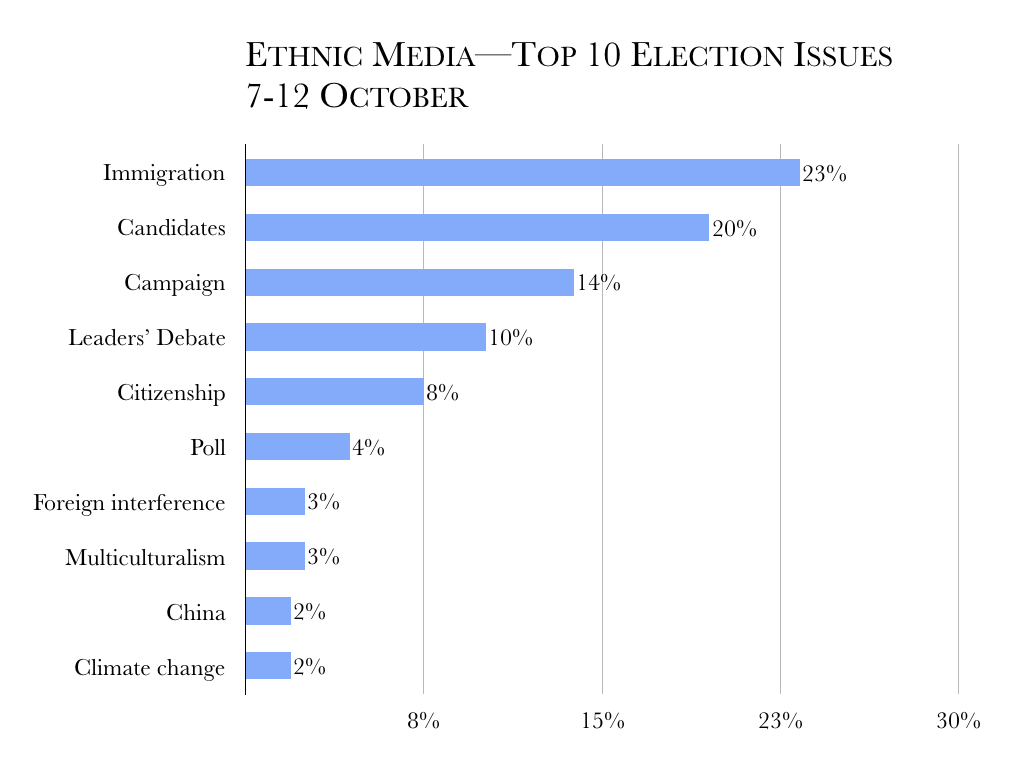
Ethnic media election coverage 7-12 October

Latest weekly analysis of ethnic media coverage. For the analytical narrative, go to Ethnic media election coverage 7-12 October:

Registered voters abroad near 45K, almost triple from 2015

When I was arguing (unsuccessfully) against expansion of expatriate voting rights, I used a number of measures to estimate the degree of connection to Canada, the and the experience of other jurisdictions to estimate the likely percentage of expatriates that would vote (see What should expatriates’ voting rights be? – Policy Options).

I was clearly wrong in my estimate of between 200 to 300,000 based upon Australian and US experience:

Elections Canada figures show 44,843 Canadians living abroad are on its International Register of Electors as of Oct. 6. In the 2015 election, 15,603 Canadians living outside of the country registered to vote.

While not all Canadians residing abroad will cast ballots, chief electoral officer Stéphane Perrault estimated last month that 30,000 citizens outside of Canada would vote in the coming election, up from almost 11,000 in the 2015 election.

When he offered that estimate on Sept. 17, he said about 20,000 Canadians living abroad were signed up to vote.

“At this point, it seems the numbers are what we thought they would be, but it may of course change,” he said.

This election will be the first where all Canadians residing abroad will be eligible to vote, regardless of how long they have been away.

In January, the Supreme Court ruled on a case brought by two Canadians residing in the United States who were barred from voting in the 2011 election because of legislation passed in 1993.

That legislation had been only loosely enforced up to that point, and barred Canadians who had lived outside the country for more than five years from voting in Canadian elections.

The country’s top court ruled the restriction unconstitutional and the Canada Elections Act was subsequently amended to adjust for the change in Bill C-76.

The international register of electors show 19,094 Canadians living in the U.S. are signed up to vote, making up almost 43 per cent of all registered abroad.

The second jurisdiction with the highest number of registered voters was the United Kingdom, with 5,176 Canadians. Hong Kong is third with 2,389 Canadians signed up to vote.

Australia, Germany, France, Switzerland, the Netherlands, Japan and mainland China capped off the top 10 list.

Elections Canada spokesperson Matthew McKenna said it’s important to note that the international register is a permanent database.

“Once a name is added, it remains there year over year, unless the elector requests that it be removed, or passes away,” he said.

Canadians living abroad can vote by mail-in ballot. The deadline to apply to vote by mail is Tuesday, Oct. 15, 6 p.m. E.T.

Perrault cautioned that voters living abroad must also account for the time it takes for an application to be mailed, processed, and for the ballot to be sent back to Canada. On Sept. 17, he said those Canadians should register within the next week to 10 days.

Elections Canada is not accepting ballots it receives later than 6 p.m. on Oct. 21.

Votes from abroad will be counted in ridings of their last permanent address.

Source: Registered voters abroad near 45K, almost triple from 2015