At least a quarter of those who have applied for Spanish nationality under the country’s law of return for descendants of Sephardic Jews are not Jewish, according to the local media.
Of the 153,767 applicants, 52,823 are from four Latin American countries — Colombia, the Dominican Republic, Venezuela and Ecuador — the La Razon newspaper reported Sunday. Their combined Jewish population is smaller than 10,000, according to the World Jewish Congress.
That means that nearly 43,000 applicants, or 27 percent of the total who applied before the closing of the deadline for applications in October, are not Jewish based on the relatively liberal definition of who is a Jew applied by the World Jewish Congress.
Only 4,313 applicants, or 2.8 percent, are Israelis and more than one-fifth, or 33,653, come from Mexico, which has the highest number of applicants. Colombia was next at 28,314. The United States had 5,461 applicants and Turkey had 1,994.
Only 31,222 applications had been approved by Oct. 1 and the rest are still pending. September had the most applicants, no fewer than 71,789, since the opening of the window in January 2018.
Spain passed its law of return for descendants of Sephardic Jews in 2015 shortly after Portugal.
Thousands of applicants have asked to be naturalized in Portugal, where the law is open ended.
In both countries, the government described the law as an act of atonement for the persecution and mass expulsion of Jews during the Inquisition that began in the 15th century. Many Jews were forcibly converted to Christianity.
Yet another study highlighting the potential for abuse and an overly modest approach to regulate the practice:
An economic study into citizenship-for-sale schemes within the European Union has called for more cooperation between nation states and the main EU institutions.
The sale of national citizenship under such “golden passport” schemes comes with the benefit of EU citizenship, and is available to anyone prepared to pay the price.
If Member States are fully sovereign in their decisions on whether and how to award national citizenship, the study said, and if national citizenship comes with the added benefit of EU citizenship, then a market for golden passports for wealthy investors from outside the EU may emerge in which at least some nation states overuse their privilege of selling citizenship.
The studyPassports for Sale: The Political Economy of Conflict and Cooperation in a Meta-Club by Kai A. Konrad and Ray Rees, focused on the political economy of citizenship-for-sale.
They approached the problem by looking at the European Union as a “club of nations” or meta-club – where each single country identified as a club of its own. In such a group, each single nation reserves the right to govern the admission of new individual members into its own club, but new members automatically benefit from the EU wide meta-club.
Member States have the sovereign right to decide whether or not to grant citizenship to anyone they choose. However, Malta, Cyprus and Bulgaria make “special use of this freedom” by offering “golden passport” programmes that enable wealthy investors from outside the EU to acquire European Union citizenship without discussion or oversight from other Member States.
Malta is also on the OECD short-list of countries whose residence or citizenship-by-investment schemes serve the “the purpose of income tax sheltering”.
The scheme has been mired in controversy from the beginning. Last week, PN MEP David Casa wrote to European Justice Commissioner Vera Jourová calling for the programme’s suspension after a fifth Maltese citizen who had acquired a golden passport was charged with criminal offences.
Earlier this year, the European Commission warned Member States to tighten security checks on wealthy investors applying for the cash-for-passport schemes, saying such applicants have opened the EU to risks of money laundering, corruption and organised crime.
The study pointed out that these schemes “raise political economy issues of conflict and cooperation at the European level, and have given rise to discussions and controversies between the central EU government level in Brussels and the individual Member States”.
The authors deliberately avoided addressing the ethical issue of golden passport programmes. Instead, they focused on the externalities that emerge inside a union where individual members sell their own membership, together with entry into the larger union.
“One important aspect of this is the extent to which new citizens move out of the countries that initially admitted them and into other countries that have had no say in the admission process, but may bear at least some of the cost”.
Explicit agreement over quotas on the number of passport sales each individual country may offer could help mitigate these concerns.
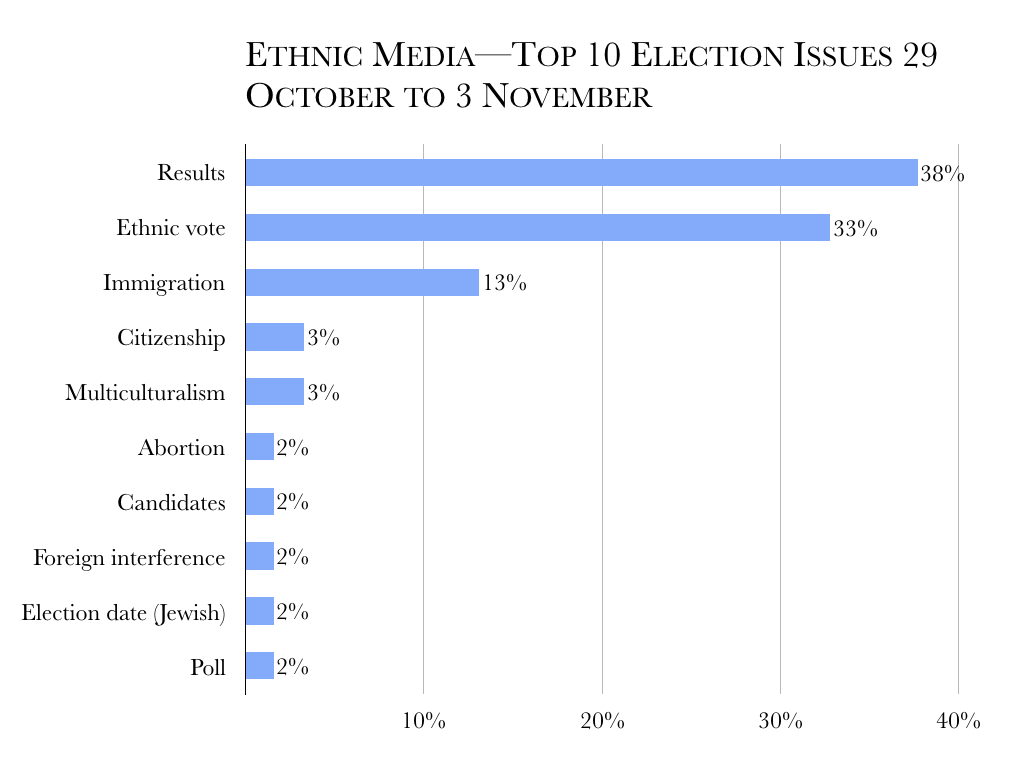
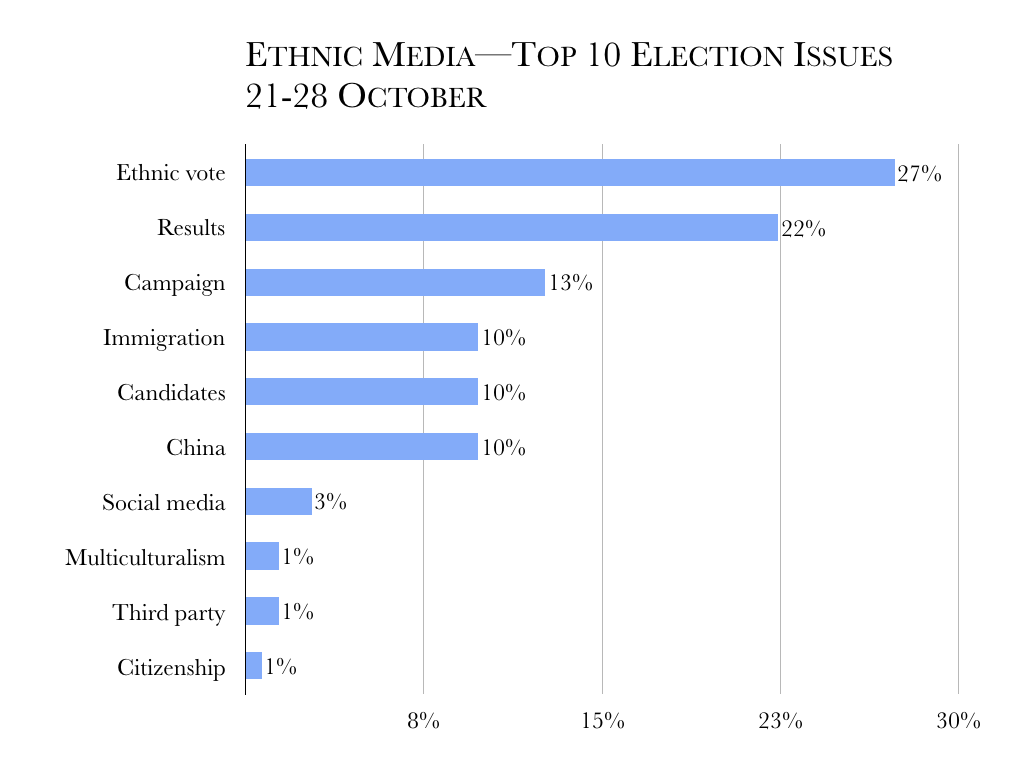
This is the last of the weekly analyses. The complete set can be found at: Ethnic Media Coverage.
I will be working on a summary report over the next few weeks regarding the close to 2,500 articles monitored 20 July to 3 November, building upon my pre-writ analysis in Policy Options, How does ethnic media campaign coverage differ?.
Vanuatu is reviewing its “passports for sale” scheme over concerns that inadequate scrutiny of the mainly Chinese applicants risks undermining the visa-free access it enjoys with the EU.
Since it was launched in 2016, the citizenship program has issued some 4,000 passports and generated more than $200 million in government revenue for Vanuatu, mostly from Chinese applicants eager to obtain a passport that provides visa-free access to 129 countries, including the EU.
Vanuatu is not alone in selling citizenship, although most countries, such as the U.K. or U.S., require investments in businesses or government bonds before handing over a passport or residence permit. But the popularity of the program sets the archipelago apart. In fact:
IN 2018, PASSPORT SALES GENERATED A THIRD OF VANUATU’S GOVERNMENT REVENUES.
But a series of scandals, including the deportation of six Chinese nationals in July at the request of Beijing — four of whom held Vanuatu passports — has led the EU to express its concerns about the program’s controls.
“We are getting some negative implications as a result of the lack of due diligence on applicants to get citizenships, which is affecting our bilateral relations with other countries,” says Ralph Regenvanu, Vanuatu’s minister for foreign affairs.
“So, it’s important for us to take stock, stop some aspects of the program and make the other aspects better.”
The review comes amid wider worries in the west over Chinese influence in the Pacific, where Beijing has funneled $6 billion in development aid since 2011 on infrastructure projects. Chinese universities have developed Pacific language programs and offered hundreds of scholarships to Pacific students to boost educational links.
Beijing’s Pacific push has persuaded six of the region’s island nations to switch their diplomatic allegiance away from Taiwan toward Beijing since 2016. Most of the tiny island nations have populations of fewer than 1 million — just 300,000 people live in Vanuatu — but each has a vote at the U.N. and controls strategic shipping lanes in Pacific waters.
Regenvanu says that because of its limited economic clout, Vanuatu had no choice but to use its votes strategically in international organizations such as the U.N. He said this included targeting infrastructure investment from larger countries, such as China.
“We’re experiencing a surge in Chinese interest in Vanuatu and investment in Vanuatu compared to, for example, Australia, a traditional partner,” says Regenvanu.
He rejected western concerns that Beijing held too much sway in the region. “The important thing is we make sure that our laws that we develop for our benefit are enforced across the board. It doesn’t matter who you are.”
But the deportation of the four Vanuatu passport holders to China undermined this statement. The Daily Post in Vanuatu suggested that Beijing had persuaded the local government to “enforce Chinese law within its own borders.”
Regenvanu says the program review was already underway and would be completed before March parliamentary elections. He said the government was not happy with the level of due diligence on applicants or the structure of a program that requires little more than a $150,000 cash payment to receive Vanuatu citizenship.
“The challenge is oversight and regulation; just who exactly is getting these passports?” asked Jonathan Pryke, director of the Pacific program at the Lowy institute, a think tank.
Pryke continued, “Vanuatu passports are appealing, they’re relatively cheap and have no requirement for a minimum amount of time or investment in the country itself, just a cash payment.”
Deputy Prime Minister for European and Euro-Atlantic Integration Dmytro Kuleba believes that granting Ukrainians the right to dual citizenship will allow Ukraine to more effectively use the potential of compatriots from the diaspora who seek to help their homeland.
The told the ZN.UA (Dzerkalo Tyzhnia.Ukraine) there are several reasons for granting Ukrainians the right to dual citizenship (he emphasized that he expressed his personal opinion, not the one of the entire government).
“If new representatives of the diaspora with Canadian or U.S. citizenship but ready to work for our country appear in the Ukrainian government in the future, the Ukrainian state should have a ready-made model of cooperation with them but not invent all kinds of schemes,” the deputy prime minister said.
He believes that liberalization of citizenship policy will make it possible to keep in the Ukrainian space millions of Ukrainians who left Ukraine and obtained the citizenship of another country, but who want to keep in touch with their homeland.
“We should not tear these people away. We have already lost so many,” the official added.
In addition, according to Kuleba, the state’s tolerant attitude towards second citizenship will solve the issue of tens of thousands of Ukrainians having Hungarian and Romanian passports, which many received only for the sake of a quiet movement in the European Union. By and large, according to the deputy premier, this should remove one of the acute problems in relations between Ukraine and neighboring countries.
At the same time, Kuleba categorically rejects the possibility of Ukraine’s recognizing Russian citizenship as the second one.
“The right of dual citizenship should not under any circumstances apply to the aggressor country,” he said.
Program of little benefit in any case, better to cancel outright as federal government did with its program:
Près de 20 000 riches candidats à l’immigration ont reçu un certificat de sélection du Québec, mais attendent toujours de recevoir leur résidence permanente du gouvernement fédéral, a appris La Presse. Une file d’attente monstre qui explique en partie pourquoi le gouvernement Legault a suspendu le programme d’immigrants investisseurs hier.
Le ministre de l’Immigration, Simon Jolin-Barrette, a annoncé que Québec va refuser toute nouvelle demande dans le cadre de ce programme controversé dès demain. L’annonce est passée quelque peu inaperçue, puisqu’elle a eu lieu en même temps que le dévoilement très attendu du « test des valeurs ».
En entrevue, M. Jolin-Barrette a expliqué que la mesure était devenue inévitable. Non seulement le taux de rétention des immigrants investisseurs est-il « famélique », a-t-il dit, mais encore « l’intégrité » du programme est maintenant compromise.
La raison : au cours des dernières années, Québec a distribué plus de certificats de sélection à des immigrants investisseurs qu’il ne prévoyait en admettre dans son plan d’immigration. Aujourd’hui, on se retrouve donc avec 19 000 personnes qui ont rempli les obligations du programme, mais qui n’ont toujours pas reçu leur citoyenneté canadienne.
Au rythme d’admission actuel, il faudrait six ans pour épuiser cette liste.
Le ministre lance la pierre au gouvernement précédent, à qui il reproche d’avoir mal administré le programme.
« Le fait qu’il y a un inventaire de 19 000 dossiers m’apparaît comme étant une gestion discutable de la sélection et de l’admission des personnes immigrantes par le Parti libéral », a-t-il dénoncé.
Intermédiaires financiers
Le programme d’immigrants investisseurs propose une voie rapide aux candidats à l’immigration qui possèdent un avoir d’au moins 2 millions. Ils peuvent obtenir leur certificat de sélection moyennant un placement sans intérêts de 1,2 million pour cinq ans à Investissement Québec.
Dans la plupart des cas, les candidats versent une somme d’environ 300 000 $ à un intermédiaire financier. Celui-ci contracte un prêt et fournit la somme de 1,2 million à Investissement Québec au nom de son client. Il touche alors 22 % des revenus d’intérêts générés par Investissement Québec.
M. Jolin-Barrette s’explique mal que ces intermédiaires profitent autant du programme.
« Lorsqu’on regarde combien de millions ont été consacrés aux entreprises par le biais de ce programme, combien de millions ont été consacrés aux revenus pour les intermédiaires financiers, ils sont pratiquement équivalents, a relevé Simon Jolin-Barrette. Donc c’est important que les revenus associés aux investissements servent à aider l’économie québécoise. »
Seul au Canada
Le Québec est la seule province canadienne qui gère un programme d’immigrants investisseurs. Le gouvernement fédéral a aboli le sien sous Stephen Harper en 2014.
La Coalition avenir Québec a critiqué le programme lorsqu’elle était dans l’opposition. Des reportages ont révélé plusieurs abus au cours des dernières années.
Les critiques relèvent que la très grande majorité des immigrants investisseurs ne font que passer au Québec et qu’ils s’établissent plutôt à Toronto ou à Vancouver.
« Ce qui est important aussi, c’est de revoir le programme, parce que le taux de présence des immigrants investisseurs était de 17 %, a convenu Simon Jolin-Barrette. Ça, ça signifie que les gens prêtaient 1,2 million au gouvernement du Québec, obtenaient la résidence permanente, mais ne venaient pas s’établir au Québec. »
La suspension du programme durera huit mois. D’ici là, les candidats qui ont respecté les exigences et qui ont reçu un certificat de sélection continueront d’être accueillis au Québec à mesure qu’ils recevront leur résidence permanente du fédéral.
La mesure du gouvernement Legault a été critiquée par le Conseil du patronat du Québec (CPQ). Il rappelle que les sommes recueillies par Investissement Québec finançaient des mesures d’intégration à l’emploi des immigrants.
« Le gouvernement se prive ainsi de sommes importantes destinées à accompagner en emploi les immigrants et les minorités visibles, ce qui n’est certainement pas la chose à faire en cette période de rareté de main-d’œuvre », déplore le CPQ.
Nombre d’immigrants investisseurs admis par Québec en attente de leur résidence permanente
Will be interesting to see the detailed analysis and review by outside experts:
If the Trump administration had been allowed to add the now-blocked citizenship question to the 2020 census, it likely would not have had a significant effect on self-response rates, the Census Bureau said Thursday.
Preliminary analysis of a national experiment the Census Bureau conducted earlier this year with two versions of a test census form — one with a citizenship question and one without — suggests that question could lower self-response rates in some parts of the country and for some populations. In a blog postreleased Thursday, the bureau highlighted a 0.3% difference in the share of participants identifying as Hispanic.
Still, the differences overall were “small,” according to Victoria Velkoff, the bureau’s associate director for demographic programs who wrote the post.
The bureau’s early findings could temper some concerns that including the question would deter households, especially those with noncitizens, from taking part in the constitutionally mandated head count of every person living in the U.S.
The Census Bureau randomly selected approximately 480,000 households across the country, except in remote Alaska and Puerto Rico, to take part in what it has called the “2019 Census Test.” Half of those households were asked to complete test forms with the question, “Is this person a citizen of the United States?”
The bureau scrambled to put together the test earlier this year in response to the administration’s push for the question. It’s not clear when the bureau plans to release a final report on the experiment.
Some critics of the citizenship question are holding their judgment of the bureau’s early findings. An earlier study by researchers at the bureau suggested the question would have deterred at least 9 million people from self-responding to the census.
“All other research to date by the Census Bureau has indicated that adding a citizenship question to the census would depress responses among noncitizens and Hispanics,” Dale Ho, an ACLU attorney who is helping to represent plaintiffs in lawsuits over the question, said in a written statement. “We look forward to seeing whether the full results of this latest study are consistent with the bureau’s previous findings in this regard.”
Throughout the legal battle over the question, opponents raised concerns that adding a citizenship question would force the Census Bureau into spending more time and money to gather responses from reluctant households.
However, the bureau’s preliminary analysis of its field test suggests it would not have needed more door knockers to follow up with people in households who did not fill out a form themselves, Velkoff wrote in the blog post.
Velkoff added that it’s unclear from these test results how the question could have impacted the “completeness and accuracy” of the 2020 census overall.
The bureau’s early findings come more than a year and a half after Ross announced his decision in 2018 to add the hotly contested question. This summer, three federal courts permanently blocked the question from being added — in part because the bureau had not conducted required testing of public reaction to including a citizenship question on 2020 census forms.
The nine-week test took place in the midst of a heated legal battle over the question. By early July, it sparked confusion around the country about why the bureau was continuing to use census forms to ask about people’s U.S. citizenship status after a majority of the U.S. Supreme Court ruled to keep the question off.
The bureau has said the test results could be “valuable” to any officials considering adding such a question to future census forms.
After backing down from efforts to use the 2020 census to ask about citizenship status, the Trump administration is now moving forward with compiling government records to produce detailed citizenship data.
In his executive order, Trump also left open the possibility of a resurrected political fight over a census citizenship question. The president directed the commerce secretary, who oversees the Census Bureau, to “consider initiating any administrative process necessary to include a citizenship question on the 2030 decennial census.”
Juan Hernandez-Villafuerte’s parents identified as Christian, so he didn’t understand why, by family tradition, they abstained from pork, washed their hands thoroughly before and after meals and covered the mirrors in the home after someone died.
“You had to do it, but you never knew why,” he says at age 41. “I wasn’t aware of my Sephardic heritage at (any) point, even though I knew there was something different about us.”
Before immigrating to Canada in 2012, he grew up in northeastern Mexico. His mother suspected they might have Jewish roots, so this fall, he left his home in Montreal and spent most of his vacation in the municipal archives of Mexico City. He found police and church records, as well as a yellowish paper — a property record from the year 1610 — bearing the name of his great-great-great-great-great-great-great-great-great-great-great grandfather.
“I was actually able to touch it,” he says. “I always wanted to know who I was.”
He was prompted to begin his research after the Spanish Parliament unanimously passed a law in 2015 to grant citizenship to the descendants of Sephardic Jews, meaning Jews with Iberian roots. The deadline for applications passed at the end of September, at which point the Ministry of Justice said it had received more than 130,000 applications, of which approximately 6,000 had been approved.
Spain’s initiative is part of a trend across Europe to repatriate Jewish families who faced persecution. Beginning in the 1300s, Sephardic Jews were forcibly converted to Catholicism, and during the Spanish Inquisition beginning the 1400s, the converts were investigated under suspicion that they may be continuing to practice judaism. Some historians estimate 2,000 converts were burned alive, while others faced different punishments, and after the Inquisition was established, an estimated 100,000 remaining Jews were expelled. Portugal also enacted a similar citizenship law in 2015, and countries including Germany, Austria and Poland have been granting citizenship to the descendants of Jews persecuted in the lead up to the Holocaust and during the Holocaust.
Spain’s initiative has led people to discover their family identities, but many of them have spent $6,000 on the application process, and the program is politically and economically charged. While some people commend Spain’s gesture as a way to rectify historical violence — or at least a way to secure a passport to the European Union — critics point out the expense of the application and question the country’s motives.
“They took everything from us — our identity, our possessions, any property that we had,” says Maria Apodaca, a Sephardic Jew who lives in Albuquerque, NM. “I don’t have $6,000 a pop to do this, and I don’t see how it would benefit me,” she says. “I was planted in the United States, and in the United States I’ll stay.”
Applicants do not need to be practicing Jews, but they do need to prove Sephardic heritage with evidence such as census documents and records of birth, baptism, marriage and death. Applicants must have these records translated by a translator recognized by the Spanish government, and they must travel to Spain to sign with a Spanish notary.
“It’s almost like a huge, many, many months-long scavenger hunt,” says Daniel Romano, a lawyer in Montreal who applied for citizenship with his wife. In his legal profession, he recently worked on an immigration case of a Venezuelan refugee, and he says her refugee claim was “100 times more simple” than his Spanish citizenship application.
Romano has always identified as a Sephardic Jew, and he had a sense of duty to accept the Spanish government’s offer of reconciliation. “It’s odd, but I felt the need to reciprocate. They cannot make amends through our mutual ancestors … if the descendants do not take up the offer,” he says.
Some applicants have sought rabbis to vouch for their heritage. Shlomo Gabay, the rabbi at Beth Hamidrash, a Sephardic synagogue in Vancouver, says he received eight or more requests per month to write letters for Spanish citizenship applications. The requests came mainly from South Americans, Mexicans and the occasional Canadian, with some people showing him original scripts from the time of the Inquisition.
“People really, really took this seriously,” says Gabay.
Though not subject to the Inquisition, Jews who refused to convert or leave Spain were called heretics and could be burned to death on a stake.Henry Duff Linton (1815-1899)/Creative Commons
In Britain, some Jews have seen repatriation programs as a ticket to work, study and travel in the European Union after Brexit. Ben Shapiro, a 26-year-old man who works at an interfaith charity in London, considered applying for Spanish citizenship but instead applied for German citizenship because the process was easier given that his relative was already applying, and it achieves the same access to the E.U.
“There’s definitely a lot of Jewish people that feel like their Spanish or Sephardic expression of Judaism is important to them, so being validated by Spain is something that’s pleasing,” says Shapiro, “but I think also Brexit is just having a big (impact on) young, liberal European-liking people who don’t want to give that up if they don’t have to.”
Spain could be taking this measure as an effort to boost its population and economy. The country’s fertility rate is far below replacement level at 1.3 children per woman, and its population is predicted to decline by 9.4 million between 2000 and 2050, according to the United Nations Population Division in 2000. The country has introduced pro-natal policies to encourage Spaniards to have more children and has accepted increasing numbers of refugees. Since applicants for the Jewish repatriation program must pass a language and citizenship test — and in many cases must hire a lawyer and genealogist to help with their claim — the initiative could attract migrants of affluence, as could repatriation programs elsewhere in Europe.
“There’s a sense certainly toward the Jews of some sort of historical debt, some sort of reckoning,” says Howard Adelman, an associate professor of history at Queen’s University, specializing in Jewish history, “but if I can be more cynical, I think there’s also an element of an attempt to bring people with assets and affluence to the countries and also to offset some of the refugees that are arriving at these countries.”
An original land grant from 1610 given to Marcos Alonso de la Garza in northeastern Mexico. His descendant, Juan Hernandez-Villafuerte, searched for the document to prove his Sephardic Jewish heritage.Juan Hernandez-Villafuerte
He notes that Muslims also endured forcible conversion in Spain, and in the 1600s, he says, hundreds of thousands of converts, known as Moriscos, were expelled. Yet, “no country has it on the table to talk about repatriating Muslims.”
Adelman says some Jews are disillusioned by antisemitism during the Trump administration, while some Jews are leaving Israel due to its unstable democracy.
“Many of them are having an awakening that they have to have another place to go, and I think that Israel used to be that escape hatch, but now Israel is in as much chaos as the United States,” he says.
Applications for Spanish citizenship surged at the time of Donald Trump’s election, says Schelly Talalay Dardashti, who works with the Spanish Citizenship Committee of the Jewish Federation of New Mexico, which received 50 to 75 calls per day before the deadline from people inquiring about Spanish citizenship. Some applicants have showed up at her office and cried, she says, having observed family customs all their lives but never having understood that the customs were Jewish.
“That is a bombshell that goes off in someone’s head. That is a real identity crisis,” she says. “Citizenship is like getting this badge: yes, we are who we are.”
When Dardashti meets with people, she asks them to write down family customs related to death, food and even cleaning the home, but many applicants get DNA testing and hire genealogists to help their claim.
Dennis Maez, a genealogist in New Mexico, was so overwhelmed with requests from Sephardic applicants that he had to put on hold his day job, running businesses that sell cars and cattle. He researched family trees for approximately 250 applicants, tracing some families back as far as the year 910.
As the deadline approached, he was “absolutely burnt out,” he says. “I would just work tremendous hours putting the (genealogies) together. I just finally had to quit.”
In Montreal, Hernandez-Villafuerte did his genealogy research himself. Even if his application is approved, he never intends to live in Spain.
“I think this is something I had to do for my ancestors,” he says. “They went through a lot of pain. They were expelled from their land … To me, it’s not about, What I can do with that citizenship? It’s more about restoring something that I love, or we loved, hundreds of years ago.”
Some interesting data. Have not looked at recent Canadian citizenship pass rates to know if there is a similar pattern here.
But we do know that Chinese immigrants have a relatively lower naturalization rate than many other groups: 77.2 percent compared to the overall naturalization rate of for those who immigrated to Canada 2006-10 (Census 2016):
One in three migrants from mainland China has failed to acquire Australian citizenship since 2012 amid the growing political debate over Chinese influence.
The figure, the highest of any nation in the top 10 sources of new Australian citizens, follows a collapse in the number of Chinese residents approved last financial year, when only 11 per cent of these applicants were granted citizenship as Home Affairs struggled to keep up with demand.
The department pulled that figure back up this year, with 42 per cent of Chinese applications between 2017 and 2019 approved overall.
But figures, given in response to questions on notice in Parliament show that, since 2012, just 64 per cent of applicants from China were approved, compared with 69 per cent from the Philippines, 77 per cent from Britain and India, and 90 per cent from South Africa. The figures exclude migrants from Hong Kong and Taiwan.
Up to 390 Chinese migrants have had their citizenship put on hold for three years, while 9600 have been waiting for two years despite already being permanent residents for several years. At the same time, 2350 Afghani migrants have been waiting since 2015 to have their citizenship applications processed.
A Home Affairs spokesperson said the department did not treat citizenship applications from people from certain backgrounds more favourably than others.
The spokesperson said processing times could vary due to individual circumstances, including the time it takes to receive additional character and national security information from external agencies and the time it takes for the applicant to attend a citizenship ceremony or receive a citizenship certificate.
The Morrison government has blamed the delays on an increase in the complexity of applications. An Auditor-General’s report dismissed this in February, finding that “overall, the relative complexity of the applications lodged has decreased” and the backlog was due to tighter security screenings.
The Home Affairs spokesperson said the department had implemented a number of strategies to improve processing times and reduce the on-hand caseload of applications, without “compromising on national security” or “program integrity”.
The figures come amid a decline in Chinese applications overall. The absolute number of applications for Australian citizenship by residents of Chinese heritage has halved since 2017, when there were 14,707 applicants, compared with 7999 last year.
Political tension between the Chinese and Australian governments has grown since 2017, when former prime minister Malcolm Turnbull angered the Chinese government by introducing foreign interference laws. Mr Turnbull last year banned Chinese telco giant Huawei from building Australia’s 5G network due to national security concerns.
Scott Morrison, who is yet to visit Beijing since becoming prime minister in August last year, has become more aggressive in his differences with China on global trade policy since visiting US President Donald Trump in September. Foreign Affairs Minister Marise Payne has also sharpened her criticism of the deteriorating situation in Hong Kong.
The chair of the Federation of Ethnic Communities Councils of Australia, Mary Patetsos, said the federation hoped people from all backgrounds and nationalities would receive equal treatment in relation to the processing of their citizenship applications.
“I think this is what an overwhelming majority of Australians would expect as citizens of a country that strives to be fair, equitable and democratic,” she said.
“We must also remember that unwarranted delays in the processing of citizenship applications cause significant hardship for families.”
Labor MP Julian Hill, who asked for the figures from Home Affairs and has launched a parliamentary inquiry into the citizenship audit, said the delays had caused widespread anxiety among migrants in his Melbourne electorate of Bruce.
He said some applicants were unable to travel where they needed to without an Australian passport, or apply for jobs in the public service or defence force.
“Then of course there is the big issue of family reunions. People are in my office weekly because they are desperate,” he said.
“Until they are citizens, their family reunion applications will get no priority. That means they have not been able to see their wife, husband or kids for years. The sheer inhumanity of that is astounding.”



 Multicultural Meanderings