Australian citizenship ceremonies to go ahead via video link during coronavirus crisis

Further to my earlier post (Thousands now face indefinite wait for Australian citizenship as ceremonies cancelled), an initiative that Canada would do well to consider:

Australian citizenship ceremonies will be conducted online via video secure video link, with the prospect of up to 750 people conferred each day, acting Immigration Minister Alan Tudge announced Monday.

The Department of Home Affairs has commenced trialling the one-on-one ceremonies for those already approved, with alternative arrangements to be made for those who can not access the internet.

“Australian citizenship is an immense privilege, and fundamental to our national identity,” Mr Tudge said in a statement.

There had been fears that tens of thousands of migrants waiting to become citizens were going to face an indefinite wait for the process to be finalised, after ceremonies across the country were cancelled because of social distancing measures brought on by the coronavirus.

After an application for citizenship is approved, migrants are required under the Australian Citizenship Act to make a pledge of commitment to Australia before a presiding officer, which normally occurs at a ceremony organised by their local council.

Current restrictions on public gatherings forced these to be put on hold.

“The Morrison Government recognises the importance of Australian citizenship for migrants and for the wider Australia community,” Mr Tudge said.

The Federal Government said there are currently 85,000 people awaiting a ceremony and those already scheduled for a citizenship event will be notified.

The Chambers family, who arrived in Perth from Wales ten years ago, are seen after becoming citizens during an Australia Day citizenship ceremony
AAP

While future applications are still being accepted, the Federal Government has put a halt on interviews and testing.

More resources will be deployed to work through the backlog once social distancing measures ease.

Source: Australian citizenship ceremonies to go ahead via video link during coronavirus crisis

Thousands now face indefinite wait for Australian citizenship as ceremonies cancelled

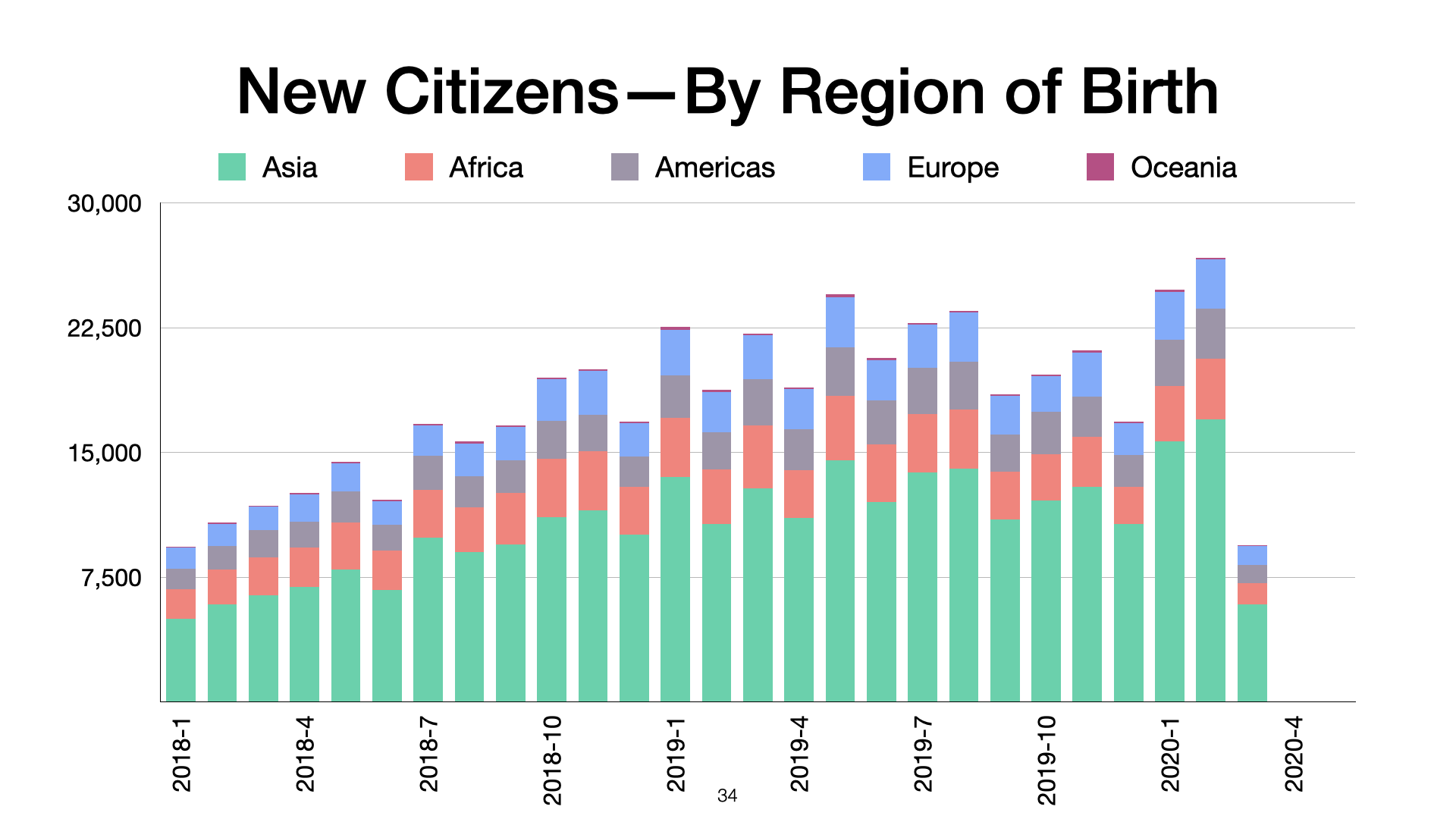
Similar to Canada in terms of applications and ceremonies on hold, but overall demand has returned to more traditional levels following C-6:

Tens of thousands of migrants waiting to become Australian citizens are now facing an indefinite wait for the process to be finalised after ceremonies across the country were cancelled due to restrictions brought on by the coronavirus pandemic.

Many are now calling on the government to follow New Zealand and temporarily waive the requirement of a public ceremony and oath-taking while national restrictions on mass gatherings remain in place.

Concerns have also been raised that pressing pause on citizenship ceremonies all together will create further unnecessary delays in the already overloaded citizenship process.

But despite meeting the residence, character, and other requirements to become a citizen, and passing the citizenship test, her hopes were shattered after the City of Sydney council announced their ceremonies would be cancelled until further notice.

While she understands the public health rationale for shutting down the ceremonies, she wants the government to find an alternative way to grant her citizenship.

“We have been left in limbo … we don’t know when it’s going to end,” the 32-year-old told SBS News. “To have the citizenship put on hold right at the end when all we need to do is attend the ceremony is a bit disappointing.”

Ms Parmentier said she was particularly worried as her home country has stopped issuing passports and she is currently unable to travel in an emergency.

After joining a forum with other people left waiting for their citizenship to be finalised, she decided to start a petition calling on the government to act.

“It’s a goal that has taken, for many of us at least, five years of hard work, taking tests, having our degrees assessed, saving money for visas and permanent residencies,” she said.

“The majority of people are looking forward to making the pledge of commitment, that’s part of the requirement and we’re more than happy to do it, either electronically or via statutory declaration.”

After an application for Australian citizenship is approved, migrants are required to attend an in-person ceremony and make the Australian Citizenship Pledge before becoming an official citizen. Incoming citizens are usually invited to a ceremony organised by their local council within six months of their application being approved.

In the 2018-19 financial year, 127,674 people became Australian citizens – almost 2,500 every week – but a backlog is now expected to pile up.

On 29 February 2020, the Department of Home Affairs had more than 120,000 applications on hand, with more than 16,000 new applications received in February alone.

The current waiting time from date of application to ceremony can be up to two years for 90 per cent of applicants in the main stream.

New Zealand national Carla Jones is among the thousands waiting for their citizenship process to come to an end after she said “ceremonies came to a grinding halt”.

The Brisbane resident, who came to Australian in 2011 following the Christchurch earthquakes, said there has been “no communication whatsoever” about the cancellation, leaving her and others who have had their applications approved to discover the news on social media.

“I want to be able to vote, there are state elections coming up in October, I want to be able to fully participate in Australian society and currently I’m hamstrung from doing so,” she said.

Ms Jones added that she was unable to finalise her divorce without proving her Australian citizenship.

Last month, New Zealand’s department of internal affairs announced that all citizenship ceremonies would be cancelled and prospective citizens would be allowed to sign a statutory declaration as a replacement for a public oath.

Professor Mary Crock, an expert in citizenship law at the University of Sydney, said there were alternative ways prospective citizens could take an oath without attending a mass gathering, but that developing a new process was likely low priority for the government.

“You’re dealing with a government that is just struggling to keep its head above water, and for that reason, citizenship has just slipped down the list of priorities,” she said.

Those waiting for their official ceremony are still able to access most of the same rights afforded to Australian citizens, including unemployment benefits for permanent residents, but they are not able to vote or apply for an Australian passport.

New Zealand nationals in Australia affected by the COVID-19 restrictions have also been included in the Government’s JobKeeper supplement, which allows employees of companies and not-for-profits that have lost at least 30 per cent of their revenue to be paid $1,500 a fortnight.

The Department of Home Affairs did not respond to a request for comment.

In September last year, Immigration Minister David Coleman said his department had been working to process citizenship applications as “efficiently as possible, while also maintaining the integrity of the program”.

Source: Thousands now face indefinite wait for Australian citizenship as ceremonies cancelled

How Census Is Building a Citizenship Database Covering Everyone Living in the U.S.

Interesting read on how the US Census bureau is working on getting greater precision on citizenship using statistical modelling. Whether this will provide greater precision than the American Community Survey remains to be seen, as well as protections to ensure privacy and anonymization:

While the 2020 decennial count is underway, the Census Bureau is working on a separate effort to identify the percentage of the U.S. population that has legal citizenship. The result will be a Census-owned database of every person living in the U.S. with a statistical “citizenship estimate” linked to each individual.

The Trump administration initially pushed to include a citizenship question on the 2020 survey of America. However, in June of last year, the Supreme Court ruled 5-4 to prevent the administration from asking the question, citing poor justification for its inclusion.

A month after the ruling, President Trump signed Executive Order 13880, requiring the bureau to produce data on the citizen voting-age population, or CVAP, by the end of March 2021, and mandating relevant agencies share databases to help Census achieve that end.

Next year, the bureau will release a publicly-available statistical modeling of citizen and non-citizen populations throughout the country, anonymized using a cutting-edge masking system. The effort will also create a dataset with a citizenship estimate for every person in the U.S., which—by law and by practice—should never be seen outside of the Census Bureau.

In an internal document obtained by Nextgov, bureau officials note the Census Unedited File—which is used to determine apportionments, including congressional representatives—will not contain any citizenship data. Instead, the bureau will create a separate micro-data file, or MDF, with the best citizenship estimate associated with each census respondent.

That micro-data file, along with the Census Edited File—an updated version of the CUF that corrects and backfills missing information—will be put through the 2020 Disclosure Avoidance System, “which will do the final record linkage and place a confidentiality protected citizenship variable on the same MDF as will be used to produce the redistricting data,” according to the documents.

While the citizenship status of individuals will not be made public, Census will be publishing CVAP tables that break down citizenship estimates at the block level—the most granular level of census data. Those tables are scheduled for release by March 31, 2021.

However, keeping that amount of public data anonymized is no simple thing. With surprisingly few bits of correlated data, a once-anonymous person can easily be identified. This becomes much easier when coupled with information publicly available on the internet, such as social media profiles.

To prevent criminals and other malicious actors from reverse engineering identities, Census is employing a new disclosure avoidance system for all 2020 census data shared publicly.

“Our decision to deploy a modernized disclosure avoidance system for the 2020 census was driven by research showing that methods we used to protect the 2010 census and earlier statistics can no longer adequately defend against today’s privacy threats,” John Abowd, Census’ associate director for research and methodology and chief scientist, and Victoria Velkoff, chief of the American Community Survey Office, wrote in an October 2019 blog post explaining the new system developed by cryptographers and data scientists.

The new differential privacy system injects “noise” into the datasets by using an algorithm that makes targeted changes to the data to prevent outside actors—malicious or otherwise—from reverse engineering identities.

Census has been using various forms of differential privacy—also known as formal privacy—since 2008, though never at the scale it will be used for on 2020 census data. In the past, Census only added uncertainty to select statistics with a high risk for deanonymization to avoid adding so much noise that the statistics become unreliable.

For the coming count, uncertainty will be added to entire published datasets using state-of-the-art mathematical models.

“The new method allows us to precisely control the amount of uncertainty that we add according to privacy requirements,” Abowd and Velkoff wrote. “And, by documenting the properties of this uncertainty, we can help data users determine if published estimates are sufficiently accurate for their specific applications. In this manner, we can determine the data’s ‘fitness for use.’”

With the public datasets anonymized, it will be up to Census to protect the raw data.

While the disclosure avoidance system is designed to ensure personal data remains anonymous, Robert Groves, provost of Georgetown University, who led the Census Bureau during the 2010 decennial count, said two things will ensure the raw, nonanonymized database is never used to target individuals: law and culture.

Groves, in an interview with Nextgov after reviewing the documents, cited a legal provision known as “functional separation.”

“Once you enter a statistical agency environment, it’s a one-way street,” he explained. “As soon as that Homeland Security dataset enters behind the firewall of Census, the laws of Census apply. It’s no longer a Homeland Security dataset, in a sense. It is controlled by the Census Bureau. And, under the Title 13 law, it is absolutely crystal clear that the combined dataset never exits Census with individual person records on it. Only statistics can exit.”

That protection extends to the highest levels.

“Even if it’s requested by the president, it’s absolutely illegal,” Groves confirmed when asked. “And even if it were an executive order directing Census to do this, the statute would trump the order.”

Beyond the law, Groves said the culture of statisticians and public servants working at the Census Bureau would make it almost impossible for the data to leak out unnoticed.

“If there’s anything I believe most strongly, it’s if there’s any illegal act that is proposed or promulgated, the staff at the Census Bureau would call [reporters] within 30 seconds. They are devoted to supplying the country statistical information under the law,” he said, adding that that devotion is rooted in necessity.

“The reason those laws exist is if individual records were freely given for enforcement procedures from the decennial census, then the cooperation from the public with the census is decimated,” Groves said. “These statistical agencies work with a social confidence—a trust with the public that the laws will be followed—and the laws were established to enhance that trust.”

Estimating Citizenship

While the Census Bureau won’t be able to ask each individual in the U.S. about their citizenship status, leveraging access to data held by other agencies will enable statisticians to match census respondents with information they have shared with the government to build a “best citizenship” estimate for each individual.

The bureau has been working on the algorithm to produce that estimate since April 2018 and planned to finalize the “final specifications and modeling details” before the end of March, according to an internal document.

The bureau did not respond to repeated requests for comments and updates on the status of that work or a comprehensive breakdown of which federal databases are actively being shared for this work.

However, the document offers a look into the main databases being used and the additional data sources most likely to be tapped.

Bureau officials believe about 90% of the U.S. population will be covered by data from two sources: the Social Security Administration’s Numerical Identification System, or Numident, which stores Social Security numbers; and, the IRS’ Individual Taxpayer Identification Numbers, or ITINs, which are used as a substitute for those without Social Security numbers. Approximately 94% of SSN records include citizenship information.

However, if officials determine these sources are not sufficient, agencies control a host of other datasets that could be added to the mix, including databases managed by the Center for Medicare and Medicaid Services, the departments of State and Housing and Urban Development, and Homeland Security Department components like U.S. Citizenship and Immigration Services and Immigration and Customs Enforcement.

In the briefing document, Census officials said additional data from Homeland Security, State and other departments “are expected to provide the [personally identifiable information] that enables record linkage for much of the balance of the resident population.” However, that comes with a caveat: “Provided that the PII on the 2020 Census is as reliable as it was in 2010.”

DHS released a privacy impact statement in December outlining how it would share information with Census, though bureau officials did not respond to requests for confirmation that the DHS databases have been accessed or integrated into the citizenship estimates.

That data will be quantified using the finalized algorithm to produce a best estimate for citizenship.

“For a single person, they’ll collect multiple data sources on citizenship. Inevitably, those sources won’t agree. Then, the question is what do you do to estimate the best response for citizenship for that particular person. They will estimate that with modeling across the various databases,” Groves said. “They’ll also use the same sort of model if, despite all their efforts, for you they can’t find a record that you’re a citizen or you’re not a citizen, they will impute your citizenship to that model.”

Groves said we won’t know how accurate those estimates are until well after the fact.

“No one’s ever done this before,” he said. “No one, at this point, I think it’s fair to say, knows what the quality of the resulting estimates will be. We just don’t know that. We’ll know it after this, through evaluation studies. But this is just a good-faith statistical effort.”

“Unfortunately, we don’t have a lot of track record on this,” he added. “These datasets, to my knowledge, have never been assembled the way they’re trying to assemble them.”

Source: How Census Is Building a Citizenship Database Covering Everyone Living in the U.S.

Citizenship is a tough mountain to climb, especially under Trump

Good overview of some of the additional hurdles, including increased fees. But of note that the backlog dates from Obama:

Gaining citizenship is a long, expensive and complicated process — one that has gotten more so under the Trump administration.

As the system currently stands, it can take 10 years or more for a person who entered the United States on a visa to become a citizen. Just getting a green card can take at least five years. Becoming eligible to apply for citizenship as a permanent resident after that? Another five years.

If you get to that stage, you then fill out the N-400 form, submit it with a $640 filing fee and then ready yourself for the civics test, biometric appointment and potential further vetting. After clearing those last hurdles, you are home free — a bona fide U.S. citizen.

Except, for an increasing number of people, that process never really takes off.

Around 700,000 applications for citizenship remained pending at the end of 2019 — and wait times have doubled over the past two years to almost three years, according to a September report by the Colorado State Advisory Committee to the U.S. Commission on Civil Rights.

“The substantial delay to naturalization created by the backlog negatively impacts voting rights, civil rights, and the administration of justice,” the report’s authors write.

A backlog results when the number of applications coming in exceed the ones processed by the U.S. Citizenship and Immigration Services staff, who are tasked with adjudicating immigration benefits. Citizenship applications tend to spike before general elections, so throughout history, there have been crests and troughs in backlogs as the agency tries to catch up to the fluctuating heap of incoming applications.

The most recent uptick in pending applications started during the Obama administration. According to Eric Cohen, executive director of the Immigrant Legal Resource Center, technological updates instituted by the administration — meant to speed the processing along — actually led to delays due to unforeseen bugs. According to a 2017 report to Congress, the electronic platform initially faced “multiple technical problems, which negatively impacted processing times.”

The 2016 election year saw more applications than expected, as people rushed to apply before candidate Donald Trump could fulfill anti-immigration promises as president, so despite the technical hiccups demand continued to rise.

“It is my understanding that they underestimated the bump [in applications],” says Cohen, whose organization oversees the New American Campaign, a coalition of 150 organizations that provide legal help with naturalizations.

“The Trump effect was more profound than expected.”

The number of pending applications actually doubled under the Obama administration, from around 300,000 in 2010 to around 700,000 in early 2017, when Trump took office. Fast forward two years, at the end of fiscal 2019, when the administration boasted about its processing progress.

“The men and women of USCIS continue to administer our nation’s lawful immigration system, processing a large number of applications and requests while naturalizing 833,000 new U.S. citizens, an 11-year high,” Ken Cuccinelli, then serving as the acting director of USCIS, touted in an end-of-the-year email.

But on the back end, delays compound the backlog, critics say.

The failure to resolve them is partly the result of a tepid response on the part of the Trump administration to the surge in naturalization applications, according to some.

Cohen mentions two other contributing factors causing delays: more interviews and additional vetting, even in cases where neither are needed. He says he has heard stories of people vetted during the asylum process, then again when they sought to obtain their green cards, and then once more during the citizenship process. One elderly Iranian woman was so distraught during the final vetting that she broke down and withdrew her application, Cohen says.

“By doing super vetting, what you’re doing is discouraging people from applying, you’re giving people a really hard time during their interview process, and you’re taking much longer — 50 percent-plus longer,” he says. “Therefore, you’re doing fewer and fewer applications. So there are a lot of these bumps in the road that are there, I would say, purposely.”

USCIS maintains that it is “completing more citizenship applications, more efficiently and effectively — outperforming itself as an agency,” a spokesman said via email, and that “many factors relating to an individual’s case can affect processing times.”

In addition, the administration has put up what critics call the “second wall” — seemingly small rule changes, fee hikes and additional paperwork requirements that altogether make naturalization much more burdensome and prohibitive.

The one proposal advocates are most concerned about is a regulation that would, among other things, increase citizenship application fees from $640 to $1,170, and fees for green card applications from $1,225 to $2,195. It also would eliminate all fee waivers for these applications.

In a comment on the regulation, the National Partnership for New Americans, a group that helps immigrants naturalize, writes that the increase would leave tens of thousands of immigrants it serves unable to undergo naturalization.  It is “undermining the civic and economic benefits that are a direct result of welcoming and naturalizing millions,” the organization writes.

“The agency is proposing to do this during the exact same time that citizenship application fees are beginning to rise in anticipation of the presidential election of 2020.”

#FATCA Accidental Americans ask US to cut fees for renouncing citizenship

More on FATCA and renunciation fees:

The Accidental Americans Association (AAA) has written a letter to the US Secretary of State, asking the country to reduce the costs of renouncing American citizenship.

Many accidental Americans would like to give up their US citizenship to avoid having tax obligations to a country most have never even lived in. However, the waiver procedure alone costs $2,350 and the final sum could run to thousands of dollars since they also need to pay the Internal Revenue Service any tax obligations from the previous five years.

“$2,350 is an exorbitant sum and does not correspond at all to the real cost of the procedure,” Fabien Lehagre, president of the Accidental Americans Association wrote in the letter addressed to Mike Pompeo.

$2,350 is an exorbitant sum and does not correspond at all to the real cost of the procedure”

According to a recent report by the Office of Information and Regulatory Affairs of the Executive Office of the President, State Department calculations show the cost of the procedure is just $20.25 per person.

“Therefore, on behalf of the accidental Americans I have been representing around the world for the past five years, I would ask you to kindly instruct your administration to reduce the costs associated with the renunciation procedure drastically, so that accidental Americans can get rid of their unwanted [American] nationality if they so wish,” Lehagre added.

The EU has urged the US to cut the $2,350 (£1,785) bill for renouncing American citizenship, and to simplify tax filing requirements.

The US is the only country aside from Eritrea that taxes non-resident citizens on their global income.

Accidental Americans is the name given to individuals who are citizens of countries other than the United States, but who are deemed also to be a US citizen, by virtue of the fact that they were born there to non-American parents, but typically only discovered this fact recently, as FATCA came into force.

FATCA was passed in 2010 and forces banks wanting to operate in the US to report any assets held by American citizens overseas. While the measure is aimed at tax avoidance, it has created problems for many American expats and dual nationals who have been rejected by retail banks seeking to avoid hassle and risk.

Dutch banks have started freezing the accounts of dozens of ‘accidental’ Americans in the Netherlands because they have failed to provide them with their US tax information numbers (TINs), a requirement under FATCA.

French Finance minister Bruno Le Maire has said that failure to comply with the FATCA TIN requirement is not cause for banks operating in the country to immediately close the accounts of French-American taxpayers. However banks are nervous about what to do.

It is estimated that over 9 million Americans live overseas, not including accidental Americans.

Source: Accidental Americans ask US to cut fees for renouncing citizenship

Despite coronavirus, Canada needs immigrants

Suspect with travel restrictions and fewer international flights, may be harder for IRCC to meet this year’s target levels. Citizenship numbers will most likely drop given the cancellation of citizenship ceremonies:

Last week Canada announced its 2020-2022 Immigration Levels Plan as the coronavirus (COVID-19) crisis was escalating.

Indeed, the announcement was overshadowed by the major economic and social turmoil that the coronavirus is having in Canada and abroad.

Here at home, Canada, just like most countries, appears headed towards a recession. COVID-19 has led to a price war between major oil producers globally, and the collapsing price of oil will have negative ramifications for Canada’s economy.

Moreover, weakened economic activity will hurt nearly every sector with certain ones in particular such as tourism and hospitality bearing significant blows.

To stymie the blows, the Bank of Canada announced an emergency cut to its overnight interest rate, just one week after it had already cut the rate. They may not be done, as some analysts forecast more cuts may be needed to help Canada’s economy weather the storm.

Overseas, we have seen the likes of states of emergency, travel bans, and other exceptional events such as stock market crashes.

Why 2020-2022 Immigration Levels Plan makes sense despite COVID-19

As such chaos engulfs the world, it is understandable that Canada’s decision to welcome over one million additional immigrants over the next three years is not the focus of attention at the moment.

Nonetheless, the COVID-19 crisis can help us understand why immigration will be so crucial to Canada’s economy moving forward.

Yes, Canada’s economy looks set to contract in 2020. As such, one could make the argument that increasing immigration at this moment is not ideal since newcomers will be arriving in Canada at a time when the labour market will struggle to absorb them.

However, current events serve as a reminder that Canada’s immigration policies are largely proactive in nature, and since the late 1980s, the decision of the number of immigrants to welcome has been largely detached from economic conditions on the ground.

While Canada welcomes immigrants to help fill immediate job vacancies, its immigration policies are also meant to strengthen the country’s economic standing years and decades from now. This means that even if newcomers arrive during an economic downturn, Canada expects the same newcomers to be catalysts for economic growth in the future.

A major reason for this is that all of Canada’s nine million baby boomers will reach retirement age by the end of this decade. Since Canada has a low birth rate, it is relying on immigration to drive the majority of its labour force growth.

Labour force growth is one of two ways to grow the economy, with the other way being to use the labour force more productively.

Hence, it still makes sense to admit high levels of newcomers even during periods of economic distress. While immigrants arriving in Canada in 2020 may face more difficulties than usual in finding work that aligns with their skills, education, and work experience, they will soon face the prospects of working in a country where the supply of labour will be significantly constrained as more baby boomers leave the workforce. This means that such immigrants will likely see more employers competing for their services, which would result in much better employment outcomes and salaries.

“Tap on, tap off” turned off in late 1980s

The proactive measure of welcoming high levels of newcomers even during recessions is a fairly new one in Canadian history.

Up until the late 1980s, Canada utilized a “tap on, tap off” approach to immigration levels. It welcomed higher levels of newcomers when the economy was strong, and reduced immigration during recessions. However, it moved away from this approach in the late 1980s after determining it needed to sustain high levels of immigration to alleviate the economic and fiscal strain that was soon to come due to its rapidly aging population and low birth rate. Since then, Canada has maintained high levels even during several recessions including the major one that occurred in 2008-09.

It can also be argued that a short-term benefit of welcoming immigrants during periods such as what Canada is experiencing today still helps the economy in the short-run since newcomers will help to stimulate demand in Canada through the purchase of goods and services which will help to relieve some of the economic stress being caused by the coronavirus crisis.

Announcing an ambitious immigration levels plan during such a crisis may not have appeared to be ideal timing on the surface, however, in practice, the timing of the announcement will prove immaterial.

Today’s higher immigration levels, even though we are experiencing a coronavirus crisis and economic pain, will result in greener economic pastures tomorrow as the influx of newcomers contributes to Canada’s economy as workers, consumers, and taxpayers.

Source: Despite coronavirus, Canada needs immigrants

How COVID-19 is altering our conception of citizenship – EUROPP

Some possible implications on the balance between human rights and health issues, muddied by the actions of some governments. Canada has included permanent residents in its travel and evacuation measures, a more inclusive approach than others:

The rapid spread of the coronavirus has wrecked human mobility, and profoundly disrupted the daily lives of millions of people worldwide. Its effects are mirrored in policies such as evacuations from affected areas or spaces, travel restrictions, and confinement in quarantines, but also in social and behavioural practices ranging from panic-shopping to the alteration of greeting customs that entail physical contact. These occurrences show how profoundly the virus has cut into the relationship between citizenship as a guarantee of the state’s responsibility for the well-being of its citizens, on the one hand, and human rights and practices of solidarity, on the other.

A thin line between responsibility and human rights

States have a responsibility towards their citizens abroad. This responsibility is brought into relief at times of natural disasters or conflicts, requiring emergency responses, such as evacuations and other types of en masse consular assistance. Karen Tindall has noted that in these instances, even though the disaster is located abroad, the emergency response involves the state’s citizens and is thus considered to be a domestic emergency.

Since the outbreak of COVID-19, there have been 39 evacuations of foreign nationals from the city of Wuhan in China. While most of these evacuations concerned nationals of the countries that performed the rescue operations, Australia, New Zealand and several Pacific Islands organised a joint operation for their respective citizens. France, Germany and the UK facilitated the removal of EU citizens, while emergency responses by India, Iran and Ukraine also included nationals other than their own.

Despite being envisaged as rescue operations, evacuations can be rather problematic in the context of human rights. This becomes evident in at least two domains. First, even though the right to family life has been recognised in article 16 of the Universal Declaration of Human Rights, article 23 of the International Covenant on Civil and Political Rights, and article 8 of the European Convention on Human Rights, a number of multinational families were at risk of being divided by evacuations.

China does not recognise dual nationality, which had originally prevented the Australian and British citizens with a Chinese passport from being eligible for evacuation. The Australian government authorised the evacuation only of those who used this country’s passport to enter China. The UK authorities could not assist dual nationals as they had “no power to get involved in mainland China”. In a number of cases, such individuals included Chinese spouses or partners and the children of Australian and British nationals. This prompted a public outcry over splitting families, with foreign embassies pressing the Chinese authorities to allow the dual nationals and their dependents to be evacuated.

Second, in 21 out of the 39 cases mentioned above, the evacuated individuals have been placed in quarantine, a historically widespread practice of limiting freedom of movement to curb the diffusion of infectious diseases. While the international human rights instruments, such as article 12 of the ICCPR, nowadays guarantee liberty of movement within a country, under international law it is possible for states to impose limitations to passage in order to safeguard public health.

Quarantines following COVID-19 evacuations – such as placing the citizens of Australia, New Zealand and Pacific Islands on Christmas Island, or placing US citizens on a marine base – have raised important human rights concerns. Confinements of large crowds in limited spaces without adequate medical facilities may have indeed reduced the risk of contracting the virus outside the quarantined areas. Yet, they amplified the possibility for spreading the virus among the quarantined individuals, and limited the right to a healthy and safe environment for all those affected by a lockdown. In such cases, the line between the responsibility of governments and an infringement of human rights has become very thin.

And a yet thinner line exists between prevention and discrimination

As of 16 March, a total of 125 countries worldwide have imposed travel restrictions to prevent the spread of coronavirus. Most of these limitations target passengers who live in or have visited the countries affected by the virus. That is, entry is denied to individuals who have travelled to places where the epidemic is widespread, including mainland China, Italy, Iran or South Korea. These restrictions tend to target entire countries rather than viral hubs such as Emilia Romagna, Lombardy, and Piedmont in Italy; the provinces of Hubei, Jiangsu, Zhejiang in China; or the metropolitan cities of Cheongdo and Daegu in South Korea.

In the most recent wave of travel bans, starting on 13 March, the United States announced that it would not allow entry to foreigners who were physically present in the Schengen Area in the two weeks preceding their entry, unless they are permanent US residents or their family members. The US administration justified the application of the ban to the 26 affected countries by references to the abolition of internal border controls, which “makes the task of managing the spread of the virus difficult“. The UK and Ireland were later added to this list (for a visualisation of the international travel restrictions implemented during the outbreak, see here).

The right to return is commonly guaranteed to a country’s own nationals, permanent residents and resident diplomats, provided that they self-isolate for two weeks.1 This type of policy is in place in countries such as Antigua and Barbuda, Australia, the Bahamas, Bahrain, Belize, Guatemala, India, Israel, Jordan, Kazakhstan, and New Zealand. While generally being the least exclusionary form of a travel ban, such restrictions have adversely affected contract and seasonal workers, as well as students, all of whom are normally holders of temporary residence permits.

Even so, the travel ban will also have a negative impact on the holders of the Overseas Citizenship of India status, a quasi-citizenship granted to Indian diaspora, who will not be able to make use of the right to enter the country freely between 13 March and 15 April. These examples show how disruptive admission constraints are for increasingly dense global mobilities. However, they are driven by two motivations – preventing the spread of disease domestically and guaranteeing the state’s responsibility towards citizens abroad seeking to return.

Upholding this guarantee is far from straightforward, especially when states impose travel bans only for foreign nationals seeking admission after a stay or transit in the areas affected by the epidemic. For instance, Angola, Bangladesh, and Fiji admit their own citizens unconditionally, but deny entry to all other passengers arriving from the countries where the COVID-19 epidemic is on the rise. Such an approach shuns responsibility towards foreign residents.

A handful of governments put in place stricter policies, targeting citizens of particular countries. Iranian nationals are not allowed to enter Hungary. Iraq does not admit Iranian and Chinese citizens. Chinese nationals are also barred from entering Kosovo unless possessing a medical certificate that proves they are not infected. Citizens of China, Iran and Italy can enter Oman only if in possession of a resident visa. The Russian Federation applies the same approach to Chinese and Iranian nationals. The policies of Singapore and South Korea target Chinese nationals with passports issued in Hubei province.

While is it illegitimate to exclude people on the grounds of their nationality, it may be legitimate to target individuals who have been present in a country rather than in an epidemic affected area within that country. The latter may be justified if the country as a whole has been declared an emergency zone (e.g. Italy) or if the government of the country has been concealing information regarding the epidemic and is inadequately applying the necessary measures (e.g. Iran). Hence, unlike denials of entry to individuals who have physically been in areas affected by the virus, immigration restrictions based on nationality rather than an individual’s physical presence in a virus-affected area are discriminatory. The former target individuals who pose a real risk to public health in their destination country; the latter represent an arbitrary mechanism of exclusion.

Ironies of thick and thin citizenship

Further to safeguarding public health inside countries by acting externally through evacuations or travel restrictions, in recent weeks there has been a sharp increase in policies that curb movement internally, and – in some instances – limit social and cultural interaction.

In some European immigration countries, forms of social interaction that are now considered as unhealthy have been made mandatory in the context of efforts to secure the adaptation of Muslim immigrants to European ways of life. For example, handshaking has been made obligatory in naturalisation ceremonies in Denmark since 2018. As Danish authorities have now recommended that people avoid shaking hands, the mayor of Ringsted, a city in Eastern Denmark decided to cancel the naturalisation ceremony. Postponing ceremonies for applicants who have met all other citizenship requirements, including 9 years of residence, learning the language, being financially stable and loyal to Denmark, reinforces the exclusionary effects inherent in the thickening of conceptions of citizenship that raise the bar for certain categories of immigrants.

At the same time, an increasing number of individuals who hold multiple nationalities can make strategic choices as to which citizenship offers better possibilities against the restrictions brought about by COVID-19. In some cases, a second (secondary or dormant) passport may secure mobility that the original one no longer can. For example, a dual national of Italy and Argentina, who had so far benefitted from the ample visa-free travel granted to Italian citizens, may well purposefully opt for using her Argentinian passport during the epidemic. Such an approach indeed reveals a rise in the instrumental use of passports and a ‘thinning’ of citizenship for dual nationals.

COVID-19 has infected citizenship, too

The recent outbreak of the novel coronavirus shows the role citizenship plays in the context of public health responses to emergencies, including evacuations and quarantines, travel and socio-cultural constraints. In none of these cases is this role unproblematic. If evacuation is a necessary response to a pandemic, citizenship determines precisely which state is responsible for evacuating whom. Yet, the line between protecting the public health of citizens abroad and violation of their human rights can become rather blurred if otherwise healthy individuals are evacuated only to be exposed to a disease through confinement.

Mobility restrictions may well be justified if they target those who may have physically been present in the contaminated areas, but they become a powerful tool for discrimination if their primary target are nationals of particular countries, regardless of other factors (e.g., residence, point of departure, length of stay). Avoidance of handshakes is perhaps necessary to contain the virus, but is it enough of a justification for postponing the conferral of citizenship for those who have met all other conditions? All of this underlines that COVID-19 has infected the uses and meanings of citizenship, too.

Source: How COVID-19 is altering our conception of citizenship – EUROPP

‘Anchor babies’: the ‘ludicrous’ immigration myth that treats people as pawns

A different situation than that normally captured by the term “birth tourists” without the abuse implied by those visiting only to give birth for the purposes of obtaining citizenship for their child:

Daira García wakes up at 5.50am. She takes out her dog, then tries to eat some breakfast before boarding the bus that gets her to school by 7.26 in the morning.

After class, she heads back home, where her parents, Silvia and Jorge, watch Noticiero and sip mate (she sometimes tries the drink as well but admits she’s never quite gotten used to it). They eat something, talk. When Daira goes off to finish her homework, she forgoes the desk in her room to curl up in her parents’ bed.

“It’s more comfy,” she quips.

Daira, 17, has a fairly standard routine for an American teenager: school, homework, family time. But unlike most kids, the schedule she’s come to rely on each day could easily be disrupted at any point.

Silvia and Jorge traveled from Argentina to the United States as 2001 became 2002, and with a new year came their new life in an unknown country. Daira’s big brother was just an infant then; now a college student, he doesn’t even really remember the place where he was born. And yet he’s only shielded from deportation because of Deferred Action for Childhood Arrivals (Daca), an Obama-era program the Trump administration has been trying to end for years. Silvia and Jorge, meanwhile, have no protection and could be picked up by agents from Immigration and Customs Enforcement (Ice) at any time.

Daira begins to cry just thinking about it.

“We’ve never had a plan for it if it happened,” Silvia says in Spanish. “Maybe we don’t give much thought to that because we think it’s healthier.”

An estimated 4.1 million US-citizen children lived with at least one undocumented parent in recent years, according to the Migration Policy Institute. They’re kids who anti-immigrant groups disparage as “anchor babies”, a derogatory term that insinuates these children are little more than pawns used by their immigrant parents to get a foothold in the US and eventually become citizens themselves.

Source: ‘Anchor babies’: the ‘ludicrous’ immigration myth that treats people as pawns

Birth Tourism: Considering the Enhanced Drivers Licence Approach

When the then Conservative government considered limiting birthright citizenship to those born to Canadian citizens or permanent residents in 2011-12, two options were considered: the federal government citizenship certificates to those entitled or incorporating citizenship information in birth certificates.

The latter option was preferred given the prevalence of birth certificates for identification purposes. My earlier article outlines the opposition to this proposed change (What the previous government learned about birth tourism).

This somewhat in-the-weeds piece looks at the earlier successful experience the federal government had with respect to the incorporation of citizenship information in drivers licenses in Ontario, British Columbia, Manitoba and Quebec (which later ended issuing Enhanced Drivers Licences given low demand), and what lessons that might have should a future government decide on curtailing birthright citizenship to children born to citizens and permanent residents..

What intrigued me in researching the matter was that the EDL experience did not appear to inform the subsequent birth tourism consultation and policy processes, even if it was the same group, my former team at IRCC, that was responsible for both.

The other interesting aspect was that governments over-estimated the demand for EDLs and thus provincial governments are essentially subsidizing their EDL programs and yet only Quebec cancelled their program.

Birth Tourism – The Enhanced Drivers License Example

Departmental Plans: Canadian Heritage (multiculturalism), IRCC (citizenship)

Relevant highlights from the departmental plans. No real surprises.

The campaign and mandate letter commitment to eliminate citizenship fees is worded as “to bring forward a plan to eliminate fees for citizenship for those who have fulfilled the requirements for obtaining it.” This suggests that it will take some time which the financial projections, which do not include any impact from elimination of fees, confirm.

The previous mandate commitment to revise the citizenship guide, Discover Canada, remains part of the plan:

Canadian Heritage (multiculturalism) Planning highlights

Canadians value diversity.

In 2020-21, the Department will undertake the following activities towards achieving this departmental result by:

  • Supporting the new Anti-Racism Secretariat, which will demonstrate leadership in overseeing a coherent whole-of-government approach on combating racism and discrimination, ensuring comprehensive and coordinated actions with measurable impact, and fostering continuing dialogue with provinces, territories and our diverse communities.
  • Implementing a new data and evidence approach to promote a better understanding of the barriers faced by racialized communities, religious minorities and Indigenous Peoples; and collecting data and information and conducting research as a means of informing policy and program development and performance reporting on “what works” in anti-racism programming.
  • Delivering more targeted community-based projects to communities, which address systemic barriers to employment, justice and social participation for Indigenous Peoples, racialized communities and religious minorities.
  • Consulting civil society representatives of LGBTQ2 communities to lay the groundwork for an LGBTQ2 action plan that would guide the work of the federal government on issues important to LGBTQ2 Canadians.

Youth enhance their appreciation of the diversity and shared aspects of the Canadian experience.

In 2020-21, the Department will undertake the following activities towards achieving this departmental result by:

  • Supporting projects, exchanges, and forums that allow youth throughout Canada to connect with one another, have a better understanding of what they have in common, and learn new things about Canada’s diverse cultural expressions, history, and heritage, with special emphasis on reconciliation, diversity and inclusion, and official language minority communities.
  • Working towards breaking down barriers to participation and providing more opportunities for diverse youth, such as youth from official language minority communities, racialized and Indigenous communities, and rural, remote and Northern communities.
  • Advancing the government-wide priority of inclusivity by involving young people in federal decision making through its work in 2020-21. For example, the Youth Secretariat will continue to manage the operations of the Prime Minister’s Youth Council, including the recruitment of a diverse and representative cohort of new members in 2020; as well as working with the Privy Council Office to implement the commitment to have 75% of all Government of Canada Crown Corporations include a youth member, as mandated by the Canada Youth Policy.

Planned spending is about $130m. Source: https://www.canada.ca/en/canadian-heritage/corporate/publications/plans-reports/departmental-plan-2020-2021.html#a4d

Immigration, Refugees and Citizenship (citizenship) Planning highlights

Departmental Result 7: Eligible permanent residents become Canadian citizens

In 2018–2019, more than 207,000 people were granted Canadian citizenship, an 84% increase over the previous fiscal year. A significant reason for this increased demand for citizenship was the coming into force of Bill C-6, which amended the Citizenship Act to make it easier and give more flexibility to permanent residents in becoming Canadian citizens. In 2020–2021, the Department will continue updating the citizenship grant operating model and client service tools with the aim of reducing processing times, improving service delivery and client experience, and enhancing system efficiency while maintaining program integrity. The Department will also bring forward a plan to eliminate fees for citizenship for those who have fulfilled the requirements for obtaining it.

The Department remains committed to revising the citizenship guide and Oath of Citizenship to better reflect Canada’s diversity and, in particular, to include more Indigenous perspectives and history. In 2020–2021, the Department will continue to engage with stakeholders, including Indigenous organizations, minority populations, women, Francophones, LGBTQ2 individuals and persons with disabilities, on the content of the revised citizenship guide to support newcomers in studying for the citizenship test. IRCC also remains committed to completing the legislative work on changes to the Oath of Citizenship to reflect the Truth and Reconciliation Commission’s Calls to Action.

IRCC will engage in a proactive communications campaign to encourage eligible permanent residents to become Canadian citizens by showcasing the value and pride of Canadian citizenship and highlighting the benefits of active and engaged citizenship to all Canadians, especially young Canadians.

Citizenship funding

For the citizenship component, resources are mainly used for assessment activities, administration of tests, criminal record checks, activities to detect and prevent fraud, citizenship ceremonies and development of tools such as citizenship tests and guides. Citizenship planned spending from 2020–2021 to 2022–2023 ranges between $69.2 million and $71.7 million.

Source: https://www.canada.ca/en/immigration-refugees-citizenship/corporate/publications-manuals/departmental-plan-2020-2021/departmental-plan.html#core3