Russia’s Policy of Passport Proliferation

Citizenship weaponization?

President Vladimir Putin signed a law to amend Russia’s citizenship law. The new provisions had been rushed through the Russian parliament, passing both houses in just two weeks. Under the terms of the amendments, described as ‘revolutionary’ for Russia’s approach to citizenship, key groups of foreigners, notably including ethnic Russians and Russian speakers resident in states neighbouring Russia, will qualify for a simplified procedure to obtain citizenship. Russia is reported to be aiming to add between five and ten million new citizens as a result of the provisions.

While the revision of the citizenship law is in part motivated by the need to address Russia’s demographic crisis, it also forms part of a shift by the Putin government to put Russian ethno-linguistic identity and nationalism at the core of its regional foreign policy. Since the annexation of Crimea and the onset of the war in Donbas in Ukraine in 2014, Russia has increasingly looked to use citizenship for geopolitical purposes in the former Soviet territories by ‘passporting’ the diaspora – the mass extension of Russian citizenship to persons outside the territory of Russia.

The policy is not, however, entirely new. Over the past three decades, Russia has used ‘passportisation’, together with various policies to promote links to compatriots, to increase its influence in strategic neighbouring regions.

In the cases of Abkhazia and South Ossetia in Georgia, Transnistria in Moldova, and Crimea and Donbas in Ukraine, these policies have been at the core of Russia’s claims to have a unique responsibility that justifies its security engagement, and even military intervention. The recent amendments to Russia’s citizenship law, thus, raise the concern that Russia is seeking to build a legal justification to interfere in the internal affairs of its neighbours, supported by an implicit threat of military action, and even possible annexation.

RUSSIA AND THE RUSSIAN DIASPORA

With the demise of the Soviet Union in December 1991, up to 25 million ethnic Russians and tens of millions of Russian speakers (those who use Russia as their main language while not being ethnic Russians) found themselves living in newly independent states outside Russia. As conflicts developed along Russia’s periphery, and the Boris Yeltsin government came under domestic political attack for neglecting the Russian diaspora in the face of alleged discrimination (notably in Estonia and Latvia), Russian policy shifted to focus on its so-called near abroad.

A new doctrine of Russian foreign and security policy crystallised from 1996 under influential Foreign Minister and Prime Minister Evgenii Primakov. The doctrine was based on the assertion that Russia is a great power in large part because of its place and responsibilities at the heart of Eurasia. Within this doctrine, ethnic and linguistic communities with historic or cultural ties to Russia (compatriots) were presented as a key Russian interest and a cornerstone of Russia’s role in its ‘sphere of influence’.

While the Primakov doctrine largely defined Russia’s foreign and security policy from the mid-1990s, the country’s internal problems and lack of resources held Russia back from implementing these ideas. When Putin became president in 2000 and subsequently consolidated power in the Kremlin, the Primakov doctrine was steadily applied, initially in the post-Soviet territories. Diaspora policy emerged as an important tool of influence as Russia sought to build ties to compatriot communities and to exert pressure in protracted conflicts in Georgia and Moldova, as well as in Ukraine.

While Putin pursued a strong Russian national policy, he was not, however, an ethnic nationalist. Russian nationalist politicians were, indeed, kept at arm’s length from policymaking. Overall, Putin sought to strike a balance between Russian ethnicity (russkii) and a bigger idea of Russian civic statehood.

Thus, while Russia reached out to ethnic kin (russkii) and Russian speakers, it also sought to build links to various communities with historic ties to the Russian Empire and the Soviet Union, irrespective of ethnicity, within the concept of Eurasianism. Simultaneously, Moscow pursued a policy of extending Russian citizenship abroad through the passportisation of strategic non-Russian groups.

In 2002, Moscow began granting Russian citizenship to residents of Georgia’s breakaway regions of Abkhazia and South Ossetia. That policy helped to increase the number of Russian passport holders there from about 20% of the population to more than 80%. An estimated, 250,000–500,000 residents of Moldova’s disputed Transnistria region are also believed to have acquired Russian citizenship.

In August 2008, when Russia and Georgia went to war, the Kremlin justified its deployment of Russian military forces in Abkhazia and South Ossetia by claiming they were needed to protect Russia citizens.

PUTIN STRENGTHENS ETHNIC NATIONALISM FROM 2014

As Russia’s relations deteriorated with Ukraine following the Orange Revolution of 2004, the countrybecame a particular target of Russia’s efforts to strengthen relations with its compatriots. Moscow’s move in 2014 to annex Crimea and its involvement in the subsequent war in Donbas marked, however, a new stage in Russia’s relationship with the diaspora. For the first time, Moscow seized territory by military force on the basis of ethnic claims.

In March 2014, in a speech justifying the annexation of Crimea, Putin drew heavily on Russian ethnic nationalism as the motivation for his policies. In the speech, Putin used the word russkii more than 20 times, and he highlighted that the Russian ethnic community had been separated by borders as a result of the breakup of the Soviet Union. He also invoked the concept of the Russian world (Russkii Mir), which is informed by Russian Orthodox and Slavophile movements, and stressed an aspiration for unity.

Later in the year, Putin’s use of the term Novorossiya (a term denoting the Russian imperial territories north of the Black Sea, which are now predominately located in southern Ukraine) appeared to indicate that Russia was looking to regather historic territories based on ethnic and linguistic ties. While Putin subsequently pulled back from the Novorossiya agenda, Russia has strengthened the ethnic and linguistic component of its foreign and security policies toward Ukraine and sought to use citizenship for strategic purposes.

In April 2014, the Russian Law on Citizenship was amended to permit the fast track naturalisation of a new legal category of ‘Russian speakers’ to enable the population of newly annexed Crimea to gain Russian citizenship. In April 2019, Russia expanded the list of persons eligible for fast-tracked passports to include residents of the separatist-controlled territories of Luhansk and Donetsk in eastern Ukraine, and later to all residents of the regions, even in areas under Ukraine’s control. More than 200,000 Ukrainians are reported to have received Russian citizenship in 2019, more than double the figure for 2018. At the same time, 227,000 residents of the two contested eastern Ukraine regions were granted Russian passports.

Under the 2020 amendments to Russia’s citizenship law, Moscow’s passportisation policy is significantly expanded to encompass much of the former Soviet territories. In the revised law, Russia de facto permits dual citizenship by waiving the former requirement that those applying for Russian citizenship submit a confirmatory note that they applied to renounce their current citizenship in their home countries. At the same time, citizens of Belarus, Ukraine, Moldova and Kazakhstan are provided with a simplified application procedures for a fast-track Russian citizenship. Stateless persons in Estonia and Latvia are also granted a simplified procedure for Russian citizenship.

PASSPORTS AND GEOPOLITICAL NATIONALISM

Since the annexation of Crimea, President Putin has increasingly stressed ethnic and linguistic elements within Russian regional foreign and security policy. As a part of this approach, Russia has sought to fashion a transnational citizenship focused on compatriot communities spread across the former Soviet Union.

The 2020 amendments to Russian’s citizenship law, thus, mark a significant step in a project of Russian nation-building beyond the borders of the Russian state. These measures appear designed to weaken further the legal significance of the state borders of Russia’s neighbours and to strengthen Russia’s claim to exercise a regional droit de regard, backed by the threat of use of force.

Source: Russia’s Policy of Passport Proliferation

The Ultra-Rich Are Now Buying ‘Pandemic Passports’ So They Can Move to Safer Countries

More citizenship-by-investment demand (so much for all being in this together and that pandemics don’t discriminate):

Wealthy travelers have been playing a game of “beat the ban” as countries have closed their borders to try to fight the Covid-19 pandemic. Getting it wrong can be very expensive, as one British couple recently learned. The pair bought two £10,000 ($12,000) first-class tickets to escape from London to Barbados, but they were so worried that British Airways would axe its service that they paid £100,00 ($125,000) to charter a private jet instead. (BA carried on flying.)

Now the super-rich are buying the ultimate insurance policy to make sure they will be able to travel to whatever virus-free, sunny bolt-hole they choose, if a second spike in Covid-19 infections triggers another global lockdown. The world’s wealthiest are snapping up multiple citizenships in countries around the world.

Henley & Partners, a London-based citizenship broker, is one of the biggest players in the nearly $4 billion-a-year “identity management” business (a.k.a. “passports for sale”). The firm’s latest figures show a 42 percent year-over-year increase in the number of people filing a formal application for a new nationality during the first three months of 2020. The number of inquiries is up by 25 percent.

“’Investment migration’ has shifted from being about living the life you want in terms of holidays and business travel to a more holistic vision that includes healthcare and safety,” Dr. Christian Kalin, the firm’s chairman, told Robb Report.

So, what exactly is convincing high net worth individuals that they need an escape plan? According to one Italian multi-millionaire who is critical of his government’s handling of the pandemic, the decision came down to two factors: the varying performance of national healthcare services and the closure of national borders, which has split up families. “We want to know there is a safe place, with good medical services, that the whole family can go to at short notice if we need to,” the millionaire told Robb Report. “Only citizenship can guarantee that.” Countries that have closed borders have continued to admit nationals returning home. Most national airlines have maintained some flights to major capitals.

The most popular “pandemic passports” or permanent residency programs are those of Australia, Antigua, St Kitts and Nevis, Tuvalu, Vanuatu, Austria, Switzerland, Portugal, Cyprus, Malta and Montenegro. All offer nationality or permanent residency in return for a direct donation to the national treasury or investments in local property or businesses. It can cost as little as $100,000 per family member in the Caribbean, rising through €1 million to €2 million ($1.1 million to $2.2 million) in Malta and Cyprus, to €7 million ($7.6 million) in Austria.

Australia and Austria are particularly attractive because they not only have high-quality national health services but the government of each country acted quickly to limit the spread of the virus. The United Kingdom, which has been a magnet for the super-rich in recent years and offers residency—but not a passport—in return for multi-million-pound investments, is not considered a safe haven because critics say the government botched its handling of the pandemic by reacting too slowly to the threat and failing to ensure the National Health Service was properly prepared.

Although having funds to buy multiple citizenships gives the rich an advantage in protecting their health and lifestyle, Kalin points out that the fees and taxes they pay are a source of much-needed capital for hard-pressed governments that now have to raise funds to pay for Covid-19 emergency economic bail-out programs. “Take Antigua,” he says. “It depends on tourism and now there is none and there won’t be for some time. It needs fresh sources of funds. Citizenship by investment is one.”

Source: The Ultra-Rich Are Now Buying ‘Pandemic Passports’ So They Can Move to Safer Countries

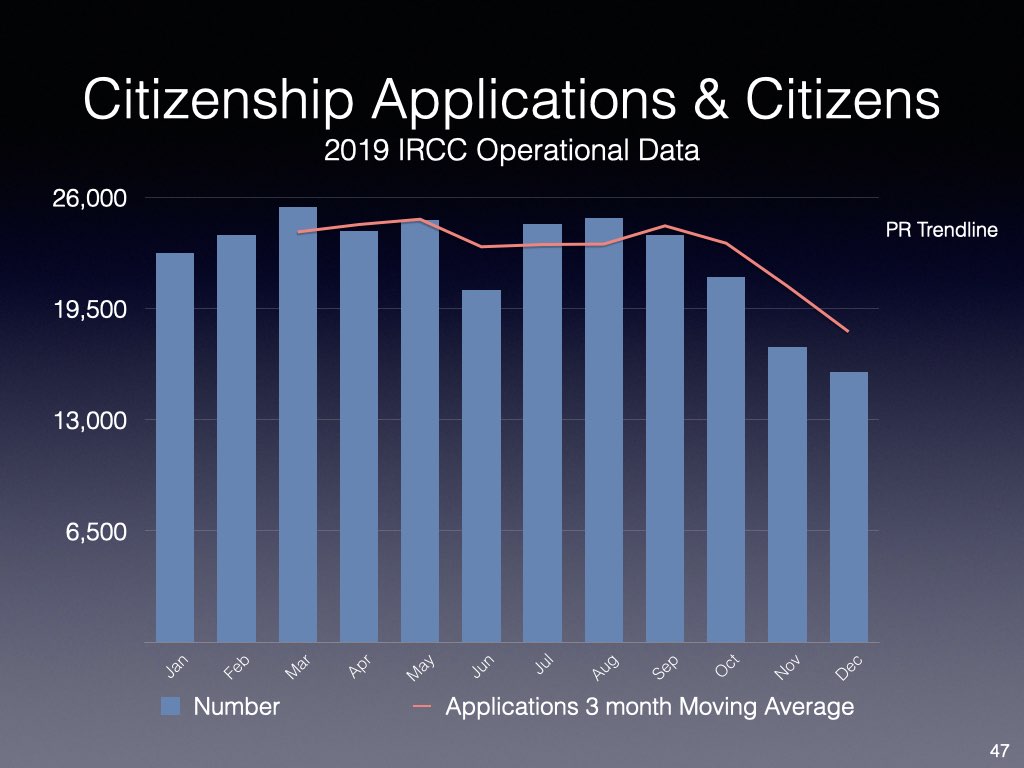
2019 Citizenship applications and new citizens

With the full 2019 numbers available, I have updated by standard chart comparing the number of applications, new citizens and permanent residents:

The following chart shows the number of citizenship applications per month for 2019, with the drop off in the fall likely reflecting the Liberal election commitment to waive citizenship fees (a smaller drop than I would have expected). It will be interesting to see if that trend continues in 2020 until the COVID-19 disruption mid-March (applications still being accepted, however):

The path to citizenship for those who put on American uniform has narrowed

Of note. One of the ironies is that Canada modelled a similar provision in the 2014 C-24 citizenship legislation after the US approach (not repealed in C-6):

When Baron Friedrich von Steuben, a Prussian officer helping the Continental Army, asked for a translator at Valley Forge to address some troops during America’s revolutionary war, the story goes that he was told there was no need. This particular group were immigrants and spoke German. Colonial militias offered state citizenship to soldiers. The Continental Congress granted citizenship even to enemy soldiers who switched sides. The baron was later given American citizenship for helping to see off the Brits.

Since 1952, immigrants have been able to apply for citizenship after one year of honourable service during peacetime. In wartime they have been able to become Americans almost as soon as they join up. Since the September 11th attacks in 2001, more than 100,000 service members have become citizens. But this avenue to citizenship is no longer assured.

In order for the naturalisation process to begin, the Department of Defence has to sign an honourable-service certification form. Without it, the Citizenship and Immigration Services (uscis) will not consider the applicant. In October 2017 the department adopted stricter vetting; as a result, claims a new lawsuit, it is very difficult for service members to be naturalised speedily. This policy change is “a departure from pretty close to 200 years of us history”, says Muzaffar Chishti of the Migration Policy Institute, a think-tank.

Ange Samma, along with five other active-duty service members, and the American Civil Liberties Union (aclu), an advocacy group, filed a class-action lawsuit against the Department of Defence on April 24th. Private Samma enlisted in 2018 and is serving in South Korea. Originally from Burkina Faso, he came to America as a teenager. According to the suit, it took multiple requests for him to receive the honourable-service certification form. When he finally did, uscis rejected it as his officers had not filled it out properly. Without citizenship, he cannot get security clearance for some army work. He is not alone. Scarlet Kim, an aclulawyer, says that thousands of service members are having similar difficulties.

In 2018 there was a 70% drop in naturalisation applicants from the armed forces after the extra vetting was put in place. The lawsuit says the servicemen would have been naturalised faster if they had taken the lengthy civilian route. Their applications are being rejected at a higher rate than civilian ones. Margaret Stock, a retired lieutenant-colonel and now an immigration lawyer, says some serving soldiers are placed in deportation proceedings by the same government that they volunteered to fight for, before the application process has been completed.

Some countries are loosening citizen-enlistment rules because of military-recruitment problems, but only a few make service a path to citizenship as America does. This distinction helps with recruiting. Without immigrants the army would have failed to meet its goals nearly every year between 2002 and 2013. A Department of Defence report in 2016 found that non-citizens perform better, have lower attrition rates and are more likely to have medical and it expertise than their citizen counterparts. Not only do they make useful recruits to the armed forces; they would make good citizens, too.■

Source: The path to citizenship for those who put on American uniform has narrowed

Richmond’s birth tourism hubs untouchable: MLA

Seems like more virtue signalling here rather than seriously arguing what the provincial government could do from a regulatory perspective (but non a high priority during COVID-19):

There’s not much that can be done when it comes to businesses linked to birth tourism, according to Richmond-Queensborough MLA Jas Johal – particularly if those companies have all their paperwork in place.

“The fact that they have a business licence means they’re not breaking the law,” said Johal. “I don’t think the city can do much about that. And even the provincial government couldn’t do much about that beyond discouraging this practice.”

A maternity and baby store, located at 8171 Ackroyd Road, is listed as the Canadian address for a China-based company, which is dedicated to helping pregnant women give birth overseas.

The store also operates a confinement centre, according to the website of parent company Mei Ya Jia Bao – translated by the Richmond News – established in Richmond in 2015.

That parent company, which lists its headquarters in Beijing, also operates Canada World Overseas Investment Consulting Inc., and Colombian International Travel Ltd., which provide travel and visa application services.

Incorporation certificates for all three companies, issued by the provincial government, are posted on Mei Ya Jia Bao’s website. Meanwhile, the website and service agreements are only in Chinese.

The website states the company has successfully helped more than 6,000 families in China travel to Canada to give birth, and offers service packages that include visa applications and confinement centre care.

After the families arrive in Canada, the website states they will make appointments with Chinese-Canadian doctors in Richmond.

Costs for giving birth are listed to be, at minimum, $60,000 to $70,000, and the website also states that living expenses in Canada will run into hundreds of thousands of dollars for a three month stay.

In a video posted by Mei Ja Jia Bao to Youku, a Chinese website similar to YouTube, a man introduces Richmond Hospital. The video also shows BC Womens Hospital and landmarks from around Vancouver.

Mei Ya Jia Bao is far from the only company to set up shop in Richmond – for example, Beijing-based Leading Baby states its Canadian branch is on Westminster Highway.

“My office did find advertising on websites in China promoting birth tourism in Richmond,” said Johal. “The fact that they set up businesses, an office here, is concerning enough.

“But the advertising and promotion of birth tourism is continuing here, so the federal government has to, at the end of the day, deal with this loophole.”

A video produced by Mei Ja Bao Er, another company, gives a short tour of Richmond Hospital’s maternity ward, while in a third company’s video a couple recounts their experience giving birth in Canada. Both videos, advertising to families in China, were also posted on Youku.

The fact that there are companies promoting their business on the web shows that nothing has been done to slow down, and ultimately stop, the practice, said Johal.

The loophole in the tourist visa system, he said, needs to be tackled at the federal level – and can be done via an administrative, rather than constitutional, change.

“It can be an administrative change, which basically states that if you come to this country on a tourist visa – which these people do – to have your child here, the child should not automatically be granted Canadian citizenship,” said Johal.

Once the message gets out that the practice is not accepted by the Canadian government, Johal said he guarantees it will slow down.

During the 2018-19 fiscal year, 23.1 per cent all babies born at Richmond Hospital had non-resident parents, or 458 out of a total 1,980 newborns, according to Vancouver Coastal Health (VCH) data. In the 2014-15 year, babies born to non-resident parents accounted for 15.3 per cent of all babies born at the hospital.

And while the businesses, such as the one on Ackroyd Road, are legal, the provincial government could help discourage the practice by increasing the costs to have a child in B.C., said Johal.

It’s not known whether foreign nationals are giving birth at Richmond Hospital during the COVID-19 pandemic or how many have given birth so far this fiscal year, as VCH doesn’t have interim data or data on homebirths outside of its acute settings, according to a spokesperson.

It’s also not known how many families may have arrived in Canada before borders around the world were closed.

For Johal, that lack of information is a “challenge,” coupled with the lack of information on how the companies operate, how many mothers they help bring to Canada at any one time, or their health and safety standards.

“The fact that we have this business, and many businesses like this set up here, and it’s just a black hole when it comes to information is concerning,” said Johal, “and even more so during this period of COVID-19.”

Source: richmond-news.com/news/richmond-…

Taxing Canadian expats not the silver bullet for generating post-COVID revenue

My latest, in response to Canada needs to start taxing Canadians who live abroad:

Chandra Arya, the Liberal MP for Nepean, Ont., recently argued for changing the current residency-based taxation approach to the U.S. citizenship-based taxation (CBT) approach, understating the complexity involved in making such a change and overstating the potential benefits.

(Similarly, Andrew Caddell argued in his April 22 Hill Times column that “the three million Canadians abroad should contribute, through a 10 per cent tax on income; that could bring in at least $30-billion per year.”)

Some of the arguments are, on the surface, convincing. Why should Canadian expatriates, after not paying Canadian taxes for their years working abroad, return to Canada to benefit from medicare and other benefits on their return as retirees? Ironically, Arya uses similar “Canadians of convenience” arguments as those used by the previous Conservative government under then-immigration minister Jason Kenney. He is part of a Liberal government that extended voting rights to virtually all expatriates, most of whom pay little or no Canadian taxes.

But we have to start with a better understanding of the numbers of Canadian expatriates, whether foreign or Canadian-born. He, like too many, uses the Asia Pacific Foundation estimate of three million, which includes all ages and permanent residents. A more accurate, albeit imperfect estimate, is closer to two million adult Canadian citizens.

But how many of these maintain strong connections to Canada or are likely to return to Canada to take advantage of Canada’s generally strong social safety net? The answer is we do not know and there is limited data available.

However, we have some proxy measures that give an order of magnitude to those keeping their close Canadian ties.

The average annual number of immigrants who left Canada between 1996 and 2011 is about 100,000, according to a Statistics Canada study, with between 25 and 40 per cent being temporary emigrants, depending on the census period. For 2006-11, 35.6 per cent of emigrants move to the USA. There is no data regarding their citizenship status or the length of time they spent in Canada prior to emigrating.

The number of adult Canadian passport holders abroad was about 725,000in 2015. The number of Canadians registered with Global Affairs Canada for consular services is about 346,200, as of April 26, the department said.

In 2017, the number of Canadian expatriates who file Canadian non-resident taxes was about 92,000.

And we also know that some immigrants return to their country of origin upon retirement, and that about 181,000 persons received CPP, according to December 2019 numbers, but there’s no data regarding their citizenship status.

So Arya’s arguments are based on “[a]necdotal evidence [that] suggests citizens are returning to Canada to enjoy these benefits after spending their productive lives elsewhere,” and his assertion “for a small but growing number, the objective is to acquire citizenship and leave again.”

Like all anecdotal evidence, there is some truth, but the extent of that truth, and whether it would warrant such a major and disruptive change in Canadian taxation, is questionable.

The other major flaw lies with citing the U.S. citizenship-based taxation approach as the model to emulate, without asking the necessary questions regarding why the U.S. is the outlier, compared to other Organisation for Economic Co-operation and Development (OECD) countries. Citizenship-based taxation is less appropriate for a world of increased mobility and dual citizenship. Moreover, residency-based taxation is intrinsically easier to administer, including with respect to double taxation issues.

The introduction of the Foreign Account Tax Compliance Act (FATCA) and its assorted implementation difficulties and inconsistencies highlights even more the complexities of CBT, leading a small, but not insignificant, number of Americans to renounce their U.S. citizenship.

This should serve as a major caution to advocating for a major change to our taxation system, one that is out of step with all OECD countries, save the U.S.

Would the alleged benefits of increased tax revenues materialize? If so, would they exceed the expected massive costs of completely revamping our tax system? How effective would expatriate tax compliance be, and what would be the costs of enforcement? And just as the U.S. approach resulted in modest income from “accidental Americans” (citizens of another country unaware of their U.S. citizenship) being caught by FATCA, how could we be sure that such a change might result in “accidental Canadians?”

Clearly, better data on the number of expatriates, permanent and temporary, and the degree to which they return as retirees and take advantage of Canadian medicare and other benefits would be useful. But like so many citizenship and immigration issues, any change aimed at a subset of the population, has to be weighed against the impact on the wider population.

Similarly, a fundamental shift from residency-based to citizenship-based taxation should take place in the context of a broader review of taxation policies, rather than a fundamental, but piecemeal, proposal. Any such review should aim at ensuring that taxation reflects current and anticipated societal needs.

A shift to citizenship-based taxation would have major impact and costs. The flawed U.S. example and anecdotal evidence fail to justify such a change or even a study, given that there are more important taxation and related policy questions.

Source: Taxing Canadian expats not the silver bullet for generating post-COVID revenue

Wealthy Move Their Money To Tax Havens

As always…:

Lockdown might impact peoples’ ability to move across borders, but it doesn’t stop money flowing into tax havens around the world.

The economic shocks of coronavirus have meant that offshore financial centres such as Switzerland are back to their old tricks: Banking peoples’ money away from their more risky homelands.

UBS, a Swiss bank and the world’s largest wealth manager, announced its profits were up by 40%. In the first three months of 2020, it saw $12 billion in net new money, nearly treble the amount banked in the previous quarter.

“We successfully managed March’s high volumes and activity across our trading and client platforms, including peaks of three times the normal levels,” Sergio Ermotti, the bank’s CEO, told investors on Tuesday (April 28).

This enabled the bank to gain a higher share of wallet from its clients, Ermotti added.

Pre-coronavirus, Switzerland’s popularity for offshore banking was fading as its banking sector could no longer guarantee client secrecy. However, the country’s notorious stability combined with low COVID-19 infection rates have renewed its appeal among the international wealthy who use its private banking services.

“There are some countries where the risk of your money and your wealth being more at risk than others does potentially also lead to inflows into safe and secure places like Switzerland,” says Anna Zakrzewski, who leads Boston Consulting Group’s Global Wealth Management division.

Source: Wealthy Move Their Money To Tax Havens

‘Will my child ever be a Malaysian?’ — Malaysian Campaign for Equal Citizenship

Of note how the impact of gender discrimination in citizenship policy has a greater impact under COVID-19:

Malaysian women currently do not have equal rights to confer citizenship on their children born overseas on an equal basis as Malaysian men. Women must utilise an application process under Article 15(2) that is fraught with delays and frequent rejections without reasons given, and sadly, no guarantee of ultimately securing citizenship.

The Malaysian Campaign for Equal Citizenship would like to highlight that the impact of discriminatory citizenship laws on women are even worse during the Covid-19 pandemic.

As the Malaysian movement control order (MCO) mandates a 14-day quarantine for anyone entering the country, this would be a challenge for pregnant women, especially those who may be travelling with their other children.

Additionally, the MCO only allows foreign spouses to enter Malaysia during the MCO provided they have a long term social visit pass (LTSVP). Hence spouses who do not hold one will not be able to accompany their wives and these mothers either have to return on their own or make the decision to give birth overseas while risking the chances of their children securing a Malaysian citizenship.

With countries’ borders closing and a limited number of flights during the Covid-19 pandemic, these women live with a tremendous dilemma.

That is, expose themselves to the health risks of traveling home (leading to the understandable quarantine) so that the child can be Malaysian; or deliver overseas, and live with the excruciating uncertainty if their child will ever be a Malaysian and then undergo the long tedious process of application.

“I was planning to give birth in Malaysia but because of the coronavirus, travels are restricted. I might not have a choice to give birth in Malaysia which is a pity for my baby as Malaysian women are not able to obtain automatic Malaysian citizenship (upon registration) for their own children, this is just getting more and more impossible.” – Malaysian woman living in Germany

Another Malaysian mother in Singapore felt it was not an ideal solution to travel to Malaysia to deliver her child as her husband could not enter Malaysia without an LTSVP, and she was not comfortable to undergo delivery by herself considering she experienced anxiety throughout her pregnancy.

She has since given birth in Singapore which cost her almost double in medical fees due to such changes in her delivery plans.

Women are often expected to accommodate their pregnancy according to existing Malaysian citizenship provisions by delivering in Malaysia for their children to be Malaysian.

Such inequality in citizenship laws discriminate against women and contribute to the unequal status of women in the family and society. Laws as such make women vulnerable, especially during times of crisis as they are left with limited choices influenced by constraints.

While the Malaysian Government has been swift in addressing the ongoing pandemic, a fair and just solution is needed to ensure that all Malaysian women enjoy equal rights and are not put in unnecessary vulnerable situations.

Therefore, we call on the Government of Malaysia and every Member of Parliament to amend Article 14 of the Federal Constitution so as to grant Malaysian women equal rights to confer citizenship on their children on an equal basis as Malaysian men.

In addressing the urgent needs of the Covid-19 situation on pregnant Malaysian women overseas, we urge the Government of Malaysia, specifically the Ministry of Home Affairs and Immigration Department of Malaysia to especially grant citizenship to children born overseas to Malaysians during the Covid-19 situation as a temporary measure until full equality is enshrined in Malaysian citizenship laws.

Source: ‘Will my child ever be a Malaysian?’ — Malaysian Campaign for Equal Citizenship

Canada needs to start taxing Canadians who live abroad

Working on a piece analyzing the issue of citizenship-based versus residency-based taxation, given this opinion piece by Chandra Arya, Liberal MP for Nepean.

His arguments are largely based on anecdote rather than available evidence, he fails to question by the USA is an outlier on citizenship-based taxation compared to other OECD countries, and understates the policy and administrative complexities involved in making such a change.

As always, people cite the Asia Pacific Foundation number of three million expatriates without controlling for age and citizenship. Doing so results in about two million expatriates:

It is time for Canada to adopt citizenship-based taxation (CBT).

While we don’t have complete information on where Canadians have taken up long-term residence abroad, there are reports of about 300,000 Canadian citizens in Hong Kong and tens of thousands in each of several countries in the Middle East. From Asia to Africa, from Europe to the Caribbean and South America and, of course, the US, significant numbers of Canadians have made their permanent home away from Canada. There were about 3 million Canadians abroad, including tourists, at the start of the COVID-19 crisis, according to the Prime Minister.

Currently, Canadian income tax obligations are based on residency status and not on citizenship or immigration status, so non-resident Canadians do not pay taxes. However, expatriate Canadians enjoy the same rights as Canadians who are resident here. They should face the same obligations as resident Canadians, including paying taxes, so that they share the responsibility of contributing, at least financially, to our country.

The United States is the only developed country that taxes its citizens on their global income irrespective of where they live or how long they have lived outside of the US. The constitutional validity of CBT has not been tested in Canada, but the 1924 US Supreme Court decision in the case of Cook v. Tait offers cogent reasoning about CBT that shows its validity under the US constitution. The decision relied on the inherent benefits received by US citizens and their property from the US government, regardless of where the citizens made their home or where their property was located.

Michael S. Kirsch of  the University of Notre Dame, in his seminal 2007 article “Taxing Citizens in a Global Economy,” argues for the same principle. Kirsch suggests that recent globalization trends strengthen, rather than weaken, the case for taxing US citizens living abroad. He concludes that modern advances in transportation and communication weaken the case for giving preferential treatment to income earned by citizens working abroad, in that these developments afford the expatriate US citizen virtually the same rights as that of a resident US citizen, such as personal protection, property protection, the right to vote and the right to enter.

The same can be said of expatriate Canadians. They are assured of guaranteed access to a safe, secure and stable society, virtually free world-class health care and education systems and, depending on income levels, affordable housing, irrespective of their length of stay (or lack thereof) in Canada. In addition, depending on the time spent in Canada, financial supports like Old Age Security and the Guaranteed Income Supplement are available to them. Anecdotal evidence suggests citizens are returning to Canada to enjoy these benefits after spending their productive lives elsewhere. This is a significant contingent liability for Canada, because citizenship — not contribution (or lack thereof) to our society — is the criterion for benefits and support.

Kirsch also discusses the need to maintain the cohesion of a society. In the absence of citizenship-based taxation, there is a strong tax-driven incentive for a not insignificant number of high-income and high-net-worth individuals to establish tax residence abroad in order to avoid income taxes. The creation of a separate class of citizens could have corrosive effects on broader society, just as it has done in other countries that rely only on residence-based taxation.

A Canadian passport facilitates visa-free travel and increased international mobility — and serves as a plan B, allowing these global citizens to return here when things get rough elsewhere.

There was a time when most immigrants to Canada came here to become citizens and settle permanently. Now, for a small but growing number, the objective is to acquire citizenship and leave again. A Canadian passport facilitates visa-free travel and increased international mobility — and serves as a plan B, allowing these global citizens to return here when things get rough elsewhere. But without CBT, they don’t help to finance the society they are counting on as a safe harbour.

There are also budgetary considerations underlying the adoption of a CBT system. Before the COVID-19 crisis, our economy was in great shape and able to generate sufficient government revenues to maintain a comfortable federal debt-to-GDP ratio of about 30 percent. Now we are in another world altogether. We are going to have the biggest budget deficit in the history of Canada, thanks to the biggest bailout packages ever for millions of Canadians and businesses. The public debt may exceed all previous peaks. While it is always optimal for a country to have an expanding tax base that is able to fund social programs and services or investments in infrastructure, defence and economic development, it has now become a necessity. With CBT, the tax base would include many more new taxpayers.

Changes to demographics, particularly the greying of our society, will only accentuate the need for higher government revenues, as these changes will result in substantial growth in demand for social services. Volatile global situations will increase the number of Canadians returning to safety (financial, health and/or physical) in Canada, also boosting the demand for government services.

One revenue option to meet these demands is to increase direct or indirect tax rates. The alternative is to shrink spending. Canadians seem to have no appetite for either of these options, especially in the current crisis. The Liberals in the recent past have raised taxes on the wealthy. But there is a limit to this approach.

The only viable alternative for enlarging the revenue stream in order to maintain adequate service delivery to citizens is to expand the taxpayer base. This is why the idea of CBT is so appealing. The government should examine CBT’s feasibility, including the potential contingent liability and revenue, plus enforcement and international tax agreement issues. The financial burden and responsibility of meeting the needs of all Canadians should be shared by all citizens. It is the equitable thing to do.

Source: Canada needs to start taxing Canadians who live abroad

Andrew Caddell, in his overview Opinion: The post-COVID Canada faces many challenges The post-COVID Canada faces many challenge includes a throwaway line which is completely silent on these complexities:

Governments will have to get out of debt without crushing the economy, or Canadians. This will require creative ways of raising taxes. One possibility would be a two per cent increase in the GST to seven per cent: that would generate $90-billion over five years. Second, the three million Canadians abroad should contribute, through a 10 per cent tax on income; that could bring in at least $30-billion per year. Third, tax havens for Canada’s wealthiest have to be closed, and that money taxed.

La pandémie force Ottawa à vider ses ambassades, Ottawa tente de régulariser le statut des Canadiens coincés à l’étranger

Two articles in French language media on relatively under-covered aspects of COVID-19:

Starting with the reduced staffing of Canadian missions abroad and the impact on consular service. Less concerned about political reporting given the amount of information publicly available:

Radio-Canada a appris qu’une soixantaine de missions diplomatiques ne peuvent désormais qu’assurer le strict minimum en matière d’aide consulaire, puisque le personnel jugé non essentiel à la réponse à la COVID-19 a été ramené d’urgence au Canada depuis quelques semaines, du jamais-vu.

Environ 1000 personnes, diplomates et membres de leur famille, ont ainsi quitté ambassades, hauts-commissariats et autres missions diplomatiques un peu partout sur la planète. Selon nos sources, le personnel diplomatique travaillant dans des pays où le système de santé est jugé peu fiable a été rapatrié en priorité.

L’opération a commencé en janvier par le retour au Canada du personnel non essentiel en Chine, premier foyer d’infection par le coronavirus, avant de se poursuivre dans une soixantaine de pays.

Le ministère [des Affaires étrangères] a un devoir d’assurer la santé et la sécurité de ses employés, indique une source gouvernementale qui a requis l’anonymat pour s’exprimer librement.

Les chefs de mission, comme les ambassadeurs, restent toutefois en poste. Si Affaires mondiales Canada demeure en mesure d’assurer les services consulaires d’urgence, le rapatriement massif du personnel force la mise en veilleuse de nombreux programmes.

Dans ces pays, ce sont surtout les programmes d’aide au développement et les missions commerciales qui sont touchés, confie un employé d’Affaires mondiales Canada bien au fait du dossier.

On fait ce qu’on peut à distance, mais c’est sûr que notre capacité à livrer des programmes et faire des suivis est réduite, ajoute cette même source.

Les opérations régulières sur le terrain avaient toutefois déjà été lourdement perturbées avant que ces diplomates ne reviennent au Canada, alors que le ministère consacrait tous ses efforts au rapatriement des ressortissants canadiens.

Une « perte de contact » avec le monde

Si le Canada n’avait d’autres choix que de rapatrier un maximum de ses représentants, Gilles Rivard, l’ancien ambassadeur du Canada en Haïti, croit que cette vaste opération nuira en premier lieu à la collecte de renseignements dans les pays où les missions auront réduit leurs ressources au maximum.

On ne produira plus de rapports politiques sur ce qui se passe dans ces pays, c’est une perte de contact que le Canada va vivre, dit-il en entrevue.

Gilles Rivard ajoute qu’il ne faut pas négliger les conséquences de la réduction du personnel canadien à l’étranger.

Ça va avoir un impact extrêmement important. Pas juste sur les programmes culturels, mais également sur les programmes d’aide au développement. Il n’y aura plus personne pour suivre les projets sur place qui sont gérés par le Canada, il n’y aura pas de suivi pendant un certain temps, souligne le diplomate de carrière.

M. Rivard rappelle cependant que le Canada peut se fier davantage à ses partenaires internationaux, comme la Croix-Rouge, pour gérer les programmes financés par le gouvernement canadien.

Dans ces moments difficiles, l’ancien chef de mission pense aussi beaucoup aux diplomates, autant les rapatriés que ceux restés à l’étranger, et à leur famille.

L’impact sur les proches est immense, dit-il. Dans des cas comme ça, des familles doivent partir en premier et certains diplomates restent derrière, c’est très difficile humainement. Ceux qui doivent partir se sentent coupables de laisser la mission derrière, ce sont des gens qui ont à cœur ce qu’ils font.

And Foreign Minister Champagne on the repatriation flights. Despite the various frustrations and complaints by many Canadians stuck abroad, the scale of the effort given the many countries involved, is impressive:
Le ministre des Affaires étrangères, François-Philippe Champagne, a indiqué que ce dossier a été abordé durant les discussions qu’il a eues avec ses homologues d’une douzaine de pays lors d’une récente conférence téléphonique.

Ce dossier devrait être de nouveau à l’ordre du jour lors de la sixième conférence téléphonique que M.  Champagne doit organiser ce vendredi avec ses vis-à-vis de l’Allemagne, de la France, de l’Angleterre, de la Turquie, de la Corée du Sud, du Brésil, du Mexique, de l’Indonésie, de l’Australie, de l’Afrique du Sud, de Singapour, du Pérou, du Maroc et de l’Union européenne.

Depuis plus d’un moins et demi, et à l’instigation de M.  Champagne, les ministres des Affaires étrangères de ces pays se donnent un rendez-vous quasi hebdomadaire afin de discuter des enjeux liés à la COVID-19 qu’ils ont en commun. À la prochaine conférence téléphonique, l’Inde a fait part de son intérêt à y participer.

Au cours des dernières semaines, les responsables de la diplomatie étrangère de ces pays ont pu coordonner leurs efforts pour rapatrier leurs ressortissants respectifs dans un contexte des plus difficiles, discuter des mesures à prendre pour protéger la chaîne d’approvisionnement mondiale en biens essentiels, faciliter l’établissement de ponts aériens et protéger les routes maritimes.

La prolongation des permis de séjour pour les ressortissants qui n’ont pas été en mesure de rentrer dans leur pays fait maintenant partie de dossiers prioritaires.

« L’objectif, c’est de s’assurer que nos ressortissants ne se trouvent pas en violation technique de leur visa ou de leur permis de séjour. Il n’y a pas que des Canadiens qui pourraient se retrouver dans cette situation. Il y a aussi des Australiens, des Britanniques, des Français, etc. Cela fait partie des enjeux que l’on aborde ensemble », a indiqué M.  Champagne dans une entrevue accordée à La Presse.

Le ministre a indiqué que les opérations visant à rapatrier les voyageurs canadiens qui se trouvent toujours à l’étranger sont à « 75 % à 80 %  » terminées. En date de mardi, les autorités canadiennes ont pu rapatrier 16 606 Canadiens en provenance de 65 pays à partir de 119 vols. Il a répété que malgré tous les efforts qui ont été déployés jusqu’ici, « on ne pourra pas ramener tout le monde ».

Quant au nombre de ressortissants canadiens qui pourraient avoir besoin d’une prolongation de permis de séjour ou de visa, il est difficile d’en dresser un portrait précis. Tout dépendra du succès des opérations de rapatriement qui auront lieu au cours des prochains jours et du nombre de Canadiens qui se seront inscrits auprès des services consulaires.

« S’il y a un moment dans l’histoire où on doit plus collaborer, c’est bien maintenant. Chaque jour, j’ai toujours l’impression que l’on fait un pas de plus », a affirmé le chef de la diplomatie canadienne.

« Dans le cas des opérations de rapatriement, c’est durant ces discussions que plusieurs pays ont décidé de mettre leurs ressources en commun pour faciliter les opérations. On devrait avoir une déclaration commune sur d’autres mesures que l’on veut prendre ensemble après notre rencontre du 17 avril », a-t-il aussi avancé.

Au départ, M.  Champagne avait comme objectif de créer un sous-groupe de pays membres du G20 pour discuter des enjeux liés à la pandémie de la COVID-19. Alors que certains de ses collègues évoquaient les problèmes qu’ils éprouvaient dans les efforts de rapatrier leurs ressortissants au Pérou et au Maroc, M.  Champagne a décidé d’inviter les ministres des Affaires étrangères de ces deux pays à participer à la conférence téléphonique pour les sensibiliser.

« Je voyais bien que nous avions tous les mêmes enjeux au Pérou et au Maroc. J’ai alors demandé au ministre des Affaires étrangères du Pérou de se joindre à l’appel, comme celui du Maroc. Et ils participent toujours aux appels aujourd’hui, même s’ils ne font pas partie du G20 », a-t-il raconté au bout du fil.

« Ce que j’aime dans la composition régionale, c’est d’abord l’importance des joueurs autour de la table. Ce n’est pas un groupe fermé. Ceux qui veulent s’y joindre – c’est au niveau ministériel – peuvent le faire. Cela nous a permis de développer des liens, de raffermir des liens. Aux dires des collègues, c’est le seul appel régulier qui se tient dans le monde sur la COVID-19 aujourd’hui », a-t-il pris soin de relever.

L’esprit de collaboration qui règne durant ces appels donne espoir à François-Philippe Champagne. Cela pourrait renforcer le multilatéralisme, mis à rude épreuve en ce moment par les États-Unis depuis l’arrivée au pouvoir de Donald Trump à Washington.

« Il y aura peut-être un renforcement du multilatéralisme dans le sens où les gens auront vu la nécessité de coordonner, de coopérer et de collaborer face à des enjeux qui dépassent les frontières. On le voit au niveau des changements climatiques, on le voit au niveau du nouveau coronavirus. On est en train de se donner des exemples très concrets où le multilatéralisme prend tout son sens », a-t-il affirmé.

Source: Ottawa tente de régulariser le statut des Canadiens coincés à l’étranger