Be in Canada, bring scissors; instructions for online citizenship ceremonies Canada is now holding citizenship ceremonies online, so some new guidelines have been put in place.

Further to my earlier post, contrasting Australia’s 60,000 to Canada’s 1,000 new citizens over the past 3 months or so, @canadavisa_com flagged the new guidelines for online ceremonies:

Canada is not letting the coronavirus pandemic rob immigrants of their special day, but since citizenship ceremonies now take place over Zoom, a few changes have been made.

Canadian citizenship ceremonies are meaningful, important events in people’s lives, so Immigration, Refugees and Citizenship Canada (IRCC) created new instructions for soon-to-be citizens who are taking their oath online.

IRCC will provide all the details of the citizenship ceremony in an invitation letter. It will include the date, time, Zoom link and log-in instructions.

Even though everything is being done online, you have to be physically in Canada in order to take the Oath of Citizenship. IRCC will ask you to confirm your location before you can participate in the ceremony. If you are not physically in Canada, you may have to do the citizenship ceremony once you are back in the country.

Though there’s no strict dress code IRCC says to dress “respectfully.” Wearing religious or traditional clothing is acceptable, though face coverings may be requested to be removed temporarily for identification purposes. Casual hats are discouraged.

You can sit for the entirety of the ceremony, even when saying the oath, but IRCC asks to choose a quiet room for the Zoom call. They recommend a room free of noise and distractions, and to have a plain background.

Your head and shoulders should be visible, and your hand-held device should be stable.

You’ll need a number of documents such as your permanent residence card, whether it’s expired or not, or your Confirmation of Permanent Residence (COPR). You will also need two pieces of ID, unless you’re under the age 18. Some people will need their record of landing if they came to Canada before June 28, 2002. IRCC will also send you a form to sign after you have taken the oath.

And of course, you’ll need scissors to cut up your permanent residence card on-screen, since you won’t be needing it anymore.

You also have the option to bring a holy book if you want to use it to swear the Oath of Citizenship.

Canada postponed citizenship ceremonies scheduled for the last two weeks of March following coronavirus closures and switched to holding the events online by April. On Canada Day, July 1, IRCC reported over 1,000 citizenship ceremonies had taken place online since the start of the pandemic.

They even held their annual Canada Day citizenship ceremony online. For the first time ever, 19 participants took the oath at the same time from all over Canada.

Source: cicnews.com/2020/07/be-in-…
Caribbean countries selling discount citizenship due to COVID hit

Of note. The citizenship variant of Gresham’s law in action:

Citizenship by Investment (CBI) Programs are not new to the Caribbean. Many countries in the region have been offering passports to wealthy foreigners in exchange for monetary investment for years, but with staggering post-COVID tourism losses, many passports have gone on sale. Among the countries to recently slash prices or make their CBI programmes more compelling are St. Kitts and Nevis, St. Lucia, Antigua and Barbuda, and Dominica.

St. Kitts and Nevis, which earns around 35 per cent of government revenue from its CBI programme, was one of the first Caribbean countries to begin slashing prices.

“In these days of Covid, when tourism is not happening, we have to find ways to create revenue to sustain our economy,” said Les Khan, CEO of St. Kitts and Nevis Citizenship Investment Unit, in a phone interview with Bloomberg.

St. Kitts and Nevis is currently offering a special deal through to the end of 2020. It entails paying a contribution of $150,000 to the country’s “Sustainable Growth Fund”, which will secure, for those who can afford it, passports for a family of up to four– a 23 per cent discount off of the usual cost of $195,000.

This is a great deal when considering the fact that St. Kitts and Nevis currently has the 26th most desirable passport in the world, out of 169 countries, according to the 2020 Henley Passport Index.

In May, St. Lucia cut the required CBI investment in five-year, non-interest bearing bonds in half, to $250,000 for an individual or $300,000 for a family of four. The “special offer” on these “Covid-19 Relief” bonds expires at the end of 2020. St. Lucia’s passport ranks at number 33 on the 2020 Henley Passport Index.

In Antigua and Barbuda, a family of four can become citizens at the bargain price of a $100,000 donation to its development fund. The government recently cut the price for adding additional children. Antigua and Barbuda’s passport ranks number 29 on the 2020 Henley Passport Index.

Pre-COVID-19, Dominica offered the cheapest citizenship by investment program in the world with the cost of second passports starting at only $100,000, but the price was scheduled to increase by 75 per cent, to $175,000. According to Dominica’s CBI website, “This major cost increase has now been put on hold indefinitely, although prices could increase once the COVID-19 pandemic is over so we encourage you to act fast.” Dominica has the 38th most desirable passport in the world, according to the Henley Passport Index.

The incentives seem to be working. According to Henley & Partners, a London-based passport broker, there has been a 42 per cent increase in citizenship applications.

“‘Investment migration’ has shifted from being about living the life you want in terms of holidays and business travel to a more holistic vision that includes healthcare and safety,” said Dr Christian Kalin of Henley & Partners.

Source: Caribbean countries selling discount citizenship due to COVID hit

Australian citizenship up by 60 per cent this year despite COVID-19 with highest number on record

One has to ask why Australia was able to maintain its citizenship program through virtual ceremonies (60,000) and Canada was not, despite recent ramping up in June and July (about 1,000).

Given that COVID restrictions on larger groups are likely to remain for some time, IRCC needs to continue to ramp up its capacity for online ceremonies even if they are not ideal and less meaningful than in-person events:

More than 200,000 people have pledged their allegiance to Australia and become new citizens in the past 12 months.

In the 2019-20 financial year, 204,817 people were conferred Australian citizenship – a 60 per cent increase on the previous financial year and the highest number on record.

Acting Minister for Immigration, Citizenship, Migrant Services and Multicultural Affairs Alan Tudge said citizenship was an important part of Australia’s success as a socially cohesive, multicultural nation.

“Becoming an Australian citizen means more than just living and working here – it’s a pledge of allegiance to our nation, our people and our values,” Mr Tudge said.

“When someone becomes a citizen, they make a pledge to uphold Australia’s rights, liberties, laws and democratic values. It represents a willingness to integrate into our successful multicultural nation.”

“Being an Australian citizen is an immense privilege, which brings both rights and responsibilities. I congratulate all those who have taken this important step.”

The Government moved quickly to start online ceremonies when COVID-19 restrictions forced in-person ceremonies to stop, and to date more than 60,000 people have been conferred citizenship this way.

Small in-person ceremonies resumed on 3 June. Online ceremonies will also continue for the foreseeable future for councils unable to host in-person ceremonies in a COVID-safe way.

The Department of Home Affairs has also resumed citizenship interviews and testing, in line with COVID-19 health advice. Small numbers of appointments have begun in Perth and Sydney and more will be rolled out in other locations as soon as possible.

Source: Australian citizenship up by 60 per cent this year despite COVID-19 with highest number on record

Home Office urged to correct false slavery information in citizenship test

Citizenship guides are tricky matters to navigate.

Despite promising a revised guide in 2016, the Canadian government has yet to release what I understand to be a largely complete revision to Discover Canada (which despite some flaws, is a vast improvement of the fluffy A Look at Canada):

More than 175 historians have called on the Home Office to remove the history element of the UK citizenship test because of its “misleading and false” representation of slavery and empire.

The signatories say the official handbook, which the Life in the UK test is based on, creates a distorted version of history, which directly counters the values of tolerance and fairness it purports to promote.

In an open letter, the signatories, including 13 fellows of the British Academy, two past presidents of the Royal Historical Society and the director of the Stephen Lawrence Research Centre, write: “The official handbook published by the Home Office is fundamentally misleading and in places demonstrably false … People in the colonies and people of colour in the UK are nowhere actors in this official history. The handbook promotes the misleading view that the empire came to an end simply because the British decided it was the right thing to do. Similarly, the abolition of slavery is treated as a British achievement, in which enslaved people themselves played no part. The book is equally silent about colonial protests, uprisings and independence movements.”

Source: Home Office urged to correct false slavery information in citizenship test

Trump gives away the game on his census citizenship gambit

Indeed:

The Supreme Court was confronted with a difficult question in the past year. The Trump administration wanted to put a citizenship question on the 2020 Census, and its stated reason was to enforce the Voting Rights Act. But opponents argued this was, in fact, a thinly veiled partisan gambit to draw more GOP-friendly districts.

The court issued a remarkable rebuke of the Trump administration’s stated reason. And now, the Trump administration is pretty much acknowledging its motivation was precisely what its critics claimed.

President Trump on Tuesday signed a memorandum stating that undocumented immigrants should not be included as part of the next process of apportionment — i.e., the doling out of congressional districts that follows every census. Such a move would reduce the representation of states (many of them blue) with higher undocumented populations.

Apportionment has never been handled like this, and there are major questions about both the legality and practicality of the memorandum.

The Constitution states that congressional districts must be drawn according to “the whole number of persons.” And federal courts have long ruled that congressional districts must be drawn according to total population. But there has been some ambiguity in how the Supreme Court has decided this question. And Justice Samuel A. Alito Jr. has indicatedthat perhaps states might be allowed to draw their legislative districts according to citizen voting-age population. At the least, the Trump administration is putting all of that to the test.

Beyond that, it’s not clear how this will be executed. Given that the Supreme Court struck down the citizenship question, how is the federal government to even determine which people are citizens? Even if the idea passes constitutional and legal muster, actually doing what the memorandum says is another matter entirely.

But those two very important questions aside, there’s the matter of what this says about the Trump administration’s true intent. The Supreme Court ruled in the past year that the Trump administration’s stated reason — the Voting Rights Act — “seems to have been contrived” and that officials such as Commerce Secretary Wilbur Ross seemed to invent a justification for something they planned to do very early in the Trump presidency.

Chief Justice John G. Roberts Jr. strongly rebuked Ross and the administration, saying, “What was provided here [as a justification] was more of a distraction.”

Absent from the Trump administration’s legal defense was any indication that this was part of an effort geared toward apportionment or redistricting — the latter being the decennial drawing of new districts to reflect population shifts.

But it was part of the opposition’s case. Critics in the past year pointed to a previously unpublished 2015 presentation from the late GOP redistricting expert Tom Hofeller, which stated that using citizenship data in a state such as Texas “would be advantageous to Republicans and non-Hispanic whites” by diluting the influence of Democratic-leaning Hispanics. The critics argued that the Justice Department’s case for a census citizenship question closely mirrored Hofeller’s 2015 study, reinforcing the political motivations of the move.

And Trump himself seemed to affirm that aim. As the case was progressing, the president blurted out that, “Number one, you need it for Congress — you need it for Congress for districting.”

This ran afoul of the Supreme Court defense offered by the Trump administration, led by then-Solicitor General Noel Francisco. Francisco said at the time that Ross “did not rely on that rationale in his decisional memorandum.” Francisco added: “Instead, he relied on DOJ’s explanation … that citizenship data from the [American Community Survey] has substantial limitations.”

In other words, the defense was that we needed the citizenship question because the more-frequent but less-robust American Community Survey couldn’t provide totally accurate citizenship data — not because of a need for apportionment or redistricting data.

Both before and since then, the administration hasn’t done much of anything to reinforce its claimed desire to enforce or bolster the Voting Rights Act. But it has now confirmed that it would very much like to use citizenship data to award congressional districts — just as its critics claimed (and it denied) was its true aim.

Trump’s move Tuesday suggests his comments were more than just a coincidence — and that his administration’s disavowals of this alleged goal were dishonest, at best.

Source: Trump gives away the game on his census citizenship gambit

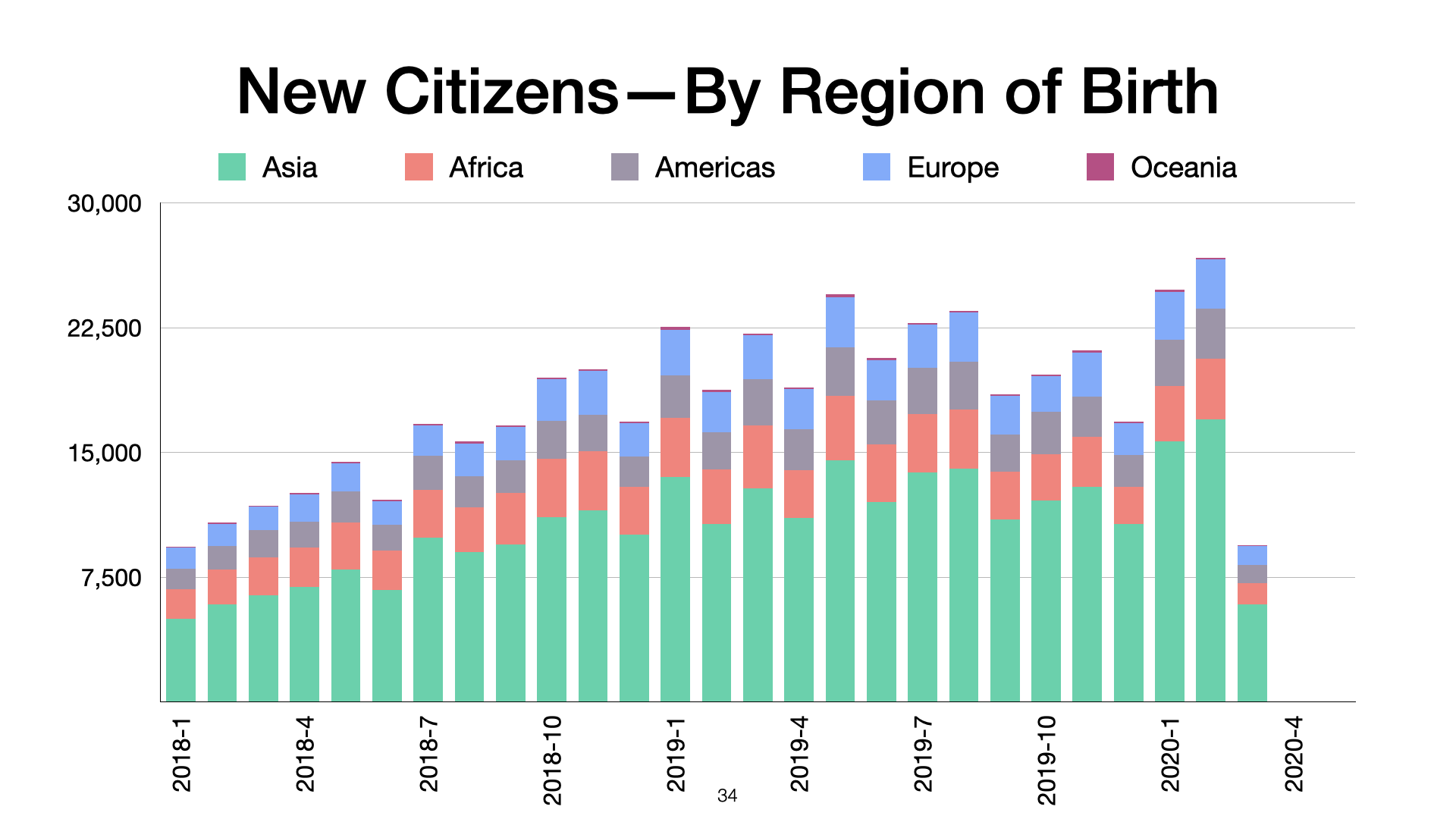
Citizenship statistics 2020: How the complete shutdown looks

With open data now having posted the 2020 numbers, we have comparable data across all IRCC programs regarding the impact of COVID-19. The data reflects the  complete shut down of citizenship ceremonies (save for a few online).

Having this baseline data will allow for analysis of how quickly the program recovers.

Unfortunately, open data does not publish citizenship applications (unlike virtually all other programs, so we only have a partial picture). Annoyingly, the IRCC country of birth listing is different from the other programs’ country of citizenship listing, making it harder to sort alphabetically across programs (i.e., citizenship country of birth Peoples Republic of China compared to other data tables, China, PRC, The Netherlands vs. Netherlands, The etc).

MPI Report: A Rockier Road to U.S. Citizenship? Findings of a Survey on Changing Naturalization Procedures

Another good and informative report by MPI:

The 9 million immigrants who are eligible for U.S. citizenship face growing obstacles to naturalization as the result of changed U.S. Citizenship and Immigration Services (USCIS) adjudications standards and a recasting of the agency’s mission to prioritize fraud detection over customer service, a Migration Policy Institute (MPI) analysis of a survey of 110 naturalization assistance providers across the United States finds.

While USCIS continues to approve the vast majority of naturalization applications it receives, the agency took nearly twice as long to process the average case in fiscal 2019 than was the case three years earlier, with case backlogs increasing as applications have been kicked back more frequently with requests for more information and English and civics tests have been administered more strictly. This increased vetting of applications was happening before a trio of new developments could significantly reduce citizenship acquisition for qualified immigrants in the months and years ahead:

  • COVID-19-related delays that shut down USCIS in-person interviews for three months, delaying the citizenship oath-taking for more than 100,000 would-be Americans,
  • the imminent furlough of two-thirds of the agency’s staff in early August unless Congress provides emergency funding to address a $1.2 billion budget shortfall, and
  • a citizenship fee increase from $640 to up to $1,170 that is scheduled to go into effect in September, alongside a restriction in eligibility for fee waivers for low-income applicants.

“The seeds of the current budget crisis were sown before the pandemic when USCIS put more intensive vetting and fraud detection in place, along with other policies that have reduced application levels,” said Randy Capps, who is director for research for U.S. programs at MPI. “Now the pandemic and anticipated furlough threaten to further slow application processing at the same time that the fee is set to increase substantially, creating much higher hurdles and potentially deterring people from applying for citizenship.”

In its latest report, MPI examines the effects of changing USCIS standards and procedures during the Trump administration, drawing from a survey of 110 naturalization assistance providers in 34 metro areas administered by the Immigrant Legal Resource Center (ILRC) between March – September 2019. These groups are among more than 200 providers in the ILRC’s New Americans Campaign, which has assisted more than 470,000 people in completing their citizenship applications.

The report, A Rockier Road to U.S. Citizenship? Findings of a Survey on Changing Naturalization Procedures, finds:

  • About one-quarter of survey respondents reported their clients missed interviews when USCIS sent notices to incorrect addresses, sent them too late or sent them to the attorney, not the applicant.
  • More than one-third reported USCIS more often issued requests for evidence (RFEs) to support applications, especially for documents related to tax compliance and income, continuous residency and physical presence, marriage and child support, and criminal history, with one-quarter reporting substantially more documents being required.
  • USCIS officers asked detailed questions not directly related to citizenship eligibility, and administered the English and civics tests differently, often more strictly, according to 10 percent of respondents.

Most of these changes were common among the 52 USCIS offices across the country covered by the survey, suggesting these shifts in adjudication practice likely represent changes in USCIS policy or broad-based agency culture, rather than being limited to individual office or adjudicator practices.

The report underscores the importance of oversight of naturalization procedures to ensure that the country reserves citizenship for those who fully meet its requirements and preserves the lawful claims of legal permanent residents to the full civic and political rights that citizenship brings. Yet even as USCIS has shifted its mission to increased vetting and fraud detection, studies have shown little to no evidence of naturalization fraud.

“USCIS’ stricter adjudicating processes have accomplished nothing aside from increasing the time and costs associated with completing the naturalization process,” said Eric Cohen, executive director of the ILRC. “Increased obstacles to citizenship prevent qualified U.S. residents from voting, running for public office, traveling without visas to many other countries, sponsoring family for immigration and many other benefits. They have no demonstrated impact on fraud prevention, which is nearly non-existent to begin with.”

Read the report here: www.migrationpolicy.org/research/changing-uscis-naturalization-procedures.

‘Exodus’ from Hong Kong? Those who fear national security law mull best offers from welcoming countries

Will see in the end how many decide to leave Hong Kong given that some likely have business interests that make leaving more difficult but given the large number of Canadian expatriates, would expect a significant number of returnees and immigrants and refugee claimants:
For several weeks, veteran emigration consultant Willis Fu Yiu-wai

found himself busier than usual ,answering queries from Hongkongers anxious to leave the city.

They were worried about Beijing’s new national security law for Hong Kong, which came into force on June 30.

In recent days, however, Fu’s clients appeared in less of a rush to go. They had not changed their minds about leaving, but now wanted to wait and see which country would offer Hongkongers the best immigration deal.

“They said they didn’t want to proceed yet,” he said.

Many decided to hold on after Britain announced this month that it would offer a new path to citizenship to nearly 3 million Hongkongers
eligible for British National (Overseas) Passports. These people, born before Britain returned Hong Kong to China in 1997, will have the right to remain in the country for five years, after which they can apply for permanent residence and, eventually, citizenship.
Since then, Australia also announced plans
to welcome Hongkongers. Now those considering emigration are anticipating that other countries will open their doors too.

“It has upended the whole market,” said Jason Yu Wai-lung, chief immigration consultant at Smart2Go, another firm helping people who want to emigrate.

The national security law, which targets acts of secession, subversion, terrorism and collusion with foreign forces, has sparked concerns over

sweeping powers handed to policeand the possible erosion of human rights in Hong Kong.

After Beijing first announced in May that it would tailor-make a law for Hong Kong, inquiries shot up at Fu’s firm, Goldmax Immigration. At one point, it received 60 inquiry forms in a day, six times the usual.

Fu said many of his clients were nurses from “almost every hospital in Hong Kong” and mainly in their 20s to 40s.

He said the British proposal for those with BN(O) passports offered a breakthrough deal for skilled Hongkongers who do not have a lot of money. Up till now, there have been high barriers to moving to Britain, such as unique professional skills, high proficiency in the English language, or hefty investments of at least 2 million pounds (HK$19.5 million).

About 350,000 Hongkongers already hold BN(O) passports, and more are eligible to apply for it.

Protester worries about reprisal

Salesman Leo Chan*, 26, said he would be ready to leave as soon as the British government laid down its plan. The university-educated Hongkonger said he feared for himself as he waved the Union flag while taking part in anti-government protests last year.

Although the law has no retroactive effect, Chan said he was still worried. Before Britain announced its offer, he was prepared to apply for any working holiday visa he could get, to some countries which allow visitors to stay and work for up to a year or two.

Now he has set his sights on the new route to Britain. “It seems easier, and brings a better chance of settling there,” he said.

David Lee* fears he might run into trouble with the new law, having worked as a journalist in Hong Kong. He and his wife, who holds a British passport, have also decided to leave.

Britain seems a natural choice as his wife has family there, but the couple are waiting to see if the United States might have an immigration offer for Hongkongers, as they prefer the latter.

In June, Britain began briefing members of the Five Eyes intelligence alliance  – the US, Australia, Canada and New Zealand – about a possible exodus from Hong Kong.
Last Thursday, Australian Prime Minister Scott Morrison announced that his administration would grant more than 10,000 Hongkongers on student and temporary visas a pathway to permanent residence  by allowing them to stay in the country for five years. He said Australia was ready to welcome Hongkongers with skills and businesses and looking to start a new life elsewhere.

According to 2018 data on Australia’s Department of Education website, the country granted more than 11,000 visas for Hong Kong students. The Australian offer will also apply to future visa holders and students from Hong Kong.

Beijing has criticised Britain and Australia for their offers of haven to Hongkongers wishing to flee the national security law.

Will they leave? ‘Too early to say’

Sociology professor Eric Fong Wai-ching, who specialises in migration at the University of Hong Kong, said it was one thing for people to say they intend to leave, and quite another for them to actually uproot and go. He felt it was too early to conclude that there would be an exodus from Hong Kong.

“Many are still at the planning stage,” he said, although he pointed to an uptick of applications for “certificates of no criminal conviction”, a document granted by police to those applying for a wide range of visas, including for education and emigration.

According to police, the number of certificates issued rose to 2,782 in June, from 1,711 in the previous month. Last year 33,252 were issued, a sharp rise from around 20,000 in previous years. Last year’s increase came in the wake of months of anti-government protests.

But another indicator of people leaving Hong Kong for good – the number of tax clearance filings to the Inland Revenue – has not changed significantly.

The tax authority processed 2,500 such filings a month in May and June this year, its spokesman said. There were on average 2,400 monthly cases in the financial years of 2019-20 and 2018-19.

For some Hongkongers, Taiwan is also a popular emigration destination due to its proximity and similar culture, according Yu from Smart2Go, who specialises in helping people move there. One attraction is the relatively low investment required to migrate there – about HK$1.5 million.

In the first five months of this year, Taiwan granted permanent residence to 558 Hongkongers, following on 1,474 over the whole of last year and just below 1,100 each year between 2016 and 2018.

Taiwan announced last month that apart from providing humanitarian support to Hongkongers feeling anxious over the national security law, it would also offer immigration assistance to those keen to invest there or who possess special talents.

Emigration consultant Yu said inquiries about Taiwan leapt tenfold during the worst of the Covid-19 pandemic, mostly from retirees, although about 20 per cent were younger people.

There was a change after Britain announced its plan for those with BN(O) passports. “People under 40 years old who made inquiries have completely disappeared,” he said.

Only older people were still considering moving to Taiwan now, he said, drawn mainly by the island’s lower living costs. The new national security law has pushed some to make up their minds sooner.

“Some of them now want to put their plans into action, and bring forward their retirement,” Yu said.

Source: Hongkongers looking to migrate mull best offers from host countries

Changes being made to make it easier for parents to pass on Canadian citizenship

Small but significant change removing genetic discrimination of parentage and citizenship, particularly important for LGBTQ as well as some parents using surrogates:

The Liberal government is updating a legal definition of “parent” to make it easier for some parents to pass their Canadian citizenship onto their children.

Previously, children born to Canadians abroad automatically received citizenship only if there was a genetic link between the parent and the child or the parent gave birth to the child.

Now, the government announced Thursday, the government will allow non-biological Canadian parents who are a child’s legal parent at birth to pass down their citizenship.

Laurence Caron, who is Canadian, and her partner Elsje van der Ven, who is Dutch, are responsible for the change after a long legal battle.

When van der Van gave birth to their son four years ago while they were living in the Netherlands, the couple went to apply for his Canadian citizenship and found out he didn’t get it automatically.

The reason: Caron’s biological material was not used for his conception.

“We were shocked, disappointed and very hurt,” Caron said during a virtual news conference Thursday.

“In the discrimination that we sometimes face as a same-sex family, we always thought that Canada would have our back but the reality was different.”

While they could have sought a grant of citizenship for Benjamin, it is a cumbersome process, and didn’t treat them equally under the Charter of Rights and Freedoms, federal Immigration Minister Marco Mendicino acknowledged Thursday.

He applauded them for taking the step of challenging the system in court, leading to the new interpretation of the term “parent.”

The change will benefit LGBTQ communities and parents facing fertility challenges, he said.

“It makes a strong statement to recognize the diversity of Canadian families, a statement which demonstrates the government’s commitment to strengthening diversity and fostering inclusion,” he said.

However, another commitment to make citizenship more inclusive — a promise in the Liberals’ 2019 election platform to make citizenship applications free — appears to be on hold.

Mendicino said Thursday the government does remain committed to reducing barriers to citizenship, but noted also the unprecedented situation of COVID-19 that is putting extreme pressure on government finances.

Source: Changes being made to make it easier for parents to pass on Canadian citizenship

Denmark: Parliament to discuss proposal to grant citizenship after 10-year stay – The Copenhagen Post

Denmark has some of the more restrictive approaches to granting citizenship that will remain unless in the unlikely event that Parliament and the government agree to make it truly automatic:

A citizen proposal to automatically grant foreigners with Danish citizenship after staying in the country for 10 years has exceeded 50,000 supporters.

Now, the proposal is qualified to be put forward as a motion for resolution and then discussed and voted on in Parliament.

However, the collection of signatures has been challenged by the fact that only citizens with voting rights can support petitions. This means that the ones directly affected by the proposal are excluded from the signature collection process.

‘Tremendous pressure’  
Authors of the proposal emphasised that one needs to receive a residence permit before being granted citizenship, and the rules for getting the permit have been repeatedly tightened in recent years.

According to the proposal, even if foreigners receive a temporary residence permit, there are still too many uncertainties. They are afraid to start a family, buy housing or pursue self-employment as their permission to be in the country may end at any time.

“It’s a tremendous pressure to live under,” the authors said, especially since 2019 when it was decided that language skills, a Danish spouse or children or in-country education cannot improve chances of being granted citizenship.

In the meantime, the number of foreigners permanently residing in the country has been growing over the years.

According to Statistics Denmark, the share of citizens with foreign citizenship has increased from 4.5 percent in 1997 to 9 percent in 2019, which equals 525,898 residents.

Going both ways
The proposal’s suggestion was made by Inge Christoffersen from Aarhus who was willing to help an acquaintance who has spent 15 years in the country but still without citizenship.

In her interview with TV2, she said: “We, who have made the citizen proposal, believe that integration goes both ways. You cannot expect people to integrate unless you give them back a little.”

She also pointed out that the argument regarding foreigners’ criminal activity in Denmark is not valid: “No matter whether you are a citizen or not, you are sanctioned if you break the law. Danish criminals also have citizenship and voting rights, so I do not understand why one focuses so much on crime when it comes to the question of citizenship.”

Source: Parliament to discuss proposal to grant citizenship after 10-year stay – The Copenhagen Post