‘This is not inclusion’: Canadian hockey parents frustrated as foreign-born kids asked to apply for transfer

Weird requirements at that level:

Mark Donkers of Sarnia, Ont., is your typical hockey-loving Canadian kid. The 11-year-old is proud to play for the under-12 BB Sarnia Sting junior team.

But while he wears the same jersey as his teammates — the one with the angry bee logo —  Mark was told last month he couldn’t keep playing on the team until he provided more documentation, because he wasn’t born in Canada.

Mark has been playing hockey for years and the request came a week before a tournament in Kitchener.

Barbaud: Abolissons l’écriture « inclusive »

Overwrought worries on inclusive language, even if excesses occur. Language usage evolves, and French is no exception. Remember in my high school days when debate was over he/she rather than just he:

La récente publication sur le Web des Lignes directrices de l’écriture inclusive par le Bureau de la traduction du gouvernement fédéral donne à lire un document comportant plusieurs dizaines de pages d’instructions et se revendiquant de six grands principes « qui devraient guider l’application des différents procédés d’écriture inclusive ». Ne nous y trompons pas : le ton est directif, à preuve l’emploi répété de l’infinitif injonctif, par exemple, « Respecter les préférences des personnes concernées ». L’objectif inavoué est le reformatage en profondeur de la culture et de la conscience collectives de la population francophone du Canada, entre autres, pour qu’elle se plie aux exigences des minorités qui désormais nous gouvernent. Une acculturation à l’envers de la majorité, en quelque sorte.

Or surtout, n’allez pas croire que l’écriture inclusive se veut une réforme de l’orthographe. Celle-ci est souhaitable, sans être vraiment nécessaire, mais celle-là est une véritable manipulation des esprits. Autant la féminisation des noms de métier et des titres, par exemple, s’avère conforme à nos valeurs d’égalité et de démocratie, autant l’intrusion de la diversité dans le code écrit relève d’une démarche totalitaire qui vous enjoint de communiquer pour qu’une « personne se sente respectée ». Mais de quoi je me mêle ? J’ai le droit de respecter qui je veux et je ne suis pas responsable de la sensibilité des autres. J’en suis le seul juge et je l’assume.
 
À cette offensive idéologique du multiculturalisme canadien se joint le volumineux document contenant les directives, plus nuancées, faut-il admettre, de l’Office québécois de la langue française. Celui-ci s’articule en quatre volets : rédaction épicène, formulation neutre, rédaction non binaire et écriture inclusive. Le moindre qu’on puisse dire, c’est que ces organismes officiels mettent le paquet pour parvenir à leurs fins. Au lieu de simplifier l’enseignement du français et de le rendre plus attrayant, ces documents gouvernementaux sont « toxiques » parce qu’ils ne feront qu’empoisonner la vie des enseignants et de nos élèves en rendant cette matière scolaire encore plus rébarbative qu’on le dit.

Au fond, ces deux entreprises ne font que perpétuer le même esprit de normativité que celui qui était dévolu à l’Académie française, fondée en 1634 et si décriée par certains (et certaines, cela va de soi) « réformistes » d’aujourd’hui. La différence de contexte est pourtant énorme. Au début du XVIIe siècle, la langue française du pouvoir royal visait à rallier la diversité dialectale de la France en la dotant d’une langue commune qui n’existait toujours pas malgré l’ordonnance de Villers-Cotterêts proclamée presque cent ans plus tôt par François Ier en 1539. De nos jours, la diversité constitutionnelle fait peser l’anathème de la discrimination sur l’individu qui écrit dans une langue française traditionnelle enfin devenue commune depuis deux cents ans. Il ne s’agit plus de politique linguistique, mais de religion.

En effet, l’écriture traditionnelle en langue française serait devenue discriminatoire en vertu de la croyance religieuse qui définit « la nouvelle culture de l’offense » faite au prochain, comme l’écrit si bien Salman Rushdie. Le masculin est une offense au féminin. Le genre est une offense à la non-binarité. Son accord par défaut est une offense à la diversité. L’épicène est la rédemption de toutes les dénominations. L’offense présumée est ainsi devenue le fonds de commerce de la bigoterie communautariste anglo-américaine qui déferle sur le monde entier, et non pas seulement occidental, grâce à l’argent des églises évangélique, baptiste, catholique, pentecôtiste, méthodiste, et sectes affiliées, dont le zèle apostolique fournit le terreau nécessaire à la diffusion de l’islamisme radical et mortifère soutenu par les pétrodollars des monarchies musulmanes.

Il s’agit ni plus ni moins que d’enfoncer à travers la gorge des ignorants les pratiques d’écriture de la bienséance diversitaire. Le stratagème est vieux comme le monde : se servir du pouvoir pour culpabiliser quiconque déroge aux normes que ce pouvoir édicte en matière de langue, de langage, de communication et de grammaire. Aussi l’écriture inclusive adopte-t-elle le procès d’intention pour fondement de sa mise en oeuvre. Une plaie « censurielle », comme au temps de l’affaire Calas rendue célèbre par Voltaire. […]

Ne pas écrire selon les nouvelles normes de la bienséance linguistique fera de vous un être qui adhère à « toute forme de discrimination fondée sur le sexe, le genre, l’orientation sexuelle, la race, l’origine ethnique, les handicaps », y compris « tout autre facteur identitaire ». La langue française définissant l’identité d’un francophone, écrire en langue française traditionnelle, c’est-à-dire non conforme à l’écriture inclusive, fait de vous par défaut un délinquant ou une délinquante « normatif.ve ».

Bref, ne pas écrire en écriture inclusive vous relègue dans le camp du racisme si vous dérogez au « Principe 4 : Faire des choix représentatifs de la diversité ». Voilà comment s’y prend l’idéologie diversitaire pour formater l’esprit du scripteur (ou de la scriptrice, cela va de soi) idéal.e (faut-il préciser ?). Écrire selon les règles traditionnelles laisse donc entendre que vous ne respectez pas votre destinataire, comme si vous ne connaissiez rien d’autre que Twitter, Facebook, Snapchat ou TikTok.

Source: Abolissons l’écriture « inclusive »

German government defends plan to ease citizenship rules

Watching with interest on how the debate and discussion proceeds given significance of shift (disclosure our son in Germany would benefit from these changes):

Germany’s government on Monday defended a plan to make it easier for people to apply for citizenship, countering complaints from within the ruling coalition and the opposition that it might encourage illegal immigration.

The government has said it wants to boost immigration and training to tackle a skills shortage weighing on Europe’s largest economy at a time of weakening growth, and when an aging population is piling pressure on the public pension system.

A position paper obtained by Reuters – and earlier reported on by the German news site t-online – shows the government wants to do that in part by sigificantly reducing the income threshhold for migration and introducing a points system.

“Anyone who lives and works here on a permanent basis should also be able to vote and be elected, they should be part of our country with all the rights and duties that go with it,” Chancellor Olaf Scholz said at a televised immigration forum.

“And this should be completely independent of origin, skin colour or religious affiliation,” he added.

Interior Minister Nancy Faeser, from Scholz’s Social Democrats (SPD), has outlined plans to cut the maximum number of years a person must wait before becoming a citizen from eight to five, and lift restrictions on dual nationality.

German language requirements for citizenship would also be eased for members of the so-called “Gastarbeiter” generation, many of them Turkish, who came to Germany in the 1950s and 1960s as migrant workers.

Scholz further said that Germany, echoing a policy in other countries, would introduce a “transparent, unbureaucratic” immigration points system to allow foreigners who have the right qualifications to apply for work.

It would also be made easier to study or obtain qualifications in Germany, he said.

Scholz defended allowing immigrants to hold dual citizenship, arguing that “belonging and identity are not a zero-sum game.”

The draft legislation will be discussed by cabinet on Wednesday, Scholz said, after which it must be put to lawmakers in the Bundestag, the lower house of parliament.

The secretary-general of the FDP, the junior partner in coalition with the SPD and environmentalist Greens, has spoken out against the plan. In an interview with the Rheinische Post, Bijan Djir-Sarai questioned its timing while decrying a lack of progress on deportations and combating illegal migration.

Faeser played down differences in the coalition and said that all parties had signed up to the plan in their coalition agreement. The legal changes could take effect in the summer of 2023, she added.

Source: German government defends plan to ease citizenship rules

Germany ‘needs better rules’ for citizenship: Scholz

Change is coming and we will see whether the changes prompt much debate:

German Chancellor Olaf Scholz on Saturday called for reforms to the country’s citizenship regulations, a day after the Interior Ministry said draft legislation on the citizenship process was “as good as ready.”

“Naturalization needs better rules,” Scholz said in a tweet Saturday. “It’s about respect and, of course, about our prosperity. Because all these women and men contribute to a strong economy. It is good if they also opt for German citizenship.”he said.

In his weekly video message, Scholz emphasized the integral role that immigrants have played in rebuilding and strengthening Germany, according to media reports. “Germany has become a country of hope for many,” the chancellor said. “The women and men and sometimes children who came to Germany have contributed greatly to making our economy as strong as it is today.”

Changing the citizenship rules is one of the reforms that the three-party coalition promised when it took office in December 2021.

German newspaper Bild on Friday reported that the Interior Ministry is preparing draft legislation that would enable foreigners residing in Germany to apply for naturalization after five years instead of eight. The ministry said proposals were still under discussion, according to the report.

Interior Minister Nancy Faeser said on Friday that reducing the waiting time to be eligible for citizenship is “an incentive for integration,” the Associated Press reported. “We are a diverse, modern country of immigration, and I think legislation must reflect that,” she said.

The Interior Ministry said on Friday that draft legislation is “as good as ready,” the AP reported.

Source: Germany ‘needs better rules’ for citizenship: Scholz

Canadians need access to immigration and citizenship data. Through a new dashboard, the ICC and Andrew Griffith are making it more accessible to the public.

Just launched yesterday, a fun project to work on and one that hopefully will make some key IRCC data more accessible and understandable. My post on the Institute for Canadian Citizenship website below.

Check it out and let us know what you think:

In the early days of the COVID-19 pandemic, Dan Hiebert (University of British Columbia) and Howard Ramos (Western University) were speculating about the possible impact of COVID-19 on immigration and citizenship in Canada. These discussions highlighted the unique value and importance of data and ultimately led to monthly tracking of IRCC data across the full range of programs: Permanent Residents, temporary workers, settlement services, international students, citizenship, and visitor visas.

The importance of data was made visible during the citizenship backlogs in the early 2000s and 2010s, which prompted the respective governments to increase funding to IRCC to reduce large backlogs.

We were curious how COVID-19 would change the complex set of push and pull factors that incentivize migration. Put simply, source countries have attributes that make life look more attractive abroad and host countries have features that attract newcomers. For instance, a weak economy or poorer quality of life at home compared to good jobs and good health abroad.

Monthly tracking of data would allow us to observe the downstream impact of COVID-19 on the number and origin of people moving through Canada’s various immigration and citizenship programs delivered through IRCC.

As it happened, the data revealed that COVID-19 did not significantly affect immigration source countries apart from China, where Chinese government restrictions and policies resulted in an ongoing decline compared to other countries.

Source: Immigration Dashboard

In the end, it was the Canadian government’s immigration policy response after the initial shutdowns and restrictions that had a much greater impact on immigration and citizenship than our relative handling of COVID-19.

The government’s response included both short-term measures to address particular pressure points such as seasonal agriculture workers, greater flexibility for international students for remote study, and perhaps most significantly, the vast expansion of temporary residents transitioning to permanent residency (TR2PRR).

Picking up on earlier plans stalled by the pandemic, the government took full advantage of the opportunity to implement substantial increases in immigration levels, with the most recent plan committing to welcome 500,000 new permanent residents in 2025.

Source: Immigration Dashboard

The citizenship program, briefly shut-down, moved to a mix of virtual and in-person citizenship ceremonies and has recovered to pre-pandemic levels.

Medium and longer-term measures included more online applications and tracking along with IT, AI, and associated investments to improve processing.

Each of these responses had an impact on the people moving through IRCC’s immigration and citizenship programs. But to what degree? The observable change can only be seen in IRCC’s monthly data tables, which remain complex and unapproachable to most.

The goal of this dashboard is to make basic immigration and citizenship data more readily available and accessible to the public. It focuses on permanent residents and new citizens in terms of overall numbers, immigration categories, the countries of citizenship and the year-over-year change. Application data is not included given the approximately six-month time lag. IRCC web data provides a sense of interest in immigrating to Canada and becoming a citizen.

The data series starts in 2018, two years prior to the start of COVID-19, and tracks the impact of COVID-19 and the related effects of the government policy and program responses to COVID-19.

Now, more than two years later, most of Canada’s immigration programs have recovered from the depths of COVID-19 health and travel restrictions.

A more in-depth analysis of COVID-19’s impact and Canadian immigration and citizenship’s recovery can be found in my article, “How the government used the pandemic to sharply increase immigration“.

The hope is that this dashboard will help to spark, substantiate, and contextualize more conversations about immigration and citizenship in Canada.

COVID Immigration Effects: September 2022 Update

The government has made progress on stabilizing backlogs, with small reductions in citizenship and temporary residence, stability in permanent residence inventories (November 3).

PRs: Increase compared to August. YTD 352,000,  2021 same period 267,000.

TRs/IMP: Increase compared to August. YTD 337,000, 2021 same period, 258,000.

TRs/TFWP: Slight increase compared to August. YTD 112,000, 2021 same period 95,000.

Students: Large seasonal decrease compared to August. YTD 431,000, 2021 same period 367,000.

Asylum claimants: Small increase compared to August. YTD 61,000, 2021 same period 12,000.

Settlement Services (July): Decrease compared to June. YTD 1,031,000, 2021 same period 918,000.

Citizenship: Decrease compared to August. YTD 279,000, 2021 same period 68,000.

Visitor Visas. Seasonal decrease compared to August. YTD 836,000, 2021 same period 111,000.

Akshay Kumar clarifies the status about his citizenship and Indian passport: “Having a Canadian passport does not mean I am not less of an Indian”

Instrumental citizenship. “Not less of an Indian” but his phrasing suggests he considers himself less of a Canadian:

Bollywood actor Akshay Kumar, who holds a Canadian passport and often gets trolled on social media for the same, recently clarified the status about his citizenship.

At the Hindustan Times Leadership Summit 2019, the actor addressed the trolling and shared an update on his Indian citizenship and said, “Having a Canadian passport does not mean I am not less of an Indian. I am very much Indian. I have been here since last nine years when I got the passport. And I don’t want to get into the reason of why, what happened, my films were not working, blah blah blah, chalo woh theek hai.”

“Yes, I had said it in 2019, I applied for it,” he added. “Then the pandemic happened and everything shut down for 2-2.5 years. My renounce letter is here and very soon my whole passport will be coming.” When said that he does intend to do it anyway, he said, “What do I do. I didn’t bring the pandemic.” Previously at the Hindustan Times Leadership Summit 2019, Akshay had shared that he is in the process of applying for an Indian passport.

The same year, Akshay also took to Twitter addressing the online fuss about his Canadian citizenship. “I really don’t understand the unwarranted interest and negativity about my citizenship,” he tweeted at the time. “I have never hidden or denied that I hold a Canadian passport. It is also equally true that I have not visited Canada in the last seven years.”

“I work in India, and pay all my taxes in India,” he further wrote. While all these years, I have never needed to prove my love for India to anyone, I find it disappointing that my citizenship issue is constantly dragged into needless controversy, a matter that is personal, legal, non-political, and of no consequence to others. I would like to continue contributing in my small way to the causes that I believe in and make India stronger and stronger.”

2022 State Of New American Citizenship Report

The USA also has program delivery problems:

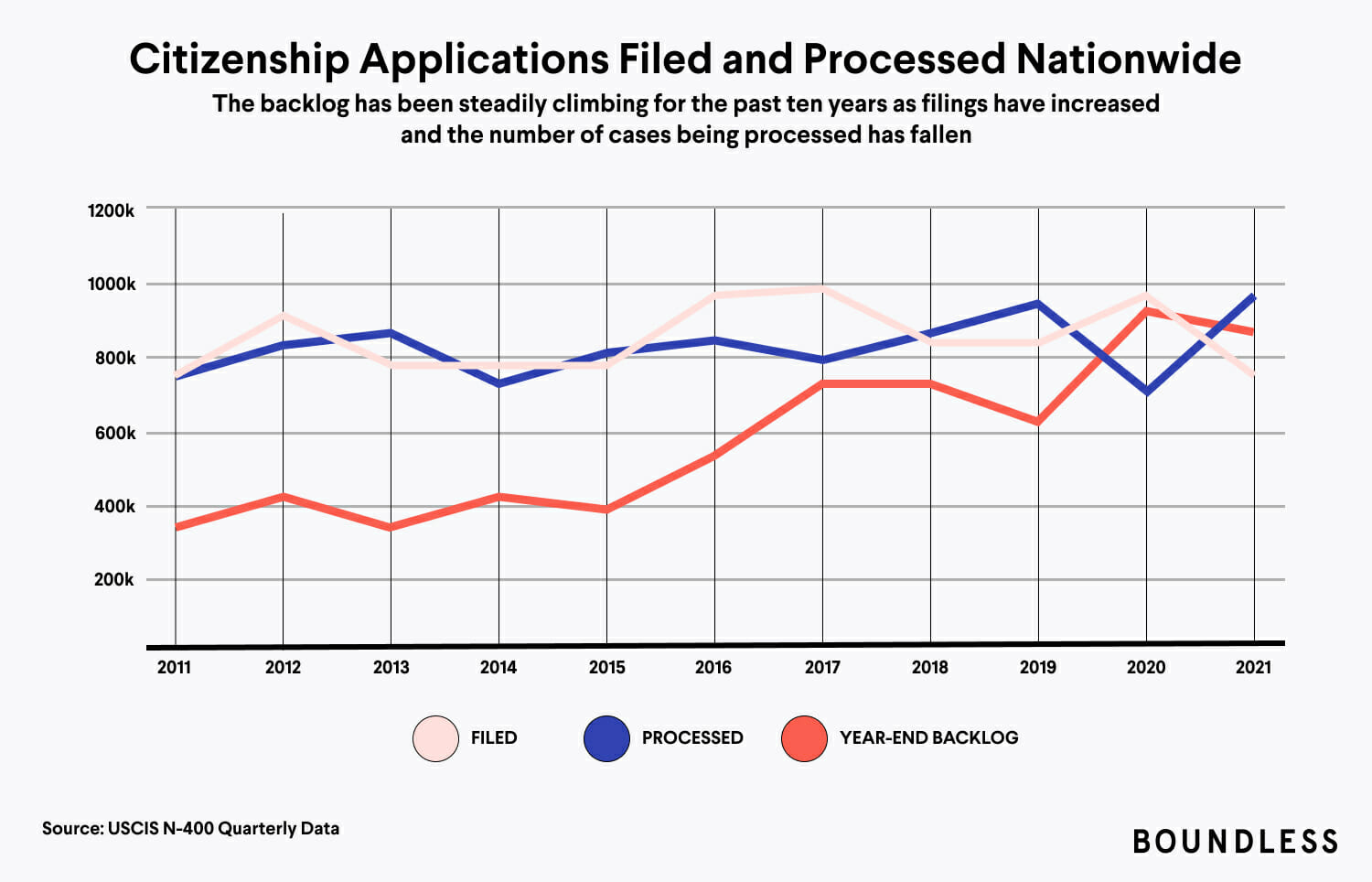
Surging BacklogCitizenship Application Filed Naationwide

A look at the past decade indicates a worrying trend.

Although application volume was expected to fall, the volume increased to almost 1.2 million applicants through the end of 2021, and although processing volume had begun to increase in 2019, the cessation of processing applications due to COVID-19 has led to a surge in the backlog of pending applications, with nearly 800,000 applications still pending by the end of 2021.

USCIS, the federal agency responsible for processing citizenship applications, has defended itself by noting that the backlog more than doubled during the Obama administration. This is true: the backlog rose from nearly 292,000 in September 2010 to over 636,000 by the time Donald Trump assumed office in January 2017.

But USCIS has also claimed that the surge in applications during 2016 and 2017 created a “record and unprecedented” workload. A look at the past 3 decades shows, however, that this is not true.

BACKLOGS IN CONTEXT

In 2007, citizenship applications surged to nearly 1.4 million, far higher than the recent uptick. This was driven in part by a looming 80% application fee hike that year, and an increase in newly eligible immigrants who had obtained their green cards 5 years earlier under the Legal Immigration Family Equity (LIFE) Act of 2000.

USCIS responded with a surge in processing volume the following year, and the backlog plunged to a 30-year low of about 257,000 in 2009.

In the mid-1990s, there was a truly “record and unprecedented” surge in citizenship applications, driven in part by a corresponding increase in newly eligible immigrants who had received green cards under the Immigration Reform and Control Act 1986 (IRCA, also known as the “Reagan Amnesty”). Between 1995 and 1998, application volume stayed well above 900,000, peaking at over 1.4 million in 1997. Although the backlog initially shot past 2 million in 1997-1998, USCIS responded with a comparable surge in processing volume that appears to have tamed the backlog by 1999-2000.

The data indicate that when USCIS devotes sufficient resources to a citizenship application surge, it is possible to dramatically reduce the backlog within one year. That’s what happened in 2000, 2007, and again in 2012.

On the other hand, when USCIS fails to devote sufficient resources, backlogs can get way out of hand. That’s what happened in the mid-1990s, and it appears to be happening again.

FALLING BEHIND

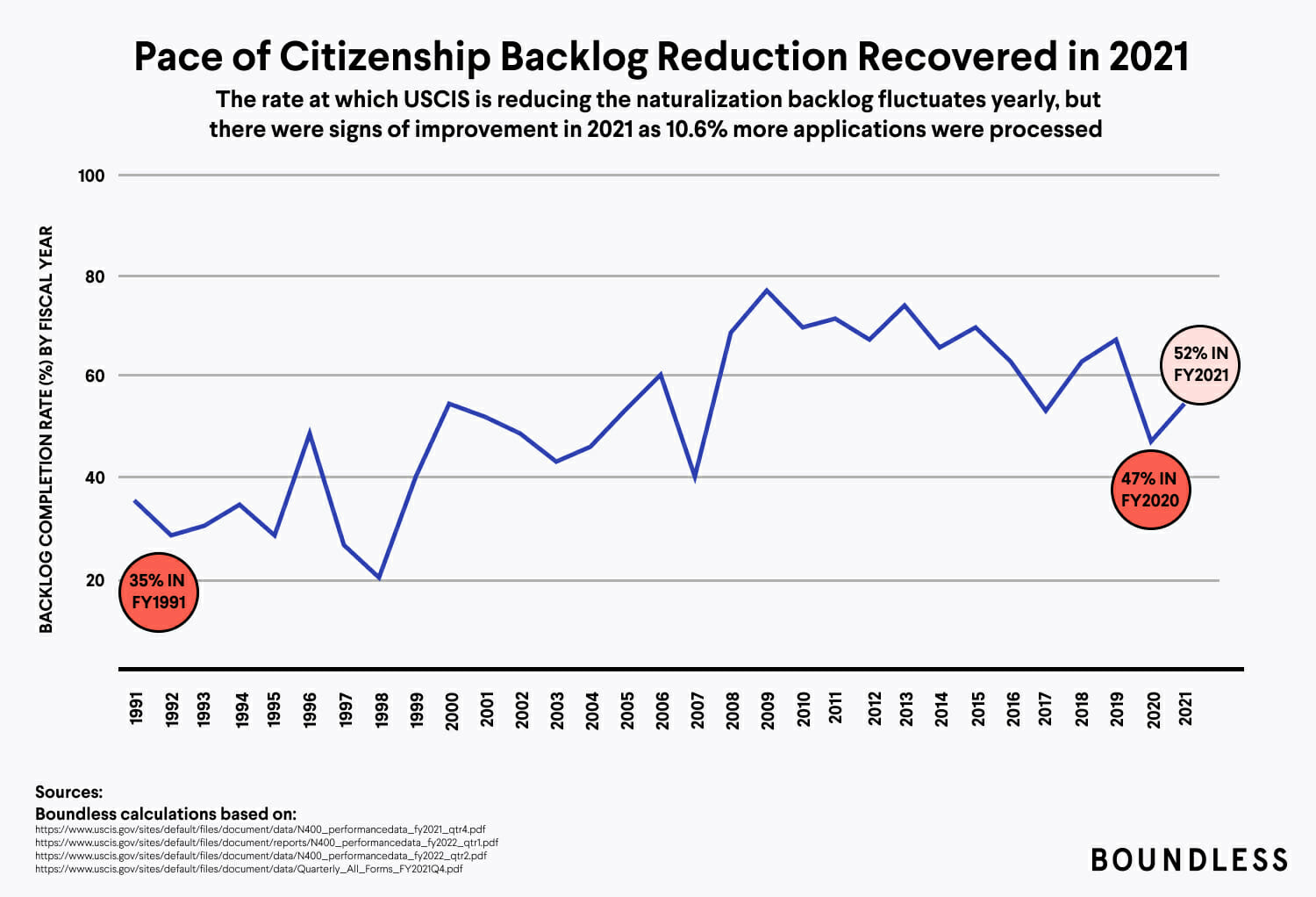
Pace of citizenship backlog reduction

Another way to evaluate this problem is to measure how efficiently USCIS beats back its backlogs. If USCIS processed every citizenship application it received in a given year, plus the applications that were pending from the previous year, that would yield a “backlog completion” rate of 100%.

In reality, USCIS achieved a backlog completion rate of 77% in 2009 — a 30-year high — and this number has been trending downward ever since. There was a 10-point drop in backlog completion between 2016 and 2017 (from 63% to 53%), but backlog completion crept back up to 67% in 2019 before falling drastically in 2020 to 47%, which was the lowest backlog completion rate since 2007 (39%).

By the end of fiscal year 2021, however, the rate at which USCIS was completing naturalization cases had recovered somewhat, to just under 52%. Unfortunately, comparing the fourth quarter of FY2021 with the first two quarters of FY2022, a trend is not immediately apparent: USCIS finished Q4 of 2021 with a backlog completion rate of 24%, but by the end of December 2021 it had dropped to 22% before recovering to 25% at the end of Q2 in March 2022. USCIS’s year-end data will reveal if the agency was able to maintain its improving overall pace of clearing the citizenship backlog.

SURGING WAIT TIMES

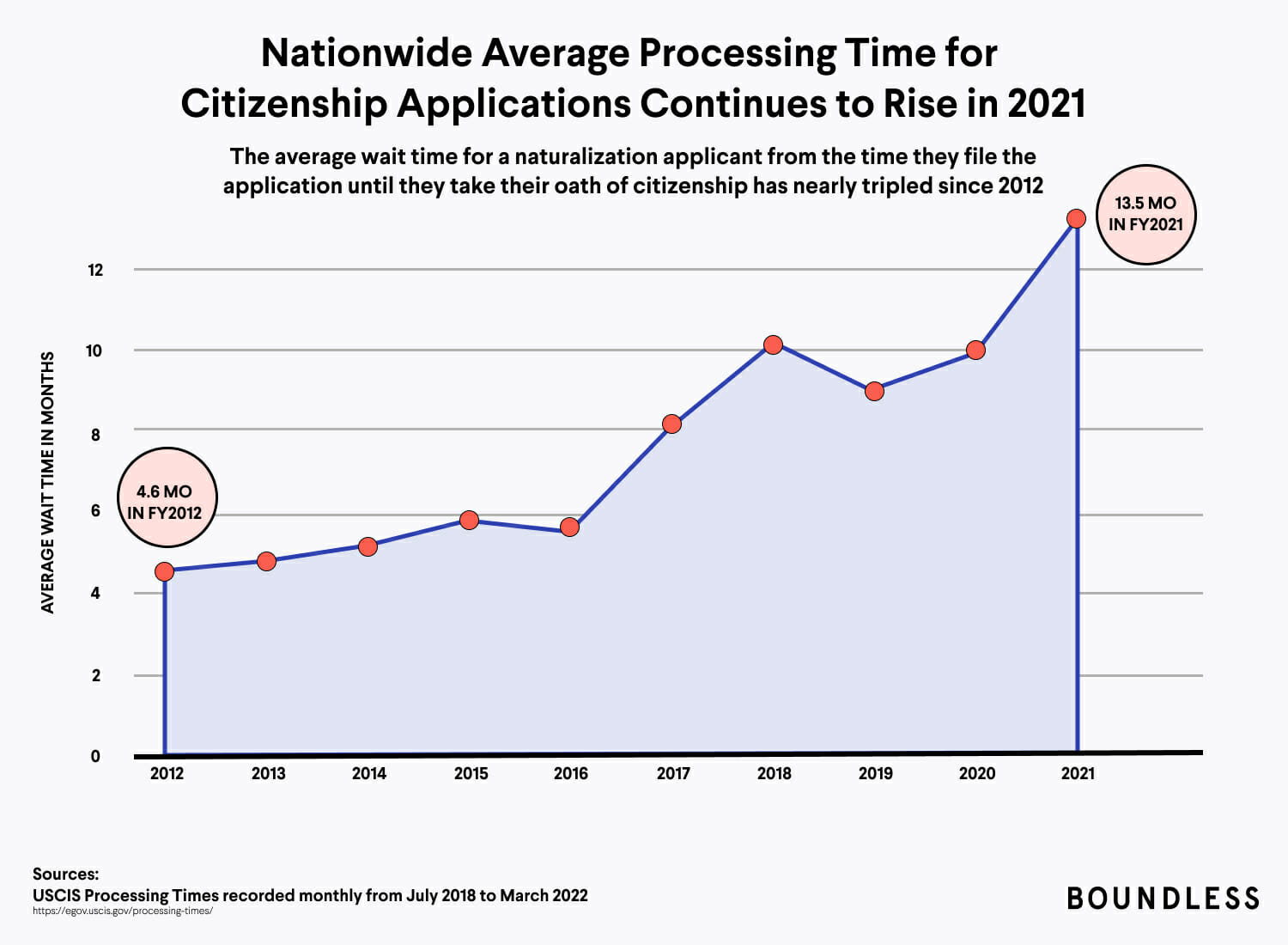
Processing times citizenship

Growing backlogs have direct and negative consequences for immigrants seeking to become U.S. citizens: They have to wait longer for their applications to be processed by the government.

Here the trend is unmistakable: Between 2012 and 2016, median application processing times hovered between about 4.5 to 6 months, before shooting past 8 months in 2017 and hovering at about 10 months in 2018 and 9 months in 2020. Compounding the worrisome trend, starting in March 2020 the coronavirus lockdown postponed the final steps for naturalization—interviews and oath ceremonies — until offices reopened in June 2020.

Source: 2022 State Of New American Citizenship Report

StatCan: A portrait of citizenship in Canada from the 2021 Census

An informative and useful update from their earlier study based on previous censa (Trends in the Citizenship Rate Among New Immigrants to Canada).

Of particular interest to me were the following elements:

Numbers of Canadian citizens born abroad: 322,530. This number quantifies those who will be impacted by the first generation cut-off introduced by the Conservative government in 2009 and thus not able to pass on their Canadian citizenship to their children. This is currently being challenged in court with profiles of families affected. IMO, the previous retention provisions were virtually impossible to administer consistently and efficiently, and the first generation cut-off is preferable.

Naturalization rate:

“Among all eligible immigrants admitted to Canada at least four years before a census year, 83.1% or just over 6.0 million immigrants reported Canadian citizenship in the 2021 census, while a larger proportion of the immigrant population reported Canadian citizenship in 2016 (85.8%) and 2011 (87.8%).”

Yet IRCC continues to use, in its annual reporting, the percentage of all immigrants, no matter whether they arrived five or 50 years ago, as its benchmark. Totally irrelevant to measuring IRCC’s performance. As I continue to argue, IRCC needs to set performance standards with respect to recent immigrants, based on the previous census period (essentially the approach StatCan uses).

Improved data on dual citizenship: The change from a simple question regarding dual citizenship to a more complex two-step set of questions has resulted in an increase in the number reporting dual citizenship. The results of this change:

“In 2021, 11.2% or 3.7 million Canadian citizens reported more than one country of citizenship. This was over double the number reported in 2016, when 4.5% or 1.4 million of all Canadian citizens identified as having more than one citizenship.”

I will be doing a more comprehensive analysis of 2021 Census citizenship data over the coming months, updating my analysis of the 2016 Census (What the census tells us about citizenship):

Source: A portrait of citizenship in Canada from the 2021 Census

Yakabuski: We cannot take Canadians’ positive views on immigration for granted 

Rare mainstream media commentary questioning the current orthodoxy regarding increased immigration and public support. Have wondered for some time whether housing, healthcare and other pressures will lead to a tipping point but as the latest Environics survey, no sign yet:

Canadians are global outliers in holding almost unfailingly positive attitudes about immigration.

Across the world, particularly in countries that have seen large and sudden waves of migrants in recent years, public opinion has turned harshly negative toward newcomers. The opposite has happened here, even in Quebec. Despite big increases in the number of immigrants this country accepts annually, fewer and fewer Canadians think our immigration levels are too high.

That is the finding made by the Environics Institute for Survey Research, which has been polling Canadians on this issue since 1977. Back then, more than 60 per cent of respondents thought the country was accepting too many immigrants. Now, only 27 per cent feel that way.

This should not come as a surprise to anyone. Canada has had the luxury of selecting immigrants in an orderly fashion. We even “choose” most of our refugees based on applications made outside Canada. And the Canada-U.S. border is an oasis of calm compared to the U.S.-Mexico border, notwithstanding the steady stream of asylum seekers arriving via Roxham Road in Quebec in recent years.

There is another, perhaps even more salient, explanation for why Canadians are so bullish on immigration. Fully 44 per cent of us are first- or second-generation immigrants, according to 2021 census data compiled by Environics chief demographer Doug Norris.

In the Greater Toronto Area, the proportion of first- and second-generation newcomers is 79.6 per cent. In Vancouver, it is 72.5 per cent. Even in most of the country’s smaller urban centres, outside of Quebec, about half of residents are now immigrants or the children of immigrants.

You are much more likely to view immigration positively if you are an immigrant yourself or the child of one. Immigrants account for more – much more – of the population here than in any other developed country except for Australia. And the proportion is set to rise sharply – to as much as 34 per cent of Canada’s population in 2041, from 2021′s record level of 23 per cent, according to Statscan’s projections.

What’s not to like? Well, for a country that is already experiencing a severe housing-affordability crisis and a major infrastructure deficit, welcoming around 450,000 new permanent residents on an annual basis, on top of tens of thousands of temporary foreign workers and international students, involves significant challenges.

Unfortunately, there are few signs that policymakers in Ottawa have thought through how the country can accommodate this influx without further straining our already strained health-care and education systems. While immigration can offer a partial solution to severe shortages of nurses and teachers – if provinces move more rapidly to recognize their credentials – overall it creates more consumers than providers of health-care and education services.

In a study prepared last year for Quebec’s immigration ministry, economist Pierre Fortin threw cold water on the idea – advanced in 2016 by Ottawa’s Advisory Committee on Economic Growth – that higher immigration levels could help resolve intractable labour shortages that have only grown worse since then.

“Resorting to immigration can relieve worker shortages at the individual firm level, though the great administrative complexity and the long wait times often render this process ineffective; but, unfortunately, at the macroeconomic level, the [council’s] idea that immigration can reduce labour shortages because it increases the working-age population is nothing more than a big fallacy of composition,” Prof. Fortin wrote. “This idea is based on incomplete logic that ‘forgets’ that immigration ends up increasing the demand for labour and not only the supply of labour.”

Next week, Immigration Minister Sean Fraser is expected to announce Ottawa’s revised immigration targets for 2023, 2024 and 2025. That announcement needs to be followed by a more elaborate strategy than Canada has seen to date to enhance the country’s capacity to integrate ever-increasing numbers of newcomers. Otherwise, we are only asking for trouble down the road.

Canada has been spared the backlash against immigration experienced in other countries, in part because few politicians see any mileage in stoking resentment toward newcomers. That is likely to remain true as long as our multicultural suburbs continue to determine electoral outcomes. But no one should take it for granted.

With the country’s emergency rooms running beyond capacity, its housing shortage leaving too many people on the sidelines and its public infrastructure in a steady state of disrepair, it would be a mistake to assume that attitudes here toward immigration will always remain so positive.

Source: We cannot take Canadians’ positive views on immigration for granted