He was given a Canadian passport by mistake — then went on a legal battle to keep it

Fortunately, common sense prevailed and the judge refused the request to “a proud Egyptian”. Poster child of a would be “Canadian of convenience”:

Nader Abdellatif certainly appeared to be a Canadian expat.

For 15 years, the executive with multinational corporations travelled with a Canadian passport. He would be invited to events and festivities hosted by Canadian missions in Cairo and Saudi Arabia. His residency documents and employment contracts in the Middle East listed him as Canadian.

But when Abdellatif applied to renew his passport in 2017, the Canadian government refused.

It told the 56-year-old that his passport had, in fact, been issued to him by mistake. Not once, not twice, but three times.

And so, Abdellatif began a fight for his Canadian passport and for his highly debatable claim to the country where he was born — and which he left, when he was two years old.

When Abdellatif was born in Ottawa in 1967, his father was the first secretary of Egypt’s embassy in Canada. The family left the country when Abdellatif was a toddler, and moved with subsequent diplomatic postings in Lebanon, Jordan, Sudan and the Netherlands.

Abdellatif later returned to Egypt for university but was able to keep his Egyptian diplomatic passport until he was around 26.

“To be honest, I can’t claim that I considered myself Canadian. However, I was proud that I was born in Canada, and I always flaunted it by virtue of saying ‘I’m Canadian,’ taunting my brother and friends,” he told the Star with a chuckle.

“It was always special to me, because I was born there. It’s attached in my birth certificate,” he said. “I always have that connection with Canada.”

But he wasn’t, actually, Canadian.

It’s true that under Canada’s Citizenship Act, all babies — including those of non-residents such as refugees, undocumented migrants and foreign students and workers — born on Canadian soil are automatically granted citizenship.

But there is an exception for children of foreign diplomats who are born in Canada. They don’t get automatic citizenship. And passport rules stipulate that only Canadian citizens are eligible for Canadian passports.

Abdellatif wrongly thought that, by virtue of his birth, he was entitled to Canadian citizenship and passport, and that he hadn’t been given one only because his father had been an active diplomat.

Around 1993, he no longer had an Egyptian diplomatic passport, he said, and figured Canada might reconsider.

Abdellatif said the status of his Canadian citizenship had never been clear to him. At the back of his mind, he said, it had been something he wanted to explore, but he had been busy with his career and looking after his father, who battled cancer and died in 1997.

In June 2003, Abdellatif decided to apply for a passport at the Canadian embassy in Cairo with a Canadian document he did have — his birth certificate.

“I said, ‘OK, let me go to the embassy and apply.’ And that’s what I did. And, lo and behold, I got it.”

Why the issue with Abdellatif’s passport bid was immediately spotted, isn’t clear. And there were — quite clearly, in retrospect — signs that things weren’t quite right.

A few months after submitting his own application, he had applied for Canadian citizenship certificates for his two sons, both of whom were born outside of Canada. His boys’ applications were subsequently refused on the grounds that Abdellatif was not a Canadian citizen.

Abdellatif said he was confused. He said he presumed he was still a Canadian citizen on the basis that he had been able to acquire his original passport. He would subsequently and successfully renew it at the Canadian consulate in Dubai twice, in 2008 and 2013.

At one point, while relocating for a new job, he even travelled to Canada briefly to apply for his residence permit from the United Arab Emirates embassy in Ottawa.

“They gave (the passport) to me legitimately. I lived with it for five years. I went to Canada. I came out of Canada. I renewed it and lived with it for five years. I renewed it again,” said Abdellatif. “It did not cross my mind that something was wrong or that it was an error.”

In December 2013, Abdellatif again applied for his sons’ Canadian citizenship certificates, in which he declared his father was employed by a foreign government at the time of his birth in Canada. It was refused two years later. Officials said he was ineligible for citizenship by birth due to his father’s diplomatic status.

It wasn’t until late 2017, when Canadian authorities refused Abdellatif’s own passport renewal on the basis that he was not a Canadian citizen that he decided to seek clarity about his eligibility to citizenship.

After years of petitioning immigration officials and politicians to look into his case, Abdellatif turned to the immigration minister, asking him in 2021 to use his discretionary power to grant him Canadian citizenship, a request that was refused last year.

In April, Abdellatif challenged the minister’s decision before Canada’s Federal Court.

His lawyer John Rokakis said: “There’s a provision for special hardship. The government kind of created this special and unusual situation for my client by giving him three passports in the past, even though they were in error. He relied on them and got positions overseas based on the fact that he had these passports.”

The case, said Rokakis, raises the question of whether the federal government should grant citizenship to children born to foreign diplomats in Canada after their diplomatic immunity expires.

It also raises questions about the oversight of passport granting abroad.

“I really don’t know how he got them. Neither did (the Department of) Justice, nor the judge,” Rokakis said.

“All three of us were a little perplexed how this happened.”

In a court submission, Abdellatif argued he built his career as a “Canadian Egyptian” executive on the strength of his belief that he was Canadian, because he was issued a passport.

A proud Egyptian, Abdellatif said his Canadian connection did give him an edge in life, and the refusal of his citizenship application harmed his reputation, professional opportunities and “social status.”

“Canada is at a different perception level and status than Egypt. As I mentioned, in my career, in my contract, in my country status, in my travel and mobility and ability to jump over to the U.S., to Europe for executive meetings,” said Abdellatif, “all these became inhibited.”

However, there were yet more strikes against his bid to become a belated Canadian.

Government records showed Abdellatif’s father had once made an inquiry about his citizenship status in 1981, through the Canadian ambassador in Sudan, where he was serving on the Egyptian mission at the time.

The information that Abdellatif was not eligible for Canadian citizenship or a Canadian passport was relayed to the family then, according to the Federal Court.

Abdellatif told the Star that his father had never told him that, and passed away before Abdellatif’s endeavour to acquire Canadian status.

The court said Canadian officials had informed him in writing in 2007, 2015 and 2017 that he was not a citizen by virtue of birth but he did not challenge those decisions. Instead, it pointed out, he chose to apply for a discretionary grant of citizenship.

It didn’t help, according to immigration officials in their submission, that Abdellatif never worked, lived or paid income taxes in Canada after age two.

“The administrative error which resulted in the Applicant being issued a Canadian passport three times does not create citizenship nor does it have any binding effect if the underlying legislative requirements are not met,” Justice E. Susan Elliott ruled in July in dismissing the case.

Abdellatif said he was disappointed but respected the court decision, and may one day return to Canada.

After all, his two sons have now graduated here as international students.

“I always teased my (older) brother that I was Canadian and he’s not,” Abdellatif said. “He’s American now by living there and I dropped this one. So the table is turned.”

Source: He was given a Canadian passport by mistake — then went on a legal battle to keep it

Meggs: Immigration and the Vote

Taking some of the government’s arguments in favour of self-administered oaths of citizenship and increased reliance on virtual ceremonies (except for those with Minister Miller!) to the extreme, Meggs argues that “If that’s how little we value citizenship, why do we make it so difficult to achieve?” why not move to complete “self-check-out” and provide voting rights to permanent residents at the municipal level, along with an integrated Permanent Residents to Citizenship process.

IMO, Meggs is to quick to state that political parties ignore the concerns of Permanent Residents, given that many have relatives and friends who are citizens, and that most Permanent Residents will become citizens:

Canada has been pretty clear about the benefits we expect from the nearly 500,000 immigrants now arriving annually, especially the wealth and economic growth we need them to generate.

But what’s in it for them?

Unless the pathway to citizenship speeds up dramatically, Canada will soon be home to millions of permanent residents who work, pay taxes, can even serve in Canada’s Armed Forces, but are prohibited from voting or running for office.

Those are in addition to the nearly one million Canadian residents in temporary work or study programs, more than 70 percent of whom aspire to stay.

The Discover Canada booklet, available to all would-be immigrants hoping to become Canadian, describes our country as a place guided by “a belief in ordered liberty, enterprise, hard work and fair play.”

What’s fair about taxation without representation?

Canada’s history provides ample evidence that those denied the vote – whether women, Japanese Canadians, Chinese Canadians, Indigenous or any other group – are also denied basic rights and subject to exploitation and discrimination.

A recent Abacus poll showed that Canadians remain generally enthusiastic about immigration, yet increasingly uneasy about the pressure on already-strained services like housing, education and health care. (Of course, both education and health care would collapse without foreign students’ fees and immigrant health workers’ skills.)

Those most affected by those shortfalls are immigrants themselves, confronted by constant economic and social hardship as they seek to put down roots.

Nonetheless, they prevail. The 2021 census showed that immigrants – people who were born elsewhere, immigrated to Canada and became citizens – already make up nearly one quarter of the electorate.

That share would be even higher if the 60 percent of “non-citizens” in the census tally, mostly people of working age and almost all engaged in the workforce, could vote. A large proportion of this group are young people who should have a right to participate in decisions that will affect them for the rest of their lives.

In cities like Toronto, Montreal and Metro Vancouver, where the majority of newcomers seek to settle, those hundreds of thousands of new voters could reshape the political landscape. Until they join the electorate, their concerns are of no interest to campaigning politicians.

As things stand, permanent residents wait a minimum of three years before becoming eligible to apply for citizenship, often after years of effort to achieve permanent resident status.

To be fair, Canada has had some limited success in reducing wait times to achieve citizenship, moving the citizenship test online and even allowing successful applicants to self-administer the oath. (Unfortunately, Queen Elizabeth II remains our sovereign, according to Discover Canada’s downloadable study guide, a potential pitfall to applicants trying the multiple-choice and true/false online test.)

These efficiencies undermine the gravity and responsibility of achieving Canadian citizenship even as they seek to streamline the process. The once momentous milestone of citizenship is reduced to something akin to self-checkout.

If that’s how little we value citizenship, why do we make it so difficult to achieve?

Why not combine the permanent resident and citizenship process into one, reserving the right to revoke citizenship within a given time frame if certain criteria aren’t met?

In the meantime, provinces should allow permanent residents to vote at the municipal level, as cities like Vancouver, Toronto, Calgary and Hamilton have all proposed in recent years.

The cost of inaction is well captured in the painful past experience of Japanese Canadians.

In October 1900, naturalized citizen Tomeikichi Homma marched into the Vancouver Court House and demanded to be registered to vote. The elections officer, relying on racist provincial election rules, said he would go to jail before he registered “a Jap.”

Homma’s challenge was upheld by two BC courts before finally being overturned at the Privy Council in London, then the British empire’s highest court. It would be nearly 50 years before Japanese Canadians got the vote, after suffering through the forced dislocation and internment of the Second World War.

In his judgement upholding Homma’s right to register, BC Judge Angus McColl warned:

“The residence within the province of large numbers of persons, British subjects in name, but doomed to perpetual exclusion from any part in the passage of legislation affecting their property and civil rights, would surely not be to the advantage of Canada, and might even become a source of national danger.”

His warning applies equally to Canada today. Yes, Canada’s permanent residents will get to vote, eventually. We should make that wait as short as possible.

. . .

ABOUT THE AUTHOR:

Geoff Meggs – Geoff is a Canadian politician, political operative and communications expert, who served on Vancouver, British Columbia’s City Council from 2008 to 2017. He was first elected in the 2008 municipal election, and resigned his seat on city council in 2017 to accept a job as chief of staff to John Horgan, the Premier of British Columbia. Prior to his election to City Council in 2017, Geoff served as Executive Director for the BC Federation of Labour.

Source: Meggs: Immigration and the Vote

Russia ‘systematically’ forcing Ukrainians to accept citizenship, US report finds

Of note, continuing weaponizing of citizenship:

Ukrainians living in Russian-occupied territory are being forced to assume Russian citizenship or face retaliation, including possible deportation or detention, a new US report has said.

Yale University researchers found that residents of the Luhansk, Donetsk, Kherson and Zaporizhzhia regions were being targeted by a systematic effort to strip them of Ukrainian identity.

Ukrainians who do not seek Russian citizenship “are subjected to threats, intimidation, restrictions on humanitarian aid and basic necessities, and possible detention or deportation, all designed to force them to become Russian citizens,” the report said.

Russia’s actions were “classic war crimes in the sense that they are restricting or limiting through this process people’s ability to access critical services and resources that Russia is required to allow all people to access, such as healthcare, and humanitarian systems,” Nathaniel Raymond, the executive director of Yale School of Public Health, told CNN.

Moscow claims to have given Russian passports to more than 3 million Ukrainians since 2014, after the annexation of Crimea and occupation of Ukrainian territories since the launch of its full-scale invasion in 2022.

Russian prime minister Mikhail Mishustin said in May that Moscow had given passports to almost 1.5 million people living in parts of Ukraine’s Donetsk, Luhansk, Zaporizhzhia and Kherson regions seized since October last year.

“This number has grown since then, with leaders of the so-called Luhansk People’s Republic (LPR) claiming that three-quarters of residents of that oblast [region] had received Russian citizenship,” the report said.

Russian president Vladimir Putin has signed a series of decrees to compel Ukrainians to get Russian passports, in violation of international humanitarian law, the report said.

The report included a timeline of increasingly aggressive measures to pressure or force Ukrainians to become Russian citizens, starting in May 2014, when Russia illegally annexed Crimea. The timeline continues ahead to July 2024, when, according to new Russian laws, residents without Russian citizenship would be considered “foreigners” or “stateless” and can be detained in detention facilities and/or deported to Russia.

  • March 2014: Russia illegally annexes Crimea and passportisation begins.Nine months after annexation, Russia claims that over 1.5 million people in Crimea have received Russian citizenship.

  • February 2022: Russia’s full-scale invasion begins and Moscow captures parts of Kherson and Zaporizhzhia regions. Three months later, citizenship application in Kherson and Zaporizhzhia is simplified. This follows the simplification of citizenship applications in Donetsk and Luhansk in 2019. In September 2022. Russia illegally annexes Luhansk, Donetsk, Zaporizhzhia and Kherson.

  • 18 March 2023: Russia introduces a law on unilateral renunciation of Ukrainian citizenship introduced. The policy allows residents to “renounce” their Ukrainian citizenship unilaterally. Two days later, Putin calls for passportisation to be accelerated and local occupation authorities quickly announce new passporting offices and mobile teams.

  • 27 April 2023: Russia adopts a law that will allow authorities to detain or deport residents without Russian passports. Starting July 2024, residents without Russian citizenship will be considered “foreigners” or “stateless”.

  • 6 June 2023: Destruction of the Kakhovka dam, resulting in widespread flooding and displacement. Russia’s forces use the aftermath to push citizenship on residents. Russian passport holders are made eligible for compensation for the flood damage, whereas Ukrainian passport holders are eligible only for only a small flat payment.

  • 26 June 2023: Planning begins for deportation and detention facilities. The head of the so-called “Donetsk People’s Republic” announces a planning group to study facilities for detaining residents without Russian passports for deportation.

  • 1 July 2024: Ukrainian residents who have not accepted Russian citizenship can be detained and/or deported, including to remote areas of Russia.

The report said: “While states are afforded wide discretion under international law with regards to conferring nationality, customary international law clearly forbids the imposition of citizenship without consent or under duress.”

Source: Russia ‘systematically’ forcing Ukrainians to accept citizenship, US report finds

Urbaniak: Becoming a Canadian citizen should require a ceremony

Another good commentary on the need for ceremonies. New immigration minister Miller likes attending ceremonies so perhaps he can ensure that most new Canadians can as well:

Last week, the federal cabinet had a major shuffle.

The new ministers and the re-positioned ministers did not “self-administer” their oaths and declarations. They were not sitting by themselves in their living rooms with no one watching when they assumed their new roles.

On the contrary, they were expected to attend a ceremony.

The ritual, the formality and the gravity of the event at Rideau Hall – steeped in symbolism – signalled to the ministers and to everyone that ministerial appointments are important.

Well, becoming a Canadian citizen is very important. Canada is important.

Becoming a Canadian citizen merits a ceremony in most cases, not just in occasional cases by request.

The government of Canada is wrong to push self-administered, on-line oaths with no ceremony of any kind.

This policy was recently announced in the Canada Gazette, the official record of federal government notices and decisions.

Inspirational Canadian

In 2018, I came across the obituary of Kamal Akbarali. I was sad to see it. I had met Judge Akbarali several times as a high-school student in the 1990s.

Kamal Akbarali was a citizenship judge, and he performed the role very well. He was also an inspirational Canadian. He loved this country.

My fellow students and I had the pleasure of attending a few public citizenship ceremonies at which Judge Akbarali presided. We were the “audience.” We were there to welcome and acknowledge the new Canadians, our soon-to-be-fellow citizens. Some of them were our peers from school.

Judge Akbarali made an impression on me.

I remember being moved by what he said about his own journey. It sounded like the stories of my own grandparents, who found freedom and possibilities and affirmation in Canada.

Judge Akbarali came to Canada from Pakistan in 1965. At the ceremonies, he talked about how he got started in this country. He took on a career in finance and started a family.

Judge Akbarali talked about the plight of refugees, about democracy, about peace, about service to others, about respect for Indigenous Canadians and people from all over the world.

In other words, he talked about Canada and aspirations for Canada.

Although full of gratitude, he did not insist the country was perfect. In his view, a good citizen is compassionate, sometimes critical and always constructive.

As Judge Akbarali spoke, I could almost feel the beautiful vastness and diversity of the country. I felt hopeful and motivated.

After each ceremony, a beautiful cake would be rolled out so that we could celebrate our fellow Canadians. The new citizens had just gone through a life-changing, emotional event.

Bureaucratic efficiency?

The stated rationale for the move toward self-administered oaths is administrative efficiency – easing the backlog by “three months of processing time.” (The change, however, is slated to be permanent.)

There is essentially no acknowledgment of the value of civic symbolism, public celebration and instilling a sense of community by the act of officially gathering.

To clear backlogs, additional part-time officiants – respected citizens — could be brought on by Ottawa. They could help with processing. They could preside at ceremonies by request. (Nova Scotia recently did this with a successful recruitment push for part-time administrative justices of the peace for civil weddings. I happen to be one of them.)

What can we do now?

I believe this is a case where a personally addressed note, in your own words, to your member of parliament could have some impact.

A petition

Also, please check out the excellent petition by Andrew Griffith, a former senior public servant in the federal Department of Immigration, Refugees and Citizenship.

You can sign it electronically on the website of the House of Commons. It is labelled as petition e-4511.

The petition calls on the Minister of Immigration, Refugees and Citizenship to “abandon plans to permit self-administration of the citizenship oath.”

The petition also urges Ottawa to “revert to in-person ceremonies as the default, with virtual ceremonies limited to 10 per cent of all ceremonies.”

Griffith believes backlogs can be addressed by other efficiencies and by holding more ceremonies on evenings and weekends.

I concur. I hope the minister listens.

The minister’s name is Marc Miller, and he assumed his current role in a ceremony – the same one that was held at Rideau Hall last week.

Dr. Tom Urbaniak, professor of political science and director of the Tompkins Institute at Cape Breton University, is the author of six books. The most recent is “In the Public Square: A Citizen’s Reader.”

Source: URBANIAK: Becoming a Canadian citizen should require a ceremony

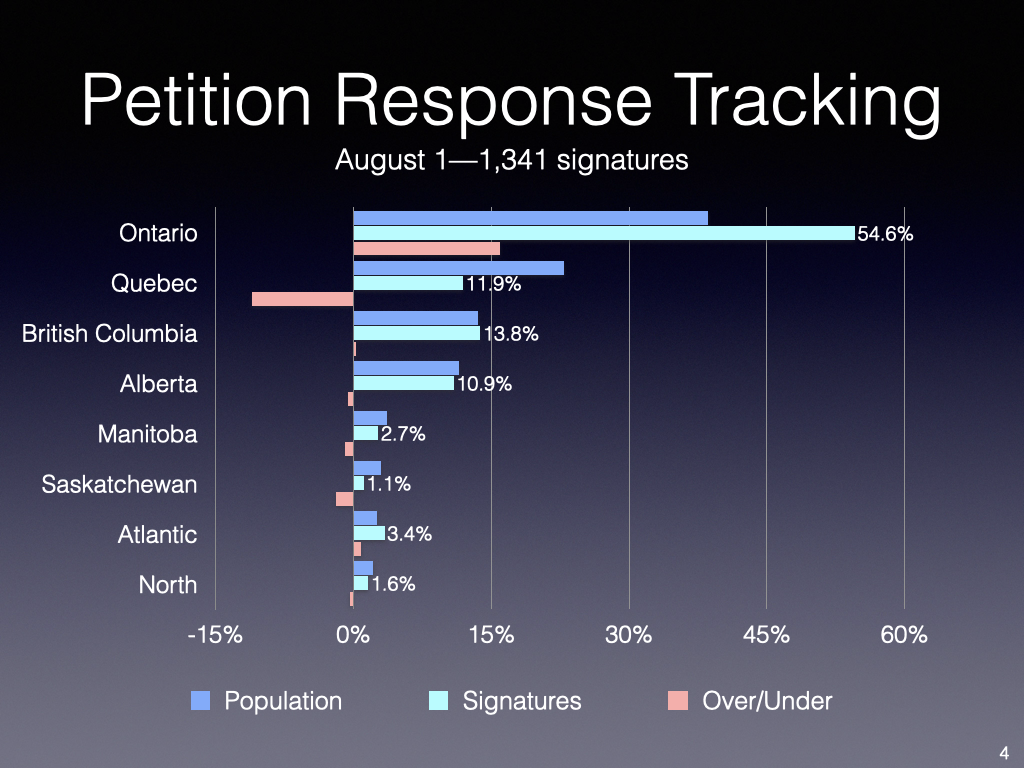
Petition e-4511 – Opposing self-affirmation of the #citizenship oath “citizenship on a click” – Signatures to August 1

The chart below breaks down the 1,341 signatures as of 1 August by province. While Ontario remains over-represented, this is gradually becoming less so. Quebec overtook Alberta this week and, if current trends continue, will approach or surpass British Columbia, thanks to my friend and partner on this petition, Richard Babczak.

And if you haven’t yet considered signing the petition, the link is here: https://petitions.ourcommons.ca/en/Petition/Details?Petition=e-4511

For minister Sean Fraser, immigration and housing are more than just numbers games

Of note. The blatant hypocrisy of Minister Fraser of proposing to make the citizenship oath self-administered while stating:

“On Canada Day, new citizens from nine different countries took their oaths at a Blue Jays game. I had my daughter with me—a seven-year-old hugging a bunch of new Canadians, pure joy on their faces. Thousands of people were cheering. The near-universal reaction was to welcome.”

Oblivious to the contradiction… as well as immigration levels, his old portfolio, and housing availability and affordability, his new portfolio:

On the off chance you overhear a Canadian bragging, it’s usually to say that this is the greatest country in the world. It might violate our national modesty policy to add that we’re now also one of the most desirable, but the data’s there: in 2022, we welcomed close to a million newcomers (a record) and, a year prior, unseated the U.S. as the number-one destination for international workers. People want to come to Canada, and Canada really wants them here.

In June, staring down the ongoing labour shortage, the federal government announced a revamped federal express-entry system, complete with shiny new expedited pathways to permanent residency for U.S. H-1B visa holders and immigrants with sought-after expertise in fields like health care, tech and, crucially, the trades. Prior to a surprise cabinet shuffle by the Prime Minister in late July, the man responsible for delivering on the government’s ambitious target—500,000 immigrants annually by 2025—was Sean Fraser, then the minister of immigration, refugees and citizenship.

Fraser, a trained lawyer and loyal Nova Scotian, spent his whole life watching talent flee his home province for more promising opportunities elsewhere. His old office is facing a backlog 800,000 applications deep—not to mention newly urgent questions about Canada’s affordability, thanks in part to our bonkers real estate market. Those same questions follow Fraser into his new role as minister of housing, infrastructure and communities. When Maclean’s spoke with him in the weeks leading up to his new appointment, Fraser was convinced that Canada is the place to be, warts and all.

According to Statistics Canada’s “population clock,” Canada hit 40 million people just before 3 p.m. EST on Friday, June 16. Where were you when you heard the news?

I think I saw it on social media at some point; I wasn’t tracking it. My mind is on whether people get reunited with families and whether businesses can access workers.

So no plaque? No balloons?

I hate to disappoint. We did have a cake for my two-year-old’s birthday yesterday. He’s getting too big too quickly.

You’re 39; I’m 35. I don’t know about you, but I’ve cited the 30 million–ish factoid as long as I’ve been alive. Is it hard to wrap your head around this new milestone?

Looking back at my earliest citizenship ceremonies, my speeches often included something like, “There’s not one way to be Canadian, but 38 million different ways.” I’ve had to shift that. But Canada’s been ascending the ranks of countries people most want to move to for economic opportunities. The U.S. and Germany used to take the top two spots. It’s not a race, though.

Immigration may not be a race, but your office is banking on many, many more people becoming permanent residents. Like, 500,000 more, every year.

People have to be careful when trying to understand those numbers. It’s not uncommon for half of the “new” permanent residents in the annual count to have already been here as temporary ones—some are temporary foreign workers or international students. Last year, we added 437,000 permanent residents. We’re looking at a gradual increase to 500,000 by 2025.

More than ever, the immigration conversation centres on labour—or how Canada will replace the huge wave of retiring workers. You recently introduced a category-specific entry strategy, with preference given to workers in specific industries, like health care. How does this approach differ from the old one?

We need to respond to the skills gaps resulting from the changing economy and retiring workers. (For what it’s worth, 50 years ago, there were seven workers for every retiree in this country. In Atlantic Canada, where I am, it’s now closer to two.) The federal express-entry system scores applicants based on factors like education and language skills. The new parameters also take the highest-scoring applicants in in-demand sectors—more doctors, more homebuilders and more tech workers.

Back in June, you unveiled the country’s first-ever tech talent strategy—its actual name—to create a steady pipeline of American-dwelling H-1B visa holders to Canada. Are you attempting a reverse brain-drain?

The move wasn’t driven by little-brother syndrome. It was a real-time response to layoffs at some U.S. tech giants. If you’re on an H-1B visa and you lose your job, you either have to find a new one or leave within 60 days. Some of those workers might want to stay in the North American market. We’d be happy to have them.

You’re also courting digital nomads—people whose jobs allow them to work from anywhere in the world. What’s your elevator pitch when people ask, “Why work from Canada when you could work from home?”

Come here for up to six months to test drive Canada while still working for a foreign employer. If you receive a valid job offer from a company here, you can apply for a work permit. The real value proposition, though, is the chance to become one of us. Don’t underestimate how powerful that is. People born to Canadian parents sometimes take our daily rewards for granted: being able to go to the doctor when you get sick and earning a meaningful income if you work hard and have skills to offer.

Bringing people to Canada en masse isn’t a success unto itself; they need to be able to thrive when they get here. Many citizens and permanent residents are without family doctors, they’re being crushed by housing prices—even groceries. It’s not actually as simple as “hard work pays off” anymore.

You have to look at the counterfactual if you’re going to say it’ll be more difficult for newcomers and citizens to thrive in this country if you add more people.

That’s not what I’m saying.

When I was an MP candidate in 2015, the biggest controversies in my province were the closures of River John Elementary School and the mental health unit at Aberdeen Hospital, one of the largest regional hospitals in northern Nova Scotia. One psychiatrist left and it became too unsafe to operate the entire unit. Look at a local machine shop that hires foreign workers, and you’ll realize that the job of every tradesperson on the floor can depend on a linchpin employee. Before we get into what we need to do to accommodate those arriving in Canada, we should recognize the drastic consequences our communities will suffer if we adopt a negative approach toward newcomers. So, with that giant preamble out of the way—

I’m going to interrupt you here. I realize that, with these new targets, you’re specifically looking for, say, construction professionals to build the houses people need to live in, which will increase overall affordability.

I can tell you that, 365 days a year, I will choose the problem of having to rapidly build more houses because so many people want to move to my community over losing schools and hospitals because so many people are leaving.

Fair, but it’s not an either-or. Righting the housing market will take time. Immigrants are arriving now in a system that already has massive cracks in it.

We’ve woken up to the fact that we need to use our immigration policies to help solve some of our social challenges rather than exacerbate them. Yes, we’re bringing in homebuilders, but we’ve also got new regional strategies, like the new Rural and Northern Immigration Pilot, which would spread people out more evenly, so they don’t all land in Ontario.

And the settlement services?

Generally speaking, there’s federally funded language training and employment assistance. Other services will go as far as to help you open a bank account or sign your kids up for soccer. There is no silver bullet, but the good news is, when you look at the children of newcomers, their outcomes are more or less on par with kids whose parents were born here.

I appreciate that this is a highly complex long game, but in Toronto, where I live, city officials have been dealing with a 500 per cent increase in the number of asylum seekers in the shelter system. I can’t count how many stories I’ve read about trained doctors driving Ubers. Immigration detainees, some of whom may not present a meaningful risk to public safety, are languishing in provincial jails. This is also Canada.

These issues need to be addressed. We’re not used to receiving this many asylum claims or irregular border crossings, which was a real challenge at Roxham Road. One of the men who delivered food for my son’s birthday was a dentist trying to get qualified to practise in Nova Scotia. It frustrates me. Each of those problems requires a unique solution. We’re also going to do what, I think, most serves Canada’s long-term interests: embrace ambitious immigration in targeted areas to meet the needs of the economy.

Do you ever think that having an impenetrable gratitude mindset stops Canadians from grappling with serious systemic issues?

I’m not going to tell you that Canada is perfect—not by a long shot. When I speak at citizenship ceremonies, I often talk about the Charter values that bind us, but also the times that we fell short of them. We just passed the 100th anniversary of the Chinese Exclusion Act, which prevented Chinese people from coming here—many of whom already had loved ones here who helped to build Canada. Still, many countries can’t openly confront their challenges because they’re not a liberal democracy. We are. Looking at the other side of the coin, there’s a lot to be grateful for.

Apparently, your office now uses “advanced analytics” to lower processing times. Is AI deciding who gets in and who stays out?

Let me be clear: an officer, a human being, makes the final decisions in all cases. I will add that, during the pandemic, we digitized most of our paper files. We didn’t raise a “Mission accomplished!” banner, but people were excited.

Isn’t technology great?

Yeah, when it works.

Where does the Fraser clan hail from?

We fled Scotland during the Highland Clearances 250 years ago and washed up on the shores of Nova Scotia 10 minutes from New Glasgow, where I live now. My parents are in Merigomish, which has a couple hundred people, eight of whom are related to me. It’s the kind of place where we come out of the woods to go hunting, to put things in perspective.

I also heard you play the bagpipes—a part of your heritage.

Thanks to my grandfather. He was born in Canada but very much a classic grumpy old Scotsman. Come hell or high water, I was going to play the pipes.

Have you really mastered any tunes? If you’re not good at the bagpipes, uh…

They’re beautiful when somebody’s playing them well. I can play most of the traditional tunes, like “Sleepy Maggie.” I once played a New Year’s Eve show with an AC/DC tribute band. I did the bagpipe part of “It’s a Long Way to the Top.”

Now for a bit of Maclean’s history: we used to have an award called Parliamentarians of the Year. In 2021, you were a finalist for Best Orator, alongside Alain Therrien of the Bloc Québécois and Pierre Poilievre. You won.

I enjoyed the back-and-forth that I had with Pierre. I wouldn’t be surprised if, for a while, I took more questions from him than any other member of the House of Commons. Anyway, it’s nice to be recognized for your contributions.

Speaking of, at a televised event back in May, you were introduced as “Mr. Sexy” by Hedy Fry, a fellow Liberal MP. Is this an official title? Is there some kind of internal ranking everyday Canadians aren’t aware of?

God bless Hedy—I think she made that up on the spot. So no official award. My friends are having more fun with that than they ought to. I fear it may stick.

Did the Prime Minister get express entry into this competition?

When you’re up close, the guy looks like a movie star. I hope that, whatever his appearance, people will remember his government for the problems it solved and the people it helped.

Well, most of us would rather be more valued for our brains than our looks.

That’s right.

Are there any citizenship ceremonies that stand out to you as especially poignant?

On Canada Day, new citizens from nine different countries took their oaths at a Blue Jays game. I had my daughter with me—a seven-year-old hugging a bunch of new Canadians, pure joy on their faces. Thousands of people were cheering. The near-universal reaction was to welcome.

Source: For minister Sean Fraser, immigration and housing are more than just numbers games

Ragbag: Did I just become a citizen of a country [USA] that doesn’t want me? [power of citizenship ceremonies]

Reminder of the various paths people take and the questions they have when taking up citizenship (likely more of an issue for those on the left who tend more to over-think). But a nice vignette on the USA citizenship ceremony and what it signified to those taking the oath.

While DG Citizenship and Multiculturalism, had an opportunity to witness a US citizenship ceremony; while different from the Canadian ceremony in some details, the overall message of inclusion and belonging was the same. Hard to imagine the USA doing away with the in person oath unlike the unthinking politicians and officials in Canada:

When the news that the Supreme Court had ruled in favor of doing away with race-conscious college admissions, I was on a plane, traveling to Texas to be sworn in as an American citizen. By the time we landed, my texts and social media feeds were consumed by the ruling. While other passengers hopped out of their seats to grab overhead bags, I sat stunned. Was I really going to go through with raising my right hand to swear that, should the law require it, I would bear arms to protect a country that keeps telling me it’s not sure if it wants to protect me? 

Let me back up. For the last 29 years, I’ve resided in the U.S. — as a student, an arts administrator, a curator, a writer, and most recently, a business owner. I’ve lived in New York, Boston, Philadelphia and Austin. I have been a permanent resident of the U.S. since 1994, but Montreal has always felt like home to me.

Some of my life’s biggest changes have happened during this time. I became a parent. I got married. (In that order.) I was quite comfortable with my permanent resident status — much like the comfort that comes with a non-committal relationship, which I know a lot about. But after nearly three decades, I am no longer comfortable not having a vote in the country where I am raising a child and growing a business. I’m no longer comfortable not having a say in how my body, my child, the people I work with, my friends, neighbors and family are cared for.

Why has it taken me nearly 30 years to make this decision? The most honest answer is that I don’t know if I feel safe here. Because I am a Black queer woman. Because I have been detained by U.S. Border Control. Because an immigration officer once told me that Americans lynch Canadians. Because guns. Because a growing scarcity mindset has made it harder for people to be kind to each other. But the decision to become an American citizen moves beyond me— anchored to the belief that after nearly three decades, it is my responsibility and privilege to shape a country for the people who I care for, and for those who care for me. This belief let me begin the citizenship process.

Along the way, my resolve in this belief would continue to be tested, along with my fears about living in this country.

* * *

Six months after completing an online questionnaire that asked questions like Have you EVER been a habitual drunkard? I was invited to an in-person interview. When the officer, seemingly making small talk, asked, “Aren’t you moving the wrong way? Do you not like free Canadian health care?”

A trap! I thought, laughing nervously. “Well, these things are complicated,” I said, trying my hand at witty banter. But he stayed quiet.

I aced my verbal exam by answering six questions in a row correctly. Some were easy: What is the ocean on the West Coast of the United States? Others were a little trickier: What is the supreme law of the land? And after I was asked —  twice— “If the law requires it, are you willing to bear arms on behalf of the United States?” I was invited to return the following week for a swearing-in ceremony. 

I flew back east to my husband and child who were visiting family in New Jersey, before returning to Texas by myself. While still on the plane, I learned of the Supreme Court’s decision to ignore the far-reaching impacts of systemic racism. The announcement continued to test my fears and my resolve. But I got off the plane to pick up a rental car to make the hour-and-a-half drive to San Antonio, where I would be sworn in.

My drive in the rental — a red pickup truck — gave me plenty of time to think about how I got to this point. I drove with the windows down. From time to time, I checked my rearview mirror.

* * *

My parents emigrated from Trinidad to Montreal in the 1960s. Because Trinidad was still a crown colony at the time, my father actually entered Canada on a British passport. As a child, the fact that my parents left where they were from, for somewhere new, was such a non-thing — in line with the experiences of many of my friends’ parents, who’d come from Italy, China, Ukraine, Portugal. (And that was just on our block.) I simply believed that moving away was something you do when you grow up. Even my name is evidence of the role moving away plays in my family’s history. Lise is a common French-Canadian — not French — name. And Ragbir is a common Indo-Caribbean — not Indian — name. Both names allude to the far-reaching and ongoing impact of colonialism as we give power to borders and trust a fiction that has shaped histories and lives.

“Hello everyone! Are you all ready to become American citizens today?”

In the 1980s, as Quebec politics increasingly shaped the provincial economy, my parents applied for Permanent Resident status in the U.S., in an effort to keep their options open. Like many West Indians, their siblings had dispersed across the globe, with many ending up in the U.S. — New York, specifically. Throughout grade school, I can’t remember a summer, Easter, or Canadian Thanksgiving when we didn’t pack the car to make the seven-hour drive from Sherbrooke Street to Flatbush Avenue via I-87.

In high school, I started making the trip without my parents, to visit cousins and see shows by artists like The Pharcyde, De La Soul and KRS One. As such, New York became the backdrop to my coming of age. New York wasn’t like Montreal. At parties in Brooklyn, I wasn’t the only Black person. Standing in line at Gloria’s roti shop, I wasn’t the only kid with Trini parents. So when my parents were approved for permanent resident status after waiting nearly 15 years, I jumped at the chance to move south. Within months, my parents let their status wane. They never took up residency and remain in Canada to this day.

* * *

On the drive from Austin to San Antonio, I saw a range of bumper stickers that continued to test my fear and resolve: “Country girls don’t retreat, they reload.” “Dump Joe and the Hoe.” “I’ll keep my guns, freedom, and money. You keep the change.”

My seatbelt felt tight as I drove.

In a strip mall in the San Antonio suburbs, people meandered through the parking lot of an immigration office carrying official-looking envelopes and little American flags. The majority of us in attendance were people of color, as were the immigration officers who were patient, and I daresay, joyful.

After being herded through a metal detector, I was asked to hand over my green card. “You’re taking it? Like, for good?”

“That’s right. You don’t need it anymore,” the officer said with a smile. I didn’t tell him I’ve been carrying my green card with me every day since 2015. Without it, I felt vulnerable, even as I made my way to the ceremony room.

Inside, nervous-looking people were taking selfies, or reading the letter from the President that we each found on our seats. I did neither.

I walked into the Texas heat carrying my little American flag. People looked at me as though I’d just won a prize.

“Hello everyone! Are you all ready to become American citizens today?” asked a cheerful man from the podium. He looked to be my age. Dark hair. Olive skin. He identified himself as a supervisor. The room full of people nodded as if on cue, and I felt like I was the only one having mixed feelings.

He ran through a list of dos and don’ts. (Do raise your right hand when told. Don’t record anything.) He’d obviously done this about a million times and clearly loved it. His enthusiasm was infectious.

He led us in a rehearsal of the oath. Then, perhaps sensing the collective anxiety, he coaxed a room full of about-to-be Americans into doing the wave, like we were at a baseball game or a Beyoncé concert. We had to do it twice because the first time we messed up. You know, nerves. But by the time we were done, everyone was laughing and smiling at each other and we felt like we were in this wild thing together. He didn’t miss a beat — he launched straight into the ceremony.

“Can you all please raise your right hand?” The words were a blur, but I said “I do” at the right time and the woman next to me bounced up and down, her blonde bob swinging above the straps on her summer dress. She went to hug me, but my face said, That was nice and all, but please don’t.

One by one our names were called to receive our naturalization certificate. When the supervisor handed me mine I thanked him and said, “You were really good. You made that so pleasant and easy. And you were just so kind.”

“Well, thank you,” he said. “I try.”

I walked into the Texas heat carrying my little American flag. People looked at me as though I’d just won a prize. I didn’t have the urge to hug strangers out of sheer joy, so part of me felt like a fraud. Another part of me, however, was proud —I’d moved through my fear to stand on this side. I did this thing that people have died for. I did this thing that gave me an extra coat of armor — for better or worse.

Around me, families cheered and cried and hugged and laughed. I choked down the knot in my throat and made my way through the crowded lot. In my truck, I locked the doors, placed my certificate and flag on the passenger seat and took a snapshot to send to family and friends, most of whom knew about my mixed feelings. One friend suggested I listen to Jimi Hendrix’s version of “The Star-Spangled Banner,” which I did, on repeat. The rendition is perfect dissonance: a balance of hope and frustration and beauty and pain. The certificate and flag sat in the passenger seat while I drove back to Austin.

* * *

I have always believed that my parents’ choice to leave the island of Trinidad for the island of Montreal had a very matter-of-fact, straightforward quality to it. And maybe it was that way for them. In fact, for millions of people, leaving where you’re from is what you do. In 2020, it was estimated that more than 280 million around the world left their place of birth — because it was expected of them, or it was necessary, or they had no choice.

But officially leaving wasn’t straightforward for me. The decision to become a U.S. citizen wasn’t like the decision my parents made. Yes, the world is different now. For one, Trinidadians no longer have automatic British passports like my father did. But change doesn’t end there.

In addition to the blow to Affirmative Action, in the same week, the Supreme Court shot down President Biden’s proposal to forgive student debt and ruled that businesses are allowed to discriminate against members of the LGBTQ community. In one week, we saw how much this country is changing — and how far we need to go.

In a recent conversation with my parents, my mother said that while she understands why I did it, she struggles with the idea that I became a citizen of a country where some of the laws seem unjust. My father, on the other hand, said that if he could, he would do exactly what I did. “I think the U.S. is through a rough time—maybe like growing pains—but they will get back

This is not an argument for, or against, becoming an American citizen. I know this is a privilege that many have lost their lives trying to attain.

He added that when he left Trinidad in the ’60s, he had initially planned to go back some day. “I didn’t want to stay in Canada,” he said. “For decades, Trinidad was my home. But now Montreal feels more like home.”

I wonder if the same thing will happen to me. Maybe, like him, it will take time.

Before I’m told to go back to where I came from, let me be clear: This is not an argument for, or against, becoming an American citizen. I know this is a privilege that many have lost their lives trying to attain. I know that my citizenship lets me move about the world with an ease unknown to billions of people. I know that legally, my citizenship lets me voice my opinion without risk. But with the Supreme Court rulings that we’ve seen in the last year, for someone like me — even with all the privilege that comes with being an American — the decision to dig deeper into this country is complex, even as I stand on this side of my fear, equipped with all the privileges that come with being an American.

When I got home, I read the letter from President Biden. In addition to acknowledging the courage it takes to start a life in a new country, the letter declares that America is a nation of possibilitiesand that the country has flourished because of immigrants.But I was most struck by this line: “Thank you for choosing us and for believing that America is worthy of your aspirations.”

Maybe one day the world won’t have borders, education will be available to everyone, and regardless of race, gender, sexual orientation, age or ability, we will all be treated equally. But until then, I raised my right hand and took an oath to protect this country because I want to believe that my voice will add to the chorus of change. Because I want to believe that as we move forward, we can all be protected. I don’t know how long this will take, or even if it’s possible. But as a new American citizen inspired by an immigration supervisor, I have to try.

Lise Ragbir writes about race, immigration, arts and culture, and relationships. She was born and raised in Montreal, Quebec, and now makes her home in Austin, Texas.
Source: Did I just become a citizen of a country that doesn’t want me?

Letters to Globe Editor on the Change to Self-Administered Citizenship Oath

Of note, letters in response to the Globe’s excellent editorial, What we all lose when we lose the citizenship ceremony. Opportunity for Minister Miller to make his mark and reverse this counter-productive proposal:

Stand on guard

Re “Citizenship is about more than just a click, a ceremony or an oath” (July 21): As is often the case, the bottom line is an influential factor for discouraging prospective Canadian citizens from having in-person swearing-in ceremonies, although the government prefers to highlight the speeding up of the procedure.

The government also wants to spare employees from having to take unpaid leave to attend. This should not be an issue. If voters in a national election are allotted three paid hours to do their duty, the same should be the law for citizenship ceremonies.

How underwhelming to sit at one’s computer, alone, after all the work entailed to pass the test, no one with whom to celebrate. Where is the government’s sense of occasion?

Ann Sullivan Peterborough, Ont.


I am appalled by the idea that our citizenship ceremonies should be reduced to a click on one’s computer.

I became a citizen at the age of 26. It was a proud event. I was born in a country where such things are important and respected, just like the flag.

There, the flag was treated with great respect and only hoisted for special days or events, then taken down at sundown. It really bothers me to see a row of faded Canadian flags at a car lot, a car with two flags to protest whatever or a homeowner proudly hoisting a flag, but only to see it faded and torn years later.

Another national symbol going down the drain. I am a proud Canadian. It hurts.

Vince Devries Ladysmith, B.C.


I became a naturalized Canadian many decades ago.

Because I was already a British subject, I swore an oath in a bureaucrat’s office, signed documents and I was done. As time went on and I attended friends’ public ceremonies, I developed a strong feeling of having been shorted.

A public ceremony, I think, would have made me feel more Canadian more quickly.

R. A. Halliday Saskatoon


My memory worsens by the day. But, although it happened decades ago, I will never forget my citizenship ceremony.

I recall the interesting mix of people who were there that sunny day in Vancouver. There was the smile and raised eyebrow of the citizenship judge when, feeling flustered, I told her that Canada Day was July 4. Immediately knowing my mistake, I said sorry. I became a Canadian.

As a retired university teacher, I know that nothing compares with the in-person experience. If that is true for birthdays and weddings, it is equally true for the life-changing event of becoming a citizen.

Richard Harris Hamilton


I arrived in Canada in 1968. Immediately after the required five years of residency, I applied for citizenship.

I remember my ceremony well. In those days, we were each given a Bible on which to swear allegiance to the Queen. It was the New Testament, and being Jewish I was not able to swear on it.

I asked if there was an Old Testament, and there began a good deal of searching. I was about to stop them, I would just affirm, but then a copy was placed into my hands.

With great pride and a swelled heart, I pledged my fealty to my new country and liege.

Michael Gilbert Toronto

Source: Trudeau’s cabinet shuffle plus other letters, July 28

Citizenship in an independent Scotland – gov.scot

Of note for the approach and messaging:

Scotland could take a fairer, and more welcoming approach to citizenship as an independent nation, according to a new paper published by First Minister Humza Yousaf.

‘Citizenship in an independent Scotland’, the fifth paper in the Building a New Scotland series’, sets out who could automatically become a citizen of an independent Scotland, and the pathway for others to qualify for Scottish citizenship, including those with a close and enduring connection to Scotland.

Other proposals in the paper include a fairer fee system for citizenship applications, based on cost recovery rather than revenue generation, and a commitment to establish an independent Migrants’ Commissioner – a key recommendation of the Windrush Lessons Learned Review.

The First Minister held a roundtable discussion at National Records of Scotland’s New Register House where he discussed the paper with representatives from migration policy organisations and individuals who may be eligible for citizenship under these proposals.

First Minister Humza Yousaf said:

“In this country, we are used to feeling a mix of identities. As a proud Scottish Pakistani, that’s something I understand and respect, and the policies in this paper would not require anybody to choose between being Scottish, British, or any other nationality.

“Instead, this paper proposes an open and inclusive approach to citizenship. One that welcomes people who want to settle in Scotland, rather than putting barriers and excessive fees in the way of individuals and their families.

“With our aging population, Scotland faces an urgent demographic challenge. That’s why we want to welcome more people, to join those who have already settled in communities across our country and are contributing to a better economy, higher living standards, and stronger public services like our NHS.

“Scottish citizens could also enjoy benefits such as the right to hold a Scottish passport, continued freedom of movement within the Common Travel Area, and eventually, following our commitment to re-join the EU as an independent nation, resumed rights as EU citizens.

“I hope this paper will help to answer questions people might have about citizenship in an independent Scotland, and I look forward to hearing people’s views on our proposals.”

Background

Building a New Scotland: Citizenship in an independent Scotland

Under these proposals, EU citizens resident in Scotland or the UK before 31 December 2020 would be entitled to receive settled status in Scotland, and a child born in Scotland after independence would automatically be a Scottish citizen if at least one of their parents was a Scottish, British or Irish citizen, or had ‘settled’ status in Scotland.

Those who want to become a Scottish citizen in future, including those with close and enduring connections to Scotland, could follow rules to apply for citizenship.

People resident in Scotland without Scottish citizenship would retain many of the same rights they currently hold, including rights to vote.

The previous four papers have set out evidence showing independent countries comparable to Scotland are wealthier and fairer than the UK; how Scottish democracy can be renewed with independence; the macroeconomic framework, including currency arrangements, for an independent Scotland; and how rights and equality could be at the heart of a written constitution developed by the people of Scotland.

Source: Citizenship in an independent Scotland – gov.scot

Petition e-4511 – Opposing self-affirmation of the #citizenship oath “citizenship on a click” – Signatures to July 25

The chart below breaks down the 1,215 signatures as of 25 July by province, highlighting Ontario over representation and Quebec under representation. British Columbia and Alberta in line with their share of the population but Manitoba and Saskatchewan under represented. No major change in regional breakdown since last week.

To date, the petition has received good media coverage, one of its objectives:

Why Canada’s ‘citizenship on a click’ is proving controversial

John Ivison: The Liberals are too eager to erode the singular power of the citizenship oath

Globe editorial: What we all lose when we lose the citizenship ceremony

Yakabuski: Cliquer pour devenir Canadien

Griffith wants in-person citizenship oath

And a contrarian perspective by Themrise Khan:

Citizenship is about more than just a click, a ceremony or an oath

And if you haven’t yet considered signing the petition, the link is here: https://petitions.ourcommons.ca/en/Petition/Details?Petition=e-4511