Articles of interest: Citizenship

Starting up my blog again, highlighting some of the articles I found of interest.

Past Imperfect: J. L. Granatstein’s prescient warning

Agree, both the good and the bad:

Also regrettable is that Granatstein did not offer a more pointed rationale for learning hist­ory. He argued that an understanding of the subject was “the prerequisite of political ­intelligence” but without going further. The cost of not knowing history is much deeper, in my view. It creates a real disquiet and robs the community of its ability to find nuance in any dispute. Indeed, one could argue that the incoherence of a vast array of policy areas in this country — from cultural and global affairs to housing and homelessness — can be explained only by a general loss of historical consciousness.

To talk historically about any episode — a court case, a medical issue, a construction problem, even a love dispute — is to inquire about “what really took place last time.” It ­naturally invites subtlety, attention to context, and storytelling that can lay the groundwork for compromise. It calls for clarity in sequencing events and necessarily examines what’s behind the story: “Well, we didn’t have the tools” or “Our thinking was wrong” or “We simply didn’t know.” It can build respect and, not least, modesty. But it can also bridge solitudes and open the road to cooperation, better understanding, and perhaps even reconciliation and forgiveness. No one who studies history seriously can be insensitive to the anxieties and cruelties of humanity or unimpressed by its resilience, ­creativity, and kindness.

But that sort of discipline has been evacuated from popular culture. For over a dozen years now, history departments have seen their student numbers decline. Consequently, new hires are even rarer than before. Governments seldom consider the failures and successes of previous policies; museums dedicated to the past are shrivelling without money for new exhibits and programs. Historians, terrified of being misunderstood, refuse to engage in public debates that could bring nuance to policy issues. Canada is not in a state of post-nationalism but is rather a place of hiber‑nation — a country that has fallen asleep and forgotten its past.

This is dangerous. Historical awareness bolsters democracy and democratic instincts. Take away history and you undermine the ability to discuss, to debate, and to share knowledge on how things evolved. Without such skills and knowledge, democracy as we know it will wither and die

Source: Past Imperfect: J. L. Granatstein’s prescient warning

Local citizenship judge wins Community Impact Award – Thorold News

A reminder of the power of in-person ceremonies:

The ceremonies to which she is referring are citizenship ceremonies. For just over five years Ivri has been a citizenship judge with Immigration Refugees and Citizenship Canada. In an average week in this role she swears in between 1,200 and 1,500 new Canadians.

In the relatively short time that she’s been one of nine judges in the Niagara and Hamilton offices of the department, she has welcomed more than 100,000 newcomers to Canada. Besides her family – husband Eldean and children Elijah, Zachariah, Ezekiel and Michaiah – she says it’s the most rewarding thing she’s ever done.

Ivri herself comes from an immigrant family. Her mother Valerie came to Canada to visit an uncle in 1967, leaving behind her husband Roosevelt and their son back in Jamaica. On leave from her job as a customs officer there, Valerie went to a Canadian immigration office to extend her visa. An officer there suggested she instead apply for citizenship, so she did.

Source: Local citizenship judge wins Community Impact Award – Thorold News

Shawn Taylor: Are Immigrants Falling out of Love with Canada? (And is it Because We Feel the Same?)

Overly negative but not without merit:

The evident decline in Canada’s citizenship rates may say more about the attitudes and habits of existing Canadians than those of newly-arriving immigrants. The federal bureaucracy’s failure to meet its own published service standards is certainly a self-inflicted wound. As is the proposal to solve this problem by eliminating much-loved citizenship ceremonies. The effect of both situations is to debase the perceived status of Canadian citizenship by emphasizing the transactional over the transformational. Then there’s the Roxham Road debacle, which offers migrants the opportunity to illegally sneak into our country via a dead-end road rather than at a regular border crossing and still be recognized as refugee claimants, with all the official support and standing this entails. If Canadian citizenship is supposed to be so valuable, it seems foolish to further cheapen the reputation of the entire immigration system in this way.

Beneath these obvious failures of governance and policy, however, lurks an even deeper and more insidious problem. As Bernhard explains, becoming a citizen is akin to joining a team with all other Canadians. A “club,” so to speak, that is exclusive to those who wish to be identified as Canadian and who intend to participate in its promotion and maintenance by voting and performing other civic duties. If we accept such an analogy, then it clearly matters how we advertise and promote this club to new members. So what sort of stories do Canadians tell about their own country these days? And do they amount to an effective marketing strategy?

 “The story of Canada that our major institutions tell has increasingly become one that focuses on only the most negative aspects of our country, such as oppression, racism, discrimination and dispossession,” observes Christopher Dummitt, an historian at Trent University’s School for the Study of Canada in Peterborough, Ontario. Common examples of this new tendency are factually-dubious claims, often from officially sanctioned sources, that Canada has committed and continues to commit genocide against the Indigenous population, is systemically racist towards black people, was once a slave country, and on and on. “It is a deliberate distortion of our actual history,” says Dummitt in an interview.

This sense of national self-loathing has become so encompassing that official multiculturalism, once billed as an unquestionable Canadian value, is now considered evidence of an “unjust society premised on white supremacy,” as two University of Calgary education professors absurdly argued last year. Even professed supporters of Canadian identity, such as ICC co-founder Ralston Saul, now casually declare that “Canada has failed on many fronts.” As for how such a perspective might work as a branding exercise, Dummitt says, “If the story about Canada is that it was an institutionally corrupt nation beset by the original sin of colonialism, then why would anyone want to become a citizen of that?”

Dummitt has been pushing back against the now-pervasive narrative that Canada is, at its core, morally bankrupt. In 2021 he organized a rebuttal signed by many eminent Canadian historians condemning the Canadian Historical Association’s (CHA) unilateral declaration that Canada’s treatment of Indigenous peoples was “genocidal.” In making such a claim, Dummitt’s rebuttal stated, the CHA was “insulting the basic standards of good scholarly conduct.” He has also spoken out against the practice of tearing down statues honouring Canada’s founding fathers, and is currently fighting Toronto’s plans to scrub the name of 18th century British parliamentarian Henry Dundas from its streets and public squares on the (entirely bogus) assertion that he was an ally to the slave trade. “We need to call out these nonsensical claims,” Dummitt states determinedly. “And we need politicians who are willing to celebrate the Canadian nation in diverse ways.”

With this sort of self-hatred being expressed by current citizens, is it any wonder immigrants are having second thoughts about joining Club Canada

Peter Shawn Taylor is senior features editor at C2C Journal. He lives in Waterloo, Ontario. 

Source: Are Immigrants Falling out of Love with Canada? (And is it Because We Feel the Same?)

Is Portugal’s Golden Visa Scheme Worth It?

No:

On Nov. 7, the same day that Portugal’s Prime Minister António Costa resigned amid corruption allegations pertaining to lithium contracts, federal officers in Brazil raided the Portuguese Consulate in Rio de Janeiro.

The Brazil raids were not connected to the Lisbon investigation, a spokesperson said. Instead, according to Brazilian police, they were part of a separate investigation into the falsification of documents in collusion with applicants seeking Portuguese visas and citizenship. Since the 1990s, amid periods of economic downturn and social instability, large numbers of Brazilians have struck out for Portugal. When the country began its “golden visa” program in 2012, wealthy Brazilians became the second largest group to take advantage of it.

Portugal’s golden visa grants European Union access to foreigners in exchange for investment. From its inception in the wake of the 2008 global financial crisis, it has faced backlash, and the criticism has only grown more vocal in recent years. Chiefly, it is blamed for contributing to a severe housing crisis that has made affordable housing unattainable for most Portuguese.

In early October, Costa’s Socialist government finally passed a law that took aim at the issue, removing the real estate investment pathway from the golden visa program. Previously, people who invested in a qualifying property worth at least 280,000 euros (about $305,000) were eligible. The change, almost a year in the making, has ricocheted around the world of global elites, many of whom had come to regard Portugal as a foothold into Europe. Although more than 30,000 foreigners have benefited from Portugal’s golden visa, its benefits for the Portuguese themselves are less clear.

Source: Is Portugal’s Golden Visa Scheme Worth It?

German State Saxony-Anhalt: No citizenship without supporting Israel’s existence 

Hard to see how this will work in practice:

The decree instructs authorities to pay close attention to whether an applicant exhibits antisemiticattitudes and states that “obtaining German citizenship requires a commitment to Israel’s right to exist.”

In a letter to local authorities, the Saxony-Anhalt state Interior Ministry said naturalization is to be denied to foreigners who engage in activities directed at Germany’s liberal democratic order as outlined in the country’s Basic Law. The denial of Israel‘s right to exist and antisemitism are included among such activities.

Local authorities have been instructed to deny an applicant’s naturalization request if they refuse to sign the declaration. A refusal is also to be documented in the individual’s application filing for future reference.

Source: German state: Citizenship applicants must support Israel
(Non) Response by the Minister of Immigration, Refugees and Citizenship to petition e-4511 on “citizenship on a click”

To be charitable, the lack of specifics in this response to the specific calls in the petition could reflect ongoing policy and program work and thus could be seen as a process response. Or, to be cynical, it may simply reflect IRCC’s general undermining the meaningfulness of citizenship by focussing on operation requirements above all (my suspicion):

Signed by (Minister or Parliamentary Secretary): PAUL CHIANG, M.P.

Immigration, Refugees and Citizenship Canada (IRCC) continues to explore the use of an online tool that could enable the self-administration of the Oath of Citizenship (the Oath) in some circumstances. Extensive analysis is underway to assess various options for implementation, particularly surrounding the client experience journey, measures related to the integrity of the process and an ongoing commitment that citizenship ceremonies remain an important part of Canadian tradition. Additionally, the Department continues to reflect on the feedback received from Canadians, which will be incorporated into the assessment of options and decisions on a way forward.

The Department introduced video ceremonies in April 2020 as a means of adapting to the COVID-19 pandemic in order to enable the Department to allow the flexibility for clients to take the oath in a safe and secure environment. Video ceremonies continue as a stream of service delivery and have proven to be an important tool for reducing processing times for applicants and increasing the number of candidates that can take the Oath each month. As we have learned: video ceremonies can also accommodate both larger groups of individuals per ceremony than in-person events; allow for participation of applicants from rural areas; and, bring together new Canadians from across the country for their citizenship ceremony. From January 1, 2023 to September 30, 2023, the Department has held on average 50 in-person ceremonies and 224 video ceremonies per month with an average of 79 and 135 invited participants per event, respectively. This has resulted in 276,540  new citizens, exceeding pre-COVID levels.

A number of factors are considered when scheduling ceremonies, including operational demands, the availability of presiding officials and appropriate venues. While citizenship ceremonies are primarily scheduled on weekdays and during working hours, the Department will occasionally schedule after regular business hours or on weekends and public holidays. The Department does hold ceremonies outside of core operational hours, but these events are considered on a case-by-case basis for significance, public interest and operational capacity. For example, the Department hosted several citizenship ceremonies across the country on Canada Day.

While the Department has made strides in returning to the 12 month service standard for the granting of citizenship, further modernization efforts will enable faster processing times as well as improved client service. In 2023, IRCC launched a review of Canada’s immigration system, and has spent the last few months meeting with stakeholders and receiving feedback from people who use the immigration and citizenship system, and others who have creative ideas on how to improve it. In hearing the strengths and challenges of current immigration and citizenship programs, policies and services has helped to inform where we need to go in the future and the steps we will need to take to get there.

New capabilities are planned via a modernized operating platform—such as an online single window portal into immigration programs, enhanced automation and digital self-service—and will transform the way we do business up to and including in the citizenship process. It will speed up processing and improve program integrity, while making the immigration to citizenship journey clearer and more human-focused for clients. Additionally, the portal will allow applicants to access all of IRCC’s programs and services and to interact with the Department. It will offer a more positive and personalized experience to those looking for information, applying for programs and services, and checking for updates on the status of their application(s).            

Although the new platform and portal will bring rapid and real enhancements, we have not been waiting on them to improve on what we do; we have made strides since 2020 with the introduction of electronic citizenship applications (e-applications), online citizenship tests, online application tracker to monitor progress, electronic certificates (e-certificates) of Canadian citizenship, and video citizenship ceremonies. These advancements have shown results. In July 2022, the Department had a citizenship grant inventory of 381,859 applications and a processing time, from application received to the client taking the Oath of Citizenship, of 26 months. By September 2023, the grant inventory had been reduced to 247,931 applications, and the processing time had improved, lowering to 17 months.

Canadian citizenship is a valuable status and the Department will ensure the Citizenship Program continues to modernize the process.

Source: https://www.ourcommons.ca/petitions/en/Petition/Details?Petition=e-4511

The petition made 4 specific calls which largely were unanswered or treated seriously:

  1. Abandon plans to permit self-administration of the citizenship oath; (word salad language likely meaning no plans to abandon)
  2. Revert to in-person ceremonies as the default, with virtual ceremonies limited to 10 percent of all ceremonies; (Rejected, no commitment to provide ongoing data on percentage of ceremonies that are in person or virtual although past numbers for January-September 2023 provided)
  3. Focus on administration and processing efficiencies prior to citizenship ceremonies, where most frustrations are; and (Mentioned but not in terms of overall focus)
  4. Explore evening and weekend ceremonies to improve accessibility along with more flexible scheduling management. (Addressed but on exceptional basis, no plans to extend practice)

What changes a Conservative government might make to Canada’s immigration policies

My latest. Speculative but reasoned (IMO):

With the Conservatives leading the polls, it is worth speculating what changes a Conservative government might bring to immigration, citizenship, multiculturalism, and employment equity policies, and the degree to which Tories would be constrained in their policy and program ambitions. Despite talking about change and “common sense,” they will still be constrained by provincial responsibilities and interests, the needs and lobbying of the business community, and an overall limitation of not wanting to appear to be anti-immigration.

Constraints

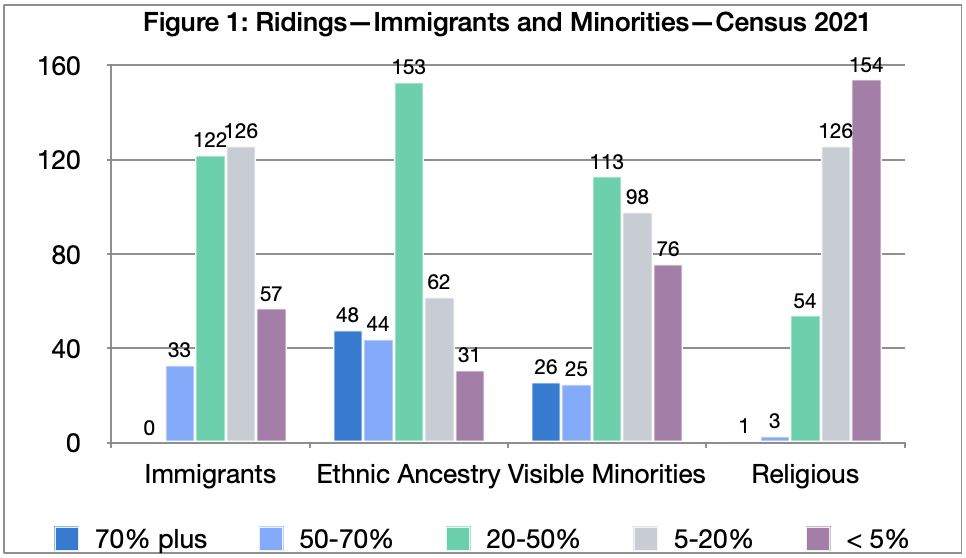
One fundamental political constraint is that elections are won and lost in ridings with large numbers of visible minorities and immigrants, like in the Greater Toronto and Hamilton Area, British Columbia’s Lower Mainland, and other urban areas as shown in Figure 1. Arguably, the Conservatives learned this lesson in the 2015 election, where citizenship revocation provisions and the Barbaric Cultural Practices Act signalled to many new Canadians they were not welcome.

The demographic of immigrants and minorities across Canadian electoral ridings. Graph courtesy of Andrew Griffith

Given that immigration is a shared jurisdiction with the provinces, any move to restrict the numbers of permanent residents, temporary workers, and foreign students will likely be met with provincial opposition. All provinces—save Quebec—largely buy into the “more is merrier” demographic arguments. Provincial governments and education institutions rely on large numbers of international students to fund higher education, and thus have already signalled concerns with the current government’s trial balloon about capping students from abroad.

Stakeholder pressures are a further constraint. Business groups, large and small, want a larger population to address labour market needs, and that includes international students for low-value-added service jobs. A larger population also means more consumersImmigration lawyers and consultants, both in Canada and abroad, benefit from more clients. Settlement and refugee groups can continue to press for increased resources even if evaluations question their effectiveness with respect to economic immigrants. Most academics focus on barriers to immigrants and visible minorities rather than questioning their assumptions. Lobby groups like the Century Initiative and others continue to push the narrative that a larger population is needed to address an aging population, a narrative that is supported by all these stakeholders, and federal and provincial governments (except for Quebec).

Few of these stakeholders seriously address the impact of immigration on housing availability and affordability, health care, and infrastructure, despite all the recent attention to the links between housing and immigration. Most stakeholders are either in denial, claim that ramping up housing can be done quickly as many recent op-eds indicate, or argue that raising these issues is inherently xenophobic if not racist.

Global trends that also could shape a possible Conservative government include increased refugee and economic migrant flows, greater global competition for the same highly skilled talent pool and, over time, expanded use of AI and automation as a growing component of the labour market.

Immigration

Given these constraints and the fear of being labelled xenophobic, Conservatives have focused more on service delivery failures than questioning immigration levels, whether it’s permanent resident targets or the rapid increase in uncapped temporary workers and international students. Poilievre has stated that the Conservative focus will be on the “needs of private-sector employers, the degree to which charities plan to support refugees, and the desire for family reunification,” suggesting greater priority on economic and family immigration categories, as was largely the case for the Harper government. The Conservatives’ recent policy convention was largely silent on immigration. They are engaging in considerable outreach to visible minority and immigrant communities, adopting the approach of former Conservative minister Jason Kenney, “the minister for curry in a hurry.”

That being said, it is likely that a Conservative government would likely freeze or decrease slightly the number of permanent residents rather than continuing with the planned increases (the Liberal government recently indicated that it is not “ruling out changes to its ambitious immigration targets.)”

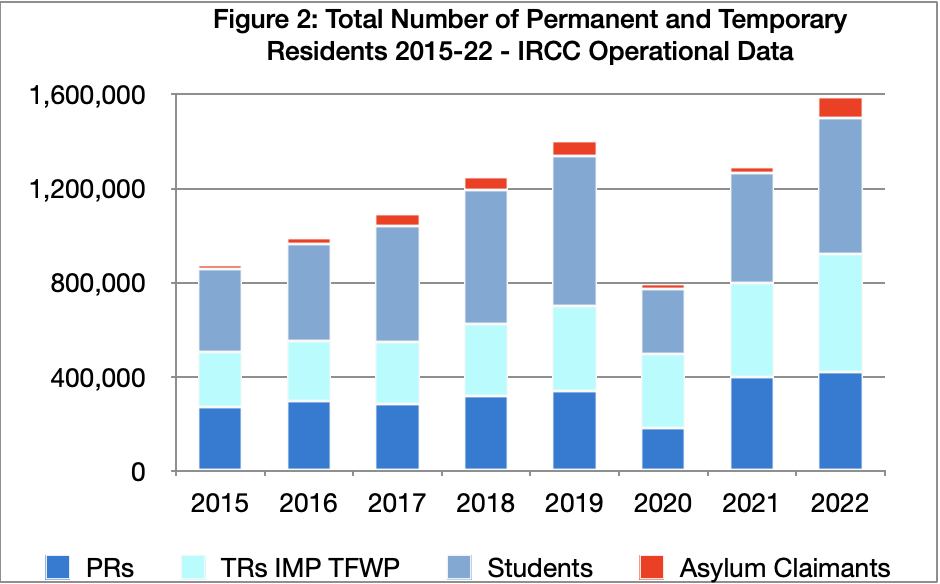
Figure two highlights the growth in permanent and temporary residents since 2015. The extent of public debate on the impact of immigration on housing provides latitude for a freeze at 2023 levels, or a small decrease given that immigrants and non-immigrants alike are affected. Graph courtesy of Andrew Griffith

It is less clear whether a Conservative government would have the courage to impose caps on temporary workers given pressure from employers, including small businesses. However, the previous Conservative government did have the political courage to impose restrictions following considerable abuse of the temporary work program, ironically exposed by the Liberals and NDP. Similarly, imposing caps on international students would run into strong resistance from provincial governments given their dependence on students from abroad to support higher education. Even placing caps on public colleges that subcontract to private colleges—which are more for low-skilled employment than education—would be challenging given employer interest in lower-wage employees. They may, however, reverse the Liberal government’s elimination of working-hour caps for foreign students.

The emphasis on charity support for refugees suggests a renewed focus on privately sponsored refugees compared to government-assisted ones. Expect the usual dynamics at play in terms of which groups have preferential treatment (e.g. Ukraine, Hong Kong) that influence all parties, and greater sensitivity to religious persecution, particularly Christians. They are likely to remember how their callous approach to Syrian refugees and the death of Alan Kurdi contributed to their 2015 defeat, and thus be more cautious in their approach to high-profile refugee flows and cases. Whether they would remove health-care coverage for refugee claimants as the Harper government did in 2012 is unclear, but as that was ruled by the Federal Court as incompatible with the Charter, they may demur. 

Whether a Conservative government would go beyond the usual federal-provincial-territorial process and provide financial support for foreign credential recognition, or be more ambitious and transfer immigrant selection of public sector regulated professions (e.g., health care) to the provinces is unclear. However, given that regulatory bodies are provincial and, for health care, provinces set the budgets, they may explore this option.

While the simplification and streamlining of over 100 immigration pathways is long overdue, given the complexity for applicants to navigate the system, and for governments to manage and automate it, such longer-term “fixing the plumbing” initiatives are less politically rewarding than addressing various stakeholder pressures. 

Given the increased number of asylum claimants, a Conservative government would be likely to restore requirements for claimants to have sufficient funds and an intent to leave, and may consider reimposing a visa requirement on Mexican nationals.

The over $1.3-billion funding for settlement agencies would likely decrease given expected overall fiscal restraint.

Citizenship 

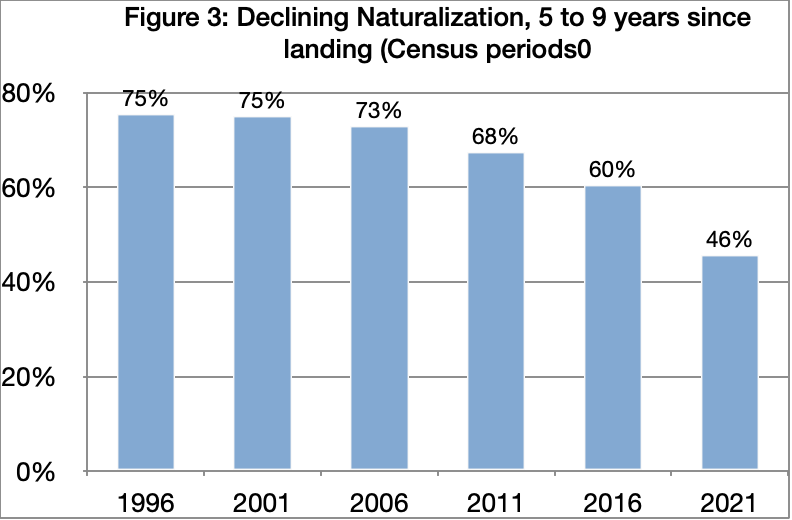
Citizenship is arguably the end point of the immigration journey as it represents full integration into society with all the political rights and responsibilities that entails. This assumption is being challenged by a combination of Canadian economic opportunities being relatively less attractive for source countries such as China and India, along with greater mobility of highly educated and skilled immigrants. As a result, the naturalization rate is declining as shown in figure three.

Figure three depicting naturalization rates between 1996 and 2021. Graph courtesy of Andrew Griffith

The previous Conservative government was more active on citizenship than other recent governments. In 2009, it released a new citizenship study guide, Discover Canada, with a greater focus on history, values and the military. It also required a higher passing score on the citizenship test—up to 75 per cent compared to 60 per cent—and different versions were circulated to reduce cheating. Language requirements were administered more strongly, and adult fees were increased from $100 to $530. A first generation cut-off for transmission of citizenship was implemented as part of addressing “lost Canadians” due to earlier Citizenship Act gaps. C-24 amended the Citizenship Act to increase residency requirements from three to four years, increased testing and language assessment to 18-64 years from 18-54 years, and a revocation provision for citizens convicted of treason or terror.

The Liberal government reversed the changes to residency requirements, the age changes for testing and language assessment, and the revocation provision, and promised to issue a revised citizenship study guide and to eliminate citizenship fees. Subsequently, the Liberals amended the citizenship oath to include reference to Indigenous treaty rights in response to the Truth and Reconciliation Commission.

It is unclear the degree to which the Conservatives will consider citizenship a priority in relation to other immigration-related issues. From an administrative perspective, changing residency requirements again would simply complicate program management, make it harder to reduce processing times, and would not provide any substantive benefit. Re-opening citizenship revocation would simply draw attention to the risks that countries would offload their responsibilities, as the example of former U.K. citizen and Canadian citizen by descent Jack Letts illustrates. 

Given that the Liberal government to date has not issued a revised citizenship guide, the Conservatives would likely stick with Discover Canada, issued in 2009. Similar, the existing citizenship test and pass rates, and proof of meeting language requirements would not need to be changed. As the Liberal government never implemented 2019 and 2021 campaign commitments to eliminate citizenship fees, one should not expect any change from the fee increase of 2014.

On the other hand, the pandemic-driven shift to virtual citizenship ceremonies in 99 per cent of all such events would likely to be reversed given strong Conservative opposition in recent discussions at the Standing Committee on Citizenship and Immigration, along with the proposed self-affirmation of the citizenship oath (“citizenship on a click”). It is also likely that a Conservative government may wish to revert to paper citizenship certificates, and away from the option of e-certificates

The Liberals and the NDP have been trying to weaken the first generation cut-off for transmission of citizenship for those with a “substantial connection” to Canada. Despite the Conservatives opposing this change, largely on process grounds as this was tacked on to a Senate private member’s bill, it is unclear whether they would reverse this change if implemented. However, if some particularly egregious public examples emerge, just as the Lebanese evacuation of 2006 prompted the government to legislate the cut-off given the large numbers of “Canadians of convenience,” they may well decide to act.  

The Conservatives may wish to revisit the issue of birth tourism. In 2012, they pushed hard, but ultimately the small numbers known at the time and provincial opposition to operational and cost considerations made them drop their proposal. Since then, however, health-care data indicated pre-pandemic numbers of birth tourists to be around 2,000, although these dropped dramatically during the pandemic given visa and travel restrictions.

The Conservatives are unlikely to revisit the issue of Canadian expatriate voting limitations given the Supreme Court’s ruling that expatriates have the right to vote no matter how long they have lived outside Canada

Part II

In contrast to immigration and citizenship, a Conservative government would face fewer constraints with respect to multiculturalism and employment equity. Their public criticism of wokeism, their policy resolutions stressing merit over “personal immutable characteristics“, their criticism of diversity, equity and inclusion training, and their criticism of Liberal government judicial, Governor in Council, and Senate appointments all point to a likely shift in substance and tone.

Multiculturalism and Inclusion

The Conservative government moved multiculturalism from Canadian Heritage to Immigration, Refugees and Citizenship Canada (IRCC) given its refocused the program on the integration of new Canadians. Grants and contributions were similarly refocused, and overall funding to the program declined from about $21-million to $13-million (operations and maintenance), and from about 80 to 34 employees. The Conservatives also implemented a historical recognition program to recognize previous discriminatory measures against Ukrainian, Chinese, Italian, Jewish, and Sikh Canadians.

The Liberal government moved multiculturalism back to Canadian Heritage. Funding increased dramatically, with $95-million for Canada’s Anti-Racism Strategy, refocusing the program on anti-racism and systemic barriers to full participation in Canadian society. Additional funding was provided to the Canadian Race Relations Foundation. Greater emphasis was placed on addressing barriers facing Black Canadians such as the Black Canadian Communities Initiative and the Black Entrepreneurship Program. A special representative to combat Islamophobia was appointed. More comparative research by Statistics Canada highlighted differences in visible minority economic outcomes. Heritage months for Canadian Jews and Sikhs were introduced among others. 

It is highly likely that resources would be cut sharply under a Conservative government given their overall approach to government expenditures, their general approach to limit government intervention and their scepticism regarding critical race theory, systemic racism, and diversity, equity, and inclusion training. There would likely also be a return to a more general integration focus between and among all groups. They would, of course, be unlikely to curb any of the recognition months or days, given the importance to communities (and their political outreach). 

The Conservatives would likely be more cautious about using language like “barbaric cultural practices” in their communications given how that eventually backfired in the 2015 election. One can also expect them to be cautious with respect to Quebec debates on secularism or “laïcité,” such as Bill 21.

Just as the Liberal government cancelled the Conservative appointment of an ambassador for religious freedom, a Conservative government would be likely to cancel the representative to combat Islamophobia.

Hopefully, a Conservative government would neither diminish the value of the mandatory census by reverting to the voluntary and less accurate National Household Survey approach, nor dramatically reduce the budget of Statistics Canada given the impact on the quantity and quality of data and related analysis.

A future Conservative government is likely to revisit the guidelines for funding research away from diversity, equity and inclusion priorities, along with Canada CouncilTelefilm, and others, based upon party policy resolutions

Employment Equity

A Conservative government might reduce the amount and quality of data available regarding visible minority, Indigenous Peoples, persons with disabilities represented in public service, and other government appointments. 

The Liberal government expanded public service data to include disaggregated data by sub-group, allowing for more detailed understanding and analysis of differences within each of the employment equity groups since 2017, along with data on LGBTQ+ people. Previous government reports only covered the overall categories of women, visible minorities, Indigenous Peoples and persons with disabilities. It is uncertain whether these reports under a future Conservative government would revert back to only reporting on overall group representation, hirings, promotions and separations. Given that this concerns public service management, it may well decide to continue current practice or the more sceptical elements may press for change.

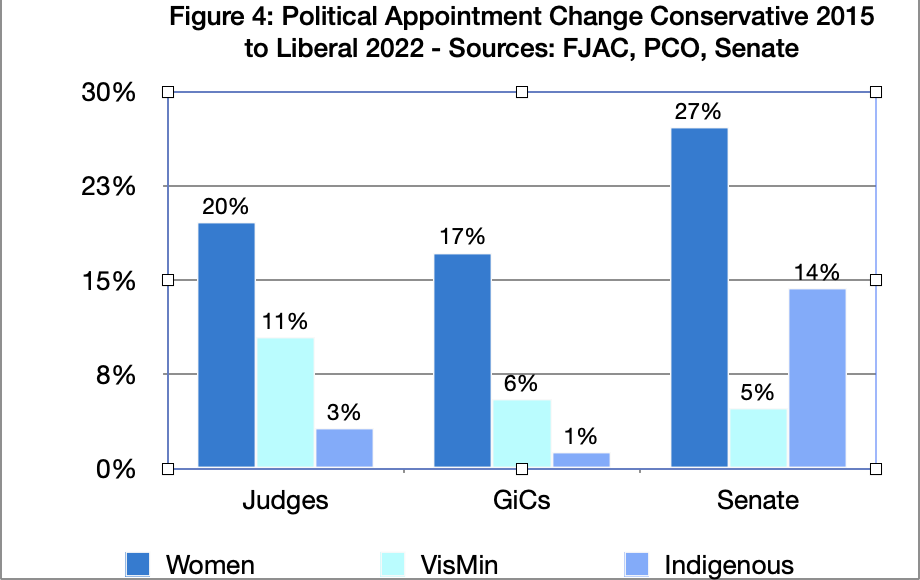
On the other hand, political appointments—judges, Governor-in-Council, Senate—are another matter. Appointment processes are likely to be revised given concerns that the processes introduced by the Liberal government unduly favoured candidates more on the centre-left than centre-right. Figure 4 highlights the increased representation of women, visible minorities and Indigenous Peoples in political appointments.

Figure four highlights the increased representation of women, visible minorities and Indigenous Peoples in political appointments. Graph courtesy of Andrew Griffith

At the end of the Conservative government, judicial appointment were 35.6 per cent women, two per cent visible minorities and 0.8 percent Indigenous. The Liberal government introduced a new application process that aimed to—and succeeded in—vastly increasing the diversity among judicial appointments. As of October 2022, they sat at: 55.2 per cent women, 12.5 per cent visible minorities, and four per cent Indigenous.

Similarly, at the end of the last Conservative government, Governor-in-Council appointments to commissions, boards, Crown corporations, agencies, and tribunals were 34.2 per cent women, 6.1 per cent visible minorities, and 2.9 per cent Indigenous. Under the Liberal government, the number of women increased to 51.4 per cent, visible minorities to 11.6 per cent, and 4.2 per cent Indigenous by January 2023.

Senate appointments present a more nuanced picture. Conservative appointment of visible minorities was at 15.8 per cent, representing a conscious effort to address under-represented groups, but women, at 31.6 per cent of appointments, and Indigenous Peoples at 1.8 per cent, were significantly under-represented. The Liberal introduction of a formally independent and non-partisan advisory board resulted in a sharp increase in diversity: 58.8 per cent women, 20.6 per cent visible minorities, and 16.2 per cent Indigenous Peoples.

Along with these process changes, the Liberal government expanded annual reporting to include visible minorities, Indigenous Peoples, persons with disabilities, and judicial appointment reporting also included LGBTQ and ethnic/cultural groups. Should a Conservative government decide to stop these annual breakdowns, it will be harder to track any shifts in representation. 

The current review of the Employment Equity Act, launched in 2021, has not yet resulted in any public report on consultations and recommendations from the Task Force. Given limited parliamentary time and higher priorities during the current mandate, it is unlikely that any revisions to the Act will be approved. However, should any legislation come to pass, it is likely that a future Conservative government might wish to revisit some of the provisions.

Concluding observations

To date, two overarching themes have driven Conservative discourse: Canada is broken, and the need to “remove the gatekeepers.” The Yeates report confirms that the immigration department is broken, reflecting long neglect of organization weaknesses, a lack of client focus, and, I would argue, an excessive multiplicity of programs that make it harder for clients to navigate, and more difficult for IRCC to manage. 

One of the ironies of assessing likely Conservative policies is immigration, citizenship, and related areas all pertain to government being “gatekeepers.” It’s easier to shrink the gate for some policies and programs than others (e.g., government political appointments). Others, such as reducing levels of permanent and temporary residents, are much more challenging given the strength of provincial, business, and other stakeholders opposition. The degree to which a Conservative government is prepared to expend political capital will obviously reflect whether or not it has a majority in Parliament. 

The sharp decrease in public support for immigration, given the impact on housing, health care, and infrastructure, likely provides greater flexibility for any future Conservative government. While there is greater flexibility with respect to multiculturalism and employment equity, a Conservative government could also be ambitious with needed immigration reforms for permanent and temporary immigration.

While some have argued that immigration and related issues have become a third rail in Canadian politics, this need not be the case. The concerns being raised are regarding the impact of large and increasing numbers of permanent and temporary migration on housing, health care, and infrastructure, not the racial, religious or ethnic composition of immigrants. These issues affect immigrants and non-immigrants alike and focus on commonalities, not differences.

Source: What changes a Conservative government might make to Canada’s immigration policies

Liberals, NDP urge Conservatives not to stall citizenship rights for ‘lost Canadians’

The original bill, S-245, focused on the narrow remaining group and small number of “lost Canadians”, born between 1977 and 1981 who failed to reaffirm their citizenship by the age of 28.

The NDP and Liberals abused the regular process by expanding to the scope to essentially gut the first generation cut-off, without the committee being able to go through the normal review process for effectively was a new bill, with far vaster implications for citizenship given the larger number of people affected.

The Conservatives are right to engage in delaying tactics on process as well as substantive grounds given that the government and the NDP initiated “playing political games” by using this backdoor shortcut:

But the NDP’s immigration critic Jenny Kwan accused the Conservatives of stalling its progress and “playing petty political games,” including filibustering debate at committee, to reduce its chances of becoming law.

She accused the sponsor of the Senate bill in the Commons, Conservative MP Jasraj Singh Hallan, of slowing the bill’s passage in the House by twice switching its scheduled third reading debate with another bill. Mr. Hallan and Tom Kmiec, the Conservative immigration critic, would not comment.

“Canada needs to fix the lost Canadians issue once and for all. The Conservatives were wrong to strip the right of parents to pass on their Canadian citizenship to their second-generation-born-abroad children 14 years ago,” she said. “In the case of William and Jack Cowling, it means they do not have the legal status to work in Canada and the family farm that has been in their family for six generations is now in jeopardy.”

Source: Liberals, NDP urge Conservatives not to stall citizenship rights for ‘lost Canadians’

Gaza evacuees question Canada’s policy for who it will help evacuate

Interesting difference in immediate family definitions (USA also includes parents in their definition).

Of course, given that the government’s immigration policies are based on (weak) demographic arguments regarding the impact of an aging population, including parents would further accentuate these impacts.

It will also be interesting to have analysis of the breakdown between long-term Canadian Palestinian expatriates and those who were caught during visits to family:

Unlike America, which, according to the UN refugee agency, typically includes parents in the legal definition of “immediate family,” Canada’s definition in the Immigration and Refugee Protection Act extends only to spouses and common-law partners, dependent children and grandchildren.

That means, for now, Canada has not offered to add parents, in-laws and siblings to its list of potential evacuees.

In any event, Abumiddain’s father isn’t willing to leave without his brother. The pair have long worked the farm together, and Abumiddain’s uncle would otherwise be alone.

If Canada widened its legal definition of immediate family, it would allow the family to stay together and remain united, said Abumiddain, who hasn’t been able to contact his dad since he left Gaza.

The Canadian Council for Refugees has advocated for a broader definition to allow people who escape to find refuge with their loved ones in Canada.

“You may have those who are trying to exit whose immediate support network may be a more distant relative,” said co-executive director Gauri Sreenivasan.

It’s important that the government recognize the unique composition of modern families and their support systems, and avoid narrow definitions, Sreenivasan said.

“I think this is a time for us to to be generous and identify what are the opportunities to get people who are trying to leave to safety, including their families.”

Source: Gaza evacuees question Canada’s policy for who it will help evacuate

COVID-19 Immigration Effects – September 2023 update

Regular monthly data update.

Of particular note this month is the drastic drop in the number of temporary residents transitioning to permanent residency and a an equally sharp decrease in the number admitted under IMP.

Asylum claimants continue to increase.

The number of new citizens rose sharply.

Highlights on slide 3.

First group of Canadians departs Gaza as Israel ramps up offensive

Some of these personal stories may raise questions about “Canadians of convenience” as in the case of the Lebanese Canadian evacuation in 2006 (same might apply to Israeli Canadians evacuated):

Shortly before 9 a.m. on Tuesday, Mansour Shouman met with his family to say goodbye.

An e-mail from Global Affairs Canada had arrived early in the morning. After a month of being trapped in the Gaza Strip, Mr. Shouman’s wife and five children had been included on a list of 80 Canadians permitted to escape the besieged enclave through the Rafah border crossing to Egypt. His name was also on the list, but he didn’t intend to leave.

By day’s end, Ottawa said that 75 Canadian citizens, permanent residents and their eligible family members had managed to flee the strip – the first group of Canadians to make the passage since the outbreak of war a month ago, when the militant group Hamas, which controls Gaza, launched attacks that killed more than 1,400 people in Israel.

While the total number of Canadians trying to escape Gaza has fluctuated, Global Affairs says it is in contact with more than 600 people there, as Israel escalates its assault on Hamas in the Palestinian territory.

Mr. Shouman’s family was among the group that left, after a bittersweet farewell.

The family, all Canadian citizens, had discussed what they would do if this moment ever came. The children would leave for Egypt with their mother, Suzan Harb, and Mr. Shouman would remain behind. He feels an obligation to help Gazans struggling to survive Israeli air strikes and a scarcity of food and water. “I have obvious feelings for my family, but as a human I also feel an obligation to alleviate the challenges people are going through here,” he said in a phone interview from Khan Younis, just north of the border crossing.

When the moment came to part ways, his two youngest children, aged four and six, objected. “They asked why we couldn’t go together, telling me to come with them,” Mr. Shouman said.

Mr. Shouman knew they wouldn’t comprehend his need to stay behind. He searched his mind for terms they would understand and settled on the family cat, who had gone missing shortly after Israel began its retaliation for Hamas’s attack.

“I said I had to find our little cat Milo,” Mr. Shouman said. “And they laughed and said, ‘You’re right, dad.’ “

They hugged, parted ways and, a few hours later, Ms. Harb let him know the family had crossed safely.

Canadian officials are facilitating bus travel to Cairo, roughly six hours away. Global Affairs said it will provide accommodation, food and basic necessities in Egypt. The Egyptian government has given border-crossers just 72 hours to leave once they arrive in the country.

Defence Minister Bill Blair told reporters in Ottawa he doesn’t anticipate military assistance being required to transport Canadians out of Egypt, because there are commercial flights available. When asked who would pay for the flights, Mr. Blair said the responsibility will fall to individuals. But he added that “if they’re unable to afford that, then there are some provisions that Global Affairs can draw upon to assist them.”

As dozens of Canadians made the crossing, hundreds of others were left to endure at least one more day of the month-long war.

“The most frustrating thing is to be going through hell while the Canadian government is in LALA land!” Asia Manthkour, a Canadian living in Gaza, wrote in an Instagram post. She added that she had contacted Canadian officials to ask if she should show up at the Rafah crossing with her two children even if their names didn’t appear on the Tuesday list, only to be told she could do so at her own risk.

Speaking on Parliament Hill, Prime Minister Justin Trudeau said the government will work to ensure “all Canadians and their families are out of Gaza.”

Canada is one of many countries that has been working to facilitate departures from the Palestinian territory. The situation on the ground there is dire. Access to food and water is restricted, and the risks to personal safety are grave. The Palestinian Ministry of Health in Gaza says more than 10,300 people in the territory have been killed in the war. The Rafah border crossing, which is controlled by Egypt, is the one way out.

Late last week, the crossing was open for limited evacuations. It closed again over the weekend with little explanation, exasperating Canadians in Gaza and their loved ones.

“It’s been torture, absolute torture,” Mohanad Shurrab said of the many false starts at the border. Mr. Shurrab lives in Brampton, Ont., and has been working to secure passage to Canada for his wife and two youngest children, aged eight and 11, who were stuck in Gaza. When Canadian officials called on Tuesday to tell him they had been cleared to cross at Rafah he at first refused to believe it.

But by Tuesday afternoon he had received confirmation that they were on their way to Cairo.

“Today I am grateful,” he said. “I thank God. I thank everyone who played a part in this.”

A new father in Brantford, Ont., had a similar reaction. Ahmad Abualjedian’s wife, Yara, was eight months pregnant when the war began, trapping her in Gaza. She gave birth to the couple’s daughter Sila on Oct. 23, still stuck in the territory.

On Tuesday, Mr. Abualjedian learned that his wife and the daughter he has never met were among those authorized to leave.

“I know they are safe now,” he said. “But I still won’t sleep until they are here.”

Source: First group of Canadians departs Gaza as Israel ramps up offensive

Israel Must Not Revoke Their Citizenship – Haaretz Editorial

Of note. Hopefully one outcome of the war will be the replacement of the Netanyahu government and these extreme ministers:

On October 7, the Israeli Arab actress Maisa Abd Elhadi published two posts. In one, she captioned an image of Yaffa Adar, 85, being abducted by Hamas from her home in Kibbutz Nir Oz, with the text, “The lady is going on the adventure of her life.” The other showed a tractor breaking through the fence, captioned “Let’s go Berlin style.”

A few days later she was arrested, and last week she was charged with incitement to terrorism and expressing solidarity with a terror organization.

Interior Minister Moshe Arbel was not content with that, and called for the revocation of her citizenship. On Thursday, he approved the publication of a draft law he wrote with Justice Minister Yariv Levin, the architect of the government’s judicial coup, that would enable the revocation of citizenship or residency of a citizen or resident who incited to terrorism or expressed support for terror during wartime.

Levin and Arbel want to expand the list of acts for which citizenship can be revoked. According to their proposal, citizenship could be revoked from anyone who supported terrorism, incited to terrorism or sympathized with a terror organization “while a special situation had been declared in the home front, due to the aggravated severity attended to the commission of such acts at wartime.”

The list of acts included under this definition includes the publication of statements of praise, support or sympathy, waving a flag, displaying or publishing a symbol or displaying, playing or publishing of a slogan or anthem in order to express solidarity.

Arbel and Levin are arming Israel with a weapon that allows it to embark on a literal witch hunt, particularly after Arab citizens. A situation of war does not justify such hysterics. Revocation of citizenship is a draconian step (the practical upshot of which is deportation, or leaving a person stateless) that should not be used, let alone for offenses such as incitement or the expression of identification. We also must not lose the critical distinction between someone publishing a post and those committing or aiding a terror attack.

In addition, according to the bill the person authorized to revoke the citizenship of a person convicted of such offenses will be the interior minister, acting on the recommendation of an advisory committee and the concurrence of the justice minister. Judicial review, according to the draft law, will take place after the decision is made.

In other words, Arbel and Levin will be able to revoke citizenship without court involvement. This is unlimited power, worse than that envisioned by the coup. The government is not a punitive agency; that is the role of the courts. The government coup was stopped, but under the cover of war Levin has continued his fight to eliminate the separation of powers.

This bill could contribute to the silencing of entire groups within Israeli society at best and to political persecution, revocation of citizenship and mass expulsion at worst. Such power cannot be placed in the hands of the government, not even in wartime.

Source: Israel Must Not Revoke Their Citizenship – Haaretz Editorial – Haaretz

Australia cannot strip citizenship from man over his terrorism convictions, top court says

Of note:

Australia’s highest court on Wednesday overturned a government decision to strip citizenship from a man convicted of terrorism.

The ruling is a second blow in the High Court to the law introduced almost a decade ago that allows a government minister to strip dual nationals of their Australian citizenship on extremism-related grounds.

The ruling also prevents the government from deporting Algerian-born cleric Abdul Benbrika when he is released from prison, which is expected within weeks.

Source: Australia cannot strip citizenship from man over his terrorism convictions, top court says – The Associated Press

A GOP plan for the census would revive Trump’s failed push for a citizenship question

Of note (the usual suspects):

A coalition of conservative groups is preparing for a chance to shape the country’s next set of census results in case a Republican president returns to the White House in 2025.

Their playbook includes reviving a failed push for a citizenship question and other Trump-era moves that threaten the accuracy of the 2030 national head count.

The plan also calls for aligning the mission of the government agency in charge of the next tally of the country’s residents with “conservative principles.” Many census watchers, including a former top Trump administration official, tell NPR they find this position particularly alarming.

The policy proposals — led by The Heritage Foundation, a Washington, D.C.-based think tank — are part of a broader “Project 2025” plan for dismantling aspects of the U.S. government. “For too long, conservative presidents’ agendas have been stymied by liberal bureaucrats who put their own agenda over that of the President, whom they serve,” Paul Dans, a former Trump appointee who is Project 2025’s director, claims in a statement.

Since the plan’s release in April, most public attention has focused on its climate policy and calls to expand the president’s power over federal agencies. But 2025 marks a pivotal year for one particular and often-neglected agency — the Census Bureau.

The federal government’s largest statistical agency is about to start a critical planning period for the upcoming once-a-decade count. Decisions expected to be made during the next administration, including what census questions to ask and how, will have long-lasting effects on the statistics used to divvy up congressional seats and Electoral College votes, redraw voting districts for every level of government, inform policymaking and research, and guide more than $2.8 trillion a year in federal money for public services across the country.

If former President Donald Trump or another Republican candidate is elected in 2024, many census watchers are bracing for a potential sequel to the years of interference that muddled the last tally in 2020.

Why do these conservative groups want a citizenship question?

It’s not clear exactly why these conservative groups want the next census to ask for the U.S. citizenship status of every person living in every household in the United States.

Research by the bureau has shown that including the question “Is this person a citizen of the United States?” on forms is likely to discourage many households with Latino or Asian American residents from getting counted in official population totals.

The bureau’s annual American Community Survey already produces estimates of U.S. citizens, which are used to help enforce the Voting Rights Act.

And a future Republican administration could, as the Trump administration tried to, seek citizenship data from an alternate source — government records. The agency’s researchers said those would be more accurate and less costly to use than people’s self-reported answers. (President Biden stopped that work in 2021.)

Still, Thomas Gilman — a former Chrysler executive who, during the Trump administration, served as chief financial officer for the bureau’s parent agency, the Commerce Department — writes in the Project 2025’s policy guide: “Any successful conservative Administration must include a citizenship question in the census.”

Gilman declined NPR’s interview requests through a Heritage Foundation spokesperson and did not respond to written questions. The Heritage Foundation also did not make any representatives available to be interviewed for this report.

During the Trump administration, a citizenship question was part of a secret strategy to alter a key set of census numbers, the 2020 release of a presidential memo and, later, internal documentsconfirmed. Those numbers are used every 10 years to reapportion each state’s share of seats in the U.S. House of Representatives and the Electoral College.

According to the 14th Amendment, the congressional apportionment numbers must include the “whole number of persons in each state.” But Trump officials wanted to make the unprecedented move of excluding unauthorized immigrants.

In public, however, the Trump administration claimed to want a citizenship question to better enforce the Voting Rights Act’s protections against the discrimination of racial and language minorities — a justification the Supreme Court found appeared to be “contrived.”

In court, groups that sued over the proposed question pointed to another reason that remains a potential motivating factor for a future GOP administration — neighborhood-block level citizenship data that could be used to draw voting districts that a Republican redistricting mastermind said would be “advantageous to Republicans and Non-Hispanic Whites.”

That kind of data would be key to a legal dispute that the Supreme Court left unresolved in 2016: whether it is legal for states to redraw legislative districts based on the number of citizens old enough to vote rather than of all residents in an area.

Would Trump, if reelected, try again for a citizenship question?

It’s an open question whether Trump, if reelected, would make another go for a citizenship question. His campaign did not respond to a request for comment.

Hermann Habermann — a former deputy director of the bureau who testified in court against the Trump administration’s citizenship question push — sees echoes of that failed effort embedded within the Project 2025 plan. It repeats a misleading Trump-era talking point that appears to reference the United Nations Statistics Division’s census recommendations: “Asking a citizenship question is considered best practice even by the United Nations.”

“I don’t think they’ve read properly what it says there,” says Habermann about how Project 2025 interprets recommendations he helped write while serving as the director of the U.N. Statistics Division. “It doesn’t say thou shalt do this. It recommends that citizenship be one of the areas that is looked at. The U.S. does look at citizenship at the block-group level through the American Community Survey. So we do it. We just don’t do it at the block level. And so the question always became, why is that necessary?”

How a Republican administration answers that question could be the focus of another round of lawsuits, says Thomas Saenz, president and general counsel of the Mexican American Legal Defense and Educational Fund, which represented some of the groups that sued the Trump administration over its citizenship question push.

“I’ve never heard articulated a justification for the citizenship question that is not fairly obviously a veil to disguise racial and partisan intent,” Saenz says.

Still, in the Biden years, GOP calls to add a census citizenship question and alter the congressional apportionment numbers have not gone away. In July, House Republicans released a draft funding bill that would have banned the bureau from using the money to include unauthorized immigrants in future counts used to divide up House seats.

These conservative groups also have a “conservative agenda” for the Census Bureau

While the Project 2025 plan also outlines garden-variety presidential transition moves such as reviewing budgets and eliminating duplicative census operations, there are other proposals that many census watchers find troubling.

They call for more political appointee positions at the bureau, which has largely been run by career civil servants.

“Strong political leadership is needed to increase efficiency and align the Census Bureau’s mission with conservative principles,” Gilman, the former Commerce Department CFO, writes, adding there’s a need to have “both committed political appointees and like-minded career employees” in place to “execute a conservative agenda” as soon as the next Republican president takes office.

During its final months in office, the Trump administration installed four additional political appointees without any past experience at the agency or obvious qualifications for joining the highest ranks. In a 2020 email, the bureau’s top civil servant raised concerns that the appointees showed an “unusually” high level of “engagement in technical matters, which is unprecedented relative to the previous censuses.” After an investigation, an official from the Government Accountability Office told Congress that the appointees ultimately “did not have undue influence into the operations of the census.” Their exact responsibilities, however, remain murky.

Habermann, the former deputy director at the bureau, sees any similar return of this Trump-era move as “the first step to having a set of statistics which the people, the nation will not trust.”

“Some of us would believe that the function of statistics is, if you will, the lifeblood of a democracy,” Habermann adds. “The idea of statistics agencies is to produce reliable, unbiased, trustworthy information that the nation can use in making its decisions and in understanding itself. They want the statistics agency to be a mouthpiece, if you will, for the Republican administration.”

Their plan includes delaying potential changes to how the census asks about race and ethnicity

The plan also criticizes an ongoing review by the White House’s Office of Management and Budget of how the census and federal government surveys ask about people’s racial and ethnic identities. Ahead of the 2020 census, Trump officials stalled that process, which has been driven by years of research by the bureau into how to better reflect the country’s ever-shifting diversity.

The bureau has found that many people of Middle Eastern or North African descent do not identify as white, which is how the federal government officially categorizes them. The agency has also been tracking the rise of a catch-all checkbox known as “Some other race,” now the second-largest racial category in the U.S. after “White.” It’s mainly the result of the difficulty many Latinos face when answering a census question about their race that does not include a checkbox for “Hispanic” or “Latino,” which the government considers to be an ethnicity that can be of any race.

Based on their testing, the bureau’s researchers have recommendedcombining the questions about race and ethnicity into one and adding a checkbox for “Middle Eastern or North African.” OMB is expected to announce decisions on those proposals by summer 2024.

Project 2025’s plan, however, calls for a Republican administration to “take control of this process and thoroughly review any changes” because of “concerns among conservatives that the data under Biden Administration proposals could be skewed to bolster progressive political agendas.”

Meeta Anand, senior program director of census and data equity at The Leadership Conference on Civil and Human Rights, says any attempts to modify or roll back changes would be a movement away from accuracy and “truly understanding who we are as a nation.”

“If you were to have a stop and say, ‘Let’s review the questions again. Let’s conduct another research test,’ we would need to see appropriations for the Census Bureau to be able to do that. They would need to mount another test all over again. And there’s no way it would be done in time for 2030,” Anand adds. “Census advocates were trying to get revisions in place for the 2020 census, and that just never happened.”

The plan’s emphasis on a “conservative” approach to the census is raising concerns, including from a former top Trump official

Terri Ann Lowenthal, a former staff director of the House oversight subcommittee for the census who served on former President Barack Obama’s presidential transition team on census issues, sees the plan’s call to get rid of at least one of the bureau’s committees of outside advisers as a way to reduce transparency about how the agency produces the country’s statistics.

“This really is sort of undermining all of the principles and practices that federal statistical agencies should be following. And that is extremely troubling,” says Lowenthal, who is now a census consultant.

For Democratic Sen. Brian Schatz of Hawaii, one of the few vocal census advocates in Congress, Project 2025’s proposals run counter to his attempts to shield the bureau from further interference through new legislation.

“This is a clear partisan effort to force an undercount of communities of color. It’s unlawful and unconstitutional,” Schatz says in a statement.

The plan’s call to carry out a “conservative agenda” at the bureau is also catching public criticism from a less likely source: former Commerce Secretary Wilbur Ross.The former top Trump administration official pushed for a citizenship question while overseeing the bureau, and an investigation by the Commerce Department’s Office of Inspector General found that Ross “misrepresented the full rationale” for adding a citizenship question when testifying before Congress in 2018. During the Trump administration, the findings were presented to the Justice Department, which declined to prosecute Ross.

“I think that the job of the census is to provide data. If the elected officials want to interpret that one way or another, well, that’s OK. That’s their prerogative. I don’t think the census should try to shade things in any political direction,” said Ross, who declined to answer questions about a citizenship question but said he believes it is “a valid question.”

On whether there should be more political appointees at the bureau, Ross said it’s not a question he has “really thought about” but noted: “To the degree that the implication was that the census should be more politicized, I do not agree with that.”

Ross said that until NPR contacted him, he was not aware of Project 2025’s census proposals written by Gilman, who served under Ross as the Commerce Department’s CFO.

“I’m frankly a little bit surprised that he regards himself as an expert on what actually happens in terms of the census. I don’t recall him being that involved in the whole process,” Ross said.

For Lowenthal, the census consultant who is a longtime watcher of the national head count, Project 2025’s census recommendations mark a notable shift in the right wing’s approach.

“I have not seen anything remotely like these proposals in this document coming out of previous Republican administrations,” Lowenthal says. “I think that the author or authors of this document clearly understand that if you control the production and flow of information, you can control how people view their government, the actions their government is taking or not taking and their view of the world around them. These proposals should raise alarm bells, I think, for anyone worried about the future.”

Source: A GOP plan for the census would revive Trump’s failed push for a citizenship question