Parties pigeonhole visible minority candidates

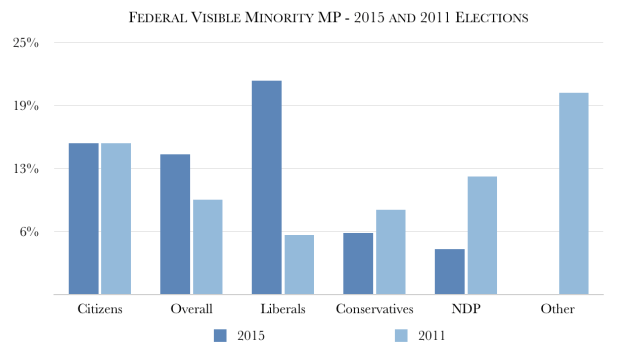
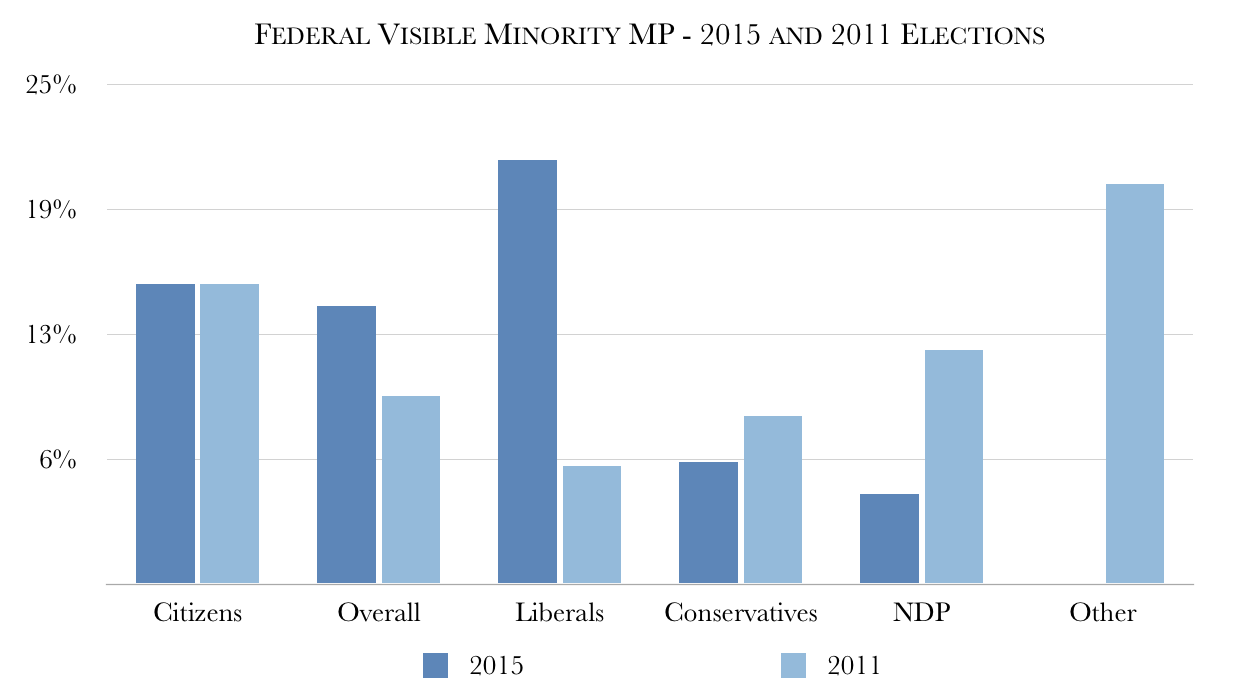
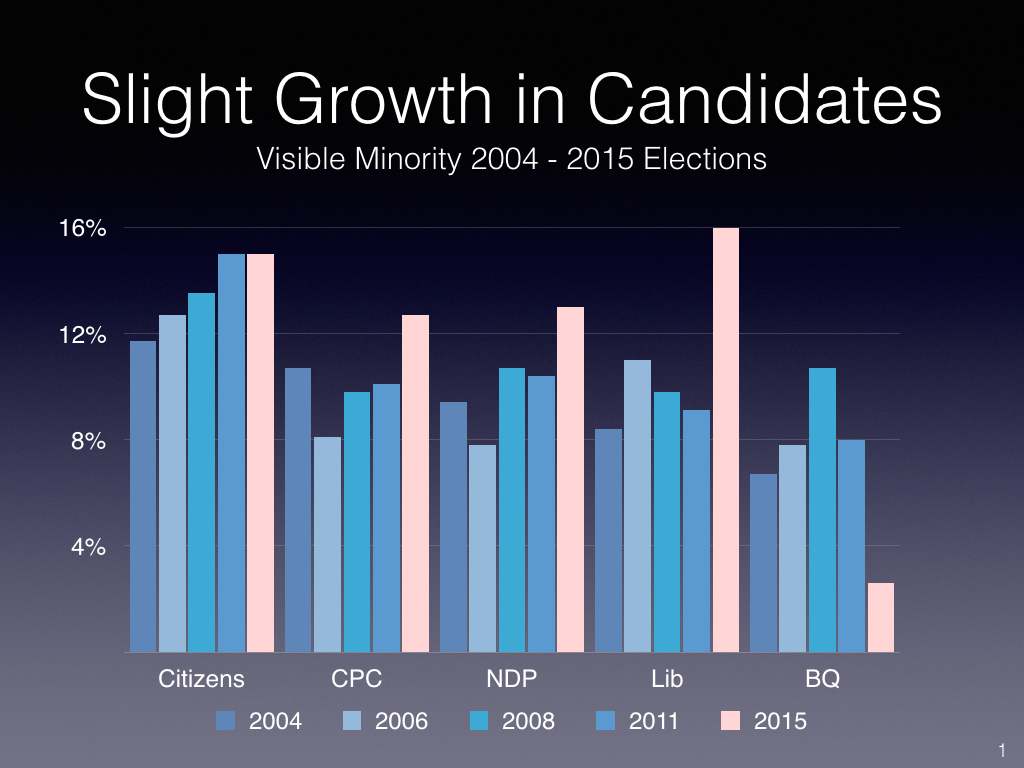
Visible_minorities_Candidates_2004-11Good analysis and necessary to complement the under-representation of women (see Debate about the women’s debate missed a bigger point: Antoinia Maioni) by Elizabeth Goodyear-Grant and Erin Tolley:

So far, we have heard quite a bit about the selection of women and Indigenous candidates, but comparatively little about visible minority candidates. This is surprising given parties’ efforts to appeal to visible minority voters and Canada’s increasing racial diversity.

Visible minorities now make up 19 per cent of the Canadian population. The proportion of candidates with visible minority backgrounds is basically unchanged since 2004 — hovering around 9 per cent — even though the proportion of visible minorities in Canada has steadily increased.

In 110 of the country’s 338 ridings, visible minorities make up 20 per cent or more of the population, up from 90 ridings in 2011. The visible minority population is thus significant in both magnitude and scope. Even so, just 13.5 per cent of candidates nominated for the three major parties so far have visible minority backgrounds. That’s 131 out of 964 nominated candidates, with 50 nominations still to come.

It is not just about absolute numbers though. Importantly, in 54 per cent of ridings (183 of 338), there isn’t a single visible minority candidate running for any of the three major parties. In those ridings with incomplete nominations, 11 per cent (36 of 338) so far have only white candidates on the ticket. In other words, it is possible that in nearly two-thirds of the country’s ridings, ballots will not include a competitive visible minority candidate.

Although many of these all-white contests are in rural ridings with small visible minority populations, many are not. In Scarborough-Guildwood, for example, visible minorities make up 68 per cent of the population, but the candidates for the three competitive parties are all white (although, notably, the Conservative candidate is a Dutch immigrant). In Ajax, Chris Alexander, the Minister of Immigration and Citizenship, is running against two other white competitors.

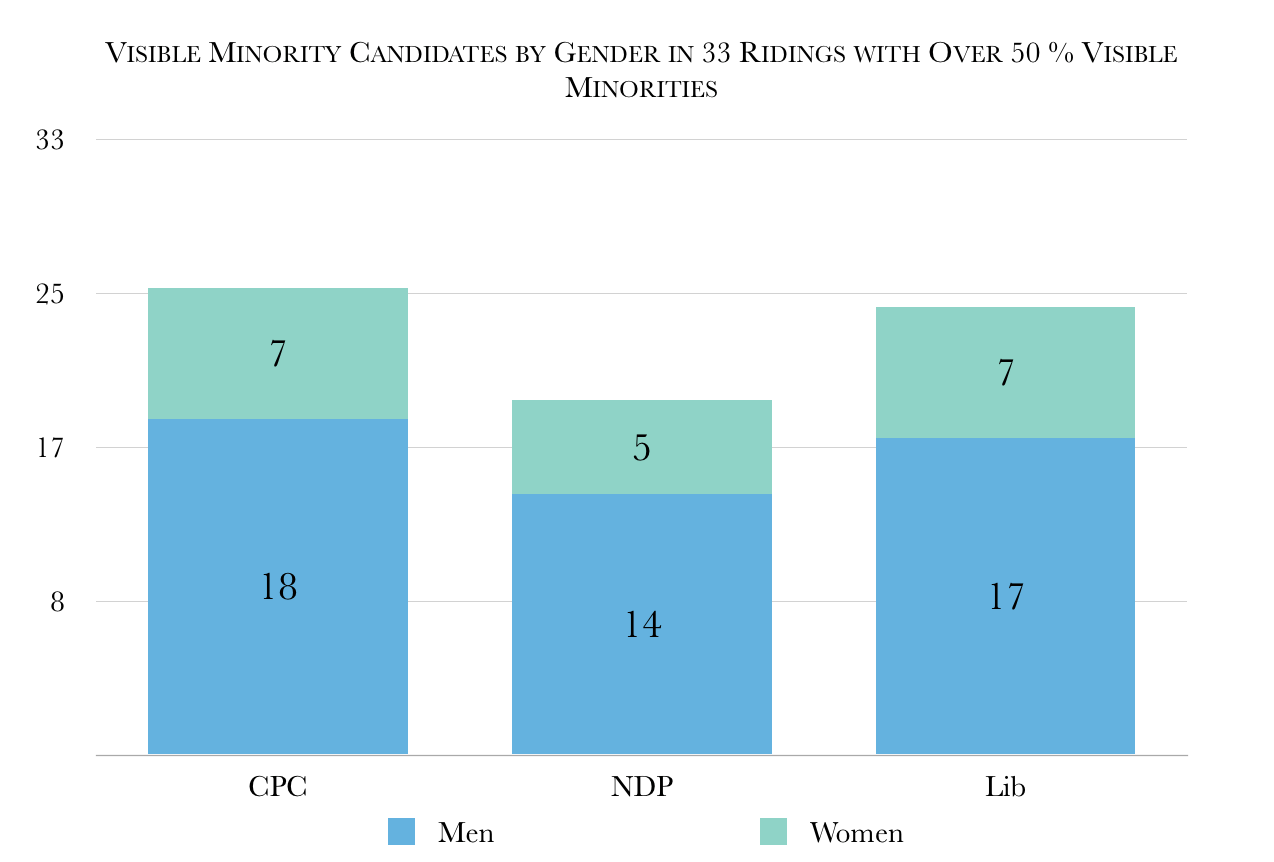
Meanwhile, in eight ridings, three visible minority candidates will square off against one another; in these ridings, the visible minority population averages 74 per cent. This suggests that parties’ wholehearted endorsement of visible minority candidacies only occurs in a handful of ridings where visible minority voters are in the overwhelming majority. At the same time, parties clearly have no problem running an entirely white slate of candidates in ridings with large visible minority populations.

The strategic placement of visible minority candidates in only the most diverse ridings lulls us into thinking that our politics is inclusive, while simultaneously capping the number of seats that visible minority candidates might ever win. Not only is this contrary to Canada’s multicultural ethos, but it is a flawed electoral strategy.

Our own research shows that white voters are about as open to visible minority candidates as they are to white candidates. When visible minority candidates run, they can win, even outside the most racially diverse ridings. But parties tend to limit the electoral prospects of visible minority candidates by pitting them against each other and nominating them primarily in the most racially diverse ridings.

The one qualification to their sound analysis lies in using the number of visible minorities that are also Canadian citizens, making the benchmark 15 rather than 19 percent used.

Source: Parties pigeonhole visible minority candidates | Toronto Star

Woman fighting ban on face-covering at citizenship ceremonies gets support from Ontario

Interesting that the Ontario government would take this step (and citizenship is exclusively a federal jurisdiction, unlike immigration which is shared):

The Ontario government is standing alongside a Mississauga, Ont., woman who is challenging the federal government’s ban on face-coverings at citizenship ceremonies.

It has filed its position, called a factum, with the Federal Court of Appeal in advance of a hearing scheduled to begin next week in Ottawa.

The province argues that requiring a Muslim woman to remove her niqab during the public oath-taking ceremony “with the result that if she does not she cannot become a Canadian citizen, fails to respect and accommodate the diversity of religious beliefs and socio-cultural backgrounds of Canadians.”

The factum goes on to say the government’s policy “tells Muslim women that if they wear the niqab, they are not welcome to join the Canadian community.”

The province is also of the view that “visual inspection of a person’s face does not prove that the person has actually spoken the words of the oath or affirmation. The proof is already provided by the existing requirement that citizenship candidates sign a certificate certifying they have taken the oath or affirmation.”

Source: Woman fighting ban on face-covering at citizenship ceremonies gets support from Ontario – Politics – CBC News

Planned passport renewal change opens door to fraud, forgery

My working assumption is that there would have been considerable risk analysis undertaken before making this change, and that Public Safety and its agencies would have been consulted and likely would have commented on the potential risks.

As more and more information is captured and shared electronically, hard to see how an expired passport would allow entry to any OECD country or equivalent.

Option summary worth noting:

From the Citizenship and Immigration Canada documents

Option No. 1 — Status quo of requiring passport holders to return their travel documents

Pros:

  • Allows passport program to take previous travel documents out of circulation and invalidate them in the system.
  • Prevents applicants from having two valid travel documents in their possession.

Cons:

  • The application process would not be entirely online, since applicants would have to return their previous passport to a designated location or by mail.
  • May reduce the number of online applications.
  • May increase application processing time and the number of incomplete applications if the previous passport can not be located.

Option No. 2 — Policy change that does not require passport holders to return their travel documents to the passport program

Pros:

  • In line with New Zealand’s current practices.
  • Adapted to online service and in line with client services, since clients do not have to return their passport to the passport program.
  • The online declaration and the sharing of information about cancelled and expired travel documents would address the risks related to the fraudulent use of passports by a third-party.

Cons:

  • Goes against the United Kingdom, United States and Australian current practices, as all three countries require that the most recent travel document, whether valid or expired, be returned. These countries do not offer an online renewal service.
  • Could inconvenience travellers crossing a border with their previous passport that has been invalidated in the system.
  • Risk of not “catching” applicants that damaged or lost their previous travel documents.

Source: Planned passport renewal change opens door to fraud, forgery – Politics – CBC News

Australia: Committee recommendations improve citizenship bill, but fundamental flaws remain

Will be interesting to see if the Abbott government accepts some of these recommendations (unlike the Canadian government which rejected any proposed amendments in committee hearings on Bill C-24):

The PJCIS [Parliamentary Joint Committee on Intelligence and Security] recommendations address several fundamental problems with the bill as drafted. The recommended tightening of Sections 33AA, 35 and 35A would ensure that some of the most inappropriate candidates for citizenship loss under the bill – teenagers who graffiti Commonwealth buildings, Red Cross aid workers or people who puncture Commonwealth car tyres – would no longer be vulnerable.

Additionally, the committee recommended the inclusion of a number of pivotal safeguards that were excluded from the bill’s original draft. For instance, for ASIO advice to be acted on, the committee recommended that – as is typical – a full security assessment should be required.

Where a person loses their citizenship, the committee recommended that, as far as possible, they should be informed of this and of their potential avenues for judicial review. The committee also recommended that additional safeguards should apply with respect to the citizenship of children.

These recommendations rectify fundamental defects in the bill’s original draft. However, important concerns about its constitutionality, clarity and adherence to the rule of law remain.

Source: Committee recommendations improve citizenship bill, but fundamental flaws remain

Foreign buyers flocking to Canada to find surrogate mothers after Asian countries crack down

Largely anecdotal rather than hard numbers, but nevertheless another aspect of birth tourism. Ironic that as developing countries crack down, Canada becomes a preferred location:

As doors are closed in some Asian countries, foreigners are flocking to Canada to make use of its surrogate mothers — and the taxpayer-financed health care system that looks after them, consultants and lawyers say.

One agency that helps “intended parents” work with surrogates says it has been “overwhelmed” with a 10-fold increase in business over the last few months.

Owner Sally Rhoads-Heinrich cites the closing recently of international surrogacy arrangements in Thailand, Nepal and — for same-sex couples — India.

Some parents are even having embryos they had stored in such countries shipped to Canada to restart the process here, said another consultant.

“I’m averaging about 600 emails a day,” said Rhoads-Heinrich. “I start usually at about 6:30 in the morning and I’m going until 11:30 at night. I can’t keep on top of it right now so I’ve had to hire more people.”

She used to sign up 20-40 clients a year, but now has more than 200, part of an industry estimated to be worth billions worldwide.

Rhoads-Heinrich worries, though, that people from overseas are essentially taking advantage of the fact Canadian surrogates are covered by medicare, an advantage promoted by at least one of her competitors.

“I don’t like Canada being seen as just a free-for-all for people to come here and use our health-care system,” she said. “We’re being flooded and I’m not seeing Canadian couples being helped. I’m seeing a lot of international couples being helped.”

The demand comes largely from other developed countries with more restrictive laws. Some, like France and Germany, ban surrogacy outright, while others, such as Israel, do not allow it for same-sex couples or single people.

Canadian law permits the practice, but prohibits commercial fees, a system on the verge of being tightened by contentious new rules.

Source: Foreign buyers flocking to Canada to find surrogate mothers after Asian countries crack down

Donald Trump, Elizabeth I, and the English Origins of Birthright Citizenship

A good in-depth piece on the history of birthright citizenship, and how it was derived from British judicial decisions:

The Republican frontrunner’s assertion that the United States is “just about” the only country “stupid enough” to grant citizenship to all children born within its borders is easily proven false. Far from a scarlet letter of perversion, the U.S. policy is more like a badge of membership in the Western Hemisphere, where nearly all countries adhere to a version of the principle, a commonality some scholars argue is a legacy of colonial pro-immigration policies in the New World.

But the term “birthright citizenship” is also misleading. There are actually two common types of birthright citizenship in the modern world, and both are incorporated into U.S. policy. Trump and those who agree with him apparently only object to one of them.

You can be born into U.S. citizenship by being born in the United States—the principle known as jus soli, or “right of the soil.” Most countries in the Americas feature jus soli citizenship. And you can also be born into U.S. citizenship by being born to U.S. citizens, even if you’re born abroad—a concept known as jus sanguinis, or “right of blood.” “Roman law,” said University of Michigan law and classics professor Bruce Frier, “was very distinctly in the jus sanguinis category.” The policy has also frequently been incorporated into modern European states, emphasizing membership in the nation through parentage.

Yet the real irony of calling “birthright citizenship” a peculiarly American stupidity is that historically and theoretically speaking, geographical birthright citizenship is precisely as American as apple pie. That is to say: it’s English—and thoroughly monarchical in origin.

Given his “anchor baby” rhetoric, Trump may be pleased to learn one thing: The case many scholars cite as establishing the theoretical basis for geographical birthright citizenship did indeed involve a troublemaking toddler. The toddler was a Scottish aristocrat, and the case was a property battle.

In 1603, Elizabeth I, the “Virgin Queen,” died without an heir. The solution was to give her cousin Mary’s son, James VI of Scotland, a second crown, making him James I of England. The tough part about that, according to the University of Miami law professor Kunal Parker, author of a forthcoming history of immigration and citizenship law, was that “under English law, aliens—those who were born outside the allegiance to the king—were not able to hold or convey titles of real property.” Thus, in 1608, an English court found itself answering an intriguing question: If two-year-old Scottish infant Robert Colville had been given lands in England, were his claims on those lands valid? The traditional English position at the time of the case, Parker said, “was of course because he’s Scottish and hence an alien he should not have good titles to lands in England.” “Every one born within the dominions of the King of England is entitled to enjoy all the rights and liberties of an Englishman.”

In his influential report on what has, inexplicably given the actual names of those involved, become known as Calvin’s Case, the English judge Sir Edward Coke articulated a distinctly feudal-sounding jus soli principle that formed the basis of much law to come: “Every one born within the dominions of the King of England, whether here or in his colonies or dependencies, being under the protection of—therefore, according to our common law, owes allegiance to—the King and is subject to all the duties and entitled to enjoy all the rights and liberties of an Englishman.” Furthermore, “Seeing then that faith, obedience, and ligeance are due by the law of nature, it followeth that the same cannot be changed or taken away.”

In other words: People born in the king’s lands are his subjects and owe him allegiance, while he owes them protection, and there’s nothing the subject can do about it. This idea failed to delight the Lockean consent-of-the-governed junkies of later decades and centuries. As the law professor Peter Schuck and the political-science professor Rogers Smith put it in their famous 1985 critique of U.S. immigration policy, Citizenship Without Consent, “At a conceptual level, [birthright citizenship] was fundamentally opposed to the consensual assumptions that guided the political handiwork of 1776 and 1787.”

Source: Donald Trump, Elizabeth I, and the English Origins of Birthright Citizenship – The Atlantic

S. Africa may cancel dual citizenship to curb IDF enlistment | The Times of Israel

Foreign military service in principle suggests a greater loyalty to the country of military service, but this measure seems unduly targeted at South African Jews who join the IDF:

Obed Bapela, a senior ANC official who heads its National Executive Committee on International Relations, said the “model” of dual citizenship may not have “a place in the world,” the South African daily The Sunday Times reported.

The government in Pretoria has been among the most hostile to Israel in recent years. South Africa’s minister of higher education Blade Nzimande, a member of the Communist Party, has openly campaigned to boycott Israeli universities and other institutions, and was denied entry into the country for a working visit to Palestinian Authority areas in April.

An ANC party conference discussed the Israeli-Palestinian conflict, including the issue of South Africans serving in the IDF, in July. The issue would be taken up again in the party’s National General Council in October, the Times said.

The country’s Jewish Board of Deputies has accused ANC officials of singling out South African Jews.

While IDF enlistment was cited explicitly by Bapela and others as the reason for reconsidering South Africa’s acceptance of dual citizenship, no figures have been provided by the party for how many South Africans actually serve in the IDF. With a population over 53 million and large immigrant populations from Asia and other parts of Africa, any change to the South African constitution to enable stripping South African migrants to Israel of their citizenship may end up affecting millions of other citizens.

Jews account for an estimated 0.2 percent of the country’s population. It is not known how many currently serve in the IDF.

Source: S. Africa may cancel dual citizenship to curb IDF enlistment | The Times of Israel

Citizenship – Differences Among Visible Minorities

A recent Twitter enquiry asked what percentage of visible minorities are also Canadian citizens. The overall answer is 78.3 percent, but that question provoked me to prepare the following chart showing the differences between different groups:

Citizenship - Visible Minorities.001

The chart is ordered in increasing order of those who remain non-citizens (but does not distinguish between those who are eligible or not).

Hard to explain some of these differences as no one variable (e.g., education, income, number of second-generation or more) seems at play. Nor is the time resident in Canada (needed to be eligible) likely to be a significant factor as it could not explain the large differences between groups (e.g., Chinese and Filipino).

The relatively large share of dual nationals for West Asian, Arab and Latin American groups may be explained by the greater convenience of being able to return to one’s country of origin with that country’s passport (e.g., Iranian Canadians cannot enter Iran on their Canadian passport and thus need to maintain their Iranian nationality).

Iran’s Surprising New Foreign Legion

Ironic. Follows US approach of granting preference to those who serve in the military, which Canada also adopted in the 2014 Citizenship Act changes:

Proposed amendments to Iran’s Civil Code under the name “Facilitating Naturalization of non-Iranian Veterans, Warriors and Elites” will offer citizenship to foreigners who join Iranian military units—be it border patrol, militias confronting the so-called “Islamic State” in Iraq and Syria, groups involved with public order operations, or any of Iran’s less “official” military initiatives, including support for Hezbollah in Lebanon. Under the amendments, “revolutionary heroes” can become citizens without undergoing existing naturalization requirements.

Parliamentarians who signed the bill say those who “serve the revolution,” including people who have contributed to Iran’s scientific progress, will be entitled to easier access to the citizenship they deserve. Yet human-rights activists and lawyers say the amendments are part of a political and militaristic strategy to entice immigrants, who have resided illegally in the country since 1979, into fighting Iran’s proxy wars.

If passed, the amendment to Article 980 will allow a new working group—the Committee for Granting Naturalization to non-Iranian Veterans, Warriors and Elites—to decide if a non-Iranian “revolutionary” will be granted Iranian citizenship. The MPs who tabled the bill on January 12 include several conservative parliamentarians who are currently waiting for their amendment to be reviewed.

Who does this new law affect and what is it really trying to achieve?

“After the Soviet Union invaded Afghanistan [in 1979], the government of the Islamic Republic of Iran opened its doors to Afghans, arguing that Islam does not recognize any borders,” explains Shirin Ebadi, an Iranian human-rights lawyer and 2003 Nobel Peace laureate. “At that time, around 4 million Afghans came to Iran, but only around 10 percent of them managed to obtain residency permits.” The rest, she explains, remained illegally, and were thus denied basic rights which citizens enjoy. “At that time,” Ebadi continues, “Iran had begun an eight-year war with Iraq and was naturally in need of inexpensive labor. Iran took advantage of illegal Afghan workers to satisfy this need.” But when the war ended, the policy remained.

Source: Iran’s Surprising New Foreign Legion – The Daily Beast

Justin Trudeau vows to repeal ‘2-tiered’ citizenship law

Unclear whether he would repeal the complete Citizenship Act (the reporting suggested that) or just the revocation and a few other provisions:

Liberal Leader Justin Trudeau says if elected his government will repeal the Conservative government’s “two-tiered” citizenship law and that he would do more to help free imprisoned Egyptian-Canadian journalist Mohamed Fahmy.

“Liberals believe in a Canada that is united — strong not in spite of its differences, but precisely because of them,” Trudeau told an audience at the Jalsa Salana Islamic conference in Mississauga, Ont., on Saturday afternoon.

He added that under Conservative Leader Stephen Harper, Canadians are being encouraged to be fearful of one another and there has been a decline in refugees coming to Canada, and in citizenship applicants.

In an accompanying news release, Trudeau said his government would repeal the Conservative government’s controversial Strengthening Canadian Citizenship Act, saying it “devalues Canadian citizenship by creating two classes of citizenship.”

“Liberals will guarantee that all Canadians’ fundamental rights are respected as guided by the Canadian Charter of Rights and Freedoms,” the statement said.

The act became law in June 2014. While several elements of the law remain controversial, a provision that came into effect in May of this year expands the grounds on which the federal government can strip dual nationals of their Canadian citizenship, even if they were born in Canada.

The provision gives the power to revoke citizenship, in some cases, to elected officials and not a federal court.

“There is a suggestion that some of us might be less Canadian than others, a suggestion of who ought to decide who stays or goes from Canada be an elected politician instead of our justice system. I think that’s wrong,” Trudeau said during his speech.

The changes are currently being challenged in court by a coalition of civil liberties groups.

In a statement, the Conservative candidate for Ajax [and current Minister of Citizenship and Immigration] described Trudeau’s remarks as “more evidence that he’s just not ready,” to be prime minister.

“Canadians know that only Conservatives can be trusted to take action against those who would do Canada harm and stand up for Canadian values,” Chris Alexander said.

Liberal position is consistent with their opposition to the revocation provisions during the C-24 Citizenship Act hearings (NDP also opposed).

In a sign that either the Conservatives continue to think they have a winner on this issue (earlier polling would suggest that) or whether they are worried that they don’t, the heavy hitters, Jason Kenney and Jenni Byrne were denouncing Trudeau’s position vigorously on Twitter.

Source: Justin Trudeau vows to repeal ‘2-tiered’ citizenship law – Politics – CBC News