Proposed niqab ban could be thin edge of the wedge: Hébert

Chantal Hébert speculates on the possible invoking the notwithstanding clause in the event a new Conservative government is elected and, as promised, passes a niqab-banning law:

If the Supreme Court agrees to hear the government’s appeal of its latest reversal, it will not address whether there is an irreconcilable conflict between the charter-guaranteed freedom of religion and a veil ban because that is simply not at issue in this case.

As an aside, if the top court were ever asked to pronounce on whether a veil ban is constitutional, the Conservatives might not like the answer, even if it turned out to be positive.

If the principle of gender equality or the secular character of the Canadian state could sustain a policy that requires the removing of the Muslim veil in order to take a citizenship oath, would the same argument not apply to just about any religion-related vestment or accessory?

The main consequence of the Conservatives’ efforts to keep their technically flawed case alive by appealing it all the way to the Supreme Court has been to turn the matter into a wedge issue in the election campaign.

At is happens, both the Liberals and the New Democrats oppose a ban on veils on constitutional and legal grounds.

The Conservatives are not the only party that believes there are points to be scored on the niqab issue. Support for a veil ban runs nowhere higher than in Quebec, the long-standing locale of a debate over the accommodation of religious minorities.

In a campaign that has the Bloc Québécois clutching at straws to justify its ongoing presence in Parliament, leader Gilles Duceppe has seized on the fact that the NDP — its main opponent in the election — is offside with the majority of voters on the niqab.

Since Bloc-sponsored attack ads came out late last week, NDP campaign signs have been defaced, with the word Islam scrawled across the face of some local Montreal candidates.

This may be only the first half of a larger game to be played out — if the Conservatives secure a majority — after the Oct. 19 election.

Harper has promised, if he is re-elected, to pass the niqab ban into law. If he wanted to pre-emptively bulletproof such a law from an all-but-certain charter challenge, he could use the notwithstanding clause of the Constitution.

It allows governments to shelter a law from the dispositions of the charter for a renewable period of five years. Over its 30-plus years of existence, it has never been used at the federal level. Some Conservative strategists have been shopping for an issue consensual enough to allow their government to break what has become a political taboo.

Support for the niqab ban extends well outside the Conservative base. It enjoys the backing of many progressive Canadians, including more than a few feminists. It would be tailor-made for that purpose.

Those same strategists believe that once the ice is broken, the use of the notwithstanding clause to suspend the fundamental freedoms that get in the way of the government’s legislative ambitions could eventually become as banal as the now-routine production of catch-all budget bills.

From medically assisted suicide to life imprisonment without parole and including supervised injection sites for drug addicts, the list of issues on which the Conservatives could find it convenient to free themselves of an inconvenient charter of rights is an extensive one.

Young Muslim voters matter more than ever

Interesting contrast between the first generation and the second generation in terms of political engagement.

Canadian Muslims form between 15 and 20 percent in six ridings (Toronto’s Mississauga-Erin Mills, Mississauga Centre and Don Valley East; Montreal’s Saint-Laurent and Saint-Léonard-Saint-Michel; and, Ottawa South):

Yet for many Canadian Muslim youth, this country is the only home they have ever known.

Unlike many of their parents, who migrated to the country in the ’70s and ’80s, more than one in four Muslims in Canada were born here, according to a report published earlier this year by Ottawa-based researcher Daood Hamdani for The Canadian Dawn Foundation.

“Both my feet are planted here. There is no ‘back home’ for me,” says 37-year-old Mohammed Hashim of Mississauga, Ont.

‘I want Canada to go back to what it was.’— Sanaa Ali-Mohammed, 26

That’s a sentiment that the older generation doesn’t always share, Ali-Mohammed says. “For my parents, I think it’s more of a transactional relationship. They’ll be good citizens but there’s always this undertone of ‘we don’t really belong here.'”

Islamic Institute of Toronto president Fareed Amin is a first-generation immigrant to Canada and has seen this sentiment among his age group first-hand. “Many of them come from countries where whether you participate or not doesn’t make a difference, so sometimes there’s that skepticism to participate in the political process .”

Some new Canadians also carry with them the view that political involvement is potentially dangerous because of the tenuous political climates they left behind.

“I don’t think our young people have the same baggage that some of the first-generation immigrants have,” Amin says. “They’re born-and-bred Canadians.”

Back in Brampton, Ali says part of being Canadian is the freedom to be whoever you are. “My parents chose to come here because you can’t always be that in Pakistan.”

His hope for the election? “I want Canada to go back to what it was; the country my parents came to.”

Some 33 federal ridings with more than 50 per cent visible minority population up for grabs on Oct. 19 | hilltimes.com

Further to the analysis in my book, Multiculturalism in Canada: Evidence and Anecdote, this Hill Times article provides polling results in these ridings along with some riding vignettes that provide colour to the somewhat dry stats:

Based on the transposition of votes analysis conducted by Elections Canada, which shows the results for the new ridings had the boundaries been in place in the 2011 election, Conservatives would have won 17 of the 33, and the NDP and the Liberals would have carried eight each. The analysis also indicated that in 20 of the 33 ridings, the margin of victory for the winning parties would have been 10 per cent or less.

In the Oct. 19 election, there are a total of 338 ridings up for grabs, 30 more than the last election, to reflect the population increase in the country between 2003 and 2012.

Most national polling numbers last week indicated that the three major national parties were in a statistical dead heat. If this trend continues, the next government will be a minority government in which every seat will count.

A Nanos poll on Thursday showed that the Liberals had the support of 31 per cent of decided voters, with the NDP and Conservatives tied at 30 per cent and the Green Party at six per cent.

According to an online national poll by Innovative Research of 2,121 Canadians conducted between Sept. 4 and Sept. 10, the three national parties were running neck and neck with the NDP support at 31 per cent, Liberals at 30 per cent, Conservatives at 28 and the Green Party at six per cent.

In the 33 ridings where the visible minority population is more than 50 per cent, the online poll indicated that the Liberals were leading the pack with 36.6 per cent, the Conservatives next with 33 percent, the NDP at 22.3 per cent and the Green Party at 7.1 per cent.

In an interview last week, Mr. Griffith said the strategic significance of the 33 ridings in this election is evident from the fact that the national party leaders have frequently visited the GTA and Vancouver areas in recent months.

“Leaders seem to be spending a fair amount of time in these ridings. It’s part of every party’s electoral strategy,” said Mr. Griffith.

For those interested in the riding list taken from my book: Visible Minority Ridings and Religious Minority Ridings.

Source: Some 33 federal ridings with more than 50 per cent visible minority population up for grabs on Oct. 19 | hilltimes.com

The Franco-American Flophouse: US State Department Confirms the New Consular Fee for Expatriation

Victoria Ferauge on the explanation of the fee structure for renouncing US citizenship:

The US State Department has finally responded to those of us who took exception to the rather extraordinary rise in the fee to renounce US citizenship.  It now costs $2,350 USD for an American citizen to exercise his or right under international law to expatriate.

Does this fee constitute a barrier to exercising that right?  The State Department doesn’t think so.  I disagree and it’s not just the fee that’s the problem, it’s the entire process which is cumbersome, time-consuming and, yes, costly for everyone – renunciants and State Department alike.

A US citizen wishing to renounce or relinquish citizenship must travel to the nearest US consulate which may be in a city far from where he or she actually lives.  There can be more than one interview required which means multiple trips.   Some of the paperwork is complex enough it would be wise to consult a lawyer before filling them out and filing the tax and bank account declarations.   All of these things taken together can make paying that high consular fee another burden laid on top of the others that already exist.  The onus should be on the State Department to prove that these burdens placed before someone seeking to exercise the human right to expatriate are legitimate and necessary.

In the State Department response they offer their justifications for the fee raise and answer those of us who sent comments.  For this they have my thanks.  I and others have answered other agencies’ requests for comments on matters concerning Americans abroad, and never received the dignity of a reply.  I may not like the answers but I appreciate that they took the time.

State argues that there is no burden, no restrictions on the right to expatriate and there is nothing punitive about the fee raise.   It is, they say, a matter of money.

Rather, the fee is a cost-based user fee for consular services. Conforming to guidance from the Office of Management and Budget (OMB), federal agencies make every effort to ensure that each service provided to specific recipients is self-sustaining, charging fees that are sufficient to recover the full cost to the government.”

A perfectly reasonable argument if we were talking about something like, say, camping in a national park.  Not so reasonable when it concerns a fundamental human right guaranteed by national or international law.  It certainly costs money for US civilians and military to vote from abroad, but could we really argue that the FVAP and the local consulates should start charging overseas voters for providing services like the Federal Write-in Absentee Ballot?

That analogy is not perfect but the underlying principle is the same.  There are things that government does for which it has both a monopoly and a duty to provide services to its citizens in the exercise of their rights.  Voting is not just another service , and neither is expatriation.

My take on this is that there should be no fee for renunciations, relinquishments or requests for CLNs.  The first two concern a fundamental human right for which I contend cost should never be an issue.  As for the last, the CLN, this is a necessary document, the only one that exists to prove that one is no longer a US citizen and is often required by states that do not allow dual citizenship.

If that’s not possible then I’d propose an option to waive the fee if the renunciant can demonstrate that it would be a financial hardship to pay it.  That would be a very reasonable compromise and one that would be more consistent with what State claims is their goal:  protecting a US citizen’s right to expatriate.

Source: The Franco-American Flophouse: US State Department Confirms the New Consular Fee for Expatriation

Visible minority communities and the Election

From New Canadian Media, some good articles on different communities and the 2015 election.

Pulse: Arab Media Tack Conservative outlines support for the Government’s position among some Arab communities (primarily Syrian and Iraqi Canadian).

Chinese Canadians Step Up to Fill Representation Gap as there have been fewer MPs than their population warrants. A Willingness to Elect People Not Born in Canada explores the relative success of Canadian Sikhs, reflecting both absolute numbers and their relative concentration in a number of ridings in the Lower Mainland and the GTA.

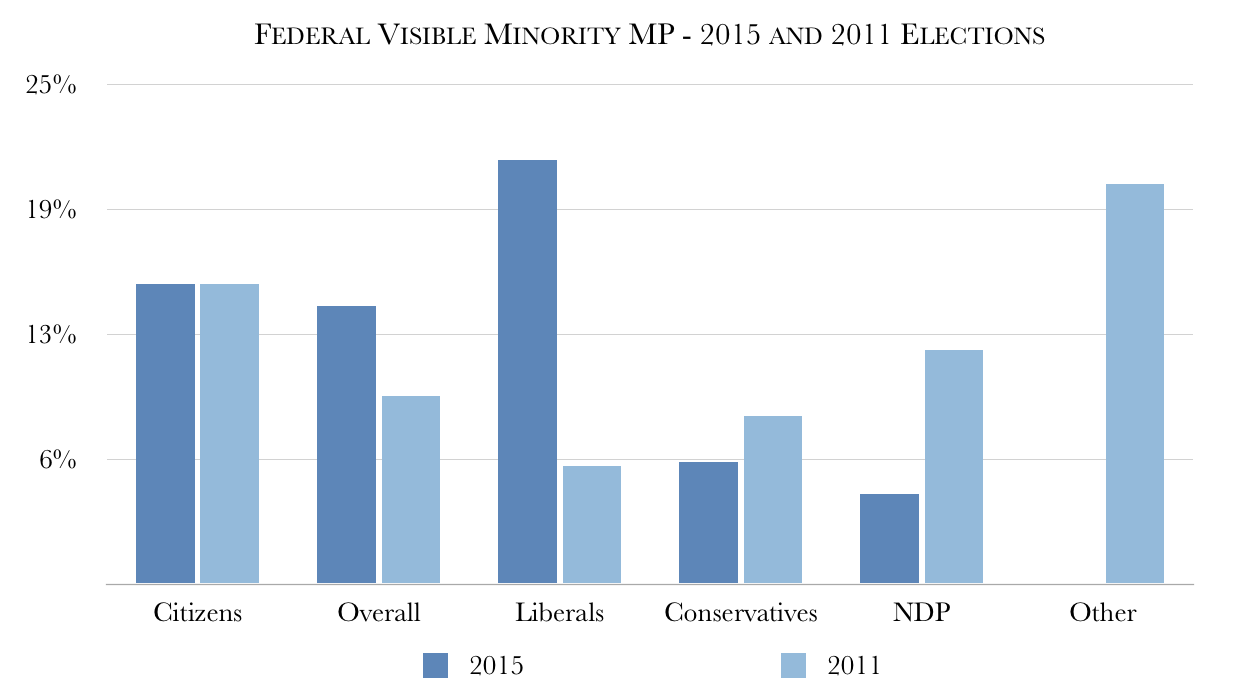
Lastly, Where are the (Ethnic) Women? analyses the number of visible minority women candidates, showing that between 16 and 21 percent (depending on the party) of all women candidates are visible minorities, slightly greater than the number women visible minorities who are Canadian citizens (and thus who can vote).

Donald Trump’s campaign manager: 400,000 ‘anchor babies’ born in U.S. every year | PolitiFact

The numbers in America of those born to undocumented immigrants and the much smaller amount due to ‘birth tourism’ (340,000 compared to 8,600, or 8 and 0.2 percent of total births respectively – Canadian figures from CIC analysis show 500 out of 360,000 total live births or 0.14 percent) :

Those figures may have been accurate several years ago, but they are outdated when compared to current estimates, said Jeffrey Passel, a senior demographer with the Pew Research Center. Passel is the author of a widely cited 2010 Pew Hispanic Center report that pins the number of children born to undocumented immigrants at 340,000 in 2008 (about 8 percent of all births that year).

“Figures as high as 400,000 per year are plausible for the mid 2000s, but our current estimates are around 300,000 per year,” he told us. “The numbers were higher in the mid 2000s than now — in part because there were more unauthorized immigrants then and overall birth rates, for natives and immigrants alike, were higher before the recession.”

So Lewandowski’s number is slightly exaggerated.

His characterization of these births as “anchor babies” is also problematic, however, as the metaphor implies intent that the numbers don’t back up. Based on past reporting, it’s not clear whether every birth to an undocumented mother was for the purpose of tethering the family to American soil.

“There are a million hardworking Hispanic people in San Diego who came here to work and then happened to have a baby,” midwife Lauren Weber said in the 2010 fact-check. “Then, there are people who come over in order to have a baby.”

Weber also described a practice known as “birth tourism,” in which middle- and upper-class visitors on tourist visas travel to the United States specifically to have a baby. The numbers for these types of births are much lower, at around 8,600, or 0.2 percent of all births, in 2013, according to the Centers for Disease Control and Prevention.

As for undocummented immigrants, experts don’t think they have the same motivations.

“I believe that most migrants come for economic reasons and opportunity,” said Theresa Brown, the director of immigration policy at the Bipartisan Policy Institute. “The idea that their child may be able to sponsor them for a green card in 21 years is probably too long term to be a primary driver of immigration.”

Source: Donald Trump’s campaign manager: 400,000 ‘anchor babies’ born in U.S. every year | PolitiFact

Confusing vote rules for expats ‘ridiculous;’ Elections Canada denies blame

More on expatriate voting and the rules that apply:

The finger-pointing highlights the confusing rules in play, which include:

  • Long-term expats, with some exceptions such as diplomats, cannot vote from abroad;
  • Long-term expats can vote in person at an advance poll or on election day in the riding they lived in before leaving Canada;
  • Long-term expats cannot vote under rules allowing resident Canadians, who will be away during the voting period, to vote at their local returning office;
  • Long-term expats can run in any riding in the country, if they meet other basic requirements;
  • Long-term expats who become candidates cannot vote for themselves, unless running in the riding in which they last lived before leaving Canada.

The current situation is patently absurd, O’Kurley said.

“All this ridiculous hair-splitting over time and place would be so unnecessary if the only litmus test for voting was citizenship,” O’Kurley said. “Policies that suppress Canadians’ ability to participate in their democracy are not worthy of Canadian democratic leadership in the world.”

O’Kurley noted that Elections Canada facilitates voting for long-term expats who work for the Canadian government, but not if they work for a private Canadian company.

Elections Canada conceded the legislation can be confusing but said it only enforces rules made by government _ and it’s up to government to fix any problems.

While I disagree with Kurley (perhaps a better test would be citizenship and filing a Canadian tax return would a future government wish to go down that road), making the rules clearer and more consistent should be doable.

Source: Confusing vote rules for expats ‘ridiculous;’ Elections Canada denies blame

The Conservatives’ veiled pitch for the anti-Muslim vote: Delacourt

Delacourt has it right, both in terms of substance and politics:

What we have here is a textbook case of saying one thing and doing another in politics. The ‘saying’ part is for all the wrong reasons — the ‘doing’ part is for the right ones.

I suspect the Conservative government realized several years ago that it was legally impossible to ban veiled voting. Two attempts were made between 2007 and 2011. Both quietly died on the order paper.

Here’s why: It would amount to singling out certain members of the population for restricted rights. We do allow people to vote in Canada without showing their face at the ballot box — through proxies, or mail-in special ballots. How do you write a law that says some people don’t need to show their faces, but others do?

Moreover, a special law to prohibit the niqab would stomp all over Canadians’ rights to religious expression. That’s probably why the Justice Department lawyer felt he had to point out the non-mandatory aspect of the legislation in Federal Court.

Rather than explain this to Canadians, though, the Conservatives took the path of blustering about niqabs and sending dog-whistle signals to people uncomfortable or fearful about Muslims. Bad statesmanship. Easy politics, though.

We saw that earlier this year, as well, when the Conservatives sent out a fundraising email asking supporters to sign up if they agreed that it was “offensive” to wear a niqab or a hijab at citizenship ceremonies. The email left little doubt that the Conservatives were whipping up these sentiments for reasons of purest electoral politics.

The note was signed by Immigration Minister Chris Alexander and stirred up some controversy with his interchangeable use of ‘niqab’ and ‘hijab’; one is generally associated with full-face coverings, while the other, the hijab, is commonly used to describe a head covering.

To make things even more confusing, not all Conservatives have been using the word “offensive” when it comes to garments of religious expression. Kenney, for instance, said on Twitter in 2013: “A child is no less Canadian because she or he wears a kippa, turban, cross, or hijab to school.” Kenney sent out that missive in the midst of the Quebec debate over the wearing of religious symbols in public.

There’s still a month left in this election and it’s entirely possible that one of the eleventh-hour Conservative campaign promises will revolve around banning veiled voting — again. It would fit well with this week’s bluster on citizenship ceremonies.

This time we might ask them: Why did the last two attempts quietly die? Are they serious this time, or is this just another attempt to whip up some good old-fashioned intolerance?

What’s really being veiled here by all this talk about the niqab?

Source: The Conservatives’ veiled pitch for the anti-Muslim vote

Birthright citizenship: Fewer babies being born to women in U.S. illegally – LA Times

Some useful birth statistics to provide context for the USA debate:

For all of this summer’s heated campaign-trail rhetoric about immigration and women in the country illegally giving birth in the U.S., new data show that the number of such babies born here is on the decline.

The number of babies born to immigrants in the U.S. illegally is on the decline, according to the nonpartisan Pew Research Center. Such births still made up 8% of total U.S. births in 2013, the center found.

The issue has been in the spotlight in recent months, with Republican presidential front-runner Donald Trump and other GOP candidates decrying such children as “anchor babies,” a term considered derogatory, and calling for an end to automatic citizenship for children born to immigrants in the country illegally. They say that the practice encourages illegal immigration.

According to the Pew report released late Thursday, about 295,000 such babies were born in 2013. That was a decline from a peak of 370,000 in 2007. The downward trend echos the overall drop in illegal immigration in recent years, which has been driven largely by a decrease in the number of immigrants crossing illegally from Mexico.

The population of immigrants illegally in the country dropped about 1 million during the Great Recession of 2007-2009 and has remained stable since.

“When the population went down, the births went down,” said D’Vera Cohn, a co-author of the Pew report.

The report found that about 8% of babies born in the U.S. in 2013 were to immigrants in the country illegally, a group that makes up only about 4% of the total U.S. population.

The loaded term ‘anchor baby’ conceals complex issues The high birthrate to immigrants can be explained by the differing demographics of the American-born and the foreign-born populations, according to Cohn. The immigrant group has a higher share of women of childbearing age, she said.

“In general, immigrants tend to be younger,” said Cohn. “They are the people who are willing to get up and leave and take the risk of going to another country, legally or not.”

This number is significantly larger than ‘birth tourism’ numbers (women who come to the USA to give birth and then leave, where hard data is scarce).

Source: Birthright citizenship: Fewer babies being born to women in U.S. illegally – LA Times

New Canadians cherish their right to vote, ICC study finds

ICC Reasons for VotingNot surprising and confirms earlier studies but nevertheless important measure of integration and participation, and further reinforces ‘shopping for the ethnic vote’:

The study released this month by the Institute for Canadian Citizenship (ICC) examined political participation of new citizens who received their citizenship between May 2012 and November 2014.

Through focus groups across Canada, it also explored this increasingly important block of voters’ reasons for voting and not voting, as well as their civic engagement beyond the ballot box.

“In 2014, Canada swore in more than 260,000 new citizens. As these people enter the body politic, by definition, they are also changing it. The ICC felt an election year was the perfect moment to examine the ongoing evolution of the Canadian voter,” said Charlie Foran, the institute’s CEO.

“We learned that new citizens believe in political participation, and are finding plenty of ways to become involved. We also learned that they definitely value the vote, and want to overcome any practical barriers that might keep them from casting their ballot.”

The key findings of the report, titled “Ballots & Belonging”:

  • 48 per cent of new citizens felt permanent residents should be allowed to vote in municipal elections;
  • 23 per cent reported having emailed or called an elected official about an issue;
  • 26 per cent had personally spoken with a candidate during their first election;
  • 10 per cent had put a candidate sign on the front lawn;
  • 5 per cent had donated money to a political party or candidate;
  • 12 per cent had attended an all-candidates debate/meeting;
  • 7 per cent had volunteered on a political campaign;
  • 6 per cent had become a member of a political party;
  • 46 per cent cited lack of knowledge of the issues and knowledge of the process as reasons not to vote;
  • 6 per cent said they didn’t vote because of the lack of interest and dissatisfaction with the government or political system.

“ ‘Ballots & Belonging’ speaks to how new citizens feel about the most fundamental marker of democracy — the vote,” said Foran.

Source: New Canadians cherish their right to vote, study finds | Toronto Star