Pretty scandalous on many accounts. Revocation on grounds of fraud or misrepresentation?
Peter Thiel, the billionaire co-founder of Paypal, was granted New Zealandcitizenship despite spending only 12 days in the country, new documents have revealed.
The government ombudsmen has forced New Zealand authorities to release further details of Thiel’s highly unusual citizenship process because it was deemed in the public interest.
On Thursday, Nathan Guy – who oversaw Thiel’s citizenship application as minister of internal affairs in 2011 – said Theil had been “a great ambassador for New Zealand, a great salesperson”. “He is a fine individual, good character, he has invested a lot in New Zealand, he’s got great reach into the US and I am very comfortable with the decision that I made.”
The billionaire entrepreneur who is a close adviser to Donald Trump, was granted New Zealand citizenship in June 2011, after taking four brief trips to the country. He made it clear he had no immediate plans to settle in the country.
The usual route to citizenship requires applicants to be in New Zealand as a permanent resident for at least 1,350 days in the five years preceding an application.
The New Zealand government granted Thiel citizenship due to his “exceptional circumstances”, and because it was understood he would promote New Zealand on the global stage, and provide introductions and contacts for New Zealand start-ups in Silicon Valley.
Official information documents stated Thiel’s “exceptional circumstances” related to “his skills as an entrepreneur and his philanthropy”, which were deemed to be of potential benefit to New Zealanders and the country. The formal citizenship process took place in a private ceremony in Santa Monica in 2011.
In his application for citizenship Thiel stated that although he had no plans to reside in New Zealand, and did not work for a New Zealand business overseas, he intended to “represent the country on the international stage”. He also donated NZ$1m to the Christchurch earthquake relief fund, and bought prime land and luxury homes in New Zealand.
Despite this intention Thiel never appeared to mention his New Zealand citizenship in any public capacity – it was revealed by New Zealand media this year.
Labour’s immigration spokesman Iain Lees-Galloway told Radio NZ that Thiel was not promoting New Zealand internationally as he’d stated in his application, as no one knew about his citizenship or ties to New Zealand for six years.
“If Peter Thiel was an amazing ambassador and salesperson for New Zealand we would have found out he was a citizen of New Zealand because he would have told the world that he was a citizen of New Zealand,” Lees-Galloway said. “He kept it under wraps. He hasn’t gone around telling the world that he’s a citizen of New Zealand and that he’s proud of New Zealand.”
The number of Americans applying for Canadian citizenship jumped slightly after Donald Trump’s election, but numbers are still only half what they were five years ago.
New statistics from Immigration, Refugees and Citizenship Canada obtained by the National Post show an average of 400 U.S. citizens put in their applications in each the first four months of this year, compared to an average of 264 per month in 2016 — including a spike in applications in November, the month Trump was elected.
But overall — despite reports of the immigration website crashing on election night, and earnest tourism campaigns sprouting in Cape Breton, N.S. — the trend line has gone down in the past couple of years.
In the decade since 2007, applications peaked in 2011, with an average of 564 Americans per month applying to become Canadians.
A batch of data to the end of 2016 was obtained through the access-to-information system and newer numbers were provided by Immigration spokesman Rémi Larivière. The numbers do not include Americans who may have moved to Canada recently to become permanent residents, or who already live here — just those who are applying for citizenship to seal the deal.
The website for Immigration, Refugees and Citizenship Canada crashed Nov. 8 while Americans were voting in their presidential election.
In the lead-up to the election, the idea of moving to Canada became a popular tongue-in-cheek reaction to the prospect of either electoral outcome — with Americans deeply divided between supporting Donald Trump or Hillary Clinton, and many apparently voting against one or the other rather than for them. It appeared some were taking it more seriously when the immigration website crashed.
All of the traffic was not necessarily election-related, however. The first day of a new system requiring visa-free travellers to apply for Electronic Travel Authorizations was Nov. 10, and had visitors heading to the site to fill out forms and pay $7 fees.
Andrew Griffith, retired director general of the Immigration Department, said the changes are long overdue and should have been passed last year if the opposition parties had not dragged the debate on.
“It’s good that the bill is through,” Griffith told the Star. “It delivered the Liberal government’s campaign commitment to facilitate citizenship, that a Canadian is a Canadian is a Canadian. It has shifted the overall balance somewhat to facilitate (access to) citizenship.”
However, Griffith was disappointed that Ottawa has chosen not to deal with the exorbitant citizenship application fees — $630 for adults [$530 administration processing and $100 right of citizenship fee] and $100 for minors [plus $100 right of citizenship] — that some said have prevented eligible applicants, especially refugees, from becoming full-fledged Canadians.
“The issue that remains for me is the fee,” said Griffith. “If the government really believed in diversity and inclusion, they should ensure it is not an insurmountable financial barrier for people to become citizens.”
Same logic would apply in Canadian cases of misrepresentation, whether it was material or not:
The justices unanimously rejected the government’s position that it could revoke the citizenship of Americans who made even trivial misstatements in their naturalization proceedings.
During arguments in April, several justices seemed indignant and incredulous at the government’s hard-line approach in the case, Maslenjak v. United States, No. 16-309.
They asked about a form that people seeking American citizenship must complete. It requires applicants to say, for instance, whether they had ever committed a criminal offense, however minor, even if there was no arrest. A government lawyer, in response to questioning, said that failing to disclose a speeding violation could be enough to revoke citizenship even years later.
Writing for the majority, Justice Elena Kagan said that the law required a tighter connection between the lie and the procurement of citizenship.
“We hold that the government must establish that an illegal act by the defendant played some role in her acquisition of citizenship,” she wrote. “When the illegal act is a false statement, that means demonstrating that the defendant lied about facts that would have mattered to an immigration official, because they would have justified denying naturalization or would predictably have led to other facts warranting that result.”
The case concerned Divna Maslenjak, an ethnic Serb who said she had faced persecution in Bosnia. She was granted refugee status, at least partly on that basis, and became a United States citizen in 2007.
In the process, she made a false statement about her husband, saying she and her family had also feared retribution because he had avoided conscription by the Bosnian Serb military. In fact, he had served in a Bosnian Serb military unit, one that had been implicated in war crimes.
When this came to light, Ms. Maslenjak was charged with obtaining her citizenship illegally. She sought to argue that her lie was immaterial, but the trial judge told the jury that any lie, however significant, was enough. Ms. Maslenjak was convicted, her citizenship was ordered revoked, and she and her husband were deported to Serbia.
The Supreme Court, having ruled that Ms. Maslenjak had been convicted under the wrong standard, returned the case to the lower courts to consider whether the government may try the case again under the stricter standard.
Given the significance of Ms. Maslenjak’s lie, she may lose again in a retrial.
Granting citizenship to children born in Italy of immigrant parents is the right thing to do and will make Italy safer, Italian Prime Minister Paolo Gentiloni said Saturday.
The so-called “ius soli” (“law of the soil” in Latin) bill has become a hot-button issue after last Sunday’s local elections which saw strong gains by the rightwing, anti-immigrant Northern League across Italy.
In remarks at a televised forum organized by La Repubblica newspaper in the northern city of Bologna, the center-left prime minister rebutted opponents of the bill.
The ius soli bill, which is supported by center-left parties and the business sector, would grant citizenship to children born in Italy of foreign parents, and to kids who have spent at least five years in the Italian school system.
Its opponents — the rightwing Northern League party and the euro-skeptic Five Star Movement — claimed it will give potential extremists a legal foothold in Italian society, that it is tantamount to an “ethnic substitution”, and that it is “an unvotable mess”.
“I know a part of parliament and of public opinion looks upon (the ius soli bill) with diffidence,” Gentiloni said. “We musn’t pretend they don’t exist.”
The prime minister explained that citizenship implies rights but also duties, and that is in the interests of the country to include children who are already Italian in everything but their passport, and who will grow into productive members of the society.
“We musn’t allow room for the notion that…we underestimate the significance of our culture and our identity,” Gentiloni said. Granting citizenship to children born in Italy is a sign of strength, not weakness, he added.
The prime minister also replied to those who “agitate the spectre of a threat to our security in a wholly unjustified way”. Counter-terrorism experience teaches that the only way to root out and prevent radicalism is social inclusion, not marginalization and discrimination, Gentiloni said.
“To those who stoke such fears, we must say extending citizenship to these children…is not just a matter of conscience and civil rights, but also one of security,” Gentiloni said.
“The time has come to consider these children as Italian citizens to all effects,” the prime minister said. “We owe it to them, it is the right thing to do, and I hope parliament (approves the bill) very soon, in the coming weeks.”
The ius soli bill was first proposed by an immigrant rights campaign called Italia Sono Anch’Io (I Also Am Italy), which gathered 200,000 signatures on a petition to parliament in 2011-2012.
Supporters of the bill argue that it grants rights to children who are already de facto Italians, boosts Italy’s aging population, and contributes to the national economy by giving them a reason to stay in the country, work, consume and pay taxes.
Daily Australian citizenship debate news following Labor’s refusal to back the proposed changes:
Labor has accused the immigration minister, Peter Dutton, of using changes to Australia’s citizenship laws as a campaign for the Liberal leadership and has confirmed it will oppose the package.
The Labor caucus on Tuesday morning signed off on a recommendation to block the government’s citizenship changes, which the shadow minister for citizenship and multiculturalism, Tony Burke, described as a “massive overreach”.
Burke told reporters the government’s legislation took some steps, “which, put simply, Australia should never take – and are inconsistent with who we are as a country”.
Labor’s decision to reject the package followed the ventilation of strong concerns internally from MPs from both the right and left factions about core elements of the changes, including the new English language test and residency requirements.
The government, which has attempted to elevate the proposed changes to a national security issue, leapt on Labor’s opposition.
The prime minister, Malcolm Turnbull, declared Labor “does not value Australian citizenship enough to say, as we do, that it must be more than simply the outcome of an administrative tick and flick form-filling process”.
Turnbull said the title, and the role of Australian citizen, “is the most important in our democracy”.
“Surely we care enough about our democracy, about citizenship, to say that it should be given, granted to people who make a commitment to our nation and share our values”.
“This demonstrates to all Australians that Labor is completely divided on the citizenship bill.”
He said would-be citizens needed to “abide by Australian laws, to abide by Australian values”.
Burke said Labor had taken the decision to reject the proposal unanimously because core elements of the package were deeply unacceptable.
He said the proposed language test required a university level grasp of English and “what sort of snobbery leads a government to say, unless you reach a university level of English, we’d rather you weren’t here?”
Burke said if there was “a national security problem” for people in the country already living as permanent residents, “then why on earth does the government have them already living here permanently?”
“It is a leadership campaign for Peter Dutton,” Burke said Tuesday. “It is a very silly game, and a very dangerous game, because he is not just playing with some random law here or there, he is talking about the thing that defines who we are as a nation.
“You don’t play games with that”.
The government will now have to rely on crossbench votes to pursue the citizenship package and Dutton told parliament the government did not intend to “back down”.
The proposal the government is seeking to legislate extends permanent residency requirements from one year to “at least four years” before someone can apply for citizenship and requires most applicants to provide evidence of “competent” English-language proficiency before they can become a citizen.
It would also give the immigration minister power to overrule decisions on citizenship applications by the Administrative Appeals Tribunal if the minister doesn’t think the decisions are in the national interest, and also give the minister power to decide whether or not the applicant has integrated into the Australian community.
Labor proposes to send the legislation to a Senate inquiry.
Burke said on Tuesday if that inquiry threw up “sensible changes”, which could be considered calmly, then the government could bring forward a new package and Labor would look at it.
Useful backgrounder on the changes in Bill C-6 and the coming into force provisions.
Short summary for the key changes: repeal of revocation in cases of terror or treason and the intent to reside provision immediately, changes to residency, pre-Permanent Resident time partial credit, and age requirements for language and knowledge assessment this fall. Changes to the revocation procedures in cases of fraud or misrepresentation expected early 2018.
Bill C-6, an Act to amend the Citizenship Act and make consequential amendments to another Act, received Royal Assent on June 16, 2017. This chart explains the changes that have been made to the Citizenship Act and indicates when these changes are expected to come into force.
Follow-up interview to CBS’s 60 Minute exposé of citizenship-by-investment schemes. Long article but interviews revealing:
It’s provided St. Kitts and Nevis with hundreds of millions of dollars for infrastructure projects, private development, and tourism but a lot of the money is unaccounted for. More than 10,000 people have purchased citizenship here, but it’s almost impossible to tell who they are because the information is not public. Chris Kalin doesn’t like the words citizenship for cash, or any suggestion that all you need is money to get a passport.
Chris Kalin: You have to go through a process. You have to apply. And you have to answer a million questions. And you have to undergo a background verification. And you have, at least in the properly run programs, you have to be a reputable person. And that’s checked.
But evidently, not that carefully. About the only way to identify people who have purchased St. Kitts citizenship is if they’ve happened to turn up on a list of international fugitives or gotten in trouble with the law, and St. Kitts and Nevis has had more than its share for two sleepy, little islands. Its passport holders have included a Canadian penny stock manipulator… a Russian wanted for bribery… a Kazak wanted for embezzlement… two Ukrainians suspected of bribing a U.N. official… and two Chinese women wanted for financial crimes.
Chris Kalin: I think it’s no secret that these islands have made decisions that are not always optimal.
Steve Kroft: They’ve taken some bozos, as you would call them?
Chris Kalin: Yes, exactly.
Steve Kroft: What about crooks?
Chris Kalin: Yes. It’s goes all the way down to crooks, yeah, absolutely. And it tended for some time to attract quite a few people that I would never let into the country. But I’m not the government of St. Kitts and Nevis.
Steve Kroft: But you set up their program.
Chris Kalin: We helped to set up the program. But, you know, as it is, advisers advise, ministers decide.
The island nation drew the ire of the U.S. Treasury Department three years ago after three suspected Iranian operatives were caught using their St. Kitts passports to launder money for banks in Tehran in violation of U.S. sanctions. It also had to recall more than 5,000 passports because they either didn’t include a place of birth or were issued to people who had changed their names. Since then a number of reforms have been made, but questions remain.
Peter Vincent: They’re not transparent programs. There are not safeguards in place.
Until 2014, Peter Vincent was the top legal adviser for U.S. Immigration and Customs Enforcement, part of the department of Homeland Security, which he says is well aware of all the vulnerabilities. In fact, before General John F. Kelly became secretary of the Department of Homeland Security, he expressed concern in a 2015 report that “cash for passport programs could be exploited by criminals, terrorists or other nefarious actors.”
Steve Kroft: Does that present a security threat, do you think?
Peter Vincent: It does. In my opinion, the global community has established a very effective global security architecture to prevent terrorist attacks. I see these cash for citizenship programs as a gaping hole in that security architecture.
Government of Antigua and Barbuda’s Citizenship by Investment Unit
CBS NEWS
But it’s not stopped the programs from multiplying across the Caribbean…Dominica, Grenada, St. Lucia, and Antigua are all competing with St. Kitts now for customers and badly needed cash.
Gaston Browne: So what are we supposed to do? Sit back and do nothing? You tell me.
Gaston Browne, the prime minister of Antigua and Barbuda, says the revenue from its four-year-old program has kept the government from defaulting on its international loans and has turned the economy around. Antigua also claims to have among the strictest programs in the Caribbean. You actually have to show up here to get citizenship, albeit very briefly.
Gaston Browne: Our law provides them to spend at least five days here.
Steve Kroft: That sounds like a vacation.
Gaston Browne: Yes. I understand. But however, we have made sure that at least there must be some face-to-face contact so we know who these people are.
Steve Kroft: For five days.
Gaston Browne: Minimum.
Steve Kroft: What kinda people are you looking for?
Gaston Browne: We’re lookin’ for high net worth individuals. People who are established business people. Who are well-known. And to make sure that we get the crème de la crème.
If so, they are recruiting them in some odd places. Last summer, Antigua announced it was opening an embassy in Baghdad hoping to sell passports to Iraqis. It didn’t work out. But it’s doing better next door in Syria after hiring a relative of President Bashar Al-Assad to represent them.
Steve Kroft: Have you had any applications from Syria?
Gaston Browne: Yes. We have had applications from Syria.
Steve Kroft: And you’ve approved them.
Gaston Browne: Syria is one of the areas in which we have had some concerns but did not place it on a restricted list.
Prime Minister Browne told us instability breeds opportunity. Besides Syria, Antigua has sold citizenship to Iranians, Libyans, Pakistanis, and the people who brought condos in this half-built complex in the desert outside Dubai, 7,300 miles away from Antigua. Its website advertised, “Buy a villa in the UAE and get citizenship of Antigua.”
Steve Kroft: I mean, you said that you were looking for the crème de la crème.
Gaston Browne: Crème de la crème.
Steve Kroft: I mean, there’s a developer in Dubai.
Gaston Browne: Yes.
Steve Kroft: Sweet Homes.
Gaston Browne: Yes.
Steve Kroft: Who is advertising that he’s giving away passports to anyone who buys a condominium there.
Gaston Browne: You don’t believe that, right?
Steve Kroft: Like you open a bank account, you get a free toaster.
Gaston Browne: That is not so.
Browne dismissed the sweet homes ads as advertising hype, saying the citizenship is not free or guaranteed. Somebody has to come up with $250,000 for Antigua and condo buyers must pass a background check.
Gaston Browne: You have to go through all of the due diligence.
Steve Kroft: What kinda due diligence do you do?
Gaston Browne: Well, and that is where the crux of the matter lies.
A diplomatic passport from Dominica
CBS NEWS
The prime minister claimed that the names of all applicants for Antiguan citizenship are screened by American intelligence and law enforcement agencies, and generally speaking due diligence in the Caribbean has improved substantially since the scandals in St. Kitts. The small island offices with a few people are now backed up by international firms that take the screening to a higher level. But ultimately it’s up to each country to decide who gets a passport, and the Caribbean has a rich history of turning a blind eye to official corruption. It’s affected the way the way passports are handed out, especially diplomatic passports, that entitle the bearer to all sorts of special privileges, which Peter Vincent says represents a much more serious security threat.
Peter Vincent: The border officials at the receiving country, even without a visa, almost always admit an individual carrying a diplomatic passport. In addition, border forces are not entitled to search the luggage of diplomats like they are for regular tourists. They simply wave them through.
The sale of diplomatic passports is not part of the citizenship by investment program, but it’s gone on under the table, according to U.S. authorities, in places like Dominica, which has had a lot of dodgy diplomats.
Lennox Linton: We had a diplomatic passport in the hands of Francesco Corallo, who, at the time, was on INTERPOL’s list of most-wanted criminals.
Lennox Linton, who heads the opposition in Parliament, says no one in Dominica had ever heard of Corallo until he was stopped by authorities in Italy.
Lennox Linton: He said, “You can’t detain me. I’m a diplomat.” They said, “Diplomat? Diplomat of where?” He said, “Dominica.”
Then there’s Dominican diplomat Alison Madueke, a former Nigerian oil minister charged with bribery and money laundering. And Rudolph King, a Bahamian fugitive from U.S. justice, who presented himself as Dominica’s special envoy to Bahrain.
Lennox Linton: What we were doing with an ambassador in Bahrain, I don’t quite know. But they seem to think that there was some benefit in there for us.
Steve Kroft: I assume that you’ve asked the prime minister…
Lennox Linton: Yes.
Steve Kroft: How he ended up appointing these people, diplomats.
Lennox Linton: Yes.
Steve Kroft: And what was the answer?
Lennox Linton: The prime minister doesn’t answer those questions.
With vast sums of money flowing into these island nations, and more and more countries selling their citizenship, there is consensus that still more oversight and transparency is needed. But privacy and secrecy have always been a major selling point for people buying multiple passports, including Chris Kalin, the man who invented the business plan.
Steve Kroft: How many do you have?
Chris Kalin: I have multiple.
Steve Kroft: So you don’t wanna tell us how many you have?
Chris Kalin: There’s a few things in my life that, that I don’t talk openly about. And I keep for myself. But I am Swiss originally and many people think I’m very Swiss and so I’ll leave it at that.
Our report in January sparked a flurry of reaction in the Caribbean. In Dominica, there were riots demanding the resignation of Prime Minister Roosevelt Skerrit for his handling of diplomatic passports. He denies any improprieties. The St. Kitts government deactivated more than 15,000 passports, including 91 diplomatic passports. And Antigua’s program — singled out by the U.S. State Department as “among the most lax in the world” — has also recalled many of its diplomatic passports.
I had always thought that Australia granted birthright citizenship but apparently it does not, with these further restrictions moving it more distinct than the Canadian approach. Also surprised that citizenship had been granted to children of diplomats – not the case in Canada:
A crackdown on citizenship rights for children of migrants and foreign diplomats is among a number of dumped Tony Abbott-era proposals to have resurfaced in the Turnbull government’s citizenship revamp.
The government says the restrictions are necessary to stop parents using their children’s citizenship “as an anchor for family migration” or to win sympathy in their own migration disputes.
Under the proposed changes, children will no longer become citizens on their 10th birthday if, at any point, they were present in Australia unlawfully or re-entered Australia without a valid visa.
The same will also apply if a child’s parent lacked a “substantive” visa at the time of the child’s birth and was present in Australia unlawfully prior to the birth. That means a child born to parents on bridging visas would not automatically acquire citizenship.
And children born to foreign diplomats will no longer gain Australian citizenship on their 10th birthday.
However, the immigration department confirmed to Fairfax Media that in each case, if one of the child’s parents was an Australian citizen or permanent resident, the child would acquire citizenship in the normal way.
While preparing a presentation on how immigration, settlement, citizenship and multiculturalism worked together to facilitate integration, I accessed a broad range of the IRCC operational datasets on the government’s Open Data website. Intrigued by what was available and what was not, I reviewed all 227 unique datasets.
IRCC has, to its credit, invested considerable resources in these datasets for both internal and external use, having the fifth largest number of datasets on Open Data (excluding Statistics Canada). Moreover, these datasets are among the most widely used: 11 of the top 25 government datasets downloaded are from IRCC (April 2017).
IRCC demonstrated considerable flexibility and agility in the creation of datasets with respect to the recent wave of Syrian refugees, and the introduction of monthly operational statistics for key programs.
Part of my motivation was to assess the long-standing weaknesses in citizenship datasets, reflecting the relative lower priority of the citizenship program, and make recommendations for improvements.
Not surprisingly, the datasets reflect IRCC’s overall management emphasis on immigration as well as stakeholder demand: permanent and temporary resident datasets are 93.5 percent of the total. The datasets include:
Permanent residents (immigrants: economic, family and refugee classes): 110 datasets of 47.6 percent of the total.
Temporary residents (Temporary Foreign Worker Program: includes agricultural workers, live-in caregivers and others; International Mobility Program: includes those admitted under international services agreements like NAFTA, those under “Canadian Interests,” primarily under youth work exchange program and spousal employment; international students): 106 datasets or 45.9 percent.
Citizenship and passport: Six datasets or 2.6 percent.
Settlement services: Nine datasets or 3.9 percent.
IRCC datasets can be divided into four categories: ongoing and published on a regular basis (80.5 percent), archived or historical datasets (16.5 percent) and specialized datasets pertaining to international students (2.2 percent).
The majority are updated annually (54.1 percent), followed by the recent introduction of monthly reports (21.6 percent), quarterly (9.1 percent) and other (15.2 percent). Monthly and quarterly reports focus on operational data: the number of applications, approvals, approval rate and inventory.
Permanent and Temporary Residents
The comprehensive datasets for permanent and temporary residents include information regarding program and category, country of origin (whether processing source area, country of citizenship or country of birth), gender and age. Table 1 summarizes this information with most datasets having several variables (e.g., gender and age).Given the shared federal-provincial jurisdiction for immigration, and the increased and active role of the provinces in selection (i.e., the Provincial Nominee Program), it is no surprise that the majority of permanent resident datasets are broken down by province (52.7 percent), with 31.8 percent at the national level. To assist the planning and programmes of municipalities and service provider organizations for settlement services (integration), ten percent are at the Census Metropolitan Area (CMA) level, with a further 4.5 percent at the Census District (CD) level.
In terms of immigration class, over one-quarter are for refugees (27.3 percent), 21.8 percent for economic class, and 1.8 percent for family class, with 49.1 pertaining to all classes.
For temporary residents, who cannot access settlement services, the majority (60.4 percent) are at the national level, 34 percent at the provincial level, and 4.7 percent at the CMA level.
By program, datasets for international students form 23.6 percent, IMP and TFWP each at 21.8 percent and other ten percent, with 22.7 percent pertaining to all programs.
By and large, these datasets are coherent and consistent, with any variation reflecting program needs and a balance between the overall picture and greater detail (e.g., top 10 for refugees, top 20 for IMP or top 50 for students or all (various) countries of birth or citizenship).
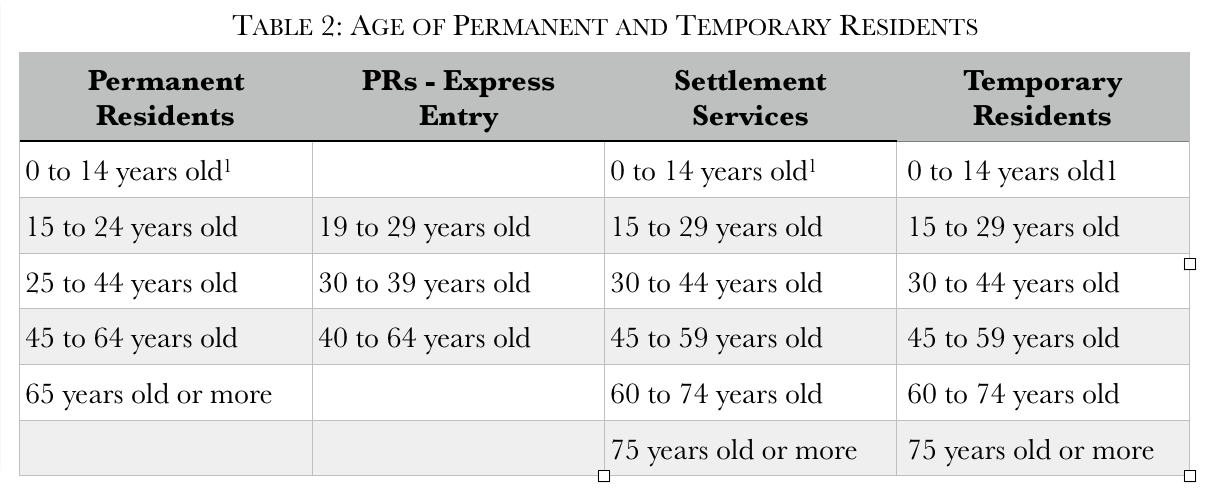
However, as shown in Table 2, the main difference concerns age data, with permanent residents focused more on younger immigrants, compared to temporary residents with a relatively greater focus on older workers. The difference in age cohorts between all permanent residents and those admitted under Express Entry likely has a policy justification. However, it is hard to understand the policy rationale for settlement services using the temporary resident breakdown given that only permanent residents can access these services. IRCC may wish to review whether there is a need for greater consistency and coherence regarding the age cohorts.
Citizenship, Passport and Settlement Services
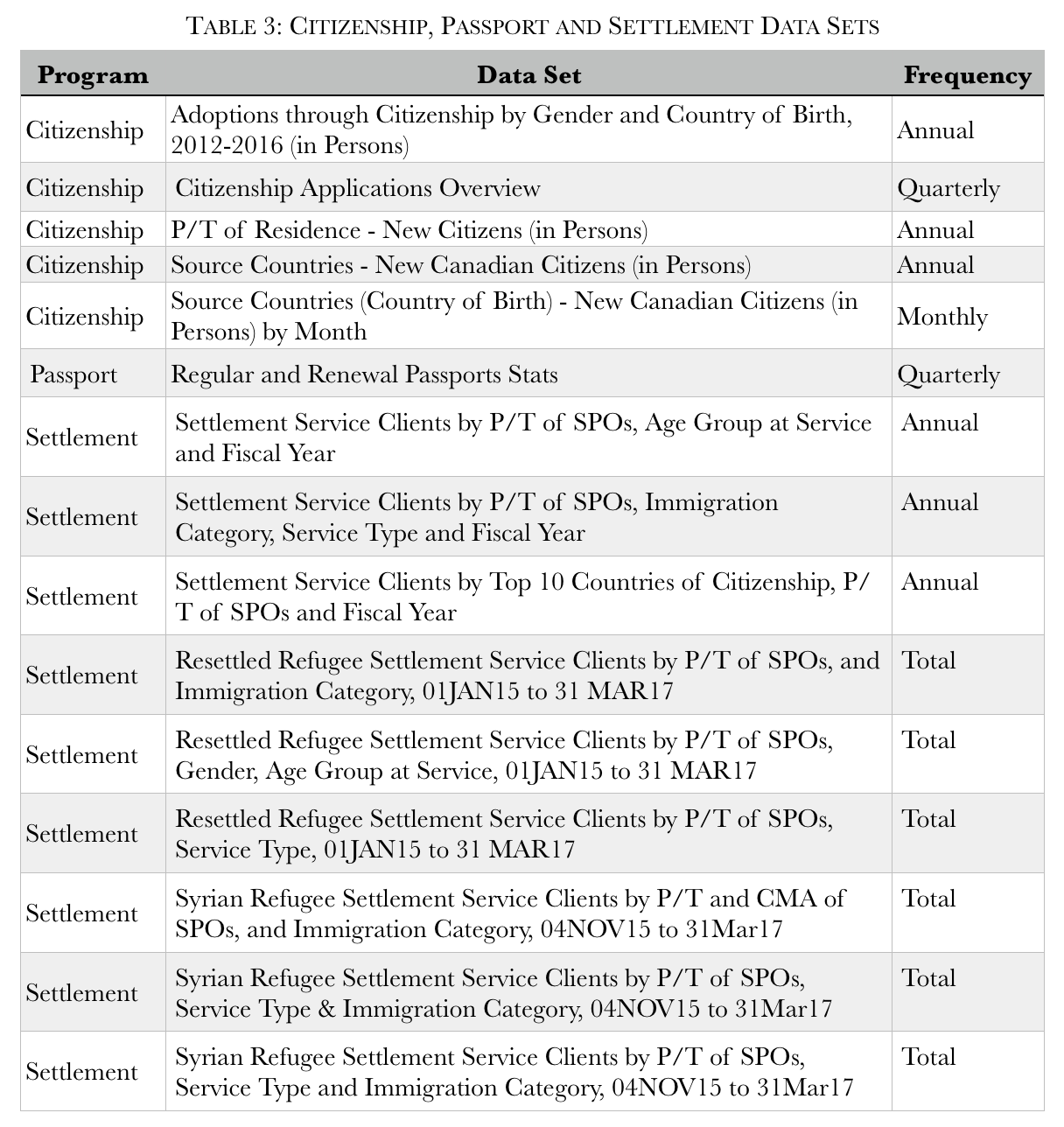
There are only six datasets for citizenship (including one for passport) and nine for settlement services (three general, six for refugees). This reflects a number of reasons:
Citizenship has always been a secondary priority for IRCC at both the political and official levels. The program is under-funded and under-managed, as seen in the large and repeated fluctuations in the number of applications and new citizens, in sharp contrast to the number of new permanent residents which is more tightly managed to deliver on the annual levels plan (Chart 1);
The provinces have no role in citizenship and thus no data demands. Immigration stakeholders have limited interest in citizenship as they focus on immigration and refugee issues;
Passport is a new program to IRCC (previously was with Global Affairs Canada), with similarly low interest with outside stakeholders beyond basic operational data; and,
Service provider organizations (SPOs) and others that are interested is settlement services data have a wide range of useful permanent resident data that assists them in planning and operations. IRCC has responded to the needs of SPOs by providing general refugee settlement datasets as well as specific ones for Syrian refugees.
Table 3 lists these datasets:
Moreover, these are more limited than other datasets. Annual permanent and temporary resident provide ten year data, adequate to assess trends and changes. In contrast, annual citizenship data covers only five years, settlement services data only two years and passport processing data is not even presented on a full-year basis, making it impossible to assess trends and the impact of policy and program changes. Citizenship datasets are even more limited with no gender and age breakdowns.
They are also updated less frequently than other datasets. Monthly datasets for permanent and temporary residents and settlement services include April 2017 at the time of writing (14 June); citizenship only until February 2017, and passport until December 2016.
Concluding observations
As noted, IRCC has invested considerable resources in developing and maintaining these datasets. In doing so, it has naturally enough reinforced its main focus on immigration statistics, responding to overall stakeholder interests, with minimal attention to citizenship.
The datasets appear to have grown organically as program changes created needs for new datasets. There appears to be potential to review the number and type to see if some datasets are no longer needed or duplicative (e.g., the introduction of monthly datasets may make quarterly ones necessary, are csv versions needed in addition to xls?).
Another area for improvement with respect to provincial datasets is to ensure that these all include national totals by program, as there is currently some inconsistency (e.g., Transition from Temporary Resident to Permanent Resident Status – Quarterly IRCC Updates tables versus the “Facts and Figures” series for both permanent and temporary residents).
Other areas for improvement at the Open Data level include, particularly those that are likely within IRCC control:
Order the dataset groupings alphabetically as it currently appears random, with related sets not grouped together;
Review grouping titles for clarity, particularly “Quarterly Updates” as the vast majority of datasets listed are a mix of annual and quarterly data;
Review all data set titles for consistency (e.g., temporary resident facts and figures are numbered, permanent residents are not; set a standard sequence: program/category then geography, then specific variables such as gender, age, education etc.; inclusion or not of ‘Canada’ in title; indicate specific immigration class if appropriate);
Advocate with other departments for a wider field for data set descriptions (appears to be only 37 characters) to make these more readable and shorten the wasted space of the titles for other fields (type, format, language, links);
Advocate for more than 10 dataset groupings per web page to minimize clicks.
My particular focus, however, is with respect to citizenship.
The lack of attention to citizenship, seen operationally in the wide swings of application and new citizens, requires greater management focus and attention. While IRCC has been very helpful in the provision of special runs, more comprehensive citizenship datasets on Open Data are needed. IRCC should ensure a minimum degree of consistency with permanent and temporary resident datasets that would help flag operational and policy concerns. For citizenship, passport, and settlement services, these would include:
10-year time series data for citizenship and settlement services;
1947-2016 long-term citizenship data (new citizens);
gender breakdown for citizenship (not just for adoptions), passport and settlement services (not just for refugees);
age breakdown for citizenship and passport, using the permanent resident age groups; and,
monthly citizenship applications by country of birth, not just monthly number of new citizens.
Should resources permit, a number of additional citizenship datasets should be considered to provide a more comprehensive understanding of how well the program is working with respect to integration and reinforcing the immigrant-to-citizen transition:
Annual data on the number and percentage of immigrants who have taken up citizenship within six years of landing in order to assess the recent naturalization rate, not the overall one that IRCC cites in its performance reports and elsewhere. While a target of 70 percent naturalization within six years of landing is proposed, more analysis might suggest a different target. Having this data collected and reported would inform the establishment of a meaningful performance standard; and,
Annual breakdown by immigration class of new citizens and approval rates by gender to assess the impact on each class of citizenship policies.
Given the importance of immigration, settlement, citizenship and multiculturalism to integration of newcomers and their children, good and comprehensive data is central to evidence-based policy making. IRCC has again commendably invested in such data with respect to immigration data but should address the above mentioned gaps in citizenship data to strengthen the management and oversight of the citizenship program.