The responsibilities of citizenship: Pew Research Poll

Another good and detailed poll from Pew Research, showing less of a partisan divide on some basics (i.e., voting, paying taxes, obeying the law) with greater variation on others (e.g., jury duty, following politics, pledge of allegiance):

When it comes to what it takes to be a good citizen, the public has a long list of traits and behaviors that it says are important. And there’s a fair amount of agreement across groups about what it takes to be a good citizen.

Still, there are differences when it comes to which aspects are considered veryimportant (as opposed to somewhat important), and points of emphasis differ by party identification as well as by age.

Overall, 91% say it is either very (74%) or somewhat (17%) important to vote in elections in order to be a good citizen; just 8% say this is not too or not at all important.

Large shares also say it is important to pay all the taxes you owe (92%) and to always follow the law (96%), including about seven-in-ten who say each is very important (71% and 69%, respectively).

For several other traits and behaviors, about nine-in-ten say they are at least somewhat important to good citizenship. However, the share saying each is very important varies significantly. For example, 89% say it’s important to serve jury duty if called, including 61% who say this is very important. While a comparable 90% say it’s important to follow what’s happening in government and politics as part of good citizenship, a smaller share (49%) says this very important.

Protesting government actions you think are wrong and knowing the Pledge of Allegiance are considered important parts of what it means to be a good citizen, though they rank somewhat lower on the public’s list. Displaying the American flag ranks last among the 11 items tested in the survey. Still, a majority says this is either a very (36%) or somewhat (26%) important part of what it means to be a good citizen.

Republicans and Democrats largely agree on the importance of most responsibilities of citizenship.

About three-quarters of Republicans and Republican leaners (76%) and Democrats and Democratic leaners (75%) say it’s very important to vote in elections.

Similarly, comparable majorities of Republicans and Democrats say it’s very important to pay all the taxes you owe, serve jury duty if called, respect the opinions of those you disagree with and participate in the census. There also are no partisan divides over the importance of volunteering to help others and following what’s going on in government and politics.

However, Republicans (79%) are more likely than Democrats (61%) to say it’s very important to always follow the law to be a good citizen.

Knowing the Pledge of Allegiance ranks higher on Republicans’ list (71% say it’s very important) than Democrats’ (just 34% say it’s very important). In addition to placing greater importance on the Pledge of Allegiance, Republicans are twice as likely as Democrats to say it is very important to display the American flag (50% vs. 25%).

By contrast, Democrats are more likely than Republicans to think it is very important to protest if government actions are believed to be wrong: About half of Democrats (52%) this is very important to what it means to be a good citizen, compared with just about a third (35%) of Republicans.

Partisans and ‘leaners’ differ over importance of aspects of citizenship

On many items, the views of independents that lean toward one of the two major parties diverge from those of self-identifying Republicans and Democrats. In general, partisan leaners tend to be less likely than straight Republicans and Democrats to view a range of responsibilities as important to what it means to be a good citizen.

Overall, 83% of Republicans say voting in elections is a very important aspect of being a good citizen, compared with a smaller majority of Republican leaners (67%). There is an even wider 28-point gap between the share of Democrats (86%) and Democratic leaners (58%) who say this is very important.

Similarly, roughly two-thirds of both Republicans (64%) and Democrats (68%) say participating in the U.S. census every 10 years is very important to being a good citizen; slightly fewer Republican leaners (55%) and Democratic leaners (53%) say the same.

This pattern is seen across other items as well: Those who identify with a party are more likely than independents who lean to a party to say it is very important to serve jury duty if called, pay all owed taxes and to follow what is happening in government.

While large shares of Republicans (96%) and Republican leaners (87%) say it is important to know the Pledge of Allegiance, Republican identifiers are somewhat more likely than leaners to say this is very important to good citizenship.

By comparison, smaller majorities of Democrats (67%) and Democratic leaners (60%) say it’s important to know the pledge. Self-identifying Democrats (42%) are significantly more likely to say knowing the pledge is a very important part of good citizenship than Democratic leaners (24%).

There is a 22-point gap between the share of Republicans (90%) and Republican leaners (68%) who say displaying the American flag is at least somewhat important to being a good citizen. And 63% of Republicans call this very important, compared with 35% of Republican leaners. About half of Democrats (52%) think this is a very or somewhat important aspect of good citizenship; 43% of Democratic leaners say the same.

In contrast to the patterns seen on many items, Republican leaners (81%) are more likely than Republicans (66%) to say protesting government actions you think are wrong is an important part of being a good citizen. The views of Republican leaners place them closer to those of Democrats and Democratic leaners in terms of the overall importance they place on this aspect of citizenship.

Age differences in views of the responsibilities of citizenship

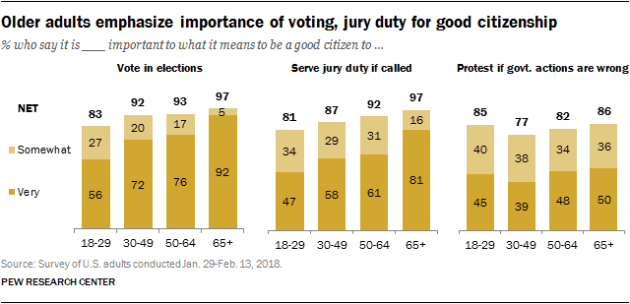
Young adults place less importance on many aspects of citizenship than older adults, especially when it comes to the share that describes a trait or behavior as very important for being a good citizen.

Majorities of adults across all ages say it is very important to vote in elections in order to be a good citizen. Still, a smaller majority of those under 30 say this (56%), compared with larger shares of those ages 30 to 49 (72%), 50 to 64 (76%) and 65 and older (92%).

And while fully 81% of those 65 and older say that to be a good citizen it is very important to serve jury duty if called, just about half (47%) of those under 30 say the same.

On other items, the pattern is similar. Young adults are less likely to call paying the taxes you owe, following the law, participating in the census, and following government and politics very important. Still, large majorities of young adults say each of these is at least somewhat important to being a good citizen.

There is no meaningful age gap in views of the importance of protesting government actions you think are wrong. Overall, 85% of those ages 18 to 29 say this is either very (45%) or somewhat (40%) important to being a good citizen. Views among those ages 65 and older are similar (50% very important, 36% somewhat important).

Displaying the American flag and knowing the Pledge of Allegiance do not rank particularly highly for young adults on their list of important characteristics for good citizenship. Among those ages 18 to 29, 63% say it is important to know the Pledge of Allegiance (38% very important) and 53% say it is important to display the American flag (19% very important). These items do not top the list of older adults either, though those 65 and older are more likely than the youngest adults to say both are important parts of being a good citizen.

Source: 9. The responsibilities of citizenship

Short videos for the Borders in Globalization Canada-EU project

As part of the EU-Canada Borders in Globalization project, I did these 3 short videos responding to the following questions:

What can Canada learn from the way how Europe deals with the irregular migration

Immigration, Multiculturalism: What works and doesn’t work in Canada

Challenges for the traditional concept of borders

Why expatriates should be able to vote

Frédéric Mégret, an associate professor of law at McGill University, trots out the usual assertions in making the case for unlimited voting rights for Canadian expatriates, no matter how tenuous or distant the connection. Completely bereft of any data or serious evidence to support his arguments.

Moreover, he appears to favour a citizenship with no connection to residency, no matter how short. Or even no residency in the case of the first generation born abroad (for my previous arguments, see What should expatriates’ voting rights be? – Policy Options):

Last week, the Supreme Court heard arguments on the barring of expatriates who have resided away from Canada more than five years from voting in Canadian elections. The Ontario Court of Appeal had earlier found the restrictions democratically justifiable because they preserved the “social contract” between voters and lawmakers. Whether it is the case that the social contract depends on denying voting rights to non-resident citizens is highly dubious. More importantly, often overlooked in the debate is the broader issue of how Canada – and other countries – should relate to their diasporas in an age when significant numbers chose to live abroad while retaining deep emotional and political bonds to their country of citizenship.

The argument against long-term expatriate voting often portrays non-residents as essentially free riders, voting on laws that will not affect them. The reality is considerably more complex. First, long-term expatriates may decide to come back and so arguably continue to have a vested interest in their country of citizenship. To the extent that they do not have voting rights in their country of residency, they are deprived of their only opportunity to exercise political rights. Second, long-term expatriates are, in fact, affected by the laws and policies of Canada, especially to the extent they have international ramifications. They are often the only point of contact that foreigners will have with Canadians. All expatriates share the experience of having been called upon to account, informally at least, for the policies of their home country. They may be targeted as Canadians. Third, many expatriates, even though they do not reside in Canada, do a considerable amount for Canada, directly or indirectly. It goes without saying that Canada is very well represented by its expatriates, many of whom do great honour to our country.

The prioritizing of residency over citizenship, in this context, is problematic in several respects. Although the nation state may be a primarily territorial concept, citizenship is not. Citizenship is measured not by how long one spends on the territory of one’s state, but how committed one is to its ideals, how ready to give back and to invest in its political life. The idea that long-term expatriates are distant and disconnected citizens is belied by their voting record and the intensity by which some of them have, precisely, been willing to protest, including before the courts, against the denial of their rights, invoking their “deep and abiding” connection to Canada. Moreover, citizenship is what you make of it: Treating the diaspora as if it had no connection to Canada is surely to contribute to severing that link. One is also a citizen because one is provided with meaningful opportunities to exercise one’s rights as such. Finally, one should be wary of attempts at fragmenting citizenship, part of a worrying trend that includes fighting less hard for dual citizens abroad or threatening to withdraw citizenship from those convicted of certain offences. Attacks on the indivisibility of citizenship suggest that some Canadian citizens are less citizens than others, and are therefore attacks on the citizenship of all.

The debate deserves to be put in its global context, where it clearly transcends the particulars of any theoretical social contract. How to deal with expatriate populations has become a defining issue of our globalized age, whether it comes to voting rights or how aggressively countries protect their nationals abroad when they are, for example, threatened or prosecuted. Canada has not always made the right choices. Today, however, many countries positively court their diasporas, and for good reason, not only as a source of remittance, but as a source of soft power, and as part of a deep commitment to the free flow of people and ideas. Many countries not only allow, but positively encourage, their diasporas to vote back at home. Although the Harper government once objected to this, Canada is actually part of a variety of French, Italian or Tunisian electoral constituencies.

It may not come as a surprise that Canada, a country that traditionally conceived itself as a place of immigration rather than emigration, has given relatively less thought to this question than other countries. The absence of specific constitutional arrangements for the representation of its diaspora, for example, sets it apart from others that have thought more creatively about this issue. In an age where people are increasingly on the move, making residency a condition of citizenship may not only be unfair to those affected; it may fail to do justice to Canada’s diversity.

via Why expatriates should be able to vote – The Globe and Mail

Richmond woman’s petition calls for end of birth tourism in Canada

While the overall national numbers are, this has been an ongoing issue in Richmond. The call for better national data makes sense as does regulation (provincial medicare data could likely capture this – see ICYMI: Petition to Parliament calls for end to automatic citizenship to end ‘birth tourism’):

A petition by a group of Metro Vancouver residents is demanding Ottawa crack down on birth tourism in Canada.

Richmond resident Kerry Starchuk started the electronic petition. She has been campaigning on this issue for the last two years since discovering a neighbouring house was a so-called “birth house,” which caters to pregnant women who come to Canada to give birth so their child is automatically granted Canadian citizenship.

“It’s wrong. It’s jumping the queue,” said Starchuk of the practice, an increasing trend in Richmond where the majority of birth tourists hail from China.

In 2016-2017, 384 babies were born to non-residents at Richmond Hospital, said Vancouver Coastal Health — a significant jump from 18 cases in 2010. Between 2014 and 2017, 1,020 newborns were born to non-residents.

The rise in birth tourism has spawned an underground economy with unregulated agencies and brokers offering services to pregnant clients, including airport pickups, room and board, and assistance with obtaining documents such as a Canadian passport for the infant.

For Starchuk, birth tourism undermines the value of Canadian citizenship by essentially buying a lifetime’s privilege for the price of a hospital procedure, housing costs, and a return plane ticket.

“It’s not truthful, it’s deceitful and it’s short-sighted,” she said. “We don’t know what the consequences are going to be in 18 years. Are we prepared for it?”

The petition, identified as E-1527 in the House of Commons, is sponsored by Liberal Richmond MP Joe Peschisolido. It calls on the federal government to denounce birth tourism; determine the extent of the practice in Canada; and implement measures to reduce and eliminate it. It has received more than 620 signatures as of Tuesday.

Gary Liu, whose family immigrated to Taiwan when he was a teen, said most immigrants are also against birth tourism.

“Almost all of them despise this kind of practice,” said Liu, a Burnaby resident. “This is a very unfair practice to all immigrants.”

The petition is Starchuk’s second attempt to get the federal government to take action.

Her first petition in 2016, sponsored by Conservative MP Alice Wong, urged the government to end jus soli, or automatic birthright citizenship.

It received more than 8,800 signatures and was presented to the House of Commons, but went nowhere because the government felt revoking birthright citizenship would require a major overhaul of how Canadian citizenship is granted.

Liu said the rejection of that petition in 2016 was seen by some as an endorsement by the federal government of birth tourism. He hopes this second petition will gain more traction.

Starchuk said birth tourism happens across Canada, but are most prevalent in Richmond and Toronto, where the women are usually from Russia or Nigeria.

In 2016, the B.C. government said it was aware of 26 birth houses in the province.

Starchuk said more data is needed to get a grip on the extent of the practice in Canada.

“We’re hoping to have Canada-wide statistics,” she said. “We don’t know if it could be happening in West Vancouver or Langley.”

Vancouver Coastal Health spokeswoman Carrie Stefanson said figures for babies born to non-residents in other hospitals in the region are not immediately available, but said those numbers would be small.

The health authority “does not endorse or support marketing of maternity tourism and we are concerned about the impact it is having on our ability to provide quality services to every resident maternity patients,” Stefanson said.

Women who intend to use Richmond hospital to give birth are asked to pre-register six to eight weeks before their due date in order to enable to hospital to plan ahead.

Stefanson said Vancouver Coastal Health is committed to collecting payment from non-residents who use medical services, but wouldn’t deny urgent care based on a person’s ability to pay.

Peschisolido, who is in Ottawa, denounced birth tourism in a statement issued to media on Tuesday.

“Birth tourism is wrong,” he said. “Women are being exploited by organized efforts to take advantage of the system.”

Source: Richmond woman’s petition calls for end of birth tourism in Canada

Metropolis Conference 2018 Reflections #Metropolisyyc

Overall, Metropolis remains a great venue to connect and reconnect with people active in immigration and integration. I thought I would share my overall impressions and reflections (these have also been shared with the organizers).

The plenaries were a mixed bag. One of them was excellent: a session with Calgary Mayor Nenshi, Brooks Mayor Morishita and Calgary Catholic Immigration Society’s Fariborz Birjandian on the role of the province and municipal governments, that provided lots of insights of integration at the local level. The contrast between a large city like Calgary and a small city like Brooks (population of 15,000) and how they approach similar issues was of particular interest.

The other plenary of note was on immigration futures, although it largely did not live up to its billing as most of the speakers were more in the here and now than in the future.

Irving Studin (Institute for 21st Century Questions) reiterated his 18th century geopolitical perspective on the need for a larger Canadian population,  Martha Hall Finlay (CEO Canada West Foundation) talked about the need for better immigrant preparation prior to landing, Senator Yuen Pau Woo provided a good overview of the politics of immigration, noted that anti-immigrant positions were sometimes cloaked in discussions on national security and housing prices and that immigration policy had to grapple with the fact that increasingly people have transnational lives, and Rubin Nelson (Foresight Canada) delivered a rambling almost end-of-days perspective on the need for a paradigm shift. Nelson was however the only dissident voice on the need for increased immigration levels, arguing for a return to 250,000 given that reflected current absorptive capacity.

I raised a question that has preoccupied me for some time: how do we factor into immigration policy the ongoing and increasing impact of automation and AI on labour force needs? Why do virtually none of those advocating increased immigration even acknowledge this aspect? Why do they assume that previous patterns of  “creative destruction” will repeat themselves? Both the audience and most panelists acknowledged the validity of these questions and I followed-up with some of the panelists.

The weakest plenary was the opener: a real yawn fest with most researchers talking about their projects and plans with no real results or lessons to share (Lori Wilkinson of U of Manitoba a rare exception as her remarks were more practical and Umit Kizilton, DG Research and Evaluation at IRCC brought home the relevance of this research far better than the researchers and SSHRC). This was more suited to a workshop for academics than the service provider organizations that form most of the attendees.

The other weak plenary was on the similarities and differences among NAFTA countries with respect to immigration. The session largely avoided the elephant in the room: the impact of Trump administration policies. The moderator ensured no questions from the floor by posing innocuous safe questions, possibly given risks that awkward questions or comments from the floor would occur. I also had the impression that the plenary was more of an infomercial for the second NAFTA country immigration conference.

One other comment: the diversity of plenary speakers (21 including moderators): 15 men, 6 women (in a conference where the majority of participants are women). Visible minorities representation was strong however: 6 out of 21.

The three workshops I organized — citizenship (data, narratives, and Focus Canada 2018 results), multiculturalism economic, social and political data, and how to debate immigration — had strong attendance and interest, particularly the immigration debate one with between 80-90 attendees (standing room only).

Citizenship: Nice contrast between my data rich presentation on Census citizenship data and the Canadian Race Relations Foundation’s Lilian Ma’s similarly data rich presentation of the Environics Institute Focus Canada 2018 public opinion tracking, and that of Yasmeen Abu-Laban, who discussed how citizenship narratives are changing as part of reconciliation with Indigenous peoples.

Needless to say, IRCC officials present challenged my interpretation of census naturalization data showing a decline which allowed me to explain the logic and data behind the analysis.

Lilian Ma was challenged on whether Canadians are honest in their replies to such surveys in which she replied, effectively, that not sharing xenophobic attitudes reveals something positive in terms of social norms; in the past, people were very willing to express openly racist views.

Presentations below:

Census 2016 and IRCC Data: What it Says About Naturalization

Environics Institute Focus Canada 2018 – CRRF Metropolis 2018 Presentation March 22-2018

Multiculturalism: Considerable interest in the data I presented even though it was a lot to digest. Dan Hiebert nicely complemented my analysis by sharing some of his detailed neighbourhood mapping, again reinforcing his earlier hyper-diversity analysis of how mixed many neighbourhoods are. Annick Germain reviewed how Montréal-Nord has evolved over time as a lower-income area that has attracted many immigrants, including the recent wave of Haitians coming from the US, the impact of a younger immigrant population compared to an older non-immigrant population and the ongoing story of two Quebec’s, one diverse centred around Montreal and the more monolithic population elsewhere. Questions she raised included whether the relatively high unemployment rates for visible minority 25-34 year olds I highlighted reflected that many were still students, and what would be the impact of increased immigration and full employment on public opinion (and in which direction).

Multiculturalism in Canada: What Census 2016 and Other Data Tell Us (in process of being revised given some good feedback received prior to and during Metropolis.

Immigration debate: I was really pleased how this worked out as I had some worries in terms of how more conservative views on immigration of Mark Milke and to a lessor extent, Raj Sharma, might land on the pro-immigration crowd at Metropolis, with Annick Germain being the moderate voice. However, both Mark and Raj effectively used humour in making their points, without sugar coating, and exposed participants to their perspectives.

The audience challenged some of their assertions and positions but did so in a focused and respectful manner. Again, this was incredibly well attended, with lots of positive feedback from those I talked to.

A lesson that it is possible to get outside bubbles/echo chambers.  I believe we need to do more of these kind of conversations to improve our understanding of different perspectives.

The Top 4 Barriers to Citizenship Most Often Faced by Immigrants | Alternet

More on citizenship barriers, some understandable, some less so. While the study is based on US citizenship acquisition, these points are broadly applicable:

…Recently, researchers at Stanford University’s Immigration Policy Lab, in collaboration with researchers at George Mason University and the Rockefeller College of Public Affairs & Policy at SUNY Albany, conducted a study that aimed to answer the question: How can barriers to naturalization be lifted?

Their findings provided a glimpse into the daily challenges that many Americans citizens haven’t considered. But a better understanding comes from hearing stories like Alex’s and addressing the four barriers to citizenship most often faced by immigrants.

1. Eligibility

Legally migrating to the United States is a multi-step process that begins with getting a visa. A visa isn’t something just anyone can get, though there are occasional exceptions. Spouses, children, siblings, or parents of United States citizens can file I-130 paperwork (Petition for Alien Relative with U.S. Citizenship and Immigration Services). Lawful permanent residents, or green-card holders, can only sponsor spouses and children for visas. Specialized careers like nursing, which brought Alex’s mother here, can be sponsored by their future employer.

According to Alex, one of the most stressful parts of attaining a green card is how dependent you become on those around you. “Everything I needed to do [with paperwork] was an extension of someone else,” she recalled. Since she married and became a mother as a teenager, she was trapped between two worlds: Privately, she had responsibilities as a mother and a student that she could fulfill independently, but when any of her immigration documents were due, she needed the aid of her husband, and later his parents, in the filing process.

Similarly, as a young wife and mother, who at the time was only sponsored on her mother’s visa, she couldn’t get a job. Her husband was a U.S.-born citizen who worked, but at that time, he made minimum wage. When Alex was finally given a working visa, it came with stipulations. “There is a clause on my visa saying I must be able to financially support myself,” says Alex. That financial support included paying for college out of pocket because most visa-holders don’t qualify for federal assistance. Following the rules of eligibility for her working visa left Alex wondering how she could afford college.

It’s also important to note that there are only a certain number of visas allowed per country every year. So if you’re the 300th person to apply and the United States has only 299 visas available for your country, you’re out of luck.

2. Cost

The path to citizenship can be extremely expensive. That alone makes it unattainable for many. According to the Immigration Policy Lab study’s findings, “the cost of naturalization has soared by more than 500 percent over the past three decades.”

This creates an obvious challenge for poor immigrants who are looking to become legal citizens. Since many immigrants end up doing low-skilled manual work, paying a $725-per-person application fee can wipe out one or even two weeks of wages.

Federally, U.S. Citizenship and Immigration Services recently lowered the fee for applicants between 150 and 200 percent of the poverty level. However, that does nothing to relieve the financial struggles related to citizenship for those who are at the poverty level or slightly above.

Also, naturalization isn’t a stand-alone fee. It exists in addition to the money spent on visa renewals, green cards and traveling to and from appointments—which could require time off work. The amount required to file visa paperwork varies greatly depending on the type of visa you are applying for as well as how and when you entered the United States. Additionally, the amount you spend on the process changes based on the distance you live from the consulars (in terms of time off work) and how many times you have to file or refile for your visa. The process varies so much depending on one’s individual situation and country of origin that it is impossible to get a single figure, but it’s generally far from free and easy.

3. Comprehension

Comprehension is one of the most impactful barriers to citizenship. The paperwork, research and understanding needed to submit a complete packet can be both mentally and emotionally taxing.

“I can vividly remember sitting in front of the computer and telling myself to take a deep breath as I prepared to read the forms,” says Alex (who was an honors student). The learning curve for the immigration paperwork process is so complex that most people who are able to, simply hire an immigration lawyer. But that gets costly. There was a $4,000 lawyer fee for Alex’s application alone, plus the total it would cost to file the paperwork. Having a professional file the paperwork isn’t a requirement, but it definitely helps.

In an attempt to save money, Alex tried to file on her own the first time, but the comprehension levels necessary were so high that she ended up missing something and had her application denied. There is no refund for denied packets, so you repay the fee each time you apply.

4. Timelines

Last but not least are the timelines involved in the citizenship process. To even be eligible for citizenship, assuming you have no special circumstances, U.S. Citizenship and Immigration Services says you must have “3-5 years as a Permanent Resident without leaving the United States for trips of 6 months or longer.”

From the moment you make the life-changing decision to immigrate to the U.S., you are constantly at the whim of a deadline. You must wait for a decision on your visa before you can come to the U.S. If you are approved, once you are on American soil, you have to keep up to date on all the normal responsibilities (work, family and friends) in addition to legal deadlines. If there’s something you don’t understand, you can contact the immigration office, but the wait times, both in-person and via phone, are so lengthy that they can put life on hold.

Legal residency, for as much time as it takes, also comes with a certain amount of stigma.

“There was a note on my license that I was a legal resident until a certain date,” says Alex. Knowing that date was listed on her license felt like a reminder that she didn’t belong. But the stigma of immigrating to the United States was most visible when her history and government curriculums discussed citizenship in middle school through high school.

“The teachers would ask the students who weren’t born here to raise their hands. Of course, I was one of the only black children to do so. At first, no one believed I was from Canada, but afterwards, I was teased and called an ‘illegal’ and ‘alien,’” she explained. Although they meant no harm, the teachers forgot the lesson’s relevant words “illegal alien” could easily be weaponized (the right wing does it all the time). Since Trump’s election, bullying based on citizenship status has become even more common; so much that some schools have had to offer counseling to help students cope.

Alex described how applying for jobs, college and even considering if she wanted to buy a house were always more extensive because her legal status had to be reviewed. But the fear of looming deadlines can also affect the mental health of immigrants.

“We aren’t advised to carry our green cards with us, but without it I began feeling unsafe,” she said. Applications for green cards are processed on a first come, first served basis, and waiting lines to have your application confirmed or denied average one to two years (many factors can influence that timeline, including if you entered the U.S. legally or illegally). That level of uncertainty affects many applicants’ major life decisions.

There are tens if not hundreds of obstacles that can limit law-abiding immigrants from achieving citizenship within a reasonable amount of time. The process is financially, mentally and emotionally taxing. U.S. citizens—especially those in power—should use their privileges to help alleviate these barriers. None of us can control where we were born or if our parents decided to migrate somewhere else, but we can all ensure that we treat others as humans deserving of grace.

via The Top 4 Barriers to Citizenship Most Often Faced by Immigrants | Alternet

Liberia – the country where citizenship depends on your skin colour – BBC News

Interesting debate and dynamics:

It is where he went to university. Where he met his wife. Where he set up his successful business.

He has stayed when so many others have fled the country’s years of unrest- determined to see the country he loves and calls home succeed.

But Mr Hage, it could be argued, is a second-class citizen in Liberia. In fact, he is not a citizen at all – prohibited from becoming a full member of Liberian society because of the colour of his skin and his family’s roots in Lebanon.

‘They will enslave us’

Liberia, on Africa’s west coast, was established as a home for freed slaves returning to the continent, escaping from unthinkable misery in the United States.

Perhaps, then, it is unsurprising that when the constitution was created, a clause was put in restricting citizenship to just those of African descent, creating “a refuge and a haven for freed men of colour”.

Hundreds of years later, Liberia’s new president, the former footballer George Weah, described the rule as “unnecessary, racist and inappropriate”.

What’s more, Mr Weah said, discriminating against races “contradicts the very definition of Liberia”, which is derived from the Latin word “liber,” meaning “free”.

The pronouncement has sent shockwaves through some parts of Liberia.

“White people will definitely enslave black Liberians,” businessman Rufus Oulagbo tells the BBC, bluntly.

He fears any move to widen citizenship away from just black people would damage Liberians’ chances to develop their own country.

In particular, he says, allowing people from other countries to own property would be dangerous.

Mr Oulagbo is not the only one to voice these fears: a new advocacy group, Citizen’s Action Against Non-Negro Citizenship and Land Ownership, has been set up to fight the president’s plans.

“Every nation has a foundation on which it was built – if you undermine that foundation, the nation will definitely crumble,” the group’s leader Fubbi Henries told the BBC.

Mr Weah, he said, “needs to focus on the right policies for Liberians”.

“Right now the prime focus is how to get our businesses on track, our agricultural and educational sectors on track, not citizenship or land ownership to non-Negroes,” he said.

It is true Mr Weah has his work cut out without changing the constitution.

Despite its wealth of natural resources, Liberia is ranked 225 out of 228 countries when it comes to average income per person, at just $900 per year for 2017.

In comparison, the US figure was $59,500, while the UK’s was $43,600.
In fact, a third of Liberia’s GDP comes from those living overseas – with some families entirely dependent on remittances from the US.

Mr Weah has been blunt in his assessment of the situation: Liberia is broke, and he is going to fix it.

After years of civil war – not to mention the devastating effect of the Ebola epidemic in 2014 – the promises are music to most Liberian ears.

But changing the law now, Mr Henries says, would be like putting a two-year-old boy – Liberians – and a 45-year-old man – outsiders – in a boxing ring and seeing if they could have a fair fight.

“He will take undue advantage over that little child,” he said. “Liberian businesses don’t have that same leverage.”

Harmony

The fear of outsiders is nothing new. The Lebanese community is used to it.

“Probably some people might take this as a threat – that foreigners are coming to take over,” Mr Hage tells the BBC from his home in Monrovia. “That’s not the case.”

At its height in the 1970s, Liberia’s Lebanese community was 17,000-strong. Now, after Liberia’s long civil war, it numbers around 3,000 – barely a drop in the ocean in a population of four million.

At one point, Lebanese families had businesses across the country. Even now, the community owns some of the country’s top hotels and businesses.

But, says Mr Hage, that should never worry their Liberian-born neighbours.

“Lebanese were all over in this country and it wasn’t any threat; and we have enjoyed living with Liberian people,” he said.

“Liberian people are fine people; and we have lived together for all these years, we have had inter-marriages. The records speak for Lebanese in this country.”

In fact, he believes that should Mr Weah’s proposal go forward, it would open the way for even more cooperation.

But on a personal note, it would mean a huge amount to him.

“I have always hoped that one day the clause would be changed.

“I celebrated my 15th birthday in Liberia, I have never regretted living in Liberia.

“I am happy not because I am not a Liberian, I am happy because President Weah is looking at the future of this country,”

via Liberia – the country where citizenship depends on your skin colour – BBC News

Citizenship: What the Census Tells Us

Please find below the link to the Policy Options article I did with respect to citizenship and the related deck that I will present later this week at the Metropolis Conference in Calgary (hence will not be blogging for the rest of the week).

What the census tells us about citizenship

This analysis uses Census data to examine naturalization rates with respect to gender, age, education, immigration period and category, labour force status and median income.

Colby Cosh: The Supreme Court faces the emo drama of expatriate voting

Good if somewhat disjointed commentary:

On Wednesday the Supreme Court will hold a hearing in Frank vs. Canada, a test case on the voting rights (in federal elections) of expatriate Canadian citizens. Everybody agrees that they definitely have some. The Charter is unambiguous about assigning such a right to all Canadian citizens. The question is whether this is a right that can be temporarily withdrawn, as the law now does, from a Canadian who has been apart from Canada for some time and is outside the reach of its law and institutions.

Lower courts have already offered conflicting answers, so it is hard to be sure what the Supreme Court will do. But emotional framing is bound to weigh a great deal in the final argument. In the court of origin, the government made an argument that letting long-term expatriates vote was unfair to the poor wretches who are trapped in Canada and who have no choice but to live with its government.

This was a sort of “dilution of voting power” argument, but it had the effect of sounding like the legal arguments that used to be made against prisoner voting — arguments that were ultimately thrown out. The Supreme Court approved inmate voting in 2002; having been asked “Hang on, you’re going to let a convicted rapist have the same voice in government as his victim?”, it returned what is now the accepted answer. “Yes, that’s the nature of a right. Like it or not, rapists have ’em too.”

This involves us in some logical awkwardness, because convicts have plenty of other rights whose free exercise we forbid after due process of law. But on the other hand, prisoners are definitely stuck with the Canadian state, and with its exclusive privilege of retaliatory violence, in an even more obvious sense than free residents are. It would thus be a bit weird to make Canada’s determination to count convict votes part of an argument, by extrapolation, for expatriate voting.

Weird or not, that’s what the originating judge did. He saw these as analogous questions of personal dignity. We don’t want to devalue or question the Canadian-ness of people who have been away for many years, but who feel Canadian and insist on being Canadian.

The majority on the Ontario Court of Appeal panel that next heard Frank vs. Canada cleared its throat and said, as it were, “Whoa, let’s start over.” Those judges chose a guiding metaphor that had not been used in the original contest: the philosophically notorious “social contract.” Resident citizens have duties and obligations that expatriates don’t: obvious ones include taxes and compulsory jury service (how would expatriates like to be reeled back in for that?), but there is also the big, obvious one of “being subject to Canadian law,” the vast obsidian bulk of which applies only on Canadian soil. Moreover, we exclude non-resident citizens from social entitlements like public health insurance.

But there is nothing in the text of the Charter that requires or urges a “social contract” framing of core democratic rights. The appeal court was, as I see it, trying to find a way of dressing common sense in legal language — asking, in effect, “Hang on: we’re really going to let U.S. taxpayers with Canadian passports vote in Canadian elections?” We have seen what often happens to such “Hang on …” arguments at the Supreme level.

Until recently, no one had considered letting expatriate citizens vote as a matter of right. The whole issue cropped up because Canadian law had, from the First World War on, to devise obviously desirable provisions for voting by Canadians who are abroad in uniform and in the foreign service. Citizens who are away from Canada just because there is more money or opportunity or sunshine somewhere else are not in the same position as those who are actual living tendrils of the Canadian state. But since the law makes a distinction between mere economic expats and offshore agents of Canada, the expats have an opportunity to denounce the distinction and wriggle through the hole.

For some reason, everyone recognizes that the “expatriates have a right to express Canadian identity” argument does not quite work for provinces. A Quebecer living in B.C. is likely to have a meaningful, even essential personal connection to Quebec, but there exists no legal concept of Quebec citizenship, or at least none recognized by the federal government.

I wonder, though, whether the resident citizen’s right to vote in federal elections could be logically severed from mere geographic accident, if we are going to adopt that view of things. Shouldn’t I be allowed to vote for a member of parliament in my hometown, although I no longer know much of its concerns and circumstances in detail, and almost never visit? Bon Accord, Alta., did form my character! And I suppose I care about it! From a polite distance!

Some Canadian citizens might be able to claim a right to cast a vote in many places with which they have some prior connection — maybe even an ancestral one. The opportunities for tactical voting would be hilarious. On what grounds could this kind of frenzy be ruled out, in logic, if the emotional principles of disfranchised expatriates are admitted by the law?

Source: Colby Cosh: The Supreme Court faces the emo drama of expatriate voting

The Supreme Court is set to decide whether long-term Canadian expats can vote

Will be interesting to see how they rule (for my previous piece on why I oppose unlimited voting rights, see What should expatriates’ voting rights be? – Policy Options and Canadian expats shouldn’t have unlimited voting rights, the latter written with Rob Vineberg):

Canada’s top court is set to grapple with whether long-term expats should be allowed to vote, an issue that loomed large in the last federal election in which Justin Trudeau and his Liberals took office.

Civil liberties groups, which argue current rules barring the expats from voting are unconstitutional, and Quebec, which supports the federal government’s defence of the restrictions, are among interveners in the closely watched case the Supreme Court of Canada is scheduled to hear on Wednesday.

Canadians lose the right to vote after living abroad for more than five years under rules on the books since 1993. However, it was only under the former Conservative government of Stephen Harper that Elections Canada began enforcing the laws.

Two Canadians living and working in the United States launched the case after being denied the right to vote in the 2011 election. They argue that citizenship, not residency, is the key requisite for voting.

“One way or the other, this is going to get decided and either Canadians will be enfranchised or Canadians will be disenfranchised,” Jamie Duong, one of the appellants, said from Ithaca, N.Y.

Duong and Gill Frank, an academic in Princeton, N.J., initially won their case before Ontario Superior Court in 2014 but the government appealed. In a split decision in 2015, the Ontario Court of Appeal ruled the restrictions do indeed infringe on the rights of citizens. However, the majority found the violation democratically justified because the rules preserve the “social contract” between voters and lawmakers.

In its Supreme Court filing, the government takes issue with the characterization that long-term expats were “disenfranchised” by the rules enforced under Harper. With few exceptions, no Canadians living abroad were allowed to vote before the 1993 law changes, the government says.

“The impugned provisions enfranchised non-resident citizens by allowing them to vote for the first time in Canadian history, for as long as they met the definition of being temporarily resident outside Canada,” the government states.

In their factum, Duong and Frank argue they maintain a “deep and abiding” connection to Canada even though, like many citizens in a globalized world, they have left the country for employment or educational reasons.

“There is no pressing and substantial objective to justify the legislation,” the pair argue. “Five years is an arbitrary marker, which is not rationally linked to a citizen’s connection to Canada, nor to being subject to Canadian laws.”

Another intervener, the Canadian Expat Association, said the rules have “devalued” the citizenship of those abroad.

“For expats whose identity is deeply Canadian, this expressive harm to their dignity and personhood is demeaning and harmful,” the association says.

In rebuttal, the federal government argues Parliament made a reasonable policy choice in enacting rules designed to maintain the fairness of the electoral system. Canadians living in Canada, the government maintains, are more affected by laws their elected officials enact than are expats.

During the last election, actor Donald Sutherland, Canadian business groups abroad and other expats rallied against Harper and the voting ban. The campaigning Liberals promised a review and in November 2016, the Trudeau government introduced legislation to enable Canadians abroad to vote. However, little has happened since.

Duong said expats — estimates are that more than one million of them are unable to vote — will be keeping a close eye to see what the Supreme Court decides.

“The Canadian expat community that has been supporting us and supporting the fight has been fantastic,” Duong said. “We’ve raised closed to $18,000 from 220 people around the world…that has been helping to cover court expenses.”

Source: The Supreme Court is set to decide whether long-term Canadian expats can vote

Every Canadian should have the right to vote — even those living abroad (pro-expat opinion piece by Ivo Entchev)