Unsurprising that stricter Danish rules give fewer Muslims citizenship: immigration minister

Frank and direct:
Denmark’s minister for immigration Inger Støjberg says she is not surprised that fewer Muslims have been approved for Danish citizenship since the government introduced stricter rules in 2015.

According to research carried out by newspaper Politiken, 70 percent of new Danish citizenships in 2014 were to people from primarily Muslim countries. That figure has fallen drastically to 21 percent this year.

In the same period, Denmark has begun to allow double citizenship, increasingly the likelihood of nationalisation applications from Western countries.

Støjberg said the figures show that the curbs, which her ministry was responsible for implementing, have had the desired effect.

“There is no doubt that this is because the demands have been increased. For example, the language requirement, being able to provide for oneself, staying away from criminality and passing certain tests,” she said.

“In my view there is no doubt at all that it is much easier to integrate a Christian American than a Muslim Somali,” Støjberg said.

The citizenship rules introduced in 2015 by the then-Liberal government with the support of Denmark’s other right wing parties included more stringent language demands, financial autonomy, a higher score in the citizenship test and stricter rules relating to criminal records.

“It is clear that if you come from other parts of the world, you have to exert yourself somewhat harder to, for example, learn the language,” Støjberg said.

She added she would begin talks over potential further curbs in the coming week.

“I have tightened up [on citizenship] once, and a new set of curbs is now on its way. People that have committed gang crime must not be allowed citizenship,” she said.

“The aim of tough rules is to make Danish citizenship something to strive for,” she added.

Source: Unsurprising that stricter Danish rules give fewer Muslims citizenship: immigration minister

Australia: Citizenship inquiry to recommend referendum, which Turnbull rejects

Although I believe that s. 44 of the Australian constitution is a historic anachronism, holding a referendum would be  high risk and divisive:

Malcolm Turnbull has given a strong indication that the government will oppose a referendum to fix the citizenship crisis, arguing they are hard to win and that aspiring politicians should “get their act together” and renounce foreign citizenship instead.

The prime minister’s opposition to a referendum puts him at odds with the Liberal senator Linda Reynolds, who has spearheaded a six-month inquiry into section 44 of the constitution. She believes there are “no easy options” to fix the crisis and a referendum is needed to reform or repeal the “profoundly undemocratic” section.

Guardian Australia understands that the joint standing committee on electoral matters will meet to finalise its report on Friday and will lay out a series of options – all of which involve a referendum.

These include options to remove section 44 entirely, to replace the ban on foreign citizens with a requirement for parliamentarians to swear an oath of allegiance, or to allow parliament to set the disqualifications in legislation, not the constitution. The overwhelming weight of evidence to the committee supported constitutional change.

It is understood that the government is keen to make only administrative changes – such as improved disclosure or new Australian Electoral Commission powers to check compliance – but these options are not supported by the electoral committee.

On Thursday the Labor leader in the Senate, Penny Wong, reiterated that a section 44 referendum was not a priority for Labor, citing the need to make other constitutional changes first.

The high court decided to disqualify the Labor senator Katy Gallagher on Wednesday, triggering the resignation of four MPs – including three Labor MPs – over dual-citizenship issues.

Turnbull told ABC’s AM that the high court’s decision meant “you have got to get your act together before you nominate”. He noted that most of the cases had been dual citizens with UK citizenship, which he said was “very straightforward” and “not complex” to renounce.

Pressed on whether Australia should have a referendum on section 44, Turnbull said the government had put forward its preferred interpretation of the disqualification of dual citizens in the “citizenship seven” case last year but the high court had not accepted it.

In that case, the commonwealth argued that parliamentarians who were unaware of their dual citizenship could not have allegiance to a foreign power but the court held that the section barred all foreign citizens.

Turnbull said changing the constitution “is very hard and [it’s] very hard to get support for [a referendum]”.

“So I think the best advice, given that the election will be next year, is for everyone to get their act together and make sure they are not a citizen of anywhere else before they nominate.”

Turnbull played down expectations that the Coalition could win seats in byelections to be held in Fremantle (Western Australia), Braddon (Tasmania), Mayo (South Australia) and Longman (Queensland), arguing that “byelections are always tough for the government”.

He said it would be up to state divisions to decide whether to run candidates in those seats but the Liberal party believed in fighting for government.

Turnbull said the byelections were “a test for Bill Shorten” who had failed to take responsibility for the Labor MPs’ refusal to resign after the Matt Canavan decisionset the test for dual citizens in October.

On Wednesday Shorten refused to apologise for allowing his MPs to sit in parliament while ineligible, citing the fact they had relied in “good faith” on legal advice.

On Thursday the manager of opposition business, Tony Burke, offered that Labor was “sorry it has turned out this way” while Wong told ABC Radio National: “We regret voters are put to the inconvenience and cost of byelections.”

In reference to warnings from academics that, after the Canavan decision, “reasonable steps” to renounce were not sufficient, Wong said “lawyers say a lot of things” and Labor had acted on its advice.

She said the test for dual citizens was strict but Labor would rather have referendums on Indigenous recognition in the constitution and other “more important issues”.

“Parties just now have to apply the high court decision to their processes,” she said.

Before the Gallagher decision, Linda Reynolds, the chair of the joint standing committee on electoral matters, said her view was “the evidence to the committee is the only way these problems will stop is via a referendum”.

The deputy chair of the joint standing committee on electoral matters, the Labor MP Andrew Giles, said the uncertainty about eligibility “can’t continue” as it was “compounding frustrations with the state of politics today”.

“It’s a collective responsibility to resolve this uncertainty, and also to make sure that all Australians can have their say in what restrictions should apply to running for election to our national parliament.”

Source: Citizenship inquiry to recommend referendum, which Turnbull rejects

Australia’s Dual-Citizenship Contagion Claims 5 More Politicians

The latest numbers. Unfortunately, a constitutional change is unlikely given the high barrier (a referendum) needed:

Four Australian members of Parliament resigned Wednesday after revealing they held dual citizenship, bringing the number of lawmakers forced to vacate their seats because of split national loyalties to 15 in less than a year.

The resignations came hours after the High Court ruled on Wednesday that another politician, Senator Katy Gallagher, a member of the Labor Party, was ineligible to remain in Parliament because she had not renounced her British citizenship before her election.

That decision prompted three other Labor members of Parliament — Justine Keay, Josh Wilson and Susan Lamb — and a member of the Centre Alliance, Rebekha Sharkie, to resign.

Section 44 of Australia’s Constitution bars anyone holding dual citizenship from running for office. Despite the clarity of the law, more than a dozen lawmakers, including a former deputy prime minister, have been found to hold dual citizenship in the past year, prompting their resignations.

The discoveries of lawmakers — sometimes unknowingly — holding dual citizenship has been likened to a virus spreading through Parliament, picking off members month after month. The contagion has affected politicians across the political spectrum, including two deputy Green party leaders and Barnaby Joyce, the former deputy prime minister and National Party leader. (Mr. Joyce would win back his seat only to later resign his post after a sex scandal.)

Senator Gallagher had argued that she should remain in Parliament because she took steps to renounce her British citizenship before the election but was delayed because of paperwork. The court rejected that argument.

The four politicians who resigned said they would contest their seats in by-elections that are expected to be held next month. The court ordered a special recount to fill Ms. Gallagher’s seat.

Among the previous resignations were dual citizens of Italy, Canada and New Zealand. Most of the politicians laid low by the scandal were dual citizens of Britain.

In the wake of the latest resignations, Larissa Waters, former Greens deputy leader and one of the first ousted in the crisis, took to Twitter.

“Go home section 44, you’re drunk,” she wrote.

Poll shows Vancouverites mixed on giving vote to ‘permanent residents’

Interesting divergence. The other interesting aspect is that giving the right to vote to PRs as proposed has no minimum residency period (the administrative complexity of implementation would not be simple). (Note: the residency requirement is three years out of five, not two, as reported in the article).

I suspect that most recent Permanent Residents have more immediate needs than municipal voting rights that may explain the difference.

A majority of the residents polled in the cosmopolitan City of Vancouver appear to support giving permanent residents the right to vote in a civic election — but many immigrants are not so sure.

A new opinion poll conducted by Research Co. found 57 per cent of those questioned in the City of Vancouver either “strongly” or “moderately” favour giving the city’s permanent residents the right to vote in a municipal election.

The Canadian government defines a permanent resident as “someone who has been given permanent resident status by immigrating to Canada, but is not a Canadian citizen. Permanent residents are citizens of other countries.”

In a city of 630,000 that has one of the highest portions of foreign-born residents in the world, a sample of Vancouver’s 262,000 immigrants found only 48 per cent ready to give permanent residents the vote in October’s municipal election.

“The level of support for the change is higher among Vancouverites who were born in Canada than among those who acquired citizenship after immigrating from another country,” said Mario Canseco, the president of Research Co.

The company conducted the survey in response to Vancouver City council passing an early April motion by Vision Coun. Andrea Reimer, seconded by Mayor Gregor Robertson, calling on the B.C. government to “make the necessary changes” to make it the first city in Canada to allow permanent residents to vote.

The Research Co. poll revealed partisan political fault lines over whether roughly 60,000 permanent residents of the city should be able to vote. People who voted for the Non-Partisan Association’s mayoral candidate in 2014, Kirk LaPointe, were 14 percentage points less likely than those who backed Robertson to want to make it possible.

While Canseco found a slim majority of Vancouverites think it makes sense to give the vote to permanent residents “who may contribute to the city by working, living and paying taxes,” he determined the strongest pockets of support were among residents aged 18 to 34 (68 per cent), those who live in the East Side of Vancouver (62 per cent), women (58 per cent) and people of East Asian origin (60 per cent).

On the other hand, the Research Co. survey revealed 49 per cent of City of Vancouver residents expressed concern that allowing permanent residents to vote “sets a dangerous precedent, as foreigners who have not sworn allegiance to Canada would have a say in the formation of governments.”

The issue of civic voting rights arises against the backdrop of Prime Minister Justin Trudeau’s Liberals raising immigration levels and last October bringing in Bill C-6, which makes it easier for permanent residents to become citizens. They now need to spend only two years out of five physically present in Canada before being eligible for citizenship (compared to the previous requirement of four years out of six).

Immigration Minister Ahmed Hussein also made it possible last year for permanent residents to spend a portion of the two years they are supposed to be physically present in Canada in a foreign land — either for work, to attend school or for family reasons.

Even though it is rare around the world for non-citizens to vote for any elected representatives, some of those who maintain it is a good thing argue that, since many non-permanent residents pay taxes, they have a right to determine how taxes are spent.

Proponents also say it’s better to offer the vote at a municipal level, since local politicians have no control over issues of national security and foreign policy.

On the other hand, the few dozen countries around the world that welcome immigrants normally require newcomers to prove in multiple ways they have a “meaningful connection” to their new homeland before granting the privilege to vote.

Since permanent residents in Canada are already free to engage in political activity, opponents of giving them a civic vote argue it’s relatively quick to become a citizen and people should wait for the privilege while learning an official language and the political complexities of their potential new homeland.

The 2016 Census shows the City of Vancouver contains 325,000 people who are non-immigrants and 262,000 “immigrants” (which includes those who are permanent residents).

Fifty-two per cent of the residents of the City of Vancouver are people of colour, (including 167,000 ethnic Chinese, 37,000 South Asians and 36,000 Filipinos). People of  European descent total 297,000 and Aboriginals 14,000.

According to the 2016 Census seven per cent of the residents of the city speak neither English nor French.

The Research Co. poll surveyed 400 adults in the City of Vancouver and has a margin of error of plus or minus 4.9 percentage points 19 times out of 20.

Source: Poll shows Vancouverites mixed on giving vote to ‘permanent residents’

ICYMI: Australia: Chair of Section 44 inquiry says dual-citizenship rules should change

Given the risks of holding a referendum on this issue, unlikely that this requirement will be changed or narrowed:

The Liberal chair of a cross-party committee on electoral reform has revealed her personal view that Section 44 of the Constitution, which forbids dual citizens being elected to parliament, should be changed in a referendum.

Liberal senator Linda Reynolds chairs the Joint Standing Committee on Electoral Matters, which launched an inquiry into Section 44 last year under instructions from the prime minister.

The 10-member committee’s final report was expected last month and is now overdue.

But Senator Reynolds has now revealed her own views in comments to Fairfax Media.

“While I will not pre-empt the findings of the committee, it is my personal belief that the cleanest way to resolve this problem is to remove sections of 44,” she said.

“Section 44 has unintentionally created two classes of Australian citizenship.

“The only way to do that would be through a referendum. Ultimately the issue of dual citizenship for MPs must be one for Australians to decide, not a parliamentary committee.”

Section 44 of the Constitution contains a number of smaller sections that disqualify certain people from being elected, including those who are bankrupt or who hold an “office of profit under the Crown”.

But the best-known is Section 44(i), the dual-citizenship rule, which sensationally ended the political careers of eight senators in the last 12 months.

It also triggered by-elections that threatened the Turnbull Government’s one-seat majority in the House of Representatives, after the High Court ruled former Nationals leader Barnaby Joyce and Liberal MP John Alexander were invalidly elected. Both men won their seats back.

Senator Reynolds, herself a veteran, reportedly told Fairfax Media it was inconsistent that dual citizens could serve in the Army but not sit in the parliament.

“Not only is this out of step with other areas of contemporary Australian life, it’s also out of step with most western democracies which allow dual citizens to serve in Parliament, including the UK, US and Canada.”

In August last year, a Guardian Essential poll found only 41 percent of Australians supported allowing dual citizens to sit, compared with 40 percent saying “no” and 18 percent saying they did not know.

Other Coalition MPs like Craig Laundy have publically suggested a referendum.

But prime minister Malcolm Turnbull has previously said a referendum would likely fail.

“I think it’s questionable whether Australians would welcome dual citizens sitting in their Parliament,” Mr Turnbull said last year.

Opposition leader Bill Shorten said the dual-citizenship rule should not have been included in the Constitution “in the first place”, speaking with reporters in Sydney.

But he said it was a more urgent priority to hold a referendum on replacing the British monarch as Australia’s head of state or on Indigenous recognition in the Constitution.

via Chair of Section 44 inquiry says dual-citizenship rules should change

Trudeau government proposes major changes to elections law: Expatriate voting rights

Very limited media attention to this proposed change in Bill C-76 (identical to Bill C-33) compared to other aspects.

And interesting that the government has chosen to press ahead with this when the current five-year limit is before the Supreme Court (see my earlier post Expatriate Voting: National and Municipal):

And the Liberals also would repeal statutes that make Canadian citizens ineligible to vote if they reside outside the country for five consecutive years.

Brison said that change would “restore voting rights to more than one million Canadian citizens living abroad.”

The wording in the backgrounder:

For Canadians living abroad, this includes:

  • Removing the requirement that non-resident electors must have been residing outside Canada for fewer than five consecutive years; and,

  • Removing the requirement that non-resident electors intend to return to Canada to resume residence in the future.

via Trudeau government proposes major changes to elections law | CBC News

Second son of Russian spies wins legal battle over Canadian citizenship | The Star

Government right to appeal given that their parents were clearly employees of a foreign government, just not on the official diplomatic list. Splitting hairs, IMO: the child of a Russian, American or other spy under diplomatic cover would not be granted citizenship at birth, the child of a spy not under diplomatic cover would:

Timothy Vavilov, a Toronto-born son of Russian spies, has won a court victory that effectively affirms his Canadian citizenship, four years after the government rebuffed an attempt to renew his passport.

The Federal Court of Canada ruling follows a similar decision in the case of his younger brother, Alexander.

However, the Supreme Court of Canada will have the final say on whether the young men are Canadian citizens. The high court is expected to rule soon on whether it will examine the legal issues at the heart of the unusual espionage saga.

The brothers — Timothy, 27, and Alexander, 23 — were born in Canada in the 1990s to parents using the aliases Donald Heathfield and Tracey Ann Foley.

The parents were arrested eight years ago in the United States and indicted on charges of conspiring to act as secret agents on behalf of Moscow.

In all, 11 people — four of whom claimed to be Canadian — were indicted on charges of conspiring to act as agents in the U.S. on behalf of the SVR, successor to the notorious Soviet KGB.

Heathfield and Foley admitted to being Andrey Bezrukov and Elena Vavilova.

Timothy tried to renew his Canadian passport in 2011, but was told to first apply for a Canadian citizenship certificate. He did so in 2013, and in November the following year the application was denied by a federal citizenship official.

The analyst concluded that Timothy’s parents were employees of a foreign government when he was born and therefore, under the provisions of the Citizenship Act, he was not a Canadian.

Just months earlier, the government had used the same rationale to strip Alexander of his citizenship.

Alexander successfully challenged the decision, with the Federal Court of Appeal ruling in his favour last year. The appeal court said the provisions shouldn’t apply because the parents did not have diplomatic privileges or immunities while in Canada.

Alexander has since been able to renew his Canadian passport, and he hopes to live and work in Canada — calling his relationship with the country a cornerstone of his identity.

Although it involves the same central issue, Timothy’s case has proceeded through the courts separately.

In his April 25 decision, Federal Court Justice Patrick Gleeson said the ruling in the younger brother’s case equally applies to Timothy, making him “a citizen.”

But the brothers face what is likely a final legal hurdle.

The federal government wants to contest the Federal Court of Appeal decision in Alexander’s case in the Supreme Court.

In its application to the high court, the government says the citizenship registrar’s conclusion — that Alexander is not Canadian — was “rational and defensible.”

Hadayt Nazami, lawyer for the brothers, says in a filing with the court that acceptance of the federal position “would result in uncertainty about an individual’s fundamental right to citizenship.”

The Supreme Court could decide as early as next month whether it will hear the case.

via Second son of Russian spies wins legal battle over Canadian citizenship | The Star

Is Canada a nation or a notion? Kingwell

As always, Kingwell both amusing and serious ruminations on Canadian identity (“nation as conversation”), with some worthy suggestions on how to strengthen it:

Those of a certain age may recall the first episode of Monty Python’s Flying Circus, aired on the BBC in October of 1969. It was called “Whither Canada?” Canada doesn’t actually figure in the episode, naturally. That interrogative, seminar-style phrase was also among the finalists for the legendary comedy troupe’s name. Why? Well, you have to imagine that the question was so inherently hilarious that it seemed appropriate for a gang of clever English absurdists in their 20s.

I think that’s funny, but not everyone does. And we’re still whithering on. You go to bed one night thinking that the existence of Canada is a more or less a settled issue, or at least one of those things, like Donald Trump’s hair, that are no longer open questions. And then you wake the next morning to headlines about cross-border beer disputes reaching the Supreme Court, and fuel-pipeline arguments that threaten to overturn the confederation. Hands are suddenly wringing. Canada: nation or notion? Provinces: evil or just standing up for themselves? How many best-selling Québécois authors can you name? How far north have you ventured?

We have been on this cultural merry-go-round so many times before that this semi-hysterical discourse about Canadian identity might in fact be what constitutes Canadian identity. In polite Canadian fashion, I acknowledge that this meta-level argument is not original to me. I also note, reputation aside, that Canadians are often more passive-aggressive than polite.

And so the grab-bag of clichés and stereotypes opens, with everyone taking a hockey slash at everyone else’s list. Poutine, hockey, canoes, toques, Ski-Doos (not snowmobiles), distance in klicks, the Hip, couches (not sofas), garbage (not trash), beer, maple syrup, hating Americans, hating Americans hating us, hockey again, maybe some duck-confit poutine this time, snowshoes, anything winter really, eh, oot-and-aboot (in fact, more like oat-and-aboat) and the Mounties always get their man. He shoots, he scores.

You can now add a couple of other parlour games of identity-insecurity. Famous Canadian who succeeded elsewhere! Bieber, Jepson, Rogen, Mitchell, Young; Trebek, Nielsen, Carrey, Meyers, Sutherland, The Shat and all those people who run New York magazines. For the olds, Hume Cronyn, Raymond Massey and Mary Pickford. Spot fictional Canadian characters – Rex Mottram in Brideshead Revisited, Richard Hannay in The Thirty-Nine Steps, Frances in The Sun Also Rises. Keep a chart!

Next, map your national travel. As a brat of the Air Force and a blessed adult traveller, I’ve been lucky to go from St. John’s to Tofino and lots of places in between. As a teenager, I was a guest of the Bloodvein First Nation in central Manitoba, which felt a lot farther north, at 51 degrees, than Edmonton does at 53, or Lake Waskesiu at just under 54, two other stops I’ve made. Sadly, I was only ever north of 60 in Reykjavik – hipster north. This game is what Glenn Gould called “northmanship,” one of those competitions that you can’t win for losing. I’m pretty sure that my neighbours in Toronto’s Regent Park won’t feel they ever need to play it, for example. The local basketball team, meanwhile, claiming the motto “We the North,” is actually situated farther south than two of its American competitors. Canada, where north is a state of mind.

Nation-states may be defined many ways, from textbook-version ideas such as a distinct land mass defensible at the borders and an identifiable citizenry. Or shared bloodline, ethnicity, history and culture. Or an enforceable monopoly on the legal use of force. Or maybe the set of laws themselves which govern a populace. Or even, at a minimum, a scheme of swapping taxes for services in a more or less reliable way.

As a loose confederation of regions and jurisdictions, assembled over a period of more than 80 years, Canada is an unlikely country, yet not an impossible one. The optimists among us find it impressive that such a place exists at all, let alone with sustaining vitality. Like so many other Western states, it was founded on force, money and colonial bigotry. There are deep wounds in our body politic, but so far they fall short of fatal ones. There is no monoculture here, as we all know, nor even a myth of one when vast differences become obvious, marked in red and blue.

This vaporous quality of the country has led many people to label Canada a postmodern, or postnational, or postpatriotic country. We might debate the possible meaning of those terms forever. I prefer to think that Canada survives as a collective act of suspended disbelief, a feat of constant reinvention. Call it the discursive state, or the nation as conversation – not always polite conversation, indeed, yet civil in the sense of confronting disagreement without violence.

Even the current pipeline dispute is subject to the judgment of the courts, after all, and while a decision there could leave nobody happy, that’s how liberal justice works. Parties to dispute accept the authority of an outcome because that is what a just regime demands. Equalization payments and national pensions enrage some citizens, just as threats of secession have done and may well do again. Even secession could not be achieved by provincial fiat, however. We came together through deal-making and discussion, and so far the deal continues.

A country can’t be all talk, though. What would bolster the national consciousness practically? Well, there should be compulsory national service for young people, as in Austria, Switzerland and other countries. Those not willing to serve in the military can opt for national parks, tree planting or community assistance. Guaranteed basic income is likewise essential, even if flawed. Wealth inequality is a much more divisive force in Canada than provincial haggling will ever be – not that the two aren’t sometimes related.

Although education is a provincial file, college and university tuition should be equalized from coast to coast. Likewise – sorry Alberta – we need a consistent sales tax, not just GST. A civics and history curriculum must be standardized for every high school in the land. National debating and youth-parliament programs, which already exist, should be funded lavishly. Subsidies should be available for all students to visit Ottawa.

The list could go on, and some are dreams destined for failure. But no practical measure will matter unless there is decisive leadership in Ottawa and respect for the rule of law everywhere else.

The current Prime Minister’s father was much criticized for his staunch nationalism. Cranky Westerners can still be coaxed into apoplexy with mention of the National Energy Program, official bilingualism or progressive immigration policies. (Not just Westerners.) What we should remember is that Pierre Trudeau’s vision of the Just Society was a powerful vision of equity without leveling differences or diminishing opportunity. It was an idea to connect the country in a manner more concrete than the airwaves of the CBC ever could – and can still less now.

Justice is long and hard work, never-ending, the work of citizens. In our increasingly networked and decentralized lives, we may only rarely consider citizenship the most important fact about us. Metaphysically speaking, it’s probably not. “Canadian” is not an identity; it’s a relationship.

I have a PhD student, from Whitehorse, who chaffs me for saying I’m proud to be Canadian. I see his point: Despite our habitual complacency, there are depredations and deficits of trust, systemic injustices and cultural bigotry that must be acknowledged. Also poverty and misery everywhere from Vancouver’s Downtown Eastside to the streets of Inuvik and the dirt roads of Nova Scotia’s South Shore.

No nation is perfect. Our job is not to make Canada perfect, only better.

via Is Canada a nation or a notion? – The Globe and Mail

Expatriate Voting: National and Municipal

Rob Vineberg and I did a further refinement of our arguments against unlimited voting rights for Canadian expatriates in the Vancouver Sun:

With the Supreme Court of Canada hearing the challenge to the current five-year limit on expatriate voting rights, advocates for expansion continue to date their case.

One common feature to such advocacy: a reliance on anecdotes and assertions, completely bereft of any serious effort to assess available data on the strength of connection to Canada.

Common arguments emphasize connections to Canada, a recent example being that of Frédéric Mégret of McGill University. Long-term expatriates “may decide to come back” but is this for family reasons or to access Canadian medicare? They “are, in fact, affected by the laws and policies of Canada” but this is largely limited given that they don’t access or are affected by government services and policies that apply to residents. “Many expatriates, even though they do not reside in Canada, do a considerable amount for Canada, directly or indirectly” but is silent that equally “many” do not. And in a theoretical sense, citizenship can be defined by “how committed one is to its ideals, how ready to give back and to invest in its political life?,” in a practical sense governments can only use crude proxy measures to assess the degree of connection to Canada.

So what do these proxy measures tell us? If we take the Asia Pacific Foundation’s estimate of the number of expatriates, and adjust by voting age and citizenship, we arrive at a baseline of just under two million. Looking at government data, we know that the number of expatriates holding valid Canadian passports is approximately 630,000 adult Canadians who have lived abroad for five years or more. We also know that the number of non-resident Canadian tax returns, a deeper measure of connection, was about 112,000 in 2015 (the last year for which information is available). And while hard to assess the potential interest of long-term Canadian expatriates in voting, the data for those who qualify under the current rules suggest there is not widespread demand (about 16,000 in the 2015 election) although this number may be depressed by the difficulty in meeting current registration requirements. These more formal indicators, albeit imperfect, suggest a smaller number of connected expatriates than some of the arguments would suggest.

An argument for unlimited voting rights means that any citizen who left Canada as a baby or small child would have unlimited voting rights. As such, the proposal disconnects voting from any experience of living in Canada, being subject to Canadian laws, accessing Canadian public services or paying Canadian taxes and thus devalues the votes of Canadians who do reside in Canada and are subject to these day-to-day realities of Canadian life.

Moreover, first generation Canadians born abroad, entitled to citizenship, would similarly be able to vote, irrespective of whether they had ever set foot in Canada.

The government has understandably chosen to await the Supreme Court decision on whether the current five-year limit is constitutional. However, it signalled its intent in Bill C-33, tabled more than a year ago, to support unlimited voting rights for expatriates. This is more generous than the practices of the UK, the USA, Australia and New Zealand, all of which impose significant conditions in order to qualify to vote abroad. While France, Italy and Portugal all allow expatriates to vote, they have established overseas constituencies in their legislatures. This prevents the will of the domestic electorate being changed by expatriate voting. In our view, residency matters.

While one can argue for a minimum of three years (as required to obtain citizenship), five years as in the current electoral rules, or some other number, citizenship is not just a theoretical construct of connection and commitment: it needs to include some measure of physical presence. The longer one has lived in Canada, the longer one should have the right to vote if living abroad. For example, if one has lived in Canada for 25 years or more, the right to vote abroad could be permanent while shorter periods of residence in Canada could entitle people to a shorter period of voting as an expatriate.

However the Supreme Court may rule on expatriate voting, the government will have to decide whether it continues to favour unlimited voting rights for expatriates or take a more measured approach to providing expanded voting rights for expatriates without the unintended consequence of diminishing the value the votes cast by Canadians resident in Canada.

Source: Andrew Griffith and Robert Vineberg: What should the voting rights of Canadian expatriates be? 

The related but distinct issue of municipal voting rights for Permanent Residents was subject to this cautionary editorial in the Vancouver Sun. In my opinion, enthusiasm for municipal voting rights is misplaced given that Canadian citizenship, which provides the full panoply of national, provincial and municipal voting rights, is to be preferred than partial rights.

Moreover, the arguments in favour of municipal voting rights are more valid in European countries with long residency period requirements compared to Canada’s three years:

About 250 years ago, colonists in New England rebelled against the Stamp Tax that Britain had imposed to recover the cost of defending the colonies during the Seven Years War. Their complaint was that the tax was illegal because they had no say in the matter. “No taxation without representation” not only became a popular bumper sticker, but ultimately led to the American Revolution.

Perhaps it was in the spirit of that principle that Vancouver city council this week unanimously passed a motion to ask the province to “make the necessary changes” to allow permanent residents to vote at the local level.

Vancouver has an estimated 60,000 permanent residents (based on 2011 statistics) — those who have gone through the immigration process but are not Canadian citizens. Permanent residents must live in Canada for two out five years to maintain their status. Although they work, own homes, pay taxes and are entitled to social benefits, including health care coverage and protection under Canadian law and the Charter of Rights and Freedoms, they do not have the right to vote. The authors of that restriction had their reasons.

Coun. Andrea Reimer said extending the right to vote to permanent residents would advance Vancouver’s ability “to be a welcoming and inclusive city.” Municipal Affairs Minister Selina Robinson added that “a local government … keen to do more engagement in our democracy is a good thing overall.” A few other municipalities, including Halifax and Toronto, have also asked their provincial governments to change the rules.

The argument that people who pay taxes should have the right to determine who is managing the money and implementing policies that affect them is compelling. Besides paying income, property and sales taxes, permanent residents are part of their communities, send their children to nearby schools, shop in local stores and put their garbage out for collection like everyone else. But if permanent residents are granted the right to vote in civic elections, why wouldn’t the same principles apply to federal and provincial elections? And if they do, what then is the value of citizenship? Is it nothing more than a passport and a guarantee against deportation?

Besides, the notion that permanent residents would rush out to exercise their newly acquired right to vote in civic elections might be wishful thinking. It seems more likely their voting patterns would mirror those of the population at large. Turnout for the last civic election in 2014 was 44 per cent, up from 34 per cent in the 2011 election. Engagement is not top of mind for a majority of Vancouver’s citizens.

Advocating for the vote for permanent residents is a feel-good initiative for city council, but the provincial government must consider the serious implications of such a move. Although many permanent residents have lived in Canada for a long time and know the ropes, many are newcomers, some from countries where social norms are quite different from Canada’s, particularly on matters of gender equality and free speech. Some may not appreciate the sanctity of the secret ballot or freedom from duress in casting a vote.

The provincial government should respond to the city’s request cautiously. Its deliberations will require all-party committee work and extensive debate, which probably cannot be completed on time to take effect before the October 20 civic election. Fortunately, Minister Robinson has not committed to having legislation in place before then. She should not rush the changes council has requested.

Source: Editorial: Take time to consider extending right to vote 

The responsibilities of citizenship: Pew Research Poll

Another good and detailed poll from Pew Research, showing less of a partisan divide on some basics (i.e., voting, paying taxes, obeying the law) with greater variation on others (e.g., jury duty, following politics, pledge of allegiance):

When it comes to what it takes to be a good citizen, the public has a long list of traits and behaviors that it says are important. And there’s a fair amount of agreement across groups about what it takes to be a good citizen.

Still, there are differences when it comes to which aspects are considered veryimportant (as opposed to somewhat important), and points of emphasis differ by party identification as well as by age.

Overall, 91% say it is either very (74%) or somewhat (17%) important to vote in elections in order to be a good citizen; just 8% say this is not too or not at all important.

Large shares also say it is important to pay all the taxes you owe (92%) and to always follow the law (96%), including about seven-in-ten who say each is very important (71% and 69%, respectively).

For several other traits and behaviors, about nine-in-ten say they are at least somewhat important to good citizenship. However, the share saying each is very important varies significantly. For example, 89% say it’s important to serve jury duty if called, including 61% who say this is very important. While a comparable 90% say it’s important to follow what’s happening in government and politics as part of good citizenship, a smaller share (49%) says this very important.

Protesting government actions you think are wrong and knowing the Pledge of Allegiance are considered important parts of what it means to be a good citizen, though they rank somewhat lower on the public’s list. Displaying the American flag ranks last among the 11 items tested in the survey. Still, a majority says this is either a very (36%) or somewhat (26%) important part of what it means to be a good citizen.

Republicans and Democrats largely agree on the importance of most responsibilities of citizenship.

About three-quarters of Republicans and Republican leaners (76%) and Democrats and Democratic leaners (75%) say it’s very important to vote in elections.

Similarly, comparable majorities of Republicans and Democrats say it’s very important to pay all the taxes you owe, serve jury duty if called, respect the opinions of those you disagree with and participate in the census. There also are no partisan divides over the importance of volunteering to help others and following what’s going on in government and politics.

However, Republicans (79%) are more likely than Democrats (61%) to say it’s very important to always follow the law to be a good citizen.

Knowing the Pledge of Allegiance ranks higher on Republicans’ list (71% say it’s very important) than Democrats’ (just 34% say it’s very important). In addition to placing greater importance on the Pledge of Allegiance, Republicans are twice as likely as Democrats to say it is very important to display the American flag (50% vs. 25%).

By contrast, Democrats are more likely than Republicans to think it is very important to protest if government actions are believed to be wrong: About half of Democrats (52%) this is very important to what it means to be a good citizen, compared with just about a third (35%) of Republicans.

Partisans and ‘leaners’ differ over importance of aspects of citizenship

On many items, the views of independents that lean toward one of the two major parties diverge from those of self-identifying Republicans and Democrats. In general, partisan leaners tend to be less likely than straight Republicans and Democrats to view a range of responsibilities as important to what it means to be a good citizen.

Overall, 83% of Republicans say voting in elections is a very important aspect of being a good citizen, compared with a smaller majority of Republican leaners (67%). There is an even wider 28-point gap between the share of Democrats (86%) and Democratic leaners (58%) who say this is very important.

Similarly, roughly two-thirds of both Republicans (64%) and Democrats (68%) say participating in the U.S. census every 10 years is very important to being a good citizen; slightly fewer Republican leaners (55%) and Democratic leaners (53%) say the same.

This pattern is seen across other items as well: Those who identify with a party are more likely than independents who lean to a party to say it is very important to serve jury duty if called, pay all owed taxes and to follow what is happening in government.

While large shares of Republicans (96%) and Republican leaners (87%) say it is important to know the Pledge of Allegiance, Republican identifiers are somewhat more likely than leaners to say this is very important to good citizenship.

By comparison, smaller majorities of Democrats (67%) and Democratic leaners (60%) say it’s important to know the pledge. Self-identifying Democrats (42%) are significantly more likely to say knowing the pledge is a very important part of good citizenship than Democratic leaners (24%).

There is a 22-point gap between the share of Republicans (90%) and Republican leaners (68%) who say displaying the American flag is at least somewhat important to being a good citizen. And 63% of Republicans call this very important, compared with 35% of Republican leaners. About half of Democrats (52%) think this is a very or somewhat important aspect of good citizenship; 43% of Democratic leaners say the same.

In contrast to the patterns seen on many items, Republican leaners (81%) are more likely than Republicans (66%) to say protesting government actions you think are wrong is an important part of being a good citizen. The views of Republican leaners place them closer to those of Democrats and Democratic leaners in terms of the overall importance they place on this aspect of citizenship.

Age differences in views of the responsibilities of citizenship

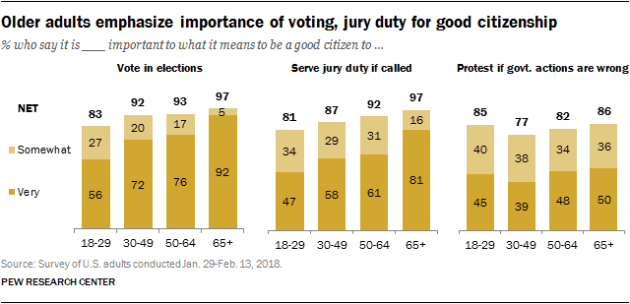
Young adults place less importance on many aspects of citizenship than older adults, especially when it comes to the share that describes a trait or behavior as very important for being a good citizen.

Majorities of adults across all ages say it is very important to vote in elections in order to be a good citizen. Still, a smaller majority of those under 30 say this (56%), compared with larger shares of those ages 30 to 49 (72%), 50 to 64 (76%) and 65 and older (92%).

And while fully 81% of those 65 and older say that to be a good citizen it is very important to serve jury duty if called, just about half (47%) of those under 30 say the same.

On other items, the pattern is similar. Young adults are less likely to call paying the taxes you owe, following the law, participating in the census, and following government and politics very important. Still, large majorities of young adults say each of these is at least somewhat important to being a good citizen.

There is no meaningful age gap in views of the importance of protesting government actions you think are wrong. Overall, 85% of those ages 18 to 29 say this is either very (45%) or somewhat (40%) important to being a good citizen. Views among those ages 65 and older are similar (50% very important, 36% somewhat important).

Displaying the American flag and knowing the Pledge of Allegiance do not rank particularly highly for young adults on their list of important characteristics for good citizenship. Among those ages 18 to 29, 63% say it is important to know the Pledge of Allegiance (38% very important) and 53% say it is important to display the American flag (19% very important). These items do not top the list of older adults either, though those 65 and older are more likely than the youngest adults to say both are important parts of being a good citizen.

Source: 9. The responsibilities of citizenship