Protesters in India claim victory as #citizenship bill stalls

Apparent end:

Protesters in northeast India claimed victory on Wednesday after a bill that the government says will help Hindus in neighboring countries settle in India lapsed before it could be ratified by parliament.

The Citizenship Amendment Bill is aimed at helping Hindus and members of other non-Muslim minority communities in neighboring Muslim countries move to India.

But critics say the legislation is as an attempt by Prime Minister Narendra Modi’s Bharatiya Janata Party (BJP) burnish its Hindu-nationalist credentials ahead of a general election, that must be held by May.

The bill had incited exceptional opposition in remote, ethnically diverse northeastern states where for years residents have complained that migrants from Bangladesh are a burden on society.

For days, protesters have taken to the streets, bringing chaos to several cities in the region. Authorities have responded with curfews and blocks on broadcasters in an attempt to quell the unrest.

The lower house of parliament passed the bill last month but it was not ratified by the upper house before the end of its last session before the election, on Wednesday.

Activists in the northeast welcomed parliament’s failure to push the legislation through.

“This is a moral victory for the people of the northeast with the BJP forced to bow down to the voices of struggle,” Samujjal Bhattacharya, a leader of the All Assam Students’ Union, one of the protesting groups, told Reuters.

Members of the Assam state organization had threatened to “shed blood” to block the bill.

Protests over recent days have also rocked the small state of Manipur, where authorities imposed an indefinite curfew and suspended mobile internet services for five days late on Tuesday, following violent protests.

Police said people were defying the curfew on Wednesday.

Protests also erupted in Mizoram state, where some activists have given voice to old separatist aspirations.

Source: Protesters in India claim victory as citizenship bill stalls

Australia’s citizenship process is not efficient, audit finds

When I was working on citizenship files, Australia’s performance standard was the gold standard compared to Canada’s less than bronze (80 percent of processed within 80 days).

The official Canadian performance standard, as reported in departmental reports, is a meaningless one: the total number of immigrants who have become citizens irrespective of how long a time they have been in Canada (the total “stock”) versus a more meaningful measure of how many have become citizens within a certain period of time (e.g., 5-9 years since arrival):

Australian citizenship applications are not being processed in a timely way by the Department of Home Affairs, according to the auditor-general.

But the department disagrees, arguing measures introduced in the past three years to protect national security and community safety are delivering results.

An Australian National Audit Office review has found just 15 per cent of applications for citizenship “by conferral” – which makes up the bulk of applications – were processed within 80 days in 2017/18.

That compares to the department’s former target to process 80 per cent of applications within 80 days, which it dropped in 2017.

The department does, however, measure the time taken to obtain citizenship from lodging an application to attending a ceremony.

Australian citizenship applications are not being processed in a timely manner.

The auditor-general found that time “increased significantly” between March 2017 and September 2018, despite a dip in the “relative complexity” of applications being lodged.

“Growth in demand for citizenship in recent years was driven by people with good supporting documents who arrived in Australia on a skilled visa,” the audit office found.

The review suggests increased screening of applicants has played a major role in extended processing times.

Nevertheless, it found staff were not being using efficiently.

“The department has a suite of initiatives in train that are designed to enhance efficiency but has been slow in implementing them,” the review stated.

The Department of Home Affairs disputes the audit office’s claim. In a statement to the auditor-general, it highlighted that the proportion of citizenship applications knocked back has doubled from 3.4 per cent in 2014/15 to 6.8 per cent in the first few months of 2018/19.

That comes as new security measures have been introduced.

“The enhanced integrity measures adopted by the department over the last three years to protect Australia’s national security and community safety are delivering results,” the department said.

“We will always prioritise these efforts over speed.”

The department has agreed to the auditor-general’s recommendation to revise how it funds its citizenship activities, based on the latest activity levels.

But the department has knocked back a recommendation to publicly report its key performance indicators, saying they could give people unrealistic expectations.

The inquiry came after the commonwealth ombudsman, Refugee Council of Australia and others raised concerns about the duration of the citizenship application process.

Source: Australia’s citizenship process is not efficient, audit finds

Debate over birthright citizenship emerges

Another follow-on article on birth tourism:

Eliminating birthright citizenship would be an overreaction to fears about a growth in birth tourism, according to an Ottawa immigration law professor.

Canada’s Citizenship Act enshrines the principle of jus soli, conferring automatic citizenship on anyone born on Canadian soil, making it one of just 30 or so countries in the world to maintain birthright citizenship.

But a recent reaction against the phenomenon of “birth tourism,” in which non-resident non-Canadians give birth in the country in order for their children to obtain Canadian citizenship, has led to calls to tighten up the law.

At its policy conference in Halifax last summer, members of the Conservative Party of Canada passed a resolution to amend the act so that birthright citizenship is only automatic when one of the child’s parents is either a citizen or permanent resident of Canada, following the example of Australia, which made a similar move in 2007.

And Liberal MP Joe Peschisolido, whose Richmond, B.C. riding has become a flashpoint for its high rate of births to non-resident mothers, lent his support to a petition demanding an end to birth tourism, which it denounced as an “abusive and exploitative practice” that is “debasing the value of Canadian citizenship.”

Despite the passion the practice arouses, Jamie Liew, an associate professor at the University of Ottawa’s faculty of law, says it’s important to remember that there is currently no legal bar to birth tourism in Canada. And she strongly opposes any amendment that would tackle it by ending birthright citizenship.

“In my opinion, it would be a massive overreaction to a very small problem that will lead to humongous social problems,” Liew says.

Such an amendment, she says, would affect every Canadian, because people would have to prove their citizenship regardless of where they were born.

“That opens up a can of worms, because you would have whole swaths of people without the means or knowledge to apply for citizenship,” Liew says. “You create a whole population of stateless people who could be excluded from the basics of life in Canada.”

In addition to the cost to the taxpayer of a whole new layer of bureaucracy, Liew says, there would also inevitably be mistakes and bad decisions in complex or difficult cases.

“People will end up in court challenging decisions, which is expensive for everyone,” she adds.

In a recent study carried out for the Institute for Research on Public Policy think tank, author and commentator Andrew Griffith, a former senior official at Immigration, Refugees and Citizenship Canada, suggested that previous figures may have heavily underestimated the incidence of birth tourism.

Statistics Canada numbers indicate birth tourism peaked in 2012, when the agency recorded 699 births to mothers whose residence was outside Canada, falling to 233 in 2015, before rising again in 2016 to 313.

But Griffith used hospital billing data to show that the number of non-resident mothers giving birth in Canada is actually much larger. Even without data from Quebec hospitals, the figure rose to 3,223 in 2016 from 1,752 in 2012. According to Griffith’s findings, the 3,628 births to non-resident mothers in 2017 accounted for 1.2 per cent of all births in Canada, a proportion he says can no longer be dismissed as “insignificant.”

Griffith says the discrepancy can be accounted for by the fact that birth tourist mothers are more likely to use their temporary Canadian address on birth registration documents used by Statistics Canada, while giving their real addresses abroad for the purposes of hospital payments.

However, he acknowledges that his figures overstate birth tourism to some extent, because the billing data does not distinguish births to temporary residents such as corporate transferees or international students or children born to Canadian expatriates returning home temporarily to give birth.

He says he welcomes the federal government’s recent commitment to look into the issue and says he hopes they can get a better handle on the precise number of birth tourists.

“But I don’t think it’s tenable to leave it at just doing a study. If they find that my numbers are correct, they need to look at options to address it,” Griffith says. “What’s important is how it’s perceived as undermining the fundamentals of citizenship.”

Despite his discomfort with birth tourism, Andy Semotiuk, an immigration lawyer with Pace Law Firm in Toronto, says he’s a firm believer in birthright citizenship.

“The troublesome thing for me is the people making money from advertising and facilitating anchor births,” he says, suggesting legal solutions focus on those profiting off birth tourism, rather than the mothers engaging in it or their children.

Source: Debate over birthright citizenship emerges

UK citizenship tests: Gangs help cheating candidates pass

When then CIC revised the citizenship test in 2009, one of the issues identified was that there was only one test in circulation, which resulted in the answers being memorized in a “song” with the a, b, c or d in correct order. CIC then switched to having different versions of the test to reduce this cheating.

The “cheating fee” appears to be more than the £1,206 citizenship fee:

Gangs are helping foreign nationals cheat their UK citizenship application test with the use of earpieces, a BBC investigation has revealed.

For a fee of up to £2,000, criminals secretly listen in and, via a hidden earpiece, give the answers to those taking the Life in the UK test.

Such an operation was secretly filmed by a BBC journalist, who was given help to pass.

The test is failed by about one in five would-be British citizens.

The Home Office said it took any cheating “extremely seriously”.

A pass in the test, which assesses candidates’ knowledge of UK laws, history and society, is usually required as part of the process to secure UK citizenship or indefinite leave to remain.

The number of applications for citizenship made by EU nationals rose by 32% last year and the BBC heard some were paying criminals to cheat the Life in the UK test, as anxiety grows over citizenship rights post-Brexit.

One woman told the BBC she decided to cheat after failing first time around, saying she “felt so much panic” about her situation.

Over the past year, nearly 150,000 people have sat the test, which consists of 24 multiple-choice questions.

The test, which is taken on a computer and has a pass mark of at least 18 correct answers, is supposed to be held under strict exam conditions.

Administration of the tests is outsourced by the government. There are 36 testing centres in the UK.

BBC researchers were able to access organised cheating when they went undercover at training academies in and around London, where candidates take classes to prepare for the test.

Masoud Abul Raza runs the Ideal Learning Academy in east London.

He was filmed telling an undercover researcher that he could guarantee a pass.

“You have to spend nearly £2,000. This is the business, it’s completely hidden. But you are getting a result,” he said.

Mr Abul Raza and his gang later provided the undercover researcher with a hidden two-way earpiece, linked wirelessly through a Bluetooth connection to a concealed mobile phone with an open line. This meant the gang outside could hear the audio feed of the test questions and provide the answers.

“Everything will be arranged. He will give you the answer,” Mr Abul Raza told the undercover journalist.

Tony Smith, the former director general of the UK Border Force, was shown the secretly recorded footage and described it as “clear and blatant cheating by an organised crime gang”.

“One would hope that the standards will change significantly so that the public can be assured that people going through this process are genuinely entitled to stay in this country,” he said.

The Home Office said test centres were required to put in place stringent measures to prevent cheating, including searches of candidates to ensure no electronic devices enter the test room.

“Unannounced visits” are also carried out to audit these processes.

But the BBC’s undercover researcher was not searched or told to hand over all electronic devices.

He sat the test, giving the answers provided to him, and within minutes of it ending he had received the pass certificate required to apply for citizenship and a UK passport.

Despite being caught on camera, Mr Abul Raza denied cheating, maintaining he only organises legitimate training.

However, he is not the only one profiting from cheating the system.

The BBC heard reports of other training academies doing the same thing, with the same method of cheating having been used at testing centres around the UK.

At the English Language Training Academy (ELTA) in east London, Ashraf Rahman told the BBC’s undercover researcher that he had arranged cheating in Birmingham and Manchester, as well as London.

“I’ve been here for five years and no-one gets caught,” he said.

Mr Rahman later denied he arranged cheating, claiming he was just discussing what others did.

ELTA denied cheating took place on its premises and said Mr Rahman was not an employee.

Source: UK citizenship tests: Gangs help cheating candidates pass

Refugees hoping to become citizens face high bar to achieve language benchmarks

While I would not want to water down the language requirement, the arguments for more flexible language training programs have merit. Similar issues present themselves with the knowledge test as illiteracy generally goes along with unfamiliarity with tests:

Fatum Ibrahim is pointing to her nose and smiling ear-to-ear.

“Nose,” she proudly pronounces, eager to demonstrate her expanding English vocabulary.

Three years ago, a day shy of Valentine’s Day, 36-year old Ibrahim and seven family members landed in Surrey, B.C., as part of Prime Minister Justin Trudeau’s signature Syrian Refugee Initiative. She didn’t know a word of English, nor could she read or write in her native Arabic.

Despite taking language classes four days a week, she has a long way to go to meet the English-language requirement for Canadian citizenship. While her mom, dad, grandmother and two school-age brothers are eligible to become citizens this year, she and two other adult siblings, who also never learned to read or write, will not be. Without a passport, they are stuck in Canada, unable to visit the six siblings they left behind in Turkey.

“I want to be a Canadian. I love it because our country has been destroyed and is gone. Now Canada is our only country. … But I don’t think I will learn to pass the English test until the end of my life,” Ibrahim says through an interpreter.

Ibrahim and her two siblings, both of whom live with intellectual disabilities, are not anomalies.

Government-assisted Syrian refugees came to Canada with less education than the refugees who came before them. Eighty-one per cent of the first 15,000 government-assisted refugees reported an education level of secondary school or less.

While Syria’s average literacy rate – eight in 10 before the war took a toll – is relatively high for the region, there is a sizeable disparity between rates for men and women. Only 77 per cent of Syrian women are literate, compared with 90 per cent of men, with rural women such as Ibrahim faring the worst. It was these women and their families whom the Canadian government prioritized for resettlement.

“I went to school only for one year, in the first grade. But I didn’t like it. I wasn’t smart,” Ibrahim says. “None of my sisters finished school; our brothers did. We spent our days cooking, cleaning the house, laughing, playing. We were so happy. … Only here in Canada did I start school again. I was terrified.”

Diana Jeffries manages English-language classes for Pacific Immigrant Resources Society, with funding from the federal government’s Language Instruction for Newcomers to Canada (LINC) program. She says adult literacy learners such as Ibrahim are right to wonder whether they will ever qualify for citizenship.

To meet the English-language requirement, individuals must reach Level 4 of the Canadian language benchmarks, meaning they can understand simple sentences and use basic grammar. Ibrahim has sat in a Level 1 class for more than a year.

“It is impossible. I have never seen someone who is non-literate get past a Level 2 literacy level,” says Jeffries. “You also have to take into account, not only do these women have no literacy skills, they often have tons of anxiety about being in a classroom. They also are women who have a lot of other things going on – often, they lack any sense of agency and have so many other needs with children, caretaking and domestic violence. It can take six months to learn how to print on a line and because it takes a really, really long time, they can give up.”

Ibrahim is not giving up yet, having just learned how to hold a pen and write her first name. She and her mom, Shakha, try to make it to their three-hour classes Mondays to Thursdays.

But chronic health challenges lead to sporadic attendance. And attendance matters more than ever.

Since 2016, LINC programs have adopted a new way of measuring language proficiency. Called the portfolio-based language assessment, it requires students to collect evidence of 32 successfully assessed assignments in order to rise to the next level. Assessments are held in class, so missing a session means missing an opportunity to progress.

Julie Ship, the settlement language co-ordinator for British Columbia’s Affiliation of Multicultural Societies and Services Agencies, argues that the portfolio process is not designed for adult literacy learners who face barriers to classroom engagement. There was no feasibility study of how changes to the assessment process might affect refugees with low-to-no literacy in their native tongues.

“We are hearing clients are intimidated by the whole process, and if they miss a class, which happens a lot when there are health appointments or they need child minding, they miss out on the assessment,” Ship says. “It is almost too rigorous. The idea was to introduce a steady flow of assessments, but it actually kind of backfires, because talking about assessments all the way through still conveys something scary.”

In fact, the portfolio process is so rigorous that it exceeds the government’s language requirement for citizenship. To become a Canadian citizen, refugees aged 18 to 54 who have lived in Canada for three years must demonstrate that they can speak and listen at Level 4. Older refugees such as Ibrahim’s mother, father and grandmother are exempt.

The portfolio assessment process gauges skills in four areas: speaking, listening, reading and writing. Although individuals can pay $200 to bypass LINC classes and take an English-language test, they must be able to read and write to use its online interface. That puts refugees with no experience of reading or writing at a disadvantage. Without a Level 4 certificate, these refugees won’t become citizens, with the capacity to vote or freely travel, until they turn 55.

Immigration Refugees and Citizenship Canada responded to a request for comment with a statement that did not address questions about the needs of refugees who are illiterate in their primary language.

It says in 2018-19, it is spending about $762-million to support the settlement needs of newcomers across all provinces and territories, excluding Quebec, and it spends more on language training than any other settlement service.

“IRCC-funded language training is offered at a range of ability levels from basic literacy to advanced language skills,” it says. “This includes more specialized courses such as labour market language training, which offers job-specific programming, mainly at higher language proficiency levels, coupled with mentoring and work placements to speed up the transition to employment.”

In 2008, before the influx of Syrian refugees, Jeffries ran a pilot program specifically for refugees with multiple disadvantages. The program’s funding was not renewed and did not run long enough to compare results with standard programming.

“The pre-literacy classes were fantastic, because it was really using different teaching pedagogies that were more experiential and kinesthetic,” Jeffries says. “Reading on a flat surface is not easy, nor is looking at black-and-white text on a piece of paper left to right. We could do art projects that were language-based and that were satisfying. In cooking, they could make measurements. We could paint the alphabet, and just do more creative things. Now, there is nothing like that with portfolio-based language assessment.”

Andrea Solnes, an independent consultant in settlement language, has been writing a guidebook on marginalized and multi-barrier learners, based on research with English-as-second-language teachers. Best practice suggests pair work, learning stations, active use of volunteers and paid teaching assistants.

“None, that’s how much specific training there is about illiteracy. Teachers are clearly expressing that they would like more,” Solnes says.

To improve outcomes for adult literacy learners, both Solnes and Ship see value in an approach that is less focused on meeting standards and more focused on building relationships between refugees and the broader community.

“Because language classes are often the first services that newcomers to Canada access, it is such a strong place to work from,” Solnes says.

But she says the push for a more standardized assessment structure means students spend less time outside the classroom learning other skills they need to be successful in Canada. “It’s important to not just look at language outcomes, but overall community engagement.”

Ibrahim is seeking more community support. She asks whether the interpreter can help her prepare for the language test. While she feels she is making progress in the classroom, it is outside those four walls where she struggles most.

“I only understand at school with my teacher,” Ibrahim says. “What is there outside of school to help me learn? I wish there were other classes after my class. We are trying. English is very hard.”
Source: Refugees hoping to become citizens face high bar to achieve language benchmarks

The Great British Race to Get a Second Passport

Good overview:

For the vast majority of British citizens who oppose a no-deal Brexit, the state of play in Parliament is dismaying. Although many members of Parliament are resolutely opposed to the United Kingdom crashing out of the European Union come March 29, the reality remains that no deal is their default option: Should Prime Minister Theresa May be unable to find support for her withdrawal agreement—which, by every indication, will be the case—Britain will have no choice but to leave the EU on the severest of terms.

Among the most vulnerable in this scenario are the 1.3 million British citizens currently living in Europe. They would have only a year and change to reorganize their lives, until December 2020, when the Brexit transition period ends and their rights to remain expire. A number of advocacy groups have joined together in a coalition called British in Europe in order to raise awareness and lobby lawmakers. But so far these groups—including the Brexpats, Bremain in Spain, RIFT(Remain in France Together), BRILL (British Immigrants Living in Luxembourg), and others—have struggled like everyone else to move the needle. For its part, the EU has encouragedmember states to “take a generous approach to the rights of UK citizens in the EU, provided that this approach is reciprocated by the UK.” Whether the U.K. will ultimately reciprocate, seeing as the free movement of people was a lightning rod of the Brexit referendum, is far from guaranteed.

Even if the British government fails to retain access to Europe, however, British citizens living at home and abroad may be able to find a way on their own. The solution: a second passport. Across the English Channel lies an obscure but inviting matrix of citizenship and residency laws that, for some, promises to keep alive the freedom to live and work throughout the continent. And in a nation where 48 percent of voters, or 16 million individuals, voted to stay in the EU, the opportunity to do so—albeit in a different form—is sure to be appealing.

Of the British citizens living in Europe, 310,000 are in Spain, 280,000 are in Ireland, 190,000 are in France, 107,000 are in Germany, and 64,000 are in Italy—followed by a significant drop-off to a smattering in other countries around the continent. Fortunately for these British citizens, and for the handful living elsewhere, passports are not particularly difficult to come by (at least compared with other parts of the world). And seeing as the number of British citizens with dual EU nationality increased by 159 percent in the year after the referendum, many have already realized how to escape a fate they did not choose.

Roughly speaking, second passports can be obtained in three ways: organically, financially, or ancestrally. The organic route to the passport is perhaps the most difficult as it requires lengthy naturalization processes. Ireland, for example, which saw a staggering 497 percent increase in new citizenship for British people in the pre- and post-Brexit years of 2014 to 2015 and 2016 to 2017, requires applicants to prove residency for five of the past nine years. France, which has seen a 226 percentincrease, is even stricter, with the same five-year residency requirement plus proficiency in French, proof of integration, and a citizenship test. Germany, which has seen a remarkable 835 percent increase in citizenship for Brits, is stricter still, with requirements of six years of residency, language proficiency, a citizenship test, and an integration course. Although the British government estimates that 900,000citizens are “long-term residents” of another EU country, it is by no means a given that all or most of them will meet their host country’s naturalization criteria. And while marriage can offer a bit of a shortcut, restrictions still apply—Ireland requires three years of marriage, France requires four with three spent in the country, and Germany requires two years of marriage along with three years of residency. For the British citizens who have suddenly been struck by the possibility of no deal, meeting requirements and spouses will be a tall task.

For a murky few, however, a much easier path is available in the form of “golden passports.” This is the financial route to citizenship, a backdoor into the EU that can be accessed through foreign direct investment for five-, six-, or seven-digit sums, often coming in the form of real estate purchases. The BBC has the figures: On the lower end, Croatian passports will cost 13,500 euros. On the higher end, a Luxembourg or Slovenian passport can cost upwards of 5 million euros. For price tags in the middle, wealthy people can get away to Greecefor a quarter of a million euros, Spain for a half a million euros, Malta for a million euros, Cyprus for 2 million euros, and more. However, the elitism and corruptibility of the golden passport scheme hasn’t gone unnoticed, and only a few months after a report from Global Witness and Transparency International detailed the more than 6,000 unaccounted new citizens, 100,000 new residents, and 25 billion euros gained through golden passport programs, the European Commission launched its own inquiry into the peculiar “investor citizenship” arrangements. The results of that inquiry were released last week and made the case for tougher security checks, more rigorous residency requirements, and better transparency. And although they did not go nearly as far as some had hoped, the very fact of the report’s existence suggests that the golden backdoor will eventually be closed.

The final path to a second passport, the ancestral option, emerges as both the least demanding and the least expensive. For some countries, such as Italy and Ireland, the generous principle of jus sanguinis invites anyone who can prove their ancestral ties to the country (with birth or citizenship records in a direct line of parents, grandparents, great-grandparents, or great-great-grandparents) to claim a passport of their own. It is difficult to determine just how many people actually qualify, and in some cases those eligible may not even know. But the eagerness among many to find out is eminently clear: Ireland’s Department of Foreign Affairs reported a twofold increase at the same time that one Italian law firm reported a tenfold increase in pre- and post-Brexit passport applications.

The ancestral option offered by other countries, however, has the much darker dimension of reparations and restorations for some of the most heinous offenses in the history of Europe. This variety of ancestral passports begins with allocations for Soviet exiles and their descendants, offered by Latvia, Lithuania, and Estonia. So far, these states have not reported much traffic, but this is quite likely to change given the 25,000Baltic men and women who came to Britain in the 1940s and the thousands more who came in the decades after.

For Germany and Austria, where descendants of the victims of the Third Reich are also offered citizenship, applications have surged. In pre- and post-Brexit years, new Austrian citizenship among Brits has risen 112 percent. The number of applicants to Germany’s specific reparations program has swelled even more, by an astounding 1,500 percent. While Poland offers the same program to Soviet and Nazi victims, exiles, and their descendants, it has been somewhat less popular, seeing only a 100 percent increase in citizenship.

Going back even further in the timeline of Europe’s atrocities, Spain and Portugal offer citizenship to Sephardic Jews who are descendants of victims of the 15th-century Inquisition, the mass exile of Jews and Muslims from the Iberian Peninsula that began in 1492. (Somewhat controversially, however, passports are not granted to Muslims whose Moorish ancestors suffered the same fates.) Since Spain and Portugal extended this offer, some 10,000 special passports have been granted—with an eightyfold increase in British-based applications in the months following the referendum.

Proactive though some European states are, one glaring absence in the list of victim and ancestral passports cannot be overlooked: colonies. It remains the case across Europe that the victims of colonization and their descendants are marginalized in the accounting of Europe’s faults as no major reparations program, citizenship-based or otherwise, is offered. And even though reparations for some do exist, many victims and their family members have been rightfully reluctant to seize the opportunity. Shortly after the referendum, Harry Heber, an 85-year-old Austrian-Jewish refugee, told the Guardian, “The proposition of seeking sanctuary in the very place that murdered my relatives absolutely appalls me.”

US charges 20 people over Chinese birth tourism schemes

Provides an example of regulatory and legal approaches to reducing the extent of birth tourism. While the national security rationale given is overblown (“ridiculous” in the words of others), the fraud and misrepresentation of purpose of visit is not, although may be hard to prove in court.
Of course, in the Canadian context, if a women openly stated the purpose of her visit was to give birth with the intent to obtain Canadian citizenship for her child, and met the security, medical and financial requirements, there would be no grounds for visa refusal and no fraud or misrepresentation.
Will be interesting to see how this case is decided:
Dongyuan Li’s business was called “You Win USA,” and authorities say she coached pregnant Chinese women on how to get into the United States to deliver babies who would automatically enjoy all the benefits of American citizenship.

Over two years, the now-41-year-old raked in millions through her business, where mothers-to-be paid between US$40,000 and US$80,000 each to come to California, stay in an upscale flat and give birth, authorities said.

Li, who was arrested on Thursday, is one of 20 people charged in the first federal crackdown on birth tourism businesses that prosecutors said brought hundreds of pregnant women to the United States.

Jing Dong, 42, and Michael Wei Yueh Liu, 53, who allegedly operated “USA Happy Baby,” also were arrested. More than a dozen others, including the operator of a third such business, also face charges but are believed to have returned to China, the US Attorney’s office in Los Angeles said.

While it is not illegal to visit the United States while pregnant, authorities said the businesses – which were raided by federal agents in 2015 – touted the benefits of having US citizen babies, who could get free public education and years later help their parents immigrate.

They also allegedly had women hide their pregnancies while seeking travel visas and lie about their plans, with one You Win USA customer telling consular officials she was going to visit a Trump hotel in Hawaii.

The charges include conspiracy, visa fraud and money laundering. But US authorities said the businesses also posed a national security risk since their customers, some who worked for the Chinese government, secured American citizenship for children who can move back to the United States and once they’re 21 and then sponsor their parents for green cards.

“I see this as a grave national security concern and vulnerability,” said Mark Zito, assistant special agent-in-charge of Immigration and Customs Enforcement’s homeland security investigations. “Are some of them doing it for security because the United States is more stable? Absolutely. But will those governments take advantage of this? Yes, they will.”

Messages left for Li and Dong’s lawyers were not immediately returned. Derek Tung, Liu’s lawyer, said the growing interest among Chinese women to give birth to American babies drew attention to a phenomenon long employed by citizens of other countries.

His client had nothing to do with getting women visas from China but worked almost as a subcontractor to provide housing once they arrived, he said. “My client is merely the provider. The people who are in China are the ones in charge of everything,” he said.

Birth tourism businesses have long operated in California and other states and cater to couples from China, Russia, Nigeria and elsewhere.

In the past, operators sometimes ran into trouble with local code enforcement officials when neighbours in residential areas complained about crowding or excess trash, but they did not face federal scrutiny.

In 2015, federal agents in California raided roughly three dozen sites connected with the three businesses. More than 20 people were designated as material witnesses but some later fled to China and were charged with violating federal court orders, and a lawyer who helped them leave the country was convicted of obstruction of justice.

This week, a federal grand jury indicted four people who allegedly ran the birth tourism businesses until the 2015 raids, including Wen Rui Deng, 65, who is believed to be in China and accused of operating “Star Baby Care.”

That business dated to at least 2010 but advertised having brought 8,000 women to the United States – half of them from China – and claimed to have been running since 1999, prosecutors said.

Each business brought hundreds of customers to give birth in the United States and some didn’t pay all of the medical costs tied to their care, prosecutors said. One couple paid the indigent rate for their hospital bills – a total of US$4,080 – even though they had more than US$225,000 in a US bank account they had used to shop at luxury stores including Louis Vuitton, according to court papers.

Li, who operated You Win USA, told an undercover federal agent who was posing as a pregnant Chinese citizen that her company would train her to interview for a visa and pass customs, according to court filings.

At one point, the papers said, she also sent a text message to her husband about the business, saying “After all, this is not legal!”

Dual citizenship in Africa: ‘Benefits outweigh disadvantages’

Good overview of African citizenship policies:

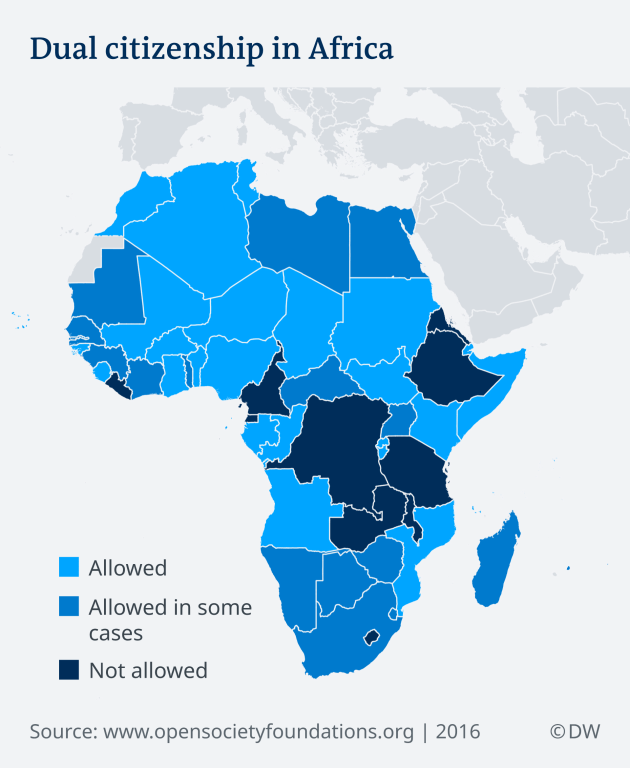
Several African countries, such as the Democratic Republic of Congo (DRC), Tanzania and Ethiopia, reject dual nationalities for their citizens. In these countries the fear of people with two citizenships seems to be acute.

There are a number of African heads of state and high-ranking politicians who have dual citizenship themselves or roots in another country. Somali President Mohamed Abdullahi Mohamed is a citizen of Somalia and the United States. Liberia’s former head of state Ellen Johnson-Sirleaf has German and Liberian roots. Moise Katumbi, a leading DRC opposition politician, was an Italian citizen for 17 years. For this reason he was banned from running in the 2018 presidential election.

Pride or politics?

While the DRC does not recognize dual citizenship, an exception is made for children born abroad. They are allowed to keep both nationalities until they come of age at 21. Then they have a year to renounce one of their citizenships. An Ethiopian law of 1930 stipulates that Ethiopians acquiring another nationality will cease to be Ethiopians. Foreigners who want to become Ethiopians need to prove that they’ve already renounced or are able to renounce their original citizenship.

Tanzania also does not allow dual citizenship. In 2007, Tanzanian Foreign Minister Bernard Membe presented a report which recommended an amendment to this law. But the government argued that such a change represented a threat to peace, security and the Tanzanian population’s livelihood.

An infografic showing how African countries deal with dual citizenship

“It’s all a mystery, because the benefits outweigh the so-called disadvantages,” Ahmed Rajab of the Pan-African Institute for Strategic Studies, told DW. “The main benefits are to the economies of these countries,” he said. “Maybe it’s a question of pride. Maybe these countries are so proud of their nationality that they don’t want any of their citizens to acquire another citizenship.” Legalization would not bring about any new problems. On the contrary: “It has been proved in the case of Ghana, for example, or even Kenya, that the country benefits from the inflow of funds from the countries of the citizens who have dual nationality.” Ghana legalized dual citizenship in 2002. Kenya followed suit in 2011.

African leaders do not want to be challenged

Tanzanian analyst Gwandumi Mwakatobe believes there is more to the rejection of dual citizenship than mere pride. Many people often do not know where to get their information from so they believe whatever their president says. Mwakatobe believes that this works to the advantage of African heads of state. People with dual citizenship who live abroad “are exposed to so many things. They know so many issues regarding politics, regarding human rights. And they are very vocal. They criticize their country. They challenge the leaders from their original countries. Many African leaders don’t want to be challenged,” Mwakatobe told DW.

Two hands holding several Malian passports (picture alliance / Godong)Mali is one of the African countries that allow dual nationality

“I think that is a threat,” analyst Ahmed Rajab agrees. African leaders view people with dual citizenship as foreigners and don’t want them to participate in politics. “Because they have ideas on democracy, democratic processes and on how to run politics. It goes against the grain of the Ethiopian political environment, for example,” Rajab said. Dual citizens are banned from local politics in Ethiopia.

‘We are world citizens’

Gwandumi Mwakatobe considers this to be a useless strategy. “There is nothing you can hide in this world today, due to the communication technology. Even in the DR Congo, where they cut the internet, they were still communicating,” he said. The analyst also believes that states will benefit from allowing their citizens to have dual nationality. “We have to put in place good systems, good laws, that can guide us to make sure that we prosper,” he said. Increased business, transport of goods and networking with people abroad are just a few advantages of dual citizenship, Mwakatobe pointed out.

He would like every African country to build a bridge to the diaspora, to ease the way home for people with dual citizenship. “That is very important, because we are all citizens of this world, and not from one nation or the other. The whole world is ours. We are world citizens.”

Source: Dual citizenship in Africa: ‘Benefits outweigh disadvantages’

Australia admits misstep over Islamic State suspect [citizenship revocation and statelessness]

Finally publicly admitted:

Australia failed to make basic checks before stripping a suspected Islamic State fighter of his citizenship, a senior official said Wednesday, an admission likely to call into question the legality of the move.

The country last month striped Neil Prakash of citizenship after claiming he was Fijian — prompting strenuous denials from the authorities in Suva and an embarrassing diplomatic rift.

Prakash is accused of being a member of the IS jihadist group, and identified as the 12th Australian dual-national to lose their passport over terrorism links.

He is currently in Turkey facing charges of joining the organisation.

A parliamentary intelligence committee on Wednesday grilled Home Affairs officials on the issue, asking whether they verified his status with Fiji or consulted experts in Fijian law before revoking Prakash’s citizenship.

“No, we did not” admitted senior department official Linda Geddes.

If Prakash is neither Fijian nor Australian he would now be stateless in contravention of decades old UN accords and Australian law.

A Special Counsel advising the government told the parliamentary committee he offered “strong advice” on the case, but would not go into detail.

The move against Prakash was touted at the time by hardline Home Affairs minister Peter Dutton as the ruling Liberal Party eyed its base supporters and May elections.

But it created an awkward backdrop for a recent landmark Pacific visit by Australian Prime Minister Scott Morrison.

Source: Australia admits misstep over Islamic State suspect

And in related news, lawyers express concern over expansion of Australian citizenship revocation policy towards those convicted of minor crimes:

Australian lawyers are afraid petty criminals and people participating in religious festivals could be rendered stateless under citizenship law changes aimed at homegrown terrorists.

Constitutional and human rights experts have also expressed grave concerns about the “irredeemable” bill being put forward by the federal government.

The Morrison government wants to be able to deport Australian-born extremists who are entitled to citizenship in another country.

But the Law Council of Australia fears the proposed powers would be disproportionately harsh and could breach international law.

Dual nationals sentenced to at least six years jail for terror offences can already be stripped of their Australian citizenship.

The coalition wants to scrap the six-year threshold and expand the range of offences it can rely upon.

The Law Council’s David Neal is urging the federal parliamentary intelligence committee to keep the existing triggers in place.

“Low-level offending, which is dealt with to finality in a local court, could be captured by laws that lead to citizenship cessation,” he told committee members in Canberra on Wednesday.

Dr Neal is also concerned the offence of “associating with a terrorist organisation” could capture people participating in legitimate social gatherings and religious festivals.

Constitutional expert George Williams believes tinkering with the bill could also capture religious pilgrims and business people who venture into politically-sensitive areas.

“There is no actual involvement in terrorism, there is no suggestion of disloyalty, but that would trigger under this legislation the possibility of revocation,” he told the committee.

Professor Williams said the bill would have a range of “extreme and unjustified” consequences and could make the community less safe.

“In fact, it may do some harm, particularly in the broader agenda of building social cohesion.”

The laws would also significantly lower the threshold around proving a person’s citizenship of another country.

Under the changes, the minister would only need to be “reasonably satisfied” a person may be entitled to citizenship elsewhere.

“As recent history demonstrates – in both the cases of members of parliament and the (Neil) Prakash case – determining existing foreign citizenship can be difficult,” Dr Neal said.

“Determinations based on predictions about future foreign citizenship – which may include decisions by foreign governments – are obviously fraught.”

The Morrison government sparked a diplomatic fight with Fiji over the summer break after stripping Prakash of his Australian citizenship.

The Islamic terrorist was born in Melbourne to a Fijian father but Fiji says he is not a citizen.

The federal government has indicated dual nationals who are stripped of their citizenship could languish indefinitely in immigration detention if other countries refuse to take them.

Source: Lawyers flag fears about citizenship laws

Brexit prompting thousands of Jewish people to apply for German citizenship

Almost ironic,  another Brexit fall-out:

Simon Wallfisch grew up in London as the grandson of an Auschwitz survivor who swore to never return to the country that murdered her parents and six million other Jews.

But more than 70 years after the Holocaust, Brexit has prompted Wallfisch and thousands of other Jews in Britain to apply for German citizenship, which was stripped from their ancestors by the Nazis during the Third Reich.

“This disaster that we call Brexit has led to me just finding a way to secure my future and my children’s future,” said Mr Wallfisch, 36, a well-known classical singer and cellist who received his German passport in October. “In order to remain European I’ve taken the European citizenship.”

Britons holding dual citizenship from an EU country like Germany will retain the privilege of free movement and work across the soon-to-be 27-nation bloc.

Many Britons whose ancestors came from other parts of Europe have been claiming citizenship in other EU member states so they can keep ties to the continent. But for Jews whose families fled Germany to escape the Nazis, the decision has meant re-examining long-held beliefs about the country.

Mr Wallfisch’s grandmother, Anita Lasker-Wallfisch, was 18 in December 1943 when she was deported to Auschwitz, the Nazi death camp in occupied Polandwhere more than one million Jews were murdered.

In November 1944, she was taken to Bergen-Belsen – the concentration camp where diarist Anne Frank died after also being transferred from Auschwitz at about the same time – where she was eventually liberated by the British army in April 1945.

Ms Lasker-Wallfisch immigrated to Britain in 1946, got married and had two children. Her career as a famous cello player took her around the world, but it took decades until she overcame her hatred enough to set foot on German soil again in the 1990s.

In recent years, Lasker-Wallfisch, 93, has become a regular visitor, educating children in Germany about the Holocaust.

On Sunday’s International Holocaust Remembrance Day, Ms Lasker-Wallfisch, her grandson Simon and her daughter Maya Jacobs Lasker-Wallfisch performed for the first time together on stage at the Jewish Museum Berlin in commemoration of their family. They played music with other members of their extended family and read letters from the past as a tribute to those who survived and those who perished in the Shoah.

Before the show, the three generations sat together on the red couch in the museum’s dressing room and told The Associated Press about the emotional thoughts that went into the younger two’s decision to take German citizenship.

“We cannot be victims of our past. We have to have some hope for change,” said Maya Jacobs Lasker-Wallfisch, a 60-year-old London psychotherapist who is Simon’s aunt and is still waiting for her German citizenship to be approved. “I feel somehow in a strange way triumphant. Something is coming full circle.”

Her application is one of more than 3,380 requests that the German Embassy in London has received since the Brexit referendum in June 2016. In comparison, only around 20 such requests were made annually in the years before Brexit. Article 116 of the German Constitution allows the descendants of people persecuted by the Nazis to regain the citizenship that was removed between 1933 and 1945.

More than just retaining the ability to travel easily from country to country or maintain business ties, Jacobs Lasker-Wallfisch said there are other, more emotional reasons to acquiring German citizenship, with Britain due to leave the European Union on 29 March.

“I feel an aliveness here [in Berlin] that I have not experienced before, but it totally makes sense because after all I am German,” Jacobs Lasker-Wallfisch said. She added that if the country behind the Holocaust is now one that welcomes the descendants of the victims, “that’s a good thing”.

But Anita Lasker-Wallfisch, who lived through the horrors of the Holocaust, remained skeptical and pessimistic.

“Jewish people never feel secure,” she said to her daughter and grandson, reminding them of her own past. “I had German nationality – it did not buy me security.”

Source: Brexit prompting thousands of Jewish people to apply for German citizenship