Countries urged not to strip terror suspects of citizenship

More on citizenship revocation for treason or terror:

Stripping terror suspects of citizenship does not increase national security and may even make it worse, legal experts told a conference on ending statelessness.

They are particularly concerned over the increasing use of the measure by Britain which this year revoked the nationality of “jihadi bride” Shamima Begum who left London to join Islamic State in 2015 at the age of 15.

Britain is also considering the case of British-Canadian Muslim convert Jack Letts who joined ISIS as a teenager and is now being held in a Kurdish-run jail in northern Syria.

“Stripping nationality is a completely ineffective measure – and an arbitrary measure,” said Amal de Chickera, co-founder of the Institute on Statelessness, which is hosting the conference in The Hague.

He said countries should retain responsibility for nationals accused of supporting ISIS and ensure they are prosecuted.

“Stripping nationality when people are abroad merely exports the problem to other countries,” he said, adding such measures were also likely to have a serious impact on families back home.

Countries should recognize that women married to ISIS fighters, and their children, may have been victimized, he told the Thomson Reuters Foundation on Friday.

The conference heard that Britain stripped nationality from more than 100 people in 2017, compared to a total of 12 people between 1950 and 2002, but most cases were done quietly.

De Chickera said it was crucial that all countries’ counterterrorism policies should not result in more people becoming stateless – which means someone is not recognized as a national by any country in the world.

To avoid making people stateless, Britain has focused on dual nationals.

But Audrey Macklin, a human rights law professor at the University of Toronto, said if all countries had laws to revoke citizenship from dual nationals then you would get a race to see who could do it first “and to the loser goes the citizen.”

“Is this a policy that makes sense as a global practice directed at making the world more secure, at reducing the risk of terrorism? To my mind, not so much,” she said.

She said citizenship was a right rather than a privilege and described citizenship deprivation followed by expulsion as the “political equivalent of the death penalty.”

The conference comes midway through a UN campaign to end statelessness in a decade. An estimated 10 to 15 million people are stateless worldwide, often deprived of basic rights.

Jawad Fairooz, a former Bahraini MP who was rendered stateless after being stripped of his nationality in 2012, said revoking citizenship should never be used as a political tool or a punishment.

Bahrain has stripped hundreds of people of nationality since a 2011 uprising although many have since regained citizenship.

“If you lose [citizenship], you lose the rest of your rights,” said Fairooz, chairman of Salam for Democracy & Human Rights.

“If you are born in a country and serve the country and you [are] part of it and quite suddenly your name is deleted from that country it is really heartbreaking.”

Source: Countries urged not to strip terror suspects of citizenship

Over 80% of Canadians would fail a citizenship test, new poll reveals

No real surprise. More Canada Day clickbait than serious:

To become a Canadian citizen, hopeful permanent residents must achieve a score of 75 per cent or higher on the Canadian Citizenship test.

However, a recent poll by Forum Research found that almost 90 per cent of Canadians would fail this test, and the average score among those polled was just 50 per cent.

According to the results, men, the country’s highest earners, post-graduate degree holders and residents of British Columbia are among the most likely to pass the test.

Survey respondents were asked a series of 10 questions, which included questions about the title of the royal anthem (often confused with the national anthem), who the Métis are, the year the Charter of Rights and Freedoms came to Canada and Canada’s head of state.

Canadians scored most poorly on questions about the title of the Royal Anthem of Canada, civic duties, and Canada’s head of state.

When asked about the title of the royal anthem, only 36 per cent correctly answered, “God Save the Queen,” while 56 per cent responded “O Canada,” and six per cent said it was the Star Spangled Banner.

Respondents were also given a list of official responsibilities Canadian citizens have and were asked to select which item was not an official responsibility. Only 26 per cent correctly responded “driving safely.”

Lastly, over 80 per cent of respondents did not know that the Queen Elizabeth II remains Canada’s head of state to this day

Areas where respondents seemed to know their Canadian trivia included Canadian geography, the English translation of the word “Inuit,” and the significance of the Canada Pacific Railway (CPR).

In the former, 63 per cent of respondents were able to identify that the Midwest is not a Canadian geographical region. In the latter, two thirds of respondents knew that the CPR, which stretches from the Atlantic Ocean to the Pacific Ocean, is representative of unity.

Other questions on which respondents scored fairly well included the year the Charter of Rights and Freedoms was brought to Canada (1982), and identifying the founding peoples of Canada (Indigenous, French and British).

The Forum Poll™ was conducted by Forum Research with the results based on an interactive voice response telephone survey of 1645 randomly selected Canadians. The poll was June 25th -27th, 2019. Results based on the total sample are considered accurate +/- 3%, 19 times out of 20. Subsample results will be less accurate.

Source: Over 80% of Canadians would fail a citizenship test, new poll reveals

On Canada Day, let’s reconsider the high cost of citizenship

While I have long advocated for a decrease in citizenship fees, given the mix of personal and public benefits of citizenship, her points on permanent residency fees miss the fact that these only cover processing costs, not the more than $1 billion the government spends on settlement services such as language training.

Both Conservative and Liberal governments in their substantial funding for settlement services demonstrate their recognition of the public, not just personal, benefits of immigration.

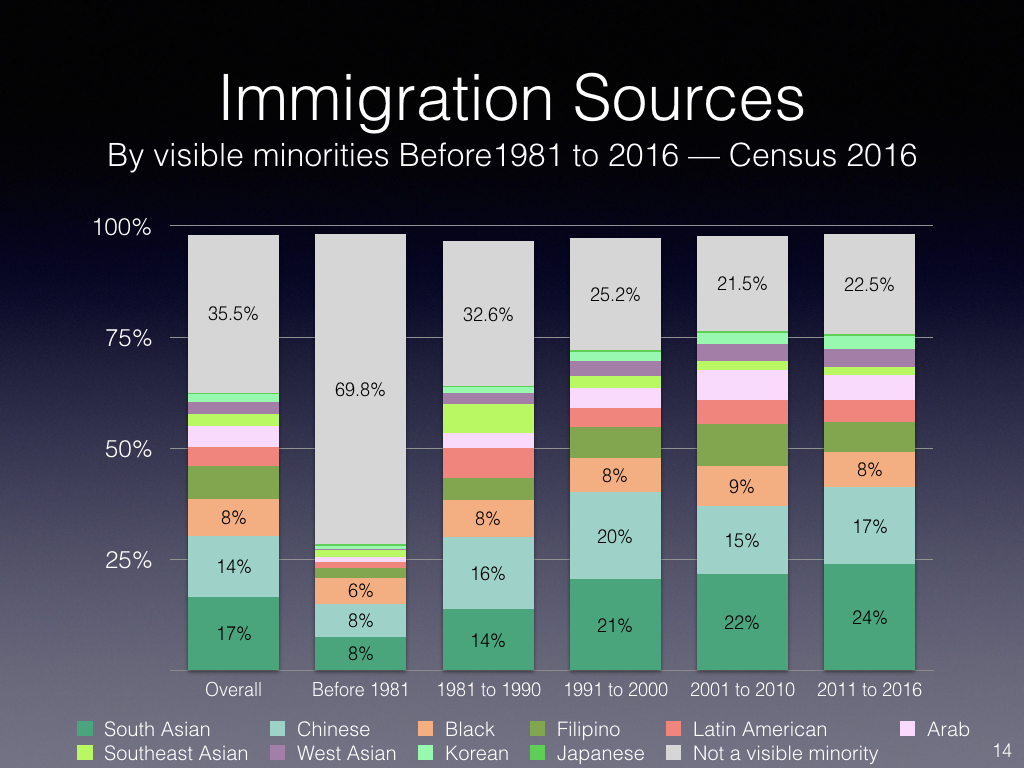
Similarly, while citizenship data (administrative and Census) show some groups adversely affected by the 2014-15 fee increases and other changes, visible minorities form close to 80 percent of all immigrants, so hard to make the case that this is a major barrier:

At any international airport, the passport of those making their way through customs could be a source of envy or a source of pity, quietly communicating the perceived quality of life lived by its holder. Voluminous emigration and immigration have turned citizenship into the “most significant class lottery remaining in the modern world,” in the words of one journalist. Perhaps recognizing this, many countries including Canada have successfully capitalized on immigration.

The path to Canadian citizenship has gone through a series of changes. In the past, in addition to being able to marry into citizenship, one could literally buy citizenship – a program Quebec continues to this day. Currently, the journey to citizenship begins with permanent residency. Apart from transitioning from a student or worker to a permanent resident, other options include using foreign entry programs such as Family Sponsorship, Economic, and Business Immigration.

Regardless of the option, in addition to the application cost comes a payment of $490 for the right of permanent residence fee, without which permanent residence status is not granted. Protected persons are exempt from this expense.

Introduced in 1995 and levied on individuals seeking permanent residency,first at a hefty price of $975, the fee is seen as “a partial compensation for benefits which accrue to the person who acquires permanent resident status and helps to defray various costs incurred in delivering the immigration program.” But this may not have been the only reason for its introduction.

The right of permanent residence fee (then called right of landing fee) came at a time when there was an increase in immigrants from Asia and the Middle East and a plummet in the numbers originating from the U.S. and Europe.

In a world where economic parity is heavily influenced by gender and colour, this fee continues to be a major impediment for many and is especially intensified if one is a woman of colour. Exceptions made for protected persons aside, and though levied regardless of the country of origin, it favours those with economic stature, which in today’s world continues to be withheld from women and people of colour, thereby contributing to inequities in education and employment opportunities.

After proving one’s worth as an upstanding permanent resident, if financial means allow, then the next step toward active civic engagement is in the form of an application for citizenship (bumped to $530 from $100 in 2015) which, once again, could be loaded with added costs.

In total, the price paid to acquire Canadian citizenship quickly escalates, approximately amounting to between $3,000 and $4,000 (or more) and may include translation fees; lawyer’s fees that could be as steep as $400 for a consultation; medical exams and diagnostic testing, which aren’t covered by provincial health care plans; official language testing by a third party; miscellaneous costs such as citizenship certificates; permanent resident card renewal; photographs, conveyance and mailing. And this is without factoring the expenses associated with holding the status as an international student or worker (before applying for permanent residency) within Canada.

In 2017, Canada should have received more than $78-million from 159,262 economic immigrants, solely based on the right of permanent residence fee, many of whom pay this amount even before arriving to Canada. Once here, if these individuals choose to pursue citizenship, then once again it translates into millions of dollars wending their way to government coffers.

There is privilege attached to becoming a Canadian citizen. But it isn’t something that is easily afforded for many. Of the total cost of the arduous, emotional and financially stressful path to citizenship, approximately 15 per cent to 20 per cent is directed toward buying the permanent residence and citizenship rights – to be able to belong, to be able to vote, and most importantly, to be able to call oneself Canadian. The fact remains that, today, the current immigration system, consciously or unconsciously, promotes gender and economic disparity globally. In a world where immigration is more than just a means to move from one country to another, it is time to recognize what this has evolved into – a booming business that only profits certain countries.

Source: On Canada Day, let’s reconsider the high cost of citizenship

Why Trump Lost the Census Case

Good analysis from the right:

I’ll freely admit, I’m surprised. In April I predicted that the Trump administration would prevailin its effort to include a citizenship question on the 2020 census form. I based my conclusion on the combination of Congress’s broad delegation of authority to the executive branch to conduct the census in the “form and content” that the secretary of commerce determines, the historical norm of including citizenship questions, and the traditional leniency of so-called arbitrary and capricious review.

Against this legal background, I believed that — like with the travel-ban case — a chaotic process would matter less than the very broad discretion granted the president by existing law. I was wrong.

Today, Justice John Roberts joined the four more progressive judges to reach a legal conclusion (articulated in a complex series of interlocking and competing concurrences and dissents) that roughly goes as follows: Including a citizenship question in the census is not “substantively invalid.” However, the Administrative Procedure Act applies, and it is “meant to ensure that agencies offer genuine justifications for important decisions, reasons that can be scrutinized by courts and the interested public.” Since the administration’s explanation for its agency’s action was “incongruent with what the record reveals about the agency’s priorities and decisionmaking process,” the administration failed to meet its APA obligations.

The secretary of commerce had pointed to an assertion from the Department of Justice that the question would assist in voting-rights enforcement. To put it simply, the majority did not buy that explanation, finding that it was more of a rationalization: The secretary of commerce decided to include the question, went hunting for a reason, and eventually got the DOJ to help.

Quite frankly, this sounds about right. As the Court put it, “the evidence tells a story that does not match the explanation the Secretary gave for his decision.” This section of the opinion is instructive:

“The record shows that the Secretary began taking steps to reinstate a citizenship question about a week into his tenure, but it contains no hint that he was considering VRA [Voting Rights Act] enforcement in connection with that project. The Secretary’s Director of Policy did not know why the Secretary wished to reinstate the question, but saw it as his task to “find the best rationale.”

A different way of putting the opinion is that the APA, at the very least, requires an honest process.

Why was this outcome different from that of the travel-ban case? In that case, the president himself offered evidence that the stated reasons for the administration’s actions were pretextual. The president himself provided evidence that anti-Muslim animus provided at least part of the justification for his order. Yet in that case the statue at issue was different. If the census statutes granted the president considerable discretion, the statute at issue in the travel ban granted him truly immense discretion, unbounded by the APA. Different statutes yield different outcomes.

So now what? There is much speculation on Twitter that the administration may have time to go back to the drawing board, conduct a proper process in accord with truthful, justifiable reasoning, and obtain legal approval in time to print the census forms.

It’s possible, but I’m skeptical. First, there are now real questions as to whether the process was improperly influenced by arguments by deceased Republican redistricting expert Thomas Hofeller that adding the citizenship question would be “advantageous to Republicans and Non-Hispanic Whites.” Evidence of racial animus would almost certainly alter the legal calculus and require the administration to go to great lengths to show that any new process has been cleansed from any racist taint.

Plaintiffs will again challenge any effort to include the question, they’ll likely obtain injunctions in favorable jurisdictions, and then the clock will become the administration’s enemy. I could well be wrong, but I’m doubtful SCOTUS will have an opportunity to opine before that clock runs out.

There is a lesson here, one that the administration (and indeed, all litigants) would do well to remember. When engaged in conduct that’s likely to lead to litigation, make it easy for the court to rule for you. Chaos can lose cases. Evidence of disingenuousness alienates judges.

Process matters, and you always want to appear to be the most reasonable party before the court. The Trump administration has gotten away with chaos before. It did not today, and as much as conservatives may once again grow angry at Justice Roberts for joining the Court’s progressive wing, if they want to place real blame for today’s Supreme Court setback, look to the administration. Its lack of candor caught up to it, and honesty may now come too late.

Source: Why Trump Lost the Census Case

This Canada Day, we need a new citizenship oath – The Conversation

Given the government’s failure to issue a new version of the citizenship guide, we do not know the degree to which the revisions would address these somewhat unrealistic concerns.

The revised version of the Oath proposed in C-99 was overall wordy compared to the TRC recommendation:

This Canada Day might be a good time for Canadians to think about the Truth and Reconciliation Commission (TRC) Calls to Action. At least three of those (No. 46, 47 and 49) call on Canadians, including newcomers to Canada, to reject concepts used to justify European sovereignty over Indigenous lands and peoples.

But my preliminary research shows that concepts taught in the process of acquiring citizenship continue to teach new Canadians colonial relations with the land and with Indigenous peoples.

To become Canadian, immigrants to Canada have to swear or affirm allegiance to the British royal monarch:

“I swear (or affirm) that I will be faithful and bear true allegiance to Her Majesty Queen Elizabeth the Second, Queen of Canada, Her Heirs and Successors.”

In learning about Canada, new immigrants are taught that the Queen runs through all things Canadian. She is everywhere. Put your hands in your wallet, she is there. Walk onto any land that is outside of city boundaries, it is largely called “Crown” land.

But the Queen is a symbol of the colonization of Indigenous land, a colonization that is ongoing and is reproduced by the citizenship process.

Despite what many would like to believe, ideas of what Canada stands for are not all equitable.

What would it mean to follow the TRC calls, and study, learn and live Indigenous ways of relating to land?

Colonial citizenship

Canadian citizenship is a social construct — a concept that seems fixed but is actually created by the changing cultures and people in a society. The idea of Canadian citizenship carries ideologies and power relations that are perpetuated through forms of public pedagogy — like popular culture, education and gate-keeping systems such as the citizenship process.

To become a Canadian citizen, immigrants have to study Discover Canadaand score at least 15/20 on an exam that teaches them ways of imagining Canada. It details their expected practices and behaviours as citizens. It teaches them Canadian history.

For example:

“The arrival of European traders, missionaries, soldiers and colonists changed the native way of life forever. Large numbers of Aboriginals died of European diseases to which they lacked immunity.”

In this version of history, we are told that Indigenous people merely died from disease, not that these diseases were purposely spread by the British. We are not told that the colonizers practiced race-based genocide, starvation policies and the separation of children from their parents, through the Indian Residential Schools, the Sixties Scoop and the continuing removal of Indigenous children from their families.

Another excerpt has to do with Canada’s first prime minister:

“After the first Metis uprising, Prime Minister Macdonald established the North West Mounted Police (NWMP) in 1873 to pacify the West and assist in negotiations with the Indians.”

Actually, one of the first assignments given to the North West Mounted Police was to forcibly relocate Indigenous communities in the path of the Canadian railway and Macdonald is the architect of the Indian Residential School system.

A third excerpt uncritically explains:

“Mining remains a significant part of the Canadian economy.”

A history of death and neglect

Colonial ways of imagining and belonging to Canada and colonial relationships with Indigenous people are at the heart of injustices that Canada continues to perpetuate.

Colonization is a key driver of how the federal government continues to neglect the health and education of Indigenous children. And the Missing and Murdered Indigenous Women report directly links the ongoing deaths of Indigenous women, girls and trans-people to colonial structures.

This colonial history presents a unique set of challenges for immigrants who have pledged their allegiance to a colonial queen. The citizenship exam attempts to bring new immigrants into Canada as allies of colonialism and frames Canada as a benevolent nation. How can immigrants decolonize their relationship to Canada?

Honoring indigeneity for immigrants is not just about saying we are all settlers — a term that assumes we are all white and relate to Canada in identical ways. And honouring indigeneity is not just a land acknowledgement in a ceremony — though that can be a starting point.

A new oath of citizenship

In her book, Pathways for Remembering and Recognizing Indigenous Thought in Education, University of Toronto Prof. Sandra D. Styres explains that Indigenous ways of relating to land centre on three practices: learning whose traditional lands we are on; committing to understanding stories and knowledges of those lands; and choosing to respect these stories of the land.

These Indigenous ways of relating to land are different from the colonial ones most Canadians are taught. These ways do not fit neatly with Canada’s colonial relations to the Queen to whom Canadians have pledged allegiance.

The TRC has called for a new oath of citizenship:

“I swear (or affirm) that I will be faithful and bear true allegiance to Her Majesty Queen Elizabeth II, Queen of Canada, Her Heirs and Successors, and that I will faithfully observe the laws of Canada including Treaties with Indigenous Peoples, and fulfill my duties as a Canadian citizen.”

Learning Indigenous philosophies

Such an oath is in the works, and would highlight immigrants as treaty people and their treaty obligations. But what of the history of colonial relations that immigrants are asked to learn and subscribe to so they can become citizens?

In 1974, the Mackenzie Valley Pipeline Inquiry, also known as the Berger Inquiry, sought input from Indigenous nations about opening up their lands of the Yukon and the Northwest territories to a pipeline. Phillip Blake, a Dene and social worker, testified at a community hearing in 1975. His words offer a powerful philosophy for relations of belonging for those who come to settle on Indigenous land:

“We have always tried to treat our guests well, it never occurred to us that our guests would one day claim that they owned our whole house. Yet that is exactly what is happening.…White people came as visitors to our land. Suddenly they claim it as their land. They claim that we have no right to call it Indian land, land that we have occupied and used for thousands of years.…

I strongly believe that we do have something to offer your nation, however, something other than our minerals. I believe it is in the self-interest of your own nation to allow the Indian nation to survive and develop in our own way, on our own land. For thousands of years we have lived with the land, we have taken care of the land, and the land has taken care of us…

It is our greatest wish to be able to pass on this land to succeeding generations in the same condition that our fathers have given it to us.…I believe your nation might wish to see us, not as a relic from the past, but as a way of life, a system of values by which you may survive in the future. This we are willing to share.”
Source: This Canada Day, we need a new citizenship oath – The Conversation

Australia: Labor should let hope prevail on refugees, shadow minister Andrew Giles says

Post-election positioning. Even the government seems to have turned down its pre-election rhetoric as seen in its apparent abandoning some of its citizenship proposals (Whatever happened to the ‘Australian values’ citizenship bill?):

Public sentiment on asylum seekers has shifted, and Labor must use the looming parliamentary term to “give Australia’s hopeful side a fair chance to prevail over the politics of fear, and division” according to the shadow minister for multicultural affairs, Andrew Giles.

Giles will use a speech to Australian Fabians on Wednesday to argue the recent community debate around the medical evacuations bill, and the tone of the federal election, suggests Australians are over the toxic politics of border protection, and are fatigued by the “false binaries and unnecessary aggression” from the home affairs minister, Peter Dutton.

The Victorian leftwinger will say it was notable that border protection, and the “demonisation of asylum seekers” did not feature front and centre in the 2019 federal election, which is unusual compared with previous federal contests. “I’m not sure if we can quite characterise this as something to celebrate, but it is a significant development – something to build upon.”

Giles says the “noise” of the hyper-partisan conflict over border protection policy that has raged in Australia since the Tampa standoff “has crowded out both a reasoned and reasonable exchange of ideas, and the voices of those whose lives are directly affected by the policy choices we make”.

Source: Labor should let hope prevail on refugees, shadow minister Andrew Giles says

Egypt considers pros, cons of foreign citizenship changes

Another citizenship-by-investment approach with explicit political involvement :

The topic of granting foreigners Egyptian citizenship has long been controversial, and proposed amendments to the Egyptian Nationality Law are no exception.

The recent proposals have stirred up many questions since the Egyptian government submitted them to parliament in April. They received initial approval June 9 of the parliamentary Defense and National Security Committee, which will discuss them further and then submit them to parliament’s general assembly for final voting.

Article 2 of the amendment bill would entitle the prime minister to grant nationality to foreigners who buy real estate owned by the Egyptian state or other public entities; it also establishes an investment project in Egypt in accordance with the investment law or deposits a sum of money in foreign currency in Egyptian banks.

Article 3 stipulates forming a Council of Ministers unit to examine naturalization applications. This unit will comprise security authorities and representatives of the ministries of Foreign Affairs, Interior, Investment and International Cooperation. The same article states foreigners would submit naturalization applications after paying $10,000. The unit would examine applications within three months while considering national security. If the prime minister grants initial approval, an applicant would be granted residence in Egypt for six months to complete the required procedures.

Opinions on the amendments vary among parliament members, political and economic observers, and citizens.

The Egyptian Businessmen’s Association (EBA) praised the amendments to the Egyptian Nationality Law, also known as Law No. 26 of 1975.

EBA vice chairman Fathallah Fawzi said in a June 17 press statement the proposed amendments to that law and a bundle of others — most notably the unified Investment Law — will help grow the real estate sector in Egypt and create a more attractive business climate for foreign investors.

But speculation abounds. Some critics see the proposed amendments as a move to pave the way for the US plan for peace between Israelis and Palestinians, dubbed by US President Donald Trump the “deal of the century.” That deal is being discussed this week at an economic summit in Bahrain.

Many Egyptians were concerned the US plan will include an offer to establish a place for Palestinians in parts of the Sinai. But US officials denied this, and Yahya al-Kadwani, a member of Egypt’s parliamentary Defense and National Security Committee, told Al-Monitor that’s not likely to happen.

He noted that in 1959, Egypt ratified an Arab League recommendation exhorting Arab countries not to grant nationality to Palestinians so as not to weaken the Palestinian movement to establish a homeland.

Talaat Khalil, a member of the parliamentary Planning and Budget Committee, said some Egyptians, himself included, also fear amendments to the Egyptian Nationality Law would be used as leverage to get Palestinians to cooperate with the US peace plan by offering them Egyptian citizenship.

He said amendments aren’t necessarily even needed, as not having Egyptian nationality is unlikely to prevent foreign investors from establishing projects in Egypt. In a June 11 statement to BBC, Khalil said the current unified Investment Law already gives foreign investors many advantages and opportunities equal to those of Egyptian investors, in addition to almost open-ended residency permits.

Other critics claim the amendments aim to pressure refugees, especially Syrians, to invest more in exchange for citizenship. Reports by the Istanbul-based Arabic Post and Qatari Al-Jazeera news websites, which oppose the Egyptian regime, potentially linked the nationality law amendments to a campaign launched by Samir Sabri, an Egyptian lawyer close to the regime.

On June 9, Sabri filed a complaint asking the government to examine the funds of Syrian refugees to ensure they’re not used for money laundering or terrorist financing. The news reports said Sabri’s complaint might aim to pressure Syrians in Egypt to invest more in real estate or make greater bank and investment savings to obtain Egyptian citizenship.

Yet, Bahaa al-Ghamri, a political science professor at Suez Canal University, questioned the Arabic Post and Al-Jazeera articles. He told Al-Monitor the Egyptian state has always welcomed Syrian and other Arab refugees fleeing civil wars and security unrest in their country.

“The amendments to the Nationality Law will favor affluent Arab and Syrian refugees. Refugees in Egypt are prohibited from engaging in many business activities such as establishing pharmacies, newspapers and some other types of companies. Once the amendments are effective, many Syrians who wish to invest in these fields will be able to do so and get Egyptian citizenship in return,” Ghamri said.

Osama Rushdy, a lawyer specializing in the incorporation of companies and representing many foreign investors, denounced attempts to link the amendments to the “deal of the century” or the Syrian crisis. He argued that the amendments aim to promote the Egyptian investment climate and make investing easier.

“Many refugees in Egypt are unable to invest because of their status as refugees, since they don’t have permanent residency. Giving them Egyptian citizenship is the best way to secure permanent residency,” Rushdy told Al-Monitor.

“The old and current investment laws don’t allow foreign investors to incorporate specific types of companies except in cases of Egyptian partnerships such as those with limited shares, with 49% of the shares held by Egyptians. This [high] percentage of shares could force the foreign investor to accept interventions by one or more unwanted Egyptian partners,” he said.

Rushdy added, “It’s better for foreign investors to obtain Egyptian citizenship to facilitate investment and business procedures.”

Source: Egypt considers pros, cons of foreign citizenship changes

Citizenship policy challenges the next government will face – My latest

Citizenship is the neglected child of immigration-related policies. It attracts less attention, and it has a lower profile and fewer resources than other areas. This is evidenced by wide swings in the number of new citizens, periodic funding shortfalls and the paucity of data, compared with that for immigration.

….

Full text: Citizenship policy challenges the next government will face

Whatever happened to the ‘Australian values’ citizenship bill?

Spoiler – Identity politics and the election:

Nothing seemed as urgent as the protection of Australian values when journalists were called to the Prime Minister’s courtyard two years ago to hear of new laws that would make it harder for migrants to gain citizenship.

Malcolm Turnbull and Peter Dutton stood side by side in Parliament House to announce a bill that would require newcomers to pass stricter English tests and sign a “values statement” before they could become Australians.

This sounded absolutely imperative. The law would be put to Parliament “as soon as possible” to not only apply the new tests but also require permanent residents to wait at least four years, rather than just one, before they could apply for citizenship.

There would even be a change to the preamble in the citizenship law so that new citizens would accept the obligation to “pledge their allegiance” to Australia and its people.

But an election victory changes everything. The new law is no longer as urgent as it seemed in April 2017. The Australian Citizenship Legislation Amendment (Strengthening the Requirements for Australian Citizenship and Other Measures) Bill 2017 has been dropped into a filing cabinet and may never be seen again.

The quiet demise of this proposal is a curious shift from years of government warnings about the need for citizens to speak better English and respect Australian laws.

“We want them to demonstrate that they’re adhering to Australian values and that is why it’s incredibly important on all of those levels to get this change through the Parliament,” Dutton told Ray Hadley on 2GB in the middle of 2017.

The proposal was the product of its time. Turnbull stood alongside Dutton at a point when Tony Abbott was mounting a conservative offensive from the backbench. One year into his tenure as Prime Minister, Turnbull was at risk of looking too “progressive” for his own side.

And the political objective of the bill was never in doubt.

“We’re standing up for Australian values and the Parliament should do so too,” said Turnbull in the courtyard.

“So if Labor doesn’t sign up they don’t respect Australian values?” asked a journalist. Turnbull did not have to answer the question directly for the implication to be obvious.

Bill Shorten and his shadow ministers, including citizenship spokesman Tony Burke, resisted the pressure to wave the bill through. Burke said the language test was “ridiculous” because it required university-level standards.

The uproar ran for months. The current citizenship test, put in place by the Howard government, is described as a de facto English test because it asks 20 questions about Australian history and culture. The new test would have required “competent” English to Level 6 of the general training stream of the International English Language Testing System.

Of course new citizens should be encouraged to speak English, but this was not the principle at stake in the government plan. At issue were the scale of the change and the difficulty of the test. The Federation of Ethnic Communities’ Councils of Australia called the proposed standard “punitive” and unnecessary.

The result, a political stand-off, raised the usual question when politicians thunder about values. What did they want more: an outcome or a fight? It was easy to see the bill as an example of conservative virtue signalling.

Eager to hear the roar of the “values” debate, the government revved the engine so hard the parts glowed red and the radiator ran dry. Was it worth it? Turnbull certainly did not prosper from his appeal to the right. The bill was hardly front-and-centre in the election campaign. It is a footnote on the long list of reasons for Shorten’s defeat.

The Immigration Minister, David Coleman, now has carriage of the citizenship bill and some of the pressing issues around the settlement of new migrants, not least the way Australia looks after new refugees. One item on his agenda is a review of settlement services.

Coleman has no history of starting culture wars. He knows multicultural Australia better than many politicians, given his seat of Banks in southern Sydney is considered one of the country’s most diverse. His focus appears to be on the practical.

The final status of the plan is uncertain. The bill will not come back to Parliament but none of the proposals has been formally rejected – not the English standard, the four-year wait, the values statement, the “pledge of allegiance” or anything else.

Some sections of the bill gave the immigration minister more discretion to reject citizenship applications, a feature that troubled experts but did not gain as much attention as the language test. There may be a natural tendency in any government to bring these sorts of changes back to Parliament.

Yet the fact remains that the government chooses to let the bill fall by the wayside even when the new Parliament seems to give it a stronger chance of getting its way. The Coalition would only need the support of Pauline Hanson’s One Nation, the Australian Conservatives’ Cory Bernardi and Tasmanian independent Jacqui Lambie to pass the bill.

A spokeswoman for Coleman says the government “continues to monitor” the citizenship requirements and the broader citizenship program.

Morrison has extraordinary authority from his election victory. How he uses his power remains to be seen. Perhaps his approach to the citizenship bill is a sign that he feels no obligation to pander to the right.

On population and migration, Morrison set out his goals in March in a 44-page statement that made no mention of citizenship tests and spoke about urban congestion far more than values.

In any case, the government would prefer to fight on the refugee medical transfer bill. All its firepower in this portfolio will be focused on the medevac debate when the new Parliament meets.

This means the citizenship bill has served its purpose. The government was able to flex its muscle, pick a fight with Labor and appeal to a group of conservative voters it feared losing during the Turnbull years.

The argument was entirely shaped by the weaknesses of the government, riven as it was by the divisions between left and right, and the result was years of hot air. No law was changed. No wonder Australians are so cynical about the empty posturing in Canberra.

Like an old car with a burnt-out engine, the “Australian values” bill may now be left to rust in a field.

Source: Whatever happened to the ‘Australian values’ citizenship bill?

UK accused of profiteering on Syrians’ child citizenship fees

Not quite a weekly event, yet another example of hard to justify UK citizenship and immigration policies and practices (when Canada raised its adult fees in 2014-15, it maintained the low fee for children):

The UK government could profit by more than £5m by charging children who have fled war-torn Syria to apply for British citizenship, according to research.

The revelation, based on the Home Office’s own data, has sparked accusations that the government is profiteering from vulnerable children and making a windfall profit by driving vulnerable families into debt.

Campaigners point out that the government will profit whether the Syrian children’s applications are successful or not: if they are refused, applicants are not refunded. If children reapply for citizenship, the fee must be paid again.

Valerie Peay, the director of the International Observatory of Human Rights, has called on the next prime minister to end the “practice of profiteering from vulnerable children”.

The UK charges 10 times more than any other European country for child citizenship fees, at £1,012 per child, plus £19.20 to provide biometric information. They are charged an extra £80 if they turn 18 during the application process. The cost of processing the application is £372.

The charges have increased 51% in the last five years, during the period when Theresa May’s Home Office instigated a “hostile environment” policy to reduce immigration numbers.

Source: UK accused of profiteering on Syrians’ child citizenship fees