Toronto Sun Editorial: Birth tourism growing issue in Canada (surrogacy)

The earlier op-ed in the Globe gets traction in the Sun (How Canada became an international surrogacy destination [another form of birth tourism]:

There were 102 babies born to surrogate moms in British Columbia in 2016 and 2017.

Of those, 45 were babies for parents from other countries.

Parents who travelled here to have their child delivered in Canada, who before they left picked up a Canadian citizenship for their child and who left Canadian taxpayers with the bills for the pregnancy of their surrogate mom as well as costs for the delivery and postnatal care of their newborn.

We know this thanks to reporting by freelance Globe and Mail writer Alison Motluk, who earlier this month wrote about Canada increasingly becoming a destination for international surrogacy.

It’s understandable that foreign parents, especially those who may need to turn to surrogacy to have a child, would find Canada and a bonus Canadian citizenship for their child attractive.

Surrogacy is prohibited in many countries and few countries permit surrogacy for non-residents, let alone pay for costs associated with the surrogate mom’s pregnancy, delivery and postnatal care costs.

Without doubt, some of those parents are likely desperate to have children and may have few options. On compassionate grounds, their desire to seek surrogacy here may be compelling.

However, an open-door policy for birth tourism is also troubling.

Why is citizenship being handed out to the children of birth tourists as a going away prize?

Citizenship is a privilege, something often earned at great cost and difficulty for the many millions of Canadians who immigrated to this country and made it their home.

Why on earth should Canadian taxpayers foot the hospital bills for foreign couples who want to have their babies in this country – $3,000 to $6,000 for uneventful births to potentially more than $90,000 for premature babies with complications?

Is birth tourism something we should be encouraging?

And although B.C. tracks residency data on parents, other provinces don’t.

So we’re not even sure of the scope of birth tourism in this country, let alone its costs.

As Brian Lilley wrote in the Sun on this issue, Real Women of Canada wants Ottawa to close loopholes that permit taxpayer subsidization for foreign surrogacy – something many European countries have already done.

Without such change, there’s little doubt Canada increasingly will become a destination for birth tourism.

Source: EDITORIAL: Birth tourism growing issue in Canada

And the Lilley piece that prompted the editorial:

Call it birth tourism of another kind.

We’ve all heard stories about mothers arriving in Canadian cities just in time to give birth so their child can get Canadian citizenship.

But what about foreign parents having a kid in Canada via surrogacy?

It is happening and it is growing.

In 2016 and 2017 there were 102 babies born to surrogate mothers in British Columbia. A shocking 45 of those babies were born to parents from outside of the country.

Here is the crazy part, you are paying for it and the baby that is quickly whisked off to a foreign land is granted automatic Canadian citizenship.

The numbers, first reported by freelance journalist Alison Motluk in the Globe and Mail, show what experts believe to be a growing issue in Canada.

While surrogacy is tightly regulated in Canada, we are one of a handful of countries that allow foreign parents to find a surrogate within our borders. We also have “free” health care, meaning the “intended parents” of the child born by surrogacy aren’t on the hook for the bill.

Estimates for the cost of an uneventful birth range from $3,000 to $6,000, not including any prenatal or postnatal care. With 45 births in B.C. to foreign parents, that means taxpayers were out $135,000 to $270,000 in health care costs for the birth alone.

If there are complications those costs skyrocket. Estimates say care for a premature baby could top $90,000.

All of that paid for by Canadian taxpayers for a baby that will be shuffled home to a foreign country as soon as all the paperwork is complete.

Those numbers I’ve given you are for B.C. alone. Other provinces either do not keep or will not release stats on the number of surrogate babies for foreign parents.

Whatever the number in other countries, expect this to grow in Canada.

As other countries crackdown on foreign surrogate parents or don’t allow the procedure for non-residents, Canada has no such rules. We also offer complete health-care coverage for the Canadian surrogate and citizenship for the child upon birth.

That means a Canadian passport for life and easier entry, maybe even sponsorship of the parents later in life.

Other countries also make you pay to use their facilities.

One American company offering surrogacy charges a low of US$39,400 in Mexico to a high of US$64,900 for the “Guaranteed Baby” program in Ukraine.

With prices like that, no wonder Canada is becoming a more attractive destination for this kind of birth tourism.

The group Real Women of Canada, which is outright opposed to surrogacy, says the federal government should at least be looking to close this loophole allowing couples from other countries to have their child’s birth subsidized by Canadian taxpayers.

In a submission to Health Canada, which is looking at modernizing rules and regulations around surrogacy, the group calls for non-Canadians to be barred from using Canada as a surrogacy destination, something many European countries already do.

Any discussion of such a ban would be a sticky one for the government, in fact any discussion of the issue is sticky.

Emotions will run high, claims of targeting specific groups will be made.

Here’s an idea though, let’s get better information on this.

It’s understandable that foreign parents may want to give their child the privilege and advantages of a Canadian passport. That’s why we have an immigration system.

But let’s find out from each of the provinces how often this is happening.

Are Canadians paying for the hospital care for babies born to foreign parents?

Are we paying for expensive neonatal care or even IVF treatments so foreign couples can have a child?

Are we handing out citizenship to children that will not live here? And if so, how often is this happening?

This looks like the type of thing  people didn’t think of when the current regulations were devised.

More than a decade in, maybe it’s time we had some honest conversations about what we want to allow, who is going to pay for it and who should actually get a Canadian passport.

Source: LILLEY: Canadians paying bills for birth tourism

When the Dominican Republic Erased Birthright Citizenship

Useful history lesson, even if any proposal for change in Canada would not be retroactive:

This is a story about what happens when you limit birthright citizenship and stir up hate against a certain class of immigrants. It takes place in the Dominican Republic. Like most countries in the Americas, for a century and a half the Caribbean nation’s constitution guaranteed birthright citizenship for anyone born on its soil, with a couple of exceptions: the children of diplomats and short-term travelers. And like most other peoples in the Americas, Dominicans have had a more complicated relationship with immigration than the framers of that constitution might have anticipated.

The Dominican Republic has long been dependent on a steady stream of cheap immigrant labor that cuts its sugar cane, builds its buildings, and staffs the beach resorts that draw in billions of foreign dollars a year. Almost all of that labor comes from the only country close enough, and poor enough, to have people who want to immigrate in large numbers to the Dominican Republic: its Hispaniolan twin, Haiti. Some working-class Dominicans without clear Haitian roots resent poorer neighbors willing to accept lower wages and tough conditions. Many wealthy Dominicans who profit wildly off the cheap labor supply are eager to have strict immigration laws in place, too—not because they want less immigration, but because they want a freer hand. Immigrants in the country illegally have no protection from workplace regulations and can be rounded up, deported, and replaced whenever convenient—including right before payday. (Sound familiar?)

The Dominican Republic also has a long, brutal history of anti-Haitian racism. During his rule from 1930 to 1961, the fascist dictator Rafael Trujillo built a racialized concept of Dominican national identity on the fuzzy idea that the descendants of Spanish slavery on the eastern part of the island had higher levels of European ancestry than, and thus were superior to, the descendants of French slavery on the western part of the island. This rhetoric led to a 1937 rampage in which Dominican soldiers and allied citizens massacred thousands of people who they identified as Haitians. They forcibly separated people who’d long mixed together in vaguely delineated borderlands, consecrating a new national boundary that had been set largely by the occupying U.S. military a few years earlier, but which until then existed mostly on paper.

In the decades that followed, Haitian migrants in the Dominican Republic remained largely confined to isolated company towns in the cane fields, known as bateyes. But in the late 20th century, Haitian immigrants and their Dominican-born children left to work in other parts of the Dominican economy. Nationalists, who’d grown up learning Trujillo’s propaganda, began to rethink the law.

Because nationalists tend to be political conservatives, they often feel pressure to pretend that the radical changes they’re making aren’t changes at all. In the 1990s and early 2000s, right-wing Dominican politicians tried to stretch a tiny loophole in birthright citizenship into a chasm big enough to swallow anyone of Haitian descent. Their main strategy was to claim that everyone with Haitian roots was “in transit,” no matter how long they (or even their parents) had lived in the country. Authorities also refused to issue Haitians’ children birth certificates, or ripped up the ones they had. Sympathetic local media helped make synonymous the words ilegal, inmigrante (immigrant), extranjero (foreigner), and haitiano. Even foreign reporters got used to referring to people of Haitian descent in the Dominican Republic—an estimated 500,000 to 1 million people, or roughly 10 percent of the Dominican population—as “Haitian migrants,” even though that category includes an estimated 171,000 Dominican-born Dominicans with two Haitian parents, and another 81,000 people with one.

Courts did not like this. The Inter-American Court of Human Rights ruled that the Dominican government’s treatment of people of Haitian descent violated not only international human-rights law but also the Dominican constitution. Dominican presidents ignored the rulings, and ultimately pulled out of the treaty establishing the court. In 2010, the government called a constitutional convention, in large part to exclude a new group from the birthright-citizenship clause: the children of anyone “residing illegally in Dominican territory.” Given the spotty distribution of birth certificates, faulty census-taking, and lackluster registration efforts in the country’s impoverished areas, this change was bound to create widespread confusion. But the government’s target wasn’t poor people in general. It was people of Haitian descent.

Even that maneuver was not enough. Under all international or national norms, the new provision could only apply to people born after the new constitution came into force. But Dominican nationalists were more concerned about adults than newborns. Fortunately for them, the new loophole had a loophole: a new “constitutional tribunal”—separate from the existing supreme court—given the “definitive and irrevocable” right to interpret the constitution.

In one of its first acts, the tribunal justices—picked by former President Leonel Fernández and a small group of other leaders—took up the languishing case of a Dominican of Haitian descent named Juliana Deguis Pierre. She had sued when officials in her town refused to give her a national ID card—needed to vote and access social services—because, she said, of her dark skin and Haitian last name. Instead of ruling on whether she had been discriminated against, in 2013 the tribunal declared that Pierre should never have had citizenship in the first place because her parents didn’t have sufficient documentation to prove residency when she was born. Then it went even further, ruling that all those who could not prove that their parents had been legal residents when they were born—going all the way back to 1929, when the “in transit” exception was added to the constitution—were not citizens. Those affected were ordered to register with the government as foreigners by June 17, 2015.

Again, this order was clearly aimed at people of Haitian descent. Hundreds of thousands who had been Dominican citizens all their lives suddenly risked being rendered stateless and eligible for deportation.

It was obvious to human-rights groups, the United Nations, and pretty much anyone watching that the Dominican government was doing an end run around some of the most important principles of the rule of law—namely, that you can’t change the rules and then go around punishing people for having violated them in the past. The tribunal bent over backward to argue that nothing had changed, while taking 147 pages to explain the new situation.

A fundamental fact that sometimes gets missed in discussions about laws and court rulings is that they’re just words on paper. What those words signify to the people they govern is often just as important as what the law actually says. For instance, the original 1865 jus soli, or “place-of-birth,” birthright-citizenship provision in the Dominican Republic—enacted three years before the U.S. emerged from its Civil War with a Fourteenth Amendment and jus soli provision of its own—signaled a vision of the new Dominican state as a place open to just about everyone. As the historian Anne Eller has written, the provision came in a moment of heightened international cooperation when Haitians, who had thrown off French colonialism and slavery more than 60 years earlier, helped Dominicans win their final and lasting independence from Spain.

The 2010 constitution and the tribunal’s subsequent ruling signaled the opposite: that the Dominican Republic should be a place where poorer, blacker, more vulnerable workers—Haitians—were not welcome. And Dominican nationalists were determined to push that message to the hilt. Armed with the ruling now known simply as La Sentencia—literally “the verdict”—the whole country seemingly prepared itself for a mass expulsion. The military readied deportation buses and border-processing centers for the June 2015 registration deadline. Online trolls threatened critics and spread racist invective. Facebook and Twitter were filled with an ultranationalist, anti-Haitian narrative of Dominican history, which erased historic alliances and played up real and imagined abuses. Many pushed their completely unfounded belief that the true intention of Haitian immigrants and their children was to conquer the Dominican Republic and raise Haiti’s flag over the entire island.

Many Dominicans are not bigoted against immigrants. But as the deadline neared, the voices of liberals and moderates were drowned out in a sea of nationalist invective. The government framed the growing criticism of their policies as an “international campaign to discredit the Dominican Republic.” Nationalists simply branded those who disagreed with them as traitors. Emboldened by their government, sensing the moment was at hand, armed nationalists marched through Dominico-Haitian barrios and towns. In February of 2015, a Haitian man was lynched in the center of the country’s second-largest city, Santiago. When television footage of his body left dangling from a tree spread across the country, Santiago police blamed two undocumented Haitian immigrants for the crime. Dominican nationalists held a rally nearby and burned a Haitian flag.

Under pressure from the international community and fearing tourism boycotts, President Danilo Medina caved—somewhat. He proposed a second registration program that would offer a path back to citizenship to some of the people his government had just made stateless. The details were confusing, but that was the point. Hundreds of thousands of people of Haitian descent in the Dominican Republic now lived in a state of institutionalized terror, enforced by police, the military, and vigilante mobs. Instead of the feared one-day mass expulsions that had drawn so much attention, Dominican authorities took a quieter approach. They deported an estimated 70,000 to 80,000 people of Haitian descent—more than a quarter of the Dominico-Haitian population—piecemeal over the next three years, according to Human Rights Watch. Tens of thousands more felt they had no choice but to escape across the border on their own.

In late 2015, I went to the Haitian border to visit makeshift camps that were home to thousands of people who had fled for their lives. Many had never been to Haiti before and didn’t know where to go. They had taken shelter in shacks made of cardboard boxes, tree branches, old clothes, and whatever other scraps they could find. Food was scarce. The shacks frequently burned down. People were forced to get their water from a dirty river. I met a grieving couple whose son had just died from cholera.

Many in the camps told me that they hoped the situation would soon calm down, and that they would be able to return. I doubt many have. According to Human Rights Watch, the Dominican government has only restored citizenship documents to about 19,000 of those denationalized in the five years since La Sentencia. Violence continues to break out between nationalists and people of Haitian descent along the border. Fear runs high. One leader of the Dominican hard right has proposed building a border wall. (No word on who might pay for it.)

Nor are there any clear signs that the purges and intimidation have helped non-Haitian Dominicans. Thanks largely to the fact that Americans and Europeans still flock to the country’s all-inclusive resorts, the Dominican economy is still growing. But that growth has slowed.

On the eve of the feared mass expulsions, to drive home the absurdity and danger, the renowned Haitian American author Edwidge Danticat compared the situation to a wild hypothetical: “It’s as if the United States said, ‘Yes, everybody who has been here since 1930, you have to prove you’re a citizen. You have to go back to the place where you come from to get a birth certificate from there.’”

For some Americans, that was not a joke. It was an aspiration. Breitbartreaders roared their approval for the Dominican strategy under an article about the planned expulsions in June 2015. Several weighed in with racist invective about “the black Haitian people.” “Get Some, Dominican Republic!” one commenter wrote. Another felt inspired: “It is past time that we end birthright citizenship here in the US. I wouldn’t be as extreme as the DR was. Ending it retroactively for anyone born after 1929 seems a bit harsh but I would have no problem ending it for anyone born after 1980 … It is time for America to put Americans first.”

The day before the migrant registration deadline in the Dominican Republic, Donald Trump rode the gold escalator into the lobby of his New York office building and declared his candidacy for the White House with a racist tirade against immigrants. Before the summer was over, he announced his intention to end place-based birthright citizenship. As president, Trump has hired several opponents of jus soli birthright citizenship to immigration posts. One of them, Senior Immigration and Customs Enforcement (ice) Advisor Jon Feere, has praised the “clarity” of the Dominican Republic’s new immigration-limiting constitution.

Before the midterm elections, President Trump declared that he wanted to repeal the citizenship clause of the Fourteenth Amendment through an executive order. To anyone even passingly familiar with constitutional law, that seems like nonsense. Automatic place-based birthright citizenship has been a well-established practice for white immigrants since the United States was founded. It was enshrined as a universal right in the Fourteenth Amendment, and has been upheld for people of all races and classes since a Supreme Court decision in 1898. A U.S. president can’t just throw out part of the constitution—as even the outgoing Republican speaker of the House, Paul Ryan, noted.

But as Dominicans have ably shown, the most extreme rhetoric has a way of becoming real. And the consequences of inciting millions of people against vulnerable groups of immigrants are impossible to control. Representative Steve King—a freshly reelected white-supremacist Republican from Iowa who favorably retweets neo-Nazis—regularly introduces bills that are eerily similar to the Dominican law: denying birthright citizenship to anyone without a parent who is a citizen or “lawful permanent resident” of the United States. In late October, King crowed: “I am very happy that my legislation will soon be adopted by the White House as national policy.” And supposedly sober-minded conservatives may be little help. Days after criticizing the president, Ryan tried to walk back his comments, telling Fox News that he agreed the Fourteenth Amendment “should be reviewed.”

Source: When the Dominican Republic Erased Birthright Citizenship

Canadian citizenship and the challenges of birth tourism

A relatively neutral legal brief on birthright citizenship, noting that a proportionate response would likely not include ending birthright citizenship (but no mention of the Australian approach of qualified birthright citizenship). Stay tuned for my take:

The president of the United States recently indicated that he was preparing an executive order to end birthright citizenship in the U.S.  President Trump said that the United States was the “the only country in the world where a person comes in and has a baby, and the baby is essentially a citizen of the United States for 85 years, with all of those benefits.

In fact, the U.S. is not the only country in the world that grants birthright citizenship. Canada, Mexico and about 30 other countries grant citizenship to babies born in the country. Canadian citizenship can be acquired by birth pursuant to jus soli — “law of the soil,” which is codified in s. 3(1)(a) of the Citizenship Act.

Over the years, there have been calls to end birthright citizenship or limiting it to those born to at least one Canadian citizen or permanent resident parent because of a rising fear of “birth tourism.” Birth tourism is where pregnant visitors or non-residents give birth in Canada so that their babies can automatically be Canadian citizens.

It has been reported that there are a number of birthing hotels or baby houses in British Columbia where pregnant women pay thousands of dollars to come give birth in Canada so that their babies could be Canadian citizens by birth. Section 179 of the Immigration and Refugee Protection Regulationspermits visitors to travel to Canada, including pregnant women. Immigration Refugees and Citizenship Canada (IRCC) publishes its own instructions and guidelines clarifying that “there is no provision in the IRPA to refuse a temporary resident visa (TRV) solely on the basis of the intent of the applicant to give birth in Canada.”

Opponents view birth tourism as an abuse or loophole of Canadian immigration and citizenship laws. They see this as a way for some wealthy foreigners to “game” the system and buy Canadian passports for their babies. An extreme view is that it is an immigration fraud giving a way for people to jump the queue. It is often argued that the practice erodes the value of Canadian citizenship.

There is also concern that birth tourism is costly to taxpayers because it allows Canadian-born children access to publicly subsidized education, health care and social security programs, all without necessarily contributing to the funding of these systems and programs by paying taxes. Moreover, there is no obligation under international law to automatically give citizenship to babies born in Canada. Countries including Ireland, Australia and the United Kingdom have either eliminated or have limited birthright citizenship over the years.

Proponents of preserving birthright citizenship argue that the principles of jus soli are part of our national identity and embodies the idea that every child born in Canada is equal. Eliminating birthright citizenship would impose additional public expenses and complicate the process for verifying citizenship and risks having two-tiered citizenship.

It would be an expensive undertaking to develop and maintain a new verification system for a localized phenomenon or “problem” that may not be prevalent or widespread at all. Indeed, Statistics Canada data reports that there were 385 babies born in 2017 to mothers whose place of residence was outside Canada. While these numbers are most likely under reported and do not tell the whole story, it does underline that this issue of birth tourism may be a hyperbole.

The benefits of Canadian citizenship to the newborn child may be immediate, but for the parents, there is no guaranteed path to permanent residency or citizenship by virtue of their Canadian-born child. Having a Canadian-born child does not necessarily allow someone to be prioritized for permanent residence status or citizenship. Canadian-born children may eventually sponsor their parents, but sponsors must meet age and income requirements before becoming eligible sponsors.

Having Canadian-born children may provide the child with opportunities attributed to the benefits of citizenship rather than being a backdoor to Canada for parents. These babies may grow up to be assets to Canada and contribute to Canadian culture, society and the economy. Any immigration benefits to the parents may be decades down the road when the Canadian babies become adults and can sponsor their parents.

It must be remembered that there are limitations to jus soli. Under s. 3(2) of the Citizenship Act, children born in Canada to foreign diplomats, consular officers or representatives of a foreign government or international organization or their employees in Canada are not Canadian citizens despite being born in Canada.

The Supreme Court of Canada will hear the case of Minister of Citizenship and Immigration v. Alexander Vavilov [2016] 2 F.C.R. 39 in December. The court will determine issues of standard of review and also weigh in on the question of whether diplomatic immunity is required to trigger s. 3(2)(a) of the Citizenship Act. The Vavilov brothers are Canadian-born but were stripped of their Canadian citizenship after it was discovered that their parents were Russian spies. The parents were deemed to be “representatives or employees of a foreign government” at the time of their birth. As such, the brothers were not eligible for Canadian citizenship by birth pursuant to s. 3(2)(a).

While birthright citizenship in the United States is a constitutional right and amendments thereof would be subject to a constitutional process, in Canada, birthright citizenship is codified in the Citizenship Act which can be amended by an act of Parliament. The question is whether Canadian laws should be amended to limit or eliminate birthright citizenship or whether policy and regulations could be implemented to curb the practice of birth tourism at the local level.

The proportionate response to birth tourism may not necessarily require a complete end to jus soli.

Kelly Goldthorpe is an immigration lawyer at Green and Spiegel LLP and Caroline Mok is an articling student at the firm.
 

Source: Canadian citizenship and the challenges of birth tourism

ICYMI: The Intellectual Origins of Trump’s Chilling Immigration Plan

Worth reading:

Hunched forward in his chair, his fingertips and thumbs forming a familiar diamond shape, Donald Trump seemed to anticipate the question that Axios’s Jonathan Swan was about to ask him. “On immigration, some legal scholars believe you can get rid of birthright citizenship without changing the Constitution—” Swan began, before Trump cut him off gingerly. “With an executive order,” he interjected. “Exactly,” Swan replied. “Have you thought about that?” The president didn’t miss a beat. “Yes.”

The video teaser of the interview, which will appear in Axios’s forthcoming documentary news series on HBO, erupted in the middle of a news cycle driven by Trump’s inflammatory comments regarding immigration—his decision to dispatch the military to the U.S.-Mexico border, relentless fear-mongering over a migrant caravan of Central American “invaders,” and a white-supremacist terror attack inspired by Jewish aid for refugees. Trump, who is presiding over a midterm election next week that could determine control of the House, has been betting that a hard-line message on immigration will drive G.O.P. turnout. Yet even for a party that has largely aligned itself with the president’s nationalist rhetoric, what Trump proposed was radical and largely without precedent. “It was always told to me that you needed a constitutional amendment. Guess what? You don’t,” the president continued in his conversation with Swan. “You can definitely do it with an Act of Congress. But now they’re saying I can do it just with an executive order.” His subsequent claim—that the U.S. is the only country that bestows citizenship upon anyone born within its jurisdiction—was false, but the racial anxiety he was tapping into is real. “[A] person comes in, has a baby, and the baby is essentially a citizen of the United States . . . with all of those benefits. It’s ridiculous. It’s ridiculous. And it has to end.”

The idea of revoking birthright citizenship has wended its way through Washington for years. Democrat Harry Reid, former Senate Majority Leader, proposed revoking birthright citizenship in 1993, before repeatedly apologizing for it. (“I didn’t understand the issue. I’m embarrassed that I made such a proposal,” he told the Las Vegas Review-Journal.) On the right, fear of “anchor babies” has been exploited politically by even moderates such as Jeb Bush, who invoked the issue in 2015. But Trump’s decisive claim that he could get end birthright citizenship with the stroke of a pen caused critics to drop their jaws. “He obviously cannot do that,” said House Speaker Paul Ryan, noting the intractable reality: birthright citizenship has been enshrined in the 14th Amendment for 150 years and would require no less than an act of Congress or a Supreme Court challenge to knock it down, an endeavor the vast majority of legal scholars consider impossible.

Regardless of whether it is a midterm stunt, Trump’s fever dream has very real origins in the scholarship of the Claremont Institute, a right-wing think tank based in Southern California—the front line, incidentally, of illegal border crossings. The current legal argument for revoking birthright citizenship, which had percolated on the left and right in the 90s, began gaining traction in 2006, when John C. Eastman, a Claremont Institute affiliate who is a professor at Chapman University’s Fowler School of Law, published an article for the Heritage Foundation laying out a three-point argument to challenge the authority of birthright citizenship. First, according to Eastman, at the time of the 1866 Civil Rights Act, children born to foreigners were “not entitled to claim the birthright citizenship” provided by the act. Since the Act eventually became the backbone of the 14th Amendment, therefore, the original interpretation of citizenship should take precedence. Second, he argued the reading of the 14th Amendment—that birthright citizenship can be bestowed upon anyone who is “subject to the jurisdiction” of the United States—was overbroad; in Eastman’s reading, citizenship can only be bestowed upon people with “total and exclusive allegiance” to the country. If a child’s parents had not pledged fealty to America, either by becoming full citizens or establishing permanent residence, their loyalty to the Constitution would, by all definitions, be as temporary as that of their parents. (The common legal interpretation of ”subject to the jurisdiction” is that anyone who enters the country, no matter how briefly, are subject to U.S. laws.) Finally, he wrote, the policy was a medieval remnant inconsistent with the Founding and the notion that Americans need consent to be governed: “This consent must be present, either explicitly or tacitly, not just in the formation of the government, but also in the ongoing decision whether to embrace others within the social compact of the particular people.”

The next year, Edward J. Erler, a Claremont scholar and one of the original thinkers on birthright issues, published a bookwith two colleagues examining what reviewer and Hoover Institution fellow Victor Davis Hanson deemed the problem of “massive illegal immigration from Mexico” for the American identity: “How did the founders and their successors deal with problems of being an American, and what are the effects of massive noncompliance with the laws of the United States?” Apart from several additional treatises they published, however, the idea never caught on with the rest of the conservative legal community. “It’s certainly in the idea of originalism, in that it relies that you understand the text at the time it was written, [but] there are a lot of people, even in that broadly conservative camp, that just reject it,” said Corey Brettschneider,professor of political science and public policy at Brown University, and the recent author of The Oath and the Office: A Guide to the Constitution for Future Presidents. “There are a couple of scholars that are pushing it, but it’s not a mainstream view even in conservative circles. That’s because it’s kind of wacky.”

Over time, Eastman and Erler’s legal arguments were adopted in Washington as part of various efforts to curb illegal immigration. In 2010, a small group of Republican senators, including Jeff Sessions, Mitch McConnell, and John McCain, floated the idea of holding hearings on the issue; Wisconsin Governor Scott Walker proposed a similar plan in 2015. Most conservative figures in Congress, to say nothing of the pro-immigration donor class, balked. But when Trump launched his unconventional, nativist-pandering campaign, legal birthrightists held out hope that he could indeed become their political vessel to revoke the law. “Political pundits believe that Trump should not press such divisive issues as immigration and citizenship. It is clear, however, that he has struck a popular chord—and touched an important issue that should be debated no matter how divisive,” Erler wrote in National Review in August 2015. At the same time, Erler acknowledged foreseeable roadblocks. “Republicans want cheap and exploitable labor and Democrats want future voters,” he said.

By early 2016, Stephen Miller was forcefully pushing for an end to the birthright privilege, calling it the linchpin in the administration’s immigration policies. “Birthright citizenship really is the ultimate magnet for illegal immigration,” he told the Daily Caller that February, outlining the traditional conservative fears of chain migration, anchor children, and the decreased likelihood of deportation. “[It’s] an open, worldwide invitation to ignore America’s immigration laws and an absolute perversion, misinterpretation, misapplication of the 14th Amendment.” Miller then suggested that Trump could do it more easily than the media or legal scholars imagined: “You could do it through a variety of different means, whether it be legislatively, whether it be through potential guidance that’s issued.”

According to Axios, the Trump administration had been quietly working on this policy for months, and Trump himself was surprised that Swan brought it up in their interview. (“I didn’t think anybody knew that but me. I thought I was the only one.”) But the revelation of the plan—only weeks away from the midterm election, and in the middle of Trump’s furious posturing on the migrant caravan winding its way to the southern border—immediately won plaudits among several of Trump’s allies, with Lindsey Graham announcing that he was completely on board. More sober-minded Republicans told Politico that they opposed Trump taking action via executive order, and would perhaps try to tailor the breadth of the amendment’s application in Congress. Nevertheless, ending birthright citizenship unilaterally, they concurred, was a bad idea. “As a conservative, I’m a believer in following the plain text of the Constitution, and I think in this case the 14th Amendment is pretty clear, and that would involve a very, very lengthy constitutional process,” said Ryan. “But where we obviously totally agree with the president is getting at the root issue here, which is unchecked illegal immigration.”

The Talmudic ponderings of Congress, however, may be less important than the energy this will automatically inject into the election—not just for Democrats enraged about Trump’s treatment of illegal immigrants, but also for conservatives prioritizing border control. Indeed, if a talk Erler delivered in April at Hillsdale College is any indication, birthright citizenship is only one facet of the great threat of political correctness, progressive equalization, and the horrors of plurality looming over the American experiment. “Greater diversity means inevitably that we have less in common, and the more we encourage diversity the less we honor the common good,” he said at the time, calling multiculturalism “a solvent that dissolves the unity and cohesiveness of a nation.” He condemned Republicans for caving so quickly to any accusations of racism, sexism, classism, and homophobia. “Only President Trump seems undeterred by the tyrannous threat that rests at the core of political correctness,” he explained.

Source: The Intellectual Origins of Trump’s Chilling Immigration Plan

Myths about shared culture have no place in the citizenship debate: Kenan Malik

Interesting and valid reflections that culture has never. been as monolithic as some immigration critics, looking back with nostalgia, imagine:

What links Mike Leigh’s new film, Peterloo, to Donald Trump’s threat to deprive children born to undocumented migrants of the right to US citizenship? It might seem an odd question, best left to Only Connect fans. But answering it helps give an insight into some of the ways we think about immigration and citizenship.

Trump wants to restrict the scope of the 14th amendment, which guarantees citizenship to anyone born on US soil. It’s the latest move in a long history of attacks on “birthright citizenship”, a history defined by a desire to create fears about an “alien” presence and to cast some Americans as not truly belonging to the nation.

There is more to the debate, however, than fearmongering. It speaks to wider questions about the nature of citizenship and of national belonging. It has resonance on this side of the Atlantic too.

The United States, according to Trump, is the only nation “stupid” enough to permit birthright citizenship. In fact, virtually every country in the Americas does so. But not one in Europe. Yet this is not a New World/Old World divide. The roots of both birthright citizenship and opposition to it lie in Europe.

Two broad approaches to citizenship are formally labelled jus soli and jus sanguinis. Jus soli (right of the soil) is the right to citizenship of anyone born in a country. Jus sanguinis (right of blood) defines citizenship as an inheritance through one or both parents, who themselves need be citizens. What Americans call birthright citizenship is jus soli (though both forms of citizenship can be a birthright, automatically conferred at birth).

The distinction between the two has traditionally been seen as that between French and German conceptions of citizenship. The French republican tradition views citizenship from a universalist perspective, without regard for ethnicity or culture. German nationalism draws upon Romantic ideas of the Volk, rooted in a specific history, culture and race.

The reality is more complicated. For a start, the US concept of birthright citizenship derives not from French republicanism but from English common law. More importantly, jus soli and jus sanguinis have long been intertwined in policy. France introduced in the 19th century a “blood” element to citizenship: only those born in France with a French parent are automatically granted citizenship at birth.

In Britain, the 1981 Nationality Act restricted automatic citizenship at birth to those at least one of whose parents was British or had permanent residency rights.

In both countries, wariness about jus soli was driven by the sense that certain groups were incompatible with the nation. In the 19th century, Jews were cast as the unassimilable “other”. More recently, North Africans or West Indians were given that role. Today, it’s often Muslims.

Today, too, such fears have been recast in the debate about populism and social fragmentation. The philosopher Michael Walzer, influential in communitarian and postliberal circles, argues that in the past there existed an organic relationship between the political community and the cultural community. This allowed for “language, history and culture [to] come together… to produce a collective consciousness” and “a world of common meanings”.

Immigration has served to disrupt this, making societies seem more fragmented. For nations to flourish, Walzer insists, they must regulate immigration and citizenship so as to protect their historical and cultural integrity.

The lesson that some, such as the academic Eric Kaufmann, draw from this is the need to employ racial and cultural criteria in selecting immigrants. There is nothing racist, Kaufmann insists, in an immigration policy that seeks to maintain the “white share of the population”. It is a pragmatic response to assuage social anxiety and protect cultural integrity. Fear of populism and the triumph of identity politics have transformed what we imagine is racist.

Enter Peterloo. Leigh’s austere, harrowing portrayal of working-class struggles for democracy does not touch upon the question of immigration. In exposing the fractures of 19th-century Britain, however, it exposes, too, the myth that, until disrupted by immigration, nations existed as organic political and cultural communities defined by a “collective consciousness”. Societies have always ruptured along class, religious, cultural and ideological lines. From the English Civil War to the anti-slavery struggles to the suffragettes to the miners’ strike British history is one of contestation. As is that of all countries. Obsession with immigration has made us blind to that history.

On neither side of the Atlantic will it help in thinking about charged issues around immigration and citizenship to cling to historical myths or be blinkered to the consequences of our answers.

Source: https://www.theguardian.com/commentisfree/2018/nov/04/myths-cultural-integrity-no-place-immigration-debate

Canada needs an honest debate about birthright citizenship: Konrad Yakabuski

Good balanced piece by Yakabuski ahead of the government’s response to the petition by Steveston—Richmond East MP Peschisolido (Yet another petition on birth tourism).

I am working on an analysis of the numbers based upon hospital financial data for non-residents (includes some other temporary residents and Canadian expatriates) – stayed tuned:

No one was surprised to learn that Donald Trump was wrong when he declared that the United States is “the only country in the world” that grants birthright citizenship. The U.S. President rarely lets the facts get in the way of an opportunity to score political points on the backs of immigrants.

Unsurprisingly, he was also wrong in suggesting he could revoke U.S. birthright citizenship, which is entrenched in the U.S. Constitution, with the simple stroke of his own pen. But on the eve of midterm elections that will determine control of the U.S. Congress, stoking outrage toward illegal immigrants who give birth on American soil is par for the course for Mr. Trump.

Unfortunately for Canada’s Conservatives, who adopted a resolution at their August convention calling for an end to “birth tourism” in this country, Mr. Trump’s outburst now risks tainting our own debate about birthright citizenship. Even before the U.S. President evoked ending birthright citizenship in his country, opponents seized on the passage of the Tory resolution to score points of their own. New Democratic Leader Jagmeet Singh attacked the “division and hate” peddled by Conservatives. Prime Minister Justin Trudeau’s principal secretary, Gerald Butts, accused the Tories of seeking to “strip people born in Canada” of their Canadian passports.

To be clear, any attempt by the Conservatives to scapegoat certain immigrants for political gain should be condemned. But so should Liberal and NDP attempts to tar the Tories with labels they don’t deserve merely for raising concerns about a phenomenon that undermines the integrity of our immigration laws. Birth tourism, the practice of foreign women coming to Canada to have their babies merely to obtain a Canadian passport for their offspring, is by all accounts a real and growing problem. Is it a big enough problem to warrant an end to birthright citizenship here? Unfortunately, we don’t have good enough data to know. Statistics Canada data on births to non-resident mothers provide an incomplete picture and conflict with evidence reported by hospitals.

In the United States, birthright citizenship emerged as a constitutional principle in the wake of the U.S. Civil War to ensure that freed slaves were entitled to all the rights and privileges of white citizens. It is rooted, hence, in that country’s long struggle against slavery and racial discrimination. Any attempt to deprive those born on American soil of U.S. citizenship would not only require a near-impossible constitutional amendment, it would needlessly reopen old wounds.

In Canada, the issue is not nearly as fraught with symbolism as it is south of the border. Birthright citizenship is a feature of our immigration law, not the Constitution, and can be changed with an act of Parliament. What’s more, federal lawyers recently argued that Canadian citizenship could not be claimed by the Canadian-born children of Russian spies, insisting that even this Liberal government believes the principle of birthright citizenship has its limits.

In most cases, foreigners who travel to Canada to give birth are not desperate, nor are their children at risk of becoming stateless, since they would inherit their parents’ citizenship, anyway. Most appear willing to pay hefty non-resident medical fees to have their babies delivered at Canadian hospitals or stay at for-profit “birth houses” catering to Chinese tourists.

Canada would not be the first country to end birthright citizenship, in part to end the practice of birth tourism. Several developed countries, including Australia, have done so in recent decades. As Canada becomes one of the last “rich” countries outside of the United States to grant automatic citizenship to those born on its soil, we should expect the incidence of birth tourism to increase in the future. That suggests we need to be prepared to have this debate, sooner or later.

The August Conservative resolution called for legislation to eliminate birthright citizenship “unless one of the parents of the child born in Canada is a Canadian citizen or permanent resident of Canada.” Leader Andrew Scheer insisted the policy was aimed strictly at ending “abuse” of our immigration laws, adding: “Conservatives recognize that there are many Canadians who have been born in Canada by parents who have come here to stay and have contributed greatly to our country. I will not end the core policy that facilitates this.”

It would be premature to change our immigration laws before we evaluate alternatives, such as stricter visa requirements, to prevent birth tourism. Ottawa also needs to collect better data to determine the scope of the problem. But we should not let the spectre of Mr. Trump stop us from having a debate about our immigration laws that, if we wait too long, could become inevitable.

Source: Canada needs an honest debate about birthright citizenship: Konrad Yakabuski

No plans to change citizenship laws for children born in Ireland to foreign parents, says Justice Minister

Consistent with most of Europe:

There are no plans to change citizenship laws for children born in Ireland to foreign parents.

Justice Minister Charlie Flanagan says the current rules that someone born here to foreign parents does not get automatic citizenship were approved by a majority of people in a 2004 referendum.

It follows the case of a Co Wicklow nine-year-old who faces deportation to China after being born and raised here.

Eric Zhi Ying Xue, who is in 4th class in St Cronan’s school in Bray, was born and has lived all his life in Ireland.

His mother has had her application to remain in the State rejected.

Justice Minister Charlie Flanagan says the government won’t be taking another look at the laws around deportation orders.

“I see no plans,” said Mr Flanagan. “I have no plans at present to revisit the 27th Amendment of Bunreacht na hÉireann which was passed by an overwhelming majority of the people back in 2004.

“The changes made to the legislation after the referendum, these were put through the Dáil and the Seanad at the time.

“What they did do, was to bring Ireland into line with the vast majority of states across the European Union.”

Source: No plans to change citizenship laws for children born in Ireland to foreign parents, says Justice Minister

A Suicidal Nanny, an Underground Industry and 3 Babies Stabbed (New York City)

Gripping and horrific reporting of some low-cost birth hotels in Queen’s. Haven’t heard of comparable horror stories from Richmond birth hotels:

Dark circles formed like warning signs beneath Yu Fen Wang’s eyes as she worked 12-hour graveyard shifts in a Queens maternity center that operated on the margins of legality. Her family said she had grown gaunt, could not sleep and told her husband she no longer wanted to live.

Her employers, however, said they needed her to work. And her family needed the money. She earned less than $100 a day, they said, working in a private house that had been converted into a combined nursery and hotel for newborn babies and their mothers.

An open secret in the Flushing community, the center was part of an underground industry catering to a demanding clientele: local mothers resting after childbirth and Chinese visitors coming to have their babies in the United States, a practice known as “birth tourism.”

On Sept. 21, at 3:40 a.m., these dangers collided to near-fatal effect when, the police say, Mrs. Wang stabbed three babies sleeping in bassinets on the first floor — all girls — and two adults. She then turned the knife on her own neck and wrists.

The victims all survived. But the horrific act turned a spotlight on a pocket of immigrant New York, where a loose network of businesses tend to mothers and infants in the crucial, fragile month after childbirth but operate without any government oversight. The center, Mei Xin Care, is one of dozens in the area that vary widely in amenities and quality, leaving workers with few avenues for complaint, and families with little to guide them other than word of mouth, internet advertisements and blind trust.

“There are victims at all sides of the spectrum,” said Assemblyman Ron Kim, a Democrat who represents Queens.

Centers like this one — which was alternately known as Mei Bao, or “beautiful baby” in Chinese — provide two services. The first is for newly-arrived immigrant mothers practicing a Chinese tradition some 1,000 years old in which they recuperate for a month after childbirth while other women, often called “aunties,” care for their infants. Authorities said the centers also provide assistance to women from China who wish to give birth in the United States in order to obtain instant citizenship for their children, which is legal under immigration law.

There are some 40 such maternity centers — in private homes and apartments — advertising their services online in the New York and New Jersey area, and nearly 20 in the Flushing neighborhood.

At Mei Xin Care, employees were paid off the books, Mrs. Wang’s family said. One of its nannies, Darong Wang, 63, got the job despite being arrested in May for promoting prostitution at a massage parlor in downtown Flushing. She was slashed in the attack, requiring 20 stitches on her face; a father of one of the children was stabbed in the leg and wrist.

The crime took place in a three-floor brick apartment house with white metal lattice balconies on the outskirts of Flushing. Its only advertisement existed on the internet, on a Craigslist of sorts for the local Chinese immigrant community.

Mei Xin Care appears to be a combination of the names of two owners: Meiying Gao and Xuexin Lin. Local employment agencies said the owners had been in the business for about a decade but opened their latest location in 2016, when city records show they bought the building for $1.5 million. Reached by phone, the owners declined to comment.

One neighbor said in an interview that she saw a steady stream of clients arriving, sometimes in fancy cars.

Some of them would have been following the custom of a monthlong rest after childbirth. The period culminates in a “red egg celebration” to mark the baby’s survival of its fragile first weeks, said Margaret M. Chin, a professor of sociology in the Asian American Studies program at Hunter College.

The centers are an alternative to obtaining visas so family members can fly to the United States, or returning to China, where health care is often less sophisticated. For several thousand dollars, new mothers have access to 24-hour nannies and cooks.

Michael Cheng and his Shanghai-born wife, who live in Flushing, considered using the center for her recuperation period. They toured the facility twice in the spring and were quoted a fee of $4,800 — in cash.

Mr. Cheng said babies were sleeping on the first floor, while their mothers slept in small bedrooms on the second and third floors.

He remembered seeing five to six workers, whom he estimated to be in their 40s and 50s. “They were working 24 hours in shifts,” he said. “I can imagine that it was a very high-stress job.”

Mr. Cheng said his wife, who did not want to give her name, spoke with some of the residents on the upper floors, one from China and another who was a New Yorker. “Before we walked out, I was like, ‘Are you sure you like this place?’ to my wife,” Mr. Cheng said in an interview. “To me, it felt stuffy in there.”

He was skeptical and asked to see a license. The owners sent a copy of a generic business operation certificate and another for maternity nutrition.

“In hindsight,” he said, “if there was more talk about these places, and people knew if you go to one of these centers that they had to hang their licenses right out in front, some kind of regulations around that, maybe it would help.”

Ultimately, the couple felt uneasy about Mei Xin Care and opted to spend the month at Mr. Cheng’s parents’ home on Long Island after their daughter was born. They got their $800 deposit back when another mother quickly filled the spot.

After the stabbings occurred, Flushing was in an uproar. At temples, in food courts and on the streets beneath bright signs in Chinese, residents worried that the incident would stir up anti-immigrant attitudes toward their community.

Others decried the center’s second purpose, easing the path for birth tourism. “They should not come through loopholes,” said Catherine Chan, 50, a bar owner in Queens who used to work on Wall Street. She came to the United States from China when she was 6, after a long process involving family sponsorship, she said. “There is no shortcut.”

Birth tourism is a well-known phenomenon. In recent years, it has drawn mostly well-off mothers from China, Korea, Russia, Turkey, Egypt and Nigeria to the United States for birthright citizenship, which President Trump has vowed to eliminate.

It can be legal, as long as pregnant foreigners applying for visas state their intention to give birth when they are in the United States and prove that they can cover the cost. If they conceal their real purpose for traveling they could be subject to visa fraud.

Once United States citizens turn 21, they are eligible to sponsor a parent for a green card, giving their parents the option of eventually settling there. Parents do not always use that opportunity, and immigration officials could deny a green card, claiming the parents had willingly defrauded the American government.

Many are more concerned about securing the future of their children who, as American citizens, have the option of schooling in the United States or in competitive private Chinese schools that have lower entry standards for foreign students. They can travel to other countries without having to apply for a visa. It is seen as a status symbol in China.

For Chinese birth tourists, Los Angeles is the marquee destination. Centers compete with each other by advertising stays at plush hotels, shopping extravaganzas in nearby malls, and state-of-the-art hospitals. Fees can range from $50,000 to $80,000.

In 2015, immigration enforcement authorities raided the Los Angeles centers, saying owners had avoided paying taxes.

Still, the raids did not deter business owners who saw an opportunity. As Chinese internet services like Weibo and WeChat expanded, so did advertisements for birth tourism services in New York.

In the New York metropolitan area, more upscale maternity centers tend to exist in New Jersey and Long Island suburbs. The ones in Flushing appear to be smaller, and less expensive, options, where mothers stay in rooms that often have been subdivided.

Annie Gao, the owner of one upscale birth center in Center Moriches, on Long Island, expressed disdain for the cramped and somewhat secretive operations of the Flushing centers.

Ms. Gao, who opened her center in Flushing in 2004, said that several years ago she tried to convince other owners to join an association that could self-regulate and keep out cut-rate, potentially unsafe, centers. Ms. Gao thought that some centers skimped on food quality and cleaning services, noting that ones she had seen looked “dirty.”

An advertisement for Mei Xin Care, also known as Mei Bao, claims the center has been legally registered for more than 10 years and provides five meals a day to new mothers.Credit

But those owners disagreed, she said.

These centers elude city and state licensing categories and zoning codes. They do not qualify as day care centers because mothers are on-site; they do not need a medical license because owners offer Chinese nutritional practices.

“There isn’t a real category for these type of activities, and they were able to leverage it and apply for a general business license and pretend that was O.K. for their clients,” Mr. Kim, the assemblyman, said.

Although neighbors of Mei Xin Care filed complaints that it was operating as a hotel, city buildings inspectors were denied access three times, which automatically closes the complaint. Neighbors can file an affidavit to warrant a full inspection, but city records show that did not happen.

The state Office of Child and Family Services, the city’s administration for Children’s Services, the state Department of Health and the city Department of Health all said such centers did not fall under their purview.

The police shut down Mei Xin Care after the stabbing, but less than three weeks later, the center seemed to have reopened. Women could be seen through the windows, and a pile of diapers sat outside…

How Canada became an international surrogacy destination [another form of birth tourism]

Just as I am working on my article on birth tourism, another example of “reproductive tourism” emerges.

The same issues larger apply in terms of abuse of birthright citizenship.

In addition, given that Canadian surrogate mothers use Canadian healthcare, there is an effective subsidy to foreign parents engaging a Canadian surrogate. Not right (and appears Canada is one of the few countries that allows intended parents living outside the country.

Hard to understand the rationale for continuing this other form of birth tourism:

Here’s an arresting statistic: Almost half of the babies born to Canadian surrogates in the province of British Columbia in 2016 and 2017 were for intended parents who lived outside the country. That’s 45 of the 102 babies born to surrogates there – 44 per cent.

What’s the national tally on such outbound babies? We don’t know. Rather, we aren’t told. The number could presumably be calculated, since individual physicians carry out the procedures and bill for them, and provinces issue birth certificates. But the information is not publicly available. Then again, we should hardly be surprised: In Canada, we don’t even know the total number of babies born to surrogates for any parent, Canadian or otherwise. I and others have been asking around for some time now.

Those B.C. numbers come to us thanks to the hard work of Pamela White, at the Kent Law School in Britain, who had to put in an access to information request with the B.C. government. She tried the province of Ontario, too, but they said they don’t collect data on residency. In the United States, such information is collected by law and published by the Centers for Disease Control and Prevention.

Prof. White, a former Statistics Canada director and data analyst, argues that Canadians deserve that level of transparency, too. She is absolutely right. Without real data, available for scrutiny, how can we make informed public policy decisions? We can’t.

Anecdotal reports and incomplete data suggest that the number of intended parents (IPs) from outside Canada has been growing in recent years. At the annual meeting of the Canadian Fertility & Andrology Society (CFAS) last month, Karen Busby, a professor in the faculty of law at the University of Manitoba, who co-authored a forthcoming paper on the topic with Prof. White, discussed why Canada is becoming an international surrogacy magnet and whether it is desirable.

The backdrop, Prof. Busby says, is that worldwide demand is huge. Many people want to be parents and can’t do so without surrogacy, but they live in countries where surrogacy is either prohibited entirely, or prohibited for them. China, Japan and many European and predominantly Muslim countries have restrictions, she says. People in such places who decide to pursue surrogacy must look beyond their own borders.

Coupled with this growing demand is shrinking supply. In the last few years, India, Nepal, Thailand and Mexico – former international surrogacy hotspots – have closed their doors to non-residents.

So why Canada? For one thing, Prof. Busby says, Canada is one of the few jurisdictions left in the world that both allows surrogacy and allows foreign participation in it. Countries such as Britain, South Africa and Israel, she says, permit surrogacy, but not for foreigners. The only other places that allow foreigners to access surrogacy within their borders, apart from a couple of completely unregulated jurisdictions, are Greece, Ukraine, Russia, Georgia and a few U.S. states.

For a number of reasons, Canada stacks up well against these others. Russia and Ukraine, for instance, only allow married heterosexual couples to participate. Canada, by contrast, does not allow discrimination on the basis of marital status or sexual orientation, Prof. Busby says.

Canada is also fairly efficient about granting legal parental rights. It varies by province, but generally speaking, IPs can be declared legal parents without a lot of hassle in just a few days, and they can be issued a birth certificate within weeks. Also, any child born in Canada has the right to citizenship, so a passport can be issued, and in short order, the families can head home and start their new lives.

Financially, Canada also compares well. Women in Canada enjoy high quality, publicly funded health care throughout the pregnancy, during the delivery and after the birth. This is as true for a woman carrying a baby for someone from France or China as it is for a woman carrying a baby for herself. Our neonatal care is also top-notch – and also publicly funded. Another perk, Prof. Busby says, is that if a Canadian surrogate has a job, then she may also qualify for employment insurance benefits following birth – to a maximum of $6,500.

Here’s another interesting twist. In Canada, it’s illegal – a criminal offence, according to the Assisted Human Reproduction Act – to pay a woman to carry a baby for you, or to pay someone else to arrange for her to do so. Since the law first passed in 2004, this prohibition has caused enormous hand-wringing for Canadian would-be parents looking to form their families with the help of a surrogate. They rightly fear that they could be prosecuted for paying a surrogate, and the penalty is steep: up to 10 years in prison and $500,000 in fines. The prohibition has reportedly driven some Canadian families to leave the country to seek surrogates elsewhere.

Ironically, this prohibition, which was designed to deter commercial surrogacy, may actually be stimulating it – and may favour foreign IPs over domestic ones. Domestic IPs may be reluctant to offer money or will only offer it under the table, but because the law is not applied to acts committed outside the country, Prof. Busby says, foreign IPs can offer money openly, so long as it changes hands somewhere else. It’s conceivable that, given the choice between being paid and not being paid, Canadian surrogates – who are legally allowed to accept the money – may opt to be paid. So foreign IPs may actually be more attractive to Canadian surrogates than domestic IPs. (There’s no data on that, of course, since there’s no data.)

It is true that foreign IPs coming to Canada will still be subject to our other prohibitions, such as paying for local egg or sperm donations or performing sex selection. But, as Prof. Busby points out, most Canadians live near the U.S. border and have easy access to the services offered there. This ability to enjoy the best of both systems only adds to Canada’s appeal.

All of these factors help to explain why Canada has become a go-to place for surrogacy. I’ll add one more that Prof. Busby did not explicitly mention: There are Canadian doctors, lawyers and agencies who actively recruit IPs from around the world. If foreign parents weren’t already aware of Canada’s considerable merits, representatives of the industry are more than happy to point them out. In fact, the newly minted president of the CFAS himself, alongside the CEO of the country’s top surrogacy agency, was recently in London, promoting Canada as a premier surrogacy destination.

And they are right: For all of the above reasons, Canada is a great place to do surrogacy. Loads of people already want to come here and we can only expect that number will grow.

Not everything about this picture is rosy, however. A big question is whether Canadians need to think about recovering medical costs. Pregnancy care, even for an uneventful pregnancy, costs money. So does birth. The average uncomplicated birth in Canada rings in at between $3,000 and $6,000, depending on whether it’s a vaginal or surgical delivery. Complications can increase that figure considerably. Neonatal care can also be pricey. For instance, according to the Canadian Institute of Health Information, care for a baby born at 29 weeks weighing less than kilogram costs an average of $91,946. One baby.

“I am pretty sure that if you asked the average Canadian whether or not the Canadian health-care system should pay for any of the health-care costs incurred in order to produce a child for a non-resident IP, the answer would be no,” Prof. Busby told the CFAS meeting. “In fact, I think it would be an emphatic no.” I suspect she’s right.

As far as Prof. Busby is aware, no province has put in place laws or policies to recover the cost of surrogate pregnancy care from foreign IPs. (A few Ontario hospitals have started charging for infant care, if the infants are for out-of-province parents.) Prof. Busby says governments could consider measures such as asking IPs for money up front or not issuing a birth certificate or passport until the bill is settled.

That’s a lot of work. It would involve co-ordination across departments and even, in some scenarios, levels of government. Another option, she says, would be to follow the lead of other countries and create residency restrictions, stipulating that only people who live in Canada can work with a surrogate here. That option would, in one fell swoop, alleviate the shortage of surrogates available to work with Canadians and eliminate the cost-recovery conundrum.

That would be a tidy solution, and, all things considered, maybe the most workable one. The cost-recovery issue is challenging. Access to surrogates by Canadians is challenging, too. There are other problems. Our country is struggling under a 14-year-old law that still hasn’t rolled out the meat of its regulatory details. We are woefully lacking in transparency about surrogacy – and assisted reproduction in general. Finally, although preliminary findings are reassuring, we have not yet done nearly enough research to establish that Canadian women who act as surrogates are not exploited.

I am not hopeful, given Canada’s track record in this sphere, that we will crack these tough problems any time soon, or ever. But let’s imagine we did – no cost to the Canadian public, adequate numbers of surrogates to work with Canadian families, effective laws for and public scrutiny of the process and confidence that women were treated fairly. Then, it seems to me, Canada would be an excellent place for international surrogacy. Surely the ideal is for surrogates and babies to have quality medical care, for IPs to be free from discrimination, for parentage issues to be resolved quickly.

If we did somehow get our house in order, I’d be the first to ask: If you believe that surrogacy is a legitimate way of achieving parenthood, what would be the argument against welcoming it here?

Source: How Canada became an international surrogacy destination: Alison Motluck

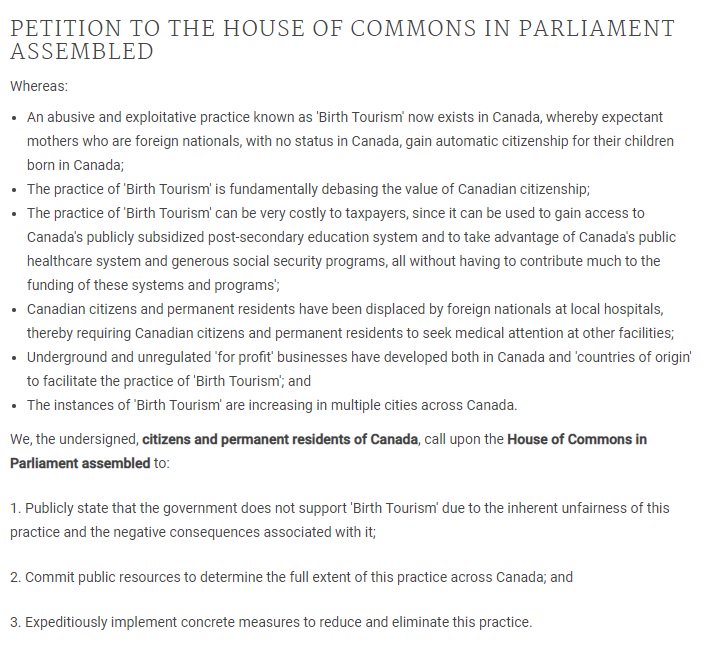
Yet another petition on birth tourism

Likely a political response to the tensions in Richmond, where over 20 percent of live births are to non-resident mothers and positioning given the Conservative party resolution calling to limit birthright citizenship to offspring of Canadian citizens or permanent residents.
Working on an article with more accurate and. spoiler alert, higher numbers which should be out later this month or early November: