‘Birth Tourism’ Is Legal in Canada. A Lawmaker Calls it Unscrupulous.

Good overview of the issues involved and interesting details on the support birth tourism “industry,” My study cited (Hospital stats show birth tourism rising in major cities) and I am quoted along with others:

Melody Bai arrived in Vancouver from China in the late stages of pregnancy with one goal: to give birth to a Canadian baby.

Awaiting her was an elaborate ecosystem catering to pregnant women from China, including a spacious “baby house” where she spent four months, attended to by a Mandarin-speaking housekeeper.

Caregivers offered free breast massages to promote lactation, outings to the mall, lectures on childbirth with other Chinese mothers-to-be and excursions for high tea.

“It’s an investment in my child’s education,” Ms. Bai, a 28-year-old flight attendant, said by phone from Shanghai, months after returning to China with her newborn and passport in hand. “We chose Canada because of its better natural and social environment.”

Ms. Bai is part of a growing phenomenon in Canada known as birth tourism, which is not only generating political opposition, but mobilizing self-appointed vigilantes determined to stop it.

It is perfectly legal.

Under the principle of jus soli — the right of the soil — being born in Canada confers automatic citizenship. But as more pregnant women arrive each month to give birth, some Canadians are protesting that they are gaming the system, testing the limits of tolerance and debasing the notion of citizenship.

In Richmond, a city outside Vancouver where about 53 percent of its roughly 200,000 residents are ethnic Chinese, nonresident mothers account for one in five births at the Richmond Hospital, the largest number of nonresident births of any hospital in the country, according to a recent report.

“Birth tourism may be legal, but it is unethical and unscrupulous,” said Joe Peschisolido, a Liberal member of Parliament in Richmond, who brought a petition against the practice to Ottawa, where the immigration minister, Ahmed Hussen, said he would examine the issue.

The practice underlines how Canada, and British Columbia in particular, has become a favored haven for well-heeled Chinese seeking a refuge for wealth and kin away from authoritarian China.

The issue of birthright citizenship gained global attention in October after President Trump said he wanted to eliminate it, though it is enshrined in the American Constitution.

At least 30 other countries, including Canada, Mexico and Brazil, grant automatic birthright citizenship. Others like Britain and Australia have tightened their laws by requiring that at least one parent be a citizen or permanent resident at the time of the child’s birth.

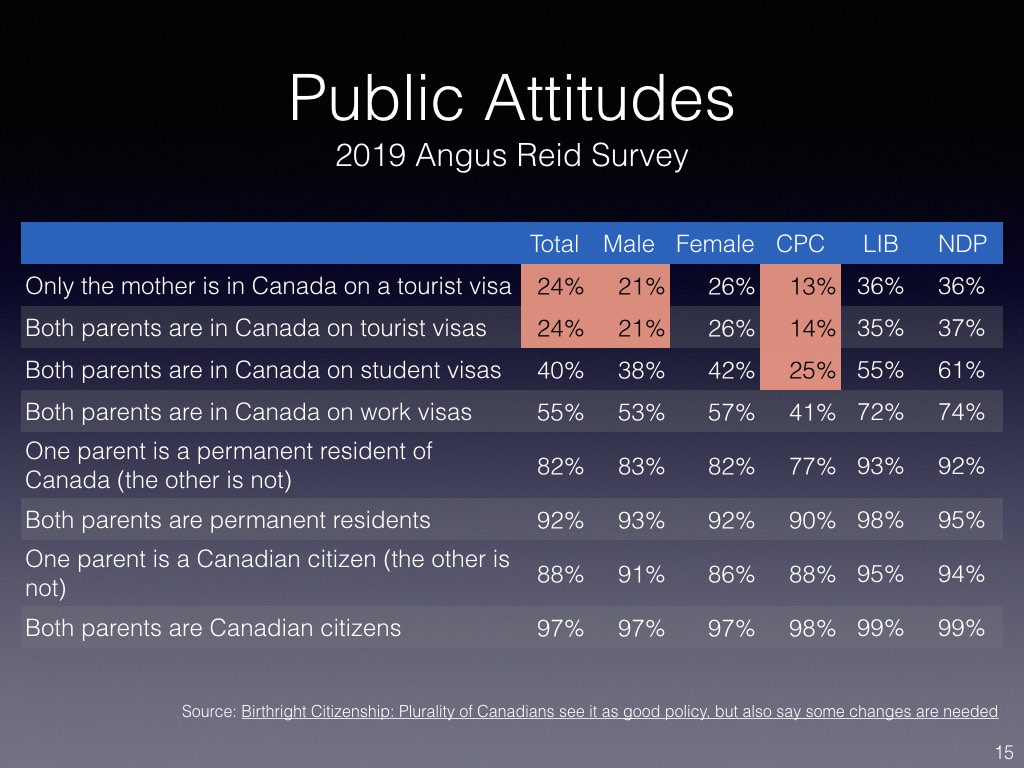
Indicating that immigration could be an issue in federal elections next year in Canada, the opposition Conservative party this summer endorsed a nonbinding motion calling for unconditional birthright citizenship to be abolished.

In the recent report, from the Institute for Research on Public Policy, Andrew Griffith, a former director general at the government department responsible for immigration, showed that the number of children born to nonresidents in Canada was at least five times as high as previously thought — close to 1,500 to 2,000 annually.

Mr. Griffith argues that Canada intended birthright citizenship for those who wanted to live in and contribute to the country. “Since those engaging in birth tourism have no or barely any real link to Canada,” he said, “the practice is challenging a very Canadian value of fair play.”

With its sprawling Chinese food markets, Chinese-language newspapers and large number of caregivers speaking Mandarin, Richmond has become ground zero for birth tourists from China.

About two dozen baby houses are in operation. Visits to about 15 addresses showed that some operate openly while others work under licenses as tour agencies or present themselves as holiday rentals. Some are in homes. Others are in apartments. Many are booked through agents and brokers in China.

In a visit to one, the Baoma Inn, a modern house across from a park, a woman in the late stages of pregnancy could be seen in a second-floor window. A young man who answered the door confirmed that the inn was a baby house before another angrily slammed the door.

But during a telephone call in Mandarin inquiring about the Inn’s services, a man said it offered a one-stop package including “guaranteed appointments” with “the No. 1 obstetrician in British Columbia,” who spoke Mandarin and had “a zero accident rate.”

Customers usually stay for three months, he said, including one month after the birth, to allow time to apply for a passport for the newborn and to recuperate, as is the Chinese custom.

He added that his agency had seven sales offices in China. The bill for a three-month stay at a two-bedroom apartment, not including meals and prenatal care, is about 25,000 Canadian dollars ($18,331).

“The women all go back to China,” he said. “They don’t enjoy any social benefits from the Canadian government and don’t need it.”

Bob Huang, who with his wife runs Anxin Labour Service, a birthing center in the nearby city of Burnaby, said he was frequently contacted by agents in China who wanted a 50 percent commission on every successful referral. He said he preferred to post his own ads on local Chinese classifieds websites.

Some Richmond residents say birth tourism is undermining the community’s social fabric.

Kerry Starchuk, a self-described “hockey mom” who spearheaded the petition championed by Mr. Peschisolido, documents baby houses in her neighborhood and passes the information on to the local news media and city officials.

On a recent morning, she received an anonymous tip on Facebook that as many as 20 pregnant “birth tourists” from China were being housed in a nearby modernist high rise.

Rushing to her minivan, she drove to a parking garage beneath a Chinese supermarket. She then hurried outside to case out a nearby building, suspiciously eyeing a pregnant Chinese woman walking by. After entering the building, Ms. Starchuk was foiled by a locked stairwell, adding the high rise to her list for another day.

Ms. Starchuk complains that birth tourists bump local mothers from maternity wards, a concern echoed by some local nurses, and get access to public services without paying taxes.

She also said the so-called “anchor babies” threatened to burden Canada by emigrating and studying here, and sponsoring their parents to become permanent residents.

Some first- and second-generation immigrants in Richmond say birth tourists have an unfair advantage by jumping the immigration queue.CreditAlana Paterson for The New York Times

The issue has become conflated with resentment in the Vancouver area against soaring housing prices, which some residents blame on an influx of wealthy Chinese.

But Ms. Bai, who had her baby in Vancouver in February, said that given the hefty price she had paid to give birth here — 60,000 Canadian dollars, including housing and hospitalization — she was subsidizing the Canadian health care system and contributing to the local economy.

“My child won’t be enjoying any Canadian health benefits, as we are living in China,” she said.

Since her son is Canadian, however, she and her husband, a pilot, could save about 150,000 Canadian dollars on tuition fees at an international school in Shanghai.

After gaining fluency in English and Western culture, her son could also later attend a Canadian university at the discounted local rate. Eventually, the entire family could emigrate to Canada.

Some first- and second-generation immigrants oppose birth tourists for jumping the queue.

“I don’t think it is fair to come here, give birth and leave,” said Wendy Liu, a Richmond resident of 11 years, adding that she had been repeatedly harassed after Ms. Starchuk mistakenly put her house on a list of birth tourism centers.

Birth tourism at Richmond Hospital recently came under the spotlight because of a so-called “million dollar baby.”

A nonresident, Yan Xia, gave birth there, racked up a bill of 312,595 Canadian dollars in maternity and neonatal care for her newborn because of complications, and then absconded without paying the bill, according to a civil claim the hospital filed at British Columbia’s Supreme Court in April, six years after Ms. Xia gave birth.

Including six years’ worth of interest, Ms. Xia’s bill would amount to about 1.2 million Canadian dollars.

There’s No Stopping the Russian Baby Boom in Miami

Very up market birth tourism services:

Matryoshka was bustling as usual, selling blinis, caviar and borscht. Not all of the customers were pregnant. Just, it seemed, most of them.

The deli store in Sunny Isles Beach, a little city on a barrier island north of downtown Miami, has long been a gathering place for Russian-speaking foreigners who stay in the area as they wait to give birth. They come for the hospitals, the doctors, the weather, the beach — not, they will tell you with some exasperation, to score citizenship for their offspring.

The perk of a U.S. passport was “the last thing on my agenda, literally,” said Viktoriia Solomentseva, 23, a former Matryoshka regular who had a daughter seven weeks ago and recently flew home to Moscow with little Emily, a newly-minted U.S. citizen. “Why does Trump think everyone is dying to have one?”

It’s a somewhat sensitive topic for the women like Solomentseva who are driving a baby boom in south Florida. They’ve been swept up in the birthright citizenship debate, reignited when President Donald Trump recently vowed to end it for children of foreigners. While his target was undocumented immigrants, he also complained that the privilege granted in the 14th Amendment has “created an entire industry of birth tourism.”

That, in fact, it has. Data are scarce, but the Center for Immigration Studies has estimated more than 30,000 women tap it every year. Some nationalities prefer certain metropolitan areas, with the Chinese, for instance, favoring Los Angeles, while Nigerians tend to choose cities in the Northeast and Texas. For women with roots in the former Soviet Union, it’s Miami; if they’re affluent, it’s Sunny Isles Beach, called Little Russia because so many of its 22,000 residents hail from that part of the world.

And these women’s numbers, by all accounts, are growing. The weakness of the ruble, the tense relations between Russia and the U.S., the hurdles that have to be scaled to get a visa — none of that is slowing down the flow.

On every flight to Miami from Moscow there’s at least one pregnant woman, said Konstantin Lubnevskiy, the owner of an agency called Miami-mama, whose logo is the silhouette of an expectant mother in front of a big American flag. On some, there are more than five, he said. “What they’re doing is perfectly legal.”

True enough. But honestly, is it for the passports?

Absolutely not, Solomentseva said from the marble-laden lobby of one of the Trump Towers in Sunny Isles Beach, where she’d rented a 39th-floor unit for a few months. “I wanted to give birth in the place that has the best medical service and is comfortable and relaxing,” she said, as her husband, who owns a business in Russia, looked after the baby upstairs. Not incidentally, the weather is a lot more pleasant in Miami than Moscow in the winter. “But I can’t wait to get back to Russia.”

Like everyone else, she did, of course, fill out the necessary paperwork for Emily. It’s not as if citizenship isn’t viewed as something that might one day come in handy. Maybe it could help a kid get into a U.S. college, or set up a business in New York, or buy a house in Sunny Isles Beach, said Moscow resident Anna Bessolnova, 42, who had a girl in Miami in 2014, days before Russia’s annexation of Crimea triggered waves of international sanctions.

“I don’t know whether my daughter will end up using the passport or not, but it’s good to have different options,” she said.

Maria Khromova, whose son was born last month in Miami, has the same attitude. “Nobody knows what’s going to happen 20 years from now.”

Like all the rest, though, Khromova said she chose to have her baby in the U.S. mainly because of the superior medical care. She pointed to two C-section scars under her shirt, one from the birth of a daughter in Russia and another from the same procedure for her son. The first one is so ugly she can’t look at it without crying, she said.

Khromova, 36,  also stayed in the Trump-branded condo complex. She was there for three months, assisted by a nanny, an interpreter, a driver, a yoga tutor and a massage therapist. A native of Siberia, she lives with her husband in Phuket, Thailand, where they run a company that helps foreigners buy property.

“I came here with a lot of money to spend,” she said. “I don’t cost the U.S. taxpayers a thing.”

Being a birth tourist in Sunny Isles Beach isn’t cheap, with agencies charging as much as $50,000 to set up housing, hire interpreters, find doctors and deal with paperwork. Those who can’t afford that level of service buy smaller packages and rent apartments in far-flung suburbs, sometimes teaming up to share lodgings and expenses.

The phenomenon has, over the years, attracted bad actors. Federal agents have raided so-called maternity hotels in California catering to women from China and Taiwan; some were coached to disguise their pregnancies when they arrived in the U.S. and lied about why they were in the country, according to federal officials. Miami-mama was raided once, too, and a notary public was indicted for making a false statement in a passport application and conspiring to commit an offense against the U.S. (That employee was immediately terminated, Lubnevskiy said.)

The focus of Trump’s criticism hasn’t been the abuse of the system but the fact that it exists. One of his arguments against birthright citizenship is that when the babies born on U.S. soil become adults, they can petition for their parents to live permanently in the country.

But to many of the Russians in Sunny Isles, at least, this idea sounded unappealing. The biggest deterrent: They’d have to start paying personal income taxes that are more than double what they are in Russia. “There’s this feeling among some that it’s cool to be a U.S. citizen,” said Victoria Parshkova, who had a son in September. “It’s not cool at all.”

Ethnic media on birth tourism (2): Spanish, Chinese (4 articles), Korean

MIREMS, Multilingual International Research and Ethnic Media Services, kindly shared what they are picking up on birth tourism in the ethnic media:

Federal government wants to better understand ‘birth tourism’ – Spanish

Description: A study shows that in 2016, many more babies were born to non-resident mothers in Canada than what official statistics indicate, which has led the federal government to analyze the phenomenon in order to better understand why women are coming to give birth here and make their babies Canadian citizens. Using data from the Canadian Institute for Health Information (CIHI ), researcher Andrew Griffith found that in 2016, 3,200 babies were born in Canada whose mothers were not residents of this country. Statistics Canada’s data shows that there were only 313. The CIHI records invoicing and payment information directly from the hospitals and this is how the statistics were obtained. According to the findings, the numbers are not only higher than what was believed, but there is an increasing trend.
WEB – Noticias Montreal (30000 – Daily6) – Montreal, 26/11/2018 – NEWS, 1/2 page web, 1st Top, Spanish

Ottawa is finally paying attention to maternity tourism – Chinese

Description: Ottawa is now studying so-called “birth tourism” in the hope of better understanding how many women travel to Canada to have babies so that the babies can be born as Canadian citizens. New research shows that more babies are born in Canada to foreign residents than Statistics Canada realized. Using numbers from the Canadian Institute for Health Information, which captures billing information directly from hospitals, researcher Andrew Griffith found that over 3,200 babies were born here to women who were not Canadian residents in 2016 — compared with 313 babies recorded by Statistics Canada. The finding suggests not only that the numbers are higher than previously reported but that it is a growing trend, Griffith said.
PRINT – Epoch Times (54000 – Daily5) – Toronto, 26/11/2018 – News, 1/4 page, p. A4, Chinese

The birth rate of anchor babies in Canada is being significantly underestimated – Chinese

Description: RCI Ya Ming – Immigration Minister Ahmed Hussen promised to study the issue of birth tourism. Researcher Andrew Griffith used numbers from the Canadian Institute for Health Information, which captures billing information directly from hospitals, and found that more than 3,200 babies were born here to women who aren’t Canadian residents in 2016, compared with only 313 babies recorded by Statistics Canada. Griffithsaid that this finding not only suggests that the numbers are higher than previously reported, but that it’s a growing trend. This trend exists in all Canadian provinces, with the exception of Quebec.
WEB – iask (Daily7) – Markham, 23/11/2018 – NEWS, 1 page web, 1st Top, Chinese

Birth tourism seeking citizenship is hiking up – Korean

Description: A new study shows that the number of births in Canada by nonresidents, known as “birth tourism,” is much higher than previously reported. The level of birth tourism nationally in Canada is at least five times greater than recorded by Statistics Canada while the number of babies in the case has been increased to 3,628 in 2017 from 1,354 in 2010. The majority of birth tourists are from Asia, including China, and prefers B.C. as the destination.
PRINT – Canadian Korean Times Weekly (Weekly) – Toronto, 26/11/2018 – NEWS, 1/4 page, 1st Top, Korean

Two thousand anchor babies are born every year; Metro Vancouver residents want to ban them from getting Canadian citizenship – Chinese

Description: Amy – Birth tourism figures in Canada are around 1,500 to 2,000, five times higher than Statistics Canada had estimated. Richmond resident Kerry Starchuk twice launched petitions to call on Parliament to ban anchor babies from automatically acquiring Canadian citizenship. One of the petitions she launched was supported by Alice Wong. Starchuk emphasized that the purpose of launching the petition was not to target babies born in the country. She is concerned that the large number of anchor babies will become a heavy burden on public spending in future. This August, the federal Conservative Party passed a motion that seeks to amend the law and ban anchor babies from automatically acquiring citizenship.
WEB – Vansky (Daily7) – Vancouver, 22/11/2018 – NEWS, 1 page web, 1st Top, Chinese

2,000 anchor babies are born in Canada every year – Chinese

Description: Sing Tao – A recent report pointed out that about 1,500 to 2,000 anchor babies are born in Canada (every year). Of the 25 hospitals where most such births occur, six are in Ontario, while two are in B.C. Among them, the Richmond Hospital recorded the largest number of anchor babies. The report made three recommendations, including requiring foreign female visitors to disclose the purpose of their visit to Canada, and considering a baby’s citizenship to be obtained through fraud if the mother came for birth tourism.
WEB – CFC NEWS (Daily4) – Ottawa, 22/11/2018 – NEWS, 1 page web, 1st Top, Chinese

BC MLA aims to address birth tourism as new data shows high non-resident birth rates

Given that most actions to curb the practice require at a minimum provincial cooperation if not collaboration, something to watch:

A new study came out last week suggesting the number of “anchor babies” in Canada, especially in Richmond, is much higher than previously expected, and MLA Jas Johal [Liberal, from Richmond] said he will introduce a petition to the B.C. government to “address the problem.”

An anchor baby is a term used to refer to a child born to a non-citizen mother at the time of the child’s birth in a country that has birthright citizenship.

Policy Options magazine published a new study last Thursday from the Institute for Research on Public Policy, suggesting every year, there are 1,500 to 2,000 “anchor babies” born in Canada.

Among all the hospitals in Canada, Richmond Hospital has the highest volume of babies born to non-resident mothers – 469 last year, taking up Richmond’s number of such births to 21.9 per cent of the total births in the hospital.

“I’m glad this national organization was able to shed light on this issue. It acknowledges for the first time everything everyone suspected and builds on the reporting the Richmond News has done,” said Johal.

“Every level of government has to acknowledge the issue and work together. We can’t just be polite Canadians and not deal with it. It has nothing to do with political correctness, but got everything to do with our healthcare system, for and by Canadians. Period.”

Johal said he is very concerned about the birth tourism industry, which “is not only allowed to exist, but to flourish.” He is working with some local residents to put together a petition, which he will introduce to the province in spring.

“There is a whole industry built on marketing these practices, attracting these individuals, housing these individuals, making sure they get proper medical treatment and care services,” said Johal.

“What are the companies being set up to bring these women here? How much do they charge? What’s the money they make? We need to shine some sunlight into an industry that’s being done in the shadows.

“And there is cost to taxpayers. I know they pay for natural birth and C-section, but the potential capacity could be used for somewhere else in the health care system in Richmond.”

The petition, according to Johal, will ask the provincial government to acknowledge that birth tourism exists and have a public say that the government does not support it.

“It will also ask the government to take concrete measures, to eliminate or very much reduce the practice,” he said.

Johal said as an immigrant moving from India when he was little, this issue upsets him on the personal level.

“I value the Canadian passport more than anything in my life, but this fundamentally debases the value of Canadian citizenship,” said Johal.

Source: MLA aims to address birth tourism as new data shows high non-resident birth rates 

Revoking birthright citizenship would affect everyone: Jamie Liew

Jamie Liew, an immigration lawyer and law professor, responds to my article, providing the “what’s the problem” perspective, noting the relatively small number as percentage of total births (and immigrants) and the likely impact on all Canadians.

However, the only option she mentions is that of requiring all Canadians to apply for citizenship. Yet when the previous government pressed unsuccessfully to abolish birthright citizenship, the other option of having the provinces apply the policy through the birth registration process was favoured at it would not impose that burden on all Canadians (see What the previous government learned about birth tourism). The provinces refused given the smaller numbers at the time (estimated at 500) and the associated costs.

However, just as the provinces were able to issue enhanced drivers licences with citizenship status as a way to make it easier for Canadians to travel to the US without a passport following 911, the provinces could do the same with birth certificates, although this would also be costly given the operational implications.

Of course, any such change would require addressing statelessness, as the previous government did with respect to citizenship revocation in cases of terrorism or treason. The examples cited of the number of persons possibly being effected are, in my opinion, exaggerated.

I find it somewhat tiresome to hear arguments that such a policy is inherently divisive, discriminatory and arguably racist. Even if some opposed to birthright citizenship may be driven by xenophobia, advocating such a policy or other changes to reduced the practice is not inherently xenophobic. It simply aims at avoiding abuse of birthright citizenship of those who come simply to give birth, obtain citizenship for their child, and then return to their country of origin.

One can argue on whether or not such a fundamental change to birthright citizenship is warranted (I don’t favour this option at present) but largely dismissing the issue and overstating collateral impacts are less than helpful to informed public discussion.

It is encouraging that the government has acknowledged the issue, agreed to study the issue, and engage the same organization to conduct the study that I obtained the numbers cited in my article (Canadian Institutes of Health Information):

There has been a lot of talk about getting rid of birthright citizenship in Canada and the United States. President Trump recently announced he will issue an executive order that would do away with automatic citizenship for babies born in the US. Conservative Party of Canada members passed a motion last August that would end birthright citizenship unless one parent is a citizen or permanent resident, should the party form government. And Liberal MP Joe Peschisolido has sponsored a petition to eliminate birthright citizenship.

In the US, the president will have to contend with the fact that he cannot just unilaterally eliminate a right in the 14th Amendment of the Constitution. In Canada, however, the story is different: birthright citizenship can be eliminated simply by amending or repealing parts of the Citizenship Act.

In both the US and Canada, the preoccupation with ending birthright citizenship is tied to the argument that migrants are engaging in “birth tourism” and challenging the integrity of citizenship. But the facts say otherwise.

Andrew Griffith, a former director general at Immigration, Refugees and Citizenship Canada recently analyzed hospital financial data for Policy Options, and noted that a sharp rise in birth tourism in some Canadian hospitals can no longer be considered “insignificant.” Still, Griffith found that only 1.2 percent of births can be attributed to mothers who reside outside of Canada. The figure might actually be lower if births to other temporary residents such as corporate transferees and international students and Canadian expatriates returning to give birth are factored in.

While there appears to be an increasing trend, the low overall levels suggest there is no business case for changing Canada’s citizenship policy. Eliminating or even creating a “graduated” birthright citizenship on this basis would be akin to an enormous hammer hitting a tiny nail.

The elimination of birthright citizenship would affect not just migrants, but all of us. A citizenship application will need to be made for every person born in Canada. More tax dollars would be needed to process the applications. Clerks would suddenly have the power to make substantive and legal determinations about the status of every person that applies for citizenship. Like any administrative system, mistakes would be made. Bad or wrong decisions would be challenged in the courts at great expense to both the state and the people affected. People would struggle with the fact that they are stateless in the interim.

Undoubtedly, doing away with birthright citizenship would increase the number of stateless persons in Canada. Being stateless has serious implications. Stateless persons have difficulty accessing education, employment, health care, social services and freedom of movement. Simple things like obtaining a bank account, cell phone account or registering birth, marriage or death are complicated if not impossible. Stateless persons would be subject to arrest, detention and potential removal to places they may never have been before.

The elimination of birthright citizenship would have the greatest impact on the most vulnerable: the indigent, those with mental illness, and children who are in precarious family situations or are wards of the state. These are the people that may not have the appropriate paperwork or proof that they do qualify for citizenship or do not have support for obtaining citizenship. For example, parents (who are Canadian citizens or permanent residents) of persons seeking citizenship may have lost paperwork, may not want to cooperate, may not be in the country, or may find out they are not the biological parent of that child.

This one policy would create an expensive social problem for the state.

The elimination of birthright citizenship is not an act to preserve or protect the integrity of citizenship. The policy would be a dividing tool. Ending birthright citizenship would legitimize the argument that racialized persons are less deserving of citizenship, even though there is no evidence to show that children born of foreign mothers do not stay in Canada and do not contribute to society. The policy would also fuel discrimination against those of different socio-economic classes, because the most vulnerable and marginalized would have the most difficulty in accessing citizenship, or if they are citizens proving that they are. These administratively stateless people would be treated like foreigners and outsiders, even though they are eligible and qualify for citizenship. It is a tool to delegitimize people who have a genuine and effective link to Canada. It would create barriers to important rights that come with citizenship, including the right to vote.

We only need to look at how stripping citizenship and the denial of citizenship elsewhere in the world has encouraged discrimination, persecution and violence against stateless people. For example, the oppression of Rohingya and the genocide against them was precipitated by their being denied citizenship in Myanmar, a country they called home for generations.

Canadians should be cautious when considering the idea of getting rid of birthright citizenship. It would not stop migrants from coming. Instead of making it harder to get citizenship, we should trust our well-oiled immigration system to deal with the entry of people into our country. If there are issues with the authorization of persons entering our country, it is immigration law that should be tweaked, not citizenship law.

Canada has signed both the Convention on the Reduction of Statelessness and the Convention on the Rights of the Child, which obligate Canada not to create situations of statelessness. My father was born stateless because the state he was born into did not confer birthright citizenship. It affected his opportunity for education and employment, as well as his mental health. Being a child of a previously stateless person, I am proof enough that welcoming stateless people to Canada with the conferral of citizenship is the best way to build a nation.

Source: Revoking birthright citizenship would affect everyone

Ethnic media coverage of birth tourism: Cantonese, Chinese, Punjabi, Haitian

MIREMS, Multilingual International Research and Ethnic Media Services, kindly shared what they are picking up on birth tourism in the ethnic media:

Study shows birth tourism much more prevalent in Canada than reported by StatsCan – Cantonese

Description: A new study shows that the number of births in Canada to non-residents, known as “birth tourism,” is much higher than previously reported by Statistics Canada. The study was done by Andrew Griffith for Policy Options, a policy think tank. It was found that the level of birth tourism nationally in Canada is at least five times greater than the 313 births recorded by Statistics Canada in 2016, sitting at 3,223. Immigration Minister Ahmed Hussen said they will look into the number of people coming into Canada to give birth and will investigate “immoral birth consulting services.” Conservative Leader Andrew Scheer said at the time one of the goals would be to end the practice of women coming to Canada simply to give birth to a child who will automatically have Canadian citizenship.
TV – Fairchild TV Ontario (400000 – Daily7) – Toronto, 23/11/2018 – News, 1 – 2 min, 02/05, Cantonese

Federal government to investigate impact of “maternity tourism” on the country – Chinese

Description: Based on the figures from the Canadian Institute for Health Information (CIHI), researcher Andrew Griffith found that in 2016, there were 3,200 babies born to “maternity tourism” mothers in Canada; that number is 9 times higher than the 313 babies recorded by Statistics Canada. Immigration Minister Ahmed Hussen said that his department has commissioned CIHI to conduct a study to fully understand the extent of the impact of maternity tourism on Canada.
WEB – Ming Pao Toronto (227000 – Daily7) – Toronto, 23/11/2018 – NEWS, 3/4 page web, 2nd, Chinese

Ottawa probes birth tourism as new data shows higher non-resident birth rates – Punjabi

Description: With new research showing that more babies are born in Canada to foreign residents than Statistics Canada realized, the federal government is studying the issue of “birth tourism” in the hope of better understanding how many women travel to Canada to have babies who are born Canadian citizens. Using numbers from the Canadian Institute for Health Information (CIHI), which captures billing information directly from hospitals, researcher Andrew Griffith found over 3,200 babies were born here to women who weren’t Canadian residents in 2016. Ontario immigration lawyer Gordon Scott Campbell said he’s had several clients in recent years who have given birth while in Canada while in the middle of legitimate refugee or immigration processes. For example, he said some women with visitor status live with their spouses while applying for spousal sponsorship, and some refugees arrive pregnant or become pregnant while waiting for their claims to be processed. But it doesn’t mean that birth tourism is a widespread practice, Campbell added. Immigration Minister Ahmed Hussen responded by saying his department has commissioned research to get a better picture of the scope of the issue in Canada.
RADIO – Red FM 106.7 Good Morning Calgary (Daily5) – Calgary, 23/11/2018 – News, 1-2 mins, 12/14, Punjabi

Tendance à la hausse au pays pour le tourisme de naissance – Haitian

Description: François Jean Denis – Une nouvelle étude démontre que plus de bébés sont nés au Canada d’une mère vivant à l’étranger que ne le croyait Statistique Canada. Les statistiques affichent une hausse croissante du nombre et du pourcentage de ce genre de naissances dans toutes les provinces, sauf au Québec. Le gouvernement fédéral étudie ce qu’il appelle le « tourisme de naissance » dans l’objectif d’avoir une idée plus précise du nombre de femmes qui voyagent au Canada pour avoir des bébés qui naissent citoyens canadiens. Le chercheur Andrew Griffith a utilisé des données de l’Institut canadien d’information sur la santé (ICIS) qui obtient des informations de facturation directement des hôpitaux. Elles ont révélé qu’en 2016, plus de 3200 bébés étaient nés ici de femmes qui n’étaient pas résidantes canadiennes, comparativement aux 313 bébés enregistrés par Statistique Canada. Ces femmes viennent au Canada pour donne la citoyenneté canadienne à leurs enfants. La découverte suggère non seulement que le nombre est 10 fois plus élevé que celui précédemment rapporté, mais que c’est une tendance à la hausse, selon M. Griffith. Le député libéral Joe Peschisolido a récemment déposé à la Chambre des communes une pétition appelant le Canada à prendre des mesures plus énergiques pour mettre fin au tourisme de naissance, affirmant qu’il porte atteinte au système de protection sociale du Canada. Est-ce que cela va remettre en question le droit du sol ? Désormais, plusieurs pays ont mis au point ou modifié leurs lois sur le droit de naissance, notamment le Royaume-Uni, l’Australie, l’Irlande, la Nouvelle-Zélande, l’Inde, la République dominicaine, la Thaïlande et le Portugal. Auparavant, des femmes venaient au Canada et partaient sans payer les frais d’hospitalisation. Aujourd’hui, les hôpitaux ont pris des dispositions pour empêcher ce problème. Aujourd’hui, c’est impossible pour des femmes étrangères d’accoucher sans payer parce qu’avant même de les admettre, on leur demande de payer. En tout cas, on ne va pas contester le droit du sol au Canada.
RADIO – CPAM 1410 AM – Immigration (Weekly) – Montreal, 24/11/2018 – NEWS, 3 mins, 02/04, French

Chris Selley: Maybe Canada has a ‘birth tourism’ problem after all

My Policy Options article (Read Story) prompted more comment. I agree with Selley in his critique of the over-reaction by the Liberals and the NDP to the CPC policy resolution calling for an end to birthright citizenship and the reflexive labelling of the proposal as racist or xenophobic rather than a measured response.

Which, as Selley notes, the government now has in its plans to study the issue using the same data from CIHI that I used in my article:

Well, here’s something curious. Last week the Liberal government announced it has commissioned research on “birth tourism” — that is, the practice of coming to Canada with the sole intent of giving birth, then returning home with a child who’s a Canadian citizen. “The government of Canada recognizes the need to better understand the extent of this practice as well as its impacts,” Citizenship Minister Ahmed Hussen wrote in a response tabled in Parliament.

It’s in reaction to new research by Andrew Griffith, a former senior official at Citizenship and Immigration Canada, published last week in Policy Options. It suggests the practice may be far more widespread than had previously been thought.

Earlier reported numbers from Statistics Canada, based on provincial records, suggested there might be 300 such births in a year. But a single hospital in Richmond, B.C., was reporting more. Griffith turned instead to the Canadian Institute for Health Information’s discharge abstract database, and found that 1.2 per cent of births between 2010 and 2017 in Canada, excluding Quebec, were to non-resident mothers.

That excludes refugee claimants and permanent residents who aren’t yet eligible for their province’s medical insurance; they are categorized separately. It includes people who aren’t birth tourists as we commonly think of them: Foreigners posted to Canada by their employers, international students, and Canadian expats returning home to give birth.

Even if just half of those are “birth tourists,” though — a conservative estimate, in Griffith’s view — it’s still more than five times what had been reported. We might be granting citizenship to more birth tourist babies than Prince Edward Islander babies. The numbers grew steadily from 1,354 in 2010 to 3,628 in 2017.

None of that is to say this is a massive problem. I say it’s curious because earlier this year, when Conservative Party of Canada members approved a resolution in favour of the most superficially obvious solution — don’t grant automatic citizenship to Canadian-born children of parents who aren’t citizens or permanent residents — the Liberals, along with much of the Canadian media, went absolutely bananas.

“The NDP unequivocally condemns the division and hate being peddled by Andrew Scheer and the CPC,” leader Jagmeet Singh tweeted. Gerald Butts, Prime Minister Justin Trudeau’s principal secretary, lamented that the Conservatives “committed to give the government the power to strip people born in Canada of Canadian citizenship.”

Media consumers were told the policy would create stateless children. But Canada is bound by treaty not to create stateless people, as are the majority of countries around the world that do not grant absolute birthright citizenship. Even the Conservatives’ law stripping convicted terrorists of Canadian citizenship respected obligations regarding statelessness; there’s every reason to believe these changes would as well.

“(It’s a) shame to see the Conservatives going back down the path established by the Harper government, which seeks to strip away the citizenship of people who have only ever known Canada as a home,” a spokesperson for Citizenship Minister Ahmed Hussen fulminated.

You would never know it was Richmond MP Joe Peschisolido, a Liberal, who sponsored a petition asking the government to condemn birth tourism and figure out how to stop it. And you would certainly never know lawyers for Hussen’s department were in court arguing not to grant citizenship to two Canadian-born children of Russian spies.

“Only 34 countries grant the automatic acquisition of citizenship through birthplace regardless of parents’ nationality or status,” the federal submission argued (noting none of the 34 are in Europe). “This practice is not consistent and uniform enough to ground a rule of customary international law.”

This is a trick only Liberals can pull off: Deny a problem exists; denounce those who suggest it exists as despicable human beings trying to foment social unrest; later accept there may actually be a problem without the slightest bit of humility, and if possible continue denouncing those who think there’s a problem even while trying to solve it. It speaks ill of our political arena that they get away with it so often.

None of the potential solutions are especially palatable. Griffith suggests asking visa applicants whether they intend to give birth in Canada; misrepresentation could lead to revocation of the child’s citizenship, as it would have been acquired fraudulently. He suspects enforcement would be “virtually impossible,” however. And asking visiting women about their reproductive intentions is the sort of thing Liberals would scream bloody murder about in opposition.

The Conservatives examined the idea of limiting birthright citizenship but ultimately rejected it for reasons of cost and practicality. But after studying the problem more in depth, if the problem really is five times or more bigger than we thought, there is no reason not to consider it again. This is something nearly every country comparable to Canada does without violating human rights. It makes perfect sense: We don’t grant citizenship to children of foreign diplomats; why grant it to others whose parents have no personal link to Canada? There is something more than a bit weird about a country where such a normal idea can be met with such hysteria.

Source: Chris Selley: Maybe Canada has a ‘birth tourism’ problem after all

In Ireland, Bid to Restore Birthright Citizenship Gains Ground

More on Irish birthright citizenship debates, where the case of a young boy has helped shift opinion:

Ireland, which seems intent on bucking the illiberal tide in the West, is at it again: As other countries move to tighten restrictions on immigration, the Irish public is overwhelmingly in favor of a proposal to reinstate birthright citizenship.

A proposed law on the subject passed a preliminary vote in the Irish Senate on Wednesday, three days after an opinion poll for the Irish edition of The Sunday Times of London showed that 71 percent of respondents favor birthright citizenship. Nineteen percent were opposed and 10 percent undecided.

Should it be enacted, the proposed law would grant the right to citizenship to any person who is born in Ireland and subsequently lives in the country for three years, regardless of the parents’ citizenship or residency status. It would largely reverse the effect of 2004 referendum in which 79 percent of voters supported the removal of a constitutional provision granting citizenship to anyone born in Ireland.

This remarkable swing in public opinion, at a time when President Trump has called for ending birthright citizenship in the United States, follows a high-profile case in which Eric Zhi Ying Xue, a 9-year-old boy who was born in Ireland, was threatened last month with deportation along with his Chinese mother.

His teachers and classmates at St. Cronan’s School in County Wicklow rallied around him, and a petition asking the government not to deport Eric or his mother collected 50,000 signatures within a few days. The family was instead given three months to make a case to be given legal permission to remain in the country, a possible route to full citizenship.

As popular as it may be, the birthright citizenship proposal has one critical opponent: the Irish government, which says it will seek to defeat the new bill.

The government’s opposition is based on the special relationship between Ireland and Northern Ireland, said a spokesman for the Department of Justice and Equality, which has responsibility for immigration matters.

Although Northern Ireland is part of the United Kingdom, its people are legally entitled to both British and Irish citizenship. The Irish government fears that people living illegally in Britain could move to Northern Ireland, give birth to a child there and obtain Irish citizenship for their child after living there for three years.

The parents could then use the child’s citizenship to obtain residency anywhere in Ireland or the United Kingdom which, though separate countries, confer extensive mutual residency and travel rights on each other’s citizens.

There are also concerns that British residents seeking to retain European rights to free movement after Britain leaves the European Union might use the same mechanism to obtain citizenship in the Republic of Ireland, which will remain in the bloc.

The case of Eric Zhi Ying Xue, who was born in Ireland and threatened with deportation, galvanized public opinion in favor of birthright citizenship.
The spokesman also said that the present path to citizenship for those born in Ireland was aligned with the provisions in most other European Union member states, and that the government had the discretion to make exceptions in difficult cases. Under the current system, the Irish-born individual must have at least one Irish parent, or several years of legal residency in Ireland by a parent, to qualify for citizenship.

Ivana Bacik, the senator who introduced the bill, said that the current immigration system was too slow and too dependent on the opaque decisions of officials.

“Over the last few years, we’ve seen a number of cases of children born and raised in Ireland, yet who are threatened with deportation because their parents’ immigration cases have dragged on for years and years,” Ms. Bacik said.

“In cases like Eric’s, the ministers tend to intervene under public pressure and give leave to remain,” she said. “But it shouldn’t be up to the classmates of frightened children to mount campaigns to have them stay in the country.”

Ms. Bacik said that her bill had the support of the three main opposition parties, and that she was confident it would pass all stages in the Senate. But its prospects in the more powerful lower house, the Dail, are less certain.

“Whether it can pass in the Dail remains to be seen, but I’m hopeful,” she said. “The government is more trenchant in its opposition than we expected. Their talk in the Senate about new waves of immigrants was almost Trumpian. But even if they can defeat this bill, they will still have to do something to regularize people in this position.”

The Irish Council for Immigrants, an independent nongovernmental organization, said that Eric’s case was part of a broader problem relating to the registration and legalization of children who were either born in Ireland to undocumented immigrants or brought to the country when they were very young.

This year, pupils, teachers and parents at a school in Tullamore, County Offaly, successfully fought the deportation of Nonso Muojeke, a 14-year-old who was born in Nigeria but has lived in Ireland since the age of 2.

“It is really the classmates of these children who are standing up for them,” said Pippa Woolnough, a spokeswoman for the Irish Council for Immigrants. “It’s people saying, ‘Hang on, this is Eric or Nonso; I play with him after school and he’s part of our community. He’s as Irish as I am.’”

Immigrant support groups complain that Ireland’s immigration system is intimidating, inconsistent, slow and difficult to navigate. They want the government to make the system more streamlined and transparent, so that children threatened with deportation do not have to lobby in the hope that someone with influence will take an interest in their case.

Maeve Tierney, the principal of St. Cronan’s, where Eric is a student, said that she had heard from other schools that there could be several hundred more cases similar to those of Eric and Nonso, and that the government may have opposed the proposed changes for fear of setting a precedent.

But she said the current system was unfair and unsustainable.

“I’m not saying open the doors to everyone and anyone,” she said. “Any system can be exploited. But this is just wrong.”

Source: In Ireland, Bid to Restore Birthright Citizenship Gains Ground

Birth Tourism: Media interest following my Policy Options piece (updated)

While I had expected considerable media interest, given the substance and the politics of the issue, yesterday had me doing TV interviews on all major networks and a radio interview with Rob Breakenridge of Global news in Calgary.

The most in-depth TV interview was on Power and Politics at the 1:13 mark: Power and Politics 23 Nov 2018.

Global TV:  New numbers show more ‘birth tourism’ in Canada than thought

CTV: New data shows birth tourism on the rise on Canada

Later interviews

On Radio Canada Vancouver (in French):

Boulevard du Pacifique: La Colombie-Britannique, chef de file du tourisme des naissances

CTV’s Your Morning:

Shocking new study reveals “birth tourism” in Canada is steadily increasing

The Sunday Edition, with Michael Enright, featuring mmigration lawyer Jamie Liew and Jas Johal, MLA for Richmond-Queensboroug: Birth tourism may be a hot button issue in the next federal election


Richmond Hospital is ground zero for the skyrocketing number of ‘anchor babies’ born in Canada, study indicates

Good report from the Vancouver Star:

More than one in five babies born in Metro Vancouver’s Richmond Hospital could be so-called “anchor babies” — children born to non-residents in order to gain Canadian citizenship — according to a new study.

The study, authored by the Institute for Research on Public Policy (IRPP) and published Thursday in Policy Options magazine, suggests 21.9 per cent of the children delivered in Richmond Hospital are born to non-resident mothers — more than double the percentage born in any other Canadian hospital.

The IRPP study also shows the number of such children born in Canada is far higher than previously estimated.

While a Statistics Canada report found roughly 312 babies are born in the country each year to mothers whose place of residence is officially listed as outside of Canada, IRPP’s study put that number at closer to 1,500 or 2,000 children annually. The data shows the number of births to non-resident mothers — including all provinces but Quebec, which refused to release the data — skyrocketed to 3,628 last year from just 1,354 in 2010.

The issue of birth tourism — when pregnant women fly to Canada to give birth — is divisive because children born under such circumstances are automatically granted Canadian citizenship. They therefore enjoy all the attendant rights and privileges, such as access to domestic university fees as well as subsidized education and health care, even though their parents aren’t taxpayers and the children themselves will not necessarily be raised in Canada.

Joe Peschisolido, Liberal MP for Steveston-Richmond East, believes the revelation provided by the study has some troubling implications.

“Even though I believe the (birth tourism) epicentre is in Richmond — and at the hospital in Richmond — I think you’re starting to see birth tourism as an institution,” Peschisolido told StarMetro in a Thursday phone interview.

“There are individuals that are profiting from this. And I think that’s the most heinous thing. You’re getting individuals that are abusing … the immigration and citizenship system … and are profiting off of an illegitimate — and the government has said unethical — system.”

A Thursday statement from Vancouver Coastal Health (VCH) confirmed the numbers in the IRPP study, though slightly more children were actually born to non-resident mothers in Richmond Hospital than the IRPP study accounted for.

While the IRPP study showed 469 non-resident births occurred in Richmond Hospital in 2017-18, VCH’s figures show 474 children were born to 469 resident mothers. The disparity, the statement explained, comes from the number of twins born in that time period.

And while the number of babies born to non-resident mothers has been increasing over the past several years — from 15.4 per cent of the total in 2014-15 to 22.1 per cent of the total in 2017-18 — the total number of babies born to all mothers decreased slightly this year, according to VCH.

The health authority also noted that non-residents are required to pay all hospital and medical-care costs for the mother and baby, including a prepayment deposit of $8,200 for a vaginal birth and $13,300 for a caesarean birth.

In March, Peschisolido sponsored a petition spearheaded by Richmond resident Kerry Starchuk calling on the federal government to condemn the “abusive and exploitative practice” of birth tourism.

Birth tourism, the petition said, fundamentally debases the value of Canadian citizenship; costs taxpayers money, since children of non-residents have access to services such as health care and subsidized education; and displaces residents from local hospital beds.

On Monday, the federal government tabled its response to Peschisolido’s petition, saying Canada does not currently collect information on whether a woman is pregnant when she enters Canada.

“A person is not inadmissible nor can they be denied a visa solely on the grounds that they are pregnant or that they may give birth in Canada,” the response reads.

And while misrepresenting the purpose of a visit to Canada to a federal officer carries “significant consequences,” the statement points out citizenship acquired through birth on Canadian soil has been policy since 1947.

Ottawa’s response, however, refers back to 2016 data from Statistics Canada, saying only about 300 of the 385,000 children born in Canada each year are born to non-resident mothers.

“This constitutes less than 0.1 per cent of the total number of births in Canada,” the response says, adding these numbers show the practice is not widespread but that the government has nevertheless commissioned research from the Canadian Institute for Health Information to look into the issue. It also committed to developing measures to address the institute’s findings.

Peschisolido said he was satisfied with the response. He said he hopes to participate in the review process once more granular data has been collected and responsible decisions can be made about the extent of birth tourism and what can be done to stop it.

But Will Tao, a Vancouver immigration lawyer, said he worries that focusing purely on statistics risks unnecessarily casting aspersions on all non-resident mothers.

“I don’t think (birth tourism) is the problem itself, so much as a symptom of the problem,” Tao told StarMetro. “I think the real problem is the unregulated nature of immigration advice.”

There are most certainly practitioners abroad who advise mothers to come to Canada to give birth as a kind of backdoor to citizenship, he said. And the federal government could do a better job providing a narrative — much in the way it has for individuals seeking refugee status — that would discourage abuses of the birthright policy, he said.

But there are countless non-residents who have children while in Canada for many other reasons. Those people, he said, should not be painted with the same brush as those who wilfully exploit the path to Canadian citizenship.

The IRPP study reflects that concern, noting its figures are not exact because they don’t express how many children were delivered by mothers with temporary status in Canada — a bracket that includes Canadian expatriates returning to give birth, corporate transferees and international students.

But researcher Andrew Griffith told The Star that a conservative estimate would suggest roughly 40 or 50 per cent of the non-resident mothers were birth tourists.

The study mined the Canadian Institute for Health Information discharge database, and according to Griffith, the IRPP’s figures — based on hospital financial data that codes services provided to non-residents under “other country resident self-pay” — more accurately reflect the number of non-resident births in Canada.

The IRPP study offered several options to address the problem of birth tourism, including:

  • Amending immigration laws to make it an offence if a woman fails to disclose the delivery of a child as the purpose of a visit to Canada and make that child’s citizenship fraudulent due to its procurement through misrepresentation
  • Adopting a “qualified” birthright approach by which a child is granted citizenship only when at least one parent is either a Canadian citizen or permanent resident and the child resides in Canada for at least 10 years after birth

Tao, the immigration lawyer, said he understood why people are shocked by how far above the national average the number of children born to non-resident mothers in Richmond Hospital are.

But through his interactions with clients, he said, he has encountered many families who could technically be called “birth tourists,” were that definition applied loosely enough. He said he was concerned that forthcoming regulations could encompass non-resident families or individuals whose children were born in Canada for legitimate reasons.

Tao also suggested a policy requiring immigration officials to question the motives of pregnant women as a matter of course could be “a very slippery slope into prejudice and background checking of other types.”

Griffiths, the researcher, agreed that birth tourism at the national level, currently accounting for roughly 0.5 per cent of the total annual live births in Canada according to the IRPP, is not a huge problem but suggested it should be monitored closely.

“Using this as a starting point, if we see any further increase or a trend line, then we need to take another fresh look at it,” he said.

But Peschisolido said that in a city like Richmond, where birth tourism appears to be a far more pervasive trend, every level of government has a responsibility to investigate how it can be slowed or stopped and what, exactly, may be driving it.

Source: Richmond Hospital is ground zero for the skyrocketing number of ‘anchor babies’ born in Canada, study indicates