Older, 70% white, plunging fertility and lost faith: Who Canada is now

Good detailed overview of Census 2021 (albeit years late). Possibly preparing for debates and discussions regarding the 2026 Census:

Numbers can tell a story. Canada is home to 41.58 million people, according to the latest population estimates, and the average age was 41.7. At the time of the last census, just over half were women and girls, and just under half were men and boys. Of the nearly 30.5 million people 15 and older, 100,815 (0.33 per cent) were transgender or nonbinary. The average household size was 2.4 people. Five per cent of the population — 1.8 million people — self-identified as Indigenous. Almost one-quarter, or 8.4 million people, were immigrants, many hailing from the three leading places of birth: India, the Philippines and China. Of the 450-plus ethnic or cultural origins reported, “Canadian” was tops at 5.7 million people.

The last census conducted by Statistics Canada in 2021, and released in stages throughout 2022, revealed the ways Canada stands out among the G7, including fastest population growth (mostly due to people moving here from elsewhere), most educated workforce (again, thanks in large part to immigrants), highest proportion of common-law couples and, at almost one-quarter, the highest proportion of foreign-born people who are now citizens.

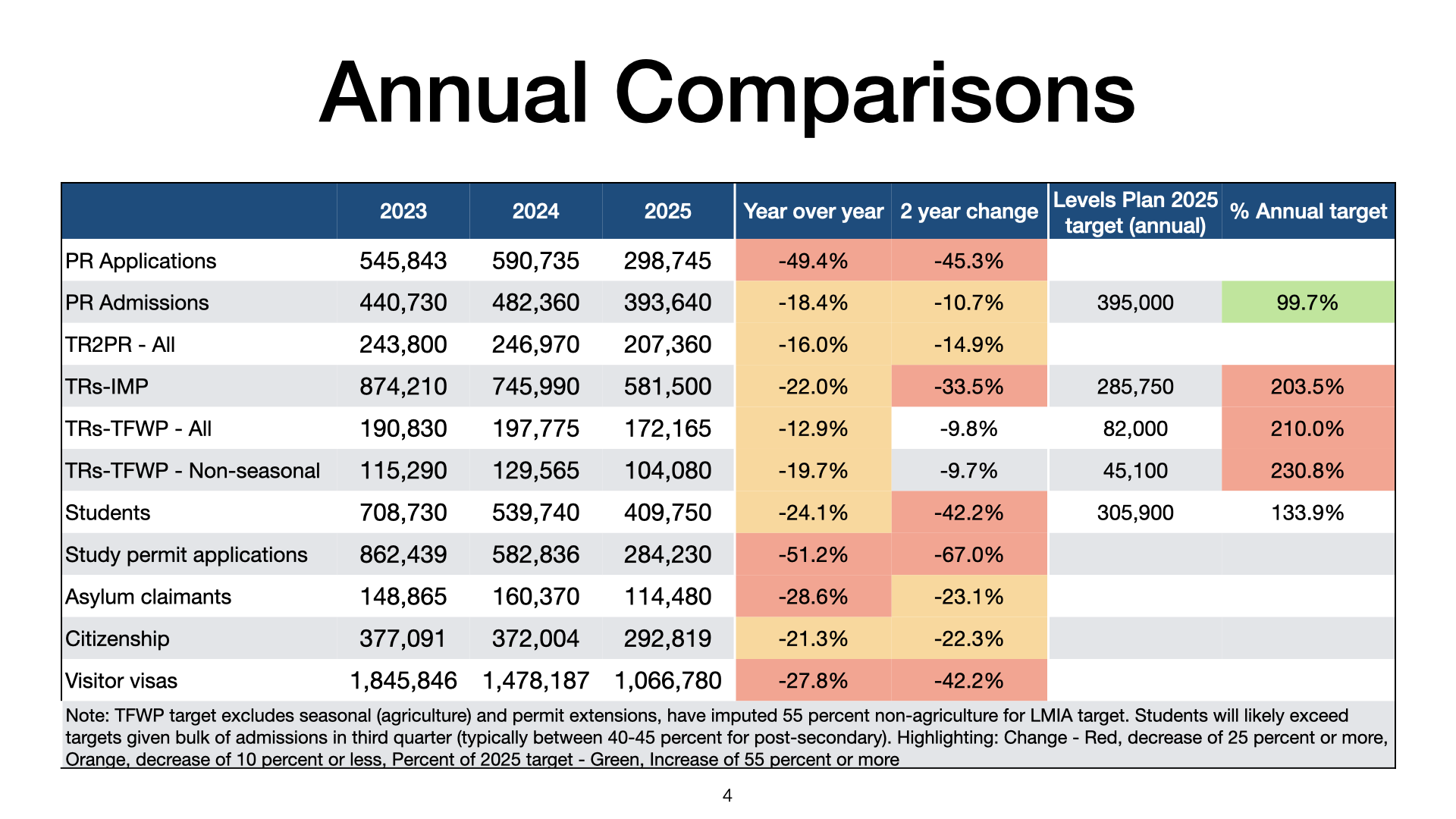
In December, it was revealed that Canada’s population decreased for the first time in about five years — thanks again to immigration or, rather, a drop in its numbers. Driven by caps on international students and temporary foreign workers, the country’s population as of Oct. 1, 2025, declined by roughly 76,068 people, or 0.2 per cent, from July 1, when the population was estimated to be 41.65 million….

Source: Older, 70% white, plunging fertility and lost faith: Who Canada is now

These international students in Canada didn’t submit test scores because they weren’t asked to. Now, their work permits are refused

Significant oversight in the online app. Lack of user testing or feedback? Students have a case for reconsideration:

…Over the last few months, immigration experts are seeing a growing number of international graduates like Xu being refused postgraduation work permits for failing to upload language test results, losing their legal status in Canada. They have to stop working immediately and face possible removal.

While many have asked officials for reconsideration, others have reapplied with the faint hope that they would get a second chance. 

“It may sound stupid, but I trusted the system, because I’ve been doing my own study permit and visa applications many times over the years,” said Xu. The Chinese student came here in 2016, first to improve her English before pursuing her master’s degree and PhD.

“There’s no reminder or alert in the system to tell you where to upload the language scores. It should not allow applicants to submit an application when a required document is missing.”

Only now did the 34-year-old woman learn, after the refusal, that the instruction on how to upload the test result had been buried on the Immigration Department website on a separate page that few would have spotted.

Students urge Minister Diab to intervene

An online petition has been launched to urge Immigration Minister Lena Metlege Diab to reinstate students’ refused applications.

Although the language requirement took effect in late 2024, Vancouver immigration lawyer Will Tao said the issue only emerged this fall due to excessive processing delays. It currently takes more than 210 days for work permit applications submitted inside Canada.

Despite what the Immigration Department called the “technical limitations” that prevent the application portal from installing a new direct upload field for language test proof, Tao is baffled as to why officials can’t just put a simple note there to inform applicants where to upload it.

“That appears only in a separate policy document that does require a lot of searching and digging to find,” he noted. “It’s all automated and now people are getting refused en masse for not uploading a document that you didn’t ask me to upload.”

(Soon after the Star’s inquiry to the Immigration Department about these refusals based on missing language proficiency proofs, Tao noted that officials had placed the upload information on three other webpages, but still not on the application portal.) 

Hundreds of permit applications refused

The department said it has received 162,000 postgraduation work permit applications since the inception of the mandatory language requirement; 815 had been refused up to September due to missing documents that may include the language proficiency proof…

Source: These international students in Canada didn’t submit test scores because they weren’t asked to. Now, their work permits are refused

ICYMI: L’Algérie réforme sa loi sur la citoyenneté dans la controverse

Of note, with likely impact on those of Algerian descent in Canada (about 90,000 according to the 2021 census):

Sous couvert d’une réforme visant à faire face aux « nouveaux défis sécuritaires », les élus algériens ont voté le 24 décembre dernier pour une modification de la loi sur la citoyenneté qui vise à faciliter la déchéance de nationalité de citoyens accusés de porter atteinte aux intérêts de l’État algérien.

La mesure est perçue comme une menace pour les diasporas algériennes partout dans le monde. Elles voient, dans la démarche, une nouvelle arme répressive ciblant une opposition et une dissidence au régime autoritaire du président Abdelmadjid Tebboune, forcées depuis plusieurs années de s’exprimer depuis l’étranger.

« Le message envoyé à la communauté internationale et aux opposants du régime en exil est d’une clarté brutale, a commenté un des membres de cette diaspora vivant au Royaume-Uni sur les réseaux sociaux cette semaine. [Cette mesure] est une preuve incontestable que toute opposition au régime militaire est assimilée à une opposition à l’État algérien lui-même, dans une confusion volontaire entre institutions de l’État et le régime. Elle est aussi la preuve que la seule opposition tolérée en Algérie est celle qui est contrôlée, encadrée ou neutralisée par le régime. »

Porté par le député Hicham Sifer du Rassemblement national démocratique, troisième parti en importance sur l’échiquier politique algérien, et formation proche de la présidence, l’amendement voté mercredi dernier par l’Assemblée populaire nationale élargit ainsi les motifs de révocation de la nationalité algérienne pour les citoyens binationaux. Elle inscrit désormais cette déchéance pour « atteinte à la sécurité ou à l’unité de l’État », « allégeance à une puissance étrangère », « fourniture de services à un État étranger dans l’intention de nuire aux intérêts nationaux », « assistance à des forces militaires étrangères » ou encore pour « participation, y compris financière ou propagandiste, à des organisations terroristes ou subversives à l’étranger ».

Le ministre algérien de la Justice, Lotfi Boudjemaa, a qualifié ce texte d’une « grande importance » en rappelant qu’il « vise à faire face à ceux qui, de l’extérieur du territoire national, veulent porter atteinte à la nation, manquant ainsi à leur devoir éthique et légal vis-à-vis de la mère patrie ».

Source: L’Algérie réforme sa loi sur la citoyenneté dans la controverse

Under the guise of a reform to face the “new security challenges”, Algerian elected officials voted on December 24 for an amendment to the citizenship law that aims to facilitate the deprivation of nationality of citizens accused of harming the interests of the Algerian State.

The measure is perceived as a threat to Algerian diasporas around the world. They see, in the approach, a new repressive weapon targeting opposition and dissent to the authoritarian regime of President Abdelmadjid Tebboune, forced for several years to speak from abroad.

“The message sent to the international community and opponents of the regime in exile is of brutal clarity,” commented one of the members of this diaspora living in the United Kingdom on social networks this week. [This measure] is indisputable proof that any opposition to the military regime is assimilated to an opposition to the Algerian State itself, in a voluntary confusion between state institutions and the regime. It is also proof that the only opposition tolerated in Algeria is the one that is controlled, supervised or neutralized by the regime. ”

Carried by Deputy Hicham Sifer of the National Democratic Rally, the third largest party on the Algerian political chessboard, and a formation close to the presidency, the amendment voted last Wednesday by the National People’s Assembly thus expands the grounds for the revocation of Algerian nationality for binational citizens. It now registers this forfeiture for “undermining the security or unity of the State”, “allegiance to a foreign power”, “provision of services to a foreign State with the intention of harming national interests”, “assistance to foreign military forces” or for “participation, including financial or propaganda, in terrorist organizations or Subversive abroad”.

The Algerian Minister of Justice, Lotfi Boudjemaa, described this text as “of great importance” by recalling that it “aims to face those who, from outside the national territory, want to harm the nation, thus failing in their ethical and legal duty towards the motherland”.

See attractions, get attracted: This is one way Canada is trying to help new immigrants decide to stay

More coverage for the latest “Leaky Bucket” report (catching up on the report issued last November, CBC only covered this week):

…Highly educated immigrants are leaving faster than those with lower education levels, while those with doctorates are more than twice as likely to leave as those with a secondary education or less, according to the report.

But ICC research shows the antidote to the skilled immigrant exodus is a sense of belonging and optimism about life in Canada, the factor most closely tied to whether newcomers stay long term.

While financial struggles and concerns push many to leave, the data found that the strongest driver of immigrant retention is optimism about the future, measured by immigrants’ confidence in their personal and family prospects, plans for long-term residence in Canada and belief that friends and family can succeed here. 

Even a one per cent increase in optimism boosts the likelihood of staying by 28 per cent, according to ICC data.

“Immigration is a long game. It isn’t just about inviting people to come to Canada as immigrants,” said Shamira Madhany, managing director for World Education Services Canada. “What really matters is how included people feel and how inclusive the system is.”

The Canoo app, which aims to support and promote an early sense of connection among newcomers, has had more than 420,000 members since it was created in 2010. …

Source: See attractions, get attracted: This is one way Canada is trying to help new immigrants decide to stay

ICYMI: Ontario judge sets aside pharmacist’s Canadian citizenship revocation over alleged fraud

Of note, justice delayed is justice denied. Justice Go has an activist background, previously she was director of the Chinese and Southeast Asian Legal Clinic:

An immigrant pharmacist whose Canadian citizenship was revoked in November 2024, a decade after officials first suspected she hadn’t met the requirements, has seen that decision set aside and revocation proceedings permanently stayed by a Federal Court judge who criticized officials for waiting so long to act on the allegations of “false representation, fraud, or knowingly concealing material circumstances.”

Nermine Magdi Ibrahim, who became a Canadian permanent resident in July 2003 and subsequently a Canadian citizen in October 2007, applied to the Federal Court for a judicial review of the revocation proceedings.

Immigration officials were not “concerned about the impact of the delay on (Ibrahim’s) ability to defend her case, nor (her) well-established ties to Canada as reasons for granting her special relief,” Justice Avvy Yao-Yao Go wrote in a recent decision out of Toronto.

“In short, the unfairness with which the applicant was treated, coupled with the unfairness in the proceedings caused by the delay, calls into question the integrity of the justice system if the court allows the proceedings to continue under these circumstances.”

In her citizenship application, Ibrahim “declared 166 days of absences from Canada during her relevant residency period from July 9, 2003 to February 18, 2007,” Go said.

Ibrahim’s “citizenship was initially flagged for investigation in 2014, and the investigation was completed in that same year,” said the judge.

The Canada Border Services Agency had “received a tip about companies operating citizenship fraud schemes with (Ibrahim’s) husband’s name appearing as one of the clients who used these services to simulate his residence in Canada,” said the Federal Court decision, dated Dec. 19.

The CBSA referred this information to the immigration minister at the time for further investigation.

“During its investigation, the case management branch … found (Ibrahim’s) LinkedIn profile which suggested that she was continuously employed as a Medical Delegate with Nestlé Infant Nutrition in Kuwait from June 2002 to June 2009,” Go said.

“On July 23, 2014, an analyst of the Immigration Section at the Canadian Embassy in Abu Dhabi, United Arab Emirates verified her continuous employment with the employer.”

It wasn’t until 2023 when Canadian immigration authorities advised Ibrahim of the potential revocation proceedings and offered her an opportunity to respond.

They argued “that the delay was not unreasonable considering this case was part of a large-scale investigation involving 300 other individuals,” said the decision.

The judge wasn’t buying it: “Based on the record before me, I find that the minister has not provided any justification for the delay,” Go said.

To become a Canadian citizen, permanent residents need to have lived in have lived in Canada for three out of the last five years.

In September 2023, immigration officials wrote to Ibrahim indicating she “may have misrepresented herself during the citizenship process and that (she) may have failed to disclose some of her absences from Canada during the four years immediately before the date of her citizenship application,” said the decision.

She was given 30 days “to make written submissions regarding the length of time she spent in Canada before acquiring citizenship and her ties to Canada since becoming a citizen,” it said.

Ibrahim responded on Sept. 21, 2023, with a one-page letter requesting “more details about alleged absences and stated that she has integrated well into Canadian society as shown in her successfully becoming licensed as a pharmacist, being a partner of two pharmacies, and owning property,” said the decision

“She also argued that the revocation would result in severe hardship and added that all her points can be substantiated with supporting documents upon request.”

On May 9, 2024, Immigration, Refugees and Citizenship Canada (IRCC) notified Ibrahim it was revoking her citizenship.

“The notification letter cited (Ibrahim’s) LinkedIn profile listing her employment with Nestlé in Kuwait, the Canadian Embassy’s verification with Nestlé’s Human Resource Department of (her) continuous employment from July 2002 to June 2009, and (her) failure to disclose this information as basis for alleging that (she) may have obtained citizenship by misrepresentation.”

Ibrahim responded on July 4, 2024, indicating “that her LinkedIn Profile is not of a factual nature and does not include any leaves taken.”

She “also explained that she was pregnant with her daughter during the relevant period, and that Nestlé had a relatively flexible maternity leave policy that enabled her to stay in Canada for the duration of her pregnancy and throughout the breastfeeding period until her daughter was two years old.”

Ibrahim “noted it has been over 15 years since the relevant period has elapsed,” said the decision.

She “emphasized that it was not only a matter of intellectual recollection, but of documentary recollection.”

Ibrahim “noted the steps she undertook to obtain information from various institutions including the pharmaceutical company she worked for, her bank and her phone company, but was unable to produce records longer than seven years prior due to these institutions’ policy on record retention,” said the decision.

Ibrahim “submitted supporting documentation, including her daughter’s Ontario birth certificate, her Ontario and Manitoba pharmacist licences, document of prior property ownership, an Ontario Profile Report for the two pharmacies she is a partner in, copies of her driver’s licences containing a residential address in Ontario, as well as her and her daughter’s hospital cards containing the same address.”

Ibrahim also “provided copies of Nestlé’s policies regarding maternity and parental support from 2012 to 2019.”

She argued “that the evidentiary burden in revocation cases rests with the minister who asserts that there was a misrepresentation.”

Source: Ontario judge sets aside pharmacist’s Canadian citizenship revocation over alleged fraud

Year in review and look ahead

Time for my looking back piece, even if a bit self-indulgent.

Most of my time was spent on an analysis of the 2025 election results from a diversity analysis with Jerome Black, highlighting how representation of visible minorities had increased while that of women and Indigenous had stalled. A second area of major work was following and participating in C-3 citizenship discussions and debates. Annual updates on public service diversity and birth tourism, and setting the baseline for appointments that will be made by PM Carney.

2026 will continue with my various annual updates. Jerome Black and I have an analysis in train on the intersectionality of women and visible minority candidate in competitive ridings. I will be analysing the impact of C-3 in relation to age, gender, and country of origin and comparing that with expatriate voting data, given that the latter has grown significantly and the number of expatriate votes cast exceeds the winning margin in a number of ridings. No doubt other issues of interest will emerge.

Lots to keep me busy and engaged, along with maintaining my blog.

Best wishes for the holidays, whichever ones you celebrate.

Print below by my late father.

Citizenship 

Citations

Immigration – Citations

Multiculturalism 

Diversity and Employment Equity

Before the cuts: a bureaucracy baseline from an employment equity lens (Hill Times)

Political Representation 

The diversity of candidates and MPs stalled for some groups in this election (Policy Options, The Hill Times, with Jerome H. Black)

Citations

A Conspicuous Gap May Undermine Trump’s Birthright Citizenship Plan

Interesting argument:

In asking the Supreme Court to let him do away with birthright citizenship, President Trump has urged the justices to restore “the original meaning” of the 14th Amendment.

What the amendment meant when it was ratified in 1868, Mr. Trump’s lawyers said in a brief, was that “children of temporary visitors and illegal aliens are not U.S. citizens by birth.”

The court will hear arguments in the spring to decide whether that is right. There are many tools for assessing the original meaning of a constitutional provision, including the congressional and public debates that surrounded its adoption.

But one important tool has been overlooked in determining the meaning of this amendment: the actions that were taken — and not taken — to challenge the qualifications of members of Congress, who must be citizens, around the time the amendment was ratified.

A new study to be published next month in The Georgetown Law Journal Online fills that gap. It examined the backgrounds of the 584 members who served in Congress from 1865 to 1871 and found good reason to think that more than a dozen of them might not have been citizens under Mr. Trump’s interpretation of the 14th Amendment. But no one thought to file a challenge to their qualifications.

That is, said Amanda Frost, a law professor at the University of Virginia and an author of the study, the constitutional equivalent of the dog that did not bark, which provided a crucial clue in a Sherlock Holmes story.

The study raises new questions about Mr. Trump’s legal battle to narrow protections under the 14th Amendment’s citizenship clause, which says: “All persons born or naturalized in the United States, and subject to the jurisdiction thereof, are citizens of the United States and of the state wherein they reside.”

The Constitution requires members of the House of Representatives to have been citizens for at least seven years, and senators for at least nine. It adds that each House “shall be the judge” of its members’ qualifications.

“If there had been an original understanding that tracked the Trump administration’s executive order,” Professor Frost said, “at least some of these people would have been challenged.”…

Source: A Conspicuous Gap May Undermine Trump’s Birthright Citizenship Plan

USA: The next step was citizenship. Then these immigrants were pulled out of line.

Cruelty personnified:

For immigrants, naturalization ceremonies represent the culmination of their yearslong effort to earn citizenship. In front of a federal judge, permanent residents raise their right hands, repeat the Oath of Allegiance to their new country, and usually wave a small American flag with pride once the judge confirms their citizenship.

On Dec. 4, inside Boston’s Faneuil Hall – a historic site where revolutionaries like Samuel Adams fostered the idea of American freedom – one such event took a turn. U.S. Citizenship and Immigration Services officers denied entry to several people who showed up for their naturalization ceremony, according to Project Citizenship, a nonprofit providing legal support for those seeking citizenship. Each of these individuals was from one of 19 countries the Trump administration identified as high-security risks under a Dec. 2 Department of Homeland Security memo, which mandated the immediate pausing and review of immigration applications from those countries, including Haiti, Afghanistan, and Venezuela.

What happened at the Boston ceremony is part of a tightening of the naturalization process throughout the country. In late November, New York state Attorney General Letitia James wrote a letter to USCIS questioning its decision to cancel ceremonies in several counties in her state; USCIS said the counties “did not meet the statutory requirements.” On Dec. 9 in Indianapolis, 38 out of 100 prospective citizens were turned away at their ceremony, according to local news reports. Local outlets in Atlanta reported that, on Dec. 12, three immigrants had their oath ceremonies canceled.

The efforts to clamp down on legal immigration pathways follows the shooting of two National Guard members in Washington, one fatally, just before Thanksgiving. An Afghan national, who entered the country legally in 2021 through a program for allies who served alongside the U.S. military, has been charged with first-degree murder. Following that attack, President Donald Trump quickly announced significant immigration restrictions, including a pause on all asylum decisions. This week, the Trump administration added 20 countries to a list of nations whose citizens face full or partial bans on entering the U.S.

Those who apply for naturalization are some of the most thoroughly vetted immigrants in the country. To be eligible, an immigrant must generally have been a lawful permanent resident for at least five years, be a “person of good moral character,” and pass tests in civics and English. The process can take decades, and the oath ceremony is largely seen as a formality.

Gail Breslow, the executive director of Project Citizenship in Boston, said that 21 clients of the organization had their naturalization ceremonies canceled this month. Clients were either pulled out of line at the Dec. 4 ceremony or notified via email that their ceremonies, scheduled for Dec. 4 or Dec. 10, had been canceled.

Source: The next step was citizenship. Then these immigrants were pulled out of line.

Sergio Marchi still believes in ethical politicians. Here’s why [citizenship oath change]

Although known, worth reminding:

You almost got Mr. Chretien to let you get rid of the citizenship oath to the Queen. At the last minute, he intervened and told you to pull the plug. How come?

I said, “Boss, why are you asking me to do this? We’re almost there. You had supported this!” He said it was the middle of the 1995 Quebec referendum and he didn’t want to fight monarchists and separatists at the same time. I told him, “Let’s have our own citizenship oath, a simple, powerful oath to country, rather than to the monarchy.” And he said, “Trust me, we’ll get back to it later.” But one of the lessons I learned in politics is that when you pause something in politics, oftentimes you lose it, and that’s exactly what happened. I was very, very close, and it’s one of my regrets.  …

Source: Opinion | Sergio Marchi still believes in ethical politicians. Here’s why

Hospital birth data suggests increase in birth tourism, says immigration expert

Globe coverage of my policy options article:

Births in Canada to foreign visitors and other non-residents have risen in the past year, an expert in immigration statistics has found after analyzing hospital data. 

The research, published in a report on Wednesday, shows a small increase in births at Canadian hospitals to temporary residents, such as international students and people here on work permits.

The proportion of births to people who are not settled in Canada is small compared with births in the country overall, but the number of temporary residents in Canada has been dropping as the federal government has reduced immigration.

According to the report, authored by Andrew Griffith, a former director-general at the federal immigration department, the data suggest an uptick in births to women here on visitor visas, otherwise known as birth tourism. …

Source: Hospital birth data suggests increase in birth tourism, says immigration expert, Policy Options Birthright citizenship and the politics of “birth tourism”