Diversity among federal and provincial judges

This article appeared originally in IRPP’s Perspectives:

With the federal government’s general commitment to increased diversity in appointments, and Justice Minister Jody Wilson-Raybould’s current review of the judicial appointment process, there needs to be a baseline of information about the current diversity situation in order to measure implementation of these commitments.

Overall, women, visible minorities and Indigenous people are under-represented among the over 1,000 federally appointed judges (65 are in federal courts, the balance are in provincial courts). There is a similar but less pronounced pattern of under-representation among the over 700 provincially appointed judges.

Does this matter given that judges by are expected to be objective, impartial and neutral? Their legal education, training and experience prepare them for this end. However, judges are human and, like all of us, they are influenced by their past experiences, influences and backgrounds. We know from Daniel Kahneman (author of Thinking, Fast and Slow) and others that no one is completely neutral and bias-free, even if the judicial process does represent “slow” or deliberative thinking, and thus greater objectivity, rather than “fast” or automatic thinking. Diversity of background and experience is another way to improve neutrality in decision-making.

Moreover, given the over-representation of some groups who are tried in the courts, such as Black people and Indigenous people, a judiciary in which these groups are significantly under-represented risks being viewed as illegitimate to those communities. The current debate over murdered and missing Indigenous women and police carding practices exemplify this risk.
Figure 1 highlights the extent of this under-representation: there are no visible minority or Indigenous judges in the Supreme Court and Court of Appeal, no visible minority judges in the Federal Court and no Indigenous judges in the Tax Court. In all the courts except for the Supreme Court, women are significantly under-represented.

Judicial Diversity 2016 - DRAFT.009Figure 1

If we look at federally appointed judges to provincial courts (figure 2), the picture is slightly better in terms of both visible minority and Indigenous judges, but in both cases the representation is significantly lower than these groups’ population shares. In the superior courts/Queen’s Bench women are particularly under-represented, but they are better represented when the representation is compared with that of the federal courts.
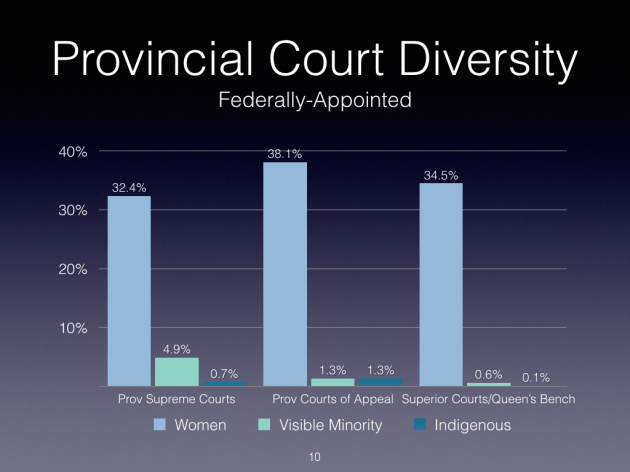
Judicial Diversity 2016 - DRAFT.010Figure 2

The picture for provincially nominated judges to provincial and territorial courts (figure 3) varies by province, but overall the provinces resemble each other in their under-representation of these groups. The Atlantic provinces, with the exception of Nova Scotia, have no visible minority or Indigenous judges. In the North, despite the large Indigenous population, there are no Indigenous judges. Quebec has relatively few visible minority judges and no Indigenous judges. Saskatchewan and Manitoba, despite their large Indigenous populations, have relatively few Indigenous judges.
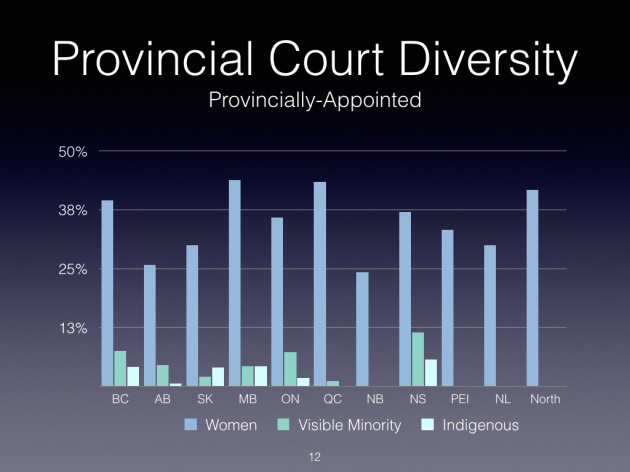
Judicial Diversity 2016 - DRAFT.012Figure 3

In the next series of charts federally and provincially appointed judges are compared for each under-represented group, by province, starting with women (figure 4). Here there is no overall trend: the federal and provincial appointment of women is similar in British Columbia, Manitoba, Nova Scotia, and Newfoundland and Labrador; in Saskatchewan, Quebec, Prince Edward Island and the North, provincial appointment of women is higher; and in Alberta the appointment of women is significantly lower, given the relatively large share of part-time and supernumerary appointments that are men (about a third of full-time judges are women).
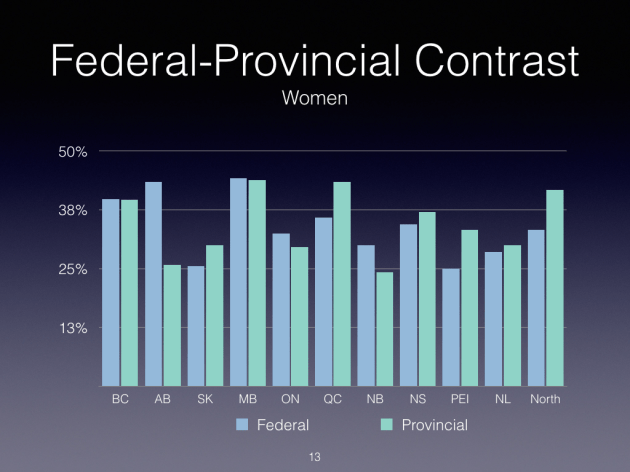
Judicial Diversity 2016 - DRAFT.013Figure 4

Looking at visible minorities (figure 5), when we compare federal and provincial appointments by province, we see a trend in all provinces except Saskatchewan: provincial judicial appointments are more representative of their populations than federal nominations, although visible minorities are still significantly under-represented.

Judicial Diversity 2016 - DRAFT.014Figure 5

Lastly, with respect to Indigenous appointments (figure 6), we see the same pattern: provincial appointments are more representative of provincial populations than federal appointments in all provinces and territories, except, surprisingly, in the North, where there are no Indigenous territorial judges.

Judicial Diversity 2016 - DRAFT.015Figure 6

Looking at senior judges (chief and associate-chief justices), there are no federally appointed visible minority or Indigenous judges, and there are only a handful number of provincially appointed senior judges (figure 7).

Judicial Diversity 2016 - DRAFT.011Figure 7

While judicial diversity is low, particularly for visible minorities and Indigenous people, the number of visible minority lawyers continues to increase. Figure 8 presents the proportions of visible minority lawyers aged 25-64 Canada-wide and in the largest provinces, which gives an idea of the size of the pool that can be drawn from. Given that visible minorities are, in general, younger than the general population, visible minority lawyers are also likely to be younger and, therefore, the percentage who would be aged 45 years old or older, the usual age people are considered for these positions, would be lower.
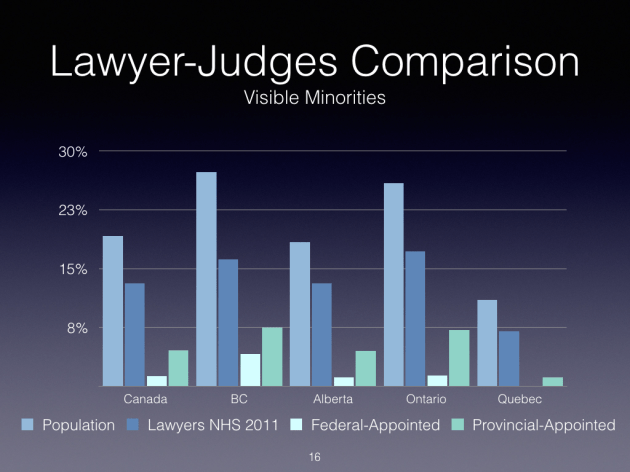
Judicial Diversity 2016 - DRAFT.016.pngFigure 8

As part of its review of the judicial appointment process, the Office of the Commissioner for Federal Judicial Affairs should expand the existing information on the gender of judges and include visible minorities and Indigenous people. With this information, the government could be held to account for its diversity and inclusion commitments, and it would be easier to track its progress over time.

The provinces and territories that do not already do this should do so, and they should use Ontario’s annual reports on appointments as a model, ensuring that the annual reports cover the overall diversity of the entire bench.

*A few notes on methodology. The federal government publishes statistics on gender but not on visible minority or Indigenous appointments. All provinces except Alberta and Saskatchewan indicate gender through the use of “Mr.” or “Madam” justice (the departments of justice provided the number of women judges). Gender information is thus complete.

To identify visible minority and Indigenous origin name checks, appointment announcements and, when available, photos and biographies were used. All provincial judicial councils or departments of justice were approached (only Ontario reports publicly but Saskatchewan, Quebec and Nova Scotia provided the breakdowns used). The Canadian Bar Association, national and regional branches, and law societies were approached and a number of individual lawyers also helped improve the quality of the data collected. I believe this provides a reasonable assessment of current diversity.
The Government Could Be Appointing Indigenous Members To Canada’s Pipeline Regulator – BuzzFeed News

What diversity and inclusion means for Governor in Council appointments, an early example:

The Canadian government is signaling that it’s going to appoint Indigenous members to the board that decides on pipeline projects.

The move would shake up the composition of the National Energy Board, which is dominated by former oil and utility company executives.

As was first reported by Blacklock’s Reporter, Natural Resources Minister Jim Carr told a committee last week that the NEB “has to be composed of individuals who better reflect the diversity of Canada.”

CPAC / Via cpac.ca

“The National Energy Board should be more reflective of the diversity of the country, including and particularly Indigenous cultural background and perspective,” Carr told the Indigenous and Northern Affairs committee.

Carr said the same applies to the temporary members the government plans on appointing to help review the Energy East proposal.

“Through the appointment of new temporary members to the board [we know] that Indigenous background issues are important,” Carr said.

Carr was speaking in the context of the Liberal government’s promised reforms of the NEB. Before the federal election, Justin Trudeau promised to “put some teeth” back into the regulator, the Canadian Press reported.

Carr’s ministerial mandate letter instructed him to reform the NEB so that its members have better knowledge of Indigenous issues, among other things.

The NEB has been criticized for its lack of diversity and failing to sufficiently consult the communities, including Indigenous ones, that would be affected by proposed pipelines.

“We’re opening up the important reform of the National Energy Board and environmental assessments in Canada generally speaking to what we hope is a robust, important Canadian chat about that,” Carr said.

He said the government will be announcing the permanent reform process “in the next while.”

Source: The Government Could Be Appointing Indigenous Members To Canada’s Pipeline Regulator – BuzzFeed News

Canada’s multiculturalism: A circle, ever edging outwards – John Ralston Saul

Good long read by John Ralston Saul, one of the few people to articulate a common narrative for Indigenous peoples, old and new Canadians.

I have always felt that it was the unique combination of Indigenous peoples with English and French founding immigrants that helped us (or forced us) to develop a culture of accommodation:

We all know that these 400 years of policy development were tarnished and regularly knocked off track by multiple insurgencies of racism and exclusion. But each of these was gradually eliminated and the main line re-established.

The philosophical trick in all of this is that immigration and citizenship have always been treated as inseparable steps. Engagement and marriage. This means that each immigrant arrives knowing that she must think of herself as a citizen, because she soon will be a citizen. This is a philosophy which changes radically everyone’s attitude toward inclusion and integration. It means that language training is simply part of the package from the beginning, as is the expectation that new Canadians will get involved in volunteerism and politics – the two keys to an engaged citizenry.

A perpetual experiment

What of the multicultural misunderstanding?

Canadians seem to be moving toward other words – diversity, pluralism, inclusion, interculturalism – as we have sensed a growing confusion elsewhere. But the idea is really not so difficult.

I think of it as rooted in balance – a central Indigenous concept of how societies function. At its best a balance between the place, the group and the individual. You could also describe it as a balanced or positive tension between organized integration and celebrated diversity; a conviction that diversity and fairness are reflections of each other; that this requires a rigorous use of political restraint; an allergy to universal mythologies and ideologies. All of which means that we must be self-confident enough and tough enough to live with the reality of complexity.

This is the opposite of the tired European-U.S. insistence on monolithic identities. The Canadian concept of living in a perpetually incomplete experiment may seem radical to many in the Western world. And yet you could simply see it as a profoundly non-racial approach to civilization – one based on the idea of an inclusive circle that expands and gradually adapts as new people join us.

Source: Canada’s multiculturalism: A circle, ever edging outwards – The Globe and Mail

‘We know who our people are,’ Ontario First Nations draft citizenship law

A very different approach than governments, with no generation limits and bloodline only:

First Nations in Ontario are encoding their traditional citizenship laws to fight back against the “genocidal” policies of the Indian Act, says the Grand Chief of the Anishinabek Nation.

E-dbendaagzijig, which means ‘those who belong’ in Ojibwe, is a draft citizenship law for 39 Anishinabek First Nations, representing approximately 60,000 people in Ontario.

The recent Daniels decision from the Supreme Court of Canada on the rights of Metis and non-status Indians continues to muddy the waters of First Nations citizenship, Anishinabek Nation Grand Chief Patrick Madahbee said.

“It’s up to our people to decide who has lineage to our territory,” he  said. “We know who our people are.”

The draft citizenship law recognizes a citizen as anyone who can trace their lineage, through at least one parent, to a First Nation within Anishinabek territory.

Madahbee said distinctions between status and non-status are part of the “genocide” inherent in the Indian Act and that First Nations leaders are prepared to take responsibility for Anishinabek citizens who live off reserve.

“The government has been very skillful at divide and conquer tactics,” he said. “Our chiefs have been saying, particularly in the Anishinabek territory, when we talk about E-dbendaagzijig, those who belong, we say we are responsible for our people, no matter where they live.”

Mahdabee said it’s important to change the terminology from ‘band membership’ in First Nations to citizenship.

“You can be a member of the Kiwanis Club or the Rotary Club,” he said. “You are a citizen of a nation. It elevates it.”

Band membership rules under the Indian Act have left a First Nation in central Ontario in a dire situation, Madahbee said.

As of 2013, the Mississaugas of Scugog Island First Nation did not have anyone eligible to be registered as a status Indian, he said.

“This Indian Act is genocide,” Madahbee said.

Source: ‘We know who our people are,’ Ontario First Nations draft citizenship law – Thunder Bay – CBC News

Legal misstep lets Catholic Church off hook for residential schools compensation – The Globe and Mail

Legally off the hook but ethically? Morally?

A miscommunication by a federal lawyer allowed the Catholic Church to renege on its obligation to try to raise $25-million to pay for healing programs for the survivors of Indian residential schools.

Of that amount, the Church raised only $3.7-million, and a financial statement suggests less than $2.2-million of that was actually donated to help former students cope with the trauma inflicted by the residential schools.

The legal misstep occurred when Ottawa was pressing the Church to pay the entirety of a related cash settlement stemming from the Indian Residential Schools Settlement Agreement, the largest class-action deal in Canadian history.

The failing fundraising effort by the Church, which represented almost a third of its obligation under the settlement, was playing out as the Truth and Reconciliation Commission was travelling the country hearing gut-wrenching stories about what occurred behind the walls of the institutions that operated in Canada for more than 100 years.

The landmark settlement agreement required 50 Catholic groups that ran the schools, known in court documents as the Catholic entities, to pay a combined $79-million for their role in the abuse.

Of that, $29-million was to be paid in cash, most of which was to flow to a now-closed Aboriginal Healing Foundation. Another $25-million was to be donated in unspecified “in kind” services. And an additional $25-million was to be raised for healing programs through the “best efforts” that the entities could make at fundraising.

In an attempt to make the Catholic Church pay the full amount of the $29-million cash settlement, the government inadvertently released it from any obligation it might have had to continue with a dismal fundraising campaign.

“When you have a deal, it needs to be implemented,” said Bill Erasmus, the National Chief of the Dene Nation who handles the residential schools file for the Assembly of First Nations. “So the Church should be paying up. The church agreed there were harms. That’s why people were to be compensated.”

But, as of last summer, the Catholic entities were legally off the hook.

In a March 19 letter to Ron Kidd, a concerned citizen from British Columbia who has been following this case, Andrew Saranchuk, an assistant deputy minister within the Indigenous Affairs department, explained that a court settlement reached on July 16, 2015 “released the Catholic entities from all three of their financial obligations under the settlement agreement, including the ‘best efforts’ fundraising campaign, in exchange for a repayment of $1.2-million in administrative fees.”

This result, Mr. Saranchuk went on to explain, “was due to miscommunications between counsel regarding the nature and extent of the settlement being discussed.”

Source: Legal misstep lets Catholic Church off hook for residential schools compensation – The Globe and Mail

Constitutional challenge looks to revive aboriginal languages

While I understand and support the case for more initiatives for indigenous languages, the challenge remains to improve the overall educational outcomes for Indigenous Canadians:

The same section of the Constitution that enshrines First Nations treaties should, according to a growing number of legal experts and academics, also grant aboriginal people in Canada the right to schooling and public services in their ancestral languages.

“Unless we do something in this generation — the generation of my daughter — the languages will die,” says Lorena Fontaine, an assistant professor of indigenous studies at the University of Winnipeg.

Fontaine and Toronto lawyer David Leitch are preparing a constitutional challenge that argues aboriginal people have the right to be taught in their own, often endangered languages under Section 35 of the Constitution.

Section 35 guarantees aboriginal treaties, but has also been interpreted to protect customs, practices and traditions integral to aboriginal culture, which she says should include language.

“We have the right to use and develop these languages in institutions that we create,” says Fontaine, who is also a PhD student in history, peace and conflict studies and law at the University of Manitoba.

Leitch says aboriginal languages should be awarded “similar consideration” to French and English, which he says tend to dominate talk about language rights in Canada.

He would rather not have to take the case to court, and hopes the government will instead address the issue as it follows up on the recommendations of the Truth and Reconciliation Commission.

“If you’re the prime minister of Canada you can do things pretty quickly,” says Leitch, adding that Justin Trudeau’s commitment to implementing the calls to action in the TRC report is a positive sign.

‘Fundamental and valued’

The TRC’s final report said the federal government has a responsibility to provide sufficient funds for aboriginal-language revitalization and preservation.

It also said aboriginal languages are a “fundamental and valued element of Canadian culture and society.”

Source: Constitutional challenge looks to revive aboriginal languages – Aboriginal – CBC

I’ll be ‘proud’ when Canada achieves justice for all: Denise Balkissoon

A needed broader perspective on the justice system than provided by Ghomeshi defence lawyer Marie Henein:

I don’t expect defence lawyers to be nice, and so I didn’t have any beef with Marie Henein until this week. Then she said that our legal system is one “we should all be proud of,” and now I’m compelled to reply: Don’t be absurd.

It’s one thing to state, as Jian Ghomeshi’s ferociously successful lawyer also did in her CBC Television interview, that justice was “absolutely” served when her client was acquitted. That proclamation refers to a single case – specific circumstances of evidence and reasonable doubt, one set of police officers and Crown attorneys, one particular judge.

But to say, as she did, that the Canadian justice system is impartial “each and every single day,” well that’s simply wrong. Training and intellect might help Ms. Henein skillfully navigate the system, but that doesn’t mean the system itself is admirable.

After Mr. Ghomeshi’s acquittal on multiple charges of assault and sexual assault, an unhappy group marched north from the courthouse to the Toronto Police Service headquarters on College Street. There, it merged with Black Lives Matter Toronto, justice advocates who have been sleeping outside the police HQ for almost two weeks now. Native Child and Family Services of Toronto is right next door, and indigenous demonstrators were soon in the mix as well.

Emotions were extremely high and the number of criticisms levelled at the Canadian justice system was overwhelming. Many of them were also valid, and reflective of my own personal list.

For example: A quarter of federal prisoners are aboriginal, even though just 4 per cent of the population is indigenous. Black Torontonians (and non-white Canadians across the country) are much more likely to be “carded,” meaning stopped randomly by police and asked to submit personal information despite not being accused of a specific crime.

Justice is expensive and the more impoverished you are, the less likely you are to receive it. The Legal Aid cutoff for a single person in Ontario is $14,000 a year, or about half of working full-time for minimum wage; Ms. Henein’s fee is rumoured to be up to $1,000 an hour. Lawyers who work with low-wage clients talk about the scourge of “pleading out” – when innocent defendants make deals, acquiring criminal records because they lack the resources for endless, unpredictable court dates.

If Ms. Henein truly considers herself a feminist, as has been endlessly discussed, a recent Criminal Lawyers’ Association report must surely upset her: Female lawyers are dropping out in droves, in part because of sexist treatment by police, court staff and judges. There are many ways that the law disappoints Canadian women – please also do not forget the hundreds of native women and girls whose disappearances and murders have been virtually ignored for decades.

To say, as Ms. Henein did, that justice in Canada is “very, very good,” is to consider all of these problems acceptable. It’s an attempt to write off dissenters as a motley crew with aimless complaints, when in reality many legal critics have clear, concrete suggestions for change.

For example, Black Lives Matter Toronto wants transparency around police violence toward civilians; this includes tracking the race of those killed by police and an inquiry into the death of Andrew Loku, a mentally ill father of five shot in his hallway last year.

One wish of many indigenous lawyers is increased application of the Supreme Court’s 1999 Gladue decision: When sentencing indigenous offenders, the focus is meant to be on rehabilitation, not punishment, with true consideration of the impact of residential schools and other historical inequities.

And advocates for sexual assault survivors have a number of ideas worth considering, such as greater use of the civil system versus the criminal courts, and increasing complainants’ access to legal support and information.

The list of proposed solutions is as long as the list of problems, and that’s good. A growing, evolving justice system is something we should all want, and I think we do. A 2014 Angus Reid Survey found that only about 60 per cent of Canadians said they trusted the police, while a mere 40 per cent said they had confidence in the criminal courts.

Victorious defence lawyers might be proud of our justice system, but the rest of the country has doubts that are more than reasonable. I guess winning is a heady drug, and intoxicants do tend to interfere with one’s sense of reality.

Source: I’ll be ‘proud’ when Canada achieves justice for all – The Globe and Mail

Time to name an Aboriginal justice to the Supreme Court: Hassan and Siddiqui

 Visible Minority LawyersNader Hassan and Fahad Siddiqui make the argument (the number of visible minority lawyers is higher than their article, based upon NHS data that I used in my book, Multiculturalism in Canada: Evidence and Anecdote):

These criteria narrow the field considerably [member of provincial superior court, bilingual, Maritime], and risk obscuring another important fact: our high court does not look like the rest of Canada. No Aboriginal or visible minority has ever been appointed to the Supreme Court. Regional representation — which convention so assiduously protects — is important, but in an increasingly ethnically and religiously diverse country, it is only one of many indicia of diversity.

Since the Abella Equality in Employment Royal Commission Report in 1984, a consensus has emerged among judges, lawyers and academics that judicial diversity matters. A diverse judiciary results in a broader range of perspectives, which is crucial to judicial decision-making. And greater judicial diversity fosters public confidence in the administration of justice.

Little progress has been made so far. Professor Rosemary Cairns Way of the University of Ottawa reports that Aboriginal and visible minority members account for roughly 23 per cent of the population, and yet from 2009 to 2014, only 1.04 per cent of appointees to the provincial superior courts were Aboriginal, and only 0.5 per cent were members of a visible minority group.

The same appears to be true of the senior reaches of the legal profession. The body that regulates lawyers in Ontario, the Law Society of Upper Canada, does not regularly collect comprehensive demographic data. But a Society report, released in 2010, shows that only 5 per cent of lawyers in Ontario between the ages of 45 and 64 are Aboriginals or visible minorities even though those two groups make up more than a fifth of that segment of the population.

It is sometimes argued that as Canada’s population diversifies, the legal profession will too. Problem solved — some years or decades down the line.

The statistics we have don’t bear out that claim though. Even among younger generations, Aboriginals and visible minorities are under-represented at the bar. And those who have managed to gain a foothold in the profession face unique challenges. The society reports that a majority of Aboriginal and visible minority lawyers believe that having a different cultural background has disadvantaged their careers. In that sense, the legal profession reflects trends in the broader job market. According to a recently released study led by University of Toronto researchers, black job applicants are 25.5 per cent more likely to land a job interview when they scrub their resumé of clues of their race.

The time has come for change. And this change requires leadership from the top. We need out-of-the box thinking, such as Trudeau’s laudable decision to name women to half his cabinet positions — including Canada’s first Aboriginal justice minister. The prime minister will have to take a similarly bold approach to fill the high court vacancy. An Aboriginal candidate should take priority. It’s an absolute shame that Canada’s highest court has never had representation from among our First Nations.

Nine different ‘alphabets:’ Inuit experts meet to standardize language

A real challenge, given the power of language and connection to identity. But the likely risk of not coming up with a common agreed approach will mean greater challenges to maintain and strengthen Inuktitut:

Two Inuit go hunting. One hands the other his rifle and the recipient says “ma’na.”

His partner, though, has no idea what he’s just heard. The word for thanks in his dialect is “qujannamiik.”

There are only 60,000 Inuit in Canada, but they are divided between nine different writing forms and at least that many dialects. On Friday, language experts are to meet in Ottawa to help bridge that gulf.

“People can generally understand each other, but there are serious limitations for that understanding,” said Natan Obed, head of Inuit Tapiriit Kanatami, Canada’s national Inuit group.

“If we had one unified writing system, we could maximize the ability for us to read in our language and also educate our children and provide them with learning resources.”

Inuktitut fractured because it was spoken by widely dispersed groups who rarely interacted. The language splintered further when missionaries developed writing for it.

Syllabics, originally based on characters from Pitman shorthand, are most common in the Eastern Arctic. Roman orthography, the letters of the alphabet most of us recognize, is mostly used in the west.

The dialects have diverged so widely that some use sounds that speakers from other parts of the North can’t even pronounce. Obed’s group produces a magazine called Inuktitut that native speakers in the far west and the far east just can’t read.

The drive to establish a standard writing form dates back to a recommendation in a 2011 report on Inuit education. Last September, experts from the four major Inuit regions began that task and continue their work on Friday.

Controversy is expected.

Many argue orthography is the way to go. It’s in common use everywhere — especially on social media and the Internet, both widely used by Inuit.

Last week, Inuktitut interpreters and translators voted at a conference in Iqaluit in favour of moving to orthography.

But many don’t want to say goodbye to the triangles, circles and squiggles of syllabics. The debate gets more heated because the areas where Inuktitut is strongest — almost all Quebec Inuit say they’re fluent — are the same areas that use syllabics.

“There are more Inuit talking seriously about transitioning out of syllabics into orthography,” Obed said. “(But) it is very contentious because it gets to the heart of who people are and how they’ve learned and express themselves.

“People have equated linguistic preservation and use to syllabics,” Obed said. “Syllabics attachment is based on the overarching history and the fact that syllabics allowed people to retain their language and their culture at a time of colonization and great upheaval.”

Source: Nine different ‘alphabets:’ Inuit experts meet to standardize language – Macleans.ca

Ontario public servants to get mandatory sensitivity training on indigenous people, history

While sad that this is needed (it’s 2016!), better late than never and likely one of the more significant TRC recommendations that will be implemented in the long-term.

Not sure what other provinces with large numbers of Indigenous peoples are doing but this approach should be considered by them if not already in place. The same applies to the federal government:

More than 60,000 members of Ontario’s public service will soon receive mandatory sensitivity training regarding the history and experiences of the province’s indigenous people, the Star has learned.

Premier Kathleen Wynne is expected to announce on Wednesday that every OPS employee will receive mandatory indigenous cultural competency and anti-racism training. Ontario’s public servants work in all government ministries from finance to child welfare, agencies and Crown corporations.

Wynne is also expected to further outline mandatory learning expectations in the province’s public education curriculum to include the impact of residential schools, the history of colonization and the role of treaties signed between the Crown and First Nations.

The changes push Ontario toward addressing the Truth and Reconciliation Commission’s (TRC) 94 recommendations, released last June, which are meant to incorporate indigenous culture and teaching throughout Canadian society.

For 100 years, residential schools — run by churches and sanctioned by the government — took nearly 150,000 First Nations, Métis and Inuit children away from their families and communities and sent them away to school. Thousands of children never made it home and died while at the schools.

TRC chair Justice Murray Sinclair called this dark period in Canadian history an act of cultural genocide as the impact of the mass removal of generations of children from their families left a legacy of broken families, poverty, mistrust of government, abuse, alcoholism and fractured lives.

A key component of the sensitivity training will be focused on violence against indigenous women and girls.

…The sensitivity training will instruct employees on terminology, colonial history in Ontario from treaties to child welfare and Indian hospitals such as the Fort William Indian Hospital Sanatorium, which operated from the 1940s to the 1970s. The training will discuss how social disparities and inequities grew from these experiences.

The training will include interactive cultural activities, the harm of stereotyping and the legacy of colonization. It will also teach better “communications and relationship-building skills to promote positive partnerships with indigenous people,” according to information on the event obtained by the Star.

Other courses required for Ontario public servants to take include workplace violence prevention and training on Ontario Human Rights Code requirements regarding persons with disabilities.

The premier is also expected to discuss further progress on collaborating with First Nations, Métis, and Inuit partners on how they are incorporating indigenous history and culture into the public school curriculum.

Source: Ontario public servants to get mandatory sensitivity training on indigenous people, history | Toronto Star