ICYMI: Indigenous people overrepresented in justice system a ‘sad reality’: Jody Wilson-Raybould

The numbers are indeed shocking – our equivalent of US incarceration rates for Blacks:

The overrepresentation of Indigenous people in Canada’s justice system, both as offenders and victims, is a “sad reality,” Attorney General and Justice Minister Wilson-Raybould said in a speech at a Canadian Bar Association conference in Ottawa on Friday.

While Indigenous people in Canada make-up 4.3 per cent of the population, they represent more than 25 per cent of inmates, Wilson-Raybould said of the most recent findings by Canada’s prison watchdog.

“This is totally unacceptable,” she said.

The justice minister also pointed to the following findings:

  • Between 2005 and 2015, the Indigenous inmate population grew by 50 per cent compared to the overall growth rate of 10 per cent.
  • Indigenous women comprise 37 per cent of all women serving a sentence of more than two years.
  • Incarceration rates for Indigenous people in some parts of Canada are up to 33 times higher than for non-Indigenous peoples.

She called the statistics “shocking.”

Source: Indigenous people overrepresented in justice system a ‘sad reality’: Jody Wilson-Raybould – Politics – CBC News

More indigenous judges needed in lower courts to develop skills for Supreme Court: Beverley Mclachlan interview

Valid points and hence the focus should be more on the yet to be formalized new process to appoint federally-appointed judges that better reflect Canada’s diversity, and the actual implementation by the government (for those who missed my analysis of the current baseline, see my Diversity among federal and provincial judges – Policy Options):

Canada’s top judge says the best way to one day see an aboriginal person named to the Supreme Court of Canada is for governments to appoint more indigenous judges to lower courts.

In an exclusive interview with the Star, Chief Justice Beverley McLachlin said the country’s highest court requires high-level judging and “considerable” judicial experience, and while she welcomes ethnic diversity and more aboriginal judges in the system, she suggested they must work their way up.

She said the challenge for aboriginal aspirants to the high court is the same that women faced three or four decades ago when there were “virtually no women on the bench. And so how did the government go about changing that to the point now where we’re four women on the Supreme Court of Canada? They started appointing people at the trial level.

“But the difficulty we have with racial minorities, indigenous people is that we’re just beginning this process of getting the judges in place on the trial benches and so on.”

The federal government has launched a new judicial selection process, striking an independent advisory board to recommend candidates to fill the top court vacancy announced in March by retiring Justice Thomas Cromwell, of Nova Scotia, who steps down at the end of August.

Trudeau wants the seven-member advisory board to recommend jurists “of the highest calibre” who must be functionally bilingual and “representative of the diversity” of Canada.

The new process has again shone a light on the lack of diversity in Canada’s judicial ranks.

McLachlin was consulted by the government as it devised the new selection process. She will also be consulted by the advisory board as it canvasses for Cromwell’s replacement. She was careful not to express an opinion on the government’s changes, saying reforms to judicial selection for greater transparency have been an ongoing project, and it is up to the government to set its criteria, including the bilingualism requirement. “I’m not about to comment on that because it’s not my business.”

 However, she did endorse the functional bilingualism prerequisite as “desirable” even though she herself was not fully, functionally bilingual when first appointed in 1989 to the Supreme Court of Canada by then-Prime Minister Brian Mulroney. That came after she actually started working in the law in French, she said.

Most of the judges at the top court are “completely bilingual now and those who might lack something are working very hard to improve their skill and the court works very well this way,” she said.

“Let me put it this way. It’s possible for the court to function without everyone being bilingual. We’ve done it in the past and I think we’ve done our job well. However, I believe that functional bilingualism is very helpful and desirable.”

But the question of diversity on the court is more complicated.

McLachlin pointed to her own experience. She was first appointed to the County Court of Vancouver “where I thought maybe that’s where I’d spend the rest of my days. And then I worked my way up through the trial court and through the court of appeal, and finally to the Supreme Court of Canada.”

Now women make up about 35 per cent of Canadian judges, she said. “We’ve been able to achieve a significant measure of diversity on the gender front and,” she stressed, “have judges who are reflective of this high calibre of judicial experience, intellectual experience and judgment and familiarity with the law and judging. So we’ve been able to have it all.”

McLachlin is encouraged by “a host of very accomplished indigenous lawyers and professors” who she said are the result of proactive programs in law schools and universities and better educational standards. However, she did not suggest any of those are in a position to be vaulted onto the top bench from the bar, as has been the case with some Supreme Court judges in the past: Suzanne Côté, Ian Binnie, John Sopinka.

Asked if there are any current sitting aboriginal judges that could sit on the high court, McLachlin dodged.

“I can’t say; I haven’t done a survey. We’ll see who applies, and what comes of it.”

Source: More indigenous judges needed in lower courts to develop skills for Supreme Court: Beverley McLachlin | Toronto Star

Taiwan’s President Apologizes to Aborigines for Centuries of Injustice – The New York Times

Learn something every day, not aware of this history:

President Tsai Ing-wen of Taiwan offered a formal apology on Monday to aboriginal peoples for centuries of “pain and mistreatment,” and she promised to take concrete steps to rectify a history of injustice.

In a ceremony at the presidential office in Taipei attended by aboriginal community leaders, she said that although Taiwan had made efforts to end discrimination against hundreds of thousands of indigenous people, a formal apology was now necessary.

“Unless we deny that we are a country of justice, we must face up to this history,” Ms. Tsai said. “We must tell the truth. And then, most importantly, the government must genuinely reflect on this past.”

Taiwan has 540,000 residents who are members of aboriginal groups, or about 2 percent of the population of 23 million. The Council of Indigenous Peoples officially recognizes 16 groups with three — the AmisAtayal and Paiwan — making up 70 percent of the total indigenous population.

Taiwan’s earliest known residents are believed to have come to the island 6,000 years ago or earlier from Southeast Asia and are part of the Austronesian peoples who range from Madagascar to Polynesia. When Han settlers from mainland China began arriving in the 17th century, indigenous peoples, particularly those on Taiwan’s western plains, faced assimilation, loss of land and outright violence.

Today, indigenous groups face high levels of unemployment, low wages and less access to education and other services.

“Another group of people arrived on these shores, and in the course of history, took everything from the first inhabitants who, on the land they have known most intimately, became displaced, foreign, non-mainstream and marginalized,” Ms. Tsai said.

Capen Nganaen, 80, a representative of the Yami, said he was happy to receive the government’s apology.

“Taiwan has had many presidents during its history, but never before has one been willing to offer an apology to the indigenous peoples,” he said during the ceremony.

Source: Taiwan’s President Apologizes to Aborigines for Centuries of Injustice – The New York Times

Saskatchewan: A special report on race and power

Good in-depth piece by Nancy Macdonald on the lack of diversity in Saskatchewan. Well worth reading in its entirety:

Right now, 22 per cent of Saskatchewan’s population is non-white: 16 per cent Indigenous, and 6.3 per cent visible minority—figures that are expected to jump when new census figures are released early next year. And yet Saskatchewan’s power structure does not reflect its changing face.

In the course of reporting a story earlier this year about the overrepresentation of Indigenous people in provincial jails,Maclean’s heard complaints of representational deficiencies in the province’s power structure; the magazine undertook a survey that looked at the 265 most powerful people in government, justice, business, and education. Just 17 positions were filled by non-white people—1.8 per cent by visible minorities, and 4.5 per cent by Metis or First Nations peoples. The mayors of Saskatchewan’s nine biggest cities are white. So are all but one of the chiefs of police and 18 of 19 city councillors in its two major cities, Saskatoon and Regina, the presidents of its two universities and its biggest college, its six major sports teams.

Saskatchewan has never elected a visible minority candidate to the House of Commons, or to the council chambers of Saskatoon or Regina, say academics, political staff and city clerks in Regina and Saskatoon. In the last election, the province made history when it elected Muhammad Fiaz, the first visible minority to sit in the province’s Legislative Assembly, a milestone that surprised even Fiaz, he tells Maclean’s. (Neighbouring Manitoba did this nearly four decades ago.)

Just one of the province’s 21 Crown corporations and one of the six Saskatchewan-based, publicly-traded businesses are headed by a visible minority: Rupen Pandya is president and CEO of SaskBuilds, which manages the province’s large-scale infrastructure projects, and Murad Al-Katib is president and CEO of agribusiness giant Alliance Grain Traders.

In perhaps the most glaring omission of minority voices, just two of the 101 judges in the province—where 81 per cent of those sentenced to provincial custody are Indigenous, higher than in any other province—is either First Nations or Metis.

Therein lies the rub, says Saskatchewan MLA Nicole Sarauer, formerly a lawyer with Pro Bono Law Saskatchewan. The problem isn’t just the unrepresentative power structure, it’s the vast “disconnect” between those making decisions and those most impacted by them. Without adequate representation, the concerns of Indigenous voices are more easily overlooked, which helps spur the growth of the appalling socioeconomic gap dividing Saskatchewan’s Indigenous and non-Indigenous populations.

Indigenous people in Saskatchewan are, for example, 33 times more likely to be incarcerated than a non-Indigenous person—higher odds than an African American in the U.S., or a black South African at the height of apartheid.

Source: Saskatchewan: A special report on race and power – Macleans.ca

Josiah Wilson, the Indian Act, hereditary governance and blood quantum

Fascinating account of the different aspects of identity, ranging from bloodline requirements to culture, and the challenge this poses across a number of fronts:

The story of Josiah Wilson, the Haiti-born, Heiltsuk First Nation adopted basketball player, has raised questions of Indigenous identity much bigger than whether he should be allowed to play in an All-Native Basketball Tournament in B.C.

The tournament committee’s decision to ban Wilson, 20, a status Indian, because he doesn’t have at least 1/8th First Nations ancestry or “blood quantum” is a symptom of a greater conflict.

This conflict lurks in band offices, treaty offices, on the land and on reserves across the country.

What, or who, defines someone as Indigenous — is it the hereditary system, the Indian Act, a blood test?

According to the Canadian government, Wilson is an “Indian.” According to the Heiltsuk, he is Heiltsuk. And according to the All-Native Basketball Tournament, he is an adoptee, Canadian and Haitian, but not Heiltsuk.

Heiltsuk hereditary system

In the eyes of the Heiltsuk Hemas (hereditary chiefs), Wilson is Heiltsuk. The Hemas embody the Heiltsuk Nation’s traditional social structure and hereditary system of governance, which identifies members through cultural protocol and a connection to family crests and clans.

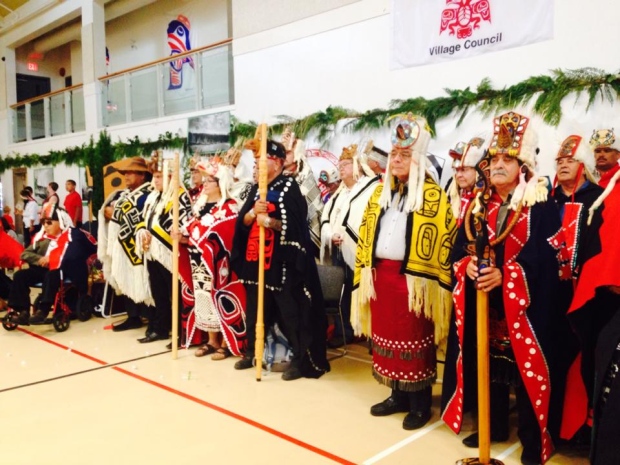
Heiltsuk Hemas standing with Haida Hereditary Chiefs

In the eyes of the Heiltsuk Hemas (hereditary chiefs), Josiah is Heiltsuk. Here, Heiltsuk Hemas are shown with Haida hereditary chiefs. (Don Wilson/Facebook)

Heiltsuk cultural adviser Frances Brown says the hereditary system is a complex set of laws that governs not only a responsibility to the land, but also social relationships to one another, including adoption.

“If there’s a customary adoption it means that you adopt a child and you do it in a potlatch where there’s many witnesses and the chiefs are there,” said Brown.

Gary Housty was one of the Heiltsuk Hemas to witness the ceremonial adoption of Wilson by a First Nations family. He says he wrote a letter to members of the all-native committee urging them to let Wilson play, but received no response.

“I really have a problem with the way they’re setting down rules that disallow people to participate in these very important cultural events, such as the All-Native Tournament. There’s so much culture there. And we are talking about culture here.

“In my eyes Josiah is a Heiltsuk boy, a Heiltsuk person. He belongs here with us,” said Housty.

Source: Josiah Wilson, the Indian Act, hereditary governance and blood quantum – Aboriginal – CBC

CAS study reveals stark racial disparities for blacks, aboriginals

The disparities are quite striking and like all studies, force questioning into the reasons why, including implicit bias:

New research that for the first time calculates disparity in Ontario’s child protection system has found that aboriginal and black kids are far more likely to be investigated and taken into care than white children.

The figures are especially stunning for aboriginal children. They are 130 per cent more likely to be investigated as possible victims of child abuse or neglect than white children, and 15 per cent more likely to have maltreatment confirmed.

Aboriginal children are also 168 per cent more likely to be taken from their homes and placed into care.

The huge disparity is “symptomatic of the system that’s failing our kids,” says Steven Vanloffeld, executive director of the Association of Native Child and Family Service Agencies of Ontario.

The study also found that black children are 40 per cent more likely to be investigated for abuse or neglect than white children, and 18 per cent more likely to have maltreatment confirmed. But the likelihood of going into care is lower. Black children are 13 per cent more likely to be taken from their homes and placed with foster parents or in group homes.

Margaret Parsons, executive director of the African Canadian Legal Clinic, blames the disparity on the “harsher lens” children’s aid societies use when investigating black families.

“What they might not consider abuse or neglect within a white or non-African Canadian family, they will consider abuse or neglect in one of our families,” she says. “This is not a matter of erring on the side of caution. We feel it is punitive.”

The provincial government, which regulates the child protection system, must make the development of an African Canadian child welfare strategy a priority, she adds.

The estimates were extracted from the government-funded Ontario Incidence Study of Reported Child Abuse and Neglect, compiled in 2013. A team of researchers, led by University of Toronto Prof. Barbara Fallon, examined a representative sample of 4,961 child protection investigations conducted by 17 children’s aid societies. The cases involved children up to age 14.

Of the dozen specific ethnic and racial categories examined, only black and aboriginal children were taken into care at rates higher than white kids.

The study was presented to more than 70 senior children’s aid society officials at a June 7 meeting in Toronto.

The disparity study calculated the relative likelihood of certain groups being involved with the child protection system. It differs from the study on disproportionate representation revealed by an ongoing Star investigation, which found that on a September day in 2013, 42 per cent of kids in the care of the Children’s Aid Society of Toronto had at least one parent who is black. Only 8 per cent of the city’s under-18 population is black.

The disparity results coincide with mounting outrage about the disproportionate number of aboriginal and black children in care. Parents and leaders in these communities have for years blamed discrimination and a lack of services for struggling families.

Source: CAS study reveals stark racial disparities for blacks, aboriginals | Toronto Star

The door to reconciliation [with Indigenous peoples] is truly open: Adams

Michael Adam’s overview of the findings of the recent Environics Institute survey on non-indigenous adults on indigenous issues:

The survey measured support for key areas related to the TRC’s recommendations and other long-standing unresolved issues. There is almost universal public support (90 per cent) for increased government spending to ensure that indigenous peoples have decent housing and safe drinking water, basics that most other Canadians take for granted.

Unsurprisingly, the people who support other equity-oriented initiatives like universal health care are the same people who support addressing inequities in indigenous living standards.

Nine in 10 non-aboriginal Canadians (91 per cent) also support the TRC’s recommendation that funding to indigenous schools be increased to ensure that students have equal access to educational opportunities. Canadians today overwhelmingly believe that education is the key to sustained economic well-being.

This finding from the 2016 survey dovetails with findings from our 2010 Urban Aboriginal Peoples Study, which found that the top priority of indigenous people living in Canadian cities was education. Of course, the history of Canadian intervention in indigenous education is a painful one. This country’s policies of forced assimilation through education, which the TRC, Supreme Court Chief Justice Beverley McLachlin and former prime minister Paul Martin have called cultural genocide, robbed tens of thousands of children of family and cultural heritage and inflicted damage across generations.

Our survey shows that awareness not only of the Indian residential school system but of the specific abuses and consequences of that system has grown among non-aboriginal Canadians since 2008; 73 per cent now make this connection.

Canadians see education as not only as a key to economic success, but as one means of unwinding the prejudices and stereotypes that have accrued during Canada’s colonial history. More than nine in 10 non-aboriginal Canadians say that it is very (62 per cent) or somewhat (30 per cent) important for all non-aboriginal Canadians to understand the true history of how indigenous people have been treated by governments and society.

Better indigenous education for all Canadian students has the potential to create a platform for true reconciliation and partnership, a project in which 64 per cent per cent feel strongly that all Canadians have a role to play (a proportion that has increased by 22 points since 2008). Only 6 per cent strongly reject the idea that we all have a role to play in reconciliation.

Our survey did find negative attitudes, including the belief that aboriginal peoples have a sense of entitlement about receiving support from government, and the belief that suffering communities are partly to blame for their own difficulties. Despite the ongoing presence of these sentiments, there is broad public support for key TRC recommendations, some of which the recent federal budget took steps toward.

Of course, government action on issues so deeply rooted in our cultural and political experience will not deliver immediate benefit. But these results suggest most Canadians would rather be moving along the path to progressive change, even if we stumble, than standing still or moving backward.

Source: The door to reconciliation is truly open – The Globe and Mail

Diversity among federal and provincial judges

This article appeared originally in IRPP’s Perspectives:

With the federal government’s general commitment to increased diversity in appointments, and Justice Minister Jody Wilson-Raybould’s current review of the judicial appointment process, there needs to be a baseline of information about the current diversity situation in order to measure implementation of these commitments.

Overall, women, visible minorities and Indigenous people are under-represented among the over 1,000 federally appointed judges (65 are in federal courts, the balance are in provincial courts). There is a similar but less pronounced pattern of under-representation among the over 700 provincially appointed judges.

Does this matter given that judges by are expected to be objective, impartial and neutral? Their legal education, training and experience prepare them for this end. However, judges are human and, like all of us, they are influenced by their past experiences, influences and backgrounds. We know from Daniel Kahneman (author of Thinking, Fast and Slow) and others that no one is completely neutral and bias-free, even if the judicial process does represent “slow” or deliberative thinking, and thus greater objectivity, rather than “fast” or automatic thinking. Diversity of background and experience is another way to improve neutrality in decision-making.

Moreover, given the over-representation of some groups who are tried in the courts, such as Black people and Indigenous people, a judiciary in which these groups are significantly under-represented risks being viewed as illegitimate to those communities. The current debate over murdered and missing Indigenous women and police carding practices exemplify this risk.
Figure 1 highlights the extent of this under-representation: there are no visible minority or Indigenous judges in the Supreme Court and Court of Appeal, no visible minority judges in the Federal Court and no Indigenous judges in the Tax Court. In all the courts except for the Supreme Court, women are significantly under-represented.

Judicial Diversity 2016 - DRAFT.009Figure 1

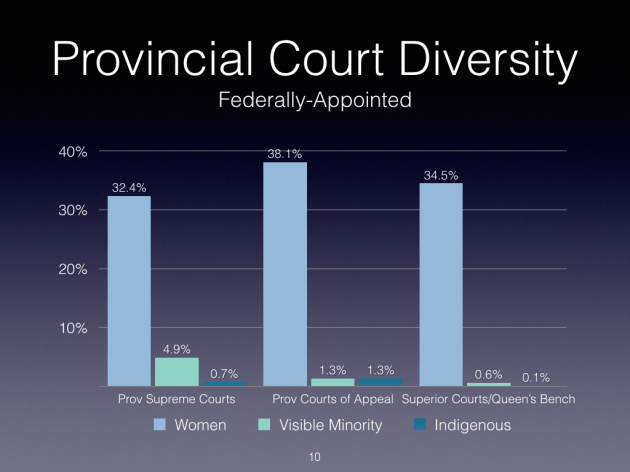
If we look at federally appointed judges to provincial courts (figure 2), the picture is slightly better in terms of both visible minority and Indigenous judges, but in both cases the representation is significantly lower than these groups’ population shares. In the superior courts/Queen’s Bench women are particularly under-represented, but they are better represented when the representation is compared with that of the federal courts.
Judicial Diversity 2016 - DRAFT.010Figure 2

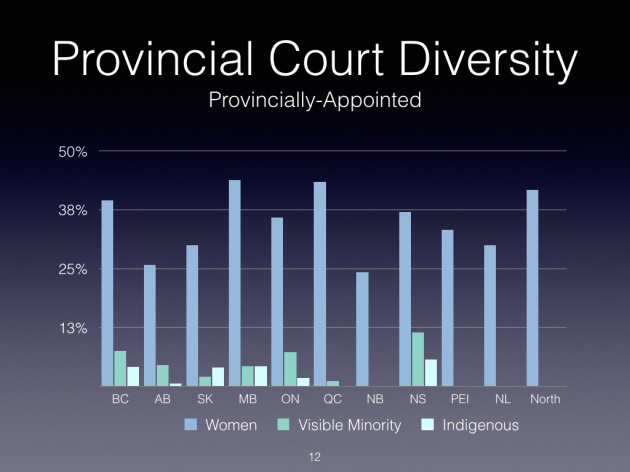
The picture for provincially nominated judges to provincial and territorial courts (figure 3) varies by province, but overall the provinces resemble each other in their under-representation of these groups. The Atlantic provinces, with the exception of Nova Scotia, have no visible minority or Indigenous judges. In the North, despite the large Indigenous population, there are no Indigenous judges. Quebec has relatively few visible minority judges and no Indigenous judges. Saskatchewan and Manitoba, despite their large Indigenous populations, have relatively few Indigenous judges.
Judicial Diversity 2016 - DRAFT.012Figure 3

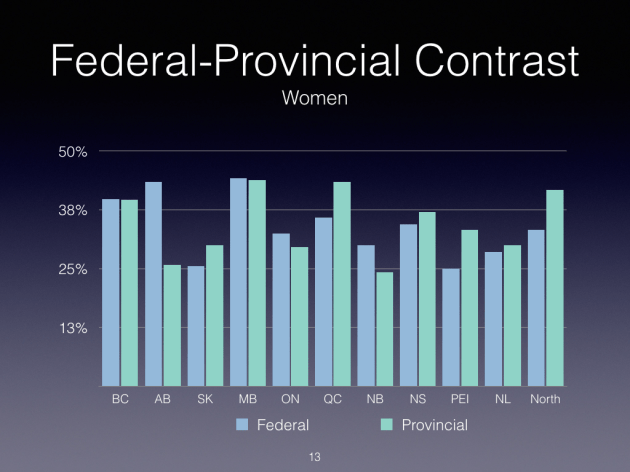
In the next series of charts federally and provincially appointed judges are compared for each under-represented group, by province, starting with women (figure 4). Here there is no overall trend: the federal and provincial appointment of women is similar in British Columbia, Manitoba, Nova Scotia, and Newfoundland and Labrador; in Saskatchewan, Quebec, Prince Edward Island and the North, provincial appointment of women is higher; and in Alberta the appointment of women is significantly lower, given the relatively large share of part-time and supernumerary appointments that are men (about a third of full-time judges are women).
Judicial Diversity 2016 - DRAFT.013Figure 4

Looking at visible minorities (figure 5), when we compare federal and provincial appointments by province, we see a trend in all provinces except Saskatchewan: provincial judicial appointments are more representative of their populations than federal nominations, although visible minorities are still significantly under-represented.

Judicial Diversity 2016 - DRAFT.014Figure 5

Lastly, with respect to Indigenous appointments (figure 6), we see the same pattern: provincial appointments are more representative of provincial populations than federal appointments in all provinces and territories, except, surprisingly, in the North, where there are no Indigenous territorial judges.

Judicial Diversity 2016 - DRAFT.015Figure 6

Looking at senior judges (chief and associate-chief justices), there are no federally appointed visible minority or Indigenous judges, and there are only a handful number of provincially appointed senior judges (figure 7).

Judicial Diversity 2016 - DRAFT.011Figure 7

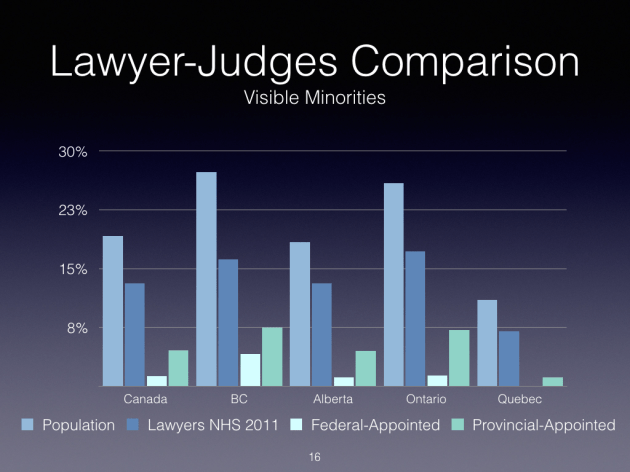
While judicial diversity is low, particularly for visible minorities and Indigenous people, the number of visible minority lawyers continues to increase. Figure 8 presents the proportions of visible minority lawyers aged 25-64 Canada-wide and in the largest provinces, which gives an idea of the size of the pool that can be drawn from. Given that visible minorities are, in general, younger than the general population, visible minority lawyers are also likely to be younger and, therefore, the percentage who would be aged 45 years old or older, the usual age people are considered for these positions, would be lower.
Judicial Diversity 2016 - DRAFT.016.pngFigure 8

As part of its review of the judicial appointment process, the Office of the Commissioner for Federal Judicial Affairs should expand the existing information on the gender of judges and include visible minorities and Indigenous people. With this information, the government could be held to account for its diversity and inclusion commitments, and it would be easier to track its progress over time.

The provinces and territories that do not already do this should do so, and they should use Ontario’s annual reports on appointments as a model, ensuring that the annual reports cover the overall diversity of the entire bench.

*A few notes on methodology. The federal government publishes statistics on gender but not on visible minority or Indigenous appointments. All provinces except Alberta and Saskatchewan indicate gender through the use of “Mr.” or “Madam” justice (the departments of justice provided the number of women judges). Gender information is thus complete.

To identify visible minority and Indigenous origin name checks, appointment announcements and, when available, photos and biographies were used. All provincial judicial councils or departments of justice were approached (only Ontario reports publicly but Saskatchewan, Quebec and Nova Scotia provided the breakdowns used). The Canadian Bar Association, national and regional branches, and law societies were approached and a number of individual lawyers also helped improve the quality of the data collected. I believe this provides a reasonable assessment of current diversity.
The Government Could Be Appointing Indigenous Members To Canada’s Pipeline Regulator – BuzzFeed News

What diversity and inclusion means for Governor in Council appointments, an early example:

The Canadian government is signaling that it’s going to appoint Indigenous members to the board that decides on pipeline projects.

The move would shake up the composition of the National Energy Board, which is dominated by former oil and utility company executives.

As was first reported by Blacklock’s Reporter, Natural Resources Minister Jim Carr told a committee last week that the NEB “has to be composed of individuals who better reflect the diversity of Canada.”

CPAC / Via cpac.ca

“The National Energy Board should be more reflective of the diversity of the country, including and particularly Indigenous cultural background and perspective,” Carr told the Indigenous and Northern Affairs committee.

Carr said the same applies to the temporary members the government plans on appointing to help review the Energy East proposal.

“Through the appointment of new temporary members to the board [we know] that Indigenous background issues are important,” Carr said.

Carr was speaking in the context of the Liberal government’s promised reforms of the NEB. Before the federal election, Justin Trudeau promised to “put some teeth” back into the regulator, the Canadian Press reported.

Carr’s ministerial mandate letter instructed him to reform the NEB so that its members have better knowledge of Indigenous issues, among other things.

The NEB has been criticized for its lack of diversity and failing to sufficiently consult the communities, including Indigenous ones, that would be affected by proposed pipelines.

“We’re opening up the important reform of the National Energy Board and environmental assessments in Canada generally speaking to what we hope is a robust, important Canadian chat about that,” Carr said.

He said the government will be announcing the permanent reform process “in the next while.”

Source: The Government Could Be Appointing Indigenous Members To Canada’s Pipeline Regulator – BuzzFeed News

Canada’s multiculturalism: A circle, ever edging outwards – John Ralston Saul

Good long read by John Ralston Saul, one of the few people to articulate a common narrative for Indigenous peoples, old and new Canadians.

I have always felt that it was the unique combination of Indigenous peoples with English and French founding immigrants that helped us (or forced us) to develop a culture of accommodation:

We all know that these 400 years of policy development were tarnished and regularly knocked off track by multiple insurgencies of racism and exclusion. But each of these was gradually eliminated and the main line re-established.

The philosophical trick in all of this is that immigration and citizenship have always been treated as inseparable steps. Engagement and marriage. This means that each immigrant arrives knowing that she must think of herself as a citizen, because she soon will be a citizen. This is a philosophy which changes radically everyone’s attitude toward inclusion and integration. It means that language training is simply part of the package from the beginning, as is the expectation that new Canadians will get involved in volunteerism and politics – the two keys to an engaged citizenry.

A perpetual experiment

What of the multicultural misunderstanding?

Canadians seem to be moving toward other words – diversity, pluralism, inclusion, interculturalism – as we have sensed a growing confusion elsewhere. But the idea is really not so difficult.

I think of it as rooted in balance – a central Indigenous concept of how societies function. At its best a balance between the place, the group and the individual. You could also describe it as a balanced or positive tension between organized integration and celebrated diversity; a conviction that diversity and fairness are reflections of each other; that this requires a rigorous use of political restraint; an allergy to universal mythologies and ideologies. All of which means that we must be self-confident enough and tough enough to live with the reality of complexity.

This is the opposite of the tired European-U.S. insistence on monolithic identities. The Canadian concept of living in a perpetually incomplete experiment may seem radical to many in the Western world. And yet you could simply see it as a profoundly non-racial approach to civilization – one based on the idea of an inclusive circle that expands and gradually adapts as new people join us.

Source: Canada’s multiculturalism: A circle, ever edging outwards – The Globe and Mail