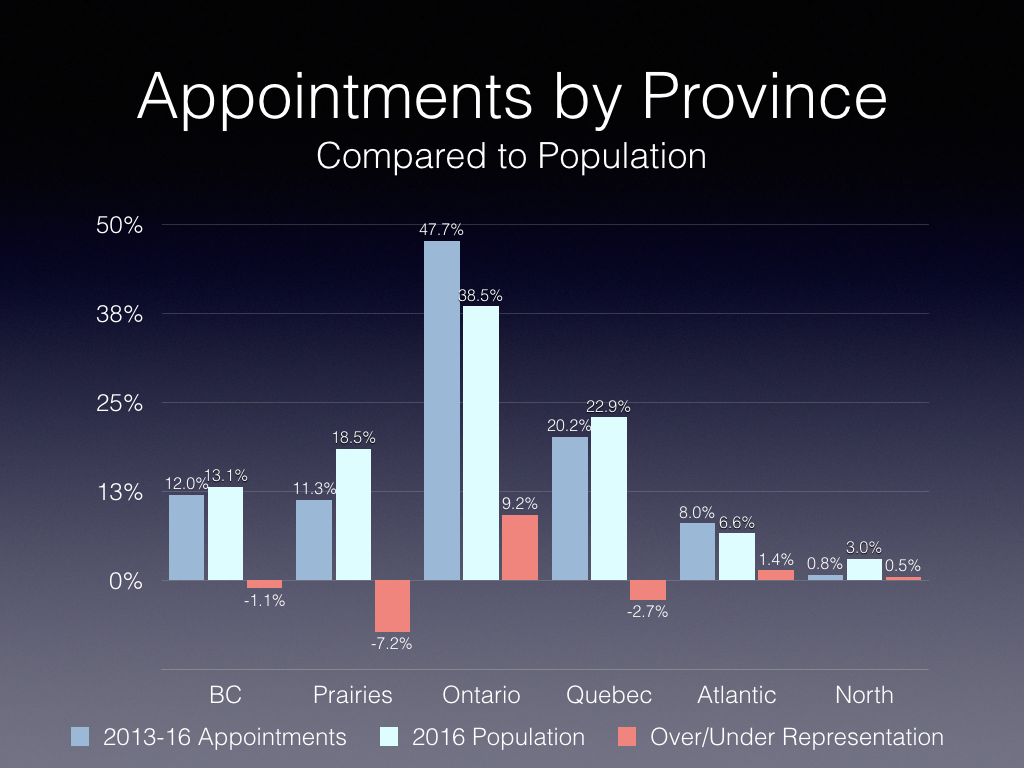
In Budget 2015, the then Conservative government announced additional funding of $13.4 million over five years and $2.8 million in ongoing funding for the Canadian Honours System. This aimed to “bring [honours] closer to all Canadians” by increasing the number of Order of Canada nominations from “under-represented sectors” (e.g. business) and regions (i.e. the West).
This was prompted by an Ottawa Citizen analysis that showed only 26 percent of recipients since the Order’s creation in 1967 came from the West, compared to the region’s 31 percent share of the population. In contrast, Atlantic Canada had 11 percent of recipients, about twice its share of the population. Moreover, the study showed an increasing percentage of awards had gone to those active in the arts while the share going to business people had declined.
I have a lot of sympathy for the people who have had to develop and implementation the criteria used, as well as the people interviewed below whose applications have been denied. Identity is as much if not more subjective and yet needed to be “objectified” for the purpose of status cards:
Belonging. Identity. Who do you think you are? Who do they say you are? For thousands of indigenous Canadians, it’s complicated. Records have been obscured or obliterated through hundreds of years of assimilation. The federal government — from bureaucrats to Indian agents — made these decisions based on the political mandates of the day. First Nations have made their decisions. So have individuals. In this occasional series, The Status Card, Tanya Talaga, the Star’s indigenous affairs reporter, will look at the complexities and who is making these decisions and how.
CORNER BROOK, N.L.—Retired master corporal Matthew Connolly has spread his prized spiritual possessions on his dining room table.
He carefully touches each as he explains its significance. He starts with a beautifully carved drumstick made from the wood of an old sweat lodge. Then he unrolls the red leather case that holds his eagle feather, given for service to the community. He moves to a hand-held drum, then a smudge kit, then a satchel of tobacco.
From his wallet, he retrieves a small, laminated white card to show the words “Teluisi Kelusit Paqtism” — Speaking Wolf, Connolly’s Mi’kmaq name. He grew up proud knowing he is a direct descendant of Mattie Mitchell, the revered trader and explorer who is recognized as a founding father of the Mi’kmaq in western Newfoundland, likely arriving here in the 1700s from Cape Breton.
Connolly, 57, may believe he is indigenous but the government of Canada does not. Connolly was one of 82,630 people who received a letter dated Jan. 31, 2017, from Indigenous and Northern Affairs Canada, denying his application for membership in the Qalipu Mi’kmaq First Nation, a landless band headquartered in Corner Brook, Newfoundland.
His rejection came at the end of an unprecedented enrolment drive that saw 101,000 claiming Mi’kmaq ancestry and applying to join the Qalipu, a band made up of nearly a dozen Newfoundland indigenous communities. Applicants were judged on a points system developed by six government representatives and six from the Federation of Newfoundland Indians (FNI) to assess how Mi’kmaq someone is.
Thirteen points grants membership. Points were given to those who live in one of Newfoundland’s 66 Mi’kmaq communities, and to those who could prove they were culturally involved with the Mi’kmaq before June 2008, when the federal government officially recognized the Qalipu. Points were also given if applicants could produce affidavits that they had engaged in activities such as hunting and powwows, and if they had airline receipts to show frequent visits to Mi’kmaq areas.
But how and why points were given to some but not others has caused endless confusion and can border on the absurd. In many families, some siblings were accepted and others rejected. In the case of twin toddlers, one gained membership and the other did not. The first president of the Federation of Newfoundland Indians was rejected and so was a recent Indspire Awards recipient. Indspire Awards are handed out only to indigenous people.
The 100,000 applicants came from across Canada and beyond — from Hong Kong, California and Australia — all claiming Mi’kmaq ancestry. But Ottawa and the Qalipu band council agreed “it was neither reasonable nor credible” to expect that all of them would become members of the First Nation, “particularly given that approximately two-thirds of the applicants did not reside in any of the Mi’kmaq communities targeted for recognition in this initiative,” Qalipu’s website states.
Connolly’s rejection was blunt: “You did not meet the requirements for acceptance by the Mi’kmaq group of Indians of Newfoundland.”
He only received three points. This stunned Connolly, who has a home in Corner Brook, has participated in cultural events and powwows and has worked for the Qalipu band. He believes multiple mistakes were made when his application was assessed and is “emotionally devastated.”
While I understand the pressures for renaming, I much prefer keeping the original names but with historical plaques that capture both sides of the legacies of historical figures. There are risks in erasing or forgetting history:
To damn Langevin is not only to judge him with the benefit of 135 years of hindsight but also to ignore the political leadership he showed during his nearly 30 years as a cabinet minister. He was not a monster — he was a man of his time.
Brian Lee Crowley, managing director of the Macdonald Laurier Institute think-tank, was not referring to Langevin in his remarks at a “Canada at 150” dinner Thursday, but he may as well have been.
“It is easy to criticize the past and the decisions made there. But it is a conceit of each and every generation that they alone are free from poor judgments and intellectual shortcomings. Looking solely at our past efforts is not the right standards by which to measure Canada and its great achievements,” he said.
Crowley referred to a recent Angus Reid poll that suggested less than half of 18-24 year olds feel a sense of pride and achievement in this country.
Since Canada’s prominent historical figures are increasingly portrayed as a parcel of racists, homophobes and militarists, is it any wonder?
This country is addressing many of the wrongs that have been wrought and has committed not to repeat them. But that does not require we repudiate our past by renaming every bridge, road and building that bears the name of someone whose actions we now deem ill-advised and unacceptable.
As the American poet and civil rights activist Maya Angelou, said: “History, despite its wrenching pain, cannot be unlived. But, if faced with courage, it need not be lived again.”
New Canadians will soon promise to honour treaties with Indigenous peoples as part of their oath of citizenship.
The mandate letter for new Immigration Minister Ahmed Hussen lists making the change to the swearing-in ceremony as one of his key priorities, along with enhancing refugee resettlement services and cutting wait times for application processing.
According to the mandate letter, the proposed change is to reflect the Truth and Reconciliation Commission’s calls to action.
That reads: “We call upon the government of Canada to replace the Oath of Citizenship with the following: I swear (or affirm) that I will be faithful and bear true allegiance to Her Majesty Queen Elizabeth II, Queen of Canada, her heirs and successors, and that I will faithfully observe the laws of Canada, including treaties with Indigenous peoples, and fulfil my duties as a Canadian citizen.”The current oath does not include the words “including treaties with Indigenous peoples.”
The call for action was among 94 recommendations from the Truth and Reconciliation Commission in December 2015.
Call to revise citizenship test
Another recommendation called on the federal government, in collaboration with national Indigenous organizations, to revise the information kit for newcomers to Canada and the citizenship test to “reflect a more inclusive history of the diverse Aboriginal peoples of Canada.”
That would include information about the treaties and the history of residential schools, according to the document.
Residential school survivor Lorna Standingready, left, is comforted during the Truth and Reconciliation Commission of Canada closing ceremony at Rideau Hall in Ottawa. (Blair Gable/Reuters)
This past December, Prime Minister Justin Trudeau announced the creation of an independent national council to help implement the recommendations.
The specific commitments of Minister Hussen’s mandate letter are (the emphasis on measuring outcomes for settlement services and “rigorous approach to data” is also of note):
In particular, I will expect you to work with your colleagues and through established legislative, regulatory and Cabinet processes to deliver on your top priorities:
Ensure the effective implementation of Canada’s increased annual immigration levels.
Working with the provinces and territories, ensure a renewed focus on the delivery of high-quality settlement services to ensure the successful arrival of new Canadians. This will require a rigorous approach to data in order to accurately measure outcomes.
Following our government-wide efforts to resettle more than 39,000 Syrian refugees as of January 2017, continue to welcome refugees from Syria and elsewhere, and work with provinces and territories, service provider organizations, and communities to ensure refugees are integrating successfully into Canada to become participating members of society.
Work on reducing application processing times, on improving the department’s service delivery and client services to make it timelier and less complicated, and on enhancing system efficiency including the asylum system.
Continue to work with the Minister of Justice and the Minister of Public Safety and Emergency Preparedness towards the adoption of Bill C-6 which would repeal provisions in the Citizenship Act that give the government the right to strip citizenship from dual nationals.
Conduct a review of the visa policy framework, including its application to the transit of passengers through Canada, in a way that promotes economic growth while ensuring program integrity.
Work in collaboration with the Minister of Indigenous and Northern Affairs to make changes to the Oath of Canadian Citizenship to reflect the Truth and Reconciliation’s Calls to Action.
Work with the Minister of Employment, Workforce Development and Labour to improve the temporary foreign worker program so it meets the needs of Canadian workers and employers. This would include:
further developing a pathway to permanent residency so that eligible applicants are able to more fully contribute to Canadian society; and
working with stakeholders to act on the recommendations of the House of Commons Standing Committee on Human Resources, Skills and Social Development and the Status of Persons with Disabilities’ study of the temporary foreign worker program.
These priorities draw heavily from our election platform commitments.
While I always have mixed thoughts about ethnically (or religiously) based schooling given that it can hamper integration, understand the pressures particularly with First Nations.
It will be important to have some long-term evaluations of this school’s effectiveness, not just in terms of graduation rates (important, where I expect improvement) but 10 years post-graduation in terms of employment and income:
Twenty-five years ago, Shannon Judge was an indigenous student in a Barrie high school where sports teams were named the “Redskins.”
A generation earlier her mother, from Wasauksing First Nation near Parry Sound, wasn’t allowed to speak her first language of Ojibwe at the elementary school she attended on her reserve.
Today, Judge’s two children are finally breaking the cycle at First Nations School of Toronto. Raven, 9, and Rayne, 8, are part of a new era of indigenous education that teaches them through the lens of aboriginal experience and history.
Thanks to their school, both children now speak Ojibwe with their grandmother, which has inspired Judge to take lessons too, provided by volunteers through the school. Morning smudging ceremonies and daily 40-minute language and culture classes with an elder are part of their routine.
“I feel like my kids are getting something from school that’s not only education, but a connection to their history and identity that empowers them and gives them a sense of worthiness,” says Judge.
As of this month, students will have the option of keeping that connection until they graduate from Grade 12, following the school’s long-awaited move from its cramped quarters at Dundas Street Public School.
The move to the spacious building — site of the former Eastern Commerce Collegiate, which closed in 2015 due to falling enrolment — means that beginning in September, First Nations School will introduce a new high school grade each fall. The new Grade 9 class next September will become the first graduates in 2021.
That will make it Ontario’s first publicly-funded school to offer aboriginal education from kindergarten through Grade 12.
“The dynamics have changed,” principal Jonathan Kakegamic said following the Jan. 10 opening on the six-acre property, also home to the Aboriginal Education Centre run by the Toronto District School Board.
The kids, currently in kindergarten through Grade 8 and from all over the city, were beside themselves to see all the space, inside and out. Instead of eating breakfast and lunch in a crowded classroom, they now have a cafeteria, along with their own gym and an auditorium.
“I’m just excited to be here,” says Kakegamic, who moved from Thunder Bay last August to become principal. “It’s an honour to be part of this new era.”
Attendance has already risen to 131 students from 96 in September and the new site will accommodate 600.
Kakegamic and others in the community stress that expanding to secondary school is critical to reducing high dropout rates among indigenous students, who often feel lost in a larger system that doesn’t teach their perspective and history.
A number of articles I found particularly interesting over the past few weeks.
Starting with Joe Friesen of the Globe’s overview of how increased numbers of urban Indigenous peoples are shaping our cities, particularly but not exclusively in the Prairies:
Look around Winnipeg’s downtown and it’s clear the city is in the midst of a demographic shift. In the elevated walkways that offer shelter from the legendary winds, it seems roughly half the people shopping, walking or stopping to chat, are indigenous. In fact, more than 70,000 residents identify as aboriginal. Like many the other cities with a growing indigenous population, Winnipeg has seen more than its share of racially charged conflict, but the signs of an increasingly prominent indigenous community are apparent.
Storefronts in Winnipeg’s downtown now bear messages of greeting in indigenous languages, ranging from Cree to Dakota, Michif and Inuktitut, distributed by the local business association. At the University of Winnipeg, students who began their studies this year are now required to take a course on indigenous peoples and culture. A community group is petitioning to rename a street in Ojibwe. The national aboriginal broadcaster, APTN, headquartered on Portage Avenue, plans to expand to the United States. On the main street of the predominantly aboriginal North End, Selkirk Avenue, once the heart of the city’s Eastern European communities, schools of social work and urban studies from the province’s two largest universities offer off-campus degree programs for indigenous students, producing a stream of graduates and nourishing a growing middle class.
Every home game for the NHL’s Winnipeg Jets now opens with an announcement recognizing that the MTS Centre is located on Treaty One land, and the homeland of the Métis Nation. It also pledges that the Jets ownership, True North Sports and Entertainment, is committed “to a spirit of reconciliation for the future.” Winnipeg’s mayor, Brian Bowman, is Métis. In the provincial legislature, speculation about who might lead the Official Opposition has swirled almost exclusively around several indigenous contenders.
Winnipeg is the largest of the 28 cities across Canada where the indigenous population has reached the symbolic threshold of 10 per cent of the broader community (including those rounded up from 9.5 per cent and higher), according to the 2011 National Household Survey.
Just 10 years earlier, in 2001, there were only 17 communities with indigenous populations of that size. The list will almost certainly grow once the results of the 2016 long-form census are available, and not just because indigenous people living off-reserve were among the groups considered at risk of being undercounted in 2011. First Nations and Inuit people tend to have higher fertility rates than the rest of the population: In 2006, it was 2.7 children per woman for Inuit women and 2.4 for First Nations women, compared to 1.8 for Métis women, and 1.6 for the population overall.
The city with the highest proportion of indigenous people in Canada is Prince Albert, Sask., a community of roughly 35,000 located 140 kilometres north of Saskatoon. It’s considered a hub for many Northern communities, including 12 nearby First Nations reserves in the Prince Albert Grand Council. Over the decade, the city’s indigenous population grew by 37 per cent, far faster than growth in the city overall.
On the city’s police force, a little less than 40 per cent of officers self-identify as indigenous, and the chief of police is Métis. One member of the eight-seat city council is Métis, and in the last election there was an indigenous candidate for mayor, though he did not win, the city manager, Jim Toye, said.
“The relationship with First Nations is very important to us,” Mr. Toye said. “This is their lands that we are operating on.”
He said the city acknowledges the Treaty relationship at public gatherings and, in its 2016 cultural plan, recognizes its history as a meeting place, known by its Cree name Kistahpinanihk, long before European arrival. The city officially defines itself as a multicultural community with indigenous roots.
As I start to think about my update to Multiculturalism in Canada: Evidence and Anecdote with 2016 Census data, I plan on using more economic, social and political data at the municipal level to help me incorporate this development.
Next, a good long read by Doug Saunders arguing that 1967 marked the emergence of the new Canada, driven largely by the changed and increased diversity by post-war immigration:
Yet to look back from Canada’s 150 th year is to realize that this feeling is not just solipsism: 1967 is the hinge upon which modern Canadian history turns and, in certain respects, the key to understanding the challenges of the next half-century.
Today, we live in the country shaped by the decisions and transformations of 1967, far more than by the events of 1867. Anniversaries are usually symbolic moments of reflection, but Canada’s hundredth was a very real bid to create an almost entirely new country, and, to a large extent, it succeeded. If you spend some time immersed in the Canada of a few years before 1967, and then in the Canada of a few years after, you feel like you’ve visited two countries – the former still colonial, closed, dependent, paternalistic and pretending to be homogeneous, a place whose sleepy streets you’d have to leave if you wanted to make something of yourself; the latter a country of self-invention and iconoclasm, a North American place whose several peoples began to build something much bigger, more complex, but also safer and more educated and urban, and something entirely their own.
Pierre Berton, the historian, famously referred to 1967 twenty years ago as “The Last Good Year” – a book title that appealed to a nostalgic belief in a placid antediluvian Canada that even he admitted had never existed. The centennial euphoria, he argued, gave way in later years to “the very real fear that the country we celebrated so joyously … is in the process of falling apart.”
There’s a better way to express that thought: After the centennial, we started to confront seriously the schisms and divisions and gross inequities that had been masked before beneath a patina of colonial gloss. We would have, over the next 50 years, two secession crises, a battle over our North American economic identity and a hard-fought political reawakening of our indigenous nations. Yet, these were the crucial struggles of becoming a real country, of finding a governing mechanism and a common culture to bring together those long-disparate peoples.
Let me make the case, then, that 1967 was Canada’s first good year. We should spend this year celebrating not the 150 th year of Confederation, but the 50th birthday of the new Canada.
But let me also make the case that our conventional story about the birth of second-century Canada is largely wrong. We like to believe that starting in the late 1960s, a series of political decisions, parliamentary votes, court rulings and royal commissions descended upon an innocent, paternalistic, resource-economy Canada and forced upon it an awkward jumble of novelties: non-white immigration, bilingualism, multiculturalism, refugees, indigenous nationhood, liberation of women and gays, the seeds of free trade, individual rights, religious diversity.
But the explosions of official novelty that were launched in and around 1967 weren’t a cause; they were an effect of profound changes that had taken place in Canadians themselves during the two decades after the war, in their thinking and their composition and their attitude toward their country, in Quebec and English Canada and in indigenous communities.
Canada was not remade by the decisions of 1967; it was reflected by them, for the first time. What began in 1967 was official Canada beginning to catch up with the real Canada. And that is also the lesson to be carried forward to 2017: Canadians tend to be ahead of their institutions, and every few decades it is time for a dramatic catching up, like the explosion of adjustment we saw in ‘67.
A War of Symbols
…Consider the ripples of change that took place on the day of my birth, as the centennial bash roared on.
Eight hours after I was born, the directors of the Canadian National Exhibition filed into a banquet hall for their annual luncheon. The exhibition’s president, W.H. Evans, asked them to remain standing to sing the national anthem – and then chaos ensued, as half the audience broke into God Save the Queen before the pianist had struck the first note of O Canada. A debate over Canada’s true national anthem, begun in 1964, had been winding its way through a special House of Commons-Senate joint committee all year and filling the media with debate. It wouldn’t fully be resolved until a law was passed in 1980, and many people (especially in Toronto) still considered the British national anthem “official.”
National symbols remained subjects of heated contention in 1967. The flag debate had officially been resolved two years earlier with the choice of the Maple Leaf, but defenders of the old colonial Red Ensign remained outspoken in Parliament, the press and even at Expo 67. Everything about the way Canada represented itself to the world was up for grabs.
But something deeper was taking place, involving not just the symbols but the realities they represented.
The postwar decades were defined by large-scale decolonization around the world: Across Africa, Asia and the Americas, scores of countries were freeing themselves from centuries of control by European masters, and struggling, sometimes violently, to find ways to represent and govern themselves as independent entities. People were learning to think of themselves not as colonial subjects but as autonomous individuals within self-created states.
In that light, 1967 can only be seen as the apex of Canada’s postcolonial moment. The wars over symbols were one small manifestation of a larger shift.
It’s worth remembering how new this all was. We still remained, in important ways, a colony. In 1967, Canadian citizenship had only existed for 20 years – before January 1, 1947, everyone in Canada was a British subject and had to travel with a United Kingdom passport. But it still didn’t quite exist: That 1947 law creating Canadian citizenship declared in its main clause that “a Canadian citizen is a British subject” (this would remain in place until 1977).
That idea was still hotly defended by many in the Ottawa of 1967: The Progressive Conservative leadership still opposed Canadian citizenship, and the flag, and the anthem. There was still a sizable political faction in Canada who supported the idea that all Canadians were simply a slightly different, less important flavour of British people.
But the great majority of Canadians had moved on – or moved in – and you could see the centennial struggling to catch up with them.
Two, Three, Many Canadas
The morning of my birth, opposition leader John Diefenbaker (still sitting, anachronistically, in the House four years after his prime ministership had ended) denounced prime minister Lester B. Pearson for having declared the previous week that “we are a nation of two founding peoples” (in French, the prime minister went further and called them “nations”).
Mr. Diefenbaker considered this a catastrophic blow to a country he had always insisted was purely British: “Adoption of the two-nation concept,” he explained to his fellow MPs that day, “would lead to the breakdown of confederation.” But he was swimming against his own party’s tide: a few days earlier, a Progressive Conservative policy conference had gone further than the Liberals by concluding that Canada should be seen as a federal state “composed of two founding peoples (deux nations), with historic rights, who have been joined by people from many lands.”
In other words: A hundred years into Confederation, the leader of the official opposition still did not seem to believe that French Canadians existed. The notion that Canada contained more than one language and people was still hotly contested in some circles.
But that era was ending fast. A day later, Ontario Premier John Robarts would announce that his province was to build a system of French-language secondary schools. This was not an act of expansive idealism: He was recognizing the reality of a population, including millions of Francophones outside of Quebec, who were no longer capable of seeing themselves, or their children, as subjects of a homogenizing foreign ruler.
These debates sprawled across Canada’s newspapers and TV screens all year. Everyone taking part in them knew there was a looming transformation about to take place. There was a name for it: “Bi and Bi,” the household name for the mammoth Royal Commission on Bilingualism and Biculturalism, the largest and most powerful government inquiry Canada had seen. It had been established by Mr. Pearson in 1963 to find a way to address growing Quebecois disenchantment with a Canada that tended to ignore its French fact, and was widely expected to endorse some version of the “two nations” model so hotly discussed that week.
On Oct. 8, 1967, it released its first report – a national event almost rivalling Expo in its media and political attention. And to the great surprise of many, the idea of Canada as two peoples and nations was not its most dramatic proposal – though it certainly did call for a fully bilingual country. That was expected. What was not expected was the very large part of the report, and the subsequent reports over the next two years, devoted to what the commission’s original mandate had called “Other Cultural Groups.” People who were neither British nor French in identity or origin had become a significant share of the Canadian population during the 20 th century.
And while the commission was clear in calling for two official languages, it found a Canada that could no longer be described as having merely one or two or three founding “peoples,” “nations” or “races” (a term still used to describe English and French communities in 1967). Its implication, not quite spelled out, was that Canada was becoming a place that could no longer be defined by its colonial origins.
Over the next several years, that reality would become impossible to ignore. So that when, in 1971, prime minister Pierre Trudeau first used the word “multiculturalism” to define Canadian policy, it was not simply a political ploy to defuse French-English rivalries and rising separatist sentiment (though it was certainly that). It was an inevitable, and perhaps even somewhat late, recognition of what Canada had already been for a long time.
While I would argue that it was a mix of the underlying realities and conscious political decisions that resulted in these changes, not just these realities as other countries were less successful in managing this transition, the contrast is clear.
Lastly, a good primer for Americans trying to understand Canadian immigration and related policies, and their relative success in integrating newcomers by Paul May in the LA Times:
To a lot of commentators, Canada looks like a sanctuary for progressive thinking on immigration, an exception to the nativist wave sweeping the United States and Europe.
A recent cover of the Economist put a maple leaf crown on the Statue of Liberty and proclaimed Canada “an example to the world.” Famously, on election day, the Canadian immigration website crashed because of the number of Americans reportedly considering a move to their northern neighbor as Donald Trump won the presidency. Year after year, polls show that Canadians are, by far, more open and more optimistic about immigration than the citizens in any other Western country.
But such optimism is perhaps easier to achieve in Canada than in other nations: For historical and geopolitical reasons, Canada does not have to cope with the same immigration challenges as the U.S. and Europe.
To start, Canada has pursued a much more selective immigration policy than the United States or any western European country. It accepts far more immigrants legally than most Western nations, but under a policy designed primarily to dovetail with the economic interests of the nation.
In consequence, Canada accepts far fewer immigrants on the basis of family ties than in the U.S., for example, and the proportion of skilled immigrants is much higher. Further, the country sets a higher education standard for immigrants than the U.S. (which is in turn more demanding than Europe). This more-selective immigration policy is likely to lead to fewer integration problems and easier access to jobs.
Canada’s selectivity is helped by its geographical position. It does not share a border with a country where wages are much lower (as the U.S. does with Mexico), and it isn’t next door to unstable regions (as Europe is to North Africa and the Middle East). The result is that few undocumented migrants move across the country’s southern border, as is the case in the U.S.; and few migrants land on its shores by boat, as in Europe.
The points system and geography also have a noticeable effect on where Canada’s immigrants come from.
Official data show that the leading countries among foreign-born residents in Canada are the United Kingdom, China and India. In the U.S., 28% are Mexicans and 24% are from other Latin American countries. In Europe, foreign-born residents originate mainly from the Muslim world (in the Netherlands, for instance, Turkey, Suriname and Morocco; in France — Algeria and Morocco). Consequently, Canada does not have to deal (at least not on the same scale) with the complex problems associated with integrating newcomers from a rural and conservative Muslim background into a highly secular environment.
Not that Canada hasn’t welcomed Muslims. Between November 2015 and November 2016, it resettled more than 35,000 Syrian refugees; most European countries have been much more reluctant to extend permanent status to these immigrants. But again, Canada can and does exert a great deal of control over the process.
Wab Kinew emphasizes a more reconciliatory approach, one that recognizes better the complexity of identities and belonging:
…Today my friend Joseph Boyden is the one in the centre of our circle being stripped of an identity. Though his disrobing is happening in the feedback loop of social media instead of a traditional arbour, as with the man at the sundance, many of the questions asked are legitimate.
Joseph Boyden will be changed by this. He owes some of our friends apologies for apparently misleading them. Media outlets will lose credibility if they present his as the voice of indigenous peoples. When he promotes his next book, he will be asked about his identity and this episode.
Already some non-indigenous readers are asking if they should read his work. His novels remain powerful. But they were always the work of a talented outsider. Even if he is Anishinaabe, he is not a member of the nations he wrote about – the Mushkegowuk, the Huron, the Haudenosaunee. Recognizing the distinctions will inform readers. So, yes, read Joseph Boyden. But also read authors who have lived a more indigenous experience.
The indigenous community also has questions to consider. First, why did we so quickly embrace someone who has long said he has little biological connection to us?
Our community hungers for reasons to celebrate, so when a brilliant artist claimed us, we claimed him. I am not sure this cost us much. While he should not accept award money meant to encourage writers who experience the very real challenges of growing up indigenous in Canada, his success did not prevent a half-dozen indigenous authors from releasing bestsellers in the past few years.
The second, and perhaps more important question, is what does it say that many of us have so quickly turned on him?
I am reminded of the man at the sundance. It could not have been easy, but he has returned year after year since his shaming. In the countless ceremonies since, all participating have repeated the prayerful Lakota words Mitakuye Oyasin (all my relations). The Anishinaabe and other peoples recite similar maxims. These axioms articulate the belief that every being is related to one another.
If we are to live this ethos, then perhaps the issue of how Joseph Boyden gained access to our circle does not matter as much as the fact he is present in our community now.
His place among us was built by writing about, giving back to and befriending us. Some, such as myself, continue to claim him. I can not give him a status card or confer on him the right to identify as Anishinaabe. But I can tell you if he keeps coming back, he will have a place in our circle.
I say this wishing he behaved differently. I want him to rescind the UBC letter, apologize for his comments about missing and murdered women, and be direct with us about his ancestry. If he is not native, he should confess. If he has one ancestor generations back, he should explain who they were.
Not long ago, a Lakota grandmother and I were teasing each other about that man from the sundance. “He’s your relative.” “No, he’s your relative,” we said to one another. But when the conversation turned to the now ailing man’s health the woman surprised me with her genuine sadness. The man was imperfect. He made us cringe sometimes. Yet, he was still a part of us.
There is room in our circle for everyone, even those who do not behave as we would like. We include them not just to make our circle bigger. We love one another as relatives because it frees our hearts from hurt and allows us to embrace the goodness in each of us. When we do that, we are stronger.
On first glance, the inclusion of the smudging ceremony in the school’s curriculum would seem to breach this prohibition on state support for religion. If it is objectionable and a breach of the Charter’s freedom of religion for a school to include the Lord’s Prayer as part of its opening exercises, then surely it must also breach the Charter when a school involves its students in a smudging ceremony. The equation of these practices, though, is too simple and fails to understand why the recitation of the Lord’s Prayer in the public schools is objectionable and why the smudging ceremony has been included in the school’s curriculum.
It is important to remember that the Port Alberni school is not affirming or supporting the smudging ceremony as a spiritually true practice — as the correct way to worship the divine. The school’s purpose is to introduce students to some of the practices of the local indigenous community.
The courts have accepted that a school may teach students about different spiritual traditions. The parent’s objection, then, must be that the students are being exposed to the practices of only one spiritual tradition — that indigenous practices are being given some form of preference in the schools.
But there are good reasons for this apparent preference. The report of the Truth and Reconciliation Commission has helped Canadians to see more clearly that the dominant culture in Canada did not simply ignore the cultural/spiritual practices of the First Nations, but actively sought to suppress those practices through residential schools and other means. Exposing public school students to a few of these practices is a small start in the process of acknowledging the presence of First Nations and the injustices committed against them.
A parent who believes that it is immoral or wrongful for her children to participate in an indigenous spiritual ceremony should be able to request an exemption from participation. The parent, though, should not be able to prevent the school from introducing other students to the cultural and spiritual practices of the local indigenous community.
Seems like reducing the costs to encourage and facilitate more indigenous and visible minority police makes sense, and ensuring comparable incentives to address representation gaps (SVPM has only 6.7 percent visible minority police officers, compared to the 20 percent of its population):
Tout étudiant québécois, autochtone ou non, peut emprunter la voie normale et obtenir un diplôme d’études collégiales (DEC) en techniques policières en trois ans sans avoir à assumer des droits de scolarité. Mais le programme, très couru, est fortement contingenté. En pratique, seul le programme d’AEC réservé aux autochtones, une voie rapide pour des étudiants qui, bien souvent, n’ont pas fréquenté le cégep, peut leur permettre d’accéder à l’ENPQ afin de devenir policiers et poursuivre une carrière dans une force autochtone ou une autre.
Les autochtones ne sont pas les seuls à avoir accès à cette voie rapide. Il existe un autre programme d’AEC en techniques policières, au cégep de Maisonneuve, pour les étudiants issus des communautés culturelles. La Sûreté du Québec et le Service de police de la Ville de Montréal (SPVM) embauchent ces diplômés afin que la composition de leurs effectifs soit plus représentative. Or, tandis que les autochtones paient le gros prix, l’AEC en techniques policières réservée aux étudiants des communautés culturelles est gratuit.
À l’ENPQ, les autochtones continuent toutefois de payer le gros prix par rapport aux autres étudiants. Au lieu de 27 000 $, les étudiants non autochtones assument des droits de scolarité d’environ 8000 $.
Au cégep d’Alma, 14 étudiants autochtones suivent les cours de l’AEC en techniques policières. Pour trois d’entre eux, leur conseil de bande a payé la totalité des droits de scolarité. Deux autres ont reçu de 2000 $ à 3000 $, tandis que neuf étudiants ont dû se débrouiller autrement, s’adressant à leur famille et contractant un prêt auprès d’une institution financière, a indiqué Patrick Girard.
Selon lui, les étudiants autochtones font les frais d’une partie de bras de fer entre Ottawa, qui a créé le programme des services de police des Premières Nations en 1991, Québec et les Premières Nations. Le gouvernement fédéral assume 52 % de la note et Québec, le reste. Or en 2012, le gouvernement Harper a décidé de geler sa contribution, ce qui a depuis exercé d’importantes pressions sur les budgets des corps de police autochtones aux prises avec un alourdissement de leur charge de travail.
La situation est différente pour les étudiants autochtones qui parlent anglais. C’est au collège Ellis, une institution privée sise à Drummondville, que l’AEC leur est offerte à un coût variant entre 18 000 $ et 20 000 $. Selon le coordonnateur du programme, Daniel Guillemette, ce sont essentiellement des Cris et des Inuits qui suivent la formation. Or leurs gouvernements assument tous les frais, a-t-il précisé. Cris et Inuits ne dépendent pas du programme fédéral : ils peuvent compter sur la Convention de la Baie-James.
Depuis qu’Ottawa a décidé de geler son financement, l’Assemblée des Premières Nations du Québec et du Labrador (APNQL) se plaint du sous-financement des corps policiers autochtones au Québec. Certaines communautés ont menacé de fermer leur service de police pour forcer la Sûreté du Québec (SQ) à prendre la relève.
En 2015, il existait au Québec 20 corps policiers autochtones qui desservaient 44 communautés et comptaient 401 policiers, selon les données citées par Patrick Girard. De son côté, la SQ emploie un petit nombre de policiers autochtones : ils étaient 27 en 2015, un de plus que deux ans auparavant.
More on Val-d’Or and its relations with its Indigenous communities:
Like many mining towns across northern Canada, Val-d’Or, pop. 31,862, is close geographically to a number of First Nations communities.
And people here say the allegations have strained relations between the town and the local Algonquin and Cree populations. Some Indigenous people are even calling for a boycott of the municipality for events and meetings.
If you say it three times, does it suddenly appear?
But the provincial legislature seems reluctant to discuss racism.
Parliamentary reporters in Quebec City noticed last week that both Public Security Minister Martin Coiteux and Native Affairs Minister Geoffrey Kelley refused to endorse the concept of “systemic racism” when asked about Lafontaine’s findings.
They preferred instead to speak of “social issues” or a “larger perspective” that needed to be considered.
That reticence was shared by members of the opposition. François Legault, leader of the Coalition Avenir Quebec, said he didn’t “like the word ‘systemic.'”
As for the Parti Québécois, Indigenous affairs critic Alexandre Cloutier would only say that the events in Val-d’Or raised the question of whether systemic racism was an issue among Quebec police. He left reporters guessing about the answer.
Ghislain Picard, chief of the Assembly of the First Nations of Quebec and Labrador, attributes this reluctance to talk about systemic racism to the government’s opposition to an independent inquiry into the relations between indigenous Quebecers and police.
‘A government in complete denial’
To date, the Liberals have been steadfast in their refusal to hold such an inquiry. They maintain it would simply rehash the work of the federal inquiry into murdered and missing Indigenous women, which has promised to look into the Val-d’Or allegations.
“They have refused from the beginning to acknowledge that there is systemic racism,” Picard said of the Quebec Liberals. “This is a government in complete denial.”
Indigenous leaders, though, have not been the only members of civil society pushing the government to take a sustained look at systemic racism.
A group called Québec Inclusif, based in Montreal, has also called for a public commission on institutional discrimination. They have the backing of the small progressive party Québec Solidaire and several prominent intellectuals.
While the government has indicated it is receptive to the group’s concerns — which include discriminatory hiring practices — it has yet to respond to their specific demand.
Is there, perhaps, a reason other than political stubbornness for ducking the question of systemic racism?
Our system of laws is designed to hold individuals -— people or corporate entities — responsible. The problem with systemic racism is that there is no Oz behind the curtain, pulling the strings.
The arc of the moral universe
Responsibility for such types of injustice don’t lie with one person, advocates suggest.
Structural injustice, the American philosopher Iris Marion Young once wrote, “is an unintended but unjust consequence of the actions of millions of differently positioned individuals … all usually acting on normal and accepted rules.”
Their argument is that confronting systemic racism may entail accepting that some of our most trenchant social problems are not anyone’s fault, but everyone’s faults— some more than others, to be sure, but each of us, if only a little.
The Indigenous leaders of Val-d’Or, and their advocates, have proposed a smaller step, one they nevertheless believe will help bend the arc of the moral universe back towards justice.
“We issue a message to the Quebec population to believe these women,” Michel said, after her meeting with the Crown prosecutors in Val-d’Or.
“Show these women, these victims, that there is someone, somewhere, who believes them.”
 My latest, in Policy Options:


