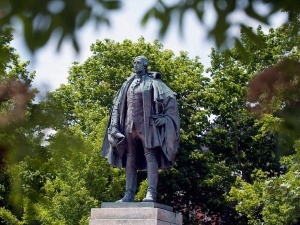
B.C.’s First Chief Judge [Begbie] haunts Law Society

The risks of hasty decisions and lack of fulsome discussion:

The ghost of pioneering B.C. justice, Sir Matthew Begbie — the Hanging Judge to some — has come back to haunt the Law Society of B.C.

The professional regulator’s benchers this spring unanimously exorcised from its lobby a statue of the legendary chief judge.

And they scrubbed references to him from the society’s image as offensive to Indigenous people.

But the colonial-era jurist who brought law-and-order to the two colonies that were the cornerstones of the province has not gone quietly into that good night.

And the decision to disown Begbie may yet prove to be just as controversial as moves in the U.S. to remove public symbols of the Confederacy or East Coast attempts to eliminate memorials of Halifax founder Edward Cornwallis, who issued a bounty on Aboriginal people.

The profession’s blue-chip journal, The Advocate, has rallied to defence of the province’s first chief justice.

In its unsigned editorial column entitled Entre Nous — Between Us, the august publication this month says that the move is “perhaps even a step in the wrong direction — than a purposeful and reasoned step toward reconciliation.”

“By removing the Begbie statue from the Law Society lobby, our governing body is now telling us that Begbie’s legacy has but a single dimension which is antithetical to truth and reconciliation,” asserts the magazine that goes to every lawyer in the province.

It added: “With great respect to the intentions of the parties, we think the recommendation to remove the Begbie statue and the acceptance of that recommendation are both misguided. … We fear that the rush to reconciliation has trampled a principled approach with one unintended consequence being estrangement rather than reconciliation of interested parties.”

Editor Michael Bain said many lawyers have already told him they want the society to revisit the issue as it was forced to do over its initial approval of a law school at Trinity Western University.

“I’ve had a lot of interesting conversations and a lot of reaction to it,” said the Vancouver lawyer. “It has definitely struck a nerve … and the impact of it happening on the profession I think has been to give people pause as to what the benchers are doing or how they are doing it.”

Published by the Vancouver Bar Association since 1943, the magazine’s masthead bears a who’s who of the profession — Christopher Harvey, Q.C. David Roberts, Q.C., Court of Appeal Justice Mary Saunders, Peter J. Roberts and Provincial Court Judge William F.M. Jackson.

The editorial acknowledged a certain amount of anxiety about wading in on the issue “but just as the first tentative steps into the ice-cold mountain lake can result in a terrified skip back up the slope, usually it is the icy plunge itself that yields the better reward.”

It then proceeds to kick the intellectual stuffing out of the society’s decision — citing the historical record to show the renowned legalist was ahead of his time and a supporter of Indigenous people.

A Cambridge-educated Chancery barrister and member of Lincoln’s Inn, Begbie arrived in what is now B.C. in 1858 at the age of 39.

“He learned a number of Indigenous dialects and even conducted trials in those languages. He had great friendships with a number of chiefs … he was clearly sympathetic when it came to trying to impose colonial law on Indigenous people. He recognized the concept of Aboriginal marriage and allowed an oath for truth-telling that recognized Aboriginal beliefs. In fact, he was surprisingly enlightened for a 19th-century Englishman when it came to understanding and interacting with Aboriginal peoples.”

Nevertheless, the Law Society indicted Begbie for presiding over four trials in which six of nine accused Tsilhqot’in warriors were convicted by juries for murdering white road-builders.

Indigenous people have long insisted the executed chiefs were freedom fighters protecting traditional territories from the encroachment of settlers.

Moreover, the chiefs surrendered only after threats to slaughter Indigenous women and children.

In 1993 the NDP Attorney General apologized for the hangings and in 2014 Liberal Premier Christy Clark confirmed the exoneration of the chiefs.

“The whole affair seems quite unseemly — indeed, Begbie’s contemporaneous writings reveal his decided unease about the outcome — but we are still trying to grasp what it is that Begbie did wrong,” the editorial maintains.

“He did not pass judgment himself but he did pronounce the mandatory sentence as the law required him to do.”

There is another Begbie icon outside the New Westminster courthouse and three mountains, two lakes, a creek, an elementary school, streets and other sites across B.C. bear his name.

The society made its decision to erase Begbie without consulting the membership, though it noted many lawyers would disagree with the move.

“I’m not sure it’s the proper road towards reconciliation in my view,” Bain said. “I would have thought more dialogue would have been helpful rather than less.”

Source: B.C.’s First Chief Judge haunts Law Society | Vancouver Sun

ICYMI: Rewriting history? That’s how history is written in the first place – Macleans.ca

Worth reading – the counterpoint to some earlier commentary:

If you’ve been following the debate over whether Sir John A. Macdonald—prime minister, lawyer, architect of Confederation, corrupt politician, and functional alcoholic—should have his name removed from schools and buildings in Ontario, you’ve likely encountered histrionic reactions from those who decry such efforts as erasing history or re-writing our past or genetically engineering political correctness into Canadians.

The “history is under attack!” responses are predictable, but that’s not their critical deficiency. No, the greatest weakness in that argument is that it fetishizes a particular account of history, ignoring what history is, what it represents, and what it does. Many of the quickest takes about the “problem with re-writing history” are sops for old-school culture, mopping up buckets of indignation from those whose historical experiences and values seem rather well-represented in our official accounts of our past, as well as our acknowledgements and celebrations of events and figures.

This all started last week when the Elementary Teachers’ Federation of Ontario (ETFO) cracked open Pandora’s box by passing a motion to “examine and rename schools and buildings named after Sir John A. Macdonald.” The impetus for dropping the sometimes-beloved whiskey-soaked codger? “[H]is central role as the architect of genocide against Indigenous peoples.” I’d say the punishment fits the crime here, except it doesn’t; being structurally complicit in the deaths of many peoples and their culture while initiating an ongoing history of violence against the descendants of those peoples seems to warrant a rather more severe reprimand. But let’s set that aside.

This debate has been a long time coming. We should have had it in earnest a long time ago, given changes to the makeup of Canadian society and the longstanding injustices that remain woefully and shamefully under-addressed or unaddressed entirely, especially our relationship with Indigenous peoples. But the debate thus far hasn’t sufficiently acknowledged one crucial consideration: revisiting our history—reassessing it and how we think about it—is central not only to correcting the record in some cases, but also to moving forward as a country. History is not a static moment or series of moments; history is an ongoing project that connects past generations to the present, and it is built by human beings who make choices about what we admit to, what we ignore, what we celebrate, and what we condemn.

The preferences, norms, and values of a society change over time; the present is a reflection of what we want to represent us, right now—and so it is perfectly reasonable, and often necessary, for a country to revisit what in its history it chooses to emphasize and celebrate. This is, after all, how history is written in the first place.

Now, no one is suggesting that we completely strike Macdonald and other historical figures who are implicated in practices or actions we now find unacceptable or abhorrent from the history books. No one is arguing that we should forget Macdonald’s legacy as a critical part of Confederation. We’re not turning the porch light off and pretending we’re not home should he pop by.

All the ETFO and others are suggesting is that in some instances, we should choose not to celebrate and honour Macdonald by naming schools and buildings after him, which seems rather reasonable given that he was complicit in the abusive and murderous residential schools system as well as other (what we would now call) crimes against Indigenous peoples. If a democratic society chooses to live its history by shifting who and what it emphasizes and celebrates, then bully for it—especially if a shift in focus is used to foreground and address historical and contemporary injustices and to renew efforts at healing persistent wounds. This reassessment of the past and how we live in the present is only controversial if your understanding of history is static and your commitment to your country is monolithic.

Historian Sean Carleton captured this line of argument well, reminding us that history is always political and never objective, and that while facts are objective, history is not. “We need to remember that both naming and renaming are political things that need debate,” Carleton said in a piece that ran in the Calgary Herald. “Names are not neutral and that’s what I think is somewhat frustrating about the claim that changing the name is erasing history.” Precisely.

Cherie Dimaline, a Métis woman, wrote in Today’s Parent that history is indeed political, as well as ongoing and alive in the present, especially the Canadian history of violence against Indigenous peoples. “It strikes me as particularly ironic that they’re worried about history being lost. After all, the very fact that we send our children to schools named after the architect of Indigenous genocide through the residential schools attempts to remove our story, negate our well-being and ignore our continued survival,” she writes. “It is, in fact, a push to actively lose history….I hear all the time that colonization happened 400 years ago, that it’s so far gone that we shouldn’t be so sensitive…. Colonization didn’t happen 400 years ago; it began 400 years ago and continues today. Right now.”

Carleton and Dimaline remind us that history is ongoing and disputed; as we live, and make choices about how we remember and view our own histories, we create history anew, whether we care to acknowledge that or not. Those who oppose dropping Macdonald’s name from schools and buildings smuggle in a comfort with a broad conceit of history that isn’t universally shared, one that carries water for some but not for others; one person’s “re-writing of history” may be another’s rectification of history. A sophisticated understanding of where we come from takes this understanding of history for granted as a starting point and accepts that the past is more than a series of fixed written records, and our conception of it certainly isn’t objective.

As long as we humans have had history, we’ve been re-writing it. In fact, our history is the history of “erasing”—that is, revisiting and revising—our past. Canada is no exception to this practice, and nor should we be. Indeed, it may be the case that the best way to continue as a country is through an ongoing and vigorous debate about who we are, where we come from, what we value, and what we choose to celebrate, emphasize, and honour in our public spaces.

Source: Rewriting history? That’s how history is written in the first place – Macleans.ca

John Ivison: Liberals turn against seafood producer in name of Indigenous reconciliation

Competing claims. Funny how the government has been criticized for symbolism and “empty words” and then is also criticized when it proposes something substantive which affects the interests of others, particularly in this case, private sector interests:

In its annual report, Clearwater Seafoods warns shareholders that its international operations are subject to economic and political risk. The domestic operations were obviously not considered precarious — after all, what could go wrong when you have a friend in the prime minister?

A year ago, Justin Trudeau was pictured in Hangzhou, China with Alibaba Group founder Jack Ma, waving around a Clearwater lobster that had recently been made available for sale on Ma’s e-commerce site T-Mall.

But politics is a fickle mistress. Promoting a growing Canadian seafood producer in Asia was a top priority when the cameras were rolling in China, but those ties have been severed now that Clearwater is an impediment to a project even closer to the prime minister’s heart: Indigenous reconciliation.

Last Thursday, the Department of Fisheries put out an innocuous-looking press release that said it will use 25 per cent of the existing total allowable catch of Arctic surf clams to issue a new license that will be open to expressions of interest from “Indigenous entities” from the four Atlantic provinces and Quebec.

Fisheries minister Dominic LeBlanc said that by “enhancing access” to the surf clam fishery for Indigenous groups, “we are taking a powerful step toward reconciliation.”

But one group’s “enhanced access” is another’s lost business.

Surf clams Clearwater Seafoods

Clearwater has, to this point, controlled all the quota available, meaning that its clam business — providing those brilliant red tongues that look so appealing in sushi — is about to shrink by a quarter.

The company is keeping its own counsel — it would say only that it was reviewing the decision — but Rex Matthews, the mayor of Grand Bank, Nfld., where Clearwater has a processing plant, did not mince his words.

In a letter to LeBlanc, he said he had received the news “with a sense of shock, disbelief, disappointment and discouragement.”

His town is “reeling and flabbergasted” that the government would take nearly 10,000 tonnes of allowable catch from a quota that has been granted to Clearwater for years, he said.

“This decision by your department has shattered the dreams of those employees who will see harvesting vessels tied up early in the year and their plant closed for at least four to five months of the year. These employees will now be forced onto the payroll of the federal government through the EI system, whereas before they were productive, contributing and proud members of society.”

The mayor goes a little far when he accuses the government of “expropriating” Clearwater’s quota. It is, after all, a public resource and quota does not confer property rights to the fishery or the fish.

But Clearwater deserves credit for developing the Arctic surf clam fishery into a $92-million market through continuous investment.

Clearwater successfully harvested its full quota in 2016 for the first time because it added a new $70-million factory-at-sea vessel to its existing fleet of three. Further, it is in the process of building a new $70-million harvesting vessel as replacement for one of the older ships.

You don’t make those kinds of investments if you think you are about to lose the right to fish.

LeBlanc said in an interview in St. John’s Tuesday that discussions to open up the market have been going on for over a year.

“It’s not a surprise,” he said — which will apparently come as news to the mayor of Grand Bank.

Earlier this summer, the government decided not to increase the current quota, a move that would have allowed new entrants and one that, ironically, Clearwater opposed.

LeBlanc said that his hope is that at some point, the data will show the stock is healthy enough to increase the quota. He said the government hasn’t taken existing quota from anyone yet — it has simply called for proposals from Indigenous groups to see whether any are prepared to come forward, potentially in partnership with an experienced offshore operator, to profit from the clam fishery. “We want to see if commercially and operationally, it’s viable. It’s an expensive undertaking to go 120 miles offshore with a large vessel,” said LeBlanc.

Quite who might be prepared to invest $70-million or so in a new clam-fishing vessel is not clear. Calls to Membertou First Nation in Sydney, N.S., one of the likely applicants, were not returned. One potential partner, Louisbourg Seafoods of Nova Scotia, said it would not partner in a venture where it would not be the majority shareholder.

Source: John Ivison: Liberals turn against seafood producer in name of Indigenous reconciliation | National Post

The New Voice of Indigenous Australia: Malik – The New York Times

Interesting reflections on the Australian Indigenous peoples debate and parallels with the Canadian one (not explored by Malik):

The debate about Indigenous peoples seems — at least to me, an outsider — to take place on only two registers: on one hand, silence; on the other, a romanticization of Indigenous life.

It may seem odd to speak of silence in a nation where the issue of Indigenous rights is so prominent in public life. But silence can come in many forms. The affirmation of Indigenous ownership at public events has become little more than a ritual incantation that allows white Australians to assuage guilt without taking the action necessary to challenge racist marginalization.

Equally troubling is the romanticization. It has become the accepted truth that Indigenous peoples have a culture stretching back 65,000 years. Humans have been on the continent for that long, but no culture extends over such a time span. Today’s Indigenous Australians no more have the same relationship to the spiritual tradition of Dreamtime stories as did those first inhabitants than modern Greeks relate to “The Iliad” in the way their ancient forebears did.

The idea of an unbroken, unchanged culture has a flip side that has always animated racists. It was once used to portray Indigenous Australians, and other nonwhite races, as primitive and incapable of development. Likewise with another common claim: that Indigenous people have a special attachment to the land and a unique form of ecological wisdom. This, too, draws on an old racist trope, a reworking of the “noble savage” myth. The fact that in contemporary debates such ideas are deployed in support, rather than denial, of Indigenous rights does not make them more palatable.

When I raised these issues with Australian academics and activists, many suggested that as someone with a European perspective, I did not grasp the nuances of the Australian debate. That may be true. But many of the issues are global, not local. From America to South Africa, from India to France, questions about the legacies of colonialism, the authenticity of cultural traditions and the meaning of democracy in pluralist societies dominate public debate.

It was fascinating to read an essay by the Indigenous activist Noel Pearson, one of the guiding lights of the Uluru Statement, in which he references the work of Edmund Burke and Johann Herder to buttress his arguments: two 18th-century European philosophers, the first a founder of modern conservatism, the second of the Romantic view of culture. Both are figures whose ideas are central to European debates about multiculturalism, tradition and recognition — common threads that run through the discussions in different continents.

I was struck, also, by the fact that the Uluru delegates had not been elected by their communities but invited by the organizers. In Europe, the demand for recognition for minority communities has often helped empower community leaders at the expense of the communities themselves. It would be a tragedy if this were to happen in Australia, too.

ICYMI: Gestes haineux envers les musulmans: les autochtones interpellés | Camille B. Vincent | Société

Good bridging and connections between new Canadians and First Nations:

La communauté musulmane se reconnaît en nous comme nous nous reconnaissons en elle.» Interpellés par la vague de haine dirigée actuellement envers la communauté musulmane de Québec, des dirigeants autochtones se sont levés vendredi pour lancer un appel à la tolérance et à l’ouverture.

«La ville de Québec traverse des périodes assez éprouvantes, et on sait tous que les racines de l’intolérance sont profondes», a laissé entendre le chef de l’Assemblée des Premières Nations du Québec et du Labrador, Ghislain Picard, lors de la cérémonie d’ouverture du tout premier événement KWE!, qui se tiendra jusqu’à dimanche à la place de l’Assemblée-Nationale. «Et j’aimerais reconnaître le courage du maire de Québec, M. Labeaume, qui a décidé de confronter la haine. C’est le geste qu’il nous faut poser.»

Rappelons que la voiture de Mohamed Labidi, président du Centre culturel islamique de Québec, a été incendiée dans la nuit du 5 au 6 août. Si la police refuse de confirmer la nature haineuse du geste, le maire de Québec, lui, affirme qu’il s’agit là d’un acte dirigé vers la communauté musulmane de Québec.

Lui-même présent vendredi soir à la cérémonie d’ouverture de KWE!, Régis Labeaume a semblé touché par le message positif que véhicule l’événement. «Je trouve ça magnifique. […] Ça ressemble à Québec, ça ressemble à la Capitale-Nationale.» Mercredi, il avait dit littéralement l’inverse du geste posé à l’endroit de M. Labidi.

«Les mots vivre ensemble, découvrir l’autre, tendre la main, se connaître, s’aimer… Ça prend une connotation un peu particulière cette semaine, parce que j’ai l’impression que ma ville n’est peut-être pas celle tout à fait que je croyais qu’elle était. […] Sans vouloir être alarmiste, j’ai certaines craintes. Il va falloir qu’on apprenne à se découvrir, à se tendre la main, à s’aimer, et surtout, à se comprendre.»

«Prendre une part de responsabilité»

Konrad Sioui, grand chef de la nation huronne-wendat, a quant à lui dénoncé la banalisation des gestes haineux posés contre la communauté musulmane. «C’est pas vrai que c’est des cas isolés. […] J’entends les radios, j’entends des commentateurs. Ils sont tous sur ce mode-là. “On est parfait, c’est un cas isolé, il n’y a rien là.” Arrêtons de parler de même et de penser de même. Je ne veux pas dire qu’il faut se rendre coupable, mais prendre une part de responsabilité.»

Par des spectacles, des discussions et des démonstrations, pour ne nommer que ça, l’événement KWE! propose d’aller à la rencontre des 11 nations autochtones québécoises. Il s’agit d’une première pour la ville de Québec, se réjouit le porte-parole Stanley Vollant. «Pour moi, c’est un événement marquant, et j’espère que c’est la première d’une série de plusieurs années.» Ce à quoi le maire Labeaume a déjà acquiescé vendredi en terminant son discours par : «Je vous dis déjà à l’an prochain!»

Source: Gestes haineux envers les musulmans: les autochtones interpellés | Camille B. Vincent | Société

Spend time honouring Indigenous heroes rather than debating Macdonald: Murray Sinclair

Indeed:

The former chairman of the Truth and Reconciliation Commission says tearing down tributes that are considered offensive to Indigenous Peoples would be “counterproductive” because it smacks of anger, not harmony.

Sen. Murray Sinclair says the debate over whether to remove Sir John A. Macdonald’s name from Ontario schools is time that would be better spent discussing the need to honour and elevate Indigenous heroes.

In an interview with The Canadian Press, Sinclair calls that approach a recipe for fighting and rancour.

Prime Minister Justin Trudeau says there are no plans to remove Macdonald’s name from buildings or sites that are in the purview of the federal government.

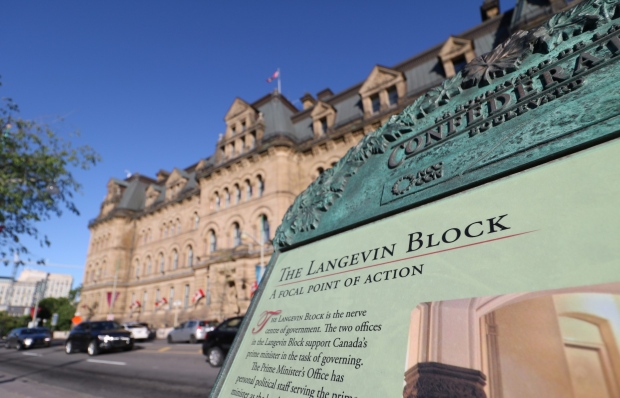
In June, Trudeau decided to remove the name of Hector-Louis Langevin, a father of Confederation and architect of the residential school system, from the Ottawa building that houses the Prime Minister’s Office

Sinclair’s remarks come after an Ontario teachers union passed a controversial motion calling for the rechristening of schools named after Canada’s first prime minister, accusing Macdonald of advocating Indigenous genocide.

Source: Spend time honouring Indigenous heroes rather than debating Macdonald: Murray Sinclair – Toronto – CBC News

‘I worry about this’: Trudeau’s move to dissolve Indigenous affairs department prompts concern

While those closer to Indigenous issues are better placed to comment on the substance of the issues, some thoughts from a machinery of government perspective.

  • Changing machinery (i.e., splitting up departments or joining them together) should never be undertaken lightly;
  • In one sense, it is the ‘nuclear’ option to be used when other efforts have failed;
  • While the enabling legislation will have its challenges, the main challenge will lie in the various operational details that follow: organizational, staffing, and resources (as I know from my experience at Service Canada 2004-7 and the transfer of the Multiculturalism Program to then CIC in 2008);
  • These take time and do not necessarily bring out the best in people (e.g., the splitting apart of Trade from Foreign Affairs under the Martin government was particularly toxic);
  • It will be interesting to watch for any changes to the current deputies and associates within the next few months to a year;
  • Given all of the above, and that concrete results are unlikely in the short-term given the degree of internal issues involved, the government is planning already for a second-term.

The basic logic of having a separate services delivery organization makes sense, as service and implementation issues typically are given short shrift in an overall policy development culture:

Source: ‘I worry about this’: Trudeau’s move to dissolve Indigenous affairs department prompts concern – Politics – CBC News

The bridges Canada must build, right here at home: John Ralston Saul

Nice long read on the links between Indigenous peoples and immigration:

To the extent that the Canadian system works, it is on one side thanks to a policy, a department, an expert civil service; and on the other side to tens of thousands of engaged citizens, many of them involved in volunteer organizations. Without one half or the other, the whole system would collapse. Our system has given itself one important psychological advantage – a clear understanding that the primary purpose of immigration is to become a citizen, as fast as possible. The sooner immigrants are citizens, the sooner they can help carry the burden of making society function.

Yet, no matter how successful the Canadian system, it cannot work in the long run if it – we – function in denial of reality. For half a millennium, immigration to Canada has been intimately tied to the Indigenous peoples. They welcomed newcomers for hundreds of years. Their welcome and openness, their support and sharing, shaped what our immigration policy would come to look like at its best. They were betrayed, particularly from the 1860s on. That is why there is growing debate over how to handle the role of historic Canadian leaders in this wrongdoing. One thing is clear, after a long struggle: Indigenous peoples are on their way back to a position of great influence.

We all agree that our system of immigration and citizenship is not perfect. I would argue that its fragility lies in our denial of the central role of Indigenous peoples. That is the original Canadian conversation – between those who were here and those who came. Deep within our reality, it is still the essential Canadian conversation. To deny this is to deny our history, but also our structures of injustice.

We now all know that the bricks and mortar of that injustice is underfunded and below-standard schooling, a dearth of Indigenous-language programs, social programs, medical services, clean drinking water, housing. And much more. We know changes are coming. But too slowly.

We know that evil was done through state schools, the public administration system, policing and the courts. And all of this was enabled by our parliament and provincial legislatures. Apologies have been made. But apologies are neither actions, nor money, nor programs. We talk endlessly about reconciliation. But reconciliation is nothing without restitution.

All these elements represent the as-yet unbuilt bridges necessary for respectful human relationships.

Some Indigenous people do not see themselves as Canadians. Some do. Some see themselves as both Indigenous and Canadian. That is their business. And that is a reminder of how clearly we must reject the Westphalian model, its monolithic mythologies and its 19th-century pastiche imitations of what makes a proper nation-state. So when we talk about diversity or multiculturalism or interculturalism we are talking about an important philosophical difference with standard Western ideas of how societies function. These are not just words or conveniences. They are ideas which can reshape human relationships.

That is why the concept of rivers as the bridges of this place is so important. It is a very different idea of human relationships, which is not based on fear of the other or on the exclusive ideas of difference, or on equally exclusive ideas of oneness. All of this is carefully laid out in Indigenous philosophies, which embrace complexity as central to how human beings embrace their differences and their relationships with each other.

This involves concepts of how humans relate to place, concepts that take us off our controlling pedestal and make us part of the place, with responsibilities rather than ownership as the key factor. Richard Atleo. Read Leroy Little Bear. Read Jean Teillet. Read Taiaiake Alfred. Read Lee Maracle. Read Niigaan Sinclair. Read dozens of other Indigenous thinkers. You will see what I mean. More important, you will see what they mean.

I have written before that the only roots I can find for the degree of comfort in our attitudes toward immigration and diversity are Indigenous. We owe a debt of gratitude for this. And for our comfort with complexity we owe a deep debt of gratitude, in particular to the example set by the Métis Nation and its people. They demonstrated that, with complexity, you can build a civilization.

It is curious. Most of us will agree that great evil has been done; that our apologies were right and necessary. Most of us will agree that the resulting injustices must be faced and dealt with, whatever the cost. More and more we understand that our governments must stop fighting in the courts against justice for Indigenous peoples. And that treaty negotiations must be dealt with expeditiously, and not as if our negotiators were divorce lawyers.

But it doesn’t seem to occur to us that when you owe a great debt of gratitude, one of the first things you do is show respect by saying thank you. That is how bridges begin to be built.

Source: The bridges Canada must build, right here at home – The Globe and Mail

Historians say removal not the only way to deal with racist relics

Thoughtful commentary by Granatstein, Stagg and Blackstock on Canadian monuments on alternatives to removal.

Not convinced that moving controversial monuments to museums, as Gabaccia suggests, is preferred approach as it removes and isolates history, rather than exposing history to the broader public:

The trend to remove those memorials — many of which are displayed in prominent public places featuring figures in heroic poses, such as riding on horseback — has provoked strong emotions and violent clashes.

But leading historian and author Jack Granatstein said that rather than allowing these sites to become flashpoints for racial divisions, they should be displayed with contextual information to help people understand, interpret and learn from the past.

“It’s probably inflaming the situation,” Granatstein said of the push to eliminate memorials. “I think we need to remember that history happened, and you don’t simply change it by taking a name off a building or taking down a statue.

“I think what is better than that is to have an explanation for why someone is being honoured for what he or she did in that time, and that explanation can go in to context of what they did.”

Granatstein said taking down monuments allows the wrong people to seize control over the interpretation of history, referring to those who have staged demonstrations protesting their removal, including white supremacists.

“In the American context and to some extent the Canadian context, you give an opportunity to people whose views we don’t particularly enjoy: fascists, Nazis, racists,” he said. “I don’t want them pretending to defend history. The history they are trying to create is not the history I would prefer to see memorialized, or honoured or understood by the public.”

String of controversies

White nationalists protesting the planned removal of a statue memorializing Robert E. Lee, a Confederate top general, clashed violently with counter-demonstrators in Charlottesville, Va., last weekend. One woman was killed and another 20 people were injured.

It was the latest in a growing number of controversies that have erupted over plans to take down Confederate symbols in the U.S. and to change names of sites offensive to Indigenous people in Canada.

With a growing push to remove historical memorials and monikers, Granatstein asked where it would stop.

He noted that in Canada, CBC listeners called Tommy Douglas the greatest Canadian of all time, yet in the 1930s the former premier of Saskatchewan and father of medicare held a then popular belief in eugenics and wanted to sterilize people with mental impairments.

“Attitudes change, and it seems to me that one of the tasks of historians and politicians is to remind people that today’s values are different than past values, and the future’s values will probably be different than ours,” Granatstein said.

Trump emboldens protesters

Ron Stagg, a history professor at Toronto’s Ryerson University, said removing statues of Confederate heroes, which are now interpreted as symbols of slavery and oppression, draws the ire of a certain segment of the white population who see it as an erosion of their rights. Provocative statements from U.S. President Donald Trump have served to embolden these people, who may not have spoken out in the past.

Stagg sees the situation unfolding in the U.S. as different from that in Canada, where most disputes are not fraught with such deep divisions and “intense feelings” on both sides.

Halifax Cornwallis Statue 20151213

A statue of Edward Cornwallis stands facing England – with his back to Halifax – in Cornwallis Park. (Canadian Press)

In Canada, most of the controversies have been around Indigenous people in the context of reconciliation.

Conflict recently erupted in Nova Scotia over a plan to take down a statue of Edward Cornwallis, a British military officer and one of the founders of Halifax, who in his day had offered a bounty for the scalps of Mi’kmaq.

The federal government also recently removed the name of Hector Langevin from a government building, after Indigenous groups complained that it paid tribute to a man who played a role in the residential schools program.

Stagg called that name removal a “token” gesture by Prime Minister Justin Trudeau, and said it may open the floodgates to other requests for change.

langevin block ottawa parliament hill june 21 2017

The Langevin Block in Ottawa is seen on June 21, 2017 — the same day that Prime Minister Justin Trudeau announced it would be renamed because Hector-Louis Langevin, a father of Confederation, proposed the creation of the residential school system. (Trevor Pritchard/CBC)

“I think we’re going to try and be politically correct in terms of trying to erase aspects of the past that we find offensive,” he said. “I think that’s wrong in the broad sense. I think it’s going to continue to happen and there’s going to be a backlash just as there has been in the States.”

Indigenous child welfare advocate Cindy Blackstock has successfully fought for revised wording on plaques commemorating certain people who had a role in the residential schools program. She said while in some cases symbols such as swastikas must be eliminated, she said most memorials should remain up in order to teach visitors about the past, provided they tell the full story.

“By erasing the monument you can erase the historical lessons, contributing even more to the rampant historical amnesia that feeds discrimination and immorality,” said Blackstock, who is also a professor of social work at McGill University.

Museums as mediators

Donna Gabaccia, a history professor at the University of Toronto who organized a weekend demonstration in Toronto to protest white nationalism and the violence in Charlottesville, said memorials could be taken down and moved to museums where they could be understood in proper context.

“I see museums as important mediators of cultural controversies, where many voices can be and must be heard if the controversies are to be resolved,” she said. “Monuments become controversial when public opinion and historical context changes around them, which is inevitable. Contestation over the meaning of museums can only be resolved when all sides begin to understand the differences between the past that created the monuments and the present that inevitably seeks new meaning in them.”

Granatstein said context about the people being memorialized — including polarizing figures deemed by some to have been heroes in their day — is critical to understanding history.

“Every country has its heroes and most of those heroes have feet of clay or maybe a toe or two of clay. A country without heroes is a country without a past. I’d prefer to have heroes and a past,” he said.

Source: Historians say removal not the only way to deal with racist relics – Politics – CBC News

Langevin Renaming: Memo raises doubts about who was ‘architect’ of residential schools

Good analysis and advice by the public service, with apparent overly hasty political symbolism by government:

Federal officials raised doubts about accusations Hector-Louis Langevin was an architect of the residential school system four months before his name was ignominiously stripped from the prime minister’s building, as the Liberal government acceded to complaints from Indigenous groups.

An internal briefing note says Langevin had a “complex” relationship with Canada’s Indigenous peoples and even tried to spare the life of Métis leader Louis Riel, who was hanged in 1885 for leading a rebellion in Western Canada.

The Feb. 27 memo for Public Services Minister Judy Foote reveals the government grappling with a troublesome tangle of historical accuracy, Indigenous grievances over the tragedy of residential schools, and the symbolic significance of public building names.

Langevin

Hector-Louis Langevin, a Father of Confederation, was a prominent member of John A. Macdonald’s cabinet. In 1883, as public works minister, he allocated $43,000 for the construction of three schools for Indigenous boys, linking him to the residential school system. (Library and Archives Canada)

“While he has been referred to in the media as an architect of the Indian residential school system, a historian at Indigenous and Northern Affairs Canada indicates that his relationship with Indigenous peoples is more complex,” says the memo, obtained by CBC News under the Access to Information Act.

“Various histories and academic articles written on residential schools make no mention of his role or impact in the development or execution of the residential schools policy.”

“Moreover, during the 1885 Northwest Rebellion and the subsequent trial of Louis Riel, he attempted to intercede with the prime minister for Riel’s clemency and the commutation of his sentence.”

The memo, signed by deputy minister Marie Lemay, was triggered after National Chief Perry Bellegarde of the Assembly of First Nations wrote to Foote asking that the Langevin Block, the building at 80 Wellington St. in downtown Ottawa that houses the Prime Minister’s Office, be renamed.

4 Indigenous MPs seek removal

Bellegarde’s Feb. 6 letter said that “key architects of the devastating Indian residential school system include prominent leaders of the past such as Hector Langevin.”

Ten days later, four Indigenous MPs also wrote to Foote, pressing for the removal of the name because “Langevin was also the creator of residential schools.”

“We do not believe this way of thinking should be celebrated by naming a building after Langevin,” said the letter, signed by the NDP’s Georgina Jolibois, Liberal Don Rusnak, the NDP’s Roméo Saganash and Hunter Tootoo, formerly a Liberal and now an Independent.

The memo to Foote suggested preserving the name of Langevin on the building, but adding a plaque about his contributions to Canada “while also highlighting the contested aspects of his legacy.”

‘It is reasonable to anticipate opposition.’— Memo from deputy pubic services minister

Lemay also said the name could be changed to that of an Indigenous person, a non-Indigenous person, a place or an event in Canada’s past.

“It is reasonable to anticipate opposition from those who wish to preserve the commemoration of the name and contributions of Sir Hector-Louis Langevin, as well as support from those who want the name changed, including Indigenous groups,” she wrote.

Government officials declined to release to CBC News material from the historian at Indigenous Affairs who is cited in the memo as unable to find evidence of any role Langevin played in establishing residential schools.

Source: Memo raises doubts about who was ‘architect’ of residential schools – Politics – CBC News