Le Canada est-il vraiment un sanctuaire pour les immigrants LGBTQ+?

Expectations of paradise in general are unrealistic:

..Le Canada, un paradis queer ?

C’est d’ailleurs le genre de partenariat qui renforce encore davantage l’image du Canada comme lieu sûr pour les communautés LGBTQ+. Une réputation bel et bien basée sur des faits, tranche Ahmed Hamila, professeur de sociologie à l’Université de Montréal. Ce qui ne veut pas dire qu’il ne faut pas la nuancer, s’empresse-t-il d’ajouter.

À leur arrivée, plusieurs de ces demandeurs d’asile vivent une « lune de miel » — d’une durée d’environ cinq ans, selon la plus récente collecte de données de M. Hamila. « Après, les personnes commencent à déconstruire cette image paradisiaque. Parce que, en plus du fait qu’elles doivent faire face à des enjeux d’homophobie ou de transphobie, s’ajoutent des enjeux de racisme et de xénophobie — des problèmes qu’elles ne connaissaient pas dans leur pays parce qu’elles faisaient partie de la majorité. »

Même au Canada, un pays où les droits LGBTQ+ font partie des « valeurs intrinsèques », poursuit le spécialiste, « il reste que, dans le traitement des demandes d’asile et dans l’accès aux soins et aux services sociaux, il y a encore de grands défis pour les personnes réfugiées, migrantes et racisées ». Celui qui est également codirecteur de la Clinique Mauve donne l’exemple des papiers d’immigration, qui permettent difficilement le changement de genre ou le choix du marqueur « X ».

« La situation est peut-être meilleure qu’ailleurs, mais ces personnes vivent de la discrimination en milieu de travail et dans le logement. Et [elles se heurtent à] énormément de barrières pour avoir accès [au statut de réfugié] ou au système de justice », note aussi de son côté M. Otaegi Alcaide.

Si l’image du Canada continue à être celle d’un « paradis queer », c’est que le pays a quand même fait figure de pionnier en la matière, poursuit M. Hamila. En 1993, la Cour suprême a reconnu dans l’arrêt Ward que l’orientation sexuelle pouvait être un motif d’asile au pays. Mais c’est « presque par hasard », au détour d’exemples donnés de « l’appartenance à un groupe social » et non pas à la suite d’une demande précise pour cette raison, souligne-t-il.

Ce n’est que près de 10 ans plus tard, en 2002, que le Haut-Commissariat des Nations unies pour les réfugiés a reconnu à son tour ce motif pour octroyer le statut protégé de réfugié….

Source: Le Canada est-il vraiment un sanctuaire pour les immigrants LGBTQ+?

Air Canada says she was being ‘loud, demanding and unruly.’ She says she was being stereotyped. Here’s what the human rights tribunal heard

Will be interesting to see how the Tribunal rules. Incident dates from 2018 and don’t know whether the delay is normal for the Tribunal. As a business class passenger, she would have access to shorter check-in and boarding lines. As an DEI academic and activist, Francis would likely be more aware and sensitive to perceived discrimination and stereotypes:

It’s not an uncommon scene at any busy airport: A passenger needs help and approaches an airline agent who may come across as rude.

But what happened to a Jamaican Canadian at Vancouver International Airport on March 1, 2018 — as described last week over a five-day hearing at the Canadian Human Rights Tribunal — has highlighted the stark contrast in how a Black woman and airline staff viewed their encounter seven years ago.

The case of alleged discrimination for “Flying while Black” will test how far the Canadian Human Rights Act can go in awarding damages to air travellers for discrimination. Claims against carriers are governed by the Montreal Convention, an international pact that’s a standard liability regime for death and injury, damage or loss of baggage and flight delay only.

Business-class passenger June Francis had had her knees replaced six months before a trip to Toronto. She approached an Air Canada check-in agent for help amid an exceptionally long lineup, the tribunal heard.

She testified that the agent cut her off before she could request an accommodation, yelled at her and told her to “get in line.” Unsuccessful in getting the agent’s name or identification number, she took photos of the agent with her cellphone for identification so she could complain to Air Canada.

Francis, who is five-foot-10, was described as “loud,” “demanding” and “unruly,” the tribunal heard from Air Canada. A supervisor and security guard were dispatched and demanded that Francis delete the photos, or else she would be refused boarding.

Francis testified that the supervisor said to her, “I can see why you are a problem. You do not take directions. I can see why you were treated that way.” 

“It was a very demeaning comment,” Francis said. “It suggested that I needed directions from people to know how to behave.”

The now 70-year-old woman — a Simon Fraser University business professor and a King Charles III Coronation Medal recipient for her anti-racism work — said she felt afraid when she saw the airport security guard.

“I was shaken,” she testified. “I had done nothing wrong. I am a Black woman … I know what has happened from my community when law enforcement arrives.”

On the witness stand, the agent, later identified as Betty Liao, described Francis as rude and aggressive, but denied yelling at her to get in line or that the complainant ever mentioned her physical needs. She also testified she did not remember if Francis asked for her name or identification number to file a complaint, or if she refused. 

Liao did remember telling Francis to stop taking photos of her, and told the tribunal she felt unsafe. “This is too intimidating,” testified Liao, who is five feet tall. “And I have no right to say no?”

In laying out the complaint at the hearing, Francis’s lawyer Sujit Choudhry said this is the first case of flying while Black to reach a full hearing before the tribunal.

“Professor Francis, a grandmother, (then) 62-year-old, recovering from a knee surgery, posed no threat,” he told the tribunal….

Source: Air Canada says she was being ‘loud, demanding and unruly.’ She says she was being stereotyped. Here’s what the human rights tribunal heard


Turley-Ewart: Canada’s risk-averse businesses are slouching toward AI

Arguably, the hardest issue to address:

…Yet, the slow adoption of AI raises questions about Canadian businesses. What are they doing to invest in their own success? The inability of so many to effectively manage AI integration that will enable them to help themselves and improve productivity, economic growth and GDP per capita points to a culture of complacency.

Canada’s aging digital infrastructure is a monument to that complacency. “Canada trails every other G7 nation in AI computing infrastructure, possessing only one-eighth to one-tenth of the available compute performance per capita compared to countries like the U.S.,” according to RBC. AI is the high-speed train that needs high speed tracks and engines. Canadian AI is running on 1960s era rails built for plodding diesel engines.

What makes business AI-adoption rates so puzzling, as Minister Solomon hinted at in a recent interview, is that Canada is known for its “pioneering frontier AI research.” It is home to the “Godfather of AI,” and Nobel Laureate in Physics, University of Toronto’s Geoffrey Hinton. The country also has AI research organizations that do world-leading work: The Montreal Institute for Learning Algorithms, the Vector Institute in Toronto, as well as the Alberta Machine Intelligence Institute.

That Canada is blessed with such rich AI research and innovation, and yet 88 per cent of our businesses have not even started to integrate AI into their operating models, speaks to a troubling lack of curiosity.

We face a future where an inquisitive person writes a prompt in their AI tool of choice asking: Why didn’t Canadian businesses adopt AI sooner and prosper? 

If we don’t change course the answer will be: “Risk aversion.” Most Canadian businesses lacked the courage to innovate.

Source: Canada’s risk-averse businesses are slouching toward AI

As premiers push for more immigration power, experts call for a fact-based debate

Please, evidence-based policy, not the reverse…:

Some premiers say they want to have more local control over the immigration system — but experts say what the system really needs is a national conversation on immigration reform that shores up public support.

“Most of the existing policies have been formulated on the fly without any evidence or serious impact evaluations of what the various classes of immigrants are, how they’re performing economically and otherwise,” said Michael Trebilcock, a retired academic and co-author of two books on immigration policy.

“So it’s basically research-free.”

As the premiers and territorial leaders were wrapping up their three-day meeting in Huntsville, Ont., late last month, they called for an increase to economic immigration levels to fill local labour gaps and said they would use their constitutional powers to seize more control over immigration and issue work permits.

Ontario Premier Doug Ford later walked back his vow to issue work permits to asylum seekers.

“Do I want the whole immigration system on the shoulder of the province? No. Would I like to be treated the same way as Quebec? Yes, and so would every other province and territory,” Ford said last Monday.

Quebec has its own distinct immigration system through an agreement with the federal government. The province is able to choose who can immigrate to Quebec based on its own criteria, with French language skills being a significant factor.

David Piccini, Ontario’s immigration minister, said last Monday that the province also wants to see more financial support from Ottawa to help pay for social services strained by a high number of asylum seekers landing in Ontario.

Ninette Kelley, a former United Nations High Commissioner for Refugees official and a former member of Canada’s Immigration and Refugee Board, said that provincial control over immigration has grown significantly over the last two decades.

“They know what their provinces need today, and they want to make sure they get the labour in that is required to meet those demands,” she said.

“But at the same time, there’s been absolutely no evaluation that I can see of how those programs are implemented or what effect they’re having.”

Trebilcock said the premiers’ concerns need to be taken seriously because increased immigration boosts demand for health care and other provincial services.

He said that it’s “disturbing” to see Canadians’ support for immigration decline in multiple public opinion polls. He said current immigration policies lack broad support and he believes a comprehensive, public review is needed to rebuild that support through evidence-based policies.

“What we see at present is often piecemeal, on-the-fly changes in reaction to particular concerns that have surfaced in the media … international students, temporary foreign workers,” he said.

Kelley said that, instead of a multi-year exercise like a national inquiry, a top-to-bottom immigration system review could be conducted quickly with “the right people at the table.”

Saskatchewan Immigration Minister Jim Reiter told The Canadian Press that he and the other subnational immigration ministers have told Ottawa they want to be seen more as partners in immigration, not stakeholders.

“We need more influence in the decision-making of this because so much of the economic stream needs to be targeted depending on the specific needs of each province,” Reiter said.

The federal government last year slashed the number of slots in the Provincial Nominee Program from 110,000 to 55,000 as part of broader efforts to rein in immigration.

The program allows provinces and territories to nominate individuals for permanent residence based on their skills and ability to contribute to the economy. Each province and territory has its own set of program streams targeting different types of immigrants based on factors like skills or business experience.

Reiter said provincial immigration ministers want to see the Provincial Nominee Program return to its previous levels.

He said that while he understands the need to reduce the number of temporary visas, that shouldn’t come at the expense of economic immigrants.

“We’ve had to restrict (the Saskatchewan Immigrant Nominee Program) down to three streams now to a large degree because we just don’t have enough spots anymore,” Reiter said.

Reiter said that of the 3,600 spots Saskatchewan has for its immigrant nominee program, three-quarters have to go to temporary workers, so the province is prioritizing nominees who work in health care and skilled trades.

“We’ve got the largest potash mine in the world being built … just outside of Saskatoon and that company, BHP, every time we meet with them they raise the issue that skilled trades are an issue. So this is having a detrimental effect on economic growth,” he said.

Trebilcock said that if provinces are focused on using immigration to strengthen their local labour markets, steps could be taken to make it easier to recognize immigrants’ foreign credentials in fields like law and medicine.

With federal immigration decisions having provincial consequences, Kelley said, running an effective immigration system requires close collaboration between all levels of government.

“So that speaks to the need for really tight co-operation between the federal government and the provincial government and municipalities, both in the setting of levels and in the housing and medical policies that are currently in place so that we can accommodate those who we’re letting in,” she said.
Source: As premiers push for more immigration power, experts call for a fact-based debate

Idées | Les défis administratifs et linguistiques de la francisation

Interesting discussion on purity vs pragmatism:

…Heureusement, on constate aussi des améliorations en matière de francisation. Un élément auquel on ne pense pas spontanément, mais qui est important, est le choix des manuels de francisation. Auparavant, les manuels s’alignaient sur le français européen, voire parisien. On employait des mots caractéristiques du français européen sans toujours donner leur équivalent en Amérique (comme portable pour cellulaire ou football pour soccer). Aujourd’hui, les manuels utilisés au Québec sont plus adaptés au contexte québécois. C’est notamment le cas des manuels « Par ici », qui utilisent par exemple arachide plutôt que cacahuète et sac à dos plutôt que cartable. Ce n’est pas banal : les apprenants reconnaîtront ainsi les mots du quotidien.

Les manuels de français langue seconde employés dans le Canada anglais ne semblent pas tous avoir mené la même réflexion sur la variation de la langue. Le fait que la langue française varie selon l’endroit où elle est parlée dans la francophonie se comprend assez aisément. Cependant, dans certains manuels, on sent une confusion entre, d’une part, cette variation dans l’espace et, d’autre part, la variation selon la situation de communication ou le registre. Il peut être tout à fait pertinent d’expliciter certaines expressions familières très courantes, comme c’est plate et avoir de la misère, comme le fait « Par ici », tout en précisant qu’elles appartiennent au registre familier. (C’est ainsi que mon ami turc Mehmet me demandait ce que signifiait l’expression ammanné. J’ai dû le faire répéter quelques fois pour comprendre qu’il s’agissait de à un moment donné…) L’information sur les registres est cruciale : le nouvel arrivant doit savoir qu’il peut dire salut et blonde à un ami, mais qu’il est préférable de dire bonjour et conjointe lors d’un entretien d’embauche. Mais certains manuels véhiculent une vision caricaturale du français québécois, comme si ses particularités se résumaient à des mots très familiers. Un manuel dresse une liste des « expressions idiomatiques » du Québec qui ne regroupe en fait que des usages très familiers : char, loader ses cartes de crédit, veut veut pas… Aucune information sur le fait que le français québécois possède aussi des particularismes neutres, comme traversier, présentement ou aréna.

Par ailleurs, on sent une confusion entre le rôle de la francisation et une certaine vision puriste de la langue. L’objectif est de faire du français la langue commune et de permettre aux nouveaux arrivants de s’intégrer à la société et au marché du travail. Est-il vraiment nécessaire d’enseigner dès les premiers mois de francisation que  caméra est un anglicisme critiqué à remplacer par appareil photo et qu’on doit employer scolaire plutôt qu’académique ? On peut aussi contester certains choix : pourquoi employer croustilles plutôt que chips, que le nouvel arrivant entendra indéniablement plus souvent ?

Poussé à l’extrême, le purisme peut avoir des conséquences négatives sur le français, même s’il part d’un attachement profond envers la langue. La sociolinguiste Françoise Gadet définit le purisme comme « une sacralisation de la norme, éventuellement jusque dans le respect des formes les moins rationnelles ». Or, certaines règles particulièrement illogiques et incohérentes de l’orthographe française sont extrêmement difficiles à acquérir, même pour des francophones de langue maternelle. Mettons-nous à la place du nouvel arrivant qui apprend sa deuxième, voire sa troisième langue, qui plus est à l’âge adulte.

« Madame, j’ai appris à parler français, je me débrouille bien, mais je n’arrive pas à réussir le test écrit de français pour accéder à l’université. Je déménage en Ontario. »

C’est le genre de confidences que partagent avec moi à l’occasion des étudiants en francisation. On peut se demander en quoi conserver les règles d’accord du participe passé ou du pluriel de « rose incarnat » et de « sapin vert-de-gris » aident à la promotion du français.

Mireille Elchacar L’autrice est lexicologue et professeure à l’Université TELUQ. Elle a publié Délier la langue. Pour un nouveau discours sur le français au Québec.

Source: Idées | Les défis administratifs et linguistiques de la francisation

… Fortunately, there are also improvements in francization. One element that we do not think of spontaneously, but which is important, is the choice of francization manuals. Previously, textbooks were aligned with European French, even Parisian. Characteristic words of European French were used without always giving their equivalent in America (such as mobile phone for cell phone or football for soccer). Today, the textbooks used in Quebec are more adapted to the Quebec context. This is particularly the case with the “Par ici” manuals, which use, for example, peanut instead of peanut and backpack rather than schoolbag. It is not trivial: learners will recognize the words of everyday life.

The French as a second language textbooks used in English Canada do not all seem to have conducted the same reflection on the variation of the language. The fact that the French language varies according to where it is spoken in the Francophonie is quite easy to understand. However, in some manuals, there is a confusion between, on the one hand, this variation in space and, on the other hand, the variation according to the communication situation or the register. It can be quite relevant to explain certain very common colloquial expressions, such as it’s flat and have misery, such as “Here”, while specifying that they belong to the colloquial register. (This is how my Turkish friend Mehmet asked me what the expression ammanné meant. I had to repeat it a few times to understand that it was at some point…) The information on the registers is crucial: the newcomer must know that he can say hello and blonde to a friend, but that it is better to say hello and wife during a job interview. But some manuals convey a caricatured vision of Quebec French, as if its peculiarities were summarized in very familiar words. A manual draws up a list of Quebec’s “idiomatic expressions” that in fact only includes very familiar uses: tank, load your credit cards, wants doesn’t want… No information on the fact that Quebec French also has neutral particularisms, such as ferry, currently or arena.

Moreover, there is a confusion between the role of francization and a certain puristic vision of the language. The objective is to make French the common language and to allow newcomers to integrate into society and the labor market. Is it really necessary to teach from the first months of francization that camera is a criticized anglicism to be replaced by camera and that we must use school rather than academic? We can also challenge certain choices: why use chips instead of chips, which the newcomer will undeniably hear more often?

Pushed to the extreme, purism can have negative consequences on French, even if it starts from a deep attachment to the language. Sociolinguist Françoise Gadet defines purism as “a sacralization of the norm, possibly even in respect of the least rational forms”. However, some particularly illogical and incoherent rules of French spelling are extremely difficult to acquire, even for French speakers whose mother tongue. Let’s put ourselves in the place of the newcomer who learns his second, or even his third language, moreover in adulthood.

“Madam, I learned to speak French, I’m doing well, but I can’t pass the written French test to get to university. I’m moving to Ontario. ”

This is the kind of confidences that Frenchization students share with me. One may wonder how preserving the rules of agreement of the past participle or plural of “pink incarnat” and “fir green-of-gris” help to promote French.

Mireille Elchacar The author is a lexicologist and professor at TELUQ University. She published Délier la langue. For a new discourse on French in Quebec.

ICYMI – Urback: Did we really have to make this D-list MAGA singer famous in Canada?

Yep:

…But perhaps most irritating of all is that this totally unnecessary controversy has made a MAGA martyr of Sean Feucht: a man who was, and should’ve continued to be, mostly anonymous – a D-list celebrity, if that, in Canada. It is irritating that many of us now know how to pronounce his name; irritating that he has accidentally stumbled upon the type of mainstream attention his brand of worship rock could have never organically drawn; irritating that there will be more eyes on his Pride month posts about the “agenda seeking to destroy our culture and pervert our children.” And irritating that those who value and understand the rights protected by our Charter – of free speech, and free assembly, and freedom from discrimination – have to defend this guy’s rights, even if they loathe what he’s saying. 

Had licensing officials politely shut down the minority of protesters who knew of Mr. Feucht’s existence and objected to his performances, the majority of us could have continued to exist in blissful ignorance, and Mr. Feucht would’ve soon returned to his long list of other grievances. Instead, they’ve set a terrible new precedent for access to public spaces, while inadvertently forcing the rest of us to give him what he clearly desires most: attention.

Source: Did we really have to make this D-list MAGA singer famous in Canada?

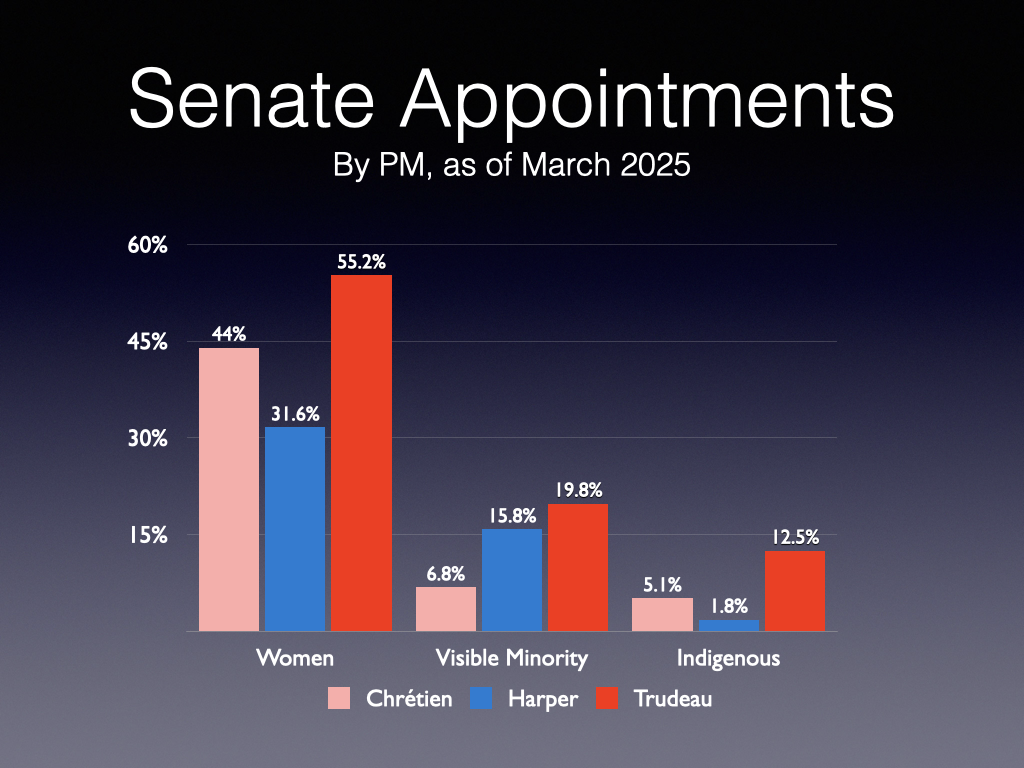
ICYMI: Trudeau radically overhauled the Senate — will Carney keep his reforms?

We shall see. Chart below contrasts Chrétien, Harper and Trudeau appointments:

…In an interview with CBC Radio’s The House, House leader Steve MacKinnon signalled there may indeed be more changes coming.

“I think the Senate is very much a work in progress,” he said.

“We continue to work constructively with the Senate in its current configuration and as it may evolve. I know many senators, the various groups in the Senate and others continue to offer some constructive thoughts on that.”

Asked if Carney will appoint Liberals, MacKinnon said the prime minister will name senators who are “attuned to the vagaries of public opinion, attuned to the wishes of Canadians and attuned to the agenda of the government as is reflected in the election results.”

Carney is interested in senators who “are broadly understanding of what the government’s trying to achieve,” MacKinnon said.

As to whether he’s heard about efforts to revive a Senate Liberal caucus, MacKinnon said: “I haven’t been part of any of those discussions.”

Alberta Sen. Paula Simons is a member of the Independent Senators Group, the largest in the chamber and one mostly composed of Trudeau appointees (she is one of them, appointed in 2018).

Simons said she knows the Conservatives would scrap Trudeau’s reforms at the first opportunity. What concerns her more are those Liberals who are also against the changes.

“There’s a fair bit of rumbling about standing up a Liberal caucus again. And I am unalterably opposed to that,” she said.

When the last Liberal caucus was disbanded, some of its members regrouped as the Progressive Senate Group, which now includes senators who were never Liberals.

“To unscramble that omelette, whether you’re a Liberal or a Conservative, I think would be a betrayal of everything that we’ve accomplished over the last decade,” Simons said.

“I think the Senate’s reputation has improved greatly as a result of these changes. I think the way we are able to improve legislation has also increased tenfold. It would be foolish and wasteful to reverse that.”

Still, she said there’s been pushback from some Trudeau appointees.

Senate debates are now longer, committee hearings feature more witnesses and there’s more amendments to legislation than ever before, she said.

Not to mention Independent senators can’t be whipped to vote a certain way. All of that makes the legislative process more difficult to navigate.

“Partisan Liberals don’t like the new independent Senate because they can’t control it as easily,” she said.

Marc Gold, Trudeau’s last government representative in the Senate who briefly served under Carney before retiring, said his advice to the new prime minister is to keep the Senate the way it is.

“The evolution of the Senate to a less partisan, complementary institution is a good thing. I think it’s a success, and I certainly hope that it continues,” Gold said….

Source: Trudeau radically overhauled the Senate — will Carney keep his reforms?

Lederman: There is an abundance of shame – and rightly so – over the calamity in Gaza

Indeed:

…As more than 170 former Canadian diplomats, including former ambassador to Israel Jon Allen, wrote in an open letter this week: “If Israel continues on this path, it will lose its standing with the world community, placing the security and the future of the Israeli people in jeopardy.”

This isn’t the most important reason to speak out about the suffering of so many people, of course. That would be the killings, the starvation, the inhumanity.

“Food and health are basic rights,” Dorit Nitzan, director of the School of Public Health at Ben-Gurion University of the Negev, told Haaretz. “When we turned them into a bargaining chip, we harmed ourselves, not just our values and morals.” 

Former Israeli prime minister Ehud Barak has issued an “emergency call” for “massive nonviolent civil disobedience” to bring a total shutdown of Israel until there is a change in government. “The Israel of the Declaration of Independence and the Zionist vision is collapsing,” he wrote.

The Union for Reform Judaism also issued a statement this week: “Blocking food, water, medicine, and power—especially for children – is indefensible. Let us not allow our grief to harden into indifference, nor our love for Israel to blind us to the cries of the vulnerable. Let us rise to the moral challenge of this moment.”

Yes. Let us. The moral tragedy of this moment is abundantly clear. 

Source: There is an abundance of shame – and rightly so – over the calamity in Gaza

Rempel Garner: Without national identity, integration is impossible and collapse is inevitable.

Always worth reading the Conservative take on immigration policy even when overly partisan and exaggerated in places. Some of her critiques have some merit but are weakened by being overstated. And to ignore broader trends on belonging and pinning everything on the Trudeau government is shallow at best:

…For example, on immigration, the Trudeau Liberals narrowed the age range for mandatory language and knowledge requirements in citizenship applications from 14-64 to 18-54, thus diminishing shared language’s role in Canadian identity for newcomers. They eliminated the in-person citizenship oath requirement. They sought to erase references to practices like female genital mutilation as abhorrent in the citizenship study guide, and in so doing, arguably normalized their importation into Canada. They turned a blind eye to judicial rulings allowing immigration status to factor into sentencing violent criminals, valuing the process of entry into the country over the responsibility associated with citizenship. They allowed Canada’s compassionate asylum system to be abused into a mockery.

The Trudeau Liberals also normalized the practice of the importation of conflicts from newcomer’s countries of origin, rather than primarily encouraging the shedding of these quarrels in favour of a pluralistic, unified Canadian identity rooted in Western democratic values. This phenomenon is best exemplified via the Trudeau government’s tolerance of diasporic lobby groups’ influence in elections and Canadian institutions, while simultaneously turning a blind eye to groups who sought to plant international conflicts and even terrorist principles in Canadian soil. And despite clear evidence of rising foreign interference in elections, the Liberals have yet to implement a foreign agent registry.

The Trudeau Liberals also prioritized cultural and ethnic differences over a shared ethos of equality in hiring and storytelling. For example, they embedded divisive, quasi-racist hiring policies into federal funding for educational institutions. They allowed Canada’s publicly funded national broadcaster to consider abandoning objectivity for racialized narratives, and now allocate news funding based on whether or not outlets sufficiently highlight ethnic, religious, and other group differences.

And rather than enlisting newcomers to help strengthen a cohesive Canadian national identity, such as by constructively addressing the nation’s historic injustices while simultaneously celebrating its positive achievements, the Trudeau Liberals actively erased symbols of shared historic Canadian identity from public view. They redesigned the Canadian passport to replace images of Canadian national heroes like Terry Fox with inert objects like a wheelbarrow. They supported activities that established the Canadian flag as a symbol of shame as opposed to a representation of patriotism. They worked to erase Canada’s founders from places of prominence.

Thus, Canada’s political left has profoundly succeeded in transforming Canada into a post-national no-nation, free from the trappings of a cohesive national identity.

For those who might argue that this is a good thing, they are very wrong. 

What Justin Trudeau overlooked in his Liberal government’s zealous pursuit of post-nationalism is that his father’s multicultural vision could only thrive under robust Western democratic institutions. Without a government prioritizing above all else, especially over partisan ideology, the safeguarding of principles like freedom of speech, secularism, and equality of opportunity, multiculturalism will inevitably destroy a peaceful, democratic pluralism.

The proof is in the pudding. Today in Canada, after decades of post-national, national identity-destroying policies, less than half of Canadian youth say they would fight for the country. This marks a startling shift from generations ago, when Canadians fought for what seemed to be immutable freedoms in the Great Wars. Diasporic conflicts now erupt on Canadian streetshate crimes against ethnic and religious groups have surged, and the once-strong Canadian consensus on immigration is solidly broken.

If Canadians want to reverse the pluralism-destroying course post-nationalism has set us on, everyone, regardless of political stripe, must acknowledge that post-nationalism has eroded Canada’s national identity to point of non-existence. That state of affairs is likely the biggest threat to Canada’s sovereignty today.

History proves this conclusion correct. For a civilization to survive the test of history it needs some sort of cohesive shared identity. Without it, collapse occurs. There’s even examples to be found within Canada’s own evolution in the 20th century. In the early 1900s a Canadian national identity had taken root in spite of high levels of immigration. Forged in the crucibles of battlefields like Vimy Ridge, peoples of many backgrounds fought together as Canadians, united by shared values of democracy, rule of law, bilingualism, and loyalty to the Crown. To be Canadian then was to embrace English or French as a primary language, respect parliamentary institutions, and demonstrate civic duty through collective efforts in war and nation-building. 

Fast forward to today. Our domestic efforts fail to build critical national infrastructure and have allowed our military to atrophy to the point of near non-functionalityOur foreign policy rewards the tactics of terrorist organizations and abandons Western allies in times of crisis. Logic dictates that if the Liberal government continues eroding the Western democratic values that once, but arguably no longer, underpin Canada’s rapidly disappearing pluralistic national identity (freedom of speechfreedom of worship, and equality in the rule of law’s application), then collapse is what should be expected of Canada’s once-vaunted pluralism.

Those looking for remedy from new Liberal Prime Minister Mark Carney will likely be sorely disappointed. Long an adherent to the World Economic Forum’s globalist brand of post-nationalism, the best definition of Canada’s national identity he has mustered is that we’re not the United States. His new “Minister of National Identity” Stephen Guilbeault managed an arguably worse response, offering pithiness like “I won’t stand here and pretend that I can tell you what Canadian identity is or should be,” while arguing there is “no one way to be Canadian.” That neither could define Canadian identity as rooted in shared respect for things like the rule of Western-based law, freedom of speech, freedom to worship, and equality of opportunity is telling.

The reality for Mr. Carney is that his government must reverse the many changes Mr. Trudeau made under his aggressive post-national doctrine to order to rebuild Canada’s national identity, prevent pluralism’s collapse, and retain our sovereignty.

If he fails, the effect will be the same as if he were to tip over Cardiff’s speakers in the National Gallery: a shameful and purposeful squandering of an intricate, delicate masterpiece.

Source: Without national identity, integration is impossible and collapse is inevitable.

ICYMI: Temporary foreign workers may get more flexibility to move jobs as Ottawa eyes changes to program

Not getting much support from worker organizations but policy is always a balance between different stakeholders:

The federal government is exploring changes to the Temporary Foreign Worker Program that would give workers more freedom to move jobs within their industry, rather than have their permits tied to a single employer.

Internal documents from Employment and Social Development Canada – the ministry in charge of the program – detail proposals to introduce a new sector-specific permit for workers in the agricultural and fish processing industries. 

The work permit, issued for two years, would allow workers to move between employers in the same sector as long as they have a new job offer from an employer. Currently, if workers lose their jobs, they also lose their permits.

The ESDC documents consist of six proposals to change aspects of the TFW program, including guidelines related to housing, wages, access to health care and transportation for workers. They were based on feedback from employer associations and labour groups and written over the past year.

The documents were provided to The Globe and Mail from Migrant Rights Network, a national advocacy organization that has long campaigned to abolish the closed work permit system and grant temporary foreign workers a direct path to permanent residency. The organization obtained the documents as part of the government’s consultation process.

On Wednesday, the group released a report criticizing the new federal proposals, characterizing the sector-specific work permits as a cosmetic change that would maintain employer control while creating an illusion of freedom and mobility for workers. The report says this is because employers would still have the ability to blacklist workers who leave their jobs. …

In November, 2024, a parliamentary committee on citizenship and immigration recommended that Ottawa get rid of the closed-work-permit system entirely, and introduce regional or sector-specific work permits that would define sectors broadly, and provide workers with access to a wide range of employers. 

The proposed changes from ESDC appear to build on recommendations from the parliamentary committee and a 2023 report from the United Nations, which branded the TFW program as a “breeding ground for contemporary forms of slavery.”

Beyond the stream-specific work permit, ESDC is proposing a redesigned LMIA process, in which employers obtain a Temporary Foreign Worker Employer Authorization (TFWEA) that they apply for every two years. A TFWEA, according to ESDC documents, will allow an employer to be approved to hire numerous foreign workers every two years, instead of the current system of applying for an LMIA approval each time employers need to fill a position with a foreign worker. “The TFWEA would be refillable, meaning that employers could re-fill a position that a TFW left with a qualified TFW who has a valid stream-specific work permit,” the document states. 

The government is touting the changes as measures that will benefit both workers and employers. The latter group, according to ESDC, would have more flexibility to replace workers. Meanwhile, those who find themselves out of work would be able to start a job more quickly with a new employer. …

Source: Temporary foreign workers may get more flexibility to move jobs as Ottawa eyes changes to program