Roberge veut renvoyer le multiculturalisme dans les « limbes de l’histoire »

Forgets, of course, s27 of the Charter and the Multiculturalism Act, not to mention that the differences between multiculturalism and interculturalism are relatively small, as both properly understood pertain to civic integration and the CAQ’s more divisive approach has been subject to considerable criticism.

And somewhat ironic for Minister Roberge to state that the parties in the Assemblée nationale opposed Bill 84 given “clientélisme partisan when arguably, so is the CAQ:

« Le multiculturalisme ne s’applique plus sur le territoire québécois, enfin ! […] C’est un modèle qui a toujours été nuisible pour le Québec », a affirmé le ministre mercredi à l’Assemblée nationale.  

Selon lui, dans ce modèle, l’État se donne le devoir de permettre aux nouveaux arrivants de garder leur culture et leur langue d’origine. « C’est ça, le multiculturalisme canadien. On vit les uns aux côtés des autres », a-t-il expliqué.  

Sa nouvelle loi – qui s’inspire de l’interculturalisme – vise à envoyer le signal aux immigrants qu’ils « arrivent dans un État qui a son propre modèle d’intégration » et qu’ils doivent accepter le contrat social du Québec basé sur des valeurs comme la démocratie, la langue française, l’égalité entre les hommes et les femmes ou encore la laïcité.  

« Sans quoi, bien, ce n’est pas une bonne idée de venir ici », indique Jean-François Roberge.  

Mais il reste des éléments à mettre en place afin de clarifier le modèle du ministre. Il promet qu’une « Politique nationale sur l’intégration à la nation québécoise et à la culture commune » sera mise en œuvre avant l’élection de 2026.  

Jean-François Roberge ajoute qu’après l’adoption de cette politique nationale, « tous les ministères, tous les organismes, les municipalités, etc., lorsqu’ils vont subventionner un projet d’un partenaire, vont devoir s’assurer que ce projet est compatible avec les fondements du modèle d’intégration nationale ». 

Le ministre assure que les financements qui ont déjà été octroyés ne seront pas retirés.  

Dans cinq ans, il y aura un rapport pour évaluer le nouveau modèle d’intégration. Les critères seront élaborés dans la Politique nationale.  

Le projet de loi 84 a été adopté mercredi matin au Salon rouge. Le Parti québécois a voté avec le gouvernement. Les solidaires et les libéraux s’y sont opposés. Le ministre s’en est désolé.  

« Je ne sais pas trop, c’est probablement pour des questions de clientélisme partisan. Il devait y avoir quelques membres très très multiculturalistes qui n’ont pas compris que c’était un projet d’ouverture », a-t-il dit.  

Source: Roberge veut renvoyer le multiculturalisme dans les « limbes de l’histoire »

“Multiculturalism no longer applies to Quebec territory, finally! […] It is a model that has always been harmful to Quebec, “said the minister on Wednesday in the National Assembly.

According to him, in this model, the State makes it its duty to allow newcomers to keep their culture and language of origin. “This is Canadian multiculturalism. We live side by side,” he explained.

His new law – which is inspired by interculturalism – aims to send the signal to immigrants that they are “arriving in a state that has its own model of integration” and that they must accept Quebec’s social contract based on values such as democracy, the French language, equality between men and women or secularism.

“Without that, well, it’s not a good idea to come here,” says Jean-François Roberge.

But there are still elements to be put in place in order to clarify the minister’s model. He promises that a “National Policy on Integration into the Quebec Nation and the Common Culture” will be implemented before the 2026 election.

Jean-François Roberge adds that after the adoption of this national policy, “all ministries, agencies, municipalities, etc., when they are going to subsidize a partner’s project, will have to ensure that this project is compatible with the foundations of the national integration model”.

The Minister assures that the funding that has already been granted will not be withdrawn.

In five years, there will be a report to evaluate the new integration model. The criteria will be developed in the National Policy.

Bill 84 was adopted Wednesday morning at the Red Hall. The Parti Québécois voted with the government. The solidarity and liberals opposed it. The minister apologized.

“I’m not sure, it’s probably for questions of partisan clientelism. There must have been some very multicultural members who didn’t understand that it was an opening project,” he said.

Harvard Has Strong Chance To Prevail Over Trump In Immigration Lawsuit

Hopefully, will lead to another defeat for the Trump administration’s self-harming policies:

Harvard University has a strong chance to prevail in its immigration battle with the Trump administration over the right to enroll international students. After Harvard refused the Trump administration’s demands for the federal government to take over the university’s hiring, admissions and governance policies, the Department of Homeland Security removed the school’s certification to admit international students. The high-profile action against Harvard came as the Trump administration’s nominee for director of U.S. Citizenship and Immigration Services said he would eliminate Optional Practical Training and STEM OPT, another measure educators warn could cause international student enrollment at U.S. universities to plummet.

The Trump Administration’s Immigration Decision On International Students

On May 22, Secretary of Homeland Security Kristi Noem sent a letterto Harvard: “I am writing to inform you that effective immediately, Harvard University’s Student and Exchange Visitor Program [SEVP] certification is revoked.”

Without the certification, a school cannot enroll international students.

Enacted after the terrorist attacks of September 11, 2001, the SEVP rules and certification process were intended to encourage schools to report when students dropped out or no longer maintained a required course load and to remove fraudulent or illegitimate schools. The rules were never intended to be used to punish universities for not complying with unrelated demands by ending their ability to enroll international students….

The Wall Street Journal asked, “Is Trump Trying To Destroy Harvard?” in a recent editorial. “The Trump Administration has frozen billions in federal grants to Harvard University, threatened its tax-exempt status and sought to dictate its curriculum and hiring,” wrote the Journal. “Now the government seems bent on destroying the school for the offense of fighting back. And for what purpose? That’s how we read the Department of Homeland Security’s move Thursday to bar foreign students from attending the world-renowned institution.”

The editorial labeled the move against international students, a quarter of Harvard’s student body, “whose futures are suddenly in disarray,” to be “a short-sighted attack on one of America’s great competitive strengths: Its ability to attract the world’s best and brightest.”…

Source: Harvard Has Strong Chance To Prevail Over Trump In Immigration Lawsuit

Nicolas: La Couronne et la décolonisation

Good reminder for anti-monarchists, particularly in Quebec, not so simple given the importance of the Crown for Indigenous peoples:

Bon, le roi est reparti. Discutons, si vous le permettez, de la Couronne à tête reposée.

Puisque le désamour envers la monarchie, principalement au Québec, s’articule autour du rejet du colonialisme, ne devrait-on pas s’intéresser à la manière dont les leaders autochtones ont accueilli la visite royale de leur côté ?

Cindy Woodhouse Nepinak, cheffe nationale de l’Assemblée des Premières Nations (APN), Victoria Pruden, présidente du Ralliement national des Métis (RNM) et Natan Obed, président du Inuit Tapiriit Kanatami (ITK) étaient tous trois sur le tarmac pour accueillir le roi Charles III. Ils ont tous trois obtenu une audience privée avec le monarque à Rideau Hall, après ses entretiens avec la gouverneure générale, Mary Simon, et le premier ministre, Mark Carney.

À la CBC lundi, Natan Obed rappelait sa première conversation avec le roi, survenue en 2022, au sujet des droits du peuple inuit, de l’Arctique et des changements climatiques. Il en parle comme une « opportunité remarquable ». « La relation avec le roi et la Couronne n’est pas seulement pratique, vu notre relation avec les traités et le Canada comme État-nation, mais aussi ambitieuse ». Un exemple ? « Le rapatriement. Dans les musées du Royaume-Uni, il y a toujours des restes humains inuits et d’autres items que nous voudrions voir rapatrier. » Obed en avait discuté avec le roi lors de sa dernière audience privée.

De son côté, le RNM indique que l’audience privée a servi à « rappeler l’importance des partenariats pour préserver l’honneur de la Couronne et remplir les promesses solennelles faites à la Couronne à la nation métisse ». Et l’APN ? « J’ai transmis le message qu’en tant que roi du Canada, sa Majesté a la responsabilité de respecter les traités qui protègent nos droits. Nous avons parlé de l’importance d’honorer les engagements qui perdurent depuis des générations », nous dit Woodhouse Nepinak.

On est très loin du boycottage du Bloc québécois. On traite la visite royale comme une occasion stratégique de faire avancer des revendications de longue date. Pourquoi ?

Parce que la Couronne britannique a commencé à conclure des traités avec les Premiers Peuples en 1701. La Proclamation royale de 1763 n’a pas que scellé le sort de l’ancienne Nouvelle-France. Elle a établi de vastes « territoires indiens » dans la vallée du Mississippi, à l’ouest des Appalaches et vers les Grands Lacs dans lesquels les Autochtones ne devraient pas être « inquiétés ou troublés ». La révolution américaine a été alimentée par le refus de la Couronne britannique de laisser les prospecteurs des 13 colonies s’avancer dans l’Ouest.

Puisque la Couronne est restée l’entité juridique du côté canadien de la frontière, la Proclamation a servi de modèle de base pour les traités signés par la suite, particulièrement après le rachat de la Terre de Rupert et l’expansion canadienne dans l’Ouest.

Par exemple, plusieurs des « traités numérotés » signés à la fin du XIXe siècle dans les Prairies incluaient un engagement de la Couronne à fournir aux Premières Nations un « coffre de médecine ». C’est l’une des bases légales sur laquelle on s’appuie aujourd’hui pour faire respecter les responsabilités du gouvernement fédéral à fournir les soins de santé aux Premières Nations.

Le problème, c’est que plusieurs de ces traités ont été signés sous pression de famine ou de menace militaire, que la Couronne a failli à d’innombrables reprises à respecter ses engagements et qu’Ottawa dépense des sommes faramineuses en frais d’avocat pour ralentir la reconnaissance des droits autochtones. Sauf que c’est la continuité juridique de la Couronne britannique, puis canadienne, qui sert de prise légale pour faire avancer de nombreuses revendications territoriales, politiques ou économiques des Premiers Peuples.

Par contraste, la France a traversé cinq républiques, deux empires, deux restaurations monarchiques et le régime de Vichy au cours de la même période : ces régimes se sont souvent contredits et dédits. Au Canada, une entente conclue au XVIIIe ou au XIXe au siècle continue d’être liante.

Dans le Globe and Mail, l’ex-chef de l’APN Perry Bellegarde reconnaissait d’emblée que la Couronne « représente une histoire de profonde douleur et injure pour les peuples autochtones au Canada et à travers le monde ». Sa lettre cherchait à expliquer que, vu le poids moral et légal des traités, « la Couronne, représentée par Charles III, restait le symbole et la garantie de notre relation originelle ».

Serait-il possible d’abolir la monarchie au Canada — symbole colonial s’il en est un — sans fragiliser légalement ces traités et les droits autochtones, ni faire avancer le colonialisme ? J’ai posé la question à Alexis Wawanoloath, un avocat en droit autochtone d’origine abénaquise et ex-député du Parti québécois, qui se définit comme « pas un royaliste ».

La réponse courte : « Ça dépend. » La réponse longue : on pourrait imaginer un changement de régime où les Premiers Peuples ne seraient plus des « sujets » (au sens très colonial du terme) de compétence fédérale, mais des acteurs fédéraux à part entière, comme le sont le Canada et les provinces. Ce serait très complexe à élaborer. Mais aussi porteur.

En attendant, Wawanoloath comprend très bien la « stratégie » des leaders autochtones qui utilisent une visite royale comme occasion de « faire respecter les traités » et de « faire de l’éducation, au gouvernement comme à sa Majesté », tout en souhaitant « qu’on se sorte un jour de ça, dans le cadre d’une nouvelle entente ».

Rappelons qu’en 1969, le jeune Jean Chrétien avait présenté un livre blanc pour naïvement abolir la Loi sur les Indiens, d’une manière qui aurait forcé l’assimilation politique des Premières Nations. La mobilisation pour le faire reculer a été historique. Si l’on cherchait à abolir la monarchie sans réfléchir ou sans même connaître vraiment les traités historiques et modernes et l’importance juridique de l’honneur de la Couronne, il y aurait aussi matière à se planter… royalement.

Source: La Couronne et la décolonisation

Well, the king is gone. Let’s discuss, if you allow, the Crown with a rested head.

Since the disaffection with the monarchy, mainly in Quebec, revolves around the rejection of colonialism, shouldn’t we be interested in how Aboriginal leaders welcomed the royal visit on their side?

Cindy Woodhouse Nepinak, National leader of the Assembly of First Nations (APN), Victoria Pruden, president of the National Rally of Métis (RNM) and Natan Obed, president of the Inuit Tapiriit Kanatami (ITK) were all three on the tarmac to welcome King Charles III. All three got a private hearing with the monarch at Rideau Hall, after his talks with Governor General Mary Simon and Prime Minister Mark Carney.

At the CBC on Monday, Natan Obed recalled his first conversation with the king, which took place in 2022, about the rights of the Inuit people, the Arctic and climate change. He speaks of it as a “remarkable opportunity”. “The relationship with the King and the Crown is not only practical, given our relationship with the treaties and Canada as a nation-state, but also ambitious.” An example? “Repatriation. In the museums of the United Kingdom, there are always Inuit human remains and other items that we would like to see repatriated. Obed had discussed it with the king during his last private hearing.

For its part, the RNM indicates that the private hearing served to “recall the importance of partnerships to preserve the honor of the Crown and fulfill the solemn promises made to the Crown to the Métis nation”. And the APN? “I have conveyed the message that as King of Canada, Her Majesty has the responsibility to respect the treaties that protect our rights. We talked about the importance of honoring commitments that have lasted for generations, “says Woodhouse Nepinak.

We are very far from the boycott of the Bloc Québécois. The royal visit is treated as a strategic opportunity to advance long-standing demands. Why?

Because the British Crown began to conclude treaties with the First Peoples in 1701. The Royal Proclamation of 1763 not only sealed the fate of the former New France. It established vast “Indian territories” in the Mississippi Valley, west of the Appalachians and towards the Great Lakes in which the Natives should not be “disturbed or troubled”. The American Revolution was fueled by the British Crown’s refusal to let the prospectors of the 13 colonies advance in the West.

Since the Crown remained the legal entity on the Canadian side of the border, the Proclamation served as the basic model for the treaties signed thereafter, especially after the purchase of Rupert’s Land and the Canadian expansion in the West.

For example, several of the “numbered treaties” signed in the late 19th century in the Prairies included a commitment by the Crown to provide First Nations with a “medicine safe”. This is one of the legal bases on which we rely today to enforce the federal government’s responsibilities to provide health care to First Nations.

The problem is that many of these treaties have been signed under pressure from famine or military threat, that the Crown has failed to meet its commitments on countless occasions, and Ottawa is spending huge sums on attorney’s fees to slow down the recognition of Aboriginal rights. Except that it is the legal continuity of the British and then Canadian Crown, which serves as a legal hold to advance many territorial, political or economic claims of the First Peoples.

In contrast, France went through five republics, two empires, two monarchical restorations and the Vichy regime during the same period: these regimes often contradicted and dedicted. In Canada, an agreement concluded in the 18th or 19th century continues to be a binding.

In the Globe and Mail, former PNA leader Perry Bellegarde acknowledged at the outset that the Crown “represents a history of deep pain and insult to Aboriginal peoples in Canada and around the world.” His letter sought to explain that, given the moral and legal weight of the treaties, “the Crown, represented by Charles III, remained the symbol and guarantee of our original relationship”.

Would it be possible to abolish the monarchy in Canada – a colonial symbol if it is one – without legally weakening these treaties and indigenous rights, or advancing colonialism? I asked the question to Alexis Wawanoloath, an Aboriginal lawyer of Abenaquise origin and former deputy of the Parti Québécois, who defines himself as “not a royalist”.

The short answer: “It depends. The long answer: we could imagine a change of regime where the First Peoples would no longer be “subjects” (in the very colonial sense of the term) of federal jurisdiction, but federal actors in their own right, as are Canada and the provinces. It would be very complex to develop. But also a carrier.

In the meantime, Wawanoloath understands very well the “strategy” of Aboriginal leaders who use a royal visit as an opportunity to “enforce the treaties” and “educate, to the government and her Majesty”, while hoping “to get out of this one day, as part of a new agreement”.

Recall that in 1969, the young Jean Chrétien had presented a white paper to naively abolish the Indian Act, in a way that would have forced the political assimilation of First Nations. The mobilization to push him back has been historic. If we sought to abolish the monarchy without thinking or without even really knowing the historical and modern treaties and the legal importance of the honor of the Crown, there would also be material to be planted… royally.
Canadians optimistic about national unity regardless of political differences, data show

Some interesting attitude research:

In the leadup to recent political disruptions, including tensions with the U.S. and growing discussion of Western separatism, most Canadians were hopeful about the future of national unity and appeared to harbour positive or neutral feelings toward each other, regardless of differences in political views, according to newly released data.

Two Statistics Canada reports published Wednesday delve into measures of national unity and social cohesion, a relatively new area of exploration for the federal statistics agency.

As the research was conducted in April, 2024, it does not capture recent shifts in sentiment in response to more recent developments such as the trade war with the U.S. However, one of the reports says, the data “serve as a useful baseline for Canadians’ sense of national unity and their societal outlook prior to these events and future comparisons.”

Most respondents were hopeful about the future of Canadian society. More than eight out of 10 said they were hopeful about unity, and a similar proportion said so about democracy.

A slightly lower proportion – 75 per cent – said they were hopeful about the economic opportunities. However, difficulty meeting financial obligations and poor health conditions were linked to relatively lower hopefulness about unity….

Source: Canadians optimistic about national unity regardless of political differences, data show, Unity in Canada: Experimental measures of feelings towards people with similar or different views

Recording of Research Matters event: Exploring citizenship trends and immigrant engagement in Canada and Australia 

ICYMI: Good webinar on recent trends in citizenship by Fung Hou of StatsCan (decline in naturalization along with “citizens of convenience” evidence showing little difference between citizen immigrants and non-citizen immigrants who leave Canada) and a Canada-Australia comparison by Li Xu of IRCC.

Source: Recording of Research Matters event: Exploring citizenship trends and immigrant engagement in Canada and Australia

Bonner: Repairing the fray: Improving immigration and citizenship policy in Canada

Hard to understand why a former staffer with exposure to immigration issues, could advance such naive, politically and in some cases, judicially unrealistic proposals in response to some of the legitimate policy concerns and failures that he points out.

Some examples. Government reorganization into a super ministry would result in significant transition processes and distract from substantive issues. Would any international campaign focussed on values discourage those with other values? No country has had success with pro-birth strategies. Differential time requirements for citizenship would be Charter non-compliant:

….Immigration has been a good thing in the past. It should be in the present and future, too.

This study has three main parts: (1) an exposition of the economic and cultural challenges of mass immigration (including a short history of immigration policy in Canada), (2) a comparative analysis of other immigration systems that we can learn from, and (3) a series of policy options for improving the Canadian system.

To repair Canada’s frayed immigration system, this study makes the case for the following recommendations:

1. Lower the annual permanent residency target to a more manageable level (e.g. 200,000).

2. Strengthen the process of deportation for any non-citizen found guilty of violent crime, supporting terrorism, or expressing hatred for Canada.

3. Execute an international campaign to discourage immigration by anyone unwilling or unable to respect our founding cultures and unwilling or unable to integrate.

4. Prioritize international students pursuing courses of study of high importance to our labour market and supply chains.

5. Re-engineer the points system to emphasize language, age, and domestic education.

6. Consolidate all “population” ministries to create the Ministry of Human Resources Canada (MHRC).

7. Make the main mandate of MHRC to ensure that economic immigration serves the national interest.

8. Require MHRC to implement a pro-birth strategy.

9. Lengthen the time requirement for citizenship, except for immigrants from peer English- and French-speaking countries.

10. Phase down and abolish the Temporary Foreign Worker Program permanently.

11. Establish a uniform standard of credential recognition in self-regulating professions and skilled trades.

We have the right and the obligation to raise the value of Canadian citizenship, and to demand more of our citizens. Above all, however, efforts at integration should proceed not from a dislike of other places, but from a love for Canada….

Source: Repairing the fray: Improving immigration and citizenship policy in Canada

Canada sees surge in temporary foreign workers applying to escape abusive employers

The positive news is that this pathway appears to be responding to the unfortunate need:

The number of temporary foreign workers applying for open work permits to escape abusive employers has jumped more than 800 per cent year over year, a surge advocates say highlights a growing crisis of abuse as immigration cuts and economic uncertainty deepen migrant workers’ vulnerability.

To address exploitation, the federal government in 2019 introduced the Vulnerable Worker Open Work Permit, allowing temporary foreign workers — whose status in Canada is tied to a single employer — to leave abusive jobs and apply for an open permit.

To qualify for one of these permits, migrant workers must show evidence of abuse.

In Ontario, open work permits for vulnerable workers soared to 435 in the first quarter of 2025, up from just 45 during the same period last year, according to the most recent data from Immigration, Refugees and Citizenship Canada — an 867 per cent increase.

In British Columbia, 650 permits were issued in the first quarter of 2025, a sharp rise from just 40 during the same period in 2024. Quebec and Alberta each saw 465 permits issued in early 2025, up from 65 and 30, respectively, during the same period last year.

As Canada increasingly relies on migrant workers to fill gaps in key sectors like agriculture, construction and health care, the surge in vulnerable worker open work permits underscores how the temporary foreign worker program leaves workers open to exploitation. Tied to a single employer, many are afraid to speak out for fear of losing their status or being deported.

Advocates say a looming recession and government efforts to cut immigration levels are exacerbating that precarity, and while more migrant workers are now seeking help, they warn the true scale of abuse is likely far greater than what’s being reported….

Source: Canada sees surge in temporary foreign workers applying to escape abusive employers

Canada increasingly dependent on low-wage migrant workers, says report

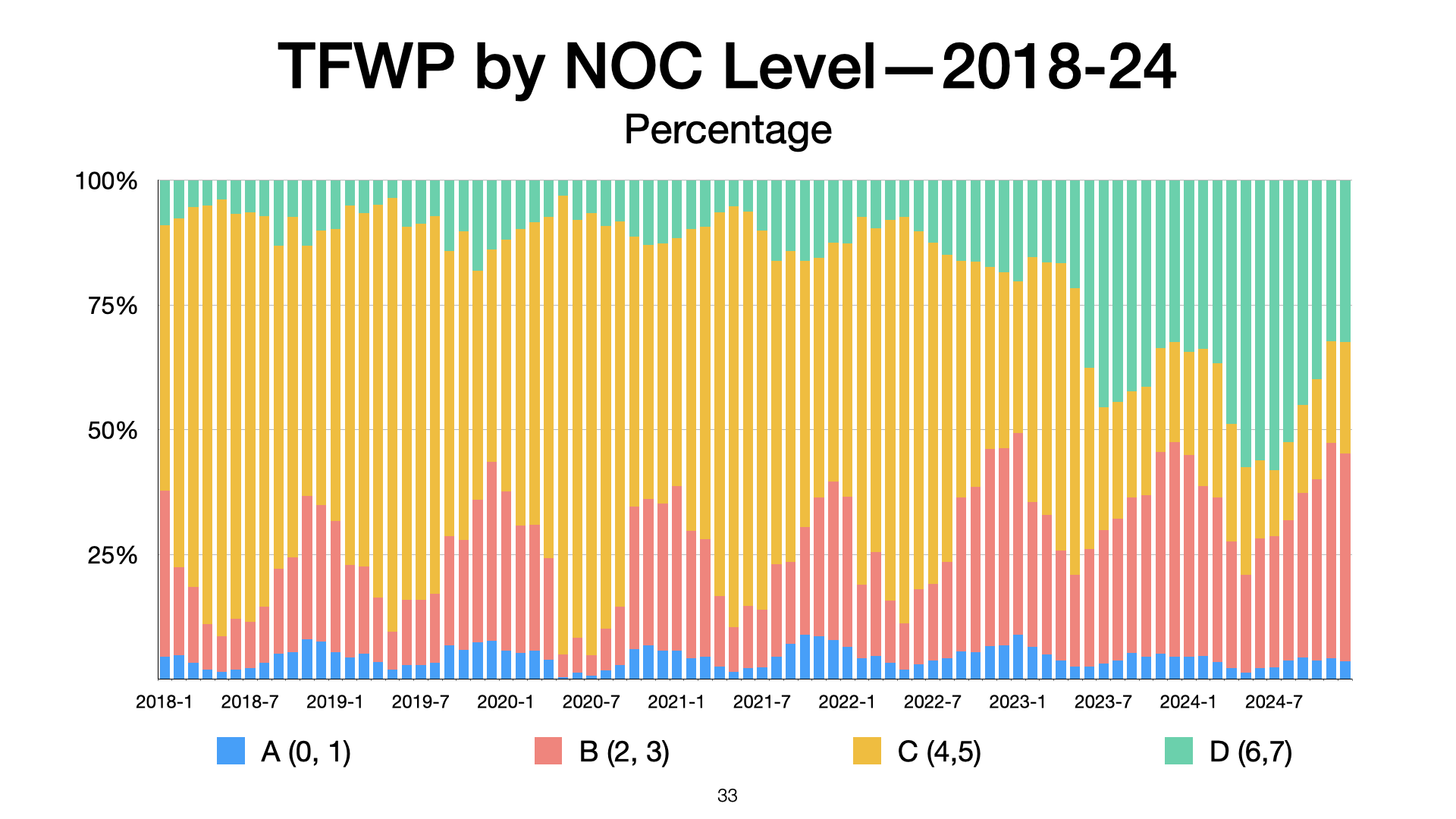
Confirmation what many have been noting (chart below highlights shift before more recent reversal_:

The share of native-born Canadians in the labour force has dropped nearly 10 percentage points since 2006, according to a new Bank of Canada report documenting how the country’s economy is becoming increasingly reliant on low-wage migrant workers.

“Not only has Canada experienced an unprecedented surge in immigration, but the composition of recent newcomers has been markedly different than in the past,” reads a discussion paper published May 9 by the bank’s Economic Analysis Department.

The paper found that, driven largely by a surge in temporary migration, the average Canadian immigrant has now become younger, lower-skilled and more likely to hail from poorer regions such as India, sub-Saharan Africa or the Middle East.

They’re also paid less. Particularly among Canada’s surging ranks of temporary migrant workers, wages have “reduced significantly relative to Canadian-born workers,” reads the paper.

Since 2015, “the average nominal wage gap between temporary and Canadian-born workers has more than doubled,” it read.

The authors calculated that the average migrant worker in Canada is now paid more than one fifth (22.6 per cent) less than a comparable Canadian-born worker. Prior to 2014, that gap was only 9.5 per cent.

The paper, entitled The Shift in Canadian Immigration Composition and its Effect on Wages, is one of the most definitive official documents as to the massive surge of migrant workers brought to Canada in the immediate wake of the COVID-19 pandemic.

Starting in 2022, Canada began accepting more than one million newcomers per year, mostly in “non-permanent” categories of immigrants ranging from international students, who are among those admitted under the international mobility program, to temporary foreign workers.

The Bank of Canada document shows that this wasn’t just unprecedented for Canada, but it went well beyond the pale of any comparable advanced economy.

Between 2019 and 2023, Canada charted population growth of more than six per cent. This was triple the rate seen in the United States, and double the rate seen in Switzerland, the only other developed economy analyzed by the paper whose demographic shift came anywhere close to those of Canada’s….

Source: Canada increasingly dependent on low-wage migrant workers, says report

Québec peut-il priver les expatriés de leur droit de vote après deux ans d’exil ? 

Another case to watch. But Gelinas-Faucher is now back in Canada, working in New Brunswick, presumably eligible to vote in his province of residence. So implicitly, he is also arguing that other Canadians should be able to maintain their province of origin vote even when they have moved to another province.

I never supported unlimited voting rights for Canadian expats in any case as they would be largely not subject to Canadian laws nor paying Canadian income tax, and the former 5-year cut-off was reasonable. That being said, the actual number of Canadians living abroad who are interested in exercising this right is relatively small, about 120,000 in 2025, compared to an estimated 3 million expatriates. Actual votes cast numbers should be released shortly.

Nuts:

Le Québec a-t-il le droit de retirer à ses citoyens le droit de vote s’ils sont à l’extérieur de la province depuis plus de deux ans ?

Après trois ans d’attente, la Cour supérieure du Québec entendra finalement la semaine prochaine la demande en pourvoi judiciaire de l’avocat Bruno Gélinas-Faucher qui cherche à faire déclarer inconstitutionnel l’article 282 de la Loi électorale du Québec.

Cet article retire le droit de vote des citoyens québécois après deux ans d’exil de la province, sauf dans deux cas d’exception, soit les personnes qui travaillent pour le gouvernement du Québec ou du Canada à l’extérieur de la province et leurs conjoints ou celles qui œuvrent pour un organisme international financé par Ottawa ou Québec et leurs conjoints également.

Dans les faits, les personnes qui quittent le Québec peuvent voter par correspondance durant deux ans, mais par la suite, si elles veulent exercer ce droit, elles doivent revenir au Québec physiquement, un obstacle de taille, surtout pour les étudiants.

Inconstitutionnel au fédéral

En 2019, Bruno Gélinas-Faucher étudiait le droit international à l’université Cambridge, en Angleterre, et il s’y trouvait depuis plus de deux ans lorsqu’est survenue l’élection partielle dans Jean-Talon, en décembre 2019. Or, onze mois plus tôt, en janvier de la même année, l’arrêt Frank de la Cour suprême avait invalidé la provision de la loi canadienne qui, elle, retirait le droit de vote après plus de cinq ans à l’extérieur du pays. Il s’agissait, selon le plus haut tribunal, d’une atteinte inconstitutionnelle à l’article 3 de la Charte canadienne des droits qui stipule que « tout citoyen canadien a le droit de vote et est éligible aux élections législatives fédérales ou provinciales ».

« Au début de 2019, la Cour rend ce jugement-là, raconte Me Gélinas-Faucher. Je ne suis pas forcément un constitutionnaliste, mais je me tiens au courant des jugements de la Cour qui ont un impact sur moi. Et j’arrive pour voter aux élections provinciales au Québec et là, on me dit non, désolé, ça fait plus de deux ans que vous êtes à l’étranger. Et là, moi, je me dis, ben voyons donc, la Cour suprême vient de dire que cinq ans, c’était une limite inconstitutionnelle. Ça me semble tout à fait illogique et tout aussi inconstitutionnel. Mais je n’ai pas pu voter à l’élection partielle dans Jean-Talon qui était (la circonscription) où j’étais domicilié et c’est ce qui m’a amené à lancer ce recours-là. »

Incohérence et discrimination

Québec a décidé de contester ce recours et la cause sera entendue par le tribunal du 2 au 6 juin, à Montréal.

Au-delà de l’atteinte au droit de vote protégé par la Charte, Me Gélinas-Faucher avance l’argument de l’incohérence. « Le gouvernement du Québec a des programmes sociaux et des dispositions qui font en sorte qu’il garde un lien et qui démontre qu’il veut garder un lien, particulièrement avec ses étudiants », affirme-t-il.

Il fait valoir qu’alors qu’il était étudiant à Cambridge, il recevait des prêts étudiants du gouvernement du Québec et qu’il était toujours couvert par la Régie de l’assurance-maladie du Québec. « La RAMQ a une exception pour les étudiants qui sont à l’étranger dans le cadre de leurs études. Alors moi, je continuais d’être couvert par la RAMQ, je recevais un prêt du gouvernement du Québec dans le cas du programme d’aide financière aux études, mais je perdais mon droit de vote. Ça me semble tout à fait incohérent. Et c’est ce qu’on met de l’avant, là, pour montrer que ce n’est pas une limite raisonnable parce qu’elle est arbitraire et incohérente. »

Aussi, dit-il, le fait que les personnes travaillant hors Québec pour le gouvernement provincial ou fédéral ou pour un organisme international conservent, elles, le droit de voter par correspondance est ni plus ni moins que de la discrimination. « C’est aussi un argument qu’on fait valoir. Il n’y a aucune base pour différencier ces gens-là. Par exemple, si je prends la deuxième catégorie, des gens qui sont affectés pour une organisation internationale à laquelle le Canada contribue financièrement. Une personne qui travaille par exemple pour l’UNESCO en République centrafricaine pendant 20 ans n’a pas plus de lien avec le Québec qu’un étudiant qui est temporairement à l’étranger pour ses études, même si ça fait plus de deux ans. »

L’exemple de Terrebonne

Maintenant que la Cour supérieure se saisira finalement du dossier, l’avocat espère avoir gain de cause avant l’automne 2026, moment où doivent avoir lieu les prochaines élections provinciales au Québec. C’est que Me Gélinas-Faucher occupe présentement un poste de professeur adjoint à l’université du Nouveau-Brunswick, à Fredericton, et si rien ne change, il n’aura toujours pas le droit de voter.

Il rappelle, pour les besoins de la cause, qu’aussi loin soit-il, chaque vote compte. « C’est dans l’air du temps, disons, les questions électorales, avec Terrebonne et tout ça », laisse-t-il tomber en référence à l’élection fédérale où le résultat final a donné cette circonscription à la candidate libérale Tatiana Auguste par une voix devant sa rivale bloquiste Nathalie Sinclair-Desgagné, alors qu’au moins un vote bloquiste confirmé par correspondance n’a pas été comptabiliséCe résultat est d’ailleurs contesté devant les tribunaux par le Bloc québécois qui invoquera sans doute lui aussi, pour d’autres raisons, l’article 3 de la Charte garantissant le droit de vote de tout citoyen.

Source: Québec peut-il priver les expatriés de leur droit de vote après deux ans d’exil ?

Immigration advocates take Ottawa to court over refugee treaty with U.S. 

As was expected and they have a case, no matter how inconvenient, as it gets stronger day-by-day with clear incidents of USA and ICE over-reach and undermining protections:

The federal government is facing a legal challenge arguing that its oversight of a two-decade-old refugee treaty with the United States is “fundamentally flawed.”

The bilateral agreement is premised on both countries being safe for asylum seekers. It prevents refugee claimants passing through the U.S. from seeking protection in Canada and vice versa. 

Canada is legally required to regularly review its neighbour’s human-rights record and refugee protections as part of the treaty, the Safe Third Country Agreement, or STCA. Ottawa has not publicized its findings since 2009. 

In January, U.S. President Donald Trump ordered a sweeping immigration crackdown that has heightened asylum seekers’ risk of detention and deportation. Immigration rights groups have asserted that migrants and asylum seekers have been held in “secret” detention at the northern border. 

In an application for judicial review, the Canadian Association of Refugee Lawyers (CARL) and the South Asian Legal Clinic of Ontario (SALCO) argue that the lack of publicly available information about Ottawa‘s refugee monitoring process shields the government from accountability − and could violate the Constitution.

“This is so crucial because what we see happening at the Canada-U.S. border is quite troubling,” said lawyer Maureen Silcoff, who is representing CARL in the legal challenge.

Advocates in Canada have long maintained that cracks in American refugee protections leave asylum seekers at risk, raising concerns about the legality of the STCA treaty. Executive orders issued by the U.S. President in January, which initiated drastic immigration changes, have heightened fears over detention conditions for asylum seekers and rapid deportation without due process. 

Sujit Choudhry, who is representing SALCO in the case, said that without detailed evidence of how Ottawa determines its neighbour is safe for asylum seekers, it is impossible to know if Canada is complying with its legal obligations to refugee claimants.

An inaccurate designation – one that results in refugee claimants at the Canadian border being returned to the U.S. and then deported to a country where they would face torture – would violate the Canadian Constitution, he added. …

Source: Immigration advocates take Ottawa to court over refugee treaty with U.S.