Caroline Elliott: A Canadian values test sounds pretty good right about now  

Valid examples. But codifying would be difficult and enforcing largely impossible except in cases of criminal convictions for hate speech. And like all tests, those who we would worry about the most are unlikely to be caught up in such a test:

…In the face of blatant and repeated assaults on many of the Canadian values identified by Leitch, one has to wonder if the reception to her idea would be different today.

Recently, a proposed vigil in Mississauga sought to commemorate Hamas terrorist Yahya Sinwar’s “martyrdom” after he orchestrated the barbaric October 7 attacks on innocent Israeli citizens and was later killed. As if the veneration of a man responsible for the brutal, intentional deaths of civilians wasn’t bad enough, the flyer for the event included near-sacred symbolism normally reserved for honouring Canada’s fallen veterans—red poppies and the solemn words of remembrance: “Lest We Forget.” The phrase and imagery lie at the very core of Canadian values, used for nearly 100 years to honour our country’s soldiers who gave their lives for the freedoms we enjoy today.

On the anniversary of October 7, streets in many of Canada’s urban centres were taken over, not by those mourning the loss of the Israeli children, parents, and concert-goers who were the victims of the horrific pogrom, but by those celebrating the assault. In Vancouver, crowds vigorously cheered as a speaker crowed that, on October 7, “We celebrate the most brilliant and beautiful operation done by our resistance!” The throng eagerly applauded as another speaker expressed his desire to “Carry out October 7, 10 times more!”

While there was once a time when defenders of these gatherings pretended they were not rejoicing in acts of terror but merely drawing attention to the plight of Gaza, any remaining deniability has since been put to rest. Speakers in Vancouver have unabashedly declared “We ARE Hezbollah! We ARE Hamas!” The Canadian flag has been torn apart and burned, and large assemblies openly roar their approval to yells of “Death to Canada! Death to the United States! And death to Israel!” Similar mobs in Calgary chanted“Allahu Akbar,” as they barricaded a former Israeli government spokesperson, and last month there were reports of outright calls for jihad on the streets of Mississauga.

Wherever one stands on Leitch’s idea of a Canadian values test, there is no question that these demonstrators—newcomers and Canadian-born activists alike—represent the polar opposite of the values Leitch sought to defend.

The idea that Canadian values include tolerance for all religions and cultures has been enthusiastically trampled by the hordes of people repeatedly targeting Jewish people, businesses, community centres, and places of worship with their hateful rhetoric and actions.

The same is true of Leitch’s idea that Canadians reject violence as a way to solve problems, a sentiment now drastically at odds with the open calls of “Death to Canada,” the donning of military-style clothing and face coverings by demonstrators, and the urging of a repeat of the unrestrained violence, rape, murder, and hostage-taking of Israeli civilians that took place last year.

A recent Leger/National Post poll indicates that Canadians are perhaps becoming more protective of their values as they come under threat. It found that 70 percent of younger Canadians endorsed the idea of a values test for new arrivals. The same poll found that 72 percent of visible minorities endorsed a values test compared to 69 percent of white Canadians in the 18-39 age range.

It was just seven years ago that Canadian values were so taken for granted that the very idea of testing potential newcomers for alignment with them was deemed not only unnecessary but morally wrong. As Canada’s streets continue to be shut down by terror-celebrating, violence-inciting, flag-burning, hate-spewing mobs who threaten our citizens and co-opt our hallowed symbols for their murderous cause, we have to ask: was Leitch’s proposal really so far off the mark?

Source: Caroline Elliott: A Canadian values test sounds pretty good right about now
Salgo: What if Canada’s public service is actually too accountable?

Has a point. Too much largely process accountability, too little substantive outcome accountability:

In the wake of this finding, it may sound foolhardy to ask whether there’s such a thing as too much accountability in the federal public service.

But yes, Virginia, such a thing exists, and it hurts the interests of Canadians.

To be clear, I’m not arguing with the AG. Accountability is a core tenet of good governance. Oversight and controls are essential, and when things go wrong, someone has to explain, take corrective action — and face the consequences.

What’s more, the public sector has a unique responsibility to be accountable. Citizens who feel ill-served can’t just take their business elsewhere, and last time I looked, paying for government services wasn’t voluntary. Still, when it comes to ensuring accountability, more is often less.

How so? First, more rules do not necessarily translate into better outcomes; the opposite is sometimes true. Many public sector controls are aimed at demonstrating good conduct rather than getting better results, as anyone who’s dealt with government procurement or staffing knows. Piling on rules doesn’t improve performance, and beyond a certain point it doesn’t improve public trust.

Second, rules are a lot more costly than people tend to realize – not just the cost of people who run accountability systems but the time of people who comply with them, who could be doing something more productive instead. Such costs are particularly onerous for small agencies. No one in the government of Canada knows the full measure of these costs and no one seems to want to.

Third, and perhaps most damaging, is the impact too much accountability can have on public service behaviour and culture. People who say there’s no accountability in government typically mean that heads don’t roll (or don’t seem to) when things go wrong. But when most of the rules are either proscriptions or exercises in box-ticking, and real-world outcomes aren’t your responsibility, avoiding blame gets easier, while innovation looks more risky and less urgent than it actually is. When your briefing note to a senior manager goes through 17 sign-offs (as I recently heard one deputy minister acknowledge) it’s a little hard to take full ownership of any slipups.

As Exhibit A, I offer the Federal Accountability Act, which I once described as “the definitive legislative monument to risk-averse, blame-avoiding institutional rigidity in the government of Canada.”

Enacted in the early days of the Harper government, the act did some good or semi-good things to hold public servants to account. Unfortunately, it also included a host of dubious measures such as redundant anti-fraud penalties, the judicialization of ethical regimes, and a series of increasingly detailed behavioral constraints.

But what was remarkable was how little connection the act had with the reality on the ground. We usually require any expenditure of public resources to address a demonstrated need. But in the case of the Accountability Act, there was often no evidence that the problems it was meant to address actually existed, or that the purported solutions would help.

The government talks a lot about risk but no risk assessment was conducted here.

This worst thing about the Accountability Act and its ilk is the missed opportunity to help modernize the public service: to streamline decision-making, encourage collaboration and innovation, and recast accountability in terms of achieving results for Canadians.

To-date, there has been no systematic assessment of the act, and the rules remain in place, as such rules usually do. Yet an underlying takeaway from COVID is actually that bureaucrats can be nimble when they are focused on outcomes and the political leadership seems to have their back. That may seem odd to say given the AG’s findings, but the scale of COVID payouts ($360 billion) was extraordinary and the government’s express goal was to get money out the door asap and ask questions later. The tolerance for error quickly snapped back, and rightly so, but the basic lesson holds.

So, yes, public servants are subject to too much of the wrong kind of accountability, and this isn’t likely to change through purely internal processes. We need an independent, public review of our accountability rules and of the opportunities to build a public service that will better serve a new and differently minded generation.

Source: Salgo: What if Canada’s public service is actually too accountable?

Australia launches special task force on antisemitism

Of note:

Australia on Monday launched an anti-semitism task force following an arson attack at a synagogue in Melbourne last week which police say was likely terrorism. 

The fire early on Friday at the Adass Israel synagogue injured one and caused widespread damage, and has strained relations between Australia and its ally Israel.

It is the third anti-semitic attack in Australia this year, following the vandalism of a Jewish MP’s office in Melbourne in June and anti-semitic graffiti daubed on cars in Sydney’s eastern suburbs, an area with a high Jewish population, last month.

The Australian Federal Police (AFP) task force will be known as Abalight.”Special Operation Abalight will be an agile and experienced squad of counter-terrorism investigators who will focus on threats, violence, and hatred towards the Australian Jewish community and parliamentarians,” the head of the AFP Reece Kershaw told a news conference.”

In essence, they will be a flying squad to deploy nationally to incidents.”

Australia Prime Minister Anthony Albanese said the attacks on the Jewish community were concerning.

“Antisemitism is a major threat, and antisemitism has been on the rise,” he said.

Earlier on Monday, Australian police transferred the investigation into Friday’s blaze to a joint counter-terrorism unit, saying the blaze was likely a terrorist attack. State and federal police along with the country’s domestic intelligence service will work in tandem to identify three suspects wanted in connection with the attack, Shane Patton, Chief Commissioner of Victoria Police, told a news conference.”We have the best resources, best-skilled investigators, people who are expert in this field, and we will throw everything we can at this investigation to resolve it,” he said.

Police initially said on Friday it did not believe the fire met the threshold of a terror attack. Designating it a suspected terror incident gives investigators additional resources and powers that include preventative detention, Patton said.Police have also stepped up patrols of Jewish areas in Melbourne in order to reassure the community there, he added. (Reuters)

Source: Australia launches special task force on antisemitism

Courts warn of ‘critical’ budget pressures as immigration cases delayed in Canada’s 3 largest cities

Yet another example where high levels of immigration have contributed to pressures on government services, in this cases, the courts. IRCC has about 80 percent of cases against the federal government:

Federal Justice Minister Arif Virani is set to meet with the chief justices of Canada’s four federal courts on Friday, after they warned of a budgetary shortfall creating “critical” pressure on their operations, including efforts to clear a backlog of immigration filings in three major cities.

The Federal Court alone is estimating that it’s on track for an almost 50 per cent increase in the filings this year.

The four courts also said they have an estimated $35 million annual gap in funding impacting court operations. The National Post first reported about the budgetary issues faced by the courts on Thursday.

“At a minimum, cases will take longer to be heard, and modernization efforts will be slowed down or stopped, to the detriment of litigants and access to justice,” the Courts Administration Service (CAS) said in a statement to CBC News. The arm’s-length federal body serves the Federal Court and Canada’s three other federal courts, the Federal Court of Appeal, the Court Martial Appeal Court of Canada and the Tax Court of Canada.

“Immigration cases are already being delayed and are not being heard within the statutory time limit,” the CAS said.

It noted that the Federal Court expects to reach 24,000 immigration and refugee case filings this year, an increase of 44 per cent over 2023, and quadruple the average number of filings it had in the pre-COVID days….

Source: Courts warn of ‘critical’ budget pressures as immigration cases delayed in Canada’s 3 largest cities

Trump Prepares for Legal Fight Over His ‘Birthright Citizenship’ Curbs

Unlikely to succeed is the general consensus but we are seeing signs of those interested in becoming a member of the Supreme Court changing their position:

President-elect Donald Trump’s transition team is drafting several versions of his long-promised executive order to curtail automatic citizenship for anyone born in the U.S., according to people familiar with the matter, as his aides prepare for an expanded legal fight.

Trump, who has railed against so-called birthright citizenship for years, said during his first term that he was planning an executive order that would outright ban it. Such an order was never signed, but the issue remained a focus of Trump’s immigration proposals during his re-election campaign. He has said he would tackle the issue in an executive order on day one of his second term.

Weeks before he takes office, Trump’s transition team is now considering how far to push the scope of such an order, knowing it would almost immediately be challenged in court, according to a transition official and others familiar with the matter. The eventual order is expected to focus on changing the requirements for documents issued by federal agencies that verify citizenship, such as a passport.

Through an executive order or the agency rule-making process, Trump is also expected to take steps to deter what Trump allies call “birth tourism,” in which pregnant women travel to the U.S. to have children, who receive the benefit of citizenship. One option on the table is to tighten the criteria to qualify for a tourist visa, according to people familiar with the Trump team’s thinking. Tourist visas are most often issued for a period of 10 years, though the tourist can’t stay in the U.S. on each visit for longer than six months.

Karoline Leavitt, a spokeswoman for the Trump transition, said the president-elect “will use every lever of power to deliver on his promises, and fix our broken immigration system once and for all.”

Some on the right have backed Trump’s plans and argued that birthright citizenship is a misinterpretation of the 14th amendment, which dates back to the 19th century and in part granted full citizenship to former slaves. They have also criticized birth tourism. Companies in China have attracted attention in recent years for advertising such services, and airlines in Asia even started turning away some pregnant passengers they suspected of traveling to give birth.

“Because you happen to be in this country when your child is born, is not a reason for that child to be a U.S. citizen. It’s just silly, and the reliance on it in law is utterly misplaced,” said Ken Cuccinelli, a senior fellow at the Center for Renewing America, a pro-Trump think tank, who previously served as deputy secretary of Homeland Security.

Many constitutional scholars and civil-rights groups have said a change to birthright citizenship can’t be done through executive action and would require amending the Constitution—a rare and difficult process. The most recent amendment was ratified in 1992, more than 200 years after it was first proposed.

T rump on the campaign trail this year offered more details on what executive action related to birthright citizenship could include compared with his first term, a change that some backers took as an indication that he is more willing to act on the issue.

Trump said he would sign a “day one” executive order directing federal agencies to require a child to have at least one parent be either a U.S. citizen or legal permanent resident to automatically become a U.S. citizen. It would also stop agencies from issuing passports, Social Security numbers and other welfare benefits to children who don’t meet the new requirement for citizenship, the president-elect’s campaign had said.

“My policy will choke off a major incentive for continued illegal immigration, deter more migrants from coming, and encourage many of the aliens Joe Biden has unlawfully let into our country to go back to their home countries,” Trump said in a campaign video.

But the requirement that at least one parent be a U.S. citizen or legal permanent resident would also affect children born to parents who immigrated legally through visas, excluding them from automatic citizenship. 

“The new piece of it is them talking publicly about the mechanism they might try to use to operationalize this unconstitutional plan,” said Omar Jadwat, director of the American Civil Liberties Union’s Immigrants’ Rights Project. “They just can’t do that consistent with the constitution.” 

“ Litigation is definitely going to follow,” he added. 

The Supreme Court affirmed birthright citizenship in its 1898 ruling in U.S. v. Wong Kim Ark. But critics of automatic citizenship argue Trump’s proposed citizenship restrictions would be different from that case, which involved a child born to Chinese parents who were legal permanent residents in the U.S.

Trump’s allies say a legal fight that makes its way to the Supreme Court is the point of the executive order. 

“Force the issue and see what happens,” said Mark Krikorian, executive director for the Center for Immigration Studies, a group favoring immigration restrictions that was close to Trump’s first administration. Even with the court’s conservative majority, Krikorian isn’t optimistic about Trump’s chances.

“ I think they’ll probably uphold the current interpretation of the 14th Amendment,” he said. “They’re going to want to start that court fight as soon as possible to see if they can see it through to the end before the administration ends,” he said.

Source: Trump Prepares for Legal Fight Over His ‘Birthright Citizenship’ Curbs

C-71 Senate committee hearings: My take

While I have followed the debates and discussions regarding “lost” Canadians over the years, this was my first time testifying on the issue in the context of C-71 along with many familiar faces. My one ongoing observation is despite all the language around up to one million “lost” Canadians, the reality is that most “lost” Canadians appear not want to be found, with only about 20,000 citizenship proofs issued (2 percent) since the first fix for those who lost their citizenship. 

The other general comment pertains to the government’s policy choice of not having the same time limit to meet the residency requirement as for Permanent Residents. The statement by officials that this is intended to make it easier and more flexible for applicants suggests that officials, and likely the minister, have not learned many lessons from the overly facilitative approach for Permanent Residents, international students and temporary workers, all of which the government has since rolled back.

We shall see the SOCI report in a few weeks and will see what points they took on and which ones they don’t.

The following is my take on the major points raised during Senate’s SOCI pre-study hearings on the Bill. 

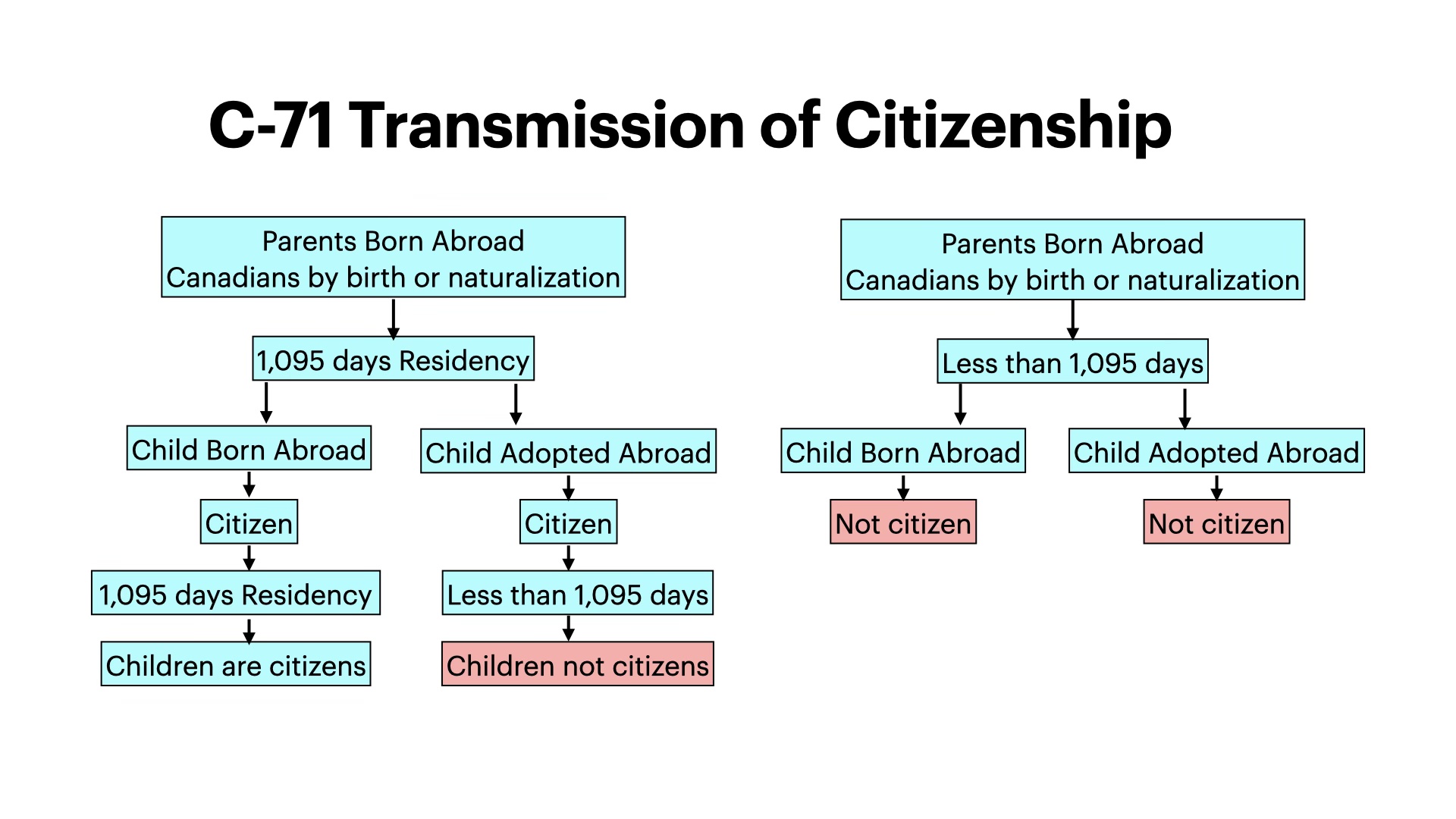
Connection test: 1,095 days cumulative with no time limit (C-71) vs within 5 years: My earlier article and formal submission advocating for the residency requirement to be limited to the same 5 year period as per citizenship applicants provoked discussion at the Senate’s SOCI, with a number of senators questioning the rationale for the government’s decision. 

Minister Miller argued that it was unlikely that the residency requirement would be “spread over forty years” and that a longer time period still means a “fairly important connection,” citing Lebanese Canadians as an example, the “Canadians of convenience” example that was the genesis of the first generation cutoff.  (Miller’s riding is about three percent Lebanese ethnic origin). The Minister also indicated concerns that the five-year limit would create another series of “lost Canadians.” 

Officials further noted that the aim of C-71 was to be facilitative, citing examples of persons coming to Canada annually for summer vacations or family visits. Notably, neither the Minister nor officials addressed the operational complexities of a residency requirement with no time limit. Most witnesses and senators support a connection test.

The appropriateness of a residency-base connection test was accepted by most witnesses.

There was some discussion about whether the lack of a time limit increased the risk of “citizens of convenience,” with the Minister not believing it would (I had previously indicating more likely without a five-year limit).

The possibility of using the electoral list as a basis for a connection test was raised. Given that only about 57,000 persons living outside Canada were issued ballots, only a small fraction of those living abroad, hard to see how this would be a valid alternative.

Numbers affected and operational impact: The Minister and officials provided existing operational data but, beyond generalities, did not share any more detailed internal analysis. There are about 700 applications under the interim measures for those affected by the first generation limit. The Minister does not anticipate that “wild scenarios of hundreds and thousands” will materialize. Officials did not appear to have undertaken any analysis similar to that in my submission that provides estimated orders of magnitude. The other element of note is that the understandable focus was on the immediate cases, those born abroad and unable to transmit their citizenship. There was little to no discussion of the future operational impact and numbers when those second generation children born-abroad had children of their own also born abroad (as is the case of my grandson, who would have to meet the residency test). 

Awareness and clarity: Predictable and legitimate calls for efforts to make those affected aware of the change, with officials indicating their efforts to make persons aware of the interim measures with work underway to prepare once Bill C-71 comes into force. The issue of readability of the current Act and the need for a new Act in lay language was raised, with the Minister noting his agreement in principle but not a priority in the final months of the government’s mandate.

Indian status and citizenship: That some Indigenous persons have Indian status but not citizenship and vice versa was raised, with the Minister noting “ridiculous situations” and that citizenship should be automatic but there were examples of First Nations that were not Canadian.

Adoptions: The CBA raised the issue of the difference between naturally born children, whose citizenship starts on the day of birth, in contrast to adopted children, who only obtain citizenship when the adoption is approved, recommending that the US and British approach of the effective date of adoption being the date of birth of the child. Hard for me to see any practical impact of current policy or substantive inequalities but understand importance to adoptee parents. 

Similarly, I find it difficult to understand the arguments that internationally adopted children, citizens by grant under S 5.1 are being discriminated against compared to naturally born children. (If I recall correctly, the direct route under S 5.1 was a response to parents who wanted their adopted child to be treated identically to a natural-born child, and not under the Permanent Resident pathway as an immigrant. In my view, hard to have it both ways and there does not appear to be any substantive differential treatment in C-71). 

The Minister himself, noting the test applies to the parents, not the child, did not see an inequality. Officials in a clear presentation clarified that natural and adopted are treated as similarly as possible and that not requiring the connection test for international adoptions could mean that citizenship could be passed on through generations without residency in Canada.

Transcript below (preliminary): “If Bill C-71 is amended to eliminate the substantial connections test in the international context and begins to treat adopted persons as if they were naturalized citizens and not citizens by descent, as is in the case for children born abroad to Canadians, this will result in differential outcome for the two groups. Children adopted abroad by Canadians would benefit preferential treatment compared to children born abroad to Canadians, who would then be subject to different and more onerous requirements in order to pass on citizenship by descent. 

If Bill C-71 were to eliminate the substantial connection requirement, again in an international adoptions context, it could mean that a child born abroad and adopted to a Canadian parent could then also adopt a child abroad and pass on citizenship despite never living in Canada. This would mean citizenship by descent could be passed down through generations of people who have never lived in Canada.”

When I worked on these issues some 14 years ago, I always found a graphic was helpful on how C-71 would work with my effort below: 

I gave up a comfortable life to come to Canada – and my immigrant story is more common than you may think

I often think it is hardest for those like Syed who were professionals living in Gulf countries or equivalent and whose experience and knowledge is under recognized along with their position in society, and thus the contrast with expectations and reality are greatest (hopefully, some potential employers will reach out to him):

…After all those struggles over five-plus years, I realized a proper job would be almost impossible to get. I used my remaining savings to buy a few properties to ensure a small but regular rental income – smaller, in fact, than my expenses. But these were my only sources of income, until recently.

And then there are the unique challenges of coming to Canada as a Muslim. I eat only halal foods, for instance, and it is still difficult for me to decipher what is religiously permitted for Muslims and what is not; fortunately, my children are better at figuring this out. The rise of right-wing populism in Canada has also worried me ever since the deadly 2017 shooting at the Islamic Cultural Centre of Quebec City. I can vividly recall my apprehension in the Muslim fasting month of Ramadan, four months after six worshippers were killed, as I offered my traveeh prayer at my mosque after breaking the day’s fast. I found myself fearing that anyone could start spraying bullets, and that I could easily be one of the victims. The 2021 murder of four members of the Afzaal family in London, Ont., only helped consolidate my feeling that being a minority in Canada could threaten my life.

This is not just my story; I know that other immigrants have experienced similar things. I have seen people go into a shell during these difficult resettlement years. It is never easy to get out of that psychological trauma; it could take even more years. And yet, despite our contributions to society – from bringing our savings to Canada to increasing the labour force and ultimately becoming a taxpayer – some still view us as burdens on society. That hurts!

Being burdens – that is not our story. And I refuse to let that define me.

Source: I gave up a comfortable life to come to Canada – and my immigrant story is more common than you may think

Report: Disparate swings in asylum outcomes by US immigration judges

Sean Rehaag has been showing similar discrepancies in Canada. Kahneman argues persuasively that automated systems are the preferred approach to deliver consistent rulings, albeit great care is needed to ensure that no unfortunate biases get coded into the system.

Wide swings in judicial outcomes for immigration asylum cases nationwide since 2019 are noted in a recent report.

Transactional Records Access Clearinghouse reports individual asylum decisions for over 800 immigration judges that finds some have denied asylum in 100% of their cases, while another judge has denied just 1% of cases.

But, on average, more than half of all asylum cases in the United States over the past five years have been denied, a sentiment that has repeatedly been said by at least one South Texas congressman.

The nationwide asylum denial rate from 2019 through 2024 was 57.7%, according to the TRAC report released in November.

“To grant or deny an asylum application is among the most consequential decisions an immigration judge makes. For this reason, understanding how asylum decisions vary across time, across courts, and across judges warrants more attention — particularly in current public policy debates on immigration enforcement policies to reduce the court’s backlog of cases. The lessons that are evident from past decades should not be ignored. For many asylum seekers our current system has not delivered a fast and fair resolution of their cases. Often it has delivered neither,” the TRAC report found.
(TRAC Graphic)
Some of the reasons for wide variations in outcome of asylum cases could be that fewer valid claims came before certain courts. Asylum applicants typically submit their claims to the court nearest their residency. Immigrants from the same country also tend to live in the same communities and their claims and outcomes can be correlated, the report found.

Other significant factors that can influence asylum outcomes includes the availability of skilled immigration attorneys in various communities, as well as court and docket size for number of immigration cases assigned to each judge, according to TRAC.

Two immigration judges in Houston — Monique Harris and Bruce Imbacuan, were cited in the report as having denied 100% of asylum cases in their courts. Harris has adjudicated 108 cases, Imbacuan has heard 105 cases with no cases granted asylum and no cases granted some type of relief, according to TRAC.

Bios on these judges show Harris previously worked as legal counsel for U.S. Citizenship and Immigration Services and Immigration and Customs Enforcement. Her case denials all fell within 2019, according to TRAC. Imbacuan was appointed in 2020 and all of his denial cases occurred in 2020. He previously worked for ICE in Cleveland, Ohio, TRAC reports.

That’s contrary to other judges within the very same court who have denial rates of 70% and 79% but who also have heard many ore cases, 430 and 235, respectively.

In South Texas, the nine immigration judges deciding cases in Harlingen, vary in denial rates from 57.8% to 84.3%. The 11 judges in the Laredo immigration courts vary with denial rates from 24.5% to 90.2%. And the five judges in Los Fresnos, Texas, have had denial rates from 77.5% to 90.6%, the report finds.
In West Texas, the El Paso immigration court judges have issued denial rates ranging from 14.7% to 85.5%.

Judge Lorely Ramirez Fernandez, in El Paso, heard 129 cases since 2019 and has granted asylum to 70.5% of cases and some type of relief to 14.7% of other asylum cases, TRAC says. Her bio lists her as having served as a staff attorney with Las Americas Immigrant Advocacy Center in El Paso in 2007.
San Francisco immigration Judge Elisa Brasil has denied just 1.3% of cases since 2023, since she has been on the bench, according to TRAC. She previously represented clients before the Executive Office of Immigration Review, which are immigration courts, TRAC found.

“Although denial rates are shaped by each judge’s judicial philosophy, denial rates are also shaped by other factors, such as the types of cases on the judge’s docket, the detained status of immigrant respondents, current immigration policies, and other factors beyond an individual judge’s control,” the report found.

TRAC reports that, to date, there are over 3.7 million immigration cases pending.

Source: Report: Disparate swings in asylum outcomes by US immigration judges


Immigration department received intelligence about huge rise in clandestine U.S.-Canada border crossings last year

Good questions regarding senior official and minister awareness:

Intelligence experts within Canada’s border agency informed the federal immigration department last December about a big rise in illegal crossings of the Canada-U.S. border, including into the States, which raises questions about why action to curb it was not taken earlier.

An intelligence document sent to senior Immigration, Refugees and Citizenship Canada officials, says smugglers were moving people across the border in both directions, with some foreign nationals flying into Canada at major airports and swiftly slipping across the border into the United States.

The Canada Border Services Agency’s intelligence analysis says clandestine entries have led to thousands of refugee claims, mostly in the Greater Toronto Area.

The document says “the Southbound movement into the United States (US) has grown significantly since 2022″ adding that “the majority of individuals who attempt to cross southbound illegally arrive by air, mainly at Montreal Trudeau International Airport and Toronto Pearson International Airport and move quickly.”

It found that “the vast majority were very likely in Canada for less than 6 months of which a large portion were in Canada for less than 3 weeks.”

Ministers have insisted in recent weeks, amid heightened tensions between U.S. president-elect Donald Trump and Ottawa over illegal immigration into the U.S., that Canada’s borders are secure.

But the emergence of the detailed analysis by the CBSA’s Intelligence and Investigations Directorate raises questions about whether ministers were ignorant of the extent of people smuggling into the U.S. from Canada, and in the other direction….

Source: Immigration department received intelligence about huge rise in clandestine U.S.-Canada border crossings last year

Salutin | Can Shylock help sort out the conceptual muddle around antisemitism? Yes

Of interest:

In “Playing Shylock,” which is about to end its Toronto run, Saul Rubinek (actor, writer, filmmaker) manages to reproblematize antisemitism and save it from the dumbing down and weaponization it has been subject to in relation to Gaza. He does a lot else in this solo drama by Mark Leiren-Young, but I’ll stick to that.

Antisemitism has a lengthy history during which it has been many different things. True, all involved enmity toward Jews, but Jews didn’t even have to be there, as they hadn’t been legally in England for 300 years before Shakespeare created the antisemitic stereotype of Shylock, in “Merchant of Venice.”

The classic version was Christ-killers, which basically excluded non-Christian places, like the Muslim world. There were Jews as global conspirators, sometimes filthy rich — or commie revolutionaries. Also, in the sudden mass rootlessness of the industrial era, as a mysteriously cohesive alien body. There was the pseudo-scientific racist version of the late 1800s, adopted by Hitler. Recently there’s the incorrect conflation of Israelis with Jews everywhere as “Zionists.” There’s even a recent attempt to impose a “working definition” over all others.

There’s also a widespread sense of antisemitism as a unique metaphysical entity that’s always existed and always will, in varied forms, hovering somehow above history but infecting it, making it uniquely malignant and incomparable.

There’s been vigorous debate on the topic, which is healthy. Definitions are always abstractions that come after actual realities and are devices meant to clarify them. But the monstrosity of the Holocaust tended to sweep aside any disputes. Zionism, the movement for a Jewish state, was one of many currents responding to antisemitism, but rather swiftly supplanted other interpretations.

In the play, Saul Rubinek plays an actor named Saul Rubinek, who plays Shylock and whose show gets shut down during an intermission because “Jewish community” leaders say it will incite antisemitism. He’s been aching to play this part, not because it’s antisemitic — which it is — but because despite that and because Shakespeare is Shakespeare, it is the first portrayal of Jews as three-dimensional (“If you prick us, do we not bleed?”) in the history of literature.

Rubinek rails at leaders who think they can legislate ideas through definitions and shut down millennia of vigorous debate among Jews: kings versus prophets, priests versus rabbis, antinomian messianists versus legalists, hassidim versus mitnagdim, secularists versus religionists, Zionists versus anti-Zionists and other Zionists! Plus, he yearns to play this energetic, contradictory figure onstage.

He even drags in whether non-Jews can play Jews (like Mrs. Maisel) or the abled play the disabled etc., along with: Isn’t all art appropriation? This is what I mean by reproblematizing, or revitalizing, the issue of antisemitism.

Let it breathe. Don’t try to suppress, for instance, almost any criticism of specific Israeli policies, including clear atrocities, as antisemitic. Rubinek’s role scarcely alludes to Gaza yet his performance encompasses it.

The Israeli novelist Aron Apelfeld, who was steeped in the Yiddish-speaking communities snuffed out by Hitler, once said, “In the modern world, every choice to be Jewish is a paradoxical choice.” Rubinek embodies this by asserting his right to go back onstage after intermission to play Shylock.

The most breathtaking moment comes near the end when Rubinek shows how his father, an actor in Poland’s Yiddish theatre before the war, would’ve played Shylock in the prick-us speech. It is a fierce proof of how unshakable a grip the past has on us. Few audience members, Jewish or not, could’ve missed each nuance — in Yiddish! Earlier he did it in the original, with a lot of Othello (warrior and general) in it. What a multifarious performance.

You may’ve seen Rubinek in Clint Eastwood’s “Unforgiven,” “Frasier,” or “Star Trek.” Yet, he’s always, as he says, quoting his director and lifelong friend, Martin Kinch, Jewish. Here, by being so relentlessly, specifically Jewish and simultaneously so riven, he’s produced something truly universal. It may be the only, or at least the most effective, way to achieve that elusive goal.

Source: Opinion | Can Shylock help sort out the conceptual muddle around antisemitism? Yes