Migrants trying to boost their chances for permanent residence by securing an employer’s sponsorship could soon lose the advantage as Ottawa is looking to crack down on fraudulent job offers for immigration purposes.
In a meeting with the Star’s editorial board, Immigration Minister Marc Miller said he is weighing removing the extra points permanent residence applicants could earn through a positive labour market impact assessment (LMIA) submitted by an employer.
Under the current system that awards points based as applicants’ attributes such as educational achievements and work experience, a job offer sanctioned by Employment and Social Development through the labour market assessment is worth 50 bonus points in an increasingly competitive candidate pool.
“There’s a value to LMIA but it can’t be $70,000 on the black market or the grey market,” Miller said Wednesday. “Not prejudicing people that have bona fide LMIAs, but it’s a balancing act. I think it’s safe to say I’m seriously considering it.”…
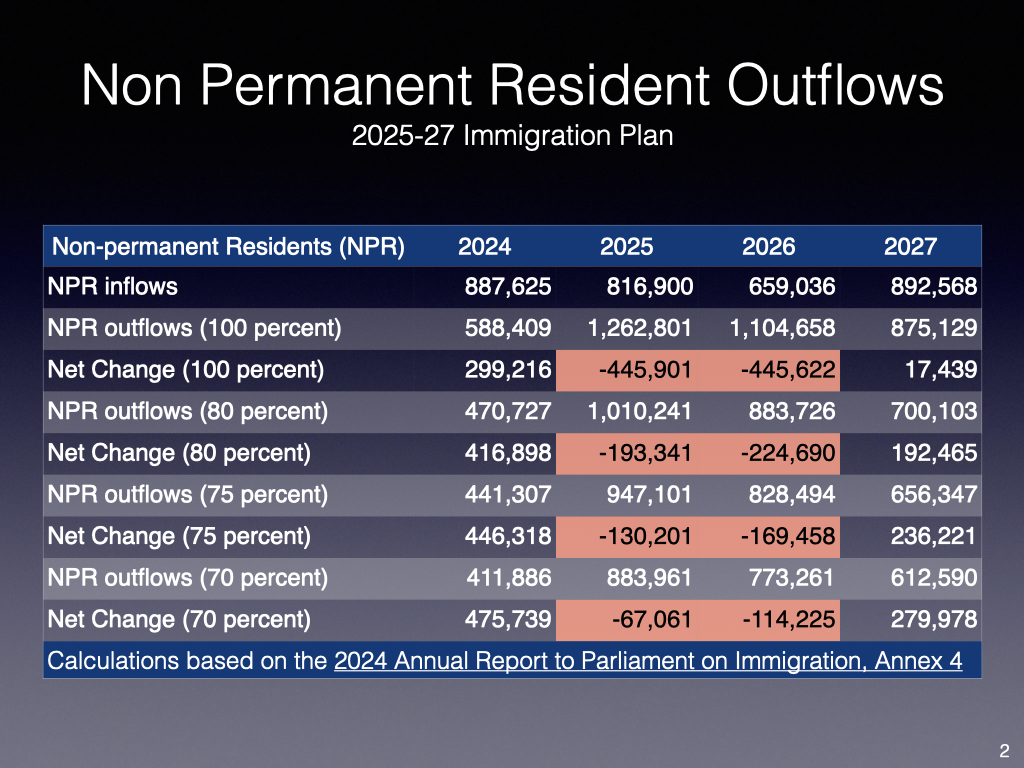
This analysis was prompted by questions regarding the projected numbers of departures with no methodology mentioned, and the suspicion, subsequently confirmed, that it was based on the false assumption that all temporary residents would leave upon expiry of their visa
—
When IRCC released its annual immigration plan last month, eyebrows were raised over the plan’s prediction of large outflows of temporary residents upon expiry of their visas. The Parliamentary Budget Office noted that “there is significant risk to the demographic projection presented in the Government’s new immigration plan—particularly to the projected outflow of non-permanent residents.” The plan included a table covering projected outflows without indicating the methodology and assumptions behind the table. Subsequently, IRCC has confirmed that the calculations assumed that all temporary residents would leave when their visa expired, save for those who transitioned to permanent residency.
This assumption is just wrong as many temporary residents may well remain in Canada and appears aimed at misleading the public. For illustrative purposes, I revised the plan table to include four assumptions: 100 percent of temporary residents leave (the plan’s assumption), and three alternatives where 80, 75 and 70 percent leave. Should 60 percent or less leave, there would not be any net reduction in the temporary resident population.
The overly precise nature of the numbers—down to individual persons—highlights that the government adapted a purely mathematical approach in its estimates. In the case of permanent resident levels, the government more sensibly uses ranges rather than precise numbers which reflect more accurately operational realities. While politically difficult to admit that some non permanent residents will remain, by not doing so the government attracts more scepticism regarding its plans.
Moreover, as Canada does not track outflows systematically, we will not have accurate data on how many actually leave. The government should explore coordination of flight and CBSA data to obtain better anonymized information on outflows and those who overstay their visa.
In short, while inclusion of temporary residents in the annual immigration plan is both overdue and welcome, a more serious approach is needed that better reflects the reality and challenges.
Immigration Minister Marc Miller says Canada should not have to shoulder the United States’ problems with border issues – and vice versa – adding that the U.S. needs to talk with Ottawa and work together if it wants issues affecting both countries addressed properly.
Last week, Tom Homan, U.S. president-elect Donald Trump’s choice as border czar, said the security of the northern border with Canada will be a priority for the incoming administration, along with deporting millions of undocumented migrants. He called on the Canadian government to enforce its ownimmigration laws to stop people, including alleged terrorists, from slipping across the border illegally into the U.S.
Mr. Miller said in an interview that he is planning to meet Mr. Homan for talks about security on the shared border. Fears about waves of migrants trying to cross illegally into Canada to escape deportation have been raised by Bloc Québécois MPs.
“The basic point is this: The U.S.’s problems shouldn’t be Canada’s to shoulder, and Canada’s problems shouldn’t be the U.S.’s to shoulder.That is an alignment of interests that does coalesce around the border and how it’s properly administered,” he said.
“If the U.S. wants to affect anything in its national interest that affects Canada, if it wants it done in a way that we agree with or properly done, it’s going to need to talk to us and work with us,” he added.
Mr. Miller’s remarks followed the third meeting of a cabinet committee on Canada-U.S. relations, reconstituted after the re-election of Mr. Trump.
Not that profound but nevertheless illustrative of some of possible impacts:
This may impact U.S. companies and U.S. institutions of higher education most.
For U.S. companies, this change has an upside and a downside. Those that cannot obtain enough H-1B visas to hire the number of foreign nationals they require will no longer have the convenient option of sending employees to Canada to work remotely. On the other hand, foreign nationals who have planned to leave the United States for better immigration prospects in Canada, may now want to try to stay in the United States. If they do, U.S. companies will have a larger talent pool to draw from, and this may cause them to expand their visa sponsorship policies, and if the Trump Administration doesn’t take steps to narrow the eligibility for H-1B visas, experience higher retention rates and less upward pressure on salaries.
As for institutions of higher education in the United States, international students who were deciding to go to Canada instead of U.S. colleges and graduate schools, due in part to the belief that post-graduation job prospects might be better there, may be rethinking their plans. Tuition from foreign students has long been essential to the budgets of colleges and universities and the number of foreign nationals coming to the United States for school has been declining. If Canada is not an option, then more applications from foreign nationals may go to U.S. schools.
For more than a decade, foreign nationals have found it difficult to obtain H-1B visas and “green cards” in the U.S. due to the limited number of slots available and the restrictive policies of the first Trump Administration. Throughout this time, highly skilled foreign nationals and international students were choosing to move to Canada from the United States on their own to obtain work authorization and permanent residence more quickly. International students who couldn’t obtain H-1B sponsorship due to unsuccessful H-1B lottery registrations have often left for Canada. This has been a boon to the Canadian economy. Now, the tide has turned, and this may be advantageous for the United States economy if the high-skilled workers and international students choose the United States over other countries.
Sarah P. Caze is an Associate in the White Plains, New York, office of Jackson Lewis P.C. Her practice focuses on representing employers in workplace law matters, including preventive advice and counseling.
…Knowledge of Canada’s legacy of racism against Black, Indigenous and other people of colour needs to become as mainstream as the multiculturalism that masks its existence.
Acknowledging anti-Black racism while simultaneously attempting to dismiss a class action lawsuit about anti-Black racism within the federal public service is an example of the paradox of progress that fuels the relentless cycle of performative politics. Working conditions in the federal public service are so hostile toward Black employees that it led to mental health challenges resulting in the use of antidepressants and suicide attempts.
More broadly, what are Black Canadians supposed to feel when a federal government seems so keen to avoid taking responsibility for bigotry in its own service? If we truly want to become the Canada we claim to be, and who Canadians believe themselves to be, we must live up to our stated ideals.
The federal government must stop fighting for a dismissal, and the Federal Court should greenlight the lawsuit and reckon with this country’s legacy of anti-Black racism. Only then can we build a future rooted in truth, transparency, equity and inclusion. Until then, Canada will remain a hostile homeland.
En définitive, Haroun Bouazzi s’est disqualifié comme porte-étendard de la lutte contre le racisme au Québec. Ce serait cependant une grave erreur de nier l’existence des disparités de traitement et des iniquités qui minent les conditions du vivre-ensemble. Le profilage racial perdure au sein de la police malgré les condamnations et les plans d’action. Le gouvernement Legault s’entête à ne pas reconnaître l’existence du racisme systémique, en jouant sur les mots, alors que des commissions d’enquête, des jugements des tribunaux supérieurs, des rapports ou études produits par des organismes gouvernementaux nomment le problème et suggèrent des mesures pour l’endiguer. L’immigration a le dos large pour expliquer les nombreuses carences du filet de sécurité sociale et les carences dans les services publics, alors qu’il s’agit de phénomènes multifactoriels. La réconciliation avec les peuples autochtones avance à reculons…
Le repli communautariste sous-jacent à l’analyse d’Haroun Bouazzi ne forme pas une base acceptable pour un débat fécond. Il faut tout de même trouver un espace pour entendre la détresse et l’inquiétude des Québécois issus de la diversité ou des Premières Nations. Ils ont droit à la pleine égalité, à leur voix discordante aussi pour dénoncer les imperfections qu’il incombe de nommer, dans un débat public qui doit demeurer vigoureux et respectueux, de part et d’autre.
.. Ultimately, Haroun Bouazzi disqualified himself as the standard-bearer of the fight against racism in Quebec. However, it would be a serious mistake to deny the existence of the disparities in treatment and inequities that undermine the conditions of living together. Racial profiling persists within the police despite convictions and action plans. The Legault government insists on not recognizing the existence of systemic racism, playing on words, while commissions of inquiry, judgments of higher courts, reports or studies produced by government agencies name the problem and suggest measures to stem it. Immigration has a broad back to explain the many deficiencies in the social safety net and the deficiencies in public services, while these are multifactorial phenomena. Reconciliation with indigenous peoples is moving backwards…
The communitarian retreat underlying Haroun Bouazzi’s analysis does not form an acceptable basis for a fruitful debate. It is still necessary to find a space to hear the distress and concern of Quebecers from diversity or First Nations. They have the right to full equality, to their discordant voice also to denounce the imperfections that must be named, in a public debate that must remain vigorous and respectful, on both sides.
This is really good data based journalism. Far more sophisticated than I did when looking at ethnic media in the 2019 election. Definitely for the data nerds but others could benefit from knowing how they did it:
While I get the attraction of the Citizen Musk approach, the lack of rigour in assessing its practicality in both the US and Canadian contexts is disappointing. The most effective exercise I have seen was the Chretien-Martin program review in the 1990s that addressed some structural issues and had a major impact, more so arguably than the Harper government exercise.
The risk of course of the Citizen Musk approach is that his cuts will be so ideologically driven and so drastic that worthwhile programs and capacity will be cut, with significant impact on the more vulnerable and core expertise (e.g., CDC, FDA and other necessary regulatory bodies).
The other question is what has Canada learned in the IT space, having a number of high level private sector interchanges (e.g., Alex Benay: the public service’s disruptor-in-chief). To what extent have they succeeded, and how effective were they in removing barriers etc. Some case studies here would be helpful in terms of what worked, what didn’t, and why:
…The D.O.G.E. exercise may therefore represent something of an inspiration. Its mandate to go beyond immediate-term savings and ask more structural questions about the operations and role of government is precisely the type of exercise that Ottawa needs. It should be understood as an effort to get out of counterproductive activities and boost federal state capacity where necessary. The Trudeau government has been a renewed education of the old conservative adage: limited government is better government.
As for who ought to lead such an exercise, my former colleague Rachel Curran has rightly argued that you probably don’t want to fully outsource it. Information asymmetries and the need for bureaucratic and political buy-in require that ministers and their departments be actively involved.
But there is something to the idea that entrepreneurs and technologists can bring a different perspective to the ones represented within the government or the management firms that are typically tapped to advise it. They bring a creativity and energy that’s often undersupplied in government. They’re unconstrained by bureaucratic assumptions and thinking. And they tend to have better track records of successfully overseeing structural reform.
Put simply: Outsiders like Musk and Ramaswamy may come with risks but they may also be more likely to overcome the public choice barriers (including confirmation bias and sunk-cost fallacy) to serious public administration reform.
Who then should lead the Canadian version of D.O.G.E.? How about Shopify’s co-founder and CEO Tobi Lutke?
Not only is he arguably the country’s most successful technologist and is increasingly commenting on Canadian public policy, including its state capacity and poor productivity performance, but Lutke’s background and experience make him an ideal candidate to deliver on a D.O.G.E.-like mandate in time for the 160th birthday of Canadian Confederation.
…Canada, as every schoolchild learns, has thousands of kilometres of undefended border. There are places where people cross officially, at roads and airports. Some people think of these border crossings as gates. But they are not gates. They are revolving doors. A lot of people go through them, in both directions, every year.
When digesting the economic data, it becomes obvious that the flow of people out of the country is following the flow of money. People want better incomes, better prospects. It seems like stating the obvious, but sometimes the obvious must be stated. The ones leaving Canada for the U.S. are the ones in a position to do so: the ones with globally marketable skills, independent incomes or inherited wealth, who can easily start anew elsewhere. And the ones who have decent incomes are usually the ones who have the brains as well. Canada is losing its best and brightest. Instead of easing, Canada’s brain drain is almost certain to intensify. Whoever holds office in Ottawa over the next decade will be hearing about it; let’s hope they do something about it.
On Harvard University’s Economic Complexity Index – a measure of an economy’s productive capacity – Romania jumped from 39th in the world in 2000 to 19th, just behind France. Canada is facing ever-greater competition from nations on the rebound just as it enters the second decade of serious economic deterioration.
Political leaders often tout Canada as a land of immigrants. In 2021, more than 8.3 million people, or 23 percent of the population, were immigrants, the highest proportion since Confederation. Never mentioned is that there could be as many as 5 million Canadians living abroad – one-eighth of the Canadian population. The inflated but often-insincere rhetoric about immigration, emanating from Liberal and NDP politicians in Ottawa and from much of mainstream media, has simply ignored the whole question of outflow from Canada, of how we have lost so many of our best and brightest – and, without major economic, fiscal and governance reforms, will keep right on doing so….
The federal government issued a new passport to an admitted human smuggler after he was ordered to surrender the travel document as part of court-imposed release conditions, CBC News has learned.
The new passport was discovered in June 2023 by RCMP investigators executing a search warrant at the Montreal home of Thesingarasan Rasiah during a probe targeting an international human smuggling network that Rasiah allegedly headed, according to court records obtained by CBC News.
At the time, Rasiah was living at home with an electronic ankle bracelet on strict conditions while awaiting sentencing on a February 2023 guilty plea to one count of breaching the Immigration and Refugee Protection Act for his role in the smuggling of a Sri Lankan national from the U.S. into Canada in 2021.
Rasiah had been forced to surrender his passport to the RCMP in 2021 as part of his release conditions related to the human smuggling attempt that was intercepted by police in Cornwall, Ont., located about 120 kilometres west of Montreal along the Canada-U.S. border.
Rasiah was also forbidden from applying for any new travel documents.
Smuggling operation linked to deaths
Rasiah was charged on April 1, 2021, after he was caught in a Cornwall motel parking lot receiving a Sri Lankan national who had just been smuggled into Canada. He was sentenced to 15 months in jail in September 2023.
He was re-arrested this past May by the RCMP on charges he led an international human smuggling organization that moved hundreds of people north and south across the Canada-U.S. border. He remains in custody.
Investigators with the Cornwall Regional Task Force — which includes officers from the RCMP, Ontario Provincial Police (OPP) and Canada Border Services Agency (CBSA) — also linked Rasiah’s organization to the deaths of nine people on the St. Lawrence River in late March 2023. Two families — one from India, the other from Romania — drowned with a boatman in rough river waters trying to get into the U.S.
The new passport seized by RCMP during the search of Rasiah’s home in 2023 was issued by Service Canada on April 11, 2023, less than two weeks after eight bodies were pulled from the river, according to a copy of the document filed with the Ontario Court of Justice. …

 Multicultural Meanderings