Clear majority of Canadians say there is too much immigration, new poll suggests

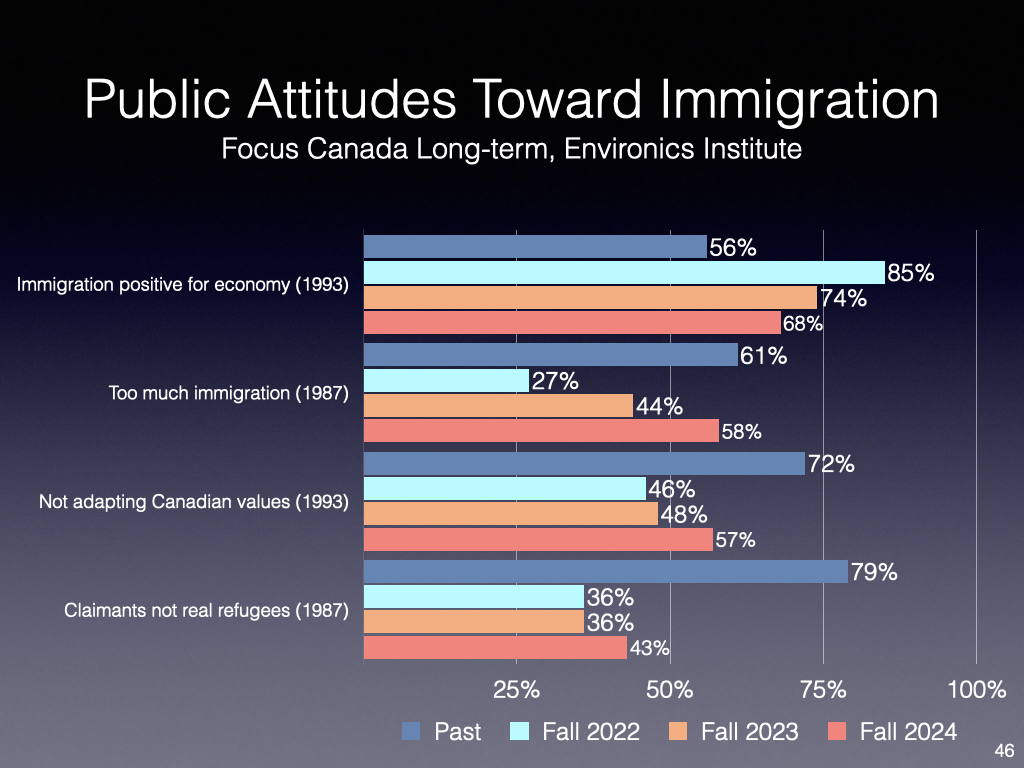
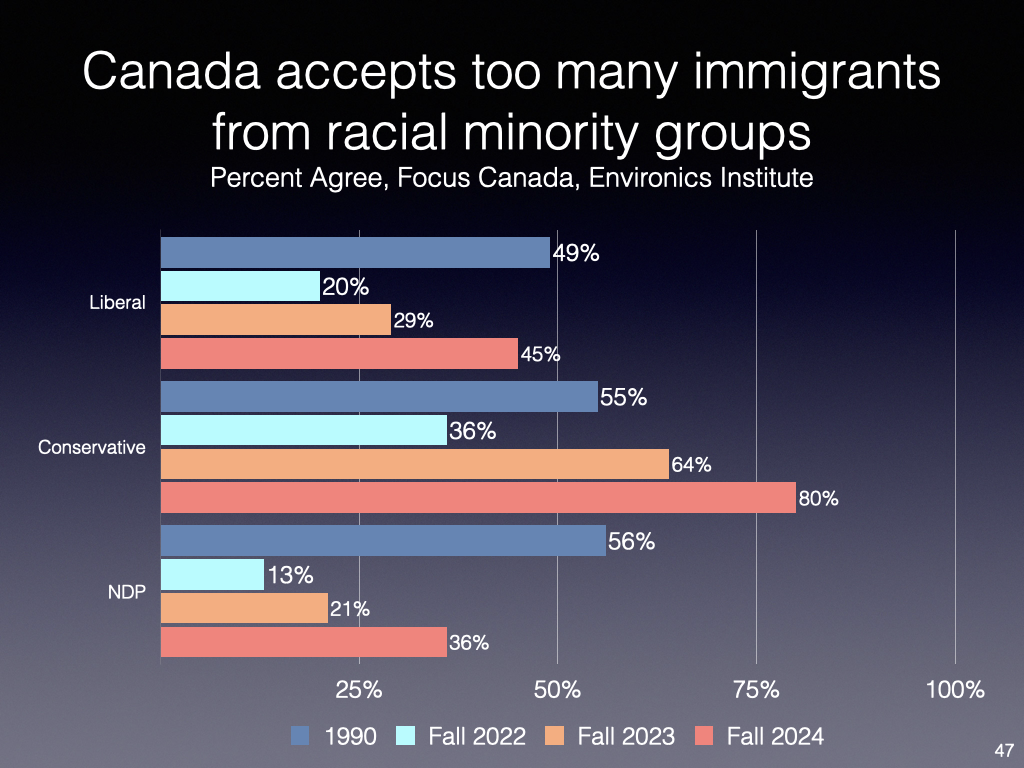
Clear continuing signs of an inflection point in attitudes, reflecting overly high levels of permanent residents and out of control temporary (students, foreign workers) along with impact on housing availability and affordability.

Recent reversals will take time to work through the system meaning that public opinion unlikely to revert to pre-2022 levels. Clear policy failure on the part of the federal government, along with provincial governments and advocates/lobbyists for high levels.

Reversion to 1990 attitudes or worse as per the summary charts below:

…..Keith Neuman, a senior associate with the Environics Institute, says his organization has consistently found a consensus that immigration was either positive for Canada or not a problem.

But he said Canadians have been growing more concerned about the volume of immigrants. “There are worries and concerns about immigration that we simply didn’t see two years ago to the same extent,” he said in an interview.

However, he said Canadians are not rejecting immigration entirely. “People still value the diversity. They still recognize the economic benefits. They understand that jobs need to be filled. Those things are still part of the general sentiment of the population for most people.

“But there are increasing concerns with how the system is being managed and the number of people coming.”

Among the findings of the researchers is a 10-point increase, to 21 per cent, in those who believe there is too much immigration because it is being poorly managed by government….

Source: Clear majority of Canadians say there is too much immigration, new poll suggests,

Clear majority of Canadians now say there’s too much immigration,


MPI: Immigrants and Crime in the United States

A reminder given the falsehoods in the USA election:

Immigrants in the United States commit crimes at lower rates than the U.S.-born population, notwithstanding the assertion by critics that immigration is linked to higher rates of criminal activity. This reality of reduced criminality, which holds across immigrant groups including unauthorized immigrants, has been demonstrated through research as well as findings for the one state in the United States—Texas—that tracks criminal arrests and convictions by immigration status.

A growing volume of research demonstrates that not only do immigrants commit fewer crimes, but they also do not raise crime rates in the U.S. communities where they settle. In fact, some studies indicate that immigration can lower criminal activity, especially violent crime, in places with inclusive policies and social environments where immigrant populations are well established….

Source: MPI: Immigrants and Crime in the United States

Rioux | La solitude des profs

A noter:

…En France, les islamistes s’évertuent à « maintenir un niveau de connaissances faible afin de tuer l’esprit critique et le rationalisme, l’imaginaire et la fiction, ou encore ignorer l’Histoire, qui n’aurait aucun intérêt pour la connaissance de Dieu », dit l’historien Pierre Vermeren. Sans parler de l’éducation sexuelle…

On ne s’étonnera pas que, laissés à eux-mêmes, 56 % des professeurs français s’autocensurent sur la Shoah, le conflit israélo-palestinien, et n’osent plus montrer à leurs élèves la Vénus de Botticelli. Avant l’assassinat de Samuel Paty, ils n’étaient que 38 %. Pourtant, combien sont-ils à se cacher la tête dans le sable sans même oser prononcer le mot « islamisme » ? Face à la démission de ceux qui ne veulent pas faire de vagues, ne vous demandez pas pourquoi les professeurs se sentent abandonnés.

… In France, Islamists strive to “maintain a low level of knowledge in order to kill critical thinking and rationalism, imagination and fiction, or ignore History, which would have no interest in the knowledge of God,” says historian Pierre Vermeren. Not to mention sex education…

We will not be surprised that, left to themselves, 56% of French teachers self-censor the Shoah, the Israeli-Palestinian conflict, and no longer dare to show their students the Botticelli Venus. Before the assassination of Samuel Paty, they were only 38%. However, how many of them hide their heads in the sand without even daring to say the word “Islamism”? Faced with the resignation of those who do not want to make waves, do not ask yourself why teachers feel abandoned.

Source: Chronique | La solitude des profs

Why Indians of almost every political persuasion are backing New Delhi in its dispute with Canada 

Of interest:

…No country should be allowed to evade accountability, and India is no exception. But as Canada pursues justice, Canadians will have to ask themselves some difficult questions. How and why did their country mutate into a haven for convicted and aspiring terrorists? As Ottawa accuses India of bringing terror to the streets of Canada, Canadians should ask: has their government become a facilitator of international terrorism? And finally: are radical ethno-religious chauvinists who pledge loyalty to – and are willing to shed blood for – a noxious fantasy really worth losing the goodwill of the citizens of the world’s most populous democracy?

Kapil Komireddi is the India-based author of Malevolent Republic: A Short History of the New India.

Source: Why Indians of almost every political persuasion are backing New Delhi in its dispute with Canada

Opinion | Justin Trudeau’s immigration minister cracked down on Canada’s international student ‘racket’. Here’s what he wishes he’d done differently

Well worth reading. Some excepts of interest:

Terms of debate: “The issue is having the proper intellectual debate and not turning it into value statements about the race, colour, or creed of the people coming in, but also without painting people as racist when they express views you disagree with.”

International students: “The program had become a bit of a racket, and I probably should have acted sooner. My biggest mistake was to trust people for too long — to trust provinces and the institutions they regulate. Auditors general have said time and time again that Ontario and B.C. had to get a grip on things. Those are the two provinces where international-student placements had become a runaway train. And they were all promising something — permanent residency or Canadian citizenship — that was not guaranteed.”

Temporary Foreign Workers: “Largely hospitality. Go into a Tim Hortons, and you will see a lot of temporary foreign workers. When you take a step back, the questions you need to pose are, ‘How are we filling needs? Are we artificially depressing wages? How is an influx of temporary foreign workers contributing to that trend, particularly when you have a labour force already here?’ There will need to be further adjustments to the program, including in the availability of asylum seekers who have work permits. But we also don’t want to harm markets that are important to regional economies, like fish processing or food processing.”

Source: Opinion | Justin Trudeau’s immigration minister cracked down on Canada’s international student ‘racket’. Here’s what he wishes he’d done differently


What citizenship applications tell us about policy implementation

My latest in The Hill Times. Password protected so here is the analysis (tables simplified in the HT):  

Analysis of citizenship applications between 2005 and 2023 reveals how the previous Conservative government’s pledge to make citizenship “harder to get and easier to lose” resulted in significant delays and reduced approval rates before political realities resulted in mitigating those impacts. The Liberal government reversion to previous residency and other requirements cemented a return to historic approval rates and processing times.

This analysis looks at four periods, roughly aligned to Census periods:

  • 2005-10: During this period, the new Discover Canada citizenship study guide was introduced in 2009 with more detailed content and more complex language, along with a more rigorous knowledge test based upon the guide and more objective language assessments. The policy intent was in part to reduce the previous approval rate of approximately 95 percent to between 80 and 85 percent (“harder to get”).
  • 2011-15: The impact of these 2009-10 operational policy changes was felt during this period. In addition, the Conservative government passed C-24 (Strengthening Canadian Citizenship Act) in 2014, expanding knowledge testing and language assessment to those between 14 and 64 years old compared to the previous 18 and 54. Fees increased from $200 to $630 per adult or over $1,400 for a family of four in 2015. The fee increases may have been a Treasury Board condition in order to obtain funding to address a processing backlog.  Revocation provisions for “treason and terror” were included.
  • 2016-20: The election of a Liberal government resulted in the reversal of knowledge and language assessment to those between 18 and 64 years old and removed the revocation provisions, among other changes. The Liberal party’s 2019 and 2021 election platforms committed to waiving citizenship fees but were not implemented. Similarly, successive ministers of immigration have noted plans for a revision to Discover Canada but the current version remains in effect.
  • 2021-24: The citizenship oath was updated with a reference to indigenous treaty rights in 2021. The pandemic resulted in the virtual shutdown of citizenship ceremonies for a number of months and a shift to the majority of ceremonies taking place on line. The proposed repeal of the first generation limit in C-71 and replacement by a time-unlimited residency requirement would result in an unknown number of additional Canadian citizens.  

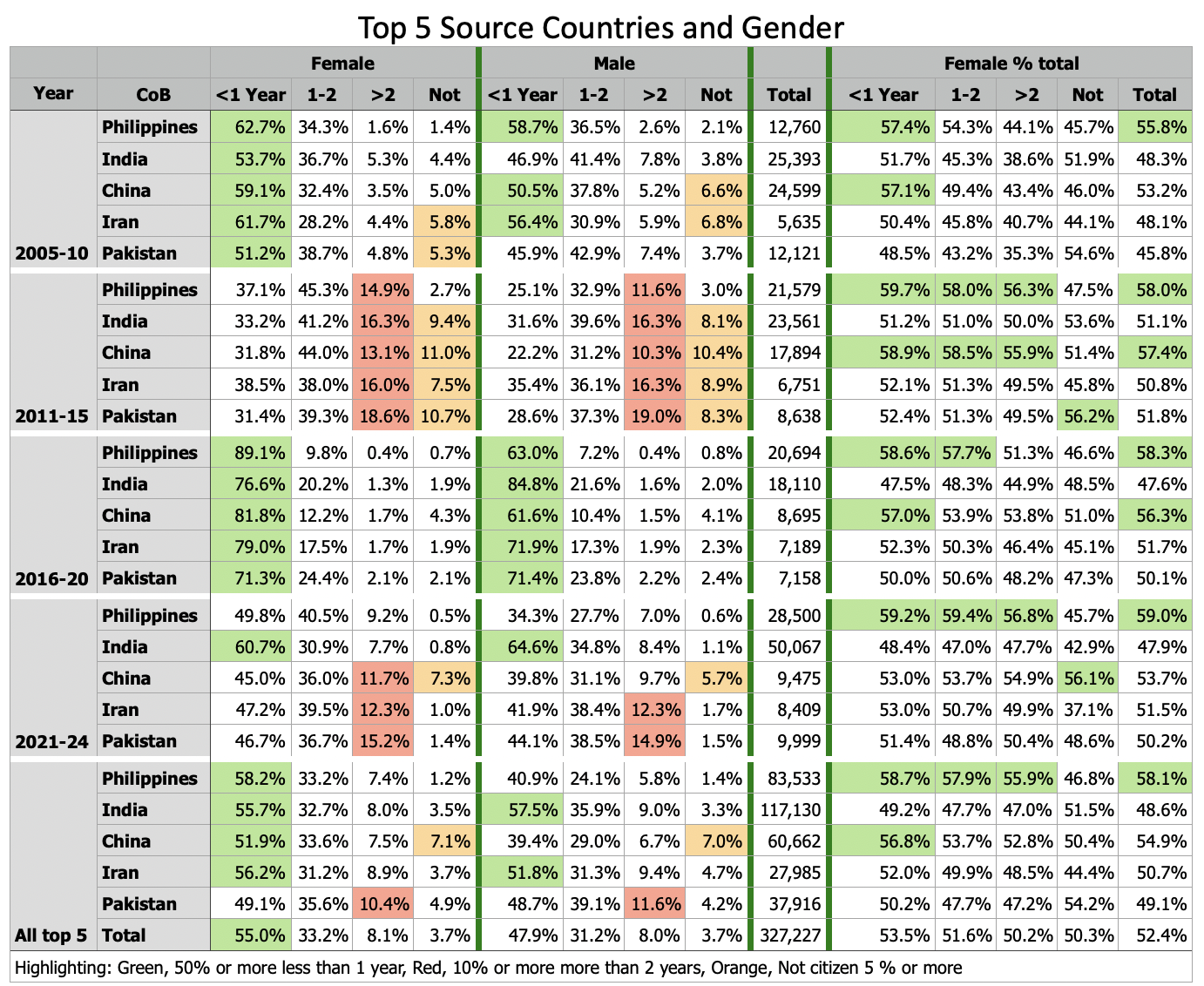
 Application data by gender, immigration category or country of birth highlights the dramatic initial impact of the policy changes of the Conservative government and how these were relaxed by the Conservatives themselves before having virtually no impact after a number of years under the Liberals. The same pattern applies no matter what the variable, the 2011-15 period was the worst period in terms of delays and approval rates.

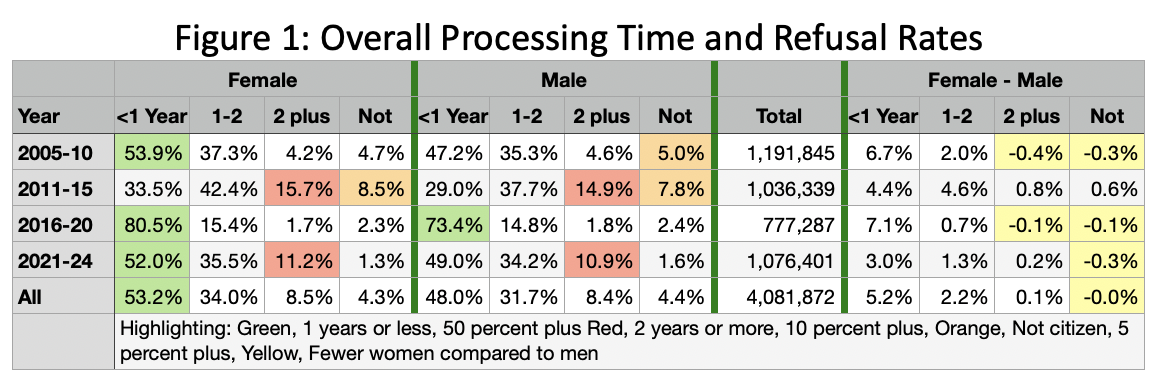
Figure 1 provides the overview by period highlighting that in general, women applicants were granted citizenship faster than men and had higher approval rages, save for the 2011-15 period. The percentage not granted citizenship rose to over ten percent in 2012 and 2013, before recovering to just over seven percent in the last years of the Conservative government. Moreover, only about 20 percent of applications were processed within the service standard of one year 2010-13. Apart from the pandemic years 2021-22, service standards were met close to 80 percent of the time.

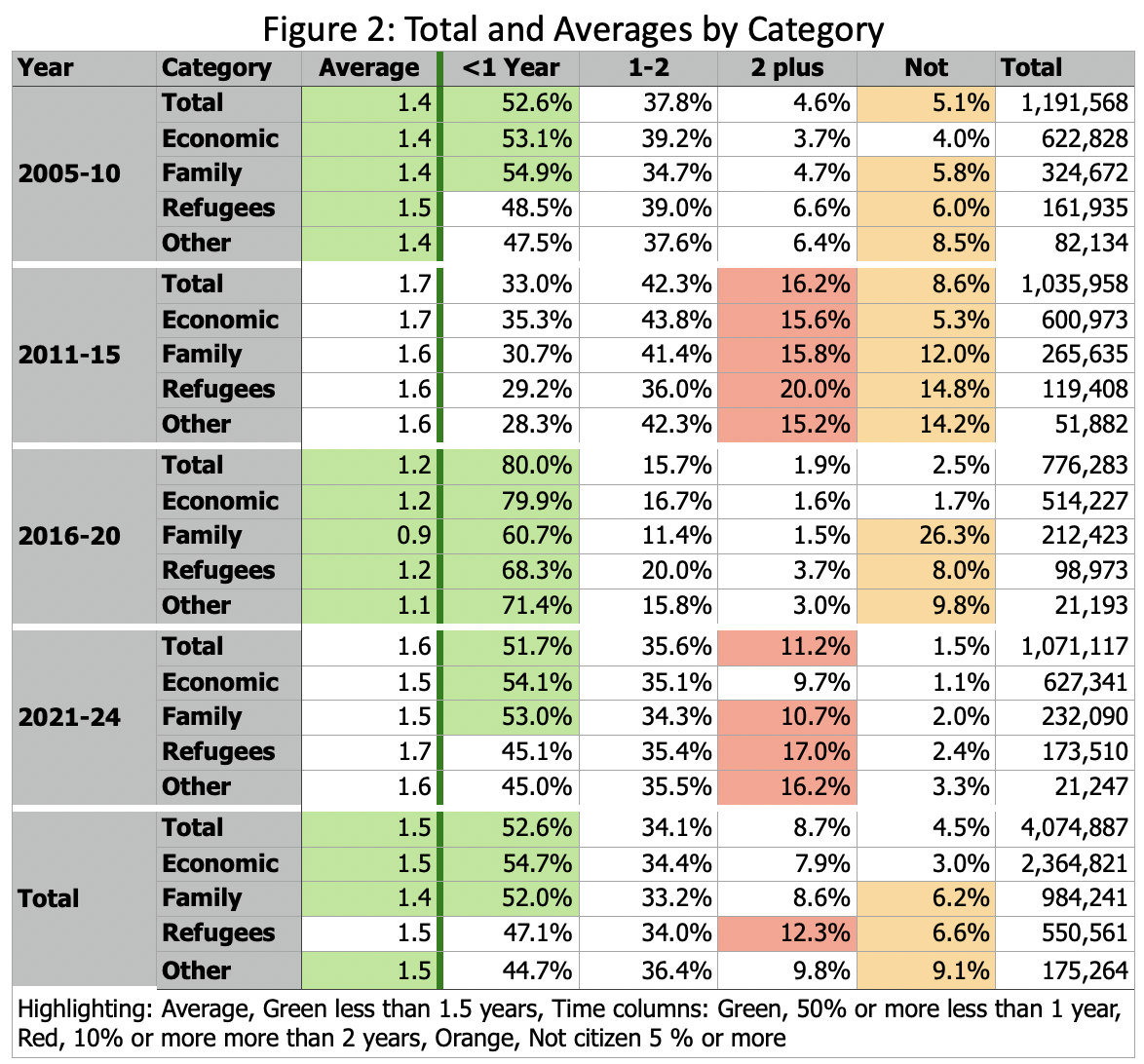
Figure 2 provides the category comparison, highlighting lower refusal rates for economic class and particularly relatively higher refusal rates immigrants for family and refugee class during the first years of the Liberal government, given that legislation reversing the Conservative age range requirement for knowledge and language assessment only came into force October 2017. But since then, refusal rates are negligible, less than three percent, or lower than 2005.

Figure 3 shows the impact on the five largest immigration source countries, showing again the same overall pattern. Of particular note is the higher rate of Chinese rejections across most periods which may reflect weaker language fluency compared to the other large source countries. 

Concluding observations

This analysis highlights the impact that operational policy changes can have on citizenship, making naturalization harder or easier, particularly for family class and refugees. The effective relaxation of knowledge and language assessment in 2014-15 reflects high refusal rates were not politically tenable, particularly in the lead up to the 2015 election.

Application data suggests that immigrants delayed submitting applications 2016-17 once the Liberal government announced it would return to the previous 18 to 54 age requirements. The data also shows a drop in applications in 2020 reflecting applicants waiting for the government to implement its 2019 election commitment to eliminate citizenship fees.

Citizenship applicants pay attention to operational and legislative policy changes and adjust their application timing accordingly. 

It is unclear whether or not citizenship changes would be a priority for an expected Conservative government and whether it would want to revert to Harper-era policies. However, citizenship changes would likely be a lessor priority than immigration changes given changing public sentiment on immigration that reflecting debates and discussion on immigration’s impact on housing and healthcare. 

Moreover, the fact that the previous government had to soften its “harder to get” approach may provide a cautionary tale in terms of what may or may not be acceptable to immigrant-origin communities. 

Methodological notes

Data provided by IRCC, 2005 to April 2024.  This partial 2024 data included in overall 2021-24 numbers.

 Source: What citizenship applications tell us about policy implementation

Articles of interest over the past month

Need to get a life as during my vacation break monitored Canadian media and collated these articles that I found of interest. Likely missed some.

The ones I found most interesting:

Donald Wright: We are not going to build our way out of the housing crisis. The harsh reality… Along with Donald Wright: When it comes to where people want to live, Canada is a very small country, Donald Wright: Urban densification is not going to solve our housing crisis, Donald Wright: The first step in solving Canada’s housing crisis? Implement a non-delusional immigration policy. “I calculate that Canada will need to limit the number of new PRs and net increase in NPRs to an average of 175,000 per year between now and 2031. This is a significant reduction from the 640,000 per year average over the past five years.”

Jason Kenney’s biggest worry about the U.S. election: A potential deportation program. “If he was still immigration minister, Mr. Kenney would make changes such as beefing up the Safe Third Country Agreement and increasing the Canada Border Services Agency’s resources. “I would make it clear that Canada is an open and welcoming country, but you have to go through the normal legal process.”’ His overall take on the Liberal record in this interview: Trudeau has ‘catastrophically mismanaged’ immigration: Jason Kenney

Laura Wright | Canada’s fertility rate has plummeted. Maybe we shouldn’t care. Good call to recognize demographic realities and focus on how to re-examine existing programs in light of this trend, rather than merely trying to delay it through immigration.

Simpson: Blame the four fatal ‘I’s of Justin Trudeau for the lacklustre state of the Liberals. On immigration: “Historians of this period will look at cabinet records to figure out why the Liberals took the decisions they did that turned public opinion against immigration and the incumbent government. Was it the old Liberal reflex that immigrants usually vote Liberal so the more the merrier? Was it a response to those who proposed that Canada should become a country of 100 million people? Was it a response to business leaders who wanted more cheap labour? Was it the Liberal/liberal reflex to want to do good rather than to be smart? Was it a response to higher education institutions whose budgets were stressed by inadequate provincial funding and so needed foreign students whom they could charge higher fees? Was the push for record-high immigration needed to fill the gap of a declining birth rate? Was it that a party that had wrapped itself in self-virtue could not believe that a variation of what had happed in other Western democracies could not and would not happen here? Was it blind incompetence not to appreciate that driving up immigration and refugees to unprecedented numbers would produce a myriad of negative side effects and destroy what had been close to a consensus in favour of previous levels of newcomers?”

Clark: Marc Miller and a mea culpa makes a rare success. “Yet Mr. Miller has taken steps that have turned around the trend. It’s hard for governments to claim credit for acknowledging their big, bad mistakes, and fixing them. But in politics, that should be rated as a rare success.”

‘Alarming trend’ of more international students claiming asylum: minister. Belated recognition of the perverse incentives at play and the likely need for further corrective actions. Marc Miller Strikes Again provides HESA’s critique of federal actions and that fed-prov consultations should have possible to achieve comparable results. This will be the next shoe to drop in our broken immigration system, Tony Keller on Miller’s admission and the further increases in asylum claimants and overstays.

Schools Make Millions Offering Degrees That Double as Work Visas (USA). Not unique to Canada. “A record 24,000 foreign graduate students were enrolled in schools offering Day 1 CPT — or curricular practical training — as of fall 2022, according to a Bloomberg News analysis of the most recent available Department of Education data. At typical prices, tuition probably topped $240 million, Bloomberg estimates.”

Waterloo’s international graduates outearn Canadian-born students, paving the way for immigration policies, experts say. Coverage of Skuterud’s case study for University of Waterloo international students.

Urback: Canada is sleepwalking into a refugee crisis. We need to act now. Another highlighting of the consequences of lack of foresight and likely not listening to public service advice. “It’s not ideal that those legitimately seeking refuge in Canada may be denied the opportunity, but it’s a consequence of this government ignoring years of warnings. It cannot ignore these next ones.”

Lisée | Les difficultés temporaires de François Legault. “François Legault avait promis de mieux gérer l’immigration et d’y arriver dans le cadre fédéral. Force est de constater que, loin d’avoir réussi à « en prendre moins », son gouvernement a activement exacerbé la situation pendant plusieurs années, avant de réaliser, penaud, dans quel pétrin il avait contribué à plonger le Québec.”

Most Canadians say citizens who stay in high-risk conflict zones don’t deserve government protection: Leger poll. Not surprising and understandable. “Canadians of convenience.” Also Flight leaves Lebanon with about one-third of seats reserved for Canadians filled.

Chris Selley: For anti-Israel protesters, October 7 anniversary is an unofficial citizenship test. Yep. 

Combatting hate in Canada. Announcement of expanded funding for a variety of programs and initiatives ($273.6 million over six years, and $29.3 million ongoing) without, it would appear, any substantive change from the INSERT evaluation. Likely will be significantly cut back under a Conservative government.

Robert P. George: A Princeton Professor’s Advice to Young Conservatives. “Grievance identitarianism — be it of the left or the right — impedes the very thing a student is attending university to do: namely, think and learn. It turns a person into a tribalist, someone who, rather than thinking for oneself, outsources one’s thinking to the group.”

Allen | The wounds of October 7 cannot heal until there is peace. “I yearn for a Canada whose citizens can hold in their hearts sympathy and understanding for all those killed and maimed during this period. I wish that students on campus and Canadians more generally understood that both sides view themselves as victims and that each side bears some blame for the current crisis. I acknowledge that Palestinians have been under the yoke of an illegal occupation for over five decades and that this must end. Unfortunately, the fears and hatred generated by the Oct. 7 attack have made the task harder.”

John Ivison: Flag-burning Islamists in our streets would kill us with our own tolerance. “Hostilities may not have been declared, but if you don’t think Canada is in a fight for all it holds dear, you should watch the forces of radical Islam calling for the death of Canada on the streets of Vancouver, while holding the remnants of a burned Maple Leaf flag.”

Gopnik: The tragedy of our time is that antisemitism rises equally from the left and right. “Every person is a world in an agonizingly literal sense. Let’s recall that one of the few texts that passes complete from Jewish scripture to Islamic scripture is the injunction that “Whoever kills a soul, it is as if he had slain mankind entirely. And whoever saves one – it is as if he had saved mankind entirely.”

The Functionary: Interview with Peter Wallace. Thoughtful discussion between Kathryn May and Wallace. Some of my favourite quotes, good reading for those preparing for a Conservative government:

“We want people to trust government, but they really should be skeptical about what government does with authority and they really should push back on that.”

“We’re mystified (as to) why people can be upset with government, and I don’t think we should be. The reality is governments are often times incredibly intrusive.”

“It’s incredibly important to remember that today’s dissidents are often tomorrow’s heroes. We must be cautious about shutting people out of the policy process.”

“The public pays for what we do, and they have a right to see our work. We need to demonstrate our value and show that we are thoughtful and competent. So, let’s embrace that scrutiny.”

“We’ve got to have metrics to help us understand individually at a gut level what we’re doing with that money. We have to be satisfied before we advise an expense that it’s actually worth the opportunity cost, worth the fiscal cost.

Full list attached: