Haan et al: What Does Integration Mean in a Multicultural Country like Canada?

Interesting discussion on integration definitions. But I think this relationship model, while important, neglects socioeconomic outcomes (income, employment, scolarity etc). Valid to question whether integration into the “mainstream” remains valid but looking at the data indicates still is relevant.

And there is a risk of dismissing pre-existing norms as it suggests an approach of “anything goes” rather than conforming with Canadian laws and regulations, which of course evolve and change as the population and social norms change:

…Although there is evidence to support both segmented and new assimilation theories, it is also becoming obvious that researchers should pay more attention to the demographic realities in immigrant-receiving countries such as Canada. As some native-born populations shrink in proportion to the whole, it becomes increasingly difficult to pinpoint where exactly the process of integration might occur. The sociologist Richard Alba recommends expanding the definition of the mainstream to include more groups. While this is obviously an important step, it maintains an underlying assumption that there exists a core population group. What happens when a city increasingly does not have a majority group? 

To this end, sociologist Maurice Crul recommends moving beyond thinking about integration as a minority group’s merging into a majority population and having little to no effect on the mainstream itself. His “integration into diversity” theory posits that the notion of a mainstream is becoming less useful and should be replaced with one of a population marked by diversity.

Drawing on results from the Becoming a Minority project, which collected data from several European cities, he provides a matrix to describe nine outcomes of individuals, each focused on different integration attitudes (see Figure 2). The most integrated individuals will exist in a diverse social network that believes immigration-related diversity is enriching, while the least integrated will be at the opposite end of the spectrum, feeling threatened by immigration and favoring a homogenous social circle.

Figure 2. Integration into Diversity Theory Matrix

Source: Maurice Crul, “Integration into Diversity Theory Renewing–Once Again–Assimilation Theory,” Journal of Ethnic and Migration Studies 50, no. 1 (2024): 257-71, available online.

The strength of this approach is that it does not take into consideration individual characteristics such as skin color or first language spoken. According to this theory, these factors do not really matter because there is no expectation of comparing individual characteristics to that of a mainstream population; neither the characteristics of the community nor the person matter. What matters instead is individual actions and attitudes towards diversity. The more tolerant a person is, the more integrated they are into their heterogenous society.    

This approach is still rather new and, as such, does not yet explain which identity position a person will take. It is, in fact, only beginning to be used to predict characteristics such as feelings of belonging and perceptions of neighborhood security. Crul is clear in that he does not want his theory to replace new or segmented assimilation theory as an explanation of the integration process (he instead refers to it as an update), but the idea shifts the focus away from that of an individual melding into the mainstream. By positing the existence of nine subgroups, it becomes possible to envision multiple mainstreams with multiple attitudes towards integration. In a country such as Canada, this approach seems rather prescient.

Nonetheless, the utility of a new theoretical framework is best assessed empirically. Canada’s General Social Survey asks individuals how many of their friends are of the same immigrant group, although not about attitudes towards diversity. It would be interesting to add this question and find other ways to analyze integration into diversity theory.

Moving forward, immigration to Canada is only increasing. With extensive efforts to bring in more new arrivals every year, immigrants’ influence on the Canadian population is growing—and appears on course to continue doing so even as public disquiet has caused the government to seek to trim some immigration. Traditional notions of integration are becoming increasingly irrelevant in a country where nearly all population growth stems from immigration. New arrivals find their place in society not by assuming pre-existing norms, but by finding their people and their place and creating their own norms. In this way, Canada’s diversity will only continue to grow over time.

Source: What Does Integration Mean in a Multicultural Country like Canada?

Gee: It’s time to bring John A. Macdonald out of his confinement

Yes. And charge people for any defacing or vandalism along with a plaque or display on his role in residential schools. Same should be done for Ryerson:

…If it’s wrong to lionize our national champions, glossing over their failures and their crimes, it is equally wrong to villainize them. Most of them are neither complete heroes nor utter rogues. A true understanding of history demands we view them in the round, considering all their human complexity.

John A. Macdonald expressed some vile – and, sadly widespread – opinions about Indigenous peoples. He had many other flaws and made many mistakes in his long tenure as Canada’s dominant political leader. But as one of his leading biographers, Richard Gwyn, argued, all of this must be set against his accomplishments, among them the creation of the transcontinental railway and the North-West Mounted Police. Before he died, said Mr. Gwyn, Macdonald made sure that “Canada had outpaced the challenge of survival and had begun to take the shape of a true country.”

Here is how the Canadian Encyclopedia summarizes him: “Macdonald helped unite the British North American colonies in Confederation and was a key figure in the writing of the British North America Act – the foundation of Canada’s Constitution. He oversaw the construction of the Canadian Pacific Railway (CPR) and the addition of Manitoba, the North-West Territories, British Columbia and Prince Edward Island to Confederation. However, his legacy also includes the creation of the residential school system for Indigenous children, the policies that contributed to the starvation of Plains Indigenous peoples, and the ‘head tax’ on Chinese immigrants.”

The past few years have seen an overdue reckoning with the tremendous and lasting harms done to Indigenous peoples during European colonization. But there are other remedies than erasing names and pulling down statues. One is to raise memorials to the victims of those times. Mount Vernon has a slave memorial close to the tombs of George and Martha Washington. Another is to explain and educate. A few years ago the foundation that runs Thomas Jefferson’s plantation at Monticello, Va., unveiled a series of nuanced exhibits about Sally Hemings, the enslaved woman who bore several children by the man who drafted the U.S. Declaration of Independence.

Instead of hiding Macdonald away, why not install a display at Queen’s Park about residential schools and his role in their story? Putting the statue of our first prime minister in a wooden box achieves nothing and satisfies no one. It is time to bring Sir John A. into the light.

Source: It’s time to bring John A. Macdonald out of his confinement

Globe editorial: Fraud in the temporary worker program isn’t the problem. The rules that rig the labour market are

Indeed. Not seeing much impact yet in numbers in government rolling back some of the earlier ill-advised facilitation under former immigration minister Fraser and his DMs:

…As is the case with much of the immigration file, the Liberals have moved only slowly to undo what have become clearly damaging changes. Last October, the government decreased the validity period for labour market impact assessments to 12 months, when the national unemployment rate had hit 5.7 per cent, up from 5.1 per cent in the spring of 2022.

In March, the validity period was reduced to six months, a belated recognition of the realities of the labour market. At the same time, the government said only two sectors would still be allowed to use foreign workers for up to 30 per cent of their workforce. But it kept in place the 20-per-cent rule for all other sectors, despite rising unemployment.

On Tuesday, Employment Minister Randy Boissonnault hinted that further tightening may be on the way, as he announced several anti-fraud measures. Of course, companies who abuse the rules and their workers should be punished.

But the real problem with the low-wage temporary foreign worker program is not abuse of the rules – it’s the rules themselves. The press release from Mr. Boisonnault’s office boldly stated that the temporary foreign worker program “is designed as an extraordinary measure to be used when a qualified Canadian is not able to fill a job vacancy.”

That may have been the case once. But now that is demonstrably untrue – and a slap in the face to unemployed workers struggling to find a job while the Liberal government allows businesses to continue to import cheap labour.

Source: Fraud in the temporary worker program isn’t the problem. The rules that rig the labour market are

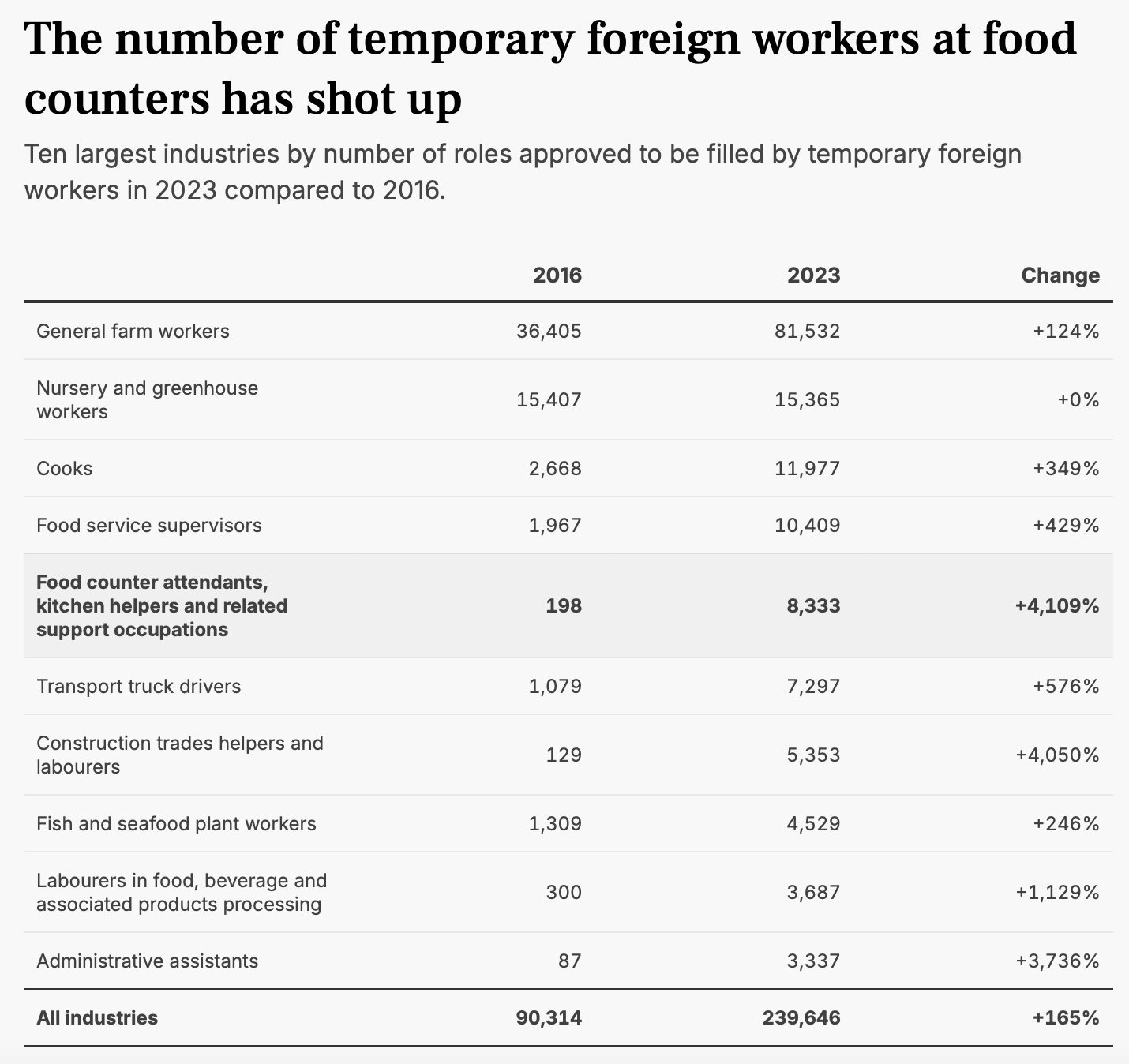
‘A new kind of slavery’: Skyrocketing use of temporary foreign workers in restaurants and fast food chains has advocates concerned

Alternate header: Restaurants rely on cheap foreign labour undermining wages:

Source: ‘A new kind of slavery’: Skyrocketing use of temporary foreign workers in restaurants and fast food chains has advocates concerned

Todd: Do women, people of colour get fewer votes in Canada? New studies say no

Interesting US study, broadly applicable to Canada:

Given the Olympics are up and running, it’s fitting to reflect on how the image that cartoonists most often use to show that women and ethnic minorities have a disadvantage is one of the hurdles.

The illustrations recur: Of women and people of colour literally having to jump over more and higher hurdles than white people or men to reach victory in their fields, particularly politics.

Now that U.S. Vice-President Kamala Harris, whose mother was born in India and father in Jamaica, is the Democratic Party’s candidate for president, media outlets are especially filled with talk about gender and racial barriers.

But the clichéd metaphor of an unfair hurdles race is in need of an update in light of studies showing that in almost all cases and places women and people of colour compete evenly.

Last month, researchers at the University of Oxford unveiled the findings of the most extensive analysis yet performed on how people vote in view of candidates’ ethnicity and gender.

Lead by Sanne van Oosten, the team looked for the patterns in 43 different sociological experiments in the U.S., Europe and Canada of voter preference over the 10-year period ending in 2022.

The experiments typically involved presenting respondents with profiles of fictional political candidates, while randomly varying the candidates’ race or ethnicity. There were in total more than 310,000 observations of respondents’ preferences.

“Our meta-analysis concludes that, on average, voters do not discriminate against minoritized politicians,” van Oosten said. “In fact, women and Asians have a significant advantage compared to male and white candidates.”

Van Oosten, who had earlier been appalled by gender-based criticism of Hillary Clinton and the race-based undermining of Barack Obama, considers the results good news — for Harris and other candidates who are female and/or of colour.

The researcher has been surprised by the dearth of media interest, however, given that her earlier study of how the public can stereotype Muslim candidates as homophobic received international coverage.

“One journalist at a very highly esteemed newspaper even literally said to me: ‘People aren’t interested in good news’,” van Oosten said on social media.

The study by van Oosten, Liza Mügge and Daphne van der Pas doesn’t deny that there is a small minority of voters who have racist or sexist attitudes. But it does find most voters aren’t negatively impacted by a candidate being female or a person of colour. Indeed, it’s often perceived as a positive.

Here how the authors put it in their meta-analysis:

• “Voters do not assess racial/ethnic minority candidates differently than their majority (white) counterparts.”

• In regard to Asian candidates in the U.S.: “Voters assess them slightly more positively than majority (white) candidates.”

• “A meta-analysis on gender demonstrates that voters assess women candidates more positively than men candidates.”

• When voters from minority ethnic groups share the same ethnicity as the candidate, they positively “assess them 7.9 percentage points higher” than white candidates.

• Even in “patriarchal” societies, such as in Jordan, men will vote for a female candidate over a male if she shares the voter’s ethnicity.

The comprehensive Oxford study also cites the work of Anthony Kevins, of Utrecht University, who found across the U.S., Britain and Canada there is no sign that voters will refrain from marking an X on a ballot for a candidate because of their gender or ethnic background.

In Canada, Kevins found only one distinct bias: That members of the Canadian political left have, all other things being equal, “a higher likelihood of voting for the East Asian candidate.”

The University of Toronto’s Randy Besco, author of Identities And Interests: Race, Ethnicity and Affinity Voting, said in an interview that on average racial minority candidates don’t get fewer votes in Canada.

However, in one specific category, “racial minorities running for the Conservative Party do get less votes.”

The broader finding in the work of Besco and others is about significant so-called “affinity voting,” in which people elect members of their same identity group.

“Chinese and South Asians showed preference for their own ethnic group compared to a white candidate,” Besco said. And they also preferred to vote for members of other minority groups over white candidates. “But this preference was weaker than same-ethnic preference.”

Asked whether Canadians who are white also engage in affinity politics, by tending to mark their ballots for Canadians who are white, van Oosten said in an interview there is no indication white majorities in Britain and Canada make a point of voting for their ethnic in-group. But in the U.S., she said there is an inclination for some white people to do that.

In regard to Canadian voting trends around gender, Besco pointed to the work of his colleague, Semra Sevi of L’Université de Montréal, whose team wrote a paper titled, Do Women Get Less Votes? No.

Sevi et al studied the gender breakdown of over 21,000 candidates in all Canadian federal elections since 1921, when women first ran for seats in Parliament.

The researchers determined, in the 1920s, women were at a 2.5 percentage point disadvantage to men.

But in recent decades, Canadian voters have shown no anti-female bias.

What then explains the disparities on gender and ethnicity among MPs in the House of Commons?

In 2023, about 31 per cent of MPs were female, even though women make up half the Canadian population. Jerome Black and Andrew Griffith also wrote in Public Policy that MPs of colour comprised about 16 per cent of House of Commons members in 2021, while visible minorities made up about 20 per cent of all citizens.

Virtually all the researchers cited in this article maintain that such variance, in Canada and around the world, is not the result of voters being prejudiced against women or members of ethnic minorities.

It’s more about who decides to test the political waters.

The researchers strongly suggest the widespread incorrect belief that voters are prejudiced contributes to fewer minority and female candidates putting their names forward, or being supported, at the nomination stage.

As van Oosten puts it, “the demand” is definitely there for women and people of colour in office. But “the supply” often isn’t, she says, in large part because of misplaced fears about racist and sexist attitudes among the electorate.

In other words, as a society we need to stop discouraging women and people of colour from running for politics — and we can start by throwing away outdated images meant to show they have to jump over extra hurdles.

Source: Do women, people of colour get fewer votes in Canada? New studies say no

Keller: How can the Trudeau government fix its immigration mess? Press ‘Rewind’

More from Keller on selectivity (Permanent Residents are selective unlike the demand-driven worker programs and international students):

…Over the last few years, work visas have been issued in unlimited numbers, with effectively no questions asked. That’s not how things used to be.

It should be quick and easy for a Canadian business to get a temporary work visa to fill a specialized, high-wage position. If an aeronautical engineering firm needs to recruit a senior production manager at $250,000 a year, they should get that visa yesterday.

But visas for $15-an-hour sandwich artists? Particularly when Statistics Canada says the summer jobless rate among students is at its highest level in decades? Forget it.

The temporary foreign worker streams must become smaller and more selective. Jobs paying, say, at least 150 per cent of the average Canadian full-time wage – that’s roughly $110,000 a year – should be possible to fill from overseas. Lower-wage applications should be auto-stamped “Denied.”

Yes, exception will have to be made for the long-standing program of seasonal agricultural workers. But other industries have to be weaned from their addiction to low-wage, low-rights labour. Going cold turkey will leave businesses with no choice but to raise wages and invest in productivity.

Selectivity should also be the rule when it comes to student visas. Immigration Minister Marc Miller is finally putting a cap on numbers, which were long unlimited. Infinite supply spawned an ecosystem of what Mr. Miller correctly dubbed “puppy mill” colleges, selling entry to Canada in exchange for minimal tuition. It’s a racket that Mr. Miller says he’s scaling back, but which he has hardly ended.

Canada should give student visa priority to programs with the best labour market outcomes, and the highest tuition. Some provinces, led by Ontario, appear to be doing the opposite. Foreign students at Ontario’s public universities pay tuitions that are generally several times those at public colleges, yet the lion’s share of Ontario’s student visas are allocated to colleges, not universities.

It’s not anti-immigration or anti-immigrant for Canada to be selective. It’s how we used to do things. It’s also how, from the 1980s until recently, through governments Progressive Conservative, Conservative and Liberal, Canada had higher levels of immigration than the rest of the developed world – and higher public support for immigration.

Source: How can the Trudeau government fix its immigration mess? Press ‘Rewind’

‘What is it about the make-up of our society?’ Deborah Lyons on antisemitism in Canada

Of interest:

What have the last 10 months been like in your role?

It has been intense, extremely difficult, with the many challenges that, frankly, we hear about every day. It has been disappointing, in part because I don’t feel that the rise in antisemitism is getting the attention or response from leadership across the country, at all levels, that it should be getting, and that’s been very disappointing. And it’s been quite troubling, because as much as I’ve worked in conflict zones before and difficult environments, to be here, in my own country and to experience the horrific rise, unprecedented rise, of antisemitism in Canada and the lack of a real response to it, causes me to worry about the future of our country.

It’s been, on the one hand, a very meaningful period. But, on the other hand, it’s been, in some ways, very discouraging and concerning about where are we headed. But, frankly, I wouldn’t have wanted to have missed it, because it’s important.

What would you like to see done? 

A lot more. A lot more of leaders at all levels — federal, provincial and municipal, local level — speaking up, speaking out, condemning, clearly, antisemitism. This is not a hard thing to do when you see hatred happening on the streets, in schools, at universities, in the business environment. When you see protests that maybe intended to be peaceful, but truly do get out of hand, with hateful slogans and chants and actually threatening slogans and chants. You really need leaders, community leaders, political leaders, business leaders, faith leaders, academic leaders, standing up and clearly speaking out against this surge of ugliness that seems to have taken over our country.

I would like to see a situation where the fullness of the legal system is being applied, where we have police well-trained on hate crimes, which I think we’re seeing now in some of the major centres across the country, where we’re recording well and fully the incidents that are happening and ensuring that we’re getting a strong sense of this new level of intimidation and fear that has been created in the last year. And that we are making sure that we have our educators, our teachers and our security, our police, well trained to recognize antisemitism and to respond to it.

Do you fear that there is any risk of allegations of antisemitism stifling legitimate political speech?

I’m less worried about that, and more worried about the level of hatred that is growing and where that could take us. Now, having said that, I am a huge supporter of freedom of expression, of academic freedom, freedom of speech.

One of the things we’re working on right now is the fulsome definition of antisemitism that has been developed by the International Holocaust Remembrance Alliance, that Canada has endorsed. And we’re going to be coming out with a guidebook, a handbook on explaining that definition and trying to demonstrate to people, criticize whatever you want to criticize, criticize Israel, criticize any government in the world. You want to criticize them? That’s what we want, in terms of democracy. We want freedom of expression. We want the boundaries of knowledge to be pushed. But there has to be an understanding of where that is treading into, either hateful speech or a demonstration of a particularly threatening bias.

I want to emphasize my concern about protecting freedom of expression, and, particularly, academic freedom, but, at the same time, we have to have a clear moral clarity about what we consider to be hateful speech or hateful incidents.

What does a day in your job look like?

It probably starts off around seven in the morning with a review of the latest crises or catastrophe or incidents, either from the mainstream media or from social media. It then goes through many, many meetings or calls with people across the country, because this is not an Ottawa-centric job, even though I am based out of Ottawa. So I’m travelling across the country a lot. We meet with provincial government people on a regular basis. We meet with federal ministers. So the whole (equity, diversity and inclusion) program is one that we’re looking at. We work with law enforcement on training on antisemitism for police officers across the country. We’re looking at the fullness of the legislation to make sure that it is adequate in addressing hate crimes. We’re looking at the data-collection process, so I’m often engaged with StatCan and others on, are we collecting the right data? Are we getting a good, comprehensive picture so we can have honest conversations about what is really happening there, and provide that to the political leaders?

We’re doing work on social media. (On Tuesday) we were spending some time with social media research companies to identify what is happening in terms of hate crimes throughout that platform. We’re doing work with the universities, of course, so we’re preparing right now for the return to campus in September. So I’m spending time with Universities Canada and specific universities on how they’re going to be working to ensure that the year ahead in the university environment is a more constructive and calmer one.

It does appear that Canada is one of the countries that is actually actively tackling antisemitism, openly, overtly, dramatically, intensely. We’ve seen a huge increase in antisemitism in many parts of the world. I think that we’re seen as a country that is really trying to address it; we’re not having the success I’d like to see us have, but we are at least pushing and actively struggling to try to get to a much healthier place.

Do you see any different textures to antisemitism in your travels and conversations across the country?

I guess I would say that what we’re seeing is a mix of motivations that seem to be driving antisemitism. Some of it comes from the far right, maybe, some of it, maybe, from the far left. Some of it from people who are confusing Canada’s foreign policy, and what they are expressing here in the country is an anti-Jewish hatred, which is completely, I think, all mixed up together.

One of the things, again, as somebody who’s travelled a lot internationally, is, why is Canada having this unprecedented surge in antisemitism right now? What is it about the make-up of our society? What is it about our push for diversity and inclusivity? And what is it about our demographics? What is it about our country that is seeing such a level that has actually caused other countries, to say ‘What’s going on in Canada? We wouldn’t have expected this from Canada.’

I don’t think the faith community has stepped up. I don’t think we’ve seen the non-Jewish, non-Muslim faith communities step up to say, ‘Wait a minute. This is unacceptable in Canada. We don’t endorse this level of hatred and  animosity toward one another. This is unacceptable. This is not who we are as children of God.’

Anthony Housefather, the Liberal MP, was appointed early last month as special adviser on Jewish community relations and antisemitism. Are you stepping on each other’s toes?

I’d say we’re dancing together rather than treading on each other’s toes. Anthony has a very particular role and it’s very important and it’s complementary to my role. We work very closely together, I know him very well. I work very closely, though, with all members of Parliament. Frankly, I can do with more people working actively on this file and I know how committed Anthony is. We’re in touch somewhere between daily and weekly.

Does it make your job easier or more challenging when there are different offices? There’s you, there’s Housefather, there’s Amira Elghawaby on the Islamophobia file. Under former prime minister Stephen Harper, it was the one office of religious freedom.

We talk about that from time to time. I think it was actually prescient, really forward thinking on the part of the present government to have put in place the special envoys and special representatives such as my counterpart, Amira (Elghawaby). No one knew that things were going to get this bad in Canada. It turned out to be prescient, because there is just so much specific work that we have to do, and hopefully we can get that done in spite of the fraught environment that everyone is working in right now and since October 7.

I think the configuration we have right now is actually one that we need for the time right now, because I think there’s very specific work that needs to be done to deal with Islamophobia, to deal with anti-Muslim hate. And there’s no question that there is a huge amount of work that we have to do to combat antisemitism here in Canada. And I don’t know if you would get that done with the same intensity if you were part of a larger, more general approach.

Is there anything specific you’d like to see that might lower the temperature when class returns at universities?

We want to try to see the administrations provide the students, and particularly working with the faculty, who could be playing a much larger role here, in creating safe spaces for debate, for argument, for learning from one another. For exchanging of views, that type of thing, so that the students have the opportunity to challenge the boundaries and come up with new knowledge and come up with new ways of understanding one another and communication.

And then, certainly, I would say that one of the big concerns that we’re seeing, not just at universities, but frankly in work environments generally, the whole EDI (Equity, Diversity and Inclusion) philosophy and approach often does not include antisemitism at all. In fact, it dismisses it almost. And what we found was that many students who were having issues on the campuses after October were going to and we’re told to ‘go to student services, the EDI counsellors are so good,’ and we’re not getting any real responses. And we’ve spoken to university administrations about that, and we’re hoping that we’re going to see some improvements there, where the EDI and student services offices will actually take more seriously the concerns of Jewish students who went to them to seek recourse or support or solace or whatever.

How optimistic are you about the future of your work?

We’re still in the middle of a very challenging time. I think we thought that we would have been in a better place by now. We’re not. So that’s concerning. But I think that you can feel the momentum building, more people coming on stream to be supportive, to be engaged, members of the non-Jewish population who are stepping up.

I don’t even know if I’d use the word optimist or pessimist. I would just say, I think we’re all very determined to come out of this. I’m hoping in a better place than we’ve been, not even the same as we were before, because I think this experience has taught us so much that we have no choice but to find a way to have a better Canada out of this. Because, if we don’t, that alternative is unacceptable.

Source: ‘What is it about the make-up of our society?’ Deborah Lyons on antisemitism in Canada

‘Our current government hasn’t been heeding national security advice’: Former immigration minister Chris Alexander on how Canada vets immigrants—and how ISIS operatives may have slipped through the cracks 

Worth reading, both as an explainer as well as the political commentary:

Significant questions are being asked of Canada’s security and immigrant vetting processes following the arrests last month of Ahmed Fouad Mostafa Eldidi, 62, and Mostafa Eldidi, 26, a father and son facing charges that include conspiracy to commit murder for the benefit or at the direction of a terrorist group—in this case, ISIS.

Reports have emerged that the pair were able to immigrate to Canada despite the elder Eldidi having participated in violence, including torture and dismemberment, against an ISIS prisoner. The assault was recorded on video and released by ISIS prior to the pair’s immigration to Canada.

Ahmed Fouad Mostafa Eldidi is a Canadian citizen while his son, Mostafa, is not.

Police claimed the father and son were “in the advanced stages of planning a serious, violent attack in Toronto,” before their arrest.

To better understand Canada’s immigration vetting process, Sean Speer, The Hub’s editor-at-large, exchanged with Chris Alexander, Canada’s minister of Citizenship and Immigration from 2013 to 2015, who offered his expert insight on how the pair may have slipped through the cracks without raising alarm.

SEAN SPEER: How does the Department of Immigration, Refugees and Citizenship draw on intelligence and national security analysis when judging the admissibility of an immigration applicant? Does the department have its own capacity or does it draw on the capacity concentrated in CSIS and other national security agencies? If the latter, what’s the mechanism or process for such analysis to be pulled into the department’s decision-making?

CHRIS ALEXANDER: The Department of Immigration, Refugees and Citizenship uses national security-related information to make decisions, but this information invariably originates with CSIS, the RCMP, or our trusted allies and partners that share such information with us. When an applicant has never before been flagged for national security-related concerns, then IRCC is relying on CSIS, relevant police services, and their international partners to ensure nothing new has come to light. Timelines are often short; resources are invariably stretched; and matching applicants to data generated by national security review across languages, alphabets, and administrative systems can pose challenges.

SEAN SPEER: What type of national security review is typically used for immigration applicants compared to more extraordinary cases? What’s the triage process for determining the level of national security review?

CHRIS ALEXANDER: Applicants for permanent residence receive a more thorough review than say, international students or temporary workers. Anyone with a background in police, the military, or security services will receive additional vetting, especially if they come from a country with a less-than-stellar human rights record. The country of origin and any other places where the applicant lived, studied, or worked are also taken into account: if any of these countries are theatres where significant terrorist or extremist groups operate, where wars, civil wars or other armed conflicts are underway, or where hostile intelligence services may be recruiting assets, then there will be additional vetting as well. The parameters for Canada’s national security vetting are always shifting as the threat environment evolves, and our assessments catch up (or fail to catch up) to fast-changing realities on the ground around the world.

SEAN SPEER: Based on what we know about this particular case, what might have happened such that this individual’s participation in an ISIS-related execution was not factored into his admissibility?

CHRIS ALEXANDER: The information on the file might have been incomplete. For sound operational reasons, those monitoring ISIS comms and participants in ISIS war crimes may not have made their information fully available to national security databases. Stove-piping still happens; delays happen. Names also get garbled: “credible” sources may have claimed this was not the same person. Mistakes are human nature. In addition, our national security machinery has shifted gears in recent years away from terrorist threats to focus more on China, Russia, and homegrown extremism—the flames of which are often fanned online by state actors that engage in large-scale disinformation and active measures, such as Russia.i

SEAN SPEER: Is this a widespread problem in your view? To what extent does it suggest that there are others—perhaps many others—in the country with broadly similar backgrounds or past actions?

CHRIS ALEXANDER: Our system is not prone to widespread, systemic failures—it’s quite solid. But over the decades we have failed on several fronts. One example is the number of Iranian and Syrian regime officials—some with allegations of having committed terrible crimes in those countries—who somehow slipped through our vetting system. But the main challenge today is that the number of threats—from terrorist and criminal groups, as well as hostile foreign states—has grown significantly while our national security capabilities have failed to keep pace.

Add to this tension the unprecedented numbers of immigrants, temporary workers, international students, asylum claimants, and other visitors flowing into Canada over the past two years—roughly double the usual levels, with asylum backlogs rising rapidly—and you have a recipe for more frequent failures. For instance, over the period when Mexicans were coming to Canada visa-free, how many drug cartel operatives eager to open new routes into the U.S. came to Canada? We may never know. The same may be true for ISIS, representatives of China’s United Front Work Department, Iran’s Revolutionary Guards (IRGC) or Ministry of Intelligence and Security (MOIS), and even Hamas or Hezbollah, which have historically had quite robust networks in Canada.

As we have all observed to our dismay, our current government has not been heeding national security advice and, to put it very mildly, has not been vigilant on these issues over the past nine years. Our allies (particularly in the Five Eyes intelligence-sharing community) have noticed, and our reputation has been tarnished as a result.

SEAN SPEER: What, if any reforms, do you think should be undertaken to strengthen the process for assessing immigration applicants through an intelligence and national security lens?

CHRIS ALEXANDER: The key to successful national security review is rapid, continuous, skillful integration of available information. The right insights are out there, but they only shape immigration outcomes in the right ways when the data is well-organized, easily accessible, and properly brought to bear on decision-making. My guess is that those responsible for these issues have been run ragged in recent years: they need backup, a full review of our procedures, and (where necessary) modernization and integration of the relevant secure communication systems and databases.

We need to put sound national security practices back at the centre of our immigration policy—as well as our policy across government. In a world where all categories of threat actors are looking for the line of least resistance worldwide to launder money, move operatives, recruit new supporters, and disrupt democracy, Canada has become an easy mark in recent years. We need to restore our reputation for a best-in-class immigration and refugee programmes rooted in sound, reliable national security vetting. We also need to harden our defences, increase our military spending, and upgrade and broaden our national security capabilities to protect Canadians in general as well as the integrity of our immigration and refugee determination system at a time when hostile state and non-state actors have become more hostile almost across the board.

Source: ‘Our current government hasn’t been heeding national security advice’: Former immigration minister Chris Alexander on how Canada vets immigrants—and how ISIS operatives may have slipped through the cracks 


Conservative leader Pierre Poilievre would be OK with permanent resident status for foreign workers, with conditions

Not exactly a bankable commitment. The devil will be in the details:

…Poilievre said he will consider permanent status for migrant workers under some specific conditions.

“I am open to it for people who have come legally, who have worked the entire time that they have been here (and) who have, or are learning one of the two official languages,” he said.

“In principle I have no problem with the idea of temporary foreign workers who have proven themselves to be strong, net contributors to our country staying permanently and becoming members of the Canadian family,” he added.

Source: Conservative leader Pierre Poilievre would be OK with permanent resident status for foreign workers, with conditions

International Students Numbers Starting to Decline

Given some of the simplistic analysis of the number of study permits issued in a number of publications, I thought the following table would be instructive. There is always a time lag in policy implementation and the caps on international students were introduced in January of this year as shown in the table below.

So while there was a slight increase for the first half of this year, the quarterly number highlights the shift: Q1 showed a year-to-year increase of 34.3 percent whereas Q2 showed a decrease of 21.4 percent.

So a plea to journalists writing about international students and other immigration numbers, look at both the totals and trends for a more accurate picture. Always happy to respond to any questions.