Gov’t Shelves Click-Box Oath

While I will never know what role the petition I launched against the self-administered citizenship oath played, nice to see that Minister Miller has shelved this idiotic proposal. Article behind paywall so if anyone has access please share:

Immigration Minister Marc Miller’s department has shelved a proposal for click-box citizenship following a public outcry. The department in a briefing note said it accepted Canadians attached profound meaning to publicly swearing allegiance to Canada in person, a legal requirement for new citizens since 1947: “I do not agree with this interpretation where the oath of citizenship is only a formality.”

Source: Gov’t Shelves Click-Box Oath

Kutty: Canada is putting too many Black Canadians behind bars. Here is what we can do about it

As always, the challenge is in the determining what is feasible and has an evidence-base regarding effectiveness, and ultimately in the doing and implementing. Writing a report and making recommendations is relatively easy and consultations have to include diverse views:

…Despite these strengths, the report has notable weaknesses that need to be addressed for effective and meaningful reform.

One problem is the lack of concrete action plans and timelines. Without specific implementation strategies and deadlines, the recommendations risk remaining mere aspirations. To drive real change, the government must outline clear, actionable steps and hold relevant agencies accountable for meeting these targets. Many such reports, including the 445-page Report of the Commission on Systemic Racism in the Ontario Criminal Justice System (1995), which I also wrote about, have gone into the dustbins of history without significant action. The evidence is in the numerous subsequent reports since then that also accumulated dust.

Another weakness is that while the report calls for major overhauls like pouring more resources into jobs, housing, health, and education, and eliminating mandatory minimum sentences, it does not provide robust strategies to address these underlying factors. Comprehensive socio-economic policies ensuring access to quality education, health care, housing, and employment opportunities are essential for a holistic approach to justice reform. Furthermore, the report’s recommendations for training and education of justice system professionals are not adequately detailed. Cultural competency and anti-racism training must be rigorous, ongoing, and integrated into all aspects of professional development. The report should specify the content, frequency, and evaluation methods for such training to ensure it effectively transforms attitudes and behaviours within the justice system.

While the report emphasizes the importance of community engagement, it falls short in outlining mechanisms for meaningful and sustained community involvement in the reform process.

True transformative justice requires continuous dialogue and partnership with affected communities. Establishing advisory councils, conducting regular town hall meetings, and creating platforms for community feedback are ways to ensure reforms are responsive to the needs and experiences of those most impacted by systemic racism.

It is well past the time to start dismantling systemic racism and build a criminal justice system that truly serves all members of our diverse nation.

Faisal Kutty is a lawyer and law professor. @themuslimlawyer

Source: Canada is putting too many Black Canadians behind bars. Here is what we can do about it

ICYMI – Israel Palestine: Australian multiculturalism was never a licence for ‘anything goes’

As in Canada:

Australians have been rightly proud of our largely harmonious and tolerant society, rooted in our unique model of multiculturalism.

This model is centred on celebrating cultural diversity, maintaining shared core values – such as the rule of law, mutual respect and tolerance – and a framework of laws aimed at ensuring good intercommunal relations and deterring and marginalising racial vilification, hate speech and incitement to violence.

Yet, in the past year, the notion that the different peoples and faiths that comprise modern Australia can co-exist in mutual harmony has been repeatedly challenged.

There is no denying we are experiencing an extended period of intercommunal tension, hatred, incitement and violence, which represents a direct challenge to ongoing Australian multiculturalism and our stable, cohesive democratic society.

Since Hamas’ barbaric attack against Israel on October 7 and the subsequent war, a day has seldom passed without examples of hate speech and incitement to violence and worse against Jews and non-Jews who dare express support for Israel or fail to condemn Israel for defending itself against Hamas.

These appalling incidents have included defacing war memorials and tagging Jewish day schools, synagogues and communal buildings with offensive graffiti and banners. The wider community has not been immune from these attacks either.

Protesters have glorified Hamas – a banned terrorist group – and chanted hateful slogans including: “There is only one solution, intifada revolution”.

Some Muslim leaders have seemingly supported Hamas’ massacre as legitimate resistance against Israel. One Australian Islamic scholar said there were no “innocent victims” on October 7; another Muslim cleric sermonised recently that Jews are “descendants of pigs and monkeys”; another sermonised on December 22 in Sydney that, “The most important characteristic of the Jews is that they are bloodthirsty … another is betrayal and treachery,” adding Jews are “monsters” who “love to shed blood”.

Antisemitic tropes – such as allegations that “Jewish power” works to undermine our institutions and national interests – have migrated from the fringes into the mainstream with claims from members of parliament about the supposed tentacles of the Jewish lobby and the alleged veto of Jewish politicians over the government’s Middle East policies.

Unfortunately, a vocal minority have seized on these incidents as proof that multiculturalism is not only a failed experiment but the catalyst for many of our problems.

Yes, we should be concerned, but we need to focus on the right targets.

Australian multiculturalism was never a licence for “anything goes”, that whatever your background or values – be they embedded in extremism, violence, terrorism, racism or whatever – they’ll fit into diverse Australia.

Rather, our multicultural, democratic model has succeeded only by emphasising the need to accept and practise one’s responsibilities and not just exercise one’s rights. It relies on a non-negotiable commitment to certain shared core values and responsibilities, including parliamentary democracy and the rule of law; freedom of speech and religion; the equality of the sexes; and mutual respect and tolerance.

If the values and principles embedded in your ethnicity, religious or national background violate those core multicultural, democratic values, they are unacceptable in multicultural, democratic Australia.

These are the principles underpinning the fabric of Australian multiculturalism, which so much of the current discord, hatred and antisemitism profoundly challenges and undermines.

The fundamental issue is the failure of our leaders to emphatically stress these core values and forcefully condemn behaviour breaching them, and the relative inaction of legal authorities in enforcing the law.

During the infamous October 9 anti-Israel demonstration at the Sydney Opera House, which included chants of “f— the Jews” and “Where’s the Jews?”, NSW Police failed to act against protesters.

Instead, Jews and pro-Israel supporters were told to avoid Sydney’s CBD. Law enforcement’s practice of managing conflict by shifting responsibility from would-be perpetrators to the targets of hate has been on repeat since October 7.

On November 10, when anti-Israel demonstrators descended on Melbourne’s Jewish community, the police evacuated congregants from a nearby synagogue service.

Continuing the pattern, visiting families of Israeli hostages kidnapped by Hamas were further traumatised when anti-Israel agitators took over their hotel lobby. Instead of dispersing those disturbing the peace, the police moved the Israeli guests to a nearby police station for their protection.

Police investigations into some of the sermons cited above concluded that none appeared to “meet the threshold of any criminal offence” covered by our laws against racial vilification and incitement.

Something is clearly amiss. At a time of escalating tensions, it’s crucial our leaders and law enforcement take a strong stand against hateful and threatening behaviour.

No one would argue that from time to time policies and legislation don’t need tweaking to meet today’s challenges and circumstances, and indeed reviews are under way, including on ways “for government and the community to work together to support a cohesive multicultural society” with the federal government just releasing the report of the multicultural framework review and its response.

Yet, we need more rigour and vigour in enunciating and implementing both our policy and legal frameworks to prevent further damage to Australian democracy and our multiculturalism upon which the harmony and security of our society crucially depend.

Colin Rubenstein is the executive director of the Australia/Israel & Jewish Affairs Council and was a member of the initial Council for Multicultural Australia (2000-06).

Source: Israel Palestine: Australian multiculturalism was never a licence for ‘anything goes’

Ottawa signals tougher rules for Temporary Foreign Worker Program

Waiting for the details of this needed corrective action:

…The federal government said these moves were aimed at easing labour shortages, although many economists criticized the policies over the potential for wage suppression and exploitation of foreign workers, who have weaker labour rights than permanent residents and Canadians.

Employers have subsequently ramped up their recruitment of foreign labour, particularly in the low-wage stream. Cooks, food counter attendants and construction workers are among the low-wage employees in high demand.

At the end of 2023, nearly 190,000 people held valid work permits through the TFW program, an increase of 157 per cent from 2019. The program accounts for a small portion of temporary foreign labour in the country; for example, international students and people with postgraduate work permits are a large and growing cohort of workers in the Canadian economy.

The country’s soaring population growth – largely fuelled by temporary immigration – is colliding with a weakening labour market. The unemployment rate has risen to 6.4 per cent, and it’s taking longer for recent immigrants and young people to find jobs.

Tuesday’s news release said the government is applying “a stricter and more rigorous oversight” of employer applications to use the TFW program and when conducting inspections of companies using such labour.

Source: Ottawa signals tougher rules for Temporary Foreign Worker Program

Meggs: Despite moving to limit temporary immigrants, Canada’s policy lacks vision

Good critique of the lack of an overall vision and direction. In addition, any such vision and plan needs to include the impacts of immigration, permanent and temporary, on housing, healthcare, infrastructure etc., along with related plans to address these impacts:

…The government’s move is part of its plan to reverse many decisions that have led to the serious negative consequences of the mismanagement of the immigration system over the last 10 years. The main stated objective is to reduce the proportion of non-permanent residents (those with work or study permits and asylum seekers) to 5 per cent of the Canadian population by 2027, a target experts consider unattainable.

However, is the growth of a population with a certain immigration status the only problem the government needs to resolve? Or is it the increasing size of the population in general? Or the number and pace of arrivals, whatever their status? Or the skills and skill-levels of the people who are arriving? Or the age pyramid?

There was no vision in the immigration policy that got us into this conundrum, and there is no obvious vision for bringing immigration policy back under control. For public policy to be effective and reinforce confidence in government, the public must understand and relate to the problems that the policy is attempting to address and feel intuitively that the government has the issue under control. Canadians these days sense that this is no longer the case for immigration policy and this is dangerous for social cohesion….

Source: Despite moving to limit temporary immigrants, Canada’s policy lacks vision

Nicolas: Conservatismes dénationalisés

While I wouldn’t class J.K. Rowling the same as the “pyromanes” Elon Musk and Donald Trump, valid point on the convergence of the nationalist right wing across countries:

Il y a désormais 20 ans, l’été normalement très peu politique des gens de Québec était interrompu par une manifestation de 50 000 personnes se portant à la défense de CHOI Radio X et de son animateur vedette Jeff Fillion alors que la licence de la station était menacée par une décision du Conseil de la radiodiffusion et des télécommunications canadiennes, le CRTC. Les voitures de mon quartier étaient placardées d’autocollants où on pouvait lire : « Liberté ! Je crie ton nom partout ! »

Liberté de quoi ? Liberté, pour Jeff Fillion, d’insulter les femmes, les immigrants, les gais, les pauvres, les politiciens : bref, à peu près tout le monde. Du moins, c’était là le type de propos dits « controversés » qui avaient justifié la décision du CRTC.

En septembre 2004, une élection partielle dans mon comté, Vanier, a fait entrer à l’Assemblée nationale un nouveau député de l’Action démocratique du Québec (ADQ), Sylvain Légaré. Le chef de l’ADQ, Mario Dumont, avait vu dans la mobilisation locale une occasion politique en or et avait fait campagne en se portant à la défense de Radio X.

Cette page d’histoire locale illustre bien le contexte social et politique dans lequel a émergé ce qu’on a appelé la « crise des accommodements raisonnables ». L’été 2004 représente en quelque sorte une version bêta de l’alliance entre personnalités médiatiques populistes et politiciens populistes qui permet aux uns de normaliser leurs idées dans l’espace public et aux autres de faire des gains électoraux à court terme.

La recette testée cet été-là a été adaptée à l’échelle de la province dans les années qui ont suivi. D’un côté, des anecdotes médiatiques du type « les immigrants et les minorités exagèrent » ont trouvé leur courroie de relais à l’Assemblée nationale. De l’autre, le nouveau paradigme parlementaire a décuplé la proportion du débat public québécois qui divise la population sur la base des attitudes face à « l’identitaire ». À bien des égards, on vit toujours dans ce paradigme.

La métamorphose politique de ces années-là n’est toutefois pas unique au Québec. L’alliance entre médias de droite populiste et mouvements politiques conservateurs a aussi été cimentée par des hommes bien plus puissants, tels que Rupert Murdoch, propriétaire de la chaîne américaine Fox News comme de plusieurs médias du même acabit au Royaume-Uni et en Australie, et Vincent Bolloré, propriétaire de CNews et de plusieurs autres chaînes françaises. Ces hommes ont transformé non seulement les médias, mais aussi le champ des idées politiques acceptables et la manière de débattre dans leurs pays d’activité respectifs.

À bien des égards, la dynamique politique des années 2000, c’était le bon vieux temps. L’enfance du problème, en quelque sorte.

Ou du moins, c’est ce qui m’appert alors que je regarde comment des présupposés sur l’identité religieuse du suspect dans une affaire de meurtre servent de bougie d’allumage à une vague d’émeutes violentes portée par des mouvements d’extrême droite en Grande-Bretagne. Ou quand je vois comment la Russie, frustrée d’être exclue des Jeux olympiques, contribue à semer le doute sur l’identité de genre d’une boxeuse algérienne, Imane Khelif, de manière à faire s’entre-déchirer tout l’Internet occidental pris au piège dans ses « guerres culturelles ».

Je suis tentée de distribuer à J.K. Rowling, Elon Musk et Donald Trump les trois médailles d’une nouvelle discipline olympique : celle de l’ultrariche pyromane. Je laisse au jury le soin de terminer à qui revient l’or, l’argent et le bronze, mais de toute évidence, ces trois-là ont formé le peloton de tête cette semaine.

Je dis que les années 2000 m’apparaissent comme un temps plus doux, parce que dans l’affaire Khelif, nos populistes locaux se sont simplement fait les perroquets de nos champions internationaux ultrariches pyromanes. Depuis l’avènement des médias sociaux et la montée mondiale du populisme de droite, les dérapages qui empoisonnent nos débats d’idées sont de moins en moins désignables comme « nos » dérapages.

Du temps du code de vie d’Hérouxville, ça chauffait, certes, mais on se sentait un peu moins directement comme les pantins des milliardaires de la mondialisation en manque d’attention. On pouvait se battre contre les préjugés toxiques à armes tout de même plus égales lorsqu’on n’avait pas carrément les algorithmes de plateformes comme X contre nous.

En 2008, le rapport Bouchard-Taylor avait désigné, finalement, la « crise des accommodements raisonnables » comme une crise de perception alimentée par des anecdotes montées en épingles par certains médias d’ici. Ce que l’actualité de la semaine démontre, en quelque sorte, c’est que le carburant de nos crises de perception est plus que jamais complètement sorti des champs de compétence provinciaux.

La « bollorisation » des médias français influence directement les élites politiques et médiatiques québécoises admiratives de l’Hexagone. Les guerres culturelles de Fox News sont adaptées à la sauce canadienne par le mouvement conservateur de Pierre Poilievre. Par TikTok et YouTube, les masculinistes parlent aux jeunes de partout dans le monde. Et les propagandistes russes alimentent les complotistes occidentaux sur des plateformes où la vérification des faits a pour ainsi dire pris le bord. En fin de compte, la circulation des idées réactionnaires sur l’immigration, les minorités, les femmes et l’identité de genre s’est accélérée et internationalisée de manière phénoménale depuis 2008.

Entendons bien : les idées ont toujours circulé et circuleront toujours. Cela dit, des commissaires auraient bien du mal, en 2024, à pointer une origine précisément locale à nos « crises de perception » contemporaines sur les drag queens, les trans, les femmes trop masculines, les immigrants qui prennent trop de place, etc.

C’est là un grand paradoxe des nationalismes conservateurs contemporains. Tout en vantant la nation, ils s’appuient sur des discours qui ont de moins en moins de contenu spécifiquement national. De la France au Royaume-Uni, des États-Unis à l’Italie, de l’Espagne au Canada, les scénarios semblent de plus en plus interchangeables — et la « question de l’heure », hors de notre contrôle.

Source: Conservatismes dénationalisés

Moffatt: Ontario experienced a decade’s worth of population growth in just three years. We can’t support that growth without building way more homes

More on housing pressures and noting the importance of curbing demand in terms of numbers of immigrants, permanent and temporary and current government changes (further reductions needed IMO):

…On the population growth side, the federal government has committed to lowering the number of non-permanent residents (NPRs), including international students and temporary foreign workers, living in Canada. They have committed to reducing the proportion of non-permanent residents to under 5 per cent of Canada’s population over the next three years, a reduction of nearly one million people. If achieved, it would ease pressure on rents and ensure that the students we are inviting to the country have the best possible experience while here. However, the Bank of Canada recently called into question the federal government’s commitment to their non-permanent resident growth targets, stating  “it will take longer for planned policies to reduce NPR inflows to achieve the 5% target”. The federal government must release a credible plan, or risk having Ontario’s population grow faster than the housing supply.

Ontario’s housing crisis can be fixed. We have the solutions on both the supply and demand sides, many of which governments have already committed to implementing. They simply need to do so.

Source: Ontario experienced a decade’s worth of population growth in just three years. We can’t support that growth without building way more homes

‘The trust has been broken’: accountability for racism in PCO requires resignations, says Black Class Action lead Thompson

Usual over the top rhetoric and expectations. Good that reporting is including relevant data from the PSES and EE representation data.

For Thompson to claim that PCO is not providing the numbers, these are available in Table 1 in the annual reports, albeit not disaggregated by visible minority or indigenous group or level.

Given the relatively large numbers (March 2023, 252 visible minority employees, or 22.8 percent), it should be possible to request and obtain disaggregated numbers for most groups, and for the larger groups, executives):

…The report—released on July 29 by the Coalition Against Workplace Discrimination, which obtained the document through an access to information request—said that Black, racialized, and Indigenous employees experienced “racial stereotyping, microaggressions, and verbal violence,” and a workplace culture where that behaviour is “regularly practiced and normalized, including at the executive level.” 

The report also found that PCO’s culture discouraged reporting and that “effective accountability mechanisms are currently non-existent.”

Rachel Zellars, an associate professor at St. Mary’s University, produced the report following interviews she conducted with 58 employees from November 2021 to May 2022 as part of the PCO’s “Your Voice Matters” Safe Space Initiative, and her work as the inaugural Jocelyne Bourgon Visiting Scholar for the Canada School of Public Service. 

Zellars said she conducted 13 interviews with racialized employees and eight with Black employees, the latter accounting for half of the total Black employees in the PCO at the time. 

Those employees shared experiences of their managers and supervisors using the N-word “comfortably” in their presence, and expressing surprise and ignorance when informed it was a pejorative term, as well as Islamophobic remarks and “feigned innocence” when white employees were promoted over them.

In contrast, white employees had worked at PCO for longer periods, and were clustered in higher-level positions than Black, racialized, and Indigenous employees. Those white employees also detailed experiences and career-advancing opportunities “in stark variance” to their non-white colleagues.

The Safe Space Initiative was launched following a Call to Action by former clerk Ian Shugart in January 2021. The call urged public service leaders to take action to remove systemic racism from Canada’s institutions. 

According to the 2022 Public Service Employee Survey results for the PCO, seven per cent of the 710 employees who responded said they had been the victim of on-the-job discrimination in the previous 12 months. Of the 35 respondents who identified as Black, 12 per cent said they had been the victim of discrimination. Ten per cent of the 145 racialized, non-Indigenous respondents indicated they had been the victim of discrimination, and five per cent of non-racialized, non-Indigenous employees did as well.

Of those who said they had been the victim of discrimination, 31 per cent said it had been targeted at their national or ethnic origin, followed by age-based discrimination at 30 per cent. Twenty-nine per cent said the discrimination they faced was based on their racial identity, 25 per cent said it was due to sexism, and 23 per cent said the discrimination was based on skin colour.

The vast majority of those employees who said they experienced discrimination—75 per cent—said the source had been a supervisor or manager, followed by 19 per cent who said it came from coworkers, 18 per cent who said employees from other departments, and three per cent who indicated they had been discriminated against by their subordinates.

Nearly half of the employees—47 per cent—who said they had been the victims of discrimination said they had taken no action in response due to fear of reprisals or expectations that doing so would be futile.

In an interview with The Hill Times following the Aug. 1 march, Black Class Action Secretariat CEO Nicholas Marcus Thompson questioned how the government can be trusted to implement any measures regarding the International Decade for People of African Descent, or even lead its own call to action to address anti-racism in the public service when the leadership responsible for doing so are themselves perpetrators. 

During this year’s official Government of Canada Black History Month reception on Feb. 7 at the Canadian Museum of History, Prime Minister Justin Trudeau (Papineau, Que.) announced that Canada would extend its recognition of the decade until 2028, giving Canada the “full 10 years.” Trudeau’s government officially recognized the UN General Assembly 2015 proclamation of the decade in January 2018.

Since 2019, the federal government has announced several measures and investments attributed to Canada’s recognition of the decade, including $200-million over five years for the Supporting Black Canadian Communities Initiative, $265-million over four years to the Black Entrepreneurship Program (BEP), $200-million to establish the Black-led Philanthropic Endowment Fund, and the development of Canada’s Black Justice Strategy to address anti-Black racism and systemic discrimination in the criminal justice system. The strategy “aims to help ensure that Black people have access to equal treatment before and under the law in Canada.”

Thompson noted that the PCO’s response to the report did not include an acceptance of responsibility or an apology. 

“No apology for the pain they’ve caused their employees … for the microaggressions or the use of the N-word,” Thompson said. “The first step should be an apology.”

In response to the coalition’s publication of the report, the PCO issued a similar statement to the one it sent to The Hill Times, highlighting the steps its senior management team has taken to “reinforce” its commitment to Shugart’s call to action, and pointing to the increases in representation within its workforce and executive since 2020. 

Between March 2020 and 2024, the PCO says that of its 1,200 employees, Black representation increased from 3.4 per cent (29 employees) to 5.8 per cent (66 employees). It also noted an increase from 2.7 per cent to 2.9 per cent for Indigenous employees, 16.5 per cent to 23.9 per cent for racialized employees, and an increase in women employees from 53.9 per cent to 57.8 per cent.

Within the executive, PCO says it has increased its representation in all those categories as well, but did not provide the underlying number of employees those percentages are based on, which Thompson said helps mask the reality of the situation. 

“They rely on percentages when it suits them because they could say they had a 50 per cent increase, but that could just represent one more employee if they only had two before,” Thompson explained. “We want to see representation increase, but it must be done proportionately.”

As for the steps the PCO says it has taken in its response, Thompson said many of those were performative “events,” and lack the depth required to comprehensively tackle the systemic issues identified in Zellars’ report and Shugart’s call to action. 

However, Thompson said the “trust has been broken,” and the coalition no longer believes the PCO can “fix itself.” 

“If we want to see accountability, we need resignations,” Thompson said. 

Alongside its reiteration of the long-standing calls for the creation of a Black Equity Commissioner and the settlement of the class-action lawsuit filed against the federal public service in December 2020, the coalition is also calling for the resignations of deputy clerk Natalie Drouin, who was responsible for the discrimination file since 2021, and Matthew Shea, assistant secretary to the cabinet, ministerial services and corporate affairs, and the head of PCO corporate services since 2017.

“The PCO can’t fix itself on this issue, so we need an arm’s-length commissioner to audit and direct it,” Thompson said, suggesting that one of the reasons so little action had been taken on Zellars’ report was because it had been “optional.” 

Thompson also noted that while the government has created commissioners or special envoys to tackle issues of antisemitism, Islamophobia, or anti-LGBTQ2S+ hate, there is “no such thing” to address anti-Black discrimination. 

“We’ve been needing specialized solutions to addressing anti-Black discrimination, recognizing that it’s unique from all other forms of racism and discrimination,” Thompson said, adding that the federal Anti-Racism Secretariat does not even have a mandate to investigate the public service. 

“It’s an outward-facing secretariat,” Thompson said. “It has no mandate to investigate, audit, or examine any forms of discrimination in the public service.”

Thompson said that the Black Equity Commissioner would also need structural support, including the creation of a new Department of African Canadian Studies to function similarly to Crown–Indigenous Relations and Northern Affairs Canada, and the changes to the Employment Equity Act suggested by the federal task force earlier this year.

Last December, the Employment Equity Act Review Task Force presented its findings to then-labour minister Seamus O’Regan (St. John’s South–Mount Pearl, Nfld.), recommending that Black and LGBTQ employees should be recognized as separate groups under the Employment Equity Act, instead of falling under the label of “visible minority.”

When it was implemented in 1986, the Employment Equity Act was intended to dismantle barriers to employment for minority communities. The four groups the act recognized as facing those barriers are women, Indigenous people, people living with disabilities, and visible minorities.

Speaking with reporters on Dec. 11, 2023, O’Regan said he was personally “delighted” by the recommendation, and the government has said it “broadly supports” it, according to reporting by CBC News.  

In a statement to The Hill Times, the office of current Labour Minister Steve MacKinnon (Gatineau, Que.) said his predecessor’s initial commitments are only the “first steps” in the government’s work to transform Canada’s approach to employment equity.

“We look forward to tabling government legislation that is comprehensive of the needs of marginalized communities across Canada, and knocks down the barriers that prevent people from achieving their full potential in the workplace,” the statement reads.

Consultations on the Equity Act Review Task Force report will continue until Aug. 30.
Source: ‘The trust has been broken’: accountability for racism in PCO requires resignations, says Black Class Action lead Thompson

Zelenskyy submits draft law on multiple citizenship to parliament

Of note:

President Volodymyr Zelenskyy has submitted a draft law on multiple citizenship to the Verkhovna Rada (the Ukrainian parliament).

Details: The explanatory note states that the adoption of this law will help ensure conditions for the return of citizens who were forced to leave Ukraine due to the full-scale war and their retention of Ukrainian citizenship.

In addition, it will expand opportunities for certain categories of foreigners and stateless persons to acquire Ukrainian citizenship.

Zelenskyy proposes that multiple citizenship (nationality) should be allowed in the following cases:

  • simultaneous acquisition of Ukrainian citizenship and citizenship of another state by a child at birth;
  • acquisition by a child who is a Ukrainian citizen of the citizenship of their foreign adoptive parents;
  • automatic acquisition of another citizenship by a Ukrainian citizen as a result of marriage to a foreigner;
  • automatic acquisition by a Ukrainian citizen who has reached the age of 18 of another citizenship, as a result of the application of the legislation on citizenship of a foreign state, if such a Ukrainian citizen has not received a document confirming the citizenship of another state;
  • acquisition of Ukrainian citizenship under a simplified procedure by citizens of other states who are included in the list of those who can obtain Ukrainian citizenship under a simplified procedure;
  • acquisition by a Ukrainian citizen of citizenship of states from the list of states whose citizens acquire Ukrainian citizenship under a simplified procedure.

Moreover, multiple citizenship will not be allowed for people who have citizenship of Russia (i.e. a country recognised as an aggressor/occupying state by the Verkhovna Rada) or a state that does not recognise the territorial integrity and sovereignty of Ukraine. 

The draft law also aims to simplify the procedure for acquiring Ukrainian citizenship and improve the regulation of the legal status of foreigners and stateless persons who are or were on active military service under contract in the Armed Forces of Ukraine, the State Special Transport Service, the National Guard of Ukraine, or are married to such persons, or are their children.

This document has several functions, here are the most important ones: 

  • it clarifies the conditions for acquiring Ukrainian citizenship by birth, by territorial origin, and the conditions for admission to citizenship;
  • it revises the grounds for the loss of Ukrainian citizenship;
  • it regulates the possibility of submitting an expired passport by foreigners and stateless persons who served in the military to obtain a temporary residence permit; and
  • it regulates the legal status of foreigners and stateless persons who, during martial law, provide or have provided fire support, tactical, medical, radio engineering, bomb disposal and other kinds of assistance to the army directly in the areas of combat actions.

Source: Zelenskyy submits draft law on multiple citizenship to parliament, record sheet for draft law no. 11469

Dave Snow: The Canadian Human Rights Tribunal will not be able to handle the deluge of cases from the Online Harms Act 

Interesting analysis of their workload and decisions:

…Exploring Human Rights Tribunal decisions

To determine how this new Bill could affect the federal human rights framework, I sought to understand how the existing framework works in practice. I conducted a content analysis of every Canadian Human Rights Tribunal decision over the last five-and-a-half years, from January 1, 2019, to June 30, 2024.

Surprisingly, I discovered that the Canadian Human Rights Tribunal issues very few decisions. Between 2019 and 2024, the tribunal only issued 63 actual decisions, along with 260 procedural “rulings” about ongoing hearings—typically involving brief motions to admit evidence, anonymize participants, or amend statements.

Moreover, nine of the 63 decisions were merely procedural in nature (mostly dismissing “abandoned” complainants) and one evaluated compliance with an ongoing settlement agreement between First Nations and the government of Canada.

This means that since 2019, the Canadian Human Rights Tribunal has only actually issued 53 decisions that involved an evaluation of a complaint alleging discrimination or harassment—fewer than 10 per year–from a low of six in 2022 to a high of 14 in 2019. By way of comparison, in 2023 alone, human rights tribunals in AlbertaB.C., and Ontario issued 126, 248, and 1,829 decisions respectively. The COVID-19 pandemic did not appear to have a serious impact on delaying tribunal decisions.

In human rights tribunals, complainants allege discrimination or harassment based on one or more “grounds.” They can claim to have faced discrimination on multiple grounds simultaneously. Across the 53 decisions, there were an average of 2.1 grounds claimed per decision.

The most frequently claimed ground was disability (in 58 percent of decisions), followed by national or ethnic origin (34 percent), race (32 percent), family status (21 percent), age (19 percent), and sex (19 percent). Interestingly, there were only two decisions where complainants alleged discrimination based on religion, only two on sexual orientation, and only one on gender identity.

For each decision, I examined whether the claimant was successful (a “win”) or unsuccessful (a “loss”). I characterized partially successful claimants as a win, as these decisions still involved a remedy that typically included some form of financial compensation.

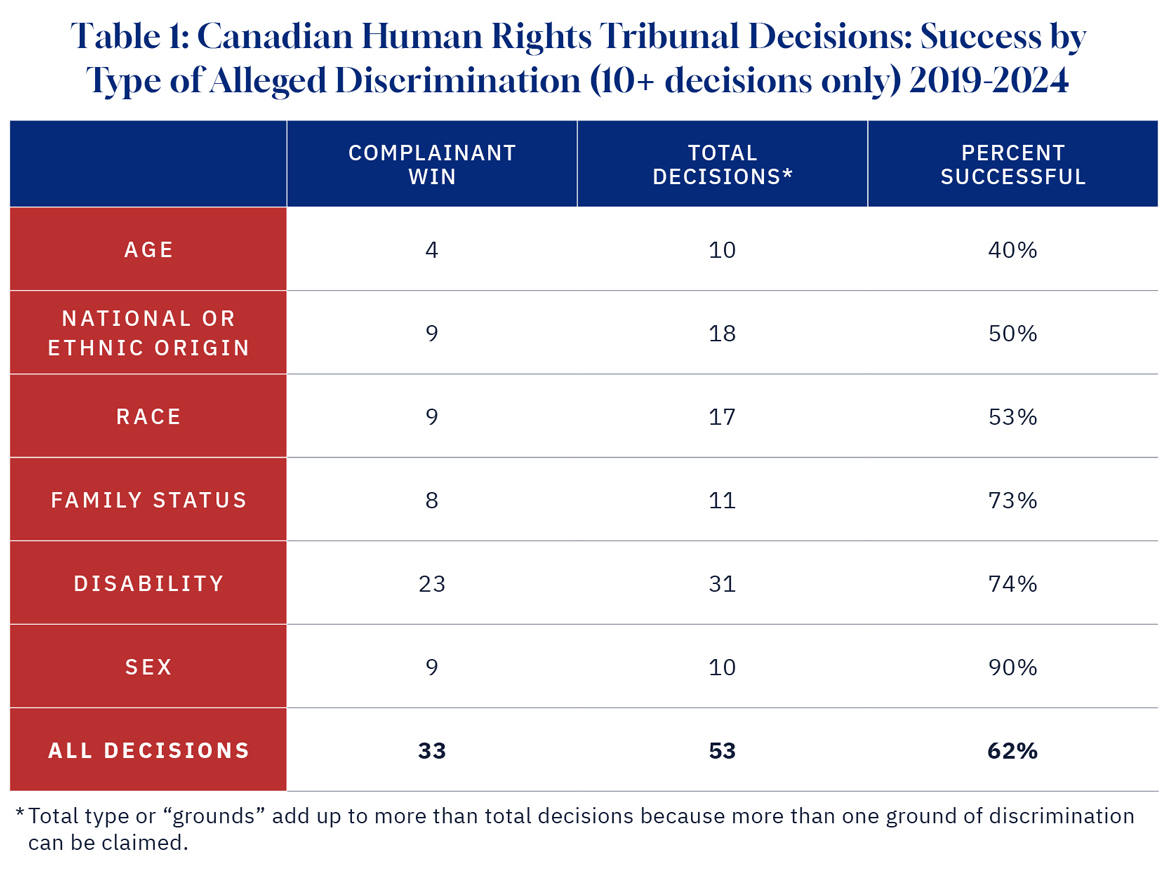
Table 1 shows an overall success rate of 62 percent. It also shows the win rate for each type or “ground” of discrimination that appeared in at least ten decisions.

Graphic credit: Janice Nelson. 

I found that complaints alleging age-based discrimination—all but one of which were based on old age —were least likely to be successful (40 percent win rate). Complaints involving discrimination based on race (53 percent) and national or ethnic origin (50 percent) also had a lower-than-average success rate.

By contrast, complainants alleging sex-based discrimination or harassment were the most successful (90 percent). Nine of the 10 complainants alleging sex-based discrimination and or harassment were women. Eight of those nine were successful.

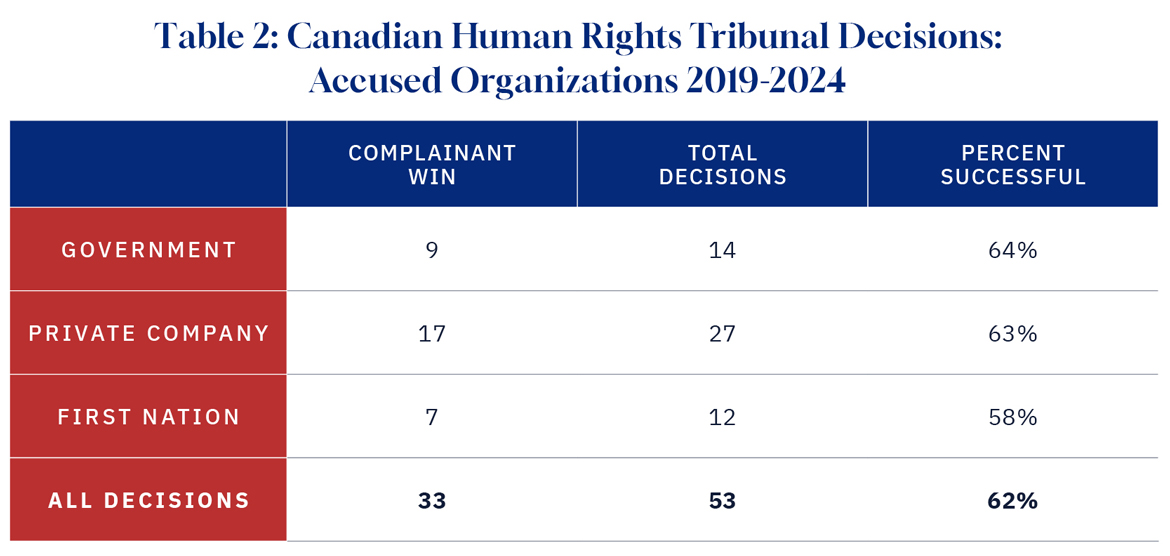
Table 2 organizes the 53 decisions according to the three types of “respondents,” or the organizations accused of harassment or discrimination: federal government entities (including federal departments, Crown corporations, the RCMP, and the City of Ottawa); private companies in federally-regulated industries (transportation, aviation, marine, rail, banking, and telecoms); and First Nations. There was minimal variation in success rates by the type of respondent, with complainants slightly less successful against First Nations (58 percent win rate) than against governments (64 percent) and private companies (63 percent).

Graphic credit: Janice Nelson. 

Given the controversy over the incoming chief of the Canadian Human Rights Commission, I also sought to explore decisions in which Jewish complainants alleged antisemitic discrimination, whether on the grounds of religion or national or ethnic origin.

What I found was that there were no such decisions. The words “Jew,” “Zion,” “Zionist,” and “antisemitic” do not appear in any of the tribunal’s 63 decisions from 2019-2024. The word “Jewish” only occurs in four procedural rulings. Three were from an identically-worded sentence in procedural rulings describing an ongoing case involving an inmate who “self-identifies as an Indigenous, Jewish, Two-Spirit transfeminine woman”. The fourth was found in an interim ruling for a Muslim inmate. He had complained that Correctional Service Canada “provided a religious diet for Jewish inmates, but not a diet for [him] that would accommodate his Muslim beliefs and his health issues.”

It is worth noting how infrequent claims of religious discrimination are. Only two of 53 decisions involved religious discrimination, and in both cases the complainants also alleged discrimination on other grounds. Both complainants were successful.

Conclusions

Federal human rights institutions are under the political microscope, and for good reason. The Canadian Human Rights Commission claims“We must all call out antisemitism” but its incoming leader (expected to take up his post this week) once posted that “Palestinians are Warsaw Ghetto Prisoners of today.” Its website proudly displays a section on “Anti-racism work” yet it has been publicly admonished for its own alleged anti-black racism.

Meanwhile, as I have demonstrated through my investigation, the Canadian Human Rights Tribunal appears unprepared to deal with the influx of complaints about online hate speech for which it will be responsible if the Online Harms Act passes.

Based on my research, I draw three main conclusions. First, the tribunal simply does not issue many decisions. It only issued 63 decisions over the last five-and-a-half years, 10 of which did not involve a formal evaluation of discrimination or harassment. The fact that the tribunal also issued 260 procedural rulings during the same period further suggests its existing hearings are often slowed down by procedural issues.

Second, the few decisions the tribunal does render are fundamentally different than what it would decide under the Online Harms Act. More than one in five decisions (12 of 53) involved truck drivers or trucking companies. The same number(12 of 53) involved allegations of discriminatory conduct by First Nations, such as when a non-Indigenous woman alleged discrimination for being fired from a First Nation-owned bowling alley (she lost). Cases of discrimination involving religion, gender identity, and sexual orientation are virtually nonexistent. The term “hate speech” occurred precisely once in a single decision over the last five-plus years. Not a single decision involved a Jewish complainant and only one involved a Muslim. This is not an organization prepared to adjudicate hateful content over the entire internet.

Third, it appears the Online Harms Act is yet another example of the Trudeau government asserting federal authority where provinces are likely better suited to govern. Because they deal with most forms of employment discrimination, provincial human rights commissions and tribunals have a far wider scope of jurisdiction than the federal tribunal does. Provincial human rights codes already deal with discriminatory speech, and the B.C. Human Rights Commission has even recently argued that the B.C. tribunal has jurisdiction over online speech as well. There is no inherent reason that the responsibility for determining online hate should be done by an entirely new and costlylayer of federal bureaucracy, particularly given the existing institutional capacity at provincial commissions and tribunals.

To be clear, I am not suggesting that provincial human rights tribunals ought to be given the sweeping powers contemplated by the Online Harms ActOthers have convincingly shown that the bill likely violatesCharter rights, and will chill “legitimate expression by the mere spectre of a complaint.” I am simply arguing that there are additional procedural reasons to be concerned about the institutional venues through which that chilling will occur.

Adjudicating online hate speech under the Online Harms Act will require deft sensitivity to competing rights claims and societal interests, a tall order for any organization. Instead, the federal government is placing its hopes in the hands of institutions that lack both the moral authority and institutional capacity to do the job.

Source: Exploring Human Rights Tribunal decisions