RCMP surprised hate groups are “increasingly racially diverse”

Always interesting to see how organizations operationalize specific laws, regulations and policies. Pretty thorough information kit and their assessment is reasonable. One pet peeve, absolute numbers rather than numbers per thousand of people is less helpful in assessing the extent even if many hate crimes and incidents are not reported.

The RCMP is surprised that hate groups in Canada are recruiting racialized people and becoming increasingly ethnically diverse

In a report on hate crimes and incidents released this year, the RCMP noted about a notable shift in the racial diversity of individuals joining what it calls “hate groups.” 

The RCMP defines a “hate group” as any organization or collection of individuals “whose goals and activities attack or vilify an entire group of people on the basis of colour, race, religion, national or ethnic origin, age, sex, sexual orientation, gender identity or expression, or mental or physical disability.”

In its report, the RCMP blames the “rise of populist politics and the normalization of racist and incendiary political rhetoric” on the rise of said groups without pointing to specific examples.

The RCMP notes that while hate groups are still “overwhelmingly white and male” there’s been a recent shift in the demographic. 

True North reached out to the RCMP for comment but did not receive a response. 

“People who join hate groups come from all socioeconomic backgrounds, professions, and, perhaps surprisingly, they appear to be increasingly racially/ethnically diverse,” the report reads. 

“In recent years, some hate groups in the United States and Canada have actively recruited members from racialized groups in an attempt to soften their public image and bolster recruitment.”…

Source: RCMP surprised hate groups are “increasingly racially diverse”

Full report: Facts, Trends and Information for Frontline Police Officers

A new law will finally grant citizenship to ‘lost Canadians’. Are we ready for the consequences?

Good questions and the answer would appear to be no, judging by the lack of analysis of the possible impacts by the Minister. Like any changes in citizenship or immigration policies, persons can be expected to respond to any perceived incentives provided by the change and IRCC needs to present any analysis during parliamentary consideration of C-71, not the subsequent regulatory stage.

Past experience with responding to “lost Canadians” and expanding voting rights suggests that the number of “lost Canadians” who want to be “found” is small subset of the total expatriate population, particularly for those living in the USA. But given the increased diversity of Canadian expatriates, that may be changing:

Last week, faced with a court-imposed deadline, Immigration Minister Marc Miller introduced new legislation that would automatically give citizenship to people born outside of Canada to Canadian parents, as long as the parents have lived here for a cumulative 1,095 days before the child’s birth.

The legislation, Bill C-71, will correct the arbitrary creation of a generation of ”Lost Canadians”. Under the current Citizenship Act, subject to a few notable exceptions, a person born outside of Canada would only be a Canadian citizen if their parents were either born in Canada, or naturalized in Canada. If their parents were born outside of Canada and became a Canadian citizen through their own parents, they did not qualify for Canadian citizenship by descent.

A particular blind spot was border babies. For example, a mother in Point Roberts, Wash., may give birth in British Columbia, while a mother in Emerson, Man., might give birth in North Dakota, simply because it is the nearest hospital to her. If those mothers were born outside of Canada, their babies would not have had automatic Canadian citizenship. 

Unlike their Canadian counterparts, however, American parents in border communities do not have to worry about where they themselves were born. Under U.S. citizenship law, if either parent meets the prescribed residency requirements (five years with at least two years after the age of 14), their child will be American. While there is some disagreement with Canada’s adoption of a less burdensome cumulative 1,095 day rule, we see it as similar to the American law. Both legislation mirror the residency requirement for naturalization and ensure a substantial connection to the country is met.

While advocates are rightly celebrating this “monumental” change for cross-border families, as immigration lawyers we have mixed feelings in light of the current political environment. Will the Canadian public “open their arms” towards the potentially untold number of U.S. residents who can now claim Canadian citizenship?

Removing outdated values and addressing historic wrongs in citizenship law

As the Senate argued in 2007, the current Citizenship Act relies on past legislation, which was built on outdated values. For example, gender and marital status played a major role in determining who was or wasn’t Canadian. Bill C-71 is likely to be the first legislation that does not consider gender or marital status.

Bill C-71 also addresses racial discrimination in the Citizenship Act. Bill C-71, would for example rightfully restore citizenship to the descendants of Japanese-Canadians, who were interned and deported during the Second World War.

Bill C-71 would also restore citizenship to those who lost it because they did know they had to meet retention requirements by their 28th birthday

These changes are long overdue. The Citizenship Act historic issues were first identified by the Supreme Court of Canada in 1997.

All these above changes are positive as they add greater coherence to the law, bridging past shortcomings with a forward-looking lens to safeguarding Canadian citizenship.

Encouraging Canadians to Return to Home

Bill C-71 could play a role in encouraging Canadian families with young children born abroad to return home. A government study found that over half of Canadians abroad are citizens by descent. Bill C-71 would allow these families to avoid the difficult processes for sponsoring their children as permanent residents because they would automatically become Canadian citizens.

It is also important to contextualize that the citizenship rules that created “Lost Canadians” was itself the product of resistance within Canada to recognizing citizens abroad attempting to return home — in particular, a public backlash to the government evacuating Canadian citizens from Lebanon in 2006. It’s important to recognize that this new legislation comes at a time when anti-immigration sentiment is on the rise and to interrogate the 180-degree motivation shift.

While much of the support for these changes has come from U.S. cross border families, we have noticed the brunt of the online discussion about the potential law change surrounding Asian birth tourism and allegations of elaborate family schemes for descendants to claim a right to Canadian citizenship.

The reality is the flood gates might open to more Canadian citizens — but the bulk will not come from Asia. Based on our reading of this current bill, anyone who descends from a person that was born or naturalized in Canada before this bill comes into force would qualify for Canadian citizenship and the vast majority of those people are American.

This can be supported not just by anecdotal data from our own practices, but also statistics. According to the Vermont Historical Society, 20 per cent New Englanders are of French Canadian descent. This is only descended from French Canadians; The fact is we do not know how many Canadians of descent live in the United States.

Considering the more affordable post-secondary tuition in Canada for citizens (including those by descent), and our more generous social programs, such as publicly funded health care, this may become a pull factor for Americans, both young and old, to claim Canadian citizenship — in fact one of the reasons Americans claim their Canadian citizenship.

Our recommendation is that, notwithstanding political pressure to possibly pass this bill quickly, the government takes a collaborative approach that consensus-builds, not consensus-divides on the topic of citizenship. Future work must centre both ameliorating historical wrong but also strengthening a conception of Canadian citizenship that reflects modern day transnationalism beyond unpredictable shifts in domestic political values.

This process may result in amendments that impose some limits, or add additional residence obligations for Canadian citizenship, but it is one we hope will give Canada coherent and predictable legislation on who is a Canadian citizen.

Amandeep Hayer and Will Tao are immigration lawyers based in British Columbia.

Source: A new law will finally grant citizenship to ‘lost Canadians’. Are we ready for the consequences?

Christopher Dummitt: Four ways Pierre Poilievre and the Conservatives can fight woke ideology 

Suspect some of these ideas are being seriously considered by the Conservative Party in planning for a likely change in government. In an ideal sense, this would lead to a new thesis, anti-thesis and synthesis, reversing some of the excesses of the current government while recognizing that greater attention to diversity and inclusion issues was needed to address representation and other gaps.

However, it is more likely that the temptation will be to wade into such “cultural war” virtue signalling given its appeal to their base and the lesser importance of these issues to Canadians compared to housing, healthcare, infrastructure, foreign interference etc. Checking and rating candidates for political viewpoints raises any number of issues whether with respect to right or left-wing views.

But Kaufmann and Dummitt should know better the risks of simply replacing one dominant ideological tendency with another rather. Interesting that they choose that approach rather than arguing for a “merit-based” or more balanced approach., suggesting the intent is as much ideological than arguing for of …Kaufmann outlines a 12-point plan but I’ll simplify it to four points and a coda.

I have sympathy for the view that the pendulum has shifted too far and that a rebalancing is needed but not convinced that some of these ideas are workable or lead to an improved syntheses:

Insist on politically neutral institutions

Conservatives should take the high ground and insist on politically neutral institutions. In everything from the CBC/Radio Canada to university research funding and heritage institutions, the government should enshrine political neutrality. This means not disseminating politically divisive concepts like “white privilege” or claiming that psychological “harm” can override free speech.

Even though some conservatives might not agree, the BBC in the U.K. could be a model. I used to live in London and attend live tapings of topical radio comedy shows. For every joke they did about one political party or idea, they had to have another taking on the other side. It was sometimes over the top—certainly, the comedians poked fun at it—but the emphatic insistence on equal treatment mattered. Right up and down the public service, a new conservative government should insist on politically neutral institutions and the end of spreading woke ideas “on the sly” through the seemingly neutral dissemination of leftist ideas. If an overwhelming majority of the public accepts these ideas—only then should they be taken up by public institutions.

Redo DEI to include political viewpoints

Kaufmann thinks that while it might be tempting to get rid of DEI this probably isn’t feasible. What is possible is to insist that it be done right. Any institution that wants to hire based on categories of identity must include political viewpoint as an equity category. Many of our institutions, especially but not only universities, are now left-wing monoliths. A Conservative government should insist that this obvious lack of diversity be tackled right alongside other issues.

A Conservative government should also insist that DEI be done accurately. That is, it can’t be done by comparing the share of a certain group’s place in a profession, like engineering, with their share in the general population. It should instead be based on that group’s share in the applicant pool. We should try to identify where the problem arises. Are discrepancies happening because of actual discrimination in hiring or are there just not enough applicants? If there aren’t enough applicants, deal with that problem (if indeed it is a problem). We shouldn’t expect every group’s share of the population to be exactly replicated in every field of work. Only if we have evidence of discrimination should discriminatory hiring quotas be implemented.

Focus on national belonging

Different groups of Canadians will find different parts of the Canadian story more meaningful. Maritimers will likely be more interested in our seafaring heritage. African Canadians might take more pride in Canada’s place as one part of the Underground Railroad (though others will of course be fascinated too). But our national heritage institutions should stop focusing on what divides us and instead embrace what brings us together.i

It doesn’t mean overlooking our blind spots. However, it does mean interpreting them correctly. A Conservative government should insist that those dark places in the Canadian record be considered from a global perspective. We should get rid of woke parochialism which exclusively focuses on Canadian and Western sins. When dealing with issues like colonialism and violence, heritage institutions must be made to interpret these parts of our history in line with the existence of worldwide non-Western forms of slavery, imperialism, and violence including among pre-contact Indigenous peoples.

This means embracing a “retain and explain” cultural policy where the assumption should be that names, statues, and other honorifics are retained except in very exceptional circumstances. What’s more, explanations cannot be one-sided accounts but must interpret figures and events within their global context.

 Remember it’s about the people

Given that so many of our institutions have been taken over by woke activists and their liberal sympathizers, a new Conservative government should make it a priority to restaff the boards and institutions to achieve political diversity. Time and again, conservative governments are stymied because the actual people in the public service align with non-conservative beliefs. This means working on two fronts.

First, find and appoint non-woke political candidates to cultural and public service institutions across the country. The goal is political balance. Second, and this is where Kaufmann really focuses, conservatives need to build pipelines to ensure that when a government goes looking for people, they can find qualified and trained individuals. This means creating a Federalist Society for the public service—the equivalent of that highly influential American conservative legal organization that funnels law students and ideas into the American legal system. Similarly, we need an Austrian School for culture—a conduit for woke-critical ideas in our university world that can generate an idea base that can serve as the cultural equivalent to what the Austrian School did for economic liberalism.

Coda

Finally, a coda. All of the above will help and can be put into action. But Kaufmann also has one final and important bit of advice that can be done right now. Stop using the woke language. Rip off the velvet glove and expose the radioactive illiberalism that lies beneath.

This means insisting on using evocative words and images. Unless there is specific evidence that a particular institution has been discriminatory, when that institution hires based on DEI quotas this should be called out for what it is: anti-White or anti-Asian or anti-male or anti-heterosexual prejudice. Unmask the language of equity to show the discriminatory and vengeful impulse at its heart.

Don’t accept the language of “gender-affirming” care when we are talking about giving adolescents drugs that might chemically castrate them. When people want to bind young girls’ breasts or surgically remove them, describe it for what it is: gender-based violence. Use vivid imagery like pictures of the outsized prosthetic breasts of the Toronto area teacher who caused such controversy recently. Canadians support liberal non-discrimination. They want a country that accepts all its citizens. But they also can smell when something is foul and conservatives need to be sufficiently brave and clear to point out when woke ideas are illiberal.

What all of this means is that modern social conservatism can look a lot different from the Liberal attack-ad caricature. A new Conservative government could stand for policies that treat all Canadians equally, could enshrine politically neutral public institutions, and could show pride in our national history and culture. These aren’t just defensible shield issues; they are worth going on the attack to promote.

Source: Christopher Dummitt: Four ways Pierre Poilievre and the Conservatives can fight woke ideology

J.J. McCullough: How you’re supposed to talk about immigration in Canada—and how Poilievre is poised to capitalize 

Another late to the party commentary.

I agree, however, that the Conservatives have greater licence to engage in immigration policy, not only because of the various commentary noting the need for a more measured approach but also because the Liberal government has largely accepted (or ceded) the arguments and is walking back some of its more ill-advised policies.

And even the Century Initiative appears to be flailing around, trying to remain relevant, when their fundamental premises are largely discredited:

…All this puts the Conservatives under Pierre Poilievre in an interesting position. The Canadian press, and thinky class more generally, has created a permission structure for him to run for prime minister on a platform of reducing immigration without fear of being characterized as a racist fearmonger. Polls suggest over 60 percent of Canadians both want and expect him to do this. Yet Poilievree himself has so far avoided articulating the extent to which he agrees; at his tightly scripted rallies he has no standard immigration-related applause line.

It’s possible his party is still captive to the legends of the Harper years—that they believe immigrant voters are “their” constituency to lose, and Conservatives must therefore tread lightly on rhetoric that could be seen as anti-immigrant. Despite a clearly changing tone in media coverage, the party might also simply not trust the press to accurately characterize a restrictionist Conservative immigration plan, and thus feel there’s no PR incentive to spend much time talking about the issue when they’re already enjoying such a solid lead in the polls.

Or, and perhaps most likely, Poilievre simply wants a restrictionist immigration agenda to be something he can roll out at a more politically opportune time—closer to the official fall 2025 election campaign when Canadians will be paying the most attention, and will be most aware of his promises.

Yesterday’s political taboo could be tomorrow’s ace in the hole.

Source: J.J. McCullough: How you’re supposed to talk about immigration in Canada—and how Poilievre is poised to capitalize

StatsCan: Recent immigrants report greater difficulty making ends meet and are less satisfied with their amount of free time

Of note (albeit not surprising):

According to the most recent data from the Survey Series on People and their Communities (SSPC), in April 2024, slightly over 3 in 10 Canadians (31%) found it difficult to meet their financial needs in terms of transportation, housing, food, clothing and other necessary expenses in the past 12 months. During this period of higher living costs, Canadians may also need to work more hours to make ends meet. Indeed, about one-third (31%) of Canadians reported having a high level of satisfaction with the amount of free time they had to do the things they like.

Not all individuals are experiencing this period of economic contraction equally. Recent immigrants, for example, often report experiencing income-related challenges, which may affect their level of satisfaction with free time. Canada has admitted record numbers of immigrants in recent years, and to better understand the experiences of recent immigrants, this release presents an analysis using the April 2024 wave of the SSPC: Social Cohesion and Experiences with Discrimination.

Recent immigrants report having greater difficulty meeting their financial needs during the past 12 months

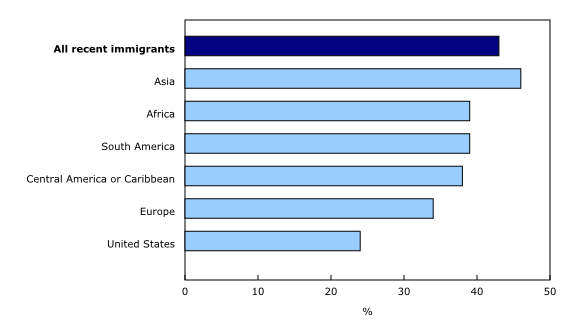
Recent immigrants (defined in this release as those admitted in 2005 or after) often face unique economic challenges in adapting to a new country and were more likely to report having greater difficulty in making ends meet. Specifically, in April 2024, a larger proportion of recent immigrants (43%) reported finding it difficult or very difficult to meet their financial needs over the past 12 months, compared with more established immigrants (29%) and non-immigrants (29%). Similarly, non-permanent residents were more likely to report finding it difficult or very difficult to make ends meet (37%) than non-immigrants.

Not all immigrants share the same economic experiences when arriving in Canada. In April 2024, while newcomers from the United States (24%) and Europe (34%) were the least likely to report experiencing financial difficulty in the past 12 months, newcomers from other regions were more likely to experience hardship during this transition. In general, newcomers arriving from Asia (46%) reported having the highest level of difficulty making ends meet. Some of these differences may be related to category of admission, which was not considered in this study.

Chart 1 
Percentage of recent immigrants (arriving since 2005) who reported having difficulty meeting financial needs over the past 12 months, by region or country of birth, Canada, April 2024

Chart 1: Percentage of recent immigrants (arriving since 2005) who reported having difficulty meeting financial needs over the past 12 months, by region or country of birth, Canada, April 2024

Racialized Canadians, especially racialized immigrants, are more likely to report experiencing financial difficulty 

Previous studies have shown that racialized Canadians may face greater economic uncertainty and, therefore, may have a more difficult time meeting their financial needs than non-racialized Canadians. In April 2024, West Asian (48%), South Asian (43%), Latin American (42%), Black (40%), Arab (38%) and Filipino (35%) Canadians were more likely to report having difficulty meeting their financial needs in the past 12 months than the non-racialized, non-Indigenous population (28%). In contrast, Chinese Canadians (22%) were the least likely to report experiencing financial difficulty in the past 12 months. 

Most of these observed differences are related to also being an immigrant. In April 2024, most Canadian-born racialized people reported having a similar experience as Canadian-born non-racialized people in Canada. For example, 28% of South Asian people born in Canada reported having difficulty making ends meet, the same proportion as the non-racialized, non-Indigenous population. However, nearly half (47%) of South Asian immigrants reported having difficulty making ends meet in the past 12 months. These results highlight the importance of understanding financial difficulty through a lens of intersectional identities, including experiences of immigration. 

Recent immigrants are less likely to report having satisfaction with their amount of free time

Economic challenges may lead to work-life balance conflicts, if workers need to work more hours, and potentially reduced satisfaction with the amount of free time available. As of spring 2024, 40% of Canadians who did not report having difficulty making ends meet also reported having a high level of satisfaction with their amount of free time. However, 12% of people who experienced difficulty making ends meet in the past 12 months reported having a similar level of satisfaction. 

In April 2024, more recent immigrants to Canada reported having lower satisfaction with their amount of free time than immigrants who had arrived earlier and non-immigrants. In fact, 23% of recent immigrants said that that they had a high level of satisfaction with their amount of free time, compared with 33% of more established immigrants and 32% of non-immigrants. About 27% of non-permanent residents reported having high satisfaction with their amount of free time.

Not all newcomer groups experienced similar levels of satisfaction with their amount of free time. For instance, in April 2024, newcomers from Asia were the most likely to report having financial difficulty and were one of the least likely to report having satisfaction with their free time (22%). In contrast, despite being the least likely to report experiencing financial difficulty, recent immigrants from Europe were among the least likely to report having a high level of satisfaction with their free time, at 20%. 

Further, in April 2024, recent immigrants from the United States (32%) were as likely to report having high satisfaction with their amount of free time as non-immigrants. These results indicate that satisfaction with amount of free time may depend on many other factors that were not measured by this study, including work-life balance, cultural perception of free time, family structure and supports, and personal outlook. 

Source: Recent immigrants report greater difficulty making ends meet and are less satisfied with their amount of free time

IRCC introduces interim measure allowing some foreign nationals to gain Canadian citizenship faster

Pending legislative approval of C-71, the tabled bill that essentially abolishes the first generation limit, and responding to the timeline of the court.

IRCC’s new measure applies to those who have applied for proof of citizenshipunder urgent processing, and may be impacted by the FGL (First Generation Limit) by descent. Specifically, it will apply in either of the following scenarios:

  • Scenario One: The applicant has submitted a proof of citizenship application that would be subject to the FGL rule change, and has requested urgent processing in accordance with urgent processing criteria; or
  • Scenario Two: The applicant has a proof of application in process and IRCC has identified that the application is impacted by the FGL rule. The application had previously been de-prioritized until new rules come into effect, but the applicant has since requested urgent processing.

In both of these circumstances IRCC will respond to and review the request, in addition to verifying an applicant’s eligibility for urgent processing.

If an applicant is eligible, they will receive a notice from IRCC that the FGL rule is still currently enforced. The department will also give eligible applicants the option to request a “discretionary grant of citizenship”* with relevant information for how to apply for this grant.

If an applicant chooses to apply for this grant, their application will be processed by the Immigration Minister, or delegated decision maker. If the application satisfies necessary criteria, applicants can be granted citizenship.

*The Immigration Minister has the authority under Canadian law to grant citizenship to individuals in special or exceptional cases.

Who is eligible for urgent processing?

IRCC allows three groups of citizenship certificate (a crucial document in proving one’s Canadian citizenship) applicants to apply for urgent processing.

To be eligible for urgent processing of a citizenship certificate, applicants are required to prove they need urgent processing for one of the following three reasons:

  • The applicant needs to access benefits, including but not limited to: a pension, health care, or their Social Insurance Number (SIN)
  • The applicant needs to prove they are a Canadian citizen to get a job
  • The applicant needs to travel to or from Canada due to a death or serious illness in their family

Note: IRCC clarifies that the department cannot guarantee applicants will receive their citizenship certificate on time, even if they qualify for urgent processing.

Source: IRCC introduces interim measure allowing some foreign nationals to gain Canadian citizenship faster

What struck my attention when away

Immigration

Century Initiative’s 100 million population goal by year 2100 was meant to be provocative – and isn’t a target – CEO says

Appears to be flailing around given that their fundamental arguments appear to have failed:

Ms. Lalande said the 100 million population goal for 2100 “was meant to be provocative and bold” and to “spark an economic recharge.” The ultimate objective isn’t to see a specific population number by 2100, she said, but for Canada to be strategic and thoughtful in planning for growth.

“We don’t believe that growth should happen at all costs,” she said, saying the 100 million figure “was meant to galvanize the conversation and to spark debate and discussion of what the country could be and how we need to get there.”

But she warned against curtailing immigration, saying “that approach would result in an aging, less-skilled work force, less foreign investment, less diversity and less influence” globally.

Source: Century Initiative’s 100 million population goal by year 2100 was meant to be provocative – and isn’t a target – CEO says

Government criticized for limiting immigration sponsorships to four-year-old list

Never possible to satisfy demand:

Immigrants who came to Canada with the hope that their parents or grandparents could one day join them say they feel cheated after the federal government opened a sponsorship lottery this month drawing from a four-year-old list of applicants.

They are upset because Ottawa decided to allow around 30,000 sponsorships this year, but excluded applicants from joining the program if they had not registered an interest in 2020.

Some told The Globe and Mail that if they can’t successfully sponsor their relatives at some point, they may have to leave this country themselves to take care of them.

Immigration, Refugees and Citizenship Canada (IRCC) is sending out 35,700 randomly selected invitations to Canadian citizens and permanent residents to apply for the Parents and Grandparents Program (PGP).

The invitations are drawn from a list of 200,000 people who expressed an interest in sponsoring their relatives in 2020.

Not everyone who receives an invitation to apply will submit a PGP application; however, IRCC said it ultimately expects around 32,000 grandparents and parents to qualify for permanent residence….

Source: Government criticized for limiting immigration sponsorships to four-year-old list

Caregivers from abroad to be given permanent residence on arrival under new pilot programs

Of note, addressing some past concerns:

The pilots, which are enhanced versions of two programs set to expire on June 17, will put qualified nannies, child-care and home-support workers on a fast track to settling in Canada.

Caregivers working for organizations that provide temporary or part-time care for people who are semi-independent or recovering from an injury or illness will also qualify under the new programs, which Immigration, Refugees and Citizenship Canada (IRCC) said will later become permanent.

Canada will admit more than 15,000 caregivers as permanent residents in the next two years, as part of Canada’s overall immigration targets, according to IRCC.

“Caregivers play a critical role in supporting Canadian families, and our programs need to reflect their invaluable contributions,” Mr. Miller said in a statement….

Source: Caregivers from abroad to be given permanent residence on arrival under new pilot programs

Canada needs an Immigrant Bill of Rights

Hard to see how adding another layer will necessarily improve processing and client service compared to addressing systemic issues:

This is why in a new report entitled Let’s Clean Up Our Act, the Canadian Immigration Lawyers Association (CILA) encourages the federal government to introduce an Immigrant Bill of Rights to provide newcomers with greater protection and an enhanced experience. 

We also believe the Immigrant Bill of Rights should be complemented by introducing an Ombudsperson for Immigration, Refugees, and Citizenship Canada (IRCC), and the Canada Border Services Agency (CBSA). 

These recommendations are far from novel or controversial.  

Numerous federal departments and agencies already have a bill of rights and/or ombudspersons.  

Source: Canada needs an Immigrant Bill of Rights

Tasha Kheiriddin: Brace for a possible tsunami of illegal migrants if Trump is re-elected

So almost a dedicated stream and pathway to citizenship? But that would require Canadian residency for at least three years, not “just being on our side:”

So what can Canada do that is positive? Apart from planning for these specific eventualities, Heyman suggests that we process as many Americans as possible for the equivalent of an American H1 Visa to Canada — not necessarily to live here, but to have a Canadian passport in their pocket and advocate for our country south of the border. “You’ve got a generational opportunity to get the top talent, people with means and skills, on your side — and possibly into your country,” Heyman said. A silver lining, perhaps, but the tsunami still looms.

Source: Tasha Kheiriddin: Brace for a possible tsunami of illegal migrants if Trump is re-elected

Rioux | «It’s the immigration, stupid!»

On the results and aftermath of the European Parliament elections and the political shakeout in France:

Son coup de tête a déjà provoqué le rassemblement de la gauche autour de son aile la plus radicale (La France insoumise) qui se complaît dans une forme de romantisme révolutionnaire flirtant avec l’antisémitisme et les appels à la violence. À droite, il a accéléré l’éclatement des Républicains, dont les jours étaient comptés, au profit d’un RN portant certes des revendications partagées par la majorité des Français, mais sans expérience ni cadres chevronnés et dont le programme économique est pour le moins boiteux.

Derrière l’apparence du combat des extrêmes, ne serions-nous pas en train de découvrir le nouveau visage de ce que sont tout simplement devenues, après une période d’effacement, la gauche et la droite ? Pour le dire simplement, la nouvelle gauche est aujourd’hui plutôt multiculturelle, wokiste et décoloniale. La nouvelle droite, plutôt nationaliste, souverainiste et conservatrice.

Dans la fureur et le chaos, nous assistons non seulement au retour de l’opposition entre droite et gauche, mais peut-être aussi de l’alternance sans laquelle aucune démocratie ne saurait survivre.

Source: Chronique | «It’s the immigration, stupid!»

Antisemitism, Israel Hamas war

Abella: What happened to the legacy of Nuremberg and the liberal democratic values we fought the Second World War to protect?

Well worth reading:

To paraphrase Martin Luther King, the arc of the moral universe may be long, but it does not always bend towards justice. And that means that too many children will never get to grow up, period – let alone in a moral universe that bends toward justice and the just rule of law.

I used to see the arc of my own life bending assertively from Nuremberg to ever-widening spheres of justice, but in this unrelenting climate of hate, I feel the hopeful arc turning into a menacing circle.

We need to stop yelling at each other and start listening, so that we can reclaim ownership of the compassionate liberal democratic values we fought the Second World War to protect, and to put humanity back in charge by replacing global hate with global hope.

My life started in a country where there had been no democracy, no rights, no justice. It instilled a passionate belief in me that those of us lucky enough to be alive and free have a particular duty to our children to do everything possible to make the world safer for them than it was for their parents and grandparents, so that all children, regardless of race, religion or gender, can wear their identities with pride, in dignity, and in peace.

Source: What happened to the legacy of Nuremberg and the liberal democratic values we fought the Second World War to protect?

Regg Cohn: Doug Ford isn’t the only one who has fumbled on antisemitism

Also well worth reading by those who have no answers to these questions:

To be sure, critics of Israel — of which I am one — are not necessarily anti-Israeli (or anti-Jewish). But a good many are so adamantly opposed to the existence of the state of Israel, for reasons of history or bigotry, that you have to ask:

Where would those millions of Jews go? Back to Poland, as some like to taunt? Here to Canada, where they feel increasingly besieged? Stay where they are in a single state where “Palestine shall be free, from the river to the sea,” subsuming and consuming the Jewish state?

Israel is guilty of many sins during its long decades of occupation, although neither side is blameless about missed opportunities. After the Oct. 7 Hamas massacre of more than 1,200 Jews and the taking of hostages, Israel’s overreaction and overreach transformed a just war of defence into a war without justifiable limits.

Source: Doug Ford isn’t the only one who has fumbled on antisemitism

Lederman: The banning of an Israeli-American graphic novelist shows how some arts organizations are rushing to judgment

Exclusion is not the answer except in extreme cases where it crosses into hate speech:

With Israel and Hamas at war, there has been so much screaming at one another, across a widening divide. What could be accomplished by having actual conversations?

This isn’t the only instance of selective targeting of Israeli, Jewish or Palestinian artists by arts organizations. With festival and awards season approaching in the fall, there is reason to fear more exclusions to come.

Source: The banning of an Israeli-American graphic novelist shows how some arts organizations are rushing to judgment

Citizenship

Mansour: Citizenship in the Multicultural State

Interesting evolution by Mansour compared to his earlier writings:

In conclusion, it might be said that the generation of 1968 was a pioneer generation in the making of a new political agenda that goes beyond the attachment to the state of which a citizen is a member. Canada has contributed to this agenda, internationalist and multicultural, through the social changes that have occurred in the years since its centenary anniversary. As a result, Canadians are in the midst of emerging new sensibilities that are more open to the world, more receptive of other cultures, more inclined to accepting international law and adjusting domestic statutes to that requirement. These changes render older political arrangements less meaningful in the twenty-first century.

Source: Citizenship in the Multicultural State

Foreign interference

Three article of interest of foreign interference and the shameful “witting” involvement of some MPs

‘Witting’ involvement changes the nature of foreign interference

NSICOP doesn’t name the parliamentarians who are witting participants in foreign interference. It raises a question about parliamentarians. It calls on the government to brief MPs about interference – and warns MPs to “reduce their vulnerabilities.”

And once again, it is another report telling the public that the Canadian government has not done enough to counter the threat of foreign interference. If anything, those warnings have grown louder.

This time, what a committee of parliamentarians has told us in clearer terms than ever is that the threat of interference from abroad includes participants here in Canada, inside Parliament, who have something to gain from dealing with foreign actors.

Source: ‘Witting’ involvement changes the nature of foreign interference

Coyne: We need to know the names of the traitor MPs, but don’t count on any of the parties to give them up

The Liberals’ tactic of deny, delay and deflect – first denying the allegations, then, when they can no longer be denied, denying they matter – has proved largely successful. Polls show that foreign interference ranks low on the public’s list of important issues. The Opposition is likely to take the hint. It was to their advantage to demand a public inquiry, so long as the government refused – and so long as they could be assured its findings would only stick to the government. But now? What’s in it for them?

For that matter, the same might apply to certain sections of the media: The report refers to Chinese officials “interfering with Canadian media content via direct engagement with Canadian media executives and journalists,” while a redacted passage cites “examples of the PRC paying to publish media articles without attribution.”

So if none of the parties is keen on turning over this rock, if law enforcement are unwilling and the media nervous – Mr. Dong’s lawsuit against Global News will have had a useful chilling effect – then the betting proposition has to be that nothing will happen. None of the MPs involved will be prosecuted, or named, or face consequences of any kind. And the public will shrug. Experience has taught them that, in this country, nobody ever faces consequences for this kind of thing.

Unless … unless a lone MP stands up in the House and names the names.

Source: We need to know the names of the traitor MPs, but don’t count on any of the parties to give them up

Yakabuski | L’ingérence étrangère et l’indifférence libérale

Tout au plus, la vice-première ministre, Chrystia Freeland, a-t-elle promis que les libéraux effectueraient « un suivi interne » dans la foulée du rapport. Comme son collègue à la Sécurité publique, elle n’a pas semblé désireuse d’aller au fond des choses. Est-ce parce que le caucus libéral compte beaucoup de députés issus des communautés culturelles qui entretiennent des relations étroites avec les représentants au Canada des gouvernements de leurs pays d’origine ? Certains de ces députés craignent, avec ou sans raison, une chasse aux sorcières dans la foulée du rapport McGuinty.

« La garantie que je peux donner aux Canadiens est que notre gouvernement prend très, très au sérieux l’ingérence étrangère », a réitéré cette semaine Mme Freeland. Or, la réaction du gouvernement au dernier rapport laisse, encore une fois, une impression contraire.

Source: Chronique | L’ingérence étrangère et l’indifférence libérale

Other

Hindutva ideology proved costly for India’s Narendra Modi

Of note:

The decade-long entrenchment of far-right ideologies in India, an over-focus on dividing Hindus and Muslims and on wealth generation for the rich eroded the country’s human rights record, judicial autonomy and press freedom.

That people with the least individual power were able to collectively push back against plans of the most powerful has rekindled the flame of democracy domestically and fanned hopes of resistance against tyranny globally.

Source: Hindutva ideology proved costly for India’s Narendra Modi

A Plea for Depth Over Dismissal

Agree:

To be clear, this article is not a plea for a return to scorecard history. Scorecard history is not a sound approach either. For, in the end, history is a qualitative discipline. Ranking prime ministers, or anyone else for that matter, is a silly exercise. Good deeds and bad deeds cannot be weighted and tallied up so that some final score can be determined. For that matter, categorizing deeds as good or bad in the first place flattens a great deal of complexity, like intentionality or unforeseen consequences, and it is precisely in that great universe of gray that real insights can be found. Insights into continuities between past and present, into how politics work in practice, and into the most accurate assessments of legacy. For the legacy of most leaders, much like the legacy of the policy of multiculturalism, will be neither entirely beneficial nor detrimental. But through a rigorous, nuanced, and deep examination of the lives and legacies of politicians and their policies, we stand to learn much about our country’s past – and its present too.

Daniel R. Meister is a Banting Postdoctoral Fellow in the Department of Political Science at the University of New Brunswick. He is the author of The Racial Mosaic (MQUP 2021).

Source: A Plea for Depth Over Dismissal
How diverse are Order of Canada appointments?

My latest analysis (for the charts, go to the IRPP link):

In the 2015 federal budget, the Harper government announcedadditional funding of $13.4 million over five years and $2.8 million in ongoing funding for the Canadian honours system.

The objective was to enhance inclusivity by increasing Order of Canada nominations from “under-represented sectors,” such as business, and regions, particularly the West.

The funding was prompted by an Ottawa Citizen analysis that showed only 26 per cent of recipients since the Order’s creation in 1967 came from the West, compared to its 31 per cent share of the population.

In contrast, Atlantic Canada, with 11 per cent of the population, had double the representation in recipients. The study also highlighted a growing proportion of awards going to individuals in the arts, while the share for business professionals had decreased.

Nine years later, has the desired shift occurred? Did the change in government later in 2015 influence the outcomes?

I evaluated that question by delving into an analysis of more than 2,000 Order of Canada appointments made between 2013 and 2023, examining regional, background and employment-equity perspectives.

Approximately three per cent of appointments are companions (the highest rank), 22 per cent are officers and nearly three-quarters are members (the lowest rank).

It is crucial to distinguish award and recognition programs from employer-employment equity initiatives and political appointments.

Employers, whether private or public sector, have considerable levers to increase diversity. Governments have considerable latitude in their appointments, as seen in the increased representation of women, racialized minorities and Indigenous Peoples under the Trudeau government.

Award and recognition programs, however, can’t do much more than encourage more nominations from underrepresented groups.

https://e.infogram.com/3383e710-d685-4697-8ae3-6a0acb642705?parent_url=https%3A%2F%2Fpolicyoptions.irpp.org%2Fmagazines%2Fjune-2024%2Fdiversity-order-canada%2F&src=embed#async_embed

Diversity

Figure 1 explores diversity through a lens of gender, racialized minority and Indigenous perspectives, comparing the average percentage of the awards given from 2013-17 and 2018-23 with the data from 2023.

There are fluctuations between the years for all groups, but the percentages of racialized minorities and Indigenous Peoples have trended upward, with a significant leap in 2023.

Racialized minorities, however, are still notably underrepresented relative to their population share, while the representation of Indigenous Peoples surpasses their demographic proportion.

Within the appointments of racialized minorities, women constitute 30 per cent, reflecting an increase to 32 from 27 per cent between 2013-17 and 2018-23.

In terms of Indigenous appointments, there is near gender parity but with a slight decline in the percentage of Indigenous women appointed, dropping to 45 from 52 per cent over the same period.

https://e.infogram.com/340c0bfc-a7d3-49d6-8812-4f2e6ae0e1b3?parent_url=https%3A%2F%2Fpolicyoptions.irpp.org%2Fmagazines%2Fjune-2024%2Fdiversity-order-canada%2F&src=embed#async_embed

Rank comparisons

Figure 2 presents a comparison of representation by rank. The proportion of women among companions declined notably between these two periods, whereas their representation among officers increased, along with a decrease in members.

In the case of racialized minorities, the share of companions decreased, but their representation among officers and members increased. Similarly, a shift is observed among Indigenous officers and members, marked by a significant increase in the number of Indigenous companions.

Traditional employment analysis involves assessing levels or ranks in Order of Canada terms and their corresponding representation. The conventional expectation is to observe higher representation at more junior levels, compared to senior positions. However, this general trend holds true only for women.

In contrast, there is a reversal of this pattern for Indigenous Peoples while racialized minority officers exhibit a higher percentage than members. This indicates a deliberate and conscious effort to appoint Indigenous Peoples to the more senior ranks, as illustrated in Table 1.

https://e.infogram.com/883c0f0b-2742-4cbe-b6ae-f276846ff2d0?parent_url=https%3A%2F%2Fpolicyoptions.irpp.org%2Fmagazines%2Fjune-2024%2Fdiversity-order-canada%2F&src=embed#async_embed

Promotions to the companion level constitute 43 per cent of all recipients. However, only 4.7 per cent of officer appointments are promotions from the member level.

https://e.infogram.com/b1f57efb-f250-4da5-9698-b8d446498158?parent_url=https%3A%2F%2Fpolicyoptions.irpp.org%2Fmagazines%2Fjune-2024%2Fdiversity-order-canada%2F&src=embed#async_embed

Regional representation

Figure 3 examines the regional balance. British Columbia appointments increased from 11.3 per cent (2013-17) to 13.3 per cent (2018-23), and Prairie appointments rose from 12.1 per cent to 14.7 per cent.

Conversely, Ontario appointments declined from 46.3 per cent to 43 per cent, and Quebec appointments decreased from 21.4 per cent to 19.7 per cent.

In 2023, British Columbia appointments exceeded B.C.’s share of the population, while the Prairies remained underrepresented. Quebec underrepresentation increased, while both Ontario and Atlantic Canada saw an increase in overrepresentation.

The North was slightly underrepresented. Recipients who spent part of their careers abroad accounted for slightly more than three per cent of all recipients.

https://e.infogram.com/0a683ec3-d5af-439c-a606-93a70b44561b?parent_url=https%3A%2F%2Fpolicyoptions.irpp.org%2Fmagazines%2Fjune-2024%2Fdiversity-order-canada%2F&src=embed#async_embed

Background of recipients

Figure 4 explores the diversity of backgrounds among Order of Canada recipients. Generally, backgrounds in the arts, health, business and public service dominate, with notable representation from individuals with academic, activist and scientific backgrounds.

The percentage of business-oriented recipients slightly declined. The same holds true for those with backgrounds in arts, academia and communications from 2013-17 to 2018-23. Conversely, there was an increase in individuals with backgrounds in health, activism, sports, science and philanthropy.

As for representation from the West, particularly the Prairies, there has been a small regional shift, likely reflecting an overall economic shift to Western Canada.

The Chancellery of Honours is responsible for overseeing the Governor General’s award programs. Chancellery staff met with me to discuss these findings. They also provided an update on efforts to improve representation.

The chancellery now has a statistician who tracks nominations and appointments and who validated this analysis.

This advisory council is reasonably diverse in terms of women, racialized minorities and Indigenous Peoples. The Governor General and staff make ongoing efforts to encourage nominations from underrepresented groups. Regrettably, they declined to provide data on nominations, though they did indicate that more women are appointed than nominated.

In terms of employment-equity groups — women, racialized minorities, and Indigenous Peoples — underrepresentation reflects the overall pattern of society as a whole, where relatively fewer people from these groups have prominent or senior positions.

That said, the increase in racialized minority and Indigenous appointments is notable, particularly in contrast with the stagnation of appointments of women, who make up about one-third of appointments.

Note on methodology

This analysis relies on the Order of Canada appointment lists released by the Governor General in June and December. Gender details are directly sourced from names and citations, while information regarding racialized minorities and Indigenous Peoples is obtained through a combination of names, citations and, when necessary, web searches.

Provincial data is extracted from the appointment lists, with a preference for the smaller province in cases where more than one is listed (although this is a rare occurrence).

Source: How diverse are Order of Canada appointments?

Executive Diversity within the Public Service: An Accelerating Trend 

My latest analysis, focussing on diversity among executives as well as an update on hirings, promotions and separations:

Source (behind firewall): Executive Diversity within the Public Service: An Accelerating Trend 

Blogging break for the next few weeks

Will, however, post some upcoming articles on Order of Canada appointments and on Diversity among the Executive Ranks.