Regg Cohn: Justin Trudeau’s point man says he’s ‘not naive’ as he tackles Canada’s surging immigration numbers

Good profile and assessment:

Marc Miller is doing what no other immigration minister has done in recent history.

He’s letting fewer temporary residents come to Canada in the short term. While planning for more immigrants in future.

Barely a year after taking over the immigration and refugee portfolio, Miller is steering a controversial course correction to avert an unplanned and unmanageable surge in temporary residents. By capping overseas student visas, and dialing down foreign work permits, he is reasserting control over uncontrolled trend lines.

Miller says Ottawa will set temporary resident targets

Immigration Minister Marc Miller announces that for the first time, Canada will set targets for the number of new temporary resident arrivals to the country. The federal government plans to decrease the number of temporary residents to five per cent of the population over the next three years, down from the current 6.2 per cent. (March 21, 2024)

Inaction is no solution, Miller told the Democracy Forum at Toronto Metropolitan University.

If he hadn’t stepped in, the country faced “exponential” growth and “exploitative” conditions for vulnerable foreigners, while exacerbating the affordability fallout from a crowded housing market.

“It’s undeniable that the volume has caused an impact on affordability,” he told me and our co-host, Anna Triandafyllidou, the Canada Excellence Research Chair in Migration and Integration at TMU (Disclosure: I’m also a senior fellow at TMU’s Dais, which sponsors the Democracy Forum).

Miller is mindful of business becoming “addicted” to the “pitfalls” of cheap foreign labour. He is also wary of post-secondary campuses becoming addled and distorted by foreign students who pay extortionary tuitions for substandard educations in partnership with private “puppy mills” — his preferred ministerial malapropism for so-called diploma mills.

The minister is unusually candid for a politician caught in the middle of competing interests and conflicting impulses, navigating the recent ups and downs of immigration policy. In his previous portfolio, Miller served as the prime minister’s point person on Indigenous issues; now as before, he helms a ministry of complexity that requires humanity — from the campuses of Ontario to the refugee camps of the world, while navigating rival political camps in Ottawa.

If he hadn’t acted, “uncapped, we were seeing potential increases of the student numbers … to 1.4 million next year.”

But these distortions didn’t come out of nowhere. He blames “systemic underfunding, particularly in Ontario, of post-secondary education.”

The fallout isn’t just affordability but asylum problems. When foreign students are squeezed for high tuition, living in cramped quarters and getting sometimes “crappy” degrees, they increasingly resort to refugee claims — 10,000 over the last three years.

“We were in the process of creating our own home-generated asylum crisis, largely within the responsibility of the provinces,” Miller argued. It was time, “after a number of warnings, for provinces to act, to take responsibility over their education system.”

Why did it take so long?

Ottawa will “step in if the provinces don’t assume that jurisdiction and clean up some of the mess in their own kitchen,” he warned.

The federal minister is clearly frustrated by Ontario’s inattention and inaction. And he is irritated by “garbage” suggestions from Ontario that it was blindsided by his two-year cap on new international permits.

“It simply isn’t accurate,” he shot back. “There were a number of warnings that were issued quite publicly by me, but also … privately through our officials.”

While balancing federal-provincial jurisdictions on student visas, Miller must juggle the demands of business interests to tackle labour shortages, while also navigating the roadblocks to resettlement of foreign refugees. Refugee and immigration policy, like Canada’s foreign policy, is often driven by domestic and diaspora interests.

Miller acknowledges a program to help Palestinians fleeing the fighting in Gaza has been a “failure” by numbers — barely 14 have made it out, compared to fully 300,000 Ukrainian refugees now in Canada. But he says it’s unfair to compare the barriers erected at a border crossing — controlled by both Israel and Egypt — with the open channel from Ukraine’s western borders.

He’s not surprised that some are “pissed off” by the program’s “very limited success.” Yet no other country has gone as far as Canada in trying to help Gazans relocate.

“I don’t think there’s any just middle in any of those debates — there’s a lot of trauma, there’s a lot of hurt.”

But he remains optimistic that Canadians can strike a balance between competing interests at home and abroad, without falling into the polarized politics that now plague the U.S. and Europe. Canada’s major political parties, like most voters, understand that an aging population benefits from regular immigration targets rising to 500,000 people a year.

“I can’t deny the winds that are blowing against immigration,” he mused. “But we’ve generally been good as parties in avoiding a huge xenophobic debate on immigration.

“Frustration can be whipped up in many ways. Politicians do have responsibilities, and it would be terrible to have an election on the backs of some of the most vulnerable people in the world, but also some of the most vulnerable people in Canada. But I’m not naive to think that it can’t happen.”

Source: Justin Trudeau’s point man says he’s ‘not naive’ as he tackles Canada’s surging immigration numbers

Keller: The Liberals broke the immigration system at high speed. They’re repairing it by baby steps

Hard not to agree:

…In all of this, the Trudeau government is caught in a bind of its own making. It found, to its evident delight, that sharply ramping up the number of people arriving on notionally temporary permits was easy. To govern is to choose, but the government discovered that the less choosing it did – and the more rubber-stamping of visas it encouraged – the easier governing appeared to be.

It is now discovering that unwinding things, even a little, is more difficult. It will be lobbied heavily to eviscerate its modest promises, and to quietly reverse this course reversal.

That is also where Liberal predilections reside. They didn’t just break the immigration system. They broke it with great enthusiasm. And their repair job is still mostly blueprints, drawn up haltingly and under the duress of public opinion.

Compared with Europe and the United States, Canada has long had a wider immigration door, but also far more control – an aspect of the “order” in peace, order and good government – over who enters. That is what underpinned public support for immigration.

And controlling the door was important because once somebody gets into Canada, whether as a temporary worker, student or even tourist, it isn’t easy to get them to leave. Not if they don’t want to. Ottawa decides who gets in but has much less control over, or information about, how many people whose visas have expired, and who are no longer legally allowed to reside in Canada, nevertheless remain.

In the months and years to come, that is likely to be the final aftershock of Liberal immigration policy.

Restoring sense and sanity to the system won’t be easy. Breaking is easier than repairing.

Source: The Liberals broke the immigration system at high speed. They’re repairing it by baby steps

Opinion: Jack Letts and other Canadians held in Syria deserve proper justice

Not convinced, given the difficulty, if not impossibility, of successful prosecution in Canada. And Letts never had a meaningful connection to Canada and his parents, understandably, only approached when his UK citizenship, where he had lived virtually his entire life, revoked his UK citizenship, effectively dumping him on Canada:

When we met Canadian citizen Jack Letts in a prison in Northeast Syria last August, he asked if we thought he would still be there in 10 years. At that point he had been locked up in harrowing conditions without charge or trial for more than six years.

The letters, photos and books we were able to bring to him from his mother, who lives in Ottawa, were Jack’s first news of his family in years. Our visit was the first confirmation for his family in two years that he was even alive. He has no access to a lawyer. And he is not receiving any support from Canadian officials, as the Canadian government refuses to carry out consular visits in the region.

We paused before answering, not wanting to crush his sprits or give false hope. We told him it was unlikely he would still be in detention in 10 years, but that there was no prospect of short-term release. We told him we hoped he might be back in Canada in a year.

“Back in Canada,” of course, does not necessarily mean out of detention. If there is credible evidence that Jack has committed terrorism-related or other crimes, he would rightly be charged under Canadian law. Jack told us that he would willingly face any such allegation, as long as it involved a fair procedure. That, clearly, is not on offer in Northeast Syria.

We were cautiously optimistic because of a pending appeal application before the Supreme Court of Canada in a legal challenge brought by Jack and three other Canadian men unlawfully detained in Northeast Syria. Little did we know, however, that three months later the Supreme Court would inexplicably deny leave to hear that appeal, a deep disappointment. The court does not give reasons for leave decisions.

We have now passed the halfway point in what we hope will not prove to be misguided optimism of justice within a year. However, six months on, there is no sign that the Canadian government is readying to repatriate Jack.

Jack Letts is not alone. There are at least eight other Canadian men unlawfully imprisoned in Northeast Syria. We also know of one Canadian woman, 13 Canadian children and three non-Canadian women who are mothers of some of those children, who are held in a dangerous and overcrowded detention camp in the region, also with no end in sight.

And those Canadians are not alone. There are more than 50,000 prisoners, more than half of them children, unlawfully detained across Northeast Syria. Most are Syrian or Iraqi, but in all there are 60 different nationalities in the camps and prisons. Some have very likely been responsible for terrible abuses during the years that ISIL controlled that region, while others were themselves victims of or opponents to ISIL. All are denied any justice.

We met with one other Canadian male prisoner, all of the women, and six of the children while we were on the ground in August. The human rights violations they are enduring are extensive, and the Canadian government’s failure to take steps to protect them is a disgrace.

Last week, an exceptional application was filed with the Supreme Court, asking for reconsideration of the decision not to hear an appeal. Given the ongoing intransigence of the government, turning to the court, no matter how extraordinary the request, seems the only option. Past progress with repatriation has generally only happened under threat of possible court action.

That application has been brought because the situation on the ground continues to deteriorate, and the risks to these Canadians grow even more alarming. That is due in part to shifting political and military circumstances in the Middle East since the Oct. 7th Hamas attack in Israel and the humanitarian catastrophe unleashed by more than five months of unrelenting bombardment of Gaza by the Israeli military.

No doubt taking advantage of international focus being diverted to the Gaza crisis, the Turkish military has ramped up its deadly drone attacks in Northeast Syria. ISIL activity also appears to be increasing. And now there is talk that the U.S. military, whose presence in Northeast Syria has provided a minimal degree of stability, may be preparing to withdraw its troops. Notably, the U.S. government repeatedly calls on Canada and other countries to repatriate their nationals.

Things were bad enough when we were in Northeast Syria in August. The situation has only worsened since and seems slated to become more dire. What is needed is not protracted litigation. What is needed is a political decision to bring all Canadians home from there, to hold them accountable in our legal system if warranted. It is time for human rights to prevail.

Kim Pate is an Independent Senator for Ontario. Alex Neve is a Senior Fellow at the University of Ottawa’s Graduate School of Public and International Affairs. Scott Heatherington is a retired Canadian ambassador and diplomat. Hadayt Nazami is an immigration and human rights lawyer in Toronto. They travelled to Northeast Syria as a civil society humanitarian delegation last August.

Source: Opinion: Jack Letts and other Canadians held in Syria deserve proper justice

Khan: Women’s rights advocates should stand up for victims on both sides of the Israeli-Palestinian conflict 

A welcome revision to her earlier post neglecting Israeli victims, one that has been all too common in much commentary and activism:

….Recognizing the suffering of “the other side” is not a sign of weakness, but rather, a recognition of our shared humanity. We all want human dignity, security and a better future for our children. Let’s work on healing the pain. This will entail difficult conversations that forge a path toward justice for all aggrieved parties.

Source: Women’s rights advocates should stand up for victims on both sides of the Israeli-Palestinian conflict

After a decade in Canada, his citizenship application was not accepted — for filing one day early

Seem to recall another similar similar case, suggesting that IRCC only does the final check the day of the ceremony, not allowing them to catch such cases before, sparing unecessary embarrassment and inconvenience. Appears to be rare however (recommendation to applicants, don’t cut it too fine given risks:

Daniel Aguilar has been waiting almost a decade to become a Canadian citizen.

He’s now wishing he had waited one more day before applying.

Aguilar submitted his application in July, and passed the citizenship exam in January.

That date, however, never came.

His application was not accepted for the most unusual and, to Aguilar, frustrating reason.

The Colombian man was told in a recent email from Immigration that there was an error in documenting the number of days he spent in Canada to qualify for his citizenship.

According to officials, he missed the required 1,095 days — by one day.

Now, he was told, he must withdraw his application and reapply.

“It’s more than seven months since I submitted my application and nobody took the time to review the physical presence (requirement) in order to allow the application to keep moving forward,” said Aguilar.

Along with his wife and four children, he has lived in London, Ont., since he came to Canada in 2014 via the United States.

“Why did they wait until this time to tell me I didn’t meet the criteria, just before I was ready for my ceremony?” said Aguilar, who says he feels he’s still a foreigner in the country. “That should have been done at the beginning of their process of the application, not at the end.”

The snafu and further delay to Aguilar’s citizenship followed a recent report that found the proportion of eligible permanent residents acquiring citizenship has dropped significantly, especially during the last census period.

According to the Statistics Canada study, the percentages of permanent residents who acquired Canadian citizenship after they met the residency requirement has decreased from 75 per cent in 1996 to just 46 per cent in 2021. Between the two most recent national surveys (2016 and 2021), the citizenship naturalization rate fell by 14.7 per cent.

The worrisome trend has prompted concerns over the value of Canadian citizenship and the potential consequences the decline may have on civil engagement, community involvement and electoral participation, as well as allegiance to the country.

This is also happening while the Immigration Department is still tackling ongoing backlogs in all of its programs, built up as a result of the operational disruptions caused by the office lockdown and travel restrictions during the pandemic.

Despite efforts to hire more staff and digitize application processing, the overall number of permanent and temporary residence as well as citizenship applications in the system has grown from 2,017,700 to 2,188,400 in the past year. Files that have exceeded the standard processing times have also grown from 896,300 to 930,000; as of January, 19 per cent of the 267,400 citizenship applications are considered backlogged.

Aguilar said requiring him to submit a new citizenship application for missing a day of physical presence doesn’t make sense when the Immigration Department has bigger problems to worry about, especially given that with the time he’s spent in Canada during the processing of his application, he would have surpassed the requirement regardless.

“According to Immigration, I need to go through the whole process again and they are going to be processing my application from scratch, just for the one missing day,” said the 45-year-old man, who works three jobs as a security guard, transit driver and landscaper.

“They are creating extra work for themselves. They are creating the backlog for themselves.”

Immigration officials said there are no waivers for adult applicants for this particular requirement and citizenship cannot be granted if the required days are not met.

“If the applicant miscalculated absences and submitted the application without having the required number of days, the application will be refused,” said a department spokesperson, who didn’t explain why the physical presence assessment only takes place at the end of the application process. He did say Aguilar’s file is still “in progress.”

The journey to citizenship has been long for the former refugee who fled Colombian paramilitaries, arrived in late 2014, had an asylum hearing in 2016, won an appeal in 2019 to overturn the initial refusal and received his permanent resident paper in 2021 after being a protected person on temporary status for two years.

Despite his years in Canada, the law stipulated that only half of the days he spent as a protected person were counted toward his citizenship application. Since he had made four overseas trips, Aguilar said he waited until July 6, 2023, to apply for his citizenship, confident that the extra time would have made up for his days absent from Canada.

In an email to Aguilar on Feb. 15, the Immigration Department pointed out a discrepancy in a trip he made to Mexico in 2020 during the pandemic to treat severe back pain.

“Our findings show that your return date to Canada on this specific trip was 2020/09/14 02:13:58 AM Entry Pearson International Airport – Terminal 3 and not 2020/09/04,” said the letter, offering Aguilar the option to withdraw his application.

“With the adjustments that have been made, you currently have 1,094 days during the following eligibility period: 2018/07/09 to 2023/07/08. You are presently 1 day short of meeting the physical presence requirement.”

The irony, said Aguilar, was his flight from the trip actually arrived in Toronto at 10:30 p.m. on Sept. 13, 2020, as per his itinerary, even though he admitted he made a mistake by filling in a wrong date. However, due to delays caused by public health protocols, he said he had to wait in lines and did not get cleared at the customs until 2:30 a.m. the next day, based on immigration officials’ record.

“To Immigration, technically I arrived the next day even though I actually landed in the airport in Mississauga the day before,” he lamented.

Aguilar said he had twice emailed the immigration office in Kitchener that handled his application for advice in his attempt to remedy the situation without having to go through the entire process again, let alone pay another $630 application fee.

He said he had no choice but to withdraw his application earlier this month after not getting a response; he is still waiting for officials to authorize his withdrawal, which he was told would take six to eight weeks.

I would love to have the right to vote, because that is the only way to participate in democracy in this country,” he said. “Having the citizenship will make me feel I belong to this country. As a permanent resident, even though you have all the other rights, you don’t feel like you’re a complete Canadian.”

Source: After a decade in Canada, his citizenship application was not accepted — for filing one day early

With move to limit temporary residents, Ottawa is ‘attacking the demand curve now’

Good analyst by Matt Lundy of the Globe. Sensible comments by academics and economists, more self-serving ones by the business community and organizations. And interesting that the “head of inclusion and resilience economics” at Bank of Nova Scotia seems to have a contrary position to the Bank’s overall economic assessment (Raising the Bar, Not Just Lowering the Number: Canada’s Immigration Policy Confronts Critical Choices):

…“The cap on temporary-resident admissions isn’t a silver bullet since supply and demand in the housing market are currently extremely imbalanced,” Royce Mendes, head of macro strategy at Desjardins Securities, said in a note to clients. “However, by way of just slowing the upward momentum in shelter inflation, this reinforces our view that the central bank will cut rates more forcefully than” investors are predicting.

Also on Thursday, the federal government announced a partial curtailment of the Temporary Foreign Worker Program. Starting on May 1, employers in four sectors, including hospitality, will see the share of staff they can hire through the program’s low-wage stream lowered to 20 per cent from 30 per cent. (Employers in health care and construction will be exempt from the reduction.)

Most employers are subject to the 20-per-cent cap, which was raised from 10 per cent as part of a 2022 overhaul of the program. At the time, the government set a temporary 30-per-cent limit for a handful of industries with acute labour shortages.

“We are disappointed in the announcement on temporary foreign workers, as this will make it even more burdensome to fill the current 100,000 job vacancies in the food-service industry and create more red tape,” Kelly Higginson, president and CEO of lobby group Restaurants Canada, said in a statement.

“Ottawa should be careful when placing arbitrary caps on immigration,” Diana Palmerin-Velasco, senior director on the future of work at the Canadian Chamber of Commerce, said in a statement. “Temporary residents, including temporary foreign workers, can be a critical pool of talent for some sectors of our economy.”

Rebekah Young, head of inclusion and resilience economics at Bank of Nova Scotia, said Thursday’s announcements were largely “backward-looking,” in that Ottawa is trying to manage the accumulation of temporary residents.

Ms. Young said the federal government needs to articulate its objectives for economic immigration. As an example, she said those goals could be tied to gross domestic product per capita, which has tumbled to multiyear lows of late.

“That gives you a hard metric to evaluate all your programs,” she said.

In theory, the new limits on temporary residents will marginally change the relative cost of labour versus capital, Ms. Young said. However, business investment in Canada has been weak for a long time, predating the population surge.

“We need more of a productivity agenda that looks at what are the really big levers to unlock substantial business investments,” she said. This “is ultimately what will drive welfare gains.”

Source: With move to limit temporary residents, Ottawa is ‘attacking the demand curve now’

UK: Say one thing, do another? The government’s record rise in net migration

Highlights the difficulties and how parties get captured by their political promises, and then later pay the political price:

Think back to the 2019 election campaign. Quite reasonably, you may not remember every detail of the Conservatives’ manifesto – but perhaps you do recall one promise: to reduce immigration.

Think back further, to 2016 and the Brexit referendum. Then there was a promise to “take back control” of the UK immigration system. And since it left the EU in 2020, the UK does have more control.

But the numbers of people who’ve moved here didn’t go down, they went up.

Since the Brexit vote and the Conservatives’ victory in 2019, the 12 months to June 2022 saw the fastest population growth since the 1960s. Current projections from the Office for National Statistics put the UK on course for 74 million people by 2036 – six million more than there are today.

You’d be well within your rights to ask how that could be? The answer, according to the ONS, is largely immigration.

And one aspect of immigration has received huge amounts of attention from the government and the media. Statement after statement, story after story, has focused on migrants crossing the Channel in small boats – and the government’s efforts to stop them.

Indeed you’d be forgiven for thinking small boats are a major part of why immigration is up. But they aren’t.

No doubt, small boats are an important issue – on a human and national level. Prime Minister Rishi Sunak has made “stopping the boats” one of his five priorities.

His government’s flagship Rwanda plan aims to send some asylum seekers who arrive on small boats there – and Mr Sunak is still trying to get the bill through parliament.

But it’s not small boats that are driving an increase in immigration – it’s choices made by the government.

Almost 30,000 people arrived in the UK on small boats last year – something the prime minister has vowed to crack down on

There are a number of ways to measure immigration.

Let’s start with one: net migration. That’s the difference between the number of people arriving and leaving the UK each year.

In 2022, it’s estimated to have reached an all-time record of 745,000.

Then, there’s the number of visas issued to people relocating to the UK. Last year there were more than 1.4 million.

For context, last year almost 30,000 people arrived by small boat.

After the UK left the European Union, the government launched a new visa scheme for most people who don’t have a UK passport.

The government decides the criteria for the different visas it issues – these can be for studying, for working, for humanitarian reasons – and other purposes too.

In the words of Prof Brian Bell, who chairs the government’s independent Migration Advisory Committee, the rise in immigration is “the inevitable consequence of government policy”.

We can see how this is the case by breaking down that 1.4 million figure.

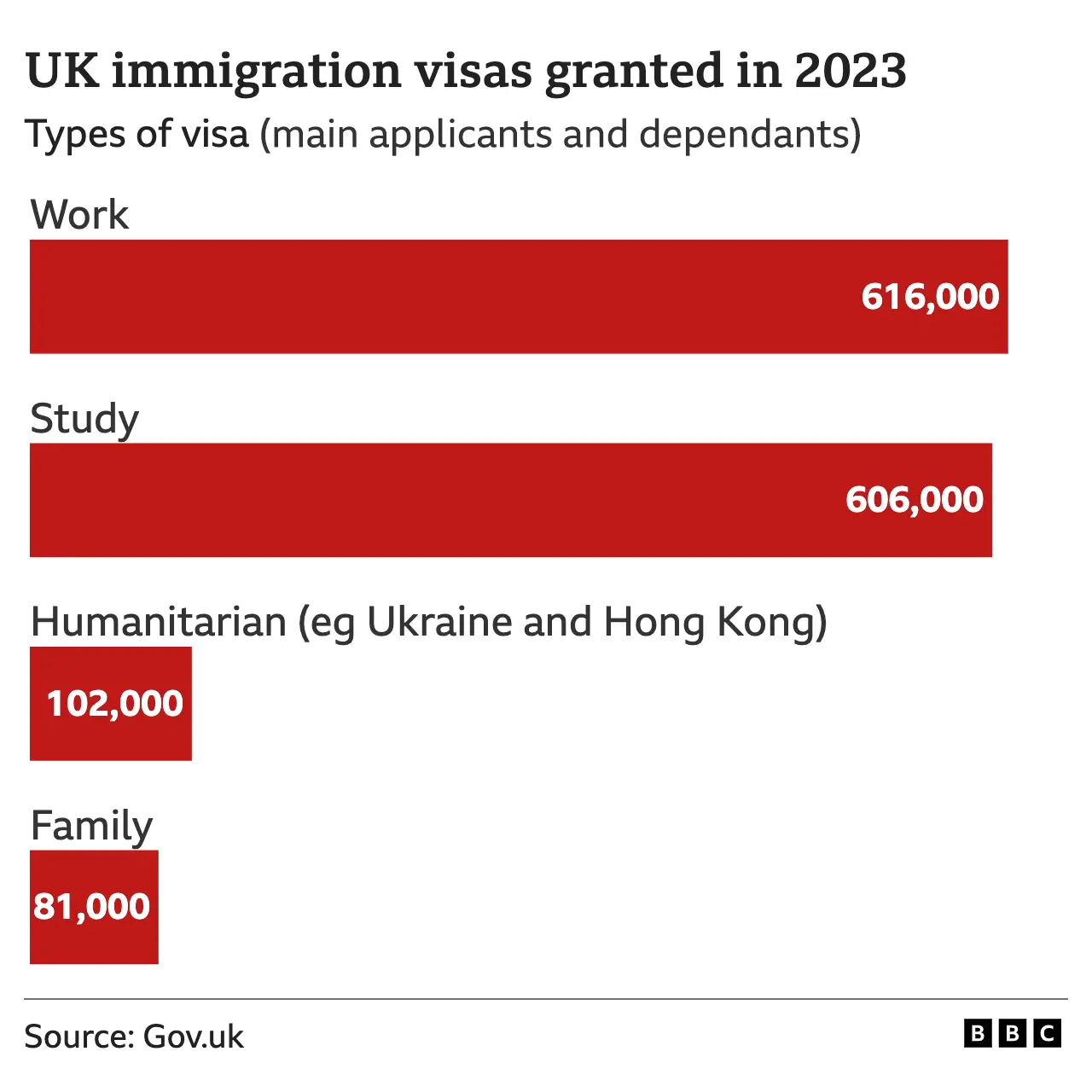
UK immigration visas granted in 2023

In 2022, the government issued almost 300,000 humanitarian visas. But last year the number was 102,000 – that’s just 7% of the 1.4 million visas issued.

The government has been consistent in its response when asked about the record levels of net migration.

Tom Pursglove MP, the Legal Migration Minister, told me: “We’ve seen incredible generosity in our country to people from Ukraine, people from Afghanistan, people from Syria, and other conflict zones. That is an important part of why we’ve seen the figures as they are.”

It is important, no doubt. And there was political consensus that issuing visas to people from Hong Kong, Ukraine and elsewhere was the right thing to do.

But the numbers show that this isn’t the full story.

The government has made other choices that have pushed up immigration.

Brexit and the pandemic added to existing recruitment problems in the social care sector. Care home owners responded by asking the government to make it easier to employ overseas care workers.

Those calls were echoed by the Migration Advisory Committee, which also suggested the government should fund higher wages to attract more British workers into the sector.

The Westminster government agreed more visas could be issued but did not raise wages.

A number of consequences followed.

For care home owners like Raj Sehgal, the changes helped. He filled almost all vacancies in his five Norfolk care homes, with 40% of staff coming from abroad.

“If we didn’t have international recruitment, I think we would probably be closed by now,” he told me.

More overseas staff arrived to work across the sector. But more may be needed. Last year, there were around 150,000 vacancies in England, and recruiting British workers remains difficult.

Let’s look at that 1.4 million figure again. Of all of those visas, more than 146,000 went to health and social care workers, another 203,000 went to their dependants.

This month, the government stopped overseas care workers from bringing dependants, describing the numbers as “disproportionate”. Mr Sehgal says this has already reduced the number of applications he is receiving.

This seems certain to reduce net migration numbers, but it’s not certain how the care sector will find the staff it needs.

If the government’s decisions on social care have driven up immigration, then so have its decisions on overseas students.

First of all, let’s consider the context here.

Tuition fees for domestic undergraduates at English universities are capped at £9,250 a year. That hasn’t risen for seven years – but during the same period, costs have. That has left universities facing financial challenges.

Some of them, like Coventry University, have targeted higher-paying overseas students to help cross-subsidise UK undergraduates. Forty per cent of the students at its campuses across the UK are from overseas.

If domestic tuition fees were raised, it could reduce the need for overseas students. But that would cost a lot. And it hasn’t happened.

Prof Brian Bell argues “that’s a choice of the government not to fund education in a particular way. The inevitable consequence is more immigration.”

The government couldn’t have been clearer about its ambition to attract more overseas students.

In 2019, it even set a target to increase the UK’s overseas student population to 600,000 – by 2030. It achieved that goal nine years early.

On top of that, in 2021, the government reintroduced a post-study work visa which allows overseas postgraduate students to work for two years after their courses finish – or three years if studying for a PhD.

It took the decision despite the Migration Advisory Committee suggesting that it shouldn’t.

All of this did what it was designed to do – attract lots more students. Last year the government issued almost 458,000 sponsored study visas. And almost 144,000 for dependants of postgraduate students.

Together, they made up almost 42% of the more than 1.4 million visas issued last year.

Again, the government was choosing immigration.

Now at this point, we should emphasise that while the government was putting in place policies that promoted immigration, knowing their precise impact was hard.

Dr Madeleine Sumption leads the Oxford Migration Observatory at the University of Oxford. She also sits on the Migration Advisory Committee that advises the government.

Predicting immigration numbers is “incredibly difficult”, Dr Sumption says. “Sometimes it’s much larger than the government expects.”

As the consequences of the government’s own policies became clear, it slammed on the brakes.

In May last year it announced that, from January 2024, most overseas postgraduate students would no longer be able to bring dependants.

This March, the government took further action – it ordered a review of the visa that allows overseas students to stay on and work. This, let’s remember, is the scheme the government had introduced only three years ago.

Legal Migration Minister Tom Pursglove explains: “The government took a view that we thought that that was the right thing to do to support the university sector. But when you consider the dependant numbers that have come with students, that has been very, very challenging.”

The government’s measures appear to be making a difference already. According to Universities UK, some universities are seeing a sharp drop in applications from overseas students for postgraduate courses.

But there’s a risk that as applications go down, so does the income of some universities.

A British Future poll suggests 69% of respondents are dissatisfied with the government on immigration

All of these government decisions have contributed to the record rise in net migration, and along with the rise we’re also seeing a shift in public opinion.

The think tank British Future, which tracks UK attitudes to immigration and describes itself as non-partisan, has shared its latest opinion poll with Panorama.

For the first time in four years, the poll suggests a majority of 3,000 respondents – 52% – want overall immigration to fall.

On top of that, 69% of those polled say they are dissatisfied with the government on immigration – that’s the highest since its polling began in 2015.

And this is where we come back to where we started – to the government’s emphasis on the issue of small boats.

The opinion poll also suggests that a little over half of those who say they are dissatisfied with the government’s handling of immigration pointed to small boats – and those concerns are coinciding with concerns about overall immigration.

Dr Sumption told me the media’s focus on small boats has probably created the impression that almost all migration comes that way, “which obviously it doesn’t”.

To reiterate – almost 30,000 people came by small boats last year and 1.4 million visas were issued by the government for people to come to the UK legally.

Some argue that the government has overemphasised the issue of small boats.

When I put that to Tom Pursglove, he countered that the government has a “moral imperative” to “grip that issue”. But he said that shouldn’t stop them, “delivering on the mission around legal migration, which is to get a better balance to bring those numbers down”.

At the moment, by the prime minister’s admission, that balance is off. In November, Rishi Sunak acknowledged, “immigration is too high and needs to come down”.

But his former Home Secretary Suella Braverman made a series of striking claims when I talked to her about Mr Sunak’s approach.

“I think the prime minister has not necessarily assumed that it’s an important issue for the British people,” Ms Braverman says.

“‘I struggled myself as home secretary, even to have a meaningful conversation with him about it. I was left to written correspondence on several occasions throughout a period of 12 months, putting forward policy proposals. But he refused to talk to me.”

I was taken aback by this. I know there is little political love lost since Mr Sunak sacked Ms Braverman last year – but this is the home secretary during the time of one of the sharpest rises in net migration in the UK’s history – claiming the prime minister wouldn’t talk to her about it – at all – for a year.

I double-checked I had heard right. I had.

“We talked about the boats every week, twice a week. We talked to each other a lot about policing and security. On legal migration, I was unable to get a hearing with the prime minister for 12 months.”

Given the importance of this issue to so many people, it is an extraordinary claim.

When we asked No 10 about this, it did not comment.

At the end of last year, the government announced plans to cut net migration by reducing the number of people coming to the UK by 300,000.

Remember, the latest estimate for net migration is 672,000 for the year to June 2023.

The estimate published just before the Brexit referendum – and which, at the time, Boris Johnson called “scandalous” – was 333,000. That estimate has now been revised down to 303,000.

So if the government meets its new target, that would take the numbers back towards where they were… just before the Brexit vote.

The government emphasises that Brexit has given the UK greater control and flexibility to adapt immigration policy to circumstance

Some observers watching the government’s statements and actions on immigration are gently raising their eyebrows.

Prof Anand Menon, who leads the independent think-tank UK in a Changing Europe, told us: “I think there is an element of dishonesty in the government at one and the same time implementing these policies and bemoaning them. Or bemoaning their impact.”

There seems little doubt the government’s latest measures will make a difference. Net migration is expected to fall. But if it does, the longer-term challenges that immigration has been easing may come into sharper focus.

Paul Johnson of the Institute for Fiscal Studies, which says it operates on a “non-political basis”, has an uncompromising message on this.

“If you want universities to have as much money as they have at the moment without these foreign students, you need to find some money from British students or the British taxpayer. If you want care homes to be staffed without bringing people in from elsewhere, you’re going to have to pay more. You have to make choices here.”

I’d hoped to ask Labour some questions about how it would approach these choices, but it declined.

This month, the Shadow Home Secretary Yvette Cooper said, “We are very clear that net migration needs to come down” and that a practical plan to tackle skills shortages in the UK is needed.

But are politicians of all parties being straight with us about what these choices involve?

For this government, for any government, these choices will involve difficult and sometimes expensive trade-offs.

Legal Migration Minister Tom Pursglove argues “issues have arisen” and it has “responded to those issues”. It emphasises that Brexit has given the UK greater control and flexibility to adapt immigration policy to circumstance.

Others point to recent data showing that one in five working-age adults are off work in the long-term, with record numbers recorded with long-term sickness.

In the Spring Budget, the Chancellor Jeremy Hunt said it would be easy to fill the 900,000 job vacancies with higher migration, but with 10 million adults not in work, it would be “economically and morally wrong”.

It’s inescapable though, that while the UK now has more control of its immigration system, the government has used that control to allow more people to come to the UK.

To come back to the question I posed earlier: how did that happen?

We can answer that by listing the government’s decisions and by acknowledging that there are powerful long-term factors that appear to encourage higher immigration. Our population is ageing, our birth rate is falling and our economy is struggling to grow.

The government though still insists the numbers will and must come down.
However, despite all the promises, this government chose more immigration. It is unlikely to be the last to do so.

Source: Say one thing, do another? The government’s record rise in net migration

Adams & Parkin: Free trade wasn’t just Mulroney’s key achievement – it is one of the most dramatic public opinion turnarounds in Canada’s history

Of note. Of course, another dramatic change was the shift to positive support for immigration, under threat to some extent by concerns over housing, healthcare etc)

….The Mulroney government implemented free trade, but (the 1988 election victory notwithstanding) it left office having lost the support of the majority of the public on the issue. Herein lies the first lesson for those aspiring to political leadership, which is perhaps a strange one for pollsters to point out: don’t pay too much attention to who’s on top of the polls. Free trade was a policy championed by experts – the dour economists and the faceless bureaucrats – that became less popular the longer the government that fought for it remained in office. Mr. Mulroney’s ability to see it through was ultimately due, not to his charm, but to his thick skin.

The second lesson that political leaders can draw from this incredible turnaround? Vindication takes time. Mr. Mulroney’s Progressive Conservatives endured defeat, then watched while Liberal governments reaped the benefits of free trade, championed its expansion globally, and won praise for defending it in response to the election of a maverick U.S. president. Mr. Mulroney played for the longer-term, which may be one of the hardest things to do in modern politics. But by choosing that path, he ensured that today – 40 years after NAFTA – his praises are being sung.

Source: Free trade wasn’t just Mulroney’s key achievement – it is one of the most dramatic public opinion turnarounds in Canada’s history

Ethnic diversity is still a serious issue at the top level in accounting firms

Of note. In general, when I looked at this some years ago, accounting firms have had a stronger diversity record than other regulated professions. Methodology of Canadian situation only focuses on recruitment photos not hard numbers so hard to assess (hopefully, Singer will add this to his research agenda):

In recent years, there has been a growing concern about the lack of diversity in workplaces, particularly in terms of ethnic and gender diversity. To address this, many companies have taken action by adjusting their recruiting policies and setting targets for achieving minimum diversity levels.

The accounting profession has suffered from the under-representation of women and marginalized people for many years. It has long been considered a white, male-dominant profession.

Accounting firms, especially the Big Four — Deloitte, Ernst & Young, PricewaterhouseCoopers and Klynveld Peat Marwick Goerdeler — have taken various measures to improve the diversity of their workforce by recruiting and retaining employees of various backgrounds. 

Each of the Big Four audit firms, for example, have created the equivalent position of chief diversity officer — a position that develops and implements diversity, equity and inclusion initiatives in the organization.

Despite these efforts, diversity at more senior ranks in accounting firms is still very much lagging, especially with regard to ethnic representation. 

Under-representation in accounting

2019 survey from the Association of International Certified Professional Accountants found that only nine per cent of accounting firm partners identify as non-white.

Another study from the Association of Accountants and Financial Professionals in Business found that only 8.9 per cent of accountants and auditors identified as Hispanic or Latino, 8.5 per cent identified as Black or African American and 12 per cent identified as Asian. In total, these group represent almost 30 per cent of The professional accountants, but their proportion in partner levels are much lower than that.

A similar report from the United Kingdom found only 11 out of almost 3,000 (or 0.4 per cent) of equity partners in the Big Four firms in the U.K. are Black, compared with their population representation of 3.3 per cent.

Although we still don’t have robust enough data about accounting firms in Canada yet, there is research that suggests women and minorities are under-represented at senior positionsin Canadian firms as well.

Recognizing the under-representation of ethnic minority accountants at the partner level, my colleagues and I aimed to gain insights into the work environment of ethnic minority accountants who made it to the top of the ladder in U.S. firms. 

New insights from research

My co-researchers and I used the term ethnic minority in our study to refer to those who are Asian, Black non-Latino, Hispanic Latino and white non-Latino as per the U.S. Census’ taxonomy. We collected data on audit partners in the U.S. from 2016 to 2020 and conducted a comprehensive analysis of various aspects of their work. 

We found that ethnic minority auditors were less likely to become partners at accounting firms. The ones that did were more likely to become partners at less notable accounting offices. They were more likely to become partners in firms other than the Big Four firms, in offices that did not have prestigious clients, in smaller offices and in offices that earned less fees.

This is despite the fact that, as our research found, they performed better than non-ethnic minority partners. Using various performance measures common in accounting research, we found ethnic minority partners performed better than their white counterparts. It is, therefore, unlikely that the under-representation of ethnic minorities at the partner level is due to their inability to perform well.

Our study also found that ethnic minority partners were more likely to be in charge of audit engagements if a client’s senior leadership also included ethnic minorities. 

It also showed that, once an error occurred, white audit partners were more likely to be absolved of audit failures than ethnic minority audit partners. The likelihood of an audit partner being replaced after a material error was discovered in a financial statement was higher for ethnic minority partners (39 per cent) versus white partners (24 per cent). 

Improving ethnic representation

One of the consequences of ineffective diversity, equity and inclusion practices in the accounting profession is talent drain. Up to 55 per cent of accountants from under-represented groups leave their employers, and up to 18 per cent leave the profession altogether. This raises concerns about the long-term sustainability of the profession’s talent pipeline. 

Our study points to some major gaps in terms of promotion and treatment of ethnic audit partners in the accounting profession. Diversity at higher levels in the corporate hierarchy appears to be lacking. 

Our study also suggests two major benefits of closing these gaps. First, because ethnic audit partners appear to outperform their white counterparts, more ethnic representation at senior positions will translate to higher-quality audits. Second, improving the ethnic diversity in senior accounting positions will help combat talent drainage.

There must be greater efforts to recruit, nurture and promote talented accountants from under-represented backgrounds, including fast-tracking promising audit managers to partnership. Individuals from under-represented groups should receive opportunities equal to those of their white peers when it comes to career advancement and the choice of work environment.

We believe more ethnically diverse accounting leadership will strengthen the profession by attracting and retaining talented ethnic accounting professionals and will position it to deal better with the challenges of the future.

Source: Ethnic diversity is still a serious issue at the top level in accounting firms

Federal cap on international students shouldn’t affect universities, colleges that have been ‘good actors,’ Miller says

Real test will be at the provincial level, particularly Ontario:

Colleges and universities that didn’t contribute to the over-enrollment of international students should not be impacted by the federal government’s clampdown, said Immigration Minister Marc Miller, also warning that Ottawa may step in if provinces allow that to happen.

Miller, speaking at the Democracy Forum at Toronto Metropolitan University on Friday, said in addition to limiting numbers Ottawa also wants “to make sure that we are separating the wheat from the chaff, rewarding those institutions that have the ability to welcome and attract the top talent for which the international visa student program was designed for in the first place.”

Ottawa has put a two-year cap on international study permits, with a plan to reduce the number by 35 per cent, to 364,000, in part to also address a housing crunch in many of the communities with large numbers of foreign students. The cap does not apply to master’s or doctoral students or those in elementary or secondary schools.

Permits will be allotted based on population, leaving it to the provinces to divvy them up. Ontario will be among the hardest hit, given it has taken in 51 per cent of Canada’s international students. 

While acknowledging that the changes being rolled out may make for a “turbulent year,” Miller said the clampdown may need to be further tailored “depending on what we see as the results or the impacts that the corresponding effects and actions that the province take in order to adjust for this.

“If they (the provinces) start to punish the good actors, that’s an unfortunate consequence that I may have to have a say over — but obviously we have to give the chance to the provinces” to fix the problems, Miller said. 

Starting in May, no post-graduation work permits will be issued to international students who studied in a program run by public-private college partnerships, which have been blamed for the explosion in Ontario’s numbers. 

Miller has been highly critical of the quality of such programs, some of them run out of strip malls. 

Both colleges and universities charge international students much higher tuition fees — sometimes up to five times — and have been using them to boost revenues because of systemic underfunding by the Ontario government, Miller said.

“I don’t necessarily fault them entirely for that, but I think that has to be done responsibly,” he said at Friday’s forum, co-hosted by the Star’s Martin Regg Cohn and TMU professor Anna Triandafyllidou.

“Had we not capped this, we would have seen exponential growth over the next one or two years with very, very, very negative carry-on effects in a number of areas.”

Ontario colleges and universities are now awaiting word from the Ford government, which has to release its plan for allocating permits and the newly required verification letters by the end of the month.

“We know some bad actors are taking advantage of (international) students with false promises of guaranteed employment, residency and Canadian citizenship,” Ontario Colleges and Universities Minister Jill Dunlop has said. “We’ve been engaging with the federal government on ways to crack down on these practices, like predatory recruitment.”

Source: Federal cap on international students shouldn’t affect universities, colleges that have been ‘good actors,’ Miller says