Businesses are joining the growing chorus of concern about the high cost of housing in Ontario

Significant. But no mention of immigration pressures on housing:

Home prices in Ontario have reached a point where they are pulling money out of other sectors of the economy and creating more challenges for business, warns a new report from the Ontario Chamber of Commerce.

As Ontarians spend more on housing, the report says, they have less money for other goods and services. The situation has resulted in “wide-ranging” implications for business in the province.

“We’re well past the stage of recognizing that this is a crisis,” Ester Gerassime, one of the report’s authors, told the Star. “There are economic implications for the business community, for our budgets at various levels of government. So, it’s important that we get this right.”

According to the report, titled “Home Stretched: Tackling Ontario’s Housing Affordability Crisis Through Innovative Solutions and Partnerships,” the cost of housing is so high it’s even impacting the ability to build housing. It argues that many in the labour force are unable to afford to live in the same communities where housing is needed.

Additional pressures, such as supply chain issues, are further hampering the ability to build enough housing to meet demand, the report says. Along with the pressure on businesses, the prices are resulting in low-income earners being pushed out of their housing and, in some cases, into homelessness.

Meanwhile, Gerassime said, other business are having trouble attracting and retaining talent, as workers avoid the increasingly large patches of the province where they can’t afford to live.

“Lots of individuals are moving to other provinces, out of Ontario,” she said. “Part of that is (due to) housing affordability.”

The provincial government wants to build 1.5 million homes by 2031 to help alleviate the pressures of the housing market. But Gerassime said it will take a “all-hands-on-deck approach” to meet that goal.

Recommendations in the report include building a labour force able to construct more housing, preservation of affordable housing and supporting innovation to find new solutions to the housing crisis.

Last week Re/Max released a report pushing for 15-minute neighbourhoods in Canada. Such planning would result in a mixed use of housing for all income levels within a 15-minute walk, bike, or transit time to all necessities.

The OCC’s report also advocated for building the “right types” of mixed housing developments as another solution to ease the real estate crunch. Such housing needs to include supportive units as well, Gerassime said.

“Addressing the housing affordability crisis is the morally and fiscally responsible thing to do,” she said, quoting a recent report from the Mental Health Commission of Canada. “For every $10 invested in supportive housing, we’d see an average saving of almost $22 dollars in health, justice and social services.”

Source: Businesses are joining the growing chorus of concern about the high cost of housing in Ontario

Paradkar: Muslims who fight against LGBTQ2+ inclusion are hurting many — including themselves

Of note:

A viral audio clip of an Edmonton teacher admonishing a Muslim student for avoiding Pride events perfectly encapsulates a dilemma that’s worth wrestling with. How does one tolerate — or, better still, tackle — the intolerance of some members of a group that has itself faced so much intolerance.

At least part of the answer is simple: not with the very discrimination you rail against. 

Less simple, and also wrapped up in the answer, is a layered understanding of how religion, a source of support for many, can also be a basis of discrimination.

In the two-minute audio clip from last month, an unnamed Londonderry Junior High School teacher told a student his behaviour was unacceptable, and referenced Uganda, where intolerance and criminalization of homosexuality has been boosted by evangelical Christians. 

She also pointed out there were no complaints when Ramadan was acknowledged at school. 

“It goes two ways. If you want to be respected for who you are, if you don’t want to suffer prejudice for your religion, your colour of skin or whatever, then you better give it back to people who are different from you. That’s how it works,” said the teacher. 

She should have stopped there.

It’s not uncommon to see individuals from equity-seeking groups aligning with discriminatory actions; the plaintiffs in front of the U.S. Supreme Court that struck down affirmative action last week were Asian-American. 

Of course, Muslims are not a monolith. Nor are they the only faith group to denounce LGBTQ2+ teachings at school. On June 27, a group of Muslim, Jewish and Christian parents of students at a Montgomery county school demanded that their kids be able to opt-out of the sex-ed curriculum.

But Muslim opposition to Pride in Canada and the U.S. is not restricted to one Edmonton student’s choice to skip Pride-related events, or students routinely using provincial exemptions and not attending sex-ed classes, or parents leading protests against school boards for gay-inclusive teachings and other forms of gay expression.

It also affects policy. Residents of Hamtramck, Mich., who celebrated their multiculturalism when they voted in a Muslim-majority city council during Donald Trump’s Islamophobic campaign rhetoric in 2015, were dismayed to find that council passing legislation in June that banned flying the Pride flag on city properties. 

It has become a knotty issue involving religious beliefs, political expediency and flirtation with outright hate. It raises questions about whether freedom of religious expression is more important than freedom from discrimination and paves a pathway to shaking hands with the devil. 

It is notable because individual intolerance was in a way sanctified by a statement by North American Islamic scholars that declared queer life sinful. In addition, at least one senior member of the Council on American-Islamic Relations, an important civil rights advocacy group, supported parents seeking book bans and opt-out options.

Perhaps these examples of opposition come from a loud minority among Muslims or perhaps the sentiments are more mainstream. In any case, these actions risk being weaponized for a larger, insidious cause that could end up hurting Muslims here in the long run.

Even if sex-ed exemptions are allowed in Alberta, I’m glad the Londonderry teacher challenged the disdain toward LGBTQ2+ groups.

But she didn’t end it there. Instead, what she said next has been gleefully and understandably seized upon by conservatives as proof of hypocrisy among progressives.

She said, “We believe people can marry whoever they want. That is in the law. And if you don’t think that should be the law you can’t be Canadian. You don’t belong here.”

I think we can all agree that we can’t beat homophobia with Islamophobia or racism. What are the odds that a homophobic white child would have been told “You don’t belong in Canada”? 

The National Council for Canadian Muslims lambasted the teacher’s comments as “deeply Islamophobic, inappropriate and harassing behaviour.”

But it did not weigh in on the question of whether the student should have dodged Pride events. 

Intolerance against queer identities has surfaced over fear of a “woke gender ideology” — a fear manufactured and stoked by the white Christian far-right, expressed under the guise of protecting children. 

In this twisted thinking, children being aware that a small minority of people are not heterosexual or that an even smaller minority doesn’t identify with the gender they were assigned at birth, is considered indoctrination or even pornographic corruption. (But gay and trans children and adults being surrounded and ridiculed by heterosexual cis people is apparently totally safe.) A miniscule fraction of that minority who might regret transitioning or might have had bad experiences with gender-affirming medical procedures is amplified as proof positive of hell having broken loose.

And what do Islamic experts say about the issue? Some 300 Islamic scholars and preachers across North America co-signed a statementlate in May to clarify their religious position on sexual and gender ethics. It was damning: homosexuality and transgenderism are not permissible.

“By a decree from God, sexual relations are permitted within the bounds of marriage, and marriage can only occur between a man and a woman,” said the statement titled Navigating Differences: Clarifying Sexual and Gender Ethics in Islam. 

I’m not qualified to offer a theological critique of Islamic beliefs. But this is a column about justice for the most vulnerable, and I don’t believe justice can be served by relying on principles of the past to moralize today.

That sentence by the Islamic scholars echoes the beliefs of the World Congress of Families created by American conservatives back in 1997, which now exists as the International Organization for the Family.

According to the Southern Poverty Law Center, the congress “pushed for restrictions to LGBT rights under the guise of the defense of the ‘natural family’ — defined as heterosexual married couples with their biological children.” 

The organization, which was created by the Christian right-wing, is another example of how religion is used to discriminate against others and it exists today, as the SPLC says, “as a political power broker as an anti-LGBT group in its own right.”

That group of people who blame gay lifestyles and feminist liberation for a declining white population also subscribe to the conspiracy theory of the Great Replacement of white people by Black and brown people.

In this process of rejecting LGBTQ2+ rights, conservative Muslims have linked hands with the very people who demonized them for decades.

But Edward Ahmed Mitchell, a deputy director at CAIR, calls the idea of that alliance “ludicrous,” and said parents were standing up for their religious rights “without prompting from the right and without fear of backlash from the left.”

“What matters is whether the cause itself is just,” he said in a Twitter statement.

Not only does his stance risks isolating gay and trans Muslims, the scholars’ statement that they are sinners could well be psychologically crippling at a time of rising hate against people like them.

The logical extension of the Islamic scholars’ argument is also damaging for all Muslims in North America.

For instance, the statement says, “As a religious minority that frequently experiences bigotry and exclusion, we reject the notion that moral disagreement amounts to intolerance or incitement of violence.”

By that token, could a law banning head coverings — based on a moral disagreement with seeing veiled Muslim women — no longer be criticized as being intolerant?

When it says: “Peaceful coexistence does not necessitate agreement, acceptance, affirmation, promotion, or celebration,” could that not be turned around to mean religious accommodation in schools or celebrating Muslim holidays is not required to signal acceptance of Muslims? 

It says, “there is an increasing push to promote LGBTQ-centric values among children through legislation and regulations, disregarding parental consent,” as if this exact same objection could not be used by the far-right to decry depictions of Muslims in schoolbooks as a sample of wokeness.

But leaders of the white far-right, sensing weakness in the solidarity of rights groups, have switched tacks for the moment.

Fox News host Laura Ingraham, a far-right hero, who once said the “dual loyalties” of Muslim refugees to the Qur’an that would lead them to “to try to blow us up” is now praising Muslim parents who are opposed to their children reading books with LGBTQ2+ themes. 

For white supremacists, expanding their base this way, or even appearing to grow support for their “causes”, offers a two-pronged advantage. One, images with visibly Muslim people in their midst make for an effective cover, similar to when the Proud Boys propped up the African-Cuban Enrique Tarrio as their “chairman” as if to say: See, no white supremacy here. 

And two, it’s an effective divide-and-conquer strategy. When they need to invoke the Great Replacement fear again, the anti-racist rights-seeking groups will have already been disorganized and weakened. 

To be clear, Muslims who support ultra-conservative ideologies around sexuality are not naïve dupes. They are simply being as closed-minded as conservatives of any religion.

Where is the compassion and mercy that religions are so famous for?

I don’t much care for religion nor do I particularly want it flapping in my face. Even so, I stick my neck out to speak up for the freedom of believers.

In times of disaster and injustice, in my experience, Muslims (and Sikhs) are often the first to show up to give support. That may be why I’m doubly disappointed by this not insignificant opposition to LGBTQ2+ rights.

As the Londonderry teacher pointed out, respect is reciprocal. The right to practise religion cannot trump the human right to sexuality. Because ultimately, religion and religiosity are a choice. Sexual orientation and gender identity are not. 

Source: Paradkar: Muslims who fight against LGBTQ2+ inclusion are hurting many — including themselves

New Canadians more religious than their natural-born counterparts: study

Of note. Earlier studies have also shown this. Not much new here given same observations 10 years ago by Pew Research, Canada’s Changing Religious Landscape:

Newcomers to Canada tend to be more religious than their natural-born counterparts, a new study suggests.

The study, released Thursday by think tank Cardus, suggests many new immigrants to Canada hold deeper religious beliefs than those born in this country, attend religious services more often, and say those in public positions should be free to integrate their faith into their words and actions.

“We’re now anticipating about 1.5 million new immigrants coming into the country by 2025,” said Rev. Dr. Andrew Bennett, Cardus’ faith communities program director.

“If you look at the the data for new immigrants, disproportionately they’re coming from countries where religion is a much more public reality than in most western democracies.”

The report, Bennett said, suggests that religion plays a larger role of in the lives of newcomers compared to those born in Canada.

“New immigrants are more likely to express their religion publicly than non-immigrant Canadians,” he said. “They’re more likely to attend religious services, they’re more likely to desire to have their children educated according to their religious tradition.” 

Data published by Immigration, Refugees and Citizenship Canada points to India as this country’s top source of immigrants in 2022, with 118,095 new people arriving from that nation last year.

That was followed by China (31,815), Afghanistan (28,735), Nigeria (22,085) and the Philippines (22,070).

Rounding out the top 10 were France, Pakistan, Iran, the United States and Syria.

The government’s 2023-2025 immigration plan, which was released last November, aims to bestow permanent residency status upon 465,000 new immigrants in 2023, 485,000 in 2024 and an even 500,000 in 2025.

The Cardus report, which used survey data gathered in partnership with the Angus Reid Institute, focused on the differences between contemporary Canadians’ religious beliefs and those of newcomers, and how recent arrivals view the role of faith in everyday life in Canada.

The study’s authors used the poll’s responses to drill down the results into a “spectrum of spirituality” index — classifying respondents into four categories: those who are religiously committed, privately faithful, spiritually uncertain and non-religious.

Among those who consider themselves “religiously committed,” only 14 per cent were born in Canada, while 28 per cent were born outside of the country.

Those who say they are “privately faithful” were a bit more evenly spread — 18 per cent of natural-born Canadians compared to 22 per cent of those born outside of Canada. Nearly half of those born in Canada self-identify as “spiritually uncertain,” compared to 36 per cent of those born elsewhere.

For those who consider themselves non-religious, 15 per cent of foreign-born Canadian residents fell into that category compared to 20 per cent of Canadian-born citizens.

As for those who say they believe in a higher power, 72 per cent of Canadian immigrants say they believe in God, compared to 64 per cent of non-immigrant Canadian citizens.

While data suggests most Canadians consider passing their religious beliefs on to their children to be important, foreign-born Canadians tend to hold this view more frequently than those born here.

A little over a quarter of those who strongly agree with the importance of teaching religion to their children were born outside of Canada, compared to 18 per cent of those born here.

Of those who strongly disagreed, 20 per cent were born in Canada compared to 16 per cent who weren’t.

Immigrants are also more likely to read sacred texts such as the Bible, Adi Granth or Qu’ran — around 20 per cent of immigrants say they consult their holy books between every day or a few times per week, a three-fold increase compared to Canada-born citizens who hold the same beliefs.

Just under 60 per cent of Canadian-born respondents say they never read sacred texts, compared to 36 per cent of those born outside of the country.

A growing number of foreign-born residents also see more importance in public figures integrating their faith into their work.

When asked if Canadians who hold public office should feel free to both speak and act based on their religious beliefs, 44 per cent of respondents who agreed with that sentiment were born outside of Canada, compared to 33 per cent who were born in Canada.

Maintaining a firm separation between church and state is a sentiment shared by 67 per cent of respondents born in Canada, while 56 per cent of those born outside of Canada agreed.

Canada’s ambitious immigration targets are sparking concern over the strain these new residents will put on our country’s already stretched infrastructure.

“The population (growth) is positive, but our infrastructure has to catch up and has to be able to keep pace, or else all of the types of frustrations and issues that we’re seeing today are only going to be magnified,” University of Toronto’s School of Cities’ Matti Siemiatycki told National Post in December.

Source: New Canadians more religious than their natural-born counterparts: study

That time when Canada’s population and prosperity both boomed, unlike now

Worrisome trend and contrast, reflecting policy failures on a number of levels, particularly the excessive focus on population growth:

Canada’s economy has outpaced that of every other G7 country over the past year, but there’s a big, million-people-sized catch.

That’s roughly how much Canada’s population grew over the past 12 months – almost entirely from immigration – for a 2.7-per-cent increase, according to the latest estimate from Statistics Canada. And as a mounting number of economists have pointed out, the massive influx of people is juicing the economic numbers.

Once the surge in population is taken into account, Canada’s real gross domestic product per capita, a measure of prosperity for the average person, is still where it was at the end of 2017.

In a recent note, Bank of Montreal chief economist Doug Porter highlighted the sluggish pace of growth at a time when the population is expanding so much faster than in the United States. In the seven years since the Trudeau government’s Advisory Council on Economic Growth proposed measures to boost growth through infrastructure spending, more foreign investment and higher immigration levels, per-capita growth in Canada has underperformed that of the U.S. by close to 1.2 percentage points per year.

The Canada of the past offers its own contrast to the current prosperity rut. The last time Canada saw its population grow this fast was the decade after 1951, when annual population growth ranged from 2 to 3.5 per cent amid a baby boom and postwar immigration.

Yet thanks to rising productivity, Canada’s overall economic output grew even faster – despite a whopping four recessions during that period – with the result that real per capita GDP raced ahead.

The past also holds a warning for what could come next. In the latter half of the 1950s, as population growth accelerated even faster, per-capita GDP did begin to stall. Yet that was with an economy growing roughly three times faster than it is now.

Canada’s population growth will likely slow from its current frantic pace as immigration officials work through the pandemic backlog of applications, but not by all that much. Barring a vast improvement in productivity, Canada’s per-capita GDP – and our standard of living – appear headed for an outright decline.

Source: That time when Canada’s population and prosperity both boomed, unlike now

Will immigration become a salient political issue in Canada?

Useful and informative polling. Money quote:

…leaders need to demonstrate there’s a coordinated, well-resourced plan to respond to the pressures created by growth. In my view, that has been sourly lacking from all levels of government.

This should also be a wake-up call to leaders from all three levels of government that if investments in infrastructure – like housing, healthcare services, and transportation – are not expediated to meet the growing population, opposition to immigration could increase thereby creating conditions for the rise of a more nationalist/populist political response.

—-

I can’t remember the last time immigration featured prominently in national political debates in Canada. This doesn’t mean that all Canadians hold decidedly pro-immigration attitudes. The lack of friction on the issue, in my view, is more likely the result of an elite-consensus on the value of immigration than a reflection of public opinion. We shouldn’t assume that none of the major political parties will never make immigration an issue.

In Quebec, immigration has been an issue that has animated the political debate but we haven’t seen anything similar in other parts of Canada. But we have seen immigration fuel divisive debates in the UK, France, the United States, and other democracies. Public sentiment about immigration and immigrants was a big factor in Brexit and the rise of Trump.

As I mentioned in an earlier post, my interest in the subject has been growing as the impact of the housing and healthcare crises becomes more intense and people start reflecting on what may be causing it or at the very least, making it worse.

At the same time, there’s been a lot of attention paid to the pace of population growth in Canada, with much fanfare over Canada’s population passing the 40 million mark a few weeks ago.

Last month, I asked some polling questions on a national Abacus Data survey on immigration. My intent is to start tracking opinions every six months, because I think this issue has the potential to become more salient and prominent in our political debate – especially in the lead up to the next election.

The survey, fielded from June 23 to 27, 2023, sampled 1,500 Canadian adults online. The comparable margin of error is +/- 2.6%, 19 times out of 20.

Here’s a summary of what the survey found (full details below for paid subscribers):

  1. 11% of Canadians rank “immigration” as a top 3 issue. This is the first time I included in out list of response categories. The rising cost of living remains a top issue to more people (71%), with healthcare (48%) and housing (43%) rounding out the top 3.
  2. 61% believe that Canada’s target to welcome 500,000 immigrants next year is too high, including 37% who feel it is “way too high”.
  3. When asked whether the number of immigrants coming to Canada is having a positive or negative impact on several possible areas, 63% feel it is having a negative impact on housing, 49% feel this way about its impact on traffic and congestion, and 49% feel immigration is having a negative impact on healthcare.
  4. Half think immigration is having a positive impact on the availability of workers while 43% think immigration is having a positive impact on economic growth.

Digging Deeper on Public Attitudes towards Immigration

When I did a bit deeper into the data, these insights are particularly noteworthy:

  • 11% of Canadians rank “immigration” as a top 3 issue. This is the first time I included in out list of response categories. The rising cost of living remains top (71%), with healthcare (48%) and housing (43%) rounding out the top 3.
  • 14% of Conservative supporters, 14% of BQ supporters, 9% of Liberal supporters, and 5% of NDP supporters put immigration in their top 3 issues.
  • There is some, but not large, differences in perceptions about Canada’s immigration target by party support. Conservative supporters are the most likely to feel the immigration target of 500,000 is too high with 52% feeling it is way too high. Half of Liberal and NDP supporters feel the target is too high as well. BQ supporters are in between with 36% describing the target as way too high and 35% feeling it is too high (71% too high in total).

  • 35% of Canadians believe that the immigrant population is increasingly significantly in their community while another 24% think it is growing moderately. This views are consistent across the country and more pronounced among Conservative and BQ supporters, although a sizeable portion of NDP and Liberal supporters also feel this way.

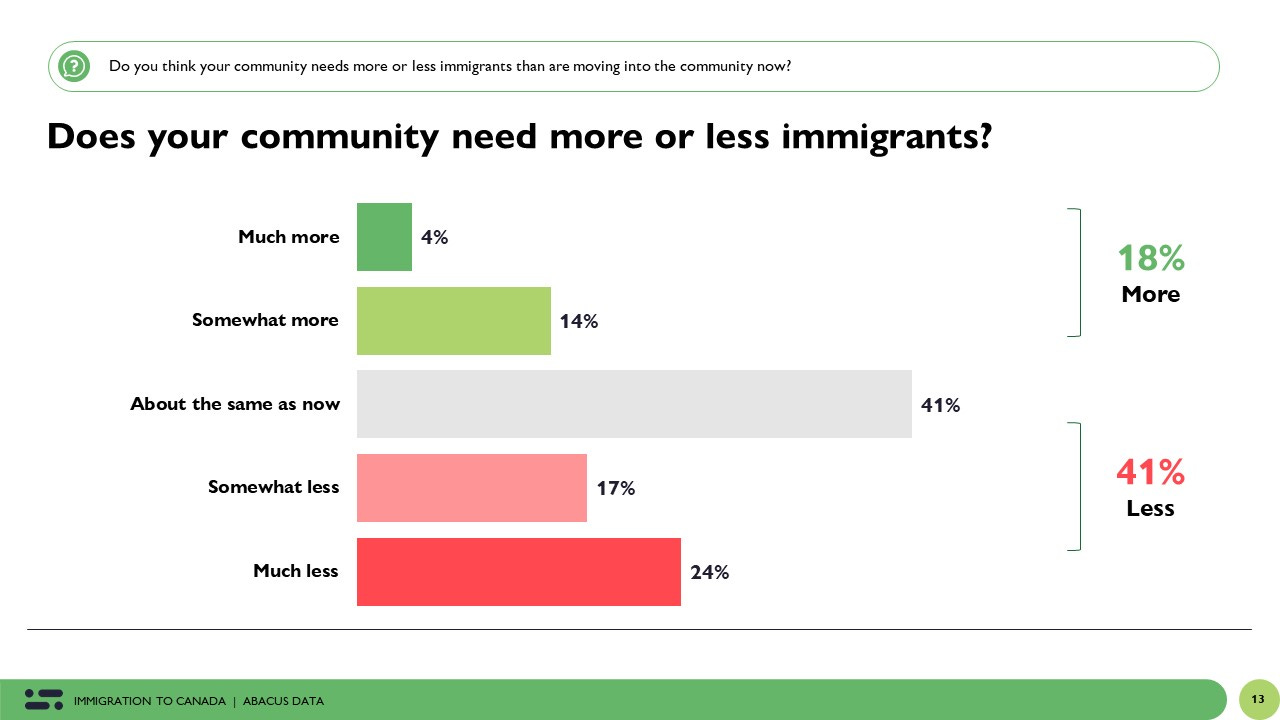
  • Despite 61% feeling that Canada’s immigration target is too high, 41% think their community needs less immigration – a fascinating 20 point gap between the two measures. 18% of Canadians think their community needs more immigrants while 41% think the same amount of immigration as happening now works well. Atlantic Canadians (29%) are the most likely to want to see more immigrants. Views in Quebec are close to the national average.

  • There is a strong correlation between feeling the number of immigrants in one’s community is increasing and opinions about Canada’s immigration target. 67% of those who think the immigrant population in their community is increasing significantly also think Canada’s immigration target is way too high. This drops to 25% among those who feel immigration in their community is increasingly moderately, and 17% among those who think it’s increasingly slightly. Interestingly, 35% those who don’t think the immigration population in their community is growing at all think the immigration target is too high. This suggests there’s latent anti-immigration sentiment in communities where residents don’t perceive their too be much growth.
  • What might be impacting the overall negative impression of immigration? It’s clear the recent crises in housing and healthcare are definitely pain points. Half or more people feel that immigration is having a negative impact on both. If those issues get worse, I expect overall sentiment to immigration to also get worse.

  • Despite the friction that immigration is causing, the good news is only a minority (although a sizeable minority at 36%) believe that on balance, immigration in Canada is making the country worse off. 17% feel it is making Canada much worse off. In contrast, 29% feel immigration makes the country better while 29% think it’s impact is neutral.

  • To better understand the drivers of this view, I ran a simple regression model with views about immigration overall with several of the variables from the survey. That analysis finds that perceptions about the economic impact of immigration, its impact on crime and public safety, and its impact on fostering a sense of community are the largest predictors of one’s view on whether immigration has a net benefit on Canada overall. This suggests that the relatively short-term problems of housing and healthcare are not yet impact people’s overall views about immigration. Instead, the perceived economic benefits drive support or at least mute opposition to immigration while longer-term concerns (possibly driven by xenophobia or racism) about social cohesion and crime are major drivers for negative perceptions/attitudes about immigration.

The Upshot

The survey data suggests that the Canadian public is not overwhelmingly pro-immigration but also not overwhelming anti-immigration either. Friction about immigration’s impact on housing, traffic congestion, and healthcare is pretty widespread and deeply felt.

About 1 in 3 Canadians (36%) believe that immigration is making Canada worse off overall. This is not an insignificant minority but likely one that has existed for some time. The question is whether the relatively recent housing and healthcare crises push more people into this camp. If so, that could become a powerful political coalition.

The data reveals a gap in perception versus community need, with 61% believing Canada’s immigration target of 500,000 is too high, but only 41% feeling their community needs less immigration.

It’s noteworthy that Quebecers do not appear more resistant to immigration than others and younger Canadians are more open to it than older Canadians.

The survey’s results highlight the need for a strategic approach in managing public perception around immigration in Canada. Given the significant proportion of Canadians perceiving immigration’s impact as negative on housing and healthcare, politicians and policy-makers should engage in transparent discussions about the impacts of immigration on these areas, possibly linking it to other causes of strain on these sectors.

More important, leaders need to demonstrate there’s a coordinated, well-resourced plan to respond to the pressures created by growth. In my view, that has been sourly lacking from all levels of government.

This should also be a wake-up call to leaders from all three levels of government that if investments in infrastructure – like housing, healthcare services, and transportation – are not expediated to meet the growing population, opposition to immigration could increase thereby creating conditions for the rise of a more nationalist/populist political response.

Political managers should also highlight the economic benefits of immigration to sway the 52% of Canadians who view immigration’s impact on economic growth as either neutral or negative. This requires engaging economists, industry leaders, and community spokespeople to discuss how immigrants contribute to the economy through taxes, starting businesses, and addressing Canada’s aging population.

Politically, Conservative and BQ supporters show more resistance to immigration, suggesting the elite-concensus on immigration should not be taken for granted. Immigration could become a salient political issue that would allow the Conservatives and BQ to speak to voters who may not otherwise consider voting for those two parties. It could also serve as a powerful issue for the People’s Party.

Let’s not underestimate the potential political power of this issue. There may be a clear political majority who are worried about immigration and could be mobilized in reaction to their views. Immigration also has the potential to fundamental realign Canadian politics.

Too often, I hear people who assume Canada is immune to the political forces that have engulfed and divided other populations. That Canada is unique in its liberal, open-to-immigration, orientation. This data should cause those to reflect on that and consider the risk these numbers represent.

Finally, I am planning to track opinions every six months because I think we need to monitor these views more regularly. This continuous feedback loop will be crucial in understanding changing perceptions and adjusting messaging, especially in the lead up to the next election.

I welcome your thoughts and feedback and suggestions for future research.

Source: Will immigration become a salient political issue in Canada?

Labour shortage narrows the pay gap between white and racialized workers — but for Black workers, things are worse

Notes impact of occupation patterns and educational attainment levels, which correlate with race:

Lower unemployment rates and higher wages in 2022 helped to narrow the employment gap between racialized workers and workers who identify as white, but not for Black workers, according to a new report.

The report, released Wednesday by the Canadian Centre for Policy Alternatives, found that the benefits of the pandemic recovery, such as wage increases, have been unevenly distributed for racialized workers, as the wage and employment gap widened between Black workers and their white counterparts.

According to the report, racialized workers, or visible minorities, are defined as those who are “non-Caucasian in race or non‑white in colour,” excluding Indigenous groups. The data indicates that anti-Black racism is a dominant force in the labour market, the report’s authors told the Star.

“Despite some progress for racialized workers as a whole, Black workers continue to bear a disproportionate burden of employment inequality,” said Grace-Edward Galabuzi, a professor in the department of politics and public administration at Toronto Metropolitan University and report co-author. “These data demonstrate the need for continued policy efforts to combat anti-Black racism in the workplace.”

The research found that racialized workers are overall more likely to be working in industries with high employment growth and faster wage growth than Black workers. In lower-wage occupations there is an overrepresentation of Black workers. Fifty-two per cent of racialized workers are in occupations in the bottom half of the wage distribution compared with 48 per cent of white workers and 60 per cent of Black workers.

“There’s a structural problem here that starts with our education system,” said Galabuzi. “Especially with Black youth, they’re not encouraged to go into higher-earning professions in the same way as their white counterparts, and tackle prejudices in grade school and post-secondary education.”

In 2022, the unemployment rate fell by 2.9 percentage points for all racialized workers, 2.1 percentage points for white workers, but only 1.6 percentage points for Black workers, the report said.

And though wages increased during the pandemic, racialized and Black men still earn less than their white counterparts, and Black and racialized women face even greater hurdles.

In 2022, comparing average weekly wages in Ontario, racialized men earned 90 cents and Black men earned 77 cents for every dollar white men earned.

Racialized women earned 71 cents and Black women earned 68 cents for every dollar white men earned.

“The pandemic recovery has been uneven, and while wages are up, racialized men and women and Black men and women still don’t make their fair share,” said Sheila Block, senior economist with the Canadian Centre for Policy Alternatives and report co-author.

“We started this research because we were curious about the tight labour market and who stands to benefit from it. And this data shows us marginalized communities continue to face barriers.”

Black men’s employment continues to be concentrated in lower-wage industries and in industries that have experienced employment losses since 2019, the report said, while Black women have the smallest share of their employment in occupations with the fastest wage growth.

Black workers are overrepresented in retail; accommodation and food; and arts and entertainment, which were the hardest-hit industries during the pandemic, said Galabuzi, and are experiencing the most gradual recovery.

However, finance, administration jobs, and professional, scientific and technical services (scientists, accountants, marketing) all received higher wages and lower unemployment rates, accounting for greater representation of white workers and non-Black racialized groups, he added.

“There’s been a shift in the labour market as people moved from food service and accommodation to professional, scientific and technical services,” Galabuzi said. “So Black workers are left behind in industries where there is job loss (and more precarious work).”

The report also highlights how Bill 124 — which was introduced in 2019 by the Ford government to cap wage increases for nurses and other public sector workers at one per cent a year for three years — had a disproportionate impact on low-wage racialized women.

In November 2022, the bill was ruled unconstitutional, though the government is appealing the decision.

Black women make up 15 per cent of nurse aides, orderlies and patient services associates while they make up only three per cent of total employment. All racialized women make up 36 per cent of social and community service workers but account for only 17 per cent of total employment.

“The racialized and gendered labour market gap persists, and further policy interventions are needed,” said Block.

“The first and most obvious step to take would be for the Ontario government to repeal its wage restraint legislation. Workplaces also need to review their diversity, equity and inclusion efforts. And the education system needs to better support and guide Black students. It requires a much larger societal approach to tackle anti-Black racism in the workforce.”

Source: Labour shortage narrows the pay gap between white and racialized workers — but for Black workers, things are worse

Mandates aim to tackle discrimination in public service, unions say it’s not enough

Well, of course it isn’t. But it reflects continuous improvement as hiring, promotion and separation data attests (How well is the government meeting its diversity targets? An intersectionality analysis) while the media generally only reports on the activist perspective:

Federal government departments and agencies will now have to evaluate whether their hiring practices are discriminatory after changes to the Public Service Employment Act came into effect this week.

Public Service Commission spokeswoman Elodie Roy said the changes will strengthen diversity and inclusion in the federal government workforce.The amendments were first introduced in the budget implementation process in 2021.

They require the public service to evaluate how staffing methods, such as interviews and written exams, might discriminate against women, people with a disability, or those who identify as Black, Indigenous or LGBTQ.

The Public Service Commission will also have more resources to investigate mistakes or misconduct that affect hiring processes.

Previous amendments revised the job qualifications for members of equity-seeking groups and ensured permanent residents were given the same hiring preferences as Canadian citizens.

But a group representing thousands of Black public servants who filed a class-action lawsuit against the government alleging decades of discriminatory hiring practices said the changes do not go far enough.

The Black Class Action Secretariat, which formed when the $2.5-billion suit was filed in 2020, has been calling on the federal government to settle claims for financial compensation and to create a mental health fund for trauma caused by racial discrimination in the public service.

The creation of that fund, which was promised in the 2022 federal budget, has also been mired in complaints of racist behaviour.

Back in March, the Treasury Board Secretariat ruled that the Canadian Human Rights Commission discriminated against Black and racialized employees.

Nicholas Marcus Thompson, the executive director of the Black Class Action Secretariat, said the agencies responsible for implementing the new changes have also contributed to systemic discrimination within the workplace.

“Frankly, there’s no trust,” said Thompson.

He pointed out that individual employers within the government separately control their staffing processes.

“If you look at the legislation, and if you look at the direction that the Public Service Commission is now empowered to take action on, it doesn’t appear to have any teeth,” he said.

“It’s mind-boggling that employers who have discriminated against workers — you have employers like the Canadian Human Rights Commission that has been discriminatory towards its own Black employees — would now be the subject of this system.”

Thompson called for more accountability in the public service, and said agencies that have engaged in discriminatory practices should take responsibility.

He said the government and public service sector have displayed that they have the willpower to make meaningful changes toward diversity and inclusion, citing the increase of women in the federal workforce.

“So the excuse that there is no magic bullet to this problem, it’s quite frankly nonsense,” he said.

The Public Service Alliance of Canada, a union that represents more than 120,000 federal workers, called the changes a good start but said more is need to address systemic barriers.

In a written statement, the union said legislative changes are also needed to overhaul to managerial powers in hiring practices, and that the Public Service Commission should have the authority to ensure transparency and make changes to hiring practices

Source: Mandates aim to tackle discrimination in public service, unions say it’s not enough

Terry Glavin: ‘Killers’ poster points to Canada’s failure to crack down on Khalistani extremism

Of note and concern:

It’s a good thing that Foreign Affairs Minister Mélanie Joly is making an effort to reassure India’s diplomats in Canada that her government is taking the latest bloodcurdling threats against them seriously. A good thing, because Canada’s track record on keeping a lid on Khalistani extremism is abysmal, and the Indian government has little reason to trust Canada’s intelligence and law-enforcement agencies to do their jobs.

The latest threat comes in the form of a pro-Khalistan “Sikhs for Justice” poster advertising an upcoming rally at India’s Toronto consulate featuring photographs of Indian High Commissioner Sanjay Kumar Verma and Toronto Consul General Apoorva Srivastava. The poster describes Verma and Srivastava as the “killers” of Hardeep Singh Nijjar, a prominent Sikh separatist in British Columbia.

The poster comes only a few weeks after Canadian diplomats in India were scrambling with earnest disavowals following a parade in Brampton, Ont., that featured a float with mannequins in a grotesque replication of Indian prime minister Indira Gandhi’s assassination by her Sikh bodyguards in 1984.

The president of the Guru Nanak Sikh Gurdwara in Surrey, B.C., Nijjar was gunned down in the temple’s parking lot on June 18. He was closely associated with the Sikhs for Justice group, which has been organizing an international “referendum” on Sikh independence in an independent Khalistan (“land of the pure”) carved out of India’s Punjab state.

While Nijjar’s friends and associates deny his alleged terrorist affinities and claim CSIS had warned him to be careful, Indian police authorities say Nijjar led a group called the Khalistan Tiger Force and was a key figure in Babbar Khalsa International (BKI), the terror-listed entity in Canada that carried out the bombing of an Air India jetliner that fell into the sea off the coast of Ireland in 1985, killing all 329 on board. That atrocity was plotted and planned in Canada under the noses of the RCMP and the Canadian Security and Intelligence Service.

Nijjar was wanted in India on a variety of criminal charges going back to the bombing of a Hindu temple in the Punjabi city of Patiala in 2010. Punjab police had also issued an arrest warrant for Nijjar on dubious charges that he was plotting the murder of religious leaders, and on the unlikely claim that he was organizing a training camp for Khalistani militants in a rural area near Mission, B.C.

While Punjab’s police authorities are notoriously paranoid about the Khalistani movement, which is almost entirely a phenomenon of diaspora Sikh communities — especially in Canada — Indian authorities have good reason to be concerned about Canada’s determination to keep a lid on a recent upsurge in Khalistani violence.

Khalistani terrorism literally exploded onto the scene in India in the early 1980s, with Canada serving as haven for the separatist movement’s government-in-exile. Babbar Khalsa was perhaps the most bloodthirsty terror group that had holed up in the Golden Temple Complex in Amritsar, Sikhism’s Vatican. The organization was commanded by the Air India atrocity mastermind Talwinder Singh Parmar from his home in Burnaby, B.C.

The Khalistani movement has undergone a revival in recent years, with Canada again providing a haven for several key figures wanted on terror-related charges in India. On Monday, India’s External Affairs Minister Subrahmanyam Jaishankar drew attention to the Sikhs for Justice “Killers” poster that singled out Indian diplomats in Canada. “We have requested our partner countries like Canada, U.S., U.K. and Australia where sometimes Khalistani activities happen, not to give space to the Khalistanis. Because their radical, extremist thinking is neither good for us nor them nor our relations.”

Similar posters identifying Indian diplomats in the style of a “wanted” poster and describing Nijjar as a shaheed jathedar (martyred commander) have also turned up in San Francisco and Australia. Last Sunday, a fire was set outside India’s consular offices in San Francisco in an incident condemned by the U.S. State Department on Monday.

In March, during a severe clampdown on separatist agitation in Punjab, Indian embassies were the sites of sometimes violent protests in San Francisco, Washington, D.C., London and Ottawa. The San Francisco consulate was subjected to an arson attack. The fence of the High Commission in London was scaled and an Indian flag was ripped down. In Washington, a journalist was allegedly assaulted, and in Ottawa, “grenades” that turned out to be just smoke bombs were thrown at the High Commission.

Surrey RCMP say they are exploring all leads related to Nijjar’s murder, which took the shape of a typical Surrey gangland hit job — two heavy-set masked men were spotted fleeing the scene and are believed to have absconded in a nearby getaway car. The local Integrated Homicide Investigation Team would not say whether a stolen car found torched a few kilometres away was part of the investigation, but it would be consistent with gangland murders in Metro Vancouver.

Nijjar was known to have been feuding with the former Khalistani militant Ripudaman Singh Malik, the multimillionaire implicated in Babbar Khalsa’s 1985 Air India bombing who was murdered in a hit job in July last year. Malik, who was acquitted on Air India charges, had made his peace with the Indian government and had his name removed from India’s visa blacklist as a result. Malik went on to express support for India’s authoritarian Prime Minister Narendra Modi, who is wildly unpopular among India’s Sikhs and has become notorious for his civil rights abuses and close relationships with Russia’s Vladimir Putin and China’s Xi Jinping.

The two men charged with first-degree murder in Malik’s shooting have lengthy criminal records and were well known to police agencies keeping tabs on Metro Vancouver’s organized-crime underworld.

While Nijjar’s murder exhibits fairly routine signs of a revenge killing, New Democratic Party Leader Jagmeet Singh, who has publicly indulged in a conspiracy theory proposing an Indian intelligence-agency plot behind the Air India bombing, has asked Public Safety Minister Marco Mendicino to look into the case in light of Prime Minister Justin Trudeau’s national security adviser’s identification of India as a source of foreign interference in Canada.

This is the sort of thing that gives the Indian government cause to distrust Ottawa’s seriousness in coming to terms with threats to India’s security that come from Canada. As recently as 2018, the convicted former Khalistani terrorist Jaspal Singh Atwal showed up in Trudeau’s entourage in the prime minister’s tour of India, which had already become a public-relations disaster owing to Trudeau’s weird wardrobe choices, and Modi snubbing him for several days before agreeing to meet with him.

The RCMP later conceded that Atwal’s background should have been brought to the prime minister’s attention. Atwal was convicted for his role as the triggerman in the attempted assassination of a visiting Punjabi cabinet minister on a Vancouver Island backroad in 1986. When the controversy blew up, Trudeau’s national security adviser at the time, Daniel Jean, insinuated that the whole affair had been orchestrated by India’s foreign intelligence agency, the Research and Analysis Wing.

Maybe Mélanie Joly’s sternly reassuring words about Canada’s duty under the Vienna Convention to protect foreign diplomats in Canada are the sign of a changed attitude in Ottawa. If so, that would be very good news.

Source: Terry Glavin: ‘Killers’ poster points to Canada’s failure to crack down on Khalistani extremism

John Ivison: As immigration doubts grow, Poilievre keeps the faith, Lawrence Martin: Canada’s best story might be immigration

Two similar takes, focussing on the welcome and rare, compared to other countries, support for immigration across political parties.

Starting with Ivison:

In mid-May, Bloc Québecois Leader Yves-Francois Blanchet put his Conservative counterpart, Pierre Poilievre, in a ticklish spot.

The Bloc introduced a motion denouncing the goal of an organization called the Century Initiative — co-founded by former ambassador to China Dominic Barton — to increase Canada’s population to 100 million by 2100. It is a goal consistent with the federal government’s immigration intake targets, the motion said; a goal that would diminish the French language and Quebec’s political weight, as well as adversely impact housing and health-care availability.

The Conservatives, always keen to curry favour in Quebec, supported the motion that called on the House to reject the Century Initiative objectives. That allowed NDP immigration critic Jenny Kwan to claim Poilievre “wants fewer immigrants to come to Canada.”

“The Conservative leader is showing his true colours and giving Canadians a sneak peek into how a Conservative government would set the country back decades,” she said.

That would be big news, if true. It would suggest that the postwar consensus that has characterized Canadian attitudes towards immigration for the past four decades is under threat, and that a future Conservative government would dramatically reduce the number of permanent residents arriving in Canada every year.

The problem with Kwan’s claim is that there is no evidence to support it in anything Poilievre or his immigration critic, Tom Kmiec, has said publicly.

In his contribution to the debate on the Bloc motion, Poilievre criticized wait times for those caught up in the immigration backlog, and the failure by the government to speed up credentials recognition for foreign-trained doctors and nurses.

“It boils my blood, sitting for five hours in hospital with my daughter, who has a migraine headache, that there are not enough doctors and nurses, while the gatekeepers block them,” he said.

True, he took potshots at Barton and criticized the Century Initiative goals as a “Utopian idea.” But his plan is to make the system more dynamic, not blow it up. “We don’t need Utopian schemes, what we need is some common sense,” he said.

Kmiec’s critique has been focused on the Department of Immigration, Refugees and Citizenship, which he pointed out has seen its budget double since 2016, yet still has a 2.4-million application backlog.

The Conservatives, he said, would put greater emphasis on employer-driven immigration streams and address critical labour needs, such as the 100,000 construction workers the province of Ontario says it is short.

There have been no attacks from the Conservatives on what Maxime Bernier has called “radical multiculturalism,” which the wild-eyed People’s Party leader defined as “the misguided belief that all values and cultures can co-exist in one society.”

Bernier will have noted that recent public opinion polls suggest around 40 per cent of respondents think the Trudeau government’s immigration targets — 500,000 permanent newcomers in 2025 — are too high. He will also be aware that Conservative voters are most concerned that immigration is a burden, not a benefit.

His party claims immigration should not be used to “forcibly change the cultural character and social fabric” of the country and that target numbers should be substantially reduced to between 100,000 and 150,000. They are arguments that will resonate with many Conservative voters.

Yet, on this issue at least, Poilievre has not pandered to his political base.

This is curious, given that there are growing calls from policy experts for the government to re-examine its targets, or at least rein in the number of temporary residents coming to Canada.

In 2022, there were 437,000 new permanent residents, in line with the government’s projected target. But there were also 1.6 million workers and students who arrived as temporary residents — far more than had been anticipated.

Statistics Canada projects the population of Canada will be as much as 43 million within five years, but those projections could prove off-base if the growth in non-permanent residents continues at the current pace.

Lisa Lalande, chief executive of the Century Initiative, said there are legitimate concerns about the deepening housing crisis and the accessibility of quality jobs. “Without planned, strategic investments, population growth will put a strain on the quality of life. We have always advocated for smart, planned population growth,” she said.

Mike Moffat, senior director of the Smart Prosperity Initiative at the University of Ottawa, tracked the impact on the housing market of 504,618 new arrivals in Ontario in 2022–23.

In a similar time period, 71,838 new units were built, almost half of which were one-bedroom apartments — a new home for every seven people.

“There is a real risk that Canada runs if it doesn’t get its housing situation in order — namely the consensus (on immigration) could crumble,” Moffat said.

He pointed out there is no cap on non-permanent residents.

In particular, the number of international students has soared, to the point where enrollment numbers for Ontario’s colleges suggest that half of all students this year will have come from overseas. There is plenty of anecdotal evidence to suggest that a large number are essentially guest workers, registering for some classes online while spending most of their week working in coffee shops and gas stations. Since the federal government is responsible for issuing those entry visas, this is one area that one might expect to see Poilievre promise to clamp down.

Yet, in a speech to Parliament, he accused the government of allowing international students to be abused and exploited by “human traffickers and shady consultants.”

Poilievre’s reasons are not that hard to fathom. Aside from the fact that his wife, Anaida, arrived in Canada as a refugee from Venezuela, Poilievre is competing for the support of the votes of many recent immigrants to Canada in the suburbs around the big cities. Not surprisingly, they are very keen on maintaining high family reunification numbers.

He is also aware that the majority of Canadians are in favour of secure, economically driven immigration. For all the comparisons with Donald Trump — contempt for civility, “insiders” and experts — Poilievre is an economic conservative, not a culture warrior.

It all suggests that the Conservative leader is not “anti-immigration,” as Kwan claimed, and that the political consensus on bringing in hundreds of thousands of newcomers to this country every year continues, whoever wins the next election.

That is to Canada’s advantage. “Immigration has not been a political issue in past elections because the political parties, the business community and Canadians in general have recognized the importance of immigration to our long-term prosperity,” said Lalande. “If it does become a political issue, it’s to our detriment.”

Source: John Ivison: As immigration doubts grow, Poilievre keeps the faith

In the Globe, Lawrence Martin, Canada’s best story might be immigration:

In the run-up to Canada’s 156th birthday celebrations there were reports, based on what people were telling pollsters, saying that Canada has never been more divided.

It appears these people weren’t around in the late 1980s and early 1990s when Quebec was aflame, when the West was up in arms with the Reform Party, when our deficits and debt approached Third World-levels, when we faced a crippling recession, when the separatist Bloc Québécois was our Official Opposition party, when a Quebec referendum nearly tore the country apart.

Conditions are worse now than then? Who are they trying to kid?

As a measure of today’s alleged divisiveness, the pessimists may wish to consider the issue of immigration. By the numbers, Canada is growing in leaps and bounds, with more than 400,000 newcomers arriving annually. According to Statistics Canada, the country’s annual population growth rate is currently 2.7 per cent, the highest it’s been since 1957.

Such incoming waves can test the temper of any land. They have certainly done so in other countries. But how much prejudice, acrimony, or backlash have we seen in Canada? By comparison, a pittance. Our huge influx of newcomers has proceeded calmly, and peaceably – and it’s a tribute to the character of Canadians and the strength of the national fabric.

On Canada Day, praise for the country was not in abundance. In these times it’s the curmudgeons who hold court. But while there are plenty of things to grouse about, how we are doing on the critically important issue of immigration is not one of them.

We’re dwarfing our competitors, outpacing the population growth rate of the United States, Great Britain and other G7 countries by large percentages. Some countries’ populations have also stagnated or are tumbling, like that of Russia’s or China’s.

Canada’s large number of retiring baby boomers and its lower birth rate necessitate the great expansion. It is indispensable to nation-building.

The influx is accompanied by many problems, like housing shortages, that are not to be underestimated. But these hardly compare to the situations in the United States and the countries of Europe and elsewhere where the arrival of immigrant waves have become powder kegs, triggering bigotry, racism and hard-right movements that threaten stability and democracy.

Immigrants to Canada are not feared, but welcomed. Some have gone so far as to say we’re creating a multicultural Mecca. That’s a bit of a stretch. But how many other countries are doing better at cultivating a more diverse and inclusive society; an ethnic mosaic?

Politically, the country has become increasingly polarized. But immigration is one big issue that offers an exception. There is consensus among the major parties for the expansion.

With the influx, abetted by several government programs, comes an infusion of brains, talent, and creativity. While we once worried about a brain drain to the U.S., it’s now the U.S. that should be worried about a brain drain in our direction. The Trump administration viewed foreign-born scientists and engineers as a threat. Washington cut back on visas allowing highly educated foreigners residence, leaving an opening that Ottawa has happily taken advantage of.

Immigration from India is an example. In recent years, the number of Indians moving to Canada has tripled. At Canadian colleges and universities, the number of Indian students has boomed, while the number of science and engineering graduate students from India at American universities has steadily declined in recent years.

Where immigration may run into strong opposition is in its potential to exacerbate the housing shortage crisis. If Canada can’t adequately house its population, critics can reasonably challenge the advisability of bringing in so many newcomers.

But while he is a staunch critic of the government’s housing policies, Conservative Leader Pierre Poilievre has steered clear of placing the blame on immigration policies. To go there would run the risk, given Canadian sensibilities, of charges of prejudice and racism. People’s Party Leader Maxime Bernier has called for major decreases in immigration numbers, but the issue hasn’t helped him at the polls. This isn’t the United States.

The housing crunch and other stresses, such as fears in Quebec over the declining use of French, need to be weighed against the advantages. As economists attest, given our labour force shortages, newcomers are required to sustain Canada’s economic growth. New brain power is necessary if we are to improve our dismal record on productivity.

Throughout history, immigration has shaped Canada. It is doing so now on an even more imposing scale. Few issues are of more importance. It is our big story and it may be our best.

Source: Canada’s best story might be immigration

McWhorter: On Race and Academia

Another advocate of class and adversity-based policies, sharing his personal experiences:

The Supreme Court last week outlawed the use of race-based affirmative action in college admissions. That practice was understandable and even necessary 60 years ago. The question I have asked for some time was precisely how long it would be required to continue. I’d personally come to believe that preferences focused on socioeconomic factors — wealth, income, even neighborhood — would accomplish more good while requiring less straightforward unfairness.

But many good-faith people believed, and continue to believe, that it is a clear boon to society for universities to explicitly take race into account. The arguments for and against have been made often, sometimes by me, so here I’d like to do something a little bit different. As an academic who is also Black, I have seen up close, over decades, what it means to take race into account. I talked about some of these experiences in interviews and in a book I wrote in 2000, but I’ve never shared them in an article like this one. The responses I’ve seen to the Supreme Court’s decision move me to venture it.

The culture that a policy helps put into place can be as important as the policy itself. And in my lifetime, racial preferences in academia — not merely when it comes to undergraduate admissions but also moving on to grad school and job applications and teaching careers — have been not only a set of formal and informal policies but also the grounds for a culture of perceptions and assumptions.

I grew up upper-middle-class in Philadelphia in the 1980s. As early as high school, I picked up — from remarks of my mother’s, who taught at a university, as well as comments in the air at my school — that Black kids didn’t have to achieve perfect grades and test scores in order to be accepted at top colleges. As a direct result, I satisfied myself with being an A- or B+ student, pursuing my nerdy hobbies instead of seeking the academic mountaintop. I was pretty sure it wouldn’t affect my future in the way that it might for my white peers.

I have no reason to think affirmative action played much of a role in the colleges I went to for undergraduate and graduate work, as neither was extremely selective at the time. In the latter case, I was told by a mentor, a Black man, that race had been the reason I wound up in the top 20 pile of applicants for graduate study in linguistics in the department where I got my Ph.D. I had minimal experience with linguistics proper, and my G.P.A. was very good but nowhere near perfect. (Those hobbies!) But I have always thought of that as racial preferences the way they should have been, merely additive around the margins. I’d done well on tests like the G.R.E., my grades in language courses were top level and I had written a senior thesis that made it clear I had a linguistics frame of mind.

But things got different later. When I was a grad student in linguistics going on the market for jobs, I was told that I needn’t worry whether I would get bids for tenure track positions because I was Black and would therefore be in great demand. Deep down, to me, it felt like I was on my way to being tokenized, which I was, especially given that my academic chops at the time did not justify my being hired for a top job at all.

I was hired straight out of my doctoral program for a tenure-track job at an Ivy League university in its august linguistics department. It became increasingly clear to me that my skin color was not just one more thing taken into account but the main reason for my hire. It surely didn’t hurt that, owing to the color of my skin, I could apparently be paid with special funds I was told the university had set aside for minority hires. But more to the point, I was vastly less qualified by any standard than the other three people who made it onto the list of finalists. Plus, I was brought on to represent a subfield within linguistics — sociolinguistics — that has never been my actual specialty. My interest then, as now, was in how languages change over time and what happens when they come together. My dissertation had made this quite clear.

At the time I was not very politicized, and I assumed that my race had merely been a background bonus to help me get hired. Only later did the reality become more apparent, when I learned just who else had been on that shortlist. (I will never forget how awkward it was when I met one of them — older than me, with more gravitas in the field — some years later. I sensed that we both knew what had happened and why.) I had been hired by white people who, quite innocently, thought they were doing the right thing by bringing a Black person onto the faculty. I bear them no malice; under the culture we were all living in, I would have done the same thing.

Around this time I gave some really good talks, and some just OK ones; I always knew the difference. But I couldn’t help noticing that I would get high praise even for the mediocre ones, by white people who were clearly gratified to acknowledge a Black academic. And in the meantime, I was hopelessly undercooked for the position I had been hired for. I was not utterly clueless, but I simply didn’t know enough yet — and especially not enough to be in a position to counsel graduate students.

 needed some years of postdoctoral study. They say you don’t really know it till you teach it, and that’s largely true: Having never actually taught a class, I needed to teach some. I needed to hang around linguistics for a longer time in general. There are formative experiences key to being a real linguist that I had not yet had, such as long-term work with speakers of my language of focus, Saramaccan.

The doctoral program I had been in had gone through a phase of allowing students perhaps too much leeway in deciding which courses to take. Many students took this as an occasion to sit at the feet of their mentors and drink in what they knew. But my natural orientation has always been autodidactic, and so I basically went off into a corner and focused like a laser on one issue that particularly interested me — how creole languages form — while developing only a passing acquaintance with linguistics beyond it. With undergrads, I could coast on stage presence, but grad students know the real thing when they see it — and when they don’t. I looked like a fool.

I didn’t like it. But because I am obsessive, I ultimately dedicated myself to boning up and then some. I read and read and read. I spoke closely with as many linguists as I could. I took up new interests within the field. I did intense study of my language of focus. I taught classes outside my comfort zone. That is, I became a normal academic.

But it all felt like a self-rescue operation, an effort to turn myself into a good hire after the fact. That backfilling of needed skills is a lot to ask of someone who also needs to do the forward-looking research necessary to get tenure.

Of course, not everyone endeavors this Sisyphean task, and the culture I refer to has a way of ensuring others don’t have to. There is a widespread cultural assumption in academia that Black people are valuable as much, if not more, for our sheer presence as for the rigor of what we actually do. Thus, it is unnecessary to subject us to top-level standards. This leads to things happening too often that are never written as explicit directives but are consonant with the general cultural agenda: people granted tenure with nothing approaching the publishing records of other candidates, or celebrated more for their sociopolitical orientations than for their research.

I had uncomfortable experiences on the other side of the process as well. In the 1990s, I was on some graduate admissions committees at the university where I then taught. It was apparent to me that, under the existing cultural directive to, as we have discussed, take race into account, Black and Latino applicants were expected to be much more readily accepted than others.

I recall two Black applicants we admitted who, in retrospect, puzzle me a bit. One had, like me, grown up middle-class rather than disadvantaged in any salient way. The other, also relatively well-off, had grown up in a different country, entirely separate from the Black American experience. Neither of them expressed interest in studying a race-related subject, and neither went on to do so. I had a hard time detecting how either of them would teach a meaningful lesson in diversity to their peers in the graduate program.

Perhaps all of this can be seen as collateral damage in view of a larger goal of Black people being included, acknowledged, given a chance — in academia and elsewhere. In the grand scheme of things, my feeling uncomfortable on a graduate admissions committee for a few years during the Clinton administration hardly qualifies as a national tragedy. But I will never shake the sentiment I felt on those committees, an unintended byproduct of what we could call academia’s racial preference culture: that it is somehow ungracious to expect as much of Black students — and future teachers — as we do of others.

That kind of assumption has been institutionalized within academic culture for a long time. It is, in my view, improper. It may have been a necessary compromise for a time, but it was never truly proper in terms of justice, stability or general social acceptance. Whatever impact the Supreme Court’s ruling has on college admissions, its effects on the academic culture of racial preference — which by its nature often depends less on formulas involving thousands of applicants than on individual decisions involving dozens — will take place far more slowly.

But the decision to stop taking race into account in admissions, assuming it is accompanied by other efforts to assist the truly disadvantaged, is, I believe, the right one to make.

Source: On Race and Academia