Permanent residents can now apply to join the Canadian Armed Forces

USA has allowed this for years:

Permanent residents can now apply to join the Canadian Armed Forces, regardless of whether they have been trained by a foreign military.

It’s the latest effort by Canada’s military to boost recruitment numbers, which are lagging well behind the target of adding 5,900 new members by March.

Officials have blamed a series of factors including the COVID-19 pandemic and reputational issues stemming from a number of high-profile sexual misconduct cases for the current shortfall of nearly 8,000 soldiers, sailors and aviators.

Until now, permanent residents in Canada could sign up only if they were skilled professionals who were trained by foreign militaries, but the federal government is now broadening the pool of applicants.

The Department of National Defence says joining the military can help permanent residents gain citizenship, in part because their applications are given priority by immigration officials.

On October, chief of the defence staff Gen. Wayne Eyre ordered an immediate halt to all non-essential activities in favour of boosting military recruitment and retention.

The Armed Forces has also been pushing for greater diversity in its ranks, with targeted recruiting of under-represented groups and efforts to create a more inclusive workplace by doing things like easing dress rules.

Source: Permanent residents can now apply to join the Canadian Armed Forces

IYMI: Chinese residing in Australia reveal why they are giving up citizenship of their homeland — or why they don’t want to

Some signs of similar views among Chinese Canadians:

Xi Jinping securing his third term as general secretary of the Chinese Communist Party was the last straw for Victor Zeng.

Mr Zeng, 26, who grew up in a remote town in Xinjiang province before moving to Melbourne to marry his husband, became an Australian permanent resident about 18 months ago.

With Mr Xi cementing his position as China’s unchallenged leader at the CCP’s National Party Congress in October, he now feels war with Taiwan and a return to a state-run collective economy is imminent.

And he worries that if he goes back to China as a Chinese citizen he may be trapped there, or one day his Australian permanent residency may be unexpectedly revoked.

“I don’t know if this is my paranoia, but I feel uncertain,” he told the ABC.

“So I’m going to discuss it with my family as soon as possible and enter the process of joining Australian citizenship.”

China’s increasing authoritarianism under Mr Xi — typified by the strict COVID-zero policy — is prompting some Chinese residents in Australia to consider taking the next step to officially become Australians.

However, China does not allow dual nationality, so it means forfeiting their Chinese citizenship.

It’s a difficult decision, with practical and emotional considerations.

‘I felt that there is another way of life’

Mr Zeng said he started feeling “conditions were deteriorating” in China from around 2016, as Beijing intensified its crackdown on the Muslim Uyghur community.

In Xinjiang, where Uyghurs are about half the population, many areas were cut off from the surrounding streets by iron gates, and authorities were checking identity cards everywhere.

“After arriving in Australia, I felt that there is another way of life that is not coerced into the grand narratives, that I can say no to the propaganda and political missions,” he said.

Mr Zeng said his biggest concern was for his family members who were still living in Xinjiang.

“If I become an Australian citizen, I don’t know if there will be more restrictions on my [visitor] visa [to China] as Xinjiang is a sensitive region,” he said.

‘We have a stronger sense of urgency than before’

In the 2021-22 financial year, 5,392 people born in China became Australian citizens, according to figures from the Department of Home Affairs.

Fan Yang, a researcher at Deakin University’s Alfred Institute, said individual choices were often connected to structural change at the societal, cultural, political, national, and even international levels.

“Xi’s third term would give people the impression that China is less likely to change,” she said.

“For those who gained significant benefit from their social status in China, it is less likely that they would give up on their Chinese citizenship.

“However, for those who tend to be more politically active, they are more likely to acquire Australian citizenship for the rights of political participation.”

While some Chinese residents in Australia share Mr Zeng’s concerns, those worries may not be enough to push them to give up their Chinese citizenship.

Aaron, who asked not to use his real name, migrated to Australia with his family in 2011.

Mr Xi’s third term and the continuation of the national COVID-zero policy were two “realistic factors” that led him to “seriously consider the choice of citizenship”.

“We have a stronger sense of urgency than before,” he said.

“China’s political and democratic environments have changed dramatically. There is the possibility of going backwards … we have put our citizenship choices as a priority now.

“When the politics is stable and the economic reforms are more stable and China connects with the rest of the world well, we think our citizenship choices don’t matter that much.”

However, because he still operates businesses and has property in China, he is reluctant to follow Mr Zeng’s lead and give up his Chinese citizenship.

He said he was also worried he would lose access to a social security fund he had been putting money into for many years.

“If we join Australian citizenship, we worry that they won’t allow us to draw money from it,” he said.

‘Identity and a choice of loyalty’

Yu Tao, senior lecturer and coordinator of Chinese studies at the University of Western Australia, said for many Chinese migrants, the decision to take Australian citizenship was tied to their “identity and a choice of loyalty”.

Becoming an Australian citizen meant “cutting ties with China” symbolically, he said.

“If China continues to close its door or gets very isolated from the rest of the world [under the COVID-zero policy], then inevitably, lots of people will have to make a choice,” he said.

“If the bilateral relationship is better, some people [will] probably feel they don’t have to make a choice.”

He said in isolation Mr Xi’s third term was unlikely to be the “single and biggest reason” for their citizenship choices.

“Xi’s third term was in a way well expected [from] when he removed the term limits of the president of PRC,” he said.

Dr Tao said the long-term sociopolitical conditions under Mr Xi’s rule, such as the COVID-zero policy and Sino-Australian relations, were likely having a more profound impact.

He said practical, economic issues were also important factors.

“I suppose if, in the long run, COVID is going to touch upon some of these practical material parts of the consideration, that will also have a profound impact on how people negotiate their citizenship,” he said.

Family ties still bind for some

Riki Lee, who came to Australia as an international student and has had permanent residency status since 2014, said taking Australian citizenship was not even a consideration for him.

He said Chinese people, influenced by the Confucian culture, were deeply affected by thoughts of homesickness and nostalgia for loved ones.

“I am an only child and my parents and family are in China,” Mr Lee said.

“If unexpected things happen, such as a war or if the bilateral relationship gets worse, a Chinese passport and a PR (an Australian permanent residency) are the most convenient way to return to China.”

‘I feel like anything could happen if I’m in China’

Dr Yang said Beijing offered incentives for young people — particularly academics — to return to China and contribute to the country, such as research allowances and discounted accommodation.

However, she said she did not believe these sweeteners played into many people’s thinking.

“Those policies are like scratching an itch outside one’s boots due to the harsh academic environment and the lack of academic funding in China,” she said.

“Academics are not well paid in China and there are unwritten rules that disadvantage female academics or LGBTQIA+ academics.”

Jessica Ching, an educational psychology graduate and holder of a Hong Kong passport, grew up in mainland China.

Before the pandemic, Ms Ching spent time in China doing psychology workshops with parents and schools and had intended to live and work in China.

She is now hesitant to continue her plan.

“I think especially in the next three to five years, I don’t see myself going back to China to start a clinic or actually going into schools to speak because there’s an imminent threat that I can’t return back to Australia,” she said.

“I feel like anything could happen if I’m in China.”

Ms Ching has a utilitarian approach to her citizenship.

She said she was holding on to her Hong Kong passport, which enables visa-free travel to many more countries than a Chinese passport, for now but she was worried that in a couple of years’ time it might lose its benefits.

“I will try to keep my Hong Kong passport as long as I can, but if it gets to a point where we have to choose, I think I will choose to be an Australian citizen,” she said.

Source: Chinese residing in Australia reveal why they are giving up citizenship of their homeland — or why they don’t want to

China operating ‘police’ station out of Vancouver, civil rights group alleges

More allegations:

A Spanish civil rights group says it has uncovered two new secret “police” stations being operated in Canada, including one in Vancouver.

Safeguard Defenders has published a report revealing the existence of 48 Chinese “police service stations” being operated overseas, in addition to the 54 stations the group initially reported on in September.

The not-for-profit human rights group has documented a total of 102 stations in 53 countries.

Gibson: Immigration reform that Republicans can love, or at least vote for

We’ll see:

Congress is in the middle of an active lame-duck session. A bipartisan coalition of senators has affirmed marriage equality and 16 Republicans in the upper chamber have signaled they’ll join Democrats in supporting the Electoral Count Reform Act. With the dust settling on the midterm elections and a few retirements around the corner, cooperation is in the air.

Immigration advocates are seizing on this rare burst of bipartisanship to push for legislative possibilities that have been lurking near the finish line for the past two years. While a permanent resolution for Dreamers might grab the most headlines, the pending bill with the potential for broadest bipartisan support is the Farm Workforce Modernization Act.

Having passed the House with the support of 30 Republicans and all but one Democrat, it is now before the upper chamber, where Democrat Michael Bennet of Colorado and Republican Michael Crapo of Idaho have been negotiating a Senate version that could meet the threshold for a floor vote any day.

The House legislation represents hard-fought compromises. It aims to provide a path for legalization for the millions of undocumented agriculture workers currently in the United States. At the same time, it simplifies and enhances the existing “guest worker,” H-2A visa program for the agricultural sector, making it easier for farmers and ranchers to import foreign labor and making improvements in some working conditions for temporary employees.

Broad Democratic support is a given. The party has long sought to address the precarious status of undocumented farm laborers and to reform aspects of the H-2A guest worker program. Some Democrats would prefer more and faster benefits for immigrant farmworkers, but they still delivered an almost unanimous vote in favor of the compromise act.

There are also compelling reasons why 13 Republicans in the House co-sponsored the bill, and their party colleagues in the Senate should join them in supporting it. The Farm Workforce Modernization Act addresses a multitude of conservative values and concerns.

According to the U.S. Department of Labor Consumer Price Index November report, Americans haven’t faced food inflation this high since 1979, with prices rising 11.4% in the last year. Inflation has been front and center for nearly every Republican over the last year and the proposed legislation has the potential to help address rising food costs in a meaningful way.

A September report from the Cato Institute detailed how reforms built into the legislation would reduce agricultural labor costs by about $1 billion in the first year and $1.8 billion in the second, “which would lead to more workers hired, more productivity, and lower prices for consumers.”

Republicans also champion E-Verify, the web-based system that allows employers to confirm that employees are eligible to work in the U.S. This bill makes an E-Verify program mandatory for all agricultural workers 30 days after the executive branch sets the final rules for administering the legislation. It also outlines changes to the verification process, including a photo-matching system, that will likely make it better at identifying unauthorized workers.

Also important to the prevailing Republican position, the legislation underscores that certified agricultural workers remain ineligible for many forms of federally funded public benefits, such as healthcare subsidies, while at the same time, bringing many more agricultural workers into the tax-paying world, increasing revenue for states as well as the federal government.

Finally, it will be rural America, where the GOP thrives, that will benefit most directly from this legislation. In addition to increasing tax revenue in some deeply red states, the legislation will stimulate rental and real estate markets throughout rural communities with 10 years’ worth of farmworker housing vouchers and grants, as well as funding for new housing developments.

Here’s how the legislation passed by the House would work:

Longtime, law-abiding undocumented agricultural workers will be able to apply for certified agricultural worker status, which means they could come out of the shadows and work legally.

CAW candidates would not be subject to deportation while their applications are considered and employers would not be sanctioned for having previously hired them.

Certification would grant 5½ years of legal residency (including for workers’ dependents), with the possibility of an extension. Certified agricultural workers who meet further residency and work history requirements could apply to become permanent legal U.S. residents, and after that, they could apply for citizenship.

Those who don’t qualify for CAW status would be given access to H-2A visas, like newly hired foreign workers. Those already here would not be required to return to their home country to apply for the H-2As, as they are today. This common-sense change would cut down on labor supply disruptions.

The legislation also streamlines the H-2A process for employers, sets wage standards for agricultural workers, and establishes the rate at which those wages can grow — all tools for stabilizing labor costs — in the long term.

Under the new law, H2-A agricultural workers are guaranteed minimum hours, implementation of “heat illness protection” plans to avoid serious injuries while working, and the freedom to leave one employer to work for another — something they’re currently prohibited from doing, which suppresses wages for all workers. Not only is housing addressed for farmworkers, but so is transportation in and out of the fields.

Republicans often emphasize that immigrants should have to “get in line and wait their turn.” The Farm Workforce Modernization Act honors that idea but also acknowledges the crucial undocumented workforce that is already here. Through the proposed CAW program and changes in H-2A visa rules, the legislation establishes serious residency and work requirements before immigrants can gain a safe and stable place in society.

This legislation is an opportunity to address an important piece of our broken immigration system, to fill farm labor gaps and meet priorities for both parties. Because the bill has already passed the House, it creates a special opportunity during the lame-duck session for the Senate. If the upper house does not act, the opportunity dies when the session ends.

DW Gibson is the research director at Ideaspace.com and the author of “14 Miles: Building the Border Wall.”

Usher: A First Look At 2021 Education Census Data

Good analysis of census data by HESA:

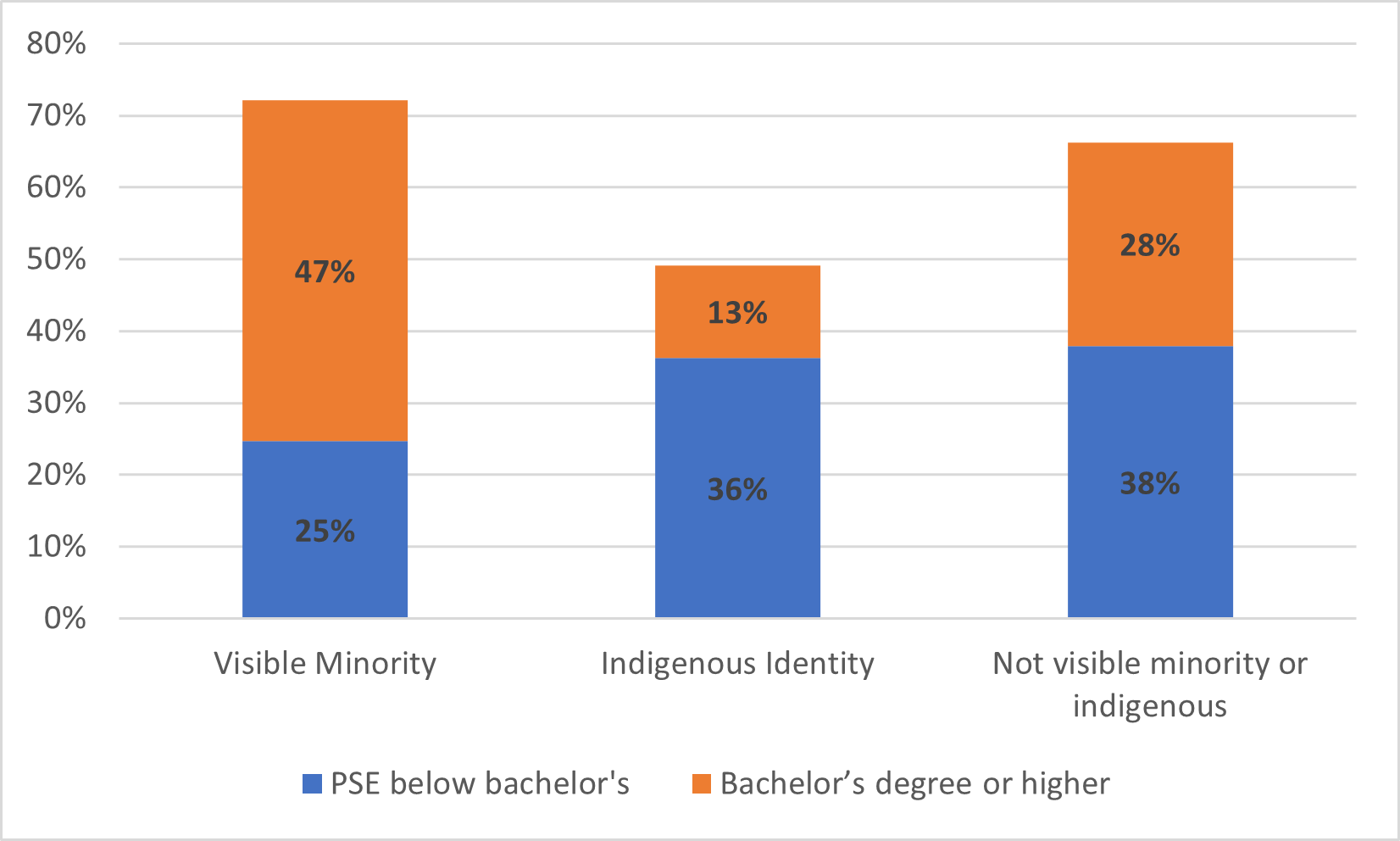
Figure 1 shows the attainment rates of the population aged 25-64, by visible minority status and Indigenous identity.    What it shows is that there are some quite fascinating differences in attainment rates across different segments of the population.   Individuals who self-declare as visible minorities are somewhat less likely than other Canadian to have a PSE credential below the bachelor’s level but substantially more likely to have a degree at the bachelor’s level or above.  Those reporting Indigenous identity, meanwhile, have college credentials at higher levels similar to those of non-visible minority/non-Indigenous Canadians, but university attainment rates substantially  lower than those of other Canadians.  White Canadians have higher college attainment rates than visible minorities, but substantially lower university attainment rates. 

Figure 1: Post-Secondary Education Attainment by Level, Visible Minority Status and Indigenous Identity, Canadians Aged 25-64, Census 2021

Stacked bars showing that visible minorities have the highest rate of bachelor degree or above attainment.

This is, by the way, quite different from the situation in basically any other developed country except perhaps Australia and New Zealand; in most other countries with large scale immigration, visible minority populations tend to have much lower levels of education that the mainstream population.

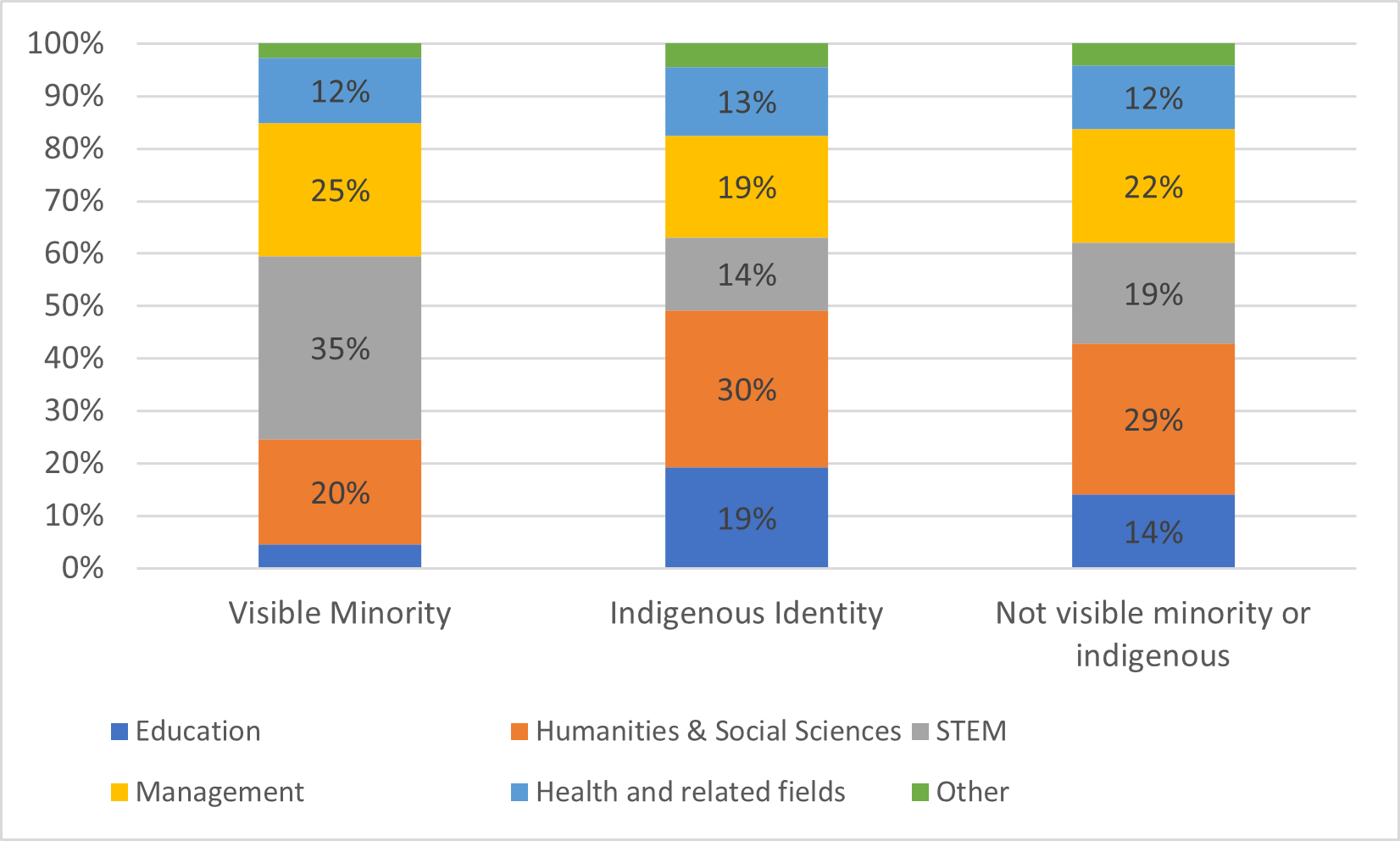
One of the interesting things about this census is that it permits analysis not just by level of education but also by field of study.  Figure 2 runs the same analysis as figure 1, only examining the distribution of undergraduate degrees.  Again, we see some interesting distributions by visible minority/Indigenous identity.  The proportions of Canadians of various backgrounds who are in the fields of health and business are relatively consistent, but there are huge differences in the areas of education, social sciences/humanities and STEM.  For those with Indigenous identities, 45% of all degrees are in education, humanities and social sciences, while only 14% of all degrees are in STEM; among visible minorities (who, recall, are more than 3 times as likely to have a degree as those with Indigenous identity), it is 25% in education, humanities and social sciences and 35% in STEM.

Figure 2: Distribution of Degrees by Broad Field, Visible Minority Status and Indigenous Identity, Canadians Aged 25-64, Census 2021

Stacked bar charts showing percentage of people with education, humanities, SETM, management, health, or Other degrees

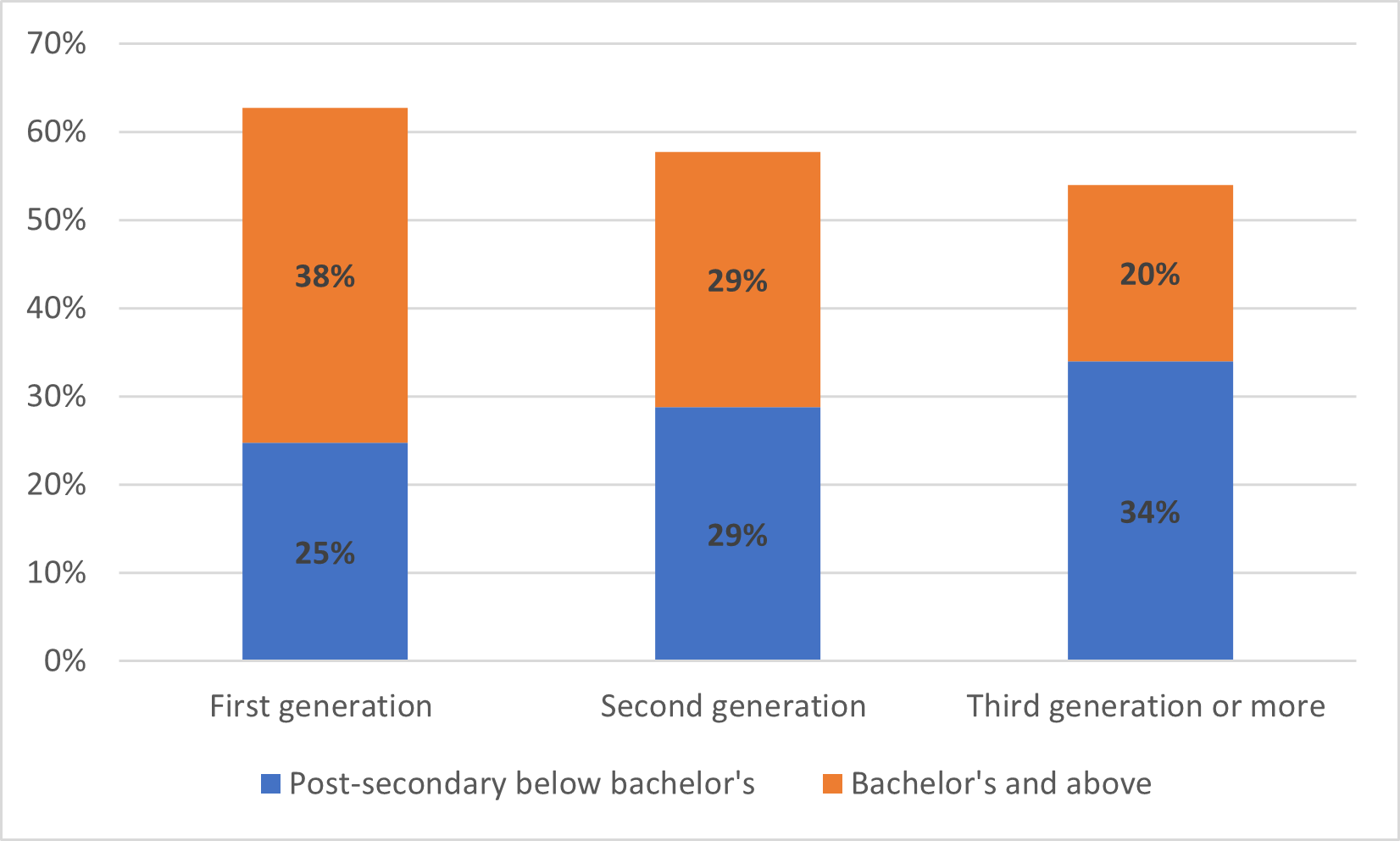
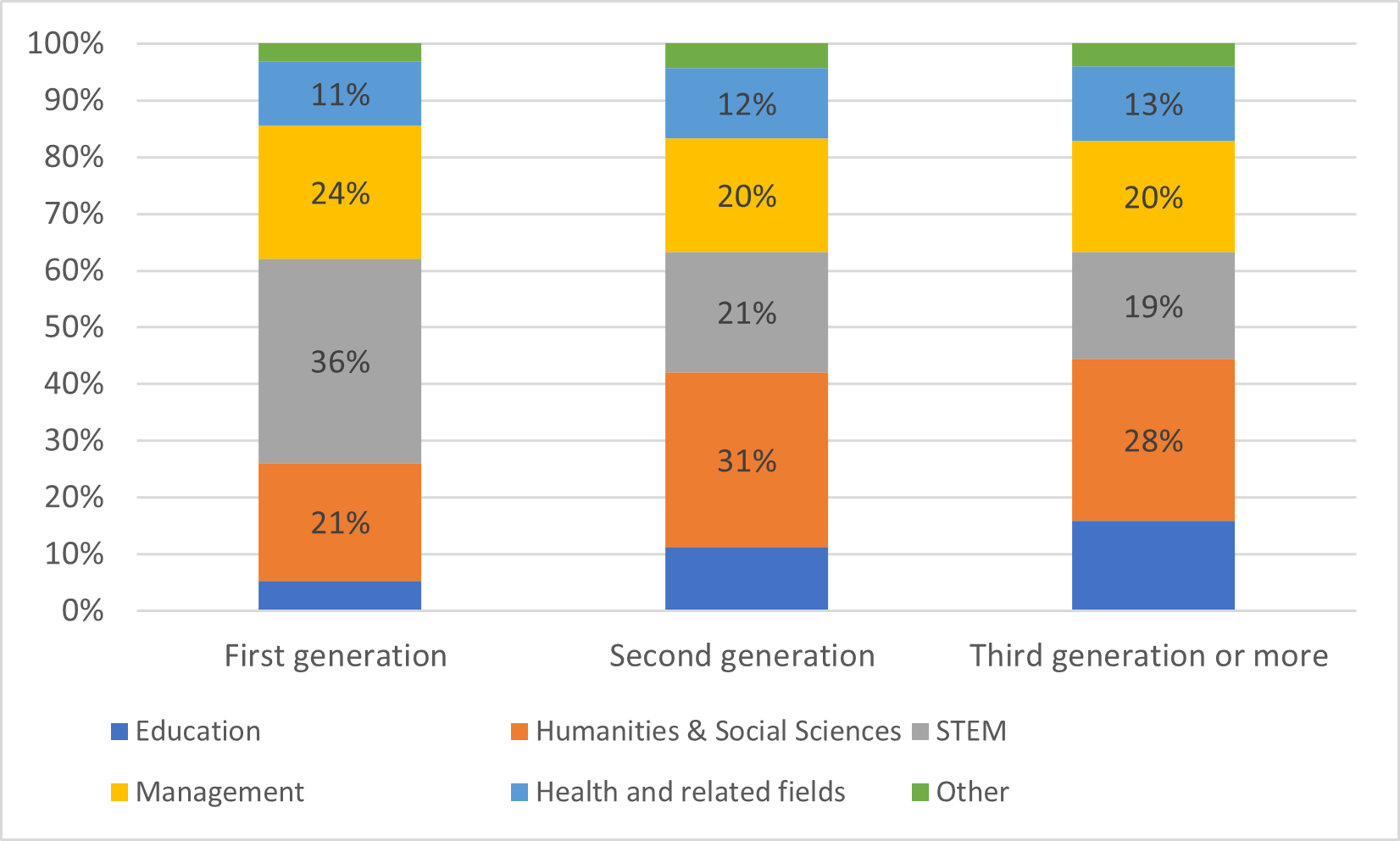
We can run the same kind of analyses by immigration status.  In figures 3 and 4, we repeat the analysis in figures 1 and 2, only by immigration status.  Statistics Canada divides Canadians into “first generation” (basically, individuals born outside Canada), “second generation” (at least one parent born outside Canada) and “third generation or more” (both parents born in Canada).  That second category is – if you ask me – a heck of a hodge-podge, so focus on the difference between first and third generations. 

Figure 3: Post-Secondary Education Attainment by Level and Immigration Generation, Canadians Aged 25-64, Census 2021

Stacked bars showing that "Third generation" people have the lowest percentage of bachelor attainments.

Figure 4: Distribution of Degrees by Broad Field and by Immigration Generation, Canadians Aged 25-64 Census 2021

Stacked bars showing that "Third generation" people have more humanities and social science degrees and "first generation" people have more STEM degrees.

There’s an old (American) cliche about how the first generation of immigrant families works hard in menial jobs to make sure their kids get ahead, the second generation works hard to get into professional schools and attract great wealth while the third generation goes to art school.  By the looks of it, Canada’s points-based immigration system allows us to skip that first generation thus bringing immigrants into humanities and arts programs that much faster.

Source: A First Look At 2021 Education Census Data

Hate Speech’s Rise on Twitter Is Unprecedented, Researchers Find

Of note. Likely to get worse:

Before Elon Musk bought Twitter, slurs against Black Americans showed up on the social media service an average of 1,282 times a day. After the billionaire became Twitter’s owner, they jumped to 3,876 times a day.

Slurs against gay men appeared on Twitter 2,506 times a day on average before Mr. Musk took over. Afterward, their use rose to 3,964 times a day.

And antisemitic posts referring to Jews or Judaism soared more than 61 percent in the two weeks after Mr. Musk acquired the site.

These findings — from the Center for Countering Digital Hate, the Anti-Defamation League and other groups that study online platforms — provide the most comprehensive picture to date of how conversations on Twitter have changed since Mr. Musk completed his $44 billion deal for the company in late October. While the numbers are relatively small, researchers said the increases were atypically high.

The shift in speech is just the tip of a set of changes on the service under Mr. Musk. Accounts that Twitter used to regularly remove — such as those that identify as part of the Islamic State, which were banned after the U.S. government classified ISIS as a terror group — have come roaring back. Accounts associated with QAnon, a vast far-right conspiracy theory, have paid for and received verified status on Twitter, giving them a sheen of legitimacy.

These changes are alarming, researchers said, adding that they had never seen such a sharp increase in hate speech, problematic content and formerly banned accounts in such a short period on a mainstream social media platform.

“Elon Musk sent up the Bat Signal to every kind of racist, misogynist and homophobe that Twitter was open for business,” said Imran Ahmed, the chief executive of the Center for Countering Digital Hate. “They have reacted accordingly.”

Mr. Musk, who did not respond to a request for comment, has been vocal about being a “free speech absolutist” who believes in unfettered discussions online. He has moved swiftly to overhaul Twitter’s practices, allowing former President Donald J. Trump — who was barred for tweets that could incite violence — to return. Last week, Mr. Musk proposed a widespread amnesty for accounts that Twitter’s previous leadership had suspended. And on Tuesday, he ended enforcement of a policy against Covid misinformation.

But Mr. Musk has denied claims that hate speech has increased on Twitter under his watch. Last month, he tweeted a downward-trending graph that he said showed that “hate speech impressions” had dropped by a third since he took over. He did not provide underlying numbers or details of how he was measuring hate speech.

On Thursday, Mr. Musk said the account of Kanye West, which was restricted for a spell in October because of an antisemitic tweet, would be suspended indefinitely after the rapper, known as Ye, tweeted an image of a swastika inside the Star of David. On Friday, Mr. Musk said Twitter would publish “hate speech impressions” every week and agreed with a tweet that said hate speech spiked last week because of Ye’s antisemitic posts.

Changes in Twitter’s content not only have societal implications but also affect the company’s bottom line. Advertisers, which provide about 90 percent of Twitter’s revenue, have reduced their spending on the platform as they wait to see how it will fare under Mr. Musk. Some have said they are concerned that the quality of discussions on the platform will suffer.

On Wednesday, Twitter sought to reassure advertisers about its commitment to online safety. “Brand safety is only possible when human safety is the top priority,” the company wrote in a blog post. “All of this remains true today.”

The appeal to advertisers coincided with a meeting between Mr. Musk and Thierry Breton, the digital chief of the European Union, in which they discussed content moderation and regulation, according to an E.U. spokesman. Mr. Breton has pressed Mr. Musk to comply with the Digital Services Act, a European law that requires social platforms to reduce online harm or face fines and other penalties.

Mr. Breton plans to visit Twitter’s San Francisco headquarters early next year to perform a “stress test” of its ability to moderate content and combat disinformation, the spokesman said.

On Twitter itself, researchers said the increase in hate speech, antisemitic posts and other troubling content had begun before Mr. Musk loosened the service’s content rules. That suggested that a further surge could be coming, they said.

If that happens, it’s unclear whether Mr. Musk will have policies in place to deal with problematic speech or, even if he does, whether Twitter has the employees to keep up with moderation. Mr. Musk laid off, fired or accepted the resignations of more than half the company’s staff last month, including those who worked to remove harassment, foreign interference and disinformation from the service. Yoel Roth, Twitter’s head of trust of safety, was among those who quit.

The Anti-Defamation League, which files regular reports of antisemitic tweets to Twitter and keeps track of which posts are removed, said the company had gone from taking action on 60 percent of the tweets it reported to only 30 percent.

“We have advised Musk that Twitter should not just keep the policies it has had in place for years, it should dedicate resources to those policies,” said Yael Eisenstat, a vice president at the Anti-Defamation League, who met with Mr. Musk last month. She said he did not appear interested in taking the advice of civil rights groups and other organizations.

“His actions to date show that he is not committed to a transparent process where he incorporates the best practices we have learned from civil society groups,” Ms. Eisenstat said. “Instead he has emboldened racists, homophobes and antisemites.”

The lack of action extends to new accounts affiliated with terror groups and others that Twitter previously banned. In the first 12 days after Mr. Musk assumed control, 450 accounts associated with ISIS were created, up 69 percent from the previous 12 days, according to the Institute for Strategic Dialogue, a think tank that studies online platforms.

Other social media companies are also increasingly concerned about how content is being moderated on Twitter.

When Meta, which owns Facebook and Instagram, found accounts associated with Russian and Chinese state-backed influence campaigns on its platforms last month, it tried to alert Twitter, said two members of Meta’s security team, who asked not to be named because they were not authorized to speak publicly. The two companies often communicated on these issues, since foreign influence campaigns typically linked fake accounts on Facebook to Twitter.

But this time was different. The emails to their counterparts at Twitter bounced or went unanswered, the Meta employees said, in a sign that those workers may have been fired.

Source: Hate Speech’s Rise on Twitter Is Unprecedented, Researchers Find

How Canada can fix its ‘predatory’ relationship with international students

Good long read on the university and college cash cow and a program that has increasingly deviated from an education to a labour program, with some interesting insights from Australia.

While bit over the top, this money quote has an inconvenient truth:

“The whole objective of international education is just to make money and to grow the economy. It has really little to do with education,” says Kahlon. “If we’re honest about what the international education strategy is, it is just to raise Canada’s GDP.”

Canada’s international education strategy has been an undisputable success — the envy of other nations — attracting foreign students to come and study with the promise of work opportunities and the prospect of permanent residency and citizenship.

Over the years, the campaign has injected billions into the economy, created a pipeline of immigrants and fuelled a post-secondary education sector that struggled with declining public funding and falling domestic enrolment.

But that successful formula and unfettered growth seems to have reached a tipping point.

Students who are falling through the cracks are starting to question whether their investment of time and money, by way of hefty tuition fees, is paying off.

And Canada doesn’t need a crystal ball to see what lies ahead.

“A CASH cow is all very well, and a fine thing when it is happily chomping in the field. But what happens when it grows horns, turns nasty and demands that you feed it more and look after it better?”

That was a question raised in an article published in The Age, one of Australia’s oldest and most reputable newspapers, back in 2008. At the time, Australia was seeing an exponential growth in international enrolment that made the then-$12.5 billion international education sector its third-largest export after coal and iron.

“There is pressure on the industry from without and within. Increasing competition from foreign universities in the global race for market share, Australian universities at capacity, and a growing perception that Australia’s international students have been exploited on one hand, and neglected on the other, are biting hard,” the story continued.

There were other reports about international students in Australia being “underpaid and exploited” as a labour underclass, of students struggling with social isolation, feeling unhappy with the immigration prospects and facing “severe overcrowding” in rooming houses, including one extreme case where 48 students were living in a six-bedroom property.

Canada has been following a similar trajectory, some say.

The pandemic has further exposed international students’ precariousness and our country’s disjointed education and immigration systems, which leave students disillusioned amid a patchwork of support that relies on the goodwill of the schools, employers and local communities.

More and more international students in Canada are publicly complaining about exploitation and wage thefts by bad employers and landlords, the financial and emotional hardship of the journey, and the unfulfilled immigration dream sold to them by unscrupulous education recruiters.

Increasingly, there’s a recognition that what they have been promised is not exactly what they’re getting. while studying in Canada is not a guaranteed pathway for permanent residence that many expect.

It’s led to a growing chorus of voices calling on the Canadian government to refresh its strategy to ensure its international enrolment growth is sustainable and its appeal as a destination of choice will last.

But what would a reset, recalibrated international student program look like in Canada?

There is some no shortage of possibilities.

Resetting Canada’s international education strategy

The Canadian government launched an aggressive campaign in 2014 to boost its annual number of international students to more than 450,000 by 2022.

The country has long surpassed that goal.

Last year, there were 845,930 valid study permit holders in Canada, which rose to 917,445 as of Sept. 30 of this year.

International students, through their spending and tuition, contribute $22 billion to the Canadian economy and support 170,000 jobs in the country.

Those international students, who typically pay up to four times more in tuition than their domestic counterparts, are a godsend to many Canadian colleges and universities to help fill classroom seats and keep courses open for domestic students who otherwise would’ve had fewer options from which to choose. They are also embraced by employers desperate for temporary help at gas stations, restaurants and factories to keep businesses running.

Yet there have been increasing public calls for the federal government to better align academic goals, Canada’s economic needs and the interests of students.

The RBC has recently recommended Ottawa to be more strategic in leveraging and expanding its international student pool in the global race for skilled workers post-pandemic; the Conference Board of Canada in a separate report urged better co-ordination to ensure the number of international students admitted are in line with thelevel of permanent residents admitted each year to avoid further “friction.”

Australia moved to reset its own system.

International enrolment there had blossomed from 256,553 in 2002 to 583,483 in 2009 as migrants were drawn by the opportunities to work and stay in the country permanently before Canberra decided to rein in an unruly sector by “desegregating education and immigration.”

Australian officials began asking education institutions to register international education agents who worked for them and to review their performances based on student enrolment outcomes.

The bar for permanent residence was raised and limited to those who completed degree-level programs, postgraduate programs and regulated professions such as nursing, engineering and social work.

All applicants must submit a statement detailing their personal circumstances and why they pursue a particular program in Australia. Each is assessed based on the study plan, as well as factors such as the economic situation, military service commitments and even political and civil unrest in the person’s home country to make sure they are “genuine temporary entrants.”

Today, international education is still worth about $34 billion (Canadian) to Australia’s economy, with 418,168 in higher education out of 882,482 students in international enrolment in 2020. The rest were mainly in language training and vocational schools.

International students, meanwhile, go where the opportunities are. Experts say students traditionally turn to other jurisdictions with fewer perceived barriers when countries such as Australia restrict the pipeline.

Students “are using commercial agents to find the cheapest, most affordable routes there are,” says Chris Ziguras, a professor at RMIT University in Melbourne, who studies the globalization of education.

“At the moment, I think there’s a lot of students clearly voting with their feet and choosing that pathway into Canada over other pathways which are more expensive, more difficult and more restrictive. And that’s why we’re seeing the bulge there.”

A patchwork of settlement supports for foreign students

Noor Azrieh didn’t know anyone in Canada when she came to Carleton University in 2018 for a four-year journalism and human rights program. The 22-year-old Lebanese says she has had issues finding housing and skilled jobs because of her temporary status.

Landlords would often ask for six-to-eight-month rent deposits and demand a Canadian guarantor, while employers lost interest in hiring her once they found out she was here on a time-limited post-graduate work permit.

“It feels like you are doing this entirely alone. And maybe that’s just how it is,” says Azrieh, who works full time as an associate producer at CANADALAND. “Maybe I wasn’t ready to move across the country, across the globe, to a country that I didn’t know. But it felt like I was doing everything alone.”

.Colleges and universities are educational institutions, and some don’t have the capacity to properly support international students, who lack access to the kind of settlement services designed exclusively for permanent residents.

In light of the service gaps, immigrant agencies in B.C. now provide support for international students and temporary foreign workers through one-on-one information and referral, workshops and support groups.

Nova Scotia also launched a pilot program recently that offers international students in their final year help with career development opportunities and community connections to successfully transition to permanent residence.

However, these supports are piecemeal and it’s unclear who is responsible for the costs and the students’ well-being, says Lisa Brunner, a University of British Columbia doctoral student, whose research focuses on immigration, higher education and internationalization.

“If you’re coming from an institution’s perspective, my goal is to support students in their education and their experience in Canada, versus the government saying, ‘OK, we want to support this person because they’re a future immigrant and we want to retain them,’ ” she says.

“Those are two different types of services.

“The way it’s structured now works well for the government, because essentially the students themselves are responsible for the settlement process. Either they acquire the capital that’s necessary to succeed in the labour market to qualify for permanent residence or they don’t. In this way, the government doesn’t have to fund the services.”

“We all acknowledge giving access to students to those (settlement and support) services from the beginning of their journeys would be a tremendous return on investment for Canada,” says Larissa Bezo, president and CEO of the Canadian Bureau for International Education, a not-for-profit organization that aims to promote and advance Canadian international education.

“There’s a shared responsibility that we have … And in a federation like ours, that’s complex. I’m under no illusion. But we need to do a better job of connecting these dots.”

Coming out of the pandemic, Bezo says, Canada’s global brand has remained strong as Canadian governments and the sector pivoted in supporting international students through the crisis as other countries such as Australia asked their students to go home.

Clear messaging to international students

Balraj Kahlon, who co-founded One Voice Canada in British Columbia in 2019 to support and advocate for international students, says Canada’s international education strategy has been “ruthlessly” successful.

“The whole objective of international education is just to make money and to grow the economy. It has really little to do with education,” says Kahlon. “If we’re honest about what the international education strategy is, it is just to raise Canada’s GDP.”

He says the country’s international enrolment has increasingly been coming from the working poor in developing countries, lured by Canada’s relatively low tuition fees, the chance to work and make money to pay off family loans for the studies, and sometimes misinformation by unscrupulous education agents about the direct pathway for permanent residence.

He says many international students these days are pursuing the cheaper and shorter programs at colleges with the sole intent of immigration, even if they know they can’t afford the tuition fees and their courses won’t get them beyond a warehouse, factory or retail job.

Yet, he says many can’t resist the allure of the opportunity for permanent residence and a life toiling in low-wage, low-skilled jobs in Canada that still pay more than what they would earn back home.

If the international education strategy really aims to attract the best and the brightest, he says, permanent residency should be limited to the students who are at the top in their fields by lowering their tuition and making schooling affordable to them.

“Until you get rid of the profit motive, problems are going to keep coming, because the incentive is always just more numbers,” says Kahlon.

Sixty per cent of international students do plan to apply for permanent residence in Canada, but only three in 10 international students who entered the country in 2000 or later ended up obtaining permanent residence within 10 years.

While some fail to complete their education or secure employment for immigration, others find opportunities elsewhere and leave.

“Higher-education admission policies and procedures have a very different goal than the admission criteria for economic immigrants,” says Grunner, the UBC researcher. “That difference is not always clear to students before they come to Canada.

“The message they get is that Canada wants international students. That’s the policy message that gets communicated. International students are desired by Canada for their labour. We got that message very clear because it says that international students can now work for the next year with unlimited hours. And international students are desired as potential immigrants.”

Diversifying where and what students choose to study

Paul Davidson, president of Universities Canada, says there is capacity to absorb more international students, though that capacity isn’t evenly distributed across the country.

Governments, education institutions, immigrant settlement agencies, local communities and employers all have a stake in ensuring international students’ experience and well-being, he says.

“It’s really important that international students get credible information and are supported in every step of their training,” says Davidson, whose organization is the voice for 93 Canadian universities. “There are people making false claims about what their experience in Canada will be and we need to call that out.”

Denise Amyot, his counterpart at Colleges and Institutes Canada, says the federal government not only needs to diversify the source of international students here (currently 35 per cent from India; 17 per cent from China; and four per cent from France), but also where and what they choose to study.

Her organization released a report last year, calling for new permanent residency streams and supports for colleges to improve their labour market outcomes.

“I would be in favour of accelerating permanent residency for students that are in the areas of skills that we need,” says Amyot, who also would like to see international students be eligible for government-funded co-op and job programs.

“It’s important that students do their homework (and ask), ‘How I will be integrated into the community,’ where they look at the best possible scenario for what they want to do and what’s their intentions moving forward.”

Global Affairs Canada says the government has aimed to diversify the countries of origin of its international students, promote study opportunities, especially outside of major urban centres, and showcase sectors to highlight areas of labour shortages and encourage study in those fields through digital marketing initiatives.

Several targeted international ad campaigns will be carried out to promote programs in STEM, artificial intelligence and quantum technologies, the department says. Consultations are underway to renew the country’s international education strategy.

Striking a balance

Sana Banu, an international student from India, can’t say enough about the amazing experience she’s had at Kitchener, Ont.-based Conestoga College, despite all the challenges her peers face and a pathway to permanent residence that’s full of pitfalls.

It has given her experience that has pushed her out of her comfort zone, says the 29-year-old, who came here in 2018 to study marketing and communication with an undergrad degree and eight years of work experience in advertising back home.

International students are a diverse group, each with their expectations and intentions, and it’s impossible to generalize everyone’s experience.

To Banu, the issues come down to equity — whether it’s about the hefty and uncapped international tuition fees or job opportunities that usually favour permanent residents and citizens.

“The relationship shouldn’t be predatory,” says Banu, president and CEO of Conestoga’s student association, who was recently invited to apply for permanent residence. “It’s a mutually beneficial relationship that international students provide to Canada and Canada provides to international students.

“It’s important that everybody sees the human side of an international student rather than just as a resource to fill your economic gaps and contribute to your economy exclusively. They are humans, who are coming here with expectations, dreams and hopes. And you could do a lot more in treating them with more dignity, equity and compassion.”

Source: How Canada can fix its ‘predatory’ relationship with international students
Canada’s international education strategy has been an undisputable success — the envy of other nations — attracting foreign students to come and study with the promise of work opportunities and the prospect of permanent residency and citizenship.

Over the years, the campaign has injected billions into the economy, created a pipeline of immigrants and fuelled a post-secondary education sector that struggled with declining public funding and falling domestic enrolment.

But that successful formula and unfettered growth seems to have reached a tipping point.

Students who are falling through the cracks are starting to question whether their investment of time and money, by way of hefty tuition fees, is paying off.

And Canada doesn’t need a crystal ball to see what lies ahead.

“A CASH cow is all very well, and a fine thing when it is happily chomping in the field. But what happens when it grows horns, turns nasty and demands that you feed it more and look after it better?”

That was a question raised in an article published in The Age, one of Australia’s oldest and most reputable newspapers, back in 2008. At the time, Australia was seeing an exponential growth in international enrolment that made the then-$12.5 billion international education sector its third-largest export after coal and iron.

“There is pressure on the industry from without and within. Increasing competition from foreign universities in the global race for market share, Australian universities at capacity, and a growing perception that Australia’s international students have been exploited on one hand, and neglected on the other, are biting hard,” the story continued.

There were other reports about international students in Australia being “underpaid and exploited” as a labour underclass, of students struggling with social isolation, feeling unhappy with the immigration prospects and facing “severe overcrowding” in rooming houses, including one extreme case where 48 students were living in a six-bedroom property.

Canada has been following a similar trajectory, some say.

The pandemic has further exposed international students’ precariousness and our country’s disjointed education and immigration systems, which leave students disillusioned amid a patchwork of support that relies on the goodwill of the schools, employers and local communities.

More and more international students in Canada are publicly complaining about exploitation and wage thefts by bad employers and landlords, the financial and emotional hardship of the journey, and the unfulfilled immigration dream sold to them by unscrupulous education recruiters.

Increasingly, there’s a recognition that what they have been promised is not exactly what they’re getting. while studying in Canada is not a guaranteed pathway for permanent residence that many expect.

It’s led to a growing chorus of voices calling on the Canadian government to refresh its strategy to ensure its international enrolment growth is sustainable and its appeal as a destination of choice will last.

But what would a reset, recalibrated international student program look like in Canada?

There is some no shortage of possibilities.

Resetting Canada’s international education strategy

The Canadian government launched an aggressive campaign in 2014 to boost its annual number of international students to more than 450,000 by 2022.

The country has long surpassed that goal.

Last year, there were 845,930 valid study permit holders in Canada, which rose to 917,445 as of Sept. 30 of this year.

International students, through their spending and tuition, contribute $22 billion to the Canadian economy and support 170,000 jobs in the country.

Those international students, who typically pay up to four times more in tuition than their domestic counterparts, are a godsend to many Canadian colleges and universities to help fill classroom seats and keep courses open for domestic students who otherwise would’ve had fewer options from which to choose. They are also embraced by employers desperate for temporary help at gas stations, restaurants and factories to keep businesses running.

Yet there have been increasing public calls for the federal government to better align academic goals, Canada’s economic needs and the interests of students.

The RBC has recently recommended Ottawa to be more strategic in leveraging and expanding its international student pool in the global race for skilled workers post-pandemic; the Conference Board of Canada in a separate report urged better co-ordination to ensure the number of international students admitted are in line with thelevel of permanent residents admitted each year to avoid further “friction.”

Australia moved to reset its own system.

International enrolment there had blossomed from 256,553 in 2002 to 583,483 in 2009 as migrants were drawn by the opportunities to work and stay in the country permanently before Canberra decided to rein in an unruly sector by “desegregating education and immigration.”

Australian officials began asking education institutions to register international education agents who worked for them and to review their performances based on student enrolment outcomes.

The bar for permanent residence was raised and limited to those who completed degree-level programs, postgraduate programs and regulated professions such as nursing, engineering and social work.

All applicants must submit a statement detailing their personal circumstances and why they pursue a particular program in Australia. Each is assessed based on the study plan, as well as factors such as the economic situation, military service commitments and even political and civil unrest in the person’s home country to make sure they are “genuine temporary entrants.”

Today, international education is still worth about $34 billion (Canadian) to Australia’s economy, with 418,168 in higher education out of 882,482 students in international enrolment in 2020. The rest were mainly in language training and vocational schools.

International students, meanwhile, go where the opportunities are. Experts say students traditionally turn to other jurisdictions with fewer perceived barriers when countries such as Australia restrict the pipeline.

Students “are using commercial agents to find the cheapest, most affordable routes there are,” says Chris Ziguras, a professor at RMIT University in Melbourne, who studies the globalization of education.

“At the moment, I think there’s a lot of students clearly voting with their feet and choosing that pathway into Canada over other pathways which are more expensive, more difficult and more restrictive. And that’s why we’re seeing the bulge there.”

A patchwork of settlement supports for foreign students

Noor Azrieh didn’t know anyone in Canada when she came to Carleton University in 2018 for a four-year journalism and human rights program. The 22-year-old Lebanese says she has had issues finding housing and skilled jobs because of her temporary status.

Landlords would often ask for six-to-eight-month rent deposits and demand a Canadian guarantor, while employers lost interest in hiring her once they found out she was here on a time-limited post-graduate work permit.

“It feels like you are doing this entirely alone. And maybe that’s just how it is,” says Azrieh, who works full time as an associate producer at CANADALAND. “Maybe I wasn’t ready to move across the country, across the globe, to a country that I didn’t know. But it felt like I was doing everything alone.”

.Colleges and universities are educational institutions, and some don’t have the capacity to properly support international students, who lack access to the kind of settlement services designed exclusively for permanent residents.

In light of the service gaps, immigrant agencies in B.C. now provide support for international students and temporary foreign workers through one-on-one information and referral, workshops and support groups.

Nova Scotia also launched a pilot program recently that offers international students in their final year help with career development opportunities and community connections to successfully transition to permanent residence.

However, these supports are piecemeal and it’s unclear who is responsible for the costs and the students’ well-being, says Lisa Brunner, a University of British Columbia doctoral student, whose research focuses on immigration, higher education and internationalization.

“If you’re coming from an institution’s perspective, my goal is to support students in their education and their experience in Canada, versus the government saying, ‘OK, we want to support this person because they’re a future immigrant and we want to retain them,’ ” she says.

“Those are two different types of services.

“The way it’s structured now works well for the government, because essentially the students themselves are responsible for the settlement process. Either they acquire the capital that’s necessary to succeed in the labour market to qualify for permanent residence or they don’t. In this way, the government doesn’t have to fund the services.”

“We all acknowledge giving access to students to those (settlement and support) services from the beginning of their journeys would be a tremendous return on investment for Canada,” says Larissa Bezo, president and CEO of the Canadian Bureau for International Education, a not-for-profit organization that aims to promote and advance Canadian international education.

“There’s a shared responsibility that we have … And in a federation like ours, that’s complex. I’m under no illusion. But we need to do a better job of connecting these dots.”

Coming out of the pandemic, Bezo says, Canada’s global brand has remained strong as Canadian governments and the sector pivoted in supporting international students through the crisis as other countries such as Australia asked their students to go home.

Clear messaging to international students

Balraj Kahlon, who co-founded One Voice Canada in British Columbia in 2019 to support and advocate for international students, says Canada’s international education strategy has been “ruthlessly” successful.

“The whole objective of international education is just to make money and to grow the economy. It has really little to do with education,” says Kahlon. “If we’re honest about what the international education strategy is, it is just to raise Canada’s GDP.”

He says the country’s international enrolment has increasingly been coming from the working poor in developing countries, lured by Canada’s relatively low tuition fees, the chance to work and make money to pay off family loans for the studies, and sometimes misinformation by unscrupulous education agents about the direct pathway for permanent residence.

He says many international students these days are pursuing the cheaper and shorter programs at colleges with the sole intent of immigration, even if they know they can’t afford the tuition fees and their courses won’t get them beyond a warehouse, factory or retail job.

Yet, he says many can’t resist the allure of the opportunity for permanent residence and a life toiling in low-wage, low-skilled jobs in Canada that still pay more than what they would earn back home.

If the international education strategy really aims to attract the best and the brightest, he says, permanent residency should be limited to the students who are at the top in their fields by lowering their tuition and making schooling affordable to them.

“Until you get rid of the profit motive, problems are going to keep coming, because the incentive is always just more numbers,” says Kahlon.

Sixty per cent of international students do plan to apply for permanent residence in Canada, but only three in 10 international students who entered the country in 2000 or later ended up obtaining permanent residence within 10 years.

While some fail to complete their education or secure employment for immigration, others find opportunities elsewhere and leave.

“Higher-education admission policies and procedures have a very different goal than the admission criteria for economic immigrants,” says Grunner, the UBC researcher. “That difference is not always clear to students before they come to Canada.

“The message they get is that Canada wants international students. That’s the policy message that gets communicated. International students are desired by Canada for their labour. We got that message very clear because it says that international students can now work for the next year with unlimited hours. And international students are desired as potential immigrants.”

Diversifying where and what students choose to study

Paul Davidson, president of Universities Canada, says there is capacity to absorb more international students, though that capacity isn’t evenly distributed across the country.

Governments, education institutions, immigrant settlement agencies, local communities and employers all have a stake in ensuring international students’ experience and well-being, he says.

“It’s really important that international students get credible information and are supported in every step of their training,” says Davidson, whose organization is the voice for 93 Canadian universities. “There are people making false claims about what their experience in Canada will be and we need to call that out.”

Denise Amyot, his counterpart at Colleges and Institutes Canada, says the federal government not only needs to diversify the source of international students here (currently 35 per cent from India; 17 per cent from China; and four per cent from France), but also where and what they choose to study.

Her organization released a report last year, calling for new permanent residency streams and supports for colleges to improve their labour market outcomes.

“I would be in favour of accelerating permanent residency for students that are in the areas of skills that we need,” says Amyot, who also would like to see international students be eligible for government-funded co-op and job programs.

“It’s important that students do their homework (and ask), ‘How I will be integrated into the community,’ where they look at the best possible scenario for what they want to do and what’s their intentions moving forward.”

Global Affairs Canada says the government has aimed to diversify the countries of origin of its international students, promote study opportunities, especially outside of major urban centres, and showcase sectors to highlight areas of labour shortages and encourage study in those fields through digital marketing initiatives.

Several targeted international ad campaigns will be carried out to promote programs in STEM, artificial intelligence and quantum technologies, the department says. Consultations are underway to renew the country’s international education strategy.

Striking a balance

Sana Banu, an international student from India, can’t say enough about the amazing experience she’s had at Kitchener, Ont.-based Conestoga College, despite all the challenges her peers face and a pathway to permanent residence that’s full of pitfalls.

It has given her experience that has pushed her out of her comfort zone, says the 29-year-old, who came here in 2018 to study marketing and communication with an undergrad degree and eight years of work experience in advertising back home.

International students are a diverse group, each with their expectations and intentions, and it’s impossible to generalize everyone’s experience.

To Banu, the issues come down to equity — whether it’s about the hefty and uncapped international tuition fees or job opportunities that usually favour permanent residents and citizens.

“The relationship shouldn’t be predatory,” says Banu, president and CEO of Conestoga’s student association, who was recently invited to apply for permanent residence. “It’s a mutually beneficial relationship that international students provide to Canada and Canada provides to international students.

“It’s important that everybody sees the human side of an international student rather than just as a resource to fill your economic gaps and contribute to your economy exclusively. They are humans, who are coming here with expectations, dreams and hopes. And you could do a lot more in treating them with more dignity, equity and compassion.”

Source: How Canada can fix its ‘predatory’ relationship with international students
Paul: Free to Be You and Me. Or Not.

Of note:

If you grew up in any remotely liberal enclave of America in the 1970s or 1980s, you grew up believing a few things.

You believed that you lived in a land where the children were free,where it didn’t matter whether you were a boy or a girl because neither could limit your choices — not when you were a kid, not when you grew up. You believed it was perfectly fine for William to want a doll and if you were a girl, you might have been perfectly happy for him to take yours.

You believed these things because of “Free to Be … You and Me.” That landmark album, which had its 50th anniversary last month, and its companion book shaped a generation. It took the idealism and values of the civil rights and the women’s rights movements and packaged them into a treasury of songs, poems and stories that was at once earnest, silly and wholeheartedly sappy. It was the kind of thing a kid felt both devoted to and slightly embarrassed by. The soundtrack got stuck in your head. The book fell apart at the seams.

In other words, for a certain generation, “Free to Be” waschildhood.

And that achievement is something to celebrate no matter your age. Alas, marking that achievement — the brainchild of Marlo Thomas and other trailblazers including Carole Hart, Letty Cottin Pogrebin and Mary Rodgers — also means grappling with the erosion of those ideas. Is it possible we’ve moved past the egalitarian ideals of “Free to Be … You and Me,” and if so, is that a step forward?

To get to an answer, let’s consider what “Free to Be” had to say — and to sing. The album opened with a title song that proclaimed: “Every boy in this land grows to be his own man. In this land every girl grows to be her own woman.” That doesn’t sound like much now, but at the time, it was revolutionary. No matter how liberated your parents were, the larger culture still typically assumed rigid roles for boys and girls, the latter still very much considered the fragile sex. I can’t count how many times people told me, on finding out I had seven brothers, “How lucky you are to have them to protect you!”

“Free to Be” unshackled boys and girls from these kinds of gender stereotypes. As Pogrebin wrote in the book’s introduction, “What we have been seeking is a literature of human diversity that celebrates choice and that does not exclude any child from its pleasures because of race or sex, geography or family occupation, religion or temperament.” For what now seems like a brief moment, boys and girls wore the same unflattering turtlenecks and wide-wale corduroys. Parents encouraged daughters to dream about becoming doctors and police officers. Boys were urged to express feelings. Everyone was allowed to cry.

Then the pushback began. Some of it stemmed from ongoing conservative resistance to feminism’s gains. Some of it was about money. And some it of it emerged from a strain of progressivism that has repurposed some of the very stereotypes women and men worked so hard to sweep away.

These moves started with an ’80s backlash against the women’s movement and, while much of it was ideological, not surprisingly some of it was about money. When lucrative boomers became parents, the toy industry redivided playthings into separate aisles. In a round table for the 50th anniversary of Ms. magazine, also this year, Pogrebin remarked: “Now I have a stroke when I go through toy stores where still everything is pink and blue. When you order a toy online, they say, ‘Is it for a girl or a boy?’ They don’t say, ‘Is this a child who’s interested in nature or in bugs or in dinosaurs?’ They say, ‘Boy or girl?’ That was gone in the ’70s and ’80s. But that’s all slid backwards.”

Of course, when clothing, toys or books are gendered, companies selling those goods make more money. In their 2012 anthology, “When We Were Free to Be: Looking Back at a Children’s Classic and the Difference It Made,” Lori Rotskoff and Laura L. Lovett noted with dismay, “When crass commercialism shows its true colors, pink and blue don’t make purple, they make green, multiplying profits every time parents buy into the premise that girls and boys require different playthings, books, websites and computer games.”

Such stereotypes belie the lessons Mel Brooks and Marlo Thomas imparted in the beloved sketch “Boy Meets Girl,” featuring a girl baby and a boy baby, the latter of whom thinks he might be a girl because he’s afraid of mice and wants to be a cocktail waitress. Back at Main Street School in 1980, where my third-grade class performed the play version of the book, those were the most coveted roles. Everyone wanted to be one of those babies! I didn’t get the part, but I did get the message. Like other liberated kids, I accepted the reality of biological science that I was a girl — and rejected the fiction of gendered social conventions that as such, I should incline toward pink dresses and Barbies.

Now we risk losing those advances. In lieu of liberating children from gender, some educators have doubled down, offering children a smorgasbord of labels — gender identity, gender role, gender performance and gender expression — to affix to themselves from a young age. Some go so far as to suggest that not only is gender “assigned” to people at birth but that sex in humans is a spectrum (even though accepted science holds that sex in humans is fundamentally binary, with a tiny number of people having intersex traits). The effect of all this is that today we are defining people — especially children — by gender more than ever before, rather than trying to free both sexes from gender stereotypes.

Oh, for the days of “Parents Are People,” when Thomas and Harry Belafonte proposed that mommies and daddies — and by extension, women and men, regardless of whether they are parents — should no longer be held back by traditionalist expectations. That they could, as Rotskoff and Lovett put it, “transcend prevailing norms of acceptable ‘boy’ or ‘girl’ behavior.” That everyone, at base, is free to be “gender nonconforming.” (It’s worth noting that Thomas, when asked in 2015 if “Free to Be” fit in with transgender rights, said its message encompasses everyone.)

As for that land where the children run free, there is little running around now. Despite efforts at free-range parenting, kids tend to be hovered over at all times: In school by surveillance systems like GoGuardian and ClassDojo and the parent portal. In their free time, by the location devices built into their smartwatches and phones. At home, by nanny cams and smart devices. And the children probably are home, socializing on their screens rather than outside riding a bike or playing kick-the-can until someone yells “Dinner!”

We’ve found new ways to box children in.

In 2012, when I interviewed Marlo Thomas on the 40th anniversary of the “Free to Be,” she told me, “The ideas could never be outdated.” But whereas the 35th anniversary got a newly illustrated edition and the 40th anniversary was marked with an anthology of essays and stories in places like Slate and CNN, the 50th anniversary has quietly slipped by, but for a brief segment on NPR in which the host noted subsequent “huge changes when it comes to gender” and called some of the album “dated.”

Let’s not lose the positive changes. Why not open the book again, still widely available? Stream the album for your kids on Spotify. This is one case in which winding the clock back a little would actually be a real step forward.

Source: Free to Be You and Me. Or Not.

Love it but leave it: Foreign PhD students call for changes to let them stay in N.L.

I don’t understand the problem. They should have access to a Post-Graduate Work Permit (the Canadian equivalent to the US OPT visa), which would allow them to work and then transition to permanent residency.

Am I missing something?:

It took Foroogh Mohammadi a while to get used to the Newfoundland weather.

Five years ago she traded the hot temperatures of Iran for cool and blustery St. John’s

“I got used to it because the warmth of the people and the culture and and everything in the city warm our hearts,” she said.

Mohammadi, along with her husband Pouya Morshedi, are doing their PhDs in sociology at Memorial University.

They came for an education, but now it’s home.

“I love St. John’s and as I said, I love the people. So I definitely would love to stay here,” she said.

“Unfortunately because of very different challenges we face, we have to leave the province. We have no other choice than leaving the province.”

For Mohammadi, after graduation an academic job is one likely path, but it’s almost impossible for her to get in Canada; Memorial University, like other Canadian universities, looks at applications for citizens and permanent residents first — but in order to get permanent residency she needs to have a job.

She’s not alone in her struggle.

Sanaz Nabavian is facing the same predicament. She’s also from Iran, completing her PhD in management information systems.

She’s started a petition to try to change the rules.

“I’m not calling it discrimination, but it’s like a a problem. It’s a barrier,” she said.

Nabavian is starting a business, developing a software tool to help companies like contractors compare pricing on products they need for projects.

She wants to build the business here instead of getting a job with a company, making it harder for her to get permanent residency.

In a statement to CBC News, Immigration, Refugees and Citizenship Canada says PhD candidates could receive high scores in its Express Entry system for their language skills and education but can also apply for work through the provincial nominee program and the Atlantic immigration program.

Source: Love it but leave it: Foreign PhD students call for changes to let them stay in N.L.

Savory & Partners: Birthright citizenship and the exciting world of birth tourism

Have an update on Canadian numbers forthcoming but in the meantime, the marketing by one of the major citizenship-by-investment firms:

Jus Soli, or birthright citizenship, is a concept that has been applied for centuries throughout various countries. The premise of birthright citizenship is simple; those born within a country’s borders are granted direct citizenship.

However, in practice, birthright citizenship can get quite complicated, as each country continues to set its own laws and restrictions.

What is Jus Soli?

In April this year, Portugal passed a legislation regarding Jus Soli. According to this law, after one year of having a Portuguese residency, should you have a child born, they would be able to obtain Portuguese nationality immediately.

The idea of obtaining a preferable citizenship for one’s children remains a major attraction, and in a world where travel times are short and visas are plentiful, it has given birth to a new type of tourism altogether – birth tourism.

“Jus Soli, or birthright citizenship, is a concept that has been applied for centuries throughout various countries. The premise is simple; those born within a country’s borders are granted direct citizenship.”

Birth tourism refers to those who obtain a visit visa to give birth to their child in a country that has Jus Soli laws in place, allowing them to obtain a citizenship for their newborn.

Unlike immigrants giving birth to their children abroad in their new country of residence, birth tourism only requires a visit visa and a well-timed trip.

One of the countries with the highest birth tourism rate is unsurprisingly the USA, as the nation has unrestricted birthright citizenship laws in place, allowing anyone born on its land to obtain US citizenship directly.

While birth tourism is not easily tracked, the Center For Immigration Studies, a US based think tank, estimates that 33,000 people on visit visas give birth in the US each year. The center also states that most of these birth tourists hail from China, Taiwan, Korea, Nigeria, Turkey, Russia, Brazil, and neighboring Mexico.

The premise of birth tourism has quickly grown, but those considering it must be aware of the country’s birthright citizenship laws, as not all Jus Solis are born equal, and traveling to a country to give birth for the purposes of gaining citizenship without understanding birthright citizenship regulations can be a costly and futile affair.

Understanding Birthright Citizenship

First, there are unrestricted and restricted birthright citizenship laws. Unrestricted birthright citizenship means that anyone born on the soil of a nation will automatically obtain citizenship, no matter their circumstances. This is the case in the US, Canada, and even Brazil, which many estimate may be one of the most birth-touristic countries in the world thanks to its powerful passport and easy visa process.

Other countries have restricted birthright citizenship, which means that in addition to being born within the country’s jurisdiction. This is the case in the UK and Ireland, for example, where to gain citizenship in the former, one of the newborn’s parents must either be a citizen or a settled resident in the UK. Settled in this context refers to someone on a permanent residence permit, or an indefinite leave to remain in the UK.

As for Ireland, one of the parents must actually be a full-fledged citizen, hence negating the entire premise of birth tourism.

Most countries allow the children of their citizens born abroad to apply for citizenship; and with a few exceptions such as Saudi Arabia requiring the father to be a Saudi national for the child to obtain citizenship, it allows for people who venture into birth tourism to obtain dual citizenship for their newborn on the day they are born.

Understanding the laws of birthright citizenship is the first obstacle, the second is getting to the country at the right time. This usually requires a visa, unless a person has visa-free travel to a country, and in the case of the US, it is difficult for pregnant women to obtain B1 or B2 visas during their second and third trimesters.

The Dual Benefits of a Dual Citizenship

Nevertheless, birth tourism remains highly attractive, especially for those who have already obtained a second citizenship through investment. For example, a person that obtains a Maltese citizenship through investment gains the ability to travel visa free to the US and Canada, two countries with unrestricted birthright citizenship, and the latter even provides free healthcare.

By getting a Maltese citizenship, a person can structure it so that their child is born in the US or Canada, giving them a third citizenship in the process, in addition to the Maltese one and their original citizenship, essentially tearing down all mobility obstacles in their child’s path and providing them with the tools they need to fulfill their potential.

Another simplified route that allows people to get another citizenship for their children is through the Portuguese golden visa, which awards those who invest in Portugalwith a residency permit for themselves and their family members. If a person has a golden visa and has a child within Portugal then that child can become a citizenship after one year of their birth. As the golden visa has a fast track to citizenship after five years and minimal residence (just seven days a year), it is an excellent option for those looking to get a second citizenship for their children in a relatively short time frame while also laying the groundwork for getting the citizenship themselves a little farther in the future.

Birthright citizenship on its own remains a very interesting topic, however, when combined with citizenship by investment, it can yield outstanding results that are open to very few people around the world.

To know more about citizenship through birthright or investment, contact us today to talk with one of our second citizenship experts.

Source: Savory & Partners: Birthright citizenship and the exciting world of birth tourism