Native Americans recall torture, hatred at boarding schools

As in Canada:

After her mother died when Rosalie Whirlwind Soldier was just four years old, she was put into a Native American boarding school in South Dakota and told her native Lakota language was “devil’s speak.”

She recalls being locked in a basement at St. Francis Indian Mission School for weeks as punishment for breaking the school’s strict rules. Her long braids were shorn in a deliberate effort to stamp out her cultural identify. And when she broke her leg in an accident, Whirlwind Soldier said she received shoddy care leaving her with pain and a limp that still hobbles her decades later.

“I thought there was no God, just torture and hatred,” Whirlwind Soldier testified during a Saturday event on the Rosebud Sioux Reservation led by U.S. Interior Secretary Deb Haaland, as the agency confronts the bitter legacy of a boarding school system that operated in the U.S. for more than a century.

Now 78 and still living on the reservation, Whirlwind Soldier said she was airing her horrific experiences in hopes of finally getting past them.

“The only thing they didn’t do was put us in (an oven) and gas us,” she said, comparing the treatment of Native Americans in the U.S. in the 19th and 20th centuries to the Jewish Holocaust during World War II.

“But I let it go,” she later added. “I’m going to make it.”

Saturday’s event was the third in Haaland’s yearlong “Road to Healing” initiative for victims of abuse at government-backed boarding schools, after previous stops in Oklahoma and Michigan.

Starting with the Indian Civilization Act of 1819, the U.S. enacted laws and policies to establish and support the schools. The stated goal was to “civilize” Native Americans, Alaska Natives and Native Hawaiians, but that was often carried out through abusive practices. Religious and private institutions that ran many of the schools received federal funding and were willing partners.

Most closed their doors long ago and none still exist to strip students of their identities. But some, including St. Francis, still function as schools — albeit with drastically different missions that celebrate the cultural backgrounds of their Native students.

Former St. Francis student Ruby Left Hand Bull Sanchez traveled hundreds of miles from Denver to attend Saturday’s meeting. She cried as she recalled almost being killed as a child when a nun stuffed lye soap down her throat in response to Sanchez praying in her native language.

“I want the world to know,” she said.

Accompanying Haaland was Wizipan Garriott, a Rosebud Sioux member and principal deputy assistant secretary for Indian affairs. Garriott described how boarding schools were part of a long history of injustices against his people that began with the widespread extermination of their main food source — bison, also known as buffalo.

“First they took our buffalo. Then our land was taken, then our children, and then our traditional form of religion, spiritual practices,” he said. “It’s important to remember that we Lakota and other Indigenous people are still here. We can go through anything.”

The first volume of an investigative report released by the Interior Department in May identified more than boarding 400 schools that the federal government supported beginning in the late 19th century and continuing well into the 1960s. It also found at least 500 children died at some of the schools, though that number is expected to increase dramatically as research continues.

The National Native American Boarding School Healing Coalition says it’s tallied about 100 more schools not on the government list that were run by groups such as churches.

“They all had the same missions, the same goals: ‘Kill the Indian, save the man,’” said Lacey Kinnart, who works for the Minnesota-based coalition. For Native American children, Kinnart said the intention was “to assimilate them and steal everything Indian out of them except their blood, make them despise who they are, their culture, and forget their language.”

South Dakota had 31 of the schools including two on the Rosebud Sioux Reservation — St. Francis and the Rosebud Agency Boarding and Day School.

The Rosebud Agency school, in Mission, operated through at least 1951 on a site now home to Sinte Gleska University, where Saturday’s meeting happened.

All that remains of the boarding school is a gutted-out building that used to house the dining hall, according to tribal members. When the building caught fire about five years ago, former student Patti Romero, 73, said she and others were on hand to cheer its destruction.

“No more worms in the chili,” said Romero, who attended the school from ages 6 to 15 and said the food was sometimes infested.

A second report is pending in the investigation into the schools launched by Haaland, herself a Laguna Pueblo from New Mexico and the first Native American cabinet secretary. It will cover burial sites, the schools’ impact on Indigenous communities and also try to account for federal funds spent on the troubled program.

Congress is considering a bill to create a boarding school “truth and healing commission,” similar to one established in Canada in 2008. It would have a broader scope than the Interior Department’s investigation into federally run boarding schools and subpoena power, if passed.

Source: Native Americans recall torture, hatred at boarding schools

International students enticed to Canada on dubious promises of jobs and immigration

Yet another policy and program fail. Federal and provincial governments need to regulate better to reduce this exploitation by recruiters and private colleges:

Dilpreet Kaur’s parents were worried it would be difficult for her to find a job in her home state of Punjab, India, where her father toils long, lonely hours as a rice and wheat farmer. She, too, felt there was no future for her there.

So last year, her dad sold two trucks for $28,000 and mortgaged the family’s land to raise money for her to come to Canada, rent a room in a shared apartment in Toronto’s east end and pay $16,000 in international tuition fees for the first year of a two-year college program.

Kaur, 19, told CBC’s The Fifth Estate that she consulted with a college recruiter, one of a legion of freelance agents operating in an unbridled market in India who earn commissions by signing up students to attend Canadian colleges — sometimes by painting a distorted picture of the education on offer and the ease of life in Canada. The recruiter directed her to Alpha College, a school she’d never heard of before.

“I don’t know why she just suggested this college,” Kaur said in an interview. Nevertheless, she enrolled in a computer systems technician course at Alpha.

“Before coming here, it was kind of, in my mind, ‘Canada is so beautiful. I’m going to come here, just earn well, live a life, have fun at the weekends,’ like we saw in the movies,” she said.

“When I came here it was different, it was completely different.”

Increasing numbers of Ontario’s international college students come, like Kaur, from India, where it’s not uncommon for rural families such as hers to literally bet the farm to raise enough money to pay for a daughter or son’s education, hoping they’ll eventually land a decent job and be able to remit money back home to repay the debt.

Drawn by Canada’s reputation and the potential to gain permanent residency, tens of thousands of foreign students enrol every year in Canadian post-secondary schools. The vast majority head to universities and public colleges.

But a subset, about 25,000 students as of last year, had been enticed to enrol at private career colleges in Ontario that partner with public colleges — colleges that have grown dependent on the international students’ much higher tuition fees, typically four to five times what a domestic student pays. Critics told The Fifth Estate those colleges are packing pupils into classrooms — real or virtual — with little regard to government rules, student wellbeing or anything beyond the bottom line.

Since the pandemic began, Alpha, a private career college in partnership with public St. Lawrence College in Kingston, Ont., has more than doubled its enrolment, to 4,900 students, whereas its two-storey building at Kennedy Road and Passmore Avenue in Toronto has a capacity of just 420, according to the Toronto fire department.

“They just want us to give money, again and again. And get rich, filling their pockets, and don’t really care about us at all,” Kaur said of her experience.

A report from Ontario’s auditor general last December found that the province’s smaller public colleges, particularly the ones in smaller or northern communities where domestic enrolments have been declining, “have become highly dependent financially on international students but increasingly face challenges in attracting these students to their home campuses.”

As a result, 11 of them have entered into partnerships with private career colleges in the Toronto area, allowing students to live in or around Toronto but take courses toward a diploma from a public college located in Timmins or North Bay, for example.

The auditor general’s report found that the tuition revenue from these partnerships single-handedly meant the difference between running a deficit or a surplus for five of the six public colleges that had them in place as of 2019-20, and is also lucrative for the private career colleges, with net profit margins ranging from 18 to 53 per cent.

“With reduced funding from government, international students have become bread and butter sustaining these institutions,” said Earl Blaney, an advocate for international students and a registered Canadian immigration consultant based in London, Ont.

“Their appetite is insatiable. They’re doing everything they can to find more ways to bring in more students… whether it is increasing class sizes, whether it is irresponsibly bringing in students that they don’t have enough support to offer. I mean it doesn’t matter. What matters is numbers.”

Recruiters make questionable claims

Education recruiters represent the first step in the chain from farmer’s field to classroom. It’s a cutthroat industry in India, where thousands of independent agents compete to earn around $2,000 for each student they recruit for a Canadian college with which they have an agreement.

Alpha College, for example, got 100 per cent of its international students in its most recent academic year through recruiters, according to documents obtained by The Fifth Estate.

Ontario’s public colleges paid more than $114 million in commissions to recruiters in 2020-21, according to last year’s auditor general report; the total paid by the private career colleges isn’t tracked.

The Fifth Estate‘s investigation went undercover in Punjab state, using hidden cameras, to see what recruiters are telling potential students. A father and his 19-year-old son interested in a Canadian education agreed to wear a hidden camera while meeting with several recruiters in Jalandhar, the state’s third-biggest city.

In one of their meetings, the recruiter outlined that tuition would cost around $17,000 for the first year.

“Will he be able to find a job for the second year?” the father asked.

The recruiter replied that “it is very easy for students to pay their second-year tuition fees.”

In fact, as The Fifth Estate found, many international college students struggle to earn enough money in Canada to pay their living expenses, much less tuition for their second year.

Last Friday, the federal government temporarily lifted the cap of 20 hours of off-campus work a week that international students had previously been limited to during school semesters. At minimum wage in Ontario, the limit meant international students couldn’t expect to earn much more than about $22,000 a year — not enough to cover $16,000 or $17,000 in tuition and have funds left over for rent, food, utilities and other essentials. And that’s while also studying full-time.

During the meeting involving the father and his 19-year-old son, the father asked about a well-established public college in Toronto. But the recruiter directed him instead to a little-known private career college.

“There is a college called Cambrian at Hanson,” he said, referring to private Hanson College, which is tucked away in a strip mall in Brampton, Ont. Hanson has had a partnership since 2005 with Cambrian, a public college based in Sudbury, Ont., 350 kilometres to the north.

When contacted by The Fifth Estate, a Hanson College spokesperson wouldn’t confirm whether the school had a relationship with that particular recruiter, but did say the college works with “recruitment agents across various regions globally, including Indian agencies,” and that the students they sign up account for about 30 to 35 per cent of the school’s enrolment.

The auditor general noted that because recruiters’ commissions are a percentage of the tuition fees paid by the students they sign up, “recruitment agencies are incentivized to enrol as many students as they can in the programs that charge the highest tuition fees.”

Dubious claims about visas

At another recruitment agency, the father expressed concern that after his son graduated, it might be hard to get permanent residency in Canada.

“Definitely not,” the recruiter said. “It’s easy for students to get permanent residency.”

In reality, a Statistics Canada study last year found only about 30 per cent of people who come to Canada on a student visa had obtained permanent residency within a decade.

Even after the father and son left the agents’ offices, they were approached on the street by recruiters for another agency offering to charge less for their services and to provide a more personal relationship.

The Ontario auditor general’s report found similar examples of dubious claims made by college recruiters, including agencies that promised “100 per cent visa success” and others that advertised “guaranteed scores” on English aptitude tests.

In recent years, a new type of recruitment has cropped up. A number of “edu-tech” companies in Canada, Australia and Singapore have created online platforms to connect the millions of potential students in other countries with the thousands of recruiters and educational institutions in Canada, the U.S., the U.K., Australia and Ireland.

But critics like Blaney, the international student advocate and immigration consultant, said these so-called aggregator companies only put more distance between colleges and the recruiters who are signing up students for them. “Ten thousand-plus sub-agents on the ground … have absolutely no direct connection with the college. The college has no ability to screen them, they have no ability to review their work or conduct with the student, promises made, advertising, you name it,” Blaney said.

Colleges exceed provincial enrolment limits

Blaney said the volume of foreign students coming to Canada really picked up starting 10 years ago, after the federal government declared the country needed more skilled immigrants. A federal advisory panel also recommended doubling the number of international students to more than 450,000 in total by 2022. Canada sailed far past that target and had 621,000 people on student visas as of Dec. 31, 2012, according to federal data.

The crush of students coming from abroad opened up more opportunities for the province’s public colleges to enter into partnerships with private career colleges; nine such deals have been signed since the 2012 report.

All those international tuition fees now provide more money to Ontario’s colleges — $1.7 billion in 2020-21, according to the province’s auditor general — than the provincial government’s total funding of $1.6 billion, which is the lowest amount of per capita government funding of any province in Canada.

Ontario’s Ministry of Colleges and Universities officially caps the number of international students that a public college can have at one of its private career college partners. The quota is a maximum of two times the number of international students enrolled at the public college’s home campus.

But the provincial auditor general found a number of colleges have exceeded those limits in recent years with seemingly no consequences. North Bay-based Canadore College’s private partner had 8.8 times the number of international students as the college itself; at Northern College in Timmins, Ont., the ratio was 8.6. Alpha College is at about 4.5-to-1 compared with St. Lawrence College’s home-campus enrolment, or more than twice the allowed ratio

“The focus has been numbers-driven,” Blaney said. “That’s all, literally, that anyone cares about … how many international students can we pack in, and how much money can we get.”

A Ministry of Colleges and Universities spokesperson told The Fifth Estate that colleges “are separate legal entities and are responsible for both academic and administrative matters — including enrolment and capacity.”

Neither Alpha College nor its public partner, St. Lawrence College, would agree to an interview.

In an email this week, St. Lawrence spokesperson Julie Einarson said the school and Alpha College have “established and followed quality assurance protocols to ensure students who come to Ontario to study have a good experience and ultimately stay here to live and work.”

“Colleges and our partners provide a wide range of support services to international students but we know there is a lot more to do,” the email continued. “We are working collaboratively with other colleges, governments, and community leaders — and most importantly, our students — to find new solutions.”

Low-wage jobs after graduation

Federal Immigration Minister Sean Fraser said it troubles him greatly that “certain private career colleges, I’m convinced, have come to exist just to make a buck on the back of the international student program.”

In an interview with The Fifth Estate last week, he said, “We have concerns that it might be about financial impropriety, rather than providing a quality education to students who are coming here trying to better themselves.”

Fraser said if certain recruiters or colleges are taking advantage of students, then he needs to make it clear to the appropriate provincial government that they don’t need his permission to oust the college from the study permit program.

“It’s not what the program was designed for. It’s designed to provide an education to students and to benefit Canadian communities, not to allow sham operations to open up to financially abuse innocent students who have in their mind what Canada could be, only to be let down.”

Source: International students enticed to Canada on dubious promises of jobs and immigration

Passport Processing: Appears to have turned the corner

Latest stats showing the September was the first month that passports issued was greater than applications received. However, no stats on the degree to which service standards on processing time were met:

Source: https://www.canada.ca/en/employment-social-development/services/passport/statistics.html

Cyprus to revoke 10 more passports issued under discredited citizenship scheme

Of note:

Cyprus on Wednesday said it would strip citizenship from 10 individuals, among thousands who benefited from a cash-for-passports scheme which collapsed under accusations of corruption in 2020.

Cyprus gave passports to more than 7,000 people under a citizenship scheme which in its final form gave citizenship to individuals investing a minimum 2 million euros. It was popular with Russian and Asian investors.

Wednesday’s cabinet decision involved three investors and seven dependants, government spokesperson Niovi Parisinou said in a written statement, without identifying the people or their nationalities.

The process to revoke citizenship had started against 60 investors and 159 family members in total since last October, she said.

Six individuals have already had their passports revoked, Parisinou added.

Once championed by the government, the passport scheme was abandoned in 2020 after a barrage of news reports suggesting that fraudsters and fugitives from justice had benefited along with bona fide investors. The European Union also frequently raised misgivings about the programme.

Two official investigations have said the scheme ran without adequate oversight, with one report suggesting some investment transactions could have been fictitious.

Source: Cyprus to revoke 10 more passports issued under discredited citizenship scheme

Hyder: Canada’s immigration advantage – A survey of major employers

Of note:

Canada’s success in attracting newcomers from every corner of the globe is one of our country’s greatest competitive advantages. In addition to enriching the social and cultural fabric of our communities, immigrants bring valuable knowledge, skills and experience that contribute to economic growth.

This report sheds light on immigration’s importance to employers and the overall economy. It is based on a survey of 80 member companies of the Business Council of Canada in the first quarter of 2022. Collectively, these 80 companies employ nearly 1,650,000 Canadians in more than 20 industries, generating revenues of approximately $1.2 trillion in 2020. 

Close to two-thirds of the companies said they actively recruit workers through the immigration system. The rest hire immigrants who have already relocated to Canada. Among employers that use the immigration system, two-thirds expect to increase their usage over the next three years.

Employers look to the immigration system to help meet a variety of business needs, from enabling enterprise growth to increasing the diversity of their workforces. Above all, immigration helps them fill positions that would otherwise stay vacant. Of the employers that make direct use of the immigration system, four out of five say they do so to address labour shortages. 

Employers rely most on programs designed to attract highly skilled workers, such as the Global Talent Stream and the Federal Skilled Worker Program. Employers report that newcomers make important contributions to their businesses, adding that the immigrants they hire tend to possess strong technical as well as human skills.

Nevertheless, some immigrants face challenges adapting to their new environment. Employers recognize these challenges and say they are committed helping newcomers succeed. This includes investing in community settlement organizations, providing language and cultural training, and helping foreign-trained staff obtain recognition of their credentials.

Half of the employers that took part in the survey are in favour of raising Canada’s annual admission targets, in particular for economic-class immigrants. At the same time, employers note that higher levels of immigration should be accompanied by greater investments in the domestic workforce, as well as in childcare, housing, and public transportation.

Despite their overall support for the immigration system, survey respondents say there is room to make it more responsive to Canada’s economic needs. Frustrated by application processing delays, complex rules, and the cost of navigating the system, fewer than a quarter say the immigration system currently serves their business needs well.

These challenges are made more pressing by the accelerating race for international talent. Canadian employers overwhelmingly agree that global competition for skilled workers is likely to intensify as other countries step up their efforts to attract the best and brightest.

Source: https://thebusinesscouncil.ca/app/uploads/2022/06/Canadas-immigration-advantage-final.pdf

U.S. Immigration Flaws Cause Ripple Effect in Canada

Of note:

While the U.S. grapples with questions of immigration reform, border security, and an ever-increasing visa backlog, neighboring Canada is experiencing immigration-related changes of its own.

Unlike the U.S., where population growth has steadily declined for decades, Canada is seeing the fastest population growth since 1957 — a demographic shift driven entirely by immigration. A significant percentage of this growth in recent years can be attributed to an increase in asylum claimants entering the country along the U.S.-Canada border. According to official government data, the number of asylum seekers crossing into Canada at informal entries along the country’s U.S. border reached the highest level since 2017.

Royal Canadian Mounted Police (RCMP) statistics show 23,358 asylum seekers have crossed into Canada at unofficial border points since the beginning of the year. While asylum seekers who enter Canada at official land border crossings are typically sent back to the U.S. for processing, migrants who cross elsewhere along the 5,500-mile border may remain in the country and file asylum claims with the Canadian government instead. These types of unauthorized crossings shot up during the Trump administration and have not slowed since President Biden took office.

Unofficial entries have become a common way for migrants to seek refuge in Canada and avoid being returned to the U.S. based on a decades-old agreement between the two countries. Ratified in 2004, the Safe Third Country Agreement (STCA) was designed as a way to manage U.S.-Canada land border crossings. Under the STCA, asylum seekers must request protection in the country where they first arrive, so migrants who enter Canada at official entry points are sent back to the U.S. — and vice versa. The idea underpinning the agreement is that both Canada and the U.S. are equally “safe” for refugees and offer access to fair asylum systems.

The pact has drawn widespread criticism from rights groups in recent years, with its future now being considered by Canada’s Supreme Court. Many in Canada argue that the U.S. is no longer a safe country for refugees, and therefore the U.S. government is unable to uphold its end of the agreement. Immigration advocates claim the policy forces asylum seekers to take increasingly dangerous journeys in order to cross the border, and migrants that do manage to cross are put at risk of immigration detention or deportation upon return to the U.S.

Canada’s asylum system and border policies are not the only areas to be impacted by grim immigration realities in the U.S. The sentiment that Canada may be a safer country for immigrants has rippled into other facets of the Canadian immigration system, namely the study and work permit sectors.

International student enrollment at Canadian colleges and universities doubled between 2016 and 2020 based on new analysis from the National Foundation for American Policy (NFAP). By comparison, Boundless’ data report on international students found that U.S. schools experienced a 72% decrease in international student enrollment in 2020 compared to the previous year. NFAP’s analysis cited Canada’s friendlier immigration policies as a possible explanation, as the lack of reliable paths to a green card in the U.S. could also make Canada a seemingly safer immigration choicefor prospective international students. International graduates in Canada jump through far fewer hoops to obtain temporary work visas and permanent residence than their counterparts in the U.S.

In addition to losing international students, many highly skilled foreign nationals are choosing employment opportunities in Canada over the U.S. In 2021, House Immigration Chair Rep. Zoe Lofgren warned that the U.S. is losing immigrant talent to Canada because of “outdated and restrictive U.S. immigration policies.”

There is no numerical limit on how many work visas can be issued under Canadian immigration law. In contrast, it has become increasingly more difficult to get an H-1B work visa, which is typically the only practical option for immigrants to work in the U.S. long-term. The H-1B system itself is plagued with complex requirements and yearly caps that applicants and sponsoring employers must navigate. For example, in March 2021, sponsoring employers filed around 308,000 H-1B applications and over 72% of petitions were rejected.

Unlike the U.S., Canada also does not have a per-country limit on permanent residence, and immigrant workers are generally able to declare immigrant intent after working in temporary status for one year, regardless of country of origin. Meanwhile, the employment-based green card backlog stood at around 1.4 million in 2021, with applicants from certain countries like India estimated to wait several years to a decade before becoming eligible for a green card.

The trend of individuals selecting Canada over the U.S. for future immigration plans, regardless of which visa category they may fall under, is likely to continue with increased incentives from the Canadian government. Prime Minister Trudeau’s government announced plans to roll out new policies and programs to better recruit immigrant workers in industries suffering the most from labor shortages. Trudeau also set an ambitious target to bring in a record number of new permanent residents (more than 1.3 million) over the course of the next three years.

Source: U.S. Immigration Flaws Cause Ripple Effect in Canada

Canada’s permanent resident application backlog is forcing thousands of skilled workers to quit and return home

Major policy and program fail, unfortunately yet another one, as a result of the government’s fixation on artificial immigration targets and attracting applications rather than addressing the existing “inventory” of potential immigrants from the Canada Experience Class, creating backlogs and hardship:

Thousands of highly skilled immigrants who in previous years would easily have qualified for permanent residence in Canada are being forced to return to their home countries as their work permits expire – the result of a backlog created by federal policy decisions intended to boost immigration during the pandemic.

Many of them are former international students who landed jobs in Canada mid-pandemic, during a critical labour shortage. Now they find themselves in limbo, waiting for opportunities to apply for permanent resident status – opportunities that may never arrive.

“I have spent weeks trying to figure out what to do, but I don’t think there’s anything left that I can really do but leave Canada and find a job elsewhere,” said Gaurav Purohit, a Toronto-based finance professional who has worked at a prominent global financial services company for the past 15 months.

Mr. Purohit came to Canada from India in 2017 and completed a master’s program in Indigenous Studies at Trent University the following year. His work permit expires this month.

His immigration problems, and those of other people who now find themselves in similar situations, stem from the earliest days of the pandemic, when COVID-19 caused a steep drop in the number of immigrants being granted permanent residence in Canada. Sensing trouble for the country’s immigrant-dependent work force, the federal government introduced measures to reverse the trend.

Those measures succeeded in attracting a great many applications for permanent residence, but there was an undesired side effect: Canada’s immigration bureaucracy soon buckled under the pressure to process the avalanche of paperwork. Immigration, Refugees and Citizenship Canada (IRCC), the federal immigration ministry, responded to the backlog by imposing a moratorium on new applications from people who had already lived and worked in Canada. The pause lasted for almost a year.

Now, Mr. Purohit and other immigrants with Canadian work experience, many of whom would likely have sailed through the federal vetting process before the pandemic, are still waiting for the government to invite them to apply for permanent residence. If their work permits expire before that happens, many of them will be unable to remain in the country.

“Our immigration system is already a particularly complicated one, but the pandemic and the decisions made by the federal government during the pandemic created an even bigger mess,” said Meika Lalonde, a partner at McCrea Immigration Law in Vancouver. “We are now in a situation where tens of thousands of individuals who are integrated into the labour market – the perfect individuals to stay here forever – have to leave.”

Canada’s economy relies heavily on immigrants. Every year, the government sets a target for the number of them it hopes to turn into permanent residents, who can live and work in the country indefinitely and eventually apply for citizenship.

The target in 2020 was 341,000 – but, because of the pandemic, only 185,000 new permanent residence visas were granted.

This was the exact opposite of what the government was trying to achieve. In late 2020, it announced that it was increasing its targets for the next three years, in the hopes of admitting over 1.2 million new permanent residents by the end of 2023.

And so the government decided to take steps to boost the number of permanent residence applications it was receiving. One of the first things it did to accomplish this was make a dramatic adjustment to Express Entry.

Skilled immigrants who want to live permanently in Canada usually start by submitting their personal information to Express Entry, which is a federal program that puts them all in a pool of candidates who are competing against one another for permanent residence.

Each person in the Express Entry pool gets a score from the government’s Comprehensive Ranking System (CRS), which awards them points for having positive attributes like Canadian work experience, advanced academic degrees or fluency in English or French. Everyone in the pool is waiting for the government to invite them to apply for permanent residence. Normally, only those with the highest CRS scores get invites.

Immigrants like Mr. Purohit, who have already worked in Canada for at least one year, typically apply for permanent residence through the Express Entry program’s Canadian Experience Class (CEC) stream, whose candidates form a smaller pool within the Express Entry pool.

The government usually issues 3,500 to 4,000 CEC application invitations every two weeks, which gives the pool time to replenish its supply of high-scoring candidates. But in February, 2021, during the push for more applications, IRCC handed out invitations to all 27,332 people remaining in the CEC pool at the time. To send out all those invites, it lowered the minimum CRS score to 75, from its usual average of 450.

Another way the government boosted 2021 immigration levels was by creating a new program: the “temporary resident to permanent resident pathway,” or TR to PR. The special program was designed as a quick path to permanent residence for foreign nationals who were already in Canada and working in essential sectors like health care.

The resulting increase in the number of permanent residence applications created a processing backlog at IRCC.

“It’s easy to make an announcement that you’re going to boost immigration levels. But they created a massive problem for the people who worked in the department, who had to now process tens of thousands more applications,” said Mikal Skuterud, a professor of labour economics at the University of Waterloo who has spent decades researching Canada’s immigration system.

In September, 2021, to stop that backlog from growing, IRCC abruptly paused permanent residence invitations for work permit holders in the CEC pool. The invitations didn’t resume until July, 2022.

“If you happened to be in the CEC pool when the CRS score was lowered to 75, you plainly got lucky. If you were in the CEC pool during the pause and your CRS score was high, above the old average of 450, it didn’t matter. You had to sit and wait, even if your work permit was on the brink of expiring,” Ms. Lalonde explained.

IRCC acknowledged these backlogs in a March, 2022, internal memo, which said “existing federal high skilled inventory would have to be reduced by more than half” before any new invitations were sent out. Caught up in this delay were immigrants like Mr. Purohit.

Canada did succeed at hitting its immigration target for 2021. That December, the government announced it had admitted more than 401,000 new permanent residents, the highest annual number on record.

“There was a cost to reaching those 2021 immigration targets. You now have huge numbers of talented, high-skilled workers, who would have previously qualified easily, sitting in this pool, just waiting,” Prof. Skuterud said.

In a statement to The Globe, IRCC said it paused invitations to “manage growing inventories.” It added that Express Entry is an application management system, meaning reducing or pausing invitations is “precisely part of what the system was designed to do.”

IRCC also said new applications will now be processed within the usual six-month time frame.

In response to a question about why the minimum CRS score was lowered to 75, IRCC said the average score of candidates invited in that round was 415.

“All candidates in the Express Entry pool, even those with the lowest CRS scores, qualify for at least one economic immigration program and therefore have the necessary skills to succeed and contribute to the economy,” the ministry said.

The government has offered some supports to immigrants who now find themselves with expiring work permits and no way to apply for permanent residence.

In January, 2021, IRCC introduced a special temporary program that gave people with postgraduation work permits 18-month extensions on their permits’ expiry dates. The permits, which are given to people who studied in Canada, typically expire after eight months to three years.

The rationale for the extensions was pandemic-related: because much of the country was in lockdown, many former international students struggled to find work in Canada. Without Canadian work experience, it’s much harder for a person to gain permanent residence.

The government estimated that roughly 52,000 former international students would benefit from the extensions. Mr. Purohit was one of them. “I was really happy to get the 18-month extension in April, 2021,” he said.

He worked as a part-time instructor at Trent University before landing his current job in July, 2021.

By October, 2021, Mr. Purohit had worked full-time in Canada for a year, his CRS score was high, and he was confident he would get an invitation to apply for permanent residence before the extension on his work permit expired.

But by the time the government resumed draws from the CEC pool in July, 2022, there were so many applicants in the pool that the average CRS score required to receive an invite had risen above 500.

“Now I’m in a situation where I’m not going to get an invitation for PR because my score is too low,” Mr. Purohit said. “And it is ironic, because when the government granted us the 18-month extension, they said it was to ensure we would all get permanent residency.”

Ramkumar Narayanaraja, a Vancouver-based graphic designer who came to Canada from India, is in a similar situation.

His 18-month extension expired in September. He is now waiting for his employer to agree to apply for a labour market impact assessment, which would allow the company to get government approval to hire a certain number of temporary foreign workers. Meanwhile, Mr. Narayanaraja’s wife is about to give birth, and the couple has been racking up hospital bills because their immigration status prevents them from getting public health benefits.

“It just seems unfair that I paid my taxes, contributed to the system, and I’m faced with so much uncertainty,” Mr. Narayanaraja said. His CRS score is high, but not high enough to clear the new, elevated bar for a permanent residence invite.

If he’s able to remain in Canada as a temporary worker, and if the minimum CRS score eventually declines, he might one day be able to apply. But it’s more likely that he and his wife will have to leave the country.

In August, the government announced another 18-month extension for post-graduation work permit holders, but only for those whose initial permits had expiry dates between September, 2021, and December, 2022. Neither Mr. Purohit nor Mr. Narayanaraja are in that category.

In response to questions about whether they and others will be granted further extensions, IRCC said it “cannot speculate on future policy or program decisions.” But the ministry noted that in some cases people who were issued extensions under the 2021 policy will also be eligible for the extension announced this year.

It is unclear exactly how many skilled immigrants are currently living in limbo, unsure when or if they will obtain permanent residence, but Prof. Skuterud and Ms. Lalonde estimate that there are tens of thousands. The number of people in the Express Entry pool currently waiting for permanent residence invitations has ballooned to nearly 240,000 since early 2021.

Prof. Skuterud argued that the government lost sight, during the pandemic, of the real objective of economic immigration.

“Look, the Express Entry program and the CRS score was created in 2015 in order to get the best immigrants into this country,” he said. “And for years, it worked well. There’s been a clear improvement in the average earnings of new immigrants since 2015.”

“But the government got really fixated on making up for the 2020 shortfall, so they lowered the CRS score for the CEC pool, and created the TR to PR pathway. The result is we gained a lot of low-skilled immigrants, and we are currently losing high-skilled immigrants because of an avoidable backlog.”

Ms. Lalonde said the obvious solution is to hand out targeted work permit extensions to people like Mr. Purohit and Mr. Narayanaraja, who have high CRS scores and would easily have qualified for permanent residence had the pandemic not happened. And she said the government should be more transparent about how it intends to address the current backlog.

In September, the government announced steps to shorten application processing times. Those included hiring 1,250 new employees at IRCC and exempting permanent and temporary residence applicants who are already in Canada from medical exams.

But that won’t help people whose work permits are on the verge of expiring.

“There is so much uncertainty. And it’s unfortunate, because these people did so much to get to this point,” Ms. Lalonde said. “We really shouldn’t have to lose them.”

Source: Canada’s permanent resident application backlog is forcing thousands of skilled workers to quit and return home

Cap on international students’ working hours should be lifted permanently: advocates

Of course they would. And of course they shouldn’t given the impact on eduction outcomes, the ostensible reason for granting the study permit. Ripe for abuse as we are already seeing:

Advocates who want the federal government to lift the cap on working hours for international students say a new pilot project that allows them to work more should be made permanent.

Last week Immigration Minister Sean Fraser announced the government would temporarily remove the 20-hour cap on the number of hours international students can work off-campus to address labour shortages.

The cap will be lifted from Nov. 15 until the end of next year.

The International Sikh Students Association has been calling for this change for years to improve the quality of life of students, and founder Jaspreet Singh says he was surprised to hear the change would not be permanent.

Singh says the cap doesn’t make sense, and puts stress on students who face increasingly high costs while they are in Canada.

At a press conference Friday, Fraser said the next year or so will help the government determine whether it could continue the approach over the long term.

Source: Cap on international students’ working hours should be lifted permanently: advocates

Quebec wants more immigration powers from Ottawa, but does it really need them?

Valid question.

IMO, not, as transferring family reunification, temporary workers and students would likely not change the overall demographic picture unless a Quebec government would decide to discriminate in favour of those from francophone countries, which would be particularly hard to justify in the case of family reunification.

And mischievous but legitimate raising the question of Quebec’s sweetheart funding agreement with Ottawa where it is guaranteed a fixed percentage of settlement funding irrespective of the number of Permanent Residents admitted:

Even though Canada’s prime minister has repeatedly shut the door, Francois Legault keeps on knocking, intent on winning more control over immigration from the federal government.

As with many past leaders in Quebec, it’s been a regular refrain of his, dating back well before the provincial election on Oct. 3.

But is there substance to the claim that Quebec needs more autonomy on immigration?

Or, does Quebec already have all the control it requires to ensure as many immigrants as possible speak French, which the premier has said is his main preoccupation?

“The fact that political parties in Quebec all want more power in immigration is not surprising,” said Martin Papillon, a political science professor at Université de Montréal.

“It’s an area of politics and policy, where, historically, Quebec governments have been very proactive […] seeking to assert their identity.”

However, Quebec already has a fair bit of independence on immigration issues compared to other provinces, he said, the result of “an asymmetrical arrangement” negotiated in 1991.

“And I have to say, and this is not something that the Quebec government or the CAQ or Francois Legault likes to talk about — it’s a pretty good deal that they got.”

A ‘VERY GOOD’ FUNDING DEAL WITH OTTAWA

Papillon describes the funding arrangement between the two levels of government as a win for Quebec, singling out the section that calls on Ottawa to pay for integration services in the province.

The funding formula “is based on a fixed percentage of the total amount that the federal government is budgeting for immigration for its own integration program, no matter the percentage of immigrants that are actually going to Quebec,” he said.

Since Quebec has been selecting fewer immigrants than its share of the population, “about 13 per cent,” according to Papillon, “Quebec has a very good deal in terms of funding its program.”

Just two days after the provincial election, federal Heritage Minister Pablo Rodriguez told reporters in the foyer of the House of Commons that the province has the power to select up to 28 per cent of its immigrants.

“Which means there is another [percentage] that Quebec could choose that would be entirely francophone,” he said.

CTV News asked the Quebec government to confirm the figures.

According to Ministry of Immigration, Francisation and Integration spokesperson Arianne Méthot, Quebec selected and admitted only 70 per cent of the proportion of immigrants permitted in 2018 and 2019.

“In 2020 and 2021, this proportion dropped to around 60 per cent due to the effects of the health crisis,” Méthot wrote in an email.

From January to August 2022, the proportion subject to Quebec selection rose to 73 per cent.

With Rodriguez pointing out publicly that Quebec is not taking full advantage of the selection powers it already has, Papillon suggested that the province’s push to reopen the deal with Ottawa could backfire, perhaps on the financial front.

“The federal government can very easily say okay…but either you increase your immigration targets to sort of balance it out, or, we change the funding. That’s an interesting side question that is not often debated,” Papillon said.

ECONOMIC IMMIGRATION, REFUGEES, AND FAMILY REUNIFICATION

There’s not much leeway for Quebec when it comes to the general area of permanent economic immigration, which is now largely controlled by the province, said Papillon.

“Its priorities and its targets and the requirements for French, for example, this is all in Quebec’s hands. So that wouldn’t change,” he said.

The next category, refugee claimants, wouldn’t provide Quebec with any greater powers either, he said, since it’s heavily regulated by federal law and international covenants.

Francois Legault has also argued for more autonomy over those who come to Quebec through the family reunification channel.

At the end of May 2022, in a pre-election speech at a CAQ party convention, he said it’s estimated that half of them don’t speak French, and called that a threat to Quebec.

But Quebec already plays a role here as well, because it’s the province that establishes the conditions for sponsoring a family member, which includes the need for the family established in Quebec to demonstrate a financial capacity to help support the new arrivals, according to Papillon.

Daniel Beland, the director of the McGill Institute for the Study of Canada, agrees that emphasizing the family reunification program is “misguided.”

“I’m not sure that Quebec should spend that much energy fighting over this,” Beland said. “It’s not the smartest way to use your political capital.”

First, it wouldn’t be a useful area of immigration to control because family reunification brings in a relatively small number of people every year, he said, and therefore wouldn’t help protect the French language in a meaningful way.

On top of that, “increasing French requirements for family members coming here, that would kind of run counter to the very basic principle of family reunification, which is, it’s not about your capacity to contribute immediately, it’s a humanitarian type of immigration,” Papillon added.

And issues that are tied to “human rights” and “foreign policy” are not things the federal government wants to give away, said Beland.

“I do think that is highly political because Francois Legault’s brand of nationalism is really about gaining more autonomy for Quebec,” he said, adding that the premier is under pressure from the Parti Quebecois, for example, to actively confront the issue.

TEMPORARY FOREIGN WORKERS

The only areas where Legault could make headway practically speaking, said Beland, is on the subject of “temporary foreign workers and helping immigrants to learn French — those who are already here.”

He thinks it could be possible to work out a new deal with the federal government or improve the current agreement. And unlike Papillon, he surmised that more funding could be on the table.

“Maybe they want more money from Ottawa to help the Francization of immigrants. Sometimes you ask a lot and in the end, as long as you come back home with something — it might not be what you asked for in the beginning, but you can still frame that as a victory,” he said.

There probably is some “wiggle room” when it comes to temporary immigration, “if the federal government is going to budge, it’s probably there,” Papillon concurred.

But again, he wonders what Legault would ask for. “What kind of criteria would you add to the temporary aspect of immigration is not clear to me,” since it would be difficult to ask a worker coming here on a temporary visa to have a basic knowledge of French, he said.

Language requirements exist for foreign students, and Papillon said Quebec already has the authority to act when temporary foreign workers or students want to stay in Quebec and become permanent residents after their temporary visa expires.

The requirements are laid out by the Quebec Experience Program and include a certain level of proficiency in French.

“I mean, this is the big untold story of this whole thing is that really, more than 60 per cent of people that are coming in Quebec […] are coming with a temporary immigration visa, as temporary workers, as students, so it’s more than half,” said Papillon.

“But the truth is, I think Quebec already has enough authority to act on this. So it’s not clear to me why they would want more power other than [for] symbolic politics” and the general idea of seeking more autonomy, he said.

That doesn’t mean we won’t see Ottawa open the door to discussions with Quebec at some point, said Papillon, particularly as the federal election approaches, given the issue’s sensitivity in the province.

“The [federal] Liberals cannot take for granted their votes in Quebec anymore in the current landscape, so it’ll be interesting,” said Papillon. “The politics of it may shift in the next year.”

Source: Quebec wants more immigration powers from Ottawa, but does it really need them?

Australian immigration rockets back

Of note:

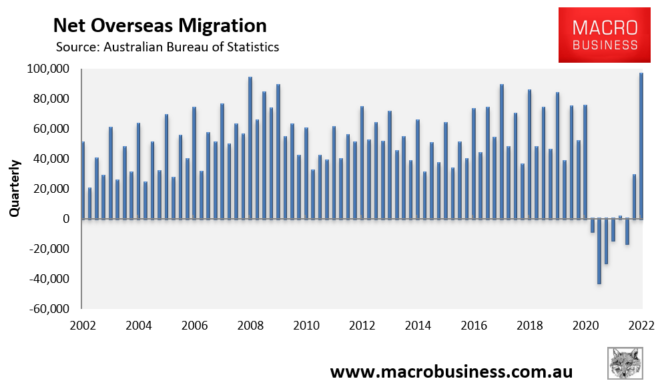
Recall that Australia’s net overseas migration (NOM) hit its highest ever level in the March quarter, with a record 96,200 net migrants arriving:

Net overseas migration

Highest ever NOM in March quarter.

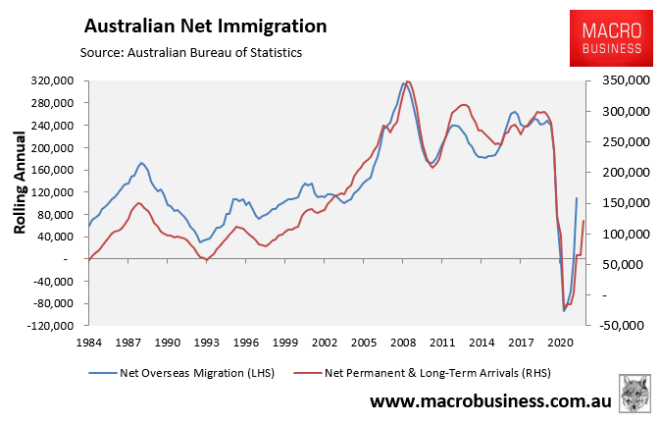
Now the ABS has released permanent and long-term arrivals data for August, which revealed that annual arrivals have surged to 121,270.

The below chart tracks this series against the official quarterly NOM and suggests that immigration has continued to surge:

Australian net immigration

Australian immigration surging.

The Albanese Government used last month’s Jobs & Skills Summit as a trojan horse to turbo-charge immigration via:

  • Lifting Australia’s permanent non-humanitarian migrant intake by 35,000 to a record high 195,000;
  • Lifting temporary migration to record levels by:
    • Expanding work rights for international students via:
      • Uncapping the number of hours international students can work while studying for another year; and
      • Extending the length of post-study work visas by two years.
    • Committing to clear the ‘backlog’ of “nearly one million” visas awaiting approval.

In turn, Australia is staring down the barrel of record immigration flows next year, which will make Australia’s rental crisis worse and make it impossible to meet Australia’s 43% emissions reduction target.

The major concern is that the planned record immigration will arrive as the economy hits the brakes on the back of the Reserve Bank’s aggressive monetary tightening.

This time next year, concerns around “skills shortages” will likely have vanished, replaced with concerns around low growth and rising unemployment.

Source: Australian immigration rockets back