Ditchley Conference: Impact of Food Security on Migration and How to Respond

I recently had the pleasure of attending this conference (virtually). Interesting and stimulating discussions, high level summary here.

My working paper for the conference is below:

There is little doubt that migration pressures will increase given greater food insecurity in countries and regions that are expected to be most exposed to climate change. While this is mainly with respect to the global south, even more temperate zones are being affected as recent extreme weather events have demonstrated. How governments and societies should respond is an easier question than how can they respond given domestic and international politics, with the ongoing challenges of climate change being perhaps the most pertinent example.

From an immigration perspective, there are some realities that need to be considered:

• Increased political and social polarization, reflecting driven by social media and political tactics at both national and international levels, resulting in greater mis- and disinformation;

• Increased economic and social inequalities within countries;

• In many countries, immigration is divisive politically, Canada being one of the rare exceptions. Irregular arrivals rather than more managed immigration tend to provoke more negative public reactions;

• Migration policies and programs of the global north are largely designed for the benefit of receiving countries, with little to no attention to the needs of sending countries and potential migrants. The overall focus on addressing the demographics of aging societies as well as the recent focus on healthcare labour shortages and immigration are examples.

• Public opinion in Western countries generally, but not exclusively, favours more “familiar” migrants with perceived shared values as recently seen in the case of Ukrainian refugees in contrast to other groups. While consistency of treatment must be the objective, the reality is more complex; and,

• There is generally greater public support for economic immigrants who contribute directly to the economy in sectors as diverse as healthcare, tech and agriculture than for refugees and asylum seekers, as the benefits are more clearly perceived.

Canadian perspective

Canada’s geography has largely provided a barrier to large scale irregular migration compared to most other countries given the USA to the south, oceans to the east, west, and north, making it easier for Canada to manage migration flows and maintain public confidence.

While my fellow Canadians at the conference may disagree, some of the factors that will influence Canadian public reaction to larger scale immigration include:

• The degree to which irregular arrivals, perceived as queue jumping, particularly those at land crossings between official border points, continue to increase (2022 average to date of 3,000 per month), with birth tourism raising similar issues;

• While public opinion research shows general support for immigration and a general understanding of the need for immigrants to address labour shortages and demographic aging, there is less support for refugees and family class, and some worries regarding immigrant group cultures;

• Given the large numbers of immigrants and their descendants, concentrated in electoral districts (41 ridings out of 338 are visible minority majority ridings, with another 16 ridings over 40 percent) and the Canadian political first-past-the-post system, no political party can win an election without their support;

• Immigrants often perceive irregular arrivals as people jumping the queue rather than applying as they did and there is a diversity of views among immigrant and visible minority groups on overall immigration levels;

• The current government has ambitious immigration targets (increasing 341,000 pre-pandemic to 450,000 by 2024) that enjoys broad support among stakeholders and have so far attracted little to no criticism by mainstream political parties (Quebec, which selects its economic immigrants, is far more restrictive); and

• The ability (arguably inability) for the government to deliver these increases has become an issue with large backlogs across all immigration programs.

Possible broader lessons from Canada

Mitigation through greater support to countries with food insecurity and greater climate change impacts may reduce pressures on receiving countries. While it is likely impossible reduce long- term pressures, the impact ideally can be made more gradual allowing more time to prepare and increase absorptive capacity.

Key to public support is the perception that migration flows are being properly managed and not just arriving at the border. To the extent that migration and refugee flows have orderly processes and procedures, public understanding and support should be easier to attain. This is clearly easier for some countries than for others but even countries that have geographic and other barriers can expect to be tested more and more.

Messaging that links immigration to a country’s interests (e.g., labour shortages) will be more powerful than general humanitarian messaging. Policies and programs that triage food and climate refugees based upon their ability to contribute to the receiving country economy and society are likely to be better received than those without such selection criteria.

Stories that focus on individual situations have greater influence than more overall analysis for the public. For example, the death of Syrian refugee Alan Kurdi galvanized support for accepting more refugees during the 2015 Canadian election and, more recently, the likely murder of Iranian Mahsa Amini over how she wore her hijab has galvanized protests in and outside Iran. Given that

the impact of individual examples and stories is more short-term, broader evidence and analysis are needed for governments and sophisticated stakeholders in order to effect sustainable change.

In short, longer term migration pressures are similar to climate change in terms of the political challenges at national and international levels. However, the Global Compact for Migration only provides a framework in contrast to the legally binding Paris Agreement on Climate Change. Moreover, the longer history of global and national environmental debates and negotiations has resulted in greater political consensus regarding the need for international cooperation to address climate change.

Issues related to climate change are largely economic in terms of the changes required while international migration is as much about more complex social change as it is about simple economic change, as we see in various debates over immigrant and national values.

Given that current narratives in receiving countries have focussed on economic benefits of immigration for receiving countries, shifting the focus to the benefits and costs to both receiving and sending countries would be extremely difficult given polarized public opinion and politics.

Source: https://www.ditchley.com/sites/default/files/2022-10/Andrew%20Ditchley%20Conference%20October%202022.pdf

The Open Secret of What Works—and What Doesn’t—for Diversity, Equity, and Inclusion – By Elizabeth Weingarten

Good and informative study:

The 1960s heralded all kinds of innovations—lava lamps, bubble wrap, the birth control pill, and the BASIC programming language, just to name a few.

Today, most of us use more modern versions of the inventions the 1960s produced.

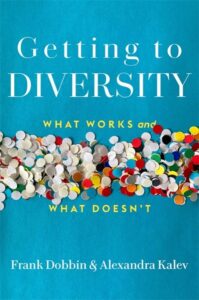
With one notable exception: corporate antibias and diversity training. “There are dozens, if not hundreds, of studies [of these programs], most of them showing that diversity training has no effects,” says Alexandra Kalev, an associate professor of sociology and anthropology at Tel Aviv University, and coauthor with Harvard sociology professor Frank Dobbin of the new book Getting to Diversity.

And yet, despite the stack of evidence, “it is hard to find a Fortune 500 company without a diversity and harassment training these days,” they write.

When antibias trainings first emerged, they were rooted in mainstream psychological beliefs at the time: that attitudinal change precludes behavior change. In other words, you need to change what you think before you can change what you do.

Many corporate trainings were a by-product of President John F. Kennedy’s 1961 legislation to stop racial discrimination, Dobbin and Kalev explain. Eager to prove that they were on the right side of history, organizations swiftly developed recruitment and training programs for Black employees and “race relations training” for others on staff, despite there being no federal mandate to do so. When the Civil Rights Act of 1964 made sex discrimination illegal, organizations expanded these trainings to cover sex discrimination.

In their new book, Dobbin and Kalev explore not only why these trainings have endured despite the evidence, but also what works to make progress on diversity, equity, and inclusion inside organizations. Their book is informed by two big questions: “What goes on within companies to prevent women and people of color from flourishing in the way that white men with the very same qualifications flourish?” And, “How can firms tear those barriers down and work toward true inclusion?” To answer them, Dobbin and Kalev use data from over 800 companies captured between 1971 and 2015, as well as interviews with managers from another 100 companies conducted after 2007. The result is a book that is tailored for anyone who is craving actionable, evidence-based advice about how to create effective programs.

The week they published their book, I spoke with Dobbin and Kalev about why we continue to rely on unconscious bias training, the most impactful interventions for diversity, equity, and inclusion (DEI) progress, a DEI “stealth program,” and why organizations tend to lay off more women and people of color during recessions. Our conversation, edited for clarity and length, is below.

What have we learned from the past few decades of studying the effectiveness of diversity trainings?

Kalev: For decades, there has been so much research, and most of it shows that diversity training has no effect. Usually, the effects examined are short term changes—understanding of certain concepts, or plans for future behavior or, attitudes. Some studies find positive short-term effects, and some of them find negative effects.

What we’ve learned is that it’s very hard for people to be forced to change their attitudes. They act with reactance, needing to take control over their decisions and regain autonomy. We’ve learned that trying to suppress stereotypes makes those stereotypes more accessible. We’ve learned that the message of multiculturalism makes white men feel excluded. And when it comes to attitudes, we gain them through the life course, so no single afternoon session will undo that.

The barriers to diversity are diverse. Different companies, departments, groups, and industries have different barriers. If you bring on an over-the-counter diversity training, what are the chances you’ll be spot on with what’s going in your organization?

Nothing I told you is a secret. That research is not the innovation of our book. It’s out there and ignored.

Why do so many organizations opt for trainings that aren’t supported by evidence?

Dobbin: Part of it is that it’s easy to do. It’s an easy way to show that you’re trying to do the right thing, and it’s conspicuous because every person in the organization is exposed to it. Part of the reason it remains popular is that it doesn’t change what executives and managers have to do from day to day. Business can go on as usual.

“Part of the reason trainings remains popular is that it doesn’t change what executives and managers have to do from day to day. Business can go on as usual.”

We also tend to think, erroneously, that our behavior is driven entirely by our values and our ways of thinking about the world. So, if you can change people’s values and ways of thinking about the world, you can change their behavior. But often it goes the other way. If you change their behavior, you can often change how they think about the world.

The main indicator you look at to understand whether a program is working, or not, is how it impacts the numbers of women and people of color in management. Why is this so important? 

Kalev: Our data looks at several decades, and we look at the change in the number of managers from each demographic group over time. Getting to management means that you succeeded in getting promotions, that you get opportunities, you feel included, your talent is visible, you’re able to show your skill. We think that looking at the numbers actually includes all other dimensions of diversity and inclusion, because the number of people of color, or women or whatever underrepresented group in management is the bottom-line outcome of all other dimensions.

You find the two most impactful programs are formal, democratized mentoring systems and having a diversity manager or task force. Let’s talk about mentoring systems first. Why do they work?

Dobbin: We think mentoring systems work so well because they do several things at once. They help managers to see the obstacles that people of color and white women face in moving up the ladder. They make managers aware that there are fixable structural problems that they could begin to address, or at least they could look out for. Part of it is just making one person higher up in the organization aware of you, aware of your strengths and your aspirations. People mostly get superior jobs in an organization because somebody’s noticed them—they need mentors and sponsors to move up.

What are the most important components of a mentoring program?

Kalev: You want to have a formal program. Mentoring does occur informally, but it excludes women, people of color, other underrepresented groups that don’t have those natural networks. You want to have someone in charge of the program to make sure it is actually happening. You want to match based on interest. People might think for cultural comfort you would want to match based on demographic identities, but there are not enough potential mentors, like Black female mentors or Asian American women that can serve as mentors. So there’s simply not enough senior people from underrepresented groups to mentor. And those who are underrepresented senior leaders are usually overloaded with diversity related tasks.

Probably the most important reason to match by interest is that you want the relationships to break down the segregation, those glass walls between people like white men, for example, and women or people of color. You want to create matches that are actually cross-cultural, but based on interests, because that’s what we do in organizations: we work in functions like finance or AI, based on disciplines or interests.

Finally, you want to make sure that mentoring is open to everybody, not only to the potential stars, because those who you think are stars have already succeeded. Those that you don’t recognize as stars are exactly the ones who need the chance. Not everyone can be promoted, but you want to give everybody the opportunity to show their skill.

You also talk about an intervention I wasn’t familiar with, perhaps because it’s not typically seen as a tool to enhance DEI: self-managed teams. This is a group of employees inside an organization charged with managing and executing on their work without being guided by a manager. You call them a “stealth diversity program.” Why can they have such a positive impact?

Kalev: Usually work in modern organizations is divided by color and gender lines. For example, men and women can work side-by-side, but the woman is the assistant, which reproduces stereotypes, because we don’t see women outside of supporting roles.

Self-managed teams were designed to increase productivity from workers. But an unexpected consequence of them, or maybe expected if you think about it, is that they put together people that never worked together to collaborate, to be dependent on each other to design a product that will have the best consumer interface, or the best technology. They have to solve problems together.

That’s one of the best ways to reduce stereotypes, to propel awareness. It’s a different type of awareness, right? Because now I see you as a person. And because I’m dependent on you, in this task, I also devote more cognitive resources to evaluate you and cannot treat you as a category.

During recessions, firms are more likely to lay off women and people of color, and also less likely to hire them. I’m curious if you could talk a little bit about why you think that is the case.

Kalev: There’s a structural bias component and an individual bias component. For the individual bias component, basically, when the ship is going down, you want to have the ones you trust most to manage the ship. Even when women and people of color reach management, they are still suspect. In times of stress, we rely more on our biases.

We think mentoring systems work so well because they do several things at once. They help managers to see the obstacles that people of color and white women face in moving up the ladder.

And then there is a structural bias component. Women and minorities are usually the later comers. So I would have a lower tenure in management than my white male colleague. And many of the layoffs and downsizings are “last to come first to go.”

Women and minorities are also still in marginalized jobs, such as in human resources, public relations, even in management. So women and minorities are more likely to be in units that are more likely to be axed.

One of the things that I was surprised by in the book was that having a diversity task force or diversity manager was such an impactful intervention. That’s because I’ve seen so many companies appoint someone a diversity manager, or create a task force, but then give that person or group virtually no budget or power to do anything. I’d love to hear why I’m wrong and why these interventions can be powerful.

Dobbin: We interviewed hundreds of diversity managers who would often say, “I have no power, I have no budget. I feel like I’m not doing anything.” But a number said there are a few things they can do, and one of the things that’s most effective is “I just ask a line manager why they made that decision.” Essentially what diversity managers do is they activate social accountability in people, and the knowledge that someone might ask you about your decisions.

Diversity managers usually have access to the human relation information system, and they’re looking at the numbers, and they’re looking at them by department, and they’re looking at hiring slates. One thing they frequently do is talk to managers after, say, a seasonal round of hiring or promotions. And they’ll ask, “So it seemed like half the applicants were women, but you didn’t find any women that you wanted to hire. Should we be searching somewhere else? Is there something wrong with the candidates we’re getting?”

There’s this sociological idea of the looking-glass self, which is when you put yourself in the perspective of somebody who’s observing you. You’re looking in the mirror at your own behavior and asking, How does this look to someone observing my behavior? How does it look if I interviewed 15 men and 15 women and hired seven men and one woman? It’s not the same as a grievance procedure where you’re being threatened through a formal complaint process. This is just social influence—what are the norms, and how is this going to look to someone else?

Source: The Open Secret of What Works—and What Doesn’t—for Diversity, Equity, and Inclusion – By Elizabeth Weingarten

Nadeau: L’insulte fasciste

Of note:

Le mot « fasciste » est de retour sur toutes les lèvres. Pour parler du monde dans lequel nous vivons désormais, convient-il encore ? Nombreux sont ceux qui, de plus en plus, voient dans la situation présente des correspondances avec les crises successives qui plombèrent les années 1930. Est-il anachronique de penser qu’un passé peut revenir nous hanter sous une forme recomposée ?

Au fil du temps, l’étiquette « fasciste » s’est décollée de la bouteille où on a mélangé trop de réalités politiques différentes. Aujourd’hui, ceux qui sont les plus susceptibles de faire sortir les mauvais génies de cette bouteille en refusent l’étiquette. Ils la savent infamante, c’est-à-dire de nature à les déconsidérer en société.

Il serait naïf de croire que le fascisme est mort avec Hitler dans un bunker ou au crochet de boucherie où fut pendu le corps de Mussolini. La guerre n’était pas terminée que bien des adorateurs des droites radicales — lesquels n’avaient pas toujours le Duce et le Führer comme modèles — cherchaient déjà à la faire regermer, plantant ses vieilles idées délétères en de nouveaux terreaux.

George Orwell prévenait que le fascisme reviendrait sur la place publique en portant un chapeau melon et un parapluie roulé sous le bras, selon l’image de l’homme respectable en son temps. Au Canada, le leader fasciste Adrien Arcand lui donnait en quelque sorte raison. Les crânes rasés, les uniformes et les démonstrations de force appartenaient au passé, disait Arcand après-guerre. L’avenir de l’extrême droite dépendait désormais de sa capacité à se parer des apparences de la respectabilité, prévenait-il. À cette fin, il fallait la présenter cravatée, puis trouver à investir les médias pour se faire valoir ainsi endimanché.

Le ridicule et la naïveté des antifascistes, clamait Pier Paolo Pasolini, étaient de continuer de traquer l’extrême droite dans ses formes anciennes. Le fascisme avait muté à mesure que la société de consommation prenait de l’expansion, plaidait-il à raison.

Comme le ridicule ne tue pas plus d’un côté ou de l’autre du spectre politique, les esprits de droite les plus radicaux exigent aujourd’hui d’être exonérés de l’étiquette de fasciste, sous prétexte qu’ils ont changé de costume. Ils ne précisent pas qu’ils ont bel et bien conservé, au creux de leurs poches et dans la doublure de leur veste, un même fond d’idées.

La Hongrie d’Orban, habituée de piétiner les droits démocratiques, est enthousiaste au possible devant les avancées de Georgia Meloni, la nouvelle tête de la droite radicale italienne au passé fasciste avoué. Vincenzo Sofo, une des figures fortes de Fratelli d’Italia, le parti de Meloni, est le mari de Marion Maréchal, l’égérie de l’extrême droite française, par ailleurs petite-fille du fondateur du Front national. Sa tante, Marine Le Pen, a multiplié par le passé les révérences de son parti, le Rassemblement national, envers le régime autoritaire de Poutine. En Suède, contre toute attente, l’extrême droite a refait son nid. Au Brésil de Bolsonaro, la dictature des militaires et ses bourreaux sont célébrés. Tout ce beau monde s’est montré ravi des pirouettes antidémocratiques proposées par Trump. Ces mouvements se portent assistance mutuelle, dans une sorte de fraternité d’idées qui n’a nul besoin d’organisations dûment constituées pour être constatée.

Les néofascistes se présentent comme des anticonformistes valeureux bravant les élites. Dans les faits, ils défendent encore et toujours la même vieille hiérarchie sociale. Les inégalités, ils les tiennent pour naturelles, tel un simple reflet du mérite individuel. Dans leur univers brutal et darwinien, où la loi du plus fort règne, chacun est livré à la merci de ses propres malheurs. Et tous sont vendus à l’illusion qu’il faut se battre les uns contre les autres pour survivre.

Ces régimes d’idées qui veulent en finir, une fois pour toutes, avec les modèles de la social-démocratie, favorisent une fiscalité à l’avantage des puissants, en prenant pour bouc émissaire les immigrants. Devant le paravent d’un nationalisme doctrinaire, l’obsession de l’immigration est ramenée à l’avant, comme aux heures les plus sombres des années 1930. La menace fabulée d’un « grand remplacement » habille désormais le vieux mannequin de la xénophobie la plus obscène, comme pour détourner l’attention du catastrophique démantèlement progressif des services publics et de menaces planétaires autrement plus profondes.

Les ayatollahs du nationalisme identitaire ont sans cesse à la bouche les mots « culture » et « civilisation ». Jamais pour autant on ne les entend parler plus de cinq secondes de littérature, de théâtre, de danse, de cinéma, de patrimoine, ni du fait d’ailleurs que l’écrasante majorité des artisans de ces sphères sont opposés à leurs pensées carrées. Jamais on ne les entend rappeler que cette civilisation, certes chrétienne, occidentale et aristocratique, a été aussi cosmopolite, qu’elle a produit la pensée critique, que son histoire a été traversée de puissants appels à l’égalité, la justice, la démocratie, l’humanisme, la tolérance. Ce versant les laisse indifférents.

Au nom d’un ressentiment populaire contre les élites qui pillent allègrement la terre, les néofascistes séduisent. Ils jouent pourtant double jeu. D’une main, ils flattent la chèvre au cou tandis que, de l’autre, ils arrosent le chou. Leur rébellion de surface, qui souffle sur les braises d’une grogne générale, ne remet jamais en cause le système économique et sert l’autorité de ceux qui en sont déjà les maîtres.

Les néofascistes s’assurent de prendre le relais de l’ordre établi, en promettant de le pousser plus loin. En se laissant de la sorte porter au pouvoir, au gré de la peur et du ressentiment, ils entendent parvenir à piloter à leur tour un système néolibéral déjà hégémonique, lui offrant tout au plus un supplément d’âme avec ses appels opportunistes à la nation, seule forme de fraternité qui les émeut. Et à vouloir mieux foncer sur cette vieille voie, ils nous conduisent tout droit à un renouveau du pire.

Source: L’insulte fasciste

Marchi: Moving on from the monarchy, incrementally [change the citizenship Oath]

Coming back to the charge (Australia useful precedent) without the institutional and constitutional issues. Other options include currency and coins:

The passing of Queen Elizabeth II will no doubt herald change – from within and externally. Indeed, the conversation about the future of the monarchy under King Charles has already begun in a number of Commonwealth countries.

Let me say at the outset that I am not a monarchist. Never have been, never will be. It is a concept, I believe, that is no longer relevant to today’s Canada and our diverse citizenry. Nor will it help us forge a more prosperous nation. However, I do salute the 70-year public service record of the late Queen. The dedication and stability that she brought to her reign was truly remarkable. She was deserving of the outpouring of respect that came from all corners of the globe following the announcement of her death Sept. 8.

Notwithstanding her record, I believe that Canada should join the conversation about the future of the monarchy.

Polls consistently have shown it has lost considerable support across Canada. A Pollara survey in September suggests only 35 per cent of respondents want Canada to continue as a constitutional monarchy, while only 24 per cent of them want to feature King Charles III on our currency.

Rightly or wrongly, Charles has always generated indifference among many Canadians. As prince, he consistently was less popular than his mom and his two boys. Now that he has the crown, will he be able to win over hearts? He has giant shoes to fill, and how he manages those expectations will critically impact the success or failure of his tenure.

But Charles is intelligent enough to understand that by the time Prince William takes the throne, the so-called “sovereign realms” around the Commonwealth will mostly be gone.

So, how should our country move forward at this juncture?

I would counsel moderation rather than revolution. After all, Canada’s DNA is gift-wrapped by prudence. Typically, we don’t rush into major decisions. We reflect, we analyze and we stew over options until the timing and strategy is right. Or, until the problem goes away on its own.

In addition, reopening the Constitution would prove most difficult, as it always has. At the end of his mandate, Pierre Trudeau won his constitutional battle, but not without fighting most premiers and having to go to the Supreme Court. Brian Mulroney was not as fortunate. Both his initiatives – the MeechLake and Charlottetown accords – went down in flames.

Moreover, any constitutional initiative would likely overwhelm the government’s agenda, and divert political energies from focusing on the bread-and-butter issues that are weighing heavily on Canadians – the economy, inflation, climate, energy, COVID and health care.

Yes, incremental moderation has been our path of choice for almost 60 years when it has come to dealing with our ties to the “motherland.” It was former prime minister Lester Pearson who gave Canadians our own flag on Feb. 15, 1965, and “O Canada” was proclaimed as Canada’s national anthem two years later, almost to the day. Initially, both measures were met with fierce debate and hostility. Today, both are symbols of great national pride.

Much later, Pierre Trudeau built on that record, by repatriating our Constitution from Britain in April of 1982. In the process, he also created the Canadian Charter of Rights and Freedoms, which moved us closer to his vision of a “just society.”

That brings us to his son, Prime Minister Justin Trudeau. He offered his condolences uponthe death of the Queen, saying she was one of his “favourite people.” Who knows? He may have a soft spot for Charles, as well. Trudeau strikes me as a reluctant reformer as it relates to the monarchy. That is why I would encourage him to take a page from his father’s and Lester Pearson’s playbooks. Move slowly but do move.

I would suggest that he modernize our citizenship oath.

Until her death, the oath of allegiance (part of the citizenship oath) was sworn to “Queen Elizabeth II, her heirs and successors…” (Now it’s to King Charles III.) When I was minister of citizenship and immigration and attended citizenship ceremonies, these words would cause people’s eyes to glaze over. They had no meaning for them and there was no personal connection. Plus, many of our would-be citizens would actually proclaim “her hairs and successors!”

It is high time to transition our oath. Rather than paying homage to a monarch, we should swear allegiance and loyalty to Canada. Period. Full stop.

As the responsible minister back in 1995, I came within one cabinet meeting of doing precisely that. After coming up with several superb, moving renditions, drafted by some of Canada’s most eloquent writers and poets, then-prime minister Jean Chrétien asked me to “park it” at the last minute. The rationale was that he did not want to fight the monarchists and the separatists (during that year’s Quebec referendum) at the same time.

I argued that reforming the oath would help us with the provincial battle because the monarchy did not enjoy much popularity with most Quebecers. In the end, I did not win the day. I always suspected, though, that the real reason was Chrétien’s affection for the Queen. He had a warm relationship with Queen Elizabeth and I believe he was concerned about offending her.

In politics, however, when you park an initiative, you usually end up losing the moment. And that’s what happened. After the referendum, I moved on to a new portfolio and my successor opted for other priorities.

Now, we have an even better window of opportunity. We should take advantage of it and revisit our oath and build on previous accomplishments. For those who believe that this represents not enough ambition in addressing the future of our monarchy, I would say better an additional single, sure step than a giant leap that goes nowhere.

Eventually, in the fullness of time, the right circumstances for altogether severing the umbilical cord to the monarchy will present themselves.

Source: Moving on from the monarchy, incrementally

Canada deports more than 200 North Korean escapees who took South Korean citizenship

Of note:

Canada has deported 242 North Korean escapees since 2018, and is in the process of sending home 512 more, after finding that many had gained South Korean citizenship before coming to Canada, RFA has learned from two Canadian government agencies.

Most of the deportees are sent back to South Korea, where they initially landed after escaping from the North – usually a harrowing journey through China where they must avoid capture and forced repatriation. And because Seoul claims sovereignty over the entire Korean peninsula, escapees are granted citizenship upon arrival.

But some then go on to Canada, after having a hard time adjusting to life in the South – and that’s where the problem arises in obtaining refugee status.

Typically, to be granted refugee status, an asylum seeker must present evidence of being persecuted in their home country. But because the North Korean escapees found refuge in the South, and were granted citizenship there, they could be excluded from refugee protection, the government agency that provides protection to refugees, Immigration, Refugees and Citizenship Canada (IRCC), told RFA.

Essentially, if the asylum-seekers had gone directly to Canada, they would have a better chance of gaining refugee status and be allowed to stay in the country.

The IRCC said that while there may still be instances in which a North Korean requires protection, many asylum petitions have been turned down due to applicants’ South Korean citizenship.

The statistics on deported North Korean escapees were compiled by the Canada Border Services Agency, which is responsible for border control, immigration enforcement and customs services.

“The Canada Border Services Agency places the highest priority on removal cases involving national security, organized crime, crimes against humanity, and criminals – regardless of country of origin,” the agency told RFA’s Korean Service.

“Removals of failed refugees and individuals with other immigration violations are also necessary to maintain the integrity of Canada’s immigration system,” it said.

Difficult Adjustment

More than 33,000 North Koreans have found their way to the South and resettled over the years, most of them having arrived after the 1994-1998 North Korean famine that killed as many as 2 million people by some estimates,  and pushed the country to the brink of collapse.

They risked their lives to escape, most having traveled more than 3,000 miles through China, all the while avoiding capture and forced repatriation and dealing with shady brokers and traffickers. From there they navigated through several southeast Asian countries in the hope of one day boarding a plane headed for Seoul’s Incheon International Airport.

The South welcomes such escapees. They are sent to government-funded orientation programs and given startup money and a living stipend as they settle into their new lives.

But for many escapees, the South is not the land of milk and honey they expected.

The fast-paced life of South Korea seems too hectic, and the people speak Korean peppered with unfamiliar loan words from the English language. Job skills the escapees may have had in the North might not translate into an equivalent position in the South Korean workforce.

And while they may physically blend in, many are made to feel that they are on the lower end of the social hierarchy in the South, due to discrimination and a resulting lack of opportunity to make their situation better.

Almost half of all North Korean refugees that settle in the South said they experienced discrimination in a 2017 poll by the South Korean government-backed National Human Rights Commission of Korea.

“Discrimination against North Korean defectors [in South Korea] is a very serious problem,” Ethan Hee-Seok Shin, a legal Analyst at the Seoul-based Transitional Justice Working Group, told RFA’s Korean Service.

Shin used the politically charged colloquial term “defector” which describes both defectors, who were part of the military or government at the time of their escape, and refugees, civilians who flee starvation or North Korea’s depressed economic situation. The term can, in some contexts, carry a negative connotation.

International Rights groups prefer to differentiate between defectors and refugees, depending on the circumstances of their escape.

“Of course, going abroad does not mean that there is no discrimination, but there is no such thing as being branded as a defector [outside of South Korea],” he said.

Hundreds therefore made the decision to move on from South Korea to Canada, where under the Resettlement Assistance Program they can get benefits that may include a household startup allowance and monthly income support.

Hiding immigration history

Since having a Republic of Korea passport is grounds to immediately reject an asylum application, many of the North Korean asylum-seekers in Canada try to hide evidence that they ever naturalized in South Korea.

According to a Canadian federal court document published Sept. 16, a North Korean refugee surnamed Kim, her husband with the family name Shin and their children were deprived of their refugee status in 2018 for concealing their South Korean citizenship. The document said deportation proceedings were to start.

Another refugee, surnamed Kang, was on the verge of being deported after it was discovered that he resided in South Korea in 2019.

Once the deportation order goes out, the refugees have a few options if they wish to remain in Canada.

According to a 2019 RFA report, over an 18-month period starting in January 2018, some 352 North Korean refugees in Canada lost their refugee status as the government at that time began revoking it in cases where they had lived in South Korea in 2013 or later.

The Canada Border Services Agency explained that a removal decision by an immigration officer can be subject to judicial and administrative review, during which the individuals involved in the case may seek leave to remain in the country.

Additionally, many of the refugees can apply for the Humanitarian and compassionate considerations program, said Sean Chung, the executive director of HanVoice, a Toronto-based nonprofit organization that assists North Koreans with settling in Canada.

Successful applicants to the program can obtain permanent residency in Canada if they are an exceptional case, such as when they have lived in Canada for a long period of time, or if there are special reasons that prevent someone from returning to their home country, he told RFA.

Source: Canada deports more than 200 North Korean escapees who took South Korean citizenship

MPI: Rollback of ‘Golden Passports’ Shows Their Elusive Shine

Good in-depth discussion of the practice and related issues.

Money quote: “greater concerns have emerged when CBI programs interfere with good governance, resulting in corruption of public officials, scandals, money laundering, or tampering with elections. These have been a rule rather than an exception in every single existing investor citizenship program:”

Little more than a month after Russian forces invaded Ukraine in early 2022, Bulgaria, Cyprus, and Malta began to heed the call of the European Union’s institutions advocating the abolition of “golden passports” by cracking down on Russian oligarchs, who were among the key beneficiaries. Formally known as citizenship by investment (CBI) programs, these schemes enable individuals to become citizens of a country by means of an economic contribution, often without any other substantive conditions such as residency periods, local language knowledge, or civic tests.

These programs have been a heated topic in the European Union ever since October 2013, when Malta decided to offer its passport in exchange for investment in the country’s economy. Its Individual Investor Program ran between February 2014 and September 2020, and that November the country introduced a new route for investors to receive citizenship after three years of residence, which could be reduced to one year on the basis of providing “exceptional services.” The pushback from EU institutions against these schemes has been driven by three main concerns: that national citizenship is a gateway to rights such as free movement across the bloc, that these programs often lead to corruption of public officials, and that investors do not have a genuine connection with their new country. In late September, the European Commission referred Malta to the Court of Justice of the European Union, claiming its program was incompatible with the concept of EU citizenship and violated the Treaty on European Union.  

Previously, these concerns did not substantively resonate with Bulgaria, Cyprus, and Malta, but security unease amidst the war in Ukraine did. Bulgaria and Cyprus have since discontinued their CBI programs; Malta has fully abolished it for Russian and Belarussian citizens. On top of that, authorities of Cyprus and Malta have already initiated several withdrawals of investment-based passports previously granted to sanctioned Russians and Belarusians supportive of the war in Ukraine; at this writing, Bulgarian authorities were reviewing the beneficiaries of their CBI program to see if any were under sanction.

CBI programs are a part of a much broader phenomenon of investor migration, which also includes the more widespread “golden visas,” or residence by investment (RBI) programs. These kinds of schemes enable investors to gain residency rights in a country by purchasing a house, as is the case in Greece, Portugal, and Spain; making a financial investment, as in Canada, Ireland, and the United Kingdom; or creating a certain number of jobs, as required under the American EB-5 visa.

Unlike the RBI programs, which frequently require investors to effectively migrate to the destination country, CBI documents are often used only for international mobility or as insurance. So why are they so controversial?

This article discusses the history of citizenship by investment, the main beneficiaries of CBI programs, the benefits and criticisms associated with them, and what the future might have in store for these programs.

Are “Golden Passports” a Novelty?

Investment-based citizenship is often perceived as a new phenomenon. Yet obtaining legal status through wealth is not a historical novelty. Romans, too, offered citizenship to men who could afford it, provided they also met other requirements such as residence, ethnicity, and military service. Things have changed since. Nowadays, a financial contribution is all that is needed to secure the passport of a country running a CBI program. The amount can be as low as USD 100,000, as in the Commonwealth of Dominica. It can be as high as 3 million euros, as was required in Cyprus in 2014 and 2015 to address consequences of the 2013 international bailout from the financial crisis.

What has caused this development, where is it possible to obtain citizenship in exchange for an investment, donation to the government, or real estate purchase, and why?

The first modern-day CBI programs emerged in islands in the Caribbean and the Pacific, shortly after they became independent from large colonial powers. The process of decolonization took a particular toll on these microstates. As a result of their small size, unfavorable climate and terrain, or remote geographic location, these new nations were faced with major economic adversities, often threatening their survival as sovereign states. These conditions stimulated the sale of passports in the Marshall Islands, Nauru, Samoa, Tonga, and Vanuatu in the 1980s and the 1990s. Such practices were often done informally by public officials, who would provide investors with passports short of full citizenship. For instance, people who leased land in uninhabited parts of Tonga would receive a Tongan Protected Person Passport (TPPP). This document did not give holders the right to enter the country or live in it but rather served as a travel document.

The first official CBI program was established by Saint Christopher and Nevis in 1984. In the years that followed, the island state introduced legislation that enabled the grant of citizenship for those who invested in real estate or donated to special funds. One such fund was aimed at diversification of the workforce previously employed in the country’s now nonexistent sugar industry. In the two decades that followed, citizenship by investment was an oddity, confined mostly to tropical islands. It was an issue that attracted hardly any public attention.

The scene changed substantively with the 2008 global financial crisis, which drew a number of countries towards alternative mechanisms for raising revenue, including the development of three main investment migration routes. More than 140 states have general provisions in their existing citizenship laws to naturalize individuals who contribute to their national interest, such as artists, athletes, scientists, and investors. A few other countries such as Bulgaria, Cyprus, Malta, Moldova, Montenegro, and Turkey developed CBI schemes similar to those in the Caribbean and Pacific states. And a majority of the world’s countries opened routes for investors—coupled with tax relief—to become residents, with the possibility of obtaining citizenship after a number of years and subject to meeting language, civics, and other requirements.

Discretionary provisions in citizenship legislation, CBI, and RBI programs have often been conflated, despite having distinct roots, objectives, and target beneficiaries, and despite raising different concerns in the context of good governance (such as corruption and money laundering) or the economy (such as skyrocketing real estate prices).

The Growth of a Citizenship Industry

Lack of understanding of the different ways in which CBI and RBI schemes operate has, in part, been caused by the growing market for investor citizenship and residence. Over the past two decades, this market has given birth to and raised a citizenship industry composed of companies that act as intermediaries between states operating these programs and individuals seeking to benefit from them. This industry includes large multinational companies such as Arton Capital, CS Global, and Henley and Partners, which often provide a wide range of services to states including designing and marketing the new program or running it through a concession. These companies may also offer their services to individuals to assist with the application, manage funds, or lease and purchase property. The industry has also branched out through specialized firms such as BDO, Exiger, and Thomson Reuters, which are engaged in due diligence of applicants, or Astons and JM, which manage real estate purchases. The industry’s final component is local law firms and agents, which facilitate investor applications through their knowledge of the language and the local context.

Citizens used to be unaware of the growth of this industry. That is until they read an in-flight magazine in which companies acting as intermediaries advertised specific programs and their own services, or passed through the Zurich Airport where until recently the passport of Malta was displayed in a shop window next to a luxury watch retailer. The industry is no longer unknown, due to a combination of factors including new marketing strategies and engagement of intermediary firms with the media. There has also been a growing public interest in the profile of beneficiaries, corruption scandals, and public protests associated with these programs.

A Connection to Mobility and Life Opportunities for a Select Few

As the international order became reconstituted after World War II, the governance of cross-country mobility became highly diversified. With the growth of global interconnectedness, possessing a particular passport determined the number of countries one could access, the countries in which one could settle, and where one could do business. Passports became connected with mobility and life prospects—both highly unequal around the world and both very much dependent on one’s birth. The increasing tolerance of dual nationality since the 1960s also enabled individuals to acquire additional passports without losing that of their country of origin, as had previously been the case.

Those obtaining citizenship by investment are, however, a tiny minority compared to the total pool of people who become citizens of a foreign country. This is nearly always the case in countries that grant citizenship to investors on grounds of national interest, where numbers are capped (for example Estonia limits these to ten applications annually) or where parliamentary approval is required, as in Bulgaria and Latvia.

The exact numbers of people who obtain citizenship through official CBI programs in most cases are not in the public domain. The majority of countries have no reporting obligations and public authorities are often slow or unwilling to provide the information. The background study for a 2019 European Commission report revealed that 12 applications were approved in Bulgaria in 2017 and at least 738 were approved in Malta from the program’s launch in 2014 until 2017. While no information on the number of applications in Cyprus was available in the report, a subsequent Al Jazeera investigation discovered that between 2007 and 2020 Cyprus granted citizenship in 6,779 instances to investors, mainly of Russian origin. In September 2020, Malta’s authorities confirmed that program reached its 1,800 approved applications cap; the more recent program is capped at 400 certificates annually and 1,500 overall, however there is no information on how many have been granted so far.

Numbers of those who obtained a passport from countries outside the European Union are even more difficult to ascertain. Grenada and Antigua and Barbuda reported 303 and 330 applications respectively in 2017; in 2018, the government of St. Kitts and Nevis reported that, since the opening of the program in 1984, a total of 16,544 investor citizenships had been granted. After lowering the investment threshold to USD 250,000 in 2017, by September 2021 Turkey had granted 7,242 passports to foreign investors, mostly of Iranian, Yemeni, Afghan, and Iraqi origin.

Whose Passport Is “Golden”? 

Different passports come with different opportunities. Being born a U.S. citizen or a citizen of an EU country comes with substantively more personal and travel freedom than, for instance, being born as a Kosovan or Congolese citizen. This fact sets the financial parameters of the global market for investor citizenship and has a major impact on the structure of beneficiaries.

Unsurprisingly, “price tags” on passports of Bulgaria, Cyprus, and Malta were substantively higher than those of the Caribbean and Pacific countries, or of Moldova, Montenegro, and Turkey. The program running in Malta between 2014 and 2020 entailed an overall investment in the range of 1.15 million euros, and the one introduced in 2020 refers to an unspecified direct investment. Cyprus, which required investments between 2 million and 3 million euros between 2014 and 2022, had the scheme with the highest contribution. These two CBI programs directly offered rights of EU citizenship, such as free movement across the European Union. Passports of Cyprus and Malta also grant visa-free access to 176 and 183 countries, respectively, slightly more than the 173 accessible to holders of a passport from Bulgaria, where the recently terminated CBI program required an investment in the range of 500,000 euros.  

The combination of the type of investment required and mobility rights attached to citizenship determined who would be interested in and able to become a CBI program beneficiary. For instance, the Cypriot program has had a disproportionate number of Russian applicants, in part because in 2014-15 it provided a special route for individuals who had lost more than 3 million euros due to a levy on foreign deposits imposed as a result of the economic bailout. Turkey’s program largely attracts investors from the Middle East, for whom the mobility rights attached to the Turkish passport are much higher than those of their countries of origin. As of September 2022, a Turkish passport provided visa-free access to 110 countries worldwide, while those of Afghanistan, Iraq, Syria, and Yemen offered access to fewer than 35 countries each.

Beyond mobility rights linked to different passports, there are a series of other motivations that wealthy individuals may have in obtaining citizenship by investment. First, additional passports might offer a Plan B for escaping political and economic instability.

Second, most CBI programs are coupled with preferential tax regimes, which may be an important motivation for individuals with very high incomes. This potentially exempts them from paying taxes in jurisdictions in which they are not physically present or of which they are not citizens. For instance, St. Kitts and Nevis, with no personal income tax and low value-added tax (VAT), has become an attractive destination for wealthy Americans seeking to renounce their U.S. citizenship.

Third, for the rich from poor countries, a passport from a nation in the so-called Global North is also a status symbol that differentiates them from less affluent conationals. Speaking to Bloomberg News in July 2018, the chairman of one of the intermediary companies involved in the citizenship industry noted, “If you have a yacht and two airplanes, the next thing to get is a Maltese passport. It’s the latest status symbol. We’ve had clients who simply like to collect a few.”

Finally, obtaining a passport through a CBI program may serve some less noble purposes. In 2010, the former Prime Minister of Thailand, Thaksin Shinawatra, who had faced corruption charges in his native country, was able to avoid extradition by having obtained a passport from Montenegro. Indian diamond mogul Mehul Choksi, charged with embezzlement in India, sought shelter in 2018 in Antigua and Barbuda, a country where he had previously become a citizen by investment. Russian oligarchs close to President Vladimir Putin, as well as Ukrainian rent-seeking billionaires have gained protection on EU soil by acquiring Cypriot and Maltese passports.

The Dark Side of CBI Programs

The box of questions surrounding CBI and RBI programs is yet to be fully prized open. So far, there have been no systematic studies of the economic impact of these programs, which would highlight potentially beneficial aspects such as job creation or construction of roads, hospitals, and other infrastructure projects. However, a 2015 report of the International Monetary Fund (IMF) highlighted that funds from investor citizenship in recent years have come to account for substantive portions of gross domestic product (GDP) in some small island states. Recent IMF studies point out that, between 2012 and 2021, as much as 30 percent of the GDP of St. Kitts and Nevis and the Commonwealth of Dominica came from investments from CBI programs. In 2020, revenue from Vanuatu’s CBI program amounted to 42 percent of the national budget, raising questions of potential overdependence on CBI.

Yet balancing economic benefits and potential dependency is not the most contentious aspect of these programs. While many have questioned whether it is just to exchange passports for investment, greater concerns have emerged when CBI programs interfere with good governance, resulting in corruption of public officials, scandals, money laundering, or tampering with elections. These have been a rule rather than an exception in every single existing investor citizenship program.

For instance, since 2017, citizens of the Commonwealth of Dominica have been protesting the country’s CBI program, which international observers such as Freedom House also regard as controversial. The protests were sparked by the country’s opposition, which demanded the prime minister resign because of corruption linked to construction fraud involving CBI beneficiaries from Iran and China. Initially focusing on domestic issues raised by the CBI program, the protests gained an international dimension when concerns emerged over how the program helped the growth of Chinese and Iranian influence in the Caribbean islands, and the potential adverse effects of such influence on Dominica’s relationship with the United States.

In the same vein, the program in Malta had been connected not only to abuse of power by public officials whose family members had a stake in CBI services, but also to the October 2017 assassination of Maltese investigative journalist Daphne Caruana Galizia. Prior to her death, Caruana Galizia had been investigating connections between high-ranking government officials involved in investor citizenship and payments from the government of Azerbaijan. The scandal that unfolded around the murder investigation eventually led to the resignation of Maltese Prime Minister Joseph Muscat. These and many other instances of institutional corruption, including allegations that the citizenship industry used the political strategy firm Cambridge Analytica to influence elections to create a favorable environment for introducing CBI programs in places such as Malta and St. Kitts, have sparked substantive international criticism of investor citizenship.

The Organization for Economic Cooperation and Development (OECD), Transparency International, and Global Witness are among the organizations that have highlighted the potentially contentious aspects of CBI programs. The European Commission and the European Parliament have been particularly active in seeking to phase out programs in Bulgaria, Cyprus, and Malta. Given that CBI programs in the European Union are connected to the rights of European citizenship—including free movement—any citizen of Malta has the right to settle in any of the 27 EU Member States. For this reason, even though granting citizenship is the sole prerogative of sovereign states, the citizenship regimes within the European Union are interconnected and can obligate other Member States.

EU institutions have continuously voiced concerns over whether the bloc’s citizenship should be for sale and have raised questions over the potentially adverse effects of CBI programs run by Member States. The 2019 European Commission report on investor citizenship and residence schemes highlighted some of the effects and their implications across the bloc. A year later, the European Commission took legal action against Cyprus and Malta on the basis that CBI programs are not “neutral with regard to other Member States and the EU as a whole,” and that individuals obtaining passports in such a way have no “genuine connection” to the country of which they are becoming citizens. While Cyprus has terminated its scheme, Malta is as of this writing facing a process at the Court of Justice of the European Union for continuing to apply its 2020 scheme, which the European Commission finds to be incompatible with the concept of “Union citizenship” and the principle of “sincere cooperation,” both of which are enshrined in treaties governing the bloc.

The Future of “Golden Passports” 

The future of CBI programs will depend on how countries decide to respond to a range of global events and dynamics.

Issues such as major natural disasters linked to climate change or global security concerns could amplify demand on CBI programs due to individuals’ need to have a Plan B. The same issues might equally reduce the number of countries offering such programs due to fears of foreign influence increasingly associated with these schemes. These two trends are perhaps not even mutually exclusive. But they will influence the market for investor citizenship going forward.

As countries become more selective as to whom they want as citizens and under what conditions, they may decide that beneficiaries of CBI programs have a risky background and stop offering such passports. Alternatively, as intermediary industries become more powerful due to growing demand, they might be able to exercise political and economic influence on some countries to keep running their CBI programs, or on others to open new ones.

The most likely scenario is that of Cyprus or Malta, where CBI schemes have transformed into residence by investment programs or grants of citizenship based on exceptional service with unspecified contributions. These may be different legal routes but raise similar issues. Governments looking to address such concerns might ensure that these residence permits and any subsequent grant of citizenship be accompanied by mandatory physical presence and socialization requirements that require the holder to relocate to the destination state and actually live there. The question is whether the shine of such golden visas will be as elusive as that of golden passports.
Source: Rollback of ‘Golden Passports’ Shows Their Elusive Shine

How Social Media Amplifies Misinformation More Than Information

Not surprising but useful studyÈ

It is well known that social media amplifies misinformation and other harmful content. The Integrity Institute, an advocacy group, is now trying to measure exactly how much — and on Thursday it began publishing results that it plans to update each week through the midterm elections on Nov. 8.

The institute’s initial report, posted online, found that a “well-crafted lie” will get more engagements than typical, truthful content and that some features of social media sites and their algorithms contribute to the spread of misinformation.

Twitter, the analysis showed, has what the institute called the great misinformation amplification factor, in large part because of its feature allowing people to share, or “retweet,” posts easily. It was followed by TikTok, the Chinese-owned video site, which uses machine-learning models to predict engagement and make recommendations to users.

“We see a difference for each platform because each platform has different mechanisms for virality on it,” said Jeff Allen, a former integrity officer at Facebook and a founder and the chief research officer at the Integrity Institute. “The more mechanisms there are for virality on the platform, the more we see misinformation getting additional distribution.”

The institute calculated its findings by comparing posts that members of the International Fact-Checking Network have identified as false with the engagement of previous posts that were not flagged from the same accounts. It analyzed nearly 600 fact-checked posts in September on a variety of subjects, including the Covid-19 pandemic, the war in Ukraine and the upcoming elections.

Facebook, according to the sample that the institute has studied so far, had the most instances of misinformation but amplified such claims to a lesser degree, in part because sharing posts requires more steps. But some of its newer features are more prone to amplify misinformation, the institute found.

Facebook’s amplification factor of video content alone is closer to TikTok’s, the institute found. That’s because the platform’s Reels and Facebook Watch, which are video features, “both rely heavily on algorithmic content recommendations” based on engagements, according to the institute’s calculations.

Instagram, which like Facebook is owned by Meta, had the lowest amplification rate. There was not yet sufficient data to make a statistically significant estimate for YouTube, according to the institute.

The institute plans to update its findings to track how the amplification fluctuates, especially as the midterm elections near. Misinformation, the institute’s report said, is much more likely to be shared than merely factual content.

“Amplification of misinformation can rise around critical events if misinformation narratives take hold,” the report said. “It can also fall, if platforms implement design changes around the event that reduce the spread of misinformation.”

Source: How Social Media Amplifies Misinformation More Than Information

Australia: It’s on and off again for foreign students wanting to work [hours cap]

Removal of cap on the number of hours students can work when courses in session, with same weak policy rationales as in Canada apart from low-paid service jobs:

Before and after Australian borders were closed during the pandemic, it was common to see young Indian and Nepali women working in cafés and as cashiers in shopping malls. Young Indian men dominated home delivery systems and were common sights stocking shelves and cleaning supermarkets in Sydney. They were foreign students who were allowed to work limited hours per week.

After some 30 years of resisting pressure from various employer bodies to remove the 40-hour per fortnight cap on the number of hours student visa holders could work while their course was in session, Immigration Minister Alex Hawke rolled over to pressure from the hospitality, tourism and other industries in May 2021 and announced that overseas students in Australia could work unlimited hours in the hospitality and tourism industry that was facing a serious shortage of labour. 

Bowing to criticism that the move was intended to solve a labour crisis and would dent education quality, that decision was subsequently qualified by another announcement in September 2022: unrestricted work rights for student visa holders will end on 30 June next year.

In a statement on its website, the Department of Home Affairs said the reimposition of the cap was aimed at ensuring that students “focus on obtaining a quality Australian education and qualification”.

Until then, it is likely that the international students will continue to take advantage of their ability to legally work unlimited hours. 

When restrictions were lifted in May 2021, the country saw a palpable spike in student visa applications from South Asia after Australia opened its borders in November 2021. 

By April this year, Nepal had become the biggest source of foreign students to Australia, with student visa applications from that country hovering above the 4,500 mark in March and April, while those from India and China were close to about 3,000 per month. 

Before the pandemic, India and China had provided the largest foreign student market for Australia. Given the huge middle-class populations of China and India, how did Nepal overtake them to become Australia’s largest source of foreign students? 

Vocational education and training

According to Australian government statistics, there has been a large increase in vocational education and training (VET) sector offshore student applications from Nepal this year. 

Since Australia’s borders re-opened, there have been more VET sector offshore student applications from Nepalese nationals than from India, China, Pakistan and Sri Lanka put together. Chinese and Indian applicants continue to prefer a university education.

The VET sector has traditionally recruited its students from those who are already in Australia, often poached from among university students who, after a year or two of undergraduate studies, feel they need a change in career focus. 

Australian immigration authorities have traditionally subjected offshore VET applicants to a high degree of scrutiny and hence there has been a high refusal rate. The approval rate for Nepalese offshore primary VET sector student applicants has, since November 2021, averaged well over 80%. 

This worries Dr Abul Rizvi, a former deputy secretary of the Department of Immigration. He argued in a commentary published by Independent Australia in May this year that Australia’s student visa is now essentially an “unsponsored work visa rather than one focused on study”. 

This view is shared by a Sydney-based Nepali immigration agent (who did not want to be named) who told University World News that Nepali parents are ever willing to fork out the money – even if they have to borrow it – to get a student visa to send their child for education to Australia, because they know they can recoup that money quickly. 

“Once in Australia the student could self-finance the studies by working and in the long term they can even earn the family an income by working after graduation,” he said. “If the child wants to go to Singapore, Malaysia, Thailand or India for studies, parents are unlikely to fork out the money for it.”

Post-graduation work rights for degree-holders

Last month, at the conclusion of the Jobs and Skills Summit, Australia’s Minister for Education Jason Clare announced that post-graduation work rights for international students will be increased by two years from next year. 

Thus, bachelor degree graduates can stay on and work in Australia for four years and masters degree graduates for five. It is believed that nursing, engineering and IT students will be top priority areas. 

In an interview with the government-owned network SBS, a spokesperson for the home affairs minister said: “They’re the graduates that the government believes Australia needs, and they can go straight into a sector where there is a shortage of high-skilled workers”. He said that “Australia needs to better use the amazing resource of international students”.

“The overwhelming majority of ‘students’ from India and Nepal come to Australia for work rights and permanent residency, not for education,” argued Leith van Onselen, chief economist and co-founder of MacroBusiness. 

He said the government’s overseas student policy is geared towards expanding student numbers, not improving quality. “All of which proves, yet again, that ‘international education’ is really a people-importing immigration industry rather than a genuine education export industry,” Van Onselen said.

Placement consultant and South Asian community leader Ash Gholkar argued that the problem lies with frequent changes by the authorities. 

“Students are not happy because the rules and points keep changing. There’s too much uncertainty. Students should get to be assessed on the points requirements prevalent at the time they enter Australia to begin their programme,” he argued. “Else, in many cases, students take up a course on a demand list only to find, after the course is completed and they’ve had sufficient experience, that the demand list and points have changed.”

Gholkar told University World News that Australia is attractive to Indian students because of its high standard of living and its Commonwealth heritage that makes adapting and living familiar and easier. “Indian students get the benefit of a world-class education and a chance to apply for skilled migration,” he added. 

Solving a skills crisis

Dr Belle Lim, a past national president of the Council of International Students Australia, argues that international students are a ready-made solution to solving Australia’s skills crisis. There are over 470,000 international students in Australia who possess local qualifications, with the most popular fields being commerce and management, IT, engineering and health sciences. 

With young Australian-born people changing jobs regularly, “taking into account the loyalty that international graduates have towards their employers (ironically due to a smaller set of options), hiring them is less risky”, she noted in a recent column for Women’s Agenda

Exactly for that reason, Sri Lankan-born Australian occupational health specialist Mahinda Seneviratne is concerned that students could be exploited as cheap migrant labour. He chairs the scientific committee of the International Commission on Occupational Health, and with colleagues in the Indo-Pacific region, he is involved in research on workplace safety for migrant labour. 

“Various short-term work visa programmes and ‘students’ coming in as low-wage workers have been the backbone of many small businesses [in Australia] in recent years, particularly in hospitality and service industries,” he told University World News

“Their precarious situation as casual, informal workers undermines working conditions, including their health and safety at work,” warned Seneviratne.

Source: It’s on and off again for foreign students wanting to work

Curry: New work rules may be too tempting for international students — and employers

Indeed. Bad policy and makes a mockery as study permits become an immigration stream for low-paid service jobs, pandering to student and business stakeholder groups:

New work rules for international students may be a boon to local employers, but a double-edged sword for the students.

To help address current labour shortages, the federal government says, as of November 15, international students will no longer be restricted to 20 hours of work a week. This will last until the end of 2023, when, presumably, it will be re-evaluated.

Immigration Minister Sean Fraser is reacting to the fact that nearly one million job vacancies were reported in the second quarter of this year.

I look back at my own undergraduate days at Carleton University when I worked 20 hours a week at the residence cafeteria, 20 hours or more on the student newspaper, and sat on the residence council.

That was a lot.

As the sports editor, I travelled with the Carleton Ravens basketball team, once on a long train trip through Quebec and New Brunswick to Antigonish, N.S., for the national basketball championships. Carleton was a power even back then, probably top five in Canada. Lately, they have won 16 of the last 19 national championships.

Although I was a varsity basketball player at Bell High School in Ottawa, when I got to Carleton the players were a lot better, and a lot taller.

Did those trips and all that work affect my grades? Certainly. I could have done a lot better.

When I was more mature and working only one full-time job, my grades for my master’s degree were much higher.

Local employers tell me they can’t get enough people to work in restaurants — as chefs, cooks, and servers. If you dine out you have probably seen that restaurant staffs are not up to their full complements.

Our latest restaurant foray was at Lot 88, where we had a wonderful meal and a university student server who really knew her stuff.

She is a Canadian student at Nipissing University and we could tell from her knowledge of the menu items, confident demeanour and sense of humour that she was likely working many hours there. There are no restrictions on how much Canadian post-secondary students can work.

She told us she was working on a second degree, so she obviously could handle working and studying at the same time.

Some aren’t so fortunate and need to study a lot to keep their grades up.

Blurring the lines

It will be tempting, for both students — and employers — to hike the hours now that they can. Some in the immigration industry are fearful that it will devalue study permits, and turn them into work permits.

Both employers and students have to be careful that it doesn’t turn out that way. Employers should not pressure international students to work long hours, and international students should not be eager to work 40-hour weeks while in school.

Study permits are a vehicle to permanent residence for the majority of international students in Canada. After a post-secondary program of two years or more they can apply for a Post-Graduation Work Permit that is good for three years. They then use that work experience to apply for permanent residence a year or two later through the Canadian Experience Class Express Entry system.

Those fortunate enough to have studied in North Bay, or Timmins, Sudbury, Sault Ste. Marie or Thunder Bay in Northern Ontario, don’t have to wait that long to apply for permanent residence. They can do it immediately upon graduation, providing they have a year-round full-time job in the community.

That is the beauty of the Rural and Northern Immigration Pilot program, which dozens of local graduates are using as their path to permanent residence, and, eventually, Canadian citizenship.

We need those students in the full-time labour force after they graduate. Let’s hope sanity prevails and they don’t use the lure of unlimited hours of work to become workers instead of students.

They came here to study, not work, and get a diploma or degree at the end of it that will help them start a satisfying career. They might have to have that conversation with their employer when pressure is exerted to work more hours.

Source: New work rules may be too tempting for international students — and employers

He’s known as Chile’s greatest poet, but feminists say Pablo Neruda is canceled

Sigh… I wonder who will be cancelled 50 years from now:

There’s a steady stream of fans visiting the museum that once was the home of Pablo Neruda, widely considered Chile’s greatest poet. It’s located on massive black cliffs overlooking the Pacific Ocean. It’s also the spot where Neruda is buried.

The poet died 49 years ago, yet his reputation remains a work in progress.

Neruda has always been a polarizing figure in Chile, mainly for his left-wing politics. But now he is being called out by Chile’s growing feminist movement as a male chauvinist and sexual predator.

“He’s been canceled,” says Lieta Vivaldi, a human rights activist and member of Chile’s Feminist Lawyers Association.

The latest controversy over Neruda, who in 1971 became the second Chilean awarded the Nobel Prize for literature, sprang up in 2018 with the rise of Chile’s #MeToo movement against sexual abuse. Activists singled out some of Neruda’s verses as sexist and focused new attention on several disturbing episodes from the poet’s past.

Neruda abandoned his only child, Malva Marina, and her mother. His daughter was born with hydrocephalus — an accumulation of fluid within the brain that can lead to swelling of the head — and died at age 8.

What’s more, Neruda wrote about his rape of a cleaning woman in his hotel room in 1930, in what is now Sri Lanka.

“I decided to go all the way. I got a strong grip on her wrist. … The encounter was of a man with a statue,” Neruda wrote in his memoir, published in 1974, a year after his death from cancer. “She was right to despise me.”

Initially, his admission went almost unnoticed. But Chile’s feminist movement — newly energized by a series of sexual abuse scandals at the country’s universities and by the global #MeToo movement — has called attention to the episode, and disdain for Neruda is spreading.

Salvador Young, who buys online books for Chile’s National Digital Library, says that for the past several years, he was instructed by his supervisors not to purchase Neruda’s books. Otherwise, he says, “Readers would demand to know: ‘Why are you promoting a rapist?'”

Some Chilean universities and high schools are steering clear of Neruda. One high school teacher, who asked to remain anonymous because he was not authorized by his school to speak to NPR, says many of his female students despise Neruda. He now teaches him less than he did a few years ago.

By contrast, he says, “When I was in school, we had to learn Neruda and recite his poetry. There are verses that students of my generation still recite and analyze.”

Among them, he says, is “From the Heights of Machu Picchu,” which Neruda wrote following an inspirational trip to the ancient Incan mountaintop site. The poem has been put to music by the Chilean group Los Jaivas.

Rejection of the poet by feminists is so strong that in 2018, Chile’s Congress scrapped a proposal to rename the country’s main international airport after Neruda. Meanwhile, anti-Neruda slogans were spray-painted on several walls during #MeToo marches in Santiago, Chile’s capital.

It’s easy to misread Neruda’s works, warns Kemy Oyarzun, a poet and professor of gender studies at the University of Chile. Yet even she is less enthusiastic about Neruda these days.

Kemy Oyarzun, a poet and professor of gender studies at the University of Chile, says this was a response to one of Neruda most famous verses, an ode to silence called “Poem XV.”

It begins: “I like for you to be still: it is as though you were absent.”

Oyarzun says some feminists interpreted this as Neruda telling his lover in the poem to keep her mouth shut. They responded with graffiti proclaiming, “Neruda, now you shut up!”

At a #MeToo demonstration in Santiago in August, high school student Laura Brodsky, 18, said her instructors are not teaching Neruda. Referring to the rape confession in his memoir, Brodsky emphasized that she and her fellow students “have no interest in learning about him.”

All this is a startling reversal for one of the world’s most famous, prolific and bestselling poets, who has often been compared to Walt Whitman. Neruda’s masterwork, Canto General (General Song), is an epic history of Latin America, recounted by way of 231 poems.

In a country where poetry had long been composed by and for the well-to-do, Neruda was known as the poet of the people, often writing about the working class and Indigenous groups, as well as Chile’s natural wonders.

In addition, Neruda won praise around the world for his humanitarian work in the aftermath of the Spanish Civil War. In 1939, following his diplomatic service as consul, he helped bring more than 2,000 Spaniards — who were fleeing Gen. Francisco Franco’s newly installed military regime — to Chile.

“Many working people and progressive activists — not just in Chile, not just in Latin America, but all over the world — adopted him as their hero, proclaimed him as their own,” wrote Mark Eisner, author of Neruda: The biography of a poet.

Still, Neruda has fallen from grace before.

In 1947, Chile’s government outlawed the Communist Party — of which Neruda was a member — and accused him of treason. To avoid arrest, he went underground; then, in 1949, he escaped by horseback across the snow-capped Andes Mountains to Argentina.

Neruda eventually returned. But in 1973, Gen. Augusto Pinochet seized power and his right-wing military regime burned Neruda’s books while promoting poet Gabriela Mistral, another Nobel Prize winner, who was viewed at the time as apolitical.

As during those past anti-Neruda crusades, many writers and academics say the current campaign has gone too far.

Fernando Saez, executive director of the Pablo Neruda Foundation that oversees the late poet’s estate, points out that many writers, painters and musicians have had stormy personal lives, and says reproachable behavior should not negate their artistic contributions.

Doing so, he says “is tremendously dangerous.”

Author Isabel Allende has also defended Neruda’s literary legacy. “Like many young feminists in Chile I am disgusted by some aspects of Neruda’s life and personality,” she told the Guardian in 2018. “Unfortunately, Neruda was a flawed person, as we all are in one way or another, and Canto General is still a masterpiece.”

Neruda “is a very, very important poet and you cannot just cancel him because of his personal life,” Vivaldi says. “In that case, we would be judging everyone.”

It’s also easy to misread Neruda, says Oyarzun. Take “Poem XV,” the one some interpret as a plea for his lover to shut up.

“That’s not what he meant,” Oyarzun says. “He meant to learn from women. He says: ‘I love it when you’re in silence because silence is my favorite dimension and I learn from your silence.'”

Yet even Oyarzun is less enthusiastic about Neruda these days. She says so much fuss over Neruda for so long has ended up overshadowing the work of female poets in Chile, where many of them remain largely unknown.

“I myself have chosen to teach young women’s poetry that was denied for so many decades,” she says. “So if you tell me — ‘Will you teach a course only on Neruda?” — I will not do that.”

At the Neruda museum on Isla Negra, many fans brush off criticism about the poet. Among them is Santiago storekeeper Jorge Díaz, who says many Chilean men of Neruda’s generation behaved the same way.

“Neruda had a dark side,” he says. “But everyone has a dark side.”