B.C. commits $100 million to Japanese Canadians in recognition of incarcerations

Of note:
B.C. is giving $100 million in funding to address the historical wrongs it caused when it helped to incarcerate thousands of Japanese Canadians during the Second World War.

The announcement comes on the 80th anniversary of the first arrivals of Japanese Canadians to the Greenwood, Kaslo, New Denver, Slocan City and Sandon camps in 1942.

Premier John Horgan says funds will go toward providing updated health programs for survivors, the creation and restoration of heritage sites and updating the provincial curriculum to include what he calls a “terrible chapter” in B.C.’s history.

Horgan says the recognition is “long overdue” and the funding symbolizes “turning a page” in how Japanese Canadians have been treated by past governments.

The province says in a statement that this builds on a 2012 apology by the B.C. legislature and responds to a redress proposal advanced in 2021 by the National Association of Japanese Canadians.

B.C. also gave $2 million to the Nikkei Seniors Health Care and Housing Society last May as a first step toward fulfilling a promise to recognize the incarceration of almost 22,000 people.

“This endowment will not change the past, but it will ensure that generations that are with us still, and those that come after, will have the opportunity to see something positive coming out of what was clearly a very, very dark period in our collective histories,” Horgan said at a Saturday news conference.

Source: B.C. commits $100 million to Japanese Canadians in recognition of incarcerations

Canadian politician wants to improve Super Visa for parents and grandparents: Bill C-242

Will likely be well received by visible minority communities. Will be interesting to see whether Liberal members support or propose amendments for the bill as super visas reduce some of the pressures on parents and grandparents immigration:

Canadian Member of Parliament Kyle Seeback is proposing a new bill to support parents and grandparents coming to Canada.

The proposed changes would affect the Super Visa for parents and grandparents. Currently, the Super Visa allows parents and grandparents of Canadians to visit for two consecutive years without having to renew their status. The visas themselves permit multiple entries to Canada over the course of 10 years. Much like the Parents and Grandparents Program, it requires the Canadian child or grandchild to meet a minimum income requirement set by the government. It also requires parents and grandparents to have medical insurance coverage with a Canadian company.

Seeback is a member of the Conservative Party and sits on the Standing Committee for Citizenship and Immigration. He proposed Bill C-242 calls for three major changes to the Super Visa.

Firstly, Seeback wants parents and grandparents to be allowed to stay for five consecutive years without having to renew their visa.

Second, the bill proposes that Super Visa applicants be allowed to purchase medical insurance from countries other than Canada. Seeback says this could save families thousands of dollars in insurance costs per year.

Finally, it also proposes that the government reduce the low-income cut-off for Canadians wishing to host their parents and grandparents. Although Seeback said he thinks the income test for this category should be eliminated entirely, he does not think it is the right time for it.

“The view of bringing a parent or a grandparent to stay with you is an economic burden is wrong,” Seeback said, “What I actually found… is that when a parent or grandparent comes it enhances the economic well-being of that family… It can be that they’re providing some reduction of daycare costs because the parent or grandparent is there to help with the family.”

So far, the bill has passed its first and second readings and is now being studied by the Standing Committee on Citizenship and Immigration. The standing committee is comprised of elected federal government officials. Their mandate is to monitor federal policy relating to immigration and multiculturalism, as well as oversee the immigration department and refugee board. They conduct studies and make recommendations to guide immigration policy.

The bill will need to pass the committee before the third reading. It will only become law after it passes the third reading and consideration of the Senate. The Governor General will then have to grant the bill royal assent, only then will it come into force.

Ashti Waissi, a spokesperson from Seeback’s office, told CIC News the NDP and Bloc parties will support the bill upon its third reading, but it is uncertain whether C-242 will get Liberal support.

Committee members questioned Seeback’s bill, specifically relating to the item on insurance. Seeback introduced the idea of allowing parents and grandparents to purchase insurance internationally while pointing out it can cost between $1,700 CAD and $4,600 CAD per year for someone in their early seventies with no pre-existing medical condition.

“This doesn’t mean you can go to any insurance company anywhere in the world,” Seeback told the committee, “I’m encouraging the minister to set up a framework for the ground rules for when an insurance company would qualify so that people can purchase insurance outside of the country.”

Concerns over allowing Super Visa holders to come to Canada with their own insurance arise from the fact that should a foreign insurance company be unable to cover a medical bill, the onus could fall onto a Canadian taxpayer.

In responses to questions posed by committee members, Seeback said he has confidence the government can set up a framework to ensure foreign insurance companies can cover medical costs in case Super Visa holders get sick. He noted that Canada currently has a framework for determining which international doctors can give medical clearance certificates, he says something similar should also be possible for insurance companies.

Although he said he did not know how quickly the framework could be set up, he said it would be “worth the wait.”

“It will be so great for Canadian families,” Seeback said.

Source: Canadian politician wants to improve Super Visa for parents and grandparents

Australia election: Why is Australia’s parliament so white?

More on the lack of diversity among Australian politiciants:

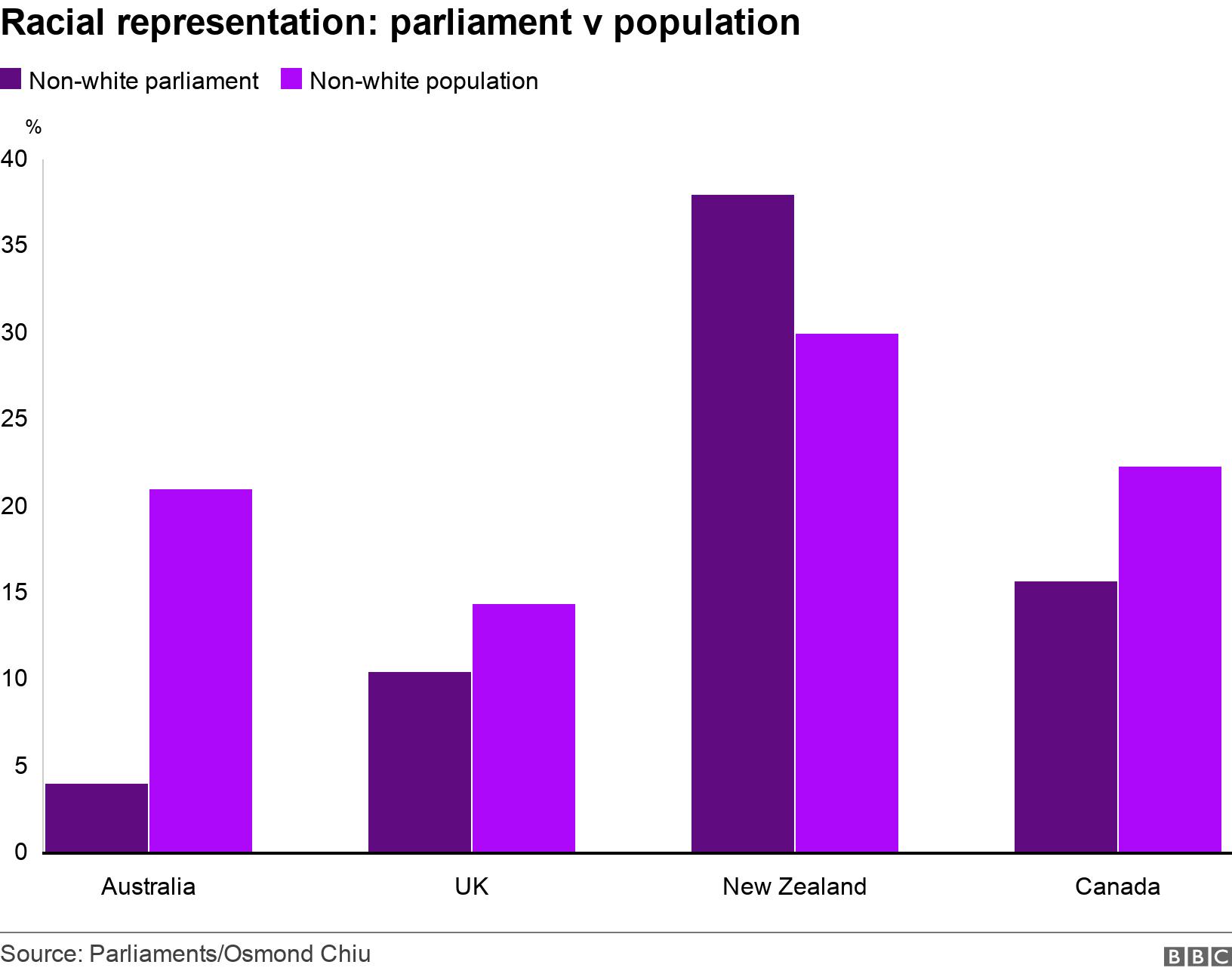
Australia is one of the most multicultural nations in the world, but it’s a different story in the country’s politics, where 96% of federal lawmakers are white.

With this year’s election, political parties did have a window to slightly improve this. But they chose not to in most cases, critics say.

Tu Le grew up the child of Vietnamese refugees in Fowler, a south-west Sydney electorate far from the city’s beaches, and one of the poorest urban areas in the country.

The 30-year-old works as a community lawyer for refugees and migrants newly arrived to the area.

Last year, she was pre-selected by the Labor Party to run in the nation’s most multicultural seat. But then party bosses side-lined her for a white woman.

It would take Kristina Kenneally four hours on public transport – ferry, train, bus, and another bus – to get to Fowler from her home in Sydney’s Northern Beaches, where she lived on an island.

Furious locals questioned what ties she had to the area, but as one of Labor’s most prominent politicians, she was granted the traditionally Labor-voting seat.

Ms Le only learned she’d been replaced on the night newspapers went to print with the story.

“I was conveniently left off the invitation to the party meeting the next day,” she told the BBC.

Despite backlash – including a Facebook group where locals campaigned to stop Ms Kenneally’s appointment – Labor pushed through the deal.

“If this scenario had played out in Britain or the United States, it would not be acceptable,” says Dr Tim Soutphomassane, director of the Sydney Policy Lab and Australia’s former Race Discrimination Commissioner.

“But in Australia, there is a sense that you can still maintain the status quo with very limited social and political consequences.”

An insiders’ game

At least one in five Australians have a non-European background and speak a language at home other than English, according to the last census in 2016.

Some 49% of the population was born or has a parent who was born overseas. In the past 20 years, migrants from Australia’s Asian neighbours have eclipsed those from the UK.

But the parliament looks almost as white as it did in the days of the “White Australia” policy – when from 1901 to the 1970s, the nation banned non-white immigrants.

“We simply do not see our multicultural character represented in anything remotely close to proportionate form in our political institutions,” says Dr Soutphomassane.

Compared to other Western multicultural democracies, Australia also lags far behind.

The numbers below include Indigenous Australians, who did not gain suffrage until the 1960s, and only saw their first lower house MP elected in 2010. Non-white candidates often acknowledge that any progress was first made by Aboriginal Australians.

Racial representation: parliament v population. .  .

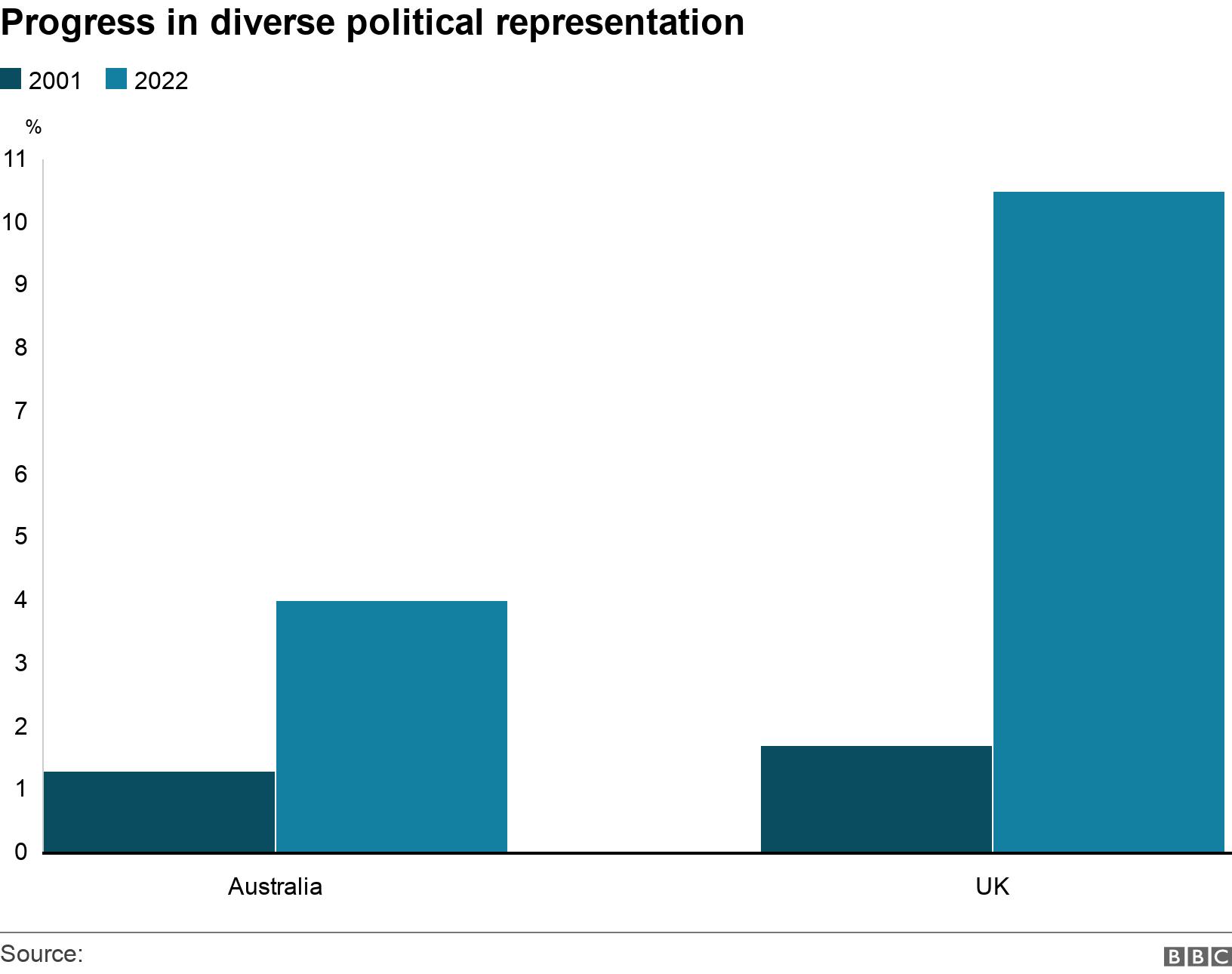
Two decades ago, Australia and the UK had comparably low representation. But UK political parties – responding to campaigns from diverse members – pledged to act on the problem.

“The British Conservative Party is currently light years ahead of either of the major Australian political parties when it comes to race and representation,” says Dr Soutphomassane.

Progress in diverse political representation. .  .

So why hasn’t Australia changed?

Observers say Australia’s political system is more closed-door than other democracies. Nearly all candidates chosen by the major parties tend to be members who’ve risen through the ranks. Often they’ve worked as staffers to existing MPs.

Ms Le said she’d have no way into the political class if she hadn’t been sponsored by Fowler’s retiring MP – a white, older male.

Labor has taken small structural steps recently – passing commitments in a state caucus last year, and selecting two Chinese-Australian candidates for winnable seats in Sydney.

But it was “one step forward and two steps back”, says party member and activist Osmond Chiu, when just weeks after the backlash to Ms Le’s case, Labor “parachuted in” another white candidate to a multicultural heartland.

Andrew Charlton, a former adviser to ex-PM Kevin Rudd, lived in a harbour mansion in Sydney’s east where he ran a consultancy.

His selection scuppered the anticipated races of at least three diverse candidates from the area which has large Indian and Chinese diasporas.

Source: Australia election: Why is Australia’s parliament so white?

McWhorter: ‘Racism’ Has Too Many Definitions. We Need Another Term.

Interesting distinction, between the individual and the systemic, and questions regarding the nexus between the two:

Since Saturday, the mass shooting in Buffalo has rarely left my mind. Ten innocent people killed at a supermarket in a predominantly Black neighborhood. Out of 13 people shot, 11 were Black. According to law enforcement, the man accused of shooting them, Payton Gendron, was motivated by racist hate. Erie County Sheriff John Garcia didn’t equivocate when he said, within hours, that it was a “straight up racially motivated hate crime.” Nor did Mayor Byron Brown when he said on Sunday that “this individual came here with the expressed purpose of taking as many Black lives as he possibly could.” It’s impossible not to be reminded of the 2015 massacre at Emanuel A.M.E. Church in Charleston, S.C., and, sorrowfully, we have no reason to think something like that won’t happen again.

Clearly, racism is not over in the United States.

I have reason to suppose, however, that there are more than a few who think that I am not aware of this. A heterodox thinker on race, as I and others are sometimes called, is often accused of thinking, “There’s no racism.” Or as more temperately inclined folks sometimes say to me, we underplay racism and seem not to understand that it’s still out there. As such, I as well as similarly minded Black thinkers such as Glenn Loury, Coleman Hughes, Wilfred Reilly, Orlando Patterson and Thomas Chatterton Williams are dealing in an alternate reality.

Much of this kind of impression is due to our questioning of how sweeping the use of the word “racism” has become, and I’d like to clarify, at a juncture like this, why I take issue with most strains of what is today called antiracism, despite the reality of racist violence.

The key difference is between outright bigotry and the more abstract operations of what we call “systemic racism.” Yes, there is a synergy between the two. But as the difficulty in our conversations about racism attests, there is a wide gulf between personal prejudice (Racism 1.0) and the societal and sociohistorical operations that render Black physicists, for example, rare relative to Black people’s proportion of the population — Racism 2.0, sometimes even termed “white supremacy.” In an alternate universe, those two things might not go under the same name.

On Racism 1.0, the lamentable thing is that I see no reason it will ever completely vanish, at least not in our lifetimes. Studies haverevealed that a degree of fear and distrust of “the other” exists in our species, for better or worse. Call it conservative of me, but I see little point in hoping that human nature will entirely change. Educated Westerners, especially, have already acquired a more robust habit of self-monitoring for racism than perhaps any humans in history. In our country, this habit noticeably gained traction in the 1960s. Some argue that white Americans need to go further, plumbing more deeply for subtle racist assumptions in their hearts. I understand the desire for it but wonder just how realistic that expectation is at this point.

I assume, with regret, that there will always be racists among us. As long as our gun laws make it easy to obtain assault-style weapons, there will be people, some mentally imbalanced and some just plain evil, who decide to commit mass shootings. There is no reason the hatred in people like this will mysteriously step around racism; the question would be why such people would not often be motivated by it. We live with this horror.

However, there isn’t enough of a nexus between this grim reality and disparities between Black people and white people — in, for example, wealth and educational opportunity — to gracefully put both under the general heading of “racism.” That is, we increasingly apply the term in reference both to violent hate crimes and to the fact that, for example, in the aggregate, Black students don’t perform as well on standardized tests as some of their counterparts. But while we tend to use the term “racism” for both things, it isn’t readily obvious to most how both prejudice and a differential in performance are versions of the same thing, referred to with one word. One of the thorniest aspects of today’s race debate is that we have come to apply that word to a spread of phenomena so vast as to potentially confuse even the best-intended of people.

As such, to be aware of a case like the Buffalo tragedy cannot be taken as making inevitable one’s support for antiracist initiatives such as reparations for slavery or taking funds away from the police in a given city. There may be arguments for such proposals, but the existence of outright bigotry and racist violence is not one of them.

Thus, I am chilled to my socks by what happened in Buffalo while also opposed to the ideology that challenges mainstream standards as “white,” sanctions the censure and dismissal of those who fail to adhere to fashionable tenets of antiracist doctrine, and condescends to Black people by encouraging exaggerated claims of injury. My position comes in full awareness that there remain people in our society who deeply despise Black people and Blackness.

There will always be those who see cases like this one, shake their heads and dismiss someone who sees things as I do with the thought: “And he thinks racism is over — yeah, right.” I can’t fix that, but I suspect I can get a little further with those who think heterodox Black thinkers are reasonable but still underplay the effects of racism. I don’t think we do. I am respectful toward, but skeptical of, potential arguments holding, for example, that acknowledging Racism 1.0 requires accepting the precepts of Racism 2.0. But I hope this newsletter shows, in line with the theme of a recent one I wrote, that my leeriness about how well that kind of argument could hold up is based on neither ignorance nor malevolence, but opinion.

Source: ‘Racism’ Has Too Many Definitions. We Need Another Term.

Koop: Foreign-worker changes could spell trouble

Yet another warning note and reminder of how the Conservatives had to backtrack in 2013-14 given the abuses of the program by employers preferring temporary foreign workers than Canadian residents:

CANADA has been welcoming temporary foreign workers since 1973, but the programs that facilitate this have often been criticized for abuse and mismanagement. Recent changes introduced by the federal government that will expand the number of foreign workers could lead to even more such criticism, as every indication is low-income Canadians will suffer because of the government’s reforms.

Programs that welcome low-skill foreign workers can be of great assistance to employers in very tight labour markets where employees are hard to come by. But the danger of unchecked growth is that these workers typically are willing to accept lower wages and worse working conditions than Canadian workers, which can lead to wage suppression for Canadians or even displacement.

In 2013 and 2014, as the number of foreign workers swelled, abuses of these workers were covered widely in the Canadian media. In some cases, foreign workers were underpaid, or their working conditions were odious; in others, corporations recruited them despite high local unemployment rates. The result of this media coverage was several restrictions introduced by prime minister Stephen Harper’s government designed to slow growth in the number of low-skill foreign workers.

Since then, Ottawa has been besieged by fancy corporate lobbyists intent on loosening these restrictions. In April, Prime Minister Justin Trudeau’s Liberal government finally caved, agreeing to reverse the 2014 restrictions. These changes, which have already taken effect, will likely lead to a spike in the number of low-skill foreign workers in Canada.

In particular: the cap on the total number of foreign workers in several sectors was boosted from 10 to 30 per cent. There is no limit on the number of foreign workers that can be employed in the agriculture, caregiving, and fish and seafood processing sectors. Crucially and inexplicably, employers will now be able to hire foreign workers in regions where the unemployment rate exceeds six per cent.

The problem with expanding access to low-skill foreign workers is that doing so short-circuits market forces that should benefit Canadian workers. When labour markets are tight, employers must compete for the applicants available. The result is higher wages, better benefits and more attractive working conditions.

Employers also have to expand their searches and be more open to applicants they may previously have passed over; for example, disabled Canadians, recent immigrants and refugees, apprentices and young Canadians.

Canadian workers should be benefiting from these market forces. But, to the contrary, post-pandemic wage growth is very low. Indeed, inflation has meant that real Canadian wages may in fact be declining. Low-wage workers — including working class-families, single mothers, and immigrants and refugees just starting out in Canada — are hit hardest by inflation since any marginal increase in costs is felt most acutely by these vulnerable Canadians.

Opening access to foreign workers will present an opportunity to business, but it will likely prolong the pain already faced by working-class Canadian families as wage growth continues to stagnate. Economists Fabian Lange, Mikal Skuterud and Christopher Worswick argue convincingly that the government’s recent reforms will further undermine wage growth despite the tight labour market. They ask, “Does relying on foreign guest workers to fill low-wage job vacancies make sense in this environment?”

Well, it makes perfect sense for corporations.

A few months ago, it was revealed that Tim Hortons, the ubiquitous coffee chain, was facing a staffing crisis that was directly related to low wages. Emails obtained by BNN Bloomberg show that managers at 22 high-traffic suburban chains, mostly surrounding Toronto, were panicked by a lack of workers to handle the post-pandemic return of motorists picking up coffee on the way to work.

As these franchises’ profits have increased, the solution to their staffing problem was obvious: increased wages and enhanced benefits to draw potential workers back from other sectors. But Tim Hortons was among the corporations that protested the most loudly when the government restricted the use of temporary foreign workers in 2014. Should anyone wonder how the coffee chain and other corporations will address staffing shortages now that the Harper-era reforms have been reversed?

When provided with an opportunity from the federal government to suppress labour costs, why wouldn’t employers take it? Workers hoping for relief in this sector may be out of luck.

This raises the question: who is looking out for these Canadian workers? New Democrats fancy themselves the party of workers, but Jagmeet Singh recently dragged his party into a confidence-and-supply agreement with the Liberal government that scrapped the old restrictions. Should voters hold him as well as the Liberals accountable in the next election?

Royce Koop is a professor of political studies at the University of Manitoba and academic director of the Centre for Social Science Research and Policy.

Source: Foreign-worker changes could spell trouble

ICYMI – Nicolas: Des langues et des choix

Reality intrudes. Harder to dismiss Indigenous concerns:

Tout le monde en parlait, cet hiver. Fin février, le rappeur anichinabé Samian s’est retrouvé exclu du Festival international de la chanson de Granby, parce que sa performance se serait déroulée majoritairement en anichinabémowin. Le festival, qui promeut la chanson francophone depuis plus de 50 ans, a refusé de faire une exception et de permettre un spectacle en langue autochtone.

Le festival avait indiqué être « sincèrement désolé de la tournure des événements », mais le mal était fait. À Tout le monde en parle, Samian avait dénoncé une mentalité « colonialiste », qui considère les langues autochtones comme une menace pour le français. Les messages de soutien avaient alors fusé d’un peu partout au Québec. Oui, il faut protéger le français, disait-on. Mais pas en nuisant aux langues autochtones ni à l’autodétermination des peuples. En matière de relations publiques, le Festival de Granby avait de toute évidence perdu la manche.

En me rappelant comment le message de Samian avait été entendu, il y a à peine quelques mois, je me dis qu’une bonne partie de la population serait aussi prête à écouter les critiques que de nombreux leaders autochtones font du projet de loi 96 depuis son dépôt par le gouvernement du Québec.

Mardi, à l’Assemblée nationale, plusieurs chefs ont réitéré leur inquiétude face à cette nouvelle politique linguistique, qui aurait de nombreuses implications pour les Premières Nations et les Inuits au Québec. Ghislain Picard, chef de l’Assemblée des Premières Nations Québec-Labrador (APNQL), a dit craindre que l’adoption du projet loi 96 force « l’exode de nos étudiants vers d’autres avenues, d’autres écoles à l’extérieur du Québec ». Il a ajouté qu’il trouvait « d’une ironie renversante que, finalement, les premiers occupants du territoire au Québec soient forcés d’aller étudier à l’extérieur de leur territoire ».

M. Picard fait ici référence aux nouvelles exigences de cours de français au niveau collégial incluses dans le projet de loi. Ses mots sont forts, donc il est important d’expliquer leur contexte. Avec le travail des missionnaires, puis avec les pensionnats, et enfin avec le système scolaire contemporain, cela fait déjà plusieurs générations que les peuples autochtones au Québec et ailleurs au Canada se font imposer une éducation dans une ou deux langues coloniales. Les premières langues du territoire en sont donc aujourd’hui fortement menacées — certaines plus que d’autres —, et la transmission culturelle et l’existence même des peuples autochtones en tant que groupes distincts sont menacées avec elles.

Les Inuits et certaines Premières Nations, comme les Micmacs et les Mohawks, se sont surtout fait imposer l’anglais, historiquement. Le gouvernement québécois, dans sa volonté d’affirmation nationale, travaille pour asseoir le français comme langue officielle et langue commune sur son territoire. Avec le projet de loi 96, on vient donc exiger de certains étudiants autochtones la maîtrise d’une deuxième langue « étrangère » dans un système d’éducation qui refuse de faire une place sérieuse à leurs langues et à leurs cultures.

Nos écoles sont déjà perçues comme des milieux de vie aliénants par une partie de la jeunesse autochtone, ce qui contribue aux taux de réussite scolaire plus faibles de plusieurs communautés. Par conséquent, on craint d’aggraver les risques de décrochage ou d’encourager le départ de certains élèves vers les provinces limitrophes si les étudiants autochtones étaient soumis à la loi 96.

J’utilise le verbe « soumis » avec une conscience aiguë du poids de ce mot. Car c’est bien de cela qu’il est question ici : de soumission. Plusieurs journalistes et élus se demandent pourquoi on ferait tout un plat pour trois cours de français supplémentaires au collégial — ou encore pourquoi on semble vouloir défendre l’éducation en anglais, une autre langue coloniale et certainement pas autochtone. La réponse formulée par plusieurs des intervenants lors de la conférence de presse de mardi se situe ailleurs.

On refuse simplement que le gouvernement du Québec dicte la langue d’apprentissage des jeunes autochtones. On ne veut pas se faire imposer le français, ni l’anglais d’ailleurs ; on veut être libre de choisir pour soi-même. Un principe élémentaire qui va de pair avec la Déclaration des Nations unies sur les droits des peuples autochtones que le Canada s’est engagé à respecter dans toutes ses lois. Un principe qu’avait aussi défendu Samian, à sa manière, quand il avait dénoncé la « mentalité colonialiste » d’un festival qui cherchait à lui imposer une langue. Principe que bien des Québécois avaient alors compris.

Il est toutefois important de dire une chose : l’autodétermination des peuples autochtones et la liberté de choisir sa langue demeurent théoriques à moins que de véritables options soient offertes. Si les programmes d’étude de niveau postsecondaires en langues autochtones n’existent à peu près pas au Québec, est-ce que le jeune micmac ou mohawk fait vraiment le « choix » de l’anglais au cégep ou à l’université ? Est-ce qu’une ado huronne ou abénaquise, dont la langue ancestrale est particulièrement menacée, fait le « choix » d’une éducation en français dès le primaire ?

Bien sûr que non. Pour que les jeunes autochtones soient véritablement libres d’apprendre leur propre langue, en plus du français, de l’anglais ou de toute autre langue, il faut une revitalisation des langues autochtones, dont les défis et les avancées varient largement d’une communauté à l’autre. Et cette revitalisation ne peut pas non plus être imposée par un gouvernement qui voudrait unilatéralement « sauver » les premières langues du territoire. L’autonomie et le respect mutuel sont ici les clés du succès.

Pour avancer et se comprendre, le dialogue et l’écoute sont nécessaires. Si le projet de loi 96 est adopté comme tel, alors que les amendements de l’APNQL ont été balayés du revers de la main par le gouvernement, il sera désormais encore plus difficile de s’entendre, malheureusement.

Source: Des langues et des choix

Israel: Shaked withdraws bill to revoke Israeli citizenship from terrorists

Of note:

Interior Minister Ayelet Shaked (Yamina) on Sunday backtracked on her plan to pass a bill that would revoke the citizenship of Israeli citizens who commit terrorist acts. The bill Shaked has promoted is based on a bill once put forth by MKs Avi Dichter and Orit Strock.

Shaked retracted the legislation after discussions between her representatives and Justice Ministry officials, who said the bill would not hold up in the High Court of Justice.

The bill stipulated that any Israeli citizen who participates in hostile terrorist activity and receives monetary support from the Palestinian Authority will be stripped of his or her Israeli citizenship. The purpose of the proposed legislation is to prevent the PA from paying Israeli citizens who perpetrate attacks.

Shaked has vowed on several occasions over the course of her tenure as head of the Interior Ministry to pass the bill into law. Officials in her circle, however, as stated, said the Justice Ministry made it clear in recent preliminary discussions that the High Court of Justice would reject the bill as it is currently worded, and that the State Attorney has no intention of defending it once an appeal against it is submitted to the Supreme Court.

Instead of revoking citizenship, Shaked now intends to promote legislation that would revoke pension payments to Israelis who have been convicted of terrorist acts. This, even though a similar law exists and is already partially implemented. Shaked is also exploring the possibility of downgrading the citizenship status of convicted Israeli terrorists, although at this point the legislative process is awaiting a High Court ruling on the matter, which is expected within the next two months.

Strock, who is a member of the Religious Zionism Party, slammed Shaked for withdrawing the legislation, saying the “excuse of oppositionist jurists doesn’t hold water. The person who twice torpedoed the bill in the Knesset without once mentioning oppositionist jurists – can’t now hide behind the ‘jurists.’ The reason this life-saving law isn’t being brought forth is the fact that this government is only surviving right now because of the mouth-to-mouth resuscitation it is receiving from the Ra’am party and [Joint Arab List MK] Ahmad Tibi. Everyone realizes this, even the terrorists, as well as their victims. It’s sad, concerning, and disgraceful.”

Source: Shaked withdraws bill to revoke Israeli citizenship from terrorists

Le Québec «bashing» ou la tolérance à deux vitesses

Sigh. Not to mention the inverse, Canada bashing on the part of some intellectuals…

Le Canada se drape de tolérance envers les minorités — tout en assumant des épisodes de Québec bashing, devenus chroniques dans l’histoire des deux solitudes. Ce paradoxe, commun au monde anglo-saxon, remonte à l’origine même du libéralisme britannique, estime Patrick Moreau, professeur au collège Ahuntsic qui participait, mercredi, à un colloque consacré à « la condescendance francophobe en contexte canadien ».

« Les sociétés anglo-saxonnes en général — et la société canadienne en particulier — se présentent toujours comme très libérales, très à cheval sur les droits individuels et la tolérance, explique M. Moreau, qui collabore par ailleurs à la section Idées du Devoir. En même temps, elles ont souvent, à travers l’histoire, connu des accès d’intolérance. »

Pour le professeur, invité à prendre la parole au congrès de l’Acfas mercredi, « le ver est dans le fruit » depuis la naissance de la tolérance religieuse proclamée au XVIIe siècle par le pouvoir anglican. « L’Angleterre autorisait toutes les sectes protestantes, ce qui était exceptionnel en Europe, à l’époque. En revanche, cette tolérance excluait les catholiques et les athées. Nous sommes tolérants, mais pas à l’égard de toutes et de tous. »

Ce même réflexe s’applique encore aujourd’hui envers le Québec, maintient le professeur Moreau. Le Canada anglais prétend accueillir et célébrer les différences. Sauf certaines, souvent québécoises.

« Dès qu’on nous montre la diversité canadienne, il faut qu’on nous montre une femme voilée, un turban, etc., poursuit le chercheur, en entrevue au Devoir. Comme si la seule différence admissible était en réalité superficielle. Si les Québécois se contentaient d’être une minorité parmi d’autres, arborant la ceinture fléchée lors de la Saint-Jean, le Canada s’en réjouirait et les tolérerait comme il tolère n’importe quel costume de n’importe quelle minorité ethnique ou religieuse. »

Or, le Québec dérange au point de devenir intolérable, soutient M. Moreau, parce que la différence qu’il revendique réfute la suprématie du modèle anglo-saxon.

« Ce qui est inacceptable aux yeux du Canada anglais, c’est cette volonté du Québec de faire société en français et selon des termes politiques qui ne sont pas ceux de la philosophie politique anglo-saxonne. Autrement dit, de revendiquer des droits linguistiques collectifs. […] La laïcité, c’est un peu la même chose, poursuit le professeur Moreau. On refuse, au Canada anglais, de voir la laïcité comme un modèle légitime de gestion de la diversité. On veut à tout prix y voir l’expression d’une intolérance ethnique à l’égard des autres minorités religieuses. »

Un Québec bashing progressiste

Cette discrimination à l’égard des francophones, M. Moreau note qu’elle a évolué au tournant du XXIe siècle. « La francophobie canadienne était, jusque dans les années 2000, plutôt conservatrice. C’était vraiment une francophobie coloniale issue d’un sentiment de supériorité très britannique et protestant à l’égard de Canadiens français, jugés arriérés, et catholiques, en plus. »

Plus récemment, avance le chercheur, « nous sommes passés à un Québec bashing progressiste, c’est-à-dire que nous allons reprocher au Québec d’être intolérant à l’égard des minorités, de créer une discrimination à l’égard des minorités, donc finalement de refuser les normes du multiculturalisme trudeauiste actuel. »

La saga entourant l’Université d’Ottawa et l’usage du mot en « n » dans une salle de cours a jeté une lumière crue sur le paradoxe de la tolérance canadienne envers ses minorités, insiste le professeur de littérature au collège Ahuntsic. « Il y a eu un glissement que je trouve personnellement assez épatant de la part de gens qui se prétendent fondamentalement antiracistes, mais qui vont insulter des professeurs en les traitant de fucking frogs. Bref, en utilisant un vocabulaire qui est très clairement raciste. »

À son avis, le Québec bashing a encore de beaux jours devant lui. Tant mieux, souligne-t-il, puisque sa disparition voudrait dire la fin d’un Québec qui revendique son droit à faire société autrement.

« Le jour où le Québec bashing va disparaître, ce ne sera pas vraiment une bonne nouvelle pour le Québec, avance M. Moreau. Ça voudra dire, je pense, que le Québec aura renoncé à faire société d’une façon différente du Canada. Autrement dit, il aura adopté le modèle dominant du libéralisme canadien. À ce moment-là, il sera devenu acceptable », conclut le professeur.

Source: Le Québec «bashing» ou la tolérance à deux vitesses

Citizenship applications full-year 2021 operational data

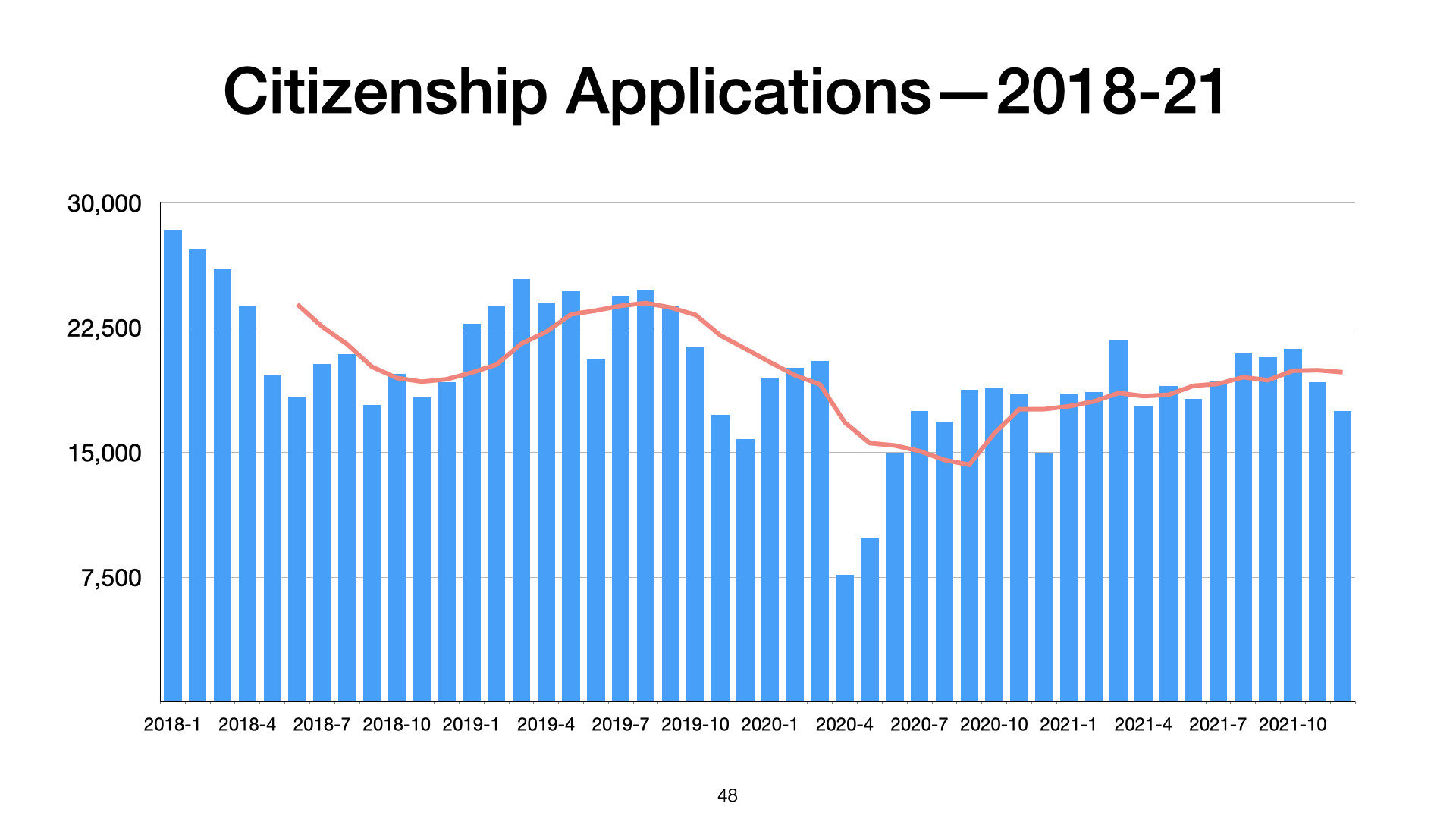
IRCC released the full 2021 data on the number of applications for citizenship. Given the delays in IRCC entering application data in GCMS (for both Permanent Residents and citizenship), this three-month old data reflects an accurate number.

The month-by-month overview:

With the full-year data, I can now update the overview chart of the impact of COVID-19 on the range of immigration-related programs 2021-18 (How the government used the pandemic to sharply increase immigration), showing that applications declined by 10.3 percent compared to new citizens, 37.6 percent.:

The average for applications in 2021 was about 19,000 monthly, with small variations.

Given current processing trends, an average of 31,000 for the first quarter, IRCC should be able to continue chipping away at the backlog of 400,000 (April 11-12) unless applications increase significantly.

Lastly, my standard chart, comparing applications, new citizens and new Permanent Residents:

‘Clearly there are stories we’re not telling’: Study seeks to improve diversity in news sources

Will be interesting to see the results, hopefully with some qualitative analysis of the differences in perspectives covered. One can see some of this shift occurring in the CBC:

For all the prodding, encouragement and reminders, progress to improve the diversity of voices in news stories seems frustratingly slow.

Now a project involving national news agency The Canadian Press and Carleton University’s School of Journalism is hoping to get a better understanding of who gets quoted, and provide a catalyst for change.

CP has teamed with the journalism school to “identify, track and analyze” the choice of interview subjects by its journalists. The goal is to track the diversity of individuals — or lack of, as a news release pointedly notes — based on gender, race and ethnicity and other equity-seeking groups.

Joanna Smith, CP’s Ottawa bureau chief, is the impetus behind the work. The goal, she emphasizes, is not simply to diversify sources. The goal is the better journalism that comes when news coverage is truly representative.

“Over and over again, we are returning to the same sources in TV and journalism, the same largely white, largely male, largely institution-based” people, Smith said. “The idea of broadening the diversity of our sources is really about telling bigger and better and different stories.” 

(Disclosure: Torstar, the parent company of the Toronto Star, is a part owner of The Canadian Press).

Nana aba Duncan, who holds the Carty Chair in Journalism, Diversity and Inclusion Studies at the journalism school, said a journalist’s first choice for an interview is often someone they’ve worked with or someone they know. It’s likely that source is not from an under-represented group.

“Our first thought is what is the easiest and what is the quickest?” Duncan said. “Anything that has to do with change has to be intentional.”

That’s why research is vital to track who is being quoted — and who is being left out. “We absolutely have to do it or else it just doesn’t get done,” said Duncan, a former CBC broadcaster who is part of the project research team.

Duncan says it’s also important how those voices are framed and treated in the story. Are we engaging people for their expertise, such as economics or politics, or only for their race or gender? Where are these voices appearing in the story? Are they making the news or reacting to it?

“You may have an experience in which you are undermined or … your value is just not recognized. That has an effect,” she said. 

Professor Allan Thompson, the head of the journalism school, says the lack of diversity in news articles speaks to the “embedded bias” that exist in newsrooms and journalism.

To him, diversity is about fact-checking and accuracy. “Unless the sourcing reflects society, then it’s not accurate, even if all the words are verbatim,” Thompson said.

“We’re knitting some cloth that is the narrative of our society. If we’re only using one cross-section of voices, then clearly there are stories we’re not telling, there are perspectives on stories that we’re not capturing, and we’re just self-perpetuating our own version of a narrative,” he said.

Shari Graydon, director of Informed Opinions, has been working for years to get more women’s voices into news coverage. (The organization provides a searchable database of more than 2,200 women experts, so there’s no excuse for journalists to exclude them.)

Its online “Gender Gap Tracker” shows the percentage of female sources in online news coverage by major news outlets. It measures all stories, such as those filed by news agencies, rather than those written solely by an outlet’s own journalists alone. Over the last 12 months, sources quoted in stories on the Star’s website have been overwhelmingly male (74 per cent) versus female (26 per cent). 

Graydon said that a diversity of sources in news coverage is a hallmark of good journalism. “I really think awareness is not remotely enough,” she said, urging record-keeping as a precaution against the self-delusion one is doing better than they really are. 

Lasting change requires deliberate action. Journalists have control over the sources they choose to interview. As a start, they should review their last 10 stories. Who was quoted? Going forward, the objective is to cultivate more representative sources and track that work. 

Duncan emphasizes that media outlets must support such efforts. “It’s on the institution saying, ‘We care about this. Here’s what we’re going to do. We’re going to spend money on caring about diversity and being intentional about it,’” she said.

This project, due to unfold over the coming months, promises to improve the diversity of sources used in CP articles, which would benefit all news organizations that rely on its coverage. I’m hopeful it will offer lessons all newsrooms can draw on.
Source: ‘Clearly there are stories we’re not telling’: Study seeks to improve diversity in news sources