Ottawa expands access to temporary foreign workers to ease labour crunch

As others have noted, “History repeats itself, first as tragedy, second as farce,” as the government is likely to discover as did the previous government in 2014 (see So who is to blame for the temporary foreign worker mess?).

The federal government is allowing Canadian employers to hire significantly more temporary foreign workers as part of changes to its immigration rules, a move aimed at easing labour shortages that have aggravated businesses during the recovery from the pandemic.

The federal employment ministry announced changes to the Temporary Foreign Worker Program on Monday that will ultimately increase the number of TFWs allowed into Canada, both in low- and high-wage jobs. The changes will also streamline the application process for employers.

The loosened restrictions deliver a boon to businesses just days before the release of the 2022 federal budget, which corporate Canada will be watching closely for measures aimed at growing Canada’s economy after two years of market gyrations and massive public spending.

Starting on April 30, employers will be allowed to increase the number of low-wage TFWs they hire, from 10 per cent to 20 per cent of their total workforces, until further notice. For seven key sectors that have suffered from particularly acute labour shortage issues over the past few years – such as food manufacturing; hospitals, nursing and residential care; and accommodation and food services – the TFW cap for low-wage workers will be raised to 30 per cent for one year.

The government is also planning to remove a cap on the number of low-wage positions that employers in seasonal industries, such as fish and seafood processing, can fill through the program. Employers will now be able to keep TFWs in these positions for 270 days, instead of the current 180 days.

In addition, the government is expanding the duration of time that a foreign worker hired through the Global Talent Streams program (which is geared at high-wage foreign workers) can be employed in Canada, to three years from two. Technology leaders in Canada have continually lobbied Ottawa to loosen immigration rules for high-skilled workers, because the battle for tech talent often pits domestic firms against deep-pocketed Silicon Valley giants.

Many businesses in Canada, particularly those that were impacted by on-and-off lockdowns over the past two years, have been struggling to find domestic workers willing to be employed on the front lines of an ongoing pandemic, and have been calling on the government to allow them to access the TFW program.

Canadian employers were recruiting for roughly 915,000 positions in the fourth quarter of 2021, an increase of 80 per cent over the number of openings two years prior, according to Statistics Canada. In December, the labour need was particularly acute in three industries, each of which had more than 100,000 open positions: accommodation and food services, retail, and health care and social assistance.

Even as demand for labour has increased, employment in Canada has jumped above prepandemic levels. The national unemployment rate is 5.5 per cent, putting it just shy of a record low – a sign that worker availability is waning.

“As we begin to recover from the pandemic and look to fill remaining job vacancies, we will continue to make our Temporary Foreign Worker Program more accessible, efficient and agile to support employers who are looking to staff up and grow their operations,” Sean Fraser, the federal Minister of Immigration, Refugees and Citizenship, said in a statement.

TFWs are allowed into Canada on temporary visas, and they usually face legal restrictions on where they can work and the types of labour they can perform. A TFW can try to gain permanent residency in Canada, but those who aren’t granted permanent status are required to leave the country when their visas expire.

The expansion of the TFW program was met with mixed reactions. Employers and business lobby groups applauded the changes, while labour advocates cautioned that increasing the number of TFWs effectively increases the number of precarious workers with fewer rights than Canadians.

“We feel like the business community has been heard around labour shortages, particularly in the short term,” said Leah Nord, senior director of workforce strategies and inclusive growth at the Canadian Chamber of Commerce. The TFW program changes are “going to go a long way to help address those issues in many sectors.”

For decades, the TFW program has been a focal point of criticism in Canada’s immigration system. Its opponents have said it is overused by companies looking to drive down labour costs. Another frequent criticism is that the program allows employers to exploit migrant workers.

Only 0.4 per cent of Canada’s overall labour force consists of workers from the TFW program, according to the government. Most end up working in low-wage jobs. Agriculture alone accounts for 60 per cent of all TFWs.

Seasonal agriculture workers often live in employer-provided bunkhouses. Those crowded conditions have been blamed for a rash of COVID-19 outbreaks among migrant workers over the past two years, resulting in thousands getting sick and some dying. Labour groups say inhumane treatment of agricultural workers is acute in Ontario, where they are barred from unionizing or entering into collective bargaining agreements.

“This is very concerning. When workers come into this country tied to an employer, it completely limits their ability to speak up about any unfair labour practices or health issues,” said Deena Ladd, executive director of the Workers’ Action Centre, a labour advocacy group.

Ms. Ladd added that allowing an influx of foreign workers to enter the country without a clear path toward permanent residency, which would give them full labour and health protections under the law, is regressive.

The government has said increasing the Global Talent Streams visa period to three years from two will allow this class of foreign worker to more easily find ways to qualify for permanent residency.

Jane Deeks, a spokesperson for Carla Qualtrough, the Minister of Employment, Workforce Development and Disability Inclusion, said nearly 152,000 applicants transitioned from worker status to permanent residency between January and November of 2021.

Source: Ottawa expands access to temporary foreign workers to ease labour crunch

America’s culture wars distract from what’s happening beneath them

Interesting take. Culture wars as the opium of the people in contrast to some of the underlying structural factors:

The neoliberal order that triumphed in America in the 1990s prized free trade and the free movement of capital, information, and people. It celebrated deregulation as an economic good that resulted when governments could no longer interfere with the operation of markets. It hailed globalization as a win-win position that would enrich the west (the cockpit of neoliberalism) while also bringing an unprecedented level of prosperity to the rest of the world. A remarkable consensus on these creedal principles came to dominate American politics during the heyday of the neoliberal order, binding together Republicans and Democrats and marginalizing dissenting voices to the point where they barely mattered.

Somewhat paradoxically, this broad agreement on matters of political economy nurtured two strikingly different moral perspectives, each of them consonant with the commitment to market principles that underlay the neoliberal order. The first perspective was ‘neo-Victorian’, celebrating self-reliance, strong families, and disciplined attitudes toward work, sexuality, and consumption.

These values were necessary, this moral perspective argued, to gird individuals against market excess – accumulating debt by buying more than one could afford and indulging appetites for sex, drugs, alcohol, and other whims that free markets could be construed as sanctioning. Since neoliberalism frowned upon government regulation of private behavior, some other institution had to provide it. Neo-Victorianism found that institution in the traditional family – heterosexual, governed by male patriarchs, with women subordinate but in charge of homemaking and childrearing.

Such families, guided by faith in God, would inculcate moral virtue in its members and prepare the next generation for the rigors of free market life. Gertrude Himmelfarb, Irving Kristol, George Gilder, and Charles Murray were among the intellectuals guiding this movement, the legions of evangelical Christians mobilized in Jerry Falwell’s Moral Majority its mass base.

The other moral perspective encouraged by the neoliberal order was cosmopolitan. A world apart from neo-Victorianism, it saw in market freedom an opportunity to fashion a self or identity that was free of tradition, inheritance, and prescribed social roles. In the United States this moral perspective drew energy from liberation movements originating in the new left – black power, feminism, multiculturalism, and gay pride among them.

Cosmopolitanism was egalitarian and pluralistic. It rejected the notion that the patriarchal, heterosexual family should be celebrated as the norm. It embraced globalization and the free movement of people, and the transnational links that the neoliberal order had made possible. It valorized the good that would come from diverse peoples meeting each other, sharing their cultures, and developing new and often hybridized ways of living. It celebrated the cultural exchanges and dynamism that increasingly characterized the global cities – London, Paris, New York, Hong Kong, San Francisco, Toronto, Miami among them – flourishing under the aegis of the neoliberal order.

The existence of two such different moral perspectives was both a strength and a weakness for the neoliberal order. The strength lay in the order’s ability to accommodate within a common program of political economy very different constituencies with radically divergent perspectives on moral life. The weakness lay in the fact that the cultural battles between these two constituencies might threaten to erode the hegemony of neoliberal economic principles.

The cosmopolitans attacked neo-Victorians for discriminating against gay people, feminists, and immigrants, and for stigmatizing the black poor for their so-called “culture of poverty”. The neo-Victorians attacked the cosmopolitans for tolerating virtually any lifestyle, for excusing what they deemed to be deplorable behavior as an exercise in the toleration of difference, and for showing a higher regard for foreign cultures than for America’s own. The decade of the neoliberal order’s triumph – the 1990s – was also one in which cosmopolitans and neo-Victorians fought each other in a series of battles that became known as the “culture wars”. In fact, a focus on these cultural divisions is the preferred way of writing the political history of these years.

Just beneath this cultural polarization, however, lay a fundamental agreement on principles of political economy. This intriguing coexistence of cultural division and economic accord manifested itself in the complex relationship between Bill Clinton and Newt Gingrich. In the media, they were depicted (and depicted themselves) as opposites, sworn to each other’s destruction. Clinton offered himself as the tribune of the new America, one welcoming of racial minorities, feminists, and gays. He was thought to embody the spirit of the 1960s and something of the insurgent, free-spirited character of the new left. Gingrich presented himself as the guardian of an older and “truer” America, one grounded in faith, patriotism, respect for law and order, and family values. Gingrich publicly pledged himself and his party to obstructing Clinton at every turn. Clinton, meanwhile, regarded Gingrich as the unscrupulous leader of a vast right-wing conspiracy to undermine his presidency.

Yet, despite their differences and their hatred for each other, these two Washington powerbrokers worked together on neoliberal legislation that would shape America’s political economy for a generation. They both supported the World Trade Organization, which debuted in 1995 to turbocharge a global regime of free trade. Their aides jointly engineered the Telecommunications Act of 1996, which did more than any other piece of legislation in the 1980s and 1990s to free the most dynamic sector of the US economy from government regulation.

Major pieces of legislation deregulating the electrical generation industry and Wall Street followed closely in the telecom bill’s wake. Clinton and Gingrich also worked together to pare back the welfare state, sharing a conviction that the tough, disciplining effects of job markets would benefit the poor more than state-subsidized “handouts”. Clinton’s collaboration with Gingrich had facilitated the neoliberal order’s triumph.

That order is now on the wane, its once unassailable principles of free trade, free markets, and the free movement of people now disputed on a daily basis. Meanwhile, public attention focuses on yet another chapter in the culture wars, with the American people divided, irredeemably it seems, over vaccination, critical race theory, and whether Donald Trump should be lauded as an American hero or jailed for acts of treason.

Yet, beneath the churn, one can detect hints of new common ground on economic matters emerging. Trump and Bernie Sanders have both worked to turn the country away from free trade and toward a protectionist future promising better jobs and higher wages. Senators Josh Hawley and Amy Klobuchar have both been warning the American people about the dangers of concentrated corporate power and the “tyranny of high tech”; and bipartisanship is driving movements in Congress to commit public funds to the nation’s physical infrastructure and to industrial policies deemed vital to economic wellbeing and national security. It is too soon to know whether these incipient collaborative efforts indicate that a new kind of political economy is in fact taking shape and, if it is, whose interests it will serve. But these developments underscore, once again, the importance of looking beyond and beneath the culture wars for clues as to where American politics and society might be heading.

Gary Gerstle is a Guardian US columnist. Excerpted and adapted from The Rise and Fall of the Neoliberal Order: America and the World in the Free Market Era (Oxford University Press, 2022)

Source: America’s culture wars distract from what’s happening beneath them

Legal US immigration rebounds somewhat after plunging with COVID pandemic

Useful analysis by Pew:

The number of immigrants receiving green cards as new lawful U.S. permanent residents bounced back last year to pre-pandemic levels after plunging during the coronavirus outbreak, according to a new Pew Research Center analysis of recently available government data. Green cards issued to immigrants already in the United States seeking to adjust their temporary status rebounded above pre-pandemic levels, while the number of green cards for new arrivals also grew but did not reach earlier totals.

About 282,000 people received green cards in July-September 2021, the final quarter of the fiscal year, according to quarterly admissions data from the federal Office of Immigration Statistics. That number was higher than in any quarter since April-June 2017, and slightly higher than the quarterly average for the period from October 2015 to March 2020. During the pandemic, new green card issuances fell to a quarterly low of 79,000 in mid-2020.

Arrivals of foreign tourists, business visitors, guest workers, foreign students and other temporary lawful migrants also rebounded somewhat, according to data for the final quarter of fiscal 2021, which ended Sept. 30. For the most part, however, arrivals of these lawful temporary migrants are still well below their pre-pandemic averages.

How we did this

Beginning in early 2020, the coronavirus pandemic had a big impact on migration worldwide. The U.S. closed land borders with Canada and Mexico to nonessential travel through late 2021, and air travel between countries also was severely restricted. Three-quarters of U.S. consulates globally, which issue visas, remained closed through June 2021. U.S. Citizenship and Immigration Services, which processes applications for immigrants already in the U.S., suspended in-person interviews as well as other services during the height of the pandemic. Other countries – both sources of immigrants and transit corridors for them – closed their borders early on in the pandemic, bringing international migration nearly to a halt.

Fewer green cards issued

A line graph showing that green card totals for legal U.S. immigrants have rebounded to  pre-pandemic levels

During the pandemic, green card issuances for newly arriving immigrants dropped more sharply than issuances for immigrants already in the United States on temporary visas. Issuances for newly arriving immigrants also have not recovered as much ground as issuances for immigrants already in the U.S. when compared with pre-pandemic levels.

At the low point for visa and legal permanent status issuances at the start of the pandemic – the April-June 2020 period that was the third quarter of the fiscal year – roughly 19,000 green cards were issued to new arrivals to the U.S., compared with an average of about 134,000 each quarter for the period from October 2015 to March 2020. In the last quarter of fiscal 2021, in June to September of that year, about 105,000 green cards were issued to immigrants newly arriving in the U.S., or about 78% of the pre-pandemic quarterly average.

The number of green cards granted to immigrants already in the U.S. on temporary visas, called an “adjustment of status,” did not fall as steeply. During the 2020 pandemic low point for lawful immigration, about 60,000 green cards were issued to immigrants adjusting their status, compared with a quarterly average of 141,000 for fiscal 2016 onward. By the final quarter of fiscal 2021, roughly 177,000 green cards were issued for adjustments of status, more than in any quarter recorded since at least fiscal 2016.

Legal admission of temporary migrants partially rebounds

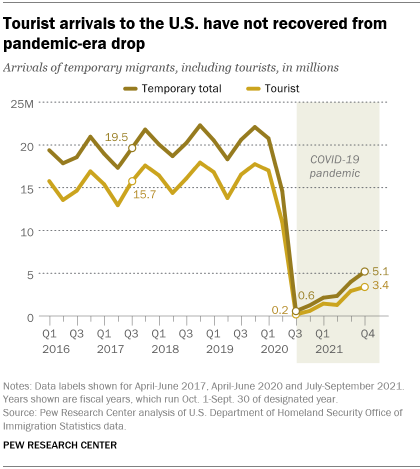
Arrivals of legally admitted temporary migrants, which averaged 19.6 million per quarter from fiscal 2016 through March 2020, dove to about 600,000 during April-June 2020, the third quarter of the fiscal year. That was only 3% of the pre-pandemic average.

A line graph showing that tourist arrivals to the U.S. have not recovered from a pandemic-era drop

About 80% of these arrivals before the pandemic were tourists, and most of the rest were business travelers, temporary workers and their families, and students.

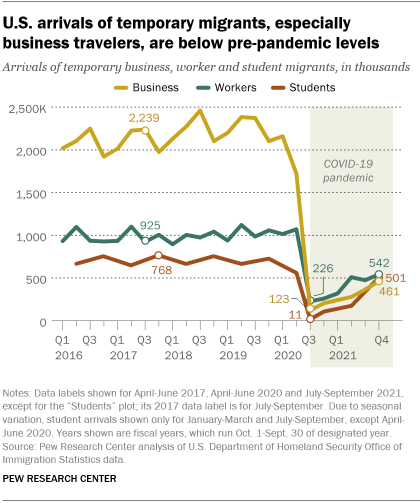
While the numbers have gone up from the low point in April-June 2020, the number of arrivals of tourists and business travelers are still well below pre-pandemic levels. However, the number of arrivals for temporary worker and student visas have risen closer to average levels in comparable quarters for October 2016-March 2020 than have the number of arrivals by business or tourist visas.

Hardest hit by the border closures were arrivals of tourists, which dropped to only 1% of earlier levels in April-June 2020 – about 185,000 arrivals, compared with a quarterly average of 15.6 million for the period beginning October 2015. These arrivals have since risen considerably, but the latest data (from July to September 2021) shows that quarterly tourism has reached only 22% of the average level of the period from late 2015 until the pandemic hit in March 2020.

A line graph showing that U.S. arrivals of temporary migrants, especially business travelers, are below pre-pandemic levels

The number of foreign visitors attending conferences or otherwise traveling on business also declined dramatically, to only 6% of pre-pandemic levels. Even with sizable increases since then, business visitor visas only reached 21% of pre-pandemic levels, roughly 461,000, in the final quarter of fiscal 2021.

In April-June 2020, only about 11,000 foreign students arrived in the United States, representing 4% of average arrivals during similar quarters since 2016. The numbers increased substantially but remained well below pre-pandemic levels until the fourth quarter of 2021, when about 501,000 foreign students arrived in the U.S., reaching two-thirds (67%) of the average number of fourth-quarter arrivals prior to the pandemic’s start.

Arrivals of temporary workers and their families dropped somewhat less during the pandemic than those of others with temporary status. The roughly 226,000 arrivals of temporary workers in April-June 2020 represented 23% of average quarterly arrivals from October 2015 to March 2020. By July-September 2021, arrivals of temporary workers had more than doubled from the 2020 low, to about 542,000, but still remained at only slightly above half the pre-pandemic level (54%).

The somewhat smaller drop in temporary workers was in large part a function of the continued arrival of agricultural workers (issued H-2A visas) to cross the border to pick crops. In a Federal Register notice, the Department of Homeland Security deemed these jobs “critical to the U.S. public health and safety and economy.” About 100,000 H-2A workers were admitted in April-June 2020, only 4,000 fewer than were admitted in the same quarter the year before and 12% more than the average number admitted for the third quarters of 2016-2019. Excluding H-2A visa arrivals, the number of arrivals of temporary workers during April-June 2020 fell to 14% of pre-pandemic averages.

Source: Legal US immigration rebounds somewhat after plunging with COVID pandemic

Sears: Canada faces great challenges. We needs more independent, creative policy thinkers to address them

Not quite as bleak as presented but does flag some real weaknesses including policy diversity:

Canada faces policy challenges today that are broader and more complex than perhaps ever in our history. Several are well-known: climate, health care and the next contagion, sliding productivity and widening inequality. Each will be expensive to tackle, and all will require great creativity to address.

In the U.S., the U.K. and Europe much of that thinking is done by an array of policy think tanks. We have a few, and some of those we have are far too predictable. One need not do more than read the headline on a C.D. Howe Institute economic report to know what the next 5,000 words of analysis and recommendations will be. The Fraser Institute’s views on private health care, climate change and lower taxes have been repeated hundreds of times with changes only to the names and dates.

Two of Canada’s political parties have policy think tanks that are aligned philosophically, but independent in their prescriptions. The Manning Centre (now the Canada Strong and Free Network) was an important ginger group of new conservative thinking in the Harper years, though it appears to have lost a great deal of energy since the departure of its founder Preston Manning.

Canadian conservatives desperately need a bold centre for testing policy if they are to return to being a party of government. It has long failed to elaborate a credible conservative agenda for action on any of the tough issues. Ken Boessenkool’s Conservatives for Clean Growth may be a valuable new player on climate, perhaps one that will inspire new groups on other priorities.

Curiously, the Liberal party has several times failed in its efforts to create a similar centre to feed its need for creative new centrist thinking. The gap is evident in areas such as security policy, wealth inequality and growth through innovation. The obstacle maybe the number of Liberal thinkers who are parked in the academy or in non-partisan centres such as the Institute for Research on Public Policy, who don’t fancy a new competitor.

The least likely of the three national parties, in terms of resources, has three policy centres. The Canadian Centre for Policy Alternatives was created by New Democrats and labour more than 40 years ago, and regularly serves up new progressive policy proposals. The Douglas Coldwell Layton Foundation, recently revived under former Jack Layton staffers Karl Belanger and Josh Bizjak, is plunging into new policy research. But it is the youngest of the three that shows the greatest strength and communications skill.

The Broadbent Institute is celebrating its tenth anniversary this year. It staged its Progress Summit this week, returning to its regular cycle of policy conferences, training sessions and research. Alone among any of the big institutes, it also runs its own media business, Press Progress. Key to its success has been finding the right balance between being a forum for new and often dissenting progressive voices, and for party loyalty. New executive director Jen Hassum brings a formidable reputation as an organizer and communications strategist.

All governments need external nudges (and occasionally shoves) to keep them out of policy ruts, or from repeating the same mistakes. Our governments today need broader and richer sources of policy innovation than ever before. The academy is curiously weak in experts who bring creative thinking combined with an understanding of tough political realities. Too many of the civil society organizations who do sponsor research promote only their own agenda. Many of the health charities are especially guilty of this.

Source: Canada faces great challenges. We needs more independent, creative policy thinkers to address them

Canada’s big six banks almost came together to help Black entrepreneurs – but then they went their separate ways

Of note. Visions are easier than implementation:

The Black Entrepreneurship Loan Fund started with a vision: bring government and financial institutions together to provide a pool of money that would help Black business owners, who disproportionately face systemic barriers to accessing capital.

When Prime Minister Justin Trudeau launched the program on May 31, 2021, he was joined by members of his government, representatives of financial institutions and leaders in the Black business community. No one from Canada’s big six banks spoke, but Small Business Minister Mary Ng said the banks were on board and were putting up $128-million to help fund the program – nearly half its budget.

Although the banks had been at the table for months, they had all walked away just days before the launch. And the millions of dollars they had supposedly committed to the fund never arrived.

Instead of a single fund, what has evolved is a patchwork system, where it’s largely public money that is at stake and the big six banks – Bank of Montreal, Canadian Imperial Bank of Commerce, National Bank, Royal Bank of Canada, Bank of Nova Scotia and Toronto-Dominion Bank – offer their own individual programs that vary widely in how generous they are and how vigorously they try to get funding into the hands of Black entrepreneurs who need it.

Those who cheer the current system say Black business owners are given a wider choice of loan programs than they would have been offered under a centralized government program. And they argue that, if all the private money that has been promised is spent, there will be a larger total amount of funds available.

But, others say, the scattered approach means there is no national standard for how to reform access to credit – a long-standing concern of Black entrepreneurs – and little transparency concerning what the various programs have to offer.


When the pandemic started, in spring 2020, Tiffany Callender was executive director of the Côte-des-Neiges Black Community Association, in Montreal. At the time, she said, she and other leaders at nonprofits serving the Black business community watched the federal government roll out the Canada Emergency Business Account (CEBA), a loan program for companies affected by COVID-19. She worried that the loans – which were backed by the government but distributed through banks – would be just as inaccessible to Black entrepreneurs as traditional bank loans were.

“The criteria that were set, we knew innately that a lot of Black entrepreneurs would not qualify,” Ms. Callender said.

Black business owners have long said lack of access to capital is one of their biggest challenges. Last year, in an Abacus Data survey of more than 300 Black entrepreneurs, nearly eight in 10 said it would be difficult or impossible to find even $10,000 to support their companies. Fewer than one in five said they trusted banks to do what is right for them.

Black Canadians have a much lower rate of homeownership than the national average, which means they are less likely to be able to use houses as collateral on businesses loans. And, according to Statistics Canada, more than half of Canada’s Black population is made up of first-generation immigrants, many of whom have low credit scores simply because they haven’t had much time to build up their credit history in this country.

Ms. Callender said she and representatives of other Black-led community organizations met with MPs during the early months of the pandemic. George Floyd had just been murdered by a police officer in Minneapolis, Minn., and there was widespread public discussion about racial discrimination. Institutions wanted to make changes to address those issues, and be seen to be making changes.

Ms. Ng became the lead minister on the file. Her office recruited representatives from Canada’s big six banks to sit with members of the Black business community and craft an ambitious lending program that would make an unprecedented amount of funding available to Black entrepreneurs.

What followed were months of talks that, participants said, included frank discussions about the barriers Black entrepreneurs face, and also about the constraints banks in the heavily regulated financial sector felt they were up against in making change.

“The kinds of conversations that took place over that year were, really, between the Black entrepreneurs and the financial institutions, with the federal government at the table. It was really to begin to understand where some of those challenges really were,” Ms. Ng said.

A key issue for the banks was what level of risk they were prepared to take on if, for example, they were to accept loan applicants with credit scores lower than their usual minimums.

Four sources with knowledge of or involvement in the talks said the financial institutions wanted the government to guarantee the loans. The government had done so with CEBA, but did not want to extend similar protections to the Black entrepreneurship program.

The Globe and Mail is not identifying the sources because they were not authorized to discuss the private negotiations publicly.

One of the sources, a senior government official, said the minister’s office was concerned that, if the changes were linked to full loan guarantees, they would last only as long as the guarantees were in place. The official said the government did explore options for guaranteeing portions of the loans, but did not settle with the banks on how that would work.

As talks continued for months, the banks grew more uncomfortable with collaborating with one another and with the government.

Ultimately, with the public announcement of the program just days away, the banks raised concerns about whether they could co-operate on a lending program without violating the law, four sources said.

The Competition Act contains criminal and civil provisions that prohibit collusion between financial institutions. But the act also spells out some circumstances in which financial institutions can collaborate. For example, one exception allows banks to work together on guaranteed loan programs created by Parliament – such as CEBA. Another exception allows the federal finance minister to endorse a collaboration if it is in service of a financial policy.

The government did not want to guarantee the loans, so the first option was out. The senior government official said the government considered the second option. But it had never been used before, and officials were reluctant to set a precedent.

The banks pulled out. The government quickly instructed the Business Development Bank of Canada, a Crown corporation, to provide $130-million to back the loan program, along with $33-million from the government itself. The government publicly said the banks would join in a second phase of the program and provide $128-million, so that the total budget of the fund would be $291-million.

The second phase was never announced. For much of the past year, the government’s website continued to say it was coming.

When The Globe began to inquire about that claim in late February, the government said the banks were still considered the program’s partners. But it was at this point that the website changed. Mention of the big banks was removed. And the overall budget of the program, once touted as $291-million, was revised down to $160-million, meaning the bank money was no longer being counted.

The Globe contacted each of the big six banks, but all declined to explain why they left the program.


The Black Entrepreneurship Loan Fund launched in two parts: a large loan program, and a microcredit program.

The large loans provide up to $250,000 to each applicant, with financial backing from the government. The microcredit stream provides privately funded loans of between $10,000 and $25,000, and is run through two credit unions: Alterna, in Ontario, and Vancity, in British Columbia.

The microloan programs are modelled after similar programs the two credit unions have run for years, which aim to get money into the hands of people who might be denied traditional bank loans.

Bill Cunningham, Vancity’s vice-president of community, business and real estate, said his organization will consider low credit scores by looking at what contributed to them. He said there is a difference between an applicant whose low score is because of negative factors – such as a bankruptcy – and someone whose score is low because they are a new Canadian who hasn’t had time to build up their credit history.

The large loans are reviewed and administered by the Federation of African Canadian Economics (FACE), a Black-led organization created for the purpose and led by Ms. Callender. It’s a coalition of five Black business groups: the Côte-des-Neiges Black Community Association and Groupe 3737, in Montreal; the Black Business and Professional Association, in Toronto; the Africa Centre, in Edmonton; and the Black Business Initiative, in Halifax.

The launch was rocky. The announcement and the promised millions of dollars for Black businesses led to thousands of applications. But FACE, which had just been built from scratch, was woefully understaffed and unprepared for the surge. The organization is still digging through the backlog.

Cheryl Sutherland, a Toronto entrepreneur who owns an e-commerce stationery business called PleaseNotes, said she applied for a loan shortly after the program launched and still hasn’t received an update on her file, more than nine months later.

She said the BBPA, one of the groups that helped found FACE, recently sent out a mass e-mail to loan applicants inviting them to a webinar. But the organization forgot to hide the addresses of recipients, which led to a group e-mail chain full of complaints

“It’s kind of, unfortunately, indicative of what ends up happening for a lot of things that they create for people of colour,” she said, referring to government programs in general. “It’s like, yeah, we’re doing something, but it’s all smoke and mirrors.”

FACE said it has received 16,000 applications and approved $14-million in loans.

One of the recipients is Margaret Adekunle, the founder and chief executive officer of City Lending Centres, in Edmonton. Her company provides credit cards and credit-education services to Black Canadians and immigrants in the area.

Ms. Adekunle, who has a background in financial services, said she faced skepticism from banks when she began to inquire about a startup loan in 2021. She said she felt much more supported when she applied for the federal loan.

“I think they understood what I was trying to do for the community and they believed in it from the beginning,” she said.


In the year since the federal loan fund launched, the big six banks have pursued their own programs.

National Bank said it had made a $1.25-million donation to the Black Opportunity Fund, an endowment started in 2020 by a group of Bay Street executives, and that it had also partnered with the BOF to create a $5-million investment fund. The bank said it had also given $10-million to EVOL, a Quebec-based organization that supports diverse business ownership.

Scotiabank said it is spending $500-million over 10 years on its ScotiaRISE initiative, which aims to direct money toward underrepresented groups, including the Black community.

TD said it would donate $10-million to the BOF over five years. The bank said it is focusing on its Black Customer Experience Strategy, which aims to improve relations with Black clients.

Three banks have unveiled programs similar to the federal one.

In October, RBC launched the RBC Black Entrepreneur Business Loan, which provides up to $250,000 to each applicant. RBC said the program is part of a five-year, $100-million commitment the bank made in 2020 to supporting Black communities.

In January, CIBC launched the CIBC Black Entrepreneur Program, which provides loans of up to $250,000 as part of a $15-million investment. The bank said it was working with the BOF and the Canadian Black Chamber of Commerce.

And in February, BMO launched Business Within Reach: BMO for Black Entrepreneurs, which provides loans of up to $250,000 as part of a $100-million commitment. The bank said it was also working in partnership with the BOF.

All the federal and bank loans are repayable in 10 years. The federal loans have interest rates of between 6 and 8 per cent. CIBC said its interest rate is the bank’s prime rate plus 1.25 to 3 per cent. RBC and BMO wouldn’t reveal their interest rates.

None of the three banks would say how many applications they have received so far, or how many loans they have disbursed.

Craig Wellington, executive director of the BOF, said his organization has spoken to hundreds of Black entrepreneurs about the financial barriers they face and has shared those lessons with some of the banks.

He said the BOF is working closely with CIBC on its program, and he encouraged Black business owners who had previously been denied loans to try again.

“Because they were declined a year, a year and a half ago by CIBC does not mean they will be declined from this current program,” he said.

But some entrepreneurs say any change hasn’t gone far enough.

Before launching her business last year, Ms. Adekunle had worked as a branch manager for three different banks over the course of 20 years. She said she looked into the terms of the banks’ Black entrepreneur programs and spoke to former colleagues to get a better sense of how they worked.

“What I was trying to figure out was, what really makes what they’re offering a Black entrepreneurship program? What is different? What is new?” she said.

She came away with the impression that the only thing different was the word “Black” in the names. “It’s the same criteria,” she said.

Source: Canada’s big six banks almost came together to help Black entrepreneurs – but then they went their separate ways

Canada’s citizenship process is a problematic piece of political theatre. Here’s why I did it anyway

A somewhat self-indulgent commentary, given many countries have comparable “political theatre” and contradictions.

But hopefully the government will finally get around to releasing the revised citizenship guide, first promised six years ago, along with related test questions. And we will see if the budget includes the platform commitments to eliminate citizenship fees:

Most imagery surrounding Canadian citizenship ceremonies involves crying immigrants holding flags, being joyfully accepted into this great nation. My experience was a little different; a dishevelled, begrudging presence on a massive Zoom call.

Too often citizenship is given some sort of quasi-spiritual meaning, but for me it was a bureaucratic decision, like renewing a licence plate sticker. I found the whole process deeply troubling, from the questions on the citizenship test that disingenuously framed Canada’s history, to having to swear allegiance to the Queen. I was troubled by just how easy it was for me, as a middle class, white Australian, compared to those from other countries, particularly agricultural workers.

Source: Canada’s citizenship process is a problematic piece of political theatre. Here’s why I did it anyway

USCIS Issues Immigration Rule To Expand Premium Processing

May be some merit in exploring premium service options for economic and family class given backlogs and likely lengthy time to reduce the backlogs. We do so for passports:

U.S. Citizenship and Immigration Services (USCIS) has announced a final rule to expand premium processing, which will allow employers and individuals to pay a higher fee in exchange for quicker processing times in certain immigration categories. USCIS also announced a temporary final rule on employment authorization renewals and targets to reduce backlogs and processing times. Employers, attorneys and foreign nationals with long waits welcomed expanded premium processing but hope the time horizons for implementing the measures will be quicker than those announced.

Why the Rule is Important: USCIS processing times are long and remain a chief complaint of the individuals, employers and attorneys who interact with the U.S. immigration system. Catherine RampellMichelle HackmanMiriam JordanDara Lind and other journalists have described the impact of long delays on the spouses of H-1B visa holders and others waiting for employment authorization documents (EADs) or an EAD renewal. Wasden Banias and other firms have filed lawsuits to compel USCIS to process cases more quickly.

Expanding premium processing does not solve USCIS processing issues. However, it provides the agency with more revenue that can be used to address those issues and can help individuals and their employers overcome processing delays by paying an additional fee. The new rule fulfills a mandate from Congress.

What Will the Premium Processing Rule Do?: In an appropriations bill that became law on October 1, 2020, the USCIS Stabilization Act expanded USCIS authority “to establish and collect additional premium processing” fees. USCIS states that it will adopt a phased implementation of premium processing because the law specifies it cannot worsen existing wait times when implementing or expanding premium processing. 

USCIS will expand premium processing for Forms I-539(application to change/extend status), I-765 (application for employment authorization) and I-140 (immigrant petition for alien work) as soon as feasible. “DHS plans on a phased implementation strategy to allow current premium processing revenue to pay for development and implementation costs associated with expanding availability of the service,” according to USCIS. 

“DHS plans to implement expansion for certain categories of Forms I-539, I-765 and both of the new I-140 classifications in FY 2022,” states USCIS. “DHS estimates that it will not be able to expand premium processing to the additional categories of Forms I-539 and I-765 until FY 2025 due to the possibility that premium processing revenues do not yet exist to cover any potential costs of hiring additional staff to expand premium processing to these additional categories without adversely affecting other benefit’s processing times, as directed by Congress.”

The rule will go into effect 60 days after publication in the Federal Register. These are the forms that will become eligible for premium processing first:

· “Form I-140 requesting EB-1 immigrant classification as a multinational executive or manager or EB-2 immigrant classification as a member of professions with advanced degrees or exceptional ability seeking a national interest waiver (NIW). Fee: $2,500. Timeframe: 45 days;

· “Form I-539 requesting a change of status to F-1, F-2, J-1, J-2, M-1, or M-2 nonimmigrant status or a change of status to or extension of stay in E-1, E-2, E-3, H-4, L-2, O-3, P-4, or R-2 nonimmigrant status. Fee: $1,750. Timeframe: 30 days; and

· “Form I-765 requesting employment authorization. Fee: $1,500. Timeframe: 30 days.”

“DHS is prioritizing premium processing for some Form I-765 categories,” according to USCIS. “DHS anticipates to begin premium processing Employment Authorization Documents for students applying for Optional Practical Training (OPT) and exchange visitors beginning in FY 2022.”

Analysis of the Rule: “The new premium processing regulation is a welcome step forward by USCIS and provides an important option for relief to massive processing delays for some individuals and businesses,” said Kevin Miner of Fragomen in an interview. “However, much remains unknown. In particular, the rule notes that while USCIS intends to implement premium processing for certain EADs (employment authorization documents) and dependent extensions this year, it may be several years before it expands premium processing to all categories of EADs and dependent extensions. 

“Just having the rule in place isn’t useful if the agency takes years to implement it. I am hopeful that USCIS will be strategic in how it handles this implementation. For instance, if the agency were to implement premium processing for all initial EAD applications, this would be a major help for individuals and businesses while allowing USCIS to manage its workload. The rules that already exist extending EADs where there is a timely filed renewal combined with the ability to premium process the initial request for an EAD would go a long way toward solving the very difficult interruptions in work authorization that we are so commonly seeing.”

“While the stakeholder community is grateful for the relatively quick expansion of premium processing to additional I-140 categories, the delayed implementation for Forms I-539 and I-765 is disappointing,” said Dagmar Butte of Parker Butte and Lane in an interview. “Since, generally speaking, I-140 filers already have status and work permission while they wait for their applications to be adjudicated, the individuals most impacted by the continued delays are those who cannot work until the I-539 (application to change/extend status) and I-765 (application for employment authorization) are adjudicated.”

“EADs are included in the rule,” said Miner. “We know that premium processing for EADs will cost $1,500 and result in an adjudication within 30 days. The big unknown is how soon USCIS will implement premium processing for EADs, and for which ones. The rule leaves it to the agency to implement this by putting a notice on its website, so we have to wait and see.”

New USCIS “Cycle Time” Processing Goals: USCIS also announced it will establish new internal “cycle time” goals. “A cycle time measures how many months’ worth of pending cases for a particular form are awaiting a decision,” according to USCIS. “As an internal management metric, cycle times are generally comparable to the agency’s publicly posted median processing times. Cycle times are what the operational divisions of USCIS use to gauge how much progress the agency is, or is not, making on reducing our backlog and overall case processing times.”

What are the cycle time goals for particular USCIS forms?

– Two weeks: I-129 and I-140 (with premium processing);

– Two months: I-129 (without premium processing);

– Three months: I-765, I-131 Advance Parole, I-539, I-824;

– Six months: N-400, N-600, N-600K, I-485, I-140 (without premium processing), I-130 Immediate Relative, I-129F Fiancé(e), I-290B, I-360, I-102, I-526, I-600, I-600A, I-600K, I-730, I-800, I-800A, I-90, I-821D Renewals.”

Critics of USCIS will likely consider these goals aspirational. However, there is a benefit for a federal agency to establish benchmarks since it can help focus decision-making. “As cycle times improve, processing times will follow, and applicants and petitioners will receive decisions on their cases more quickly,” according to the agency. “USCIS will increase capacity, improve technology, and expand staffing to achieve these new goals by the end of FY 2023.”

Temporary Final Rule on EADs: USCIS stated that it “continues to make progress toward a temporary final rulecurrently named ‘Temporary Increase of the Automatic Extension Period of Employment Authorization and Documentation for Certain Renewal Applicants.’” Depending on the substance, the rule could provide an option for individuals who risk losing their jobs due to USCIS processing delays.

“I don’t think anyone has seen the text, but from the title, I think they must be extending out the automatic 180-day extension that you get with a timely filed renewal for some EAD categories,” said Kevin Miner, “This would be helpful, especially for adjustment of status EADs. We have had many cases where the EAD renewal is filed as far in advance for the expiration as USCIS allows (6 months), but with processing times taking 13 or 14 months in some cases, the individual still ends up with a gap in work authorization. 

“By extending out the auto-extension period to say, 240 days like they do for H-1Bs, L-1s, and other nonimmigrant [temporary visa] categories, that would provide a better cushion and avoid those gaps. It would also likely significantly reduce the number of EAD expedite requests the agency has to handle, which would allow them to better allocate resources internally.”

Nothing precludes USCIS from proposing broader solutions, including changes in the process, that would limit the need for individuals to file—and the agency to process—requests for employment authorization. Under a recent settlement, USCIS agreed to “issue policy guidance that states that L-2 spouses are employment authorized incident to status.” (That means no initial filing requesting employment authorization would be necessary.) There may be statutory differences with the spouses of L-1 visa holders. However, USCIS could consider a range of regulatory or administrative actions in other categories. Miner points out a regulation will not be quick. On the other hand, USCIS has proposed a potential three-year phase-in for the premium processing rule.

The Trump administration enacted many policies designed to make it more difficult to gain approvals in various immigration categories, made the process more cumbersome and, as a result, cases piled up and wait times increased. During the Trump administration, the number of pending cases at USCIS increased by 37%, from 4.7 million to 6.4 million, between the first quarters of FY 2017 and FY 2021, according to a National Foundation for American Policy analysis, and the trend has continued.

USCIS Director Ur Jaddou started her job less than 8 months ago and inherited what observers consider a train wreck years in the making. Ultimately, Jaddou and USCIS will be judged by their ability to reduce wait times for immigration benefits. Expanding premium processing, allowing more leeway on employment authorization renewals and establishing clear targets to reduce processing times represent steps in the right direction.

Source: USCIS Issues Immigration Rule To Expand Premium Processing

Federal Court getting clogged with immigration appeals – Canada News

Without earlier pre-pandemic data, hard to assess the degree to which this is a significant increase. In the context of backlogs etc, clearly could be:

The number of people seeking the Federal Court’s help to determine the status of their applications to become new Canadians has increased by almost seven times over the past three years, according to the latest figures provided to New Canadian Media.

Commenting on a recent NCM article, Immigration, Refugees and Citizenship Canada (IRCC) said that it is now dealing with 445 mandamus files referred by the Federal Court. There were only 65 such cases for the 2019/2020 period.

In the immigration context, a mandamus application is a judicial remedy compelling the performance of a public legal duty by IRCC that is owed to an applicant.

According to the latest IRCC numbers, 445 mandamus applications were referred by the Federal Court for the 2021/2022 year as of Feb. 28, including 153 in family class, 239 in economic class and 53 as refugees.

“The increase in mandamus applications is in part due to closures at various processing offices and Visa Application Centres during COVID-19 that led to longer processing times for applicants, and in part due to our growing inventory and the number of applications received by IRCC every year,” Julie Lafortune, IRCC’s communications advisor, told NCM.

“A number of complex files involving paper application forms have been seriously impacted by the office closures, and all of our partners upon which we rely on for the processing of complex files have also been experiencing longer delays than usual.”

Victor Ing, a Vancouver-based immigration lawyer, said the latest numbers clearly confirm a marked increase in mandamus cases over the past year, which is consistent with the day-to-day experiences of immigration law practitioners.

“Applying for mandamus is not something that most clients take lightly. Starting a lawsuit against the party you want to receive a positive decision from is counterintuitive, but many clients eventually reach a tipping point where they no longer feel like there is an alternative path,” he told NCM.

“In my experience, many mandamus applications can be avoided if IRCC would communicate more openly and honestly with clients. Too often they are made to feel like a file number, and what is easily overlooked is that they are all individuals whose lives have been put on hold waiting for decisions they expected to receive much sooner,” said Ing.

“The frustrations of the public around COVID-19 related to processing delays are palpable, and IRCC needs to continue to develop new tools and policies to increase transparency in the decision-making process and to reassure clients that their cases will be processed in a timely manner.”

There are now close to two million applications trapped in a massive backlog that IRCC is struggling to clear.

IRCC undeterred

At the same time, Canada aims to attract about 1.3 million new immigrants over the next three years to help fill critical labour shortages and fuel post-pandemic growth.

The 2022–2024 Immigration Levels Plan aims to continue welcoming immigrants at a rate of about one per cent of Canada’s population, including 431,645 permanent residents in 2022 (an increase of about 21,000 people from its original plan), 447,055 in 2023, and 451,000 in 2024.

The Government of Canada recently announced that it has allocated $85 million in new funding to reduce IRCC application inventories. The funding will build on what IRCC has already done to reduce wait times, such as hiring approximately 500 new processing staff, digitizing applications, and reallocating work among its offices around the world.

Ing said that while IRCC has introduced many innovative systems since the start of the pandemic, the implementation of these systems has been lagging, contributing, in some cases, to the growing frustrations of the public.

“For instance, on February 8, 2022, the Minister announced a new online tool that would allow Family Class applicants for permanent residence to track the status of their cases online,” he said. “I shared the announcement with one of my clients who would have benefited from the new tool, but she was unable to make use of it due to technical issues.”

Numerous mistakes

Chun He, a student-at-law, in an article for the Canadian Immigration Lawyers Association (CILA), said IRCC’s appetite for automation has led to numerous mistakes and dehumanizing experiences for people trying to come to Canada.

He said that the multiple, rapidly designed electronic IRCC portals implemented without adequate testing or stakeholder feedback has resulted in poor functionality and user frustration.

“Advocates note that they have never experienced so many portals not working. The authorized representative portal has been out of order for days at a time. These glitches and kinks in the system have created huge problems for clients, as it has forced some of them to file applications at the last minute, lose their status, or even stop working,” wrote He.

“Overall, the primary outcome of this never-before-seen multi-portal experiment is ongoing distress for clients and their representatives.”

Source: Federal Court getting clogged with immigration appeals – Canada News

Kluth: Golden Passports, Citizenship and Identity in a Time of War

On the intersection of citizenship and identities, never as simple as presented. But citizenship decisions, like all decisions, have consequences:

As a dual citizen who hangs out with polyglots carrying several passports each, I can attest that identity is a complicated thing. It’ll never be captured adequately by lists of checkboxes — from age and sex to race, religion, profession or indeed citizenship. Just glance across Europe right now.

In one corner, Ukrainians are fighting heroically to preserve their distinct national identity against Russia, whose despot denies they have one. Some of the defenders speak Ukrainian as a mother tongue, others Russian or something else. The older ones used to be citizens of another entity, the Soviet Union. But now their allegiance is to Ukraine.

Right next door is the European Union. It’s a confederation that recognizes overlapping and thus ambiguous layers of identity and citizenship, including both a European and a national tier. Moreover, many of its members have in the past been quite relaxed about granting citizenship to outsiders, provided those have money. In return for big investments, these foreigners got “golden passports.”

The EU never liked these schemes, seeing them as mechanisms to dodge taxes or conduct other monkey business. That’s why it has leaned on countries like Bulgaria, Cyprus or Malta to quit the practice. Since the attack on Ukraine, the EU started cracking down harder. It fears that golden EU passports given to Russian oligarchs or Kremlin-cronies — granting them all the rights of other Europeans — could subvert the sanctions passed against them.

Ukraine and the EU are bookends around a variegated subject. People gain multiple citizenships for all sorts of reasons. Some Brits, in the run-up to Brexit, remembered an Irish grandmother to get themselves an EU passport. Many descendants of German Jews or other victims of the Nazis have exercised their right to become German citizens. Immigrants get naturalized in many countries every day.

Other bi-nationals, like me, simply fall between jus solis— Latin for “right of the soil” — and jus sanguinis — the “right of the blood,” creepy as that term sounds nowadays. That means we automatically got one citizenship through our place of birth, and another through our parentage.

Sometimes these twists of fate are boons that give people more options in life. Other times, they are banes, as for so-called “accidental Americans” — those who were born in the U.S. but lost contact with the country as babies or children, and often don’t even speak English. And yet, owing to the peculiar American tax system — which is based on citizenship rather than residence — they face a nightmare of compliance paperwork and are often barred from financial services in their home country.

Even in extreme cases, however, citizenship is rarely as problematic as the lack of it. Millions of people around the world — Palestinians, Rohingya, Kurds and others — are stateless. Their sense of identity is just as strong. But without the right papers, they often live in limbo.

Historically, the idea of citizenship has morphed enough to make the concept seem almost arbitrary. It originated in city states (poleis in Greek, the root of “politics”) such as ancient Athens or Thebes, where it described the rights and duties of rich, non-slave men. But during the Middle Ages, the notion all but disappeared. Identity and standing were instead based on a person’s feudal class — such as peasantry, clergy or aristocracy.

When the idea of citizenship returned in the modern era — especially with the American and French revolutions — it was again based on a covenant between an individual and a state. The former got rights (to vote, for example) but also responsibilities (to pay taxes, say).

Even so, citizenship rarely fits neatly with more slippery notions about identity. If you had an interesting life in the 20th century, you could have held papers issued variously by Austria-Hungary, Yugoslavia and Bosnia Herzegovina — and identified all along as Serb, Croat or something else. Latinx Americans, Turkish Germans, Algerian French — ever more identities in the modern world are hyphenated and thus complex.

That’s even true for people with only one citizenship — especially if they’re “army brats” or children of expats. Raised in countries other than the one named on their passport, such “third-culture kids” tend to float between contexts, sometimes feeling unmoored but also showing unusual flexibility and tolerance. Many feel most at home with other cosmopolitans of any nation rather than their own compatriots.

For some people who feel unambiguously rooted in their countries, such fluid identities can be provocations. Populism has been blamed in part on a backlash by so-called “somewheres” against the allegedly footloose “anywheres.”

The multinationals in turn chafe at the taunts of their compatriots who don’t consider them “real” Americans, Germans, Japanese or whatever. They consider these labels attempts at exclusion, and power grabs.

The reality is that identity and allegiance are highly individual and subjective. Take Eileen Gu. She’s an American-born freestyle skier with a Chinese mother, who competed for the U.S. before winning two gold medals and a silver in this year’s Olympics for China, a country that doesn’t even recognize dual citizenship. Is that fair or foul? Neither, I’d say. It’s simply up to her.

Part of freedom is choosing our communities, allegiances and loyalties. And part of tolerance is respecting the choices of others. In the modern world, those decisions are sometimes confusing, other times urgent and clear. Just ask the brave Ukrainians fighting for their country right now.

Source: Golden Passports, Citizenship and Identity in a Time of War

Australia: ‘Beyond the pale’: PM rocked by new claims

Difference of interpretation or dog whistle?

Scott Morrison has been hit with fresh claims he sought to exploit anti-Muslim sentiment, with two witnesses to a shadow cabinet meeting in 2010 insisting there was a “blow up” with Malcolm Turnbull over the issue.

The Prime Minister has previously confirmed the discussion in an interview with The Project’s Waleed Aly, but insisted he sought to cool voter concerns over Muslim migration, not exploit it.

However, two people who attended the meeting on December 1, 2010 have told news.com.au they did not believe he raised the issue purely to address voter sentiment.

“Malcolm Turnbull genuinely ripped into him. Said it was ‘beyond the pale’,” a Liberal source said.

Another Liberal shadow cabinet member at the time told news.com.au: “He absolutely did talk about the Muslim migration.”

“He flagged it and I remember Phillip Ruddock was very scathing about it,” they said.

Reports of the meeting first emerged in 2011, with claims Mr Morrison urged the shadow cabinet to capitalise on the electorate’s growing concerns about “Muslim immigration”, “Muslims in Australia” and the “inability” of Muslim migrants to integrate.

Then-opposition leader Tony Abbott was not at the meeting, but deputy leader, Julie Bishop, and the former immigration minister, Philip Ruddock, strongly disagreed with the suggestion, pointing out the Coalition had long supported a non-discriminatory immigration policy.

Liberal sources said at the time Mr Morrison told the shadow cabinet meeting on December 1 at the Ryde Civic Centre that the Coalition should ramp up its questioning of “multiculturalism” amid deep voter concerns.

Three years ago, when the claims surfaced again, Prime Minister Scott Morrison described them as “a disgusting lie”.

Mr Morrison abruptly shut down a press conference when he was asked, “Those that did attend the meeting told the Sydney Morning Herald in 2011, quote, that Scott said, ‘What are we going to do about multiculturalism?’”

“I’m going to stop you there. I’ve already addressed this issue today. It is an ugly and repugnant lie,” Mr Morrison said.

“I reject it absolutely 100 per cent and my record of working with the Muslim community in Sydney in particular speaks volumes for my track record. Any suggestion to the contrary, I find utterly offensive. Thank you.”

But just 24 hours later, he confirmed he had raised concerns over the “anti-Muslim” sentiment of voters during a 2010 shadow cabinet meeting, but insisted it was only to “address them, not exploit them”.

Mr Morrison confirmed the discussions with The Project’s Waleed Aly in March 2019.

It was the first time the PM has admitted the discussions on “anti-Muslim” sentiments occurred, after describing claims he had sought to capitalise on the fears as “an ugly and disgusting lie” just 24 hours earlier.

In the interview, Aly asked: “Who is lying? You say that this never happened. You’ve called it a smear and a lie. Who is lying?”

Mr Morrison then blamed two “unnamed sources” in shadow cabinet – Liberal MPs – for twisting the truth of the meeting into “a lie”.

“What is suggested is that I said that we should exploit – exploit – concerns about Islam in the community to our political advantage,” Mr Morrison said.

“Well, I was the shadow immigration minister at the time. And I was very concerned about these issues and the way people were feeling in the community.”

In 2011, Liberal finance spokesman Andrew Robb confirmed that “Scott did talk about the strong feelings in the general community about Muslim immigration and he said that we as a party had to engage with that sentiment”.

“But I’m sure he meant we should engage in a constructive way,” Mr Robb said.

The story first emerged after Mr Morrison questioned the cost of asylum-seeker funerals in 2011. Mr Morrison later apologised for the “timing” of his comments, saying it was “inappropriate” and “insensitive”.

When Aly asked the Prime Minister about Mr Robb’s on-the-record confirmation that he had discussed anti-Muslim sentiment, Mr Morrison confirmed he had discussed it in the meeting.

“I was concerned that we needed to address them. Which is what I have been doing inside and outside of the Parliament for the last 10 years of my life,’’ he said.

“Yes – to lower them. I was acknowledging that there were these fears in the community and we had to address them, not exploit them.”

“I want to rule a line under this issue. It never happened. I have always been deeply concerned about attitudes towards people of Muslim faith in our community.”

Mr Morrison ended the interview with a plea for voters to respect his sincerity on fostering good relationships with the Muslim community.

“Don’t pre-judge me. I know what my values are,” he said.

Source: ‘Beyond the pale’: PM rocked by new claims