Quebec students feel there’s ‘no future’ for them due to religious symbols law, study suggests

Of note. Interviews, not a poll, selection bias likely at play, but nevertheless of note (article in Le Devoir below):

A new study looking into how university students feel about Quebec’s religious symbols law is painting a bleak picture, with many saying they’ve lost faith in the province and plan to leave.

The study, completed by researchers from two Montreal-based universities, asked post-secondary students, recent graduates and prospective students about their feelings on Bill 21.

The bill, also known as Quebec’s Laicity Act, became law in June 2019. It banned some civil servants, including teachers, police officers and government prosecutors, from wearing religious symbols at work within the province.

The study acknowledged the sample size is “relatively small” — 629 respondents, polled from Oct. 2020 through to Nov. 2021 — and has a “strong possibility of selection bias,” as those who feel more strongly about Bill 21 are more likely to have responded to the survey.

However, the authors noted that respondents were “relatively diverse” and attended both French and English institutions from across the province.

Only about 28 per cent of respondents said they wore some form of religious symbol.

“We were expecting a more balanced diversity of responses. We thought we would get more people in favour of the law,” said Elizabeth Elbourne, an associate professor of history at McGill and one of the researchers behind the study.

“There’s a really interesting generational gap. We were quite struck.”‘I have no future in Quebec’

Respondents in Elbourne’s study were invited to write-in additional comments. Many said they experienced increased racism since the law was introduced.

“I think that the bill — despite the fact that many people don’t mean it this way — in practice, can give permission to discriminate,” she said.

Over 34 per cent of respondents — including those who did not wear a religious symbol — reported experiencing increased discrimination since the law was passed. That number jumps to 56.5 per cent for those who do wear religious symbols.

“It used to happen to me occasionally. Now it happens almost every time I go out,” said one Université de Montréal student who wears a hijab.

One McGill education student described seeing Bill 21 invoked in the classroom while on a work placement during their studies.

“[I] watched students and the teacher ridicule a Muslim girl for wearing a hijab. The teacher said with Bill 21, you can’t dress like that,” the respondent wrote. “The girl was mortified and silent and just 11 years old.”

Even those outside of law and education, the fields most impacted by the law, reported feeling its effects.

“I have had some job interviews where I could immediately tell that the person lost interest in my application as soon as they saw me with my headscarf,” said a Concordia engineering student.

Moving provinces seen as ‘only solution’

As a result, 69.5 per cent of the students polled who wear a religious symbol said they were likely to leave the province for work.

“I didn’t even get a chance to start my career properly,” lamented one McGill education student who wears a hijab.

“The only solution I am strongly considering is to move to another province.”

Weeam Ben Rejeb is one of those considering the move. The McGill law student hoped to become a prosecutor, but would be banned due to her hijab.

“Even though I could practice in the private sector, it’s more about what this law is saying about me,” she said.

Ben Rejeb described Bill 21 as an “insult,” saying it suggested that she wouldn’t be able to do her job because of what she chose to wear.

“It’s extremely offensive,” she said. “We are essentially saying we’re not intelligent enough or impartial enough to be able to be neutral judges or teachers.”

Can’t work with ‘clean conscience’

They’re not the only ones considering leaving.

Forty-six per cent of the students who don’t wear religious symbols said they were also planning to leave Quebec due to Bill 21, saying they don’t want to participate in a system that discriminates against their colleagues.

“I refuse to work in a place where my peers cannot or will be punished for expressing themselves,” said one education student.

“I don’t feel that I can be a teacher here in Quebec and have a clean conscience while doing so,” wrote another.

“I chose Canada because I believed their laws aligned with my liberal beliefs,” wrote a Concordia law student who does not wear a religious symbol. “Now I am very disappointed and rethinking everything.”

Elbourne, the researcher who worked on the study, said she sees the potential exodus of students having a “serious impact” on the province’s education system.

“I think it’s going to make it harder to recruit teachers. And I also think, if we’re looking at the people leaving — are people from the outside going to want to come to Quebec?” Elbourne said.

As for how they feel about Quebec, 70.3 per cent of all respondents said they had a worse perception of the province since the law passed.

“I despise Quebec now,” wrote one McGill education student who wears a hijab. “A province which has absolutely no respect for me or my people to the point that they’d like to take my livelihood away deserves no love.”

“We’re racist af (as f–k),” wrote another.

Some support for Bill 21, survey shows

Not everyone was against the law, however. While the study notes that the “vast majority of people … were critical or divided” on Bill 21, there were also those who supported the measure.

One McGill education student hoped the bill would “encourage all faiths to embrace secular civic life” in Quebec.

“Hopefully we will see a new era in which students are able to attend school without being subjected to symbols of patriarchal religious oppression on their teachers,” they wrote.

One McGill law student said their family “escaped” a country that forced women to wear the hjiab. “We are free here,” they wrote.

A PhD student in education at McGill said they came from a conservative and religious part of the United States and would like to see something similar there.

“[Bill 21] is a wonderful step towards women’s liberation and freedom,” they wrote. “I wish my state would pass a similar bill.”

Ben Rejeb, the law student, acknowledged that Bill 21 does have widespread support in the province — especially in more rural regions — but questioned why that was.

“If all that you know about Muslims is what you see on TV … then it makes sense why you might have these fears,” she said.

Ben Rejeb said that with more education, she believes that most Quebecers would change their minds about supporting the law, though she fears many have already moved on.

“I feel like most of my peers, and Quebec society in general, has kind of forgotten about this and is going on with their lives and not really thinking about it because it doesn’t affect them personally,” she said.

“All of us who are living in Quebec right now are complicit in allowing this bill to continue to exist.”

Source: Quebec students feel there’s ‘no future’ for them due to religious symbols law, study suggests

Un grand nombre d’étudiants en enseignement et en droit projettent de faire leur vie hors de portée de la Loi sur la laïcité de l’État québécois — en commençant par ceux portant un signe religieux, mais pas seulement eux.

Près de trois ans après l’adoption de la loi 21, 73,9 % des futurs, actuels ou anciens étudiants en enseignement qui portent un signe religieux et 54 % des futurs, actuels ou anciens étudiants en droit qui portent un signe religieux réfléchissent à l’idée de quitter le Québec, peut-on lire dans un rapport de recherche signée par les professeures Elizabeth Elbourne (Université McGill) et Kimberley Manning (Université Concordia).

Celles-ci se sont employées à mesurer l’incidence de la loi 21 sur les projets de vie d’étudiants et de diplômés en enseignement et en droit. Pour y arriver, elles ont notamment distribué un questionnaire sur les campus des collèges et des universités, que 629 personnes ont rempli entre le 13 octobre 2020 et le 9 novembre 2021. « L’échantillonnage est relativement petit et pas nécessairement représentatif de l’ensemble des étudiants du Québec en droit et en éducation », précisent-elles.

L’idée de tourner le dos au Québec trotte aussi dans la tête de plusieurs étudiants et diplômés qui ne portent pas de signe religieux. En effet, 46 % des personnes interrogées se disent être « très ou assez susceptibles de chercher du travail ailleurs qu’au Québec à cause de la loi 21 ».

« Ce ne sont pas seulement les gens qui portent un symbole religieux, mais ce sont les membres de leur famille, ce sont leurs amis, ce sont leurs camarades de classe qui repensent leur carrière, se demandent s’ils vont rester au Québec, et cela se répercute sur leur impression générale du Québec », soutient Kimberley Manning.

D’autres, moins nombreux, se résigneraient plutôt à revoir leurs plans de carrière, croyant — parfois à tort — ne pas pouvoir aller au bout de leurs ambitions professionnelles en raison de la loi 21.

« Au lieu d’aller en droit, je vais essayer de rentrer en psychologie. Je voulais être enseignante de droit au niveau universitaire », a souligné une collégienne portant le hidjab.

« Je comptais terminer mes études en droit ou enseigner à l’université, mais j’ai changé mes plans parce que je n’ai pas d’avenir au Québec dans ces domaines », a affirmé une étudiante inscrite au programme Droit et société de l’Université Concordia. La femme, qui porte aussi le voile islamique couvrant les cheveux, les oreilles et le cou, dit ne pas pouvoir se résoudre à demander à son mari de renoncer à son emploi et à déraciner leurs trois enfants de Montréal, « une ville que nous aimons et dans laquelle nous avons vécu la majeure partie de notre vie ».

La loi 21 interdit à certains employés de l’État québécois, dont les policiers, les procureurs, les gardiens de prison, les enseignants et les directeurs d’école primaire ou secondaire publique de porter un signe religieux dans l’exercice de leurs fonctions. Les avocats de pratique privée et les professeurs de cégep ou d’université ne sont pas assujettis à l’interdiction du port de signe religieux.

Épisodes de discrimination

Par ailleurs, les chercheuses notent une montée de l’islamophobie et de l’antisémitisme depuis l’adoption de la Loi sur la laïcité de l’État par l’Assemblée nationale, en juin 2019.

Pas moins de 76,2 % des femmes portant le hidjab ou un foulard interrogées dans le cadre du projet de recherche ont rapporté avoir subi de la discrimination. Elizabeth Elbourne dit avoir été « surprise par les expériences de discrimination vécue — harcèlement dans la rue, etc. » relatées par les étudiants au fil de ses travaux.

Les autrices prennent soin de signaler « une forte possibilité [de] biais de sélection en faveur de ceux opposés à la Loi » dans les résultats du sondage, qui serait causé par le « haut taux de réponse dans la région de Montréal, où se concentrent les minorités religieuses plus que partout ailleurs au Québec, et des personnes portant des signes religieux visibles ».

Cela dit, « le fait que peu de personnes aient répondu afin d’exprimer un fort soutien à la Loi est un élément significatif en lui-même », estiment-elles.

Source: La loi 21, source de craintes pour des étudiants en droit et en enseignement

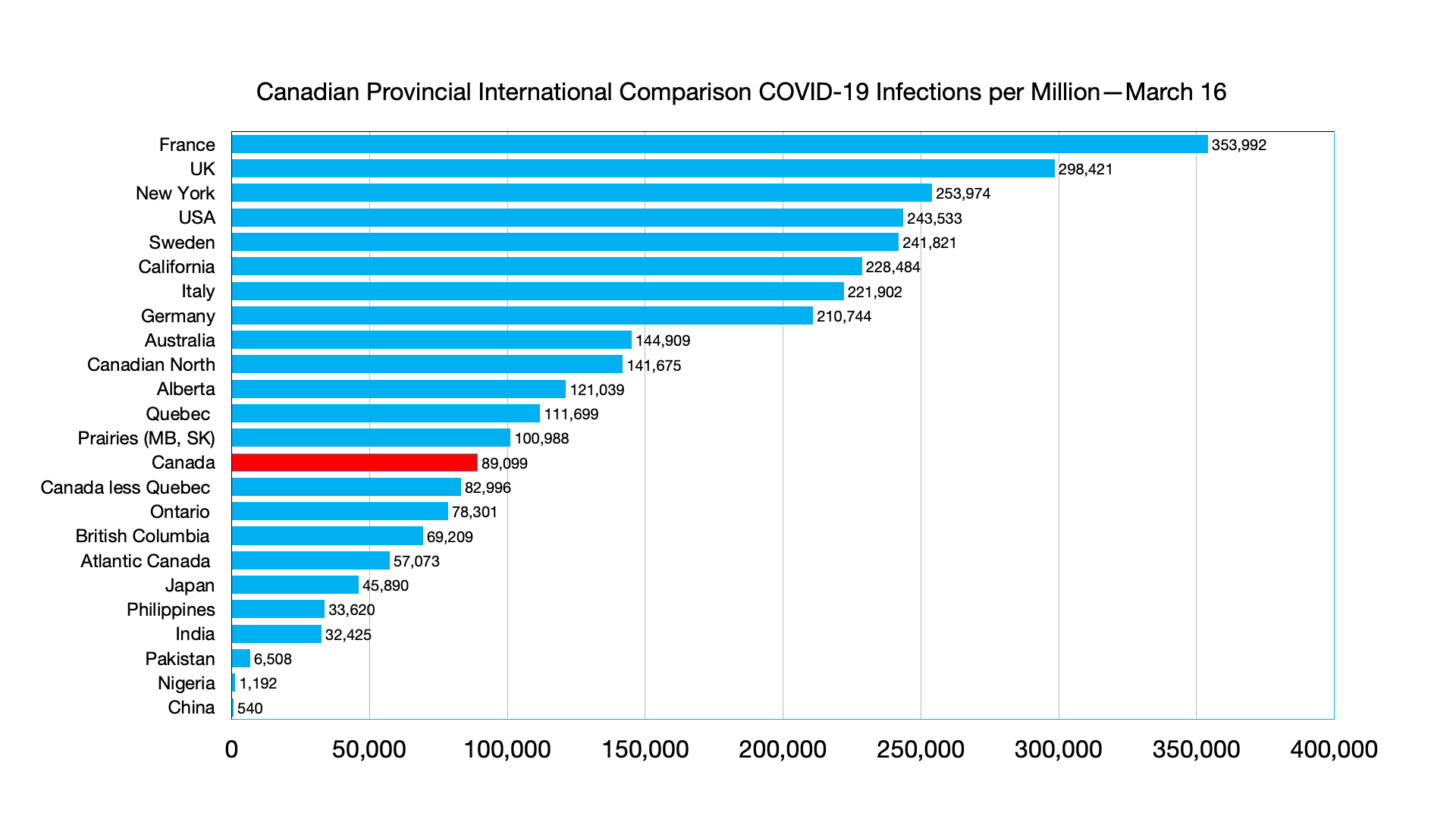
#COVID-19: Comparing provinces with other countries 16 March Update

Numbers from China continue to climb 608,000 to 753,000 infections and from 6,923 to 8,915 deaths. New omicron variant showing up in increased infections in some countries.

Vaccinations: Some minor shifts but convergence among provinces and countries. Canadians fully vaccinated 82.5 percent, compared to Japan 80 percent, UK 74 percent and USA 66 percent.

Immigration source countries: China fully vaccinated 88.3 percent (numbers have not budged over past month, India 60 percent, Nigeria 4.4 percent, Pakistan 47 percent, Philippines 60 percent.

Trendline Charts:

Infections: Ongoing signs of omicron and other variants plateauing, with Atlantic Canada being the notable provincial exception.

Deaths: No major changes. Ontario appears to have revised its count, reflected in the chart.

Vaccinations: No major relative changes.

Weekly

Infections: Australia ahead of Canadian North.

Deaths: Canadian North ahead of India

Immigrants are twice as likely to fear being targets of stigma during the COVID-19 pandemic in Canada

Not that surprising but disturbing:

A new study from the University of Toronto has found that that COVID-19-related health concerns are more prevalent among marginalized people who are migrants to Canada.

Published online in the Journal of Immigrant and Minority Health, the research revealed that during the early phase of the pandemic, migrants were almost twice as likely as Canadian-born residents to fear being the target of stigma. They were also more likely to express vaccine hesitancy (21.5% vs. 15.5%) and perceive when accessing care (89% vs. 76.3%).

“Fear and anxiety about COVID-19 have sparked big rise in ,” says lead author Shen (Lamson) Lin, a doctoral candidate and researcher at the University of Toronto’s Factor-Inwentash Faculty of Social Work. “The pandemic and consequential public health restrictions seem to have contributed to ‘othering’ and labeling that disproportionately affects marginalized minority groups—especially immigrants, refugees, and migrant populations.”

Among those who anticipated being the target of stigma, Canadian-born residents were more likely than immigrants to attribute their fear of stigmatization to non-compliance with mask wearing. Migrants to Canada, however, were three times more likely to link their fear to non-health-behavioral reasons, such as racial identity.

“Excess fear of stigmatization among may be partly ignited by a tendency to frame COVID-19 as foreign virus,” says Lin. “This framing blames the pandemic on foreign ‘others’ and exacerbates physical and mental health disparities already present in the immigrant and refugee communities.”

The study’s finding that immigrants were more likely to view going to a doctor or hospital as a health risk, regardless of the free services offered by Canada’s publicly funded health care system, may not be unrelated, says Lin.

“Those who fear stigmatization often hide symptoms or illnesses and may avoid obtaining early , which can make it more difficult to limit the spread of the virus,” he says. “Perceiving medical care as a health risk is worrying, as it could lead to immigrants’ underutilizing needed services, such as diagnostic tests and care for COVID-19 infection, during the crisis.”

While 16.9% of all study participants expressed vaccine hesitancy before the first COVID-19 vaccine was authorized for use in Canada, the prevalence of during this time was greater among migrants to Canada compared to Canadian-born residents (21.5% vs. 15.5%, respectively). Among vaccine-hesitant individuals, immigrants reported higher concerns than non-immigrants on vaccine safety (71.3% vs. 49.5%) and side effects (66.4% vs 47.3%). Immigrants who were vaccine hesitant were almost twice as likely to mistrust vaccines.

The study analyzed the publicly available data from the Statistics Canada’s Canadian Perspective Survey Series 3 (CPSS-3, June 15 to 21, 2020) which included 2,924 non-immigrants and 598 immigrants aged 25 years and above. The CPSS-3 survey is a probability sample of the nationwide population in Canada with a response rate of 58.1%.

“Our response to the COVID-19 pandemic must include confronting xenophobia and stigmatization in order to mitigate heightened and mistrust of new vaccines among amidst turbulent times. Health authorities need to ensure equitable access to COVID-19 vaccines and other -enhancing resources for communities,” says Lin.

“It is vital for any COVID-19 recovery plans to proactively include migrant and displaced populations—regardless of their legal status. Health equity should be placed at the center of the pandemic responses.”

Source: Immigrants are twice as likely to fear being targets of stigma during the COVID-19 pandemic in Canada

India court upholds a ban on hijab in schools and colleges

Of note:

An Indian court Tuesday upheld a ban on wearing hijab in class in the southern state of Karnataka, saying the Muslim headscarf is not an essential religious practice of Islam.

The high court in Karnataka state delivered the verdict after considering petitions filed by Muslim students challenging a government ban on hijabs that some schools and colleges have implemented in the last two months.

The dispute began in January when a government-run school in Karnataka’s Udupi district barred students wearing hijabs from entering classrooms, triggering protests by Muslims who said they were being deprived of their fundamental rights to education and religion. That led to counterprotests by Hindu students wearing saffron shawls, a color closely associated with that religion and favored by Hindu nationalists.

More schools in the state followed with similar bans and the state’s top court disallowed students from wearing hijab and any religious clothing pending a verdict.

Ahead of the verdict, the Karnataka government banned large gatherings for a week in state capital Bengaluru “to maintain public peace and order” and declared a holiday Tuesday in schools and colleges in Udupi.

The hijab is worn by many Muslim women to maintain modesty or as a religious symbol, often seen as not just a bit of clothing but something mandated by their faith.

Hijab restrictions have surfaced elsewhere, including France, which in 2004 banned them in schools. But in India, where Muslims make up 14% of the country’s 1.4 billion people, the hijab has historically been neither prohibited nor limited in public spheres. Women donning the headscarf is common across the country, which has religious freedom enshrined in its national charter with the secular state as a cornerstone.

Some rights activists have voiced concerns that the ban could increase Islamophobia. Violence and hate speech against Muslims have increased under Prime Minister Narendra Modi’s governing Hindu nationalist party, which also governs Karnataka state.

Source: India court upholds a ban on hijab in schools and colleges

Poilievre pitches to new immigrants, as Brown attacks him over 2015 niqab ban bill

Of note:

Brampton Mayor Patrick Brown and high-profile Conservative Pierre Poilievre spent Monday battling over a seven-year-old election promise to prohibit face coverings during citizenship ceremonies — a sign of what could be the makings of a tense rivalry between candidates in the Tory leadership race.

Brown, who launched his bid on Sunday, blasted longtimeOttawa-area MP Poilievre over his actions back in 2015 when the party promised to create a “barbaric cultural practices” tip line and require people’s faces to be visible during citizenship oaths.

The attack came as Poilievre spent the past few days meeting with cultural community leaders in the Greater Toronto Area and promising to cut red tape for immigrants wanting to access the necessary licences they need to work in regulated industries.Among those he met with were members of the Armenian, Muslim and Pakistani communities as well some of the party’s candidates from the area.

Regardless of who is chosen as leader Sept. 10, Conservatives know they must make inroads with immigrants and racialized Canadians if theyhope to pick up seats in the region as well as other major cities and suburbs, considered key to defeating three-term Liberal Prime Minister Justin Trudeau.

Poilievre pledged Monday to revive similar programs that were in place under the last Conservative leader who did well in communities of visible minorities: former prime minister Stephen Harper, at least prior to 2015.

He promised toincentivize provinces to require occupational licensing bodies to decide on an immigrant’s application within 60 days of receiving their paperwork, rather than forcing them to wait for months.

As well, Poilievre pitched offering small loans to immigrants who might need to take extra courses to gain a professional or trade licence to work in their respective field.

As Poilievre made these pledges, Brown, who is positioning himself as the candidate who stands for religious freedoms, released a statement saying the MP lacks credibility on any policy that impacts minority communities given his role in the Conservatives’ 2015 election campaign.

It was during that race when the party, then led by Harper, promised to create a tip line for so-called “barbaric cultural practices.” Conservatives at the time said it was meant to report things like forced marriage.

During that election, Poilievre was running for re-election as a candidate. He was also a member of Harper’s government when it introduced a bill banning people from wearing face coverings during citizenship ceremonies. That was ultimately struck down in court. The promise was also included in the party’s election campaign, when Harper also mused about possibly extending it to federal public servants.

Brown said Monday that Poilievre has never spoken out against these measures. The MP also has Jenni Byrne on his team, who was the party’s national campaign manager in 2015.

“This is the same campaign which platformed those two abhorrent policies, and lost the Conservatives the 2015 general election,” Brown’s statement read.

“Even if he attempts to distance himself from his silence today, it would be a hollow gesture in an insincere bid to gain votes.”

Poilievre responded Monday by calling Brown a “liar,” accusing him of mischaracterizing what Harper was doing.

“There was no niqab ban,” he said in a statement released on social media.

“I would never support that, nor did Mr. Harper. What Mr. Harper proposed was that a person’s face be visible while giving oaths at citizenship ceremonies.”

Poilievre, whose statement didn’t address the past proposal of a “barbaric cultural practices” tip line, added he would continue to support immigration and equality.

In response, National Council of Canadians CEO Mustafa Farooq tweeted that “leadership requires accountability” and pointed out some of Poilievre’s fellow MPs have apologized for what happened in 2015.

Among those is Edmonton MP Tim Uppal, a co-chair on Poilievre’s campaign, who has apologized for his role as a minister in promoting the ban on niqabs during citizenship ceremonies.Before the leadership race, Uppal said the party was still dealing with the fallout from racialized communities because of the 2015 campaign.

A post-mortem from the Conservatives’ 2021 election loss submitted in January came to a similar finding, according to three sources who spoke to The Canadian Press on the condition of anonymity.

Melissa Lantsman, a newly elected Ontario MP who is also supporting Poilievre in the race, shared on social media last fall that while she was stood in favour of banning the niqab during citizenship ceremonies in 2015, her “view has since evolved.”

Michael Diamond, a campaign strategist who, among other campaigns, worked on Peter MacKay’s 2020 Conservative leadership bid, said Brown’s attack over the issue and targeting of Byrne is a “proxy” attack on Harper, who is highly respected among the membership.

“It seems like folly to me to attack the last campaign of the man who remains the most popular figure in this party.”

He added it’s still early days in the race and cautioned that the debates playing out between the campaigns and on social media were occurring in an “echo chamber.”

Source: Poilievre pitches to new immigrants, as Brown attacks him over 2015 niqab ban bill

Lewis calls Bill 21 ‘religious discrimination,’ Poilievre hopes Quebec repeals law

A bit more forthcoming criticism of Bill 21 from all contenders, to various degrees:

Conservative leadership contender and rookie MP Leslyn Lewis on Monday called a Quebec law restricting public servants in positions of authority from wearing religious symbols at work “explicit religious discrimination.”

Lewis, who is running for the leadership a second time after placing third in the party’s 2020 race, says Conservatives must make decisions “based on principle” and not how it will be viewed by a particular demographic.

“Even making the right decision for purely political purposes is wrong. While I respect provincial jurisdiction, Bill 21 is explicit religious discrimination and as leader of our party, I will always defend religious freedom,” reads a statement made Monday.

Her stance on Quebec’s controversial secularism law, known by its legislative title of Bill 21, comes as other candidates have staked out their positions on the matter.

Some in the party expect the issue to become a policy debate during the race, which will run until a new leader is picked Sep. 10. So far, there are five candidates running and others have until April 19 to declare and June 3 to sell new memberships.

Different Tory MPs have said they believe the Conservatives must take a stronger stance against Bill 21 and criticized former leader Erin O’Toole for saying that while he personally opposes the law, it’s an issue best left up to Quebecers to decide. By contrast, Liberal Prime Minister Justin Trudeau has left the door open on federal court intervention.

Lewis vowed Monday that if elected as party leader, she would condemn religious discrimination regardless of “who it is against or where it is happening.”

As a candidate in the 2020 race, Lewis enjoyed strong backing from the party’s social conservative wing, which, among other things, cares about religious freedoms.

Fellow leadership candidate Pierre Poilievre, a longtime Ottawa-area MP who is running as a candidate that champions all forms of freedoms, also came out opposing the law on Monday.

“It is wrong,” he said in a statement.

“If anyone proposed it federally, my government would not allow it to pass. I respect Quebec’s right to make its own laws, but hope the province repeals the bill.”

Brampton Mayor Patrick Brown, who officially entered the race Sunday, made a point of sayingin the speech he made to announce his candidacy that he forcefully stood against the law and believes the party can win while doing so.

During his time as a municipal leader, he also led the charge on big cities from across the countries pledging money to assist groups that are challenging Bill 21 in court.

Former Quebec premier and leadership candidate Jean Charest has also said he doesn’t support the law.

Source: Lewis calls Bill 21 ‘religious discrimination,’ Poilievre hopes Quebec repeals law

Israel: Immigration minister blasts hypocritical’ neglect of Ethiopian refugees

Of note:

Immigration and Integration Minister Pnina Tamno-Shata and Diaspora Affairs Minister Nachman Shai got into a heated exchange at a government meeting on the Ukraine refugee crisis Monday.

At the meeting, government ministers spoke out against Interior Minister Ayelet Shaked’s newly announced framework that would see all Ukrainians with relatives in Israel allowed entry into the country.

Agriculture Minister Oded Forer said, “We need to stop with the self-flagellation. We are going above and beyond for a country that does not border Ukraine. Britain is only taking in 2,000 people.”

Shaked said, “The government and the ministers should boast and praise the integration operation. No other country is taking in [refugees] on such a scale.  They’ve taken in 5,000 people in exemplary order. Nachman is talking about the negative and not just the positive. We should be proud of what we are doing.”

Finance Minister Avigdor Lieberman noted, “When the State of Israel was under fire, we didn’t see anyone in Europe speak out for us. We are making a supreme effort.”

Science and Technology Minister Orit Farkash-Hacohen said the policy balanced “humanitarian needs with the significant challenge we face. The immigration wave is estimated at tens of thousands of people, which is estimated in billions [of dollars], and that is the important challenge.

We shouldn’t rule out settling the immigrants in lands we have a strategic interest in settling, of course, through investment in their needs and the provision of everything they need.”

Communications Minister Yoaz Handel said the immigrants should be settled in the Jordan Valley, the Golan Heights, the Negev [region], the Galilee, and in the country’s east.

When Handel told Shai, “I didn’t see anyone speak out when there were refugees from Africa,” Shai responded: “We are from Europe.”

Shai’s comment angered Tamno-Shata, who told him: “Take it back. That’s not funny.”

Lieberman attempted to ease tensions, telling Tamno-Shata it was just a joke.

But Tamno-Shata retorted: “It’s not a joke. It’s the truth. I work tirelessly for the benefit of the Law of Return from Ukraine …. We will immigrate them well, but I want the voice of Ethiopian Jews heard. What we have here is the hypocrisy of the white man.

“I demand the immediate extrication of those eligible for the Law of Return in Tigray and Ethiopia who have been at war for a year. None of those speaking up here spoke up for those eligible for the Law of Return from Ethiopia. This is simply hypocrisy of the white man,” she said.

Source: Immigration minister blasts hypocritical’ neglect of Ethiopian refugees

‘Lost Canadians’ case challenges ‘discriminatory’ citizenship law | CTV News

Inevitable that the first generation limit would be eventually challenged (there was considerable and careful legal analysis when it was introduced more than 10 years ago).

And of course, citizenship and immigration legislation and policy, in setting the criteria and conditions for becoming a citizen or resident, have inherent elements of discrimination, with the issue being whether the discrimination is reasonable from a policy, program and societal perspective:

Patrick Chandler is Canadian, but he can’t pass his citizenship on to his children.

While working in China in 2008, Chandler fell in love with a Chinese woman named Fiona. The pair got married and had two kids. Then, in 2017, Chandler landed a job in British Columbia. The young family planned to move to Canada together, until they learned their children didn’t qualify for Canadian citizenship.

Chandler was born in Libya to Canadian parents. Although he’s Canadian and has spent most of his life in Ontario, his kids don’t qualify for citizenship. It’s due to a citizenship law enacted by the federal Conservatives in 2009, which prevents Canadians born abroad from passing citizenship to their children, if they too were born outside of Canada.

“The rules – the way they are set up – creates two tiers of citizens,” said Chandler. “A tier that can pass on citizenship and a tier that cannot pass on citizenship.”

The intent of the 2009 law was to prevent citizenship from being continually passed down in families with no legitimate connection to Canada. For Chandler, who grew up, studied, and works full-time in Canada, the law makes him feel like a second-class Canadian.

“(The law) devalues citizenship because it shows Canadian citizenship does not mean equality,” said Chandler. “Unless we get that fixed, it’s going to hang over Canada’s head, and I don’t want that. And at the same time, I don’t want other people to have to go through this.”

Now, he and several other Canadian families have launched a Charter challenge, and are calling on the current federal Liberal government to change the rules.

“The law is discriminatory,” said Sujit Choudhry, a Toronto-based constitutional lawyer representing the families in the Charter challenge.

According to Choudhry’s research, there are 173,000 Canadian citizens living in Canada who were born abroad to other Canadian citizens. He said those people should have the right to start families abroad and give their children Canadian citizenship just as Canadians born in the country can. Choudhry said the current citizenship law is far too broad, causing families to fall through the cracks of bureaucracy.

“There are many other ways for the government to reinforce the value of Canadian citizenship and address the problem of indefinite generations of Canadians passing on citizenship abroad, without using such a blunt instrument,” said Choudhry.

When Chandler moved back to Canada in 2017, his wife and kids stayed behind in China. They were reunited in B.C. more than a year later, after the sponsorship process was approved and his children arrived in Canada as immigrants. In that year, all Chandler could do was keep in touch through video calls.

“It was absolutely difficult. As a parent, you want to be there for your kids. You want to be there to guide them, to educate them, to play with them,” Chandler said.

Just over three years since his kids arrived in Canada, one of them has been granted citizenship. Still, Chandler says, government red tape should never have got in the way of his role as a father. He hopes the Charter challenge will be successful, so no other Canadian families abroad find themselves in the same predicament.

Source: ‘Lost Canadians’ case challenges ‘discriminatory’ citizenship law | CTV News

Watt: Elections Canada failed to guarantee access for Indigenous voters during the 2021 federal election

Not good:

You likely didn’t hear about it, as the issue hardly made a splash in the news: during our September federal election, 205,000 mail-in ballots were uncounted. This issue is especially troubling for its outsize impact on Indigenous communities, and stacks on other, similar failures.

There are 274 First Nations communities in Canada that lack access to an on-reserve polling station. This adds to the importance of accessible mail-in ballots. However, the relatively short writ period, combined with the pressing demands of a pandemic election, created a flurry of issues on this front.

Ridings in northern Ontario were especially problematic. In Kenora, election day arrived during multiple First Nations’ traditional hunting season, meaning a wide swath of those communities would be absent. To accommodate this, Elections Canada provided advance polling for fly-in communities to ensure access. But when election day arrived, there were no polling stations provided — and what’s more, multiple voters were issued voting cards with incorrect information.

It is straightforward enough to chalk this up to a failure of communication, but the entire episode speaks to systemic issues in the way Indigenous communities are engaged. First Nations, Métis and Inuit represent priority communities for Elections Canada’s work — and this failure to guarantee the most fundamental of civil rights is a direct affront to the spirit and process of reconciliation.

In the last year, Indigenous peoples have had to contend with the painful discovery of unmarked burials at former residential schools, a lengthy court dispute over Canada’s discriminatory child-welfare system, and persistent challenges accessing the necessary infrastructure so that drinking water advisories can be lifted.

Given our unambiguous failings in these areas, it’s worth pausing to consider the stakes of this past election, and the particular importance for every Canadian voter, including Indigenous people, to have their voices heard.

When Justin Trudeau’s government came to power in 2015, the new prime minister ensured that each incoming minister received notice in their mandate letters that “no relationship is more important to me and to Canada than the one with Indigenous peoples.”

But the Elections Canada failure demonstrates an important reality that Indigenous people contend with every day: political will and good intentions alone cannot uproot the problematic systems that define Canada’s relationship with Indigenous people.

We are lucky to live in a country where elections are managed independently — but given the widespread nature of oppression elsewhere in Canada, is it any surprise that independent bodies are marked by the same?

And while Parliament has no role in the day-to-day operations of Elections Canada, our political leadership bears accountability.

In October 2020, Stéphane Perrault, Canada’s chief electoral officer, provided a series of recommendations to Parliament that would strengthen Elections Canada’s ability to execute a fair, safe election. While these changes were considered in Bill C-19, it was abandoned before passage. Ultimately, calling the election was given higher priority than ensuring its fairness.

This issue is not a partisan one, nor is it a unique flaw of this current government. This case is emblematic of systemic racism and the failure to listen to Indigenous voices — from our political leadership, our bureaucracy, and yes, from Elections Canada.

No doubt, the political will for Indigenous reconciliation is strong, even if it may not always translate into effective action. But what needs to change at an equal pace is the way our machinery of government accounts for and engages with Indigenous people.

Elections Canada has vowed to conduct a review, but the problem is clear and has been known for some time. A 1991 Royal Commission explained that Indigenous communities cannot be engaged only once the writ has dropped. Rather, they need to be consulted on an ongoing basis.

Enfranchisement is the most fundamental of civil rights, and work needs to happen now to make certain that it is shared equally by all Canadians at the next election. For those championing reconciliation, this would be a good place to start.

Source: Elections Canada failed to guarantee access for Indigenous voters during the 2021 federal election

EU parliament demands end to ‘golden passports’ for Russians

Long overdue, not just for Russians:

The European Parliament has voted overwhelmingly to end the practice of EU countries selling citizenship and visas to rich individuals.

It comes in the wake of Russia’s invasion of Ukraine with many wealthy Russians having received EU passports in exchange for significant investments.

Members of the European Parliament in Strasbourg on Wednesday voted 595 for, 12 against and with 74 abstentions to end the so called ‘golden passport’ schemes.

They are calling for an all out ban on the purchase of citizenship by 2025 but want significantly increased background checks to come into force immediately.

The vote is however not binding. It is now up to the European Commission to outline a detailed proposal of how to end the schemes and then the EU’s national government will have the final say on the matter.

“The system of golden passports and visas carries with it inherent risks of tax evasion, corruption and money laundering.” said Saskia Bricmont MEP, a Green MEP from Belgium. “For too long oligarchs, criminals and corrupt politicians have had the ability to buy their way into Europe and launder their cash, image and identities.”

Malta, Cyprus and Bulgaria are the EU countries which have run the most lucrative golden passportschemes.

It is estimated that in the eight-year period until 2019, over €20 billion of investments came into EU countries in this manner.

“The time of asking national governments nicely is over,” said Dutch MEP Sophie In’t Veldt during the European Parliament debate. “[We need] the total complete abolition of this procedure, not simply to reduce it but to completely eliminate it.”

Members of the European Parliament accepted in the report that the move would lead to shortfalls in national budgets and allowed for a phased out approach.

Values for sale

The report into the golden passports has been moving through the European Parliament for a while but came into focus when the schemes were specifically mentioned in a joint EU statement alongside the leaders of France, Germany, Italy, the United Kingdom, Canada, and the United States, in the immediate hours after Russian invaded in Ukraine.

It is unknown exactly how many Russian citizens have received an EU passports through the schemes, but in April 2021 a leak of documents suggested Malta was giving out passports in exhange for investments of around €910,000 ($1 million) and that the income amounted to €432 million the country’s 2018 budget.

When that leak came out, European Commission President Ursula von der Leyen said “European values are not for sale.”

Gaining an EU passport allows the bearer to travel freely within the EU’s border-free Schengen area, to access healthcare in all EU member states, to live and work anywhere, and also to enjoy the tax situation in that country’s jurisdiction.

Damage done

Last minute amendments to the European Parliament’s report saw EU lawmakers demand an immediate end of the schemes for Russians – other nationalities who profit from them like Saudis and Chinese would be included in the phase out.

Many experts warn that while the move comes alongside the cutting sanctions against Russian President Vladimir Putin and the oligarchs who prop him up, those who already have the passports cannot be kicked out.

“The damage is done” Jacob Kirkegaard said senior fellow at the German Marshall Fund told DW. “But at least the war finally may have shamed the relevant national governments into ending this corrupt practice”

EU Commissioner Didier Reynders believes the EU’s position against selling passports is clear

The European Commission, which drafts EU law, rejects the need for new rules to end the golden passport schemes, believing the current legal position in the EU against them is clear.

EU Justice Commission Didier Reynders told the house in Strasbourg that country’s should check the passports which have already been issued and pointed to legal proceedings which were started against Malta and Cyprus in 2020 as evidence that Brussels was already acting to end the schemes.

Source: EU parliament demands end to ‘golden passports’ for Russians