Canada’s next wave of immigration set to add more fuel to overheated housing market

About time for greater focus on the links between levels and housing prices. Federal and provincial governments need to consider such externalities rather than just push for more:

After a frenetic 18 months when Canadians pushed up home prices in a quest to ride out the pandemic in comfort, another influx of buyers is set to provide more fuel to the overheated real estate market.

The federal government has increased its annual immigration targets to the highest levels on record, creating the conditions for a surge of new permanent residents, which Canada needs to fill job vacancies. These new immigrants will add to the country’s population and immediately boost the need for housing in major job centres and nearby cities.

This will ramp up competition for homes at a time when national real estate prices have jumped 40 per cent in the past two years.

“Canada’s strong population growth is a factor driving our home prices upward at a faster pace than in many other economies,” said Bank of Montreal chief economist Douglas Porter, who analyzed the relationship between population growth and home prices in 18 developed countries.

He found that countries with faster population growth have had greater home price inflation than those whose populations have remained stable, or decreased.

Between 2010 and 2020, New Zealand and Canada both saw their populations climb by an average of more than 1 per cent each year. In Canada’s case, much of that growth was attributable to immigration.

Over that same decade, home prices rose an average of 7.9 per cent each year in New Zealand and 7 per cent each year in Canada.

Meanwhile, countries with shrinking populations have experienced stagnant or falling home values. Japan’s population declined by an average of 0.2 per cent each year, and home prices there rose an average of 0.2 per cent annually.

One reason immigration may be pushing up Canadian home prices is that Canada’s policies cater to newcomers with wealth and job skills. Many new permanent residents arrive with hefty bank accounts, or with enough professional expertise to make money quickly. And, like anyone else with means, they buy real estate.

Parisa Mahboubi, a senior policy analyst with the C.D. Howe Institute and an immigration labour expert, said integration is a challenge for all newcomers. But, she said: “Economic immigrants, especially those with Canadian experience or with education, are able to integrate into the labour market quickly. This means they are able to purchase a property sooner than other immigrants.”

New research from Statistics Canada suggests that in many cases it’s pre-existing wealth, not Canadian income, that is behind pricey real estate purchases by immigrants.

For example, in Richmond, B.C., a typical immigrant buyer in the lowest wage quintile, with median annual income of just $11,100, spent a median of $763,000 on a home in 2018, according to data from Statscan’s Canadian Housing Statistics Program (CHSP).

In contrast, a typical Canadian-born buyer in British Columbia in the lowest income quintile, with median annual income of $32,300, spent a median of $396,000 on a home in 2018, according to CHSP, which analyzed land registry information, property assessments and tax filings.

The disparity in the amounts spent by low-income immigrants and Canadian-born buyers suggests that the newcomers were relying on money not earned in Canada. The actual sources of the funds are unknown. CHSP has said the immigrant wealth could have been income earned previously in Canada or abroad, or income that was earned by others or underreported.

CHSP observed that in 2018 the majority of immigrant buyers across B.C. had moved to Canada prior to 2009 and had been admitted through the country’s various economic immigrant programs, which are designed to attract skilled workers and those with wealth.

“If you are an economic immigrant and you don’t have other opportunities, real estate becomes one of the fastest wealth generators,” said Andy Yan, director of the city program at B.C.’s Simon Fraser University. “They are wealthy. But when they try finding a job, it goes south.”

Other factors that have contributed to high home prices in Canada include low mortgage rates, a flood of domestic investors looking for high investment returns, and millennials increasingly forming families and seeking properties.

In the Toronto region, the country’s largest job centre, the average price of a home is above $1-million and many of the surrounding cities are nearing or above that price.

That has pushed Canadians and newcomers out of Toronto and into smaller regions in Southern Ontario. Some have left the province altogether for more affordable areas such as Regina, Saskatoon, Winnipeg and Halifax.

Canada’s six largest metropolitan areas – Toronto, Vancouver, Montreal, Edmonton, Calgary and Ottawa – used to be the top destinations for immigrants. But that has been changing.

In 2002, Canada’s largest cities took in 88 per cent of the country’s immigrants and non-permanent residents. In 2019, the proportion was just 68 per cent, according to Canada Mortgage and Housing Corp.

Over that same period, net international migration to those cities grew by 43 per cent. But in the rest of Canada it soared by 370 per cent, with particularly strong growth in Ontario locations such as Niagara, London, Kitchener-Waterloo and Cambridge.

Today, there is an acute shortage of housing in those smaller cities.

In Kitchener-Waterloo, Cambridge, London and the Niagara-St. Catharines region, the typical price of a home is 60 per cent higher than it was two years ago, according to the Canadian Real Estate Association home price index, which adjusts for higher-priced homes.

The flow of new permanent residents will put even more pressure on those places. If prices continue to rise, the higher cost of living could discourage newcomers.

“We need the immigration for the labour market. But if we don’t get the immigration for the labour market because they can’t afford to live in the community, that’s a significant challenge,” St. Catharines Mayor Walter Sendzik said.

The federal immigration target for 2021 was 401,000 new permanent residents. The goal for 2022 is 411,000. For 2023, it’s 421,000. By comparison, the number of new permanent residents admitted to the country in 2019 was 341,180.

Anthony Passarelli, a CMHC senior analyst, said that if immigration reaches these record-high levels and Canada doesn’t respond by increasing its housing supply, the effects on the housing market could be noticeable. “We will likely go through a similar situation, where you see another price surge and the ripple effects of people getting priced out of the larger population centres and moving further out,” he added.

Asked whether Canada should slow the pace of immigration until the country has enough affordable housing, BMO’s Mr. Porter said: “I suspect policy will be little swayed by housing market concerns. Having said that, at the very least the impact on housing should be taken into consideration when determining immigration targets.”
Soon-to-be Canadians waiting in vain to hear about their citizenship applications

A backlog of close to 500,000, and a citizenship program has only recently started to get back to more traditional numbers of new citizens (close to 20,000 October 2021, compared to a pre-pandemic monthly average of 21,000). Will need to ramp up quickly to clear the backlog:

A large number of immigrants say they’ve been waiting months to hear back from Immigration, Refugees and Citizenship Canada (IRCC) about whether or not they will soon become Canadian citizens.

Parandis Haghnesarfard and her husband, who passed their citizenship tests in January 2021, say they feel like they’ve been left out in the cold by the Canadian government.

It’s been one year and the couple says they still don’t know if they will be called to take their oaths.

“My sister lives in the U.K. She had heart surgery and she needed my help to take care of her and his son,” Haghnesarfard said. “I haven’t seen my father in three years, my aunt passed away this summer and I couldn’t be there.”

It seems Haghnesarfard isn’t the only one sitting idly; dozens of families have written to CTV News asking for help with their citizenship applications.

“The only answer was, ‘sorry, please be patient,'” Haghnesarfard said. “I am tired of this answer.”

For its part, IRCC acknowledges that “some applicants have experienced considerable wait times.”

“Scheduling an oath ceremony usually takes four to six months after all criteria are positively assessed,” explained Isabelle Dubois, a spokesperson for the department.

Immigration lawyer Tamara Mosher-Kuczer argues the actual average wait time sits closer to 12 to 18 months.

“Pre-COVID-19, that would be a long delay,” she points out. “In COVID-19 [times], three to six months is not unusual. I have heard of some people still waiting to take the oath from pre or early pandemic.”

HELP FROM CTV NEWS

Mehrnoosh Djavid, a software quality engineer from Iran, was waiting for more than nine months to hear back about whether or not she would be called to take her citizenship oath when she wrote to CTV News.

She explains she lost her father two years ago, but hasn’t yet been able to go home to comfort her mother because of COVID-19.

“I cannot go and visit my family in Iran because the citizenship ceremony can happen anytime and I need to be present in Canada during this ceremony,” she said. “Also, I can not go to company conferences in the U.S. because I don’t have my Canadian passport. Basically, I can’t travel anywhere.”

She argues the selection process seems random, with some of her friends who applied for citizenship after her already receiving their new, navy blue passports.

After CTV News inquired in mid-December about her file, Djavid says she immediately received an e-mail notifying her that her citizenship ceremony would take place on Dec. 20.

“I still can’t believe it and don’t know how to thank you for your help and support,” she said. “It really means a lot to me and I’ll never forget your kindness.”

Similarly, Aida Rangy and Mostafa Darabi, who came to Canada in 2014 as international students and applied for citizenship in March 2020, did not hear back from IRCC until CTV News intervened.

“Having delays with the pandemic situation was understandable during 2020,” Rangy said. “We have many friends in Ontario, B.C. and even Quebec who applied for citizenship months after us and they have their passports now.”

The couple says they completed their citizenship application in May 2021.

“It’s not right. We are working in this community, paying taxes and doing our responsibility as citizens, but IRCC is not treating us as valuable members of Canada,” said Rangy.

After an inquiry by CTV News, Rangy and Darabi were called to take their oaths on Dec. 21.

“With your help now we are Canadian citizens,” Rangy said. “The best Christmas gift we could have. We booked tickets to visit our families in March. I can’t believe I can see them after almost two-and-a-half years.”

Malek Mohammad Karami Nejad, who works at Gameloft Montreal, and Vajiheh Roshan Nia, a substitute teacher and daycare educator with the Centre de services scolaire de Laval, have been in a similar position since their permanent residency cards expired.

“My wife has a lot of worry about her parents and I’m scared she will get ill with these stress pressures,” said Nejad. “From my company’s side, I need to travel outside Canada to other countries.”

The couple’s citizenship applications were approved in July 2021.

After a query by CTV News, IRCC confirmed the couple would be scheduled to attend their oath of citizenship ceremony on Jan. 17.

“I don’t know how to say thank you. Really appreciated and God bless you,” Nejad said. “You saved my time and my life.”

CTV News is still waiting for responses on at least 10 other dossiers.

BLAMING COVID-19

Mosher-Kuczer points out COVID-19 has exposed many cracks in the foundation at IRCC.

Since Afghanistan became an issue in August, they [IRCC] changed their messaging, and it’s such offensive messaging, in my opinion, because when you submit a web form, the response back is ‘we’re only dealing with priority requests and we won’t respond to other requests,'” she said. “Well, that’s offensive because everybody who’s contacting them, it’s a priority for them.”

The immigration lawyer points out it’s almost like a chicken-or-the-egg situation, where people are not getting any answers and are writing again and again to the department.

“Now you’ve got a system backlog — and you’re adding additional applications into this system backlog,” Mosher-Kuczer said. “With the pandemic, they’re understaffed, but I think they were always understaffed.”

She calls it a “failure of communication” on the part of IRCC.

“If they had some better messaging; if they came out and they said, ‘we understand that this is an issue,’ but they’re not doing that,” she stated. “They’re saying, ‘everything’s OK here, nothing to see. Don’t worry.'”

Mosher-Kuczer is calling on IRCC to, if they cannot speed up processing times, at least be honest with people.

“People are so angry. They’re angry, and they’re depressed,” she noted. “This is their dream and their hope for their future. They’ve made plans about buying houses, jobs, education based on processing times and based on where they thought they would be.”

Due to the pandemic, IRCC says ceremonies are taking place virtually.

“Some of the larger volume offices may be experiencing longer-than-normal delays given limitations of the virtual format,” Dubois noted, adding approximately 3,500 to 5,000 applicants are invited each week to take their oaths as Canadian citizens.

In a move towards better efficiency, IRCC has created an online tool for applicants to check their application status.

“Applicants do not generally receive any communication from IRCC until receiving their notice to appear for their video oath ceremony,” added Jelena Jenko, a department spokesperson.

Source: Soon-to-be Canadians waiting in vain to hear about their citizenship applications

Women, visible minorities make up larger share of latest Order of Canada appointments

My working deck highlights more of the findings of my analysis of the close to 1,700 appointments made over the past 9 years, looking at representation of women, visible minorities and Indigenous peoples, broken down by level, province and background. Given that most appointments reflect a long-term contribution, there is a gap between the population and visible minority appointments:

Working on a more detailed analysis but this provides the highlights:

Women, visible minorities and Indigenous people accounted for a larger share of the latest Order of Canada appointments than in recent years — a sign that Rideau Hall’s quest to diversify one of the country’s highest civilian honours is making progress.

Of the 135 people recently inducted into the Order of Canada, 40.7 per cent (55) are women, 12.6 per cent (17) are visible minority and just over eight per cent (11) are Indigenous.

The numbers are higher in all three categories than in the previous three years. Last year, most of the inductees were white men, and in 2019 well under a third were women.

Retired public servant Andrew Griffith, who served as Canada’s director general of citizenship and multiculturalism, said that while the numbers represent a “significant improvement,” it’s too soon to say whether it’s a trend.

“I’m always wary of claiming victory on the basis of one year,” he said. “So what I look at, whether I’m looking at these kind of numbers or other diversity numbers, is are you seeing a sustained change, a sustained increase.

“What I would like to see is two to three years from now comparing, let’s say, the previous three year period to the next three year period, and see if the needle has been moved.”

The Governor General makes appointments based on recommendations from the Advisory Council for the Order of Canada, which advises her based on nominations suggested by members of the general public.

Griffith said this process means Rideau Hall doesn’t have as many options to diversify the Order of Canada as other institutions.

The newest appointees include entreprenuer and philanthropist Mohamad Fakih and former senator Murray Sinclair, who chaired the Truth and Reconciliation Commission.

The Order of Canada relies on public nominations. The Office of the Secretary to the Governor General encourages people to nominate individuals who are reflective of our diversity, including Indigenous peoples and persons from diverse cultural and ethnic backgrounds,” a spokesperson for the Office of the Governor General said in a statement to CBC.

“As of 2019, the OSGG has asked new appointees to the Order of Canada to complete a voluntary self-identification questionnaire. We look forward to identifying trends as we gather data in the coming years.”

‘Perpetually vigilant’

Sarah Kaplan, director of the Institute for Gender and the Economy at the University of Toronto’s Rotman School of Management, said the numbers show improvement but still don’t reflect Canada’s demographics.

“It seems to me that if your population is made up of about half women, or people of diverse genders, and you’re not representing that same proportion in the country’s most prestigious honours, then you are doing a disservice to the community,” she said.

She said she’d like to see Rideau Hall and the advisory council reach out to communities for suggestions rather than rely solely on nominations.

“Who’s going to know about that process and figure out how to navigate the nomination system?” she said. “It’s going to be people who are already in the centre of power, and that’s a pretty closed set of folks in the Canadian context.”

She also said the Office of the Governor General must keep pushing to make the Order of Canada better reflect Canadian society.

“The thing about improving representation in a society that has historically privileged just one group of people is that you have to be perpetually vigilant,” she said.

“And so one year’s progress does not mean that we have now fixed the problem, and that it will naturally trend upwards in subsequent years.”

Source: https://www.cbc.ca/news/politics/representation-better-order-of-canada-2021-1.6302725

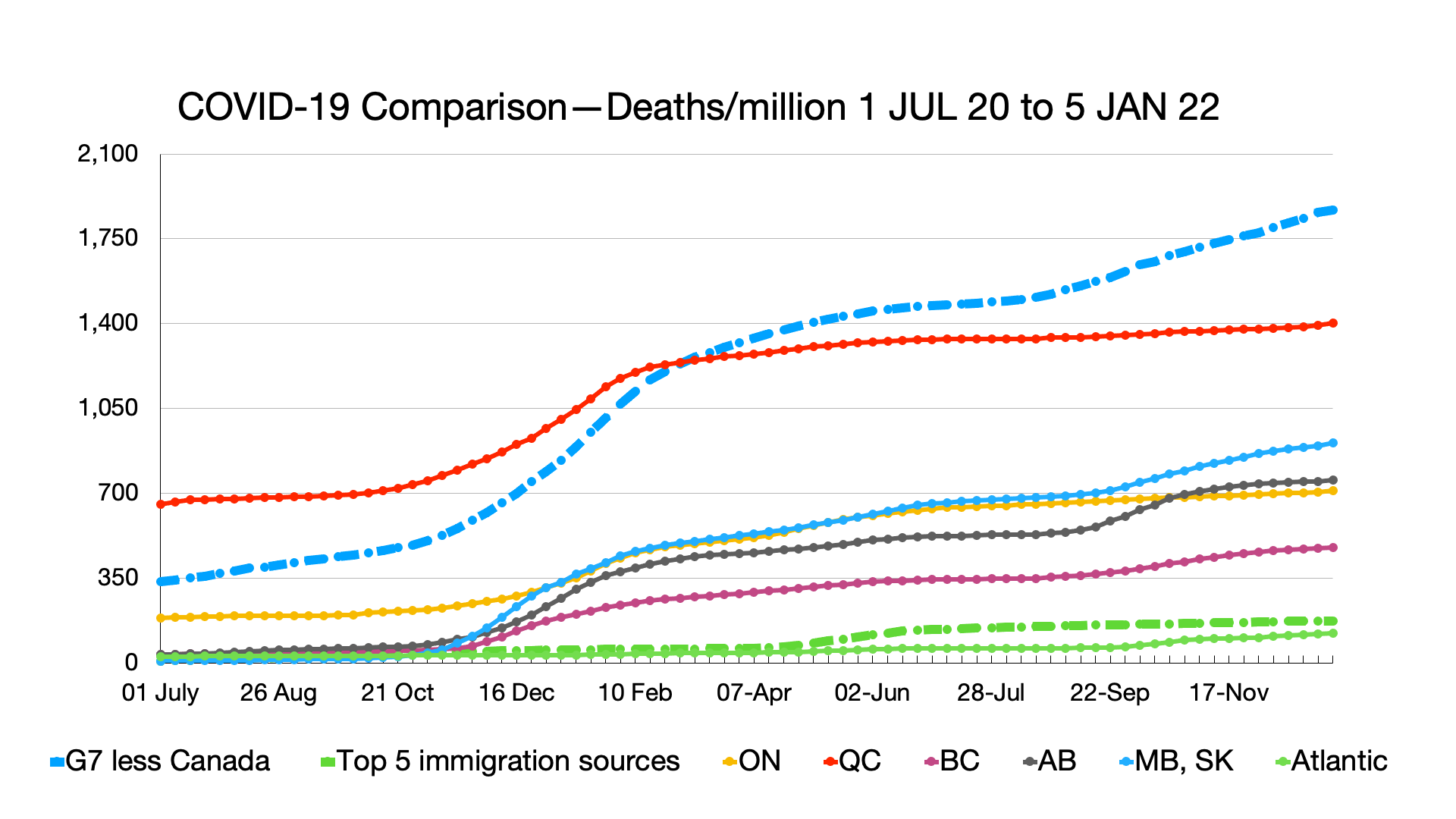
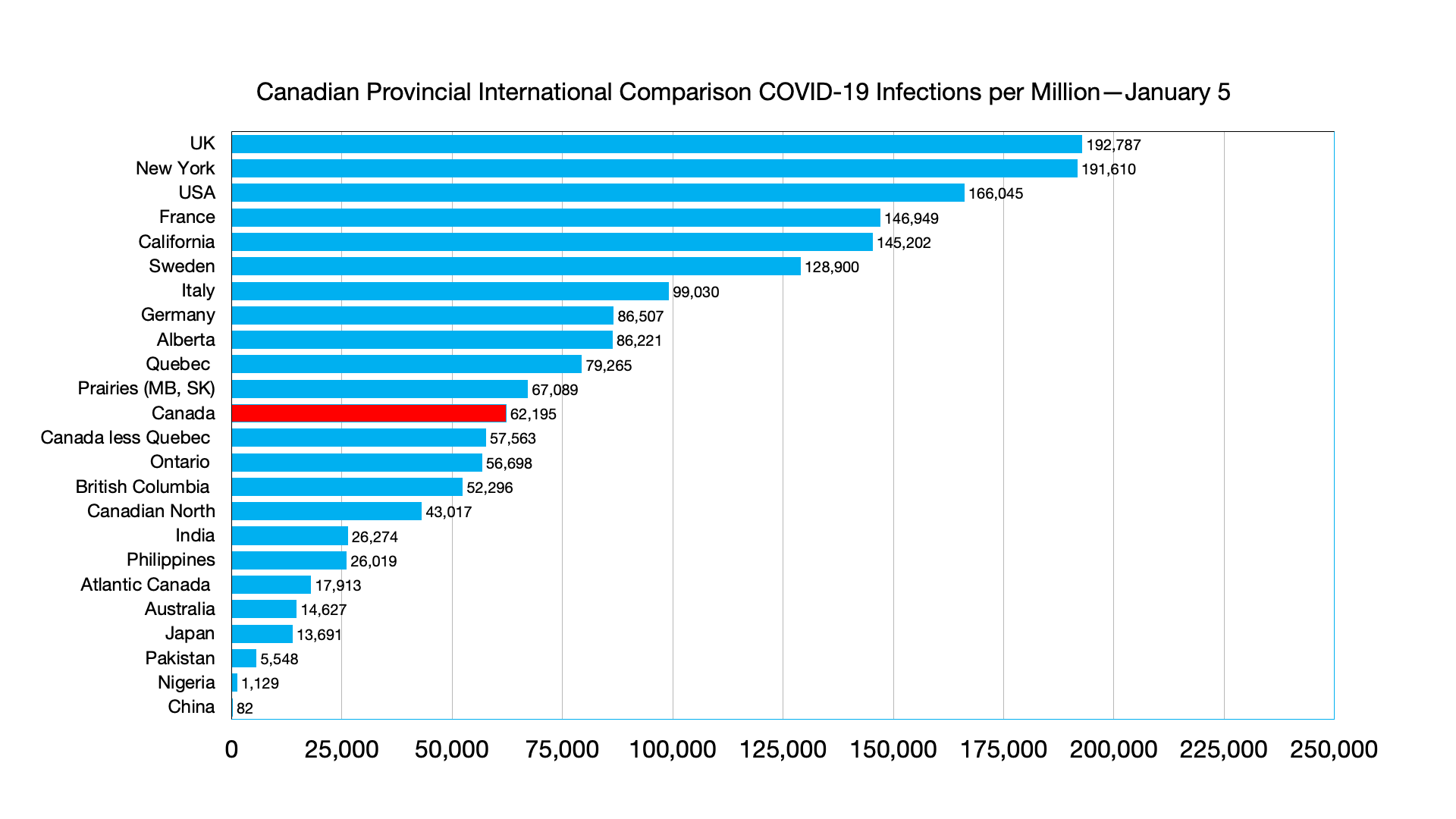
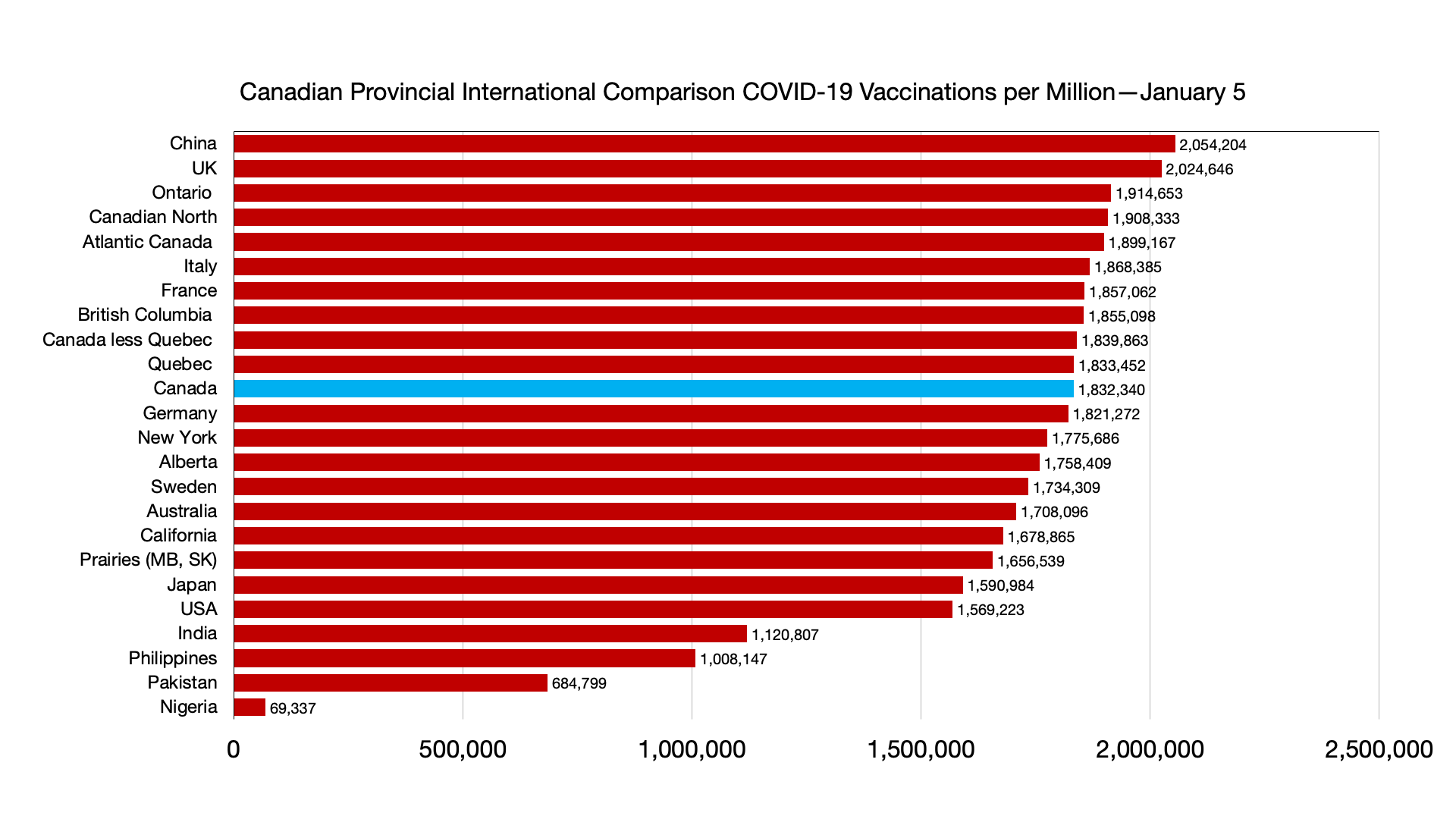
#COVID-19: Comparing provinces with other countries 5 January Update and impact of Omicron

Back from my holiday break, three weeks later, the steep rise in infections due to Omicron (likely undercounted given testing constraints).

Vaccinations: Some minor shifts but general convergence among provinces and countries. Canadians fully vaccinated 78.3 percent, compared to Japan 78.7 percent, UK 71 percent and USA 62.9 percent.

Immigration source countries are also converging: China fully vaccinated 86.4 percent, India 45 percent, Nigeria 2.2 percent (the outlier), Pakistan 33.5 percent, Philippines 46.8 percent.

Trendline Charts:

Infections: Effects of Omicron becoming more apparent with steep rise in all provinces, led by Quebec.

Deaths: No relative changes.

Vaccinations: Ongoing convergence among provinces and G7 less Canada and narrowing gap with immigration source countries. Nigeria remains the laggard.

Weekly

Infections: Atlantic Canada ahead of Australia and Japan.

Deaths: No relative change

ICYMI: Its critics call it ‘birth tourism.’ But is the practice real? COVID-19 is providing clues

The COVID-19 pandemic and the border closures and travel restrictions that came with it seem to have put a dent in the number of non-Canadians coming to this country to deliver their babies.

The latest government data offers what may be an unprecedented look at the practice that has been controversially dubbed “birth tourism.”

It shows the number of “non-resident self-pay” new births in the country dropped by 57 per cent during the first full year of the global crisis, between April 2020 and March 2021 — from 5,698 the year earlier down to 2,433. 

Observers have stressed that the practice of coming to Canada to deliver a baby is legal and cautioned that its frequency has been overblown by critics, drawing focus at times more for reasons of racism than for pragmatic concerns.

All babies born in Canada receive automatic Canadian citizenship. 

The Liberal government has said it’s committed to investigating the issue of foreign nationals taking a shortcut to obtain citizenship for their children by giving birth in Canada, but no policy recommendations or changes have been made to date.

Under normal times, it’s hard for researchers to pinpoint the number of visitors who came here with the main purpose of giving birth, because the data would also capture non-residents who delivered babies while working or studying in this country. 

But the pandemic’s unique circumstances brought with them novel data.

As Canada has imposed restrictive measures against the entry of non-essential travellers but not international students and temporary foreign workers, the data for the first time gives a more precise picture of the extent of those coming to Canada to deliver babies.

“This really provides you with what Nobel Prize-winning economist David Card called a natural experiment, where there was one variable that changed and it affected one group disproportionately,” says researcher Andrew Griffith, whose findings will be published by the Institute for Research on Public Policy on Thursday.

“This basically confirms that when you don’t have visitors’ visas, you have a major drop in birth tourists because that’s how they come in.”

Based on hospital delivery data from the Canadian Institute of Health Information, a Crown corporation, Griffith looked at the number of times the cost of delivering babies in hospitals over the past decade was paid out of the patients’ own pocket.

The number surged yearly from 1,863 in 2010 to a peak of 5,698 in 2019, before it nosedived last year, which coincided with a 95 per cent drop in the number of visitors’ visas issued by Canada.

In comparison, the number of international students fell by only 25 per cent, while the number of temporary foreign workers actually increased by 5.5 per cent.

Griffith estimates that the percentage of “tourism births” has now reached one per cent of all births in Canada in an average year.

“This is really a question of the integrity of the citizenship program. If you come here as a permanent resident, you have to meet the residency requirements, you have to meet the knowledge requirements, you have to meet the language requirements. There’s a whole process that you have to go through to be Canadian citizens,” said Griffith, a fellow with the Canadian Global Affairs Institute and Environics Institute.

“This is legal but it’s still a loophole that allows basically fairly affluent women and families to shortcut the process, find a backdoor entry and without going through the standard process of becoming a Canadian citizen.”

The citizenship afforded to these Canadian-born children allow them to automatically access health care, local education and tuition fees, as well as other government benefits.

While any visa restriction against pregnant women visiting Canada would be difficult to administer and enforce, Griffith said Ottawa could change the citizenship act to require at least one parent to be a citizen or permanent resident of Canada for citizenship to be conferred to a Canadian-born child, as Australia does.

The former Conservative government explored similar legislative changes in 2012, but the idea was abandoned due to opposition from provincial governments, which are responsible for the administration of birth certificates, a key document for citizenship. The number of people coming to Canada for the express purpose of delivering a baby was estimated at just 500 at the time and such changes were considered not worthy of the hefty administrative costs.

“We have more accurate data now,” said Griffith. 

In a 2019 survey by the Angus Reid Institute, 64 per cent of Canadians said a child born to parents who are in this country on tourist visas should not be granted Canadian citizenship, and 60 per cent said changes to the citizenship laws are necessary to discourage birth tourism.

Critics have argued that any requirement of one parent being a Canadian citizen or permanent resident could lead to children, such as those born here to refugee claimants, to be stateless.

“Anything to deal with immigration and citizenship basically has some form of discrimination. Who do you let in? Who do you not let in? What are the criteria to allow somebody to become citizen,” said Griffith.

“Is it too rigid? Is it too open? You are always going to have the debate over how you cut the line in the right place.”

Source: https://www.thestar.com/news/canada/2021/12/16/its-critics-call-it-birth-tourism-but-is-the-practice-real-covid-19-is-providing-clues.html

My Policy Options article which formed the basis for the reporting: https://urldefense.com/v3/__https:/policyoptions.irpp.org/magazines/december-2021/birth-tourism-in-canada-dropped-sharply-once-the-pandemic-began/__;!!AlmGDlt8!iF8vkNntsOxOaoiOptdZnIP6_nTznLbhJ0nHgByjTRO0V5pBnecrGb7ZGeXR858$

My articles and issues in 2021, focus for 2022

While a bit self-indulgent, thought it might be interesting to do a recap of my articles and commentary over the past year. 

A major focus has been the ongoing work with Dan Hiebert and Howard Ramos regarding the impact of COVID-19 on immigration and related programs (weekly comparison of Canadian provincial infections, deaths and vaccinations compared to other G7 and top immigration source countries: India, China, Philippines, Pakistan and Nigeria) and compilation of monthly IRCC operational statistics across immigration, citizenship and visitor visas, with partial results for settlement given no recent public datasets.

Citizenship 

Birth tourism in Canada dropped sharply once the pandemic began (Policy Options, 2021)

Likely my most significant article, my analysis shows the impact of the “natural experiment” of the drastic fall in visitor visas issues and related travel restrictions on the number of non-resident self-pay hospital deliveries, confirming that birth tourists form more than 50 percent of non-resident births. My position has evolved from minimizing the issue some 10 years ago, to noting the need for ongoing monitoring and consideration of various approaches to reduce the practice to now advocating for a change in the Citizenship Act as the “cleanest” solution. 

Amid languishing numbers, Canada’s citizenship process needs to be modernized (Policy Options, 2021)

Given the ongoing weaknesses in citizenship program management, ranging from wide fluctuations in annual numbers of new citizens to limited and delayed data sets, this article makes the case for extensive modernization of citizenship operations (some of which has started or accelerated due to COVID).

Immigration 

Increasing immigration to boost population? Not so fast. (Policy Options, 2021)

Increasingly frustrated by some of the simplistic arguments advanced in favour of increased immigration by the Business Council of Canada, Century Initiative and others, I raised some needed questions that governments and policy makers need to consider and advocated a Royal Commission or equivalent to undertake a fundamental review of immigration policies that would take a broader perspective than a larger overall GDP. Some of my thinking was developed in my earlier Why the Canadian government must review its immigration policy (Open Democracy, 2021) and some was reiterated in The Need for a Longer Term Perspective on Immigration, Citizenship and Multiculturalism (Canadian Global Affairs Institute, 2021).

Will the pandemic make Canada less attractive to newcomers? (With Howard Ramos, Policy Options, 2021)

At the beginning of the work Dan Hiebert, Howard Ramos and I set out some of the questions we were asking regarding the impact of COVID on immigration, tracking both  COVID numbers in G7 and immigration source countries along with monthly tracking of the impact on immigration and related programs. While the end of the pandemic is not yet completely clear, we do have a good sense of how the government has reacted in terms of policy changes (e.g., massive shift to “two-step immigration”), modernization (more online applications, virtual citizenship ceremonies etc) and operations (backlog increases).

Multiculturalism 

Racism and the need for a national integration commission (Policy Options, Philippine Canadian Inquirer, 2021)

Similar to my frustrations regarding immigration policies, much of the commentary and analysis over racism tended to overly simple framing of the issues, whether visible minority/not visible minority, Black and White differences, with limited discussion of the diversity within and among groups, the discrimination and biases that exist within and between groups, and the need for a better understanding of the neuropsychological basis for racism and discrimination. Again, I advocated a Royal Commission or equivalent, given the importance to social inclusion and cohesion, with a strong focus on lessons learned on what works.

Diversity and Employment Equity

Will the removal of the Canadian citizenship preference in the public service make a difference (Policy Options, 2021) andDiversity and inclusion: public service hirings, promotions and separations (The Hill Times, 2021).

The collection and publishing of disaggregated public service data for employment equity groups (official and likely to become official) provides the granularity needed to assess the different groups in terms of representation by occupational group, including hiring, promotions and separations. With four years of disaggregated data, visible minority representation has increased at three times the rate of not visible minorities, one that may increase further given the removal of Canadian citizenship preference. The other notable finding, in the context of the understandable focus on anti-Black racism, is that representation of Blacks in the public service is reasonably strong compared to a number of other visible minority groups and at the EX level, greater than South Asian, Chinese and Filipinos.

Contrasting pre- and post-pandemic public service survey results (The Hill Times, 2021)

Although we only have two-years disaggregated data for the Public Service Employee Survey (PSES), this provides a comparison pre- and post-pandemic. As one would expect, visible minority groups report more instances of harassment and discrimination than not visible minorities, with Blacks reporting more than other visible minority groups. Most striking for me in analyzing the data was the degree of scepticism if not cynicism regarding the government’s anti-racism initiatives, particularly for Blacks.

The Year Ahead

The big news of course is the release of the 2021 census data, providing a wealth of information to assess and analyze in terms of immigration, citizenship and multiculturalism. 2021 data also includes religious affiliation, providing another aspect to understanding diversity in Canada. So I expect to be busy!

While the government remains committed to its immigration levels plan, how it handles the backlog in all areas remains to be seen. In one sense, in order to deliver on its 401,000 number, privileging two-step immigration meant large backlogs on other immigrants, an issue that opposition parties will correctly focus on.

With respect to citizenship, while I would like to see some action on birth tourism (or at least some serious work!), the government needs to release the revised citizenship study guide (announced in 2016!) and eliminate citizenship fees (2019 and 2021 platforms). Whether the government will feel compelled to respond to some pressure regarding the first generation transmission of citizenship remains to be seen.

.