H-1B Visa Denial Rates Plunge After Trump Immigration Policies End

Not surprising. Will see if this reverses some of the preference of some high skilled immigrants for Canada that emerged during the Trump years:

H-1B denial rates have returned to pre-Trump levels after court decisions and a legal settlement ended the Trump administration’s restrictive policies, according to a new report. The changes started in the fourth quarter of FY 2020, while Donald Trump was still president, following a legal settlement with the business group ITServe Alliance and judges declaring the Trump administration’s policies unlawful. The lower denial rates continued through FY 2021 because the Biden administration abided by the legal settlement and did not introduce new restrictions.

“The denial rate for new H-1B petitions for initial employment in FY 2021 dropped to 4%, far lower than the denial rate of 24% in FY 2018, 21% in FY 2019 and 13% in FY 2020,” according to a new report from the National Foundation for American Policy (NFAP). “The Trump administration managed to carry out what judges determined to be unlawful policies for nearly four years, and the policies imposed significant costs on employers, visa holders and the U.S. economy, likely contributing to more work and talent moving to other countries.”

H-1B petitions for “initial” employment are for new employment, normally a case for companies that counts against the H-1B annual limit. The FY 2020 denial rate would have been higher if not for the legal settlement. Court rulings also stopped U.S. Citizenship and Immigration Services (USCIS) from continuing to impose new restrictions on who qualified for an H-1B specialty occupation.

The low H-1B denial rates in FY 2021 show the Trump administration’s anti-immigration approach was an aberration. “NFAP found the denial rates in FY 2021 and FY 2015 to be similar for employers, meaning the Trump years were an aberration due to imposing restrictive policies that courts found to be unlawful,” according to the report. “For several companies, particularly those that provide information technology (IT) services or other business services to U.S. companies, the denial rate for H-1B petitions for initial employment was far lower in FY 2021 than in FY 2020.”

H-1B temporary visas typically are the only practical way for a high-skilled foreign national, including an international student, to work long-term in the United States and have an opportunity to become an employment-based immigrant and a U.S. citizen. Many founders of billion-dollar companies and individuals who created the vaccines and delivered medical care that has saved the lives of Americans during the pandemic have used H-1B visas and employment-based green cards, notes NFAP.

Among the findings in the NFAP analysis:

–     “The denial rate for H-1B petitions for continuing employment was 2% in FY 2021, much lower than the 12% denial rate in FY 2018 and FY 2019 and the lowest level since data on H-1B denial rates became available. H-1B petitions for ‘continuing’ employment are usually extensions for existing employees at the same company or an H-1B visa holder changing to a new employer. The denial rate for H-1B petitions for continuing employment was 7% in FY 2020 but would have been higher if not for the impact in the fourth quarter of the court decisions and the legal settlement. In recent history, the 7% denial rate was still high compared to the 3% denial rate for H-1B petitions for continuing employment each year between FY 2011 and FY 2015.

–     “Much of the increase in denials for continuing employment during the Trump administration was due to an October 2017 memo that instructed adjudicators to no longer ‘give deference to the findings of a previously approved petition.’ Many extensions of H-1B status were reviewed under a new, more restrictive standard based on policies that judges later determined to be unlawful. Employers and attorneys have credited USCIS Director Ur Jaddou and the Biden administration for rescinding the October 2017 memo.

–     Amazon had the most approved H-1B petitions for initial employment in FY 2021 with 6,182. Amazon also had the most new H-1B petitions approved in FY 2020. Infosys had the second most H-1B petitions in FY 2021 approved for initial employment (5,256), followed by TCS (3,063), Wipro (2,121) Cognizant (1,481), Google (1,453), IBM (1,402), HCL America (1,299) and Microsoft (1,240).

–     “Processing issues likely inflated the number of approved H-1B petitions for the top employers. In the USCIS data, H-1B petitions are counted in the fiscal year they are approved, not in the cap year the H-1B visa holder begins to work. NFAP determined approximately 18,000 more petitions were approved for initial employment in FY 2021 compared to FY 2020, possibly due to USCIS processing issues in FY 2020 caused by the pandemic and the higher denial rate in 2020. Another caveat to the numbers is that, according to attorneys, in FY 2019 and FY 2020 during the Trump administration, USCIS held or delayed H-1B applications for many IT services companies, which would have inflated the number of approved H-1B petitions for those companies in FY 2021.

–     “The top employers of approved H-1B petitions in FY 2021 were also among the fastest-growing employers of U.S. workers, providing evidence that companies that employ H-1B visa holders also seek out and employ U.S. workers in significant numbers. The information on the significant hiring of U.S. workers by employers of H-1B professionals helps demonstrate the fallacies of the zero-sum argument about high-skilled foreign nationals ‘taking’ American jobs, particularly since economists have found hiring high-skilled personnel complements other high-skilled jobs as well as other types of employment at a company and in the economy.

–     “At U.S. universities, only approximately 25% of the full-time graduate students in electrical engineering and computer and information sciences are U.S. students.”

Source: H-1B Visa Denial Rates Plunge After Trump Immigration Policies End

New One-of-a-Kind World #Citizenship Report Gives Switzerland Top Spot with Asian Countries Not Far Behind [for the wealthy]

For “global citizens” read the ultra-rich or plutocrats:

CS Global Partners, the world’s leading government advisory and marketing firm, has released its much-anticipated World Citizenship Report (WCR). The WCR showcases the World Citizenship Index (WCI), a distinctive tool that compares world citizenships from the perspective of a global citizen. The index’s methodology evaluates 187 jurisdictions across five key motivators defining citizenship for the global citizen.

The top scoring countries in the World Citizenship Report (WCR)

The top scoring countries in the World Citizenship Report (WCR)

Reliance was placed on official statistics to evaluate a score for the defined motivators of Safety and Security, Quality of Life, Economic Opportunity, Global Mobility and Financial Freedom. Backed by research from leading data banks, interviews and a survey undertaken by over 500 wealthy investors, the WCR looks beyond passport strength and emphasises pivotal factors that play a role in choosing the right second citizenship.

Micha Emmett, the CEO of CS Global Partners, said that the WCR stands apart from other reports in the industry because it “examines which countries offer the most benefits for global citizens, particularly in a post-COVID world where those that have the means are consistently searching for greater opportunities and better protection.”

“We wanted to capture what truly concerns and affects a global citizen,” she said. “When there are options to gain a second or third citizenship, the first question HNWIs mind is ‘where is the next place to be associated with?'”

“High-net-worth individuals must consider a myriad of factors when deciding something as monumental as where to obtain second citizenship and build a second home. While passport strength is, of course, an important component, it is also one that is subject to the greatest change as evidenced by pandemic related travel restrictions,” she added.

Results show Switzerland scoring the highest with 88.1, followed by Denmark (88.0) in second place and Finland, Norway and Sweden tied for third (86.9). Notably, global superpowers such as the United States did not rank in the top ten, symbolising a significant shift in what these economic giants can tangibly offer the global elite. Comparatively, Asiaemerged as a hub for economic prosperity due to its business advantages, particularly Japan, which ranked sixth and Singapore, which came in seventh.

Aside from analysing the performance of countries, the WCR looks at ways HNWIs protect and grow their wealth. This includes implementing an effective financial plan that considers inheritance and wealth taxes and investing in emerging valuable assets like cryptocurrency.

The report finds that citizenship by investment (CBI) is also an effective tool for the world’s wealthiest, and it has become a trend exacerbated during the pandemic. CBI offers an alternative and time-effective solution for those who do not have a marriage, descent, or naturalisation attachment to other countries. It ultimately enables applicants to obtain a second citizenship, often within three to four months, without any former ties to the nation, as long as they can pass a multi-tiered vetting procedure.

According to the report, entrepreneurs and business people actively sought investments that stood the test of time during the thick of lockdowns. While predicting the future isn’t possible, keeping abreast of global trends has enabled many HNWIs and global citizens to identify opportunities in places they may not have considered before. The WCR aims to bring these trends to light and make the second citizenship process simpler by compiling relevant data that most concerns affluent individuals and their families.

Source: New One-of-a-Kind World Citizenship Report Gives Switzerland Top Spot with Asian Countries Not Far Behind

Students left in lurch after Quebec private colleges, recruiting firm file for creditor protection

Not all that surprising given the financial incentives involved and the exploitation by some Indian recruiters and likely some private colleges:

Three Quebec colleges and a connected recruiting firm have filed for creditor protection, adding to the uncertainty for hundreds of international students who had already been seeking tuition refunds.

M College in Montreal, CDE College in Sherbrooke and CCSQ, which has campuses in Longueuil and Sherbrooke, all requested protection in a filing in Quebec Superior Court last Friday. The Montreal-based recruiting firm, Rising Phoenix International, also filed for protection.

They are all owned by the Mastantuono family — including Caroline, Christina, Joseph and Giuseppe Mastantuono — under the umbrella name RPI Group.

The request for creditor protection comes a little more than a year after the province suspended 10 private colleges, including M College and CDE college, for what it described as “questionable” recruitment practices for students in India.

The suspension meant the schools were temporarily prevented from accepting certain foreign-student applications. Quebec’s investigation into the 10 colleges revealed shortcomings around recruitment, commercial practices, governance and teaching conditions.

Although the suspension was lifted at the beginning of 2021, hundreds of students faced long delays in obtaining a student visa that would allow them to come to Canada.

Students from India struggle to get refunds

Students pay between $28,000 and $30,000 to attend the colleges, usually over a two-year period, according to court documents. Students from India represent 95 per cent of the 1,177 students at the three colleges.

In December, CBC News reported dozens of students in India had been trying to get their tuition refunded for months after their student visas had been delayed.

Several said their parents had saved for years so they could study abroad. Without a refund, some students said they are unable to apply to other colleges, meaning their academic progress is effectively frozen. Others had to take out loans or work part-time jobs.

According to the application for creditor protection, unpaid tuition fees and refund claims from 633 students against the RPI Group are estimated at nearly $6.4 million.

The document adds that there are “potential additional claims of approximately $5 million from pipeline students awaiting a decision on their student visa application.”

In its application, RPI Group blamed its financial troubles on “a cascade of unfortunate events,” including “the impact of the COVID-19 pandemic, untimely and improperly financed expansions, changes to the immigration process for international students, as well as the litigation and public relations issues faced by the group.”

RPI Group’s decision to purchase CDE and CCSQ colleges in June 2020 for $10.9 million also left it vulnerable after subsequent visa delays led students to ask for refunds, the application said.

‘No refunds can be processed at this time’

The application for creditor protection says the colleges are committed to ensuring “the best possible outcomes for all stakeholders, including students and other creditors.”

But a letter to students at CDE College from Joseph Mastantuono, the president of the school, suggests it will be difficult for them to get a refund.

According to the letter, which CBC News has obtained, there is a plan being developed for students close to graduation to help them complete their program.

Other students will have their academic training temporarily suspended to see if a potential buyer for the colleges can be found. Failing that, the students will have to transfer to other colleges.

The letter tells students that it is “within your right to withdraw from your college” but because of its creditor protection filing, “no refunds of tuition can be processed at this time.”

The Mastantuono family is involved in another legal matter involving international students.

In November 2020, investigators with the province’s anti-corruption unit arrested Caroline Mastantuono and her daughter, Christina, for allegedly committing fraud to facilitate the processing of student permit applications while working at the Lester B. Pearson School Board between 2014 and 2016.

Although the allegations occurred before RPI was created, the negative publicity led to creditors backing out or refusing to work with them.

Caroline and Christina Mastantuono deny any wrongdoing and have contested the charges against them. The case is still before the courts.

Source: Students left in lurch after Quebec private colleges, recruiting firm file for creditor protection

COVID-19 related racism impacts sense of belonging, reporting incidents: Study

Of interest given lack of major difference between first and second generation:
The dramatic increase in reports to Vancouver police of hate crimes targeted at Asian-Canadians in 2020 shocked many.

Now, a new study delves into the psychological impact of experiencing COVID-19 and racism when it comes to the sense of belonging held by different generations of Chinese-Canadians. It finds these feelings could hinder the reporting of incidents just as policy-makers are grappling with how to better understand what’s happening.

Source: COVID-19 related racism impacts sense of belonging, reporting incidents: Study

How Australia’s handling of Djokovic exposed its flawed immigration system to the world

Not sure most of the world will note this aspect but of note.

However, in case of Djokovic, hope Australian govt holds firm and doesn’t issue him a visa. He has been irresponsible in his behaviour and damaging to public health overall in his behaviour:

Novak Djokovic has claimed victory in one court, and is back on one more familiar.

But as he prepares for the Australian Open at Melbourne Park, he does so with a Damoclean sword hanging above his head.

Australia’s immigration minister, Alex Hawke, a close ally of the prime minister, is uniquely vested with extraordinary powers: at any time, with the stroke of the ministerial pen, he can end Djokovic’s right to stay in the country, and ban him for three years.

Within government, these are known as the “God powers”, and their use – and misuse – has been controversial for decades.

“I have formed the view that I have too much power,” a former holder of the immigration portfolio, Senator Chris Evans, said more than a decade ago.

“I am uncomfortable with that, not just because of concern about playing God, but also because of the lack of transparency and accountability for those decisions and the lack in some cases of any appeal rights against those decisions.”

Since Evans aired those concerns to the parliament, successive governments have falsely conflated migration with terrorism, or criminality, to justify more and more extreme powers.

Source: How Australia’s handling of Djokovic exposed its flawed immigration system to the world

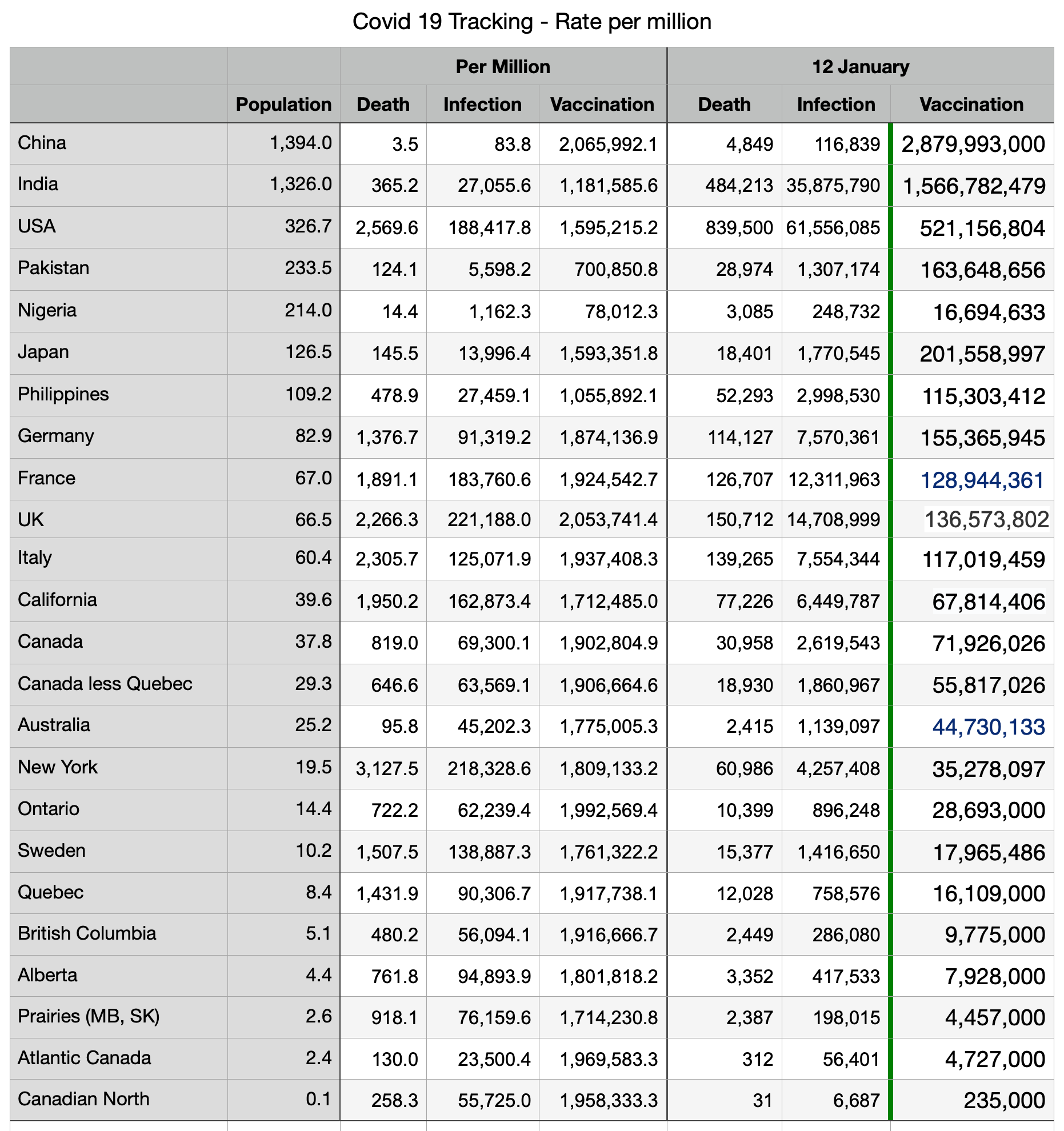
#COVID-19: Comparing provinces with other countries 12 January Update

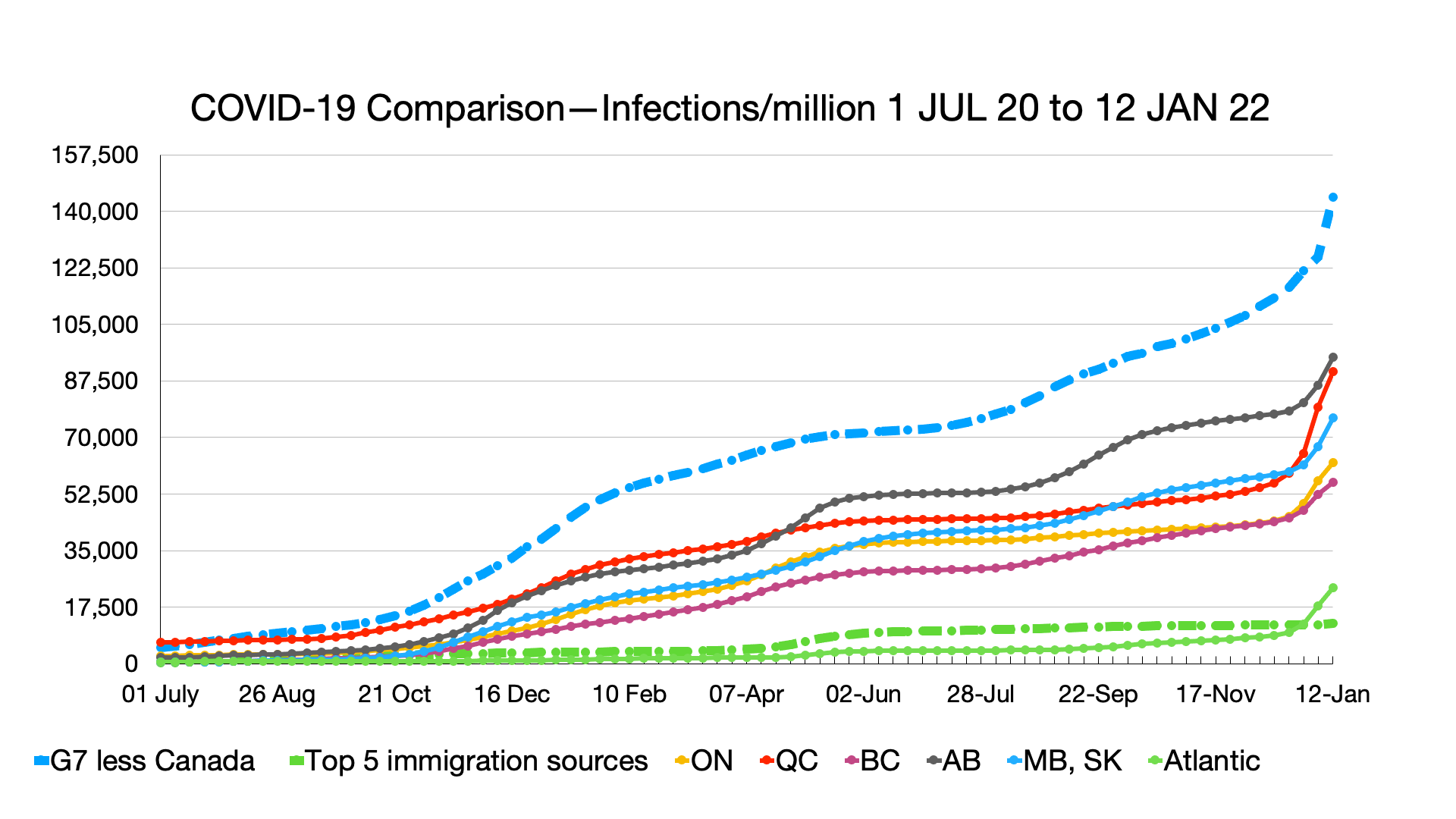
Steep rise of infections remains the main story, along with resulting increases in hospitalizations and ICUs.

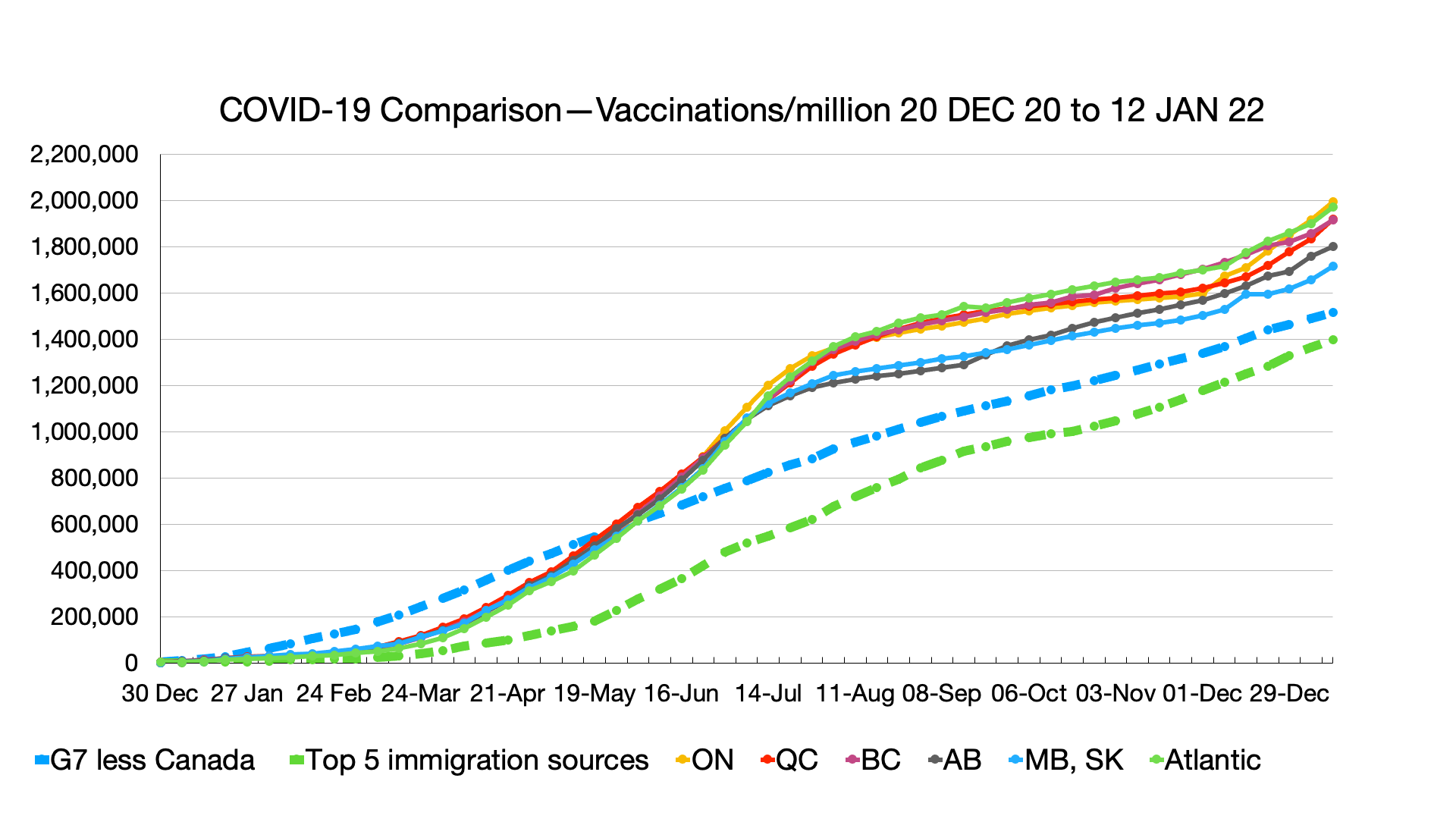
Vaccinations: Some minor shifts but general convergence among provinces and countries. Canadians fully vaccinated 78.7 percent, compared to Japan 78.8 percent, UK 71.4 percent and USA 63.4 percent.

Immigration source countries are also converging: China fully vaccinated 87 percent, India 46.8 percent, Nigeria 2.4 percent (the outlier), Pakistan 34.7 percent, Philippines 49.4 percent.

Trendline Charts:

Infections: Effects of Omicron seen in steep curve in all G7 countries and provinces. No such effect in immigration source countries

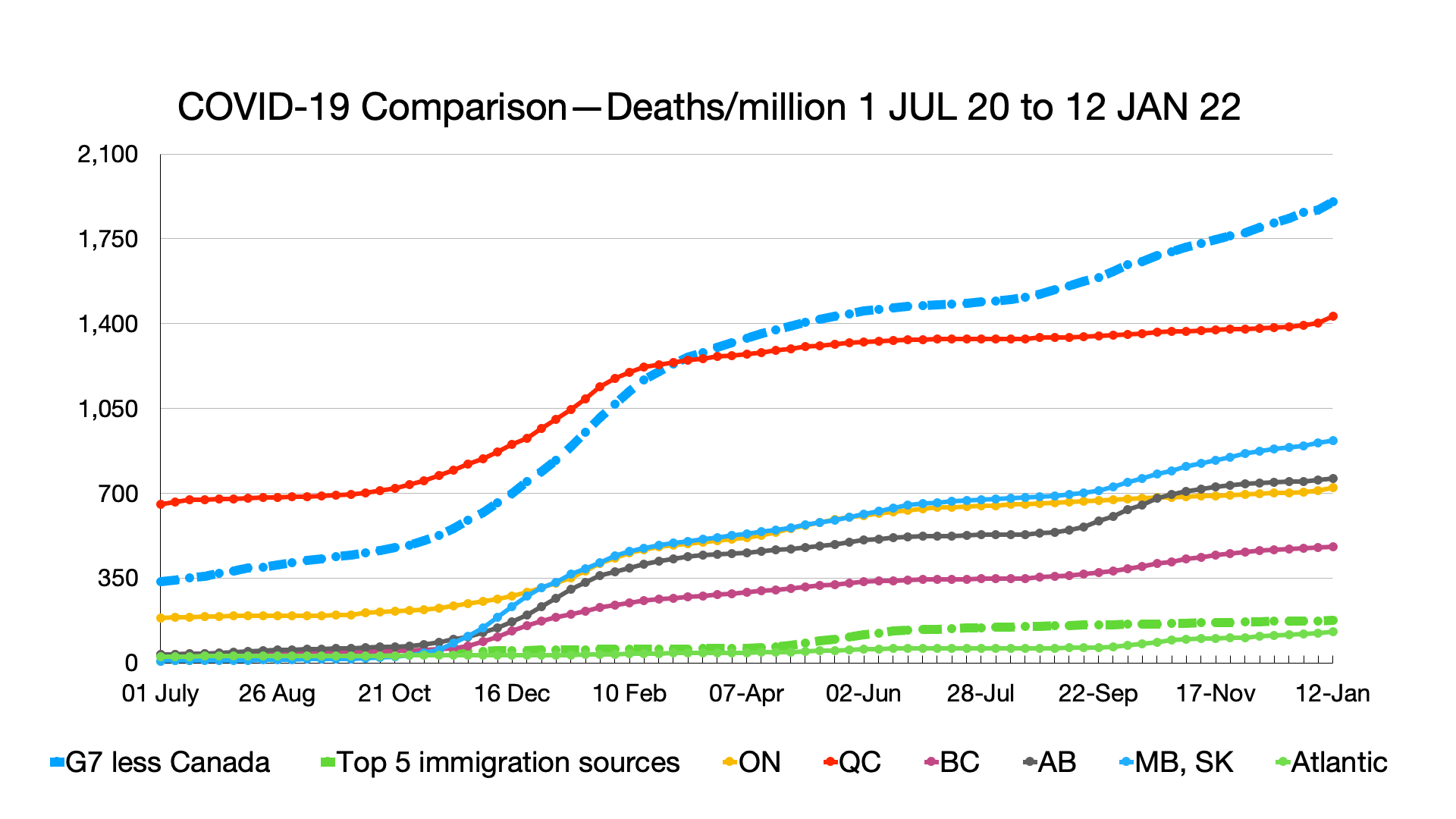
Deaths: No relative changes but slight uptick in Quebec.

Vaccinations: Ongoing convergence among provinces and G7 less Canada and narrowing gap with immigration source countries. Nigeria remains the laggard.

Weekly

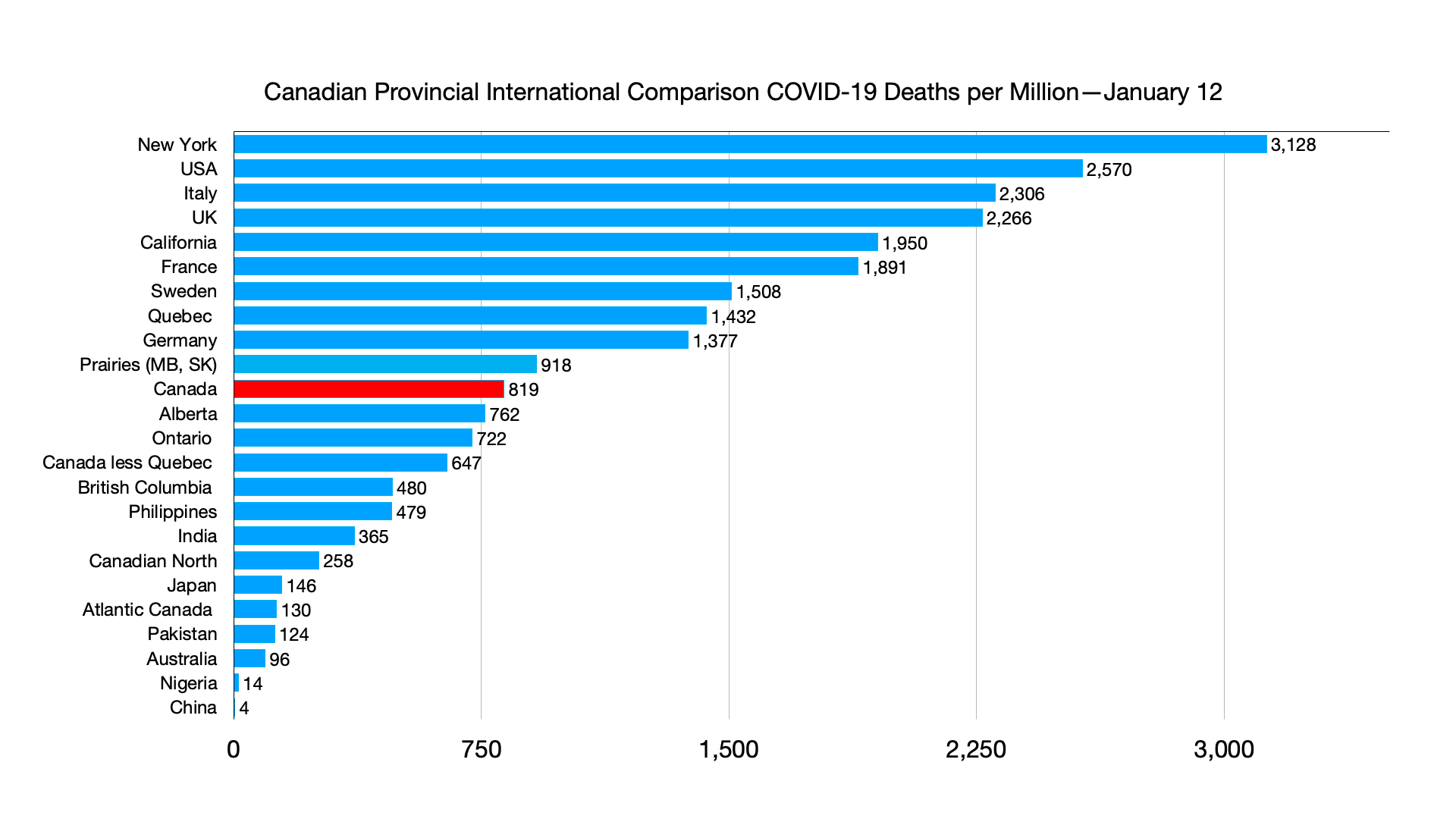
Infections: Alberta ahead of Germany, Australia and Philippines ahead of India, India ahead of Atlantic Canada. 

Deaths: Atlantic Canada ahead of Pakistan.

Fair amount of commentary on Quebec’s announcement of a health tax on the unvaccinated, with most commentary opposed to the idea. A notable exception on the right side of the political spectrum, Tasha Kheiriddin:

What to do about the unvaccinated? As Omicron tears through Canadian society, this public health question has become a political wedge issue. The Liberals and Conservatives have chosen sides, ramped up the rhetoric, and polarized the debate, each playing to the base they think is most likely to support their point of view.

With 88 per cent of Canadians over the age of 12 fully vaccinated , the Liberals figure they’re pretty safe siding with the crowd that favours the jab. Regrettably, they have chosen the strategy of demonization. On Friday, Health Minister Jean-Yves Duclos speculated provincial governments would make vaccination mandatory, which he said could be needed to get “rid” of the virus.

During the election campaign Prime Minister Justin Trudeau called the unvaccinated “misogynists and racists.” He dialled that down a bit last week when he said that Canadians are angry at the unvaccinated who take up hospital beds, but his remarks caused a furor that has yet to subside. This is not accidental.

The sad reality is that there is a subset of the unvaccinated who fit Trudeau’s description; since September, for example, some have been using the hashtag “Pureblood” on social media to self-identify as unvaccinated. You don’t have to scroll far to find tagged images peppered with shots of white supremacy gestures or MAGA hats.

The Liberals’ dogwhistle is designed to conflate these people with mainstream Conservatives — and turn people off Conservative Leader Erin O’Toole’s call for “reasonable accommodation.” O’Toole is asking for “acceptance” of the fact that up to 15 per cent of the population will not get vaccinated. He favours using rapid tests to keep unvaccinated workers on the job, as opposed to shutting down to stop the spread of the virus.

“In a population that is now largely fully vaccinated, in fact the action and inaction by the Trudeau government is normalizing lockdowns and restrictions as the primary tool to fight the latest COVID-19 variant.”

But this approach is also wrong. First, it relies on unreliable technology. Rapid tests are not good at detecting Omicron infections, particularly in the early stage when a person is infectious but shows no symptoms. Second, it sends a double message. On the one hand, the Tories encourage people to “get vaccinated.” On the other, they make allowances for those who eschew the jab. It’s like saying “wear your seatbelt, but if you don’t, that’s OK.” Well guess what — it’s not. If you get in an accident, it will cost up to three times more to treat you in hospital than if you were buckled up. Sound familiar?

The reality is that we restrict plenty of behaviours where we judge the harm to others, including economic harm, outweighs the limits to individual liberty. We don’t allow people to smoke in workplaces or public buildings. We forbid drinking and driving. And we mandate vaccination for contagious diseases such as measles if children are to attend public school. Why? Because otherwise your actions, or inaction, present a real risk of harm to someone else. They can cause quantifiable loss, in the form of sickness, suffering, even death (yes, last year 200,000 people worldwide died of measles , mostly children under five). People don’t live in a vacuum.

A liberal would cite Jean-Jacques Rousseau’s Social Contract, which called for government by popular consent; a conservative would point to Edmund Burke, who rightly observed, “Men are never in a state of total independence of each other.” In other words, there is no freedom without responsibility, no liberty without duty.

When it comes to vaccination, we should protect those who understand this truth from those who disdain it. Vaccine passports, restrictions on interaction and withdrawal of privileges are preferable to calling people names, forcing them to get the shot, or conversely accommodating a choice that puts others in harm’s way. Obliging those who opt out of vaccination to pay a penalty, such as the Quebec government is suggesting, is also a possibility. Such measures are not about cajoling or compelling, though if they do result in more vaccinations, that’s a good thing. They are meant to protect all of us who just want to move on from this once-in-a-century public emergency and get back to living our lives

Source: The unvaccinated must be deterred from harming others

Who gets to use NASA’s James Webb Space Telescope? Astronomers work to fight bias

Really neat example of how to reduce bias through blind approval processes:

The scientists who eventually get to peer out at the universe with NASA’s powerful new James Webb Space Telescope will be the lucky ones whose research proposals made it through a highly competitive selection process.

But those that didn’t make the cut this time can at least know that they got a fair shot, thanks to lessons learned from another famous NASA observatory.

Webb’s selection process was carefully designed to reduce the effect of unconscious biases or prejudices, by forcing decision-makers to focus on the scientific merit of a proposal rather than who submitted it.

“They assess every one of those proposals. They read them. They don’t know who wrote them,” explains Heidi Hammel, an interdisciplinary scientist with the James Webb Space Telescope. “These proposals are evaluated in a dual-anonymous way, so that all you can see is the science.”

This is a recent innovation in doling out observing time on space telescopes. And it’s a change that only came about after years of hard work done by astronomers who were concerned that not everyone who wanted to use the Hubble Space Telescope was getting equal consideration.

A bias emerges in who wins telescope time

One of their first clues came when Iain Neill Reid went looking for signs of any possible gender bias in the acceptance rate for Hubble proposals. He’s the associate director of science at the Space Telescope Science Institute, the science operations center for both Hubble and now Webb.

His results, published in 2014, were startling. Proposals that were led by women had a lower acceptance rate than proposals led by men. This discrepancy remained constant for more than a dozen years, the entire period of time he analyzed.

“I was surprised at how consistent it was,” says Reid. “There was a systematic effect.”

To try to fix this, he and his colleagues eventually developed the “blinded” proposal review process that’s now being used for Hubble, Webb, and NASA’s other major space telescopes. So far, the evidence suggests that this is working to level the playing field — even though the measure was initially opposed by a lot of the astronomy community

Since any telescope in space is a rare, precious resource, NASA wants to devote its time to the most-promising science. Anyone in the world can submit a proposal for where to point a space telescope, and there’s so much demand that the majority of ideas have to be rejected.

Even before the James Webb Space Telescope was launched, for example, the first call-out for proposals drew 1,173 ideas that would require 24,500 hours of prime observing time. But only 6,000 hours were available.

“It was a cutthroat competition. We rejected three-quarters of all the accepted proposals, and we’re taking the top ranked quarter,” says Jane Rigby, an astrophysicist with NASA’s Goddard Space Flight Center who serves as the operations project scientist for the new telescope.

And even though Hubble launched more than 30 years ago, astronomers still clamor to use it. Every year they submit 1,000 or more proposals.

“Only the top 20% of those proposals will actually make it through to the telescope to get time,” says Reid.

Focusing on the science, not the scientists

After his study showing a gender discrepancy in acceptance rates for Hubble proposals, Reid and his colleagues tried different solutions. First, instead of having the lead scientist’s name on the front page of a proposal, they tried putting it on the second page. Then, they tried just using initials. Nothing worked.

“Then we got sensible and we said, ‘Let’s actually talk to some experts in social sciences,’ because they can understand this better than we do,” says Reid.

They reached out to Stefanie Johnsonof the University of Colorado and her then-student, Jessica Kirk, now at the University of Memphis. The pair sat in on the meetings that evaluated and ranked proposals. And they noticed that a lot of the time, the discussion centered on who had submitted the proposal, rather than scientific considerations.

“There might be a question about it, like, ‘Oh, you know, this seems really good but can they actually do this?'” recalls Johnson. “A lot of times, there’s someone who will speak up in the room and say, ‘I know this person … they will figure it out, because that’s who they are.'”

“There is this evaluation not just of the science and the research, but of the researchers,” adds Kirk.

This means astronomers who were already established and well-known got an extra leg up.

“They were getting a pass,” says Reid. “They had a lower bar, in some ways, to overcome, than the scientists who were coming into the field completely fresh with no track record.”

Johnson and her colleagues recommended making the review process completely blinded and anonymous. Not only would the evaluation committees not get to see any names, all proposals would be required to be written in a way that made it totally impossible to know who the proposal was from.

Some doubted this new system would work

The institute surveyed the astronomy community to see what it thought of this potential change.

“You can imagine, the knee-jerk reaction was actually pretty polar,” says Lou Strolger, deputy head of the instruments division at the Space Telescope Science Institute and chair of its working group on anonymous proposing.

He says about half of those who responded favored the idea — and those tended to be women or people who were relatively young.

“They thought that this would be a good way to make it not only more fair but to encourage new people to participate,” he says.

But lots of astronomers had objections.

“They ranged from ‘This will totally upset how good science is done’ to ‘You’ll basically fool yourself into giving time to people who don’t know what they are doing’ — all sorts of things,” recalls Strolger.

Still, the institute’s director gave the go-ahead, and they plowed forward. In 2018, astronomers did their first truly anonymous review for Hubble proposals. Priya Natarajan, a theoretical astrophysicist at Yale University, was there and chaired the process. She says occasionally someone would try to guess who had submitted a proposal.

“But the buy-in from the community was so tremendous,” she says, “that there would be other people on the panels who would say, ‘Oh no, no, come on, let’s stick to the science.'”

“I was stunned”

And sticking to the science had a real impact. That year, for the first time ever, the acceptance rate for proposals led by women was higher than the acceptance rate for proposals led by men. The gender difference had flipped.

“I was stunned,” says Natarajan. “There was an effect right away.”

And when members of the selection committees were finally allowed to see who had submitted a proposal that they had just deemed worthy of telescope time, Strolger says that they never objected that the person wasn’t up to the job, although they were often surprised.

“There were a lot of, ‘Oh, that was not at all who I thought it was’ kind of reactions,” says Strolger.

Data from the last few years suggests that this process continues to help close the gap between men and women in acceptance rates for Hubble proposals, and it may have improved fairness in other ways, too.

There’s been a dramatic rise in approvals for astronomers who have never used Hubble before, says Strolger. “It went from something like a dozen per year, to 50 per year.”

What’s more, data from the first round of proposals for Webb shows hints of similar results, with “a much closer gap in male and female acceptance rates,” says Strolger.

“This seems to be working, and it seems to be working as we anticipated it would.”

What other biases could affect telescope users?

Still, anonymizing everything doesn’t solve all the problems in making sure everyone has equal access, says Johnson, who notes that unconscious bias can affect who in astronomy gets advantages like mentors and job opportunities.

“It’s not perfect. It doesn’t wipe out systemic bias, and I don’t know of the impact that the dual-anonymization has in terms of creating greater racial equity,” she says. “But it did seem to lift some of the gender bias.”

Trying to track equity issues is complicated by the fact that the Space Telescope Science Institute has historically not gathered demographic information about those who submit research proposals.

“Partly by policy and partly by federal law, we’re not permitted to collect that information,” explains Strolger.

That’s why, when Reid did his initial study looking at gender and Hubble, the best he could do was to make assumptions about gender based on the lead scientist’s name or his knowledge of people in the field.

The researchers are now looking for ways to learn more about submitters, perhaps by allowing people to voluntarily or anonymously submit information about themselves to a third party.

“We hope that by providing ways in which we can get access to more demographic data,” says Strolger, “we can begin to see where other biases may lie.”

Source: Who gets to use NASA’s James Webb Space Telescope? Astronomers work to fight bias

Safe places [Safe Third Country Agreement Supreme Court case]

Bit unbalanced in terms of experts interviewed. Would be useful to have a dissenting view for contrast as there is room for debate on the SFCA:

The Safe Third Country Agreement with our Southern neighbour that compels would-be refugees to cross into Canada at unofficial border crossings was bound to end up before our Supreme Court at some point. Last month, the top court finally granted leave to review its constitutionality. The Federal Court initially ruled in 2020 that the agreement violated refugee claimants’ Charter rights by deporting those who arrived from the U.S. and had filed a claim in Canada in contravention of the STCA. The declaration of invalidity was suspended to give the government time to take action, and then the Federal Court of Appeal overturned the decision.

There are several key questions the Supreme Court must address now, says Janet Dench, executive director for the Canadian Council for Refugees, who brought the challenge along with several asylum claimants. She calls the Federal Court of Appeal ruling “disturbing,” having “left us with a sense that there is no real recourse for violations of refugees’ rights.”

She also expresses concern that a broader application of the Federal Court of Appeal’s ruling could affect other Section 15 Charter claims.

Indeed, part of the Council’s case hinges on the failure of the U.S. to adequately protect people fleeing gender-based persecution, which it says was exacerbated under former President Donald Trump’s administration. The Federal Court rendered its judgment based on Section 7 arguments, and did not consider Section 15 claims. Having overturned the Section 7 argument, the Federal Court of Appeal also did not need to look at Section 15.

Another issue is that the Federal Court of Appeal held that the plaintiffs were wrong to challenge the designation of the U.S. as a safe third country. Instead, it’s up to cabinet to regularly review the designation, and therefore it is cabinet’s decision that must be challenged.

“If this decision and analysis was to stand, then lawyers would constantly be asking what they are challenging,” says Dench. “Are they challenging that a regulation was put into force that disadvantages or violates certain people’s rights, or should they be challenging the fact that regulation hasn’t subsequently been set aside,” says Dench.

Jamie Chai Yun Liew, professor at the University of Ottawa, who has previously represented the Canadian Council for Refugees but is not involved in this matter, notes that the focus of the Federal Court decision was on the impact of the decision-making by those at the border implementing the STCA.

“There was a lot of social science, affidavit and first instance evidence presented to the court of the experiences of migrants who have been turned away at the border and their experiences,” Liew says. “One of the things that the [Federal Court] focused on was the immediate detention of people who were turned away at the border, and the risk of them not even having their refugee claim assessed at all by either country.”

Liew notes that the Federal Court of Appeal focused instead on “safety valves” that allowed for claimants to access a different assessment or protection before the decision leading to the harm that the applicants described, including federal review of the STCA.

“During the discovery process, the government was very resistant in sharing any information about the internal political system of how the Safe Third Country was reviewed, so there’s very little evidence on that,” Liew adds. “What evidence there is, publicly, doesn’t show that the government has done a very deep review of these kinds of things, despite increasing evidence that the United States is a hostile place for refugees, especially during the Trump administration.”

Despite the evidence of harms, Liew notes, the government’s unwillingness to come forward with information during the discovery process means the Supreme Court will be limited in its ability to examine what actually happened.

“It will be interesting to see how those on the bench absorb the evidence and what angles they take,” Liew says.

Liew hopes that the court ensures that Charter rights aren’t being trampled under the pretext that the so-called “safety valves” are available to refugee claimants. She notes that past ruling on immigration by the Supreme Court have raised questions around alternative remedies. On paper there are mechanisms, such as pre-removal risk assessments, whereby a person can apply to remain in Canada if they are at risk of physical harm in the event they get deported to their country. In reality, however, people have difficulty accessing these measures.

Audrey Macklin, professor and the Rebecca Cook Chair in Human Rights Law at the University of Toronto, says that Canada can neither directly violate the Charter rights of those seeing refugee protection, or indirectly, by returning them to a country that will violate fundamental human rights.

“We’re talking about arbitrary detention, separation of families, detention of children, substantive doctrines that deny women fleeing gender persecution, and so on,” says Macklin. “Procedurally, there is also an issue about the failure of the Canadian government to regularly monitor the United States for compliance with those fundamental human rights obligations.”

Macklin adds that the STCA is predicated on the notion that the U.S. is safe for people to seek refugee protection. Even if it was not when the agreement was signed and implemented, circumstances can change. The problem is that Canada has no procedure to scrutinize whether the U.S. continued to be a safe country, she says.

What’s more, Canada routinely evaluates the safety of other countries as part of refugee determination itself. It would hardly be an overstep for Canada to do the same with the U.S. Besides, there are provisions in the STCA allowing either country to suspend it for two six-month periods, or to terminate it with one year’s notice. “There’s nothing untoward about Canada doing that,” says Macklin.

Liew doesn’t think the court will strike down the whole Immigration and Refugee Protection Act. It’s not the legislation that is problematic so much as the Safe Third Country Agreement, which flows from provisions in the Act.

“My suspicion would be that they would suspend or ask the government to terminate the agreement that flows from the provision, and it wouldn’t be striking a provision from the legislation per se,” Liew says. “Or they could give the government that six-month window, as the Federal Court did, to get their act together and either review it or amend it, and that might be a way for the government to save face.”

Or the Supreme Court might find the violation so glaring that it suspends it right away, she says. But its history with immigration decisions shows a pattern of moving more cautiously.

Dench notes that because the situation in the United States can change from year to year, there isn’t an expectation that the Supreme Court will make findings of fact. Instead, it could provide a pathway for these kinds of matters to be brought to the courts for evaluation.

Dench also disputes that the situation in the U.S. is solely attributable to Trump’s policies. Since he left office, it’s not like there’s been a complete reversal of his border policies.

“We don’t expect an impartial analysis to say that all of the existing problems have been solved,” Dench says.

Ultimately, says Liew, the agreement has failed to live up to its promise. It hasn’t stopped people from coming to the border, though it has made it harder to do so safely. There are countless stories of claimants who lost fingers from frostbite at irregular crossings or at the quasi-official crossing facility at Roxham Road in Quebec.

Therefore, she would advise the government “to look at how people can access our official ports of entry and process them in a way that is humane and fits with our international law obligations.”

Macklin notes that the STCA was struck at the behest of Canada, given that we only have one border. And though it is a mechanism to put breaks on the flow of people who can reach Canada and make refugee claims, she also disputes the notion that it is intended to combat “asylum shopping.”

“In absolute and relative terms, the number of asylum seekers that Canada receives is trivial,” says Macklin. “If you were seeking refugee protection and you had a child with you, and you knew that the United States would rip you away from your child, do we call it asylum shopping because you say I can get to Canada, please let me do that?”

Source: Safe places

Galon: The inherent evil of Israel’s Citizenship Law

Of note:

The government has informed the High Court of Justice that Interior Minister Ayelet Shaked plans to pass a new citizenship law within a month – and that it will preserve the racist clauses that were included in the original law. The government was responding to a petition submitted by the Association for Civil Rights in Israel; Hamoked: The Center for the Defense of the Individual; Physicians for Human Rights and several Palestinian petitioners.

Shaked has continued to refuse family reunification for Palestinians, and has done so without any legal authority. Since the Knesset revoked the original Citizenship and Entry Into Israel Law, 1,680 requests have been submitted, and under Shaked’s instructions the Interior Ministry has refused to discuss these requests, continuing to operate as though the law were still in effect.

The background: At the start of the second intifada the Knesset passed a law designed to prevent Palestinians living in Israel from marrying Palestinians from the territories. The Knesset understood at the time that it was a law whose constitutionality was in doubt, and which undermines the right to family life and equality, and therefore declared it a temporary “emergency provision.”

That was the excuse for the High Court: Look, this law isn’t permanent, we will discuss it on an annual basis depending on the situation. And of course, since 2003 the Knesset has approved it year after year. An “emergency provision” turned into a permanent law. And the High Court? It sighed, but didn’t rule on the matter. The justices said that the law raises difficult constitutional questions, but refrained from invalidating it. Why would they need this headache?

Six months ago the coalition was unable to garner a majority and the law was revoked. Prime Minister Naftali Bennett promised the Meretz party – which supported the racist law – that he would change the law. And what did Shaked do? She announced that she doesn’t care, and that she forbids family reunification even if she has no legal authority to do so. Instead of the State Prosecutor’s Office ordering her to return to the situation prior to the passing of the law – in other words, an individual examination of every request for reunification – Gil Limon, the deputy attorney general, declared that he supports the law.

Hold on a moment, my friend Limon. It is now 2022. The law that was passed 20 years ago originated in the days of the second intifada and the security situation that ensued from it. But that was over 17 years ago. How can you pretend, 17 years later, that the security situation in 2002 is still relevant today? The law that you are approving – wouldn’t it be preferable for it to suit the actual security situation?

Excuse me for the bad joke. The Citizenship and Entry Into Israel Law was always justified with security excuses, but it has no real connection with security. Justice Edmond Levy mocked this claim during my petitions and those of human rights organizations, and noted that Israel permits Palestinian workers to enter its jurisdiction.

And here precisely is the crux of the matter: The law does not protect Israel’s security, and was never designed to do so. It is designed to allay the demographic fears of Israeli Jews. Prime Minister Ariel Sharon said so at the time, and half a year ago Yesh Atid chairman Yair Lapid repeated his words: “We don’t have to hide from the essence of the citizenship law, it is designed to ensure a Jewish majority in the country.”

The significance of Lapid’s words is that Israel is not a democracy. It has a large, native-born minority whose rights will always be inferior to those of the majority. This native-born minority won’t be able to realize its family-related rights or aspire to happiness. One of the advantages of this government is that Israeli Arabs are participating in it. If Shaked throws the Arab community to the dogs, Bennett, Lapid and their comrades should be aware that they won’t have another government after the election. Perhaps this utilitarian argument will succeed in overcoming the law’s built-in evil.

Source: The inherent evil of Israel’s Citizenship Law

In Egypt, some are forced to trade citizenship for freedom

Of note:

On January 8, Egyptian-Palestinian activist Ramy Shaath arrived in Paris after Egyptian authorities released him from prison and deported him after over 900 days in remand detention. He walkedout of Charles de Gaulle Airport with his wife Celine Lebrun-Shaath to a cheering crowd of supporters. Yet the conditions of his release were no cause for celebration — Shaath was forced to renounce his Egyptian citizenship in exchange for his freedom.

In a statement announcing his release, Shaath’s family said: “No one should have to choose between their freedom and their citizenship. Ramy was born Egyptian, raised as an Egyptian, and Egypt has always been and will always be his homeland; no coerced renunciation of citizenship under duress will ever change that.”

Throughout the two and a half years of Shaath’s imprisonment, his wife Celine Lebrun-Shaath, a French national who was deported from Egypt upon his arrest, led a longstanding public campaign for his release. French President Emmanuel Macron also made a direct demand for Shaath to be released during a December 2020 press conference alongside President Abdel Fattah al-Sisi, held after bilateral talks at the Elysee Palace in Paris.

Over the last six months, the National Security Agency had been communicating with Shaath’s family to begin the process of his citizenship renunciation, and to arrange for his deportation, according to a source informed of discussions around his release, who spoke to Mada Masr on condition of anonymity. Those procedures came to a head on January 1, when Shaath’s lawyer submitted an official document to the Supreme Administrative Court saying that he would drop his Egyptian citizenship, the source added.

Shaath was released on January 6, according to the family, and handed over to a representative of the Palestinian Authority at Cairo International Airport, where he boarded a flight to the Jordanian capital, Amman. He then traveled on to Paris.

The controversial practice is based on a decree — known as Law 140 — issued by President Abdel Fattah al-Sisi in November 2014 that allows the repatriation of foreign prisoners to their home countries, at the president’s discretion, to serve their time or be retried there.

The decree was issued five months after three Al-Jazeera journalists — Australian Peter Greste, Egyptian-Canadian Mohamed Fahmy and Egyptian Baher Mohamed — were sentenced to between seven and 10 years in prison on terrorism charges in a high profile case that sparked international condemnation and was criticized by human rights groups, Western governments and the United Nations. According to lawyer Negad al-Borai, who represented Fahmy in the case, Law 140 was issued to allow for the release and deportation of Greste to his native Australia. Less than three months after the decree was issued, Greste was indeeddeported.

Around that time, Fahmy renounced his Egyptian citizenship in the hope of being deported to Canada. Fahmy told Mada Masr at the time that senior officials had visited him in detention and told him that renouncing Egyptian citizenship was his “only way out.” Fahmy refused at first, but said he felt pressured and wanted to get out of prison. The move did not work and he was only released, along with Baher Mohamed, after they received presidential pardons in September 2015 following a retrial. Fahmy has since regained his Egyptian citizenship.

Months earlier, in May 2015, Mohamed Soltan, an Egyptian-American activist imprisoned for over 640 days, was forced to relinquish his citizenship in order to be released from prison and deported to the United States after direct appeals from the Obama administration.

Soltan’s case included an additional twist. During a visit to Capitol Hill in July 2021, Egyptian intelligence chief Abbas Kamel insisted to US officials that Washington had promised in 2015 that if Egypt released Soltan he would serve out the rest of his life sentence in a US prison, according to Politico. Kamel even handed congressional staffers what appeared to be a signed agreement between Egyptian and American officials laying out such an arrangement. Sources told Politico that a State Department employee signed the document when it was pushed on them at the airport at the last minute, as U.S. officials were trying to get Soltan out of the country, and that the document was not legally enforceable.

In any case, forcing Egyptians to renounce their citizenship in order to be deported remains a highly controversial, and arguably illegal, practice.

Lawyer Gamal Eid of the Arab Network for Human Rights Information says that Law 140 is unconstitutional, as it creates a privilege for non-Egyptians. “The idea was to cower to foreign governments and polish the regime’s image, but the decree breaches the principle that all are equal before the law, which is a supra-constitutional principle.” Eid says he is not condoning the continued imprisonment of dissidents, rather, he says they should all be released, not just the foreign nationals.

While the decree doesn’t force anyone to drop their nationality, the choice between citizenship and freedom is not really a choice. Hussein Baoumi, an Egypt researcher at Amnesty International told Mada Masr it is more accurate to say that Shaath and Soltan were forced to cede their Egyptian citizenship, which he says is unconstitutional.

“This practice we are now seeing in Egypt of trading citizenship for freedom is against the constitution and the citizenship law, and is also a blatant breach of the stipulations of international law about rescinding one’s citizenship. It circumvents the provisions of the law regulating such a measure,” Baoumi says.

The 1975 citizenship law stipulates that a number of conditions be met before the state can rescind citizenship from an Egyptian national. Yet, this law does not apply in Shaath or Soltan’s case because they technically relinquished their citizenship themselves. However, both Soltan and Shaath contend they had no choice in the matter.

Following Shaath’s release, Soltan tweeted: “To be given a choice between your freedom and your citizenship is easy, for freedom always and forever comes first, and this doesn’t take away from your belonging to your country because that is in the heart. As for a regime that conditions enjoying your most basic citizenship rights of freedom and life upon your dropping your nationality, it is a regime that is reinforcing its repressive philosophy: to be a citizen necessarily means not to be free.”

Source: In Egypt, some are forced to trade citizenship for freedom