Nicolas: Libres de quoi? [on Neo-liberalism]

Strong critique:

On sait que la malbouffe et le trop-plein de sucre, c’est mauvais pour la santé. Se demande-t-on pourquoi les principaux commerces de proximité vendent surtout des chips, des jujubes, des boissons gazeuses et autres aliments surtransformés ? Non. Mais on nous conseille de faire des choix individuels santé.

On sait que la sédentarité augmente le risque de maladies chroniques. Réglemente-t-on l’étalement urbain et densifie-t-on les villes pour endiguer la dépendance à la voiture ? Veille-t-on à ce que les quartiers où le transport actif est possible restent abordables ? Non. Mais c’est à chacun de faire le choix de l’exercice physique quotidien.

On sait que l’anxiété et la dépression sont en hausse depuis des années, sous l’effet du stress croissant des études et du travail. Met-on en place la semaine de quatre jours ? Non. Mais on télécharge une appli de méditation ou on fait du yoga. À chacun d’entraîner son « mental » pour mieux endurer le quotidien.

L’idéologie néolibérale a tellement imbibé le discours populaire dans le domaine de la santé qu’il est devenu difficile d’en expliciter le fonctionnement. Tentons-le. Le néolibéralisme croit qu’une société bonne est une société libre, et que cette liberté passe par des institutions qui tentent de laisser le secteur privé exempt de réglementations, et les individus libres de leurs choix.

Dans une société néolibérale, il est donc inapproprié de trop encadrer les compagnies dont le modèle d’affaires rend carrément malade, que ce soit en invitant la population à ingérer des calories vides bon marché, en polluant l’air ou les cours d’eau, ou en exploitant des employés au statut précaire. Les entreprises doivent rester le plus libres possible dans leurs activités, et nous, en contrepartie, sommes libres d’y travailler ou pas, de consommer leurs produits ou pas.

Dans une société néolibérale, les professionnels de la santé nous parlent de changer nos choix de vie, de prendre des habitudes plus responsables. Mais il est incongru qu’un groupe de diététiciennes fassent une sortie commune contre l’abondance de malbouffe dans les chaînes de dépanneurs et la persistance des déserts alimentaires ; il est presque tabou que des médecins se mobilisent pour une réforme du Code du travail ; et il est impensable que la direction d’un CIUSSS demande plus d’espaces verts sur son territoire.

Dans une société néolibérale, le tout est fait d’une somme d’individus auxquels il faut séparément enseigner à choisir des aliments et des loisirs qui maximisent l’espérance de vie. Les membres du personnel soignant qui voudraient « prescrire » des lois, des politiques, des réglementations, des réformes institutionnelles pour améliorer la santé de toute une collectivité passent pour des hurluberlus. Celles et ceux qui préconisent l’action à la source, c’est-à-dire sur les déterminants sociaux de la santé, sont le plus souvent à la marge de leur ordre professionnel.

Dans une société néolibérale, l’individu est un agent rationnel, responsable de ses choix. Les individus qui font les moins bons choix sont donc moins rationnels, et moins responsables. Les inégalités sociales, notamment sur le plan de la santé, sont donc légitimes : les populations les plus amochées n’ont qu’à faire de meilleurs choix. Ces meilleurs choix sont surtout accessibles aux mieux nantis ? Il fallait aussi faire les bons choix de vie pour arriver à ce niveau de confort matériel qui permet de choisir le bio, de choisir le week-end en nature au chalet, de choisir de se renseigner sur les aliments bons pour prévenir le cancer. Il y a les gagnants, et il y a les perdants. Dans une société néolibérale, il y a de bonnes chances de tomber sur un médecin qui te soigne, certes, mais en te jugeant intérieurement de t’être rendu malade, avec tes choix de perdants.

Dans une société néolibérale, le rôle du gouvernement en santé publique, c’est au mieux de sensibiliser les individus à l’importance de faire les choix les plus gagnants possibles. Ce n’est certainement pas — un exemple comme ça — de réglementer plus sévèrement la qualité de l’air dans les écoles comme dans les usines, et de rendre l’environnement public et privé moins propice à la maladie.

Dans une société néolibérale aux prises avec une crise sanitaire, une partie de la population aura intériorisé ce gospel de la liberté individuelle et (surtout) d’entreprise. Des gens, donc, se braqueront contre une mesure sanitaire ou un vaccin parce qu’en les recommandant, le gouvernement outrepassera son étroit petit rôle de protection des choix des individus et (surtout) de la liberté des business. On s’insurge, en bref, contre le spectre menaçant d’un « gouvernemaman ».

Dans une société néolibérale aux prises avec une crise sanitaire, il y aura aussi des gens déjà critiques de la logique néolibérale qui se demanderont si les institutions obéissent trop au capital pour agir dans l’intérêt public. On a donc un groupe qui peut rejeter une mesure sanitaire non pas par dégoût de la solidarité sociale, mais parce que face à des institutions jugées « vendues », on préfère se fier à son propre jugement, à ses sources « alternatives », et se démerder seuls.

Avec ce deuxième groupe, on peut absolument parler de santé publique, parce que le souci du bien-être collectif est présent et partagé. Mais avec lui, il ne suffira pas de déplorer la désinformation ou de ressasser les dernières connaissances scientifiques pour rebâtir la sacro-sainte confiance à l’égard des institutions. Il faudra aussi admettre les failles du système, nommer ce qui n’y tourne pas rond, en altérer la logique. Non pas tenter de convaincre les individus, un par un, de faire des « choix » plus centristes, mais plutôt « prescrire » des changements institutionnels profonds. En commençant par un examen de ce néolibéralisme et de ses conséquences.

Source: Libres de quoi?

Chakrabarti and Woolley: The UK nationality bill makes it clear: some British citizens are more equal than others

More opposition to the proposed changes:

As longstanding human rights campaigners, we are both well acquainted with the harsh realities of inequality and injustice in modern Britain. But the government’s nationality and borders bill– which will be in the committee stage at the House of Lords for the next two weeks – feels like a very personal insult. This is because it lays bare an uncomfortable and usually unspoken truth: that people like us, born in Britain but with foreign-born parents, are second-class citizens.

We are talking about the bill’s provision to strengthen the government’s ability to deprive people of citizenship – a profound exercise of state power. Currently, the home secretary has the power to do this if they determine it is “conducive to the public good” and if they believe the person being deprived is eligible for the citizenship of another country. This last condition has been estimated to be applicable to several million people.

Hundreds of formerly British citizens, especially from ethnic minorities, have already been stripped of their citizenship in the past 15 years. But Boris Johnson’s government wants to go even further. Clause 9 of this generally poisonous bill would give ministers the ability to remove our British citizenship without even telling us. This would severely affect the right of appeal; contesting government decisions needs to be done in a timely and effective way, but how would this be possible if you don’t know that the decision has been made? It seems the government is saying, if we take your citizenship, you’ve lost it. Period.

This is why we have come together, as members of the House of Lords, to oppose the government’s plans and will be supporting an amendment removing clause 9 in committee stage, along with other amendments to restrict already draconian citizenship removal powers.

Why does clause 9 feel so personal? Because it seems to say that no matter that this is the only country we’ve ever lived in; no matter that our life’s work has been to make our nation fairer; no matter that we are both peers of the realm because of this work; no matter that our ancestors gave their lives in two world wars: our citizenship is precarious and conditional in a way that isn’t the case for many others. It can be stripped away by the government of the day.

For those pushing through this bill, the history of Commonwealth migration of British citizens to the UK counts for nothing. Simon’s mother arrived in the late 1950s to give her best years to the recently formed NHS. Soon afterwards, the then health minister Enoch Powell (before he became an overt racist) flew to Barbados to call on British overseas citizens to come to the UK and support the NHS: thousands responded to that call. In that same era, Shami’s parents came from Kolkata to London. Years of race discrimination and even physical attacks never deterred them.

In a House of Lords debate on the bill this month, peers spoke about the hundreds of thousands from Africa, the Caribbean and Asia who fought for Britain in two world wars, believing they were part of a wider family. They believed they had earned the right for their children and grandchildren to be treated as equals. It seems they were wrong.

And this is not just an argument about morality: because when you have a second class, precarious version of citizenship it becomes open to political interpretation – as we have tragically seen in recent years. Everyone now accepts that the Windrush scandal – which saw legitimate British citizens denied healthcare and benefits, or hounded out of their country and left to die impoverished in places they had left as toddlers – is a stain on this country. So why are hundreds of British citizens still being stripped of their citizenship? Just recently a British-born man with Bangladeshi heritage had his citizenship removed and spent four years challenging the decision. He is now on his way back to the UK after winning his appeal.

What the Windrush scandal and other cases show is that governments make a lot of mistakes. The idea that a “good British citizen” – particularly those from the most affected groups of Black and Asian people – can be safe and secure is frankly fanciful. Rather than continuing to erode fundamental rights, the government should be trying to strengthen security and belonging for everyone. That also goes for other parts of the bill, which trash even the 1951 refugee convention by treating the most desperate, who escape persecution by clandestine means, as second-class asylum seekers.

This shouldn’t be a partisan issue. When the Conservative Lord Moylan spoke passionately about witnessing citizenship ceremonies as wonderful celebrations of belonging, he said: “My conception of British nationality is much more profound than a mere travel document. It is – or should be – a permanent and reciprocal bond of loyalty on the one hand and protection on the other … we should be building up and strengthening the bond between citizen and nation, whereas it seems to me that this provision goes only to dissolve it further.”

He is right, of course. Millions of people in this country, whose passport photos show faces that are not white, are vulnerable to structural racism – including when turbo-charged by broad powers of citizenship deprivation. The thought of citizenship being stripped without notice will only create fear and alienation, and do nothing to bring the people of this nation closer together.

  • Shami Chakrabarti was shadow attorney general for England and Wales from 2016 to 2020, and was director of Liberty from 2003 to 2016. Simon Woolley is the director of Operation Black Vote. He was chair of the No 10 race disparity unit until July 2020

Source: The nationality bill makes it clear: some British citizens are more equal than others

Des anges gardiens du Québec s’impatientent

Does seem to be a bit slower than elsewhere in Canada:

Plus d’un an après l’ouverture du programme spécial de régularisation, de nombreux demandeurs d’asile ayant travaillé au Québec dans le milieu de la santé durant la première vague de la pandémie s’impatientent devant la lenteur à obtenir leur résidence permanente. Sur 2275 dossiers (représentant 4535 personnes) déposés depuis le début du processus, à peine 28 % ont été finalisés, selon les plus récentes données fournies par Immigration Canada au Devoir. La plupart des dossiers (69 %) ont été approuvés, mais sont dans le camp du gouvernement fédéral, à la dernière étape du processus.

« Ça fait plus d’un an. C’est très long », déclare la directrice de la Maison d’Haïti, Marjorie Villefranche. « Ça bloque à divers niveaux. » Elle souligne que les demandeurs d’asile québécois, souvent appelés les « anges gardiens », doivent d’abord passer l’étape de l’obtention d’un Certificat de sélection du Québec (CSQ), ce qui peut expliquer les délais plus longs. « Ça double le temps pour avoir les papiers », dit-elle. « Quand on regarde ce qui se passe dans les autres provinces, plus de gens ont obtenu leurs papiers. »

En effet, en Ontario, la province où le programme a été le plus populaire, environ 40 % des 3385 dossiers soumis (représentant 8110 personnes) ont été finalisés. La grande majorité d’entre eux demeurent en attente d’un dénouement. Dans l’ensemble du Canada, 5930 dossiers ont été déposés, et 2050 (35 %) ont abouti à une résidence permanente. Au regard des dossiers ayant reçu une « approbation de principe », cette proportion est toutefois d’environ 50 %.

Établi au Québec, Doris Bissakonou attend toujours sa résidence permanente, après avoir postulé au programme des anges gardiens en mars 2021. Originaire de la Centrafrique, le jeune homme de 23 ans a demandé l’asile en février 2020, tout juste avant que la pandémie ne frappe. « J’ai travaillé comme préposé aux bénéficiaires, sur la première ligne. J’ai prêté main-forte pendant que d’autres étaient chez eux. J’ai travaillé dur, souvent seul sur mon étage », a-t-il raconté.

Jugé admissible au programme, M. Bissakonou a complété l’étape de la sélection du Québec en moins de deux mois et a ensuite soumis son dossier au gouvernement fédéral pour l’étape finale de la résidence permanente. Mais selon ses dires, son dossier aurait été suspendu à la fin de l’été, et il n’a plus de nouvelles depuis. « Je n’ai aucun retour, et mon permis d’étude est expiré », souligne le jeune homme qui s’estime « bloqué ».

Retard généralisé

Selon Martin Savard, du Centre social d’aide aux immigrants (CSAI), il y a un retard généralisé dans toutes les catégories de demandes d’immigration, y compris pour les permis d’étude et la réunification familiale. « La COVID a causé un gros retard, et personne n’y échappe », constate-t-il. Il souligne que l’accueil des réfugiés afghans depuis la fin de l’été dernier a également contribué à retarder le processus.

« Pour les anges gardiens, c’est toujours trop long, car ça fait plusieurs mois qu’ils attendent. Pendant ce temps, ils continuent de se trouver dans une situation vulnérable », note M. Savard. En plus de mettre fin à l’angoisse, la résidence permanente permettra à ces personnes de retourner aux études à moindres coûts, pour terminer l’école secondaire ou pour se spécialiser dans un domaine. « Elles n’auront plus à demander le renouvellement de leur permis de travail. Ça va simplifier leur vie », ajoute-t-il.

Si l’étape du CSQ est terminée dans la majorité des cas, plusieurs anges gardiens attendent toujours d’être régularisés par le gouvernement fédéral. « Quand on regarde nos dossiers, je dirais que c’est 50-50 entre ceux qui le sont et ceux qui ne le sont pas. »

Au cabinet du ministre de l’Immigration Sean Fraser, on aimerait que le traitement soit plus rapide, mais on indique que les délais seraient dans la norme par rapport à d’autres programmes en immigration. Certains demandeurs d’asile peuvent avoir fourni des dossiers incomplets ou ne pas avoir été capables de fournir les preuves qu’ils sont admissibles au programme. Selon l’attachée de presse, Émilie Simard, les délais de traitement varient aussi en fonction « de la facilité avec laquelle nous pouvons vérifier les renseignements, du temps nécessaire au demandeur pour répondre […] et d’autres facteurs ».

Des retards aussi au Québec ?

Selon le ministère de l’Immigration, de la Francisation et de l’Intégration (MIFI), le délai moyen de traitement du CSQ était d’environ un mois et demi (35 jours ouvrables) en date du 17 décembre dernier, un délai jugé raisonnable par les organismes et demandeurs d’asile.

Certaines personnes attendent toutefois depuis plusieurs mois ce précieux document pour postuler à l’étape finale du programme. C’est le cas de Naomi Kakenza, préposée aux bénéficiaires dans un CHSLD sur la Rive-Sud de la région de Montréal, qui attend depuis cinq mois son CSQ et celui de ses trois enfants. « À chaque fois que j’appelais, on me di[sai]t qu’il n’y a rien qui manqu[ait], mais que le dossier n’a pas encore été traité », soutient cette mère de famille d’origine congolaise. À la mi-janvier, le MIFI l’aurait informée qu’il avait été finalisé. Mais elle demeure prudente. « J’attends de l’avoir. »

Mme Kakenza dit ressentir une certaine frustration à voir que de nombreux collègues ont déjà leur carte de résident en poche. D’autant qu’elle a été l’une des premières à postuler au programme en janvier 2021, soit un mois après son ouverture officielle. « Je n’ai rien dans ce pays, ici. J’ai seulement le permis de travail et je travaille comme un robot sans repos depuis le début », dit cette mère de famille monoparentale qui dit avoir toujours travaillé depuis qu’elle a demandé l’asile au Canada en janvier 2018. « Je dois faire des quarts doubles presque tous les jours pour pouvoir me loger et nourrir mes enfants. »

Sans commenter les cas particuliers, le MIFI reconnaît que plusieurs demandes font actuellement l’objet « d’un délai d’examen plus long », parce qu’elles « ont nécessité un examen plus approfondi » ou ont requis « un complément d’information ».

Source: https://www.ledevoir.com/societe/665463/immigration-des-anges-gardiens-du-quebec-s-impatientent?utm_source=infolettre-2022-01-27&utm_medium=email&utm_campaign=infolettre-quotidienne

Semotiuk: Foreign Investors Need Help From America’s EB-5 Immigrant Program

Funny op-ed that reads more as Semotiuk’s brief for a client than broader policy arguments. And not convinced of the overall economic benefits claimed for the program but understand the frustration of  applicants caught by operational changes during the pandemic:

Marcos Bertola is a U.S. EB-5 Regional Center foreign immigrant investor whose green card is in limbo because the Regional Center program shut down while his application was in process. He is one of over 30,000 such committed investors whose I-526 immigration petitions are stuck. At least $15 billion in capital investment and almost 500,000 American jobs are caught up in this logjam according to IIUSA, Invest in the USA.

Better Understanding Needed

“I believe the lack of sympathy from Congress towards what investors are going through with the lapse of the Regional Center program is due at large to people not realizing who they are,” said Bertola. He added, “Investors are seen as millionaires who can afford to wait another year so that the delay won´t affect their lives. But in our case, and that of many EB-5 investors we know of, we are just middle-class families investing our savings in the American economy to give a better education for our children and because we believe in the excellence of the American institutions to such a degree that we want to be part of it.”

Bertola describes how the process started for his family, “The decision to immigrate to the US started when my daughter was finishing high school and decided to become a nurse. Researching on how she could study in the US we learned that EB-5 seemed an opportunity for us to be with her as a family. My wife who is a researcher graduated with a Master´s Degree at one of the most prestigious universities in Latin America was thrilled with the idea of being able become a doctor in the US.”

Bertola filed his EB-5 investor petition in 2016, when adjudication times were expected to be around 14 months. It took three years for it to be approved, yet he was glad and expected things to run faster after that. The next step in their immigration journey was to get approval from the National Visa Center to get their immigrant interviews at the U.S. Consulate abroad. He and his wife even bought a house in the US in 2019 in Orlando, Florida expecting everything would work out. That house has been empty ever since, creating a financial burden of paying for two households, with property taxes, insurance, HOA, etc., in addition to their expenses overseas.

Consulates Closing Didn’t Help

Bertola indicates, “Our documents were filed at the National Visa Center on March 2020, but due to the pandemic, Consulates worldwide closed that month. When they resumed immigration interviews one year later, there was a 4-tier priority to determine which immigration petitions should be interviewed first and EB5 cases were last on the list.”

The Bertola oddessy continued, “Our interview was finally scheduled, with the assistance of a Florida Senator´s office, for July 30th, 2021 after the sunset of the Regional Center Program. A week after the interview, we got an email from the Consulate saying that everything was good on our end, and they were waiting for the reboot of the program to issue our visas. We were in the incredible situation of having all steps of our petition approved, including the Consulate interview, but unable to get our visas due to the lapse. Our passports are still with the Consulate since then.”

Psychological Toll

This wait has also put an immense psychological burden on his children. “My daughter who was on her 3rd year as a nursing student has just decided she can no longer wait to go. My wife could be graduated in the biomedical field and working in healthcare in the U.S. by now if not for this reauthorization lapse. Our lives have been put on hold for many years in the expectation of moving to the U.S., but every time a deadline seems close, a disappointment comes and uncertainty grows,” Bertola says. He adds, “Those years of professional development and achievements are being robbed from us, especially my children who are starting their careers. Our personal belongings are in a warehouse for more than a year, ready to be shipped, and we spend our time searching the internet for news about the reauthorization which never comes.”

No Sense Of Urgency

The way Bertola sees it, “There is no sense of urgency in Congress towards the reauthorization, and investors are being used as hostages in the negotiations.” A grandfathering bill, such as FIFPA (Foreign Investors Fairness Protection Act) could easily solve this problem, but according to Bertola it lacks political awareness. “It´s a damaging situation for the reputation of the program and could bring as consequence the loss of millions of dollars and thousands of jobs if the investors start to sue to get their investment back. Nobody wins, but we investors are the weakest link,” says Bertola.

“Right now, our best hope is to have our voices and personal stories heard. I have a dream of moving to America as a legal immigrant and to become an American citizen in the future, but that dream is being denied for thousands of investors who did nothing wrong but were caught in the political turmoil of these past years,” concludes Bertola.

Grandfathering Legislation Needed

Dealing with this problem, Kurt Reuss a securities broker and founder of EB5 Marketplace, recently wrote, “Existing EB-5 regional center investors are stuck in limbo right now as their applications remain frozen due to the lapse of the Regional Center Program. The U.S. government has an obligation to live up to its end of the bargain: adjudication of the petitions of investors who invested and filed in good faith. To do otherwise, would be just plain wrong and would negatively impact our immigration reputation.”

According to Reuss, who advocates an end to the Regional Center program in favor of the EB-5 direct investment option, “Simple grandfathering legislation can protect those investors who filed their petition when the program was authorized. Take care of past regional center investors who acted in good faith and end the program with that.”

Whether or not the Regional Center program is renewed, it is clear that it is time to help the foreign investors caught in the fray.

Source: Foreign Investors Need Help From America’s EB-5 Immigrant Program

Express Entry: The case for resuming invitations to FSWP and CEC candidates

Good assessment by Kareem El-Assal:

It is in Canada’s policy interests to resume Express Entry invitations to FSWP and CEC candidates in short order.

Upon its launch in 2015, Express Entry sought to invite the highest scoring candidates to apply for permanent residence. Its dynamic nature sought to end backlogs since IRCC only needs to process the applications of those it invited rather than processing every application it receives. Unfortunately, IRCC has departed from inviting the highest scoring candidates and backlogs have grown due to it shifting its resources to prioritizing permanent residence applications submitted within Canada as well as the processing of Afghan refugee applications.

Back in 2015, IRCC argued that using the Comprehensive Ranking System (CRS)to score and rank candidates was the best way to identify new immigrants most likely to successfully integrate into Canada’s economy. The CRS was informed by many decades of Statistics Canada research and hence is meant to be a scientific way of selecting the Canadians of tomorrow. Thus, it is in Canada’s best interests to use the CRS as the main determinant for Express Entry invitations. One may even argue a stronger case can be made to stick with the CRS now, during an economically turbulent period, since Statistics Canada research also shows immigrants who land during a recession have weaker economic outcomes throughout their careers in Canada than those who land during stronger economic times.

An argument to stick to the CRS can also be made on grounds of fairness. Between 2015 and the end of 2020, IRCC had been overwhelmingly issuing Express Entry invitations based on CRS score but departed from this approach in January 2021 without warning. Many candidates entered the Express Entry pool after taking steps to maximize their CRS score or have taken steps since entering the pool to improve their CRS score. Such efforts have gone for naught through no fault of their own due to IRCC shifting the goalposts on them with no advanced notice (IRCC remains quiet on its Express Entry plans for 2022).

The growth in the Express Entry backlog was avoidable since IRCC made the deliberate choice to expedite CEC application processing while holding off on processing FSWP and other applications. In the second half of 2021 it was processing about 14,000 CEC applications per month and just 600 FSWP applications monthly.

The backlog of FSWP and other applications of skilled workers abroad is proving costly since it is resulting in weaker population, labour force and economic growth. Canada’s population growth is the weakest since 1915/16 and the country is currently grappling with the highest job vacancy rate on record with nearly 1 million jobs currently unfilled. Crucial industries across the Canadian economy from health care, to transportation, to agri-food, and many others are in dire need of more workers. It goes without saying then, it is in Canada’s economic interests for IRCC to get the application processing of skilled workers abroad back on track so they can soon arrive to alleviate the labour shortages that are slowing the country’s economic recovery.

Finally, the pause in CEC draws since September is also concerning from both economic and fairness perspectives. CEC candidates tend to work for Canadian employers and are able to remain with them indefinitely after getting permanent residence via Express Entry. Many CEC candidates risk losing their legal status due to the absence of Express Entry invitations which may force them to leave the country. This would result in less economic activity in Canada and contribute to additional labour shortages and pressure for Canadian employers. From a fairness point of view, it would not be right to also shift the goalposts on such individuals with no advanced notice, and ask them to leave the country, after they have spent years contributing to Canada’s economy and society.

Source: Express Entry: The case for resuming invitations to FSWP and CEC candidates

Should new Australians have to pass an English test to become citizens?

Canada moved towards more formal language assessment in 2015, with exceptions for those with difficulties. Surprising no mention made of Canada’s experience (basic level), as more relevant than the more restrictive European policies and practices. And last time I checked, acceptance rates were above 90 percent although they did dip to the low 80s when this change was introduced :

On Australia Day each year, thousands of people become Australian citizens at ceremonies around the country.

Prospective citizens have to meet a number of eligibility criteria, including passing a citizenship test to show they have a reasonable knowledge of Australia and basic English.

But there are persistent suggestions those applying to be citizens should also pass a separate formal English test to prove their language skills.

In a newly published article, we explain why this poses a range of problems and why it would not boost English proficiency among new Australians.

What do other countries do?

Language tests for citizenship have become increasingly common overseas: for example, 33 of 40 Council of Europe member states surveyed in 2018 had one.

In 2017, the Australian government also proposed adding a language test to the citizenship requirements. It backed away from the idea following a public backlash, although it continues to put a strong emphasis on the importance of English ability across the visa system.

Proponents of language tests for citizenship see them as promoting migrant integration and social inclusion. Requiring prospective citizens to pass an English test seems like an easy way to ensure they can be educated, employed and participate in society more generally.

But there are some real issues with this approach.

Why language tests don’t work

Language-testing scholars have repeatedly criticised the tests, saying there is no evidence they help people integrate.

Furthermore, it is not clear what kind of language skills a citizenship language test should include.

As our article notes, language tests for jobs or entry to higher education have been developed by experts to reflect the linguistic demands of the relevant discipline or profession.

For example, doctors are tested on medical language and their ability to communicate respectfully and empathetically with patients, prospective university students on their academic reading and writing abilities, and so on.

But what are the language skills required to be a good citizen? We might think skills like being able to follow a political debate are a good starting point, but this is a very high bar that would exclude many people – including, potentially, some native English speakers.

What about testing basic skills?

And even if – like many European countries – we set the bar lower and asked for more basic, conversational language skills, this would still raise a number of problems. We know many factors beyond people’s control influence their ability to learn a second language after migration.

Among those who find it particularly difficult are older people, those with limited education or who are illiterate in their first language, and those who have experienced significant trauma (such as refugees and asylum seekers). Language tests risk putting citizenship out of reach for these vulnerable groups, an outcome that seems inequitable at best, discriminatory at worst.

This is complicated by the huge variation in the way people around the globe speak English, and how we avoid situations where those who speak English with particular accents (including, sometimes, well-educated native speakers), fail English tests because their accents are deemed too different from what the test thinks is “normal” or “standard”.

Tests as an incentive to learn English

What of the idea that tests motivate prospective citizens to learn the language of their new society?

Migrants’ motivation to learn the language of their new country cannot be assessed independently of contextual factors, especially incentives and rewards. Furthermore, migrants often face barriers around eligibility, scheduling, transport, work and childcare commitments, or lack of good quality classes.

Moreover, there is no guarantee tests actually work as an incentive. The Netherlands, for example, introduced a tough system that fines new migrants if they do not pass a Dutch test within three years of their arrival. Despite this, around one in four migrants still fails to pass the test within the required time.

Older migrants, especially those from countries where schooling is commonly interrupted (such as Afghanistan and Somalia), are particularly likely to fail the test. This reinforces the view that social and cognitive factors are more reliable predictors of language learning than lack of motivation.

What to do instead

Forcing people to pass an English test in order to become Australian citizens creates a range of practical and ethical problems, while producing little benefit for migrants and their host society.

Instead, the federal government should use other measures – such as extending eligibility for its adult migrant English program – to support English learning.

Meanwhile, COVID-19 has reinforced the importance of migrant language media and migrant associations. To better support and include this part of our population, we also need to ensure people with lower English skills are able to get the information they need and fulfil the expectations and duties of citizenship.

Source: Should new Australians have to pass an English test to become citizens?

The Chinese Exploitation Of Turkish Citizenship To More Easily Obtain US/EU Residency Permits — Greek

Would be nice to have more data rather than just examples of advertising by immigration consultants. That being said, not surprising that alternate and backdoor pathways emerge:

In order to circumvent strict norms put in place by the United States, rich Chinese people are on the lookout for easier alternatives to acquire the US citizenship.

They have recently discovered that obtaining Turkish citizenship first would make it easier for them to acquire US citizenship.

Chinese websites and social media platforms are flooded with advertisements for obtaining Turkish citizenship.

These advertisements underline that the alternate way to obtain US Citizenship is by first obtaining Turkish citizenship which can be acquired through an investment of at least USD$250,000 in property.

The advertisements emphasise that it is possible to go to America and other western countries easily after obtaining Turkish citizenship.

The tagline of ads reads, “if you buy real estate, all your family members get their passports as gifts.”

As a result of China’s strained relations with the USA and many European countries in recent years, it has become difficult for Chinese citizens to obtain a residence permit in Western countries.

One Chinese real estate consultancy firms that deals with real estate sales from Turkey, emphasises in one of its advertisements that for Turkish citizenship, “Britain is the best springboard for settling in developed countries, such as the USA.”

The expressions used in the advertisements for Turkish citizenship published in China are as follows: “AFTER YOU BUY THIS, YOU CAN GO TO THE USA.”

The advertisements highlight the features of the Turkish passport: It can only be earned by buying a house for USD$250,000.

• It is a cheap and simple process, and it has two great advantages: It is the best springboard to go as an immigrant to developed countries such as the UK and the USA. After obtaining a Turkish passport, you can go to the USA as an immigrant with an E2 investor ID.

• E2 is a visa issued by the USA only to countries with mutual trade partnerships. After you get Turkish Citizenship, you can commute to and from the USA, you can live in the USA. Your spouse can work in the USA. Your children can study in American schools.

• Turkey is a country that has a trade partnership with the US. The E2 visa is the country’s most issued visa. It can take 500-600 people every year.

• If you get a Turkish passport, you can go to England with a business visa. The UK government allows Turkish citizens to engage in business. A 1-year commercial visa can be obtained on the first application. After five years, the right to stay in the UK indefinitely can be earned. After getting a business visa from the UK, your children can study in the UK. They can study for free in public schools.

• You can earn a Turkish passport with very simple transactions, just by buying a house. You don’t need to go yourself. If you buy real estate for 1.600 million yuan (USD$250,000), all your family members will be given passports. It does not ask for any documents. You can complete the transactions without leaving home.

It is recalled that a Turkish passport guarantees visa free travel to over 100 countries. You can get an E2 visa to the US with it.

Turkey has provision vide, in which a foreigner can obtain Turkish nationality on the basis of certain amount of investment in real estate, capital investment, by way of business generating employment for Turkish nationals, or by investing in Treasury bonds or any type of government loan instrument.

In 2018, with a legal regulation, the lower limit of real estate investment, which is one of the options for citizens of other countries to obtain Turkish citizenship, had been reduced from USD$1 million to USD$250,000.

However on January 06, 2022, the regulation on the ‘Implementation of the Turkish Citizenship Law’ was amended and the investment values were enhanced.

The Turkish government facilitated the regulation for foreigners to acquire Turkish citizenship in a bid to support the Turkish lira.

However, China is exploiting this provision of Turkey, whereby Chinese citizens are purchasing real estate in Turkey or making a fixed capital investment to obtain Turkish citizenship.

This is in order to bypass the difficulty its citizens face in obtaining the residence permit in western countries.

Source: The Chinese Exploitation Of Turkish Citizenship To More Easily Obtain US/EU Residency Permits — Greek

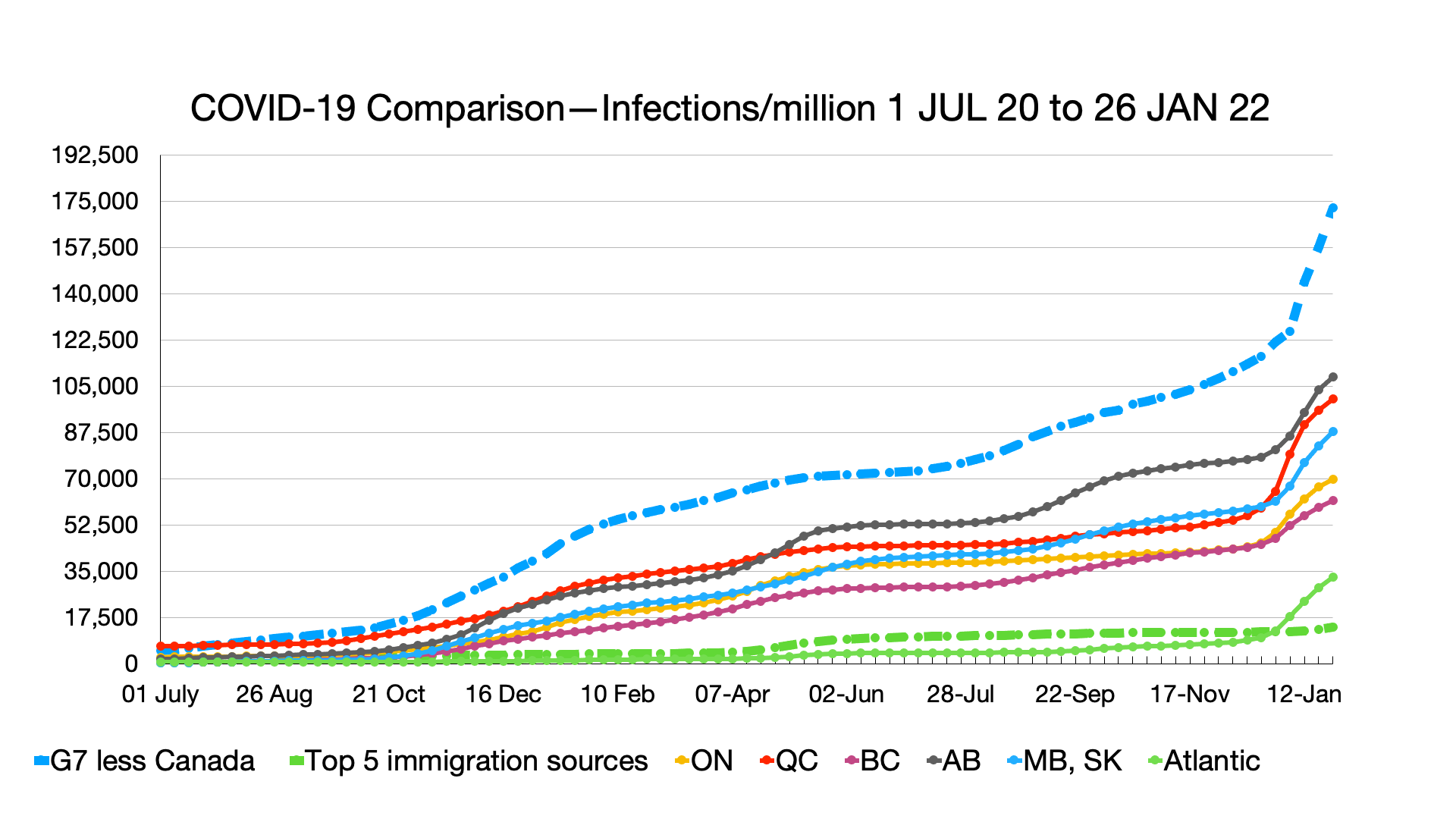
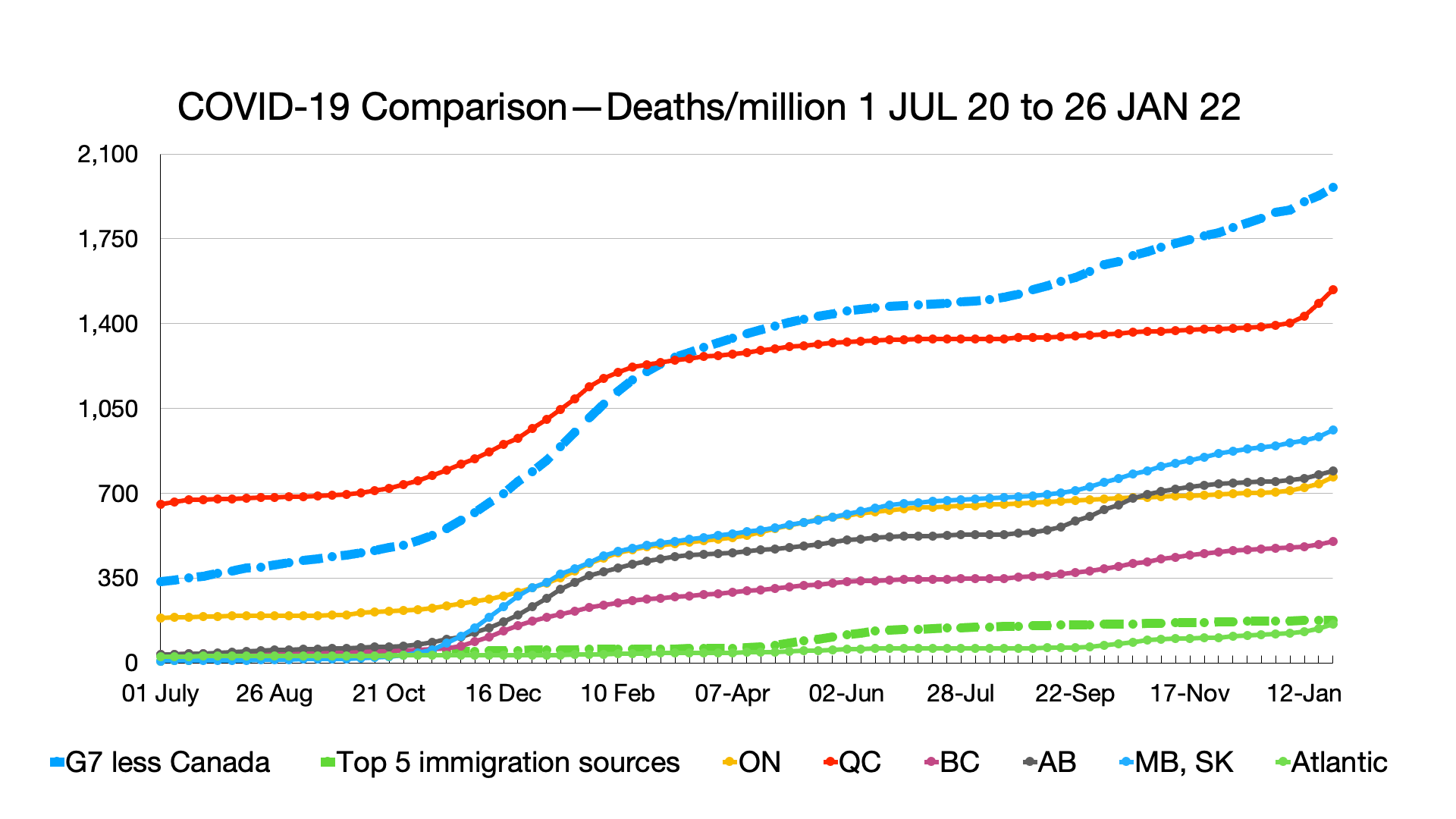
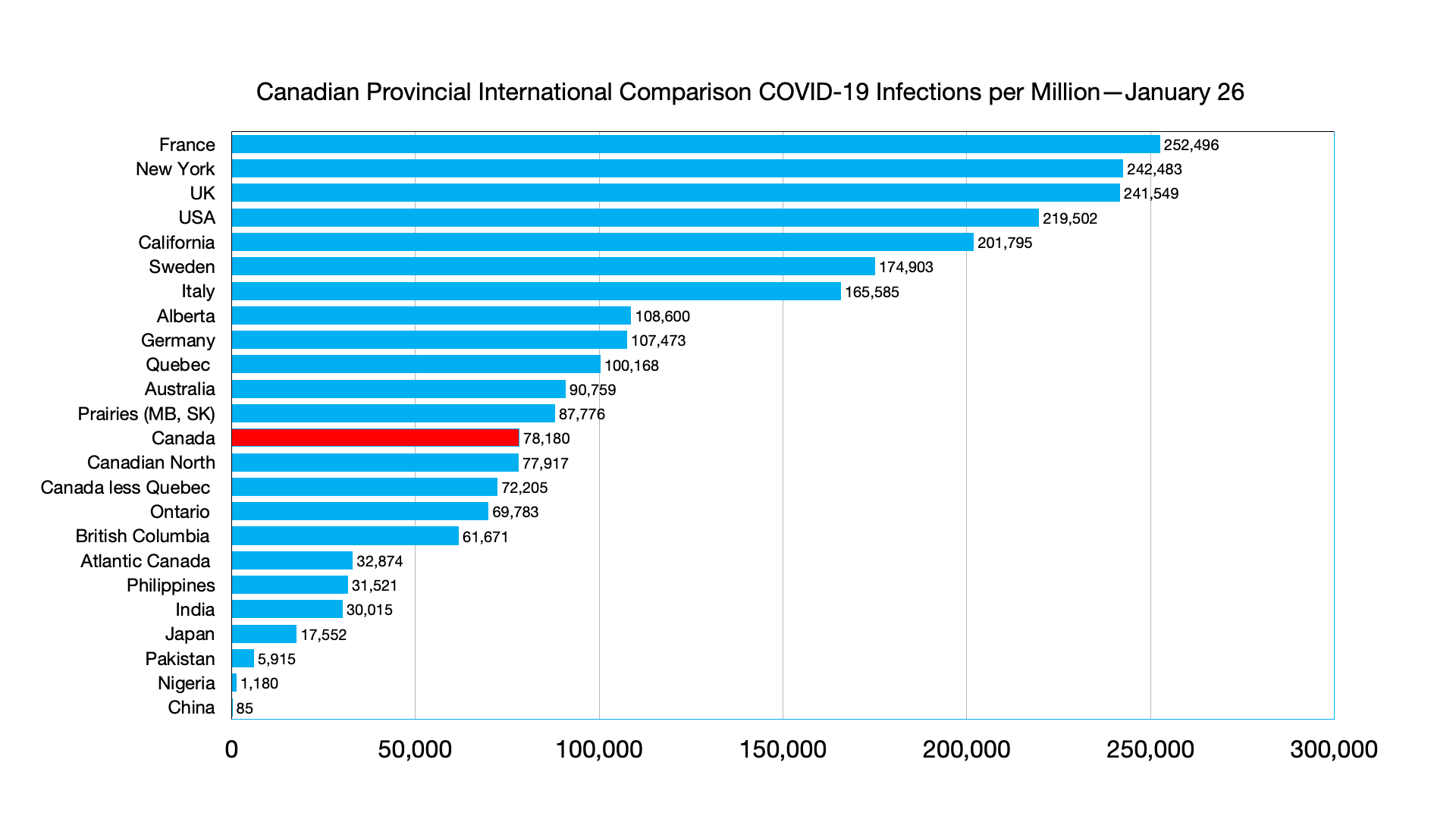
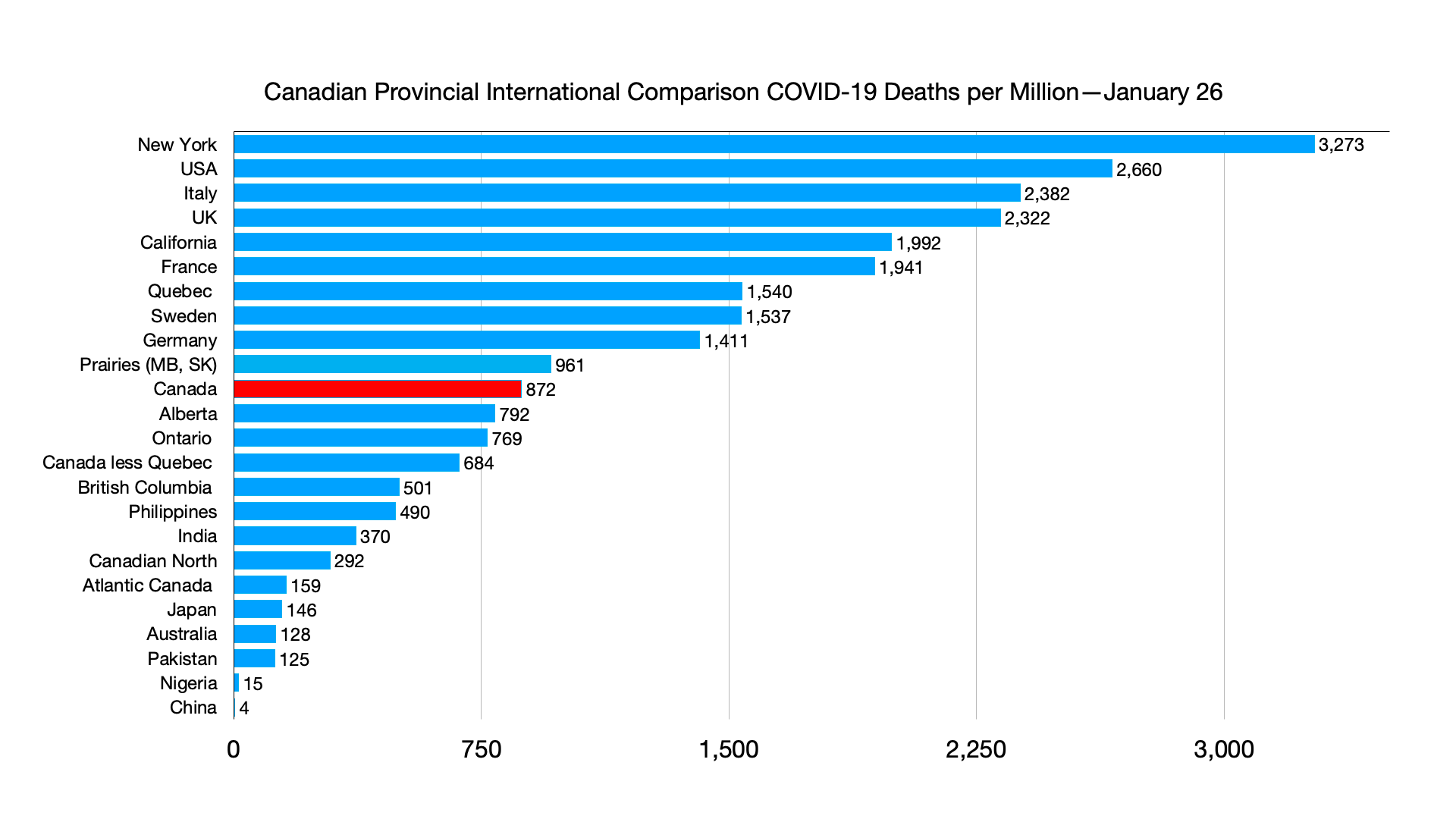
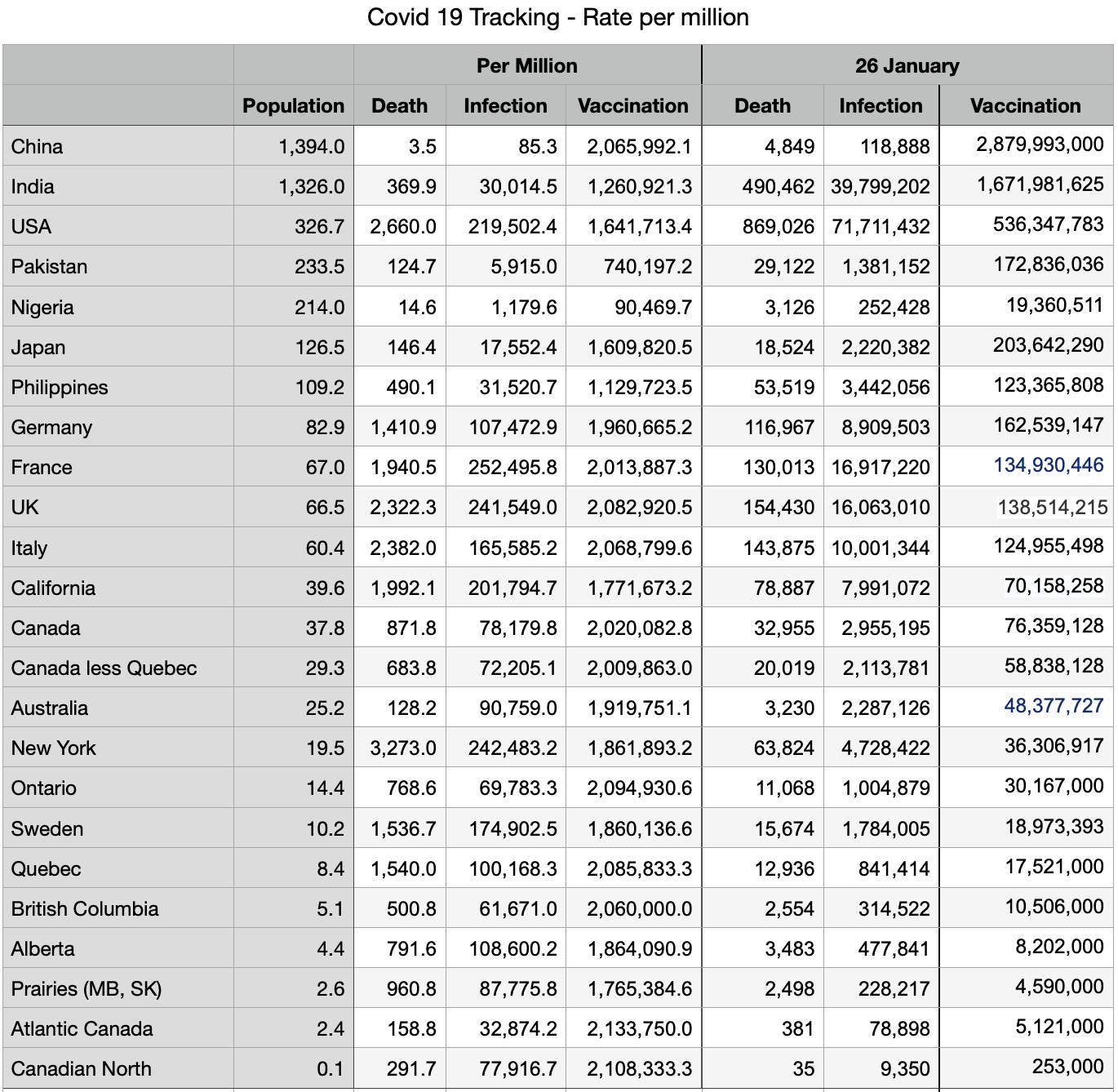
#COVID-19: Comparing provinces with other countries 26 January Update

Steep rise of infections remains the main story, along with resulting increases in hospitalizations and ICUs.

Vaccinations: Some minor shifts but general convergence among provinces and countries. Canadians fully vaccinated 79.5 percent, compared to Japan 78.9 percent, UK 72.2 percent and USA 64.2 percent.

Immigration source countries are also converging: China fully vaccinated 87.6 percent, India 50.4 percent, Nigeria 2.6 percent (the outlier), Pakistan 37 percent, Philippines 53 percent.

Trendline Charts:

Infections: Effects of Omicron seen in steep curve in all G7 countries and provinces. No such effect in immigration source countries.

Deaths: No relative changes but Quebec uptick highly visible.

Vaccinations: Ongoing convergence among most provinces. Gap between G7 less Canada continues to grow despite overall convergence, with narrowing gap with immigration source countries save for Nigeria.

Weekly

Infections: France ahead of New York and UK, Australia ahead of Prairies, Atlantic Canada ahead of Philippines. 

Deaths: Quebec ahead of Sweden, Atlantic Canada ahead of Japan, Australia ahead of Pakistan.

Krugman: Attack of the Right-Wing Thought Police

Strong reminder of the greater danger to free speech. Money quote: “What’s really striking, however, is the idea that schools should be prohibited from teaching anything that causes “discomfort” among students and their parents.” Phrase applies to both left and right who argue against raising difficult or contentious issues:

Americans like to think of their nation as a beacon of freedom. And despite all the ways in which we have failed to live up to our self-image, above all the vast injustices that sprang from the original sin of slavery, freedom — not just free elections, but also freedom of speech and thought — has long been a key element of the American idea.

Now, however, freedom is under attack, on more fronts than many people realize. Everyone knows about the Big Lie, the refusal by a large majority of Republicans to accept the legitimacy of a lost election. But there are many other areas in which freedom is not just under assault but in retreat.

Let’s talk, in particular, about the attack on education, especially but not only in Florida, which has become one of America’s leading laboratories of democratic erosion.

Republicans have made considerable political hay by denouncing the teaching of critical race theory; this strategy has succeeded even though most voters have no idea what that theory is and it isn’t actually being taught in public schools. But the facts in this case don’t matter, because denunciations of C.R.T. are basically a cover for a much bigger agenda: an attempt to stop schools from teaching anything that makes right-wingers uncomfortable.

I use that last word advisedly: There’s a bill advancing in the Florida Senate declaring that an individual “should not be made to feel discomfort, guilt, anguish or any other form of psychological distress on account of his or her race.” That is, the criterion for what can be taught isn’t “Is it true? Is it supported by the scholarly consensus?” but rather “Does it make certain constituencies uncomfortable?”

Anyone tempted to place an innocuous interpretation on this provision — maybe it’s just about not assigning collective guilt? — should read the text of the bill. Among other things, it cites as its two prime examples of things that must not happen in schools “denial or minimization of the Holocaust, and the teaching of critical race theory” — because suggesting that “racism is embedded in American society” (the bill’s definition of the theory) is just the same as denying that Hitler killed six million Jews.

What’s really striking, however, is the idea that schools should be prohibited from teaching anything that causes “discomfort” among students and their parents. If you imagine that the effects of applying this principle would be limited to teaching about race relations, you’re being utterly naïve.

For one thing, racism is far from being the only disturbing topic in American history. I’m sure that some students will find that the story of how we came to invade Iraq — or for that matter how we got involved in Vietnam — makes them uncomfortable. Ban those topics from the curriculum!

Then there’s the teaching of science. Most high schools do teach the theory of evolution, but leading Republican politicians are either evasive or actively deny the scientific consensus, presumably reflecting the G.O.P. base’s discomfort with the concept. Once the Florida standard takes hold, how long will teaching of evolution survive?

Geology, by the way, has the same problem. I’ve been on nature tours where the guides refuse to talk about the origins of rock formations, saying that they’ve had problems with some religious guests.

Oh, and given the growing importance of anti-vaccination posturing as a badge of conservative allegiance, how long before basic epidemiology — maybe even the germ theory of disease — gets the critical race theory treatment?

And then there’s economics, which these days is widely taught at the high school level. (Full disclosure: Many high schools use an adapted version of the principles text I co-author.) Given the long history of politically driven attempts to prevent the teaching of Keynesian economics, what do you think the Florida standard would do to teaching in my home field?

The point is that the smear campaign against critical race theory is almost certainly the start of an attempt to subject education in general to rule by the right-wing thought police, which will have dire effects far beyond the specific topic of racism.

And who will enforce the rules? State-sponsored vigilantes! Last month Ron DeSantis, Florida’s governor, proposed a “Stop Woke Act” that would empower parents to sue school districts they claim teach critical race theory — and collect lawyer fees, a setup modeled on the bounties under Texas’ new anti-abortion law. Even the prospect of such lawsuits would have a chilling effect on teaching.

Did I mention that DeSantis also wants to create a special police force to investigate election fraud? Like the attacks on critical race theory, this is obviously an attempt to use a made-up issue — voter fraud is largely nonexistent — as an excuse for intimidation.

OK, I’m sure that some people will say that I’m making too much of these issues. But ask yourself: Has there been any point over, say, the past five years when warnings about right-wing extremism have proved overblown and those dismissing those warnings as “alarmist” have been right?

Source: https://www.nytimes.com/2022/01/24/opinion/florida-critical-race-theory-de-santis.html

John Ivison: Liberals thwart badly needed skilled immigrants with mendacious political meddling

Header overly strong but substance important:

In a recent article in Foreign Policy, Parag Khanna of globalization experts FutureMap predicted that the Great Lockdown will be followed by the Great Migration, as the best and brightest move to exploit opportunities and fill labour shortages.

It would seem an inopportune time for the government of Canada to stop accepting applications from highly skilled workers from overseas. Yet that is exactly what the Liberals have done.

As my colleague Ryan Tumilty reported on Saturday, the high-skilled worker stream is backlogged, so despite nationwide labour shortages, the government is pausing new invitations because the department can’t process them.

The reason why Immigration, Refugees and Citizenship Canada is so backed up are entirely political.

For a variety of reasons, not least of which is that more immigration means more economic growth, the Liberals have committed to bringing in more than 400,000 permanent residents a year for the next three years.

Canada’s growth rate has been tepid in recent years, even with high levels of immigration. Absent the new arrivals, we’d be going backwards, as is clear from real GDP per capita data (in 2015, it was $51,158 per person; in 2020, it was $50,510, in constant 2012 dollars).

High levels of immigration are integral to the Liberal economic plan.

Yet those targets looked untenable during the pandemic, as international travel was suspended. Ottawa worked around the problem by granting permanent residency to thousands of temporary residents who were already employed or studying in Canada – the so-called Canada Experience Class.

The subsequent torrent of applications from students and temporary workers in Canada, coupled with the commitment to double the number of refugees coming from Afghanistan to 40,000, has resulted in bureaucratic resources becoming swamped. IRCC now has around 1.8 million applicants in a queue which is growing by about 20,000 every couple of months.

Part of the solution, according to an internal memo, is to cut the 110,500 skilled workers in the government’s target for next year by about half. The government says that there are still 76,000 skilled workers in the queue, so 2022 numbers won’t be affected. “The pause is temporary,” said a spokesperson for new immigration minister, Sean Fraser, who added that the government provided $85 million in new money to increase processing capacity.

But with around half of all businesses claiming to be experiencing labour shortages, the government has decided to meet its numerical targets, rather than focus where the needs are most pressing.

This is political meddling at its most mendacious. The government was able to boast about breaking the all-time immigration record in 2021, yet a quarter of those people were already here.

On refugees, no-one disagrees that Canada owes a duty of care to many people in Afghanistan but doubling the number of refugees from 20,000 to 40,000 will take two years to honour.

Andrew Griffith, a former director general at IRCC and author of a book on citizenship and immigration policy, said that the political choice to meet numerical targets, by allowing temporary residents to become permanent residents, meant that all other classes of immigrants became a lower priority. “It was a trade-off and, personally, I’m not convinced it was the right trade-off to make,” he said.

Griffith said the department would have warned the minister about the consequences of “bringing in the bodies” on the capacity constraints of other immigration streams. That advice appears to have been ignored.

The Liberals have so far stuck within the bounds that have traditionally governed Canada’s immigration policy, and which have ensured it has support in virtually all parties.

Immigration programs that are fair and economically-driven will continue to have widespread public support. People appreciate that we need new taxpayers to spread the burden of paying for an aging population.

In 2021, 58 percent of new immigrants were drawn from economic class programs; 26 percent from family class; and 16 percent from refugee and humanitarian class.

But the 2023 numbers may look quite different, if the number of high-skilled workers drops off dramatically and the number of refugees rises.

It has been a hallmark of this government that it has not been very effective at implementing policies, often because it is too focused on communications, and not enough on making things happen after they’ve been announced. This reflects a prime minister, who, in the words of one of his own senior members of staff, it “much more about: ‘what’s new?’”.

“He’s good at getting people super-excited, setting bold visions. But it creates real challenges in execution,” the staffer said.

This is a classic example. The “1 percent of population” immigration target probably got the inner circle “super-excited”, as, no doubt, did the 40,000 Afghan refugee promise.

But it may well be that there are consequences to those decisions which will see Canada miss out on tens of thousands of the globe’s most able engineers, heavy duty mechanics, plumbers, computer programmers, carpenters and database analysts.

Source: John Ivison: Liberals thwart badly needed skilled immigrants with mendacious political meddling

And, slightly different take, from Matthew Claxton:

What with COVID-19, and winter storms bearing down, and two days left until Christmas, it’s fair to say that few of us were paying attention to Canadian immigration policy on Dec. 23.

Which is a shame, because an announcement from the Department of Immigration, Refugees, and Citizenship showed that we’ve had a quiet revolution in how Canada accepts new permanent residents.

The government announced that 2021 was a record year for the arrival of new permanent residents – in total, 401,000 people had “landed” as permanent residents. Permanent residency is a major step towards Canadian citizenship, and it’s a massive driver of our population growth.

But in that announcement was a confirmation of something that Immigration has mentioned a few times in passing during the pandemic.

More than half of the folks who officially “landed” as permanent residents were already here.

“As we continue to struggle with the pandemic, we made the most of the talent already within our borders,” the announcement said. “The majority of these new permanent residents were already in Canada on temporary status.”

Yep. We increased our population of permanent residents by moving a bunch of people from one column in a government ledger to the other!

A significant number of permanent residents have always come from the ranks of temporary residents. In 2019, 74,586 of the 341,180 new permanent residents were already here on temporary status. But that’s just 21 per cent of the total number of new permanent residents, not more than 50 per cent!

In 2020, massive disruptions in travel due to the pandemic caused immigration rates to plummet just as the federal Liberal pledge to ramp up immigration levels was supposed to be coming into effect.

In the first year of the pandemic Canada admitted just 184,500 new permanent residents barely more than half the number from the year before.

I don’t actually have any particular objection to this change as policy. Making it easier to transition from being a temporary resident to a permanent one seems only just and fair, to me. If you’re good enough to work here or go to school here, surely you’re good enough to stay.

But the federal government didn’t make this change because they wanted to change the mix of people coming to Canada and becoming permanent residents. It wasn’t based on the idea that allowing increasing temporary residents to become permanent would be good for them, or good for Canada’s economy or culture.

It was done to hit an arbitrary number. The government had pledged to bring in more than 400,000 new permanent residents. Never mind how many were already here, some of them for years.

It doesn’t speak well that the government would see people, most of whom are future Canadian citizens, as mere numbers, a target that needed to be hit to meet an arbitrary goal.

Source: Painful Truth: Liberals hit artificial milestone on immigration – Aldergrove Star