Ibbitson: China’s population decline poses challenges and opportunities

We need to broaden thinking beyond “more immigration is the solution” to how Canada could adapt to a world of population decline, where fewer higher-skilled Chinese and other groups may wish to come here:

China is reportedly holding back census data because it shows the country’s population has started to decline, years ahead of even the most aggressive predictions.

If so, every game changes: global warming projections, global population projections, geopolitical and economic projections.

The world’s most populous nation is now a nation on the wane.

The Financial Times reported Tuesday that China has delayed the release of its 2020 census, which was expected earlier this month, because the data reveals that China’s population has declined from a peak of more than 1.4 billion in 2019 to less than 1.4 billion now.

If true, this is one of the most momentous events of our time. Many analyses of the geopolitical rivalry between China and the United States are predicated on the assumption of continued Chinese growth and relative American decline.

But it now appears United Nations population projections, which had China’s population peaking in the 2030s before levelling off and gradually starting to decline, were off by more than a decade.

The reason, according to a report this month by the Bank of China, is steadily falling fertility. Even after the ban on more than one child per family was lifted in 2015, China’s fertility continued to fall, to a level well below that needed to sustain the population.

For that reason, Darrell Bricker and I, in our book Empty Planet, predicted that population decline would hit China sooner and harder than expected. The question was how soon and how hard. If the answer to the first question is right now, then China could lose nearly half its population by the end of the century – more if fertility continues to fall.

The decline could have been accelerated by the COVID-19 pandemic, which has suppressed birth rates across much of the world, as couples put off having a child during this period of economic insecurity. A post-pandemic baby boom is unlikely: Past experience shows that once couples put off having a child, they don’t make up for it later on. Instead, they settle for having fewer children than they’d planned.

Population decline will present both opportunities and challenges for China. Environmentally, the news is encouraging: There will be fewer new coal-fired generating stations needed, as the number of people on the grid goes down instead of up.

The problem of labour shortages could be addressed by bringing in temporary foreign workers and improving productivity through automation.

But preserving economic growth becomes difficult when there are fewer young people every year buying their first refrigerator, their first car, their first baby stroller. Fewer young consumers also means fewer taxpayers to sustain the pensions and health care costs of older people, and fewer adult children to look after the needs of aging parents.

Countries that lose population every year stagnate economically: Italy, Spain, Japan. China is the new Japan. And that could lead to problems containing the discontent of an overtaxed, overworked, increasingly frustrated population. China announced this week that it planned to gradually raise the age of mandatory retirement, which is currently 60 for most men.

This delivers a huge competitive advantage to the United States. That country’s fertility rate has also reached record lows. But despite the effort of former president Donald Trump to seal the country’s borders, the U.S. continues to let in immigrants, both legal and illegal.

The U.S. needs to return, as quickly as possible, to its former practice of welcoming a million new permanent residents each year. That may be difficult, given rising nativism among conservatives, but if Americans want to stay ahead in the race for economic and political power, immigration is the not-so-secret weapon.

In any event, as my colleague Doug Saunders noted Tuesday on Twitter, the news about the Chinese census “will help make immigration a seller’s market.” As fertility rates decline in China and other source countries, such as Philippines and India, and as labour shortages grow in China, Japan and elsewhere, the question for immigrant-friendly countries such as Canada will shift from “how many should we let in?” to “how many can we convince to come?”

That is another reasons why former prime minister Brian Mulroney and others are right to maintain that Canada should greatly increase its immigration intake. We need to get them while we still can.


Source: https://www.theglobeandmail.com/politics/article-chinas-population-decline-poses-challenges-and-opportunities/

Ottawa says it only learned Chinese police ran visa centre this year

Appears to be lack of due diligence as should have been caught earlier:

Ottawa says it only learned in February that Canada’s visa-application centre in Beijing is managed by Chinese police, the same month The Globe and Mail reported the arrangement.

The federal government has trusted its visa centre in Beijing to a police-owned company since 2008, and has been required to conduct due-diligence screenings during renewals of the contract in subsequent years including 2018.

The government acknowledged its lack of awareness in documents tabled in the House of Commons this week in response to written questions from NDP immigration critic Jenny Kwan.

“In February, 2021, Public Services and Procurement became aware that Beijing Shuangxiong Foreign Service Company is ultimately owned by the Beijing Public Security Bureau,” the government said in an answer to Ms. Kwan that was signed by Steven MacKinnon, parliamentary secretary to the Minister of Public Services and Procurement.

The Globe reported the ownership structure of the company managing the visa-application centre on Feb. 8.

Ottawa said in the documents that government officials have conducted three site visits to visa-application centres in China “since becoming aware of the subcontractor ownership,” according to another response to Ms. Kwan signed by Immigration Minister Marco Mendicino.

Ms. Kwan said she’s surprised by the government’s admission. “That to me is absolutely shocking. … How on Earth did they not know about the ownership structure?”

She blamed both the Liberal government and previous Conservative government for failing to stop this arrangement and said she remains concerned about how Canada can safeguard visa applicants’ private and confidential information. “I fear for the applicants who use the Canadian government’s services there.”

Canada’s visa-application centre in Beijing is operated by Beijing Shuangxiong Foreign Service Company, which is owned by the Beijing Municipal Public Security Bureau, The Globe discovered. And at least some of the people working inside the centre are members of the Chinese Communist Party, recruited from a school that trains the next generation of party elite.

Beijing Shuangxiong is a subcontractor for VFS Global, a company headquartered in Zurich and Dubai that holds a wide-reaching contract to provide visa-processing services around the world for the Canadian government. VFS offices collect personal and biometric information that is then forwarded to Canadian immigration officials for decisions on who will be granted visas.

Prime Minister Justin Trudeau’s government has given no indication that it intends to end the Beijing arrangement.

Alexander Cohen, press secretary for Mr. Mendicino, said Wednesday that Immigration officials regularly audit and inspect visa-application centres for compliance, including through unannounced audits, and that video cameras are used for ongoing monitoring.

He said no privacy breaches have been reported at these centres by those operating them and that VFS Global has complied with all security requirements in its contract. “Since 2018, [the Immigration department] has conducted over 20 site visits to visa-application centres in China,” Mr. Cohen said.

The government had acknowledged earlier this year that it was unaware from the start of the contract that Chinese police ultimately owned the company that is the facilities manager of the Beijing visa-application centre. At the time, though, it did not reveal when precisely it learned of the matter.

Richard Fadden, a former director of the Canadian Security Intelligence Service, who served as national security adviser to two prime ministers, has said that Ottawa should end the visa situation in Beijing.

“An instrument of the Chinese government has access to a facility in China with connections to Immigration, Refugees and Citizenship Canada,” he said. “I cannot think of a more promising entry point for China’s cyberspies.”

The 2018 contract was not the first time VFS and affiliated companies had won federal contracts to operate visa-application centres, including the ones in China. Earlier contracts were awarded under the Conservative government of Stephen Harper. And during parliamentary hearings in February, MPs learned that Beijing Shuangxiong has actually provided facilities and staff for Canada’s visa-application centre in China’s capital since 2008.

VFS told the hearings it informed Ottawa in 2008 that it intended to use Beijing Shuangxiong as the local subcontractor, or as it calls the company, its local facility-management company.

However, two former Conservative immigration ministers Jason Kenney, now the Premier of Alberta, as well as Chris Alexander, have told The Globe that they were unaware the subcontractor for the visa-application centre in Beijing was a company owned by the Chinese police.

“There was a public tendering process, and as you know there can be no political interference in tendering. If this happened during my tenure and I had been made aware of it, obviously I would have stopped it,” Mr. Kenney told The Globe earlier this year.

Mr. Alexander, for his part, said: “I was never informed of this arrangement in Beijing: it should never have happened. No state body in any region should be controlling access to our immigration or any other programs.”

Jeremy McIntee, a spokesman for former Conservative immigration minister Diane Finley, who was in charge of the department in 2008, said she does not recall whether she was informed of the subcontractor’s ownership.

VFS has said it is obligated to use local partners under Chinese law. It has also said it conducts “deep identity, credit, criminal, residency, education and employment checks” on employees, uses encrypted systems to send application information to Canadian servers, and employs a raft of measures to secure information, including an obligation for employees to hand over mobile phones to managers inside the visa centre.

Beijing Shuangxiong also acts as a subcontracted facility manager for VFS in Beijing for other Western countries, including New Zealand, Britain and Ireland. Immigration New Zealand has said it knew “from the outset” that the Beijing police have ownership of Beijing Shuangxiong.

VFS spokesman Peter Brun has previously said the Chinese companies it works with “are managed by VFS Global and we ensure they operate entirely according to all VFS Global security processes and protocols, and according to the Canadian government’s visa-application process and data-protection requirements, which are audited regularly by the Canadian government.”

Source: https://www.theglobeandmail.com/politics/article-ottawa-says-it-only-learned-chinese-police-ran-visa-centre-this-year/

RCMP looks to redraft its entrance exam as it pushes for a more diverse police service

Of note. An appropriate review to assess the validity of criteria and the impact on recruitment. My earlier tweet generated some negative commentary from former RCMP members:

The Royal Canadian Mounted Police is looking to scrub its entrance exam of cultural biases and “outdated criteria” as it tries to confront what’s been called its “toxic culture” and the problem of systemic racism in the ranks.

The RCMP posted a tender this week looking for a contractor to provide pre-screening exams for applicants. It’s part of the RCMP’s modernization plan, known as Vision 150, which also includes changes to the criteria for becoming an RCMP officer.

“A thorough review of these processes has determined that despite significant changes made to the processes and tools over the past decade, systemic challenges remain,” says the tender.

“Most notably, a gender-based analysis plus (GBA+) review of the current RCMP exams concluded that even when prospective applicants possess both the interest and qualifications, there is evidence that the exams themselves may create barriers to a diverse applicant pool. Outdated criteria, lacking strong supporting evidence, may result in high-potential candidates being unable, or unwilling, to apply.”

RCMP Commissioner Brenda Lucki has been signalling that changes are coming to the recruitment process. She told a House of Commons committee late last year that the force needs to better reflect the communities it serves.

“We’re looking at our organization as a whole, and we’re looking at those systems and those processes, those policies and procedures that will eliminate systemic racism,” she said in November.

“We are going to be testing for those types of behaviours that could negatively impact their interactions.”

RCMP faces a decline in applicants

The move to redraft the exam comes as the RCMP struggles with a staffing crunch — particularly when it comes to attracting candidates of colour.

As of April 1, 2020 (the most recent period for which statistics are available), just under 12 per cent of the RCMP’s 20,000 rank-and-file members identified as visible minority, according to figures posted online late last week. That figure hasn’t changed dramatically over the past few years and remained lower than the general rate in the workforce nationwide.

Source: RCMP looks to redraft its entrance exam as it pushes for a more diverse police service

CATO Poll: 72% of Americans Say Immigrants Come to the United States for Jobs and to Improve Their Lives

The top level finding, with the report having a wealth of detail, with some of the same characteristics as in Canada such as age, education, political affiliation in terms of support or not for immigration:

The Cato Institute 2021 Immigration and Identity National Survey, a new national survey of 2,600 U.S. adults, finds that nearly three‐​fourths (72%) of Americans believe immigrants come to the United States to “find jobs and improve their lives” while 27% think immigrants come to obtain government services and welfare.

READ THE FULL SURVEY REPORT HERE

Support for More Immigration Is on the Rise

Support for more immigration has tripled from the mid‐​1990s when about 10% of the public supported more immigration and two‐​thirds wanted less. Today 29% of Americans want more, 38% want to maintain current levels, and 33% want less.

Chart 1


Democrats’ views largely account for this shift. Starting around 2008–2010, Democratic support for more immigration rose from about 20% to 47% today.

….

Source: Poll: 72% of Americans Say Immigrants Come to the United States for Jobs and to Improve Their Lives

Did Trump’s botched census citizenship push cost red states?

Ironic:

Among the many haphazard and politically transparent moves by the Trump administration, few rank quite as high on both measures as its botched push for a census citizenship question. The move was widely criticized as a thinly veiled attempt to dissuade undocumented immigrants from responding and to give the GOP a tool to draw more favorable political maps. The Supreme Court wound up rejecting the whole thing, with Chief Justice John G. Roberts Jr. effectively accusing the administration of hiding its true motives.

But even when the administration succumbed, some warned that damage might already have been done — that certain immigrants might still shy away from responding because of fears engendered by the lengthy battle. And there was data to back that up.

So did it happen? It’s not quite clear that it did in significant measure, but there are some indications it might have — though perhaps to the detriment of Trump’s red-state allies rather than Democrats.

Source: Did Trump’s botched census citizenship push cost red states?

Montreal latest Canadian city to consider granting voting rights to non-citizens

Unlikely to happen given provincial decision. Relatively few studies regarding the experience of jurisdictions that have granted voting rights, with Leslie Seidle’s review of the Netherlands, Sweden and Belgium showing mixed results: “Finally, those who advocate local voting rights for non-nationals should be modest in their claims. Although the expanded franchise can have symbolic as well as practical value, more equitable elected representation of immigrant-background communities requires explicit efforts on the part of political leaders and party organizations, as well as the commitment of the broader society.“:

Montreal officials are looking into extending voting rights to more than 100,000 non-citizens in order to better integrate immigrants and encourage more racialized people to participate in municipal politics.

The idea isn’t new: for years, Canadian cities such as Toronto, Vancouver and Saint John, N.B., have debated or proposed giving the vote to permanent residents — but none have succeeded in convincing provincial or federal governments to modify citizenship and voting laws.

Montreal can “show leadership” on this issue and rekindle the debate in the country, according to an April 19 report by the city’s committee on social development and diversity.

“Granting voting rights to permanent residents is one of the ways to foster political participation and ensure better representation of the various groups that form society,” the report said.

“Montreal, the city that welcomes the largest number of immigrants to Quebec each year, should ensure it reflects the diversity of its population.”

The committee, composed mostly of elected officials from the two main parties at city hall, wants Montreal to publicly affirm its desire to grant voting rights to permanent residents who have lived “for at least 12 months on the territory of the city of Montreal.” It also wants the city to lobby the provincial and federal governments to change laws to allow non-citizens to vote in municipal elections.

The idea has its critics. Frederic Bastien, history teacher at Montreal’s Dawson College and former leadership candidate for the Parti Quebecois, says allowing non-citizens to vote could endanger the foundations of the nation state.

He says citizenship comes with an understanding of the culture, language and history of a country, adding that the idea could be a political strategy by Mayor Valerie Plante ahead of next November’s municipal election.

“It is part of a series of gestures from the Plante administration,” Bastien said in a recent interview. “It’s a ‘woke’ trend among Projet Montreal and it’s a toxic vision of social and public life,” he added, referring to Plante’s political party.

Chris Erl, doctoral candidate in McGill University’s geography department who researches municipal politics, disagrees that granting voting rights to marginalized communities would undermine the country’s democratic values. Rather, he said, doing so would provide a voice for many people who have been excluded from politics.

“Where all the political parties have failed in the past is in recruiting candidates from communities of colour,” Erl said. “Something like this could certainly help inspire people that may feel isolated from the political system to get involved.”

He said he questions the fairness of refusing to allow people who are actively engaged in the urban life of a city the right to select those who represent them in office.

“People need to look at this from the very basic idea that their neighbours, who might not have citizenship, are paying the same property taxes, they use the same services and they have the same ideas and opinions about how the city could be better run, so why shouldn’t they be able to send people to city hall to make decisions?” Erl said.

The city’s diversity committee noted that permanent residents compose about 9 per cent of Montreal’s population, equalling about 170,000 people — roughly 105,000 of whom would qualify as voters.

Montreal’s city administration says it’s interested in letting non-citizens vote in order to attract more people to the political process — especially immigrants. Voter turnout in the 2017 municipal election was 22 per cent in Cote-des-Neiges—Notre-Dame-de-Grace, the most ethnically diverse borough in the city, according to government data.

But it’s unclear what the Quebec and federal governments think of Montreal’s idea. A spokesperson for Quebec’s municipal affairs minister didn’t return a request for comment. And Corinne Havard, spokesperson for federal Intergovernmental Affairs Minister Dominic LeBlanc, said Ottawa doesn’t play a role in municipal elections and directed questions about reforming voting laws to the Quebec government.

Montreal doesn’t seem interested in pushing the issue at the moment — at least not ahead of November’s city election.

Genevieve Jutras, spokeswoman for Plante, said the city will take its time to examine the report, adding that it is up to the provincial government to modify voting rights.

“The administration doesn’t have the intention to request a modification before the next municipal election,” Jutras said.

Source: Montreal latest Canadian city to consider granting voting rights to non-citizens

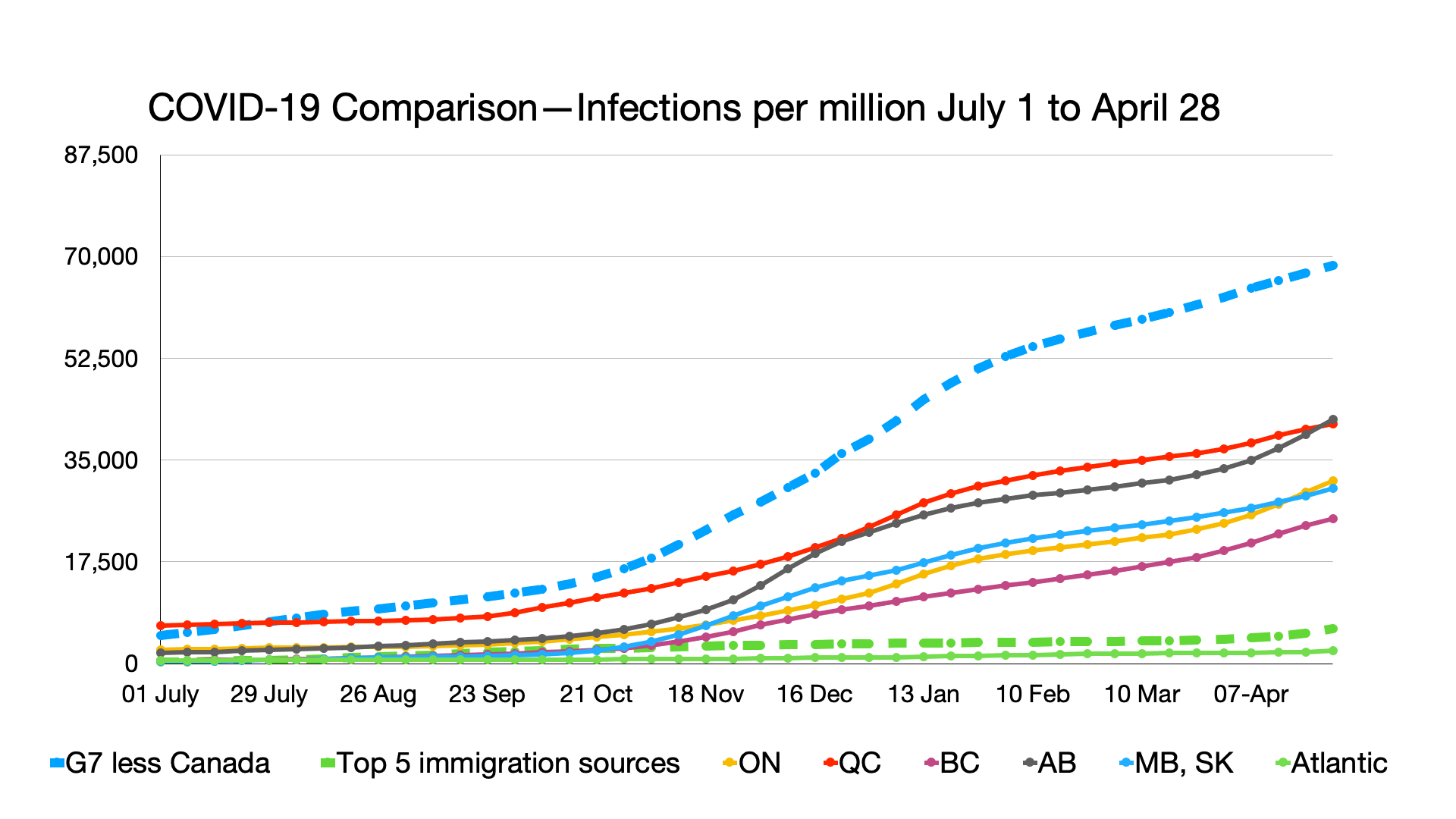
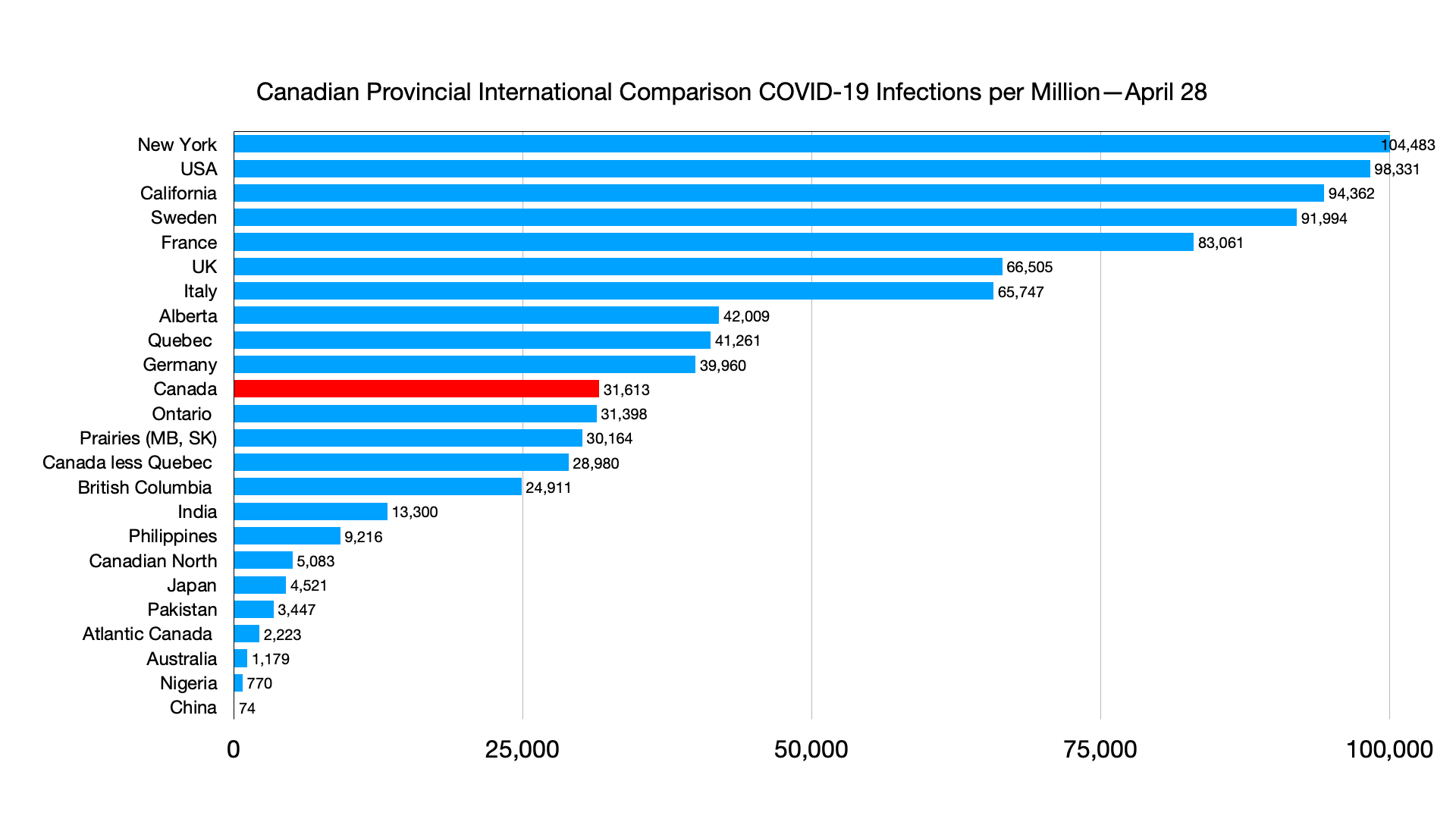
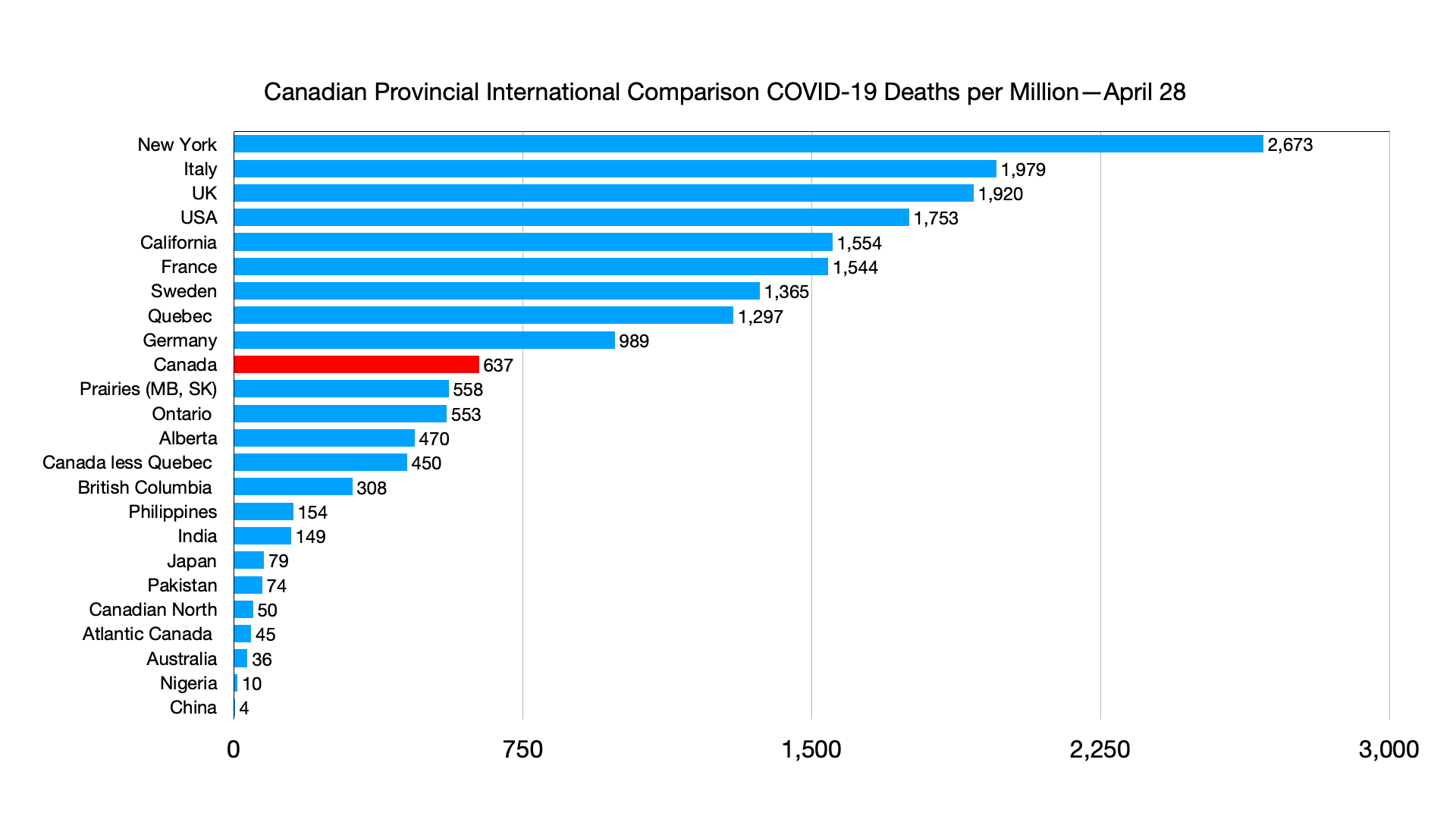
#COVID-19: Comparing provinces with other countries 28 April Update

The latest charts, compiled 28 April as the third wave has started. The spike of infections and deaths in India per million, although dramatic, has not resulted in a change in the relative ranking given the size of India’s population.

Vaccinations: Overall, Canada and most provinces continue to be comparable or greater to EU countries. On a personal note, received my vaccine last week.

Trendline charts

Infections per million: Recent spikes in Ontario and Alberta continue to be more apparent.

Deaths per million: Canadian North ahead of Atlantic Canada.

Vaccinations per million: Vaccination rates in Canadian provinces continue to increase more quickly than overall G7 less Canada countries. Increases among immigration source country reflect China and India mass vaccination roll-out.

Weekly

Infections per million: Surge in Ontario has not changed overall ranking but surge in Alberta has resulted in Alberta surpassing Quebec.

Deaths per million: As noted, Canadian North now ahead of Atlantic Canada.

Protests reveal generational divide in immigrant communities

Likely similar in Canada, as second generation grow up with Canadian expectations of equality and opportunity:

When protests began in a Minneapolis suburb after a white police officer fatally shot a Black man, 21-year-old Fatumata Kromah took to the street, pushing for change she says is essential to her Liberian immigrant community.

Meanwhile, 40-year-old Matilda Kromah feared stepping outside her home as trauma associated with the Liberian civil war suddenly rushed back into her life, two decades after she escaped the conflict.

The two women, whose shared last name is common among Liberians, have seen their lives changed amid the unrest that has sometimes engulfed Minneapolis in the months since George Floyd’s death. Their behavior also reflects a generational split: While Fatumata has been drawn into the protests, Matilda has tried to avoid them, focusing instead on running a dress shop and hair-braiding salon that is essential to sending her children to college.

The same divide has played out across the Twin Cities’ burgeoning Somali, Ethiopian, Liberian and Kenyan communities. Young people have thrust themselves into movements for racial justice, often embracing the identity of being Black in America. Older generations have been more likely to concentrate on carving out new lives rather than protesting racial issues in their adopted homeland.

When Fatumata visited Matilda’s shop this past week in the Minneapolis suburb of Brooklyn Center, the topic was unavoidable. Matilda’s strip-mall storefront — Humu Boutique and Neat Braids — was vandalized in the aftermath of the April 11 death of Black motorist Daunte Wright. Thieves smashed windows and doors and took nearly everything of value, even stripping mannequins of their African dresses.

Tears formed in the elder woman’s eyes, and her hands shook as she spoke. Memories of the atrocities she had fled during the Liberian civil war had returned.

“Maybe war is starting again,” Matilda said of the demonstrations. “I was traumatized. For three days, I didn’t want to go out of my house. I was hiding in my room.”

But she needed to figure out a way to pay for her son’s college tuition, so she posted an “open” sign on the plywood covering the shop’s broken windows and began accepting customers. She did not have insurance to cover the losses, she said.

Fatumata, who chanted and yelled at protests, grew quiet as Matilda spoke. She agreed that the United States offered opportunities for education and a “better life,” but she had also made up her mind that such a life would not be complete without justice for Black people.

After moving to Brooklyn Center from Liberia in 2015, she said she was treated differently as a Black person. People commented on the color of her skin, disapproved of the clothes she wore and once called the police on her and a friend for being too “loud.”

“I started to realize like, ‘Oh, America is not what it says on TV,’” she said.

Then Floyd’s death sparked protests, and she decided that “this was not the American dream I was promised.”

Kromah is not alone. Young people in the city’s East African communities came out to protest in droves following Floyd’s death. Despite tension, at times, between Black immigrants from Africa and Black people whose long history in the U.S. began with slavery, protesters united around decrying police brutality they said plagued their communities.

The verse “Somali lives, they matter here,” often followed the protest refrain of “Black lives, they matter here.” And one of the most widely shared images of last year’s protests was a video posted on social media showing a protester in a hijab and a long skirt kicking a tear gas cannister back toward law enforcement officers in riot gear.

“I am Somali, I am Black American, I am Muslim,” 21-year-old Aki Abdi said. “If a cop pulls me over, he don’t know if I’m Somali or Black. They go hand in hand.”

When former Minneapolis police officer Derek Chauvin was convicted of murder in Floyd’s death, celebrations broke out across the city, and Abdi and two friends made their way to George Floyd Square.

On the sidewalk down the street from where Floyd took his last breath, they scrawled the names of two Somali men — Dolal Idd and Isak Aden — who were fatally shot by Minnesota police in recent years. They hoped some people in the crowd would search those names on the internet. Police defended their actions in both shootings, saying the men had guns, but the men’s families have pressed for more thorough investigations.

Many older immigrants grew up in countries where speaking out against the government resulted in punishment, and some are so focused on making a living after escaping war-torn countries that they do not have time or energy for anything besides their families’ immediate well-being, said Jaylani Hussein, executive director of the Minnesota chapter of the Council on American-Islamic Relations.

Younger Black immigrants who were born in America or came at a young age often know firsthand both their parents’ struggles and America’s history of racial injustice, Hussein said.

“By being squeezed by these two pressures, they have no option but to fight and to try to change the system.” he said. “The younger generation is propelled by this legacy of the fight that is happening in the country that they’ve adopted, but also the fight that their parents have been teaching them about in the country that they left.”

Fatumata Kromah’s mother, Rebecca Williams Sonyah, said parents like her fear for their children’s safety both in interactions with police and at demonstrations, all while trying to stay focused on the jobs and businesses essential to their livelihoods.

“Our children should have freedom. They should have equal rights,” Williams Sonyah said. “They shouldn’t judge our children because of their color or because of where their parents are from.”

She recognized her daughter’s activism as important to those goals but still pleaded with her to stay home after Wright’s death, knowing that destruction was likely. They compromised by agreeing that Kromah would return home before the curfews set by city authorities.

Williams Sonyah’s job in medical home care prevented her from joining in the marches in front of the police department. But she seemed sympathetic to the movement.

“If I had a way to go protest,” she said, “I would protest.”

Source: Protests reveal generational divide in immigrant communities

How Extremists Weaponize Irony To Spread Hate

Of interest, and no “just joking” is no excuse:

On a recent episode of his livestreamed show, the 22-year-old extremist Nick Fuentes repeated a formula that has won him a following with some of the youngest members of the far right. He went on an extended, violent and misogynistic rant, only to turn to the camera and add with a smirk, “Just joking!”

In this case, from the April 22 edition of Fuentes’ show, America First, a viewer wrote in to ask Fuentes for advice on how to “punish” his wife for “getting out of line.”

Fuentes responded, “Why don’t you smack her across the face?”

The rant continued for minutes.

“Why don’t you give her a vicious and forceful backhanded slap with your knuckles right across her face — disrespectfully — and make it hurt?” Fuentes went on. At one point, he pantomimed punching a woman in the face.

He then added, “No, I’m kidding, of course. Just kidding. Just a joke.”

Fuentes was following a playbook popular among domestic extremists: using irony and claims of “just joking” to spread their message, while deflecting criticism.

Researchers who track domestic extremism say the tactic, while not new, has helped several groups mask their danger, avoid consequences and draw younger people into their movements.

Irony as “cover” for extremism

Fuentes is best known for using cartoonish memes to spread white supremacist propaganda. His followers refer to themselves as “Groypers” — a reference to a mutated version of the Pepe the Frogcartoon that was co-opted by the far right. Though Fuentes exists on the fringes of the extreme right, Rep. Paul Gosar, R-Ariz., spoke at a political conference that Fuentes hosted, drawing widespread criticism.

But Fuentes has said himself that he uses irony and “jokes” to communicate his message without consequences.

“Irony is so important for giving a lot of cover and plausible deniability for our views,” Fuentes said in a 2020 video. He specifically cited Holocaust denial — or what he termed Holocaust “revision” — as a topic that is too fraught to discuss earnestly, even on the far right.

Far-right extremist Nick Fuentes, seen here in a screenshot from his livestreamed show, has said he uses irony because it provides “plausible deniability” and cover for some of his most incendiary statements.

“When it comes to a lot of these issues, you need a little bit of maneuverability that irony gives you,” Fuentes said.

And, in fact, after Fuentes questioned the death toll from the Holocaust in one rant, he later claimed to The Washington Post that it was just a “lampoon.”

Researchers who track domestic extremism say Fuentes is not the only figure to adopt these tactics, particularly among far-right content creators, who encourage their audiences to follow suit.

“A lot of these content creators will tell the audience explicitly, ‘When people say you’re racist for liking this or thinking this, just laugh at them. They can’t handle it — they’re sensitive babies,’ ” said Jared Holt, a resident fellow with the Atlantic Council’s Digital Forensic Research Lab.

Concern on campus

In early 2020, Oona Flood started getting more and more worried about a classmate at the University of California, Los Angeles.

The classmate, a 22-year-old named Christian Secor, was already well-known for his self-proclaimed “love” of guns. Around that time, he was also posting racist and antisemitic memes and tweets, attacking immigrants online and publicly supporting Fuentes. Often, Secor adopted the kind of “trolling” style that’s prevalent on the internet.

When one student called Secor out for a tweet that the student found offensive, Secor responded that he was using “post irony.”

“It’s called a joke and the fact that you think that these posts are anything more than that is telling,” added Secor.

Flood, who is Japanese American, said they wanted to speak up.

“I definitely felt that sense of threat,” Flood told NPR recently. “And, like, I really hate to say, [because] it sounds so much like, overblown, ‘snowflake,’ that we’re just overreacting, you know?”

And throughout 2020, students told NPR, UCLA took no action against Secor despite his escalating rhetoric, likely because of free speech concerns. (As a public university, UCLA is legally bound to follow the First Amendment, which protects hate speech.)

In retrospect, Flood’s concern does not seem like an overreaction.

Secor is currently facing federal criminal charges for allegedly storming the U.S. Capitol on Jan. 6. Prosecutors have cited his support for Fuentes in charging documents. Secor has pleaded not guilty.

In addition to Fuentes and his followers, other experts point to the extremist group known as the Proud Boys, which has embraced outlandish rituals. The group’s name was inspired by a song from the Broadway version of Disney’s Aladdin, and one of the group’s initiation rites involves members listing breakfast cereals while they get lightly punched in the stomach. Yet that same group is known for its involvement in violent street fights. At least 25 members of the group are facing federal criminal charges related to the Capitol riot, including, in some cases, conspiracy.

Gavin McInnes, the group’s founder, said in an email that the media, including NPR, “willfully ignores” jokes to paint the group in a more negative light. The Proud Boys are “funny dudes, not Nazis,” McInnes wrote.

But Cassie Miller of the Southern Poverty Law Center said the group’s use of “jokes” is strategic. “It distracts from what their actual political ideology is and from their violence,” said Miller. “Because if you point it out, it’s, like, ‘well, they’re so goofy.’ ”

Similarly, the far-right, pro-Trump conspiracy theorist Alex Jones is often so over the top on his InfoWars broadcasts that his own attorney likened him to a “performance artist” during a court hearing about Jones’ divorce.

The appeal to young people

Humor has always been crucial to building social movements, experts say, because it serves to define the people who are “in on the joke” and those who “just don’t get it.”

And online extremists have adopted irony because it is, in many ways, the native language of the internet.

“I’m speaking the language of other zoomers,” said Fuentes in 2020. “If you’re a young person online, I mean, this is the language of our generation.”

“Every kid naturally wants to push away from their parents,” said Joanna Schroeder, a writer based in California.

Schroeder was troubled when she saw a pro-Hitler meme pop up in one of her kids’ Instagram feeds. Memes that merely pushed boundaries were mixed in alongside outright racist and antisemitic content.

“The problem is that all of this kind of trolling behavior, some of it is harmless and goofy,” said Schroeder, “and others of it is designed to look harmless and goofy but will drive our kids’ social media and YouTube algorithms toward alt-right and even more extremist content.”

Schroeder has since collaborated with the Western States Center to develop a guide for parents who see their kids share online extremist content.

Historic parallels

Violent domestic extremism in America long predates the internet, however, and so does the tactical use of irony.

Historians have documented how the early iterations of the Ku Klux Klan were portrayed by group members and their allies as outlandish, rather than as a dangerous terrorist group. The KKK put on racist minstrel shows and created its own songs.

This drawing from 1868 depicts early members of the Ku Klux Klan. Historians have documented how the group used absurdity to mock its opponents and to try to mask the seriousness of the KKK’s atrocities.

Descriptions of attacks by men in hoods, who had titles like “dragon,” “ghoul,” and “wizard,” were often seen by white Americans as tall tales and ghost stories. Newspapers that supported the KKK played up those aspects of the group and mocked their opponents for supposedly taking the KKK too seriously, said Elaine Frantz, a historian at Kent State University.

Pro-KKK newspaper editors would often “talk jokingly about what the klan has done,” said Frantz, “in order to be deniable.”

And at first it seemed to work. Frantz cites the testimony of a Georgia congressman who tried to play down klan murders and other racist atrocities.

“Sometimes, mischievous boys who want to have some fun go on a masquerading frolic to scare the negroes,” testified U.S. Rep. John H. Christy of Georgia in the early 1870s. Christy insisted that stories of klan attacks were “exaggerated.” In fact, he claimed, the group did not exist at all. Frantz said there were also documented instances in the Reconstruction era of white Northerners dressing up in klan robes as a supposedly boundary-pushing “joke.”

But eventually, Frantz said, the testimony of Black Americans who witnessed these atrocities — published widely by newspaper reporters and in government investigations — so thoroughly demonstrated the KKK’s campaign of lynchings and assassinations that it became undeniable. They pulled back the klan hood to see the terrorism and violence it masked.

Source: How Extremists Weaponize Irony To Spread Hate

India is in a COVID-19 crisis. South Asian-Canadians are weeping from afar, but also seeing devastating parallels for our people in Ontario

Captures well some of the dilemmas facing diaspora communities:

11,627 km.

That’s the distance from my house in Peel to Delhi, India, where the majority of my family lives.

This past week has been extremely difficult as a first generation Canadian born in India. I watch the devastation occurring in my hometown, and can’t help but see the parallels happening here in Ontario within the South Asian community. Immigrants like myself are fighting two pandemics – one here and one tens of thousands kilometres away, and it weighs heavily, each and every day.

On March 23, India had 40,000 COVID-19 cases. Fastforward to April 22, that number rose to 330,000. This is what exponential growth looks like. Experts believe these numbers are vastly under-reported by a margin of at least 10 times. Even if 10 per cent of these were hospitalized, with the average COVID-19 related hospital or ICU stay being 15 days, there is simply no healthcare system in the world that has the capacity to sustain such volume.

The situation in India is grave and complex. India saw a sharp decline in cases earlier this year, with around 10,000 cases on average per day in February. This unfortunately led to a sense of complacency, with some experts claiming preemptively that the country had achieved herd immunity. Subsequently, life returned to a form of “normalcy,” with weddings, religious festivals and political rallies being commonplace. Even Kumbh Mela, which is one of the largest gatherings in the world that sees upwards of 110 million people over the duration of the festival and up to 30 million people per day, went ahead as planned.

Complacency, however, wasn’t the only factor that led us to this situation. It’s a culmination of other factors. India has one of the lowest testing capacities per capita, with only 0.4 tests conducted per 10,000 people. India also has a much slower vaccination program. While India has manufactured large quantities of vaccines, it has distributed the majority of these globally. It is one of the largest suppliers into the COVAX program, accounting for 60 per cent of global vaccine supply. Meanwhile, less than 10 per cent of India’s own population has received one dose of the vaccine, with only 1 per cent fully vaccinated with two doses.

In addition, India now has a potentially concerning new variant, B.1.617, that amongst many mutations has two critical ones — L452R and E484Q — within the spike protein, making it more transmissible and possibly able to evade pre-existing immunity. It is still unknown whether vaccines are efficacious against this variant.

The stories, pictures and videos coming out of India are devastating. Scenes of people lying on the ground on the street with oxygen masks connected to empty tanks, dying outside of hospitals that did not have capacity to take them in, health care systems collapsing. There are make-shift outdoor hospitals, mass cremations sites, and reports of families having to keep dead bodies of relatives at home for two days because there was no wood left to build a funeral pyre. Hospital with mere hours left of oxygen supply.

Many in the South Asian diaspora are carrying the burden of knowing our own family members are amongst those affected. My father, who lives with me, spends his entire day calling each and every one of his family and friends. So many infected, many hospitalized, many searching for hospitals. Daily updates, sometimes hourly. Everytime he utters Hari Om Tat Sat (a sanskrit mantra) I wait with baited breath. I feel helpless remembering we are again, 11,627 km, apart — a number I can’t stop thinking about.

What hurts my heart even more is knowing that what is occurring to my people in India is also occurring here on Canadian soil. South Asians have been disproportionately impacted by COVID-19. The pandemic has been deeply inequitable, from support and protections to testing and now access to vaccines. Further, we are seeing additional stigmatization of South Asians due to this new variant now being found in Canada despite the fact that the primary reason for transmission remains to be structural barriers faced by our racialized communities. And like me, they are dealing with two pandemics — the one here and the one back home.

It really feels like because our skin is brown, our lives mean less. But we didn’t get to choose the colour of skin we were born into our socioeconomic status. We didn’t get to choose the country we were born in.

It was heartbreaking to see the world’s response to India’s crisis. Canada shut its borders. Simultaneously, our Premier’s office contacted the Indian high commissioner to request additional AstraZeneca vaccines in spite of the current crisis. The United States of America continues to sit on unused AstraZeneca vaccines and withhold raw materials required for India to manufacture more vaccines. This ‘me first’ strategy is not only inequitable, it is unwise because we know how the pandemic unfolds in one country will eventually happen in another.

And this is why vaccine nationalism is lethal. Your access to vaccines and subsequent right to life is dependent on factors that are out of your control. It is the stark inequities, the perpetuation of discrimination, the haves vs the have nots, the unfairness of it all that weighs heavily on me.

India gasps for air and burns with funeral pyres. But these lives don’t seem to matter. Because they’re brown.

I can’t stop crying. Because my heart can’t take it anymore.

Source: https://www.thestar.com/opinion/contributors/2021/04/24/india-is-in-a-covid-19-crisis-south-asian-canadians-are-weeping-from-afar-but-also-seeing-devastating-parallels-for-our-people-in-ontario.html?li_source=LI&li_medium=thestar_recommended_for_you