Controversial parade not the way to honour Ukraine’s contribution to Second World War

Sigh…

On April 28, approximately 250 people marched through the streets of Kiev, Ukraine, to commemorate the 78th anniversary of the Second World War Waffen SS Division Galicia.

That’s right folks, hundreds of people gathered, despite the threat of spreading the COVID-19 virus, to commemorate Ukrainian soldiers who took an oath of allegiance to Adolf Hitler and fought for Nazi Germany.

This parade drew an immediate backlash from Germany’s ambassador to Ukraine, Anka Feldhusen. She tweeted: “Waffen SS units participated in the worst war crimes and the Holocaust during WW2. No volunteer organizations fighting and working for Ukraine today should be associated with them.”

This blatant display of Nazi glorification was also condemned by the Israeli ambassador in Kiev and the Israeli Foreign Ministry. Sadly, there was no such reaction from the Canadian Embassy nor from the Canadian Armed Forces. Canada presently has more than 200 military trainers assisting the Ukrainian armed forces in the face of Russian aggression.

For the regime in Kiev to not only allow a tribute to Hitler’s SS to take place, but to also provide the marchers with a police escort, flies in the face of all those Canadian soldiers who fought and died in Second World War to defeat the Nazi regime.

For the record, and before the apologists claim this event was an exercise in “free speech,” Ukraine cancelled this year’s May 9 traditional public celebration of the Second World War Victory Day due to COVID-19 concerns.

Ukrainians were prevented from gathering to celebrate the defeat of Hitler, but allowed to parade in commemoration of Ukrainians who volunteered to fight for the Nazis?

The U.S. State Department did not directly condemn the parade but in a statement to The Nation they noted “We welcome [Ukraine] President Zelensky’s strong statement condemning the march.” However, they added the comment that the U.S. State Department “continues to monitor and systematically refute a longstanding Russian disinformation campaign that conflates support for Ukrainian sovereignty with support for neo-Nazi and fascist ideals.”

Here is a little bit of free advice for those concerned about Russian disinformation: just put an end to parades and events that glorify Hitler’s Waffen SS.

While I can understand that Ukrainians are proud of their heritage, I cannot fathom why young nationalists seek to glorify those who took up arms to enforce the Nazis’ ideology. Yes, I understand that Stalin imposed ruthless measures against the people of Ukraine and that they suffered horribly under the Soviet regime.

However, the fact that Ukrainian men took up arms to fight the Red Army as members of the Waffen SS does not change the reality that Hitler’s Nazis perpetrated the Holocaust.

Of all the incredible accomplishments that Ukrainians have achieved throughout history—music, literature, cuisine, art, etc.—I cannot fathom why it is a flawed military unit that fought for Hitler that these young Ukrainians have chosen to revere.

Formed in 1943, the SS Galicia Division only really fought one major engagement against the Soviets in the Battle of Brody in July 1944.

The SS Galicia was soundly defeated and it was subsequently relegated to fighting against partisans, first in Slovakia and then in Yugoslavia.

For those who would paint the SS Galicia volunteers as fighters for Ukraine’s independence, this theory cannot be justified in view of the fact they actually fought against civilian patriots in Slovakia and Slovenia to enforce Hitler’s Nazi occupation.

In the final days of the war, the SS Galicia changed its name to the 1stUkrainian Division prior to surrendering to the allies in Austria.

After a lengthy internment in Italy, many of these Ukrainian SS veterans emigrated to Canada. There is actually a memorial erected to the memory of the SS Galicia division in Oakville, Ont.

That said, it is estimated that more than 40,000 Ukrainian Canadians served in the Canadian military during the Second World War, fighting to defeat Hitler.

It is those brave, patriotic Ukrainian-Canadians that Canada needs to remember. It will make it far easier for our government to publicly denounce any future Nazi-glorification in Ukraine.

Source: Controversial parade not the way to honour Ukraine’s contribution to Second World War

Sir John A. statue in Charlottetown will stay, but he’ll have some company

Good approach, expanding our knowledge of history and historical figures, the good and the bad,  rather than removal:

The controversial statue of Sir John A. Macdonald in downtown Charlottetown will remain, but with some modifications.

Monday evening, Charlottetown city council voted 8-1 in favour of adopting five recommendations presented by the Abegweit Assembly of Councils, a joint forum that includes the councils of both Abegweit First Nation and Lennox Island First Nation.

The assembly said it had made five suggestions to the city to amend the art installation and “tell the true story of this individual and begin to address the trauma that its presence is continuing to perpetuate,” the statement said.

Source: Sir John A. statue in Charlottetown will stay, but he’ll have some company

Australia Budget 2021-22: Update on immigration program, skilled migrants and international students

Sharp contrast with Canada’s budget and immigration plan:

Taking a cautious approach amidst COVID-induced restrictions, the Morrison government announced it will maintain its planned ceiling for the 2021-22 Migration Program at 160,000 places.

“Australia’s effective management of COVID makes us an even more attractive place for the best and brightest from around the world,” Treasurer Josh Frydenberg said in Parliament while delivering this year’s Budget.

“To take advantage of this, we are streamlining visas to target highly-skilled individuals when circumstances allow.”

‘A ceiling, not a target’

These planning levels include 79,600 skill and 77,300 family stream places, a measure that the government says, is “appropriate” for the current health and economic circumstances.

“Family and Skilled stream places will be maintained at their 2020-21 planning levels, with a continued focus on onshore visa applicants, including reducing the onshore Partner visa pipeline,” the Budget document states.

The government has also decided to maintain the Humanitarian Program at 13,750 places.

“The Humanitarian Program will be maintained at 13,750 places in 2021-22 and over the forward estimates, and the size of the program will remain as a ceiling rather than a target,” the Budget document reveals.

Melbourne-based migration agent Navjot Kailay says that tonight’s announcements indicate that the government’s plans for migration in the next year are largely based on “heroic assumptions”.

“There are so many factors and parameters that need to be met, including the vaccine rollout and crucial decisions like reopening Australia’s international borders to skilled migrants,” he told SBS Punjabi.

“Everything in the next program year for migration would depend upon the success of the COVID-19 vaccination strategy, the number of new COVID cases and a safe quarantine program — one that can accommodate more returning international arrivals, including skilled migrants and international students,” Mr Kailay added.

Impact on Skilled Migration

In context of visas, the Budget document states that the government will continue to prioritise Employer-Sponsored, Global Talent, Business Innovation and Investment Program visas within the Skilled Stream.

“The priority remains the same as last year when the government had tripled the allocation of the Global Talent Independent (GTI) Program to 15,000 places, which was a massive increase from the previous program year’s planning levels, as part of which, only 5,000 places had been granted. So, overall there will be no major change in the Skilled Stream,” explained Mr Kailay.

Phased return of international students

According to Budget Paper No 1, a key assumption in its economic forecast is that international students will only be able to return to the country as part of “small phased programs” later this year and student numbers will only “gradually increase” from 2022.

Flexibility for student visa holders

In yet another important announcement impacting foreign students, the government has provided flexibility to student visa holders in the hospitality and tourism sectors to work beyond the current 40 hours-per-fortnight limit, as they have been severely impacted by COVID-19 restrictions.

This measure builds on previous changes in response to COVID-19, which allowed international students working in critical sectors, such as agriculture, health and aged care, to work more than 40 hours per fortnight.

The Budget also includes an additional $53.6 million lifeline for international education providers that have suffered monumental economic losses owing to Australia’s border closures. These measures are targeted at independent English language and non-university higher education providers.

Temporary visa holders

The federal government has removed the requirement for applicants for the Subclass 408 Temporary Activity visa to demonstrate their attempts to leave the country in order to undertake agricultural work.

The period in which a temporary visa holder can apply for the Temporary Activity visa has also been extended from 28 days prior to visa expiry to 90 days prior to visa expiry.

Parent visa validity

In a new provision, the government will extend the validity period for Sponsored Parent (Temporary) visas by 18 months for individuals who are unable to use their visas due to COVID-19 travel restrictions.

The government has allocated $0.1 million to back this announcement.

Adult Migrant English Program

The government will introduce a new delivery model for the Adult Migrant English Program (AMEP) from 1 July 2023 to improve English language, employment and social cohesion outcomes for migrants by linking provider payments to student outcomes.

The cap of 510 hours will be removed and migrants will be able to study until they have reached the level of ‘vocational’ English.

Government’s net migration plans

In a major blow to Australia’s economy that is heavily reliant on immigration, the 2021-2022 Budget estimates reveal that the country will suffer yet another year of negative net overseas migration since the Second World War.

As previously noted, the Net Overseas Migration (NOM) is expected to fall from around 154,000 persons in 2019-20 to around -72,000 persons by the end of 2020-21.

Dr Liz Allen, a demographer at the Australian National University told SBS Punjabi that this could have far-reaching consequences for the nation’s future.

“Australian governments since World War II have relied on immigration to help build, and more recently, to maintain the economy. Despite what the current government has done in reducing the permanent overseas migration ceiling, behind the scenes, the Morrison government has indicated their reliance on migrants contributing to the nation.

“Much of the post-pandemic recovery is dependent on having the necessary workforce and migrants are vital to the nation’s success, over the next 20 years especially,” Dr Allen explained.

She added that without migrants, Australia’s COVID recovery is going to be a “painfully long process”.

“Net overseas migration will take around one to two years to return to pre-pandemic numbers, once borders are properly opened. This means Australia’s recovery will be a much longer process than countries like Canada or the US.

“I fear housing affordability is going to get much worse over the next few years because the nation doesn’t have the necessary workforce to build essential infrastructure,” she added.

Dr Harminder Singh, Associate Professor of Finance at Melbourne’s Deakin University, also suggests that Australia’s road to economic recovery is heavily reliant on its migration program.

“There are many industries that are suffering from labour shortages that could only be fulfilled by skilled migrants and international students. The government understands this but would need to wait and watch how the pandemic unfolds in the rest of the world, especially in countries like India and China which are the two top sources of skilled migrants and international students,” Mr Singh says.

“At this stage, the government is in no position to commit to opening international borders – a measure which has so far protected Australia,” he adds.

Source: Budget 2021-22: Update on Australia’s immigration program, skilled migrants and international students

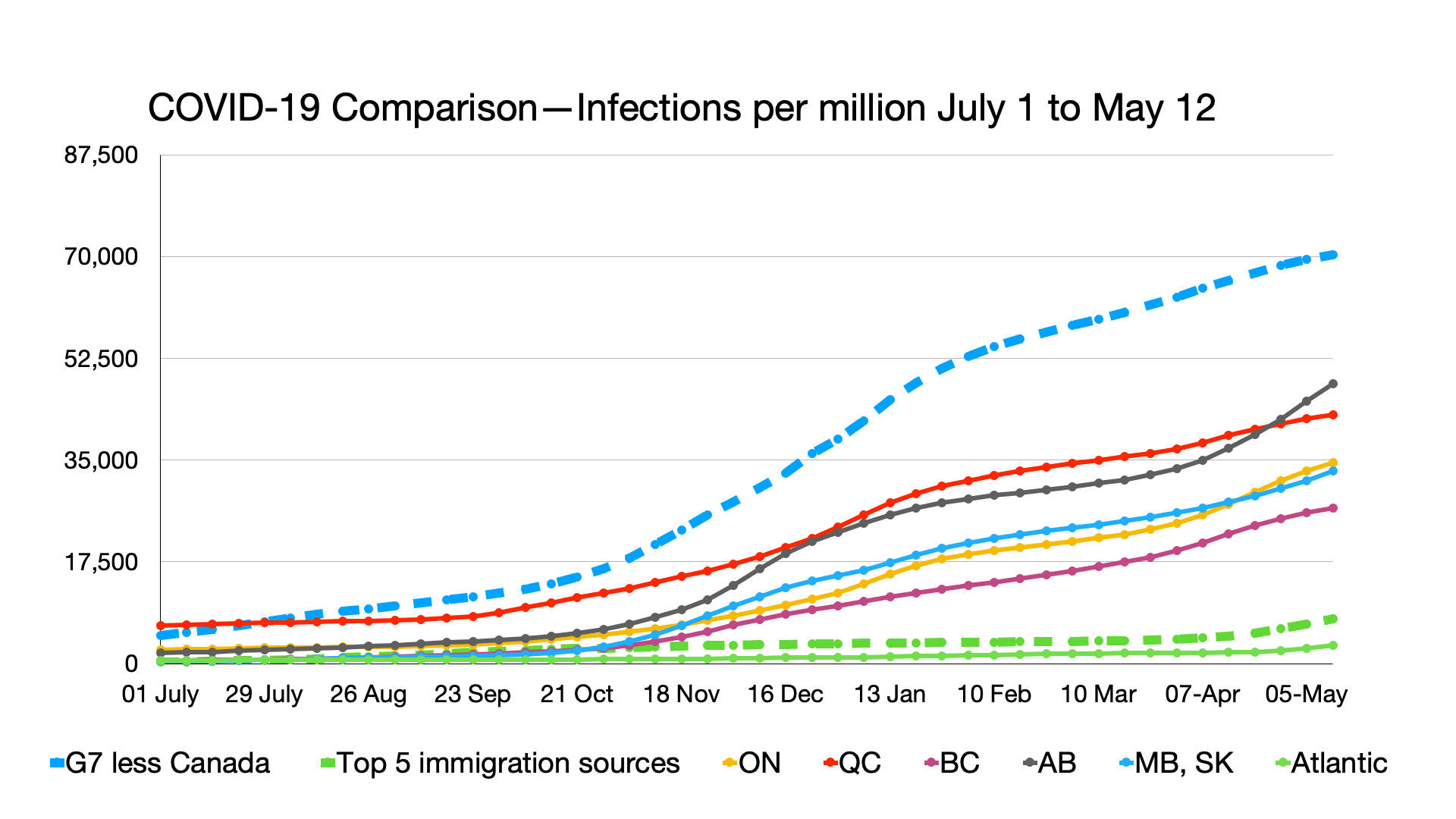
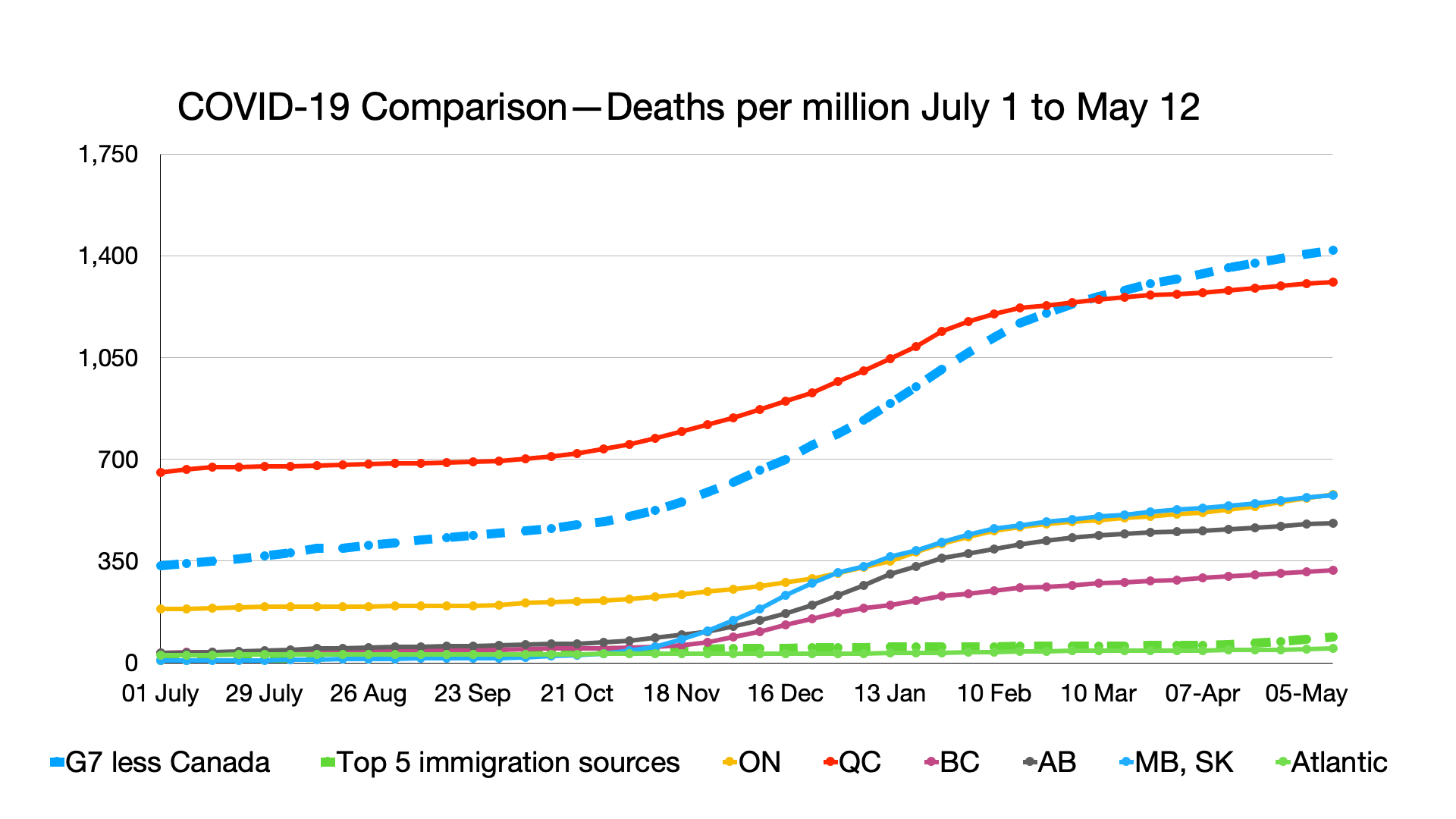
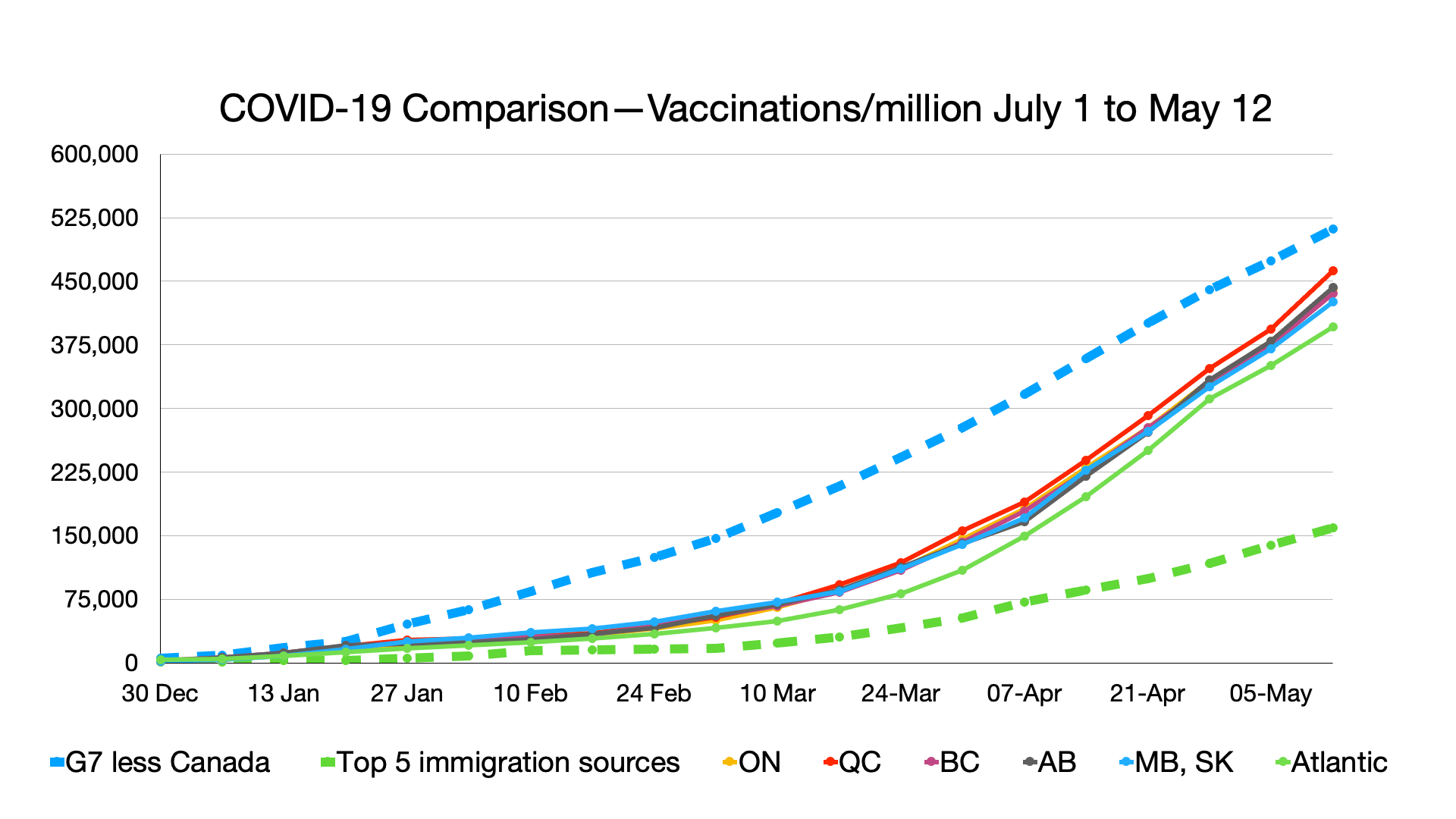
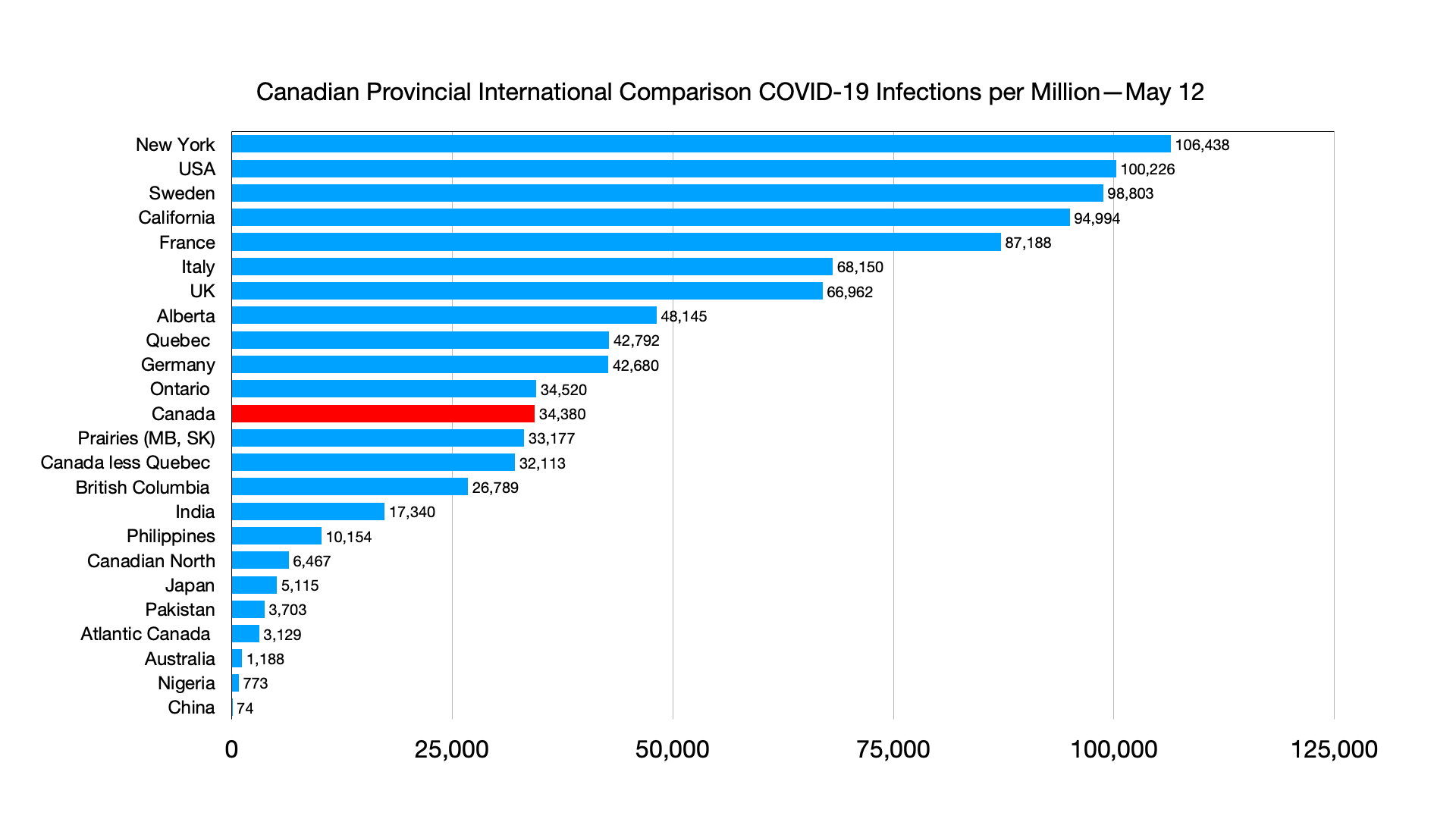
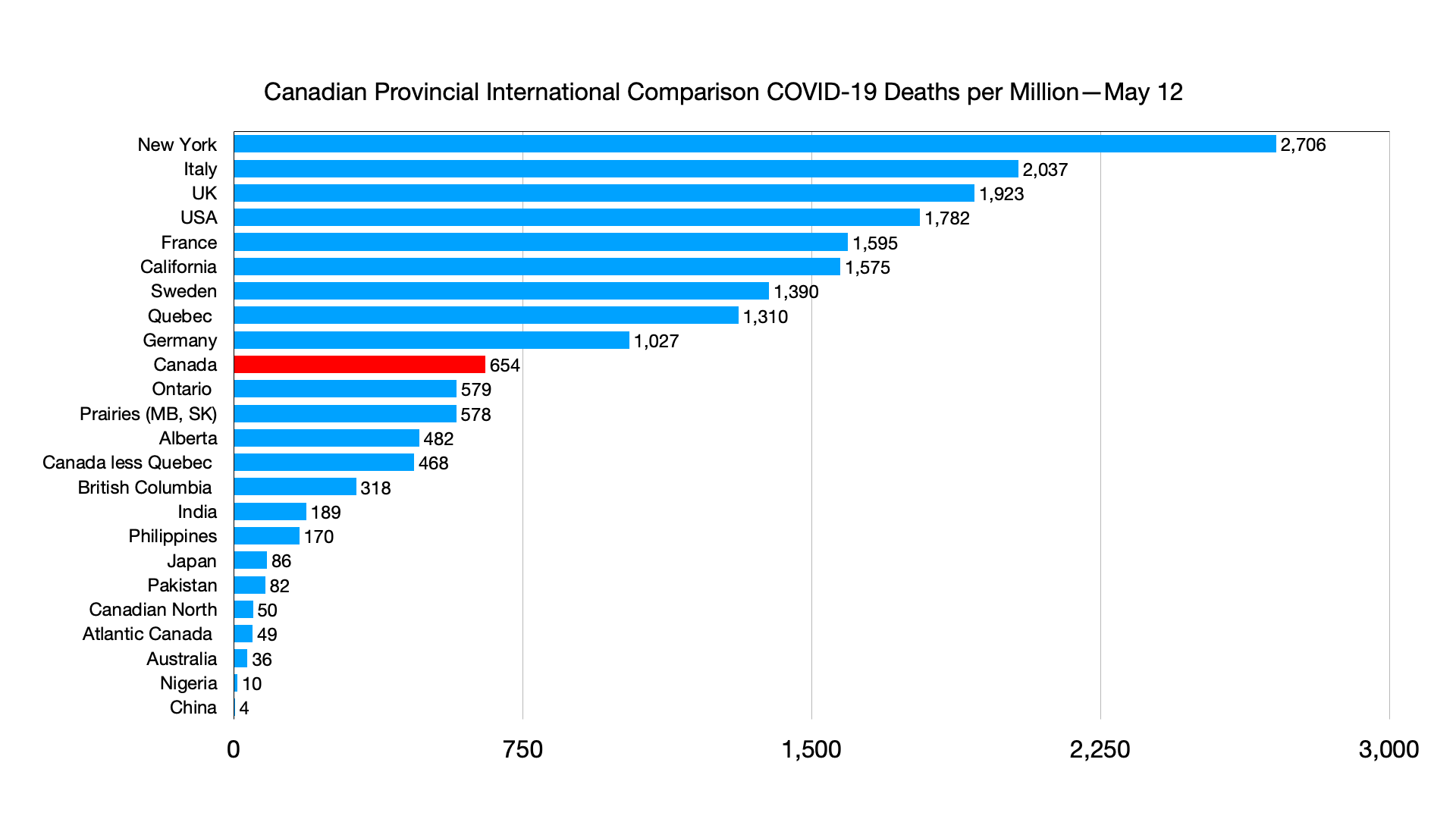
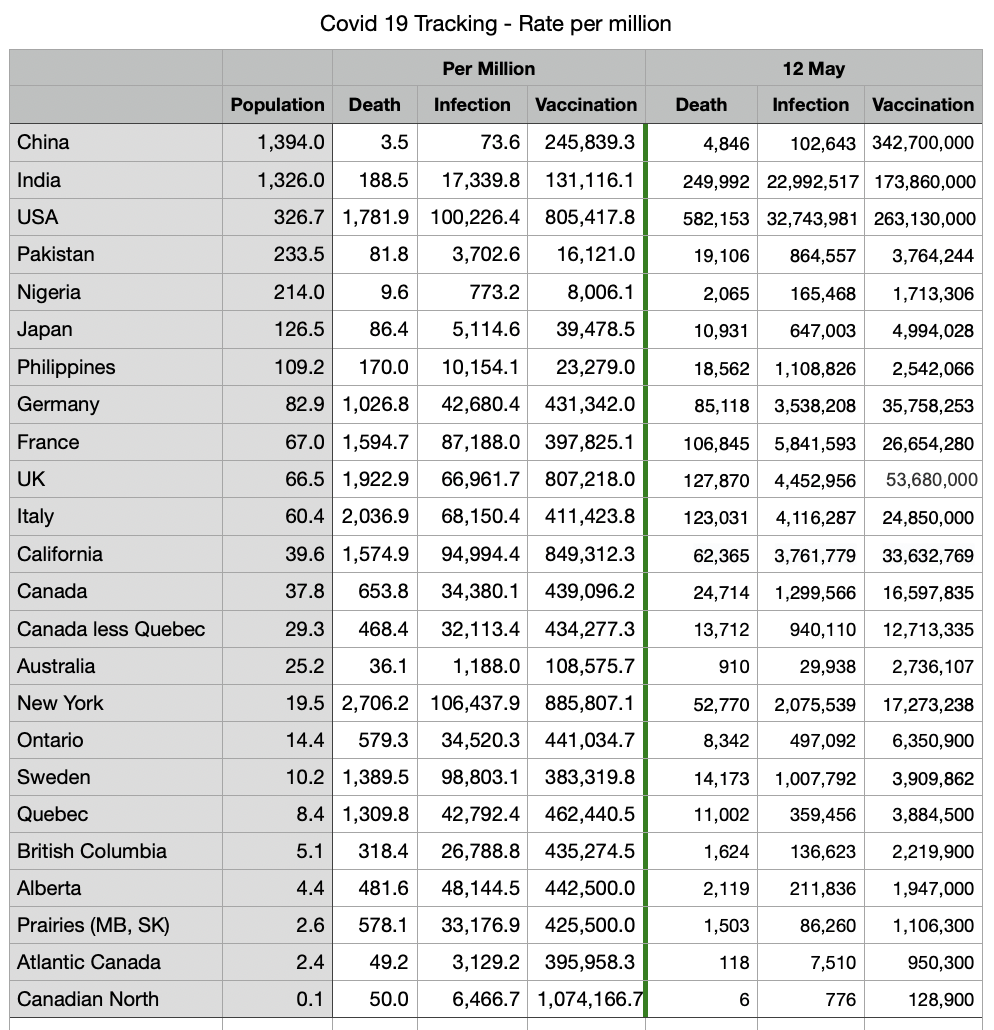
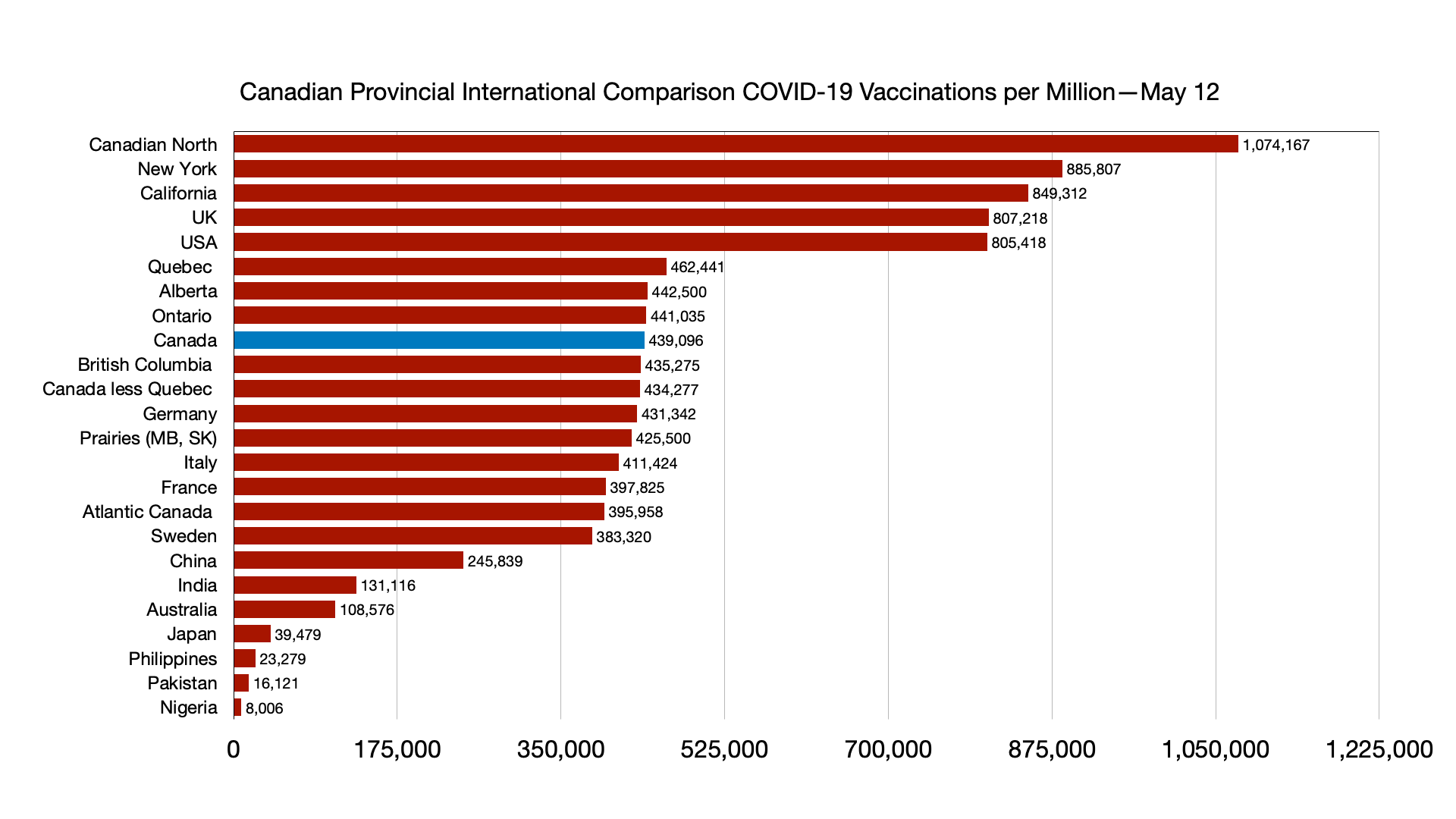
#COVID-19: Comparing provinces with other countries 12 May Update

The latest charts, compiled 12 May as the third wave continues. The ongoing spike of infections and deaths in India per million still has not resulted in a change in the relative ranking given the size of India’s population.

Vaccinations: Overall, vaccination rates in Canada and most provinces continue to be comparable or greater to those of EU countries.

Trendline charts

Infections per million: The ongoing spikes in Alberta and Ontario continue, with Alberta showing the highest growth rate.

Deaths per million: Gap between G7 and Canadian provinces continues to grow.

Vaccinations per million: Vaccination rates in Canadian provinces continue to increase more quickly than overall G7 less Canada countries. USA has moved ahead of the UK. Canada and the largest four provinces all ahead of Germany but Atlantic Canada behind France, while Australia and Japan have moved ahead of the Philippines. The Increases among immigration source country continue to reflect China and India mass vaccination roll-out, but at lower rates of increase compared to Canadian provinces and G7.

Weekly

Infections per million: Sweden moved ahead of California, Italy ahead of UK, and Ontario ahead of all Canada.

Deaths per million: Ontario ahead of Prairies.

Why Canada so urgently needs to update its citizenship materials

Kind of surprising that Postmedia has largely ignored these criticisms to date (unless I missed them) and that little effort appears to have to engage more than one advocate and one academic. And why pick a pharmacology professor rather than one with citizenship and immigration expertise (e.g., Ravi Pendakur, Elke Winter, Audrey Macklin to name but a few).

But at least we have a glimpse of the revised guide themes: relationships, opportunity and commitment.

No public date yet set for release, and unclear whether it will be released before an expected election later this year:

More than a decade after its publication and at least four years after it was promised, an update is coming this year to the Discover Canada: The Rights and Responsibilities of Citizenship study guide.

The current guide, created in 2009 and lightly updated in 2012, is provided to newcomers to learn about the nation’s history, culture and ethics in advance of the citizenship test they must pass to become Canadians. The study guide is, in essence, a distillation of how the government wants the nation to be seen and of the foundational touchpoints it wants immigrants to understand.

The guide has been criticized for its many misrepresentations about Canada, either by omission or part-truth, because it contains highly controversial statements that, critics say, have continued to whitewash the country’s historical treatment of First Nations and other minorities.

Source: Why Canada so urgently needs to update its citizenship materials

They’ve been called hot spots. It’s actually ‘code’ for social inequity

More analysis confirming COVID-related racial and other disparities:

People who live in Toronto and Peel COVID-19 hot spots are on average nearly twice as likely to be racialized and about four times more likely to be employed in manufacturing and utilities compared to those in the regions’ other neighbourhoods, a new analysis shows. 

New research from the Gattuso Centre for Social Medicine at University Health Network also highlights how residents of these hot-spot areas are, on average, more than twice as likely to work in trades, transportation and equipment operation and also more likely to meet low-income thresholds.

While the public has heard over the past year that racialized people, those with lower-income status and essential workers are bearing a disproportionate burden of the COVID-19 pandemic in Ontario, the analysis from the Gattuso Centre highlights at a granular level who actually lives in the neighbourhoods hardest hit by the virus, how much money they make, and what they do for a living. 

“When we talk about ‘hot spot’ postal codes, what we’re really talking about is the structural determinants of health. Social inequities and the pathologies of poverty have been driving this pandemic,” said Dr. Andrew Boozary, executive director of the Gattuso Centre. “This is further evidence that life-saving measures need to get to neighbourhoods with the highest structural risks –– this at the very least means community leadership driving vaccine rollouts and better safety measures at workplaces.”

Using Census data, the social medicine team looked at demographics in Toronto’s 13 “sprint” strategy communities deemed most at-risk and compared it with the rest of Toronto’s forward sortation areas (the first three characters in postal codes). They also compared hot spots in Toronto and Peel with the remainder of neighbourhoods in those regions, and did a similar comparison of all of Ontario’s 114 hot spots with postal codes in the rest of the province.

In virtually every case, the most at-risk neighbourhoods had, on average, higher proportions of racialized individuals, those who meet low-income measures, people who work in manufacturing and utilities, and those employed in trades, transportation and equipment operation. 

For example, M3N, which includes Jane and Finch and Black Creek, has the most manufacturing and utilities employment, the sixth-highest proportion of people who meet low-income thresholds, the eighth highest employment in trades, transportation and equipment operation, and is the 10th most racialized community out of all postal codes in Toronto and Peel.

Similarly, L6R, in northern Brampton, has the most trades, transportation and equipment-operation employment, the fourth-most manufacturing and utilities employment and is the third-most racialized postal code out of all Toronto and Peel neighbourhoods. 

The only exception the researchers found was in the Ontario-wide hot-spot comparison, in which the percentage of people who work in trades, transportation and equipment operation in hot spots was slightly lower than non-hot-spot neighbourhoods.

“That’s the thing with this data, it also really shows the disparity. It really shows that no, we haven’t all been through the same experience with COVID,” said Sané Dube, Manager, Community and Policy with Social Medicine at UHN, using the example of someone who makes over $100,000 annually, lives in downtown Toronto and can pay for their groceries to be delivered.

“That is very different from the experience from the person who is making $30,000 in a grocery store, has continued to work the whole pandemic and lives in a certain part of the neighbourhood. There’s this idea that we’ve all had the same experience in this pandemic. We haven’t. This really brings that home.”

Laura Rosella, scientific director of the Population Health Analytics Lab at the Dalla Lana School of Public Health and a collaborator on the analysis, notes that hot spots are vulnerable for different reasons, which is why connections between policy-makers and the communities are so important.

“The data kind of gives you that first layer, saying we need to pay attention here. Then it’s the conversations with the community that will tell you what the solutions are,” Rosella said. “The data alone won’t tell you what the solutions are. The community will.”

Michelle Dagnino, executive director of the Jane/Finch Community and Family Centre, says that while she is not surprised by the data, many people, including many who work in social services, did not realize just how many people in vulnerable areas have continued to go to work throughout the pandemic. 

“I think there was a sense that there were going to be more workplace shutdowns than there ever actually ended up being. The definition of ‘essential’ just ended up being so broad in terms of these workplaces,” she said. 

“Effectively, all of our factory workers, whether they’re manufacturing glass panes or producing clothing or whether they’re delivering factory-made goods through Amazon distribution centres, they have been open the whole time. And the consequences of that in this third wave have led us to a situation where we have seen racialized, low-income workers dying because they’ve had to continue to go to work.”

Source: https://www.thestar.com/news/gta/2021/05/11/theyve-been-called-hot-spots-its-actually-code-for-social-inequity.html


‘Pandemic of hate’: Leaders, experts warn anti-lockdown protests linked to far right

Of note:

Online conspiracy theories about COVID-19 and protests against public health orders are helping to spread dangerous ideas laden with racism and bigotry, says a network monitoring hate groups in Canada.

The executive director of the Canadian Anti-Hate Network said since last year people espousing hateful beliefs have linked themselves to conspiracy and anti-lockdown movements around the novel coronavirus.

“We have two pandemics: We have the actual pandemic and then we have this pandemic of hate,” Evan Balgord said.

“Things are kind of getting worse both online and offline … with maybe one pandemic, we have kind of a solution for, but the hate thing, we don’t have a vaccine for that.

Federal New Democratic Party Leader Jagmeet Singh was the latest on Monday to note a connection between anti-mask and anti-lockdown protests and far-right extremism.

His comments came as rallies against COVID-19 health orders are being staged across the country while many provincial doctors battle a deadly third wave of the pandemic.

“To brazenly not follow public-health guidelines puts people at risk and that is something that we’ve seen with extreme right-wing ideology, ” he told reporters.

These demonstrations have been met with frustration from some in the public over what they say appears to be a lack of police enforcement, and a few premiers have promised stiffer fines for COVID-19 rule-breakers.

The far right has become adept at integrating populist grievances into its own narratives and exploiting them to enhance membership, said Barbara Perry, director of the Centre on Hate, Bias and Extremism at Ontario Tech University, in a recent interview.

As a result, members of the far right have turned up at virtually all of the recent anti-lockdown gatherings, “trying to lend their support to that movement, and thereby garner support and sympathy, or solidarity, with their more extreme movement,” she said.

Mr. Balgord said such events make for “fertile hunting” for new recruits because hateful ideas are not being policed, and once someone believes in one conspiracy theory, it’s easy to believe in others.

“We now have a greatly increased number of people who are coming into close contact with racists and bigots of all stripes with more conspiracy theories,” he said.

And more than a year into the pandemic, Mr. Balgord said, organizers behind anti-lockdown protests in Vancouver, Toronto and the Prairies know figures from the country’s “racist right” are involved in their movement.

More recently, he said, some protesters have started showing up with Nazi imagery to depict themselves as being persecuted by the government.

“The racist right that we monitor and the COVID conspiracy movement are inseparable from each other at this point. We monitor them as if they are the same thing because they involve all the same people,” Mr. Balgord.

He said the network’s information is based on what it observes and the far-right figures it follows, but there is a lack of data tracking how conspiratorial thinking around COVID-19 has moved across Canada.

After Mr. Singh’s comments, Bloc Québécois Leader Yves-François Blanchet played down the idea of a connection between the protests and far-right extremism, saying arguments suggesting a correlation were politically motivated.

“I am absolutely certain — absolutely certain — that people which have been involved in such discussions in the last hours and days know very well that there could be no link between … two things that should not be what they are, but are not related,” he said.

The NDP leader said he sees a link between those refusing to follow public-health advice and the ideologies of the extreme right because both show a disregard for the well-being of others and put people at risk.

“There is a connection, certainly.”

Mr. Singh said declining to listen to COVID-19 health orders is dangerous and needs to be called out.

Calgary Mayor Naheed Nenshi earlier called such demonstrations “thinly veiled white nationalist, supremacist anti-government protests” on Global’s “The West Block.”

Source: https://www.theglobeandmail.com/politics/article-pandemic-of-hate-leaders-experts-warn-anti-lockdown-protests-linked-to/

Paris court tries anti-racism activist for statue attack

Of note. All societies and cultures have to face their histories, but in a manner that educates and improves understanding of their context and not simply dismisses historical figures without considering the times and their other contributions, good and bad:

A French activist for Black rights went on trial in Paris on Monday for defacing a statue of a historical figure from France’s colonial, slave-trading past, calling the protest a political act to denounce deep-seated racism.

Franco Lollia was on trial for spraying “state Negrophobia” in red paint on the pedestal of a statue outside parliament in Paris last June. The statue Jean-Baptiste Colbert, a 17th-century royal minister who wrote rules governing slaves in France’s overseas colonies.

Lollia told the court that, in his view, Colbert committed crimes against humanity. He said celebrating Colbert with a statue outside the National Assembly shows that the French state “is viscerally Negrophobic even today” and that the statue’s presence is “spitting in the face of all people who look like me.”

Lollia, who is Black, called the trial “an insult.”

“I am sad to see that history seems to be repeating itself and our voices are still not heard,” he said. “I am really disappointed that the justice system is still so blind.”

The trial coincided with France’s annual commemoration of the abolition of slavery. Lollia noted that the day isn’t marked with a national holiday, dismissing it as “a bone for a dog” that fails to adequately commemorate the horrors inflicted on millions of slaves.

The sweat-top and face mask that Lollia wore to the trial both had the words “Anti-Negrophobia Brigade” printed on them. Other words on the back of his T-shirt said “Negrophobia” is a “weapon of mass destruction that doesn’t admit its name” and exhorted: “Let’s arm ourselves to the hilt to fight it.”

The judge said video footage of the graffiti attack showed him hurling paint at the statue and spray-painting its base.

“It was a political act,” Lollia said.

The charge of defacing property is punishable by a fine or community service.

Lollia’s team argued that he acted in self-. His attorney Georges-Emmanuel Germany said the judge should consider France’s past as “a criminal state” in weighing Lollia’s act.

“You are not only the judge of the accused,” the attorney said. “You are also the judge of the of the victim” — meaning the French state.

Speaking outside the courtroom, Lollia said France’s colonial past is still feeding racial discrimination.

“Colbert is a major figure of this colonial past, this past where Black people were not recognized as human beings,” he said.

“The system itself is Negrophobic from the moment it doesn’t put into question the history,” he said. “France is capable of healing from its Negrophobia and from its state racism in general, but the French state must learn to face its history, and not only part of the history it likes.”

Source: Paris court tries anti-racism activist for statue attack

Thirty years ago, he became the first Mountie to wear a turban. Here’s why he still worries about hate ‘in the shadows’

Good reminder of Canada coming to terms with a more open society and identities, even as the RCMP continues to face challenges in recruitment of women and visible minorities (Indigenous peoples are above their population share and labour market availability):

During a visit to Calgary in late 2019, Baltej Dhillon couldn’t resist paying a visit to Shoulder to Shoulder Militaria & Collectibles after his son-in-law told him what he’d spotted inside.

Behind a glass display case were a bunch of pins that had been produced three decades earlier, when Dhillon was caught up in a fierce national debate over whether the RCMP should allow Sikh officers — like him — to wear turbans on duty.

One pin showed an image of a turban-wearing Mountie with a cross through it and the label: “Keep the RCMP Canadian.”

Another pin showed a turban-wearing Mountie riding a camel. It was labelled: “Canada’s New Musical Ride.”

Stunned to see these “symbols of hate” still in circulation, Dhillon snatched up about $50 worth of the pins. When he went to pay for them, he says, he could sense a tinge of embarrassment from the store’s merchant.

“I am grateful to live in a country where expression is part of our freedom,” he told the Star.

“Propagating hate, however, is not.”

This month marks the 30th anniversary of when Dhillon graduated from the RCMP training academy and made history as the first Mountie to be permitted to wear a turban while on the job. Through a 2021 lens, some will find it jarring to think that such a simple thing could be a source of controversy, but the uniform policy change sparked heated discussion over the meaning of Canadian identity, as well as petitions and court challenges seeking to preserve traditional elements of the Mounties’ garb, such as the Stetson hat.

While Dhillon, of Surrey, B.C., says there’s no question attitudes have evolved over the past three decades, there remains much that has not. The Star discovered as much, recently, when it spoke to some of the people who fought against his right to wear the turban while in uniform three decades ago.

For his part, Dhillon said the continued circulation of the pins, the relatively recent debate over whether people should be allowed to wear face coverings during citizenship ceremonies and Quebec’s ban on government workers wearing religious symbols all show there’s still a lot of work to be done in “finding kindness and compassion in how we interact with each other.”

“We need to continue to be vigilant because that hatred is just in the shadows.”


In 1988, Dhillon was in his early 20s and figuring out what he wanted to do with his life.

His part-time work as an RCMP jail guard led him to apply to become a Mountie. He passed the initial application process but didn’t proceed further because he wasn’t willing to conform with the RCMP’s uniform policy, which required him to remove his turban, something he’d been wearing since he was 12.

“I’m not able to do that and cannot do that because of my commitment to my way of life and my articles of faith,” he says he told his recruiter.

Having been born and raised in Malaysia, where it was commonplace to see Sikh officers in law enforcement and armed forces, Dhillon says he had no inkling of the “great national debate” about to unfold.

In spring 1989, then-RCMP commissioner Norm Inkster recommended to the federal government a change in dress regulations to allow Mounties to wear turbans as part of their uniforms.

It sparked an outcry.

Three Calgary sisters from an RCMP family — Kay Mansbridge, Dot Miles and Gen Kantelberg — launched a petition calling for the preservation of the “distinctive heritage and tradition of the RCMP.”

“I don’t think we can give up our heritage just to pacify one religious group,” Mansbridge told the Calgary Herald at the time, adding that “chaos” would result when other minority groups demanded the right to wear their cultural garb.

The sisters insisted their petition — which gathered more than 200,000 signatures — was not fuelled by racism.

“I have friends who are East Indian,” Mansbridge told the Ottawa Citizen. “I even looked after their children.”

Meanwhile, some business owners saw potential to make money out of the controversy.

Herman Bittner of Langdon, Alta., produced a calendar containing a portrait of himself wearing a red serge, a turban and dark makeup on his face. He is identified as “Sgt. Kamell Dung” alongside the caption: “Is this Canadian, or does this make you Sikh?”

“I’m doing a job the politicians should be doing — they’re supposed to be representing the views of the majority,” he told The Canadian Press.

Two Calgary business owners — Bill Hipson and Peter Kouda — reportedly started mass producing pins that also mocked turban-wearing Mounties.

One of Kouda’s pins ended up in the collection of the Galt Museum & Archives in Lethbridge. According to the museum’s website, it depicts a Caucasian man surrounded by three visible minorities with the caption: “Who is the minority in Canada?”

As the controversy grew and respectful debate turned hateful, Dhillon said he could no longer remain the “quiet candidate.”

“I quickly realized there was a lot of ignorance and a lot of misinformation around the Sikh faith, the Sikh way of life, and there weren’t many spokespersons within the community that were able to speak to the issue from my perspective. So I took it upon myself to make myself available at that time.”

The debate found its way into the halls of Parliament in Ottawa.

“The RCMP cannot be frozen in time,” NDP MP Jim Karpoff told the House of Commons at the time. “Canada is an evolving multi-ethnic community and the RCMP should fully represent this.”

As part of the same debate, Louise Feltham, a Progressive Conservative MP from Alberta, asked: “If you make an exception for one group of people, where do you stop?”

“Today’s uniform depicts neutrality, impartiality, tradition, history and heritage. ”

But in March 1990, the government under Brian Mulroney announced it was moving forward with the dress code changes and an application form was created for Sikh officers wishing to be exempted from the standard headdress.


Dhillon graduated from the RCMP training academy in May 1991 and began working at the RCMP detachment in Quesnel, B.C.

Community reception at the time was mixed. When he walked into some bars to do sobriety checks, he was greeted as a hero. In others, he was greeted with boos.

“I would take it in stride,” he said. “I would take a bow, wave at them and make my way out. What more can you do?”

Dhillon says his staff sergeant greeted him icily on his first day on the job but when he retired a couple of years later, “He looks at me and says, ‘You’re like a son to me.’”

Meanwhile, a group of retired Mounties from Lethbridge — John Grant, Kenneth Riley and Howard Davis — along with Kay Mansbridge, filed a lawsuit seeking an order prohibiting the RCMP from allowing the wearing of religious symbols and a declaration that the commissioner’s actions were unconstitutional.

The plaintiffs, according to court records, asserted that when a religious symbol is allowed to be part of the RCMP uniform, the appearance of impartiality is undermined.

Outside the courtroom, the plaintiffs used far looser language.

“When they come over here why do they have to change it and make it the same way it is in their homeland?” Grant, one of the plaintiffs told Southam News. “Anybody that looks at it any differently in my opinion should get the hell out of Canada because they’re not good Canadians.”

The defendants argued the change in uniform policy was designed to remove a barrier to the employment of Sikhs in the RCMP and to reflect the multicultural nature of Canada.

In 1994, the Federal Court dismissed the lawsuit, concluding there was no evidence anyone had been deprived of their liberty or security by RCMP members wearing turbans, or had experienced a reasonable apprehension of bias.

The decision was upheld by the Federal Court of Appeal. The plaintiffs took the case to Canada’s highest court, which declined to hear it.

Laura Morlock, a lecturer at Ryerson University, spoke extensively with Dhillon for her PhD dissertation on religious diversity and dress at the University of Waterloo.

It’s interesting that when Dhillon started his RCMP career, he was accused of “threatening Canadian identity,” Morlock said. Now, when you do a Google image search of “Canadian multiculturalism,” Dhillon is among the results.

“Dhillon went from being an icon of threat to Canadian identity to becoming an icon of Canadian identity. ”


After taking part in high-profile investigations such as the Air India bombing and the serial killings of Robert Pickton and developing expertise as a polygraph examiner and interviewer, Dhillon retired from the force in 2019 and took on a new role as a staff sergeant with B.C.’s Combined Forces Special Enforcement Unit, overseeing a program that aims to reduce gun violence.

Prior to his departure, the RCMP relaxed some of its uniform and dress policies, allowing members to wear their hair in a bun, ponytail or braid, to grow out their beards and to display tattoos. They also removed the requirement that members have to seek exemptions to wear faith-based headdresses, including turbans and hijabs, a move welcomed by Dhillon.

“When you give someone an exemption, in essence what you’re saying is you’re not exactly the same as everybody else,” he said.

Another thing he has been heartened by is the number of people who come up to him during his public-speaking engagements who say they were once opposed to the uniform accommodation but have since changed their minds.

“That’s the hope — that there’s opportunity for people to grow,” he said.

Dhillon says he believes there are now a few dozen RCMP members who wear turbans across the country.

Many of the people who led the campaign opposing the RCMP’s uniform change have since passed away. The Star did, however, reach some of their surviving family members.

Mansbridge’s son, John, said the “sentiments of 30 years ago don’t necessarily match with some of the thoughts of today.”

“Some of the points that were being made back then may still be relevant, but they’re drowned out by louder voices. I don’t think any of us want to be part of that, quite frankly.”

“The courts spoke,” he added, “and I think that’s probably the end of the issue for all of us.”

Riley’s daughter, Diana, said she still feels “proud” of her father for taking a stand for something he believed in.

“The only thing I myself remember and still to this day feel very proud of is that Dad believed in something and he believed in it strong enough to take the government to court,” she said.

Her father and the others weren’t opposed to having a diverse force, she said.

“Inclusivity wasn’t the problem. It was flashing the superior garb.”

Hipson, one of the makers of the offensive pins, said he had no regrets about his actions, calling it a “fun time” and an exercise in free speech.

“That was a big highlight for me. I was doing quite well with the pins. When this controversy came, it just opened up another one. I kind of enjoyed it.”

Hipson chuckled as he recalled some of his pin designs.

“Most people were laughing at it. I guess some people took it serious.”

Asked if his position on Mounties wearing turbans had changed in 30 years, he said it hadn’t.

“I still don’t think they should get preferential treatment.”

Reid Moseley, owner of the Calgary collectibles store that Dhillon visited, said he was proud of his collection of “politically incorrect” pins.

“My business is a collectors’ paradise, so I have been told by many of my customers. It represents the true history of our country, through the exhibit and sale of physical reminders of where our country came from.”

It is “sad” that such ignorance persists, Dhillon said when informed of the comments.

“To veil the hateful pins with the thought that they somehow represent the true history of our country is irresponsible,” he said.

“They were symbols of hate in 1990 and they remain that today.”

And to suggest that the debate over the right to wear turbans in the RCMP was a “fun time” is demeaning.

Such sentiment, he said, belongs to someone who hasn’t grasped what it means to be Canadian.
Source: Thirty years ago, he became the first Mountie to wear a turban. Here’s why he still worries about hate ‘in the shadows’

In the fight against anti-Asian racism, advocates say federal funds a ‘good start,’ but more support needed

As always…:

The head of an organization tasked with combating racism in Canada says the group is building a collaborative strategy to tackle the issue, but some advocates say more government support is needed to directly address the rise of anti-Asian racism.

Mohammed Hashim, executive director of the Canadian Race Relations Foundation (CRRF), said a centralized plan is needed to create real change, and that his group will consult directly with community organizations across the country to hear what supports are needed.

April’s federal budget allocated $11-million over two years to the CRRF to combat racism and empower racialized Canadians affected by racism during the pandemic. The budget document also specifies that the money can go towards establishing a “national coalition to support Asian-Canadian communities.”

Though many advocates see the funding as a positive step, some say the government is not doing enough to ensure the safety and well-being of Asian-Canadian communities.

“It’s a good start,” said Avvy Go, director of the Chinese and Southeast Asian Legal Clinic, “but it’s just as important for the government to support organizations that have a more specific mandate to address anti-Asian racism as an issue.”

Amy Go, president of the Chinese Canadian National Council for Social Justice (CCNC-SJ), said she agrees the funding falls short. “Given that people’s lives are still being threatened – that we are still targeted, that we are being attacked and assaulted – hopefully the government would do more than just the $11-million,” she said.

A report released in March by the CCNC’s Toronto chapter and other advocacy groups found that 1,150 racist attacks against Asian-Canadians took place across Canada between March, 2020, and February, 2021, compiled from incidents reported to online platforms Fight COVID Racism and Elimin8hate. One thousand thirty-two incidents have been reported to date through Fight COVID Racism alone. Verbal harassment, targeted coughing and spitting, and physical aggression made up the majority of the incidents.

The CCNC-SJ’s Ms. Go said while the report presented a starting point for understanding anti-Asian racism during the pandemic, the incidents are underestimated because many cases go unreported. “That’s just the tip of the iceberg,” she said.

She added that the creation of a national coalition, as suggested in the budget, risks erasing the differences between Asian communities and not addressing their diverse needs and concerns. “We are not one monolith,” she said, adding that many heritages and backgrounds exist within Asian-Canadian communities.

Mr. Hashim said the CRRF’s plan is to consult with local groups across the country to understand their needs, and also empower them to do their own work. The $11-million in funding will go towards researching and developing a strategy to combat racism, with a portion also allocated to community organizations.

“A Crown corporation is not going to solve racism,” he said. “It’s going to work in collaboration with community groups, who are deeply connected to the people that they serve.”

Xiaobei Chen, a sociology professor at Carleton University, said she wants to see the government invest in public education on the existence of anti-Asian racism and rising hate crimes against Asian-Canadians during the pandemic.

“People don’t think it’s serious,” Prof. Chen said. “People don’t think that it’s something that we actually need to think about, what we can do to actually invest seriously in solving.”

Investments to combat anti-Asian racism should take many forms, CCNC-SJ president Ms. Go said, adding that money isn’t the only thing Asian communities need from the government.

“We need to think more broadly – along the lines of the systemic policies that will bring about long-term change.”

Source: https://www.theglobeandmail.com/politics/article-in-the-fight-against-anti-asian-racism-advocates-say-federal-funds-a/