#COVID19 #Immigration effects: March 2021

My regular monthly update. A few changes from earlier versions. 

Slides now have one-year and two-year comparisons, highlighting change from 2019 pre-COVID baseline as well as well as post-COVID 2020. Citizenship application numbers include first quarter 2021. 

Slide 3 summarizes the changes by program. 

In terms of trends and observations, the overall picture is that of a return to the 2019 baseline, partially for Permanent Residents but close to normal for IMP, TFWP and study permits except where noted below. No significant recovery in citizenship numbers. 

  • While still lower than 2019 baseline, PR admissions are recovering from their 2020 low. First quarter numbers of 70,000 suggest 280,000 for 2021 but government changes (lowering of Express Entry minimum score, Temporary resident to permanent resident pathway program, likely others to come) will result in higher numbers. 
  • TR to Permanent Residents transition continues to remain at about half of total Permanent Residents numbers. 
  • TRs, both IMP and TFWP, have all increased compared to 2019 save for IMP/Agreements.and TFWP/Caregivers. Most dramatic increase is with respect to “Other IMP Participants” which largely reflects open work permits for Hong Kong residents with HKSAR and BNO passports. 
  • Study permit holders have increased from the 2019 baseline. 
  • Asylum claimants remain significantly lower given border closures and travel restrictions. 
  • Citizenship numbers remain much lower than the 2019 baseline, reflecting the partial reopening and move to online testing and ceremonies. 
  • Visitor visas remain largely closed 

Canada announces new pathway to permanent residency for families of crash victims

Of note. Generous, given applies to extended families, and yet another contribution to meeting immigration levels:

Ottawa is launching a new policy to help the families of victims of two major airline disasters become permanent residents in Canada, Immigration Minister Marco Mendicino said Thursday.

The new policy will apply to relatives of anyone who died on board Ukraine International Airlines Flight 752 or Ethiopian Airlines Flight 302, so long as those victims were Canadian citizens, permanent residents or found eligible on their application for permanent residency.

The policy applies to people currently in Canada, and anyone who made a refugee claim after these two disasters happened is also eligible to apply under the new policy.

Mendicino said the federal government is introducing this public policy, which will remain in place until May 11, 2022, to demonstrate compassion and solidarity with the families in their efforts to seek justice.

“I’ve had the privilege of speaking with some of the families were related to the victims of flight PS752. Grief and anguish is real and ongoing,” he said.

“Families are in pain. They still ask questions.”

Kourosh Doustshenas, whose partner Forough Khadem died in the crash, said the association that represent the families of the victims welcomes the new policy.

“We appreciate the government of Canada is taking these steps to support the families,” he said in an interview with The Canadian Press.

Fifty-five Canadian citizens and 30 permanent residents were among the 176 people killed when a Ukrainian jetliner was shot down by an Iranian surface-to-air missile minutes after taking off from Tehran on Jan. 8, 2020.

The Ethiopian Airlines passenger plane crashed near Addis Ababa on March 10, 2019, claiming the lives of 157 people, including 18 Canadians.

Mendicino said the new program provides a pathway to permanent residency to people whose loved ones made Canada their home before being so suddenly taken.

He said a relative a relative could be spouse, common-law partner, child, grandchild, mother, father, grandmother, grandfather, brother, sister, aunt, uncle, niece or nephew.

Applicants may still be eligible even if they have entered Canada without the required visa or other documents, failed to comply with certain conditions or have worked or studied without being authorized under the Immigration and Refugee Protection Act, he said.

Doustshenas the government should allow family members outside of Canada to apply.

“We are hoping (the government) will expand (the new policy) to be more inclusive,” he said. “We want to make sure other people who are not in Canada also get the chance to travel here and apply for permanent residency.”

He said the policy should be expanded to include the families of Iranian students who where among the victims of the plane shootdown and had the intention to work and live in Canada after graduation.

Mendicino said his department is working on further measures to facilitate permanent residence applications for certain members of victims’ families who are currently outside Canada, and it will provide updates on this once those measures are in place.

Former Liberal public safety minister Ralph Goodale, who was named Canada’s special adviser on the response to the crash, released a report on the downing of Ukraine International Airlines Flight 752 in December concluding that it’s vital it is for the investigation into this air disaster to be transparent to ensure accountability.

Ten Iranian officials were indicted over the shootdown of a Ukrainian passenger plane by Tehran military prosecutor Gholamabbas Torki, who avoided naming those responsible when he announced the indictments last month.

Doustshenas the families of the victims can’t trust the Iranian justice system because the Tehran military prosecutor didn’t disclose the names of those charged, nor the alleged offences.

“We still don’t know what happened. We still don’t know the truth. We haven’t seen any kind of justice,” he said.

“We are hoping through an independent investigation by Canada and other countries, we can finally get to the bottom of that and find the truth.”

Prime Minister Justin Trudeau said last month that Canada would work with the international community to reform aviation standards and to ensure the families of victims “get closure, get compensation and mostly get justice from Iran.”

Source: Canada announces new pathway to permanent residency for families of crash victims

Farber and Fisman: The overlap between lockdown agitators and hate groups is a threat to us all

Of note:

The pandemic has been a major source of disruption in the lives of Canadians for more than a year, leaving many of us frightened. For some people, that fear means opportunity.

In 2008, epidemiologists developed models of the “coupled” dynamics of epidemics and the fear generated by them, showing that behavioural changes engendered by fear can spread as a parallel epidemic, making the infectious disease worse. When two such epidemics interact, the process is referred to as a “syndemic.”

The pandemic, then, has undoubtedly been a syndemic of infection and fear, preyed upon by well-known internet influencers who sat at the core of hate networks that existed before the first outbreak. Now, we have to reckon with a syndemic of infection and hate in a system too vulnerable to both – or face very real consequences.

According to a recent report in The New York Times, many experts now believe the United States may never reach herd immunity. This is largely due to hesitancy around safe and effective vaccines, which is being driven in part by anti-science and pro-conspiracy beliefs. These movements have only sown confusion as people navigate the informational minefield that is a public-health crisis, and they threaten to keep us all in pandemic limbo for the foreseeable future.

Indeed, since the beginning of the global outbreak, conspiratorial anti-establishment movements have only gained momentum, finding common cause in opposing mask mandates and lockdown measures and sucking up oxygen by undermining valid criticisms of government health orders. Rallies and protests have been organized almost every weekend across the country, and those who have found fame in the process bill themselves as defenders of our freedoms. They march with a list of grievances and conspiracy theories, but all believe they are standing up against their misguided idea of tyranny.

Outdoor rallies may not in and of themselves confer much risk on attendees; COVID-19 is some twentyfold less infectious outdoors than indoors as a result of dominant aerosol transmission. However, these gatherings undermine confidence in public-health guidance and promote messaging that is likely to further damage communities already hard-hit by this pandemic.

Ekos Research has found that 8 per cent to 20 per cent of Canadians have views that could be characterized as being distorted via disinformation, with men, minorities and lower-income individuals more likely to be disinformed. We know that minority and lower-income communities in Canada have already been the hardest-hit by COVID-19, and now we’ve seen the promotion of disinformation deepening the problem. Vaccine hesitancy also tracks closely with being disinformed; the promotion of disinformation will continue to injure communities even if it becomes possible to move beyond the pandemic via vaccination.

The principal actors of the anti-lockdown movement have either been or rubbed elbows with some significant haters on the scene. Vancouver neo-Nazi Brian Ruhe, who at one point organized a mock book burning, was involved in its earliest iteration. Quebec’s far-right conspiracy streamer Alexis Cossette-Trudel, a big name among France’s QAnon following, is an important mouthpiece of the francophone anti-lockdown movement. Neo-Nazi Paul Fromm is a fixture at rallies in both Ontario and in Kelowna, B.C. Antimask activist Chris Saccoccia’s social-media feeds feature Holocaust denial and racist posts.

Perhaps one of Canada’s most persistent agitators is Kevin Johnston, who made national headlines in 2017 when he was charged with the willful promotion of hatred against Muslims. In 2019, he lost a $2.5-million judgmentfor his role in racially motivated defamation against Toronto philanthropist Mohamad Fakih in which he repeatedly accused him of being a terrorist; the judge called his comments about Mr. Fakih “hate speech at its worst.” Now, Mr. Johnston is running for mayor of Calgary and has shifted gears by portraying himself as an anti-lockdown and antimask influencer.

The fact that an anti-public health agenda aimed at undermining the Canadian economy and the health and well-being of Canadians has been taken up by a rogues’ gallery with a long track record in disinformation and promotion of hatred should give us all pause. And with our country now approaching 25,000 dead due to COVID-19, Canadians should ask themselves whether the promotion of disinformation – and the undermining of the tools and measures that will permit a return to normalcy – has crossed the line from mere grotesque opportunism to active, malicious harm.

Source: https://www.theglobeandmail.com/opinion/article-the-overlap-between-lockdown-agitators-and-hate-groups-is-a-threat-to/

Are golden visas a golden opportunity? Assessing the economic origins and outcomes of residence by investment programmes in the EU

Good detailed study. Money quote: “our analysis suggests that wealthy investor migrants may be better conceptualised as mobile, profit-oriented populations akin to tourists and businesspeople, rather than as long term-oriented immigrants.” Conclusion below:

The twentieth century saw a remarkable shift from screening new immigrants based on racial origins to screening based on human capital contributions (Joppke 2005; FitzGerald and Cook-Martín 2014). The spread of RBI programmes in the twenty-first century adds a new dimension: screening new residents by economic capital contributions only. The results of this investigation suggest an upper limit on Ellerman’s (2019) finding that western countries now devalue the economic offerings of foreigners when selecting new members. In contrast to the policies aimed at workers that she examines, here we see that countries are indeed supplying pathways to long-term residence and citizenship for those making economic contributions – as long as they are very sizeable. Notably, the injections are one-off and the new residents are not expected to continue to contribute to economic growth in the same way that migrant workers might; they must simply maintain the original investment. The trend suggests a short-term calculation on the part of states, seeking to plug economic gaps, as our analysis finds, rather than a longer-term orientation of crafting a middle-class national identity (cf. Elrick and Winter 2018; Ellerman 2019). If social capital (Portes 1998), human capital (Stark, Helmenstein, and Fürnkranz-Prskawetz 1998; Ellerman 2019), and ethnic capital (Mateos and Durand 2012; Kim2018) have captured the attention of social scientists analysing migration, the developments tracked here suggest that a renewed focus on economic capital may be warranted. We find that states continue to harness mobility policies in service of economic objectives, now in a more starkly transactional manner, and – as we show – no matter what the political orientation of the government may be.

If RBI programmes are becoming an increasingly popular policy option, not all countries see the same uptake. Demand in Europe is concentrated in a handful of pro- grammes: just four countries represent 75 percent of all investor residents. The programmes now bring nearly €3.5 billion to the Union annually, yet the economic benefits are uneven. Indeed, only in two countries, Latvia and Portugal, are the economic injections large enough to represent a significant proportion of FDI. However in no country do they represent a substantial proportion of GDP, suggesting that concerns about macroeconomic destabilisation are unwarranted.

Our analysis reveals that economic decline leads to a greater likelihood that countries will start programmes, and that if the economic decline occurred during the Eurocrisis, the likelihood is yet greater – an argument proposed but not demonstrated by the literature (e.g. Parker 2017; Holleran 2019; Dzankic 2018; Veteto 2014). The choice of investment options, too, is largely responsive to economic need when governments implement real estate and business investment options, though not government bond options. Furthermore, the spread of programmes itself does not lead to more programmes: there is no contagion effect. As such, driving the onset of RBI programmes is more than mere client politics or neo-liberal ideology (cf. Mavelli 2018); economic need is a significant factor behind them. However, investors may stymie government intentions to use programmes to boost several areas of the economy, for they overwhelmingly invest in real estate if given the option.

Furthermore, our analysis suggests that wealthy investor migrants may be better conceptualised as mobile, profit-oriented populations akin to tourists and businesspeople, rather than as long term-oriented immigrants. The results lend support to qualitative work that identifies such mobile populations as ‘flexible citizens’ (Ong 1999), who use investment to multiply their options and secure additional bases, rather than to pack up and immigrate or invest in a growing economy (see also Ley 2010; Surak 2020a). We also find that countries with strong tourism sectors can charge more for their programmes as well. Yet they are not merely profit maximisers, choosing a price that will attract the most applicants; they respond to internal issues too, changing price in accordance with economic growth and employment rates.

A number of analysts have raised warning flags that investor migrants may price locals out of real estate (Scherrer and Thirion 2018; Holleran 2019). Our analysis shows the concern is unwarranted: the proportion of RBI real estate transactions in the national market is miniscule in nearly all cases. Notably, these programmes attract more distant and often ‘browner’ others than the fellow Europeans who constitute the greatest proportion of foreign real estate buyers and raise less media hype, suggesting that xenophobia may lie behind the concern. Greece is the sole, but significant, exception where the scale of the programme could indeed destabilise the property market. As real estate investment tends to be concentrated in specific locales (Friedland and Calderon 2017; Viesturs, Pukite, and Nikuradze 2017), regional and city-level data are necessary to further identify whether more limited destabilisation is occurring in particular areas.

What has been the impact of Covid-19 on these programmes? The sudden hardening of borders across the world has sent many wealthy people looking for ways to hedge their risks by securing mobility options and a Plan B (Surak 2020b, 2020c). To date, as we show, national-level healthcare statistics have been insignificant, but Covid-19 may encourage wealthy investors to select countries that have handled the pandemic well or that offer state-of-the-art healthcare. Covid-19 may also bring a shift away from a short-term ‘tourist-like’ calculation to a medium-term calculation preferring a place for longer-stint stays.

Regarding supply, Covid-19 is likely to increase the attractiveness of RBI programmes as a way to draw in foreign investment. Our study found that countries are more prone to start programmes after a period of slowed economic growth, particularly after a systemic recession. If the economic downturn spurred by the pandemic continues, it is likely that new countries will start their own programmes, replicating the pattern we found, and that countries with RBI offerings already in place will attempt to develop them further to address deepening economic need. Even if the schemes to date have been small, they still offer a means to attract additional resources at little cost. With real estate the most popular qualifying option, the investment boost is likely to be concentrated in the property and construction sector, which itself is transforming as the pandemic reconfigures work patterns and the desirability of urban living. Even if the European Commission continues to call for ending the programmes, countries are more likely to adapt their RBI offerings – perhaps by shifting them closer to, or even transforming them into, entrepreneurial options – rather than do away with them entirely.

Source: https://www.tandfonline.com/doi/full/10.1080/1369183X.2021.1915755

Why ‘Canadian’ shouldn’t be an option on the census

If I recall correctly, it was a campaign by the Toronto Star that led to “Canadian” being included in the Census, thus supplanting British and French to a certain degree (pre-internet days). Given the large percentage reporting “Canadian” (just under one-third), unrealistic:

Enumerator: “What origin, Ma’am?”

Lady: “Canadian, of course!”

Enumerator: “But you KNOW we don’t take down Canadian origin.”

Lady: “Well, then! Follow Darwin’s theory, and enter us as descended from apes!”

A century and a half ago, the May 6, 1871 edition of The Canadian Illustrated News ran a comic depicting an enumerator collecting data. The cartoon, with a nod to Charles Darwin’s recently released The Descent of Man, highlights the controversial decision to not allow Canadians to identify as ethnically Canadian.

It’s a controversy worth revisiting as Canadians consider how to describe their own complicated ancestries on the 2021 census. When the cartoon ran, Canadian was disallowed as an ethnic category to prevent the statistical fragmentation of French Canadians. The decision caused controversy, in part because it prevented the term from becoming a measure of inclusion and national unity.

Perhaps the critics were right. Today a Canadian ethnicity is allowed by the census, and it’s the largest single ethnic group in the country. However, 150 years after Confederation, should we consider a third of the country identifying as ethnically Canadian a good thing? Or does a concept of a Canadian ethnicity actually divide us?

The 1867 British North America Act mandated a decennial census, starting in 1871. Although censuses had been conducted previously in colonies that would become part of Canada, they were rudimentary initiatives that produced unreliable statistical portraits. The 1871 census, by contrast, was the first to be conducted using standardized methods and centralized bodies: It was “scientific.”

Despite being characterized as more professional than previous endeavours, the census was “in fact a fundamentalist Catholic ethnic-national project.” As historian and sociologist Bruce Curtis details in The Politics of Population: State Formation, Statistics, and the Census of Canada, 1840-1875, leadership was handed to civil servant and writer Joseph-Charles Taché, a French-Canadian Catholic nationalist who understood that the census was a valuable political tool. With it, he intended to build a “monument” to the existence of the large, unified French-Canadian nation.

The 1871 census was the first to distinguish ethnic origin from birthplace, and enumerators received strict instructions about allowable responses. Mr. Taché understood that, particularly in a heterogeneous society such as Canada, ethnic identities were malleable and fluid. By denying Canadian as an option, he avoided splitting French Canadians into two camps, while denying the term’s use by multiple communities as a unifier. British residents were divided into constituent categories such as English, Welsh or Scottish. Indigenous nations were forced into the singular Indian category, while the only mixed ethnicity that the census recognized was people of mixed European and Indigenous ancestry, who were categorized as “half-breeds.”

Ultimately, Mr. Taché‘s categorizations produced the illusory unity that he wanted: The final reports found that French was the country’s largest ethnic group, and that curiously enough the new country of Canada held no ethnic Canadians. The actual returns reveal numerous examples of respondents attempting to give their ethnicity as Canadian, only to have their answer scratched out and “corrected” by a reviewing enumerator.

Canadians can now select multiple ethnicities to better reflect their heritage, including Canadian. Although the 1986 and 1991 censuses found only 0.5 per cent and 4 per cent respectively were ethnically Canadian, that number shot up to 31 per cent with the 1996 census after Canadian was listed in suggested ethnicities, becoming the fastest growing demographic. This figure has held steady, with 32 per cent of respondents selecting the option in 2016.

Ethnic identities can be difficult to coherently define, and those mulling how to describe their own complex heritages in the most recent census may well find that the term Canadian best encapsulates their sense of self. Research has shown that respondents identifying as Canadian are usually French or British in background. The sudden boom in the mid-1990s of Canadians identifying as ethnically Canadian could be interpreted as a heartening sign of growing connection and national identity, particularly in the aftermath of the 1995 Quebec independence referendum. However, as sociologist Jack Jedwab points out, the trend can also be understood as a manifestation of an ugly “old stock” xenophobic nationalism that’s been long simmering below the surface, and the use or denial of a seemingly unifying term can reinforce tacit lines of belonging and ownership, ultimately undermining intercultural solidarity in Canada.

Canadian multiculturalist discourse and the demise of the two-founding nation thesis alienated some who viewed their national identity as inherently British or French, to the point of, according to sociologist Himani Bannerji, stimulating “white supremacist attitudes.” The fact that respondents identifying as Canadian remain overwhelmingly French and British in heritage points not only to a lingering sense of entitlement and ownership, but also to a sense of exclusion felt by the communities that are not recording themselves as such.

Critics of the 1871 census pointed out that limiting respondents to a single category, while disallowing the answer of Canadian, prevented respondents with ancestors from multiple communities from adequately or accurately communicating their identity or family history. Taché used denial of Canadian ethnicity to force a perceived unity upon Canadians of French descent at the expense of multiethnic realities, ultimately highlighting existing fractures.

The very idea of a Canadian ethnicity, through its use and denial, functions as a tool of othering. Canadians today can give multiple responses to questions about their ethnic identity, helping better capture the kaleidoscopic nature of our national past and present. However, because there are options beyond picking a single category, the availability of the Canadian ethnicity in the census undermines national multicultural ideals, implicitly dividing the country between inheritors and interlopers.

150 years ago, Taché disallowed Canadian for ethno-nationalist reasons. For the sake of multicultural solidarity in the 21st century, we should do the same thing, albeit under different motives. It has lost any unifying function it would have held in 1871 and should be delisted as an option.

If diversity is indeed Canada’s strength, we should do away with ideas of a Canadian ethnicity.
Source: https://www.theglobeandmail.com/opinion/article-why-canadian-shouldnt-be-an-option-on-the-census/

The Cesspool That Gave Rise to Stephen Miller

More background on some of the more prominent anti-immigration advocates:

Last August, the conservative writer David Horowitz, who mentored Trump’s former senior adviser Stephen Miller, emailed me. Subject: “Your book.” He wrote, “I was more than generous with you, and you repaid me by raping me and my reputation, which I assure you will survive your malicious drivel.”

The 82-year-old former Marxist was referring to my biography, Hatemonger: Stephen Miller, Donald Trump and the White Nationalist Agenda, which drew in part from email exchanges Horowitz had forwarded to me, showing conversations with Miller between 2012 and 2017, including those with him feeding Miller talking points for some of Trump’s most incendiary campaign speeches, which the reality TV mogul regurgitated. Horowitz met Miller as a Santa Monica high school student and shaped his career, introducing him to Tea Party Minnesota congresswoman Michelle Bachman, who gave him his first job as a press secretary, and later to then-Alabama Senator Jeff Sessions, who also hired him.

Horowitz had previously told me he was trusting me with his correspondence because he read a 2018 interview in which I discussed my aversion to labeling people: “When you label someone, you do violence to them.” He said he feared being labeled a “hatemonger,” a word that had been used to describe him, and believed I was unlikely to label him or Miller. It was a strange argument given that Horowitz has dedicated much of his life to labeling entire groups, calling the National Association for the Advancement of Colored People (NAACP) “fascists” and progressives “totalitarians.” After my book was published, he featured me as the top article on his site, calling me “an anti-American racist,” and in a separate email, called me “stupid, lazy or deranged.”

Horowitz’s art is projection, which he teaches to his disciples. People fighting racism are “Nazis.” Activists fighting inequality are “oppressors.” Classified as an anti-Muslim and anti-immigrant extremist by the Southern Poverty Law Center, he has for decades groomed young conservatives to adopt an incendiary, extremist approach through his “School for Political Warfare,” and connected prominent right-wing politicians and media personalities at expensive West Coast Retreats and Restoration Weekends. “The political left has declared war on America and its constitutional system, and is willing to collaborate with America’s enemies abroad and criminals at home to bring America down,” reads the mission statement for the David Horowitz Freedom Center.

Now, two writers who have known Horowitz for half a century, Ronald Radosh and Sol Stern, have written a piece in The New Republic calling for an investigation into his nonprofit’s “potential abuse of its tax-exempt status.” Per the Internal Revenue Code: “All section 501(c)(3) organizations are absolutely prohibited from directly or indirectly participating in, intervening in, any political campaign on behalf of (or in opposition to) any candidate.” They recount Horowitz’s visits to a “psychic healer” and his “relentless drive toward the violent fringes.” As a radical leftist, they added, their former friend “celebrated the burning of a bank by a student mob. Today, he’s an intellectual pyromaniac who honors the MAGA mob that attacked the U.S. Capitol on January 6.”

In a strategy paper Horowitz emailed Miller in December 2012, as the Republican Party was publicly reckoning with its failure to appeal to communities of color, Horowitz called for Republicans to launch a campaign of fear. He later said they “must begin every confrontation by punching progressives in the mouth.” His drive to intimidate and terrorize has compelled him to threaten lawsuits against reporters, including me, accusing me of “malicious and defamatory statements” in a letter from his lawyer that closely resembled those he has sent to others. It’s an echo of how he spent the ’90s, coordinating lawyers to threaten legal action on behalf of people accused of bigotry.

Horowitz, who casts himself as colorblind, has tweeted content such as “The Most Dangerous Social Problem in America Today: Anti-White racism,” and attacks women of color in positions of power, saying of Rep. Ilhan Omar, “This witch is part of a terrorist network… should be deported now.” He denies Palestinians their national identity. “There is no Palestine, there are no Palestinians,” he has tweeted.

His tirades caught the attention of John Tanton, an influential white supremacist who published an English translation of the virulently racist French novel Camp of the Saints—which describes the destruction of the white world by brown refugee “monsters,” a book that Miller recommended to Breitbart for an article pointing out its “parallels” with real life. Tanton, who died in 2019, featuredHorowitz on his website and highlighted his work through his journal, The Social Contract. He also wrote him and his colleague Peter Collier at least one letter, which The Daily Beast is reporting on here for the first time and is housed in the partially sealed archive of Tanton’s papers at the University of Michigan. In the letter, obtained from Virginia attorney Hassan Ahmad—who is suingto unseal the entire archive—Tanton rants about gay men and HIV and muses bizarrely about the rectum as “an ideal cultural medium: it is wet; its (sic) warm, it is chock full of nutrients, and has a rich blood supply to provide oxygen for those (aerobic) organisms that need this nutrient.” Horowitz did not respond to requests for comment about Tanton or the nature of their relationship, if any.

Tanton also shared Horowitz’s work with Dan Stein, the head of the Federation for American Immigration Reform (FAIR), which Tanton created with heiress Cordelia Scaife May to restrict the flow of brown and Black immigrants into the United States. Tanton wrote separately, “As whites see their power and control over their lives declining, will they simply go quietly into the night? Or will there be an explosion?” Later, in the White House, Horowitz’s protégé Miller would implement restrictive immigration policies that echoed recommendations issued by FAIR almost verbatim, including limiting family-based legal immigration and attacking sanctuary jurisdictions.

What people like Horowitz and Miller believe, although Miller is careful to phrase it differently, is that white men make America great. White European males created “America’s unique political culture… [which] led the world in abolishing slavery and establishing the principles of ethnic and racial inclusion,” Horowitz wrote in his book Hating Whitey, ignoring the central role of racialized people in the civil rights movement. “We are a nation besieged by peoples ‘of color’ trying to immigrate to our shores to take advantage of the unparalleled opportunities and rights our society offers them.”

It’s a view that has become mainstream in the radicalized Republican Party, which has surrendered to its once-fringe white supremacists. Miller’s recently launched nonprofit, America’s First Legal (White Men First Legal), is attacking efforts to help immigrants, non-white U.S. workers and the LGBTQ community. Soon it will be women. He is Horowitz 2.0, more powerful than his mentor, leading a full-fledged assault on the teaching of critical race theory and diversity in schools through litigation and regular appearances on Fox News and other right-wing media. People must understand the man who made him, who helped forge our era’s banality of extremism.

Horowitz was right when he guessed that I would be reluctant to label him or Miller a “hatemonger.” I’ve seen firsthand the damage that labels have done to people I love, such as my father, who immigrated here from Mexico. But I also believe journalists have a responsibility to use accurate words to describe the actions of people in power. Horowitz and Miller not only made careers of hatemongering—they’ve made it a centerpiece of modern right-wing ideology.

Source: The Cesspool That Gave Rise to Stephen Miller

Immigration Minister open to raise permanent residency caps

Of note, more signs of government determination to meet 2021 levels target of 401,000 (January-March 2021, 70,425 permanent resident admissions, or an annualized rate of about 280,000). Modernization remarks also of note:

Canada’s Immigration Minister says he’s not ruling out expanding a new program that would grant permanent residency to 90,000 temporary foreign workers and international student graduates as part of the country’s annual immigration goal.

“I am open to discussing whether or not to revisit the current caps,” Marco Mendicino said in an interview Wednesday.

He made his comment after delivering a speech on modernizing immigration earlier in the day. He said in the speech to the Canadian Club that more than 50,000 people have expressed interest in the spaces since last Thursday’s opening for applications.

He said the Immigration, Refugees and Citizenship department needs to carefully assess the early results of the program, including the quality of applications, and see how quickly the department hits the 90,000 target.

“At that point, I will certainly have a much greater line of sight on whether or not there may be a need to revisit the caps.”

Asked if he could secure cabinet approval for such a shift, Mr. Mendicino said, “Well, we got this far, didn’t we? I am open to revisiting the caps.”

In mid-April, the minister announced the plan to allow 20,000 temporary foreign workers in health care, 30,000 workers in other occupations deemed essential and 40,000 international students who have graduated from a university or college to apply to become permanent residents.

However, migrant groups have criticized the program, saying program exclusions and requirements shut out many refugees, undocumented people and thousands of migrants, with caps in application streams meaning few will be able to get their applications in before spots are filled.

In a statement, NDP immigration critic Jenny Kwan said Wednesday that the rollout of the new pathways to permanent residency for the 90,000 applicants has been problematic, adding it excludes many essential workers and does not recognize those who have lost status.

Also Wednesday, Mr. Mendicino called for moving toward a paperless immigration system that would offer prospective new Canadians more opportunities to file claims online and even be sworn in virtually.

“The reality is that our immigration system is one that has been bogged down by paper. We need to change that,” Mr. Mendicino said in the speech to the Canadian Club. “The technology is behind the times.”

As Canada has raised levels of immigration – the goal is 401,000 new permanent residents this year – Mr. Mendicino said there have been challenges in capacity and processing times exacerbated by the pandemic.

“We need to retire our systems that are long past their best-before date,” he said.

Mr. Mendicino said the recent federal budget commits more than $800-million to create a new digital platform to replace the existing Global Case Management System, which the department uses to process citizenship and immigration services applications.

In the interview, Mr. Mendicino said there is an online component to immigration now. “But what I would like to do is transform the entirety of our system,” he said.

“We still have many aspects of the system that have to be done in person or through paper-based applications. Transforming the system means that every aspect of that process will be an online application process with in-person meetings being substituted and replaced by digital and virtual meetings.”

He said he expects there will be a dedicated department team to look at the issue and drive it forward. “I think it’s a safe thing to say this will be a multiyear project, but not that long,” he said.

Ms. Kwan said that while digitizing the immigration application process is “long overdue,” the Liberals have been using this as an excuse to avoid talking about current delays.

“The process to move to a new system could take years and the government has failed to present a plan or provide resources to address current backlogs in a reasonable timeline,” she said.

But Mr. Mendicino said the department is well-advanced on its goals of meeting its target of 401,000 new permanent residents this year.

Jasraj Singh Hallan, the Conservative immigration critic, echoed Ms. Kwan’s concerns, saying the Tories have long called for the modernization of the immigration system. But he said Mr. Mendicino’s announcement does nothing to address thousands of applicants caught in backlogs.

“Because of the Liberal government’s poor management of the immigration system, outdated systems, and paper applications, families who have been trying to reunite with their loved ones have been stuck in massive backlogs and delayed processing times causing hardship,” he said in a statement.

Source: https://www.theglobeandmail.com/politics/article-immigration-minister-open-to-raise-permanent-residency-caps/

FATAH: The census battle over mother tongues

Not sure to which extent the campaign mentioned by Fatah makes a difference. 2016 Census reported 502,700 Punjabi speakers, 211,995 Urdu:

There are times when one wonders if the policy of multiculturalism is a value worth enshrining as a Canadian value or whether it’s a time bomb that is slowly eroding the foundations of our country.

Where once we had to bring the Quebecois and Anglo Canadians together and bridge the Protestant-Catholic divide, today we are facilitating endless petty schisms among new Canadians, matters often seeped in the very hostility they escaped.

Source: FATAH: The census battle over mother tongues

Des problèmes de diversité à Radio-Canada

Of note:

Les employés de Radio-Canada issus des minorités visibles se sentent mis de côté et craignent d’exprimer leurs idées. Une étude commandée à une firme externe révèle de graves lacunes en matière de diversité au sein du diffuseur public, alors que ses cadres ne voient pas de problèmes.

L’étude tentait de déterminer quel est « l’ADN des Radio-Canadiens », en se basant notamment sur un sondage mené par la firme RH Sept24, en novembre, auprès de 1383 employés francophones. Elle a plutôt démontré que le racisme systémique existe à Radio-Canada, de l’aveu même du grand patron des services français, Michel Bissonnette.

« Je pense qu’il y a un racisme systémique au pays, je pense qu’il y a un racisme systémique dans la majorité des grandes institutions. […] Est-ce qu’il y a des gens dans l’organisation qui ont plus de difficulté à avoir des promotions, donc plus de difficulté à être embauchés ? Y a-t-il des commentaires et des préjugés [qui sont] inconscients ? La réponse, c’est oui », a-t-il expliqué en entrevue au Devoir.

Selon un sommaire partagé aux employés le mois dernier et dont Le Devoir a obtenu copie, « il semble y avoir beaucoup d’éléments ne respectant pas l’équité dans l’organisation ». Certains employés se sentent stigmatisés ou perçus comme étant toujours biaisés s’ils partagent leur opinion, et craignent même des conséquences lorsqu’ils s’expriment. Ce constat est qualifié de « particulièrement inquiétant ». Contrairement à leurs subalternes, les gestionnaires, eux, « sentent une bonne ouverture aux nouvelles idées ».

De plus, les employés appartenant aux « groupes d’équité », ce qui inclut les minorités visibles, mais aussi les personnes handicapées, celles issues des communautés LGBTQ+ et les Autochtones, sont significativement moins portés à recommander Radio-Canada comme employeur. Ces employés auraient typiquement été victimes ou témoins de « micro-agressions » à propos de leur différence et se sont vu refuser des possibilités d’avancement sans justification. Très peu d’entre eux ont accédé à des postes supérieurs. Un employé sur cinq aurait été victime de comportements non équitables, toutefois principalement en raison de l’âgisme ou du sexisme.

Culture d’entreprise

Trois employés actuels et un ancien employé de R.-C. issus de la diversité qui ont accepté de se confier au Devoir, sans que leur identité soit révélée, ont dressé le portrait d’une culture d’entreprise plutôt rigide, mal adaptée aux différences, mais où tout n’est pas négatif.

Une employée a confirmé avoir été la cible de commentaires laissant entendre que sa couleur de peau rendait partial son jugement pour certains sujets, comme ceux sur la communauté noire de sa province d’emploi. « Dans une réunion, on m’a dit que j’avais un parti pris. Comme si j’étais biaisée ! » Elle aurait aussi été la cible de commentaires désagréables de collègues selon lesquels des promotions lui seraient garanties par la politique de discrimination positive de l’entreprise. Elle note cependant que le problème de diversité est présent dans tous les médias québécois, et pas seulement à Radio-Canada.

« Des fois, quand tu es une minorité culturelle, tu n’as pas le goût d’aller en région éloignée et être le seul Noir », indique un ancien employé, en référence à la pratique de faire débuter les jeunes journalistes loin des grands centres. « Durant mes années en poste, je n’ai jamais eu un patron noir », conclut-il, ajoutant avoir eu globalement une expérience très positive à l’emploi de Radio-Canada.

Un employé actuel de la société d’État qui est en situation de handicap pense pour sa part qu’« il faut souvent tomber sur le bon patron pour avoir une bonne expérience de travail ». Il affirme que ses demandes d’adaptation de son espace de travail durant la pandémie de COVID-19 se sont heurtées tantôt à des refus, tantôt à beaucoup de compréhension, en fonction du gestionnaire. « On m’a déjà dit : on ne va pas changer nos façons de travailler parce que tu es arrivé.

C’est justement cette culture d’entreprise que promet de changer le vice-président principal des services français, Michel Bissonnette, selon qui le rapport a créé un « choc » à la haute direction. Très surpris d’y apprendre ces conclusions, M. Bissonnette attribue une part du retard de Radio-Canada en matière de diversité dans la différence, en général, de représentation des minorités entre le Québec et le Canada anglais. « Toronto est une ville qui est beaucoup plus multiculturelle que Montréal peut l’être. CBC à Toronto a déjà des groupes d’équités qui sont déjà structurés. […] On avait l’impression que nous, tout allait bien. »

Au moment de l’entretien avec Le Devoir, M. Bissonnette estimait que les conclusions de l’étude ADN des Radio-Canadiens ne s’appliquaient qu’au Québec. Vérification faite, l’étude inclut les services français de toutes les stations du pays, y compris celle de Toronto. Depuis sa publication, Radio-Canada a procédé à la création d’un groupe de travail et d’un nouveau poste de cadre responsable de la diversité et de l’inclusion, en plus d’avoir retenu les services d’une firme spécialisée pour l’aider à s’améliorer.

Le mal-être

Or, la haute direction aurait été mise au courant de ces problèmes d’inclusion depuis plusieurs années, affirme le Syndicat des travailleuses et travailleurs de Radio-Canada, qui regroupe les employés de la société d’État du Québec et de l’Acadie. « Historiquement, il n’y a jamais eu d’efforts de Radio-Canada et du service français pour être réceptif et ouvert. J’ai plus d’histoires d’horreur que d’histoires heureuses de la part de collègues issus de groupes minoritaires », indique son président, Pierre Tousignant. Il impute le mal-être vécu par les groupes de la diversité à un contexte plus large d’un problème de gestion « infantilisante » du diffuseur public, dans lequel « chacun vit son problème ».

Seule note positive pour la société d’État, le rapport « l’ADN des Radio-Canadiens » rapporte que ses employés sont malgré tout fiers et loyaux à l’entreprise, et considèrent que Radio-Canada a un rôle important à jouer dans la société.

Source: Des problèmes de diversité à Radio-Canada

Former Minister Marchi: Apologizing to Italian Canadians — maybe there’s a better way to make amends

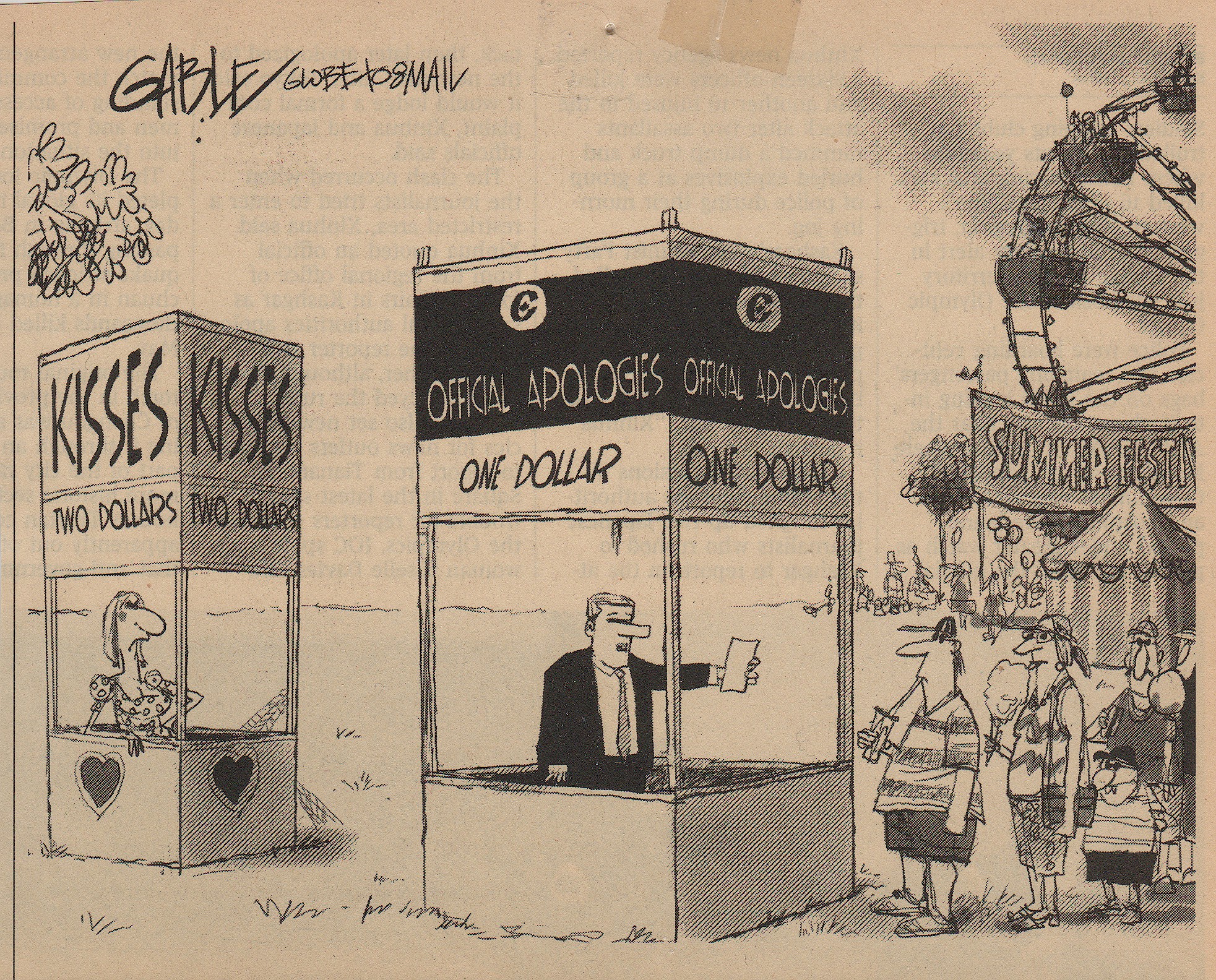
Couldn’t resist posting this cartoon regarding the Harper government’s apologies:

Harper appology cartoon

That being said, there is considerable merit to Marchi’s arguments against apologies, even if the train left the station many governments before. But agree with his proposals to have broader discussions with all groups would be more integrative and inclusive than targeted apologies (and the one to Italian-Canadians is controversial as Michael Petrou’s article indicates The harm done by Justin Trudeau’s apology to Italian-Canadians might require an apology of its own:

Later this month, Prime Minister Justin Trudeau plans to issue a formal apology to the Italian-Canadian community over how some of our fellow citizens were interned during the Second World War. This would his fifth apology for past injustices since being elected prime minister in 2015.

To be fully transparent, while I was an Opposition MP, I, too, argued for apologies towards Japanese and Italian Canadians, based on how they were treated during that war. But I feel differently today.

I have since moved towards former prime minister Pierre Trudeau’s position. He argued that the obligation of a government is not to right the past. In the House of Commons, he stated, “It is our purpose to be just in our times.” He refused to play Monday morning quarterback. He instead encouraged us to learn from history, rather than apologize for it.

Source: Marchi: Apologizing to Italian Canadians — maybe there’s a better way to make amends