Military police investigate dozens of complaints of racism in the Canadian Army

Not all that surprising but encouraging that recent initiative to review cases is bearing some results. And makes sense that all three services should have comparable review to assess extent and measure change:

Military police and civilian law enforcement have investigated up to 70 cases of alleged hateful conduct and racist attitudes within the Canadian Army since a crackdown began in September last year, CBC News has learned.

A briefing prepared for the army’s acting commander last winter and obtained under access to information legislation shows 115 cases were catalogued up until that time, with 57 of them being investigated by military authorities.

Figures updated to the end of August — and released to CBC News — show an additional 28 allegations. Of those, 13 were deemed serious enough to warrant a police investigation.

Source: Military police investigate dozens of complaints of racism in the Canadian Army

ICYMI: Ontario PCs want immigration deal with Ottawa changed

Of note:

Although a provincial election stands between now and when Ontario and Ottawa will decide the terms of a new immigration agreement, the Progressive Conservatives are keen to make changes to the pact that’s up for renegotiation in 2023.

The province’s existing immigration deal with Ottawa was agreed to in 2017, while Justin Trudeau was prime minister, but before Doug Ford’s Progressive Conservatives (PCs) were elected to govern Ontario.

Monte McNaughton, Ontario’s Labour minister, says the PCs want more of a say in which immigrants are allowed to come to Ontario, so they can better leverage them to fill holes in the province’s job market.

“The Liberals have used immigration as as a social tool, and that’s an entirely valid purpose — and one, I want to be clear, that we support, like for family reunification, for example,” McNaughton told iPolitics in a brief interview on Thursday.

“But to me, immigration is one of the key economic drivers of Ontario’s growth, and one that can be used strategically to fill critical gaps in labour supply and to create more jobs.”

Ontario usually takes in more than 125,000 immigrants each year, but it’s allowed to nominate fewer than 9,000 potential immigrants each year through the Ontario Immigrant Nominee Program (OINP), the main mechanism the province uses to attract the skilled workers it lacks domestically.

The federal government has to approve the province’s OINP nominees, because the former is responsible for Canada’s borders and for assigning citizenship and permanent residency.

The PCs have changed the OINP by improving its intake system and giving more priority to workers in health care and the skilled trades, but they want Ottawa to allow Ontario more autonomy in the system, and to double the number of nominees it’s allotted.

McNaughton has already spoken to Sean Fraser, Canada’s new minister of Immigration, Refugees and Citizenship, but the two haven’t had the chance to meet officially yet. McNaughton said their first formal tête-à-tête could happen as soon as next week, which is when he’d start appealing to Fraser with the PCs’ requests.

A year ago, the federal Liberals set higher immigration goals, including increasing the number of permanent residents from 351,000 to 401,000 this year, and from 361,000 to 411,000 in 2022.

The Liberals also promised in the recent election campaign to reform economic-immigration programs and to recognize more foreign job credentials.

On a similar front, McNaughton tabled a bill on Monday to recognize the licences of foreign workers in nearly two dozen trades in Ontario.

Source: Ontario PCs want immigration deal with Ottawa changed

Dutrisac: Le pis-aller (Temporary Foreign Workers and Quebec agreement and exception for their children to study in French)

More complaints regarding IRCC’s treatment of Quebec applicants. Not seeing much evidence in the data for Temporary Foreign Workers:

En août dernier, Québec et Ottawa concluaient une entente en vue d’alléger les exigences que le gouvernement fédéral impose aux entreprises qui recourent à des travailleurs étrangers temporaires (TET) dans certains types d’emplois. Le ministre québécois du Travail, de l’Emploi et de la Solidarité sociale, Jean Boulet, vient de dévoiler les détails des assouplissements qui découlent de cette entente et qu’il demande maintenant au fédéral d’avaliser.

Ces mesures, qui feront l’objet d’un projet pilote, sont particulières en ce sens qu’elles ne visent pas seulement des emplois qualifiés à 100 000 $ par an dont rêve François Legault, mais aussi des gagne-pain modestes dans des domaines toutefois frappés par des pénuries de main-d’œuvre.

À la fin octobre, la Commission des partenaires du marché du travail, un organisme qui regroupe patrons et syndicats, a dégagé un consensus et confectionné une liste de 71 métiers et occupations qui doivent faire l’objet d’un traitement simplifié des demandes. Le commerce de détail, l’hébergement, la restauration et la transformation alimentaire font partie des secteurs favorisés. On y trouve des caissiers d’épicerie, des manutentionnaires, des préposés à l’entretien, des manœuvres et des serveurs, mais aussi des opérateurs de machinerie, dont les postes sont mieux rémunérés.

Un des problèmes touchant ces travailleurs étrangers, c’est qu’ils se voient accorder par le gouvernement fédéral des permis de travail dits « fermés », c’est-à-dire liés à un seul employeur, ce qui les rend vulnérables et les expose à des abus de la part de patrons exploiteurs. Cette situation est exacerbée par le fait que ces travailleurs ne connaissent pas leurs droits et peuvent avoir de la difficulté à communiquer en français ou en anglais.

Le ministre s’est montré sensible à la situation. Il a fait adopter des modifications à la Loi sur les normes du travail assorties d’un règlement sur les agences de recrutement auxquelles les entreprises font appel. Ces agences, dont les pratiques, dans certains cas, étaient douteuses, doivent désormais détenir un permis. Elles sont dans l’obligation de fournir aux travailleurs une description des conditions de travail relatives à leur emploi ainsi que des documents d’information de la Commission des normes, de l’équité, de la santé et de la sécurité du travail (CNESST) qui portent sur leurs droits et les obligations de l’employeur. Ces documents existent maintenant en français, en anglais et en espagnol.

Comme il l’a fait pour les travailleurs étrangers agricoles, le ministre a formé au sein de la CNESST une escouade TET vouée à enquêter sur les plaintes concernant d’éventuels abus et contraventions aux normes du travail.

Sans que ce soit une garantie que les travailleurs seront toujours bien traités, il s’agit d’une nette amélioration. En outre, les employeurs se sont engagés, même pour les emplois moins rémunérés, à fournir aux nouvelles recrues le transport, le logement et la couverture de la Régie d’assurance maladie du Québec (RAMQ).

Cet afflux accru de travailleurs étrangers, dans la région de Montréal du moins, réjouira les commissions scolaires anglophones, qui trouveront sans doute, quand les travailleurs sont accompagnés de leur famille, un certain nombre d’enfants pour peupler leurs écoles. Contrairement aux immigrants, ces travailleurs temporaires ne sont pas soumis à la Charte de la langue française et peuvent envoyer leurs enfants à l’école anglaise.

C’est une anomalie qu’il faudrait corriger. Le gouvernement Legault voudrait d’ailleurs qu’Ottawa lui cède la gouverne du programme des TET, qu’il pourrait harmoniser avec ses responsabilités en matière d’immigration. À cet égard, Le Journal de Montréal nous apprenait que Service Canada ne répond plus à la demande en provenance des entreprises du Québec. Celles-ci doivent toujours produire une fastidieuse « étude d’impact sur le marché du travail » pour chacun des emplois offerts, tandis que les fonctionnaires fédéraux n’arrivent pas à traiter les dossiers en temps utile.

Le recours aux travailleurs étrangers temporaires est un pis-aller qui témoigne d’un système d’immigration grippé. Le programme québécois Arrima, qui consiste à lancer des invitations à des candidats à l’immigration en fonction des besoins du marché de travail, n’est pas fonctionnel. De toute façon, Immigration Canada, dont le dysfonctionnement est manifeste, ne parvient même pas à accorder la résidence permanente aux dizaines et dizaines de milliers d’immigrants détenteurs d’un certificat de sélection du Québec qui sont déjà sur le territoire québécois. En recruter de nouveaux par le truchement d’Arrima ne ferait qu’ajouter aux inexcusables délais, de 28 mois en moyenne, dont est responsable le gouvernement fédéral.

Source: Le pis-aller

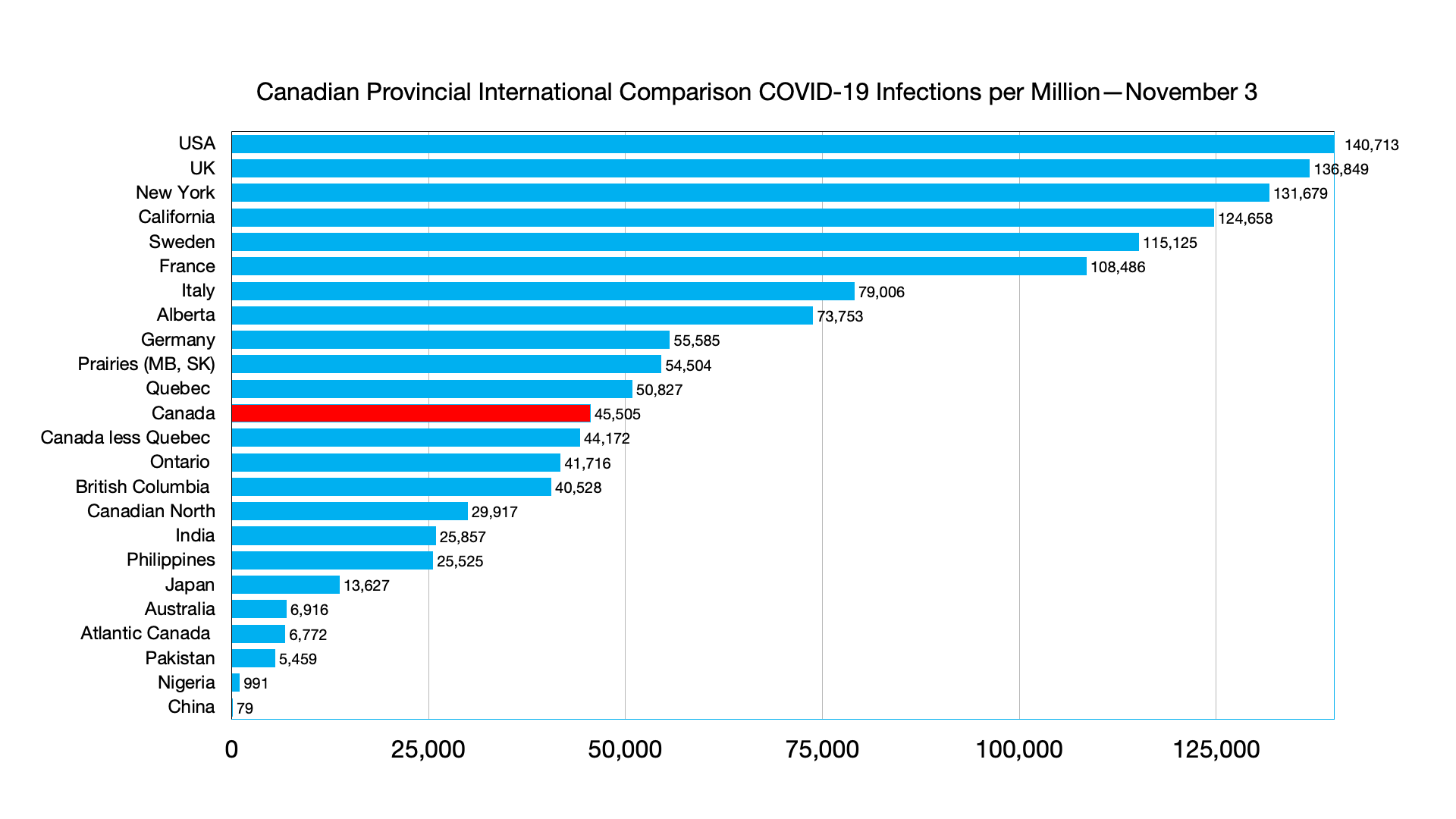
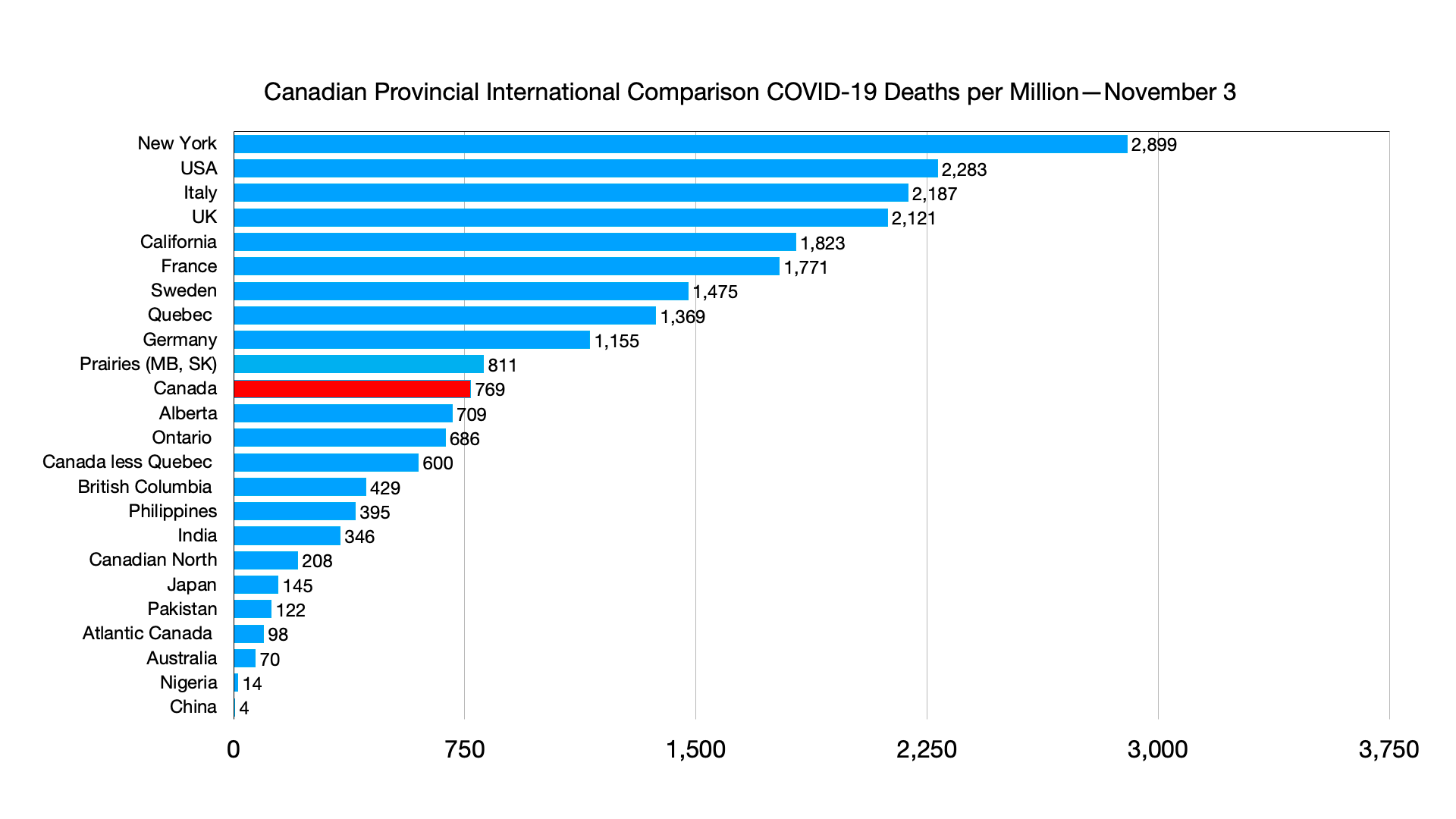
#COVID-19: Comparing provinces with other countries 3 November Update

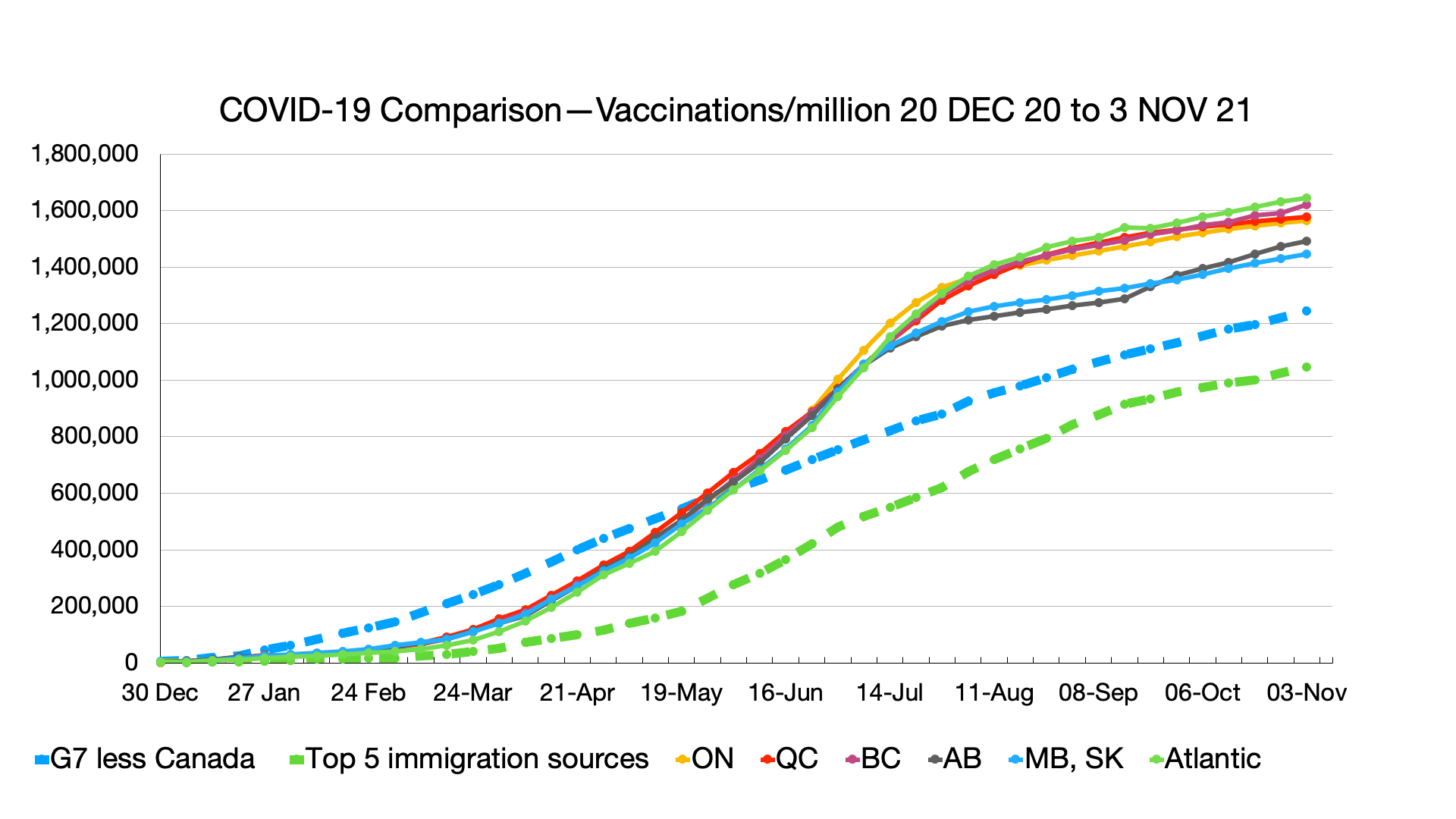
The latest charts, compiled 27 October. Canadians fully vaccinated 75.4 percent, higher than USA 58.7 percent and the UK 68.4 percent).

Vaccinations: Quebec and UK are now ahead of the Canadian North, where few vaccinations took place. Australia now ahead of New York. China fully vaccinated 76.6 percent, India 24.4 percent.

Trendline Charts:

Infections: The chart shows the number of infections in Alberta continues to level off unlike the Prairies or British Columbia.

Deaths: Alberta deaths, along with the Prairies albeit to a lesser extent, continue to climb.

Vaccinations: Alberta vaccinations continue to surpass the Prairies. Immigration source country vaccination rates starting to increase again given India’s acceleration of its vaccination program.

Weekly

Infections: Australia ahead of Atlantic Canada.

Deaths per million: No relative change.

And a good piece on what the UK did wrong (applies to a number of Canadian provinces):

There are downsides to most Covid-19 precautions. Keeping children home from school can cause them to fall behind. Working from home can impede creativity. Staying away from friends and relatives can damage mental health. Wearing masks can muffle speech, hide smiles and fog eyeglasses.

For all of these reasons, the ideal Covid policy for any society balances the benefits and costs of precautions. It acknowledges that excessive caution can do more harm than good. By now, regular readers will recognize the search for Covid balance as a theme of this newsletter. Today, we want to focus on a place that seems to be erring on the side of too little caution: Britain.

Over the past year, Britain’s Covid response has included some major victories. The country rushed to vaccinate people (as we’ve explained) and was also willing to reimpose behavior restrictions last winter. These measures helped cause a sharp drop in caseloads.

In response, Britain reopened over the summer, allowing people to live largely without restrictions. Schools and workplaces have returned to normal, without masks. Restaurants are booked. Finding a taxi on a Saturday night in Central London is again a challenge.

“There’s a feeling that finally we can breathe,” Devi Sridhar, the head of the global public health program at the University of Edinburgh, wrote in August. “We can start trying to get back what we’ve lost.”

The problem is that Britain now seems to have lost a sense of balance, as Sridhar has also suggested. Cases have surged this fall, more so than in the rest of Europe, the U.S. or many other countries. Yet Prime Minister Boris Johnson’s government continues to oppose measures that could reduce cases.

We want to focus on Britain partly because it can offer lessons for the U.S. and other countries. The Delta variant arrived in Britain earlier than in many other places, making it something of a leading indicator. Cases in Britain rose for about two months starting in May and then started falling. But the decline didn’t last:

Over the past week in the U.S., cases have also stopped falling. The reasons are not clear, as is often the case with Covid, and the recent increase is minuscule. But it’s a reminder that the pandemic will probably keep having ups and downs.

Experts say Britain seems to be making three main mistakes that are aggravating the pandemic.

Despite being ahead of most of Europe on vaccinating adults, Britain waited to approve vaccines for adolescents. It did not recommend vaccinating 12- to 15-year-olds until September, weeks after many students had returned to school, as our colleague Josh Holder has noted. Today, only 21 percent of 12- to 15-year-olds in England are vaccinated, compared with 80 percent of adults.

The U.S. faces a related challenge. About 57 percent of Americans age 12 to 15 have been vaccinated, and children 5 to 11 are on the verge of becoming eligible. A significant number of parents remain wary, partly because Covid is rarely severe in children. But vaccinating children — in addition to the individual benefits — is likely to hold down cases for everyone else.

The biggest problem in the U.S. is a vaccination rate lower than in most other high-income countries.

The pace at which vaccines lose their effectiveness remains a subject of intense debate. Most experts believe that the vaccines remain excellent at preventing severe illness, even months after shots are given. But the bulk of the evidence suggests that the vaccines do lose some of their ability to prevent at least mild infections. That’s especially true of the AstraZeneca vaccine, which has been widely used in England.

Britain’s initial speed at vaccinating people brought down caseloads early this year. Yet it also meant that waning immunity became a problem sooner than in countries that were slower to give shots. Britain is now offering boosters to people 50 and above, as well as health care workers and the medically vulnerable.

Over the next few months, waning immunity could become a growing problem in the U.S., especially for more vulnerable people. All Americans 65 and above are eligible for boosters, along with anybody who received the Johnson & Johnson vaccine and some other people.

Behavior restrictions — like mask wearing — are not as effectiveas their proponents sometimes suggest. Britain offers a case study: Scotland, where masks are often mandated, has a similar level of Covid spread as England, where masks are less common, as John Burn-Murdoch of The Financial Times has written. If masks determined Covid spread, Scotland’s rate would be lower than England’s.

But there is a difference between a precaution having a modest effect and no effect. Masks do help, according to a wide variety of evidence, even if their impact is sometimes overwhelmed by other factors. Britain seems to be suffering from a lack of almost any restrictions, including mask mandates. Among the biggest problem, Burn-Murdoch notes, is the number of crowded indoor gatherings across Britain, including Scotland.

When cases are falling, it often makes sense to let people live more freely. When cases are surging, the reverse is true. Britain is ignoring that lesson — and pleas from many experts.

Britain’s recent Covid policy has led to deaths and overwhelmed hospitals. “When a health care system fails, increasing numbers of people suffer and die needlessly,” Dr. Kenneth Baillie wrote on Twitter. “This is happening, now, all over the U.K.”

Still, it is worth putting Britain’s troubles in perspective. The country’s high vaccination rate means that only a tiny share of recent cases have led to severe illness, and the death rate this fall has been a fraction of what it was last winter. “This virus is going to be with us for years, if not the rest of our lives,” Willem van Schaik, a microbiologist at the University of Birmingham in England, told us. “We’ve definitely left the worst behind us.”

Despite the Covid surge in Britain, the U.S. — where the overall vaccination rate is lower — arguably remains in worse shape, with a considerably higher death rate per capita. Why? Vaccination rates still matter more than anything else.

Source: https://www.nytimes.com/2021/11/02/briefing/britain-covid-cases-restrictions.html

Mohamad Fakih and Walied Soliman made legal history. Now it’s harder for haters to have their way

Good for them and all of us:

Mohamad Fakih owns a restaurant chain and is a big Liberal backer.

Walied Soliman heads a law firm and chairs Conservative campaigns.

In their political tastes, the restaurateur and the lawyer couldn’t be more different.

But both are Muslims.

Which was enough for them to be targeted for hateful libels accusing them of being closet terrorists. Personally harangued and persecuted for no reason beyond their faith, they were publicly vilified and personally victimized.

Yet both refused to play victim. Today, each is victorious.

In two separate libel cases, they made legal history last month. By calling their persecutors to account — and forcing the legal system to act — they have made it harder for haters to get away with screaming bloody murder in public.

Soliman won a precedent-setting $500,000 defamation award against social media agitator Daniel Bordman, who had publicly accused him of harbouring crypto-Islamist terrorist links and hiding “secret” antisemitism. The case against Bordman was so compelling that the ruling came in a summary judgment (without going to full trial due to the damning evidence).

Separately, Fakih finally saw justice done when a failed Mississauga mayoral candidate, Kevin Johnston, was sentenced to 18 months in jail for contempt of court — after failing to abide by the terms of a $2.5 million libel judgment against him two years ago (and continuing to spew venom).

What unites Soliman and Fakih, apart from their shared faith and charitable works, is that both paid a personal price in public harassment for their high profiles. And for the sin of being successful in their work.

At the intersection of religion and Islamophobia, power and privilege, they found themselves at an inflection point. They could turn the other cheek, and let others fight the battle against bigotry, or they could push back against their persecutors.

“The first instinct is to ignore it,” Soliman told me. “It’s very easy for privileged people — who have the ability to fight — to say it isn’t worth it.”

But as chair of the Norton Rose Fulbright Canada law firm, who has served as campaign chair for both the Ontario and federal Tories, Soliman knew he had no excuse to do nothing. The libels falsely claimed he had “connections to the Muslim Brotherhood” and wanted to impose Islamic “sharia law to … override Canadian law,” the judge noted.

“I hate being the victim, I hate that role,” Soliman said. “If we don’t fight those battles, then who is going to set the precedents?”

To silence his bilious antagonist, Soliman turned to a rival lawyer against whom he is often pitted in legal battles over mergers and acquisitions, but whose judgment he deeply respects: Jonathan Lisus not only agreed to take on the case, but insisted on doing it at no charge.

Let’s connect a few dots here — not conspiracies but connections: Lisus happens to be a Jewish lawyer who took on the case of Soliman, a Muslim lawyer, to shield him against the lies and libels of Bordman — a Jewish social media provocateur falsely accusing Soliman of antisemitism.

But there’s another link. Lisus also fought and won the libel action of Fakih, setting not one but two major precedents with cases that, combined, should give pause to all hate-mongers:

“If you are going to engage in defamatory hate speech, you can lose everything,” Soliman concludes.

Fakih came to Canada from war-torn Lebanon in 1996 (having covered that conflict at that very time as a foreign correspondent, I know where he’s coming from). He savoured the seeming paradise of his adopted country, and revelled in his spectacular success founding the Paramount Fine Foods chain.

But with paradise, and Paramount, came the bizarre torment from Johnston, the failed politician and provocateur (who placed second to Mississauga Mayor Bonnie Crombie, winning 13.5 per cent of the vote in 2017). Post-Lebanon, Fakih didn’t see it coming.

“I lived the Canadian dream, I always thought it would never happen in Canada,” he told me. “It was a shock, and it helped me grow up.”

Like many immigrants, Fakih wondered if he would somehow seem like an ungrateful troublemaker for pushing. But when he was called a child killer, with doctored pictures showing “blood on my face,” after hosting a Liberal party fundraiser for Prime Minister Justin Trudeau in 2017, he had to protect his family — and his fellow Canadians — from the injustices and indignities.

“I wanted to show them I would not stay silent, that I would stand up to bullying … and live with dignity in front of my children,” Fakih explains. “Coming from a country like Lebanon, I am not a victim, it’s my duty to take them on.”

He won the multimillion-dollar defamation judgment against Johnston in 2019, but it was a hollow victory. Unsurprisingly, Johnston never paid up, but he shockingly refused to shut up — continuing to defame him publicly.

“I thought there would be accountability,” Fakih said. And so he went back to court a second time, this time to hold the justice system itself to account — and won another victory with the jail sentence, four years after he first came under attack.

Fakih’s story does not yet have a happy ending, for it is seemingly never-ending — the bigotry keeps coming back. Just as he had to deal with a defendant who refused to stop libeling him, so too Soliman has had to contend with one Islamophobic attack after another — most recently in last year’s federal Conservative leadership race (best leave his attacker nameless lest he profit from the attention).

Still, the legal precedents that Fakih and Soliman have established, each in their own way, will make it easier for those who follow to win in court. The personal examples they have set will also make it harder for haters to have their way.

But it is the resilience they have shown — by refusing to be victims after being victimized for so long — that may be their lasting legacy. Singled out for being Muslims, they both stood their ground without losing faith — either in their religion, or their country.

Source: https://www.thestar.com/politics/political-opinion/2021/11/01/mohamad-fakih-and-walied-soliman-made-legal-history-now-its-harder-for-haters-to-have-their-way.html

The 2020 census likely left out people of color at rates higher than a decade ago

Of note:

Last year’s approximately $14.2 billion census likely undercounted people of color at higher rates than those of the previous once-a-decade tally, an Urban Institute study released Tuesday suggests.

Researchers at the Washington, D.C.-based think tank say that while the Census Bureau may have continued to overcount people who identified as white and not Latino, it also likely failed to count some 2.5 million people in other racial and ethnic groups.

The Urban Institute estimates that nationwide, the net undercount rates by race or ethnicity were highest for Black people (2.45%), Latinx people (2.17%) and Pacific Islanders (1.52%). The estimated net undercount rates for Asian Americans and Native Americans were each less than a percent.

The study, which cites NPR’s reporting, also finds last year’s net undercount rate for children under 5 (4.86%) is likely higher than what is considered the bureau’s most reliable 2010 estimate. The net undercount rate for renters may have almost doubled over the past decade to 2.13%, and for households with noncitizens, that rate may have been as high as 3.36%.

The Urban Institute’s method for calculating the national head count’s accuracy is different from what the Census Bureau uses. The think tank’s new figures come months before the bureau is set to start releasing its over- and undercount estimates from a follow-up survey for a census that was disrupted by the coronavirus pandemic and interference from former President Donald Trump’s administration, including a failed push to add a citizenship question.

“In a decennial census where there was a lot of uncertainty, I think it’s increasingly important to have external benchmarks on census data so we know, for example, if states need to rethink how they allocate resources within their state,” Diana Elliott, one of the Urban Institute report’s co-authors, says of how each state’s share of federal funding is determined in part by census results.

To produce their estimates, researchers with the Urban Institute used census participation rates, national survey results and other data to simulate results of last year’s national head count.

One of the report’s advisers — Robert Santos, who is the Urban Institute’s chief methodologist — is also President Biden’s nominee for Census Bureau director.

Source: The 2020 census likely left out people of color at rates higher than a decade ago

How Big Business Got Woke and Dumped Trump

Good long read:

The CEOs started calling before President Trump had even finished speaking. What America’s titans of industry were hearing from the Commander in Chief was sending them into a panic.

It was Nov. 5, 2020, two days after the election, and things weren’t looking good for the incumbent as states continued to count ballots. Trump was eager to seed a different narrative, one with no grounding in reality: “If you count the legal votes, I easily win,” he said from the lectern of the White House Briefing Room. “If you count the illegal votes, they can try to steal the election from us.”

The speech was so dangerously dishonest that within a few minutes, all three broadcast television networks spontaneously stopped airing it. And at his home in Branford, Conn., the iPhone belonging to the Yale School of Management professor Jeffrey Sonnenfeld began to buzz with calls and texts from some of the nation’s most powerful tycoons.

The CEOs of leading media, financial, pharmaceutical, retail and consulting firms all wanted to talk. By the time Tom Rogers, the founder of CNBC, got to Sonnenfeld, “he had clearly gotten dozens of calls,” Rogers says. “We were saying, ‘This is real—Trump is trying to overturn the election.’ Something had to happen fast.”

For decades, Sonnenfeld has been bringing business leaders together for well-attended seminars on the challenges of leadership, earning a reputation as a “CEO whisperer.” A committed capitalist and self-described centrist, he has informally advised Presidents of both parties and spoke at Senate GOP leader Mitch McConnell’s wedding. Now he suggested the callers get together to make a public statement, perhaps through their normal political channels, D.C. industry lobbies such as the U.S. Chamber of Commerce and the Business Roundtable (BRT). But the CEOs wanted Sonnenfeld to do it; the trade groups, they fretted, were too risk-averse and bureaucratic. And they wanted to do it right away: when Sonnenfeld, who issues invitations for his summits eight months in advance in order to secure a slot on CEOs’ busy calendars, suggested a Zoom call the following week, they said that might be too late.

The group of 45 CEOs who assembled less than 12 hours later, at 7 a.m. on Nov. 6, represented nearly one-third of Fortune’s 100 largest companies: Walmart and Cowen Inc., Johnson & Johnson and Comcast, Blackstone Group and American Airlines. Disney’s Bob Iger rolled out of bed at 4 a.m. Pacific time to join, accompanied by a large mug of coffee. (Sonnenfeld, who promised the participants confidentiality, declined to disclose or confirm their names, but TIME spoke with more than a dozen people on the call, who confirmed their and others’ participation.)

The meeting began with a presentation from Sonnenfeld’s Yale colleague Timothy Snyder, the prominent historian of authoritarianism and author of On Tyranny. Snyder did not beat around the bush. What they were witnessing, he said, was the beginning of a coup attempt.

“I went through it point by point, in a methodical way,” recalls Snyder, who has never previously discussed the episode. “Historically speaking, democracies are usually overthrown from the inside, and it is very common for an election to be the trigger for a head of state or government to declare some kind of emergency in which the normal rules do not apply. This is a pattern we know, and the name for this is a coup d’état.” What was crucial, Snyder said, was for civil society to respond quickly and clearly. And business leaders, he noted, have been among the most important groups in determining whether such attempts succeeded in other countries. “If you are going to defeat a coup, you have to move right away,” he says. “The timing and the clarity of response are very, very important.”

A lively discussion ensued. Some of the more conservative executives, such as Blackstone CEO Stephen Schwarzman, wondered if the threat was being overstated, or echoed Trump’s view that late ballots in Pennsylvania seemed suspicious. Yet others corrected them, pointing out that COVID-19 had led to a flood of mail-in ballots that by law could not be counted until the polls closed. By the end of the hour, the group had come to agreement that their normal political goals—lower taxes, less regulation—weren’t worth much without a stable democracy underpinning them. “The market economy works because of the bedrock foundation of the rule of law, the peaceful succession of power and the reserve currency of the U.S. dollar, and all of these things were potentially at risk,” former Thomson Reuters CEO Tom Glocer tells TIME. “CEOs are normally hesitant to get involved in political issues, but I would argue that this was a fundamental business issue.”

The group agreed on the elements of a statement to be released as soon as media organizations called the election. It would congratulate the winner and laud the unprecedented voter turnout; call for any disputes to be based on evidence and brought through the normal channels; observe that no such evidence had emerged; and insist on an orderly transition. Midday on Nov. 7, when the election was finally called, the BRT immediately released a version of the statement formulated on Zoom. It was followed quickly by other trade groups, corporations and political leaders around the world, all echoing the same clear and decisive language confirming the election result.

Sonnenfeld thought the hastily convened “Business Leaders for National Unity,” as he’d grandly dubbed the 7 a.m. call, would be a one-off. But Trump’s effort to overturn the election persisted. So in the ensuing weeks, the professor called the executives together again and again, to address Trump’s attempt to interfere with Georgia’s vote count and the Jan. 6 Capitol insurrection. “This was an event which violated those rituals of America and created a visceral reaction,” Nick Pinchuk, CEO of the Kenosha, Wis.–based toolmaker Snap-on, tells TIME. “Talking about this, it kind of transformed from the realm of politics to the realm of civic duty. CEOs wanted to speak out about this, and Jeff gave us a way to do that.”

To Sonnenfeld, the effort—much of which has not been previously reported—underlined a generational shift taking place in the collective civic attitudes of the CEO class. Its effects are evident in Washington, where Big Business’s longtime alliance with the Republican Party is foundering. Congressional Republicans have divorced the Chamber of Commerce; the GOP’s corporate fundraising is diminished; Fox News anchors and conservative firebrands rant about “woke capital” and call for punitive, anti-free-market policies in retaliation. Many of the companies and business groups that implacably resisted Barack Obama have proved surprisingly friendly to Biden, backing portions of his big-spending domestic agenda and supporting his COVID-19 mandates for private companies. Political observers of both parties have tended to attribute these developments to the pressures companies face, whether externally from consumers or internally from their employees. But Sonnenfeld, who is in a position to know, argues that just as much of it comes from the changing views of the CEOs themselves.

Snyder, the scholar of authoritarianism, believes the CEOs’ intervention was crucial in ensuring Trump left office on schedule, if not bloodlessly. “If business leaders had just drifted along in that moment, or if a few had broken ranks, it might have gone very differently,” he says. “They chose in that moment to see themselves as part of civil society, acting in the defense of democracy for its own sake.”


It was perhaps inevitable that Trump, the corporate-showman President, would force the private sector to reconsider its duty to society—and that Sonnenfeld would be the one to force the issue. For 2020 was not the two men’s first confrontation. Back in the mogul’s reality TV days, the business guru was a harsh critic—before burying the hatchet and giving Trump the idea for Celebrity Apprentice.

A Philadelphia native, Sonnenfeld, 67, was drawn from an early age to the human side of business. “He was always irrepressible, uninhibited—just a barrel of monkeys,” recalls the public relations guru Richard Edelman, who rowed crew with Sonnenfeld at Harvard. “You always knew he would be either a politician or a professor, not one of the gray-suited soldiers coming out of Harvard Business School.”

Sonnenfeld authored several scholarly publications before his 1988 book, The Hero’s Farewell: What Happens When CEOs Retire, became a surprise best seller. CEOs sought his counsel, and he realized they were starving for such insights: surrounded by subordinates and yes-men, powerful executives had plenty of opportunities to pontificate but few venues for learning from their peers. Yet Sonnenfeld’s interest in leadership psychology was unfashionable in an M.B.A. field focused on the technical workings of companies and markets. Denied tenure at Harvard, he started his “CEO College” at Emory University in 1989. After a decade, he moved it to Yale, where his Chief Executive Leadership Institute helped put its School of Management on the map. Today, Sonnenfeld’s executive seminars have many imitators, including CEO summits put on by Forbes, Fortune, Bloomberg and the New York Times.

When The Apprentice premiered in 2004, Sonnenfeld reviewed it for the Wall Street Journal. The show, he wrote, was teaching aspiring leaders precisely the wrong lessons while fueling public disdain for business. “The selection process resembles a game of musical chairs at a Hooters restaurant,” he wrote. “No new goods or services are created, no business innovations surface, and no societal problems are solved.” A real-life leader who tried to run a business that way would quickly fail, he added.

Trump fired back, insulting Sonnenfeld as a know-nothing academic. But he also tried to win him over, offering Sonnenfeld the presidency of Trump University, which he turned down, and an invitation to his Westchester golf club, which he accepted. Over lunch, Sonnenfeld said he’d stop criticizing the show if the players were cranky B-list celebrities instead of earnest young strivers. Trump liked the idea, and the following season he transitioned to an all-celebrity cast.

Sonnenfeld finally gave in to Trump’s pestering and invited him to one of his CEO summits at New York’s Waldorf Astoria hotel. “You would have thought it was the Pope, people were so amazed,” Sonnenfeld recalls. “But at the same time, the top tier of CEOs told me, ‘When he walks in, we’re walking out.’ And they did.” After Trump won the presidency, Sonnenfeld paid him a visit at Trump Tower and reminded him of the incident. “Funny thing about that, Jeff,” Trump said, “they’re all coming by here now.”

Over the course of the 2016 campaign, Sonnenfeld’s surveys of his seminar participants found that although around 75% identified as Republicans, 75% to 80% supported Hillary Clinton, he says. And while many were optimistic about Trump’s pro-business Administration, their enthusiasm soon dimmed. It wasn’t just the chaotic way he operated; he seemed determined to pit them against one another. “I started hearing from the CEOs of Lockheed and Boeing, saying, ‘Wait, he’s trying, over chocolate cake at Mar-a-Lago, to get a fight going between us over the cost of a fighter jet,’” Sonnenfeld recalls. It was the same with Ford vs. GM, Pfizer vs. Merck.

Sonnenfeld realized Trump was repeating the tactics from The Apprentice,the same zero-sum mentality that had buoyed him to political success: divide and conquer. “Trump’s whole modus operandi, his one trick his whole life, is to break collective action,” Sonnenfeld says. “The whole NAFTA battle was pitting Canada against Mexico. He constantly tried to divide France and Germany, the U.K. vs. the E.U., Russia vs. China. He tried to build up Bernie vs. Hillary, just like he did with the Republican primary candidates. As pathetically puerile a device as it is, with the GOP it worked magnificently well.”

But business leaders, unlike the Republicans, banded together to resist. In August 2017, when Trump opined that there were “very fine people on both sides” of the deadly white-supremacist march in Charlottesville, Va., Merck CEO Kenneth Frazier, who is Black, announced that he would step down from Trump’s American Manufacturing Council. Others—some prodded by Sonnenfeld behind the scenes—quickly followed. Within a few days, that council, along with another business advisory group, had disbanded. It was, Sonnenfeld says, the first time in history that the business community turned its back on a President’s call to service.

“He lost the business community in Charlottesville,” says Matthias Berninger, who heads public affairs for Bayer. “Ken leaving his council, that was the starting point of everything that followed.” Deregulatory actions Trump expected Big Business to appreciate were rebuffed: oil and gas companies publicly opposed his repeal of methane regulations, and many utilities shrugged off his rollback of CO₂ limits. The auto industry united against Trump’s attempt to eliminate mileage standards, only to be investigated by the Department of Justice.

Trump’s antagonism to immigration and free trade ran counter to business’s interests, says the D.C. corporate fixer and former GOP strategist Juleanna Glover. “Many corporations and CEOs had an abiding fear of being attacked in a Trump tweet, so staying out of Washington was a good risk-mitigation strategy,” she says. “The Republicans have largely abandoned their pro-business values, and it’s hard to negotiate in good faith when one of the parties is seen as continuing to undermine democratic values.”


Trump may have been the catalyst. But the recent shift of the corporate class is only the latest in the long history of Big Business’s dance with Washington.

While many remember the robber barons of the Gilded Age, the same era produced a generation of innovative entrepreneurs (Thomas Edison, Luther Burbank) who were folk heroes. “The business leaders of the early to mid-1900s were the original ‘progressives,’” Sonnenfeld says. “They were for infrastructure, sustainability, safe workplaces, urban beautification, immigration.” Midcentury CEOs saw themselves as patriotic industrialists, allies of government and builders of society. During- the World Wars, they famously answered the call to contribute. Republican President Dwight Eisenhower appointed three sitting CEOs to his Cabinet.

By the 1970s, pollution and price-fixing scandals had tanked Big Business’s image. A few CEOs decided to break with the conservative politics of the U.S. Chamber of Commerce and the National Association of Manufacturers and came together to found the BRT. But the succeeding generation, in Sonnenfeld’s view, didn’t live up to the BRT’s original promise of civic virtue, focusing instead on attacking government interference and avoiding taxation. “It wasn’t that we had a few bad apples,” Sonnenfeld says. “There’s something wrong with the whole orchard in that period.”

The tech bust, corporate scandals such as Enron and the 2008 financial crisispushed Americans’ esteem of business to historic lows. When the Obama Administration tried to get health care companies on board with the Affordable Care Act, not a single member of the industry came to the table. “They were like little kids throwing stones and hiding in the hedges,” Sonnenfeld says. “The business community was not trying to solve problems.”

But over the past decade, Sonnenfeld believes, a new generation of leaders has stepped into the public sphere to do well by doing good. In 2015, opposition from corporations like Eli Lilly and Anthem helped kill a proposed Indiana state law that would have allowed businesses to refuse to serve gay people. The following year, American Airlines, Microsoft and GE were among the companies protesting a North Carolina ordinance barring transgender people from using their preferred bathrooms. Similar bills were defeated in Texas and Arkansas. The business leaders who thwarted these efforts weren’t just stereotypically “liberal” corporate behemoths like Apple, Starbucks and Nike, Sonnenfeld notes. “It was the bedrock of traditional American industry in the heartland: UPS, Walmart, AT&T. They’re the ones who led the charge, saying, ‘This is not America. We don’t want our workforces divided over this.’”

Today, Wall Street firms grade companies on their climate and diversity initiatives as well as their balance sheets. In the wake of the 2018 mass shooting in Parkland, Fla., both Dick’s Sporting Goods and Walmart announced they would no longer sell assault weapons or ammunition. Dozens of companies cut ties with the NRA. In 2019, the BRT revised its charter to redefine “the purpose of a corporation,” saying companies should be accountable not only to their shareholders but also to the wider array of “stakeholders,” including customers, employees, suppliers and communities.

“The role of the CEO has changed, and I don’t think anyone can sit on the sidelines,” says Paul Polman, the London-based former CEO of the consumer-goods giant Unilever, whose new book, Net Positive, argues that sustainability can go hand in hand with profit—one of a raft of recent do-gooder tomes by CEOs (including Salesforce CEO Marc Benioff, the co-owner of TIME). Under Polman’s leadership, Unilever set ambitious climate goals and sought to improve its human-rights record, lobbying against the death penalty for gay people in Uganda and deforestation in Brazil. “Smart CEOs realize that their business cannot function in societies that don’t function,” Polman tells TIME. “We have to be responsible and speak up, not just lobby in our own self-interest.”

Skeptics on the left see this kind of talk as cynical posturing. Democratic Senator Elizabeth Warren denounced the BRT’s “stakeholder” announcement as an “empty gesture,” and former Labor Secretary Robert Reich called it a “con.” Many of the statement’s signatories, liberals note, still preside over abysmal working conditions, environmental violations and racially segregated workplaces, while employing armies of lobbyists to resist government attempts to hold them accountable.

The right has revolted as well. GOP Senator Marco Rubio decries “woke corporate hypocrites,” while Trump has taken up the slogan “Go woke, go broke!” In the new book Woke, Inc., Vivek Ramaswamy, a tech entrepreneur turned self-styled class traitor, decries “corporate America’s game of pretending to care about justice in order to make money.”

The public, too, appears skeptical. In recent research conducted by Edelman, 44% of Americans say they trust CEOs to do the right thing, about on par with government leaders (42%) but lagging behind clergy (49%) and journalists (50%). A far greater share, nearly three-quarters of employees, trust the CEO of the company they work for.


In the spring of 2020, as the spread of COVID and Trump’s attempt to undermine the vote began to raise fears of an election meltdown, Sonnenfeld began privately raising the issue with prominent CEOs. He urged them to promote political participation to their employees and customers. For the first time, thousands of companies gave millions of workers paid time off to vote and volunteer at the polls. By October 2020, you could scarcely visit a retailer or open a mobile app without encountering a pro-voting, nonpartisan corporate message.

After the CEOs’ Nov. 7 statement, many—including Sonnenfeld—assumed their work was done. Despite Trump’s refusal to concede, dozens of courts rejected his challenges, all 50 states certified their electoral votes, and the presidential transition began. But on Jan. 3, the Washington Post published a recording of Trump’s phone call to Georgia secretary of state Brad Raffensperger, in which he cajoled and berated the election official to “find” the nearly 12,000 votes it would take to reverse his loss of the state.

So on Jan. 5, Sonnenfeld reconvened his executives. This Zoom was better attended than the first, with nearly 60 CEOs—and more concerned. Nobody quibbled with the “coup” terminology this time. There were CEOs Sonnenfeld had never met who had demanded invites after hearing about the November call. There were right-wing executives and former Obama and Bush Cabinet secretaries. The group voted unanimously to suspend donations to the GOP members of Congress who contested the election.

The next day, Jan. 6, validated their fears. In the aftermath of the Capitol riot, the group met again, and this time, 100% of the CEOs favored impeachment, Sonnenfeld says. The National Association of Manufacturers, known as the most conservative of the major trade lobbies, subsequently called for impeachment publicly, to the political world’s astonishment. Nearly a year later, 78% of the companies that pledged to withhold donations have kept true to their word, according to Sonnenfeld’s analysis of the latest campaign-finance data. One D.C.-based fundraiser for Republican candidates tells TIME she has virtually given up seeking money from corporate PACs as a result.

Sonnenfeld’s efforts didn’t end with Biden’s Inauguration. He was particularly disturbed by the election law the Georgia legislature began considering in the spring, one of many GOP-backed measures to make it harder to vote and easier to interfere with vote counting in future elections. In 1964, it was the former president of Coca-Cola who publicly shamed the white Atlanta business community into honoring Martin Luther King Jr. after he won the Nobel Peace Prize. Now Georgia’s 34 Fortune 1000 companies were largely silent in the face of a modern civil rights issue. In late March, Sonnenfeld and a former UPS executive penned a joint Newsweek op-ed calling out their “cowardice.”

On a subsequent Zoom, two leading Black executives, Merck’s Frazier and Kenneth Chenault of American Express, got more than 100 fellow CEOs to sign on to a statement opposing the Georgia voting law, which was published as a full-page ad in the New York Times and Washington Post.“The people who signed the letter did so because they didn’t see it as a partisan issue,” Frazier tells TIME. “They felt, as business leaders, that they shouldn’t stand on the sideline when our fundamental rights as Americans are at stake.”

But these moves also sparked a political backlash. Executives who had interceded during the election’s aftermath began to fall away from the group, leery of liberal activists seeking to apply similar pressure on other issues, like Texas’ new abortion law. The coalition that rallied with such alacrity to defend American democracy now appears splintered, unsure of the extent of the continuing threat or how to confront it.

“I really thought Jan. 6 was a turning point, a tipping point, but now I think maybe it was just an inflection point,” says Mia Mends, the Houston-based CEO of Impact Ventures at global food–services giant Sodexo. Companies including hers that spoke out against voting restrictions in Texas faced threats of retaliation from state GOP officials. “When that day of reckoning comes, on what side will you be? On what side were you?”


There have been no more pop-up Zooms. Sonnenfeld is back to his old grind, gathering CEOs and nudging them toward public-spiritedness. On a recent Tuesday in New Haven, he led a frenetic virtual discussion with the leaders of Starbucks, United, Xerox, Dell, Pepsi, Kellogg’s, Duke Energy and others, along with members of Congress and current and former Administration officials from both parties. Adam Aron, the CEO of AMC Entertainment, dialed in from his bedroom, looking disheveled, only to be hit with an aggressive Sonnenfeld question about whether the tech-stock mania that had sent his company’s value skyrocketing was really a scam.

Sonnenfeld understands that the CEOs feel whipsawed by the political chaos. “They’re being pelted with so many different causes,” he tells me after the Zoom, his town car speeding to the airport so he can make a board meeting in Miami. But he is scathing in his contempt for financiers who have ostentatiously embraced socially conscious investing while failing to speak up on voting and democracy issues. “The sheer, screaming cowardice of these institutional investors—they own 80% of corporate America, and they never miss a stage to proclaim their commitments to [environmental and social justice],” he says. “Where are they now? Why are they the last to take a stand?”

Yet Sonnenfeld has no doubt that having stepped up for democracy at a crucial time, the CEOs would do it again. “The GOP has created these wedge issues to divide society, and the business community is saying, ‘Wait a minute, that’s not us, those are not our interests,’” he says. “That doesn’t mean they’re going to rush off and support Bernie Sanders and the Democratic Party. But they’re trying to break free and find their own way.”

Source: How Big Business Got Woke and Dumped Trump

BIPOC or POC? Equity or Equality? The Debate Over Language on the Left.

Good discussion of the various positions and rationales, along with the risks of language debates distracting from addressing the harder intractable issues. I share the latter concern, as these debates are much easier than actual initiatives to reduce barriers and improve inclusion.

And a reminder that BIPOC is an American term, reflecting their reality, as Joseph Heath correctly called out in his The term ‘BIPOC’ is a bad fit for the Canadian discourse on race:

In California, a Black college freshman from the South is telling a story about his Latino friends from home when he is interrupted by a white classmate. “We say ‘Latinx’ here,” he recalls her saying, using a term he had not heard before, “because we respect trans people.”

In Philadelphia, Emma Blackson challenges her white neighbor’s assertion that Black children misbehave in school more than others. “It’s just my implicit bias,” the neighbor offers, saying that she had recently learned the phrase.

In Chicago, Kelsey O’Donnell, 31, wonders why colleagues and friends have suddenly started saying “BIPOC,” an acronym that encompasses individuals who are Black, Indigenous or other people of color. Where had it come from? “There was really nobody to ask,” says Ms. O’Donnell, who is white. “It was just, ‘This is what we say now.’”

Americans have always wrestled with language when it comes to describing race, with phrases and vocabulary changing to meet the struggles and values of the moment. But especially in the wake of last summer’s protests for social justice, there is a heightened attention to this language, say scholars and activists, as some on the left try to advance changes in the culture through words.

“You can’t change what you can’t name,” Cathy Albisa, vice president of institutional and sectoral change at the racial justice nonprofit Race Forward, said.

For some people, though, the new lexicon has become a kind of inscrutable code, set at a frequency that only a narrow, highly educated slice of the country can understand, or even a political litmus test in which the answers continually change. Others feel disappointment, after so many protests last summer demanded far deeper change on issues like criminal justice and voting rights.

“I really believed America was having a reckoning when it came to race,” said Ms. Blackson, a Black graduate student in epidemiology who has expressed her disillusionment on Twitter. “So far it’s been a lot of words.”

Unsurprisingly, the language itself has become contested, especially by conservatives who have leveraged discomfort with the new vocabulary to energize their base of white voters, referring to it as “wokespeak.” One conservative think tank circulated a list of words — including “microaggressions” and “Black Lives Matter” — that it said could alert parents that what has been labeled “Critical Race Theory” is being taught in their children’s schools. 

The new language extends beyond race, adding phrases and introducing ideas that are new to many Americans. Gender-neutral terms like “Latinx,” for people of Latin American descent, “they/them” pronouns that refer to a single person, and “birthing parent” or “pregnant people” instead of “mother,” to be inclusive of trans people, are also gaining traction.

Some activists defend the focus on language, saying that the way people use words is not mere symbolism but is necessary to achieving justice.

“Saying something like, ‘Black people are less likely to get a loan from the bank,’ instead of saying, ‘Banks are less likely to give loans to Black people,’ might feel like it’s just me wording it differently,” Rashad Robinson, president of the racial justice organization Color of Change, said. “But ‘Black people are less likely to get a loan from the bank’ makes people ask themselves, ‘What’s wrong with Black people? Let’s get them financial literacy programs.’ The other way is saying, ‘What’s wrong with the banks?’”

Mr. Robinson added, “When you’ve been on the margin, being able to claim a language and a narrative and a set of words to express yourself is incredibly important.”

Still, some other self-identified liberals who said they care deeply about social justice feel uncomfortable with some of the changes and the pressure that can be associated with them.

Ms. O’Donnell of Chicago said that, especially when she is among other white, college-educated liberals, “I’m exhausted by the constant need to be wary or you’ll instantly be labeled racist or anti-trans.”

And Stephen Paisley of Ithaca, N.Y., said he cringed at hearing libraries described at an academic conference as “sites of violence,” which is intended to reflect biases in how their rare books collections are curated. Rather than language that “tries to guilt people into action,” he said, he wishes the message was “white people, too, suffer from living in a society in which racial injustices and inequities persist.”

Many of the words surfacing in today’s language debates are not new.

“Implicit bias” traces to the work of psychologists in the 1990s, when the field began to document the subconscious associations that cause people to harbor stereotypes. The effort to substitute “enslaved people” for “slaves” has been long advocated by many Black academics to emphasize the violence that defined American slavery and the humanity of those subjected to it, said Anne Charity Hudley, a linguist at Stanford.

But it is only recently, Dr. Hudley said, that “all these terms are swirling around more in the public consciousness.”

The murder of George Floyd by the police and the outraged protests that followed — in large cities but also in small towns and suburbs across the country — was one catalyst for spreading the terms. The words reverberated across social media and book groups. The word “racism” is being looked up online twice as often as before the killing of Mr. Floyd, according to Merriam-Webster, which has updated its definition to illustrate how racism can be systemic. And more companies, small and large, began requiring language training as part of broader programs they say are aimed at creating a more welcoming culture for diverse work forces.

In a reflection of its surging popularity, “BIPOC” (pronounced “bye-pock”) received its first Merriam-Webster dictionary entry this year, though a number of linguists said they were not sure how the term emerged.

One reason BIPOC has engendered both backlash and bewilderment, said Nicole Holliday, a linguist at the University of Pennsylvania, is because it seems to be an example of “top-down language reform.” Widely shared over social media last year, its champions have said it is intended to emphasize the severity of racial injustice on Black and Indigenous people. But few Black or Indigenous people use it, language scholars say.

In a national poll conducted by Ipsos for The New York Times, more than twice as many white Democrats said they felt “very favorably” toward “BIPOC” as Americans who identify as any of the nonwhite racial categories it encompasses.

In “Why BIPOC Fails,” an essay in a recent issue of the Virginia Law Review, Meera Deo, a sociologist and professor at Southwestern Law School, notes that the term can end up being “confusing” or “misleading.”

The acronym, which was widely adopted only in the last year or so, is often misread as meaning “bisexual people of color.” Asian and Latino Americans are often left to wonder whether they are covered by the “POC” part of the acronym.

Racial justice activists have also long distinguished “equality” from “equity,” but the latter has filtered into the mainstream more recently. Supporters of the word say that it is preferable to “equality,” which they argue suggests that equal treatment is sufficient to achieve fair outcomes — a premise they maintain disregards built-in disadvantages caused by past and present discrimination, and the need for policies to counteract them.

The terms can seem to change swiftly too. Some scholars are now arguing that “implicit bias” should be replaced with “complicit bias,” saying that the former has been used as a kind of exoneration from the biases one holds rather than a call to address them.

In another example, “L.G.B.T.Q.,” the abbreviation for lesbian, gay, bisexual, transgender and queer or questioning, has recently incorporated an “I” for intersex, for people whose biological sex characteristics don’t fit the traditional definitions of female or male, and an “A” for either asexual — someone who experiences little or no sexual attraction — or ally. And the addition of a “+” at the end is aimed at indicating that the term should not be seen as comprehensive.

“I’m trying to think why it makes me so angry that they keep adding letters,” said Laura Bradford, 52, of Nashville, Tenn., who is bisexual and married to a woman. “It’s like, ‘We’re trying to understand, but you’re making it too complicated!’’’

Still, like many Americans, Ms. Bradford said that she had felt “woken up” last summer after educating herself about racism in America. And the identity-politics term that disturbs her most is the pejorative use of “woke,” a word that has cycled through several meanings, including one that reflected her own experience but now carries the implication that social justice ideals are absurd or insincere.

“It’s mean,” she said. “Being woke is about realizing that you’ve been hurting someone for a long time.”

Whether using certain words is an indication of a willingness to upend the traditions that reinforce social inequalities, however, is unclear. For white liberals especially, “there is social pressure to engage with these words in the social moment,” Dr. Hudley said. “They see this as part of what it means to be an educated white person in certain places and spaces, whether they agree with it or not.”

The current struggles over language reflect meaningful shifts in thinking on some essential issues, experts say.

The addition of the word “structural” or “systemic” ahead of “racism,” for instance, stems from a broader acceptance of the idea that racism is not just personal prejudice but a set of disadvantages that start with the average white child being born into families that are wealthier than others, and extend to laws related to housing and voting, bank-lending policies and education systems.

“Compared to 18 months ago, the term ‘systemic racism’ is being used across the board, whether people are talking about it or denying its existence,” said the historian Ibram X. Kendi, whose book “How to Be an Antiracist” has been widely read.

For Nancy McDonald Ladd, a white senior minister at a Unitarian church in Bethesda, Md., that is made up of mostly white progressives, the fixation with language stems at least partly from a sincere desire to reorient one’s worldview. It can be hard to stay on top of lexical tweaks, which include words that distinguish between defining a person and describing a situation — “unhoused” instead of “homeless.”

Although the Rev. Ladd has sometimes seen her congregants’ deliberations over words as a substitute for more substantive action, the language is “not just virtue-signaling,’’ she said, referring to expressions of opinion intended to publicly demonstrate a person’s good character.

“It’s this deep-seated anxiety about failing,” she said. “So they’re reaching, we are reaching, reaching, reaching for the perfect language.”

Language change, linguists say, has long been a tool in shaping social perceptions of identity.

“Queer,” once a pejorative for gay, has been reclaimed as a self-affirming term, especially by a younger generation of the LGBTQIA+ community. “African American,” which became prevalent in the 1980s after the Rev. Jesse Jackson objected that “black” reduced the complexity of race to a skin color, is now being superseded by “Black,” with a capital “B,” to underline a shared political identity among disparate groups.

Changes in language, of course, also make people feel anxious because they signify changes in society.

The honorific “Ms.” for instance, encountered decades of resistance before it became a widely preferred alternative to identifying women by their marital status.

Still others see the attention on language as a dodge.

Increasingly prevalent statements known as “land acknowledgments,” in which officials mention that a speech or public event is taking place on land once occupied by Indigenous people, have recently come in for criticism. Summer Wilkie, a member of the Cherokee Nation, suggested in a recent essay that they can simply seem shallow and take focus away from policies that support Indigenous people.

Those statements that are meant to convey “thank you” or indicate that the speaker is a “guest,” Ms. Wilkie said, are especially “empty and alienating.”

Lucia Martel-Dow, an immigration lawyer in liberal Marin County, has had a similar thought about white progressives who reflexively use “Latinx.” She has no problem with the term, which has been adopted by a small fraction of U.S. adults who identify as being of Latin American descent, to avoid defaulting to the masculine “Latino” and to be inclusive of people who identify as neither male nor female. But how many white Marin residents making a point to use inclusive language, she wondered, also supported changing the zoning laws to create more housing opportunities for Latin American immigrants?

“You can say ‘Latinx’ all day,” she said, “but if you’re not doing the work, I don’t care.”

Such observations are borne out in a national survey this year by Jennifer Chudy, a political scientist at Wellesley College. Even white Americans with the highest levels of concern about racial discrimination, she found, ranked activities like “listening to people of color” or “educating myself about racism” as more important than “choosing to live in a racially diverse community,” “bringing racial issues to the attention of elected officials,” or voting.

One risk of using words without really meaning them, said Dr. Holliday, the linguist, is the overuse of a term — like “inclusion” — to the point where its meaning is diluted, which linguists call “semantic bleaching.”

Lucia Martel-Dow, an immigration lawyer in liberal Marin County, has had a similar thought about white progressives who reflexively use “Latinx.” She has no problem with the term, which has been adopted by a small fraction of U.S. adults who identify as being of Latin American descent, to avoid defaulting to the masculine “Latino” and to be inclusive of people who identify as neither male nor female. But how many white Marin residents making a point to use inclusive language, she wondered, also supported changing the zoning laws to create more housing opportunities for Latin American immigrants?

“You can say ‘Latinx’ all day,” she said, “but if you’re not doing the work, I don’t care.”

Such observations are borne out in a national survey this year by Jennifer Chudy, a political scientist at Wellesley College. Even white Americans with the highest levels of concern about racial discrimination, she found, ranked activities like “listening to people of color” or “educating myself about racism” as more important than “choosing to live in a racially diverse community,” “bringing racial issues to the attention of elected officials,” or voting.

One risk of using words without really meaning them, said Dr. Holliday, the linguist, is the overuse of a term — like “inclusion” — to the point where its meaning is diluted, which linguists call “semantic bleaching.”

Source: https://www.nytimes.com/2021/11/01/us/terminology-language-politics.html

How can universities in the US tackle anti-Asian racism?

Seeing more opinion pieces like this, not just focussed on Asian international students:

In 2011, I moved to the United States for my graduate studies in Boston. Having lived all my life in China until that point, I had never needed to analyse the world through the lens of race because race was, and still is, not a salient social category in Chinese society. 

“You speak very good English” was not an offensive comment to me at all, but rather I received it as a compliment about my many years of learning the language. 

“Where are you from?” at the beginning of a conversation was not a xenophobic remark or a denial of my Americanness, but instead, a genuine curiosity about my background. At least, that’s how I felt back then.

Political tensions between the United States and China in the past few years – and then-president Donald Trump’s labelling of COVID-19 as the ‘China virus’ or ‘kung flu’ – have made conversations about race and racism for Chinese students in particular more real as racism against them and the larger Asian communities has become more rampant. 

It is a crushing realisation for many Asian international students – who comprise 70% of all international students in the United States (China alone accounts for 35% of that total) – that, despite their foreign upbringing, they are instantly racialised once they set foot in the United States. 

The thought that their skin colour alone could see them subjected to physical or verbal violence is unfathomable back in their home countries.

Historic roots

Fear of the ‘yellow peril’, the racist and dangerous view of Asians as dirty, disease-ridden, invasive and perpetually foreign, is nothing new in US history, of course. 

The pandemic was only a catalyst that has exposed, and arguably augmented, this systemic, centuries-old ‘American tradition’ in its ugliest form.

Reports of anti-Asian incidents across all Asian populations – and towards the Chinese in particular – are on the rise, as is violence targeting these groups, the murders of six Asian women in Atlanta in March 2021 being the most horrific example of this. 

And in spite of protests, awareness campaigns and pleas from such non-profits as Stop AAPI Hate, anti-Asian incidents show no signs of abating and the fear is still palpable.

So what can we do to stop this insidious movement? US colleges and universities can play a critical role. 

Countering anti-Asian racism on campus

We should continue to voice our support and solidarity with Asian students on campus and provide tangible short- and long-term action plans to educate the entire campus community on anti-Asian racism. 

Such support should come directly from college presidents and chancellors in order to raise campus-wide awareness. If done right, according to American rhetorician Lloyd Bitzer’s rhetorical situation theory, it has the potential to alter human action

Not issuing any statements or issuing statements that ring hollow not only misses the opportunity for campus-wide learning, but further distresses Asian students, leaving them feeling more invisible and forgotten.

Second, instead of seeing Asian international students simply as a source of revenue, we need to recognise and acknowledge their unique experiences of navigating racism on college campuses and in the greater American society. 

One way to do that is to create on-campus spaces and support groups facilitated by college administrators to validate their experiences and create a safe environment for Asian international students – and all other international students of colour – dedicated to community building and conversations. 

One example of this is a programme at Amherst College, where I work, called Racialization of International Students, organised jointly by the Center for International Student Engagement and the Multicultural Resource Center. It focuses on international students’ own experiences and struggles around race and racism.

Third, it is important for colleges and universities to consider incorporating workshops or training that introduce the concept of race and racism in the United States for all incoming international students during orientation. 

This will equip international students as well as domestic students with proper knowledge and tools to contextualise their unique positions in dialogues on race and racism and prepare them to voice their needs and seek help when they experience racial hatred. 

This is a critical step that will also empower international students to become change agents in combating systemic and institutional racism on and off campus. 

One recent example of this is Princeton University’s new first-year orientation training module required for all entering first-years on the university’s racist history and the power of student activism.

Last but not least, colleges and universities should enhance their counselling centre staffing by hiring more counsellors who are proficient in foreign languages or are from international backgrounds, to provide more culturally responsive counselling services to international students. 

In general, international students experience mental health issues related to transitioning from their home culture to a different culture, that of the host country. 

Since the onset of the pandemic, many of them have been dealing with extra layers of stress, including isolation in a foreign country away from their families and navigating health concerns and racial violence in a non-native language and environment that are different from the experiences of their domestic peers. 

All of these acute realities warrant dedicated institutional attention. For example, Tufts University’s Counselling and Mental Healthteam hires a culturally sensitive generalist clinician who is bilingual in English and Mandarin and has expertise in counselling international students on life transitions, cultural adaptation and racial dilemmas.

Time for action

One of the biggest strengths of the United States as a study destination for international students is its diversity – the diversity of the student body on college campuses and the ‘melting pot’ signature of the nation that is known worldwide. 

But underneath the surface of diversity, race and racism permeate almost every aspect of American life. That reality often overwhelms many newly arrived international students, particularly those from homogenous societies. 

As the United States undergoes an awakening to racism against the backdrop of anti-black and anti-Asian racism, there is no better time than now for US colleges and universities to take concrete actions to orient international students better for a more complete American experience. 

We cannot afford to do nothing because doing nothing will further marginalise and devalue Asian international students on our campuses. We also cannot afford to lose their voices in the fight against racism because that will make our commitment to diversity, equity and inclusion just another empty promise.

Xiaofeng Wan is an associate dean of admissions and the coordinator of international recruitment at Amherst College, United States. He is also a doctoral candidate in the Executive EdD in Higher Education programme at Boston College’s Lynch School of Education and Human Development, United States.

Source: https://www.universityworldnews.com/post-nl.php?story=20211025095928462

First Rizal monument in Alberta, Canada unveiled

Signs of the increased Filipino community in Canada (Rizal was influential in the Philippine independence movement in the second half of the 19th century and was executed by the Spanish colonial authorities):

Amid the rainy and cold weather on a Saturday afternoon, the first Dr. Jose Rizal Monument in Alberta, Canada, was unveiled in Nose Creek Regional Park in the City of Airdrie on Oct. 23, 2021.

A three-foot bust of Dr. Rizal on top of a seven-foot pedestal covered with granite now proudly stands on a 36 foot x 38 foot spot within Airdrie’s Nose Creek Regional Park, where most of the gatherings of the Filipino community in the city takes place.

Consul General Zaldy Patron of the Philippine Consulate General (PCG) in Calgary led the unveiling ceremony of the monument. The installation of the Dr. Jose Rizal Monument is the PCG’s biggest cultural diplomacy project to date.

In his remarks, the consul general emphasized that the monument, the first Rizal monument in Alberta province and Western Canada, was the PCG’s “humble way of honoring the Philippine national hero, paying tribute to the hard-working Filipinos in Alberta, and promoting Philippine heritage and culture.”

The PCG implemented the project in partnership with the Airdrie City Council, the Filipino Airdrie Association (FAA), and the seven-man Rizal Monument Project Team (RMPT), which Consul General Patron formed and headed.

Muhammad Yaseen, Alberta associate minister of immigration and multiculturalism, who represented the provincial government of Alberta, Airdrie Mayor Peter Brown, and FAA president Jun Martin joined Consul General Patron in the unveiling ceremony.

The PCG and FAA commissioned renowned Filipino sculptor Toym Imao to make the Rizal bust. The bust was shipped from Manila to Calgary, then brought to Airdrie.

About 400 attendees from Airdrie and other parts of Alberta braved the inclement weather to witness the historic unveiling of the Rizal Monument in Airdrie.

“I wish to invite the Filipinos in Alberta and their Canadian friends to come to Nose Creek Regional Park in Airdrie to visit and enjoy our community’s Rizal Monument,” Consul General Patron told the Filipinos in Alberta.

Source: First Rizal monument in Alberta, Canada unveiled